If you're standing in a Melbourne apartment with boxes stacked by the door, a dog pacing past the hallway mirror, and a cat gone silent behind the washing machine, you already know the hard part of moving with pets isn't the transport. It's everything happening at once, the lift booking, the removalists on the way, the front door opening and shutting, and the fact that your animal has no idea why the house has turned into a loading bay.
In real moves, pets don't fit neatly into the plan unless someone makes a plan for them. That means thinking about the building rules, the timing of the truck, where the pet can wait, and how you keep doors, stress, and escape risk under control while the job gets done.
The Move Day Reality Most Pet Owners Underestimate
Move morning in an apartment is rarely calm. One person is trying to find the keys, another is stripping bed frames, the lift is booked in a tight block, and the removalists are usually only minutes away from arrival. In that kind of chaos, a dog pacing in the hallway or a cat vanishing behind whitegoods isn't a side issue, it's a live risk.
That risk is bigger in Australia than a lot of people realise because 69% of Australian households owned at least one pet in the 2022 survey, up from 61% in 2019, with about 28.7 million pets nationally, including roughly 6.4 million dogs and 5.3 million cats (Animal Medicines Australia survey summary). In practice, that means pet-safe moving decisions aren't niche. They're part of ordinary house and apartment moves.
What actually goes wrong on the day
The usual failure point isn't the crate. It's the overlap between people, pets, and access. A pet gets loose when a balcony door is left open for a minute. A cat bolts because someone props the front door while carrying boxes. A dog overheats in a parked car because “I'll just be two minutes” turns into fifteen.
Practical rule: if the property has a loading zone, lift booking, or body corporate restrictions, the pet plan has to sit inside the building plan, not beside it.
When that doesn't happen, families end up improvising with laundry rooms, bathrooms, and half-cleared bedrooms. That usually creates more stress than it solves. A better approach is to decide early whether the pet stays on-site, goes to a neighbour, or leaves for the day, then tell the removalists what to expect before the first box moves.
For broader packing and household stress reduction, this home-moving stress guide is worth a look because pet calm and house calm usually rise and fall together.
Building a Six-Week Pet Move Timeline
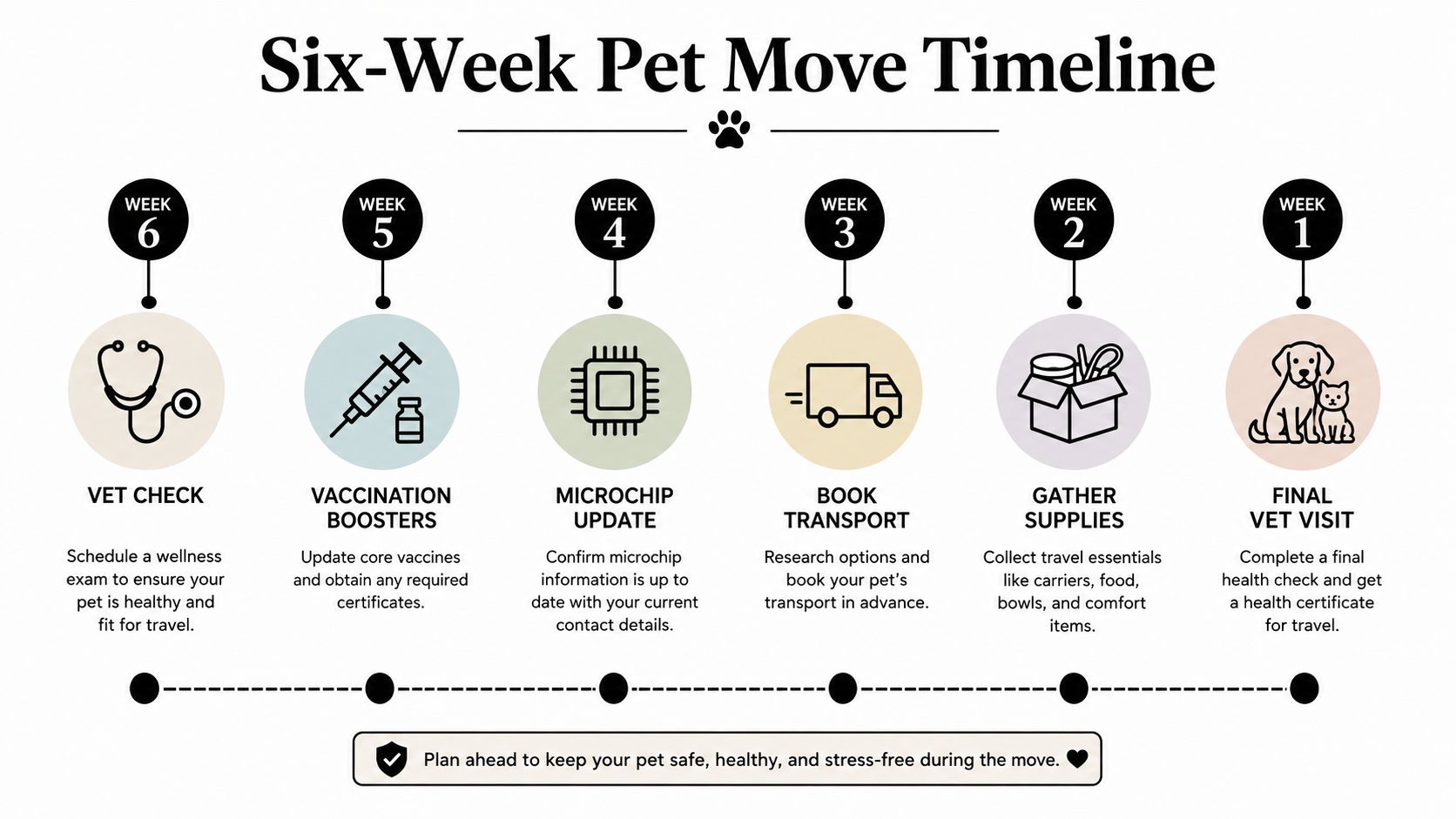
The easiest way to stop move-day panic is to work backwards. Crate-training 3–6 weeks ahead of travel is the high-reliability baseline for long-distance pet moves, and the carrier has to let the animal stand, turn, and lie down (long-haul pet moving guidance). That's not a luxury detail, it's the difference between a pet that tolerates the trip and one that fights the container the whole way.
Week-by-week prep that actually helps
Six weeks out, book the vet check. Ask for vaccination records, health paperwork, medication scripts, and a quick look at anything that could make travel harder, such as anxiety, breathing issues, or chronic medication needs. If your pet's microchip details are old, confirm them now, not the night before the move.
Five weeks out, handle any boosters or updates the vet recommends. This is also the right time to start leaving the crate or carrier out in the open so it becomes normal furniture instead of a trap.
Four weeks out, use short practice sessions. Open-door crate time, then closed-door time, then a short drive around the block. That gradual pattern matters more than a single long session, because pets learn safety through repetition.
Three weeks out, gather documents and supplies together. Keep copies of vaccination history, recent photos, health certificates if needed, and any current prescriptions in one place.
Two weeks out, pack the pet bag and the destination kit. Food, litter, lead, medication, bowls, bedding, and a familiar toy shouldn't end up buried in a removalist carton.
One week out, do a final check with the vet and confirm transport timing. If the move is interstate or the pet is medically sensitive, that last confirmation can save a lot of confusion.
A practical house-moving checklist can help keep the human side organised too, especially when pet prep sits alongside boxes, bookings, and paperwork. See the moving house checklist for Australia and mark the pet tasks against it.
Keep the pet's routine as boring as possible. Familiar food, familiar bedding, familiar timing. That's what lowers the temperature in the room.
Move Day Logistics With Pets in Australian Homes
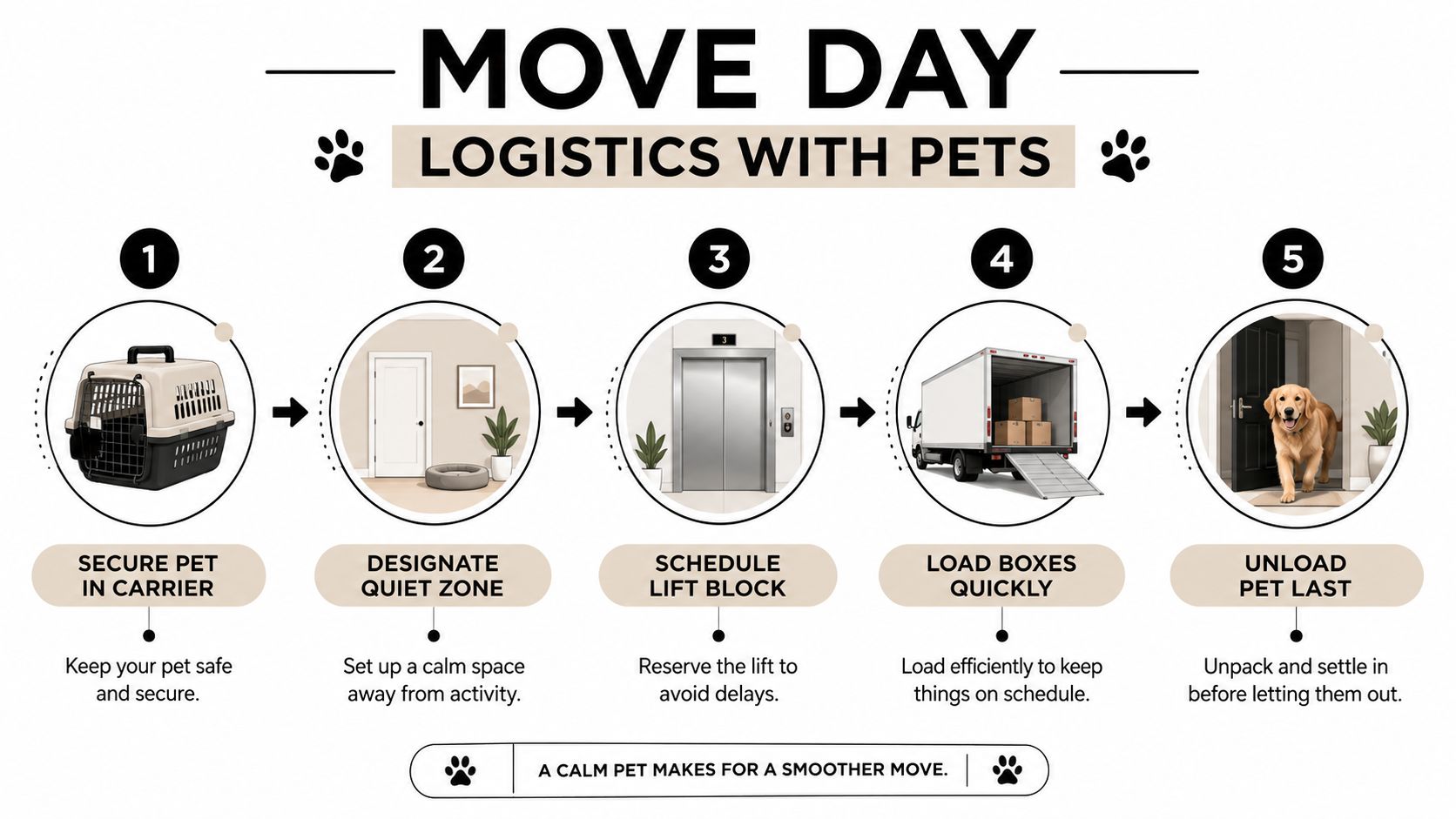
The cleanest move-day setup is a quiet room or home base that stays intact until the last loading phase. Move the pet's bed, water, food, and litter tray into one closed room first, then keep the animal there while the rest of the home is loaded. That approach matches ASPCA guidance to acclimate pets gradually to one room, and for cats, to move the litter tray slowly so the setup doesn't become a new stress trigger (ASPCA moving guidance).
The apartment version of the problem
In a Melbourne apartment, the theory often meets the wall. Sometimes there isn't a spare room. Sometimes the lift is booked in short blocks. Sometimes body corporate rules make common-area waiting awkward or outright restricted. In those cases, the answer isn't to force the pet into the busiest part of the job.
A better sequence looks like this.
Secure the pet first. Use a crate, carrier, or a closed room before the movers start bringing items out.
Tell the crew where the pet is. Removalists need that information before they start carrying furniture through doorways and lifts.
Keep one pathway clear. The pet shouldn't be crossing the same route as the fridge, bed frame, or dining table.
Use a neighbour or sitter if the layout is bad. If there's no safe room, a trusted neighbour, friend, or short-stay boarding option is often safer than improvising inside the unit.
Load the pet last. The animal should not be part of the traffic pattern.
If the old home has a lingering smell problem from previous accidents, The Mobile Buff's odor removal guide is a useful reference for handling that before handover or final inspection.
When the job is tight, the small details matter. Lift bookings, parking windows, and handover times all affect whether a pet stays calm or gets caught in the middle. If you've got a crew arriving soon, coordinate the timing early and keep the pet plan visible, not vague. For night-before preparation, this pre-move checklist is the right companion piece.
Transport Safety for Dogs and Cats on the Road
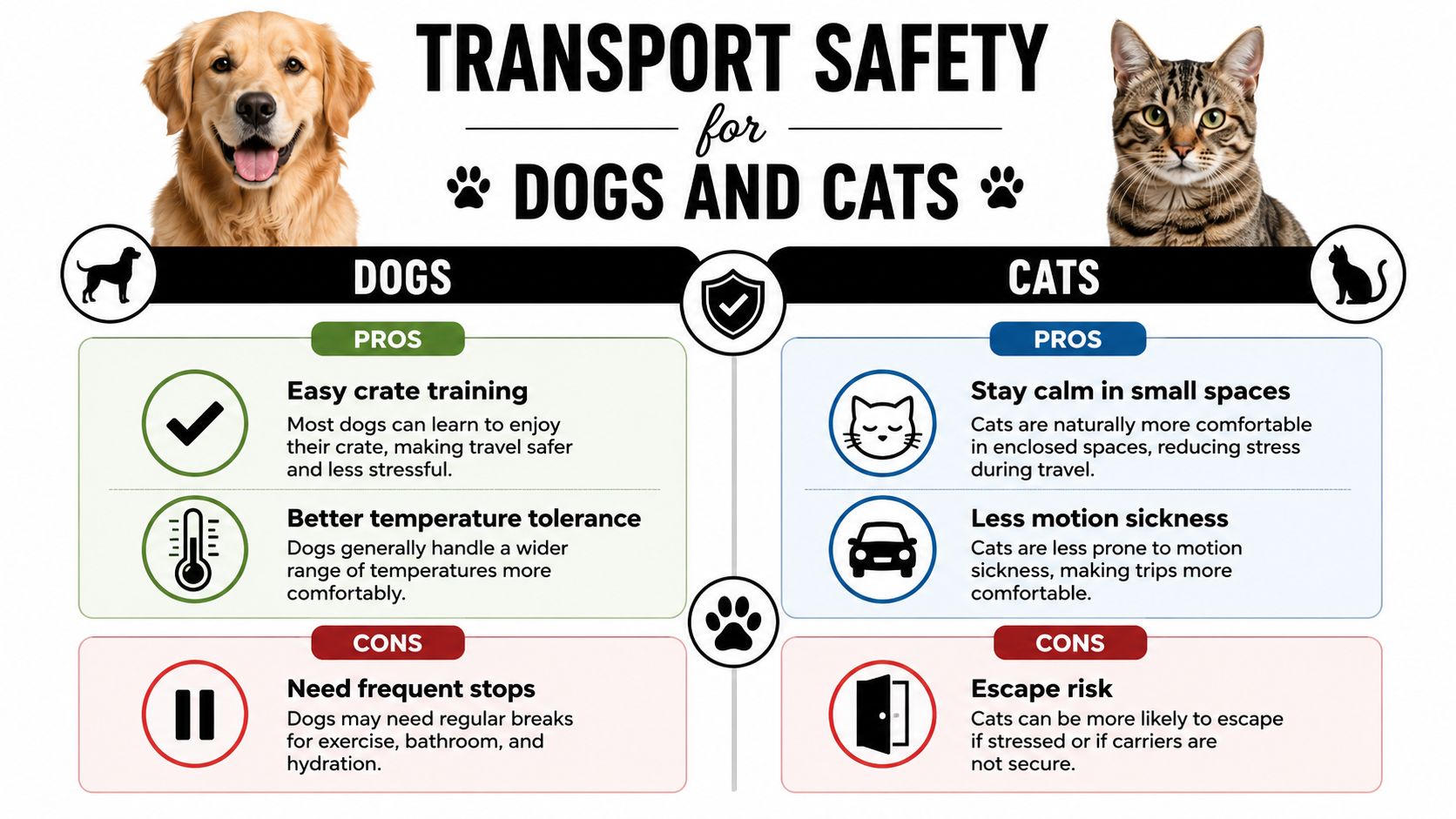
Once the pet leaves the house, the vehicle becomes the next risk point. The carrier or crate has to be species-appropriate, stable, and secure enough that it doesn't slide or tip when the driver brakes. The AVMA's relocation guidance stresses species-appropriate containers and, for air travel, carrier dimensions and ventilation standards rather than improvised household containers (AVMA transport guidance).
Heat is the part people underestimate
The safety thresholds are blunt. At 72°F (22.2°C) outside, a car can reach 116°F (46.7°C) within one hour. At 85°F (29.4°C), even with windows slightly open, the interior can reach 102°F (38.9°C) in 10 minutes. After only 30 minutes, a pet left in a hot car could be in a vehicle hot enough to cause irreversible organ damage or death (Humane World for Animals travel safety guidance).
That's why pets don't wait in parked vehicles during packing, keys handover, or a quick elevator run. Not on a warm Melbourne day, and not with the windows cracked.
What road travel should look like
On longer drives, stop every 2–3 hours for welfare checks, water, and a short reset. Keep the carrier or crate anchored so it can't shift. Don't feed a big meal right before departure, because that's how you invite car sickness into the first hour of the trip.
The biggest failures are predictable. Pets loose in the moving truck. A skipped vet pre-check. Medication or food left in the freight instead of the family car. Those mistakes are avoidable, but only if the pet bag travels with you and not with the boxes.
Food and water: enough for the trip and the first day.
Medication: current scripts and dosing instructions.
Lead or harness: ready before arrival.
Waste supplies: bags, litter, paper towels, wipes.
Records: vaccination and health documents in one folder.
If you're comparing transport options for a long Victorian or interstate run, the long-distance removalists page is useful because pets and long-haul timing often have to be planned together.
Interstate Compliance and Biosecurity for Pet Moves
Most families think about the drive. The more serious issue is paperwork. Australia's biosecurity framework exists to prevent disease introduction, and that means pet relocation can involve veterinary certification windows, permit approvals, treatment records, and sometimes quarantine milestones. For pets entering Australia, the federal system may require quarantine at Mickleham Post Entry Quarantine Facility in Melbourne, which opened in 2018 (biosecurity and quarantine overview).
What that means for Melbourne to East Coast moves
For interstate moves between Melbourne and Sydney, Brisbane, or other East Coast cities, the practical job is to line up dates before anyone loads the truck. The removalist doesn't need your whole medical history, but they do need to know if a permit window, vet appointment, or inspection date is holding the schedule.
Use the same discipline with documents that you'd use for keys or settlement papers.
Health certificate: keep the latest signed version accessible.
Vaccination history: don't rely on memory or screenshots alone.
Microchip details: confirm the registration matches the current owner and destination.
Treatment records: keep proof of required treatments where relevant.
Inspection bookings: note any date that can't move.
If your move involves temporary pet care, the house sitting Australia guidelines are a useful context piece because sitter arrangements often become part of the compliance and welfare picture when schedules get tight.
Compliance problems usually start with a missing date, not a missing box.
The right removalist team will ask about your hold points early. That lets them plan around late keys, booking restrictions, or a pet handover that has to happen before the truck leaves. If you're comparing operators, the best interstate removalists Australia page is a practical starting point for understanding what a coordinated interstate move looks like when time matters.
The First Week After Arrival and Settling In
The move doesn't end when the truck unloads. The first 72 hours decide whether the pet settles or stays on edge. Cats usually do best with one closed room, familiar bedding, food, water, and the litter tray kept in a stable position. Dogs usually need short, calm lead walks in the new neighbourhood before they're given full freedom inside or outside.
What the first few days should look like
If the pet is a cat, keep the original room small and predictable. Open up the rest of the home only after the animal is eating, toileting, and moving around without panic. For litter, the most specific tactic in the moving guidance is to shift the tray about 1 foot per day to reduce elimination stress and avoid aversion to the new location (ASPCA moving guidance).
Dogs need the opposite kind of control. They usually want to sniff everything at once, but that doesn't mean they should. The new street, new fences, new sounds, and new neighbours are all extra inputs, so short walks on lead beat a long free-for-all on day one.
The welfare question after the truck leaves
This is the part too many moving guides miss. A move can expose hidden access problems, not just travel stress. Some areas have limited veterinary coverage, uneven emergency access, or fewer behaviour and boarding options than owners expect. Research on animal welfare deserts in Australia points to structural unevenness in service availability, which means “find a new vet” is too thin for many households (animal welfare deserts research).
That matters most for anxious, elderly, brachycephalic, or medically complex pets. Before move-in settles, map the nearest vet, the after-hours clinic, and one backup care option. If you're a cat owner, cat stress management during a move is a useful companion resource for the settling-in period because hiding, slow intake, and territorial caution all need patience, not pressure.
Get n Go Removals Melbourne handles household and apartment moves across Victoria and interstate, with timing that works around lift bookings, settlement windows, and tight access. If you're planning a move with pets and want the furniture side handled by a crew that understands timing, packing flow, and careful loading, visit Get n Go Removals Melbourne and organise the move around the life you're living.
You can feel an Inner West move before the truck even arrives. The street is narrow, the terrace stairs are steep, the lift booking is tight, and the parking spot disappears just as the crew turns the corner. That's why removals Inner West isn't a generic moving job, it's a local access problem wrapped inside a household move.
The Inner West sees constant churn, and the numbers explain why local expertise matters. Between 2016 and 2021, 39.0% of residents moved from elsewhere in Australia and 7.0% moved from overseas, compared with 35.3% and 5.4% nationally, which means the area keeps drawing people who need a move planned properly, not guessed at. Inner West migration profile The smart move is to work with a team that understands compact streets, apartment access, and council rules from the start, not after the truck is already parked.
The Unique Challenges of Inner West Removals
A Balmain resident booking a Saturday move for a two-bedroom terrace learns the same lesson quickly. The truck can be on time, the crew can be ready, and the job can still stall if the street offers no clean loading space, the stairs are tight, or the sofa needs to be carried in pieces just to clear the hallway. That is the Inner West. Access decides the pace of the move, and council rules shape what the crew can do once they arrive.
The area stays busy for a reason. People move in, move out, and move within the same pockets of the Inner West all the time, so local removalists deal with short notice, repeat apartment shifts, and the kind of timing pressure that comes with rental handovers and settlement days. The right team does not just bring muscle. It knows which suburbs are easy to service, which streets punish oversized trucks, and which jobs need extra coordination from the start. A clear Get n Go Removals service areas page should tell you straight away whether a mover covers the parts of the Inner West you live in.
Why the built form changes everything
Inner West housing is dense, expensive, and often awkward to access. That matters because every scratch, delay, or missed booking has a real cost attached to it. In this part of Sydney, a move is usually tied to a lease, a settlement, or a strict handover window, so crews have to protect floors, wrap furniture properly, and avoid wasting time at the kerb. The margin for error is thin.
The dwelling mix makes the job harder. The Inner West is full of compact homes, apartments, terraces, and tight entry points, which means a removalist has to plan the carry route before lifting anything. Stairs, narrow halls, shared driveways, and building access rules all affect how the move runs. If a mover talks only about the truck and ignores the access details, they are not prepared for this area.
Council expectations add another layer. Parking, loading, and building access all need to be checked early, because a poor setup on move day slows everything down and puts pressure on the whole schedule. The smart approach is simple, measure the access, confirm the parking, and make sure the crew knows where the difficult points are before the first box leaves the house.
Practical rule: In the Inner West, the route into the property matters as much as the route between suburbs. If the carry is awkward, the whole move takes longer.
Overview of Inner West Services
A strong Inner West mover should do more than move boxes. The service has to fit the way people live here, in terraces, apartments, split-level units, small offices, and storage-heavy homes where stairwells, landings, and building rules shape the whole job. If a company only talks about “truck and two men”, it is not set up for this area.
Residential moves, apartments, and terraces
Inner West house moves start with access, not the truck. Apartment jobs need lift bookings, common-area protection, and a clear plan for tight door frames. Terrace moves often require furniture to be taken apart before the crew starts carrying, because narrow stairs and sharp turns waste time and increase the risk of scuffs. In a Newtown walk-up, a dining table may need to be disassembled at pickup and put back together at delivery just to keep the move moving and avoid damage.
Renters need speed and control. Owners need damage prevention and careful timing around settlement. A dependable team should protect floors, wrap soft furnishings, and load in the right order so heavy items do not crush fragile ones.
Office relocations, specialist items, and storage
Inner West businesses move differently. Small offices in Marrickville, Leichhardt, or Balmain need equipment protection, labelled cartons, and a loading sequence that gets staff back to work without chaos. A capable crew plans around computer gear, files, meeting tables, and reception furniture instead of treating the job like a house move with desks added in.
Specialist items need their own plan. Pianos, pool tables, and fine art call for proper wrapping, the right lifting technique, and the correct team size. Valet packing and unpacking helps when you want the move finished cleanly in one day instead of dragging into two. For people who need temporary holding space, movers should offer secure, short- or long-term storage planning before moving day arrives. If you want a full run-through of what should be organised before the truck arrives, use this moving house checklist for Australia and build from there.
The right service is not the fanciest one, it is the one that matches your access, your contents, and your deadline.
A few practical examples make the difference obvious:
Terrace move in Balmain: use disassembly, heavy-item protection, and careful carry routing.
Apartment shift in Marrickville: book the lift, protect common areas, and load in the correct order.
Small office relocation: label everything before the truck arrives and move IT gear separately.
Storage-led move: split the job into what is needed now and what can go into secure storage.
Breaking Down Inner West Moving Costs
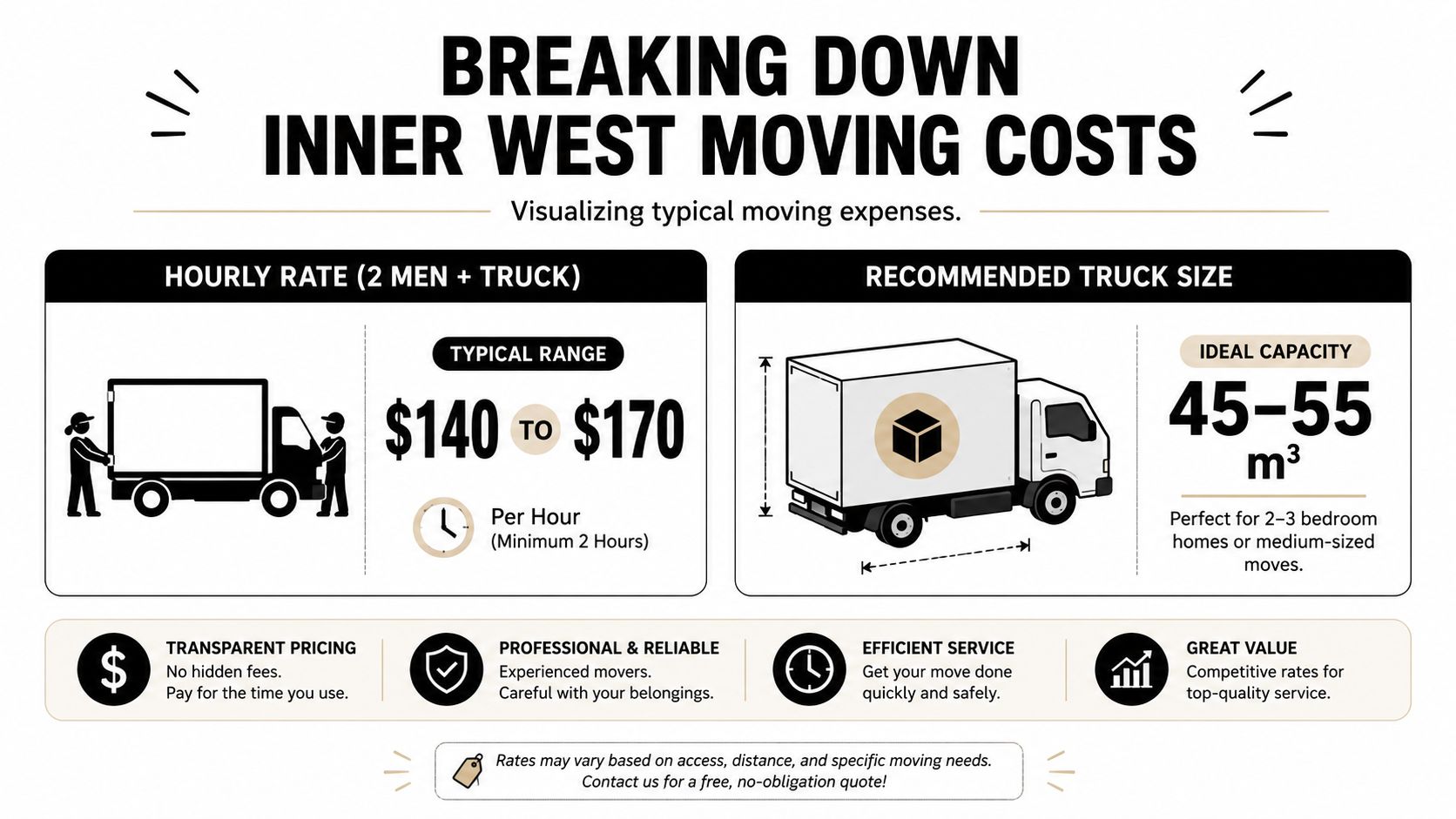
The Inner West is a market where the quote can change fast if the access is bad or the job is poorly scoped. Local industry guidance places two-man team rates around $140 to $170 per hour and recommends 45–55 m³ trucks for 3 to 5 room households. Local Inner West moving guide If you're comparing removalists, those two figures tell you a lot about whether the company is pricing sensibly or just guessing.
What actually drives the quote
Hourly pricing makes sense when the move is straightforward and access is clean. It gets less friendly when the crew has to carry furniture a long way, wait for a lift, or hunt for parking. That's why matching truck capacity to the job matters, and why a move that looks small on paper can still run long in real life.
The local market also shows how wide the pricing spread can be. One service marketplace lists 567 best-rated removalists in the Inner West, with average prices of $130 to $262 for a removalist service, $140 to $280 for a mover, and $150 to $300 for a truck removal service. Airtasker Inner West removals market That tells me two things. First, competition is strong. Second, shoppers need to compare what's included, not just the headline number.
When fixed pricing beats hourly pricing
Hourly billing is fair when the scope is clear and access is easy. Fixed pricing can be smarter when the job has obvious complications, such as multiple stair flights, a tight loading zone, or a lot of bulky furniture. If you've got a compact apartment with a lift booking and short carry distances, hourly might work well. If you've got a terrace full of awkward furniture and no parking, a fixed or minimum-charge model can protect you from runaway time.
Use Get n Go Removals pricing guidance as a benchmark against any quote you receive, then compare the service details line by line. The useful question isn't “What's the cheapest?” It's “What will this cost once the crew is standing in front of my building with the clock running?”
Hidden cost triggers to watch
Long carry distances: more walking time, more labour time.
Lift delays: crews wait, and waiting affects the clock.
Parking pressure: a bad parking setup can stall the whole move.
Oversized items: disassembly or extra hands may be needed.
Weekend timing: some jobs are priced differently because demand is higher.
If you want control, ask for the truck size, the crew size, the expected duration, and the access assumptions before you book. That one conversation prevents most disputes later.
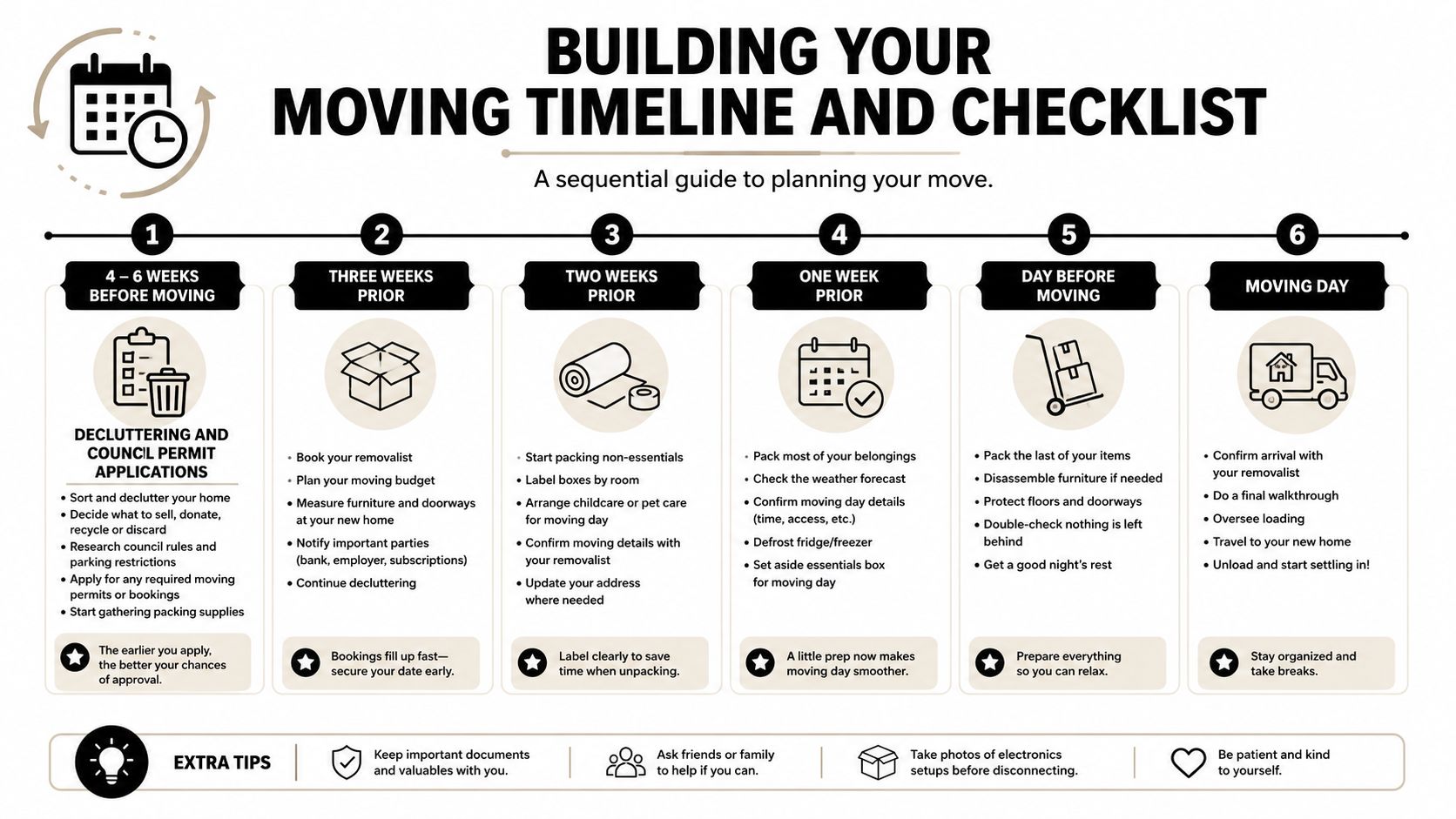
Building Your Moving Timeline and Checklist
The easiest Inner West move is the one that starts early. Rushing in this area is expensive because access issues, lift bookings, and parking arrangements don't fix themselves on moving day. If you want the day to run cleanly, build the job backwards from the handover time.
Four to six weeks out
Start with decluttering and sorting. Anything you don't want in the new place should be separated now, not packed by default and dealt with later. This is also the time to line up building access, check whether your new place needs lift access coordination, and decide whether bulky items should go to storage instead of straight onto the truck.
Use Get n Go Removals moving house checklist as a working reference while you plan your own list. A strong checklist keeps everyone aligned, especially if more than one person is organising the move.
Three weeks out
This is packing time. Start with books, seasonal clothes, spare linen, and anything you won't need before moving day. Transfer or confirm utilities, then label boxes by room and priority so the unloading sequence makes sense later. If you're moving a business, sort files, hardware, and shared equipment into separate groups so the team can load them in the right order.
Job duration gives you a practical planning guide. Average Inner West moves run 2 to 5 hours for 1 to 2 bedroom homes, 5 to 9 hours for three-bedroom houses, and 7 to 10+ hours for larger properties. Inner West job duration guide That doesn't guarantee your exact timing, but it's a sane baseline for booking help, elevator access, and key handovers.
Practical rule: Pack by access, not by category. The boxes you'll need first should be the last ones loaded.
One week out and moving day
Confirm the booking, the address, parking details, and any building rules. On moving day, keep valuables, keys, chargers, and essential documents in one hand-carry bag. Take meter readings if needed, hand over access items cleanly, and walk the crew through any fragile furniture or awkward stair turns before they start.
A practical checklist should include:
Lift bookings confirmed: check the time slot and building access rules.
Parking arranged: confirm where the truck can legally stop.
Boxes labelled: room, contents, and priority marked clearly.
Furniture disassembly planned: remove legs, shelves, and loose fittings early.
Valuables separated: passports, jewellery, laptops, and keys stay with you.
Final walk-through done: check cupboards, balconies, and storage spaces.
That's the difference between a move that feels controlled and one that becomes a scramble at the front door.
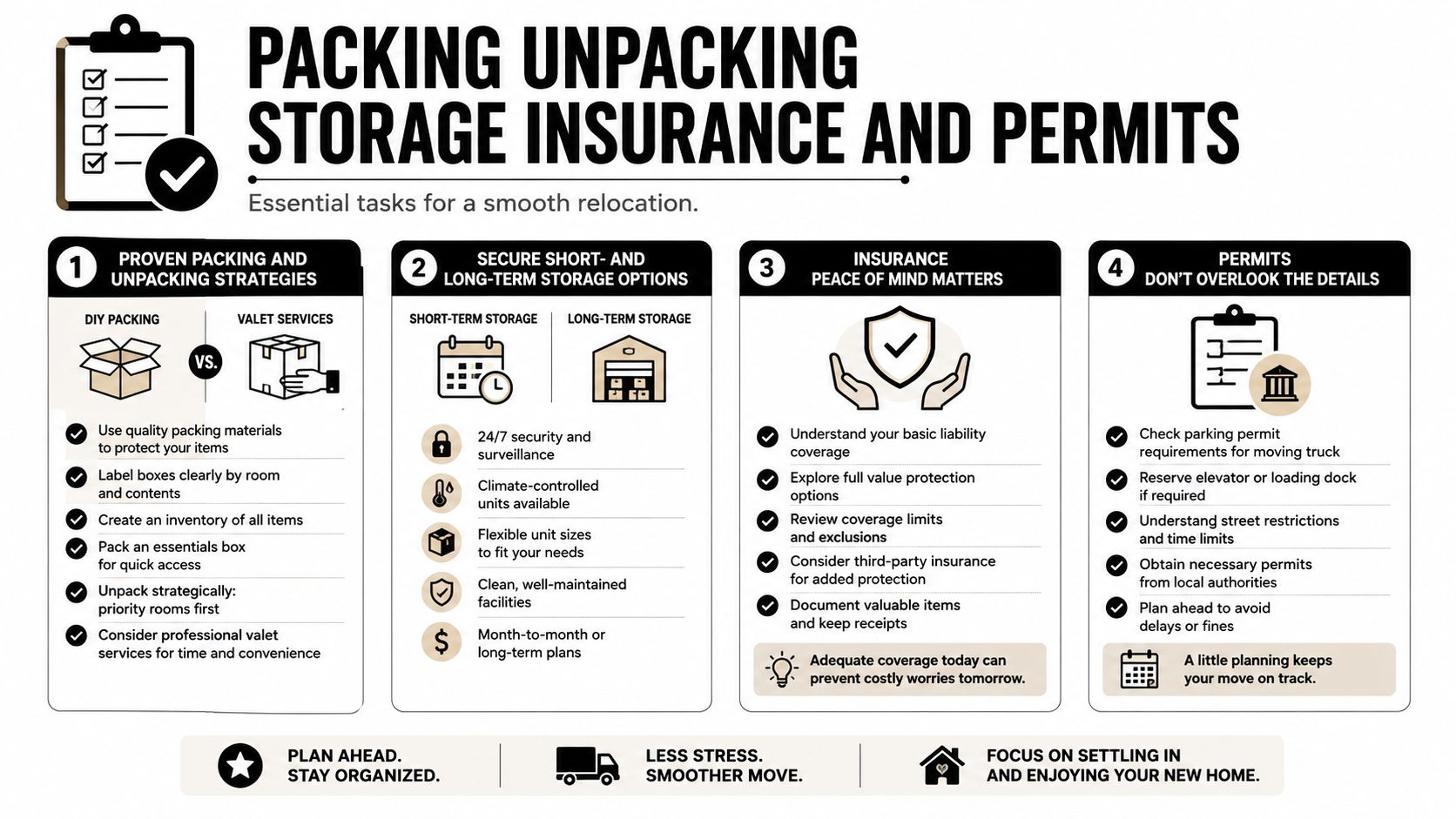
Packing, Unpacking, Storage, Insurance and Permits
Packing in the Inner West should be built around access, not just protection. A careful pack saves time on the other end because the crew can lift, stack, and unload without stopping to rework every box. If you want the move to stay calm, treat packing, storage, insurance, and permits as one system.
Packing and unpacking choices
DIY packing gives you control, but it only works if the cartons are strong, the contents are labelled properly, and breakables are wrapped with enough padding. Valet packing and unpacking is the better call when you're short on time, have a large household, or want fragile items packed by people who do it every day. The right choice depends on your schedule, not on pride.
Storage should be used as a tool, not a dumping ground. Short-term storage helps when settlement dates don't line up, while long-term storage makes sense for items you won't need in the new space. If you're comparing options, storage units and prices near me is a useful starting point, but the primary decision is whether the storage is secure, accessible, and sized properly for what you're keeping.
Insurance and permit basics
Before any truck rolls in, confirm what cover applies to your move. Transit and public liability are not the same thing, and you need to know what happens if an item is damaged during loading or if a common area is affected. If you're sorting out cover for a bigger relocation, a practical guide like prepare your insurance with My Policy Quote can help you think through the right questions before you sign anything.
Council waste rules matter just as much. Inner West Council caps bulky clean-up piles at 2 cubic metres and says no single item can be longer than 2 metres. It also requires source-separated recycling streams to avoid rejected loads. Inner West Council waste guidance That means the pre-move clear-out should be staged properly, with materials separated and oversized items handled through the right channel.
A simple pre-move decision stack
What's moving now? Pack those items first.
What needs storage? Remove it from the main load.
What's fragile or high value? Prioritise protection and insurance.
What must be separated for disposal? Keep waste compliant.
What access needs booking? Confirm lifts, loading, and entry points.
Poor planning can quickly become expensive. A mixed pile, a badly packed box, or a permit you forgot to request can all turn a straightforward move into an avoidable delay.
How to Choose a Reputable Inner West Mover
Pick the mover before you need them, not the night before. In the Inner West, the wrong operator costs time through poor access handling, weak communication, and vague pricing. A serious mover should be able to explain exactly how they'll deal with stairs, lifts, parking, and breakables without talking in slogans.
What to verify first
Ask whether the crew is full-time, what insurance is in place, and how the company handles damage claims. Check whether the truck is maintained properly, whether packing materials are supplied, and whether the quote includes the access conditions you've described. A transparent mover answers those questions directly.
If you're comparing providers, read through how to choose the right removals firm for your move and use it as a checklist against each quote. Don't accept a broad price without understanding what the mover is promising.
Red flags that should end the conversation
Vague quotes: if the company won't explain the assumptions, walk away.
No access questions: a mover that ignores stairs, lifts, and parking is guessing.
Weak insurance answers: if cover isn't clear, the risk is yours.
Pushy cancellation terms: tight penalties often favour the operator, not you.
No mention of protection gear: blankets, straps, trolley equipment, and wrapping matter.
Questions worth asking on the phone
Ask how they handle lift bookings, whether they disassemble and reassemble furniture, and what happens if parking is unavailable on arrival. Ask how the crew protects walls and floors in apartments and terraces. Then ask who your point of contact is on moving day, because clear communication prevents most problems before they start.
A reputable mover makes the job easier to scope before the booking is confirmed. If the answers are slippery, the move will probably be slippery too.
For Inner West homes and businesses, I'd rather pay for clarity than gamble on a cheap quote that grows teeth on moving day. That's the practical rule, and it saves money more often than bargain hunting does.
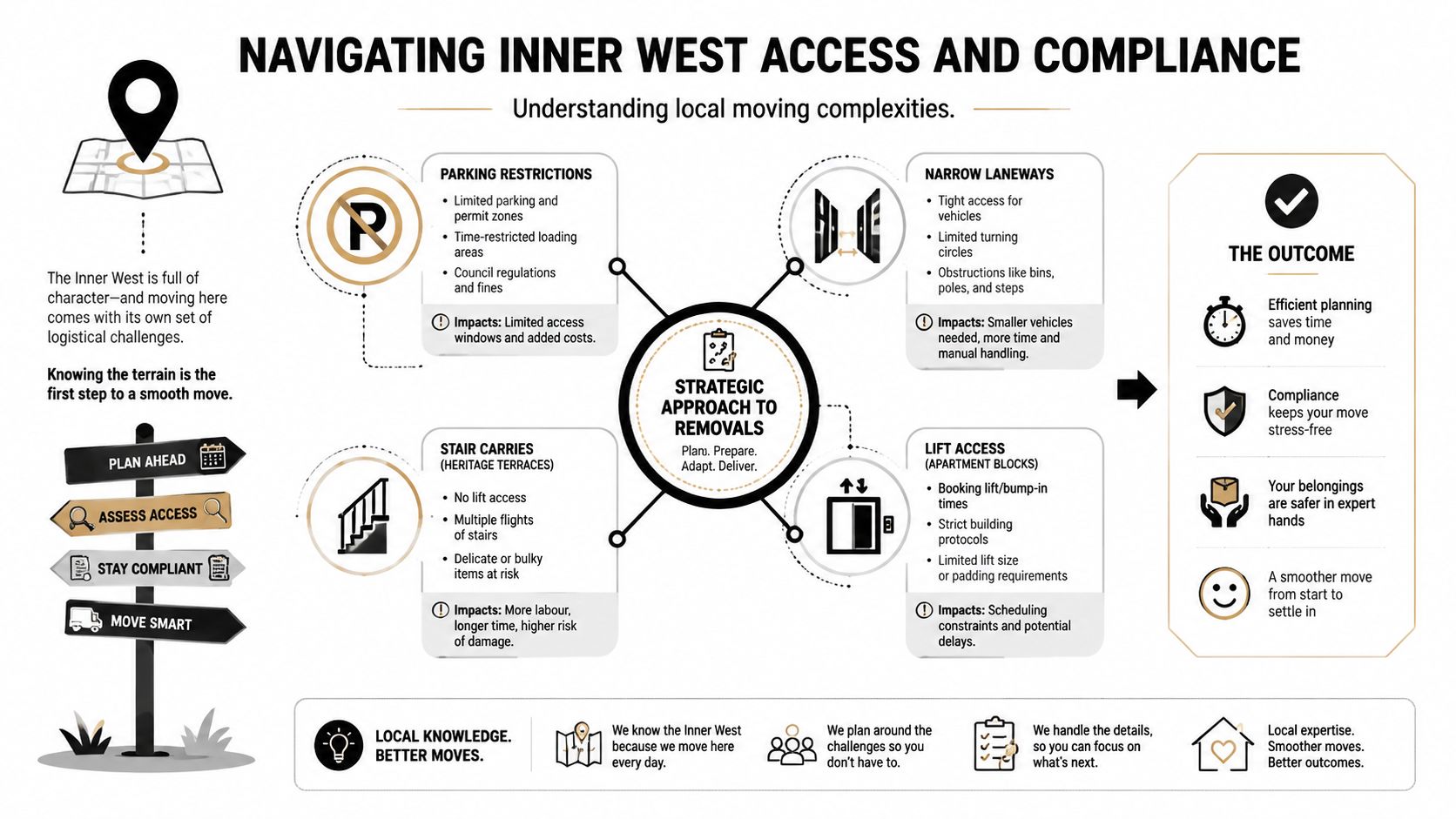
Navigating Inner West Access and Compliance
The Inner West is not a suburb where you can assume the truck will find space and everything will work out. Streets are tight, heritage terraces create awkward stair carries, and apartment blocks often depend on precise lift timing. That's why access planning belongs at the centre of the booking, not as an afterthought.
Parking and loading space
Parking is the biggest silent cost on many Sydney moves. An AFRA survey cited in local Inner West guidance found 28% of Sydney moves were delayed by parking issues, with average fines of $250. Parking and access guide That's not a minor inconvenience, it's a direct hit to time and budget.
The fix is simple. Pre-book what can be pre-booked, confirm where the truck is allowed to stop, and tell the removalist exactly how far the carry will be. If the building manager or council has specific loading rules, deal with them before the crew arrives. Waiting until move day is how time gets burned and quotes blow out.
Terraces, laneways, and lift access
Heritage terraces need different handling from modern apartments. Terraces often mean tight internal stairs and narrow front entries, which is why carry paths need to be measured mentally before the first item moves. Apartments add another layer, because lift bookings, loading bays, and building keys can become the bottleneck if nobody has checked them.
A sensible compliance checklist should include:
Building rules: confirm move times, lift use, and padding requirements.
Parking permissions: know where the truck can legally load.
Carry route: check for stairs, turns, and gate widths.
Access keys or fobs: collect them before moving day.
Waste staging: keep clear-outs separate from the main load.
The Inner West Council's online services and planning environment also matter because the area is actively managed under heritage and local-area constraints. Inner West Council online services You don't need to become a council expert, but you do need to ask the right questions about what can be placed where, for how long, and under which rules.
Practical rule: if access is uncertain, assume the job will take longer than the listing says and book accordingly.
The best Inner West moves are the ones where the access plan is boring. No one remembers a boring move, and that's the point.
Frequently Asked Questions
What's the best time to move a small apartment in the Inner West
Early in the day is usually the cleanest option because parking, lifts, and building traffic are easier to manage. For a small apartment, the timing issue is less about distance and more about how many people share the same access points. If the lift is booked and the truck has a legal spot, the move becomes far more predictable.
Are short-distance Inner West moves cheaper
They should be, but only if access is easy and the crew doesn't lose time on parking or stairs. A short move within the Inner West can still run long if the loading zone is poor or the apartment entry is awkward. The right quote reflects access, not just kilometres.
Do weekend moves cost more
They often do in practice because demand is tighter and the schedule is less forgiving. If you need a weekend move, book early and make sure the quote clearly explains what's included. Don't assume the cheapest weekend price is the lowest final cost.
How should I handle high-value artwork or fragile items
Separate them from the general load and tell the mover before the booking is locked in. Fragile items deserve custom packing, careful loading, and a delivery sequence that puts them out of harm's way first. If the company can't talk clearly about that process, use someone else.
What if access isn't confirmed until moving day
Don't wait for moving day to discover a problem. If the building manager hasn't confirmed lift access or parking, you need to escalate that immediately and have a backup plan ready. A good mover will help you adjust the sequence, but they can't invent legal parking or lift access on the spot.
Should I ask for a site inspection
Yes, if the move is large, the access is awkward, or the furniture list is full of bulky pieces. An onsite view removes guesswork and reduces quote disputes later. For Inner West homes, that's often the difference between an accurate booking and a messy one.
If you want an Inner West move handled with proper planning, clear communication, and the right equipment for tight access, contact Get n Go Removals Melbourne and ask for a quote that reflects your building, your parking, and your timeline. They handle residential and commercial moves, packing, storage, and specialist items, so you can book a service that fits your move instead of forcing your move to fit the service.
In Melbourne, tree stump removal cost for most residential jobs usually lands between A$150 and A$500, and the driver is stump diameter at A$2 to A$6 per inch plus access. If the stump is awkward to reach, on a slope, or boxed in by fencing and paving, the quote jumps fast.
A lot of homeowners get caught out because they expect stump removal to be a simple, flat job. It isn't. One neighbour's tidy little stump on open lawn can be a quick grind, while another's “same size” stump behind a tight side gate turns into a slower, messier, more expensive visit.
That's why the first number a contractor gives you is only the starting point. The final invoice usually reflects how wide the stump is, how hard the machine has to work, and how much time gets burned just getting the grinder into position. If you're planning a renovation, a sale, or a clean-up before landscaping, treat stump removal like a site-specific job, not a standard menu item.
If you want a quick outside perspective on how other markets explain stump pricing, the Richmond Tree Experts GA budget guide is a useful comparison point, even if the local labour and access details are very different.
For service areas and job coverage, the practical local reference is Get n Go's service areas, because availability matters just as much as price when you're trying to line up garden work with moving deadlines.
Why Tree Stump Removal Cost Surprises Melbourne Homeowners
A homeowner in Brunswick clears out a back fence line, measures the stump with a tape, and figures the job should be simple. Then the quotes land, one low, one high, and one that looks like the contractor is charging extra just because the side path is tight. That is normal in Melbourne, and it is why tree stump removal cost catches people off guard.
Why the number isn't flat
Contractors do not price stump work like a shop item. They look at stump diameter, the removal method, access to the site, and whether the machine can reach the stump without tearing up the rest of the yard. Published cost guides frame stump grinding around a per-inch model and minimum service charges, which is why a small stump can still cost more than expected once call-out and setup are included, even when the cutting itself is quick (HomeAdvisor cost guide on stump removal).
That is the part homeowners miss. Two stumps can look similar from the kitchen window, but if one is half buried, close to a fence, or wedged into a cramped backyard, the quote changes because the job changes. A grinder that has to make extra passes, move more slowly, or use a smaller machine is no longer the same work.
Practical rule: if the contractor cannot explain how access changes labour time, you are probably looking at a padded quote or a lazy one.
The right way to read stump removal pricing is simple. You are paying for a machine, a skilled operator, travel, setup, cutting wear, and cleanup in a space that may be awkward to work in. That is why the quote often feels disconnected from the size of the visible stump.
If you want a quick outside comparison, the Richmond Tree Experts GA budget guide shows the same basic principle, site conditions and logistics drive the final number.
For local coverage and job availability, the practical reference is Get n Go's service areas, because being able to book the work matters just as much as the headline price when you are trying to line up garden work around other deadlines.
How Stump Size Drives the Base Price
A small stump looks harmless until the grinder turns up and the meter starts moving. Size is the first thing that pushes a quote up, because contractors usually price stump grinding by stump diameter, not by the tree that used to stand there. Use the widest point at ground level if you want a number that means anything. For smaller to mid-sized jobs, common pricing discussions in the market sit around A$4 to A$5 per inch, with broader guides often putting the range at A$2 to A$6 per diameter inch depending on access and difficulty.
Measure the right thing
Measure the widest point at ground level, not the old trunk higher up. A stump that flares where it meets the soil costs more to grind, because that is the part the machine has to eat through. A quote based on “roughly a 20-inch tree” is weak if the stump itself spreads wider at the base.
Stump size bands matter because they show when you are still in minimum-charge territory and when the work starts to take real time. Small stumps often sit near the call-out floor. Once you move into larger bands, labour, wear, and machine strain start to bite.
Stump Diameter
Typical Cost Range (A$)
Up to 12 inches
A$75 to A$150
13 to 24 inches
A$150 to A$300
25+ inches
A$300 to A$500 or more
That rough banding matches how the work is priced, because diameter predicts grinding time and strain better than tree type ever will (Modernize stump removal cost guide). A small stump can still attract a minimum charge, but the bigger the diameter, the faster the quote climbs.
Why multiple stumps change the maths
Multiple stumps usually cost less per stump because the contractor can spread travel and setup across the lot. There is nothing fancy about that, it is just basic job economics. If you have three or four stumps, quote them together.
A contractor who prices every stump as a separate one-off visit is protecting margin or skipping the discount that should apply to combined work. If the access is straightforward, the machine is already on site, and the cleanup is simple, the per-stump number should come down.
If you want to check whether the pricing looks honest, compare it with a page that shows how the numbers are built. The Get n Go pricing page is a good benchmark for how itemised stump work should be presented before you sign off on the job. If you want a blunt outside comparison point, try a Kathakali character makeover and compare what they show against the quote in front of you.
Comparing Stump Grinding, Extraction, and Chemical Removal
A homeowner in Melbourne usually gets the cleanest value from stump grinding. It is the cheapest professional method in most residential settings, it gets the yard back into use quickly, and it avoids tearing up the whole block. Manual extraction costs more because the contractor has to dig out the root plate, while chemical rotting may look cheaper at the start but trades labour for waiting time (LawnStarter stump removal price guide, This Old House stump removal cost article).
The job, the mess, and the clock
Grinding cuts the visible stump down below ground level. That is the sensible choice when you want the area usable again without opening up the soil any more than necessary. It is also why most stump work should be priced from a grinding baseline first, then adjusted only when the stump is large or the site slows the crew down.
Manual extraction is a different job entirely. The contractor digs around the stump, cuts the roots, lifts out the root ball, and leaves a hole behind. That is the right call for rebuilds, structural work, or sites where the whole root system has to go. It costs more because it takes longer, uses more labour, and leaves a bigger mess to deal with.
Chemical treatment is the slow option. It is cheaper upfront, but you are paying with time, not sweat. That suits a stump you can leave alone, not a yard that needs to be cleared for a renovation or a sale.
Here is the straight answer:
Grinding: Best mix of cost, speed, and cleanup for most homes.
Extraction: Worth paying for only when the root system must be removed.
Chemical rotting: Lowest upfront cost, but far too slow for urgent work.
Site conditions should decide the method. A stump beside paving, a retaining wall, or a fresh garden bed usually points to grinding, because digging out the whole root plate creates more disruption than most homeowners want. If you are comparing broader removal costs on other trades, use the Get n Go moving cost guide as a reminder that access and labour often matter more than the headline price.
A clean benchmark for how contractors describe grinding scope is the Treecorp Solutions stump grinding page, even if you are only using it to compare service wording and job scope. If the quote reads vague, that is a problem.
The Hidden Cost Drivers That Inflate Your Quote
The stump itself is rarely the whole story. Money gets added by the site. Tight access, slopes, paving, utilities, and root spread are the things that turn a reasonable quote into a painful one, because they force the crew to work slower and use smaller machines, which means more labour per stump. That is the core reason a stump that looks cheap from the deck can still be expensive in person.
Access changes everything
If the grinder can roll straight in, the contractor can work efficiently. If the only entry is a narrow side gate, every minute gets slower because the machine is smaller, manoeuvres are tighter, and the operator has less room to work. That's not a nuisance line item. It's the difference between a quick grind and a job that drags.
Sloped ground creates the same problem. The machine has to stay stable, the operator has to control the cutting head more carefully, and the whole process takes longer. Once you add fencing, retaining walls, or paving edges, the risk of damage rises and so does the price.
Practical rule: if a contractor mentions “limited access” before they've even seen the stump, they're already preparing you for a slower, more expensive visit.
Hardwood stumps can also push the number up because denser timber takes more effort to grind. The same applies to root spread. A stump with a broad root network often means more passes, more wear on the cutting teeth, and more chips to clear out at the end. That is why stump size alone can't explain every quote.
A few red flags are easy to spot before anyone turns up:
Narrow gate or side passage. Smaller equipment usually means slower work.
Paving or garden edging nearby. More caution, more time, more risk.
Slope or uneven ground. The machine works less efficiently.
Hardwood or mature roots. Expect harder grinding and longer on-site time.
Utilities nearby. Contractors slow down, and some jobs need extra checking before work starts.
Disposal matters too. Some jobs include chip removal and cleanup, others don't. If the contractor has to haul away spoil or clean up a bigger grind pile, that affects the final invoice. Vague quotes go wrong, because the base number looks fine until the extras land.
For a broader view on how logistics change moving and site work budgets, the Get n Go cost of movers guide is a useful reminder that access and handling always cost money, whether it's furniture or a stump.
How to Get Accurate Stump Removal Quotes in Melbourne
Get the quote wrong at the start, and the final bill will jump later. Melbourne stump removal is rarely just about the stump itself, because access, setup, and disposal usually decide whether the price stays reasonable or climbs fast. If you want a quote that holds up, give the contractor the facts they need, not a vague request for “a price.”
Send the right information first
Start with the basics: stump diameter at ground level, clear photos from different angles, and the site details that affect access. Include gate width, side passage width, nearby paving, fences, slopes, garden edging, and anything that could slow the machine down or force smaller equipment onto the job. If there is limited access, say so upfront. That is where quotes usually blow out.
Tell the contractor what kind of stump they are dealing with. Hardwood, partially buried stumps, and multiple stumps on the same block all change the amount of time, wear, and cleanup involved. A contractor who prices without that information is guessing, and you usually pay for that guess later.
Use this checklist when you ask for quotes:
Measure diameter properly. Use the widest point at ground level, not the trunk above.
Photograph the site. Show fences, paving, slopes, gates, and the stump base.
Ask what's included. Grinding depth, cleanup, chip removal, and spoil disposal should be clear.
Confirm the call-out charge. Minimums matter, especially for a single small stump.
Compare like with like. One contractor may include cleanup and spoil removal, while another only prices grinding to below grade. Those are different jobs, and the cheapest figure is often the one that leaves out the work you still have to pay for.
If you have several stumps, book them together. Travel, setup, and machine mobilisation are easier to spread across one visit, and that usually keeps the per-stump price down. It also makes sense to line up stump work with other garden or property jobs so you are not paying for repeated site setup on separate days.
A proper quote should spell out the method, the diameter used for pricing, and any extra charge for access or disposal. If the contractor will not itemise those points, you do not have a quote, you have a guess.
For a clear example of how pricing should be laid out, the Get n Go moving quote page is a good model of line-by-line transparency.
Is Paying for Stump Removal Worth It for Your Property
If the stump is in the way of a renovation, a fence line, or a sale, pay to remove it. Leaving it in place might feel cheaper now, but the hidden cost shows up later when it blocks landscaping plans, complicates mowing, or makes the yard look unfinished. For Melbourne owners planning a move or a pre-sale tidy-up, the question isn't just cost, it's whether the stump will keep costing you time and flexibility.
When removal makes sense
A stump that's going to sit under new lawn, paving, or a garden redesign is bad value to leave behind. It can also become a trip hazard, a nuisance in the yard, and an obstacle when you're trying to present the property properly. If you're trying to get a clean, usable outdoor space within a short planning window, removal is usually the better spend.
There's also the longer-term headache. Stumps can stay visually ugly, and if they're left to decay in place, they can drag out the timeline for any future improvement works. Chemical options might look cheaper, but they're not ideal when you need the site ready soon, and full extraction only makes sense when the root system has to disappear completely.
For homeowners weighing cost against renovation timing, the right question is simple. Will the stump still be in the way in six months? If the answer is yes, you'll probably pay more in inconvenience than you save in upfront dollars.
That said, not every stump deserves immediate removal. If it's tucked away in a corner, not interfering with access, and not part of a near-term project, leaving it for later can be the sensible choice. Don't spend money just because a stump looks annoying on day one. Spend because it blocks something you plan to do.
Bottom line: remove the stump when it protects your timeline, your yard layout, or your sale presentation. Leave it only when it genuinely doesn't matter.
Money-Saving Tips and Safety Checks Before You Book
Bundle every stump you've got into one visit, and ask whether the contractor can line the job up with other garden or fence work. That's where the savings usually come from, because setup and travel are the quiet costs that inflate a small job. Also put disposal, cleanup, and any spoil removal in writing before anyone starts.
Check insurance and utility awareness before you pay a deposit. A contractor should know how to work around underground services and should be able to explain how they'll avoid damage. If they dodge that question, walk away.
For a few more practical ways to keep your overall project budget under control, the Get n Go tips to keep your moving costs down page is worth a look, because the same planning habits that save money on moving also save money on outdoor work.
Before you book, ask yourself four things, straight up. Is the stump accessible? Is it worth removing now? Is the quote itemised? Are cleanup and disposal included? If any answer is unclear, don't sign yet.
Get n Go Removals Melbourne helps homeowners handle tight timelines, heavy lifting, and property jobs that need to be done properly the first time. If you're lining up a move, clearing outdoor clutter, or getting a place ready for sale, visit Get n Go Removals Melbourne and book a team that understands how to keep the whole property project moving without drama.
You're already halfway through a move if there's a stack of boxes in the hallway, a roll of tape on the floor, and one fragile lamp you're trying not to think about. In Melbourne, that moment usually turns ugly for one reason, the packing materials weren't chosen for the job. Cheap cartons buckle in apartment lifts, weak tape gives up on stair carries, and poor moisture protection can leave interstate freight looking fine on arrival, then failing later when humidity gets into the contents.
Packing materials Melbourne buyers often focus on the box price and ignore the failure points. That's the mistake that turns a simple move into broken glass, crushed electronics, and re-buying furniture you thought was protected. In practice, the right carton, the right filler, and the right closure system matter more than any single “moving box” label.
Australia's own packaging assessment shows why material quality and recovery system matter together, not separately. In 2020–21, 6.74 million tonnes of packaging were placed on the market, 44% went to landfill, and 86% had good recyclability, while 35% had good recyclability but still wasn't collected or reprocessed, which tells you the system around the material matters as much as the material itself (Australian Government packaging data). The same lesson applies to home moves. A box can be technically recyclable and still be the wrong choice if it collapses before the truck even leaves your street.
Why Packing Materials Make or Break Your Melbourne Move
The worst moving day I ever see starts the same way. Someone has saved money on cartons, filled a too-large box with crockery, taped it once across the middle, then tried to carry it down a stairwell in a Carlton walk-up or into a lift that keeps bouncing against the walls. The box survives the first lift. It doesn't survive the second drop.
That's why packing materials aren't just consumables. They're the difference between a controlled move and a damage claim. In Melbourne, the risk isn't only distance, it's the handling pattern. Apartment lifts shake boxes, stair carries concentrate load on corners, and interstate moves add long dwell times plus changing humidity.
What cheap materials really cost
Cheap cartons usually fail at the edges, seams, or under internal movement. Once a box starts bulging, every handling touch makes it weaker. Fragile items shift, the load spreads unevenly, and the carton loses its shape before the truck even gets to your new place.
You can often spot the bad setup before it's packed. The box is too big for the contents, the filler is light and airy, and the tape is the kind that peels when you pick up a flap. A move doesn't punish one weak point, it exposes every weak point at once.
Practical rule: if a carton feels light for its size, assume it's weak until proven otherwise.
That's why professional crews spend more on board grade, tape, and cushioning than most DIY movers expect. They're not buying “better-looking” supplies. They're buying margin for vibration, compression, and careless handling. For a Melbourne household, that margin is usually cheaper than replacing a smashed appliance or a box of broken crockery.
Essential Packing Materials and When to Use Each Type
The smartest way to shop for packing materials Melbourne households need is to think by function, not by aisle. A good shopping list protects against impact, movement, moisture, and seam failure. If a material doesn't do one of those jobs, it's probably filler, not protection.
Boxes that match the load
Use small boxes for books, pantry jars, and other dense items. Use medium boxes for kitchenware, toys, and mixed household items. Save large boxes for light goods like linen, cushions, and soft toys. That simple rule matters because oversized cartons invite movement, and movement breaks things.
For heavy or fragile items, double-corrugated cardboard boxes are the gold standard. They're stronger than single-layer boxes and less likely to collapse under pressure, which matters for stacked apartment moves and truck loading. A lot of people think a bigger box is safer. It usually isn't.
Wardrobe cartons suit hanging clothes, while picture cartons protect flat artwork, mirrors, and framed prints. For mattress and sofa protection, use covers that keep dirt and scuff marks off during loading. A mattress dragged through a stairwell without a cover picks up more grime than many expect.
Cushioning, wrap, and filler
Use bubble wrap for fragile edges, glassware, and electronics. Use packing paper for wrapping plates, bowls, and items you want protected without sticky residue. Newsprint can work too, but plain packing paper is cleaner for white crockery and anything that stains easily.
Foam sheeting helps with surface protection for furniture and screens. Stretch wrap is best for keeping drawers closed, bundling loose parts, and preventing dust on upholstered items. It is not restraint for a heavy load, so don't rely on it to hold furniture together in transit.
Tape and sealing
Use heavy-duty tape with a dispenser. The closure has to survive repeated handling, not just one lift. In Melbourne moving conditions, the box gets set down, tilted, rotated, and squeezed more than people expect.
For a deeper packing reference, the guide to packing materials from Home Removals Sydney gives a useful overview of common supply types, and it pairs well with the packing approach most Melbourne movers need.
If you want one more practical reminder before you buy, this internal guide on how to pack fragile items for moving is worth a look because the material choice only works when the wrapping method is right.
What a typical three-bedroom home usually needs
For a standard family move, think in categories rather than exact counts, because the mix of rooms changes the order. You'll usually need a spread of small, medium, and large cartons, plus several specialty cartons for hanging clothes, pictures, and mattresses. You'll also need enough wrap, paper, and tape to protect every item once, then reinforce the weak points twice.
A good shopping rule is simple. Buy more small boxes than you think, fewer large boxes than you're tempted to buy, and enough tape that you're never rationing it on moving night.
A box only protects what it can hold still.
The infographic above matters because it shows the failure chain clearly. Compression, edge crush, point loading, and internal movement all happen in the same move, often within minutes of each other. If you stop those four problems, you stop most breakage.
For a practical comparison of box handling and packing habits, the pro moving hacks for 2026 guide from TLC Moving & Storage is a useful companion read, especially if you're reusing cartons and want them to stay square under load.
The Technical Reasons Boxes Fail During Transit
Carton failure is usually blamed on “bad luck”. It's not luck. It's mechanics. A box fails because its structure can't take the load pattern it's given, and Melbourne moves create a nasty mix of vertical pressure, corner stress, and repeated handling.
The four failure points
Compressive strength is the box's ability to hold weight from above. In a truck, that matters because cartons are stacked and the bottom layers carry the load. If the board is weak, the box flattens before the contents even get a chance to shift.
Edge crush is what protects the corners and vertical sides from tearing or puncture. When a box hits a wall in a lift or gets pressed against another carton, the edges take the impact first. Weak edges fail early.
Point loading is the hidden killer. One heavy item, an awkward shape, or a hard corner puts stress in one tiny spot. That's why a loose power supply, a ceramic bowl, or a metal tool can punch through what looked like a decent carton.
Internal movement finishes the job. If contents can slide, they keep building force inside the box until the seam, flap, or sidewall gives way. That's why void fill matters so much.
Why bigger boxes fail faster
A larger box than the contents often increases collapse risk unless the load is stabilised with dense void fill and a proper closure system. Empty space gives items room to accelerate inside the carton, and every bump multiplies the force on the sides. A box that looks roomy is often the one most likely to split.
That's also why the closure system matters. Australian packing guidance for shipment specifies 48 mm pressure-sensitive plastic packaging tape with three strips on both top and bottom flaps, which helps seam integrity under vibration and repeated handling in apartment lifts, stair carries, and vehicle loading (packing guidance). It also specifies reusable cartons must be rigid and in excellent condition, and heavy-duty double-layer board is recommended for items over 12 kg in the same guidance.
A taped seam is only as strong as the flap behind it.
If you've ever watched a box sag while someone turns sideways in a narrow stairwell, you've seen all four failure points work together. That's why professionals inspect carton shape, not just contents. They want square corners, tight fill, and a closure that won't peel when the box gets jolted.
For more on common packing errors, the internal guide on top 10 common packing mistakes when moving home is useful because most box failures start with a packing mistake, not a transport mistake.
Where to Source Packing Materials in Melbourne
Melbourne movers usually choose from four sources, retail stores, online suppliers, removalist-provided materials, and rental crate services. Each one solves a different problem, and none of them is perfect for every move.
Retail stores are the fastest option when you need boxes today. They're convenient, but the quality can vary and the better cartons usually cost more. Online suppliers are better when you can plan ahead and want a fuller range of sizes and protective materials delivered in one order.
Removalist-provided materials are purpose-selected for moving conditions, which matters if you're packing a fragile house, an office, or a tight apartment with stair access. They also save time because the materials can come to your door rather than requiring a separate store run. Rental crate services suit moves where reusability and neat stacking matter more than ownership, but they aren't always the easiest fit for a short-notice move.
Why free boxes are risky
The temptation to grab free cartons from supermarkets or liquor stores is strong. I get why people do it, but second-hand boxes are a gamble. They can be weakened by previous use, contaminated by spills, or structurally tired at the seams.
Australian biosecurity guidance is stricter for a reason. For interstate or international household moves, the Department of Agriculture requires a detailed packing list that identifies each carton and what's inside, and it says goods that have contacted food, soil, plants, animals, or their products must be clean and dry before packing. It also says second-hand boxes previously used for fruit and vegetable cartons, meat boxes, egg cartons, or fertiliser bags must not be used because they pose a biosecurity risk (Department of Agriculture moving guidance).
For a practical sourcing reference, the where to find moving boxes guide is helpful if you're deciding between pickup, delivery, and reuse.
The key question isn't “What's cheapest?”. It's “What will hold up once the lift stops, the truck turns, and the weather changes?” For many Melbourne households, the answer is a mixed order, because fragile and heavy items need different sources and different carton grades.
Sustainability and the Environmental Cost of Moving
Moving creates a surprising amount of packaging waste, so the sustainability question is real, not performative. The better move isn't always the greener one on paper, but the one that uses materials you can recover, reuse, or dispose of properly after the job.
Australia's latest APCO material factsheet shows that in 2022–23, 7,039,812 tonnes of packaging were placed on market, equal to 264 kg per capita, down from 269 kg per capita in 2021–22. It also shows the material mix is led by paper and paperboard at 54%, then plastics at 18%, glass at 16%, wood at 8%, and metals at 4%, with total recovery at 56% (APCO material factsheet). For movers, that means cardboard and paper-based protection make sense when they're strong enough for the job, because they sit in the dominant recovery stream.
The practical trade-offs
Recycled cardboard is a sensible choice for many household moves, but quality still matters more than the recycled label. A weak recycled box won't survive a stair carry just because it's environmentally friendly. Paper-based void fill is often a better sustainability compromise than plastic fillers, especially for furniture edges and lightweight household goods.
Reusable tubs can work well for storage-heavy moves or office relocations, but they're not always the right shape for fragile items or mixed household loads. Specialty protective materials can also be the right choice when breakage would create more waste than the packaging ever saved. That's the part people miss.
For a broader sustainability angle, the award-winning office cleaning Toronto page is an example of how service businesses are increasingly talking about waste reduction and responsible material use, which mirrors the direction Melbourne moving customers are starting to expect.
What actually helps
Use the materials that match recovery systems and reuse patterns. Donate cartons that are still square. Flatten and store clean boxes for future moves. Choose protective materials that can be reused once, not just used once.
The office and home move that wastes the least is the one packed with intent. A pile of broken cartons in the laneway is not a sustainability win, even if the cardboard is technically recyclable. The cleaner move is the one that arrives intact, gets unpacked once, and leaves materials in a condition someone else can use again.
Room by Room Packing Strategy for Melbourne Homes
Kitchen packing fails when people mix heavy items with fragile ones. Keep plates, glassware, and mugs separated by wrap, and use small boxes for pantry items so the weight stays manageable. Put knives, tools, and loose kitchen gadgets in a clearly marked container, not in the same carton as glass.
For bedrooms, use wardrobe boxes for hanging clothes if you want speed and less ironing later. Mattress covers keep bedding protected during loading, and they're especially useful when a bedroom has to pass through narrow hallways or balcony access. If the room is being staged or stored, keep seasonal clothing and spare linen compressed and labelled by use.
Living areas need tighter labelling because electronics and artwork are easy to misroute. Mark screens and framed pieces as fragile, keep cords in a separate bag taped to the device, and protect remote controls, stands, and brackets in a clearly named pouch. For large furniture, use furniture blankets under stretch wrap so surfaces don't rub against door frames.
Garages are where people get careless. Tools, oils, paints, and chemicals need isolation, and anything that might leak should be packed upright and separately from household goods. If the garage is part of a longer interstate move, the cleaner and drier the load, the less trouble you'll have on arrival.
The most useful labels go beyond room names. Mark fragile, this side up, and priority unpack where relevant, then add a short contents note. A box marked “Kitchen, Fragile, Plates” is far better than just “Kitchen”.
For a practical sequence, the internal guide on packing tips for moving house is worth using alongside your labels, because a good room-by-room plan only works if the packing order matches the load order.
Label for the person unloading, not for the person packing.
In Melbourne apartments, that matters even more. Balcony access, narrow stairwells, and lift bookings force quick decisions, so the cartons need to tell the crew exactly where they belong and how careful they need to be.
How Get n Go Removals Simplifies Your Packing Process
Some moves need more than boxes and tape. They need a team that turns packing into a managed task instead of a last-minute scramble. Get n Go Removals Melbourne provides packing materials, professional packing and unpacking, and specialist handling for items like pianos, pool tables, and fine art, so the materials and the labour are planned together rather than guessed separately.
The practical value is in the setup. If you're juggling settlement times, lift bookings, and a tight move-out window, having materials delivered and packed by experienced staff removes a lot of the friction. Their team works with full-time, police-checked staff, and transit insurance adds another layer of comfort when fragile goods are on the line.
For households that don't want full-service packing, partial packing can still take the pressure off the problem rooms, usually the kitchen, artworks, or the heavier storage pieces. Their valet white-glove packing and unpacking service suits people who want the boxes to land ready for a direct unpack, not just a drop-off.
If you want the broader argument for why packing help changes the whole moving day, the internal article on top 5 benefits of using professional packing services is a sensible next read. It lines up with what most experienced movers already know, the right packing system saves time, reduces damage risk, and keeps the load under control from the first carton to the last.
Your Complete Packing Materials Checklist
Boxes
Small cartons for books, jars, and dense items.
Medium cartons for mixed household goods.
Large cartons for linen, cushions, and light bulky items.
Wardrobe cartons for hanging clothes.
Picture cartons for mirrors, frames, and artwork.
Protective materials
Bubble wrap for fragile edges and electronics.
Packing paper for crockery and glassware.
Foam sheeting for surface protection.
Mattress and furniture covers.
Stretch wrap for bundling and dust protection.
Sealing and labelling
Heavy-duty tape with a dispenser.
Marker pens.
Labels with room name, contents, fragility, and orientation.
Specialty items
Double-corrugated boxes for heavy or fragile loads.
Reusable tubs for stored items.
Corner protection for screens and frames.
A practical timeline is simple. Order materials as soon as the move date is locked, start packing non-essentials first, then leave daily-use kitchen and bathroom items for last. Pack the essentials box the day before, and keep it separate so it doesn't disappear into the truck.
If you want the packing to feel controlled instead of chaotic, Get n Go Removals Melbourne can supply the materials, handle the fragile items, and manage the move around your schedule. Visit Get n Go Removals Melbourne to organise packing materials, expert packing help, and a move that's built around protecting what matters.
You can be standing in a Melbourne garage with half the house boxed up, a fridge sale pencilled in, and a rough idea that life in New Zealand will sort itself out once the plane lands. That's the trap. Moving to New Zealand from Australia is easy at the border for many people, but it's still a serious relocation project once you add household freight, customs, biosecurity, and the first few weeks of living costs.
The single biggest mistake is treating the move like a flight booking instead of a three-part operation. Eligibility, household logistics, and arrival setup all run in parallel, and each one can stall the others if you leave it too late. A three-bedroom Melbourne home headed for Auckland, Wellington, or Queenstown needs a clear plan for documents, freight, and where everyone sleeps when the container hasn't arrived yet.
Why a Trans-Tasman Move Is Easier and Trickier Than People Expect
A couple in Melbourne rings up about shipping a full family home to Auckland. They've already sold some furniture, the kids have school dates pencilled in, and they keep asking the same question in different forms. “We're Australian, so this shouldn't be that hard, right?” The answer is yes, and no.
The Trans-Tasman Travel Arrangement has made crossings unusually low-friction since 1973, allowing Australian and New Zealand citizens to live and work in either country without prior approval, which helps explain why the movement remains so fluid (ID Community Insights). In Australia alone, the New Zealand-born community was 617,960 at 30 June 2024, equal to 2.3% of the national population and the fourth-largest migrant community in the country (ID Community Insights). That long-running connection is why people often assume the whole move will feel almost domestic.
Easy entry doesn't mean easy relocation
The border is only one piece of the job. A household move still needs freight bookings, packing standards, inventories, arrival addresses, and a realistic gap between loading day and the moment your sofa is delivered. You're not just moving people, you're moving a household system, and that system has to survive customs, shipping, and the first rental handover.
That's where the workstreams split. Your personal eligibility sits in one lane, your furniture and vehicle logistics in another, and your first-week setup in a third. A good Melbourne removals coordinator treats them as separate timelines, because they fail in different ways. Visa assumptions cause border headaches, packing mistakes cause customs delays, and weak arrival planning causes expensive short-term accommodation.
Practical rule: if a task affects whether you can enter, do it before you pay for freight. If it affects whether your shipment clears, do it before the truck is loaded.
For a household moving across the Tasman, that means planning for eight to twelve weeks of lead time rather than hoping the dates will magically line up. If you want a broader long-distance relocation checklist, this comprehensive guide to long-distance relocation gives a useful framework for the moving side of the job.
Visas, Passports and the New Zealand Traveller Declaration
A lot of Tasman moves get slowed down here because people assume the border process is identical for everyone. It isn't. Australian citizens can usually live, work, and study in New Zealand without applying for a visa before travel, and Immigration New Zealand says they're normally granted an Australian Resident Visa on arrival if they hold a valid Australian passport and meet character requirements (Immigration New Zealand). Australian permanent residents need an NZeTA before travel and still have to meet the Australian Resident Visa entry requirements on arrival (Immigration New Zealand).
A valid passport comes first. If that document is close to expiry, the rest of the planning gets shaky fast. The New Zealand Traveller Declaration (NZTD) also has to be completed online before passport control, and character checks matter if there is any criminal history or anything else that could affect entry (Wise). I tell clients to sort the entry side before they lock in freight. If you reverse that order, you can end up paying to move goods while the person is still stuck cleaning up paperwork.
A practical sequence keeps the move under control:
Confirm your status, citizen or permanent resident.
Check your passport validity and make sure it is ready for travel.
Complete the NZTD before you reach passport control.
Review character issues early, because they can change the whole move.
Then book freight and packing dates.
Households with mixed nationalities need a closer look. If a partner or child is not an Australian citizen, or if the plan is really a longer stay with a job offer or another pathway, immigration planning gets more detailed. Skilled or employer-linked visas may come into play, because the easy cross-Tasman pathway does not cover every person in the household.
Onward travel is another point that trips people up, because airline requirements and immigration rules are not the same thing. Passport Premiere explains onward travel in a way that helps separate those two issues: Passport Premiere explains onward travel. That matters if you are sorting flights while also trying to understand what New Zealand will ask for at the border.
What to have ready before you leave
Valid Australian passport, not close to expiry.
Completed NZTD, saved before passport control.
Clean character history review, especially if there is anything unusual.
Household document file, with names matching exactly across bookings.
For the moving side of the job, a dedicated long-distance removalists page helps you line up the freight and arrival planning around the paperwork, not the other way around.
Sea Freight Versus Air Freight for Household Goods
For a Melbourne household, freight choice drives the move more than expected. A shared sea-freight container is usually the sensible middle ground for a normal family load. A sole-use 20ft container works better when the home is large enough to justify private space. Air freight is for the things you can't live without in the first week, not for bookshelves and dining tables.
Furniture by air sounds fast until you compare the bill with the value of the actual item. For most households, it's the wrong tool for the job.
Transit time isn't just the ocean crossing. Door-to-door movement includes pickup in Melbourne, packing, export handling, the sea leg, import checks, and delivery at the New Zealand end. A studio flat can often be split between shared sea freight and a small air-freight parcel for essentials. A four-bedroom home is usually heading straight into a 20ft container because the volume tips the decision for you.
Comparing freight options for a Melbourne household moving to NZ
Freight mode
Best for
Indicative transit
Indicative cost band (AUD)
Shared sea freight
Small to mid-sized household loads
Weeks, including handling at both ends
Lower than sole-use container
Sole-use 20ft container
Larger family homes
Weeks, including export and import processing
Higher than shared sea freight
Air freight
Documents, heirlooms, clothing, urgent essentials
Fastest option
Highest per kilogram
For Melbourne movers, a practical rule is to use sea freight for the bulk of the house and air freight only for the things that keep life moving during the first fortnight. That can be passports, laptops, a couple of kitchen basics, school items, and clothes. If you're comparing service structures, this long-distance removalist overview is a useful reference point for understanding what a coordinated trans-Tasman move should cover.
Customs, MPI Biosecurity and the Quarantine Inspection That Delays Most Movers
Many first-time movers get caught out. New Zealand's biosecurity system doesn't care that the couch is expensive or that the golf clubs were packed carefully. It cares whether the shipment is clean, documented, and safe to inspect. In practice, that means the shipment is only as good as the packing list and cleaning standard behind it.
Clean the goods as if an inspection is guaranteed
Outdoor furniture, gardening gear, shoes, sports equipment, and anything that's been near soil need proper cleaning before packing. If a box of camping kit still carries dirt in the seams, or the lawn tools have dried grass on them, it can slow the whole shipment down. The safest approach is to clean first, photograph the cleaned items, and keep a record of what was done before the truck leaves Melbourne.
The other trap is restricted or prohibited goods. Fresh food, untreated wood, soil, seeds, and some pet products are common examples of what needs careful checking before the move. If MPI flags the shipment, the consequences can include re-cleaning, fumigation, or even export of the container. That's not theoretical, it's the practical cost of skipping prep.
Documentation is part of biosecurity
Your mover or freight forwarder needs more than a vague list of “household goods”. They need an inventory, photos where relevant, a packing list, and a cleaning log that shows the shipment was prepared properly. Household relocation guides often underplay this, but customs and quarantine issues usually come down to incomplete paperwork rather than drama at the dock.
The cleanest container is the one that arrives with the right paperwork attached to the right load.
I also tell customers to separate emotional decisions from packing decisions. Keep the indoor furniture, keep the linen, keep the things that were easy to clean and easy to declare. Be ruthless about anything with organic material, odd residue, or unclear origin. If you want a practical reference for one of the most troublesome categories, the guide to moving with plants shows why living material needs special handling long before the truck arrives.
Realistic 2026 Costs and the Financial Trade-Off Most Guides Skip
A Melbourne family can get the freight quote looking manageable, then the bill starts to show up in the rest of the move. Packing, storage, airfare, bond money, and the first few weeks of living costs in New Zealand all land in the same period, so the question is not just what the container costs. It is whether the move still works once the whole spreadsheet is in front of you.
Once-off costs and the everyday gap
Start with the relocation costs you only pay once. That usually includes container shipping, packing services, customs or import-related fees, transit insurance, pet transport, vehicle shipping, and temporary accommodation while you wait for the rental and the shipment to line up. The figure on each line changes from move to move, but the categories stay the same.
Then look at the longer-term trade-off. Immigration New Zealand says Australian citizens and Australian permanent residents can live and work in New Zealand without applying for a visa before travel, so the test is whether the household can carry the move over time (Immigration New Zealand). Australian-focused relocation content often warns that salaries in New Zealand are 20-40% lower than comparable Australian roles, which makes monthly cashflow more important than the moving truck bill on its own.
That gap does not hit every household the same way. Healthcare, fuel, education, and day-to-day spending patterns can shift the picture depending on where you live and how you live. A rent figure that looks fine on paper can still fail once transport and regular spending are added. If you want a practical way to test what a rent figure can support, Fintrack's rent planning guide is a useful budgeting reference before you lock in a suburb.
What to budget for
Freight and packing, because household goods still need to be wrapped, loaded, and handled properly.
Insurance and contingencies, because transit risk does not disappear just because the route is short.
Temporary housing, because rental dates and container arrivals rarely match neatly.
Setup costs, including banking, utilities, and the first round of local purchases.
Lifestyle buffer, because a lower salary or different spending pattern can hit harder than the move itself.
For clients who ask whether professional moving help pays off, I usually frame it in practical terms. If the household is large, the timeline is tight, or the biosecurity risk is high, coordination has real value. That is where a full-service mover can reduce mistakes by handling packing, loading, and handover in one chain. The cost of movers overview is a sensible place to compare that spend against the risk of piecing the job together yourself.
Pets, Vehicles, Storage and the First Two Weeks on the Ground
Pets come first because they can't be treated like afterthoughts. Cats and dogs need their entry paperwork lined up properly, and the approved-country framework plus treatment and veterinary steps can stretch the preparation window much longer than people expect. In practice, pet moves need a calendar, not a whim. The safest approach is to work backwards from travel date and keep every vet record together in one folder.
Vehicles are the next big decision. If the car is worth shipping, it needs to fit the budget, the timing, and the registration plan on the New Zealand side. If it isn't, selling in Melbourne and buying again after arrival is often cleaner. For driving, one New Zealand moving guide says you can use a current Australian licence for up to 18 months from arrival, then convert it through Waka Kotahi, the New Zealand Transport Agency (Transworld).
Storage and interim housing tie the whole move together. Containers often arrive before a long-term rental is signed, or the rental opens before your shipment clears, and that gap is where costs creep in. Short-term furnished accommodation saves the household from panic buying, while secure storage gives you a place for overflow boxes, excess furniture, or the items you've decided not to ship yet.
If you're managing pets as part of the move, it helps to use a specialist guide that focuses on the handover and welfare side, such as how to choose pet transport service. That sort of preparation matters because pets and freight both punish last-minute decisions.
Choosing a Mover and a Pre-Departure Checklist You Can Actually Use
The choice isn't just between “cheap” and “expensive”. It's between one team running the whole chain and several vendors each owning a piece of it. A full-service Melbourne mover can coordinate packing, loading, sea freight, and delivery in New Zealand, while a split setup lets you book local loading and then hand the container off to a separate freight operator. One option reduces handover risk, the other can reduce cost but creates more points where something can go wrong.
Get n Go Removals Melbourne is one option for households that want packing, loading, and coordination handled by one team, especially when the move needs short notice, storage, or careful furniture handling. For a broader view on selecting the right company, the guide to choosing the right removals firm is worth reading before you sign anything.
A usable eight-week checklist
Eight weeks out: confirm eligibility, passport status, and NZTD requirements.
Six to seven weeks out: book freight, start cleaning outdoor gear, and photograph higher-value items.
Four to five weeks out: finalise inventories, short-term accommodation, and pet or vehicle decisions.
Two to three weeks out: separate essentials, label boxes clearly, and confirm arrival contacts.
Final week: lock in travel, keep documents in carry-on bags, and make sure nothing important is left in storage by mistake.
Professional packing usually pays for itself when the home is large, fragile, or time-poor. Transit insurance matters when you'd struggle to replace what's inside the boxes without stress. Storage is worth paying for when the rental dates and freight dates don't line up, which happens often enough that I'd treat it as normal, not exceptional.
If you're planning moving to New Zealand from Australia and want the freight side handled without guesswork, talk to Get n Go Removals Melbourne. They can coordinate the move around your travel dates, packing needs, and storage timing, so you're not juggling separate handovers across the Tasman.
You open the letter, see notice to vacate, and the whole month changes in one minute. The rent still has to be paid, boxes still need to be packed, and you're suddenly trying to work out whether the date on the notice is real, lawful, and movable, or whether you've just been handed a paper that can be challenged. In Victoria, that difference matters immediately, because the notice starts a legal process, not a packing deadline.
If you're dealing with a notice to vacate vic, stop treating it like admin and start treating it like a timeline. The legal ground, the notice period, and the way the notice was served all decide how much time you have to plan your move, book removalists, and protect your bond. Get those details wrong and the whole relocation gets harder than it needs to be.
What a Notice to Vacate Means in Victoria
A notice to vacate is a formal legal step, not a casual request from a landlord. In Victoria, Consumer Affairs Victoria treats it as part of the Residential Tenancies framework, and the notice has to do its job properly. It must state the reason, be signed, be sent with enough time to arrive, and include the termination date. If any of those parts are missing or unclear, the notice is already on shaky ground.
Victoria has changed the rules in a blunt way. No-fault termination is gone, so a landlord now needs a specific lawful ground to end a tenancy. That changes the job for renters across Melbourne and the rest of the state, because the notice is no longer just a signal that a term has ended. It has to match the Act.
Practical rule: if the notice does not clearly say why you are being asked to leave, do not treat it as valid.
The standard notice period is 90 days for most valid reasons, according to Consumer Affairs Victoria's current guidance on notices to vacate. Some situations allow a shorter period, but guessing is a bad move. Read the ground first, then check the timing, because the ground sets the timeline.
That is why this document matters beyond the legal side. A valid notice, or an invalid one, decides whether you have a few weeks to organise everything or enough time to line up a mover, a cleaner, storage, and your next lease. If you are moving house in Victoria, the notice is the trigger that tells you when the clock starts, and a house relocation plan in Victoria should always begin with that date, not with hope or habit.
Notice Periods and Grounds You Need to Know
Tenants get caught out when they treat every notice as the same. Victoria does not work that way. Fault-based notices and no-fault notices follow different timelines, and those timelines decide whether you can move with some control or whether you are forced into a rushed exit.
The short timelines are for breaches, not ordinary endings
Victoria Legal Aid says that if rent is overdue by 14 days or more, the residential rental provider or agent can give 14 days' notice in writing. That is one of the fastest triggers in Victorian tenancy practice, and it matters because rent arrears can turn from a payment problem into a firm deadline very quickly.
For renters giving their own notice of intention to vacate, Tenants Victoria says it must be in writing, signed, include the minimum notice period, and state the move-out and key-return date. The minimum is usually 28 days, though it can be 14 days in some cases or immediate if the property is unfit or unsafe before move-in. If you are the one leaving, put the period in writing and date it correctly.
No-fault grounds now usually mean a longer runway
For many Victorian no-fault grounds, the minimum notice period increased from 60 days to 90 days under the Victorian reforms, including notices for repairs, demolition, sale of premises, and occupation by the rental provider, family, or dependent. Justice Connect also notes that notices under certain sections must be supported by documentary evidence for the reason to be valid. That evidence requirement matters because a reason without proof usually does not carry much weight.
Consumer Affairs Victoria's current guidance reflects a tighter, more formal system in many cases, with longer notice windows and more specific grounds than older tenancy habits assumed. That shift is why renters in Melbourne need to plan early. A move is not just about the end date, it is about how much certainty you have before that date arrives.
Victorian Notice-to-Vacate Timelines by Ground
Minimum Notice Period
Key Requirement
Rent overdue by 14 days or more
14 days
Must be in writing
Renter's notice of intention to vacate
Usually 28 days
Must be in writing, signed, and state move-out and key-return date
Some renter move-out situations
14 days
Shorter period applies in specific cases
Property unfit or unsafe before move-in
Immediate
Applies in specific cases
Many no-fault grounds, including sale, demolition, repairs, owner occupation
90 days
Specific lawful ground, and some grounds need documentary evidence
Read the law the practical way. If the notice is based on a breach, the timeline is short. If it is based on a lawful no-fault ground, the notice period is usually longer, and that extra time should be used properly.
If you are planning around those periods, keep it grounded in the deadline first. A moving house checklist for Australia only works if it starts with the legal deadline, not the packing fantasy. Use the notice period to set your next steps, then build the move around that date.
How to Serve and Prove Service of a Notice
A notice can be legally correct and still fail if it is served the wrong way. Landlords and agents get caught here more often than they should, and tenants should check service carefully the moment a notice arrives. The notice must be in writing, use the prescribed government form, identify the correct section of the Residential Tenancies Act, and include the required facts or documentary evidence where the ground demands it.
The timing also matters from the start. The minimum notice period begins the day after service, and notices sent by post need extra time for delivery. A notice dated on one day and a notice received on another day are not the same thing, and that difference can change the move-out deadline.
The service method changes the legal timing
Personal delivery, post, and email all work differently. Each method has its own service rules, and the person serving the notice has to know when service is legally complete. If the landlord or agent cannot prove proper service, the tenant has a strong argument that the notice is not valid.
A notice that can't be proved is a notice that can be challenged.
That is the point where many notices fall apart. The problem is not just the reason in the notice, it is whether the form, the section, the evidence, and the service method all match up. Some notices fail because someone assumed an email was enough, some fail because the wrong statutory ground was cited, and others fail because the period was counted from the wrong day.
What tenants should look for immediately
Check three things before you do anything else.
Form and section: The notice should use the correct prescribed form and point to the right section of the law.
Timing: The notice period must match the ground, and the countdown starts after service.
Proof: If the reason needs evidence, that evidence has to be attached, not promised later.
If any of those points is off, do not treat the notice as settled. Tenants do not need to become tenancy lawyers, but they do need to know that paperwork errors matter. A defective notice can change the whole move plan, and that is why service details are not a side issue.
For a practical preparation sequence, use this guide on how to be ready for your move rather than a generic packing article, because the notice date should drive what gets done first, second, and last. The notice-to-vacate process is legal first, logistical second, and if you reverse those priorities, you usually pay for it later.
What to Do When You Receive a Notice to Vacate
A tenant gets a 90-day notice for the sale of the property, reads the date three times, and still isn't sure whether to leave, fight it, or ask for more time. That reaction is normal. Panic is not useful, but delay is worse, because the right response depends on what's written in the notice and whether the ground is supported.
The first move is simple, check the document itself. Is it in the correct form, signed, dated properly, and based on a lawful reason? If the notice is weak on form or unsupported on substance, that's when you start thinking about a dispute. If it looks valid, the next question is whether staying and challenging it makes sense, or whether you should use the notice period to organise a clean exit.
Use a decision tree, not emotion
You don't need to decide everything in the first hour. You do need to decide what kind of problem you've got.
Check validity. Look for the correct reason, the right period, and proper service.
Assess the ground. If the reason is weak, unsupported, or appears to use the wrong section, get advice.
Choose the outcome. Either contest the notice or plan the move around the deadline.
If you're the one giving notice, Tenants Victoria says a notice of intention to vacate must be in writing, signed, include the minimum notice period, and state the move-out and key-return date. The minimum is usually 28 days, with some shorter cases and immediate cases where the property is unsafe or unfit before move-in. That matters because tenants often forget the formality cuts both ways. Your own notice needs structure too.
For a clear moving mindset, how to reduce stress when moving home is worth using as a planning reference, especially if the notice lands while work, school, or family demands are already tight. A notice to vacate is not the moment for vague intentions. It's the moment to get organised fast and decide whether the property exit is contested or confirmed.
Best advice: if you think the notice might be invalid, don't start packing in a blind rush. Check the paper first, then move on the facts.
That approach keeps you from making avoidable mistakes. It also stops you from overcommitting to a move date before you know whether the notice will stand.
Coordinating Your Move and Bond Return After Notice
The hardest part of a notice to vacate is not the legal wording. It's the gap between the deadline and the actual move, because that's where stress, costs, and bad timing pile up. Consumer Affairs Victoria's current guidance shows how different the planning window can be, with a renter's own notice generally needing at least 14 days, while many landlord-issued no-fault notices now require 90 days. Those are very different moving horizons.
Build the move around the notice date, not around wishful thinking
Start with the termination date and work backwards. If the notice is likely to hold, lock in your practical dates early. If the notice might be contested, keep your commitments flexible until the position is clearer.
A workable sequence looks like this.
First two weeks: confirm the notice, check the lease, and decide whether you're disputing it.
Middle period: book the removalist window, line up packing materials, and arrange any storage if your new place or settlement timing doesn't match.
Final stretch: clean, photograph the property, confirm key return, and prepare your bond claim paperwork.
The risk is booking too early or too late. Book too early and you may pay for storage you never needed. Wait too long and you can end up with limited truck availability, tighter lift bookings, and less room to handle keys, cleaning, and handover.
For end-of-lease cleaning, the Star Cleaner's bond checklist is a useful reference because it keeps the focus on what usually comes up at inspection time. Use it with a proper exit plan, not as a replacement for one. Bond returns are smoother when the property is cleaned, photographed, and handed back in a way that matches the lease obligations.
Use storage only when the timeline really demands it
Storage is a tool, not a default. If your move-out date, settlement date, or key collection date doesn't line up, storage can keep the move from falling apart. If the dates do line up, don't pay for space you don't need.
For Melbourne renters dealing with timing uncertainty, a storage option can be the difference between a messy handover and a controlled one. Storage units and prices near me is the kind of practical search people use when the notice period, inspection date, and new lease aren't matching cleanly. That's the reality of relocation planning under notice, you need flexibility, not just a truck.
Disputing a Notice and Your Options at VCAT
A notice to vacate is not the end of the story. In Victoria, the renter does not have to leave just because the notice arrives, and the landlord or agent must then apply to VCAT for a possession order. If that order is granted and the renter still does not leave, the landlord or agent must obtain a warrant of possession, and only the police can execute it. That three-step pathway matters because a notice is only the start of enforcement, not the whole process.
Compare the two paths before you react
If the notice is wrong, disputing it can be worth the time. If it's valid and well-supported, dragging it out may only add pressure. The sensible question is not “Do I like this notice?” It's “Is there a real legal flaw here?”
A dispute makes sense when the notice uses the wrong form, the notice period is shorter than required, or the ground isn't backed by the evidence the law expects. A move makes more sense when the notice is clean, the ground is lawful, and your energy is better spent securing the next property and coordinating the handover.
For tenants who want a plain-English sense of how to write and handle an exit notice, how to write a valid move out is a useful reference point, especially if you're comparing what a proper notice should contain against what you've received. Keep in mind that a written guide doesn't replace advice on your exact situation, but it can help you spot obvious defects fast.
Use VCAT when the issue is real, not theoretical
VCAT hearings give the renter a chance to contest the notice or seek extra time. That's the place to argue over defects in form, service, timing, or evidence. It's also the place where you need to be disciplined, because weak disputes waste time that could be used to plan a safe move.
If the notice is valid, the better strategy is often to keep your attention on the move, not the argument.
That's the call I'd make in most cases where the notice clearly fits the law. Fighting every notice just burns energy. Focusing on the relocation, bond, and handover usually gets a better result when the legal ground is sound.
Get n Go Removals Melbourne handles home and office moves across Victoria, including tight handover timelines, packing support, and storage when notice periods and move dates don't line up. If you've received a notice to vacate and need a move planned properly, visit Get n Go Removals Melbourne and get the relocation organised before the deadline starts closing in.
You're standing in a rental inspection queue, or maybe you've just signed a contract and now the hard work starts, deciding which part of Melbourne fits your life. That's the tough part with this city, because the best areas to live in Melbourne Australia aren't just about postcode prestige, they're about commute patterns, apartment access, school runs, storage needs, and whether you want a terrace with tight stairs or a high-rise with lift bookings. If you're still comparing options, it helps to compare house rental platforms first, then choose the suburb that matches the kind of move you can realistically manage, not just the one that looks best on paper. Melbourne rewards people who think practically, especially when settlement dates, parking permits, and furniture size all land at once.
1. South Yarra
South Yarra suits people who want inner-city convenience without giving up café culture, retail options, or quick access to the CBD. It regularly appears in Melbourne's liveability rankings, with strong amenity access and short travel times supporting its appeal MyConnect's Melbourne liveability rankings. That profile matches a suburb people choose when daily life needs to stay close and practical.
The trade-off is moving access. South Yarra's streets can be narrow, apartment buildings often need lift bookings, and older homes can hide tight stairwells that punish oversized furniture. Parking is rarely generous, so timing and vehicle choice matter more here than in many outer suburbs.
Practical rule: book your move early, then match the truck to the street, not the other way around.
A smaller truck is often the smarter choice for Chapel Street-adjacent addresses and apartments with awkward loading access. If you have designer furniture, framed art, or a collection you do not want scratched during a rushed entry, white-glove packing is worth considering. For anyone moving into a Victorian property, measure doorways and stair turns before the truck arrives. South Yarra can be an organised move, but only if parking, lift access, and timing are treated as part of the job from the start.
2. Toorak
Toorak is the suburb people think of when they picture Melbourne prestige, heritage homes, and private, carefully managed living. It appeals to buyers and renters who care about privacy, space, and the kind of address that comes with established status. The suburb's appeal is obvious, but so is the moving complexity.
Large homes bring large inventories, and that changes everything. You're not just moving boxes, you're dealing with art, antiques, wine storage, built-in furniture, and layouts that can include multiple levels and ornate internal features.
Why the move needs more care
Toorak properties often sit behind long driveways, gates, or security protocols that require advance notice. That means movers need to be verified, briefed, and on time, because access delays create knock-on problems for the rest of the day. High-value contents also need detailed condition records before they're packed.
Security and privacy matter here as much as speed, and in many Toorak homes, the smoothest move is the one that looks organised from the first minute.
Insurance shouldn't be treated as a box-ticking exercise. If you're relocating valuable furnishings, confirm the cover before move day and keep a written inventory with photos. Heritage staircases, plasterwork, fireplaces, and polished finishes also need protection, especially if disassembly and reassembly are part of the job. Toorak is the right suburb for people who want refinement and space, but it demands a removalist who can work with discretion, care, and a proper site assessment.
3. Fitzroy
Fitzroy suits people who want character, walkability, and a neighbourhood that feels lived-in rather than polished for display. It sits high on Melbourne liveability lists because it combines amenity, connectivity, and strong access to the city's creative core OpenAgent's 2026 liveability summary.
The suburb's appeal is obvious, but the move can be demanding. Fitzroy terraces often come with narrow hallways, steep stairs, and very little room for bulky furniture, so oversized couches, wardrobes, and awkward appliances need to be measured before move day.
If you are downsizing from a larger home, storage can take pressure off the schedule, especially when settlement dates and furniture sizes do not line up cleanly. Storage solutions in Melbourne are often the practical fix when you need to hold items between properties or stagger the move into a terrace.
A Fitzroy move usually works best with smaller, manoeuvrable trucks and a plan that allows for multiple trips if needed. Parking is tight, entertainment traffic can clog the streets, and weekend schedules often clash with local activity, so timing matters as much as muscle. Original floorboards, fireplaces, and cornices should be protected from the start, because repairs to old detailing can be costly and disruptive. Fitzroy rewards people who like heritage homes and inner-city energy, but it punishes anyone who treats a terrace move like a standard suburban relocation.
4. Bayside Suburbs, Brighton, Sandringham, Black Rock
A Bayside move suits people who want beach access, wider streets, and a calmer pace without giving up good schools or a solid family base. Brighton, Sandringham, and Black Rock each bring a different version of that coastal lifestyle, from prestige homes and larger blocks to quieter streets and a more relaxed village feel. The appeal is clear. The logistics need more care than many buyers expect.
Salt air is part of the job here. Electronics, timber furniture, and metal finishes should be wrapped properly, because moisture and corrosion can become a real problem near the water. I also advise checking entry points before the truck arrives, since coastal homes often have longer driveways, side access, or tighter paths than people assume from the street.
Moving near the coast
Beach parking can be tight, especially on good-weather days, so a weekday move usually causes less disruption. Autumn and winter often make the process easier too, because the streets are less crowded and access around the foreshore is simpler.
Coastal moves need more than a standard packing job, because salt spray, moisture, and access restrictions can all affect the day.
Distance from the CBD still matters, even in a beachside move. Bayside suburbs sit roughly 10 to 15 kilometres from the city, so travel time, fuel, and labour should be planned carefully if the move starts in another part of Melbourne. Heritage overlays can also affect how work is done around certain properties, particularly where access is limited or the home sits on a narrow street. If your settlement timing is messy, secure storage gives you breathing room, see our guide to furniture removal and storage in Melbourne for options that fit coastal moves. Bayside works well for people chasing a sea-change feel without leaving the metropolitan market, but it rewards careful packing, good timing, and a move plan that respects the street layout.
5. Carlton and Parkville
Carlton and Parkville are ideal if you want a walkable inner-north lifestyle with universities, hospitals, museums, and strong public transport close by. They attract students, academics, medical staff, and families who want cultural depth without a car-dependent routine. Carlton's Lygon Street, heritage terraces, and dense apartment mix make it especially popular with people who want to live near the city and still feel part of a neighbourhood.
The moving pattern here is predictable. Student turnover creates busy periods, especially around January and late summer, and that congestion affects availability, parking, and building access.
Character terraces often have narrow entrances, uneven stairs, and limited storage space, so smaller trucks are usually easier to manage. Books, academic equipment, instruments, and compact office furniture also need more careful packing than a standard household move. If you're moving between leases, short-term storage can bridge the gap between settlement and handover.
A good Carlton move is about timing. Mid-week and mid-month slots are usually simpler than peak changeover dates, and that can reduce stress before the truck even arrives. Parkville brings a more formal, institutional feel, but the access logic is similar. These suburbs are strong choices for people who value access and character, but you need a plan that respects the terrace layout and student-cycle pressure.
6. Southbank and Docklands
Southbank and Docklands suit apartment living, short commutes, and a routine built around the CBD, the river, and nearby entertainment. They draw professionals, downsizers, and international residents who want a modern base close to work and amenities. The lifestyle is straightforward, but the move itself depends on building rules and tight coordination.
In these buildings, the move day is usually controlled by management and the lift schedule, not by the team carrying the boxes. Lift bookings, loading bay access, floor protection, and security checks need to be arranged early, because delays at any one point can affect the whole day.
How to plan for an apartment move is a useful guide for this kind of relocation, since apartment moves ask for different planning than house moves.
Floor plans are often compact, so furniture should be measured before the truck arrives. Oversized sofas, beds, and dining tables may need disassembly, and some pieces will not fit the space without a different plan. Packing support and furniture reassembly can save time here, because they keep the move moving instead of stalling in the hallway.
High-rise moves reward preparation. If the lift window is missed, the whole schedule can slip.
Weekday bookings with lower building traffic usually work better, along with a clear handover to the property manager. Lobbies and lifts need protection because building rules are often strict, and rebooking access is a headache nobody wants on move day. After your move settles in, you can find the Crown Melbourne poker room just steps from your new apartment along the riverfront. Southbank and Docklands suit people who want convenience and a modern apartment lifestyle, provided they are ready to work within the building process.
7. Hawthorn and Camberwell
Hawthorn and Camberwell are classic middle-ring family suburbs, leafy, established, and strong on schools, shops, and community stability. They appeal to households that want more space than inner Melbourne can usually offer, without giving up access to the city. These suburbs also show up in market discussions as practical long-term locations because they combine liveability with resale depth Stryve's Melbourne investment analysis.
The moving experience is usually easier than in the inner city, but older homes still need attention. Weatherboard houses, Edwardian façades, and renovated period properties can have narrow internal openings, polished floors, and stairs that need careful handling.
A standard-sized truck often works well here because the streets are more forgiving than in Fitzroy or South Yarra. Still, the property itself may be the issue, not the road outside.
Period homes need their own moving plan
Measure hallway turns, stair widths, and door frames before you commit to large furniture. If you're moving school-aged children, timing matters too, because a weekday move during school term can be easier to organise around pick-up and drop-off routines.
Garden waste or old furniture clearing can also be part of the job if you're taking over a larger family home. Vacant period homes can be sensitive to moisture and dust, so cleaning after the move is often worth booking. Hawthorn and Camberwell suit families who want a stable address, but the advantage is that the suburbs tend to be more forgiving on access than the tightly packed inner city.
8. Glen Waverley and Malvern
Glen Waverley and Malvern sit in that part of Melbourne where established prosperity, school demand, and strong family appeal all overlap. Glen Waverley is often chosen by families who want good education access and a multicultural community feel, while Malvern leans into prestige and long-standing eastern-suburb confidence. Both suburbs work for households that want space, garden areas, and a more settled feel.
The properties here can be larger and more complex than they first appear. Multiple levels, heavy furniture, built-in pieces, and valuable collections are common enough that white-glove service makes sense for many moves.
In suburbs like these, the move is rarely just transport, it's coordination around access, valuables, and household routines.
Pre-assessing driveways and entry points saves time on the day. Some houses allow big trucks easily, others hide awkward gates, long paths, or internal turns that slow everything down. If you've got art, antiques, or premium furnishings, packing them properly matters more than shaving a little time off the schedule. Glen Waverley and Malvern suit people who want a premium residential base, but the best move is the one that's planned around the property rather than the suburb name alone.
9. Footscray and West Melbourne
Footscray and West Melbourne suit movers who want value, mixed housing, and areas that still have room to change. Both suburbs have become established multicultural and creative hubs, with strong food options, warehouse conversions, renovated terraces, and a clear sense of movement in the local property market. For renters and buyers watching their budget closely, they often provide a more workable entry point than many eastern suburbs.
The trade-off is access. Footscray and West Melbourne can bring construction, redevelopment, and shifting street conditions, so move timing needs more attention than it would in a quieter residential pocket. If your move lands near an active site, a lane closure, or an area with frequent roadworks, the loading plan needs to be checked against current access, not just the map.
Converted industrial spaces often come with unusual layouts, and that can make furniture placement more difficult than it first appears. Check ceiling heights, lift access, and entry paths before move day, because a property that looks generous in photos can still be awkward for large items.
Busy streets and nearby works can make a smaller truck the better option. Dust protection and careful packing also matter if the property is partly renovated or surrounded by development. These suburbs suit people who like momentum and value, but the move works best when access is treated as a live issue from the start.
Werribee, Pakenham, and Craigieburn are strong options for people who prioritise space, affordability, and newer homes over inner-city convenience. They suit growing families, first-home buyers, and anyone who wants a larger home without the pressure that comes with central Melbourne. These suburbs also connect well to broader Victorian and interstate travel patterns, which matters if your plans are bigger than one local move.
Distances from the CBD are longer here, generally around 25 to 40 kilometres depending on the suburb, so transport time needs to be built into the moving day plan Greater Melbourne housing and moving context. If you're moving from another state, those routes also make practical sense for future relocations, which is why some households choose outer suburbs with wider road access and more space around the house.
New estates usually mean easier access, wider driveways, and more predictable loading areas than inner Melbourne terraces. That said, builder handover dates can change, and that's when storage or flexible scheduling becomes useful. A larger truck often makes sense here because the streets and driveways can usually handle it better than inner-suburb roads. Outer suburbs work well for families who want room to grow, and they're especially practical when a move needs to support later interstate travel or a second relocation down the line.
Affordable spacious homes; strong family growth; longer commutes
New estates, space, value for money
Best for growing families/first‑home buyers. Plan for distance pricing, book weekdays, request full‑service packing for new homes.
Ready to Make Your Move? Let's Get Going!
Choosing your new neighbourhood is the exciting first step. The next is making sure the move itself doesn't turn into a stressful week of last-minute packing, parking headaches, and awkward furniture fits. Whether you're relocating to a high-rise in Southbank or a family home in Glen Waverley, the suburb you choose should match your lifestyle and your moving plan at the same time.
At Get n Go Removals, the team understands Melbourne's mix of apartment buildings, heritage homes, narrow streets, and longer outer-suburb runs. That matters because the right truck, the right packing approach, and the right timing can make a real difference on moving day. If you want a local mover that handles house moves, apartment relocations, packing, unpacking, storage, and interstate jobs across Victoria and beyond, Get n Go Removals Melbourne is a practical option to consider.
If you're deciding where to live and how to move there, Get n Go Removals Melbourne can help with local suburb moves, apartment relocations, house moves, packing, and storage. Visit Get n Go Removals Melbourne to organise a move plan that fits your Melbourne suburb, your schedule, and the access challenges that come with it.
You can feel it the moment the truck doors open, the room isn't ready yet, and the table parts are heavier than they looked on paper. There's a slate stack on one side, a frame on the other, and a bag of bolts that suddenly feels too small for the job. That's the point where a pool table setup goes right or turns into a long, annoying second attempt.
A calm first hour matters more than most owners expect. If you open the crate in the wrong spot, brace the frame badly, or rush the levelling, you can end up fighting the table for years, not just a weekend. The good news is that the work is manageable when you treat it like a sequence, not a scramble.
The First Hour After Delivery Sets Your Table Up for Years
The first hour is where a pool table setup is won or lost. In Melbourne homes, the common mistake is opening boxes before the final position is settled, then discovering the slate has to be shifted again after the room feels too tight or the access path is awkward. Once the heavy parts are on the floor, every extra move adds risk and makes later alignment harder.
Start with the room, not the hardware
The table should land where it can be played. Australian guidance for a step-by-step pool table installation guide points to around 5 feet of clearance so cue swing, movement, and safe circulation still work in real use, not just on a tape measure a step-by-step pool table installation guide. That matters in apartments and narrow townhouses, where a table can fit the room but still fail once cues and people are moving around it.
Practical rule: if you are still shifting chairs, lamps, or sideboards to create cue space, the table is not in the right place yet.
The table also has to suit the game you want to play. The Australian state-level sports dimensions guide separates billiards, pool, and snooker footprints instead of pretending one size suits every layout WA sports dimensions guide. That lines up with how Melbourne homes work. A room that looks generous during delivery can still play cramped once the cues come out.
Protect the parts before you assemble them
Open the crate on a clean, flat area with blankets down first. Slate edges chip, rail corners bruise, and one careless drag across concrete can leave damage that stays visible after the cloth goes on. If the access path is tight or the room has a fresh timber floor, keep the parts lifted and padded rather than sliding them.
The first hour sets the tone for the whole job. If you mark the final spot, protect the floor, and brace the frame before anyone reaches for the slate, you cut down the odds of rework later. For people getting ready the night before a delivery, this moving-day preparation checklist helps the room and access path line up before the heavy parts arrive. If you also want a practical view on spacing, lighting, and room flow, the game room layout and lighting tips on Urban Man Caves are worth a look.
Planning Your Room, Tools, and Time Before You Touch a Bolt
A table can be mechanically sound and still play badly if the room is wrong. I always tell owners to measure the space like a playing area, not like a delivery bay. In Melbourne, that catches people out often, because a pool table setup that looks fine in an open-plan lounge can feel tight once cues, chairs, and walking paths are all in the same room.
Measure the room for cueing, not just for delivery
Start with the table footprint and work outward for cue clearance. Around 5 feet on each side is still the practical target for comfortable play, but the room also has to account for doors, columns, heaters, and the way people move through the space. A proper room plan should read like a room measurement and clearance checklist, not a guess based on whether the table will fit through the front door.
In apartments, that usually means a smaller table is the sensible call. Forcing a larger one into a tight room often leaves you with awkward shots, scuffed walls, and a table that never quite feels right to play on.
Australian home-size data explains why this comes up so often. The 2021 Census reported a median floor area of 167 m² for separate houses and 82 m² for flats, units, and apartments, and ABS housing data shows roughly one in four dwellings are flats, units, or apartments ABS housing and dwelling information. Tight game rooms are normal, especially in inner Melbourne.
If you want a clearer sense of how the table sits in the room before you start lifting, the game room layout and lighting tips from Urban Mancaves are a useful visual reference for spacing, sightlines, and how to avoid crowding the space.
Gather the right tools and help
You do not need a workshop full of gear, but you do need the basics close by. A socket set, spirit level, rubber mallet, chalk line, shims, and packing blankets cover most of the work. The parts are awkward rather than complex, so steady hands and enough people to control the slate matter more than fancy tools.
A helper who can hold a corner still is worth more than a fast helper who keeps asking where the next bolt goes.
Time is the other hidden cost. A flat-pack toy takes an hour. A slate table with a proper re-level can stretch across an afternoon once the room, access, and final placement are all considered. If the route includes stairs, narrow doors, or a garage with a slope, the job stops being simple DIY and starts looking like a handling job.
For owners who need to shift furniture before the table even comes into the room, the practical advice in how to move heavy furniture is a good place to check the lifting plan before the slate comes off the truck.
Assembling, Levelling, and Clothing the Table the Right Way
The cleanest builds I've seen all follow the same rhythm. The frame goes together upside down, the legs and braces get squared before the table is flipped, and the slate only goes on once the base is stable. That sequence matters because every error at the start gets multiplied when the weight lands.
Build the base as if the slate will expose every mistake
A frame that's slightly out of square can still look fine from above, but the slate will reveal it. Measure the diagonals first, because matching diagonals is the quickest way to confirm the frame is square before the heavy surface goes on. Once the frame is square, use a spirit level lengthwise and widthwise, then check it again after the legs are locked in.
That repeated checking isn't overkill. It's the difference between a table that settles and a table that keeps drifting out of true. One setup walkthrough makes the same point by showing levelling repeated after slate placement and again after fastening, which is exactly why single-pass levelling is a bad habit for performance tables installation walkthrough video.
If you want a simple cross-check while assembling, a concise reference like the StableTable Scandinavia AB assembly guide can help you compare the sequence of frame, base, and top installation against a second set of instructions.
Seat the slate, then level it again
Once the slate sections are in place, don't assume the first level reading still holds. Slate weight changes the base, joints tighten, and the support can shift as each piece is seated. That's why I re-check after every section is shimmed and fitted, then once more after fastening.
This is also where seam work matters. The joints should be sealed with beeswax or a similar filler before the cloth goes on, because even a tiny ridge at the seam can affect the roll. If the seam feels proud to a fingertip, it'll usually show up on the ball.
Stretch the cloth with patience
Cloth tension is one of those things people rush because the table looks nearly done. It's not done until the cloth is pulled evenly, stapled cleanly, and free of wrinkles that will telegraph through the play surface. The rails and pockets go on after that, not before, because final rail alignment should follow the true slate surface, not the other way around.
If the cloth has to fight the slate, the slate will win, and the table will play like it was installed in a hurry.
For older English pool format tables, the playing-surface dimensions and layout marks differ from many casual home setups, so a 7-foot table needs its own reference points rather than a generic approach. A UK-style guide lists the playing surface at 84 inches by 42 inches for a 7-foot table, with the baulk line 16.8 inches from the head cushion, the D radius 11.5 inches, and the black spot 6.5 inches from the foot cushionEnglish pool table setup guide. That's one more reason to keep the layout consistent with the table's intended format.
Common Problems After Setup and How to Fix Them
A table that has just been set up can look right and still play wrong. A ball drifts to one side, a cushion feels flat, a pocket rejects a shot that should have stayed out, or a seam grabs the cloth enough that you feel it through the cue ball. Those faults usually come from levelling, shimming, cloth tension, or rail fastening, not from some mysterious defect in the table.
The awkward part is that a table can be assembled correctly and still need a second pass. Floor flex, slate settling after relocation, and uneven cloth stretch all change how the table behaves once it is sitting in the room. That is common in Melbourne homes, especially where the table lands on timber floors, older apartments, or any room that has a bit of movement under load.
Symptom
Likely Cause
DIY Fix
Balls drift to one side
Table not level or floor flex under one end
Re-check level lengthwise and widthwise, then shim the low points
Uneven bounce off a rail
Loose rail bolts or tired cushion contact
Tighten rail bolts and inspect the cushion line for gaps
Cloth catches at a seam
Slate joint not filled or cloth stretched unevenly
Rework the seam fill and ease tension before re-stapling
Pockets feel too forgiving or too harsh
Rail alignment or pocket hardware slightly out of line
Check pocket mounts and confirm the rail sits evenly on all sides
Break shot feels inconsistent
Slate settled after move or base shifted on the floor
Re-level the full table after it has sat in place
A proper post-move check is to run the level again after the table has acclimatised in the room. If the surface changes after a few days, that is not unusual, especially on upper floors or timber subfloors. The point is to catch movement early, before you start blaming the cloth or the cushions.
I also tell people to stop chasing the wrong problem. If the balls drift, start at the base, then work up to the slate and rails. That order saves a lot of unnecessary unpicking, and it is why a careful follow-up often fixes what a rushed install missed. Many of these setup problems echo the same mistakes people make when packing for a move, see our guide to the top 10 common packing mistakes when moving home for context on how to avoid repeat errors.
Safety, Costs, and When a Specialist Pool Table Mover Is Worth It
Slate is where DIY confidence usually runs into reality. These slabs are awkward, unforgiving, and heavy enough that one bad grip can turn into a back injury or a chipped edge. The practical risk is not just lifting, it's controlling the slab while moving through doors, around corners, and onto a frame that's waiting to be damaged by a poor drop.
The DIY path and the specialist path suit different tables
DIY makes sense when the table is smaller, the bed is lighter, the access is wide, and the home is on one level. It also suits owners who are comfortable with patient levelling and don't mind re-checking the table after the move. If that's the setup, a careful owner can handle the job with the right tools and enough help.
A specialist becomes the smarter call when the table is full-size, the route includes stairs, the doorway is tight, or the move is interstate. It also makes sense when a bad re-level would mean stripping the table back down and re-felting it. That's not just extra labour, it's avoidable wear.
What professional handling actually covers
A proper pool-table service isn't just transport. It usually includes disassembly, slate transport, frame reassembly, professional levelling, and re-clothing or re-felting where needed. For homeowners who need that full service as part of a move, Get n Go Removals Melbourne handles specialist items including pool tables and offers furniture disassembly and reassembly as part of its moving work.
The decision often comes down to access and tolerance for risk. If the table has to be carried through a tight Melbourne hallway, down stairs, or into a room with a delicate floor, the cost of a mistake can easily outweigh the convenience of doing it yourself. If the room is easy, the table is modest, and the owner already has help lined up, DIY can still be sensible.
Cost should be weighed against the downside
Professional movers usually cost more than a hands-on DIY move, but the price buys control, equipment, and a cleaner result. That's especially relevant for slate tables, where a rushed lift can lead to damage that takes longer to fix than the move itself. The better question isn't “Can I lift it?” It's “What happens if the table needs to be reset twice?”
For owners who want the logic behind using a removal service rather than gambling on a one-off lift, the reasoned case for hiring removal services is worth a quick look before you decide.
Your Pool Table Setup Checklist Before the First Break
Check the room clearance first, and don't let the table sit where cueing feels cramped. Re-level the slate in more than one pass, because one check is rarely enough after a move. Seal the seams, keep the cloth tension even, and go back over the table after a week if the room or floor has settled.
A proper install is not a race. It's a one-time investment that pays you back every time the break feels clean and the cue ball rolls where it should. If the move itself is still on your list, this moving house checklist for Australia will help you line up the rest of the day around the table instead of fighting the clock.
If you want the table moved, protected, and set up without the guesswork, Get n Go Removals Melbourne handles pool table transport, furniture reassembly, and careful home moves across Melbourne and beyond. If your table has tight access, heavy slate, or a room that needs more than a basic lift-and-place, their team can take that pressure off your move and put the focus back on getting the table ready to play.
Moving Interstate? Your Timeline-Based Plan Starts Now
Relocating from Melbourne to Sydney, Brisbane, or Canberra can feel like a pile of separate jobs that all need to happen at once. One day you're deciding what to keep, the next you're chasing lift bookings, utility dates, and box labels while trying not to lose track of the essentials. A good interstate moving checklist turns that pressure into a sequence you can manage, especially when the first 90 days after arrival matter for licence and registration changes in Australia, as noted in interstate-moving guidance from Allied's checklist timeline for ACT, NSW, and Queensland residents (Allied Australia moving checklist timeline).
The strongest moves start early, not on moving day. Australian moving guidance consistently points to an 8-week planning window, and practical interstate checklists also build around a 6 to 8 week lead time so the high-risk tasks land first, including quotes, access checks, utility coordination, and packing preparation (InstaMove interstate moving checklist, RelocationsWA moving interstate checklist). That timing matters because a Melbourne-to-East Coast move usually involves a tighter handover, more admin, and fewer chances to fix mistakes after the truck leaves.
If you're moving house or office, the fastest way to stay in control is to work from a timeline, not a vague to-do list. Get the big decisions made first, then lock in the items that create delay risk, then finish with the details that protect your deposit, your insurance, and your sanity.
1. Assess Your Inventory and Create a Detailed Moving List
The first task is blunt but necessary, know exactly what's going. A proper inventory saves time later because it tells you what needs packing, what needs special handling, and what shouldn't be carried interstate at all. It also gives your removalist a realistic view of volume, access, and protective equipment needs.
Build the list room by room
Start with one room and work through the property methodically. Write down furniture, electronics, artwork, boxed items, garage goods, and anything awkward to lift, such as a piano, pool table, or oversized sofa. If you're moving from Melbourne to Brisbane, that list might include delicate glassware, a grand piano, and a couple of bulky pieces that need disassembly and reassembly before loading.
Use your phone or a spreadsheet, not loose notes. Add photos, measurements, and condition notes for valuable items so you can compare the original state with what arrives at the destination. That's especially useful for office relocations, where servers, filing systems, monitors, and ergonomic furniture all need to be tracked without slowing down business operations. Share the inventory with your mover early, because it helps them plan the truck, the crew, and the protection materials.
Practical rule: If you can't describe an item clearly, your mover can't plan for it properly.
Separate what stays, what goes, and what needs attention
Create three categories, essentials, valuables, and everyday belongings. Then add a fourth pass for items that should be sold, donated, or stored instead of hauled interstate. That sort of upfront declutter keeps the move lighter and makes unpacking less chaotic at the other end. If you want a practical decluttering guide that fits this stage, use the declutter before you move checklist to trim the load before packing begins.
For larger furniture, record dimensions and note doorways or stairwells at the new property. A Sydney-bound move with a leather sofa and pool table can become a problem fast if the dimensions were never checked. Detailed inventory work doesn't feel exciting, but it's the part that prevents the expensive surprises.
2. Obtain Multiple Quotes from Licensed, Insured Interstate Moving Providers
A quote should tell you more than the price. It should show whether the company understands interstate work, whether the services match your move, and whether the booking can handle access, packing, and storage without surprise extras. Get at least three written quotes from providers that can show licensing and insurance coverage clearly, then compare them line by line.
Compare the service, not just the headline price
An interstate move should be judged on the full scope, not the cheapest figure. Ask what is included, truck type, crew size, labour, disassembly, reassembly, packing, and whether secure storage is available if the dates do not line up. A Melbourne homeowner comparing providers may choose the company that includes moving and storage in one package, because that can reduce handover pressure when settlement dates shift.
Route experience matters for Melbourne-to-East Coast moves. Regular direct runs to Sydney or Brisbane usually mean better scheduling discipline and fewer timing surprises, especially when lift access, settlement timing, and delivery windows all need to align. Ask whether the mover runs your corridor on a direct schedule, and how they handle delays if traffic, weather, or building access changes the plan. For guidance on vetting providers, see our guide on how to choose the best interstate removalists.
The U.S. FMCSA guidance is still useful as a consumer-safety benchmark even if you are moving in Australia, because it shows the sort of checks serious customers should make before booking. Its consumer advice says to get estimates from at least three movers or brokers, confirm interstate registration, and review the booklet Your Rights and Responsibilities When You Move before booking, while also checking complaint history and on-road safety performance records (FMCSA Ready to Move brochure, FMCSA moving company checklist).
Ask the quote questions that prevent disputes
Truck and crew details: Confirm truck size, number of movers, and estimated time on site.
Packing scope: Ask whether valet packing, unpacking, and materials are included.
Access conditions: State lift access, parking restrictions, stairs, and narrow hallways in writing.
Special handling: Identify artwork, antiques, electronics, or specialty items that need extra care.
Storage terms: Ask how storage is priced and how retrieval works if dates change.
For insurance wording, keep your records clear and consistent. If you want to compare a separate policy option while you review provider coverage, the term shipping insurance is worth checking in context.
A strong quote should make the move feel organised, not vague. It should also give you enough detail to compare direct-run schedules, valet packing options, and secure storage without relying on verbal promises.
3. Book Moving Services and Confirm All Appointment Details in Writing
Once you've chosen a mover, lock the booking in as early as you can. Interstate jobs during summer months and end-of-quarter periods are often harder to secure, so the best slots usually disappear before the move feels urgent. Written confirmation protects both sides and removes confusion when moving day gets close.
Put the booking on paper, not in memory
Your confirmation should list the moving date, arrival window, services included, final cost, insurance details, and the name of the person managing your booking. Ask for a single point of contact so you're not relaying questions through different staff members every time something changes. That matters even more if you're balancing school calendars, settlement dates, or business handover deadlines.
For a Melbourne family moving to Sydney, booking six weeks ahead can be the difference between getting a preferred weekend slot and settling for a less practical window. For an office relocation, early booking gives the scheduler time to coordinate lift access, parking, and after-hours timing so staff disruption stays low. When a mover already runs the route regularly, early confirmation can also improve availability.
Get every material commitment in writing, including access instructions, delivery window, and any packing or storage add-ons.
Use a timeline that fits the reality of interstate work
A 4 to 8 week booking window is a solid practical benchmark for most interstate moves, and it gives you enough room to confirm the details without rushing. Ask the company to email the confirmation so you have a record you can forward to landlords, building managers, or internal office stakeholders. If the company has a contingency plan for truck replacement, late access, or route changes, get that in writing too.
This is also the moment to clarify any special requests, such as valet packing, furniture disassembly, or a direct-run service between Melbourne and an East Coast city. If the move is complex, a clear appointment note now is far cheaper than a fix later.
4. Arrange Storage Solutions if Timing Between Moves Doesn't Align
Interstate moves rarely line up perfectly. One property may be ready before the other, or settlement dates may shift after you've already committed to the move. Storage becomes the bridge that keeps your belongings safe instead of leaving you to improvise with temporary garages, borrowed rooms, or rushed decisions.
Treat storage as part of the move, not an afterthought
If you know the dates don't align, arrange storage at the same time as your moving quote. That's often the cleanest way to control cost, because the mover can plan the pickup, holding period, and final delivery in one workflow. It also gives you a single inventory trail from Melbourne to the storage facility and then onto the new property.
For family moves, storage is often the difference between a smooth transition and a stressful scramble. A Melbourne family waiting for a new Sydney home to settle might keep furniture in secure storage while the final paperwork clears. Office relocations use the same principle when a renovation or fit-out delays access to the new space. In both cases, the goal is the same, protect the items and keep the timetable from breaking.
Check the conditions before you hand anything over
Make sure the storage terms are in writing. You need to know how long the items will stay in storage, how access works, whether the facility is climate-controlled, what insurance applies, and how retrieval is booked. Electronics, furniture, and household goods all behave better in a controlled facility than in a temporary arrangement that wasn't designed for long-term holding.
If you want a storage option that sits naturally within an interstate move, the short-term storage guide is a sensible reference point for working out what to ask before you book. A good storage plan should reduce pressure, not add another layer of uncertainty.
5. Manage Utilities, Address Changes, and Administrative Transitions
An interstate move can look organised on moving day and still fall apart on the admin side. If your power is still live at the old place, your internet install is delayed, or your mail keeps going to the wrong suburb, the move feels unfinished long after the truck has gone. The physical job gets the attention. The admin keeps the handover functional.
Handle the time-sensitive items first
Start with the services that affect daily living. Contact electricity, gas, water, internet, and phone providers before moving day so disconnections, final meter reads, and reconnections are set around your handover date. Keep your own record as well. Photograph the meters before you leave, then store the images with your paperwork so any bill dispute has a clear starting point.
Address changes need the same early attention. Update Australia Post, banks, insurance providers, employers, subscription services, and government agencies as soon as you have the new details. That includes the ATO, Medicare, and the relevant state authorities. Driver licence and vehicle registration updates also need timing checked against your new state's requirements, because different states handle compliance differently after arrival.
Keep one master list and work it in stages
A moving spreadsheet is the simplest way to keep admin under control. List every organisation, account number, contact name, and completion status in one place, then update it as each task is finished. Set reminders for four weeks, two weeks, and one week before moving day so the work starts before packing and travel take over your attention.
Use the list to separate tasks that can be done online from those that need appointments or proof of address. That distinction matters because some providers will update records quickly, while others need supporting documents or a follow-up call. The Allied Australia moving checklist timeline is a useful reference for spacing these admin jobs across the move, rather than trying to finish them all at once.
Mail forwarding: Set it up through Australia Post early enough that the first redirected mail is not missed.
Utility connections: Confirm reconnection times the day before the move so you are not left waiting at the new property.
Insurance updates: Tell your insurer the new address so your policy details stay accurate.
Vehicle and licence admin: Leave enough time to update records after arrival, especially if you are crossing state lines.
Billing clarity: Keep disconnection notices and final meter photos in the same folder so your records are easy to check.
For a practical reminder of how easily utility details build up, you can browse utility bills by Ring Hot Water. It is a simple way to keep the admin side visible while everything else is moving at once.
6. Pack Strategically with Proper Materials and Organization Systems
Packing is not just about getting things into boxes. For an interstate move, it's about protecting items through longer transit, making the truck easier to load, and setting up a faster unpack at the destination. Good packing also reduces damage claims because items are separated, labelled, and cushioned properly from the start.
Use the right materials and the right box sizes
Sturdy boxes, tape, bubble wrap, foam padding, and protective blankets are basic gear, not extras. Heavy items belong in smaller boxes, lighter items in larger ones, because oversized heavy boxes are harder to lift and more likely to split. Fragile pieces should be wrapped individually before they go into a box, and any empty space should be filled so things don't move around during transit.
Colour coding works well because it removes confusion when boxes land in the new property. A Melbourne family moving to Brisbane might use blue for kitchen, red for bedroom, and green for living room, then match each box to a numbered inventory list. That gives the crew a simple visual system and gives you a faster unpack later.
Use valet packing when the move needs more protection
Professional valet packing is worth considering for delicate or high-value loads. It's especially useful when you're dealing with glassware, artwork, electronics, or a mix of household and office items that need to arrive intact and in order. A good packing team also knows how to place furniture and boxes in the truck so the weight distribution makes sense.
Packing rule: Pack essentials last, but keep them separate and clearly marked so they don't disappear into the truck load.
For extra packing guidance, the packing tips for moving house resource fits well here because it reinforces the habits that prevent damage and confusion. If you want a practical visual reminder for storing accessories after the move, store spare mattress protectors correctly is a useful reminder that not everything needs to be handled the same way. Packing well is less about speed and more about control.
7. Confirm Access Arrangements at Both Properties Including Lift Bookings
A lot of interstate delays happen at the building entrance, not on the highway. Lift bookings, loading bays, parking permits, and strata rules can all stop the job if they aren't confirmed early. If you're moving into an apartment or a commercial building, access is a major part of the checklist.
Lock in the building details before moving day
Contact both property managers or strata teams well before the move and get the access arrangements in writing. Share the moving date, the time window, truck size, and any restrictions on hours, parking, or lift use. If the building has a lift booking system or a loading zone permit, make sure it's reserved and documented.
A Melbourne apartment resident moving to a Brisbane high-rise might need lift bookings at both ends, plus parking confirmation in a limited-access building. A Victorian office relocation may also require after-hours access so staff can finish setup without disrupting the work week. These details are easy to ignore when you're focused on packing, but they're the difference between a smooth load and a long, expensive wait.
Give the mover the exact access picture
Tell your moving coordinator about stairs, lift capacity, narrow hallways, concierge hours, and any protection requirements for walls or floors. If a deposit is needed for lift use or a permit is needed for the street, include that in your preparation notes. The goal is to remove guesswork before the truck arrives, not while the crew is standing outside with furniture in their hands.
Write down the contact person: Have the building manager's phone number ready on moving day.
Confirm parking early: Don't assume the loading zone will still be available.
Check access hours: Some buildings won't allow moves outside specific windows.
Ask about lift protection: Know who is responsible for coverings and supervision.
Keep approval documents handy: You may need them if security asks at the door.
If a building blocks access after the truck is booked, the schedule can unravel quickly. That's why this step is one of the most important parts of any interstate moving checklist.
8. Prepare Essential Items Box and Plan Your First Night at the New Property
A good first night depends on the box you keep with you, not the boxes on the truck. Your essentials box should travel in the car or with the person who's arriving first, because it gives you immediate access to the things that make the new place usable. This is one of the simplest ways to reduce stress after a long travel day.
Pack for the first 24 hours, not the whole week
Your essentials box should hold toiletries, medications, phone chargers, important documents, bed linens, a basic change of clothes, and some kitchen basics. If you're moving with children or working from the new property quickly, add medication prescriptions, small snacks, and any immediate-use electronics. Keep this box separate, clearly marked, and out of the moving truck.
A Melbourne family relocating to Sydney might have bedding, chargers, and toiletries in the essentials box so they can sleep comfortably even if the main truck arrives later. An office move can use the same idea by packing a priority box with laptops, chargers, and basic phone system equipment to get staff operational the next morning. The logic is simple, if the essentials are with you, the delay feels manageable.
Make the first night simple on purpose
Check that electricity, water, and internet are connected or scheduled for activation. Know where the main switch and water shut-off are before the movers leave, because those are the questions that surface when something stops working. Keep cleaning supplies, toilet paper, and paper towels easy to reach so you can handle minor messes without unpacking half the house.
Keep the essentials box with you, not on the truck, and treat it like carry-on luggage for the move.
For a broader practical reference, the moving into a new house checklist sits neatly beside this step because the first night is where organisation either pays off or falls apart. Plan the evening, and the whole move feels less overwhelming.
9. Conduct a Final Walkthrough and Document Property Condition at Both Locations
Final walkthroughs protect you from arguments later. They also make sure nothing has been left behind, no damage is missed, and the property handover is properly documented. That matters at both ends of an interstate move, especially when different landlords, agents, or building managers are involved.
Document the old property before you hand it over
Check every room, cupboard, laundry, storage area, and garage space. Photograph the condition of walls, corners, floors, appliances, and anything that may be questioned later in a bond discussion. Confirm that the property is clean, note that utilities have been disconnected, and make sure nothing has been left behind.
If you're a renter, this is also the point where written evidence matters most. Take timestamped photos and a short video so you can show the condition exactly as it was when you left. If the landlord or property manager is available, ask them to sign off on the condition notes. That small step can save a lot of back-and-forth later.
Check the new property before furniture goes in
Before the first box is placed, photograph the new place as it stands. You want a baseline record of existing damage, appliance condition, and room layout before your belongings cover anything up. Then confirm that utilities are working, doors and windows lock properly, and that the mover has delivered items to the right rooms.
An office relocation benefits from the same discipline. Staff can verify that IT systems are connected, furniture is in the correct areas, and the building is ready for use before the workday begins. That reduces disputes and helps the site settle faster.
Use photos and video: Capture both detail and overall room condition.
Write down meter readings: Keep final and opening readings together.
Note pre-existing damage: Be specific about dents, marks, and appliance faults.
Check locks and safety: Confirm doors, windows, and alarms work as expected.
Match the delivery list: Make sure the mover placed items in the right rooms.
This is the stage that proves the move was completed properly. If there's a dispute later, you'll be glad you documented it.
10. Unpack Strategically and Reassemble Furniture for Full Property Setup
Unpacking should be sequenced, not rushed. The fastest way to make a new property feel functional is to start with the rooms you need every day, then work outward into storage and secondary spaces. If furniture was disassembled for the move, get reassembly underway early so you're not living around dismantled pieces and unopened cartons.
Prioritise the rooms that support daily life
Start with the bedroom, bathroom, and kitchen. Those three areas control sleep, hygiene, and meals, which is why they should be functional before the decorative or low-use rooms. After that, move into the living area, storage spaces, and anything that can safely wait a few days.
A Melbourne family moving to Sydney may choose to unpack for three weeks rather than trying to finish everything in one weekend. That approach makes it easier to spot damaged goods, organise room by room, and reassemble furniture in the right order. Office relocations benefit from the same method because desks, cubicles, and conference tables need proper setup before staff can settle into their work rhythm.
Use the unpacking process to catch problems early
Check visible damage before you fully unpack fragile items or assemble furniture. If something is broken, contact the moving company straight away and keep the photos with your inventory notes. Don't bury the evidence under half a house of boxes and forget where the damage was first noticed.
Professional disassembly and reassembly services are useful here because they keep furniture safe and make it usable again faster. A coordinated team can handle the bed frames, tables, and larger items while you focus on the essentials. That keeps the new home from becoming a storage shed for parts.
Spread unpacking over weeks, not hours, and finish one room before opening the next.
Keep empty boxes stacked in one area so disposal is easier later. The move is not really finished when the truck leaves, it's finished when the house works again. That's the standard worth aiming for.
10-Item Interstate Moving Checklist Comparison
Task
Implementation Complexity 🔄
Resource Requirements ⚡
Expected Outcomes 📊
Ideal Use Cases
Key Advantages ⭐
Quick Tip 💡
Assess Your Inventory and Create a Detailed Moving List
Medium, systematic, time‑intensive 🔄
Time, smartphone/apps, tape measure, photos ⚡
Accurate quotes; fewer surprises; insurance-ready 📊
Large households, specialty items, office moves
Improves cost accuracy and planning ⭐
Use apps + photos; share list with movers 💡
Obtain Multiple Quotes from Licensed, Insured Interstate Moving Providers
Medium, requires outreach and verification 🔄
Time, internet, documentation of items; phone/email ⚡
Competitive pricing; verified insurance and services 📊
Any interstate move where cost/insurance matter
Protects belongings and reduces disputes ⭐
Request itemized written quotes and insurer details 💡
Book Moving Services and Confirm All Appointment Details in Writing
Low–Medium, clerical but time‑sensitive 🔄
Deposit funds, email confirmations, contact info ⚡
Secured date; single point of contact; contractual clarity 📊
Color-code + number boxes; keep master inventory 💡
Confirm Access Arrangements at Both Properties Including Lift Bookings
Low–Medium, requires early coordination with management 🔄
Communication with strata/managers, possible deposit/permits ⚡
Smooth loading/unloading; avoids delays and fines 📊
High‑rise apartments, restricted access buildings
Prevents costly schedule disruptions on moving day ⭐
Book lifts 4–6 weeks ahead and get written confirmation 💡
Prepare Essential Items Box and Plan Your First Night at the New Property
Low, simple but essential preparation 🔄
A single box/bag with chargers, meds, documents, linens ⚡
Immediate functionality on arrival; reduced stress 📊
All moves, especially long interstate trips and families
Ensures comfort and basic needs without unpacking ⭐
Keep this box with you, label clearly, pack last 💡
Conduct a Final Walkthrough and Document Property Condition at Both Locations
Medium, detailed and evidence‑based process 🔄
Camera/video, timestamps, written notes; possible witness/signature ⚡
Bond protection; evidence for claims; utility verification 📊
Rentals, leased commercial spaces, bond returns
Protects deposit and documents pre‑existing damage ⭐
Take timestamped photos/video and get landlord sign‑off if possible 💡
Unpack Strategically and Reassemble Furniture for Full Property Setup
Medium, phased effort over 2–4 weeks 🔄
Time, tools, possible reassembly service, storage for boxes ⚡
Functional home progressively; documented damage for claims 📊
New homes, large moves, when furniture was disassembled
Systematic setup reduces clutter and stress ⭐
Unpack room‑by‑room; schedule reassembly early; save empties for disposal 💡
Settle In Smoothly with Your Melbourne to East Coast Move
You've made it. With a structured interstate moving checklist, the move from Melbourne to an East Coast home stops feeling like a dozen separate problems and starts looking like a clear sequence of decisions. The inventory comes first, then the quotes, then the booking, storage if you need it, admin, packing, access confirmation, essentials, walkthroughs, and unpacking in the right order.
The first 90 days matter for state-specific obligations, so keep your records close and your admin list handy even after the truck is unloaded. The practical advantage of working this way is simple, you don't rely on memory when the move gets busy. You rely on the plan.
If you're moving a house, apartment, office, or specialty item, the right mover should make the process easier, not more confusing. Get n Go Removals Melbourne works across residential, commercial, packing, storage, and interstate jobs, so it fits naturally into a move where timing, access, and careful handling all matter. The useful part is having one team manage the moving day details while you focus on settling into the new place.
Keep this guide for your next relocation or pass it on to someone who's preparing for their own move. When you're ready to turn the checklist into a booked job, contact a mover that understands Melbourne-to-East Coast timelines and the admin that comes with them.
If you want a move that's planned around timing, access, packing, storage, and interstate delivery, Get n Go Removals Melbourne can help you organise it properly. Their team handles house moves, office relocations, valet packing, disassembly, reassembly, and secure storage, which makes them a practical fit for this kind of checklist-driven move.