Your Expert Guide to Hiring Long Distance Removalists in Australia
Embarking on a long-distance move is more than just a change of address; it's a significant life transition. Whether you're relocating across the state or to the other side of the country, the logistics can be daunting. This is where professional long distance removalists become your most valuable asset. They are the specialists who orchestrate the complex process of moving your entire household, ensuring everything from your furniture to your treasured keepsakes travels hundreds or thousands of kilometres safely and efficiently.
Think of them as the project managers for your move. They handle the intricate details, from professional packing and creating detailed inventories to navigating the long-haul journey, allowing you to focus on the exciting new chapter ahead.
What Do Long Distance Removalists Actually Do?

While any move is a substantial task, relocating over a long distance presents a unique set of challenges. A local move across town might feel like a weekend project; you pack some boxes, hire a truck for a day, and you're done. An interstate move, however, is a major logistical operation. It demands meticulous coordination, precise timing, and a level of expertise far beyond a standard local move.
This is precisely where the specialised skills of professional long distance removalists come into play.
Their role extends far beyond simply lifting boxes. They are logistics experts, equipped to handle the unique hurdles of interstate relocations, such as navigating diverse state road regulations, coordinating multi-day transit, and ensuring the complete safety of your belongings over vast distances.
Long Distance vs Local Mover Services at a Glance
It can be tricky to see the difference between a local mover and a long distance specialist at first glance. This quick table breaks down where they differ, highlighting why a big move needs a specialised team.
| Feature | Local Movers (Under 100km) | Long Distance Removalists (Interstate/Regional) |
|---|---|---|
| Primary Service Focus | Quick, same-day moves within a single city or region. | Complex, multi-day relocations across state lines or to distant regional areas. |
| Planning & Logistics | Simple scheduling, often just booking a truck and a team for a few hours. | Detailed logistical planning, including route optimisation, driver relays, and inventory tracking. |
| Pricing Structure | Typically charged by the hour. | Based on the volume (cubic metres) or weight of your goods and the total distance travelled. |
| Specialised Services | Basic packing and furniture handling. | Full-service packing, fragile item crating, vehicle transport, and secure storage solutions. |
| Typical Move Duration | A few hours to a full day. | Several days to over a week, depending on the distance. |
As you can see, while both get your things from A to B, the scale and complexity of what a long distance removalist handles are in a completely different league.
Core Services That Define the Experts
To fully appreciate their value, it's essential to understand the specific services that distinguish long distance removalists. They provide a comprehensive suite of solutions tailored to the demands of an interstate or significant regional move.
- Full-Service Packing and Unpacking: This is a professional skill, not just putting items in boxes. Experts use industry-grade materials and proven packing techniques to ensure everything from delicate glassware to large electronics is protected for the long journey.
- Specialised Fragile Item Handling: Do you have valuable artwork, family heirlooms, or a grand piano? Professional long distance crews possess the training and custom equipment to crate, wrap, and transport high-value items, drastically reducing the risk of damage en route.
- Vehicle Transport Coordination: Many people moving interstate prefer not to drive their second car, boat, or motorcycle over long distances. Removalists can coordinate safe, insured transport for your vehicles, seamlessly integrating it into your overall moving plan.
- Secure Storage Solutions: Delays can occur during long-distance moves. Your new home might not be ready, or you may need some flexibility. Reputable removalists offer secure, often climate-controlled, storage facilities to keep your possessions safe until you are ready to receive them.
The decision to hire professionals is often a smart one, as the right team transforms a potentially chaotic experience into a structured and manageable process. Understanding why hiring removal services is the smart way to move can provide deeper insight into the value they bring.
By offering these bundled services, long distance removalists act as your single point of contact for what would otherwise be a major logistical challenge. They simplify the entire process, relieve the stress, and provide the peace of mind that your belongings are in capable hands from your old doorstep to your new one.
Why So Many Aussies Are Making a Long-Distance Move
If you're contemplating a significant move across the country or to a new state, you are far from alone. The demand for professional long distance removalists has surged in recent years as more Australians choose to relocate far from their current homes. This is not a mere coincidence but a major national trend often referred to as the 'great regional migration'.
This large-scale movement is reshaping communities and underscores why having a dependable removalist is more critical than ever. Understanding this broader context can help you view your own move not just as a personal decision, but as part of a larger Australian narrative—one driven by the pursuit of a better quality of life in the modern world.
What Exactly Is The Great Regional Migration?
At its heart, the great regional migration is a significant demographic shift away from Australia's major capital cities. For decades, hubs like Sydney and Melbourne were the primary destinations for career and lifestyle opportunities. However, that trend has reversed, with thousands now moving to regional towns and smaller cities.
This isn't about escaping city life entirely, but rather about discovering a new, more balanced version of it. The motivations behind this shift are compelling, persuading families, professionals, and retirees to reconsider where they want to establish their roots.
"What we're seeing is a fundamental re-evaluation of the Australian dream. It's no longer just about the quarter-acre block in the suburbs of a big city; it's about finding a place that offers affordability, community, and a balanced lifestyle."
Key Drivers Fuelling Long Distance Moves
Several powerful forces are converging to drive this national trend. Each addresses a different aspect of contemporary life, from financial pressures to a desire for greater freedom and well-being.
- The Search for Housing Affordability: The primary driver is undoubtedly the cost of housing. With property prices in capital cities reaching record highs, homeownership has become an unattainable dream for many. Regional areas offer a viable alternative, with more affordable housing and a lower overall cost of living.
- The Rise of Remote and Flexible Work: The widespread adoption of remote work has been a game-changer. No longer tethered to a physical office in a CBD, people now have the freedom to live where they want to live, not just where their job is located. This has effectively opened up the entire country as a potential new home.
- A Desire for a Better Lifestyle: Beyond financial considerations, many people are seeking a different pace of life. They are trading traffic jams and urban density for more space, cleaner air, and a stronger sense of community. This is a significant factor for young families looking for an ideal environment to raise children.
These pressures are transforming the landscape of moving in Australia. In fact, 2025 data highlights a significant migration to regional centres such as Ballarat, Toowoomba, and Albury-Wodonga—towns experiencing population growth unseen in decades. You can get more insights into these Australian interstate moving trends on bestratedtransport.com.au.
This ongoing shift means you are part of a major national movement. Your search for a reliable long-distance removalist is a journey shared by countless others also making a bold move towards a better future.
How to Accurately Budget for Your Long Distance Move

Creating a budget for a long-distance move can feel like trying to hit a moving target. Generic online calculators often overlook the crucial details that significantly impact the final cost, leaving you with an unreliable estimate and the risk of a budget blowout.
The key to a realistic budget lies in understanding that a quote from professional long distance removalists is a detailed calculation, not a rough guess.
Unlike a local move typically billed by the hour, a long-distance relocation is priced based on a combination of specific factors. A firm grasp of these variables is the first step toward obtaining a clear, accurate quote and avoiding unexpected costs when the final invoice arrives.
The Australian removalist industry is a significant contributor to the national economy, generating approximately $2 billion AUD in annual revenue. A substantial portion of this—around 45%—is derived from interstate and long-distance moves. This illustrates just how many people are undertaking these major relocations, making an accurate budget more critical than ever.
The Key Variables Shaping Your Quote
Think of your moving quote as a recipe with several key ingredients. Each one contributes to the final price, and understanding them will enable you to have a more informed conversation with potential removalists.
-
Total Volume of Goods (Cubic Metres): This is the most significant factor. Your quote is heavily influenced by the amount of space your belongings occupy on the truck, measured in cubic metres (m³). A one-bedroom apartment might be around 10-15m³, while a large four-bedroom family home could easily exceed 40-50m³.
-
Travel Distance: A straightforward variable—the number of kilometres between your origin and destination directly affects fuel costs, driver hours, and overall transit time. A move from Melbourne to Sydney will naturally cost less than a move from Melbourne to Perth.
-
Property Access: Can the large moving truck get direct access to your front door? Or will the crew need to navigate narrow laneways, multiple flights of stairs, or a restrictive lift? Difficult access requires more time and labour, which will be factored into your quote.
Hidden Costs and How to Avoid Them
Beyond the primary factors, several other elements can increase your final bill. Being aware of these allows you to ask the right questions and ensure your quote is truly all-inclusive.
A transparent quote is the hallmark of a professional removalist. If a price seems too good to be true, it often is. Always ask for a detailed breakdown of costs to ensure there are no hidden fees for things you assumed were included.
Seasonal demand is a major influence. Moving during the peak summer months or school holidays is typically more expensive due to high demand. If your schedule allows for flexibility, planning your move during the off-season (such as autumn or winter) can result in significant savings.
For smaller moves, inquire about the consolidation of shipments. This is where your goods travel with other shipments on the same truck, allowing you to share the transport costs. Additionally, be upfront about any specialty items like pianos, pool tables, or fragile antiques, as these require special handling and will affect the cost. For more handy advice, check out our guide on tips to keep your moving costs down.
Your Pre-Quote Information Checklist
To receive the most accurate quotes and compare them effectively, you need to provide moving companies with precise information. Before you make any calls, gather the following details:
-
A Detailed Inventory List: Go through each room and list all major items you plan to move. Include furniture, large appliances, and an estimate of the number of boxes.
-
Addresses and Access Details: Have the full street addresses for both the pickup and delivery locations. Note any potential access challenges, such as stairs, narrow driveways, or lift booking requirements.
-
Preferred Moving Dates: Determine your ideal moving window. If you have flexibility, mention it, as it may open up more cost-effective options.
-
Specialty Items: Make a list of anything that requires extra care or special equipment, such as a piano, large artwork, or heavy gym equipment.
By preparing this information beforehand, you help long distance removalists provide a quote that accurately reflects the scope of the job. This not only saves time but also ensures you are comparing like-for-like quotes, enabling a better decision for your budget.
Choosing the Right Long Distance Removalist
Selecting the right long distance removalist is arguably the most critical decision you'll make for your entire move. You're not just hiring a truck; you are entrusting a company with all your worldly possessions for a journey that could span several days and thousands of kilometres. The right team ensures a smooth, stress-free process, while the wrong one can lead to a disastrous experience.
Approach this decision as you would hiring a builder for a major home renovation. You wouldn't simply accept the first or cheapest quote. You need a systematic approach to vet potential movers, verify their credentials, and identify any red flags before signing a contract. This diligence is your best defence against unreliable operators and the key to ensuring your belongings are in safe hands.
Your Step-by-Step Vetting Framework
To navigate the competitive removals market, you need a clear, actionable plan. Follow these steps to filter out unsuitable options and find a trustworthy mover that meets your needs and budget.
-
Start With Solid Research: Begin by casting a wide net. Use online searches, ask for recommendations from friends or family who have moved interstate, and consult industry directories. Your objective is to create a shortlist of three to five companies with a professional online presence and positive initial feedback.
-
Verify Their Business Credentials: This is a non-negotiable step. Every legitimate Australian business must have an Australian Business Number (ABN). You can easily verify this on the official Australian Business Register website. The absence of a valid ABN is a significant red flag.
-
Dig Into Customer Reviews (On Multiple Sites!): Don't rely solely on the testimonials featured on a company's website. Conduct thorough research on independent review platforms like Google Reviews and ProductReview, and check their social media pages. Look for consistent patterns in customer feedback—both positive and negative—to gain a realistic understanding of their service quality and how they resolve issues.
The Importance of Industry Accreditation
In the Australian moving industry, one credential serves as a hallmark of quality and professionalism: AFRA. The Australian Furniture Removers Association (AFRA) requires its members to adhere to high standards covering everything from staff training and vehicle maintenance to fair contracts and effective dispute resolution processes.
Choosing an AFRA-accredited removalist provides an added layer of assurance. It signifies that the company is accountable to a professional code of conduct, uses approved contracts, and maintains the necessary insurance policies. While not mandatory for all movers, AFRA accreditation is a strong indicator that a company is committed to professional excellence. For more on this, explore our guide on how to choose the best interstate removalists.
Red Flags to Watch Out For
As you evaluate different movers, certain signs should raise immediate concerns. Knowing what to look for can save you from stress, financial loss, and potential damage to your belongings.
A professional removalist will give you a clear, detailed quote and communicate openly. Be wary of any company that pressures you, dodges questions, or offers a price that seems way too good to be true.
Keep a sharp eye out for these specific warning signs:
- Unusually Low Quotes: If one quote is significantly lower than others, exercise caution. This could be a "bait-and-switch" tactic where hidden fees are added later, or it may indicate a lack of proper insurance or professional equipment.
- Pressure for Large Upfront Cash Deposits: Reputable movers will require a deposit to secure your booking, but they will not demand a large portion of the total cost upfront, especially in cash. An insistence on cash payments can be a way to avoid a paper trail.
- Vague Insurance Details: A professional company will be transparent about their transit insurance. If a mover is evasive when asked for their policy details or cannot provide a Certificate of Currency, it's best to walk away. Adequate insurance is absolutely essential for any long-distance move.
Your Essential Packing and Preparation Checklist
Securing the right long-distance removalists is a major milestone, but it's only half the battle. Your next task is to prepare your home for their arrival. A well-executed packing strategy is the key to a smooth, chaos-free move. It helps you avoid last-minute panic and ensures your valuable possessions are protected for the long journey. The golden rule? Start early.
By breaking down the process into a timeline, you can transform an overwhelming task into a series of manageable steps. Think of it as a countdown to your new beginning. Each week, you'll tackle specific tasks, moving progressively closer to being fully prepared. This approach not only keeps you organised but also helps manage your budget by prompting you to decide what is truly worth moving.
The Eight Week Countdown Begins
Believe it or not, eight weeks out is the ideal time to begin decluttering. Go through every room, cupboard, and drawer with a simple rule: if you haven't used it in a year, do you really want to pay to move it? The less you move, the smaller your volume in cubic metres, which directly translates to a lower moving quote.
Sort your belongings into three categories: keep, donate, and discard. This is the time to be decisive. That old armchair in the spare room or the boxes of books you'll never read again? Let them find a new home. This will save you money and simplify the unpacking process at your destination.
This infographic lays out the key stages, showing just how much a structured timeline can simplify things.
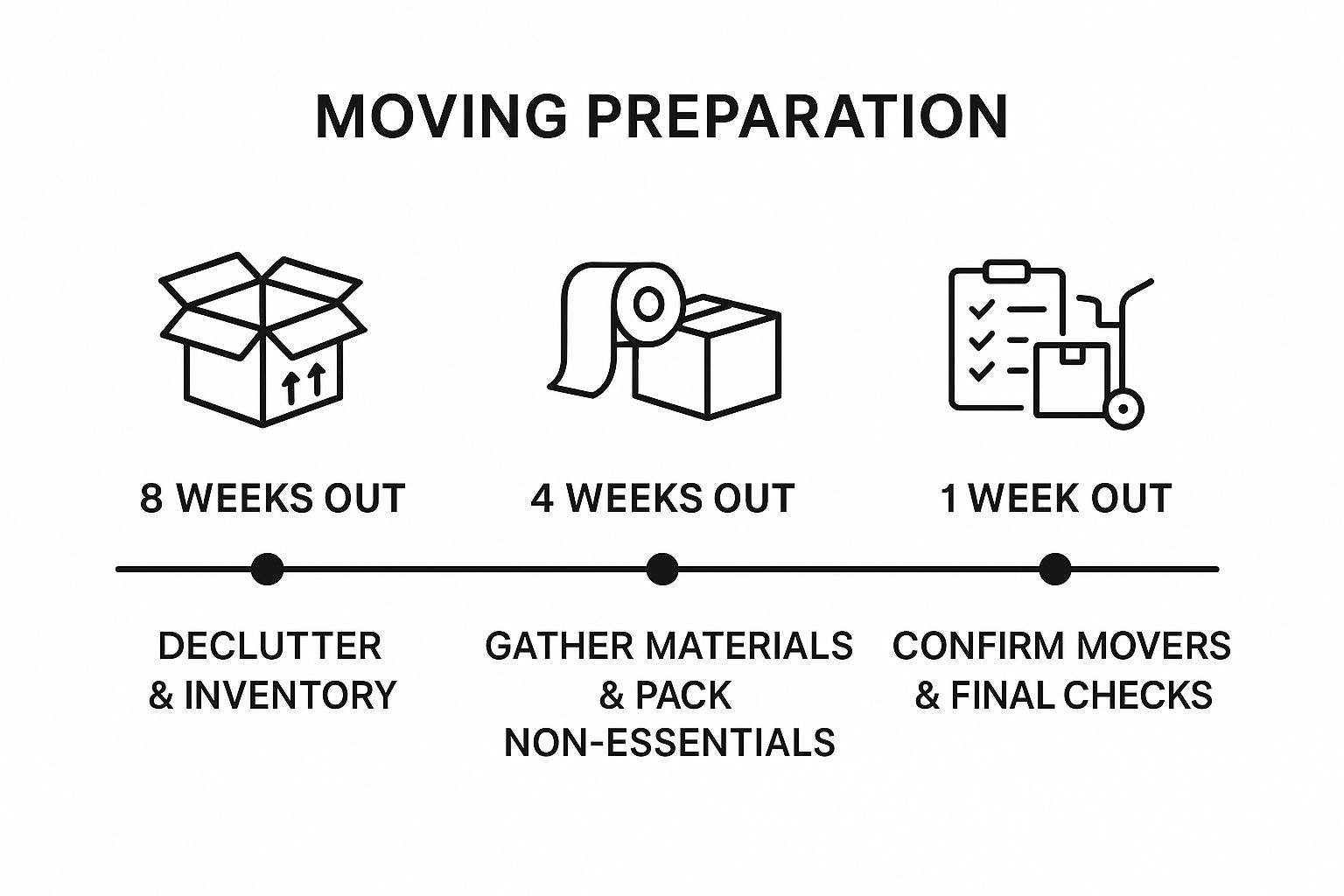
Viewing the move as a series of distinct phases allows you to focus your energy where it's needed most at each stage, preventing you from feeling overwhelmed.
Gathering Supplies and Starting the Pack
At the four-weeks-to-go mark, it's time to assemble your packing supplies. You will likely need more than you anticipate, so it's always better to have extra boxes on hand than to run out mid-way through packing your kitchen.
Your essential packing kit should include:
- Sturdy Boxes: Obtain a variety of sizes. Use small boxes for heavy items like books and large boxes for light, bulky items such as linen and pillows.
- Packing Tape: Invest in high-quality tape and a dispenser to save time and frustration.
- Protective Materials: Bubble wrap, packing paper, and even old towels or blankets are excellent for protecting fragile items.
- Permanent Markers: Label every box with its contents and the room it belongs in. This will be invaluable during unpacking.
Once you have your supplies, begin packing non-essential items. This includes out-of-season clothing, formal dinnerware, spare linen, and books. For a comprehensive guide, consulting an ultimate long-distance moving checklist can be incredibly helpful.
To help you stay on track, we've put together a simple week-by-week guide.
8-Week Countdown to Your Long Distance Move
| Timeline | Key Tasks to Complete |
|---|---|
| 8 Weeks Out | Research and get quotes from long-distance removalists. Start the big declutter: sort items into keep, donate, and discard piles. |
| 7 Weeks Out | Book your chosen removalist and confirm all dates. Begin using up pantry items to reduce food waste. |
| 6 Weeks Out | Notify important parties of your move: banks, utilities, subscriptions, schools, etc. Arrange for mail forwarding. |
| 5 Weeks Out | Gather packing supplies: boxes, tape, bubble wrap, markers. |
| 4 Weeks Out | Start packing non-essential items like out-of-season clothing, books, and decorative pieces. Label every box clearly. |
| 3 Weeks Out | Pack most of your home, leaving only daily essentials. Arrange for cleaning services for your old place if needed. |
| 2 Weeks Out | Confirm all arrangements with your removalists. Defrost your fridge and freezer. |
| 1 Week Out | Pack your "essentials box" with items you'll need immediately upon arrival. Disassemble remaining furniture. |
Following a timeline like this helps ensure nothing crucial gets missed in the lead-up to the big day.
The Final Week and Moving Day Prep
With just one week to go, your focus should shift to the final details. Reconfirm all arrangements with your removalists, including arrival times and contact numbers. Finish packing everything except the absolute necessities for your last few days in the old home and the first night in the new one.
Pack an 'Essentials Box' that travels with you, not on the truck. This box should contain medications, important documents, chargers, toiletries, a change of clothes, and basic kitchen items like a kettle and coffee mugs.
Finally, prepare your home for the movers. Disassemble any remaining furniture if possible. Ensure the fridge and freezer are defrosted, clean, and dry. Crucially, clear a path from the entrance to every room to allow the crew to move freely and safely. While knowing how to pack is important, knowing what not to do is equally vital. To avoid common mistakes, review these top 10 common packing mistakes when moving home.
Navigating Moving Day and Your First 24 Hours
The day your long distance removalists arrive is the culmination of weeks of planning. All your preparation leads to this moment, and the key to a stress-free experience is to remain organised. Your primary role on moving day is to act as the director, guiding the crew and ensuring a smooth process.
Begin with a final walk-through with the team leader. Point out any boxes that are particularly fragile or any furniture that requires special care. This is also the ideal time to clearly designate any items that will be travelling with you in your car to prevent them from being loaded onto the truck by mistake. A few moments of clear communication at this stage can prevent significant issues later.
For a deep dive into prepping for the big day, our article on what to do the night before your movers arrive is packed with great tips.
Managing the Final Checks and Departure
As the crew begins to load your belongings, your job is to oversee the process and verify the inventory. Your removalists will provide a detailed list of every item being moved, often using numbered stickers for tracking. It is your responsibility to check this list against what is being loaded onto the truck.
Once the last box is loaded and before the truck doors are sealed, conduct a final sweep of your old home. Check every room, cupboard, and wardrobe thoroughly. It’s surprisingly easy to leave things behind, and this simple step can save you considerable hassle later.
Before you sign any final paperwork, make sure you're 100% happy with the inventory list and the condition report. This document is the official record of your move, so it's worth taking a moment to confirm every detail is spot on.
Arriving and Your First 24-Hour Action Plan
When you finally arrive at your new home, the ‘essentials box’ you packed will feel invaluable. As the removalists begin unloading, you can focus on establishing a small, functional base. This is especially relevant now, with more people relocating than ever before.
Long distance removalists in Australia have seen a surge in demand since the pandemic, with a significant wave of people moving from capital cities to regional areas. These internal moves increased by 10.5% in the March 2025 quarter alone, reflecting the ongoing trend of Australians seeking more space, affordability, and a different lifestyle. You can read more about these significant moving industry trends at austate.com.au.
Your first 24 hours should be about strategic unpacking, not chaos. Focus on these key tasks to feel settled quickly:
- Direct the Big Stuff: Guide the movers on the placement of large furniture items. It is much easier to get this right the first time than to move a heavy wardrobe by yourself later.
- Set Up the Bedrooms: Prioritise assembling the beds and making them with fresh linen. A good night's sleep is essential after a long move.
- Sort the Bathroom: Unpack toiletries, towels, and any necessary medications. A hot shower will feel incredibly refreshing.
- Create a Basic Kitchen: Get the kettle and coffee maker set up, along with some mugs and basic utensils. Order takeaway for dinner—you've earned it.
By tackling these key areas first, you can create pockets of calm and order amidst the boxes. It's the most effective way to make your new house start to feel like home.
Your Top Long Distance Moving Questions, Answered
Even with the most thorough planning, a few questions are bound to arise. This is completely normal, and getting clear, straightforward answers is key to feeling confident about your move. Here, we address some of the most common queries about hiring long distance removalists.
What Kind of Insurance Do I Really Need?
This is a critical question. While all professional removalists are required by law to have carrier's liability insurance, it's important to understand its limitations. This basic coverage typically protects against major incidents like a truck fire or a serious road accident. It does not cover accidental damage, such as scuffs or scratches, that may occur during loading or transit.
For comprehensive protection and genuine peace of mind, you should consider comprehensive transit insurance. This type of policy covers your belongings for their full replacement value against accidental loss or damage. Most removalists can help arrange this, or you can obtain a policy through a third-party insurer.
How Long Will My Delivery Take?
Unlike a local move that is completed in a single day, the delivery timeframe for a long-distance relocation can vary significantly based on several factors:
- The total distance of your move.
- Whether it's a dedicated trip or a backload (where your items share truck space with other jobs).
- Road conditions and unforeseen events like adverse weather.
A move from Melbourne to Sydney, for instance, might take 2-5 days. However, a cross-country move to Perth could take 7-14 days or longer. Your removalist will provide an estimated delivery window rather than a fixed date to account for these variables.
What Is Backloading and Is It a Good Idea?
Backloading is a cost-effective option where your belongings are transported on a truck that is returning empty from a previous delivery. Because the removalist is utilizing space that would otherwise be wasted, they can offer this service at a significantly lower price.
Backloading is an excellent way to save money, especially if you have a smaller load and flexible moving dates. However, delivery times are often longer as the truck may make several stops along its route.
If you are on a tight budget and not in a hurry, backloading is a fantastic choice.
Are There Items I Cannot Move?
Yes, for safety and legal reasons, there are certain items that long-distance removalists cannot transport. These generally fall into the following categories:
- Hazardous Materials: Anything flammable, corrosive, or explosive is prohibited. This includes petrol, gas bottles, paints, aerosols, and most cleaning chemicals.
- Perishable Food: Any food items that require refrigeration or can spoil during transit are not allowed.
- Plants: Due to strict interstate quarantine laws, most removalists will not transport live plants.
- Valuables and Personal Documents: Items such as jewellery, cash, passports, and important paperwork should always be kept with you and not packed on the truck.
It is always advisable to confirm with your removalist for their complete list of prohibited items before you begin packing.
Planning your next big move? Let the experts handle the heavy lifting. Get n Go Removals Melbourne offers reliable, professional long distance removalist services to ensure your belongings arrive safely and on time. For a seamless relocation experience, visit https://www.getngoremovals.com.au to get your free quote today.