
Piano Removal Cost: An Expert 2024 Pricing Guide

When planning to move a piano, the first question that springs to mind is almost always, "How much will this cost?" In Australia, the average piano removal cost typically ranges between $200 and $800.

However, this is just a starting point. A simple, local move for a small upright piano will naturally be on the lower end of that spectrum. In contrast, relocating a concert grand piano across state lines is a far more complex operation that can significantly increase the price. Moving a piano is not just another item on your moving house or office checklist; it's a specialised task demanding precision and care.

Understanding Piano Removal Costs: What You're Paying For

It's crucial to understand that moving a piano is nothing like moving a standard piece of furniture. It is a specialised service for a heavy, surprisingly delicate, and often priceless instrument—both sentimentally and financially. The price you pay covers the expertise of a trained crew, specialised equipment like piano dollies and skid boards, and the meticulous care required to transport it from point A to point B without a single scratch.

This guide will break down every cost component, empowering you to budget accurately and understand the value behind the quotes you receive.

Estimated Piano Removal Costs at a Glance

To provide a clearer picture of potential expenses, here is a summary of typical costs based on piano type and distance. This visually stimulating table helps you quickly gauge the investment required.

Piano Type Local Move (Under 100km) Interstate Move
Upright Piano $300 – $600 $1,000 – $1,800
Baby Grand Piano $450 – $800 $1,200 – $2,000
Grand Piano $600 – $1,000+ $1,500 – $2,500+

As the table illustrates, the larger the piano and the longer the distance, the more intricate and costly the move becomes. For a detailed breakdown of our pricing structure, you can learn more about our piano moving prices and what's included.

The infographic below offers another useful visual representation of the average cost ranges for common piano types.

Infographic about piano removal cost

As the diagram shows, the complexity and size of the piano are primary drivers of the base removal cost.

Key Factors That Influence Your Final Quote

Have you ever wondered why one quote to move an upright piano is $300, while another for a similar instrument comes in at $600? The final price is not arbitrary; it's a detailed calculation based on several critical variables. Professional movers assess each factor to ensure the job is performed safely, efficiently, and successfully.

Think of it as assembling a puzzle. Each piece represents a different aspect of the move, and how they fit together determines the final picture—and the final cost. The most significant piece of that puzzle is, of course, the piano itself.

Image

Piano Type And Size

The specific type of piano you own is the foundational element of any quote. A small spinet or console piano, typically weighing between 130-180 kgs, requires less manpower and is a simpler task than moving a full-sized upright piano, which can easily exceed 270 kgs.

Grand pianos are in a league of their own. They frequently require partial dismantling—removing legs and pedals—and may need custom crating for secure transport. Managing their immense weight and unconventional shape necessitates a larger, more experienced team.

This is why providing accurate dimensions is so important. When planning a larger house or office move, using a tool like a cubic metre calculator can help you contextualise the piano's significant volume alongside your other belongings.

The Difficulty Factor

Once the piano's specifications are known, the next critical question is how it will be moved. The logistical challenges of the move, often termed the "difficulty factor," play a massive role in the final price. This encompasses all the unique obstacles at both the pickup and drop-off locations:

  • Stairs: Stairs are a piano mover's greatest challenge. Each flight introduces complexity, risk, and significant physical exertion. This often requires additional crew members and specialised equipment like stair-climbing dollies. A move involving two flights of stairs will invariably cost more than a straightforward ground-floor relocation.
  • Tight Spaces: Navigating narrow hallways, sharp 90-degree turns, or restrictive doorways demands extreme precision and, consequently, more time and skill.
  • Access: The pathway from the building to the truck is crucial. We must consider obstacles such as steep driveways, long grassy paths, or uneven gravel surfaces. Poor accessibility at either end can add considerable time and labour to the job.

Ultimately, understanding service charges comes down to appreciating the complexity of the work. This principle applies across many home services; for example, guides on getting a fair house cleaning estimate also detail how costs are calculated based on job specifics, offering a helpful parallel for how professionals determine their quotes.

Comparing Local and Interstate Piano Moves

Moving a piano across town is fundamentally different from transporting it across the country, and the piano removal cost will reflect this disparity. A local job and an interstate haul are priced and executed differently.

Local moves are generally more straightforward. The pricing is often based on hourly rates and minimum call-out fees. The level of competition among removalists in a metropolitan area can also influence what you pay.

For instance, in a competitive market like Melbourne, local upright piano moves might be quoted between $150 and $200, showcasing how a bustling market can help maintain competitive pricing for customers.

The Complexities of Interstate Moves

When your piano must cross state lines, the logistics become far more intricate, and the costs increase accordingly. This is not simply about a longer drive; it is a specialised transport mission requiring end-to-end management.

What factors contribute to the higher price tag for a long-distance move?

  • Dedicated Transport: Pianos are extremely sensitive to fluctuations in temperature and humidity. An interstate move often requires a climate-controlled truck to prevent the delicate wood and internal mechanisms from warping or cracking.
  • Robust Insurance: The risks are inherently higher over a long journey. Comprehensive transit insurance is non-negotiable to protect your valuable instrument against any potential mishaps on the road.
  • Fuel and Labour: The significant cost of fuel for covering vast distances, combined with paying the crew for what could be several days of work, are major components of any interstate quote.

An interstate piano move is less about distance and more about preservation. That higher cost ensures your instrument is protected from environmental shifts, transport risks, and the sheer physical demands of a multi-day journey.

If you're planning a long-distance relocation, understanding all the moving parts is vital. For a comprehensive guide on managing the logistics and budget of such a move, you can find valuable insights by reading up on preparing for moving out of state.

Choosing the right professionals for the job is paramount. You can learn more by checking out our guide on how to choose the best interstate removalists.

Uncovering Potential Hidden Charges

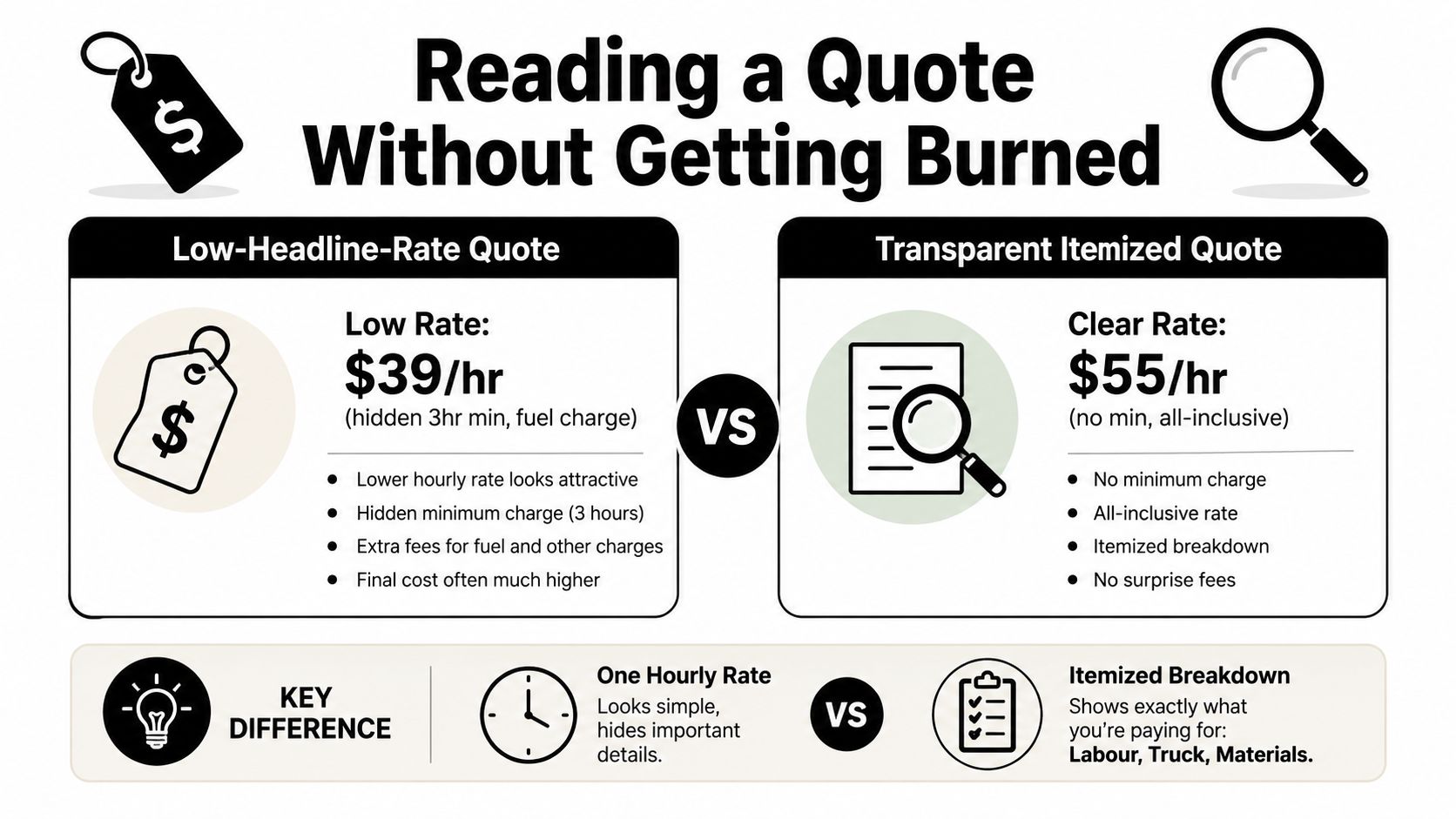
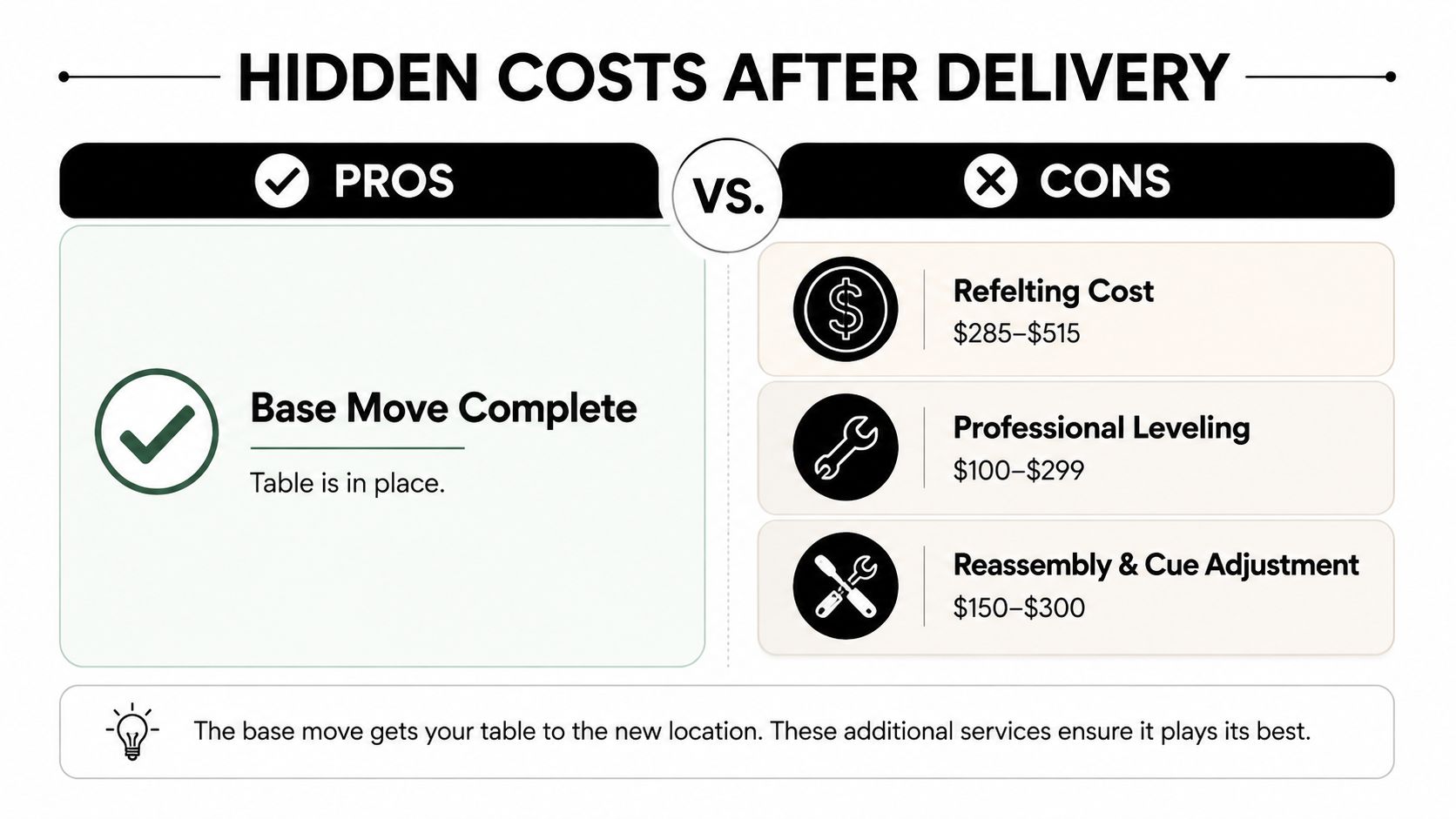
A high-quality quote is a transparent one, but the initial figure you see may not represent the final bill. To get a truly accurate forecast of the final piano removal cost, you must consider the additional services that might be required for your specific situation.

These are not "hidden" fees in a deceptive sense, but rather conditional charges that apply to more complex moves. Knowing what to ask about upfront is the key to receiving a comprehensive quote with no unwelcome surprises on moving day. It is the difference between a smooth, well-budgeted process and an unexpectedly costly one. Many of these potential costs are similar to those in any major relocation, which we detail in our guide to the hidden costs in moving house.

Common Additional Services and Fees

When requesting a quote, it is wise to inquire if it includes the following. These tasks require extra time, specialised materials, and additional expertise, which naturally impacts the price.

  • Dismantling and Reassembly: A grand or baby grand piano simply will not fit through a standard doorway. Professional movers must carefully remove and wrap the legs, pedals, and music rack, which adds to the labour time.
  • Specialised Crating: For a high-value or antique instrument, especially for an interstate move, a custom-built wooden crate offers the ultimate protection. This is a specialised service that shields your piano from bumps and vibrations during transit.
  • Premium Insurance: While reputable movers include standard transit insurance, you may desire additional peace of mind for an instrument with significant monetary or sentimental value. Upgraded insurance policies offer higher coverage limits.
  • Temporary Storage: If there is a gap between moving out of your old property and into the new one, you will need a secure place for your piano. Climate-controlled storage is essential here—it protects the delicate wood and internal mechanisms from damaging humidity and temperature fluctuations.

Beyond the basic transport, additional costs in Australia can range from dismantling fees to insurance upgrades. For instance, dismantling can add AUD 100 or more to the bill, while a custom crate might cost anywhere from AUD 800 to AUD 1,200. Extra insurance and storage also contribute to the final total.

How to Prepare Your Home and Save Money

A clear hallway in a home, prepared for a piano to be moved through it.

You have more control over the final piano removal cost than you might think. A small amount of preparation not only protects your instrument and your home but is also one of the most effective ways to keep the movers on schedule and avoid unexpected fees.

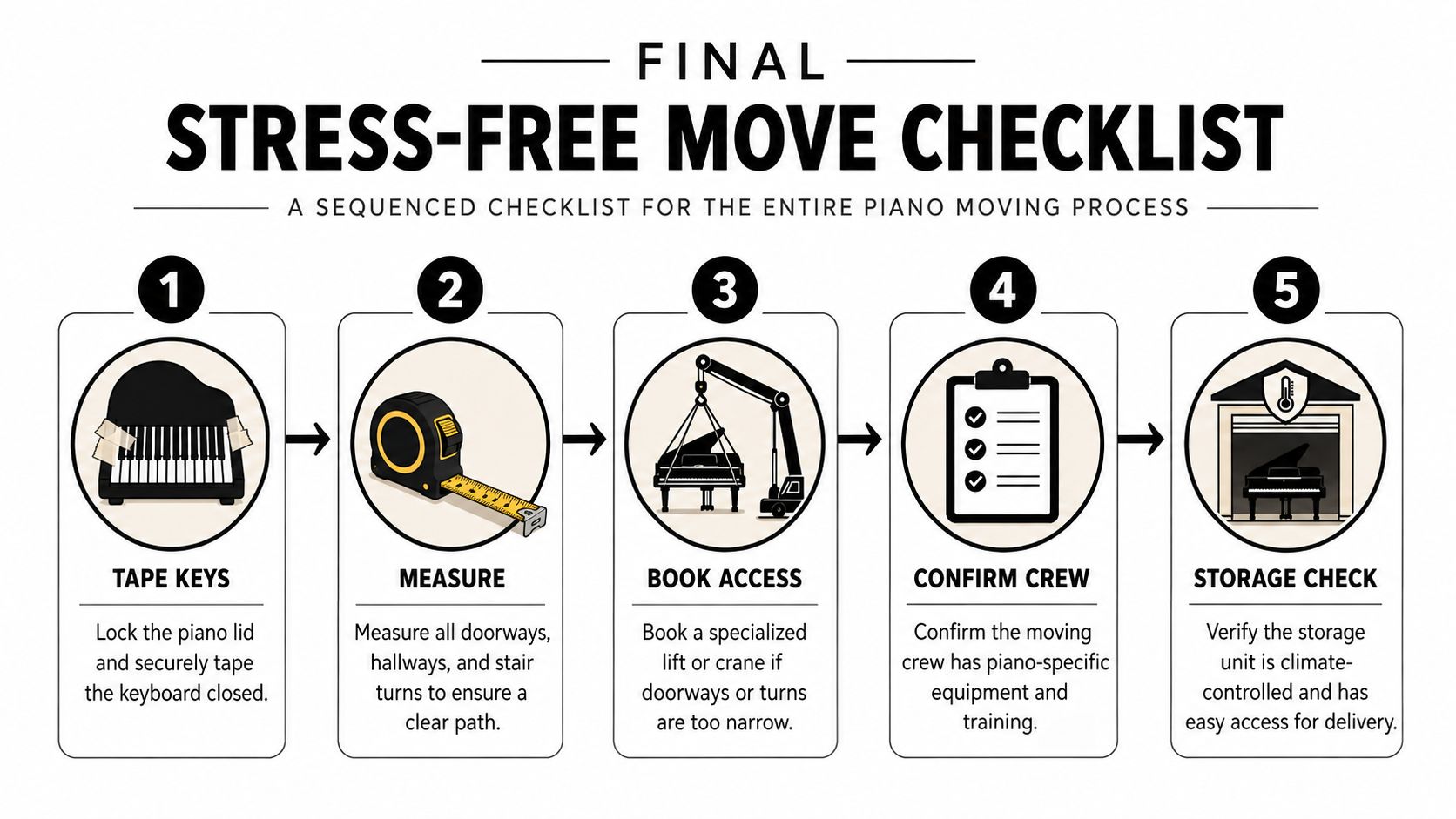
Before the moving team arrives, walk the entire path from the piano's current location to the street. Clear all potential obstructions—rugs, furniture, pot plants, and other items. It is also a wise practice to use a measuring tape to confirm that your piano will fit through all doorways and tight hallways.

A pro tip: take clear photos of your piano from multiple angles. This simple step documents its pre-move condition, providing you with complete peace of mind.

Your Pre-Move Preparation Checklist

A little planning goes a long way. Use this checklist to ensure your home is fully prepared:

  • Clear the Path: Ensure the entire route, both inside and outside, is completely free of obstacles.
  • Measure Everything: Double-check the dimensions of hallways, stairwells, and doorways against the piano's size to prevent surprises.
  • Protect Your Floors: Place old blankets, cardboard, or floor runners along the moving path to prevent scuffs and scratches.
  • Document its Condition: A quick video or a few photos of your piano will serve as a valuable record of its pre-move state.
  • Communicate Challenges: Inform your movers in advance about any tricky stairs, sharp turns, or difficult access points. The more they know, the better they can prepare.

Proactively addressing potential obstacles is the key to a smooth, efficient move. A clear path means less time spent by the movers, which can directly translate into savings for you.

For more expert advice on managing your moving budget, explore our other tips to keep your moving costs down. Being organised and communicating clearly with your removalist team sets the stage for a successful and affordable piano move.

Frequently Asked Questions About Piano Moving

Let's conclude by addressing some of the most common questions we receive about the piano removal process and its costs. Clear answers can help you plan your move with greater confidence.

Can I Move a Piano by Myself to Save Money?

While the idea of a DIY move to save money is tempting, it represents a significant risk. Pianos are not just heavy; they are awkwardly balanced, top-heavy instruments containing thousands of delicate moving parts.

The potential cost of damaging the piano, your floors, walls—or worse, causing a serious injury—far outweighs any potential savings. Professionals use specialised equipment like piano dollies, skid boards, and ramps for a reason, backed by the experience needed to handle these instruments safely.

How Long Does a Professional Piano Move Take?

The duration depends entirely on the job's complexity. A straightforward, local move of an upright piano with clear access at both locations can often be completed in just 1-2 hours.

However, for a grand piano requiring careful dismantling, or a move involving multiple flights of stairs, the job can easily extend to 3-4 hours or more. Interstate moves are a multi-day commitment.

Will My Piano Need Tuning After the Move?

Yes, it almost certainly will. The vibrations from the journey, combined with changes in temperature and humidity between the old and new locations, will affect your piano’s tuning.

We always recommend letting your piano acclimate to its new environment for at least two to four weeks before scheduling a professional tuning. This allows the wood and internal components to settle.

What Kind of Insurance Should Movers Have?

A reputable piano mover must carry two essential types of insurance. The first is Public Liability Insurance, which protects your property (walls, floors, doorways) from accidental damage. The second is Transit Insurance, which covers your piano while it is in their care and on the truck.

Do not hesitate to ask for proof of their policies and ensure you understand the coverage limits. For a particularly valuable instrument, inquiring about additional coverage is a prudent step for complete peace of mind.


Ready to move your piano with a team that understands its value? The professionals at Get n Go Removals Melbourne have the specialised equipment and extensive experience to ensure your instrument arrives safely. Contact us today for a free, no-obligation quote!

READ MORE

7 Best Platforms for Cheap Removalists Melbourne Reviews (2025 Guide)

Moving in Melbourne can be a stressful and expensive affair, but it doesn't have to break the bank. The key to a smooth, affordable move is diligent research. With countless removalists claiming to be the cheapest, how do you separate genuine value from potential disaster? This guide is your ultimate resource, diving deep into the platforms and directories where real customer experiences are shared. We'll analyse the best places to find transparent cheap removalists Melbourne reviews, helping you identify movers who offer great prices without compromising on care, reliability, or professionalism.

This article cuts through the noise. Instead of just listing movers, we focus on the most reliable platforms where you can compare services, read unfiltered feedback, and get multiple quotes quickly. We’ll guide you through seven essential websites, from dedicated moving marketplaces like Find a Mover and Muval to broad-based review aggregators such as ProductReview.com.au. For each platform, we provide a detailed breakdown of its features, screenshots for easy navigation, and direct links so you can start your search immediately. Beyond reading reviews, gaining insight into the overall process, including understanding licenses and insurance, is vital. You can find more expert tips on how to choose a moving company to ensure a smooth and reliable relocation.

Forget guesswork; let's equip you with the knowledge to hire a five-star team that respects your budget and your belongings. This isn't just about finding a low price; it's about finding smart value for a stress-free relocation, whether you're moving a small apartment across town, relocating an entire office, or need secure storage for your possessions.

1. Find a Mover

Find a Mover is not a removalist company itself, but rather a powerful marketplace designed to connect you with them. It operates like a reverse auction, where you post the details of your Melbourne move, and a network of pre-vetted removalists compete for your business by submitting quotes. This model is exceptionally useful for anyone searching for cheap removalists Melbourne reviews, as it centralises comparison shopping and leverages competition to drive down prices. The platform essentially does the initial legwork for you, gathering multiple options in one convenient place.

Find a Mover

The primary advantage is the ability to compare side-by-side quotes without the commission fees often associated with aggregator sites. This transparency is a key feature that makes Find a Mover a standout choice for budget-conscious movers.

Key Features and User Experience

The user interface is straightforward. You input your moving details-such as pickup and delivery suburbs, property type, and a general inventory list-and the platform broadcasts this request to its network of Melbourne movers. Within a short time, you receive multiple, no-obligation quotes directly from interested companies.

A unique and highly valuable feature is the "Recent Live Bookings" feed. This tool offers real-time price discovery by showing what other users in Melbourne have recently paid for similar moves. It provides concrete examples of job costs, hourly rates, and the specific removalist hired, giving you a realistic budget benchmark before you even post your job. This level of transparency helps you spot a good deal and avoid overpaying.

Expert Tip: To get the most accurate quotes, be as detailed as possible when listing your inventory. Mention any access challenges like stairs, narrow hallways, or difficult parking. This prevents unexpected surcharges on moving day.

Analysing Reviews and Making a Choice

Each mover on the platform has a public profile featuring ratings and detailed reviews from past customers who booked through the site. This peer-reviewed system is crucial for vetting the quality of different operators. Since service standards can vary significantly between individual removalists, taking the time to read through these reviews is essential. It's a key part of the process when trying to find a removal company in Melbourne that balances cost with reliability.

While Find a Mover facilitates the connection, it's up to you to scrutinise the quotes. Pay close attention to what is included, such as insurance coverage, policies on heavy or fragile items, and whether there are extra charges for travel time or difficult access. This due diligence ensures you find not just a cheap option, but a genuinely good value service.

2. Muval

Muval is another leading online platform that simplifies the process of finding and booking a removalist in Melbourne. Unlike a traditional mover, it acts as a digital marketplace, providing instant, bookable quotes from a network of vetted moving companies. This approach is incredibly effective for anyone searching for cheap removalists Melbourne reviews, as it presents real-time availability and transparent pricing, allowing you to secure a booking on the spot without endless phone calls. The platform aims to take the stress out of moving by offering a one-stop-shop for comparing, booking, and managing your relocation.

Muval

The key benefit of Muval is its blend of technology and customer service. It provides the speed of an online booking system with the reassurance of a dedicated support team, making it a powerful tool for organising a cost-effective and reliable move.

Key Features and User Experience

The platform's user experience is designed for speed and clarity. You start by entering your move details, including locations, property sizes, and your preferred moving date. Muval instantly displays a list of available Melbourne removalists, complete with their hourly rates, total estimated costs, and customer ratings. You can filter these results by price, rating, or specific services required.

A standout feature is the platform's clear pricing guidance. Muval provides helpful benchmarks, such as typical hourly rates for two men and a truck in Melbourne and average cost examples for different-sized homes. This information empowers you to assess whether a quote is competitive. Furthermore, their supplier vetting process, which includes checks for AFRA (Australian Furniture Removers Association) membership, adds a layer of trust and professionalism to the movers available on the site.

Expert Tip: Use Muval's "inventory calculator" to get the most precise quote. An accurate item list helps the system estimate the truck size and time required, which directly impacts the final price and avoids any last-minute cost escalations.

Analysing Reviews and Making a Choice

Each removalist listed on Muval has a detailed profile featuring customer reviews and a star rating. These reviews are from users who have booked and completed their move through the platform, providing authentic feedback on punctuality, care, and overall service. This system is vital for understanding how to find the best house movers in Melbourne and not just the cheapest one. Reading through these firsthand experiences is crucial for gauging the quality of a mover, as service levels can differ between companies in the network.

While Muval provides instant quotes and a centralised booking system, it's essential to check the fine print of each offer. Look at what's included in the price, such as complimentary transit insurance cover, and what might be an extra charge, like packing services or dismantling furniture. Because the platform uses a network of independent and subcontracted movers, careful review of their individual profiles and customer feedback is the best way to ensure you find a service that offers great value and reliability.

3. Airtasker (AU)

Airtasker is a versatile gig marketplace rather than a dedicated moving company. It connects people who need tasks done with "Taskers" willing to do them. This model is exceptionally well-suited for finding budget-friendly help with moving in Melbourne, especially for smaller jobs, single-item transport, or when your budget is the primary concern. You post the specifics of your moving task, set a suggested budget, and receive offers from local Taskers, making it a dynamic resource for anyone searching for cheap removalists Melbourne reviews on a task-by-task basis.

Airtasker (AU)

The platform's main appeal is its flexibility and potential for significant cost savings. By cutting out the overheads of a traditional removalist company, you can often find someone with a ute or van to help for a fraction of the price, making it one of the best ways to keep your moving costs down for less complex moves.

Key Features and User Experience

The process is user-friendly and straightforward. You create a detailed post describing your moving needs: what you're moving, pickup and delivery locations in Melbourne, and any specific requirements like needing two people or help with stairs. You then set a budget, which signals to Taskers what you're willing to pay. Interested individuals will then make offers, sometimes bidding below your suggested price.

One of Airtasker's most powerful features is the detailed profile system for each Tasker. You can see their star rating, completion rate, and read specific reviews from previous customers. This transparency helps you gauge the reliability and experience of the person you're considering hiring, which is crucial when entrusting someone with your belongings. The platform also includes a secure payment system, holding your funds until you confirm the task is completed to your satisfaction.

Expert Tip: Be extremely clear in your task description. Specify the exact items, mention if a trolley is needed, and detail the access conditions at both ends. Vague posts lead to mismatched expectations and potential issues on moving day.

Analysing Reviews and Making a Choice

Scrutinising Tasker profiles is the most important step. Look for individuals with a high number of completed moving-related tasks and consistently positive feedback. Reviews often mention a Tasker's professionalism, punctuality, and how carefully they handled items. This is your primary tool for vetting candidates on the platform.

While Airtasker can be the cheapest option, it requires more due diligence from you. Unlike professional removalists, not all Taskers will have proper insurance, a large truck, or specialised moving equipment. It's your responsibility to ask these questions directly in the chat before accepting an offer. For small-scale moves or simple transport jobs, the cost savings can be immense, but for larger or more complex relocations, the security of a professional service might be more appropriate.

4. Oneflare

Oneflare is a well-established Australian services marketplace where you can find and hire a wide array of local professionals, including Melbourne removalists. Much like an aggregator, it simplifies the search process by allowing you to post your moving requirements and receive quotes from interested businesses. This platform is a valuable resource for anyone searching for cheap removalists Melbourne reviews, as it combines a multi-quote system with a robust, job-verified review framework, making it easier to gauge both price and quality in one place.

Oneflare

The platform’s strength lies in its large network of service providers and the detailed business profiles it offers. This allows you to quickly compare established operators based on their experience, customer feedback, and credentials, streamlining your decision-making process.

Key Features and User Experience

The process begins by submitting a job request outlining the specifics of your move, such as location, property size, and key items. Oneflare then distributes this request to relevant removalists in their Melbourne network. You can expect to receive up to three quotes from businesses interested in your job, which is a manageable number to compare without feeling overwhelmed.

Oneflare’s business profiles are particularly useful. They often display crucial verification details like ABNs and insurance badges, offering a layer of trust and security. You can also see performance metrics, such as how many jobs a business has won and its average response time. Some profiles even disclose their hourly rates upfront, providing immediate cost transparency before you even request a formal quote.

Expert Tip: Pay attention to the "Verified" badge on reviews. This indicates the review comes from a customer who hired and paid the business through the Oneflare platform, making it a more reliable indicator of service quality than an unverified testimonial.

Analysing Reviews and Making a Choice

Each removalist's profile is populated with star ratings and written reviews from past clients. This system is central to the platform's value, as it provides direct insight into the customer experience offered by each company. Reading through these firsthand accounts is a critical step, as it highlights the pros and cons of different services and helps you understand why hiring professional removal services can differ greatly between providers.

While the multi-quote system is designed to find competitive pricing, it’s important to critically assess each offer. Be aware that some business rankings on the site may be influenced by paid placements. Therefore, focus on the substance of the reviews and the specifics of the quotes. Check for hidden costs, confirm insurance details, and ensure the quote covers all your specific needs to find a service that offers true value for money.

5. Word of Mouth (WOMO)

Word of Mouth (WOMO) is a long-standing Australian review platform where genuine customer feedback is the main event. Unlike a direct booking service, WOMO acts as a comprehensive directory and review aggregator, allowing you to research and connect with a vast number of Melbourne removalists. For anyone looking for cheap removalists Melbourne reviews, this platform is an invaluable resource, as its strength lies in the depth and volume of its community-generated, verified feedback. It provides a grassroots perspective on the service quality and value for money offered by local moving companies.

Word of Mouth (WOMO)

The primary advantage of WOMO is its focus on authentic, long-form reviews from a dedicated Australian user base. This allows you to move beyond simple star ratings and understand the nuances of a customer's experience, from punctuality and care for belongings to the professionalism of the moving crew.

Key Features and User Experience

The platform is designed for easy navigation. You can search for "Removalists" in the "Melbourne, VIC" area and are immediately presented with a list of businesses ranked by their star rating and review count. Each listing provides a snapshot of the company's performance, including key metrics like the "Average time to first quote," which gives you an idea of their responsiveness.

Many business profiles on WOMO also display their starting hourly rates, specialities (like piano or fragile item moving), and service areas. The platform facilitates contact by allowing you to request a quote directly from a mover's page, or even from multiple businesses at once, streamlining the initial outreach process. This blend of detailed reviews and direct contact tools makes it a powerful one-stop shop for research and initial engagement.

Expert Tip: Pay attention to how a removalist business responds to negative reviews on their WOMO profile. A professional and constructive response to criticism can be a strong indicator of good customer service and a commitment to resolving issues.

Analysing Reviews and Making a Choice

WOMO's core value is its review system. With thousands of reviews for Melbourne removalists alone, you can gain deep insights into a company's reliability and service quality over time. Look for patterns in the feedback. Do customers consistently praise their efficiency, care, and communication? Or are there recurring complaints about hidden fees, lateness, or damage?

While the platform offers a wealth of information, it's important to note that some businesses participate in promotional programs that can influence their visibility. Always cross-reference high ratings with a thorough read-through of recent reviews. Ultimately, you are responsible for obtaining and comparing detailed written quotes. Use WOMO to create a shortlist of highly-rated, budget-friendly candidates, then contact them directly to confirm all costs, insurance details, and terms of service before making your final decision.

6. Yellow Pages (AU)

Yellow Pages is Australia’s classic and long-standing business directory, offering a vast, comprehensive list of Melbourne removalists. While not a mover-specific marketplace, it serves as an excellent starting point for anyone wanting to compile a list of local operators and contact them directly. This traditional approach is particularly effective for those who prefer to negotiate rates over the phone, as it bypasses platform fees and allows for more direct communication. For anyone searching for cheap removalists Melbourne reviews, Yellow Pages provides a broad overview of available services, complete with contact details, locations, and user ratings.

Yellow Pages (AU)

The primary advantage of using Yellow Pages is its sheer breadth of listings, covering everything from large national companies to small, local family-owned businesses across all Melbourne suburbs. This wide coverage gives you the power to find operators in your immediate vicinity, potentially reducing travel costs and supporting local businesses.

Key Features and User Experience

The platform functions as a straightforward search directory. You can search for "furniture removalists" in Melbourne and receive a long list of businesses, which can be filtered by suburb or specific services. Many listings feature a "Request a quote" button, allowing you to quickly send an enquiry to multiple companies without leaving the site.

Unlike modern aggregator platforms, the information provided can vary significantly from one listing to another. Some profiles are detailed, with photos, service descriptions, and numerous reviews, while others may only offer a name and phone number. This inconsistency means the user experience requires a bit more manual effort, but it also provides an unfiltered view of the market. The category-level rating snapshots give a quick sense of a company's general reputation based on a large volume of customer feedback.

Expert Tip: Use Yellow Pages to identify smaller, local movers who may not advertise on larger platforms. Calling them directly and mentioning you found them on Yellow Pages can sometimes open the door to negotiating special off-peak or last-minute rates.

Analysing Reviews and Making a Choice

Each business profile on Yellow Pages has a section for customer reviews and star ratings. These reviews offer valuable insights but often lack the detailed, move-specific context found on dedicated removalist websites. It's crucial to read through them to spot recurring themes, such as punctuality, care with belongings, or communication issues.

When using this directory, the responsibility falls on you to vet each company thoroughly. After shortlisting potential movers, you will need to contact them individually to confirm pricing structures, insurance coverage, and availability. Be sure to ask about hidden fees, like charges for stairs, depot-to-depot travel time, or fuel levies. While it requires more legwork, this direct approach can unearth some of the most genuinely cheap and reliable removalists in Melbourne.

7. ProductReview.com.au

ProductReview.com.au is not a removalist or a booking platform but arguably Australia’s most influential independent consumer review website. It serves as a crucial due diligence tool for anyone researching cheap removalists Melbourne reviews, offering a vast repository of candid, user-submitted experiences. The platform allows you to investigate specific Melbourne removalists you might have received quotes from, providing an unfiltered look at their performance from the customer's perspective. It helps separate genuinely good-value services from cheap operators with hidden costs and poor service.

ProductReview.com.au

The primary advantage of ProductReview.com.au is its depth of qualitative data. While a star rating gives a quick impression, the detailed written reviews are where you uncover recurring issues like late arrivals, surprise fees, or damaged items, which are critical red flags for budget-conscious movers.

Key Features and User Experience

The site is organised around dedicated pages for individual businesses. You can search for a specific Melbourne removalist and find their profile, which includes an overall star rating, a summary of review counts, and a chronological feed of all customer feedback. This makes it simple to get a comprehensive overview of a company's track record.

The ability to sort and filter reviews is a standout feature. You can filter by rating (e.g., show only 1-star reviews) to quickly identify common complaints or by recency to see if a company's service quality has improved or declined over time. Reading a mix of positive and negative reviews gives you a balanced and realistic expectation of the service you are likely to receive.

Expert Tip: Pay close attention to the company's responses to negative reviews. A business that responds professionally and offers solutions demonstrates good customer service, while one that is defensive or ignores complaints might be a risk.

Analysing Reviews and Making a Choice

ProductReview.com.au excels at complementing other platforms. After getting quotes from a marketplace like Find a Mover or directly from a company, you can use this site as a final verification step. Many reviews detail the entire moving process, from the initial quote's accuracy to the crew's professionalism on the day, giving you insights that a company's own website will never provide. Reading the real-world experiences detailed in Melbourne removalist reviews is an essential part of the decision-making process.

While this platform is an invaluable research tool, it doesn't facilitate bookings. You must contact the removalist directly or use another service to hire them. Its role is purely informational, empowering you to make a more informed choice by leveraging the collective experience of thousands of past customers.

Cheap Removalists Melbourne Reviews Comparison

Platform Implementation Complexity 🔄 Resource Requirements ⚡ Expected Outcomes 📊 Ideal Use Cases 💡 Key Advantages ⭐
Find a Mover Moderate – users compare multiple quotes Low – no commission fees Transparent price discovery with verified reviews Budget-conscious users seeking multiple quotes Wide Melbourne coverage, real-time pricing insights
Muval Low – instant online quotes and booking Medium – centralized support Fast, clear pricing with vetted suppliers Users needing quick quotes with vetted movers Instant pricing, AFRA verified movers, customer cover
Airtasker (AU) Low – post tasks, receive offers Low – gig economy model Low-cost options with multiple bids for small or partial moves Small, budget-sensitive or single item moves Cheapest for small jobs, quick turnaround
Oneflare Moderate – request quotes from multiple Medium – review and ABN verification Verified reviews, easy multi-quote comparison Users wanting reliable comparisons with verified info Verified jobs, business credentials, multiple quotes
Word of Mouth (WOMO) Low – review browsing and quote requests Low – review-focused platform Deep verified customer feedback and service insight Researching reputable Melbourne movers Strong local reviews, quote requests via platform
Yellow Pages (AU) Low – directory browsing and direct calls Low – self-managed contact Broad local listings, direct negotiation possible Users preferring phone contact and negotiation Wide metro and regional coverage, direct price chats
ProductReview.com.au Low – reading and filtering reviews Minimal – review only Detailed, balanced feedback revealing potential issues Due diligence prior to booking In-depth candid reviews, highlights red flags

Your Next Step: Choosing a Mover You Can Trust

Navigating the landscape of cheap removalists Melbourne reviews is the most critical part of orchestrating a smooth, stress-free relocation. Throughout this guide, we've explored a variety of powerful online tools, from dedicated mover marketplaces like Find a Mover and Muval to broader service platforms such as Airtasker and Oneflare. We've also highlighted the enduring value of established directories like Word of Mouth and Yellow Pages, alongside the unfiltered customer feedback found on ProductReview.com.au.

These platforms are your starting blocks, offering a valuable launchpad for research, comparison, and initial vetting. They empower you to sift through numerous options, compare pricing structures, and gain a broad understanding of the market. However, the most crucial takeaway is that the 'cheap' in 'cheap removalists' should refer only to the price, never to the quality of service, the level of professionalism, or the care taken with your prized possessions.

Distilling Your Research into a Final Decision

Your goal is to move beyond the initial digital search and create a focused shortlist. Once you have two or three potential candidates, the real work begins. This is where you transition from a researcher to a client, engaging directly with the companies to gauge their suitability for your specific needs.

Here are the actionable steps to take your research to the finish line:

  • Request Detailed, Itemised Quotes: A vague estimate over the phone is a red flag. A professional removalist will provide a written quote that clearly outlines all costs, including call-out fees, hourly rates, travel time, and any potential surcharges for stairs or heavy items. This transparency is key to avoiding unpleasant surprises on moving day.
  • Verify Insurance and Credentials: Do not take their word for it. Ask for proof of Public Liability and Transit Insurance. A reputable company will have this information readily available. This is non-negotiable; it's the safety net that protects you and your belongings from unforeseen accidents.
  • Assess Their Communication: Pay close attention to how they respond to your enquiry. Are they prompt, professional, and patient with your questions? Clear, respectful communication from the outset is often a strong indicator of the service you'll receive during the move itself.

Key Insight: The best budget-friendly mover isn't the one with the lowest absolute price. It's the one that delivers the greatest value by combining fair, transparent pricing with proven reliability, comprehensive insurance, and a professional, experienced team.

Factoring in the Finer Details

Beyond the core service, consider the other logistical elements of your move. Does your new property have difficult access? Are you moving particularly fragile or valuable items like a piano or antique furniture? Be upfront about these challenges to ensure the company you choose has the right equipment and expertise.

Furthermore, moving timelines don't always align perfectly. There might be a gap between when you need to vacate your old property and when you can access your new one. In these situations, it's wise to plan ahead and investigate dedicated moving home storage services to ensure your belongings are kept safe and secure during the interim period. Discussing storage options with your removalist can also provide a streamlined, all-in-one solution. Ultimately, a thorough review of cheap removalists in Melbourne involves looking at the entire moving process, not just the transport from A to B. By taking these deliberate steps, you can move forward with a team that gives you complete confidence, turning a potentially chaotic day into a seamless transition.


Ready to skip the endless searching and partner with a trusted, top-rated Melbourne removalist? Get n Go Removals Melbourne combines affordable, transparent pricing with the five-star service of a dedicated, family-owned business. See the difference our fully-insured, police-checked team makes by requesting your free, no-obligation quote today at Get n Go Removals Melbourne.

READ MORE

Expert Packing Tips for Moving House: The Ultimate Guide to a Stress-Free Move

Moving house consistently ranks as one of life’s most stressful events, but with a smart packing strategy, much of that pressure can be eliminated. A methodical approach does more than just get your belongings from A to B; it saves time, protects your valuables, and makes unpacking in your new home a streamlined process rather than a chaotic chore. The key to a successful relocation lies in the details—from how you declutter and organise your boxes to the techniques you use to safeguard your most fragile possessions. Forget the frantic, last-minute rush and the frustration of searching for essentials upon arrival.

This definitive guide provides a blueprint with proven, actionable packing tips for moving house that will transform the entire experience. We will explore professional-grade strategies that turn daunting tasks into manageable steps, ensuring every box is packed with purpose. Whether you are moving across town, relocating interstate, or organising an office move, these techniques will set you up for an organised new beginning. By implementing these expert methods, you can ensure your transition is as smooth and efficient as possible. For a broader collection of strategies, explore additional moving house packing tips to cover all bases. Let's get packing, the smart way.

1. The One-Room-at-a-Time Method

Feeling overwhelmed by the sheer scale of packing an entire house? The one-room-at-a-time method is a systematic approach that transforms a monumental task into a series of manageable projects. Instead of tackling a little bit everywhere, you focus all your energy on decluttering, sorting, and packing a single room completely before moving to the next. This strategy, a favourite among professional organisers, is one of the most effective packing tips for moving house because it creates a clear sense of progress and prevents the chaotic mixing of items from different areas.

This focused technique streamlines both the packing and unpacking phases. When every box is clearly labelled with its origin and destination room (e.g., "Guest Bedroom," "Kitchen – Pantry"), your movers can place them in the correct space at your new home. This eliminates the frantic search for the coffee maker or your toothbrush on moving day, significantly reducing stress and helping you settle in faster.

How to Implement This Method

To put this strategy into action, follow these practical steps:

  • Start with Non-Essentials: Begin with rooms you use least, like the garage, spare bedrooms, or formal dining room. This allows you to pack a significant portion of your home without disrupting your daily life.
  • Create a System: Use colour-coded tape or labels for each room. For instance, blue for the main bedroom, green for the kitchen, and yellow for the lounge. This visual cue makes identifying boxes instant and foolproof.
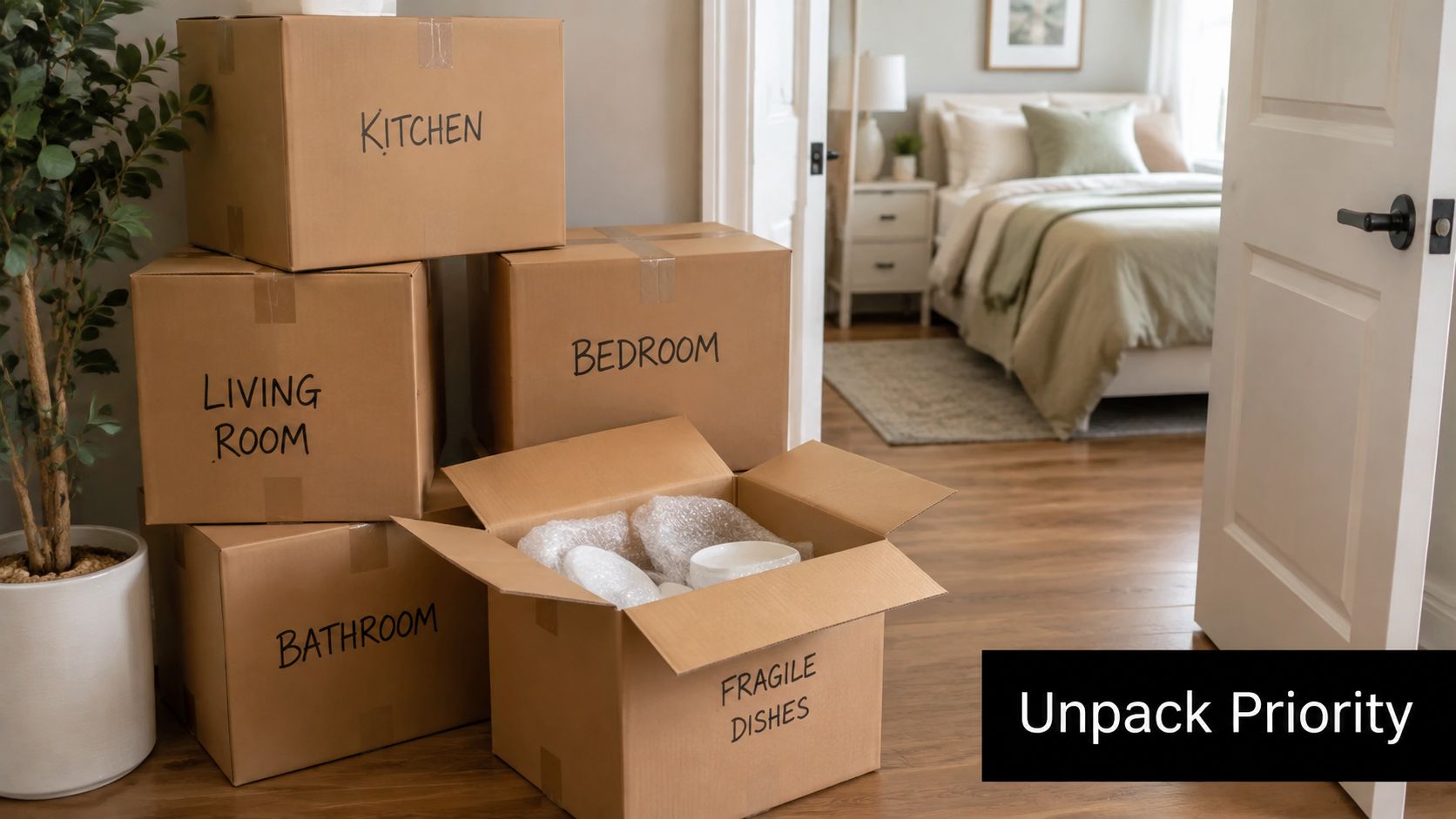
  • Pack an 'Open First' Box: For each room, prepare one box containing critical items you'll need immediately upon arrival. For the bedroom, this might include bedding, a lamp, and phone chargers. For the bathroom, it would be toilet paper, towels, and essential toiletries.
  • Leave Key Rooms for Last: The kitchen, main bedroom, and primary bathroom should be the last rooms you pack. This ensures you can live comfortably in your home for as long as possible before the move.

By adopting a structured, room-by-room approach, you establish an organised foundation for your entire move.

2. The Essentials Box Strategy

After a long and physically draining moving day, the last thing you want to do is hunt through dozens of unidentified boxes for a toothbrush or phone charger. The essentials box strategy, also known as a 'First Night Box', is a game-changing packing tip for moving house that solves this problem. It involves preparing one or more specific boxes containing everything your family will need to comfortably get through the first 24 to 48 hours in your new home, preventing stress and frantic searching. This simple but highly effective method is endorsed by professional movers for its ability to create a smooth transition.

The Essentials Box Strategy

This dedicated box ensures all immediate necessities are in one easy-to-find place. Instead of unpacking under pressure, you can focus on getting settled and resting. A critical piece of advice is to keep this 'survival kit' with you in your personal vehicle rather than on the moving truck. This guarantees you have access to your critical items the moment you walk through the door of your new property.

How to Implement This Method

To create an effective essentials box, focus on immediate needs and comfort:

  • Label it Clearly: Use a brightly coloured marker or label to write "OPEN FIRST" or "ESSENTIALS" in large letters on all sides of the box. Using a clear plastic tub is even better, as it allows you to see the contents at a glance.
  • Include Personal Basics: Pack one change of clothes and pyjamas for each family member. Crucially, include essential toiletries like toothbrushes, toothpaste, soap, toilet paper, and any required daily medications.
  • Prepare for Simple Meals: Moving day is not the time for gourmet cooking. Include paper plates, cups, utensils, a kettle, instant coffee or tea bags, and some non-perishable snacks like muesli bars or pasta and a jar of sauce.
  • Pack Key Tools and Supplies: A small toolkit with a screwdriver and Allen keys, a torch, phone chargers, and basic cleaning supplies (paper towels, multipurpose spray) will prove invaluable for immediate tasks and clean-ups.

3. The KonMari Decluttering-While-Packing Method

Moving house presents a rare opportunity not just to relocate your belongings, but to reset your entire living space. The KonMari method, popularised by organising consultant Marie Kondo, integrates intentional decluttering directly into the packing process. Instead of mindlessly transferring every item you own, this approach encourages you to pause and evaluate each possession, asking if it truly "sparks joy" or serves a genuine purpose in the life you're building in your new home. This transforms a logistical chore into a meaningful fresh start, ensuring you don't bring old clutter into a new chapter.

This philosophy is one of the most transformative packing tips for moving house because it drastically reduces the volume of items you need to pack, move, and unpack. Downsizing families have been known to reduce their belongings by up to 40%, saving significantly on removalist costs and starting life in their new, smaller space with only the things they love and need. It shifts the focus from simply moving stuff to curating your ideal home environment from the very beginning.

How to Implement This Method

To effectively merge decluttering with packing, follow these practical steps:

  • Start Well in Advance: Begin the decluttering process at least two to three months before your moving date. This provides ample time to make thoughtful decisions without the pressure of a looming deadline.
  • Work by Category, Not Room: Unlike the one-room-at-a-time method, KonMari suggests tackling categories (e.g., all clothes, all books, all kitchenware). Gather every item from a single category into one spot to grasp the true volume of what you own before making decisions.
  • Ask the Right Questions: For each item, hold it and ask yourself: "Does this spark joy?" and "Will I realistically use this in my new home?" If the answer is no, it's time to let it go.
  • Plan Your Disposals: Organise your unwanted items into distinct piles: sell, donate, and discard. Schedule a donation pick-up in advance and list valuable items on platforms like Facebook Marketplace early on to maximise your chances of a sale.
  • Consider Costs: For items you're unsure about, weigh the cost of moving and storing them against the cost of replacing them. Often, it's more economical to let go of a bulky, rarely used item than to pay to move it.

By adopting this mindful approach, you lighten your physical load and your mental space. If you want to dive deeper, our complete guide explains how to declutter before you move with a step-by-step plan.

4. The Wardrobe Box Technique

Folding every single piece of clothing in your closet is a tedious and time-consuming task. The wardrobe box technique is a professional-grade solution that bypasses this process entirely. These specialised, tall boxes feature a built-in hanging bar, allowing you to transfer clothes directly from your closet to the box, still on their hangers. This method is a cornerstone of efficient packing tips for moving house, as it prevents wrinkles, saves immense time on both packing and unpacking, and protects delicate garments.

The Wardrobe Box Technique

This technique transforms unpacking from a chore into a simple, swift action. Instead of facing piles of clothes to fold or re-hang, you simply move the hangers from the wardrobe box directly into your new closet. It’s particularly valuable for protecting business attire, formal wear, or delicate fabrics, ensuring they arrive at your new home in pristine, ready-to-wear condition.

How to Implement This Method

To make the most of this professional packing secret, follow these practical steps:

  • Source Your Boxes: While you can purchase wardrobe boxes, many professional removalists offer them for hire, which is a more cost-effective and sustainable option for a single move.
  • Organise by Type: Group similar clothing items together in each box. For example, dedicate one box for work shirts and blouses, another for dresses, and a third for jackets. This makes finding specific items much easier.
  • Utilise the Bottom Space: The bottom of a wardrobe box is the perfect spot for lightweight, bulky items like shoes, purses, or even pillows and folded sweaters. This maximises space and provides a soft base for your hanging clothes.
  • Choose Sturdy Hangers: Before packing, swap out flimsy wire hangers for more durable plastic or wooden ones. They provide better support and are less likely to bend or break during transit, keeping your clothes secure.

5. The Sandwich Method for Dishes and Fragiles

Protecting your fragile kitchenware, like dishes and glassware, is often one of the most stressful parts of any move. The Sandwich Method is a professional-grade technique that dramatically reduces the risk of breakage. It involves creating cushioned layers around each fragile item, much like making a sandwich, to absorb shock and prevent items from clashing during transit. This is one of the most crucial packing tips for moving house, transforming a box of potential shards into a securely protected package.

This method, used by professional movers, ensures that each plate, bowl, and glass is individually protected and stabilised within the box. By creating a system of padding at the bottom, between each item, and on top, you effectively build a shock-absorbing nest that guards against bumps and vibrations on the road.

How to Implement This Method

Follow these steps to pack your breakables like a professional:

  • Prepare Your Box: Start by creating a thick, cushioned base inside a small (1.5 cubic foot) moving box. Use several sheets of scrunched-up packing paper or bubble wrap to form a protective layer at least 5-7 cm thick.
  • Wrap and Layer: Wrap each dish or fragile item individually in packing paper. For plates and bowls, place them on their sides vertically in the box, like records in a crate. Slide a piece of cardboard or extra padding between each one.
  • Use Dividers for Glassware: For wine glasses and stemware, use cell-divider kits specifically designed for moving boxes. Stuff crumpled paper inside each glass before wrapping it to provide internal support.
  • Fill the Gaps: Once your items are in the box, fill any empty spaces with more crumpled paper, towels, or soft linens. Nothing should be able to shift or move when you gently shake the box.
  • Add the Top Layer: Finish by adding another thick layer of crumpled paper or bubble wrap on top before sealing the box. Clearly label the box "FRAGILE" on all sides and the top, with arrows indicating which way is up.

This infographic outlines the simple three-step process for creating a secure package using the Sandwich Method.

Infographic showing key data about The Sandwich Method for Dishes and Fragiles

Following this sequence of padding the bottom, placing items vertically with dividers, and padding the top ensures maximum protection.

6. The Heavy-to-Light Box Loading Strategy

A fundamental principle of physics and professional packing, the heavy-to-light box loading strategy is crucial for a safe and successful move. This method involves placing the heaviest items at the bottom of a moving box and layering progressively lighter items on top. It’s a time-tested technique used by professional removalists to create stable, balanced boxes that are less likely to collapse, tip over, or cause damage to their contents. Adopting this strategy is one of the most effective packing tips for moving house, as it protects your belongings and makes handling boxes much safer.

This simple weight distribution principle prevents delicate items from being crushed by heavier objects during transit. A well-balanced box is also easier and safer to lift, carry, and stack, reducing the risk of personal injury or dropped boxes. By ensuring each box has a low centre of gravity, you create a solid foundation for stacking in the moving truck, maximising space and preventing shifts that could lead to breakages.

How to Implement This Method

To properly balance your boxes, follow these practical steps:

  • Establish a Solid Base: Always start by placing your heaviest items at the bottom of the box. For a kitchen box, this means packing pots, pans, or small appliances first. For a study, this would be hardcover books or paper files.
  • Layer Lighter Items: Continue packing by adding medium-weight items, finishing with the lightest objects at the very top. For instance, place dish towels or plastic containers on top of the heavy pots in a kitchen box.
  • Use Small Boxes for Heavy Loads: When packing items that are uniformly heavy, like a collection of books, always use a small box. This prevents the box from becoming too heavy to lift safely—a common yet dangerous mistake.
  • Fill the Gaps: Use soft, lightweight items like linens, socks, or packing paper to fill any empty spaces. This stops items from shifting and provides extra cushioning. You can avoid many of the top 10 common packing mistakes when moving home by ensuring every box is packed firmly.

7. The Colour-Coding and Detailed Labeling System

Turning a mountain of brown boxes into a logically organised system is one of the most powerful packing tips for moving house. This method uses coloured markers, tape, or stickers combined with detailed labels to create an instant visual guide for your belongings. Each room is assigned a unique colour, allowing anyone helping with the move to know exactly where a box belongs without reading a single word, dramatically speeding up the unloading process.

This system is a favourite of professional organisers and moving companies for good reason. It removes guesswork and confusion on moving day, empowering movers and helpers to place every box in its designated room efficiently. When paired with detailed content lists on each label, it transforms unpacking from a chaotic treasure hunt into a streamlined, room-by-room task.

How to Implement This Method

To put this highly effective strategy into action, follow these practical steps:

  • Create a Master Key: Before you pack a single box, assign a colour to each room in your new home (e.g., blue for the main bedroom, red for the kitchen). Post a clear, printed copy of this colour key at the entrance of your new home for your moving team to reference.
  • Use Durable, Visible Materials: Coloured duct tape or large, high-quality stickers are ideal as they are easily visible from a distance and adhere well to cardboard. Ensure you label boxes on the top and at least two sides so they can be identified even when stacked.
  • Be Specific with Labels: Your written labels should be as detailed as possible. Instead of just "Kitchen," write "Kitchen – Kettle, Toaster, Coffee Mugs." Add handling instructions like "FRAGILE" or "THIS SIDE UP" where necessary.
  • Number Your Boxes: For an extra layer of organisation, number each box (e.g., "Kitchen 1 of 15," "Kitchen 2 of 15") and keep a corresponding inventory list. This makes it easy to check that everything has arrived safely.

8. The Suitcase and Container Strategy

Why pay for empty space? The suitcase and container strategy is an incredibly efficient packing tip for moving house that leverages items you already own and plan to move. Instead of packing empty suitcases, laundry baskets, and storage tubs, this method involves using them as packing containers themselves. This common-sense approach reduces the number of cardboard boxes you'll need, saves money, and makes clever use of every available bit of space in the moving truck.

This strategy protects your containers from damage during transit while simultaneously housing soft, non-breakable items like clothes, linens, and towels. It's a sustainable and budget-friendly technique that simplifies the entire process. By filling these vessels with items destined for the same room (e.g., a laundry basket with bathroom towels), you also make unpacking a more organised and intuitive task.

How to Implement This Method

To put this space-saving strategy into action, follow these practical steps:

  • Use Suitcases for Soft Goods: Pack rolling suitcases with off-season clothing, spare bedding, and pillows. The wheels make them easy to transport, even when heavy, and the soft contents provide a protective cushion.
  • Fill Baskets and Hampers: Use laundry baskets and hampers to transport towels, children’s toys, or shoes. They are perfect for last-minute items you’ll need right up until moving day.
  • Utilise Dresser Drawers: For lightweight items like socks, underwear, and t-shirts, you can often leave them in the dresser drawers. Secure the drawers with stretch wrap or painter's tape to prevent them from sliding open during the move. For heavier furniture, it's best to remove the drawers first.
  • Label Everything: Even though it's not a box, a suitcase or storage tub still needs a clear label. Use luggage tags or a piece of masking tape to note the contents and the destination room (e.g., "Main Bedroom – Jumpers & Scarves"). This ensures movers place it correctly and you know what’s inside.

Packing Strategies Comparison: 8 Key Methods

Method Implementation Complexity 🔄 Resource Requirements ⚡ Expected Outcomes 📊 Ideal Use Cases 💡 Key Advantages ⭐
The One-Room-at-a-Time Method Moderate 🔄🔄 Moderate (labels, boxes) ⚡ Organized unpacking, manageable progress 📊 Multi-room homes, phased packing Reduces overwhelm, easy progress tracking ⭐
The Essentials Box Strategy Low to Moderate 🔄 Low (one/two boxes with essentials) ⚡ Immediate access to necessities, stress reduction 📊 Moves with children, pets, or first night needs Prevents frantic searching, ensures comfort ⭐
The KonMari Decluttering-While-Packing High 🔄🔄🔄 Variable (time-intensive) Less clutter, lower moving costs, fresh start 📊 Downsizing, major decluttering, long-distance moves Reduces volume/costs, easier unpacking ⭐
The Wardrobe Box Technique Low to Moderate 🔄 High (special wardrobe boxes rental/purchase) ⚡ Wrinkle-free clothes, fast unpacking 📊 Moving formal wear, large wardrobes Protects clothes, saves ironing ⭐
The Sandwich Method for Dishes & Fragiles Moderate to High 🔄🔄 High (packing materials) Minimal breakage, safe fragile items 📊 Packing dishes/fragile collections Great protection, cost-effective DIY ⭐
The Heavy-to-Light Box Loading Strategy Low 🔄 Low (small boxes, tape) Stable boxes, safer lifting 📊 All packing situations, especially manual loading Prevents damage, safer to carry ⭐
The Color-Coding and Detailed Labeling System Moderate 🔄🔄 Low to Moderate (colored tape, labels) ⚡ Fast unloading, easy identification 📊 Large moves with helpers, multi-room unpacking Speeds unpacking, reduces confusion ⭐
The Suitcase and Container Strategy Low 🔄 Low (uses existing containers) ⚡ Efficient packing, fewer boxes, less waste 📊 Budget moves, short-distance, eco-friendly relocations Saves money, reduces waste, uses existing containers ⭐

From Packed Boxes to Your New Front Door

Mastering these packing tips for moving house is your first and most crucial step toward a successful, stress-free relocation. The journey from a fully lived-in home to a new, empty space can feel monumental, but by implementing strategic systems, you transform chaos into an organised, manageable process. You're not just moving belongings; you're orchestrating a smooth transition into your next chapter.

Let’s recap the core strategies that will revolutionise your move:

  • Systematic Decluttering: The KonMari method ensures you only move what you truly value, saving time, money, and energy.
  • Prioritised Unpacking: The Essentials Box is your first-night saviour, providing immediate access to necessities without the need to tear through dozens of boxes.
  • Strategic Organisation: A detailed, colour-coded labelling system turns unpacking from a guessing game into a streamlined activity, allowing you to settle in faster.
  • Damage Prevention: Techniques like the Sandwich Method for dishes and the Heavy-to-Light box loading strategy are fundamental to protecting your valuables and ensuring everything arrives in one piece.

By adopting these approaches, from dedicating focus with the one-room-at-a-time method to utilising every available container, you lay the groundwork for an efficient move day and a far more enjoyable unpacking experience. An organised pack is the foundation upon which a smooth move is built.

Ultimately, the goal of these packing tips is to empower you with control over a process that can often feel overwhelming. Once your items are packed using these expert tips, the next critical step is ensuring they are transported safely. While careful packing is essential, remember that the heavy lifting, logistical planning, and safe transport are best left to professionals. This allows you to focus on the excitement of your new beginning, secure in the knowledge that your carefully prepared belongings are in safe hands. The effort you invest in packing now will pay dividends, welcoming you into your new property with calm and order, not clutter and confusion. For help finding reliable movers, resources like local moving companies can be a good starting point.


Ready to turn your organised packing into a seamless move? Trust the experienced, family-owned team at Get n Go Removals Melbourne to handle the heavy lifting. We offer everything from premium packing materials to full-service valet packing and unpacking, ensuring your carefully packed items arrive safely at your new Melbourne home or interstate destination.

READ MORE

Your Ultimate Guide to Choosing Movers in Melbourne

Planning a move in Melbourne? The first crucial step is finding professional movers Melbourne locals trust and recommend. At Get n Go Removals, we've built our reputation on providing an expert, reliable moving service specifically tailored to handle this city's unique challenges. From navigating inner-city laneways to coordinating suburban relocations, we deliver a seamless experience, ensuring your move is smooth from start to finish.

Why Melbourne Is a Magnet for Movers

There's no denying it – Melbourne has a magnetic pull. It consistently attracts people from all over Australia and the globe, and for good reason. Its vibrant culture, diverse job market, and unbeatable lifestyle make it a top destination for those seeking new opportunities and an enhanced quality of life. But what exactly makes this city such a hotspot for relocation?

The magic lies in its perfect blend of economic energy and cultural richness. Melbourne frequently ranks as one of the world's most liveable cities, a reputation that speaks for itself. This constant influx of new residents creates a dynamic, competitive environment for both moving and housing, making expert guidance essential.

The Impact of Rapid Population Growth

Melbourne's growth isn't just a slow trickle; it's a powerful current. Recently, Melbourne reclaimed its title as Australia's fastest-growing city, adding over 130,000 new residents in the last year alone. This surge has had a direct knock-on effect on the moving and real estate markets, pushing rental demand sky-high and causing vacancy rates to plummet.

What does this population boom mean for you? It means planning your move requires meticulous coordination. Securing a reliable moving company well in advance is no longer just a good idea—it's absolutely essential for a stress-free transition.

Navigating Melbourne's Unique Moving Challenges

Moving in Melbourne is unlike moving anywhere else. It presents a unique set of logistical puzzles that only seasoned local movers know how to solve efficiently. The city's landscape is incredibly varied, and each area presents a different set of challenges.

Consider the complexities involved:

  • Inner-City Laneways: Those charming Melbourne laneways? They are often too narrow for a standard moving truck, requiring smaller vehicles and strategic planning.
  • High-Rise Apartments: A move in the CBD or Southbank typically involves coordinating with building managers, booking service lifts, and navigating tight loading zones.
  • Suburban Sprawl: Moving to expansive suburbs like Point Cook or Cranbourne means factoring in longer travel times and potential traffic congestion.
  • Heritage Homes: Older properties in suburbs like Fitzroy or Carlton often feature narrow staircases and delicate architectural details that demand a specialised, careful touch.

At Get n Go Removals, we thrive on these challenges. Our deep local knowledge means we anticipate these obstacles and have proven solutions ready. We transform potential moving-day chaos into a smooth, streamlined operation.

Our team’s familiarity with every corner of Melbourne is your greatest asset. For anyone planning a move, our ultimate guide to relocating to Melbourne offers even more local insights to help you prepare. We understand Melbourne's rhythm, and we use that expertise to ensure your belongings arrive safely and efficiently, no matter which part of this incredible city you choose to call home.

Choosing the Right Moving Service for Your Needs

Image

It’s a simple truth in our line of work: no two moves are ever the same. A student moving out of a studio apartment has vastly different needs than a family of five relocating to a larger home. That’s why selecting the right service from your chosen movers Melbourne is the critical first step towards a smooth, stress-free day.

Think of it as choosing the right tool for the job. You wouldn't use a small hammer to break up concrete; you need equipment built for the task. At Get n Go Removals, we’ve structured our services around this principle, ensuring we have the perfect solution for your unique situation.

Residential Moves for Every Home

Whether you’re in a high-rise city apartment or a sprawling suburban house, we have a residential moving service to match. We understand the specific requirements of Melbourne’s diverse property types and plan every move accordingly.

  • Apartment Relocations: We are experts at navigating tricky stairwells, coordinating service lift bookings, and adhering to the strict rules set by building management—common hurdles in inner-city moves that we handle daily.
  • Large Family Homes: For larger moves, we dispatch bigger trucks and a larger crew to ensure everything can be transported in a single, efficient trip, saving you both time and money.

Our approach is to perfectly match the crew size and vehicle to your specific needs. This is the key to an efficient and cost-effective move, every single time.

Specialised Office and Commercial Relocations

Moving an office is an entirely different challenge. It’s not just about relocating desks and chairs; it’s about minimising downtime so your business can resume operations as quickly as possible. Every hour of disruption impacts your bottom line, and we take that responsibility seriously.

Our commercial relocation teams are specialists in meticulous planning and execution. We work with you to create a detailed moving schedule, often after hours or over a weekend, to ensure your daily operations are not interrupted. We handle everything—from packing sensitive IT equipment to dismantling and reassembling office furniture—so your team can arrive on Monday morning ready to work.

A successful business move is measured in hours, not days. Our strategic approach ensures your company experiences the smoothest possible transition, protecting your productivity and profitability.

Handling Fragile Items and Antique Furniture

Some possessions are more than just objects; they are irreplaceable memories or valuable investments. Moving antique furniture, precious artwork, or delicate family heirlooms requires a level of care that goes far beyond standard moving practices.

Our teams are professionally trained in specialised packing and handling techniques for these exact items. We use premium materials like custom crating, heavy-duty blankets, and shock-absorbent padding to provide maximum protection. Every high-value piece is treated with the respect it deserves, ensuring it arrives at your new location in pristine condition.

For a deeper dive into what distinguishes a professional service, explore our guide on choosing the right removals firm for your move. By understanding your specific needs—whether residential, commercial, or specialised—we can deliver a service that provides complete peace of mind.

How Much Do Movers Cost in Melbourne?

Understanding the cost of your move shouldn't be a mystery. When searching for movers Melbourne residents trust, clear and transparent pricing is a key indicator of professionalism. The final figure on your quote is not arbitrary; it's carefully calculated based on the specific details of your relocation.

Let's demystify moving quotes. Most professional movers in Melbourne charge an hourly rate, which covers the labour of the moving team and the use of their truck. However, the total cost is a combination of several key factors, each contributing to the final price.

Key Factors That Influence Your Moving Quote

At its core, the cost of your move is determined by the size and complexity of the job. It’s logical: a large family home will naturally require more time and manpower to move than a compact one-bedroom apartment.

Here are the primary factors that shape your final quote:

  • Number of Movers: The crew size is a significant factor. A two-person team is typically ideal for smaller moves, such as a one or two-bedroom apartment. For larger family homes, a three or four-person team can complete the job more efficiently, often saving you money in the long run.
  • Truck Size: We pride ourselves on matching the truck to the move. A truck that’s too small leads to wasted time and money on multiple trips, while one that’s too large is inefficient. We will select the appropriate size for you, whether it's a 4.5-tonne truck for a smaller job or a robust 12-tonne truck for a major move.
  • Distance of Relocation: The travel time between your old and new properties is a crucial component. Since the hourly rate applies while the truck is in transit, moves within the same suburb will naturally be more affordable than those that involve crossing the city.
  • Specialty Items: Do you have a piano, a pool table, or a fragile antique cabinet? These large or delicate items require special equipment and extra care to move safely. The additional skill and time needed can influence the overall cost.

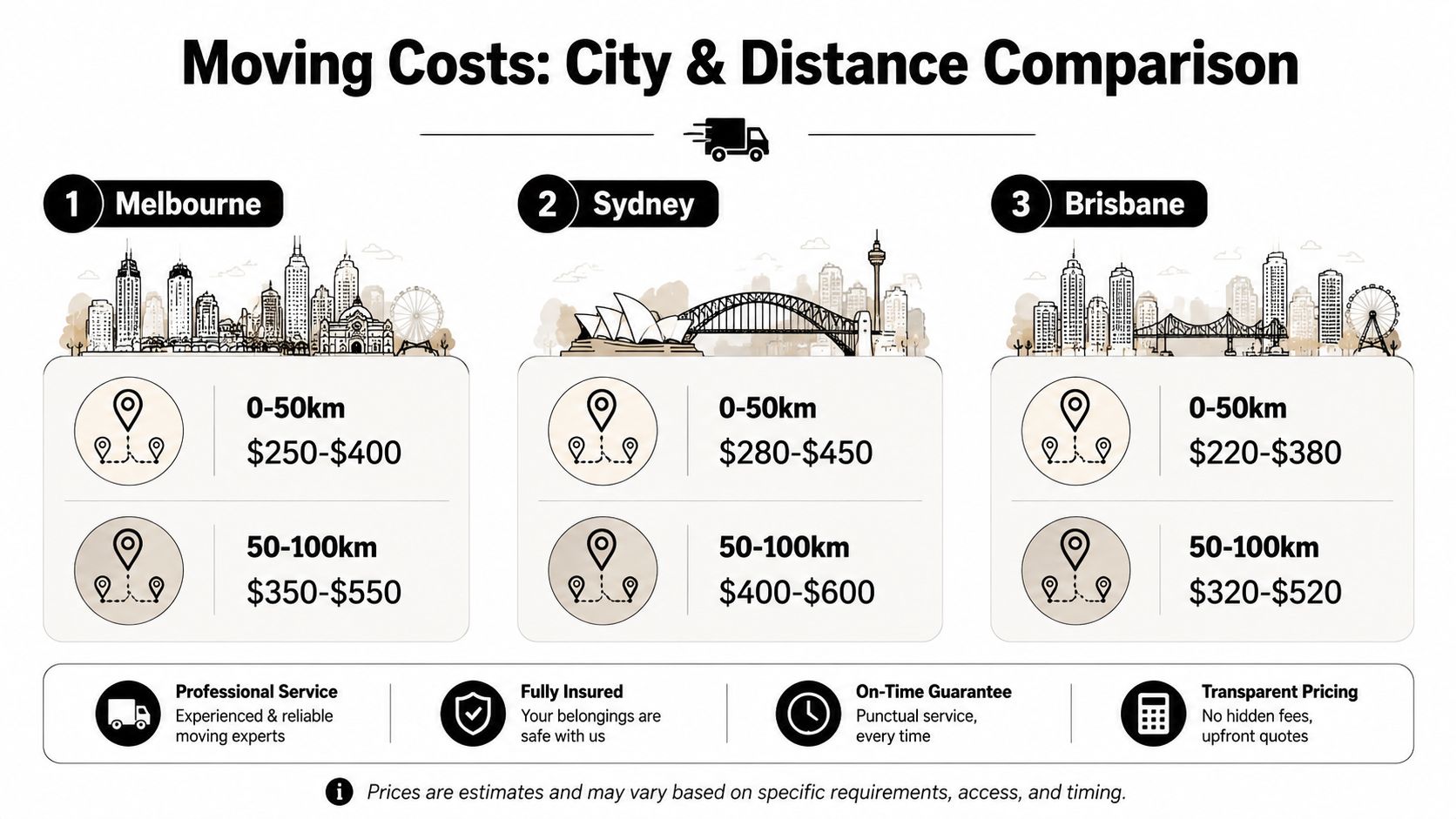
This image provides a helpful breakdown of average costs for different moving services across Melbourne, giving you a clearer picture of where your money goes.

Image

As you can see, long-distance moves represent a larger investment due to the extended time on the road. Conversely, professional packing services are a surprisingly affordable way to save yourself a significant amount of stress and ensure your belongings are securely packed.

Sample Moving Cost Scenarios in Melbourne

To give you a clearer idea of what to expect, here are some sample moving scenarios. Remember, these are estimates to help you budget. Your actual cost will depend on the unique details of your move, but this table serves as a great starting point.

Move Type / Property Size Estimated Hours Number of Movers Typical Truck Size Estimated Cost Range (AUD)
Studio / 1 Bedroom Apt 2 – 4 hours 2 4.5 Tonne $340 – $680
2 Bedroom House/Apt 4 – 6 hours 2 6.5 Tonne $680 – $1,020
3 Bedroom House 5 – 7.5 hours 3 8 Tonne $1,040 – $1,520
4+ Bedroom House 7 – 11+ hours 3-4 10-12 Tonne $1,485 – $2,640+

These scenarios illustrate how factors like property size and the number of movers directly impact the time and, consequently, the final cost. A well-planned move with the right-sized team is always the most cost-effective strategy.

Unpacking Potential Extra Costs

Any reputable mover will be completely transparent about potential extra costs. It’s crucial to be aware of these possibilities so you can budget accurately and avoid any unwelcome surprises on moving day.

Common additional charges may include:

  • Packing Materials: If you require us to supply boxes, bubble wrap, or packing paper, this will be an additional cost.
  • Stair or Lift Fees: Difficult access, such as multiple flights of stairs or a slow service lift, can be more labour-intensive and may incur a small fee for the extra work involved.
  • Storage: If you need to store your belongings for a period before moving into your new home, we can arrange this, and it will be quoted as a separate service.

For a comprehensive breakdown of the numbers, you can learn more about how much moving houses costs in Melbourne in our detailed guide. When you understand the components of your quote, you can fully appreciate the value and peace of mind that comes from hiring genuine professionals who prioritise clarity.

Your Essential Pre-Move Checklist

A successful move is organised long before our truck arrives at your door. The secret? Effective planning. By breaking down the process into smaller, manageable tasks, you can avoid last-minute panic and ensure moving day proceeds without a hitch.

Think of the weeks leading up to your move as a countdown. This checklist is your game plan, guiding you from the initial stages right through to the big day. Following a simple timeline transforms an overwhelming job into a series of small, achievable wins.

Eight Weeks Before Your Move

This is the foundational stage. Your primary goal is to set yourself up for an easier process in the coming weeks. It's the perfect time to declutter and make key decisions that will simplify everything later.

  • Declutter Ruthlessly: Go through every room and decide what to keep, donate, sell, or discard. Less stuff means a faster, cheaper move.
  • Book Your Movers: This is critical. Reputable movers Melbourne teams, like us at Get n Go Removals, get booked solid weeks in advance, especially during peak season. Lock in your date now for complete peace of mind.
  • Create a Moving Folder: Use a physical or digital folder to keep all your quotes, receipts, and important documents in one accessible place.

Four Weeks To Go

With the major decisions made, it's time to get practical. This is when you'll begin packing non-essentials and managing the administrative tasks associated with moving.

Start gathering your packing supplies—boxes, tape, markers, and bubble wrap. Begin packing items you don't use daily, such as books, off-season clothing, and decorative objects. This is also the time to notify important contacts and services of your change of address.

Pro Tip: Label every box with its contents and the room it belongs to. It may seem tedious, but it is an absolute game-changer for a fast, stress-free unpacking process in your new home.

Two Weeks Until Moving Day

The move is now feeling very real. Your focus should be on finalising arrangements and completing the bulk of your packing.

  • Notify Utility Providers: Contact your electricity, gas, and internet providers to arrange for disconnection at your old property and connection at your new one.
  • Update Your Address: Inform your bank, insurance companies, subscription services, and government bodies like the Australian Electoral Commission of your new address.
  • Confirm with Movers: Give your moving company a quick call to reconfirm all details—arrival time, addresses, and any special instructions.

The Final Week

You're in the home stretch. It's time to focus on the essentials and prepare for the day itself. The goal is to be completely ready when our team arrives. For more specific advice, check out our guide on what you should do the night before your movers arrive.

  1. Pack an 'Essentials' Box: This is non-negotiable. Pack a box with everything you'll need immediately upon arrival: toiletries, a change of clothes, medications, phone chargers, kettle, mugs, and key documents. Keep it separate.
  2. Finish Packing: Aim to have every box packed and sealed, leaving out only what you'll need for the last 24 hours.
  3. Prepare Appliances: Ensure your fridge and freezer are empty, clean, and defrosted. Disconnect your washing machine correctly.

By following this timeline, you can transform a potentially stressful experience into a controlled and organised relocation.

What Makes Get n Go Removals Different?

In a city buzzing with activity, choosing from the many movers Melbourne has to offer can feel overwhelming. Many companies make similar promises, but the true test of their service comes on moving day. It’s not just about physical strength; it’s about reliability, efficiency, and a genuine commitment to caring for the people and possessions entrusted to them.

At Get n Go Removals, this philosophy is at the heart of our operations. We understand that we're not just moving boxes; we're helping you transition your life from one chapter to the next. This principle guides everything we do, from the initial quote to placing the last piece of furniture in your new home. It’s our promise to you: a seamless move, backed by years of hands-on Melbourne experience.

Rock-Solid Reliability in a Bustling City

Melbourne's rapid growth presents unique moving-day challenges. The city is a highly sought-after destination, with internal migration trends showing it’s Australia’s number one choice. Recent data from a national booking platform revealed that a staggering 28% of all metro inbound moving enquiries were for Melbourne, significantly outpacing Sydney and Brisbane. You can explore the full Australian moving and migration statistics to see the complete picture.

This boom is great for the city, but it places a strain on logistics, making a dependable moving partner more critical than ever.

This is where we excel. We anticipate Melbourne's challenges and plan accordingly.

  • Beating the Traffic: Our drivers know Melbourne's traffic patterns intimately. They choose the best routes to avoid common bottlenecks, saving you valuable time and money on your hourly rate.
  • Sorting Out Building Access: Whether it's coordinating with a strict CBD high-rise manager or navigating a narrow Fitzroy laneway, our crews arrange all access requirements in advance to prevent delays.
  • Punctuality is Key: We respect your schedule. Our teams arrive on time, fully equipped and briefed, ready to get to work immediately.

Smart Efficiency That Saves You Time and Money

Efficiency is about working smart, not just fast. Our experienced crews are logistics professionals, trained to handle every aspect of your move with precision. Over the last decade, we have refined our methods to ensure every move is executed perfectly, keeping your belongings safe while completing the job quickly.

We believe a great move is one that feels effortless for our clients. It’s our job to manage the complexities behind the scenes, so you can focus on the excitement of your new beginning.

This means we consider every detail. We expertly load the truck to protect fragile items and can efficiently disassemble and reassemble your furniture. We don't just lift and carry; we plan and execute a moving strategy tailored to your exact needs, ensuring your move is both cost-effective and secure.

Genuine Care for Your Peace of Mind

Ultimately, what truly sets us apart is our people. Our team consists of full-time, police-checked professionals who are dedicated to making your move a positive experience. We support our exceptional team with practical measures like transparent, upfront pricing and comprehensive transit insurance.

It's this combination of a skilled crew, strategic planning, and a genuine focus on your satisfaction that makes Get n Go Removals the right choice. We are here to be your trusted partner for a secure, successful, and stress-free move in Australia's fastest-growing city.

Moving Beyond Melbourne's CBD

While Melbourne's city centre has a magnetic pull, an increasing number of people are discovering the appeal of life beyond the CBD. We're observing a significant shift as Melburnians look towards spacious suburbs and picturesque regional towns for a different pace of life. This is not just a fleeting trend; it's a lifestyle evolution that presents new challenges for moving.

Relocating to places like Geelong, Ballarat, or the Mornington Peninsula requires more than just a larger truck—it's a different logistical operation entirely. A local move in Fitzroy might take a few hours, but a regional relocation is a full-day project that demands sharp planning, intelligent route-finding, and solid scheduling from the start. As experienced movers Melbourne specialists, we have every corner of Greater Victoria covered.

The Nuances of Regional Relocations

Moving outside the metropolitan area introduces complexities not typically encountered in a standard suburban job. The travel time alone means every minute is crucial, and our pricing is structured to reflect the dedicated crew and vehicle your move requires for the day.

Instead of a simple hourly rate, a regional move typically receives a custom quote that factors in several key elements:

  • Travel Time: The drive to and from your new regional home is a significant part of the day. We meticulously map out the most efficient routes to minimise time on the road.
  • Fuel Costs: Longer distances naturally consume more fuel, and we incorporate this into your quote with full transparency.
  • Dedicated Crew: For a regional move, our team is exclusively assigned to your job for the entire day, ensuring their undivided attention is on getting you moved and settled.

Catering to the Great Regional Shift

This trend of moving to regional areas is happening across Australia. We've witnessed a massive migration from capital cities to regional hubs, which has reshaped the removals industry. Areas like Greater Geelong, for instance, have welcomed a huge influx of new residents. A lifestyle-driven move like this requires a team that understands the unique demands of a longer-distance job. You can read more about this great regional migration across Australia to understand the scale of this movement.

Moving to a regional area is an exciting new chapter, but one where flawless logistics are absolutely critical. Our extensive experience in Victorian relocations means that whether you're heading to the coast, the country, or a bustling regional city, your move will be handled with precision.

Our expertise is not limited to a few popular towns. We have the team and the experience to manage moves right across the state. You can see the full extent of our coverage by exploring the areas we service and discovering how we can help make your big move a reality. We'll handle the complex logistics so you can focus on the excitement of starting fresh, wherever in Victoria that may be.

Your Melbourne Moving Questions Answered

Image

To conclude, we've compiled answers to some of the most common questions we receive from people planning a move. Getting clear, honest answers helps you feel confident and fully informed when you book with professional movers Melbourne locals depend on.

Consider this a final checklist to address any remaining questions. Our goal is to ensure you have all the information you need to feel prepared and ready for a seamless moving day.

How Far in Advance Should I Book Movers in Melbourne?

Our best advice is to book your movers at least 4-6 weeks in advance. This is especially important if you are moving during the peak season (October to March) or on a weekend. High-quality Melbourne removalists get booked up quickly during these periods.

Securing your spot early not only helps you avoid disappointment but also gives you the time to focus on other aspects of your move. For a mid-week or off-season move, 2-3 weeks' notice might suffice, but booking earlier is always the smarter, less stressful option.

Booking in advance isn't just about securing a spot; it's about solidifying your plan. It allows you to concentrate on packing and preparation, knowing the most critical part of your move is already in professional hands.

What if Something Gets Damaged During the Move?

We understand that your belongings are important. Protecting them is our highest priority. Our crew is trained in proper handling techniques, using high-quality packing materials to secure all your items, from large, sturdy furniture to your most delicate possessions.

For complete peace of mind, we have comprehensive transit insurance that covers your belongings in the unlikely event of any mishaps. If something does get damaged, our claims process is simple and straightforward. We will work to resolve the issue for you quickly and fairly, ensuring you are properly looked after.

Do You Disassemble and Reassemble Furniture?

Yes, absolutely. This service is a standard part of our offering. Our teams arrive equipped with the necessary tools to disassemble items like bed frames, dining tables, and bookshelves, and then correctly reassemble them in your new home.

This service simplifies the moving process and helps you get settled in much faster. If you have any particularly complex, custom-made, or antique furniture, please let us know when you book. This allows us to ensure we bring the right specialists and equipment to handle it with the extra care it requires.


Ready to experience a truly smooth and stress-free move? A move where your needs are prioritised? Contact Get n Go Removals today for a clear, no-obligation quote and let our expert Melbourne movers handle all the heavy lifting for you.

Get Your Free Moving Quote Now

READ MORE

Finding Australia’s Best Interstate Removalists: A Complete Guide

Choosing the best interstate removalists in Australia involves more than simply finding the cheapest quote. It’s about entrusting a professional, reliable company to transport your life's possessions safely and efficiently to your new home. The top-tier movers master a critical trifecta: transparent pricing, comprehensive insurance, and exceptional customer service, transforming a potentially stressful ordeal into a seamless transition.

Why Your Choice of Mover is Crucial for a Stress-Free Relocation

An interstate move is a significant life event. The last thing you need is your chosen removalist adding to the stress and complexity. This guide is designed to help you navigate the options and understand what truly distinguishes an average mover from the industry's best. Making the right decision from the outset is the cornerstone of a positive moving experience.

A premier removalist provides more than just logistics; they deliver invaluable peace of mind.

  • Unwavering Reliability: Punctuality and clear, consistent communication are non-negotiable. You need a team that shows up on time and keeps you informed every step of the way.
  • Transparent Pricing: You should receive a detailed, itemised quote upfront, with no hidden fees or surprise charges appearing on the final bill.
  • Exceptional Value: The service should feel worth every dollar, providing confidence that your belongings are handled by dedicated professionals who genuinely care about their work.

A professional removalist carefully wrapping furniture for an interstate move.

Understanding the Current Moving Landscape in Australia

The Australian housing market has undeniably influenced moving trends. With shifts in property affordability and lifestyle priorities, the demand for removalists has changed. Google search interest for movers, for instance, has seen a notable 22% decline since the market peak in 2019.

This trend is closely linked to the housing crisis, which has made it more challenging for many Australians to relocate. This has resulted in one of the quietest periods the moving industry has experienced in two decades. For a deeper analysis of these statistics, the Muval Index 2025 offers comprehensive insights.

Consider this guide your foundational resource for making an informed decision. We will equip you with the essential questions to ask and the critical red flags to avoid, empowering you to secure a smooth, drama-free move. For additional advice on managing the emotional side of relocating, explore our guide on how to reduce stress when moving home.

How to Decode Removalist Quotes and Costs

Understanding the financial aspect of an interstate move can often feel like the most daunting part. However, by learning what goes into a professional removalist's quote, you can establish a realistic budget and avoid unexpected expenses. A high-quality quote is not just a final figure; it's a transparent breakdown of the entire service you're paying for.

The final cost primarily hinges on two core factors: the volume of your belongings, precisely measured in cubic metres (m³), and the travel distance between your origin and destination. Naturally, relocating a large family home across the country will be more expensive than moving a one-bedroom apartment to a neighbouring state.

Key Factors That Influence Your Final Quote

Beyond the size and distance of your move, several other variables can significantly impact the cost. It's crucial to consider these factors when you compare quotes from different removal companies.

  • Property Access: Difficult access points, such as a narrow driveway, multiple flights of stairs, or a long walking distance from the truck to your front door, require more time and labour, which will be reflected in the quote.
  • Optional Services: Services like professional packing and unpacking, or short-term storage solutions, are invaluable for saving time and reducing stress, but they are additional costs to factor into your budget.
  • Specialty Items: Pianos, pool tables, large artworks, and fragile antiques require specialised handling, specific equipment, and extra manpower to be moved safely, which increases the cost.

Familiarising yourself with industry terms can also lead to significant savings. A key term to know is backloading. This cost-effective solution involves your items sharing truck space with another consignment on a return journey. If your moving dates are flexible, backloading can be an excellent way to reduce expenses.

A detailed, itemised quote is a hallmark of a professional removalist. Vague estimates often hide extra charges, so always ask for a clear breakdown of every cost involved before you commit.

Estimated Interstate Moving Costs in Australia

To provide a clearer financial picture, interstate moving costs can vary significantly based on your route and the volume of your goods. The table below offers some ballpark figures for popular Australian routes.

Route 2-Bedroom Home (Est. Cost) 3-Bedroom Home (Est. Cost)
Sydney to Melbourne $2,100 – $2,800 $3,500 – $4,900
Melbourne to Brisbane $2,300 – $3,200 $3,800 – $5,300
Sydney to Brisbane $2,175 – $2,900 $3,625 – $5,075
Brisbane to Perth $4,500 – $6,300 $7,500 – $10,500

These figures demonstrate how substantially costs can rise with distance and home size, reinforcing the importance of obtaining multiple, detailed quotes to accurately plan your budget.

Of course, the best way to keep your budget on track is to be vigilant about unexpected fees. It’s well worth learning how to spot and avoid hidden costs in moving house before you sign any contracts.

Vetting Your Movers: A Checklist for Finding a Quality Service

With several quotes in hand, your work is just beginning. Selecting one of the best interstate removalists Australia has to offer requires looking far beyond the price. Not all moving companies operate to the same professional standard, and the last place you want to discover this is on moving day.

A moving company team member with a clipboard, speaking to a customer in front of a moving truck.

Before signing any agreement, it's time to conduct thorough due diligence. Verifying credentials and ensuring proper protections are in place is non-negotiable for a secure, worry-free relocation.

Confirm They Have Comprehensive Insurance

First and foremost is insurance. Any reputable removalist must hold both Public Liability Insurance and Transit Insurance. Public Liability covers accidental damage to property (e.g., a scratched floor or dented wall), while Transit Insurance protects your possessions while they are in transit on the truck.

Moving without this dual-layered protection is an unnecessary and significant risk.

Look for Professional Industry Accreditation

A clear indicator of a high-quality removalist is accreditation from the Australian Furniture Removers Association (AFRA). This is more than just a logo on a website; AFRA members are held to rigorous industry standards.

To earn this accreditation, companies must demonstrate they have adequate insurance, well-maintained vehicles, and properly trained, professional staff. Choosing an AFRA-accredited mover provides an essential layer of assurance that you are dealing with a legitimate and professional operation.

Investigate Their Reputation and Customer Feedback

So, they have the right paperwork. But what is their real-world track record? It's vital to look beyond the hand-picked testimonials on their company website and seek out independent feedback.

  • Analyse online reviews: Dive into independent review platforms like Google and ProductReview. Look for consistent patterns—do multiple reviews praise their communication and punctuality, or are there recurring complaints about delays or damages?
  • Request client references: A reputable company that is proud of its service history will have no issue connecting you with recent clients. Hesitation to provide references is a significant red flag.
  • Assess their customer service: How do they handle your initial enquiry? Are they responsive, clear, and helpful? The quality of their customer service before you've even booked is a strong indicator of the service you'll receive throughout the moving process.

Vetting a removalist is a bit like a job interview. You're trusting them with everything you own, so you have every right to make sure they have the experience, protection, and professionalism for the task.

Taking these extra steps helps you weed out the unreliable operators from the genuine pros. For an even more detailed checklist, check out our guide on choosing the right removals firm for your move. It'll ensure you find a mover who will treat your belongings with the care they deserve.

What People Moving Interstate Actually Care About

The motivations behind interstate relocations are evolving. While a competitive price will always be important, it is no longer the sole deciding factor. Today, Australians are increasingly pursuing a higher quality of life, and they expect their moving experience to be as modern, convenient, and transparent as other services in their lives.

This cultural shift means lifestyle factors—such as community atmosphere, access to green spaces, and genuine long-term affordability—are now primary drivers, often outweighing traditional motivators like a shorter work commute.

The Move Towards Conscious and Convenient Service

As personal priorities evolve, so do consumer expectations. It is no surprise that people now want to partner with companies that align with their values, particularly concerning sustainability. The demand for eco-friendly moving practices is growing.

This translates into tangible preferences, such as:

  • Using recycled boxes or hiring reusable plastic moving crates.
  • Selecting movers who optimise fuel-efficient routes.
  • Preferring digital platforms for obtaining quotes, booking services, and tracking shipments in real-time.

These are not niche requests but indicators of a broader market shift towards more conscious consumerism. Digital tools have become a game-changer, streamlining the entire process from comparing free quotes to booking verified, reliable removalists. You can learn more about these Australian moving house trends to understand how technology and lifestyle are reshaping the industry.

The best interstate removalists in Australia get this. They offer more than just muscle and a truck; they provide a smooth, tech-friendly, and often greener service that meets the real demands of today’s movers.

Ultimately, this evolution benefits anyone planning a move. It is driving the industry towards greater transparency, efficiency, and alignment with what customers truly value—a smooth, stress-free start to their new chapter. A modern removalist doesn't just move your boxes; they understand the why behind your move.

Your Essential Pre-Move Action Plan

A successful interstate move is not a matter of luck; it is the direct result of meticulous planning and preparation. Starting well in advance of moving day is the key to minimising chaos, reducing stress, and maintaining control throughout the process. The secret is to break down the monumental task of moving into smaller, manageable actions.

The first step is to conduct a comprehensive home inventory. This is more than just creating a list; it is the perfect opportunity to declutter. Deciding what to sell, donate, or discard can significantly reduce your moving volume, which directly lowers your quote. Fewer items always result in a faster, more affordable move.

Pack and Label Like a Pro

Strategic packing is your next mission. Avoid random packing; instead, work methodically, room by room. Use high-quality, sturdy boxes and appropriate packing materials to protect fragile items. Crucially, label every box clearly with its contents and its destination room (e.g., "Kitchen – Everyday Glasses" or "Master Bedroom – Linens"). Your future self will thank you for this diligence.

Pro Tip: Always pack a "first-night" essentials box. This should have your toiletries, any medications, a change of clothes, phone chargers, and some basic kitchen supplies like a kettle and mugs. Keep this box with you, not on the truck. It’s a lifesaver when you arrive and are too exhausted to rip open a dozen boxes just to find a toothbrush.

Infographic about best interstate removalists australia

As you can see, getting your inventory, packing, and utilities sorted are the foundational tasks that pave the way for a hassle-free transition. If you're looking for a more detailed schedule, our essential moving home to-do list breaks it all down into a handy timeline.

To help you stay on track, we've put together a simple timeline of the crucial tasks you'll need to tick off in the weeks leading up to your move.

Essential Pre-Move Task Timeline

Timeline Task Status (Checkbox)
8 Weeks Out Research and get quotes from at least three removalists
6 Weeks Out Start decluttering and creating a home inventory
4 Weeks Out Arrange transfer of utilities (electricity, gas, internet)
3 Weeks Out Begin packing non-essential items
2 Weeks Out Organise end-of-lease cleaning and any necessary repairs
1 Week Out Confirm final details with your removalist company
1-2 Days Before Pack your "first-night" essentials box
Moving Day Do a final walkthrough to ensure nothing is left behind

Following a timeline like this helps make sure nothing slips through the cracks during what is already a hectic time.

Finally, don't leave your end-of-lease duties to the last minute. To avoid any dramas with your bond return, it’s a good idea to get a clear picture of what's expected for your exit clean. Reading a Property Managers' guide to exit cleaning requirements can give you some great insight and help you know exactly what needs to be done before you hand those keys back.

Common Questions About Interstate Moving

Moving interstate naturally raises numerous questions. Gaining clear, accurate answers is the first step towards feeling confident and prepared for your relocation. Here, we address some of the most common queries we receive from customers planning a move.

When Should I Book and How Can I Save Money?

One of the most frequent questions is about booking timelines. To secure your preferred dates with a reputable mover, it is highly recommended to book 4-6 weeks in advance.

This buffer is even more crucial if you are moving during a peak season, such as summer or school holidays, as the best removalists get booked up quickly.

Regarding cost savings, the most effective method is often backloading. This is an excellent option where your belongings share space on a truck that is already scheduled for a return trip. This means you only pay for the space you use in one direction. The only trade-off is that you need some flexibility with your pickup and delivery dates.

Here's a pro tip: the absolute best way to lower your moving bill is to simply move less stuff. Have a massive declutter before you even think about packing. Less volume means fewer cubic metres, which directly translates to a smaller final invoice.

What's the Deal With Moving Insurance?

Understanding moving insurance is crucial for protecting your assets. Most professional removalists carry Transit Insurance. However, it's vital to understand its limitations: this policy typically covers catastrophic events like a truck fire, theft, or a major road accident.

What it does not typically cover is accidental damage to an individual item that might occur during handling, packing, or transit.

For complete peace of mind, we always recommend taking out a separate, comprehensive moving insurance policy. Do not hesitate to ask your chosen removalist for a copy of their insurance certificate (Certificate of Currency). This allows you to see exactly what their policy covers and identify any gaps you may need to cover yourself.

If you've got more questions buzzing around, have a look through our detailed list of frequently asked questions about moving.

READ MORE

Your Guide to Short Term Storage in Australia

Think of short term storage as a flexible, temporary home base for your belongings during life's busy transitions. It's the ideal solution for those in-between moments—typically lasting one to three months—offering a secure space for your items without the burden of a long-term contract. In essence, it's a 'pause button' for your possessions, giving you valuable breathing room to navigate your next move.

What is Short Term Storage, and When Do You Need It?

A well-organized short term storage unit with neatly stacked boxes and furniture.

Life is full of moments when your available space and your timeline don't quite align. Whether you're moving house, renovating your office, or simply decluttering to create a more functional living area, short term storage acts as the perfect bridge to get you from A to B stress-free. Unlike long-term options that can lock you into yearly agreements, this solution is built on flexibility.

The concept is beautifully simple: you rent the exact amount of space you need, for precisely how long you need it. This could range from a small locker for a few archive boxes to a large unit capable of holding the contents of an entire family home. This inherent adaptability makes it an incredibly practical tool for resolving temporary logistical challenges.

When Is Short Term Storage the Right Choice?

Countless scenarios can make temporary storage a genuine lifesaver. It’s not just for moving; it’s a strategic way to create space, protect valuable assets, and make complex projects feel significantly more manageable.

This table highlights some of the most common situations where a short term unit proves invaluable.

Situation How Short Term Storage Helps Typical Duration
Moving House or Office Bridges the gap between settlement dates, keeping everything safe if you have to move out before moving in. 1-2 months
Home Renovations Protects furniture and belongings from dust, paint, and damage by getting them safely out of the way. 1-3 months
Decluttering to Sell Creates a clean, spacious look that helps your property sell faster and potentially for a better price. 2-3 months
Seasonal Needs Stores bulky winter gear, patio furniture, or seasonal business inventory until it's needed again. 3-6 months

These situations are increasingly common, which explains why the demand for storage solutions is soaring.

As Australian cities expand, our living spaces are becoming more compact. With 86.6% of Australians residing in urban areas, the need for extra room outside the home has never been more pressing. It's no surprise that this trend has propelled the Australian self-storage market to a value of USD 1.2 billion in 2024, with forecasts indicating continued robust growth. You can learn more about the factors driving this growth and see detailed market forecasts.

By providing a secure, accessible, and temporary space, short term storage transforms a potentially chaotic transition into a smooth and organised process. It's about buying yourself time and peace of mind.

Ultimately, this solution empowers you to manage your belongings on your own terms. Instead of rushing critical decisions or cluttering a friend's garage, you gain a controlled, professional environment that flexes to fit your unique timeline. It’s the key to navigating life’s transitions without feeling buried by your own possessions.

The Key Benefits of Flexible Storage Solutions

A secure, gated entrance to a modern storage facility with CCTV cameras visible.

Opting for a short-term storage solution is about more than just finding a space for your boxes. It’s a strategic decision that delivers a powerful combination of flexibility, security, and convenience, significantly reducing stress during major life events. It provides a practical way to manage your possessions without being tied to a long-term commitment you simply don’t need.

The real beauty lies in its adaptability. Most facilities operate on a simple month-to-month basis, placing you firmly in control. You only pay for the time you actually need, whether it's a few weeks during a home renovation or a couple of months while settling into a new city.

Unmatched Flexibility and Financial Freedom

The freedom of a month-to-month contract is a significant financial advantage. Unlike a traditional lease, you won't be stuck paying for an empty space long after you've moved your items out. This pay-as-you-go model is perfectly suited for any situation where the timeline is uncertain.

For instance, if you're selling your home, you can move excess furniture into storage to stage the property effectively. As soon as the house sells, you can end the agreement without penalty, regardless of how quickly the sale completes. This kind of flexibility ensures your storage solution scales perfectly with your requirements.

Short term storage is about gaining control over your space and timeline. It’s a tool that adapts to your life, not the other way around, giving you the breathing room to make clear, unhurried decisions.

Superior Security for Your Valuables

When you place your items in storage, you’re not just renting a space; you’re investing in peace of mind. Professional storage facilities offer security features that far surpass what a garage or spare room can provide. These sites are purpose-built to protect your belongings around the clock.

You can typically expect several key security advantages:

  • 24/7 CCTV Surveillance: High-definition cameras continuously monitor the entire property, acting as a powerful deterrent and providing a clear record of all activity.
  • Gated Electronic Access: Personalised access codes ensure only authorised individuals can enter the facility, tracking entry and exit times.
  • On-Site Management: The presence of staff during business hours adds an essential layer of security and provides immediate assistance when needed.
  • Individual Unit Alarms: Many modern units are equipped with individual alarms, instantly alerting management to any unauthorised access.

This comprehensive security is a game-changer, especially when storing valuable or sentimental items. Knowing your belongings are protected allows you to focus on the task at hand, whether it's managing a move, overseeing renovations, or simply decluttering. Of course, ensuring those items arrive safely is equally crucial; it's wise to understand why hiring removal services is the smart way to move to guarantee everything arrives intact.

The Convenience of a Clutter-Free Space

Ultimately, short term storage is about simplifying your life by bringing order to chaos. A clutter-free home or office can make any project feel less daunting, from preparing for a move to redesigning a living space.

Moving non-essential items out of the way creates significant physical and mental space, allowing you to work more efficiently and with far less stress. This simple convenience is what makes temporary storage such an invaluable resource for almost any situation.

Decoding Short Term Storage Costs in Australia

Budgeting for short term storage can feel like guesswork, but it doesn't have to be. Understanding the costs involves knowing what factors contribute to the final price. It’s not a one-size-fits-all scenario; several key elements combine to determine your monthly fee.

Think of it like booking a hotel: a spacious suite in a prime city location will naturally cost more than a standard room in the suburbs. Storage operates on a similar principle. Once you understand what drives the price, you can make an informed decision that aligns with both your budget and your needs.

Key Factors That Influence Your Monthly Rate

When you receive a quote, it is primarily shaped by three factors: the amount of space you require, the facility's location, and any special features like climate control. Each plays a significant role in the final cost.

  • Unit Size: This is the most direct cost factor. A small locker-sized unit (around 1.5m²), perfect for a few boxes, will be considerably cheaper than a single-car garage-sized space (15m²+) needed for the contents of a three-bedroom home.
  • Location: Real estate values have a major impact. Facilities in prime metropolitan areas like Sydney or Melbourne typically have higher rental rates than those in suburban or regional towns.
  • Climate Control: This is a crucial consideration, particularly in Australia's varied climate. If you are storing items sensitive to temperature and humidity fluctuations—such as wooden furniture, electronics, musical instruments, or artwork—a climate-controlled unit is essential. This feature maintains stable conditions but comes at a premium.

This infographic provides a clear visual breakdown of how these factors influence costs across Australia.

Infographic about short term storage

As you can see, choosing a standard unit or one in a regional area can lead to significant savings. However, for valuable or sentimental items, the additional cost of climate control is often a small price to pay for complete peace of mind.

The storage market is dynamic, with prices shifting based on local demand. For instance, recent market analysis shows storage fees fluctuating across major cities. Perth experienced the largest quarterly increase at 3.0%, while Sydney saw a slight decrease of 1.0%. These trends demonstrate how local economic conditions can affect your quote. You can explore the data in more detail by reviewing the full market performance report on storage trends.

Understanding the Extra Costs

While the monthly rent is the primary expense, a few other costs should be factored into your budget. Being aware of these upfront ensures there are no surprises when it's time to sign the agreement.

Don’t just focus on the monthly rental fee. A comprehensive budget should account for one-time administrative charges, mandatory insurance, and security essentials like a high-quality padlock to ensure your belongings are fully protected.

Here are the most common additional costs:

  • Administration Fees: Most facilities charge a small, one-time fee to set up your account and process the paperwork.
  • Insurance: This is non-negotiable. The facility's insurance covers the building itself, not the contents of your unit. You will need to arrange your own policy to protect your goods against risks like fire, water damage, or theft.
  • Locks: You are responsible for securing your own unit, which means you'll need to purchase a padlock. This is a small but critical expense—invest in a high-quality lock for maximum security.

By considering both the main rental fee and these extra costs, you can create a realistic budget for your short term storage. For a transparent overview of all potential expenses, view our complete storage and removalist pricing and plan your move with total confidence.

How to Choose the Right Storage Provider

Selecting the right provider for your short term storage is about much more than finding the nearest location on a map. It’s a decision that directly impacts the safety of your belongings and your own peace of mind.

With a bit of research, you can find a facility that feels like a secure, temporary home for your items—not just another locked box.

The self-storage industry in Australia is booming. As of late 2024, the country boasted 2,543 facilities with over 573,000 available storage units, a number that continues to grow. While this competition helps keep prices competitive, it also means you need to be discerning to sort through the options.

Location and Access Hours Should Be Top of Mind

When it comes to temporary storage, convenience is paramount. A facility that is difficult to access will quickly become a source of frustration, especially if you need to retrieve items periodically. Aim to find a provider located near your home, workplace, or along a regular travel route to save time and fuel.

Equally important are the access hours. Many modern facilities offer 24/7 keypad access, providing incredible flexibility to visit whenever you need. Others operate with more traditional, restricted hours. Always confirm that their opening times align with your schedule before signing an agreement.

Take a Hard Look at Security Features

Ultimately, a storage provider's primary responsibility is to keep your belongings safe. A reputable facility will have invested in a comprehensive, multi-layered security system. When visiting a potential site, don't hesitate to ask for a tour and thoroughly inspect their setup.

Here’s what to look for:

  • Comprehensive CCTV: Cameras should cover more than just the entrance. Look for them in hallways and monitoring all entry and exit points.
  • Secure Perimeter Fencing: The entire property should be enclosed with controlled, electronic gate access.
  • Good Lighting: Well-lit corridors and driveways are a simple but effective deterrent for intruders and enhance safety during visits after dark.
  • On-Site Staff: The presence of a manager or staff during business hours adds a human element of security that cameras alone cannot provide.
  • Individual Unit Alarms: This premium feature offers an immediate alert if your specific unit is accessed without authorisation.

Understanding the essential self-storage equipment can also provide insight into a facility's commitment to quality and security.

Don't Overlook Cleanliness and Customer Service

A clean, well-maintained facility is a strong indicator of a well-run business. During your visit, pay attention to the details. Are the hallways clear of debris? Do the units look and smell clean and dry? A tidy environment shows that management is proactive in protecting your belongings from pests, dust, and moisture.

Your interactions with the staff are equally revealing. Are they friendly, professional, and willing to answer all your questions? Excellent customer service is crucial, especially if an issue arises later. A brief phone call or in-person chat will give you a good sense of how they will treat you as a customer.

Choosing a storage provider is like hiring a guardian for your belongings. Prioritise facilities that demonstrate a clear commitment to security, cleanliness, and responsive customer care. These non-negotiable standards ensure your items are in trustworthy hands.

Comparing Your Options

Once you have a shortlist of potential providers, comparing their features side-by-side can make the final decision much clearer. Use a simple checklist to evaluate them on the points that matter most to you.

Provider Comparison Checklist

Feature to Check Provider A Provider B Your Priority
Location Convenience
24/7 Access
CCTV Coverage
On-Site Staff
Individual Unit Alarms
Cleanliness
Insurance Options
Monthly Cost
Customer Service Feel

By systematically comparing these points, you can quickly identify which option offers the best overall value and security for your needs, not just the lowest price.

Ask the Right Questions Before You Commit

Before signing any agreement, prepare a list of questions for the facility manager. This is your opportunity to clarify any details not found on their website and ensure there are no hidden surprises.

Key questions to ask include:

  1. What is the minimum rental period, and what is the process for moving out?
  2. Are there any items I am prohibited from storing here?
  3. Can you detail the specific security features for the unit I will be renting?
  4. Do I need my own insurance, or do you offer a policy?
  5. What are the procedures if I am late with a payment?

Vetting your storage provider is as vital as vetting your removalist. The same principles of trust and reliability apply. You can find more helpful tips in our guide on choosing the right removals firm for your move. Taking these extra steps will help you find a dependable partner for all your short term storage needs.

Packing and Organising Your Storage Unit Like a Pro

A person carefully placing a labeled box onto a stack in a well-organized short term storage unit.

A well-organised short term storage unit is the secret to a stress-free experience. Taking the time to pack and arrange your belongings strategically not only maximises your space but also protects your items and saves you significant time and frustration later. Think of it as creating a small, efficient warehouse for your possessions.

The key is not to just cram everything inside, but to be methodical and strategic. With the right materials and a clear plan, you can transform a chaotic pile of boxes into a tidy, accessible space where finding any item is effortless.

The Foundation: Good Packing Materials

Before you begin packing, gathering the right supplies is the most critical first step. While it may seem economical to use an assortment of flimsy, used boxes, this often leads to crushed containers and damaged goods.

Instead, prioritise uniformity and protection. High-quality, sturdy moving boxes in a few standard sizes are a game-changer. They stack more securely, create stable columns, and provide far better protection for their contents.

Here are the absolute essentials:

  • Uniform, Sturdy Boxes: Use new or near-new moving boxes in a few different sizes to allow for safe, stable stacking, similar to building with blocks.
  • Packing Tape: Invest in good quality tape and a dispenser to seal boxes quickly and securely.
  • Protective Wraps: Use bubble wrap for fragile items like glassware and electronics. Packing paper is ideal for everyday dishes and other less delicate items.
  • Furniture Covers: Specialised plastic or cloth covers are essential for protecting sofas, mattresses, and wooden furniture from dust, moisture, and scratches.

There is a science to proper packing, and minor mistakes can lead to major problems. Get ahead by reading our guide on the top 10 common packing mistakes when moving home, which is filled with practical advice.

A Step-by-Step Guide to Loading Your Unit

Once everything is packed, how you load the unit makes all the difference. The goal is to create a space that is not just full, but also functional. Rushing this stage is a recipe for a disorganised mess that is impossible to navigate.

Follow this systematic approach to load your short term storage unit like a professional:

  1. Start with the Heaviest Items: Place large, bulky items like appliances, desks, and couches along the back and side walls. This creates a solid foundation and prevents lighter boxes from being crushed.
  2. Create a Central Aisle: This is non-negotiable. Leave a clear walkway down the middle of your unit so you can access items at the back without having to empty the entire space.
  3. Stack Strategically: Build stable walls with your boxes, placing the heaviest on the bottom and the lightest on top. Keep stacks as level as possible and avoid going too high to prevent them from toppling.
  4. Position Frequent-Access Items Near the Front: Consider what you might need to retrieve while your belongings are in storage. Seasonal items, important documents, or children's toys should be placed near the door for easy access.
  5. Utilise Vertical Space: Don't forget to use the full height of the unit. Store tall items like headboards, mirrors, and standing lamps upright along the walls to save valuable floor space.

Additionally, learning the best ways to store clothes can help protect your garments and further optimise your storage space.

The Power of Labelling and Inventory

The final, and arguably most important, step is clear labelling. This small task is a massive favour to your future self, transforming a frustrating search for a specific item into a quick, simple retrieval. Be detailed: instead of "Kitchen," write "Kitchen – Pots, Pans & Cutlery."

A simple inventory list is your map to everything you own. Pairing this list with clearly labelled boxes transforms your storage unit from a cluttered mystery into an organised, accessible library of your belongings.

To take it a step further, create a basic inventory list. This can be in a notebook, a spreadsheet, or even just photos on your phone. Number each box and write a brief summary of its contents next to the corresponding number on your list. It’s a foolproof system for finding exactly what you need, precisely when you need it.

Common Questions About Short Term Storage

Even after planning the basics, you might still have a few questions about short term storage. To help you achieve complete clarity and feel confident in your decision, we’ve addressed some of the most common queries we receive from customers.

Getting these final details sorted will ensure you know exactly what to expect, with no surprises down the line.

What Is the Typical Minimum Rental Period?

One of the greatest advantages of short term storage is its flexibility, which extends to the rental agreement. Most storage facilities in Australia operate on a month-to-month basis. This means you are typically only committed to a one-month minimum stay.

This arrangement is ideal for situations with uncertain timelines. You are not locked into a lengthy, daunting contract, giving you the freedom to store your items for just a few weeks or several months. Just remember to check the required notice period before moving out—it is usually between seven and fourteen days.

What Can I Not Store in My Unit?

While storage units are incredibly versatile, there are strict rules regarding prohibited items. These regulations are in place for safety and legal reasons, ensuring the protection of everyone's belongings.

Here is a quick list of common prohibited items:

  • Hazardous Materials: Anything flammable, combustible, or corrosive is strictly forbidden. This includes petrol, paint thinners, gas bottles, explosives, fireworks, and chemicals.
  • Perishable Food: Any food that can spoil, attract pests, or create odours is not allowed. This is crucial for preventing infestations and maintaining a clean facility.
  • Living Things: It is illegal and unsafe to store plants, animals, or people in a storage unit.
  • Illegal or Stolen Goods: Storing any illegally obtained items, such as unregistered firearms or illicit substances, is strictly prohibited.

A good rule of thumb: your storage unit is a secure vault for your possessions, not a hiding place for dangerous or illegal items. Adhering to these rules keeps everyone safe and maintains the integrity of the facility.

Do I Need Insurance for My Belongings?

Yes, absolutely. It is crucial to understand this before signing an agreement. The insurance policy held by the storage facility covers their building and infrastructure, but it does not cover the contents of your individual unit. You are responsible for insuring your own goods against risks like fire, theft, or water damage.

Many storage providers offer specialised self-storage insurance policies that you can purchase directly from them for a small monthly fee. Alternatively, your existing home and contents insurance may be extended to cover items in storage, but you must confirm this with your insurer first. Having a policy in place is non-negotiable for complete peace of mind.

For more detailed answers to your queries, you can always check our full list of frequently asked questions.


Ready to simplify your move with a secure and flexible storage solution? The team at Get n Go Removals Melbourne can help you find the perfect short term storage option and handle all the heavy lifting. Visit our website to get a transparent, no-obligation quote today!

READ MORE

Finding Business Moving Companies Near Me: Your Ultimate Guide

Before you even start searching for "business moving companies near me", let's pause and talk strategy. A successful office relocation is far more than just hiring people to lift boxes; it's a critical operational project. Meticulous planning from the outset is the key differentiator between a seamless transition and a chaotic, costly disruption to your business.

Defining Your Commercial Relocation Strategy

Moving your entire business is a significant undertaking. Treat it not as a simple change of address, but as a complex logistical project that demands a robust plan to ensure minimal downtime and maintain business continuity. This initial strategy is your roadmap, guiding every decision from selecting a mover to unpacking the final piece of equipment.

The Australian removalist industry is substantial, hitting a market size of AUD $2.6 billion between 2019 and 2024, despite a slight dip in 2025. This statistic highlights the importance of partnering with a stable, experienced company that has successfully navigated the industry's fluctuations.

A team of professional movers carefully loading boxes and office furniture into a large moving truck, illustrating a well-planned commercial relocation strategy.

Create a Detailed Inventory and Timeline

First, you need a comprehensive understanding of what you are moving. A detailed inventory is non-negotiable and should be your top priority.

  • IT Infrastructure: Catalogue every server, workstation, printer, and piece of network hardware. Note any specialist requirements for disconnection and reconnection, as this is often the most critical and delicate part of the move.
  • Furniture and Equipment: Itemise everything, from large modular desks and conference tables down to the appliances in your breakroom.
  • Confidential Archives: Identify all sensitive files and documents. These require a secure chain-of-custody plan to ensure confidentiality is maintained throughout the move.

Once you know what you're moving, you can determine when. Work backwards from your move-in date to create a realistic, detailed timeline. This schedule should account for packing, IT systems migration, and the setup process at the new location. A clear timeline is essential for keeping all stakeholders informed. For a more detailed guide, see our page on commercial and office removalists in Melbourne.

Set a Comprehensive Budget

Your moving budget must extend far beyond the mover's invoice. Before requesting quotes, it's wise to conduct a thorough inspection of the new premises using a commercial building inspection checklist. This can help you identify potential hidden costs before they become unexpected problems.

A common pitfall is underestimating ancillary costs. Your budget must include a contingency for potential downtime, IT setup and configuration fees, new signage, and any necessary make-good repairs or updates at the new location. Factoring these in from the start will prevent significant financial stress later on.

How to Properly Vet Local Office Movers

A search for "business moving companies near me" will yield numerous options. The challenge is not finding movers, but identifying a partner with the specific expertise to handle a commercial relocation without halting your operations. You must look beyond slick websites to find companies with a proven track record of excellence.

The best movers leave a trail of satisfied clients. Begin by researching online reviews on platforms like Google, but read beyond the star ratings. Look for detailed testimonials that mention specific challenges, such as moving delicate IT equipment or adhering to a strict weekend schedule. While generic five-star reviews are positive, in-depth feedback provides a much clearer picture of their capabilities.

Look for Verified Credentials

Beyond customer reviews, certain credentials demonstrate a mover's professionalism and commitment to their trade. This vetting step is often skipped but is absolutely crucial. A truly professional moving company will be transparent about their qualifications and ready to provide proof.

Here are key indicators of a trustworthy team:

  • Industry Accreditations: Membership in professional associations means they adhere to higher standards and a strict code of conduct.
  • Comprehensive Insurance: Never assume they are insured. Request to see current certificates for both Public Liability and Transit Insurance. This protects your valuable assets in case of an incident.
  • Permanent Staff: Companies that employ their own full-time, police-checked staff typically provide a more consistent and reliable service compared to those who rely on temporary contractors.

This infographic outlines the essential vetting process for any business moving company.

Infographic about business moving companies near me

Following this sequence—assessing their public reputation, verifying their professional credentials, and confirming their insurance coverage—provides a robust framework for making an informed decision.

Critical Questions to Ask Potential Movers

Once you have a shortlist, it's time to conduct interviews and ask insightful questions. Their responses will reveal their experience level and suitability for your specific move. Any hesitation or vague answers should be considered a major red flag.

Be direct. Inquire about their experience with businesses of your size and within your industry. A team that excels at moving small retail stores might lack the expertise required to relocate a corporate office with a complex server room and sensitive equipment.

Prepare a list of questions before making contact. For additional ideas on what to ask, our guide on choosing the right removals firm for your move provides valuable insights. Ultimately, their ability to provide clear, confident, and detailed answers is a strong indicator of their competence.

Unpacking Mover Quotes and Service Agreements

Obtaining quotes from local business movers is straightforward; the real skill lies in comparing them accurately. You must analyse beyond the total cost, as a seemingly cheap quote can quickly become expensive if it contains hidden fees or excludes essential services you assumed were included.

Break down each quote line by line. Be wary of ambiguous terms like "miscellaneous fees" or "handling charges" without clear explanations, as these are often where unexpected costs hide. A reputable professional mover will provide a detailed, itemised quote that clearly outlines every included service.

Knowing Your Estimate Type

One of the first things to clarify is the type of estimate provided, as this directly impacts your final cost.

  • Binding Estimate: This is a fixed-price contract. The cost is locked in based on the agreed-upon inventory and services. As long as you don't add items or request additional services on moving day, the price will not change.
  • Non-Binding Estimate: This is more of an educated guess. The mover estimates the cost based on the projected weight of your items or the time required. The final bill could be higher or lower depending on the actual circumstances of the move.

Always insist on a binding estimate in writing. It provides cost certainty, which is invaluable for managing a relocation budget. If a company is reluctant to offer one, it could be a warning sign.
It's About More Than Just the Price

A thorough comparison goes far beyond the final dollar amount. Your goal is to determine which provider offers the best overall value. Scrutinise the scope of services. Does the quote include packing materials? Does it cover the disassembly and reassembly of desks and workstations? Do they offer storage solutions if there's a gap between your move-out and move-in dates? These services can significantly increase costs if they are not part of the initial agreement.

Insurance is another critical component. Verify the level of transit insurance they provide and ensure you understand the claims process and any applicable excess fees.

Finally, compare the proposed timelines. A mover that costs slightly more but can complete the job overnight or over a weekend might be the superior choice, as minimising your business downtime has immense value. To see what a professional, transparent estimate looks like, you can request a moving quote online and receive a clear, detailed breakdown.

Commercial Mover Quote Comparison Checklist

Use this checklist to systematically compare quotes from different business moving companies, ensuring you evaluate all critical factors beyond just the final price.

Evaluation Criteria Mover A Details Mover B Details Mover C Details
Estimate Type (Binding/Non-Binding)
Total Quoted Cost (incl. GST)
Hourly Rate (if applicable)
Number of Movers & Trucks
Packing Services Included (Yes/No)
Packing Materials Included (Yes/No)
Furniture Disassembly/Reassembly
IT Disconnect/Reconnect Service
Transit Insurance Coverage Amount
Excess Fee for Insurance Claim
Proposed Move Date & Timeline
Potential Extra Fees (Stairs, lift, etc.)
Payment Terms & Deposit
Customer Reviews/Rating (e.g., Google)
Cancellation Policy

By completing this table for each potential mover, you will gain a much clearer understanding of who truly offers the best service and value for your specific business relocation needs.

Preparing Your Team and Workspace for the Move

A successful office move is often determined more by your internal preparation than the movers themselves. Proactively preparing your team and technology is what transforms potential chaos into an organised, efficient process. Clear and consistent communication from the very beginning will significantly reduce stress and minimise operational downtime.

Your first step should be to establish a robust communication plan. Appoint a dedicated move coordinator to act as a single point of contact for your staff and the moving company. This person will be responsible for sending regular updates, addressing questions, and ensuring everyone is aligned. They should also provide staff with clear, simple guidelines for packing personal items, including firm deadlines for when desks must be completely cleared.

Employees in an office collaborating and preparing their workstations for an upcoming move.

Coordinating Your IT and Tech Migration

The technology migration is arguably the single most critical component of any modern office move. Your business cannot afford to be offline, making the coordination of your IT infrastructure's relocation a non-negotiable priority. You need a meticulous plan for your servers, workstations, and network equipment.

This plan should include several key actions:

  • Data Backup: Before any equipment is disconnected, perform a complete and verified backup of all critical business data.
  • Server Migration: Work closely with your internal IT team or a specialised external partner to safely disconnect, transport, and reconnect your servers.
  • Workstation Setup: Map out the new office layout in advance. You must confirm that every workstation can be promptly set up and connected to the network upon arrival.

When preparing the new space, consider partnering with a provider of comprehensive IT services to manage the technical aspects of the transition, ensuring a seamless handover.

Timing is crucial in the Australian removalist industry. The peak 'moving season' runs from October to March, accounting for approximately two-thirds of all moves. This period aligns with the spring property market and rental cycles. Consequently, booking your movers and IT support well in advance during these months is essential.

Preparing your team and technology is where the real work of a successful move lies. For more practical advice, be sure to review our 9 tips to make sure your office move goes smoothly.

Executing a Flawless Moving Day

After extensive planning, moving day has arrived. If your preparation has been thorough, the day should proceed like a well-oiled machine, not a frantic last-minute scramble. The keys to success are clear leadership and constant communication from the moment the removalists arrive.

Designate one person from your team as the on-site point of contact. This move coordinator will be the go-to person for directing the crew, answering questions, and making swift decisions. This simple step prevents confusion and maintains momentum, as the moving team knows exactly who to consult for instructions.

A professional moving team efficiently and carefully executing an office move on moving day.

Protecting Assets and Verifying Inventory

Before the first box is lifted, focus on protecting both the old and new properties. A professional moving company will arrive prepared, but it's always wise to double-check their plan for safeguarding vulnerable areas.

  • Floor Protection: Ensure heavy-duty floor runners or protective coverings are laid in high-traffic zones such as doorways, hallways, and main walkways.
  • Wall and Doorway Guards: Confirm they are using corner guards and door jamb protectors to prevent scuffs and damage when moving bulky furniture.

As items are loaded onto the truck, your move coordinator must check them off against the inventory list. A simple checklist system is crucial for accuracy. Repeat this process as items are unloaded at the new office to confirm everything has arrived safely. This meticulous tracking is your best defence against lost or misplaced assets.

Your responsibility doesn't end when the truck departs. Always perform a final, thorough walkthrough of the old premises to ensure nothing has been left behind. Check every cupboard, storeroom, and hidden corner before you officially hand over the keys.

Once at the new location, the focus shifts to a strategic unpacking process. Prioritise getting critical operations online first. This means setting up IT infrastructure and key workstations to minimise downtime. After everything is in place, conduct a final walkthrough to inspect for any damage and formally sign off on the job. A little preparation goes a long way; learn more about what to do the night before your movers arrive in our practical guide.

Your Top Business Relocation Questions Answered

When faced with a commercial move, numerous questions will inevitably arise. This is perfectly normal. Obtaining clear, straightforward answers is the first step towards a smooth relocation and helps you select the right partner when searching for "business moving companies near me."

Let's address some of the most common questions we hear from business owners.

What About Insurance?

This is a critical concern, and for good reason. Your equipment, furniture, and inventory are the lifeblood of your business. Any professional commercial mover should hold both Public Liability and Transit Insurance.

However, don't just take their word for it. Always request to see their certificates of currency to verify that their policies are active. It is also wise to inquire about the excess amount, so you are fully informed in the event a claim needs to be made. This due diligence provides peace of mind that your assets are protected from the moment they leave your old office until they are safely placed in the new one.

Can You Move Us After Hours?

Minimising downtime is another major concern. The question often arises: can a move occur over a weekend or during the evening to avoid disrupting business operations? The answer is yes. Reputable, experienced movers are designed for flexibility and understand that a standard 9-to-5 move is not feasible for most businesses.

The key is to plan ahead. We strongly recommend booking your commercial move at least 4-6 weeks in advance, especially during the peak moving seasons. Securing your date early ensures you get the schedule that best suits your business needs and helps avoid last-minute stress.

What’s Happening in the Moving Industry?

This is a savvy question that demonstrates strategic thinking. The Australian removalist industry is a dynamic and competitive market, and understanding its stability can be very telling. For instance, when a major moving company ceases operations, you will often see established, stable firms absorb that market share, indicating their resilience.

Monitoring these industry trends can help you assess the health and reliability of the companies you are considering. You can gain deeper insights into the Australian removalist industry's performance on ibisworld.com.


Ready to plan your office relocation with a team that provides clear answers and expert service? Get n Go Removals Melbourne offers transparent, reliable commercial moving services tailored to your business needs. Get your free quote today!

READ MORE

How to Pack Clothes for Moving Like a Pro

The secret to packing your clothes without all the drama? It starts way before you even think about grabbing a box. The real trick is to be strategic – a good old-fashioned declutter first, followed by getting the right supplies to keep your clothes in good nick. Get this part right, and the rest of the process is a breeze.

Your Smart Start to Packing Clothes for Moving

Let's be honest, moving is the perfect excuse to finally go through that wardrobe. We've all been there, moving clothes we haven't touched in years, only for them to take up precious space in the new place. The smartest way to kick things off is with a simple but super effective sorting session.

Don't try to tackle your entire wardrobe at once – that’s a one-way ticket to feeling overwhelmed. Instead, just pull things out one by one and make three piles: Keep, Donate, and Sell. This isn't just about clearing out clutter; it's about making your move leaner, your packing quicker, and your unpacking a whole lot less painful.

Sort and Categorise Your Wardrobe

Alright, once you've got your "Keep" pile, it's time to get organised. A bit of clever grouping now will save you from tearing your hair out later.

A great way to break it down is by:

  • Season: Pull your summer gear apart from your winter woollies. If you’re moving in the middle of winter, you won’t be needing those board shorts and singlets on day one.
  • Necessity: Think about what you'll absolutely need that first week. This is your 'essentials' pile – work uniforms, comfy clothes for unpacking, a couple of go-to outfits.

This simple sorting means you won't be digging through ten boxes just to find a jumper when a cold snap hits. For a bigger picture on how to tackle your entire move from the get-go, our guide on where to start when packing to move house is a fantastic resource.

Here’s a great little infographic that shows this simple three-step prep in action.

Infographic about how to pack clothes for moving

Seeing the workflow laid out like this—from decluttering right through to gathering your supplies—really helps make the whole task feel less daunting.

Proven Packing Methods for Every Type of Garment

A person rolling clothes to place them neatly into a suitcase.

Not all clothes are created equal, so your packing strategy shouldn't be either. Just throwing everything into a box is a rookie error and one of the most common packing mistakes when moving home. When you tailor your method to the specific garment, everything arrives in great condition, making unpacking a whole lot less of a chore.

For all your everyday stuff like t-shirts, activewear, and jeans, the rolling technique is your best friend. Tightly rolling each piece saves a surprising amount of space and helps keep those deep-set wrinkles at bay. It lets you pack more into a standard box, creating a neat grid of clothing that's easy to see and grab.

Folding Delicates and Formal Wear

Now, when it comes to more delicate items—think woollen jumpers, silk blouses, or formal wear—folding is definitely the way to go. Rolling can stretch or damage these sensitive fabrics, which is the last thing you want.

Here’s a great little trick I’ve picked up over the years: place a sheet of acid-free tissue paper on the garment before you fold it. This simple step stops zips or buttons from snagging on other items in the box and lets the fabric breathe. If you're looking to really master the art of packing, it's worth exploring some effective methods for folding clothes to save space.

Pro Tip: When you're packing a box of folded items, always put the heavier garments like jumpers at the bottom. Lighter pieces like silk tops should go on top. This stops the weight from crushing your more delicate clothing during the move.

Using Wardrobe Boxes and Vacuum Bags

For some clothes, neither folding nor rolling will quite cut it. Wardrobe boxes are an absolute necessity for your suits, long dresses, and nice coats. These are basically tall boxes with a built-in hanging bar, so you can transfer items straight from your closet to the box, hanger and all. Your clothes travel upright, stay clean, and arrive ready to wear.

Bulky items like ski jackets, puffer vests, and doonas can eat up a ridiculous amount of box space. This is where vacuum-sealed bags become a game-changer. By sucking all the air out, you can shrink their volume by more than half, freeing up precious room for other essentials. You can’t afford to waste a single centimetre of space.

Protecting Delicate Fabrics and Valuable Items

A person carefully folding a delicate silk garment with white tissue paper on a bed.

Let's be honest, some things in your wardrobe demand more respect than your trusty old t-shirts. When you're figuring out how to pack clothes for moving, it’s the items made from silk, wool, lace, or leather that need special attention to avoid snags, stretching, or other irreversible damage.

The golden rule here is to stop these delicate pieces from rubbing up against cardboard or even other clothes. This is where acid-free tissue paper becomes your best friend. Unlike regular paper, it won’t discolour your fabrics over time.

Just lay each delicate garment flat, place a sheet of tissue paper on top, and then fold it gently. It's a simple step, but that little barrier makes all the difference by cutting down on friction and the risk of damage.

Strategies for High-Value Garments

Now for the really important stuff: formal suits, wedding dresses, or that designer leather jacket you saved up for. These pieces are often major emotional and financial investments, so a little extra care goes a long way.

Wardrobe boxes are great for anything that needs to stay on a hanger. But for items that have to be packed flat, you'll need a bit more of a strategy.

  • Handbags and Shoes: Stuff your leather handbags, boots, and shoes with crumpled acid-free tissue paper or even some rolled-up socks. This is a game-changer for helping them keep their shape and avoid creases.
  • Formal Wear: For suits and gowns, a high-quality garment bag is your first choice. If you absolutely have to box them, lay the item down in a clean, lined box with plenty of tissue paper cushioning every single fold.
  • Layering Correctly: Common sense, but easily forgotten. Always put the heaviest protected items at the bottom of the box. Your light, delicate silk scarf should always go right on top.

This careful approach is a lot like learning how to pack fragile items for moving – it’s all about smart layering and cushioning. And for those garments that really can't leave their hangers, looking into clothes racks with covers can be a fantastic way to give them maximum protection from dust and dirt during the move.

A Simple Labelling System for Stress-Free Unpacking

A moving box being labelled with a black marker, showing the room and contents.

The time you put into labelling your boxes now is a massive gift to your future, post-move self. Trust me on this. A smart system goes far beyond just scrawling "Clothes" on the side; it’s what turns the chaos of unpacking into a straightforward, almost pleasant, task.

Instead of being vague, get specific. This little bit of effort will save you from that frustrating guessing game later when all you want is to find your favourite jumper. A simple but effective strategy is to create a mini-inventory right on the box.

Create a Clear Inventory on Each Box

Every time you seal a box of clothes, grab a thick permanent marker and jot down three key details on at least two sides of the box:

  • Destination Room: Where does this box need to end up? Be clear: "Main Bedroom," "Chloe's Room," or "Linen Cupboard."
  • Specific Contents: What’s actually inside? "Summer Dresses & Skirts" is a million times more helpful than a generic "Clothes."
  • Owner: If you're moving with your family or housemates, just adding a name ("Liam's T-Shirts") stops any mix-ups before they start.

This level of detail is a crucial part of any good moving house checklist and lets you decide what to unpack first. A well-organised move is especially important now, as many Australians are making lifestyle changes that often involve moving into new spaces, requiring streamlined and efficient packing methods.

The 'Open First' Box: A Non-Negotiable Pro-Tip
Always pack one suitcase or a very clearly marked box with everything you'll need for the first 48 hours. This means a few changes of clothes, toiletries, pyjamas, phone chargers, and any other daily essentials. This single step guarantees you can settle in comfortably without desperately tearing through boxes to find a clean shirt after an exhausting day.

Getting Your Clothes to Their New Home Safely

You’ve done the hard yards with sorting, folding, and labelling. Now it's time to make sure all that effort pays off by getting your clothes to their destination in perfect condition. The first line of defence is a properly sealed box.

Don't be shy with the packing tape. A good, strong tape across the bottom and top seams is the minimum. For a bit of extra security, I always add a couple more strips across the edges. It’s a small thing, but it makes a big difference.

When it comes to loading the truck, a little bit of physics goes a long way. Your heavier boxes – think denim, jumpers, or even books – need to form a solid base. Keep the lighter boxes and especially the wardrobe boxes on top, making sure they’re wedged in securely so they can’t topple over. Nothing’s worse than opening a wardrobe box to find a crumpled heap at the bottom.

Weather-Proofing and Final Checks

The weather can turn in an instant, and a sudden downpour on moving day is the last thing you need. If rain is even a remote possibility, grab a roll of plastic cling wrap and give your cardboard boxes a quick wrap. It’s cheap, easy, and creates a surprisingly effective waterproof shield.

Moving house is a significant undertaking, and while DIY packing can save money, enlisting professional help ensures everything arrives safely and efficiently. This is especially true in the current climate, where people are increasingly focused on reducing stress and ensuring a smooth transition into their new homes.

Final Tip: As the big day gets closer, do one last sweep to make sure every box is taped up and clearly marked. A little organisation now pays off big time later. Knowing what to do the night before your movers arrive can turn a potentially stressful day into a much smoother one.

Of course, even the best-laid plans can hit a snag. As you get stuck into packing your wardrobe, a few questions are bound to pop up. Getting these sorted early on will keep things moving and give you the confidence that you’re doing it right.

Let's tackle some of the most common queries we hear from clients.

Probably the biggest question is what kind of boxes to use. While any sturdy cardboard box will work for your folded or rolled clothes, wardrobe boxes are an absolute game-changer for hanging items. For everything else, small to medium moving boxes are your best bet—this stops you from accidentally creating a box that’s too heavy to lift safely.

Another classic is what to do with the clothes you’ll need right up until the last minute. It's so easy to leave your go-to outfits until the end, but that's a recipe for a last-minute panic. The simple fix is to pack an "Open First" box or a dedicated suitcase about a week out. Fill it with enough clothes to see you through moving day and the first couple of days in your new place. Problem solved.

Should I Wash Clothes Before Packing?

Yes, absolutely. This is one step you really shouldn't skip. Packing clean clothes means you won’t have any strange odours setting into the fabrics while they’re sealed up, which is especially important if your things are going into storage for a bit.

Throwing dirty laundry into a box can also lead to mildew or even stains spreading to other clothes. That’s a headache you just don’t need when you arrive.

Washing everything beforehand is a gift to your future self. You can unpack straight into your new wardrobes and drawers, instead of being faced with a mountain of laundry after an already exhausting day.

Here's a simple rule I always follow: If you wouldn't hang it straight in your clean wardrobe right now, don't put it in a moving box. It ensures you get a truly fresh start in your new home.

How Far in Advance Should I Start Packing Clothes?

The sweet spot for starting to pack up your clothes is about two to three weeks before you move. The trick is to start with anything that’s out of season. Moving in the middle of summer? Get all your winter coats, heavy jumpers, and snow gear packed away first.

Tackling it piece by piece like this makes the whole job feel much less overwhelming. As moving day gets closer, you can start packing the clothes you don’t wear as often, leaving just your daily essentials for that "Open First" box we talked about.


Navigating the logistics of a move can be complex, but packing your clothes doesn't have to be. For a seamless moving experience from start to finish, trust the experienced team at Get n Go Removals Melbourne. Let our professional movers handle the heavy lifting so you can focus on settling into your new home. Contact us today for a free quote

READ MORE

How to Pack Books for Moving Like a Pro

If there's one golden rule for packing books, it's this: use small, sturdy boxes, reinforce them well, and never, ever let them get heavier than 15-18 kilograms. How you arrange them inside matters just as much. Paperbacks can lie flat or stand upright, but hardcovers need to be placed spine-down to protect their binding. Always remember to stuff any empty space with packing paper to stop your collection from shifting around during the move.

Your Essential Book Packing Toolkit

A collection of moving supplies including cardboard boxes, packing tape, and bubble wrap.

Before you even think about pulling a single book off the shelf, you need to get your supplies in order. This isn't just about finding any old box and roll of tape; it's about putting together a professional kit that will protect your beloved library and your back. The right gear is your first line of defence against bent covers, broken spines, and the soul-crushing moment a box gives way in the middle of a hallway.

Moving is a huge part of life here in Australia. Believe it or not, 43% of people aged 15 and over have moved house in the last five years. When you consider that over 1.5 million of us relocate during the peak moving season, you realise just how critical it is to know how to pack heavy items like books properly.

Choosing the Right Boxes

The most important choice you'll make is the box itself. It’s so tempting to grab a massive box and try to cram as many books in as possible, but that's a classic rookie mistake. Books are deceptively heavy, and a large box filled with them quickly becomes an immovable, back-breaking nightmare.

  • Small Book Boxes are a Must: These aren't just a suggestion; they're non-negotiable. Their smaller size is designed to naturally limit the weight, keeping you under that crucial 18kg threshold.
  • Look for Sturdy Construction: Always go for new or very gently used double-walled cardboard boxes. Steer clear of any box that looks like it's seen better days—any sign of water damage, crushing, or weakness is a red flag.

The goal isn’t just to fill a box; it's to create a dense, stable cube that's easy to lift and stack. A well-packed small box is infinitely safer and more manageable than a large, half-empty one.

Essential Packing Accessories

With your boxes sorted, a few other items will make your life a whole lot easier. Investing in quality supplies now will save you from the headache of tape peeling off mid-lift or labels smudging into an unreadable mess. For a full rundown of supplies, have a look at our guide on where to start when packing to move house.

Here’s a quick-reference table to get you started on your shopping list.

Book Packing Supplies Checklist

Supply Item Key Purpose
Small Book Boxes Keeps the weight manageable and prevents back strain.
Strong Packing Tape Secures the bottom and top seams to prevent collapses.
Packing Paper Fills empty gaps and cushions books to stop them from shifting.
Permanent Markers For clear, bold labelling (e.g., "HEAVY," "BOOKS").

Having these items on hand before you begin will make the whole process feel less like a chore and more like a well-executed plan.

Cull Your Collection Before You Pack

A move is the perfect opportunity to curate your library, not just shift it from one place to another. Think about it: every single book you decide not to take is one less thing you have to pack, lift, and then find a new home for. This pre-packing clear-out is hands-down one of the most effective ways to make your entire move easier and maybe even a bit cheaper.

Before a single roll of tape is unspooled, take a good, hard look at your bookshelves. You have to be honest with yourself about every single volume. Have you read it? Will you really ever read it again? Does it mean something special, or is it just gathering dust? That's the heart of downsizing effectively.

Deciding What Stays and What Goes

The easiest way to tackle this is to create three distinct zones: Keep, Donate, and Sell. This simple method takes what can be a sentimental, overwhelming task and turns it into a structured, manageable process. That old university textbook you haven't opened in a decade? It's a prime candidate for the 'donate' or 'sell' pile. The goal isn't to get rid of books you genuinely love, but to let go of the ones that are no longer serving a purpose.

This infographic breaks down a simple flow for sorting your books before the packing madness begins.

Infographic about how to pack books for moving

By taking the time to evaluate, group, and prepare your collection, you’re setting yourself up for a much more organised and efficient packing process from the get-go.

Once you’ve sorted your piles, you can start giving those unwanted books a second life. Local charities, libraries, and second-hand bookshops are almost always happy to take good-quality donations. If you've got a larger volume of books to part with, or other household items, you might find that professional junk removal services can efficiently handle anything that isn't suitable for donation.

For a deeper dive into decluttering, check out our complete guide on how to declutter before you move.

Grouping and Preparing Your Keepers

Right, now let's focus on the 'keep' pile. To make packing—and more importantly, unpacking—a breeze, it pays to group these books logically before they even see the inside of a box.

  • Group by Size: Stacking books of a similar height and thickness together is a game-changer. It creates a solid, stable block inside the box, almost like a brick, which stops them from sliding around and getting damaged.
  • Group by Destination Room: Already know the cookbooks are going straight to the kitchen and the novels to the new study? Group them that way now. Trust me, your future self will thank you when it comes time to unpack.
  • Group by Genre: If you like your library organised by fiction, non-fiction, or another system, sort them that way before you pack. It makes recreating your perfect bookshelf order in the new house so much faster.

Finally, do a little bit of prep work. Give your books a quick wipe with a dry cloth to get rid of any dust. Pull aside any that are particularly fragile, old, or valuable. These treasures will need some extra TLC and padding, so keeping them separate from the main pile is a really smart move.

Master Proven Book Packing Techniques

A person carefully placing books into a cardboard moving box.

How you get your books into a moving box is more science than art. Just tossing them in randomly is a surefire way to end up with bent pages, broken spines, and boxes with such poor weight distribution they give up halfway to the truck.

The secret is to treat each box like a small, dense puzzle where every piece supports the others.

Getting the packing technique right ensures your books arrive in the same condition they left. It also creates stable, secure boxes that are safer for you (and your movers) to lift and much easier to stack. Let’s break down the three core methods and figure out when to use each one.

Packing Books Flat And Layered

This is the most straightforward method, and it works like a charm for paperbacks, especially if they're all a similar size. Packing them flat creates beautifully stable, even layers that distribute the weight perfectly.

Start by lining the bottom of the box with some crunched-up packing paper to create a cushion. Then, place your first layer of books flat, stacking them until you have a nice, even surface. If you’ve got a mix of sizes, always put the biggest and heaviest books at the bottom to build a solid foundation.

You can slip a sheet of packing paper between each layer to stop any rubbing or scuffing. Keep stacking until the box is full, but make sure to leave just enough room at the top for one last layer of cushioning paper before you tape it shut. This is a brilliant technique for your standard novels and prevents pages from getting folded or warped.

The Upright Method For Hardcovers

For most of your hardcovers, the best approach is to pack them standing upright, exactly how they’d sit on a bookshelf. This protects their structure and is especially critical for those with rigid spines.

  • Spines Against the Wall: Stand the books up vertically in the box with their spines pressed firmly against the cardboard wall. This gives them the most support and stops the spine from getting crushed.
  • Alternate the Spines: To get a more level and balanced arrangement, alternate the direction of the spines. Pack a few with spines to the left, then the next lot with spines to the right. This simple trick balances the weight and stops the books from leaning into each other.
  • Fill Every Gap: Never, ever leave empty space. Books that can shift and slide around are books that get damaged. Use crumpled packing paper to fill in every single nook and cranny so everything is snug and totally immobile.

The golden rule for upright packing? Avoid placing books with the paper edges facing down. The pressure of the move can cause the pages to sag and bend, permanently messing up the book's shape.

Handling Oversized And Oddly Shaped Books

So, what about those beautiful but awkward coffee table books, hefty photo albums, or massive atlases? These items need a special approach because their size and weight make them pretty vulnerable.

The best way to handle these is to pack them flat, just like paperbacks, but with one crucial limit. Never stack more than two or three of these oversized books in a single box. Their weight adds up incredibly fast, and an overloaded box is a massive safety hazard. Always put the largest book at the very bottom and stack the smaller ones on top.

With a 10.5% increase in Aussies moving from capital cities to regional areas, more households are undertaking these big relocations. Ensuring heavy items like a book collection are packed properly is absolutely vital for a smooth transition.

No matter which method you use, the key is to avoid simple errors. To make sure you’re not falling into any common traps, take a moment to review our guide on the top 10 common packing mistakes when moving home. By mastering these techniques, you can turn a potentially damaging task into a systematic process that gets your entire library to its new home, safe and sound.

Protecting Your Most Valuable Books

Let's be honest, while every book has its place, some are just different. We're talking about the truly irreplaceable ones: the signed first editions, the fragile antiques passed down through generations, or that one book with so much sentimental value it’s practically priceless.

When you're figuring out how to pack books for moving, these special volumes need a whole different game plan. Think of it less like packing and more like curating a safe passage for your most precious stories.

Just tossing them into a box with the paperbacks won't cut it. The real goal here is to build a little protective fortress around each one, shielding it from moisture, pressure, and the acidic materials that lead to that dreaded yellowing over time. A few extra steps now will bring you enormous peace of mind later.

The Foundation of Protection: Acid-Free Paper

First things first, every valuable book needs to be wrapped individually. And not just with any paper. Standard packing paper and, especially, newspaper are full of acids that can leech into your book's cover and pages, causing permanent discolouration.

This is where acid-free tissue paper becomes your best friend.

Lay a sheet out on a clean, flat surface and place your book right in the middle. Wrap it up neatly, just like you would a gift, making sure every surface is covered. Use a tiny piece of tape to hold the paper in place, but be absolutely certain the tape only touches the wrapping paper, never the book itself. This simple layer is a powerful barrier against long-term environmental damage.

This initial wrap isn’t just about stopping acid transfer. It also creates a soft, non-abrasive buffer that prevents scuffs and scratches on delicate leather bindings or dust jackets while everything is in transit.

Adding Layers for Cushioning and Support

With the acid-free wrap in place, it’s time to add some serious cushioning. This is non-negotiable for antique books with brittle bindings or those with embossed covers that could be easily crushed.

  • Bubble Wrap for Impact: Add a second layer of bubble wrap over the acid-free paper. It’s fantastic for shock absorption and will protect those vulnerable corners and spines from bumps and drops.
  • Cardboard Inserts for Rigidity: For your most fragile hardcovers, you can easily make a cardboard "sandwich." Just cut two pieces of sturdy cardboard so they're slightly larger than the book's front and back covers. Place one on each side before you bubble wrap it to create a rigid shell that stops any bending or flexing.

These techniques are quite similar to how you’d handle other delicate items. If you want to dive deeper, you can learn more about how to pack fragile items for moving in our detailed guide.

Finally, never mix these specially-prepped books in with the rest of your collection. Give them their own dedicated small box. Label it clearly and boldly: "FRAGILE – VALUABLE BOOKS". If you can, consider keeping this box with you and transporting it in your own car instead of on the moving truck. That way, you have complete control, ensuring your most irreplaceable stories arrive safe and sound.

Label and Stack Boxes for a Smarter Move

Clearly labelled moving boxes stacked securely against a wall.

You’ve done the hard yards packing, but don’t stop now. These final touches are what truly separate a chaotic move from a seamless one. A solid labelling system and a bit of strategic stacking will save you—and your removalists—a world of pain on moving day.

Think of each box label as a mini instruction manual. Simply scrawling "Books" on the side just isn't enough if you want to find anything later. A well-marked box instantly tells everyone handling it where it goes and how heavy it is, making the whole process far more efficient.

Create a Labelling System That Works

The goal here is simple: convey the most critical information at a single glance. Grab a thick, permanent marker and write on at least two sides of every single box. This little trick ensures you can see what’s what, no matter how the boxes get shuffled around.

Here’s what you should write on every book box:

  • Destination Room: Be specific. "Study," "Living Room," or "Leo's Bedroom" tells the movers exactly where to put it.
  • Brief Contents Description: A quick note like "Fiction Novels" or "Cookbooks" helps you prioritise which boxes to open first.
  • The 'HEAVY' Warning: This is non-negotiable. Writing "HEAVY" in big, bold letters is a crucial safety warning for anyone who has to lift the box.

This simple system ensures your boxes land in the correct rooms, ready for you to deal with when you have the time and energy.

To make this crystal clear, here’s a quick rundown of what an effective labelling system looks like.

Effective Box Labelling System

Information to Include Why It's Important
Destination Room Directs movers to the correct location, saving you from having to move boxes again later.
Brief Contents Helps you identify and prioritise boxes during unpacking.
"HEAVY" Warning Alerts anyone lifting the box to its weight, preventing potential back injuries.

Following these simple rules makes for a much smoother process for everyone involved.

An effective labelling strategy does more than just organise; it creates a safer environment on moving day. Clear warnings prevent injuries from unexpectedly heavy loads and help movers place boxes correctly the first time.

The Art of Stacking Boxes Securely

Once everything is labelled, how you stack your boxes is incredibly important. Books are dense and heavy, which actually makes their boxes the perfect foundation for any stack, both in your home and on the moving truck. It’s like building with bricks—you always put the strongest, heaviest ones at the bottom.

Never, ever place a heavy box of books on top of a lighter one filled with things like linen or kitchenware. That’s just asking for crushed boxes and broken belongings.

Always start your stacks with the book boxes to create a solid, stable base. Lay them flat and make sure you have a level surface before you even think about putting lighter boxes on top.

With Australia's dynamic property market, more people are on the move than ever, driven by population growth and shifting lifestyle priorities. As we seek out homes that better suit our needs, efficient moving practices—from packing books to loading the truck—are essential. You can discover more insights about Australian moving house trends on homemove.com.au.

By combining clear, bold labels with a physics-first approach to stacking, you’re setting yourself up for a much smoother, safer, and more organised move.

Common Questions About Packing Books

Even with the best plan, a few questions always pop up when you're staring at a mountain of books and a stack of empty boxes. It's totally normal to second-guess yourself. We get asked these questions all the time, so we've put together some quick, clear answers to help you pack with confidence.

Think of this as your go-to guide for solving those last-minute packing puzzles.

What Are the Absolute Best Boxes for Books?

The undisputed champion for packing books is the small, double-walled cardboard box. You’ll often see these sold as a "book box" or "half-size" moving box, and their compact size is exactly why they work so well.

Using smaller boxes naturally stops you from over-packing them, which is key to keeping the weight under the 18-20 kilogram limit. This not only saves your back but also makes sure the box itself won't buckle under the strain. Whatever you do, avoid using large boxes—they become dangerously heavy almost instantly.

As a pro tip, always try to get your boxes from a proper removalist supplier. If you're in a pinch, boxes from a bottle shop can be a decent substitute. They're designed to hold heavy, fragile glass bottles, so they’re usually quite sturdy.

Is It Okay to Use Suitcases for Books?

Absolutely! Using suitcases is a brilliant and often overlooked packing hack. A carry-on or medium-sized rolling suitcase is perfect for the job.

  • Natural Weight Limit: Their size is great for keeping the load manageable.
  • Built-in Wheels: This is the best part. The wheels make getting a heavy load of books from your house to the moving truck an absolute breeze.
  • Durable Protection: The hard shell or padded sides of a suitcase offer fantastic protection against bumps and knocks during the move.

If you've got spare suitcases lying around, filling them with books is a smart way to use the space and make moving a heavy part of your collection so much easier.

How Do I Stop Book Corners From Getting Bent?

Bent corners and dinged-up covers are one of the most common and frustrating types of moving damage. The secret to preventing this is to stop any and all movement inside the box.

Start by grouping and packing books of a similar size together to create a solid, stable block. Once your books are in, you need to fill every single gap with crumpled packing paper, or even soft things like tea towels or old t-shirts. The aim is to make everything so snug that nothing can shift, slide, or knock against anything else while on the road. For your really precious or valuable books, wrapping the corners with a small piece of bubble wrap gives you that extra layer of defence.

What's a Safe Weight Limit for a Book Box?

The golden rule is to keep every single box of books under 20 kilograms. Honestly, the 15-18 kilogram range is even better. This is a non-negotiable for the safety of both you and your movers.

An easy way to check is with the "one-hand lift test." After you've taped a box shut, try to lift it just off the ground with one hand. If you can't do it comfortably, it’s too heavy. You'll have to open it back up and move some of the books into another box. It might feel like a pain at the time, but it’s far better than dealing with a burst box or a serious back injury.

Of course, tackling an entire house pack can be a huge job. If you find it's all getting a bit overwhelming, it might be worth looking into the top benefits of using professional packing services. It's a great, stress-free alternative that ensures everything—not just your books—is packed with expert care.


Ready to make your move completely seamless? Let the experts at Get n Go Removals Melbourne handle the heavy lifting. From professional packing to careful transport, we ensure your belongings arrive safely at their new home. Contact us today for a free, no-obligation quote and experience a stress-free move. Learn more at https://www.getngoremovals.com.au.

READ MORE