Where to Get Packing Boxes: A Complete Guide for Your Move

When you're planning a move, one of the first and most critical tasks is figuring out where to get packing boxes. It's the foundational step that sets the stage for a smooth, organised relocation. Your main options boil down to three choices: buying new boxes for premium protection, sourcing free used boxes to be budget-savvy, or renting specialty crates for high-value or delicate items. Each approach has distinct advantages and is suited to different needs, budgets, and types of belongings.

Your Quick Guide to Finding Packing Boxes

Kicking off the packing process can feel daunting, but securing the right boxes is the cornerstone of a successful move. Whether your priority is saving money, maximising convenience, or ensuring Fort Knox-level security for your valuables, there’s a perfect solution available. Making a well-informed choice now will prevent last-minute scrambling and ensure your belongings are safe and ready for moving day.

The three primary methods for acquiring moving boxes are:

  • Buying New: This is your safest bet, particularly for fragile items like glassware or heavy loads such as books. Professional-grade boxes are uniform in size, making them ideal for stable stacking in a moving truck, and they are engineered to withstand the rigours of transit.
  • Finding Free/Used: An excellent option for those on a tight budget or aiming for an eco-friendly move. Supermarkets, local community pages, and online marketplaces can be goldmines for sourcing quality secondhand boxes.
  • Renting Crates: Ideal for specialised items like IT equipment during an office move or valuable artwork. These sturdy plastic crates offer superior protection compared to cardboard and represent a zero-waste alternative.

To simplify your decision, this flowchart can help you determine the best approach based on what you are moving.
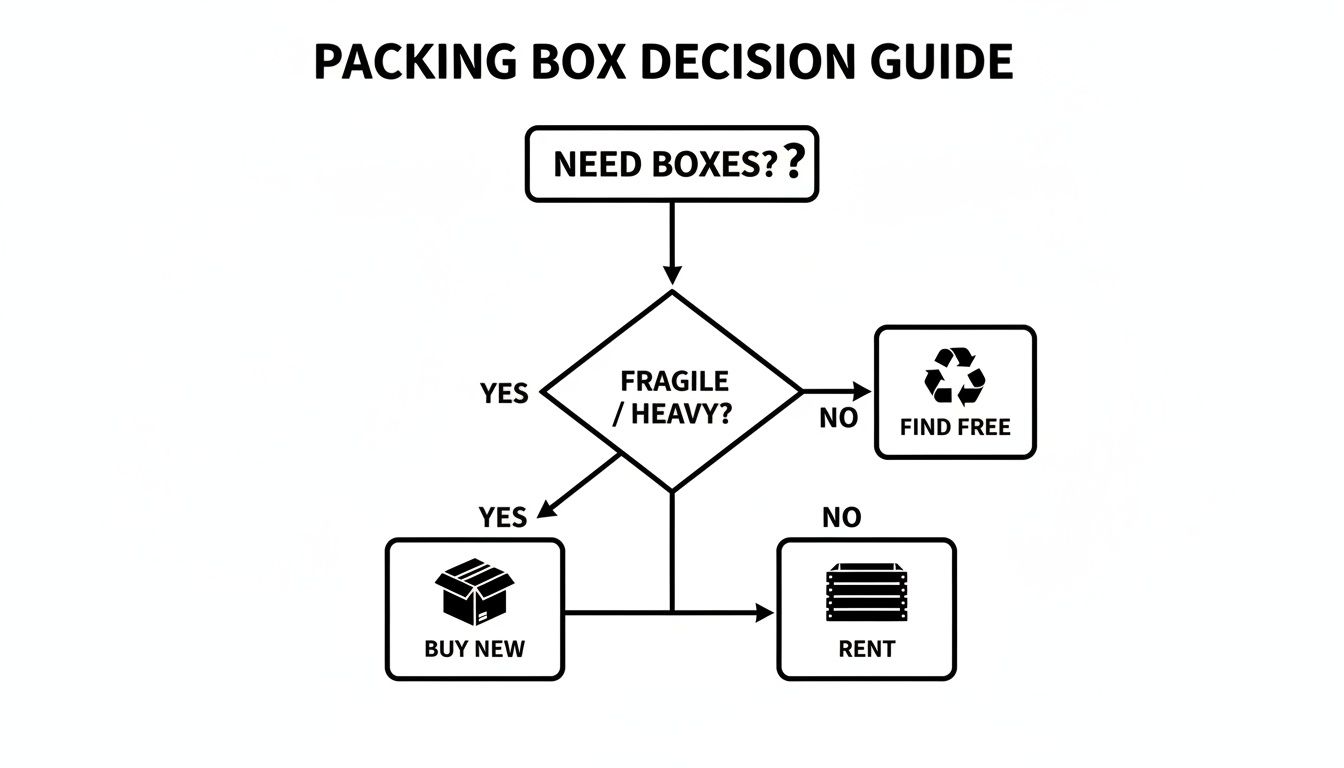
Flowchart outlining decisions for packing boxes: need, fragile/heavy, buy new, rent, or find free.

As you can see, the choice often involves balancing the value of your items against your budget and sustainability goals. Remember, it's not just about standard boxes; you can find a wide range of various packaging products tailored for specific needs.

A successful house move is the sum of many small, correct decisions. Choosing the right packing boxes is one of the first and most important ones. It directly impacts your packing efficiency and the safety of your belongings during transit. Get this right, and the entire moving process becomes significantly easier.

For those undertaking a major relocation, our ultimate guide to moving to Melbourne offers even more tips to help you settle in. In the following sections, we will explore each box-sourcing method in greater detail to help you make the best choice for a stress-free move.

Comparing Your Packing Box Options At a Glance

To help you decide quickly, here’s a straightforward comparison of your main options for getting packing boxes. Consider what matters most to you—cost, quality, or convenience—and identify which source aligns with your moving needs.

Source Typical Cost Quality & Durability Convenience Level Best For
Buy New $$$ High – brand new and sturdy High – readily available Fragile, valuable, or heavy items; uniform stacking
Rent $$ Very High – heavy-duty plastic Medium – requires booking/return Office moves, specialty items, eco-conscious moves
Find Free $ (Free!) Varies – check for damage Low – requires hunting & effort Non-fragile items, budget-conscious moves

Ultimately, many people use a hybrid approach. You might buy new boxes for your kitchen and electronics while finding free ones for linens and clothing. It’s all about creating the right strategy for your specific move.

Why Buying New Boxes Is the Safest Bet

When it comes to protecting your belongings, especially fragile or valuable items, buying new, purpose-built moving boxes is unequivocally the safest choice. While the appeal of freebies is undeniable, you cannot beat the reliability and peace of mind that come with fresh, sturdy cartons designed specifically for moving.

Think of it as a small insurance policy for your possessions. You are investing in their security from the very first item you pack.

Brand-new boxes offer uncompromised structural integrity. Unlike used boxes, which may have hidden weaknesses like damp spots, weakened seams, or old tears, new boxes are at their peak strength. This means they are far less likely to buckle, tear, or collapse under weight, whether you're moving across town or undertaking a long-haul interstate relocation.
A stack of cardboard packing boxes in a home entryway, with 'FIND PACKING BOXES' on the open door.

Uniformity and Stability

One of the greatest advantages of buying new is uniformity. Professional moving boxes come in standard sizes, which is a game-changer for stacking them safely and efficiently in a removalist truck. A solid wall of same-sized boxes functions like a well-built brick wall—strong, stable, and much less prone to shifting or toppling during transit.

This consistency helps you avoid a common packing pitfall: using mismatched, oddly shaped boxes that create unstable gaps and uneven weight distribution. You can prevent many of the top 10 common packing mistakes when moving home simply by starting with the right equipment.

Furthermore, new boxes are available in specialised designs for specific needs:

  • Wardrobe Boxes: These tall boxes feature a metal bar, allowing you to move clothes directly from your closet on their hangers. No wrinkles, no fuss.
  • Kitchen Boxes: Typically made from double-walled cardboard, these are built tough to handle the substantial weight of plates, glasses, and appliances.
  • Picture Boxes: Specially designed to protect mirrors, artwork, and framed photos from scratches and impacts.

Retail Stores vs Professional Removalists

So, where should you buy them? Your main choices are large retail stores and professional moving companies. While purchasing boxes from a big-box retailer is convenient, the quality offered by removalists is often superior. Their boxes are engineered specifically for the moving industry, designed to withstand the vibrations and pressures of being stacked in a truck for hours or even days.

Sourcing your boxes directly from your moving company, like Get n Go Removals, streamlines the entire process. We know precisely what types and quantities of boxes are needed for a home your size. We can deliver high-quality packing materials directly to your door, eliminating guesswork and ensuring you are fully equipped for a successful move.

Opting for professional-grade cartons from your mover isn't just about buying boxes; it's about investing in a system designed for a damage-free move. From consistent sizing to specialised types, it sets the foundation for a secure and organised relocation.

How to Find Free and Used Boxes in Melbourne

If you're moving on a budget or prefer a more sustainable approach, hunting for free secondhand boxes is a brilliant strategy. This saves you money and gives perfectly good cardboard a second life—a clear win-win. Think of it as a treasure hunt where the prize is a cheaper, greener move.

With a bit of effort, you can find nearly all the packing supplies you need without spending a cent. Melbourne is full of places, both physical and online, where you can source free boxes if you know where to look.

Your Go-To Spots for Free Boxes

The best places to start your search are businesses that receive large, regular shipments. They are often inundated with cardboard and are happy for you to take it off their hands to free up space. A little good timing and a polite request are all it takes.

Here are the top places to try:

  • Supermarkets and Grocers: Think Coles, Woolworths, and Aldi. They receive daily deliveries and flatten dozens of sturdy boxes. Your best bet is to visit on a weekday morning when they are busy restocking shelves.
  • Liquor Stores: Retailers like Dan Murphy's and BWS are goldmines. They have exceptionally strong boxes designed for transporting wine and spirits, making them perfect for packing heavy items like books, records, or kitchenware.
  • Big-Box Retailers: Stores such as Bunnings, Officeworks, and The Good Guys are constantly unpacking large items. Don't hesitate to ask at the customer service desk if they have any spare cartons available.

A helpful tip: always speak with a manager or staff member before taking boxes. They can direct you to the best ones and let you know the ideal time to return.

Tapping Into Your Digital Neighbourhood

Instead of driving around town, leverage the power of the internet. Online platforms connect you directly with people in your community who have just moved and are eager to get rid of a mountain of boxes. This is often the fastest way to acquire a large number of quality moving boxes in one go.

Online community platforms are a mover's best friend. People are often keen to pay it forward and help someone else out, especially when it means clearing space in their own home after unpacking.

Check out these online resources:

  • Facebook Marketplace & 'Buy Nothing' Groups: Simply search for "moving boxes" to find numerous listings for free collections. Your local 'Buy Nothing' group is particularly effective, as its entire purpose is to gift items to neighbours.
  • Gumtree: The "Freebies" section on Gumtree is another popular spot where people list their leftover packing materials. Consider setting up an alert to be notified as soon as new listings appear.

Of course, knowing where to start packing to move house is just as crucial as finding the boxes themselves. A solid plan makes the entire process feel far less overwhelming.

The Essential Used Box Inspection Checklist

While free is fantastic, it’s critical to remember that not all used boxes are suitable for moving. Before you take them home, perform a quick inspection to ensure they can adequately protect your belongings. A weak box is a recipe for disaster.

Keep an eye out for these three red flags:

  1. Structural Weakness: Look for bent corners, deep creases, or any rips and tears. The box should feel solid and rigid.
  2. Moisture Damage: Check for water stains, discolouration, or a musty smell. Any exposure to moisture compromises cardboard's integrity.
  3. Pests or Odours: Give the box a quick inspection for any signs of insects or strong, unusual smells that you wouldn't want transferring to your belongings.

Why Interstate Moves Demand Stronger Boxes

Moving across Melbourne is one thing; relocating interstate is an entirely different challenge. The journey is longer, handling is more frequent, and the stresses on your belongings multiply significantly. This is precisely why the standard or used boxes that might suffice for a local move are simply inadequate for a long-haul journey.

An interstate move is not just a longer drive—it's an endurance test for your packing materials. Your boxes will be subjected to extended periods of vibration, fluctuating temperatures, and multiple instances of loading and unloading. Each of these factors can slowly degrade the structure of a standard cardboard box.
A building's white wall features a black stripe with "FREE USED BOXES" text next to stacked cardboard boxes.

Vibration and Time: The Enemies of Cardboard

Imagine the constant hum and rumble of a truck on the highway for hundreds, or even thousands, of kilometres. This relentless vibration works its way through every box, gradually weakening seams and compressing the cardboard. A box that felt sturdy on day one can become soft and flimsy by day three.

Over time, this can lead to boxes sagging, being crushed by the weight of others, or even bursting open. For this reason, professional-grade cartons sourced from experienced removalists are absolutely essential for protecting your possessions on a long journey.

The need for high-quality supplies is more relevant than ever. Recent data shows the number of people leaving capital cities for regional Australia was 10.5% higher than the previous quarter, with regional migration sitting about 20.5% above pre‑COVID levels. This trend highlights a growing demand for durable packing solutions for long-distance moves. You can discover more insights about moving industry trends on austate.com.au.

The Double-Walled Difference

For any interstate move, double-walled corrugated boxes are non-negotiable. Unlike their single-walled counterparts you might find at a supermarket, these boxes feature two layers of fluted cardboard sandwiched between three flat linerboards.

This reinforced construction provides:

  • Superior Strength: They can handle much heavier loads without buckling, which is crucial when boxes are stacked high in a moving truck.
  • Enhanced Cushioning: The extra layer acts as an excellent shock absorber, offering better protection against the inevitable bumps and jolts of transit.
  • Increased Durability: They are more resistant to punctures and moisture, keeping your items safer over a multi-day trip.

Choosing professional-grade, double-walled boxes for an interstate move isn't an extra expense; it's a fundamental part of ensuring your belongings arrive safely. It’s the difference between hoping for the best and planning for success.

Ultimately, your best source for these robust materials is a moving company that handles long-distance jobs regularly. Experienced long distance removalists understand the unique demands of interstate transport and stock boxes specifically designed to withstand them. By getting your cartons from them, you ensure everything you own arrives in the same condition it left in, no matter the distance.

Choosing the Right Box for Every Item

Using the wrong box is one of the most common—and costly—moving mistakes. It's a surefire way to end up with broken heirlooms or, even worse, a strained back. Getting this right is simple but makes a massive difference in how smoothly your move goes.

Think of it like this: a small box is your hero for heavy items, while a big box is perfect for all the light, bulky stuff.

The golden rule of packing is dead simple: pack heavy items in small boxes and light items in large boxes. This single principle prevents any one box from becoming a dead weight. Lifting a small, dense box of books? No problem. But trying to hoist a giant tea chest carton filled with them is a recipe for disaster.

Getting to Know Your Standard Moving Boxes

When you start looking for packing boxes, you'll see a couple of standard types pop up everywhere. They're not all the same; each one has been designed for a specific job to make your move safer and more organised.

Here are the absolute essentials you'll be dealing with:

  • Book/Wine Boxes: These small, tough little cartons are your go-to for anything dense and heavy. Think books, wine bottles, pantry staples like canned goods, tools, and even stacks of plates. Their compact size is intentional—it keeps the weight manageable, usually under 20 kilograms.
  • Tea Chest Boxes: This is the classic, large moving box, the workhorse of any move. You'll use these for bulky but light things like linen, towels, doonas, pillows, lampshades, and kids' toys. Whatever you do, resist the temptation to fill these with heavy stuff. It's a rookie error you'll want to avoid.

Remember, a box is there to contain and protect your belongings, not just to be crammed full. Overloading a large box makes it a nightmare to lift safely and dramatically increases the chances of it bursting open mid-carry.

Before we move on, let's break down which box works best for common household items. This isn't an exhaustive list, but it's a great starting point for planning your packing strategy.

Matching Box Types to Your Household Items

Box Type Typical Use Key Feature
Book/Wine Box Books, wine, pantry items, CDs/DVDs, tools, small appliances Small and strong to handle heavy, dense items without becoming too heavy to lift.
Tea Chest Box Bedding, linen, towels, clothes, plastic containers, toys, lampshades Large volume for bulky but lightweight items that take up a lot of space.
Porta-Robe Hanging clothes (suits, dresses, shirts) Includes a metal bar to hang clothes directly from the closet, preventing wrinkles.
Picture/Mirror Box Artwork, mirrors, framed photos, flat-screen TVs Flat, often adjustable design to provide snug, protective cushioning for fragile glass.

Choosing the right container is half the battle won. It turns a chaotic packing session into a much more streamlined, logical process.

Specialty Cartons for Your Fragile Gear

Beyond the basic boxes, some of your belongings need a bit of extra TLC. Using a purpose-built box for fragile or awkwardly shaped items is a small investment that buys you a huge amount of peace of mind. You'll thank yourself when your prized possessions arrive in one piece.

Keep an eye out for these specialty options for a damage-free move:

  • Porta-Robes: These are basically portable wardrobes. They're tall boxes with a metal hanging bar inside, letting you transfer clothes straight from your closet without folding them. It's a massive time-saver that prevents wrinkles and saves you from hours of ironing later.
  • Picture/Mirror Boxes: Designed to securely wrap artwork, mirrors, and large framed photos, these flat boxes are a must. They provide that crucial protection against scratches, cracks, and shattered glass that bubble wrap alone just can't guarantee.

By matching the right box to every item, you're not just packing—you're streamlining the entire move, making the lifting, loading, and unpacking so much easier on everyone.

Save Time With All-In-One Packing and Moving Services

If you're facing a tight deadline or simply feel overwhelmed by the scale of your move, bundling packing and moving services is the ultimate stress-buster. Instead of juggling dozens of separate tasks, an all-in-one moving solution consolidates everything into a single, hands-off experience managed by professionals. It completely eliminates the question of where to get packing boxes and ensures the entire job is done efficiently.

Imagine this: a single team arrives at your door with all the high-quality packing materials required. They expertly pack everything, load the truck, and can even arrange for secure storage if there is a gap between your move-out and move-in dates. It is, by far, the most efficient and seamless way to handle a relocation.

A collection of colorful and plain storage boxes arranged on a wooden shelf against a blue wall.

Why a Bundled Service Makes Sense

Opting for an all-in-one service saves you more than just time; it provides invaluable peace of mind. You are no longer running around to different suppliers for boxes, tape, and bubble wrap. Instead, you receive everything from a single, trusted source.

This is more significant than you might think. Australia’s logistics market is vast, valued at over AUD 125 billion, with road freight alone moving approximately 86 billion tonne-kilometres in a recent year. That is an incredible volume of goods—and boxes—in transit nationwide. When you partner with a professional removalist, you tap directly into this expertise, receiving supplies that are purpose-built to survive the journey.

Handing over the logistics to the experts means you get back dozens of hours you would have lost to sourcing supplies and packing. More importantly, you get the confidence of knowing every detail is handled professionally, from the first box packed to the last item placed in your new home.

Professional packing is practically a science. It’s a carefully planned process designed for maximum efficiency and safety. If you’re curious about how this works on a larger scale, learning about understanding pick and pack fulfillment offers some really interesting insights into the logistics world.

At the end of the day, the benefits of using professional packing services go way beyond simple convenience. It's about ensuring your move is organised, efficient, and completely damage-free.

Common Questions About Moving Boxes

Even with the best moving plan, a few questions always seem to pop up once the packing tape comes out. We get it. Figuring out the box situation can be tricky. Here are some straightforward answers to the questions we hear most often from people moving around Melbourne.

How Many Boxes Do I Actually Need for My Move?

Estimating the right number of boxes is a classic moving challenge. A reliable rule of thumb is to plan for approximately 10-15 boxes per room. Therefore, for a standard two-bedroom house, you will likely need somewhere between 40 and 60 boxes of various sizes.

It is always wise to acquire a few extra boxes. The last thing you want is to run out of supplies midway through packing your kitchen. If you are uncertain, a professional removalist can provide a more accurate estimate after a brief assessment of your home.

Are Plastic Tubs Better Than Cardboard Boxes?

The answer depends on their intended use. Plastic tubs are excellent for long-term storage in a garage or shed, as their durable shells provide superior protection against moisture, dust, and pests.

However, for the move itself, professional cardboard moving boxes are almost always the better choice. They are lightweight, designed for neat and secure stacking in a truck, and can be easily labelled. Plastic tubs can be slippery and are prone to cracking when stacked too high, whereas proper moving boxes offer a stable, recyclable, and cost-effective solution.

Pro Tip: Utilise the best of both worlds. Use professional moving boxes for the actual transit, then transfer items intended for long-term storage into plastic tubs once you have arrived at your new home.

What Is the Best Way to Tape a Moving Box?

Properly taping a box is crucial for its strength. Avoid the temptation to use duct tape or masking tape, as they lack the necessary adhesive strength. Always use high-quality packing tape.

For an average-weight box, a single, solid strip of tape along the main bottom and top seams is sufficient.

For heavier boxes containing books or plates, the 'H-Tape' method is essential. First, tape down the centre seam. Then, run another strip of tape along each of the shorter side seams. This creates a strong 'H' shape that reinforces the entire base and prevents it from giving way unexpectedly.


Ready to make your move simple and secure? Get n Go Removals Melbourne provides high-quality packing boxes and a full suite of professional moving services to ensure a stress-free experience. Find out more and get your free quote today!


READ MORE

Your Ultimate Guide to Cheap Furniture Removals Melbourne

Finding a great deal on furniture removals in Melbourne isn't just about chasing the absolute rock-bottom price. It's about securing genuine value. The real victory is hiring a reliable, professional crew that works efficiently and safely, all without charging you an arm and a leg. The secret lies in understanding what truly drives the cost of your move and how you can take control of the process. This guide will walk you through everything you need to know to find cheap furniture removals in Melbourne that don’t compromise on quality.

Decoding the Cost of Removals in Melbourne

Two men, possibly movers, are organizing cardboard boxes at the back of a moving truck.

Moving house in Melbourne can feel like a major expense, but it doesn’t have to drain your bank account. When you start searching for "cheap furniture removals Melbourne," you'll be inundated with quotes. The key to an affordable move isn’t just picking the lowest number; it’s about making smart decisions long before moving day.

The Australian removalist industry is a substantial $2.0 billion sector, with a significant 29% of its revenue generated from local moves. This is the competitive space where Melbourne movers operate, often competing on hourly rates. This competition is advantageous for you, making it possible to find budget-friendly and reliable services. You can read more about Melbourne's need for reliable movers to understand how local demand shapes pricing.

Understanding What Drives Your Quote

Ultimately, your moving quote is a calculation of time and labour. The less time and effort required from the removalists, the lower your final bill. This simple principle places a significant amount of cost-saving power directly in your hands.

Here’s a breakdown of the primary variables that determine the cost of your move.

Key Factors That Influence Your Moving Quote

Cost Factor How It Affects Your Price Pro Tip to Save Money
Volume of Belongings More items mean more time spent packing, loading, and unloading. It’s the biggest factor. Declutter ruthlessly before requesting quotes. It's the single most effective way to cut costs.
Property Access Multiple flights of stairs, narrow hallways, or difficult parking significantly increase the time required, driving up hourly costs. Secure a prime parking spot close to your entrance. Measure doorways and disassemble large furniture beforehand.
Travel Distance The distance between your old and new properties directly impacts fuel costs and the total time billed. Consider a mover based locally to minimise their travel time to your pickup location.

By understanding these factors, you can see your quote not as an arbitrary number, but as a direct reflection of the job's scope.

Hourly Rates vs. Fixed Quotes: Which Is Better for You?

When you start receiving quotes, you'll encounter two main pricing structures: a fixed price or an hourly rate. For local Melbourne moves, hourly rates are the most common. This is excellent news if you are well-prepared, as your own efficiency directly translates into savings. If your belongings are organised and ready to go, you will pay for less time.

A fixed quote offers certainty on the final cost, providing peace of mind, but it often includes a buffer to account for potential delays. For large, complex relocations, this can be worthwhile. However, for smaller, straightforward moves, an hourly rate almost always proves to be more economical. To get the most accurate estimate, it's essential to provide any potential furniture removalists in Melbourne with a completely honest and detailed inventory of what needs to be moved.

How Smart Preparation Slashes Your Moving Bill

A man organizing moving boxes and furniture in a room with a 'Pack Smart' logo.

The secret to a genuinely cheap furniture removal in Melbourne is proactive preparation. Since most local movers charge by the hour, every minute you save through careful planning is money back in your wallet.

The less time our crew spends on packing, carrying, and loading, the lower your final invoice will be. By tackling a few key tasks yourself, you can significantly reduce the required labour hours, making your move quicker and far more budget-friendly.

Declutter Before You Pack a Single Box

The number one rule of an affordable move is simple: don't pay to move items you no longer want or need. Every single item you sell, donate, or discard is one less thing to pack, lift, transport, and find a place for in your new home. A thorough declutter is the most impactful way to reduce the volume (and therefore the cost) of your move.

Start this process several weeks in advance to avoid last-minute stress. Go through each room and be ruthless. If you haven't used an item in over a year, it's a perfect candidate for removal. For more detailed guidance, explore our guide on how to declutter before you move.

The goal is not just to discard items, but to reduce the overall volume and weight of your belongings. A lighter, smaller load always results in a faster, cheaper removal.

If you're downsizing or have items you can't part with but don't need immediately, you can explore self-storage options. Moving these items into storage beforehand can streamline moving day and reduce costs.

Source Smart and Pack Efficiently

Packing materials can be a hidden expense that adds a surprising amount to your moving budget. Instead of purchasing everything new, get resourceful.

  • Free Boxes: Check local community Facebook groups, ask friends and family, or visit local supermarkets and bottle shops. They often have sturdy boxes they are happy to give away.
  • Low-Cost Supplies: You don't need endless rolls of bubble wrap. Use your towels, quilts, and clothing to wrap fragile items. You have to move them anyway, so put them to work protecting your valuables.

When you pack, be strategic. Place heavy items like books in smaller boxes to make them manageable to lift. Use larger boxes for light, bulky items like pillows and bedding. Always reinforce the bottom of every box with extra tape. A clear label detailing the contents and destination room will make unpacking significantly easier.

Disassemble Furniture Yourself

One of the biggest time consumers for any moving team is disassembling large furniture items like bed frames, dining tables, and large shelving units. If the crew has to handle this on moving day, the clock is ticking on your hourly rate.

If you are comfortable with the task, disassemble these items the day before your move. Place all screws, bolts, and small components into a labelled zip-lock bag and tape it securely to the largest piece of the furniture. This simple step can easily save 30-60 minutes of labour time, making it one of the most effective ways to reduce your final bill.

Comparing Quotes and Spotting Hidden Fees

Once you’ve prepared your home, it’s time to gather quotes. Securing a great deal on furniture removals in Melbourne is about more than just choosing the lowest price—it's about understanding the true value behind each quote.

A vague request like "I'm moving a two-bedroom apartment" will only yield a vague, ballpark estimate, which can lead to unpleasant financial surprises on moving day. For an accurate quote, you must provide a detailed inventory of the job.

Providing the Right Information for an Accurate Quote

To get a quote you can rely on, provide a clear and comprehensive overview.

Here’s what every professional Melbourne mover needs from you:

  • A Detailed Inventory List: Itemise every large piece of furniture (e.g., king bed, 3-seater sofa, fridge, washing machine).
  • Box Count Estimate: Give a realistic approximation, such as "40-50 standard moving boxes."
  • Property Access Details: Be upfront about any challenges. Mention stairs, long walkways, lift access, or parking difficulties.
  • Both Addresses: Provide the complete pickup and drop-off addresses so they can accurately calculate travel time.

This level of detail allows the removalist to dispatch the correct size truck and the appropriate number of crew members, ensuring your quote is based on reality, not guesswork.

Reading Between the Lines of Your Quote

With quotes in hand, it's time for scrutiny. The cheapest hourly rate is not always the best option. A suspiciously low price can be a major red flag, often indicating a lack of insurance, inexperienced staff, or a host of hidden fees that will be added to your final bill.

ATO benchmarks show that for most removal companies, total expenses consume 57%–82% of their turnover. When a mover offers a very low rate, they are operating on extremely thin margins, which should prompt caution. Be wary of any price that seems too good to be true.

A professional quote should be clear, itemised, and completely transparent. If you have to ask what’s included, it’s a warning sign. A trustworthy company will proactively outline all potential costs to eliminate surprises on moving day.

Look past the headline figure and search for extra charges that can quickly inflate your budget. Our guide on hidden costs in moving house provides a deeper look at what to watch for.

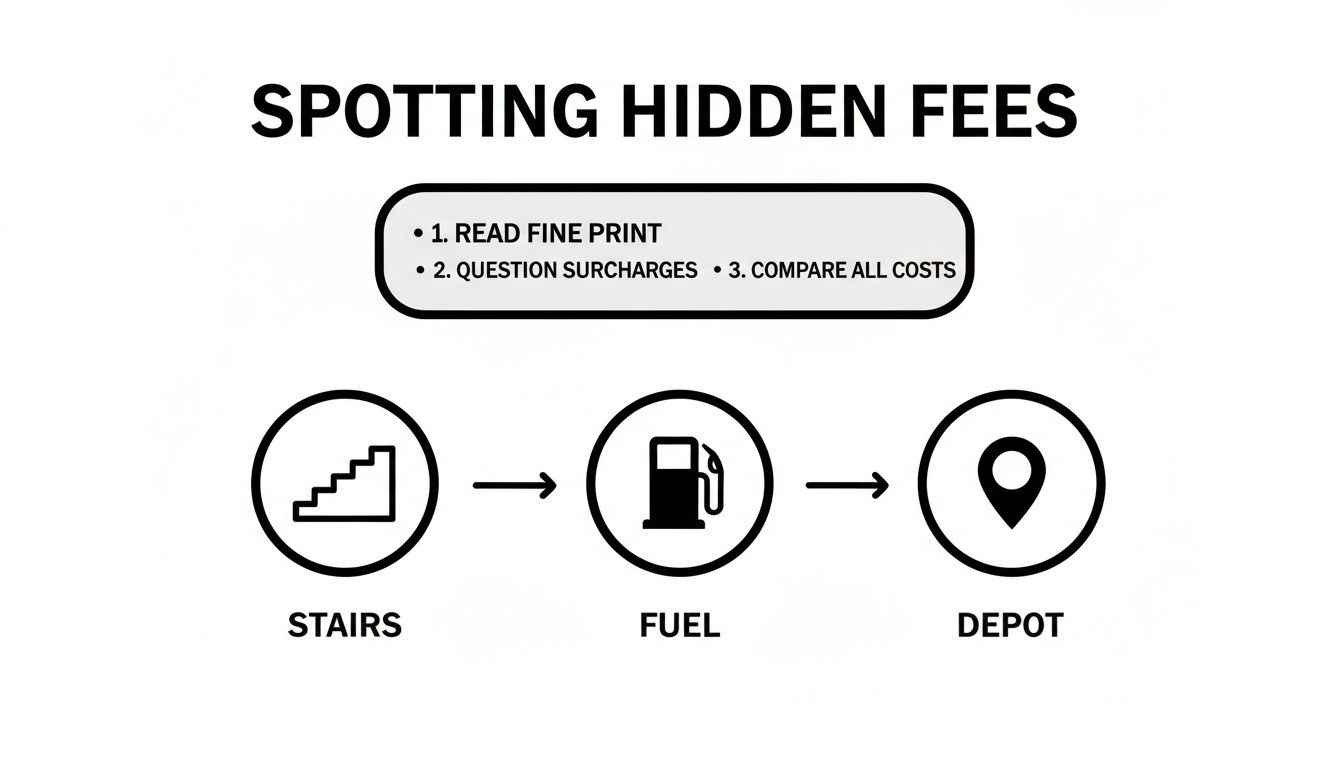
Common hidden fees to ask about include:

  • Depot-to-Depot Charges: Are you being billed for the team's travel time from their base to your home and back again?
  • Stair Levies: Many companies charge an extra fee per flight of stairs.
  • Fuel Surcharges: Is fuel included in the hourly rate, or is it an additional percentage?
  • Call-Out Fees: Some movers have a minimum charge just for showing up.

Always request an all-inclusive quote or a clear list of potential extras before making a booking. This empowers you to compare offers fairly and choose a mover based on honest, upfront value.

Why the Cheapest Quote Can Cost You More

When searching for cheap furniture removals in Melbourne, it's tempting to select the lowest quote. However, the cheapest price can quickly become your most expensive mistake.

An unbelievably low quote should be a cause for concern. It often means the operator is cutting corners in crucial areas—such as insurance, vehicle maintenance, or staff training. These shortcuts place your valuable belongings at significant risk.

The True Cost of Inexperience and No Insurance

A professional removalist is a trained spatial problem-solver who knows how to manoeuvre a sofa through a tight doorway, protect your floors, and load a truck to prevent damage.

Inexperienced crews hired by budget operators often lack these skills, leading to costly problems:

  • Damaged Furniture: Scratches, dents, and broken items become much more likely.
  • Property Damage: Scraped walls, chipped door frames, and scuffed floors can jeopardise your rental bond.
  • Inefficient Loading: A poorly packed truck may require a second trip, instantly doubling your costs.

Worse still is hiring an uninsured operator. If they damage your property or belongings, you have little recourse for compensation. A reputable company will always carry Public Liability and Transit Insurance and be willing to provide proof. This is a non-negotiable part of the value you are paying for.

Unreliable operators are a known issue. Consumer Affairs Victoria data revealed that complaints against removalists in Melbourne increased by nearly 11% in a single year. The lesson is clear: thorough vetting is essential.

Peace of Mind Is Worth Paying For

A slightly higher quote from a professional company is an investment in skill, reliability, and peace of mind. A proper mover provides a comprehensive quote without hidden surprises.

Infographic on spotting hidden fees: read fine print, question surcharges, compare all costs.

Those unexpected charges for stairs or fuel are how "budget" operators often compensate for their lowball initial price.

A professional, value-focused quote typically includes:

  • Experienced, full-time, police-checked staff.
  • Comprehensive insurance covering your goods and property.
  • Well-maintained, fully equipped company trucks.
  • Transparent, upfront pricing with no hidden fees.

This same logic applies elsewhere in your move; understanding why professional move-out cleaning can be a worthwhile investment shows how paying for expertise saves time and stress. For a detailed checklist, see our guide on choosing the right removals firm for your move.

Ultimately, you want a mover who offers genuine value, not just a cheap price tag. This ensures your belongings are protected and your move is smooth.

Comparing a Budget Mover vs. a Value-Focused Professional

The price difference is obvious, but what about the service? Here’s a breakdown of what you're really paying for.

Feature Typical 'Cheapest' Operator Professional Value Mover
Crew Experience Inexperienced, often temporary cash workers. Trained, full-time, police-checked employees.
Insurance Minimal or non-existent. You're on your own if things break. Comprehensive Transit & Public Liability Insurance.
Equipment Old truck, may lack blankets, trolleys, or ties. Modern, well-maintained fleet with all necessary equipment.
Pricing Low hourly rate with multiple hidden fees (stairs, fuel, etc.). Transparent, all-inclusive quote with clear terms.
Reliability High risk of no-shows, lateness, or demanding more cash on the day. Punctual, reliable service backed by a company reputation.
Efficiency Slower work leads to longer hours and a higher final bill. Skilled crew works quickly and safely, saving you time and money.

The initial "savings" from a budget operator often vanish when you factor in the risks, hidden costs, and potential for damage. Investing in a professional mover is an investment in a stress-free experience.

Smart Booking Strategies to Lock in a Low Price

A laptop displaying a calendar with 'Book Early' banner, coffee, phone, and notebook on a desk.

Timing is crucial when securing a great deal on your move. Much like booking a flight, when you book your removalist can significantly impact the price you pay. By being strategic, you can lock in a lower rate for cheap furniture removals Melbourne without changing what you need to move.

The most effective strategy is to book well in advance. Professional movers' schedules fill up quickly, especially during Melbourne’s peak seasons—the summer months (December to February) and the end of any month.

Booking four to six weeks ahead, particularly during these busy times, not only secures your spot but also often gets you a better rate before demand drives prices up. Last-minute bookings almost always come with a premium.

Capitalise on Off-Peak Periods

If your moving dates are flexible, you have a prime opportunity to save money. Demand for removalists drops significantly during certain times, which is when you'll find the best deals.

Most people prefer to move on a Friday or over the weekend. This creates a surge in demand and higher prices. By scheduling your move for a Tuesday, Wednesday, or Thursday, you can often achieve significant savings. Mid-month moves are also typically cheaper than those at the beginning or end of the month when most leases turn over.

When requesting quotes, always ask if a discount is available for moving on a weekday. Many companies offer off-peak rates to keep their crews busy during quieter periods.

Other Smart Timing Tactics

Beyond choosing the right day, other timing strategies can help reduce the final bill.

  • Ask About Last-Minute Deals: If you have complete flexibility, ask movers if they maintain a cancellation list. You might be able to secure a spot at a reduced rate if another client cancels.
  • Be Ready for an Early Start: The first job of the day, typically around 7:30 or 8:00 AM, is highly desirable. Booking this slot ensures the crew arrives fresh, with no risk of delays from a previous job. This efficiency can save you money on an hourly rate.

By being mindful of the calendar, you can make your budget go further. For more expert advice, check out these additional tips to keep your moving costs down and secure the best possible value.

Your Questions About Cheap Removals Answered

Even with careful planning, you likely still have questions. Here are straightforward answers to the most common queries we receive from people seeking affordable removalists in Melbourne.

What Is the Average Hourly Rate for Cheap Furniture Removals in Melbourne?

While rates can fluctuate based on season and demand, a reputable, budget-friendly mover in Melbourne typically charges between $120 and $180 per hour for a truck and a two-man crew.

If you receive a quote significantly below this range, be cautious. Extremely low rates are often a red flag for corner-cutting on insurance, using inexperienced staff, or hidden fees. The final price will always depend on the truck size, number of movers, and the date of your booking.

Are There Hidden Costs I Should Watch Out For?

Absolutely. This is the biggest pitfall of choosing the cheapest quote. Before committing, demand a full, transparent breakdown of all potential costs.

Common "surprise" fees that can inflate your bill include:

  • Depot-to-Depot Charges: Billing for the time it takes the crew to travel from their base to your location and back again.
  • Stair Fees: An extra charge per flight of stairs, common in apartment moves.
  • Fuel Levies: A surcharge for fuel that may not be included in the initial hourly rate.
  • Heavy Item Fees: An additional fee for particularly large or heavy items like pianos or pool tables.

A professional company will be upfront about all these potential charges in their quote, ensuring no unwelcome surprises on moving day.

How Can I Make Sure My Belongings Are Insured?

Never assume insurance is included, especially with a low-cost service. It is often one of the first things cut by unreliable operators. Before booking, you must ask the removalist to provide a copy of their Certificate of Currency.

This document is your proof of active Public Liability Insurance (which covers your property) and Transit Insurance (which covers your belongings while in the truck). Any reputable company will provide this without hesitation, offering you crucial peace of mind.

Choosing a mover without verifying their insurance is a significant gamble. If something is broken or damaged, you could be left with the full cost of replacement or repair. Do not skip this vital step.


For a Melbourne move that balances a fair price with the confidence of a professional, fully insured service, have a chat with the team at Get n Go Removals Melbourne. We pride ourselves on transparent quotes and sending out experienced crews who make moving day smooth and stress-free. Get your obligation-free quote today by visiting us at https://www.getngoremovals.com.au.

READ MORE

A Guide to Finding Cheap Furniture Removal in Melbourne Without the Risk

Searching for cheap furniture removal in Melbourne is about more than just finding the lowest price—it's about securing exceptional value without compromising on reliability or the safety of your cherished belongings. The best affordable movers are defined by transparent pricing, efficient service, and a strict no-hidden-fees policy. They deliver genuine value for your money, not just an enticingly low hourly rate that inflates with unexpected costs later.

Ultimately, true affordability is a seamless, stress-free move, not a day marred by surprise charges and damaged possessions.

Finding Affordable Movers Without the Risk

Let's be candid: moving house in Melbourne is a significant expense, and the temptation to google "cheapest movers" and book the first option is strong. However, in the removals industry, "cheap" can be a deceptive term. That alluringly low hourly rate often conceals a high-risk service that can end up costing you dearly in damaged furniture, frustrating delays, and unexpected fees.

The key is to shift your focus from finding the "cheapest" mover to identifying a "high-value" one. A high-value mover transports your belongings from point A to point B efficiently, safely, and seamlessly, all at a competitive price. They don’t cut corners on critical elements like comprehensive insurance, proper equipment, or trained, professional staff. This approach not only protects your belongings but also your peace of mind on what is already a demanding day. Mastering this is all about choosing the right removals firm for your move.

Balancing Cost and Quality

Achieving the perfect balance between cost and quality requires a bit of due diligence. It involves looking beyond the headline price and asking what is actually included in the service. A genuinely affordable removalist is upfront from the beginning, providing a clear, itemised breakdown of costs so you know exactly what to expect.

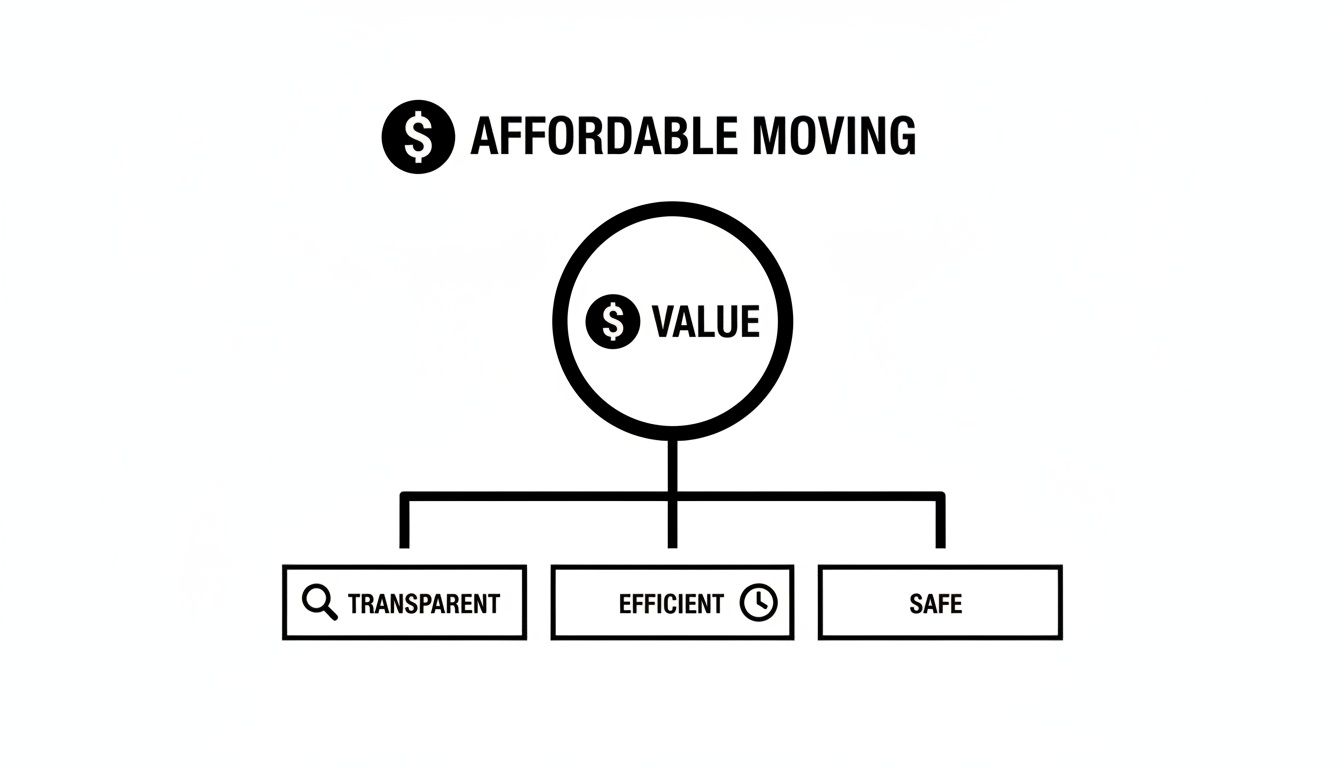
This graphic illustrates the three pillars of a high-value, affordable move.

Infographic illustrating affordable moving services, emphasizing value through transparency, efficiency, and safety.

As you can see, true value is founded on transparency, efficiency, and safety—not merely a rock-bottom price tag.

Unfortunately, trust has become a significant issue in Melbourne's removalist industry. Complaints to Consumer Affairs Victoria saw a notable increase from 656 in 2019 to 726 in 2020. More concerningly, industry insiders estimate that for every official complaint, another five incidents go unreported, indicating a much larger problem. This makes it absolutely crucial to thoroughly vet any potential mover to avoid becoming another statistic.

What Really Drives Your Moving Costs?

Two professional movers loading a grey sofa into a white moving van, with boxes nearby.

To find a genuinely cheap furniture removalist in Melbourne, you must first understand the components of your quote. Deconstructing a mover's pricing is the key to identifying real value and avoiding unexpected hidden fees that can derail your budget.

The final price is rarely just a simple hourly rate. It is a detailed calculation based on several key factors that determine the time, labour, and equipment required for your specific move.

Consider it like ordering a custom-built product. The base price is straightforward, but the final cost depends on the size, added features, and delivery complexity. A moving quote functions in much the same way.

The Big Three Cost Factors

Nearly every quote you receive will be based on three core elements. Providing accurate details for these factors will result in a more precise estimate and help you avoid surprises on moving day.

  • Volume of Belongings: This is the most significant factor. More items require a larger truck, more personnel, and more time on the clock. Moving the contents of a one-bedroom apartment is a vastly different operation from relocating a four-bedroom house filled with bulky furniture.

  • Property Access: How easily can the crew move your furniture from your old home to the new one? Difficult access points—such as multiple flights of stairs, narrow hallways, or a long distance from the property to the truck—will invariably add time and, consequently, cost.

  • Travel Distance: The distance in kilometres between your pickup and drop-off locations directly impacts fuel costs and the total time the moving crew is dedicated to your job. This often includes the travel time from their depot to your property and back, which may appear on a quote as a "depot-to-depot" fee.

Key Insight: Never underestimate the impact of access. A ground-floor move with a driveway directly out front is a completely different scenario from a fourth-floor apartment with no lift and parking 50 metres down the street. Be completely transparent about any potential access challenges.

Other Important Things That Add to the Bill

Beyond the main three factors, several other elements can influence your final bill. Understanding these can help you plan more effectively and potentially reduce costs.

  • Disassembly and Reassembly: Items like beds, large wardrobes, and complex shelving units often need to be disassembled for transport and then reassembled at the destination. This is skilled work that adds time to the job.
  • Specialty Items: Pianos, pool tables, heavy marble tabletops, and other oversized items are not standard furniture. They require specialised equipment and expertise to move safely, which comes at a premium.
  • Packing Services and Supplies: If you opt for professional packing services (a great time-saver!), the cost of labour, plus all necessary materials like boxes, tape, and bubble wrap, will be added to your quote.
  • Timing of Your Move: Weekends, public holidays, and the end of the month are peak moving times. You can almost always secure a more favourable rate by booking a mid-week, mid-month slot.

Truly understanding the cost of movers involves seeing how all these components fit together. In Melbourne's competitive market, you can expect hourly rates for professional services to range from approximately $100 to $280. This wide range reflects factors like truck size, the number of movers assigned to the job, and the company's operational overheads.

Practical Ways to Lower Your Removal Bill

Understanding the factors that influence removal costs is half the battle won. The other half is taking proactive steps to reduce that final bill. The good news is that securing a cheap furniture removal service in Melbourne doesn't require settling for subpar service. With strategic planning and some hands-on effort, you can significantly lower your moving expenses.

The single most effective strategy is remarkably simple: reduce the volume of items you need to move. The less stuff you have, the less time the movers spend and the less truck space you require. That's why decluttering is your ultimate secret weapon for a more affordable move.

Start with a Strategic Declutter

Before you even start requesting quotes, it's time to be decisive. Go through each room and honestly assess what you truly need to take to your new home. That old armchair gathering dust in the spare room? The boxes of university textbooks you haven't opened in a decade? Each item adds minutes and dollars to your moving bill.

Think of it this way: every item you get rid of is one less thing you're paying someone to lift, carry, load, transport, unload, and position in your new home. Selling, donating, or responsibly disposing of unwanted items before the movers arrive will directly reduce your final invoice.

  • Sell: Utilise online marketplaces to sell furniture, electronics, or other items that are in good condition but no longer needed.
  • Donate: Charities are always grateful for quality furniture, clothing, and household goods. Many offer a collection service for larger items.
  • Recycle: For old whitegoods or electronics, locate a local recycling program to ensure they are disposed of in an environmentally friendly manner.

Be Flexible with Your Timing

Timing is a critical factor in the moving industry. Demand skyrockets on weekends and at the end of the month, and prices reflect this surge. If your schedule has some flexibility, booking your move for a mid-week, mid-month day is one of the easiest ways to achieve substantial savings.

Removalists often have more availability during these quieter periods and may offer more competitive rates to fill their schedules. A simple question like, "What are your quietest days this month?" can unlock significant savings.

Prepare Your Space for Efficiency

On moving day, your primary goal should be to make the movers' job as quick and seamless as possible. Since most local Melbourne moves are charged by the hour, every minute saved translates directly into money back in your pocket.

You can help the entire process run like a well-oiled machine by preparing both properties:

  • Clear the Pathways: Ensure there is a wide, unobstructed path from your front door to the moving truck at both the pickup and delivery locations.
  • Reserve Parking: If you live in an apartment building or on a busy street, take steps to secure the closest possible parking space for the truck. Use cones, bins, or your own car to reserve the spot.
  • Disassemble Furniture: If you're comfortable with basic tools, disassembling beds, tables, and other large items yourself before the crew arrives is a massive time-saver.
  • Consolidate Boxes: Move all your packed boxes to an easily accessible area, such as the garage or living room. This prevents movers from having to navigate through your entire house to collect them.

Taking these proactive steps allows the removalists to establish a rhythm and work at peak efficiency, which helps keep the billable hours to a minimum. For more expert advice, take a look at our guide on tips to keep your moving costs down. By combining these strategies, you can turn your search for cheap furniture removal in Melbourne into a resounding success.

Spotting the Warning Signs of a Dodgy Removalist

A person holds a phone with a checklist, surrounded by moving boxes, signifying lower moving costs.

When you're looking for cheap furniture removal in Melbourne, an unbelievably low quote should raise immediate red flags. While everyone appreciates a bargain, a price that seems too good to be true usually is. It's often a tactic used by rogue operators who plan to recover their profits through hidden fees, poor service, or even holding your belongings hostage until you pay more.

Protecting yourself and your possessions means learning to identify the warning signs of a questionable removalist before you make a commitment. These operators thrive on confusion and pressure, but you can see through their tactics with a few simple checks.

Vague Quotes and Hidden Fees

A professional mover provides a detailed, itemised quote. A dubious one will give you a simple hourly rate over the phone with no specifics. This vagueness is often intentional—it leaves the door open for various extra charges to mysteriously appear on moving day.

These "surprises" can transform a supposedly cheap move into a financial disaster. Be cautious of any company that isn't completely transparent about potential extra costs, such as:

  • Stairs and Lifts: A common tactic is adding a per-flight-of-stairs fee that wasn't mentioned initially.
  • Fuel Levies: A surprise surcharge added at the end of the job.
  • Long-Carry Fees: An extra charge applied if they can't park their truck directly outside your property.
  • "Extra Time": Ambiguous charges for a job that mysteriously takes much longer than originally estimated.

Key Takeaway: A legitimate quote is a transparent one. If the price breakdown isn't crystal clear, it's best to walk away. A trustworthy company wants you to understand exactly what you are paying for, leaving no room for unpleasant surprises.

No Professional Footprint

In today's digital age, any legitimate business has a professional online presence and a physical address. The absence of these fundamental elements is a major red flag. If a mover operates solely through a mobile number and a basic social media page, you should proceed with extreme caution.

The lack of proper insurance is another absolute deal-breaker. Any reputable removalist will have Public Liability and Transit Insurance and will be willing to provide proof. Without it, you have zero protection if their team damages your property or your furniture during the move.

Similarly, demanding a large cash deposit upfront is highly suspicious. It often indicates a financially unstable operation or, in the worst-case scenario, a complete scam.

Staying vigilant for these red flags will help you filter out high-risk operators and find a service that offers genuine value and, most importantly, peace of mind.

Essential Questions to Vet Any Removalist

Before you commit, it's wise to conduct some due diligence. A few pointed questions can quickly distinguish the seasoned professionals from the cowboys. Treat it like a job interview—you are the client hiring a team for a very important project.

Use this checklist to interview potential movers and ensure you're hiring a transparent, professional team.

Topic The Question You Should Ask Why This Question Matters
Quoting & Pricing "Can you provide a detailed, itemised quote that breaks down all potential costs, including depot fees, stair fees, or fuel levies?" This question forces transparency. A vague answer or a simple hourly rate is a red flag for hidden charges later on.
Insurance "Could you please send me a copy of your Public Liability and Transit Insurance certificates?" Legitimate movers will have this ready to go. If they hesitate or can't provide it, your belongings are not protected.
Experience & Team "Are your movers full-time employees or subcontractors? What kind of training do they receive?" Full-time, trained staff are more accountable and experienced than random contractors hired for the day.
Equipment "What size truck will you be using for my move, and is it equipped with blankets, trolleys, and straps?" The right truck and equipment are essential for an efficient and damage-free move. A "one-size-fits-all" approach doesn't work.
Contingency Plans "What is your policy if there are delays or if something gets damaged during the move?" A professional company has clear procedures for handling unexpected issues. No plan is a bad plan.
Reviews & Reputation "Where can I find recent reviews from other customers in Melbourne?" This pushes them to prove their track record. Look for reviews on independent platforms like Google, not just testimonials on their own site.

Asking these questions upfront not only provides you with answers but also demonstrates to the removalist that you are an informed customer who will not be taken for a ride. The response you receive—or don't receive—will tell you everything you need to know.

How We Deliver Affordable Quality and Peace of Mind

A man holds a document by a window with a 'Watch for Red Flags' sign, observing a white moving truck outside.

Finding a cheap furniture removal service in Melbourne that you can trust should not feel like a gamble. We believe that affordability and reliability can go hand in hand, which is why our entire operation is built on delivering exceptional value without ever cutting corners on quality or your peace of mind.

Our approach is founded on a simple principle: transparent, all-inclusive pricing. Before any work begins, you will receive a clear, detailed quote outlining the full cost. We don't believe in surprise stair fees, last-minute fuel levies, or any other hidden charges that can appear at the end of the day—just honest, straightforward pricing you can depend on.

Efficiency Is Our Secret to Affordability

True value is derived from efficiency, not from being cheap and compromising on quality. Our team consists of experienced, full-time employees, not casual day-hires. They work together cohesively, minimising billable hours while ensuring every item is handled with professional care. This teamwork is how we maintain affordability for you.

We also invest in the right tools for every job because we know it makes a significant difference. This includes:

  • A Modern, Company-Owned Fleet: Our trucks are meticulously maintained and fully equipped, significantly reducing the risk of breakdowns and delays that can disrupt a moving day.
  • Professional-Grade Protective Gear: Every move includes thick blankets, heavy-duty straps, and trolleys to keep your furniture safe and secure from start to finish.
  • Comprehensive Insurance: We provide full Public Liability and Transit Insurance for your complete protection and peace of mind.

This commitment to a skilled team and proper equipment makes us the smart, dependable choice for your Melbourne move. For particularly valuable items, such as art, understanding protection is crucial. You can learn more about insuring fine art to ensure your collection is fully covered during transit.

Beyond Melbourne Local Moves

Our efficient operational model extends far beyond local moves. The Australian furniture removal industry is projected to see a 2.8% revenue increase in 2025-26, with interstate transport playing a significant role. Our weekly direct runs connecting Melbourne with Sydney, Brisbane, and other key locations along the East Coast are a core part of our service, providing a reliable and cost-effective solution for long-distance relocations.

You can find out more about how we handle furniture removal and storage in Melbourne for both local and interstate jobs.

Frequently Asked Questions About Affordable Moving

When you're searching for a furniture removalist who is both affordable and reliable, it's natural to have questions. To help you feel confident in your decision, we've answered some of the most common queries we receive about finding cheap furniture removal in Melbourne.

Is It Cheaper to Move Furniture Myself in Melbourne?

On the surface, a DIY move may seem like the most budget-friendly option. However, hidden costs can quickly add up. You need to consider truck rental, fuel, hiring equipment like trolleys and protective blankets, and the potential cost of repairing any accidental damage to your belongings or the property itself.

Hiring professionals offers efficiency and expertise. A skilled crew can complete the job in a fraction of the time it would take you, which is a significant advantage. More importantly, they are insured and equipped with the right tools, saving you time, stress, and potentially a lot of money by avoiding costly mistakes or injuries.

What Is the Cheapest Day of the Week to Move in Melbourne?

Timing your move is one of the most effective ways to reduce your costs. As a general rule, Tuesdays, Wednesdays, and Thursdays are the most affordable days to book a removalist in Melbourne. The industry experiences peak demand on weekends, public holidays, and at the end of the month when most leases expire.

During these peak times, demand surges, and prices often increase accordingly. If you can schedule your move for mid-week and mid-month, you will often find more competitive rates as moving companies look to fill their schedules during these quieter periods.

A great tip is to simply ask a mover, "What are your quietest days this month?" This one question can sometimes lead to a better quote that aligns with their schedule.

Do I Need My Own Insurance If the Mover Is Insured?

Yes, it's always a wise decision to have your own coverage. Any reputable removalist will carry two key types of insurance: Public Liability (covering damage to the properties) and Transit Insurance (covering your items while on the truck). However, this coverage may not extend to accidental damage that occurs during packing or while moving items within your home.

Before moving day, review your home and contents insurance policy. Some policies cover your goods while they are in transit. If yours does not, you might consider a specific moving insurance policy for added peace of mind. For more detailed information, you can also explore our comprehensive moving FAQs page.

How Can I Get the Most Accurate Moving Quote?

The single most important factor in obtaining an accurate quote is providing detailed and honest information. Vague details lead to vague estimates, which can result in unpleasant surprises on moving day. For a reliable quote, provide a complete inventory of your items, making sure to highlight any large, bulky, or particularly heavy pieces.

You also need to be crystal clear about the access at both your current and new properties. Mention every flight of stairs, any narrow hallways, the availability of a lift, and the distance the truck will have to park from your front door. The more information you provide upfront, the more accurate your quote will be, helping you avoid dreaded bill shock.

As you plan your move, remember to coordinate other aspects of your relocation. Arranging for affordable move-out cleaning services can also help make the transition from one home to the next a much smoother experience.

READ MORE

A Complete Guide to Finding Professional House Relocators in Victoria

Moving house in Victoria is a significant undertaking. It's much more than just transporting items from A to B; it's about executing a well-structured plan to ensure the entire process is smooth and stress-free. While professional house relocators in Victoria provide the muscle and expertise, the groundwork you lay in the preceding weeks is what truly defines the success of your relocation experience. This guide will provide you with the customer information and expert insights needed to navigate your house or office move with confidence.

Your Pre-Move Blueprint for a Seamless Victorian Relocation

A successful move is no accident—it's the result of meticulous planning and early organisation. The task can feel overwhelming, but by breaking it down into a clear timeline, the chaos transforms into a manageable, step-by-step process. We consistently advise our clients to begin planning around eight weeks before the moving day. This timeframe provides ample breathing room to declutter, gather accurate quotes, and finalise all the small details without the frantic last-minute rush.

Getting a head start is more crucial than ever. A significant trend sees people moving from Greater Melbourne to regional Victoria, seeking a different lifestyle and more affordable housing. This high demand means the best professional house relocators are often booked weeks, or even months, in advance.

Recent reports highlight a massive 10.5% increase in people migrating from capital cities to regional areas, with regional Victoria being a prime destination, attracting 34% of all net regional moves in Australia. This data underscores the importance of organising your move early to secure a high-quality, professional moving team.

The Power of a Detailed Inventory

Before you even think about requesting a quote, you need a precise understanding of what you're moving. A detailed inventory list is an indispensable tool in this process. Systematically walk through every room, open every cupboard, and document your belongings.

This task is about more than just counting boxes. An effective inventory should detail:

  • Large Furniture: Every sofa, bed, table, and cabinet.
  • Specialty Items: Pianos, large artworks, or cumbersome gym equipment that requires special handling.
  • Box Estimation: A rough count of boxes for each room helps movers determine the required volume and truck size.

Completing this process allows any professional house relocator to provide a far more accurate quote and allocate the appropriate crew size and vehicle for your job, preventing unexpected issues on moving day.

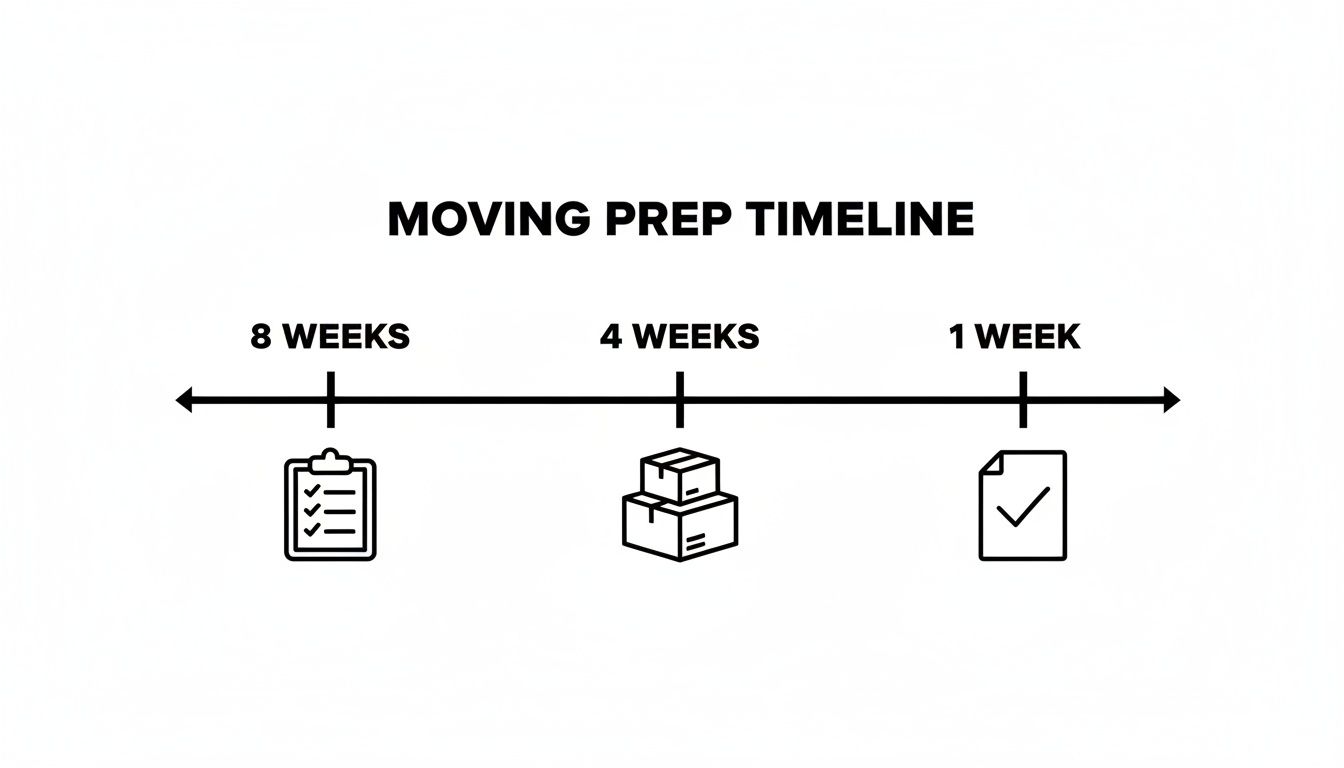
This timeline offers a clear visual breakdown of what to do and when, starting from the critical eight-week mark.

Moving prep timeline with key milestones: 8 weeks (checklist), 4 weeks (boxes), 1 week (completed document).

The key takeaway is simple: the sooner you complete your inventory and declutter, the smoother the subsequent stages—like packing and final logistics—will be.

Decluttering Your Home Strategically

A house move presents the perfect opportunity for a significant clear-out. Culling your possessions not only reduces the volume you need to move (and pay for) but also allows you to start fresh in your new home without carrying over years of accumulated clutter.

Employ the straightforward three-pile method for items you're leaving behind: sell, donate, or toss.

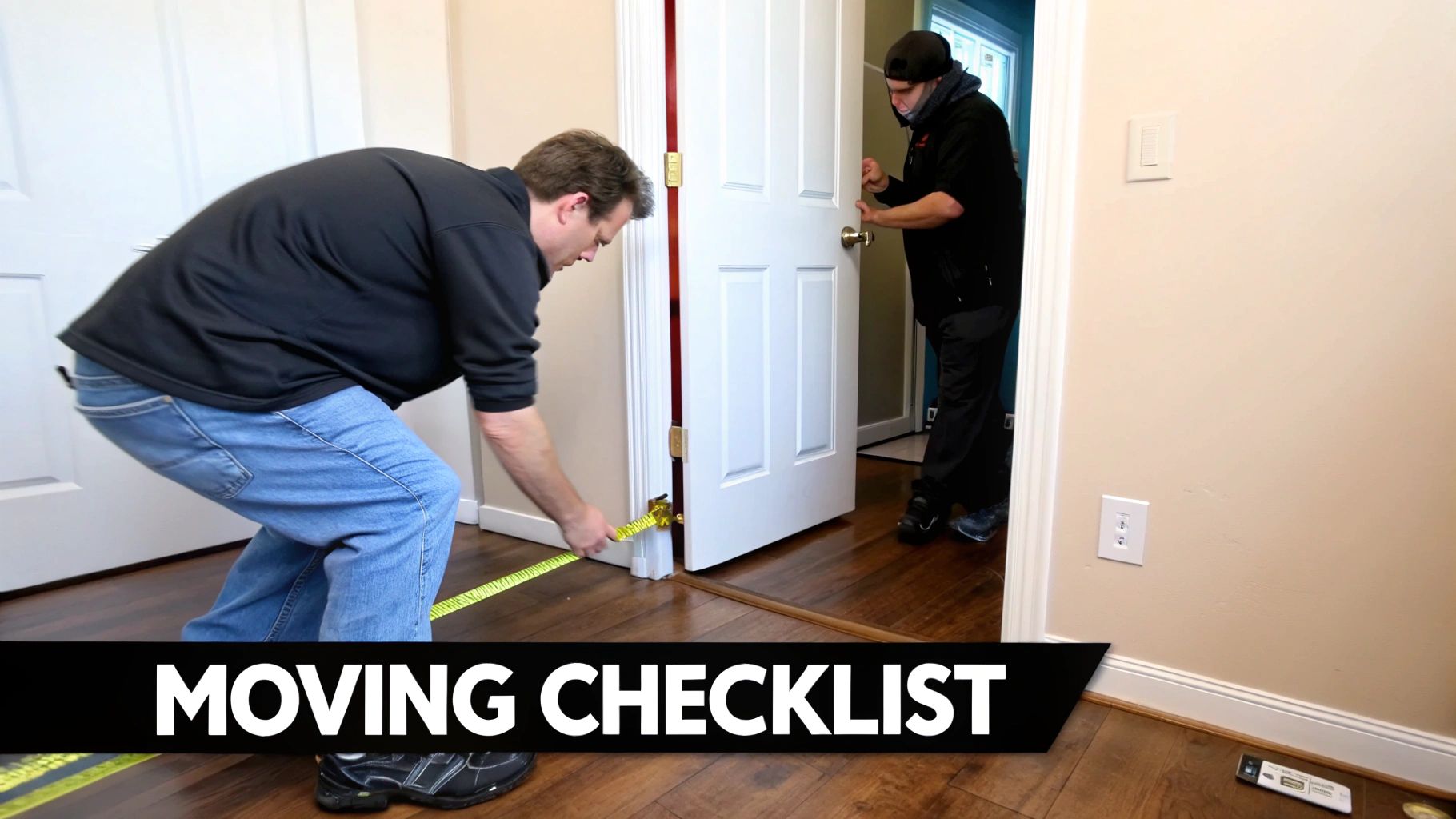
Pro Tip: Use a tape measure to check the dimensions of your large furniture against the doorways, hallways, and stairwells of your new home. Discovering that your favourite sofa won't fit through the front door on moving day is a stressful scenario you can easily avoid.

Another effective strategy is to create a 'moving folder'—either a physical binder or a digital one. This is the ideal place to consolidate all your quotes, receipts, contracts, and checklists. For a comprehensive guide, our essential moving home to do list provides a detailed breakdown. By tackling these steps methodically, you build a solid foundation for a stress-free relocation.

How to Find and Vet Professional House Relocators

Desk with 'PRE-MOVE PLAN' binder, cardboard boxes, measuring tapes, and notebooks for relocation planning.

Selecting the right moving company is arguably the most critical decision for a stress-free move. The market offers numerous options, from large national brands to local, family-run businesses. You need to know how to identify the true professionals who will safeguard your life's belongings. Investing time in due diligence now will prevent significant issues later.

First, it is crucial to understand who you are hiring. Many online platforms are simply moving brokers, not actual removalists. They collect your details and pass them on to various companies, which can lead to confusion and a lack of clear accountability if problems arise.

Conversely, engaging directly with established house relocators in Victoria who own their fleet of trucks and employ their own staff provides a direct line of responsibility. You know precisely who will arrive on the day and have a single point of contact for all your queries.

Essential Questions to Ask Potential Movers

Once you have a shortlist, it's time to probe deeper. Don't hesitate to ask direct questions—a reputable mover will provide clear and honest answers. Their transparency is often a strong indicator of their professionalism.

Here are a few questions we always recommend asking:

  • Are your movers full-time employees or contractors? Full-time, police-checked employees are typically better trained and more accountable than temporary or subcontracted labour.
  • What type of insurance do you hold? You need to hear the terms Public Liability and Transit Insurance. These policies protect your property and belongings during transit.
  • Can I receive a detailed, written quote? A vague, handwritten quote is a major red flag. A professional estimate should provide a clear breakdown of all associated costs.

Gathering this information upfront helps you assess the calibre of the company you're considering. To find a reliable local team, starting your search close to home can be beneficial; our guide on finding trusted removalists near you offers more detailed advice.

Spotting Red Flags in Quotes and Reviews

When you begin receiving quotes, remember that the final price isn't the only factor to consider. If a quote seems too good to be true, it likely is. An unusually low price can conceal numerous problems, from undertrained staff to inadequate or non-existent insurance.

Be extremely cautious of any company that demands a large cash deposit upfront or is unwilling to provide everything in writing. A comprehensive contract is your protection—it should clearly outline the scope of work, all costs, insurance details, and the moving day schedule.

Online reviews are another valuable resource, but they require careful interpretation. Don't just look at the overall star rating; delve into the specific comments to understand the actual customer experience.

Look for recurring themes in reviews:

  • Punctuality: Do customers consistently mention that the crew arrived on time?
  • Care and Professionalism: Are there comments praising how carefully they wrapped furniture or handled delicate items?
  • Problem Resolution: If an issue occurred, how did the company address it? Even the best movers encounter challenges; it’s their response that truly matters.

A few negative reviews aren't necessarily a deal-breaker for a company that handles thousands of moves. However, if you notice consistent complaints about damaged furniture, hidden fees, or poor communication, it's wise to look elsewhere. Your objective is to find professional house relocators who are not only efficient but genuinely trustworthy.

Decoding Quotes and Understanding Your Moving Costs

Reviewing a moving quote can sometimes feel like trying to decipher a complex code. Between different pricing structures and a long list of potential fees, it's easy to feel overwhelmed. However, understanding how professional house relocators in Victoria structure their pricing is the key to making an informed decision that aligns with your budget.

You will typically encounter two primary pricing models: hourly rates and fixed-price quotes. Neither is inherently superior; the best option depends on the specific details of your move. Let's break them down.

Hourly Rate vs. Fixed Price

An hourly rate is a straightforward pricing model. You pay for the time the movers are working, which usually includes the travel time from their depot to your location and back. This is a common choice for smaller, local moves within Melbourne, such as relocating a one or two-bedroom apartment.

A fixed price, in contrast, is a single, all-inclusive cost for the entire job. This model is generally better suited for larger homes or long-distance moves to regional Victoria where the logistics are more complex. It provides certainty about the final cost, offering significant peace of mind while you manage other moving expenses.

This has become particularly relevant recently. With Victoria attracting a substantial 34% of Australia's net regional migration, more families are undertaking large-scale moves to areas like Greater Geelong or the Latrobe Valley. For these complex relocations, a fixed price from experienced house relocators is often the most sensible choice. You can learn more about this migration trend in this great analysis on Australian migration patterns.

Expert Insight: For a local Melbourne move with good property access where you are fully packed and prepared, an hourly rate can be more cost-effective. However, if you are moving a large family home or relocating to regional Victoria, a fixed price provides budget certainty and protects you from unexpected costs if the move takes longer than anticipated.

To clarify further, let's compare these two models directly.

Hourly Rate vs. Fixed Price Comparison

Choosing between an hourly or fixed-price model can be challenging, but the decision largely depends on the scale and complexity of your move. The table below outlines the key differences to help you determine which option is best for your situation in Victoria.

Feature Hourly Rate Fixed Price
Best For Small, local moves (e.g., apartments) with easy access and few potential delays. Larger homes, long-distance relocations, or jobs with challenging access points.
Pros Can be more affordable for quick, efficient moves. You only pay for the time used. Provides cost certainty upfront—no surprises. The price is locked in, regardless of time.
Cons Costs can escalate due to traffic, poor access, or other unforeseen delays. May appear slightly more expensive initially to account for potential risks for the mover.

Ultimately, the right choice will give you control over your budget and eliminate a significant source of stress on moving day.

Uncovering Hidden Costs and What to Look For

A high-quality quote is a transparent one. While the final number is important, what's included in that price is what truly matters. When comparing quotes from different house relocators, ensure you are making a like-for-like comparison.

A professional mover will always provide a written quote that breaks down every potential charge. If a company is hesitant to offer a detailed estimate, consider it a major red flag.

Here are the key items to look for on any quote:

  • Call-Out/Depot Fee: This covers the crew's travel time from their base to your home and back.
  • Number of Movers: The quote should clearly state how many crew members will be on the job.
  • Truck Size: This confirms they are sending an appropriately sized vehicle for your belongings.
  • Stairs or Lift Fees: Additional charges for navigating multiple flights of stairs are common.
  • Difficult Access Fees: If the truck cannot park directly outside your property, a fee may apply for the extra carrying distance.
  • GST: Always verify that the price is inclusive of GST to avoid any surprises on the final invoice.

Requesting a full breakdown empowers you to make a confident decision. For a more in-depth look at how removalists price their services, review our guide on the cost of movers. A reputable company will always be transparent about their costs, helping you stay within your budget without worry.

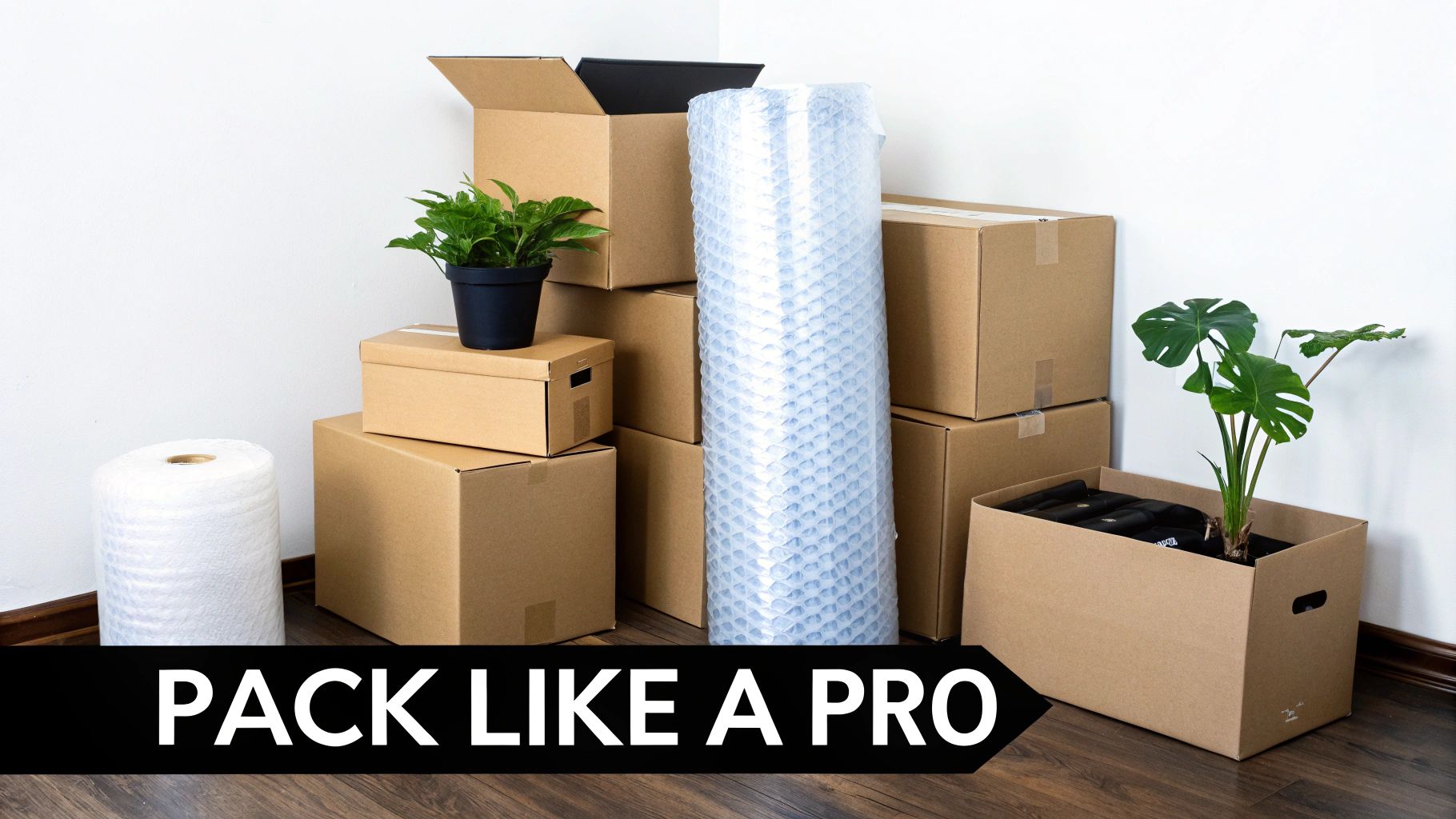
Mastering the Art of Packing Like a Pro

Proper packing is the single most crucial element for a damage-free move. While professional house relocators in Victoria are responsible for the heavy lifting, the way you pack your belongings directly impacts their condition upon arrival. It's the difference between unboxing treasured heirlooms and discovering a box of broken pieces.

It all begins with acquiring the right supplies. Avoid flimsy supermarket boxes and invest in proper, double-walled moving boxes of various sizes. You will also need an ample supply of packing paper, bubble wrap, high-quality packing tape, and thick markers for clear labelling.

A Strategic Room-by-Room Approach

Attempting to pack your entire house at once is a guaranteed recipe for feeling overwhelmed. The professional method is to work room by room, starting with those you use least, such as a spare bedroom or home office. This strategy keeps your primary living spaces functional for as long as possible.

Establish a dedicated packing station in an out-of-the-way area, like a corner of the dining room, and keep all your supplies there. As you pack each box, adhere to a few golden rules:

  • Heavier items must always be placed at the bottom of the box.
  • Position your lighter, more delicate items on top.
  • Use crumpled packing paper, towels, or linens to fill any empty spaces to prevent items from shifting.
  • Label clearly on the top and at least two sides with the destination room and a brief summary of the contents.

This system not only protects your possessions but also simplifies the unpacking process immensely for everyone involved. For a comprehensive overview of our best techniques, explore our guide with more packing tips for a successful house move.

The Benefits of Professional Packing Services

While packing yourself can save money, it consumes a significant amount of time and energy. If you have a demanding job, a family, or simply a large volume of belongings, engaging a professional packing service (also known as a 'valet' or 'white-glove' service) is a game-changer.

These services completely revolutionise the moving experience. A trained crew can pack an entire home in one or two days—a task that might take you weeks to complete. They arrive with all the premium materials and possess the expertise to wrap and secure everything, from fragile wine glasses to bulky electronics.

A full professional pack allows you to continue with your daily life with minimal disruption. The team manages everything, from wrapping every plate in your kitchen to boxing up your entire wardrobe. This frees you up to focus on the many other important tasks on your moving checklist.

Partial Packing for Maximum Flexibility

If a full-home pack seems excessive, most reputable house relocators in Victoria offer partial packing services. This is a brilliant, cost-effective solution that allows you to get professional help for the most challenging areas of your home.

The kitchen, for example, is notoriously difficult to pack due to its many fragile and awkwardly shaped items. Hiring professionals for just this one room can save you hours of stress and significantly reduce the risk of breakages. For oversized or unusually shaped items, movers often use specialised stretch film for secure wrapping. If you're interested in the professional techniques, you can learn more by understanding professional-grade stretch film.

Ultimately, whether you choose a full or partial service, professional packing transforms one of the most dreaded aspects of moving into a seamless, hands-off process.

Handling Specialist Items and Smart Storage Solutions

A room corner filled with moving boxes, bubble wrap, foam, and potted plants, ready for relocation.

While most of your household items will fit into standard moving boxes, certain possessions require a higher level of care. These include large, awkward, and valuable items like a grand piano, a slate pool table, or an antique armoire that has been in your family for generations. These items are not just heavy; they are often complex, delicate, and irreplaceable.

Attempting to move these items yourself without the proper equipment and expertise is a significant risk that can lead to costly damage. Professional house relocators in Victoria are equipped with specialised gear—such as piano trolleys, hydraulic lifts, and custom crates—and the training to use it effectively. Their experience is essential for navigating these items through tight corners, up stairs, and around challenging access points without causing any damage.

When vetting a moving company, be direct with your questions. Don't just ask if they can move a piano; ask them how they will do it. Discussing the specific methodology will help you quickly determine if they are genuinely experienced or simply improvising.

Confirming Specialist Handling Capabilities

A true professional will have no hesitation in detailing their process. Before signing any contract, ensure you receive satisfactory answers to these questions:

  • What specific equipment will you use? You should hear them mention items like piano dollies, stair-climbing equipment, heavy-duty protective padding, and custom-built crates for artwork or statues.
  • What is your team’s experience with this type of item? Ask how many similar items they move each month to gauge their confidence and skill level.
  • Is your insurance sufficient for high-value items? Verify that their transit insurance policy has a high enough coverage limit to protect your most valuable possessions.

Receiving clear, confident answers will provide peace of mind that your treasured belongings are in capable hands. If a mover is vague or dismissive of these questions, consider it a serious red flag.

Integrating Smart Storage Into Your Move

Beyond specialised items, moving often creates a need for storage. This situation arises frequently—perhaps there's a gap between your settlement dates, you're downsizing and need time to sort through your belongings, or you plan to renovate your new home before moving everything in. A reliable storage solution can be a lifesaver.

Choosing a moving company that also offers its own secure storage facility is a significant advantage. It streamlines the entire process, keeping your belongings under the care of a single, trusted provider from the moment they leave your old home until they are delivered to your new one. This eliminates the hassle of coordinating with multiple companies.

When your mover handles the storage, your items are loaded once, transported to their secure facility, and then delivered to your new home when you are ready. For more flexible, on-site storage during a move or renovation, it's also worth exploring various self-storage container solutions that can be delivered directly to your property.

Whether you require short-term storage for a few weeks or a long-term arrangement, integrating it with your move simplifies the logistics immensely. To explore local options, you can find valuable information on storage units and prices near you. By planning for both your specialist items and potential storage needs, you can ensure every aspect of your Victorian move is comprehensively covered.

Your Ultimate Moving Day Survival Checklist

The big day has finally arrived. After weeks of planning, packing, and organising, it all comes down to these crucial hours. The key to a smooth process from start to finish is a calm and methodical approach. Consider this your game plan for the day, designed to help you stay in sync with your house relocators in Victoria and complete the final essential tasks.

A small amount of preparation the night before and on the morning of the move can make a significant difference. The goal is simple: be fully prepared when the truck arrives, rather than frantically packing last-minute items.

The Day Before and Morning of the Move

Your final preparations are focused on making the moving day itself as seamless as possible. By addressing these tasks ahead of time, you can eliminate potential obstacles and ensure everything runs like clockwork.

  • Confirm Truck Access: This is a critical step. Double-check that there is a clear and legal parking space for the moving truck at both your old and new properties. If you needed to reserve a spot with the local council, confirm that all arrangements are finalised.
  • Pack Your 'Essentials Box': Do not skip this step. Take a box or suitcase, label it clearly, and fill it with everything you will need immediately upon arriving at your new home. This includes phone chargers, toiletries, medications, a change of clothes, basic tools (a screwdriver and a box cutter are invaluable), and, most importantly, the kettle.
  • Keep Valuables Separate: Gather all your critical documents, jewellery, keys, and laptops. These items should remain with you at all times, not on the truck.

Moving Day Pro Tip: Just before you leave your old home for the last time, use your phone to take photos of the utility meter readings (gas, electricity, water). This creates a time-stamped record that can prevent headaches if any disputes arise with your former providers.

During and After the Movers Are On-Site

Once the crew arrives, your primary role is to provide direction. Be available to answer questions and give clear instructions. Point out which items are fragile or require extra care, even if they are already labelled.

Before you depart from your old home, conduct one final walkthrough. After the truck is fully loaded, check every room, open every cupboard, and inspect all storage areas. It's surprisingly easy to overlook items in the hustle of the day.

At the new property, your first task is to direct the movers on where to place large furniture and boxes. Guiding them will save you significant effort later. Before the team leaves, review the inventory list (if one was provided) and quickly inspect your belongings for any obvious damage. A reputable moving company will have a clear claims process, but identifying any issues immediately is always beneficial.

With these steps completed, you are ready to begin the exciting part: settling into your new Victorian home.

Your Top Moving Questions Answered

Two men move boxes from a moving truck into a large brick house on a sunny day.

We receive many questions about the nuances of moving in Victoria. Below, we've addressed some of the most common queries with straightforward, practical advice to help you prepare for the big day.

How Much Notice Do Movers Really Need?

Ideally, you should book your movers at least four to six weeks in advance. This is particularly important if you are planning to move during peak seasons, such as spring, summer, or school holidays.

With the high demand for moves to regional Victoria, the most reputable companies are booked up quickly. Securing your date early not only guarantees you a spot but can also result in a more favourable rate. Leaving your booking to the last minute may incur a premium for the tight scheduling.

Is Moving Insurance Actually Necessary?

Yes, it is highly recommended. While professional house relocators in Victoria will have their own insurance, such as Public Liability and Transit Insurance, it's important to understand the limitations of these policies. Your first step should be to review your own home and contents insurance to see what coverage it provides during a relocation.

For complete peace of mind, especially if you own high-value antiques, art, or electronics, consider purchasing a dedicated removals insurance policy. This provides an additional layer of protection against accidental damage while your belongings are being packed, transported, and unloaded.

What Items Will Movers Refuse to Take?

For critical safety and legal reasons, there are certain items that movers cannot transport. Knowing this list in advance will prevent major issues on moving day.

Generally, movers will refuse to transport:

  • Hazardous Materials: This includes items like petrol, gas bottles, paints, aerosol cans, and most cleaning chemicals.
  • Perishable Food: Anything that can spoil must be moved by you or disposed of before the truck arrives.
  • Personal Valuables: Keep your essential documents, jewellery, cash, and items of high sentimental value with you at all times.
  • Live Plants: Policies regarding plants can vary, especially for long-distance moves, so it's always best to check with your mover beforehand.

Always request a specific list of prohibited items from your chosen moving company well in advance of your move. This will give you ample time to make alternative arrangements for those items.


Ready to make your Victorian relocation a seamless and stress-free experience? The team at Get n Go Removals Melbourne has the expertise, equipment, and dedication to handle every detail of your move, from professional packing to secure transport. Let our experienced, police-checked crew take the heavy lifting off your shoulders. For a transparent quote and reliable service you can count on, visit us at https://www.getngoremovals.com.au.

READ MORE

Self Storage Rates Melbourne: A 2024 Guide to Finding the Best Price

When you start searching for self storage in Melbourne, the first question on your mind is almost always, "How much is this going to set me back?" The short answer is that you can expect to pay anywhere from $90 to over $550 a month, but that's a huge range. The final price really hinges on the unit's size, its location, and any special features you might need. A small locker could cost less than your weekly grocery bill, while a space large enough for the contents of a family home will naturally be a more significant investment, especially if it's in a prime inner-city spot.

This comprehensive guide is designed to give you all the information you need to navigate the Melbourne self storage market, helping you make an informed decision for your moving or decluttering needs.

Understanding Melbourne Self Storage Rates: What to Expect in 2024

A bright, clean self-storage facility hallway lined with green unit doors. A sign reads 'STORAGE RATES'.

Figuring out the cost of storage in Melbourne doesn't have to be a guessing game. While prices do vary between providers and suburbs, getting a handle on the general landscape of self storage rates in Melbourne is the best first step. The monthly fee is shaped by a few key factors that we'll break down, but even a quick overview can give you a solid baseline for your budget.

The good news for anyone needing storage is that Melbourne's market is incredibly competitive. Recent industry stats show that storage fee growth here was the lowest among all major Australian cities, nudging up by just 0.1% over six months. What does that mean for you? It points to a market where there are plenty of options, so if you do a little digging, you can find excellent value. This is especially beneficial for customers moving house or office who need a cost-effective solution.

To give you a clearer picture, here’s a quick guide to what you can generally expect to pay for different unit sizes around the city.

Estimated Monthly Self Storage Rates in Melbourne

This table gives you a ballpark idea of what you might pay each month for common self-storage unit sizes in Melbourne. It's a great starting point for figuring out your budget and understanding the value you get for your money.

Unit Size (Approx.) What It Can Hold Estimated Monthly Price Range (AUD)
Small (1.5m x 3m) Contents of a studio apartment or a large walk-in wardrobe. Ideal for boxes, small furniture, and seasonal items. $90 – $180
Medium (3m x 3m) Furnishings from a one or two-bedroom apartment. Can fit a couch, bed, white goods, and multiple boxes. $200 – $350
Large (3m x 6m) Contents of a three-bedroom house or a standard car. Perfect for large furniture sets, appliances, and business inventory. $350 – $550+

Think of these numbers as a solid reference, but remember that the final quote will depend on the specifics of your situation and the factors we discuss next.

Key Takeaway: As a rule of thumb, the price per square metre gets cheaper as the unit gets bigger. But the most significant factor driving the cost is almost always the location—you'll pay a premium for storage in the inner suburbs.

While these figures are a great starting point, they are just averages. To get a wider view on pricing and what to watch out for, checking out a general guide on self storage costs can be really helpful, even if the exact numbers differ.

And if you want to dig deeper into what really shapes these prices, you might find our detailed breakdown of how much self storage costs useful. At the end of the day, your final quote will come down to your specific needs, whether that’s climate control for sensitive items or 24/7 access for convenience.

What Really Determines Your Storage Price?

Those average price tables you see online? They're a decent starting point, but the actual quote you get for a self-storage unit in Melbourne will swing based on a few critical factors. Understanding these variables is key to finding the best value, ensuring you only pay for what you actually need.

First up is the most obvious one: unit size. You're paying for space, so figuring out exactly how much you need is the first step to keeping costs down. Renting a unit that’s too big is like paying for empty air, but underestimating can leave you scrambling for a last-minute upgrade during a stressful move.

Beyond the unit's dimensions, the facility's postcode has a massive impact on what you'll pay.

Location: Convenience vs. Cost

Where you decide to store your things is probably the biggest single driver of your monthly bill. A storage facility in a prime, high-demand spot like Richmond or South Melbourne will always cost more than one out in Dandenong or Werribee. The price difference comes down to land value and accessibility.

Essentially, you're paying for convenience. If you need to pop in and grab things regularly, a nearby location might be essential. But if you’re stashing items away for the long haul and don’t plan on visiting often, choosing a facility a bit further from the city centre can lead to serious savings on your self storage rates in Melbourne.

A prime CBD or inner-suburb location can add a 20-30% premium to your monthly storage fee just for the convenience. Deciding if that proximity is worth the extra cost is a crucial part of your decision-making process when moving house or office.

Special Features and Access

The type of unit and what it offers also plays a huge part in the final price. Not all storage spaces are built the same, and if you need specialised options, you can expect to pay a bit more.

Here’s a quick look at common features that will affect your quote:

  • Climate Control: If you're storing anything sensitive like wooden furniture, electronics, artwork, or important documents, a climate-controlled unit is a must. It keeps the temperature and humidity stable to protect your items from Melbourne's unpredictable weather, but it usually adds 15-25% to the standard price.
  • Access Hours: Most places offer standard access during business hours. If you need to get to your stuff 24/7, you'll likely pay a premium for that flexibility. This is often essential for business owners or anyone with a hectic schedule.
  • Ground Floor vs. Upper Level: A ground-floor unit, especially one you can drive right up to, is the ultimate convenience for loading and unloading heavy items. That easy access often comes with a higher price tag compared to units on upper levels that you access via a lift.

Rental Duration and Promotions

Finally, how long you plan to stay can work in your favour. Many facilities will offer a discount if you commit to a longer-term rental. Paying for six or twelve months upfront can often lock in a lower monthly rate than a flexible month-to-month plan.

On the other hand, short-term rentals, while flexible, usually come at the standard, or sometimes slightly higher, rate. Always ask about introductory offers like "first month free" or "50% off the first three months." These promotions can seriously reduce your initial cost, but make sure you check what the standard rate will be afterwards. A smart decision balances the upfront savings with the long-term cost.

How Melbourne's Shifting Landscape Affects Storage Costs

To find the best value on self storage rates in Melbourne, it helps to know what’s happening behind the scenes. The city’s bustling property market has a direct impact on the prices you’ll see, and understanding these forces can give you a real advantage in your search.

Melbourne is growing at a cracking pace, and there’s a clear shift towards denser urban living. This isn't just a passing trend; it's changing how Melburnians live and, consequently, how they store their belongings.

The Rise of Apartment Living and Storage Demand

Melbourne’s boom in urban density has completely reshaped the housing market. New developments are all about high-rise apartments and compact homes, which are fantastic in many ways but often lack one crucial thing: storage space. This shift means more and more people are looking for external storage solutions, as modern apartment life almost assumes you'll have a storage unit on the side.

This constant demand, fuelled by people downsizing, relocating, or simply running out of room, keeps the storage industry on its toes. If you're planning a move to the city, getting a handle on these housing dynamics is key. Our ultimate guide to moving to Melbourne offers some great practical advice on this. For a deeper dive, the Australian self-storage market insights from IMARC Group show just how much this sector is growing.

How Increased Supply Creates a Competitive Market

The high demand for storage hasn't gone unnoticed. In the last few years, Melbourne has seen a massive boom in new self-storage facilities popping up all over the place. Now, while strong demand usually sends prices skyrocketing, this surge in supply has actually created a fiercely competitive environment.

This is brilliant news for you. With more facilities fighting for your business, providers are much more likely to offer sharp pricing and tempting introductory deals to get you through the door.

Market Insight: It's a classic tug-of-war. The high demand from apartment living keeps the need for storage strong, but the increasing supply of new facilities means providers have to work harder to win you over. This often translates to better deals for savvy shoppers.

So, what does this mean for your search? It means you’ve got the upper hand. Don't just accept the first quote you get. Compare prices from different providers, ask them flat-out about any special offers, and don't be afraid to negotiate for better terms. Knowing the market is this competitive empowers you to find a rate that truly reflects the current landscape.

Comparing Storage Rates Across Melbourne Suburbs

When you start looking for the best self storage rates in Melbourne, you’ll quickly notice that location is a massive factor. It's a bit like the property market itself—a facility's postcode can have a huge impact on what you pay, meaning a short drive could easily save you a fair bit of cash.

To find a good deal, it helps to understand how prices differ across Melbourne's suburban rings. The city is generally split into three main zones, and each has its own pricing structure based on land value and the density of local demand.

Inner City Versus Outer Suburbs: A Price Breakdown

It’s no surprise that inner-city suburbs like South Melbourne, Port Melbourne, and Richmond offer incredible convenience, but you definitely pay a premium for it. These areas have the highest land values and serve a dense population, many of whom live in apartments with limited space. This keeps demand high and prices firm.

As you move out into the middle-ring suburbs—think Box Hill, Preston, or Essendon—land gets a bit cheaper and there's often more competition between storage facilities. This usually translates to more moderate pricing. Go even further out to places like Werribee, Frankston, or Dandenong, and you'll almost always find the most affordable rates because the operational costs for facilities there are much lower.

The key drivers for storage demand in Melbourne are pretty clear: more high-rise living means less personal space, which pushes people to look for external solutions.

Bar chart illustrating Melbourne storage drivers: high rises, less space, and more demand.

This just goes to show that the boom in apartment buildings directly fuels the need for more storage units. Less living space simply means more stuff has to go somewhere else.

To give you a real-world idea of the price difference, let’s look at how the monthly rate for a standard 3m x 3m unit—one of the most common sizes—can vary across these regions.

Sample 3m x 3m Storage Unit Monthly Rates by Melbourne Region

This table gives a snapshot of what you might expect to pay for a popular unit size, showing just how much your suburb choice matters.

Melbourne Region Example Suburbs Average Monthly Rate (AUD)
Inner-City Ring South Melbourne, Richmond, Port Melbourne $280 – $350
Middle-Ring Box Hill, Essendon, Moorabbin $240 – $290
Outer Suburbs Werribee, Dandenong, Frankston $200 – $250

As you can see, you could save up to $100 per month or even more just by choosing a facility in an outer suburb over one in the inner city.

Expert Tip: If you don't need to get to your belongings all the time, choosing a facility that's a 20–30 minute drive away can be the single most effective way to lower your monthly bill without giving up on security or quality.

Is the Drive Worth the Savings?

Deciding whether to store your items close to home or further afield really comes down to a trade-off between convenience and cost.

If you’re a business owner who needs to grab inventory every day, then a nearby inner-city unit is probably a non-negotiable expense. But if you’re just stashing furniture during a reno or keeping seasonal gear safe, the savings from an outer-suburban unit can add up fast.

For those in the middle of a move, an even better option is to bundle services together. Many professional removalists offer their own secure storage solutions in Melbourne, which simplifies the whole process and can often be more cost-effective than getting a separate storage contract. This all-in-one approach means you’re not trying to coordinate multiple companies, making for a much smoother experience from start to finish.

Smart Ways to Lower Your Self Storage Bill

Finding affordable self storage rates in Melbourne doesn't have to be a shot in the dark. With a few clever tactics up your sleeve, you can seriously cut down your monthly bill without skimping on quality or security. It all comes down to knowing where the savings are and making choices that match what you actually need.

A lot of the best deals are found online, where facilities often post special promotions to attract new customers. But beyond those initial offers, one of the most powerful strategies is geographic; choosing a facility just outside the pricey inner-city suburbs can lead to big, immediate savings on your monthly costs.

Right-Size Your Unit to Avoid Wasted Spend

One of the easiest mistakes to make is paying for space you don't use. It’s so common to overestimate how much room you'll need, which lands you with a bigger unit—and a bigger bill—than necessary. Before you even think about booking, take the time to make a quick inventory of everything you're putting into storage.

A little bit of planning here goes a very long way. Stacking and organising your boxes properly can make a massive difference, and you might find you can fit everything into a smaller, cheaper unit after all. To avoid this common trap, the first step is always to reduce what you're storing in the first place. You can get some great tips from our guide on how to declutter before you move, which has practical steps to help you minimise your load.

Long-Term Commitments and Bundled Services

If you know you’ll need storage for more than just a couple of months, it's always worth asking about long-term discounts. Plenty of facilities will offer a lower monthly rate if you commit to a six or twelve-month rental period. It's a simple way to lock in savings, especially if you're storing things during a long trip or while renovating your home.

Pro Tip: Think about how storage fits into the bigger picture. If you're moving house, juggling a separate removalist and a storage provider just adds layers of complexity and cost. Bundling the two with a professional mover is often far more cost-effective and a whole lot smoother.

For instance, a moving company that also offers its own storage handles everything under one roof. This kind of integrated approach doesn't just simplify the logistics; it often works out cheaper overall. Your belongings are moved directly into a secure facility by the same team you trust, which means less handling and a seamless journey from your old place to the storage unit, and eventually, to your new home.

Evaluating Security and Reliability in a Storage Provider

A white security camera watches over secure self-storage units with textured walls and black doors.

While competitive self storage rates in Melbourne can grab your attention, the safety of your belongings should always be the deciding factor. Let's be honest, a cheap rate means nothing if your items aren't secure. Beyond the monthly cost, you need to dig into the security measures a provider has in place to get genuine peace of mind.

A reliable facility is more than just a lock on a door. It's a combination of modern technology and proactive management working together to protect your valuables from theft, damage, and even pests.

Core Security Features to Look For

When you're inspecting a potential storage facility, keep your eyes peeled for these non-negotiable security and maintenance features:

  • 24/7 CCTV Surveillance: Cameras should be everywhere—covering entry points, hallways, and loading zones. An effective CCTV camera installation is the backbone of any serious security setup.
  • Individually Alarmed Units: This is a huge plus. It adds another layer of protection by alerting staff if your specific unit is accessed without permission.
  • Secure Access Control: Look for PIN-coded gates or electronic access systems. These don't just keep people out; they create a digital log of everyone who comes and goes.
  • Robust Pest Control: Don't be shy about asking for their pest management schedule. Regular, professional treatment is absolutely vital to protect your goods from unwanted visitors.

Key Insight: Real security isn't just about stopping break-ins. It's about creating a controlled environment that also protects your belongings from environmental damage and pests, ensuring they come out in the exact same condition they went in.

The Advantage of an Integrated Solution

Choosing a provider you can count on is crucial, especially when you consider that Melbourne's storage market is always in flux. While demand is high, you need a stable and professional operator.

This is where an integrated service really shines. When you use a professional removalist that also offers secure storage, you create a seamless, accountable system for your possessions.

By combining your furniture removal and storage in Melbourne, your items are handled by one expert team from start to finish. This massively cuts down the risk of damage or loss that can happen when you're juggling multiple companies. It's a streamlined approach that delivers a secure and genuinely stress-free experience.

Answering Your Melbourne Storage Questions

Got a few lingering questions before you commit to a storage unit? You're not alone. Here are the answers to some of the most common queries we hear from customers, designed to give you clarity and confidence.

How Much Notice Do I Need to Give to Move Out?

Most storage places in Melbourne will ask for somewhere between 7 to 14 days' written notice before you clear out your unit. It's one of those details buried in the rental agreement, so it's always smart to double-check the specific terms before you sign.

Of course, if you’re using an all-in-one service from a removalist like us, this whole process is a lot more fluid. We just coordinate it with your moving schedule to keep things simple.

Is Insurance a Must-Have for Self Storage?

Yes, you'll find that nearly every reputable storage provider in Melbourne will require you to have insurance for your belongings. While it's not always a hard legal requirement, it's a standard industry practice that protects both you and them.

They'll likely offer their own policy, but it's also worth checking if your current home and contents insurance already covers items in storage. A quick phone call could save you a bit of money.

What Can't I Put in a Storage Unit?

There’s a pretty standard list of no-go items. You cannot store anything flammable, toxic, or perishable. This includes things like hazardous materials (fuel, paint, chemicals), anything perishable that might attract pests, illegal substances, and, of course, living things like plants or pets.

To be absolutely sure you’re not breaking any rules, just ask the facility for their complete list of restricted items before you start packing your boxes. It’s always better to be safe than sorry.


Ready to make your move and storage completely seamless? Get n Go Removals Melbourne combines secure storage with our expert moving services, streamlining the whole process. Let us take the stress out of your hands. Find out how our team can help by visiting us at Get n Go Removals.

READ MORE

Couch Delivery Service: A Guide to Moving Your Sofa Stress-Free

A professional couch delivery service is the simplest, safest, and most straightforward way to transport a sofa from one place to another. Whether you’ve just invested in a brand-new lounge suite for your home or are moving a cherished family sofa to a new office, professional movers are equipped to handle all the heavy lifting, transportation, and logistical challenges involved.

Put simply, hiring experts saves you from a world of stress, the risk of personal injury, and accidental damage to your property or your new couch.

Why a Professional Couch Delivery Service Is Worth It

Let’s be honest, getting a new sofa is exciting. But the reality of actually moving it can quickly turn that excitement into a logistical nightmare. Couches are notoriously awkward, impossibly heavy, and an absolute pain to manoeuvre through doorways and tight corners.

It’s one of those jobs that seems simple enough until you're halfway up a flight of stairs with a 100kg sectional, sweating buckets and wishing you’d just called for help.

Think of it this way: you wouldn't perform your own dental work to save a few dollars. So why risk your valuable furniture, your walls, and your own back with an amateur move? A dedicated couch delivery service turns this complex chore into a completely hands-off experience, ensuring a smooth transition for your office move or house relocation.

Comparing Professional Service vs DIY Moving

The difference between hiring the pros and roping in a few mates is night and day. Professionals show up with the right tools, proper training, and years of experience to get the job done flawlessly. This isn't just about raw muscle; it's about technique.

They know exactly how to pivot a sofa around a sharp corner, wrap it securely in moving blankets, and strap it down in the truck so it doesn't budge an inch during transit. Trying this on your own often ends in scratched floors, dented walls, or worse, a damaged couch. To really get a feel for the benefits, it's worth exploring why hiring removal services is the smart way to move for any large, awkward item.

To make it even clearer, let's break down the key differences.

Professional Couch Delivery vs DIY Moving at a Glance

Feature Professional Service DIY Method
Safety Trained staff use proper lifting techniques to prevent injury and property damage. High risk of personal injury (back strain, pulled muscles) and damage to walls, floors, and the couch itself.
Efficiency The entire process is done quickly and correctly, often in less than an hour. Can take several hours of stressful, frustrating effort, often with multiple attempts to get through tight spaces.
Equipment Arrives with dollies, moving blankets, straps, and a suitable vehicle (like a truck with a hydraulic lift). You have to rent or borrow gear, which adds cost and hassle. Using the wrong vehicle risks damage.
Insurance Your couch and property are covered by Public Liability and Transit Insurance for complete peace of mind. You are personally liable for any damage that happens to your property, the couch, or any helpers.

When it comes down to it, a professional couch delivery service offers so much more than just transport. It gives you expertise, security, and the assurance that your investment will arrive in perfect condition. It’s a small price to pay for a smooth, stress-free experience.

Decoding the Different Types of Couch Delivery

Choosing a couch delivery service isn’t a one-size-fits-all deal. The right service really depends on your situation—whether you've just snagged a last-minute bargain online, are planning a move months away, or just want a completely hands-off experience. Figuring out the options means you only pay for what you actually need.

Think of it this way: you wouldn't use a sledgehammer to hang a picture frame. In the same way, you don't need a full-service interstate team for a quick trip across town. Each service is a different tool designed for a specific job.

The infographic below really nails the difference between roping a mate into helping you move a couch versus hiring a professional service. It highlights just how much smoother things go with expert help.

Infographic comparing DIY couch delivery, shown as stressful and risky, versus professional service, highlighting safety and efficiency.

As you can see, professionals bring the right gear and know-how, turning a potentially back-breaking job into a safe and efficient process. Let's break down the main types of delivery you’ll come across.

Same-Day Delivery For Urgent Needs

Picture this: you’ve found the perfect couch on Facebook Marketplace, but the seller needs it gone today. This is where Same-Day Delivery is an absolute lifesaver. It’s built for speed and convenience, perfect for those urgent situations where waiting just isn't an option.

This service is a lifeline for last-minute purchases or unexpected moves. Professional teams can be dispatched quickly, often with a 2 man with a van crew, to pick up and deliver your new couch within hours. It takes all the pressure right off your shoulders.

Scheduled Delivery For Perfect Planning

For those of us who love a good plan, Scheduled Delivery gives you total control and predictability. This is the ideal choice when you need to coordinate your couch's arrival with a house settlement, a specific move-in day, or a building manager who has strict rules about using the lifts.

You simply book a specific date and time slot well in advance, making sure the delivery team shows up exactly when you need them. No more waiting around wondering where they are—you can get on with organising the rest of your move with confidence.

White-Glove Delivery The Ultimate Hands-Off Service

White-Glove Delivery is the premium, all-inclusive option for valuable, delicate, or just plain awkward pieces of furniture. It’s so much more than a simple drop-off; it's a complete, end-to-end solution handled by experts from start to finish.

With a white-glove service, the delivery team handles everything. This includes carefully disassembling the couch if needed, protecting every inch with high-quality packing materials, transporting it, and then reassembling it in the perfect spot in your new room.

They’ll even clear away all the leftover packing rubbish, leaving you with nothing to do but sit back and enjoy your new setup. It's the go-to for antique sofas, expensive modular sectionals, or for anyone who just wants a truly stress-free experience.

Interstate Delivery For Long-Distance Moves

Getting a couch from Melbourne to Sydney or Brisbane is a whole different ball game. It requires a serious level of logistical planning, which is where Interstate Delivery comes in. This is a specialised service designed to get bulky items safely across long distances.

Companies that offer this service use purpose-built trucks and have established routes to ensure efficiency and safety. This is a crucial part of Australia's logistics network, where the demand for reliable movers has skyrocketed with the growth of e-commerce.

How Much Does Couch Delivery Cost in Australia?

Figuring out the cost of a professional couch delivery service can feel a bit like solving a puzzle. The price isn't just a simple flat fee; it's a combination of several important factors that reflect the time, effort, and resources needed for the job. Understanding these elements helps you see exactly what you're paying for and avoid any surprises down the track.

Essentially, the final quote for your couch delivery is shaped by three main ingredients: the couch itself, the distance it needs to travel, and the level of service you choose. Each one plays a big part in building the total cost.

Key Factors Influencing Your Couch Delivery Quote

So, what actually goes into that final number? It's a mix of a few key things that professional movers need to account for.

Here’s a quick breakdown of what shapes your quote:

Key Factors Influencing Your Couch Delivery Quote

Cost Factor Description Potential Price Impact
Couch Size & Weight A huge modular sectional is a different beast to a simple two‑seater. High: Heavier or bulkier couches often require more movers or specialised gear.
Distance The kilometres between the pickup and drop-off points. High: Longer distances mean more fuel, driver time, and potential tolls.
Access Conditions How easy is it to get the couch in and out? Think stairs, tight corners, and lifts. High: Difficult access takes more time and effort, directly impacting labour costs.
Service Level From a basic kerbside drop to a full white-glove setup. Medium to High: More comprehensive services cost more but save you the hassle.

The first thing any moving company will consider is the size and weight of your couch. A compact two-seater is far easier to handle than a sprawling, heavy modular sectional. Heavier pieces often require more staff or specialised equipment like hydraulic lifts, which naturally adds to the price.

Distance is another major factor. A short trip across a Melbourne suburb will cost significantly less than an interstate run to Sydney or Brisbane. Fuel, travel time, and the driver's wages all get factored into that final figure.

It's not just about the distance on a map. "Access" is a huge part of the equation. A ground-floor delivery with a wide, straight path is straightforward. A fifth-floor apartment with a narrow staircase and no lift is a completely different, and more complex, job.

Finally, the type of service you select makes a big difference. Standard kerbside delivery is the most budget-friendly option, while a full white-glove service, including disassembly and reassembly, will be at the higher end of the price scale. You’re really paying for convenience and expertise here.

Typical Price Ranges and What to Expect

To give you a clearer idea, let's look at some common scenarios. A local delivery of a standard three-seater sofa within Melbourne might cost between $120 and $250. This usually covers two movers for about an hour, including their travel time and all the necessary equipment.

For longer distances, like a run from Melbourne to Sydney, you could expect to pay anywhere from $350 to $700 or more. These interstate deliveries are often part of a consolidated load, which helps keep the price more affordable than hiring a dedicated truck just for your couch.

It's also worth noting that the furniture delivery sector is a vital part of Australia's logistics market. With the boom in online furniture sales, residential pickups for larger items have become more common. A couch weighing 30-99kg might incur a surcharge, while one over 100kg could require a tail-lift truck and additional labour, impacting the final cost.

Understanding Additional Charges

Sometimes, extra fees are necessary to handle specific challenges that pop up during the move. These aren't hidden costs, but rather fair charges for additional labour or complexity. The crucial thing is that your chosen moving company is transparent about these from the very start.

Common situations that might incur extra charges include:

  • Stairs and Lifts: Navigating multiple flights of stairs takes more time and serious physical effort. Some apartment buildings also require special lift bookings, which adds another layer of logistics.
  • Difficult Access: Tight hallways, sharp corners, or narrow doorways that require a bit of extra wrangling can increase the time needed to get the job done safely.
  • Disassembly and Reassembly: If your couch needs to be taken apart to fit through a doorway and then put back together, this skilled work will be reflected in the final cost.

A trustworthy moving company will always discuss these potential charges with you upfront during the quoting process. For a more detailed breakdown, our guide on moving company costs provides a deeper look into how professional quotes are structured, ensuring you can budget with complete confidence.

How to Prepare for a Smooth and Damage-Free Delivery

A successful couch delivery service experience doesn’t kick off when the truck pulls up outside your house. It actually starts long before that, with a bit of smart prep work on your end. Taking a few simple steps can be the difference between a quick, seamless delivery and a stressful afternoon of awkward shuffling and potential dings and scratches.

Think of it as setting the stage for a perfect performance. When you prepare the environment, you remove the obstacles and let the professionals do their job safely and efficiently. This checklist is your best defence against those all-too-common moving day headaches.

Measure Twice, Move Once

The single most common hiccup in furniture delivery is a couch that simply won't fit. A few minutes with a tape measure now can save you a world of trouble later. Don't just measure the couch itself; you need to measure its entire journey into your home.

Start with the couch. Get its height, width, and depth at the absolute widest points. Next, measure every doorway, hallway, and tight corner it needs to get through. Don't forget to account for things like door frames, hinges, and low-hanging light fixtures that might sneakily reduce your clearance.

One measurement that people often forget is the diagonal height of the couch. This is the secret weapon for tilting a sofa to get it through a tight doorway. To find it, measure from the bottom rear corner all the way up to the top front corner.

Clear the Path for Safe Passage

Imagine you’re rolling out the red carpet for your new couch. The goal here is to create a totally unobstructed path from the delivery truck to its final resting spot. This isn't just for the safety of the movers—it’s about protecting your belongings, too.

A clear path is more than just sliding a coffee table out of the way. It involves:

  • Removing Obstacles: Take pictures down from walls, roll up any rugs, and move furniture, lamps, or plants that are in the direct line of fire.
  • Protecting Surfaces: Lay down some protective runners or even old blankets to shield your floors from scuffs and dirt, especially if it’s a rainy day.
  • Securing Pets and Children: It's best to keep pets and small kids in a separate, secure room to stop them from getting underfoot during the move.

Communicate Potential Challenges in Advance

Professional movers are absolute pros at problem-solving, but they can work their magic much better if they know what they’re walking into. Being upfront about any potential access issues isn't just helpful—it's essential for a smooth delivery.

When you book your service, give the company a heads-up about any of the following:

  • Staircases: Let them know how many flights of stairs are involved and if there are any tricky turns or narrow landings.
  • Elevators: If you live in an apartment building, find out if you need to book a dedicated service elevator and double-check its dimensions.
  • Parking Restrictions: Inform the team about any tough parking situations, like a narrow street or a long walk from the truck to your front door.
  • Building Rules: Be aware of any specific moving times or rules set by your body corporate or building management.

This kind of proactive communication allows the delivery team to show up with the right equipment and the right number of crew members, making sure they’re fully prepared for the job. For extra peace of mind, consider using a plastic couch protector to keep your sofa pristine during the move.

If you’re dealing with a particularly large or heavy piece and are worried about navigating those tricky spots, our guide on how to move heavy furniture offers some extra expert tips on handling bulky items safely.

Finding a Couch Delivery Service You Can Trust

Choosing the right mover is easily the biggest decision you'll make in this whole process. A great couch delivery service does more than just lug your sofa from A to B; they deliver complete peace of mind. But with so many options out there, how do you sort the true professionals from the rest? It all comes down to spotting a few key markers of quality.

Think of it like hiring any other skilled expert. You wouldn't pick a surgeon just because they were the cheapest, or an electrician with zero experience. The same logic absolutely applies here. You're trusting a valuable, heavy, and seriously awkward item to a team that will be working inside your home.

Two professional movers carefully deliver a beige couch from a truck into a house.

Experienced Staff Make All the Difference

The real value of a top-tier service lies in its people. A company you can trust invests in full-time, experienced staff—not casual day labourers picked up for a job. These are pros who have shifted hundreds of couches and know every trick in the book for handling them safely.

They’ll treat your home with respect, using protective gear for your floors and walls, and they communicate clearly from start to finish. You can often get a sense of this professionalism from the very first phone call. It’s a culture of care that truly separates the best from the pack.

Non-Negotiable Comprehensive Insurance

Let’s be crystal clear: insurance isn’t some optional extra. It’s an absolute deal-breaker. Any reputable couch delivery service will have comprehensive coverage to protect you, your property, and your furniture.

There are two main types you need to make sure they have:

  • Public Liability Insurance: This is what covers any accidental damage to your property, like a scuffed wall or a scratched floor, while the movers are on the job.
  • Transit Insurance: This protects your actual couch while it’s in their care—from the second it leaves the pickup spot until it's safely in its new home.

Without this cover, you’re the one left on the hook for any mishaps. Always, always ask for proof of insurance before you book. A professional company will have no problem showing you.

Peace of mind is priceless. A mover without full insurance is a risk you simply can’t afford to take. It’s the ultimate safety net that ensures your investment is protected from start to finish.

A Modern and Well-Maintained Fleet

The state of a company’s trucks says a lot about their level of professionalism. A modern, well-maintained fleet is a dead giveaway that you're dealing with a business that takes reliability and safety seriously. Look for companies with purpose-built moving trucks, not just open-air utes or tired old vans.

Proper moving trucks come equipped with features that are essential for a safe couch delivery, including:

  • Hydraulic tail lifts for safely raising heavy sofas.
  • Secure anchor points and straps to stop things from shifting around.
  • Plenty of moving blankets and protective gear right there on board.

A reliable fleet is essential, especially given the high demand for dependable movers with insured, company-owned vehicles to service both residential and commercial clients.

Spotting the Hallmarks of Quality

Beyond the big three—staff, insurance, and fleet—a few other signs tell you you've found a trustworthy partner. Look for transparent, upfront pricing with no hidden fees. A reliable company will give you a clear quote that breaks down all the potential costs.

Flexible scheduling is another good sign. A top-notch service gets that house settlements and building access can be a nightmare to coordinate, and they’ll work with you to find a time that suits. Finally, check their customer reviews. Consistent five-star feedback on platforms like Google is a powerful vote of confidence. To feel fully prepared, it's worth learning how to choose the best moving and storage company for your particular needs.

By keeping these markers in mind, you can confidently pick the right team for your couch delivery. For a deeper dive, check out our guide on choosing the right removals firm for your move to make sure you make the best possible choice.

Common Questions About Couch Delivery Services

Even with a solid plan, a few questions about how professional couch delivery services work can pop up. Getting these sorted will help you feel confident and ready for a completely smooth run. Here are some of the most common questions we get about moving sofas, with straightforward answers to clear things up.

Knowing exactly what to expect is the best way to ditch any last-minute stress. It really shows the value of putting your furniture in the hands of seasoned pros.

Do I Need to Wrap My Couch Before the Movers Arrive?

That’s a great question, and the short answer is no, you don't. While it’s helpful to make sure the couch is clean and you’ve checked under the cushions for loose change, a huge benefit of hiring a professional service is that they handle all the protective wrapping. It's all part of the service.

A real expert team will show up with everything they need. We’re talking heavy-duty moving blankets, thick plastic shrink wrap, and plenty of tape. Their job is to expertly wrap your couch to protect it from scuffs, dirt, moisture, or any other bumps along the way. This saves you the time, money, and hassle of trying to find these professional-grade materials yourself.

What Happens If My Couch Does Not Fit Through the Door?

This is a classic fear, and it’s exactly why measuring everything beforehand is so crucial. But even with the best preparation, tight squeezes can happen. If your couch doesn’t fit on the first go, an experienced moving crew won’t even flinch—they’ve seen it all before and have a few tricks up their sleeve.

The team will calmly take a step back, assess the situation, and find a safe solution. Often, this involves a bit of skilled furniture disassembly. They can professionally remove legs, and sometimes even armrests or back panels, to shrink the couch’s dimensions just enough to get through tricky doorways or stairwells. Amateurs might try to force it and damage your couch and your home, but professionals have the right tools and know-how to solve the problem without creating a bigger one.

The ability to troubleshoot on the spot is a hallmark of a high-quality moving service. Their experience in disassembly and reassembly can turn a potential disaster into a minor, manageable delay.

Is My Couch Insured During the Delivery Process?

Absolutely. Any reputable moving company worth its salt will carry comprehensive insurance. This is a non-negotiable part of a trustworthy service and acts as a critical safety net for you and your furniture.

There are two main types of insurance a professional service should have:

  1. Public Liability Insurance: This covers any accidental damage to your property, like a scuff on a wall or a scratch on the floor, during the move.
  2. Transit Insurance: This specifically protects your couch against any damage while it's in the movers' care, from the moment they pick it up until it's placed in your home.

This kind of protection is one of the biggest reasons to hire a professional instead of attempting a DIY move or using an uninsured person from an online marketplace. With proper insurance, you have peace of mind knowing you won’t be left out of pocket if an accident happens. Always feel free to ask for proof of insurance before you book.

Can You Deliver a Couch I Bought from Facebook Marketplace?

Yes, all the time! This is an incredibly common request and a perfect example of when to use a professional couch delivery service. Picking up and delivering items from private sellers on platforms like Facebook Marketplace, Gumtree, or eBay is something these services do every single day. It’s a much safer and more reliable option than trying to coordinate the move with a stranger.

A professional company makes the whole process easy. They can chat directly with both you and the seller to lock in a pickup time that suits everyone. From there, the team handles all the heavy lifting, professional wrapping, and secure transport, making sure your new find arrives at your home safely and in the exact condition you bought it in. It takes all the logistical headaches out of buying second-hand.


Ready to make your next couch move the easiest one yet? At Get n Go Removals Melbourne, we combine years of experience with a commitment to five-star service. Whether it's a local Marketplace find or an interstate relocation, our professional team is here to help. Contact us today for a transparent, no-obligation quote and experience a truly stress-free delivery.

Learn more and book your service at https://www.getngoremovals.com.au.

READ MORE

Your Guide to Trusted, Insured & Affordable Piano Movers in Melbourne

Moving a piano isn't just a bit risky; it's a huge gamble with a beautiful, often priceless, instrument. Hiring professional piano movers in Melbourne provides the specialised skills, proper equipment, and crucial insurance needed to protect your investment. It’s the only way to guarantee your cherished instrument arrives safely, without a scratch on the piano, your property, or yourself.

Why Specialist Piano Movers Are Non-Negotiable in Melbourne

Two specialist movers carefully carry a heavy black piano up outdoor stairs outside a house.

Moving a piano is nothing like shifting a sofa or a heavy cabinet. We’re talking about a complex, delicate, and incredibly top-heavy instrument that can weigh hundreds of kilos. But the real value isn't just its dead weight; it's in the thousands of intricate, finely calibrated parts inside—the hammers, strings, and keys. A single jolt or drop can damage them beyond repair, and a DIY move often ends in disaster, from deep scratches in the finish to a cracked soundboard.

The unique architecture across Melbourne adds another layer of complexity. Trying to navigate the tight corners of a Victorian terrace in Fitzroy, tackle multiple flights of stairs in a South Yarra apartment, or deal with a modern high-rise’s strict lift rules requires more than just muscle. It demands genuine local know-how and specialised gear. While many people look into general delivery services in Melbourne, it's crucial to understand why a specialist is the only real choice for a piano.

A professional team doesn't just lift; they strategise. They assess every single angle, doorway, and step to map out a precise plan. This protects both your instrument and your home from any harm.

The True Cost of a DIY Piano Move

Hiring professionals isn't an expense; it's an investment in preservation. For local relocations within Melbourne's bustling moving scene, the average cost for an upright piano move typically sits between $250 and $600 for jobs under 100km. When you consider that professional movers prevent millions of dollars in damages from botched moves every year, that cost seems more than reasonable.

The risks of not hiring an expert are simply too high:

  • Irreparable Damage: A warped frame or damaged pinblock can render a piano completely untunable, effectively destroying it.
  • Severe Personal Injury: The immense and unbalanced weight can easily cause serious back, hand, or foot injuries.
  • Property Damage: Scraped floors, dented walls, and smashed door frames are the classic calling cards of an amateur attempt.

Entrusting your piano to a dedicated team like Get n Go Removals means it's handled by trained staff who live and breathe its unique challenges. For more tips, check out our article on choosing the right removals firm for your move.

Decoding Your Piano Moving Quote in Melbourne

Getting a quote to move your piano can sometimes feel like trying to read a foreign language. You see various line items and figures, and it’s not always clear what’s what. However, a clear, transparent quote is the hallmark of a truly professional crew of piano movers in Melbourne. It ensures you see exactly what you’re paying for, with no nasty surprises or hidden fees popping up on moving day.

Think of it this way – a good quote is based on a few core factors. Each one reflects the time, skill, and specific gear needed to move your instrument safely. The goal is to provide a fair price that matches the protection your piano deserves.

Key Factors Influencing Your Quote

So, what actually goes into that final number? The biggest factor is the type of piano. An upright piano, while certainly heavy, is usually a more straightforward job than a baby grand or a full-size concert grand. Larger pianos often require partial disassembly and specialised equipment like skid boards, which demands more expertise.

After the piano itself, the next significant factor is access. This includes:

  • Stairs and Lifts: Navigating a piano up or down a flight of stairs is a serious task that needs more manpower and specific equipment, which is always factored into the price.
  • Tight Corners: Pivoting a half-tonne instrument around a tight hallway bend is a delicate dance requiring extra time and precision.
  • Distance: It goes without saying that the distance between the pickup and drop-off locations across Melbourne will affect fuel and time costs.

These access challenges are more common than you'd think. In fact, stairs and tricky access points feature in about 40% of all piano moves in Melbourne, which can add anywhere from $40 to $100 per flight of stairs. In some of Victoria’s hillier suburbs where lifts aren't as common, these issues can easily increase a base move cost by 30-50%. For more in-depth information, you can explore our insights on factors affecting piano moving costs in Melbourne.

Understanding Estimated Costs

To help you budget, it’s useful to see what typical moves might cost. Every job is unique, of course, but a clear price structure helps you know what to expect.

A detailed quote isn't just a number; it's a plan. It shows that the movers have considered every challenge and have a specific strategy to protect your piano, your home, and their team.

The table below gives you a general feel for local moves within Melbourne, showing how different pianos and situations stack up.

Estimated Piano Moving Costs In Melbourne

This table breaks down typical price ranges for different piano types and common moving scenarios within the Melbourne metropolitan area.

Piano Type Typical Weight Base Local Move Cost (Ground Floor) Common Additional Fees
Upright Piano 180 – 300 kg $250 – $450 Stairs ($40-$100 per flight), Difficult Access
Baby Grand Piano 220 – 350 kg $400 – $650 Disassembly ($100+), Stairs, Crane Hire
Grand Piano 350 – 550+ kg $500 – $850+ Disassembly, Specialised equipment, Crane Hire

Remember, these are just estimates! The best way to know for sure is to get a proper quote.

At Get n Go Removals, we believe in being upfront and honest. We provide a clear, itemised quote so you understand exactly what’s involved, ensuring you have a smooth, stress-free move from start to finish.

Our Meticulous Step-by-Step Piano Moving Process

Ever wondered what a professional piano move actually looks like on the day? It’s much more than just brute strength; it’s a carefully planned operation that relies on precision, the right strategy, and very specific tools. Let’s pull back the curtain and show you how our expert piano movers in Melbourne make sure your instrument’s journey is safe and sound from start to finish.

The process begins the moment our team arrives. First is a thorough on-site assessment. We don't just look at the piano; we examine its entire environment. This involves measuring every doorway, hallway, and stairwell to pinpoint potential tricky spots, like tight corners or awkward angles. This initial planning is absolutely critical—it allows us to map out the safest, most efficient path out of your old place and into the new one.

Securing the Instrument for Transit

Once we have a clear plan of attack, we turn our full attention to prepping your piano for the move. We don’t just sling a blanket over it and hope for the best. We use premium, thick protective blankets and custom padding to wrap every single inch, protecting its delicate finish from any potential scuffs or dings.

Next, we secure all the moving parts. This means locking down the keyboard lid and pedals to make sure nothing shifts or gets damaged internally while on the road. For grand pianos, this step often involves carefully removing the legs and the pedal lyre. Each piece is then wrapped and protected individually before we secure the main body of the piano.

This infographic shows some of the key factors, like piano type and access, that our team assesses during the initial planning stages.

Infographic showing piano moving cost factors including type of piano, distance, and access challenges.

As you can see, our assessment has to cover the piano's specific build and the unique challenges of the property to pull off a safe move.

Utilising Specialised Equipment

With the piano fully wrapped and protected, we bring in the specialised gear. This isn’t the kind of stuff you'd find in a standard moving truck. We use heavy-duty piano dollies fitted with non-marking wheels, specifically designed to handle immense weight without leaving a single mark on your floors. When stairs are involved, we use robust skid boards and stair-climbing equipment that allow for a controlled, stable descent or ascent.

Every one of our modern, company-owned trucks comes standard with a hydraulic tail lift. This powerful platform lets us smoothly raise the piano from the ground right up into the truck, which completely removes the risks that come with trying to manually push it up a steep ramp.

Inside the truck, the piano is never just left to its own devices. It’s strategically positioned and then locked down with heavy-duty straps to make sure it stays completely still for the entire trip. This detail-oriented approach is part of a bigger system; you can learn more by checking out our guide on how to move heavy furniture the right way.

"A successful piano move relies on a proven system. From the initial assessment to the final placement, every step is deliberate and designed to eliminate risk, ensuring the instrument arrives in the exact condition it left."

When we get to your new home, we simply reverse the process with the same level of care. We unload the piano with precision, reassemble any parts that were removed, and carefully place it in its new spot. Our methodical, proven process is all about our commitment to safety and expertise, giving you total peace of mind.

How to Prepare for a Smooth Moving Day

Two men measuring a doorway with a tape measure, preparing for a move.

A successful piano move is a genuine team effort. When you take a few simple steps to get your home ready for our arrival, it helps us work faster and makes the whole process run like clockwork. It’s all about creating a safe, clear runway for your piano’s journey.

Think of it like setting the stage for a performance. The more prepared the space is, the better our expert piano movers in Melbourne can execute the move. It cuts down on risks, saves time, and makes for a much less stressful day for everyone.

Clear the Path

This is the most critical step. We need a completely clear, unobstructed path from where the piano sits all the way to our truck. That means clearing the way both inside and outside your home.

Start by removing any potential trip hazards. This includes things like:

  • Loose Items: Rugs, welcome mats, shoes, and kids' toys.
  • Furniture: Small tables, pot plants, or chairs that are along the exit route.
  • Outdoor Obstacles: Garden hoses, bins, or parked cars that might be in our way.

This simple preparation is crucial. It prevents trips and helps our team maintain a steady, controlled pace, which is vital when handling an instrument that can weigh hundreds of kilos.

By clearing the pathway, you are not just tidying up; you are actively participating in the safety protocol of the move. A clear path is a safe path.

Measure and Confirm Access

While we always conduct our own checks, it’s a significant help if you can double-check some key measurements beforehand. Grab a tape measure and note the width of your doorways, hallways, and any stairwells on the route. Compare these numbers to your piano's dimensions to identify any potential tight squeezes ahead of time.

Informing us about tricky corners or narrow passages beforehand means our team can arrive with the perfect strategy and the right gear, ready to go.

Final Preparations for Moving Day

With the main path clear, just a few final touches will have you completely ready for our crew.

  • Secure Pets and Children: For their safety and to help our team focus, it’s best to keep pets and small children in a separate, secure room or arrange for them to be elsewhere during the move.
  • Notify Neighbours: If you live in an apartment or a home with a shared driveway, giving your neighbours a quick heads-up is a polite courtesy that can prevent access issues.
  • Book Lifts and Parking: If you’re in a high-rise, make sure you've booked the service lift for our scheduled time. If possible, try to reserve a close parking spot for our truck.
  • Close the Piano: All you need to do is close and lock the keyboard lid. Our team will handle all the protective wrapping from there.

Taking care of these small details allows our team to put 100% of their focus on what they do best: handling your piano with the utmost care. For more tips on looking after your valuables during a move, check out our guide on how to pack fragile items for moving.

Your assistance in preparing for the day makes all the difference in us delivering the five-star service you expect.

To make it even easier, here’s a quick checklist you can use to track your prep.

Your Pre-Move Preparation Checklist

Task Status Notes for Your Movers
Clear Inside Path ☐ Done Let us know about any floors that are particularly delicate.
Clear Outside Path ☐ Done Please mention any steep slopes or uneven surfaces.
Measure Doorways/Halls ☐ Done Note the tightest measurement here (e.g., "Front door is 80cm").
Secure Pets/Children ☐ Done Kids and pets will be safe in the back room/with a friend.
Notify Neighbours ☐ Done Neighbours are aware and won't block the driveway.
Book Lifts/Parking ☐ Done Service lift booked from 9 am – 11 am. Parking cone is out.
Close & Lock Piano Lid ☐ Done The key is in a safe spot, ready for the new location.

Ticking these boxes off before we arrive is the best way to guarantee a seamless and efficient move for your beloved instrument.

The Get n Go Removals Service Guarantee

When you're searching for piano movers in Melbourne, you're doing more than just looking for a truck and some muscle. You’re entrusting someone with an instrument that's not only valuable but often holds significant sentimental weight. That’s a big deal, and we treat it that way.

As a family-owned business, we’ve spent over a decade building our reputation right here in Melbourne. Our guarantee isn't just marketing jargon; it’s the foundation of how we run our business every single day. We know our customers want a reliable team that gets the job done right, with no drama. That’s what we deliver.

Our Team Is Our Greatest Asset

Here’s something that truly sets us apart: we don’t use subcontractors. Ever. Our team is made up entirely of full-time, police-checked employees.

This isn't just a minor detail. It means the people showing up at your door are dedicated professionals who are part of our crew. They’re trained to our high standards and are genuinely invested in making sure every move is a success.

With an in-house team, you get:

  • Consistent Quality: Every mover knows our process inside and out. No guesswork, just professional work every time.
  • Total Security: Having police-checked professionals in your home gives you complete peace of mind.
  • Real Expertise: Our team has seen it all. They have specialised, hands-on experience with delicate moves like pianos.

Transparent and Honest Pricing

We believe trust starts with being upfront. That’s why we provide a clear quote with no hidden fees or nasty surprises down the line. We break down the costs so you know exactly what you’re paying for before we even start.

The price reflects a professional service designed to protect your piano, not to cut corners.

Your peace of mind is priceless. Our service guarantee is built around ensuring you never have to worry about the safety of your piano or the integrity of your movers. We handle every detail so you can focus on your new beginning.

Comprehensive Protection and Support

From the moment we step inside, your piano is fully protected. We carry comprehensive Public Liability and Transit Insurance, so there's a safety net in place for the unexpected. For us, this isn't just about ticking a box; it's a core part of protecting your property.

To ensure your move is as seamless as possible, we also offer:

  • Flexible 24/7 Scheduling: We know life in Melbourne is busy. We’ll work around your schedule, whether that means dealing with tight settlement times, specific lift bookings, or even after-hours moves.
  • A Single Point of Contact: You'll have one dedicated person to talk to throughout the whole process. No being passed around—just clear, simple communication.

Choosing Get n Go Removals means you're picking a team that stands by its work. We don't just move your piano; we look after it like it’s our own.

Common Questions About Moving Pianos in Melbourne

Even with a solid plan, it’s completely normal to have a few last-minute questions. Before you entrust your pride and joy to a moving team, you want to be 100% confident. We've compiled the most common queries we get from customers all over Melbourne, complete with clear, expert answers.

Think of this as the final piece of the puzzle. Our job as professional piano movers in Melbourne is to make sure you feel totally informed and at ease, making the whole process transparent and stress-free.

Will My Piano Need to Be Tuned After the Move?

Yes, we always recommend it. Even though our team handles your piano with incredible care, the simple act of moving it—plus changes in temperature and humidity between locations—can slightly affect its tuning.

It's a good idea to let your piano settle into its new home for about two to four weeks. This gives the wood and internal components time to acclimate to the new environment. After this period, you can call in a professional tuner, and the new tuning will hold much better.

Can You Handle Stairs and Difficult Access?

Absolutely. Navigating stairs is a fundamental skill for our specialist teams. With Melbourne's mix of older terrace houses and modern apartment buildings, we encounter everything from tight staircases to narrow hallways almost every day.

We come equipped with specialised gear like stair-climbing dollies, heavy-duty straps, and skid boards to tackle stairs safely and efficiently. Just make sure to inform us about any stairs or tricky access points when you request a quote. This allows us to arrive with the right equipment and crew size for the job.

Is My Piano Insured During Relocation?

Yes, your instrument is fully protected while in our care. Get n Go Removals holds comprehensive Public Liability and Transit Insurance. This covers your piano from the moment we pick it up until it's safely placed in your new home.

This insurance is our promise to you. It's a crucial safety net that shows we stand behind the quality of our work, giving you complete peace of mind.

Our professional handling and careful processes are always the first line of defence, but having solid insurance in place means your valuable asset is protected against any unexpected bumps in the road.

Can You Move Other Furniture at the Same Time?

Certainly. While we are experts in moving pianos, we are also a full-service removalist company. Many of our clients find it more convenient and cost-effective to combine their piano move with their full home or office relocation.

We can easily coordinate moving all your furniture, boxes, and other belongings right alongside your piano. Just let us know everything you need moved when you get in touch, and we'll put together a single, all-inclusive quote with the right-sized truck and team for the job. Having all your questions answered is a key part of the process; for even more information, you can explore our detailed FAQs page.

READ MORE

A Pro’s Guide to Moving a Pool Table in Melbourne

When you’re staring down the barrel of moving a pool table, bringing in the pros is almost always the right call. The thought of doing it yourself might seem like a great way to save a few dollars, but that path is littered with risks—from doing yourself a serious injury to permanently wrecking your table or your house.

Professional movers come armed with the proper tools, the right experience, and the muscle needed to get your pride and joy moved safely and correctly.

Understanding The True Cost Of A DIY Move

At first glance, moving a pool table yourself looks like a simple way to keep costs down. You round up a few mates, hire a truck, and figure you’ll have it done in an afternoon. But this way of thinking completely misses the hidden problems and surprise costs that can turn a "cheap" move into an expensive disaster.

The reality of shifting something this heavy, delicate, and awkward is a whole lot more involved than most people ever imagine.

Two professional movers transport a large, strapped item with a hand truck in a bright room.

This isn’t just a heavy lift; it's a technical job that demands specific skills and gear. Get it wrong, and the consequences can be severe.

The Hidden Risks And Challenges

Trying to move a pool table yourself is full of challenges that professional removalists are trained to handle. Underestimate them, and you could end up with a mess that costs far more than any initial savings.

  • Immense Weight and Injury Risk: The slate bed of a typical pool table can weigh over 200 kg, and it’s usually in three separate pieces. One wrong move lifting that kind of weight can lead to serious back injuries, hernias, or crushed fingers. It's just not worth it.
  • Specialised Equipment Needs: You can’t just manhandle slate. Professionals use specific dollies, heavy-duty straps, and ramps built for the job. Trying to find and hire this equipment for a one-off move is often a pain and can get pricey.
  • Irreversible Damage: Drop a piece of slate, and it will almost certainly crack or shatter. Your table is now junk. Ripping the felt, stripping the rail bolts, or warping the frame are other all-too-common (and expensive) mistakes we see from DIY attempts.
  • Property Damage: Trying to steer a 200 kg slab of rock through a house is a recipe for disaster if you don't know what you're doing. Deep scratches in your floorboards, dings in the walls, and splintered door frames are common casualties of an amateur move.

Deciding between a DIY attempt and calling in a professional crew comes down to more than just the initial price tag. Here's a realistic look at what you're actually signing up for.

DIY vs Professional Move A Realistic Comparison

Factor A Typical DIY Attempt A Professional Service
Safety & Injury Risk High. Lifting over 200 kg of slate without training is incredibly dangerous for you and your friends. Low. Trained movers use correct lifting techniques and equipment to prevent injury. Fully insured.
Equipment Needed Have to source and rent specialised dollies, straps, a suitable truck with a ramp. All necessary professional-grade equipment is provided as part of the service.
Damage Risk Very high. Risk of cracking slate, tearing felt, or damaging your walls, floors, and doorways. Very low. Experienced movers know how to protect both the table and your property.
Time & Effort A full day or weekend job, plus the stress of coordinating everything and everyone yourself. Usually completed in just a few hours. The team handles all the heavy lifting and logistics.
Hidden Costs Truck rental, equipment hire, potential repairs to the table or house, and maybe a trip to the physio. The quoted price is all-inclusive. No surprise expenses for damages or medical bills.

At the end of the day, a DIY move often creates more problems than it solves. The potential for injury, damage, and stress just isn't worth the perceived savings.

A professional service isn't just paying for labour; it's an investment in skill, safety, and the right equipment. It's the difference between a smooth relocation and a weekend spent dealing with injuries and expensive repairs.

Why Professional Expertise Matters

Hiring a team that has experience in moving a pool table takes all of these risks off your plate. They know the ins and outs of taking it apart, the proper way to handle slate without damaging it, and the precision needed to put it all back together and level it perfectly. Their expertise means the integrity of your table is protected from start to finish.

Ultimately, the choice comes down to how much you value your time, your safety, and your investment. For a task this specific, understanding why hiring removal services is the smart way to move gives you a bigger picture of the benefits. A professional team brings the muscle, sure, but they also bring the peace of mind that comes from knowing the job will be done right.

Mapping Out Your Move Like a Pro

Anyone who's moved a pool table knows the truth: the real work happens long before anyone lifts a single piece. A successful move is 90% solid planning and only 10% brute force. Rushing the prep phase is a one-way ticket to scraped walls, a chipped table, or that gut-wrenching moment you realise it just won't fit through the door.

This is the exact pre-move playbook our teams use on the job. It’s all about getting to know the space you're leaving and, just as importantly, the one you're moving into.

Measure Twice, Move Once

The very first thing we do on any pool table job is pull out the tape measure. And I don’t mean just getting a rough idea—I mean taking meticulous, down-to-the-millimetre measurements of the entire journey.

Start with the table itself: length, width, and height. Then, measure every single doorway, hallway, and staircase it needs to travel through, both at the old place and the new one. Don’t forget to factor in the extra couple of centimetres your moving blankets will add. It sounds small, but it can make all the difference.

Here's the thing: Your narrowest point is your only point. A doorway that’s 2 cm too small is just as much of a deal-breaker as one that’s 20 cm too small. Getting the numbers right from the start means no nasty surprises on moving day.

Charting the Path and Spotting Trouble

With your measurements in hand, it's time to walk the route. Actually walk it, from the table's current spot to where it will live in the new place. Try to visualise carrying each heavy slate piece through that exact path. Keep an eye out for the little things that can turn a smooth move into a nightmare.

  • Tight Corners: Is that sharp turn in your Richmond terrace hallway going to be an issue for a long, heavy slab of slate?
  • Stairways: Are the stairs wide enough? More importantly, is there enough headroom and landing space at the top and bottom to pivot?
  • Lift Access: If you’re in a Southbank apartment, you’ll absolutely need to book the service lift. Get its dimensions and, crucially, its weight capacity confirmed well ahead of time.
  • Flooring: Think about the floors. Can they handle the constant traffic and the weight of a dolly loaded with slate? Protecting your floors is a critical part of the plan; you can find excellent strategies for protecting hardwood floors during a move to avoid any costly damage.

Catching these potential roadblocks early gives you time to come up with a solution, whether it's taking a door off its hinges or finding another way in or out.

Your Essential Toolkit

Trying to move a pool table without the right gear is setting yourself up for failure. This isn't a job for your standard household toolbox; you need specific equipment to do it safely and without damaging the table.

Here’s what any professional setup should include:

  • Socket Wrench Set: You'll need this for the rail bolts. Make sure you have a full set to find the right size.
  • Power Drill: A lifesaver for quickly removing the hundreds of staples holding the felt down, especially if you plan on reusing it.
  • Pry Bar or Flathead Screwdrivers: For gently separating the slate sections if they’ve been sealed with beeswax.
  • Heavy-Duty Moving Blankets: Don't skimp here. You need enough to generously wrap every piece of slate, the rails, and the frame.
  • Sturdy Furniture Dolly: This is completely non-negotiable for moving those incredibly heavy slate pieces.
  • Carpenter's Level: Absolutely essential when you get to the reassembly stage. A perfectly level playing surface is everything.
  • Slate Shims: These thin little wedges of wood or plastic are what you'll use to get that precision levelling just right.

Having all this gear laid out and ready to go before you even touch the first bolt is what separates a chaotic, stressful job from a structured, professional one.

The Art of Safely Disassembling Your Pool Table

Now that you’ve done the prep work, it’s time to get your hands dirty. Taking apart a pool table isn't a race; it's a careful, methodical process where every step sets up the next one. One stripped screw or a tear in the felt here can mean expensive repairs and a whole lot of frustration down the track.

This is where you really see why moving a pool table is a specialist job. The biggest mistake we see people make is rushing this part, and it almost never ends well.

Starting with the Pockets and Rails

First up, you’ll tackle the pockets and rails. They form the frame that holds the whole playing surface together. Look underneath the table and you'll find the bolts holding the pockets to the rails. Unscrew them, and immediately pop the bolts and pockets into a labelled bag so nothing gets lost.

With the pockets out of the way, you can now get to the rail bolts. These are the bigger bolts, also on the underside, that secure the rail system to the slate. Grab your socket wrench and carefully loosen each one. It's a good idea to have a mate hold the rail steady as you remove the last bolt so it doesn't drop and get dinged.

Pro Tip: Before you take that last bolt out, pull out your phone and snap a quick photo. Trust me, having a visual reminder of how everything fits together is a lifesaver when you're putting it all back together later.

Carefully Removing the Felt

The felt, or cloth, is easily the most delicate part of the table. If you're hoping to reuse it, you have to be incredibly gentle. On most modern tables, the felt is stapled to a wooden backing board that sits on the slate. The goal is to get those staples out without tearing the fabric.

A power drill with a flathead bit can speed things up, but a simple staple remover or a thin pry bar works just as well. Take your time and gently lift each staple. Whatever you do, don't pull or yank at the felt. Even a tiny rip can ruin the entire playing surface. Once all the staples are out, fold the felt carefully—avoiding any sharp creases—and pop it into a clean, dry bag.

To see how this all fits into the bigger picture, this diagram shows how crucial planning is before you even touch a single screw.

A diagram illustrating the pool table planning process with three key steps: measure, path, and tools.

It really drives home the point that a successful disassembly is built on a solid foundation of measuring, planning your route, and having all your tools ready to go.

Handling the Slate with Extreme Caution

Alright, this is the most critical—and dangerous—part of the whole process. Pool table slate is ridiculously heavy, with a single piece often weighing over 100 kg, and it's surprisingly brittle. Drop one, and it will almost certainly crack, making it completely useless. Most tables have a three-piece slate system, and each one needs to be handled with absolute care.

The slate sections are usually screwed down to the table's main frame. Find those screws and take them out. You might find the seams between the pieces are sealed with beeswax or putty. If so, use a pry bar very gently to separate them. Slow, even pressure is key to avoiding chips along the edges.

Never, ever try to lift a piece of slate on your own. This is a job for two people at a minimum, and ideally three. Using the wrong lifting technique is a fast way to do some serious damage to your back.

Proper lifting technique is everything here. For a good refresher on how to do it safely, check out our guide on how to move heavy furniture. The safety principles there are spot-on for handling slate.

Labelling and Wrapping for Success

As soon as a piece comes off the table, label it. No exceptions. Use painter's tape and a marker to note what each piece is and where it goes.

  • Mark each rail (e.g., "Head Rail," "Right Side 1").
  • Number the slate pieces (1, 2, 3) and their positions ("Head," "Middle," "Foot").
  • Put every single screw and bolt into a separate, clearly labelled bag.

This simple system takes all the guesswork out of reassembly. Once a piece is labelled, wrap it snugly in a heavy-duty moving blanket. For the slate, wrap each section on its own and secure the blankets with packing tape to protect against chips and scratches.

Finally, with the table completely broken down, you can remove the legs from the main frame and wrap those too. This obsessive approach ensures every part arrives at your new place in perfect nick, ready for a smooth, stress-free reassembly.

Mastering Secure Transport and Precision Reassembly

You've managed to get your pool table into labelled, wrapped pieces. That's a massive part of the battle won. But the next stage—the actual transport—is often where things go pear-shaped and costly damage happens. This isn't just about lugging heavy items; it's about safeguarding fragile slate and finely-tuned components from every bump and vibration on the road.

Getting the table apart is one thing, but getting it to its new home in one piece is another entirely. The way you load and secure everything in the truck is just as critical as the disassembly itself. A single cracked slate or a warped rail can easily write off the whole table.

Two men meticulously reassembling a green felt pool table with cues and various accessories.

Loading and Transporting with Care

Here's the single most important rule: slate must be transported vertically on its edge. I can't stress this enough. Never, ever lay slate flat during a move. The vibrations from the road can cause a hairline crack to form in a flat slab, which you probably won't even spot until you're trying to level the table later.

  • Your Vehicle Choice Matters: A ute or a trailer might seem like it'll do the job, but a proper moving truck with tie-down points is a far better bet. The enclosed space protects everything from Melbourne's unpredictable weather, and the solid walls give you something to anchor to.
  • The Right Loading Order: Get the slate pieces in the truck first. Lean them on their long edge against a truck wall, and make sure you slide a moving blanket between each piece so they don't grind against each other.
  • Strap Everything Down: Use heavy-duty ratchet straps to secure the slate tightly against the truck wall. You want zero wiggle room. After that, you can load the frame and legs, securing them just as firmly to stop anything from shifting in transit.

A classic DIY mistake is underestimating the forces inside a moving vehicle. A slow turn or a sudden brake can send an unsecured 100 kg piece of slate sliding across the truck bed, causing irreparable damage. Tying it all down properly isn't a suggestion—it's absolutely essential.

The Art of Precision Reassembly

Once all the parts have arrived safely, the reassembly process begins. This is where your patience and meticulous attention to detail really pay off, turning that pile of components back into a perfect playing surface.

First, get the frame and legs into their final spot. Use those measurements you took earlier to make sure the table is centred and you've got enough room for cueing on all sides. Bolt the legs on securely before you even think about touching the slate.

Next, carefully lay the slate pieces back onto the frame, following the labels you made. You want to nudge them as close together as possible. The goal is to have seams that are almost invisible—this alignment is what ensures a smooth, true ball roll.

Sealing Seams and Stretching Felt

With the slate perfectly positioned, it’s time to seal the seams. This is a vital step that stops the sections from shifting over time. Professionals usually use melted beeswax or a special epoxy putty.

Work the sealant into the seam, then use a putty knife to scrape the surface completely flat and smooth. You can't have any bumps or ridges here, as they'll telegraph right through the felt. Let the sealant cure fully before moving on.

Now for the felt. Lay the cloth over the slate and start stapling it to the wood backing underneath. The best technique is to start in the middle of a long side and work your way towards the corners. You're aiming for a "drum-tight" surface without a single wrinkle, pulling the felt taut—but not too tight—as you go.

If your move involves some downtime between houses, knowing you can use professional furniture removal and storage in Melbourne can be a real lifesaver. It keeps your disassembled table safe and dry until you’re ready to put it all back together.

The Final and Most Crucial Step: Levelling

Levelling is the final exam of any pool table move, and it's where professional skill really comes into play. An unlevel table is basically useless, as balls will drift and roll unfairly.

Grab a machinist's or carpenter's level and check the surface across the length, width, and along the diagonals. To make tweaks, you’ll use thin slate shims—small wedges of wood or plastic that you slip under the slate sections for micro-adjustments.

This is painstaking work. You might add a shim in one corner, only to find it throws off the opposite side. It’s a delicate balancing act that continues until the bubble on your level sits perfectly in the middle, no matter where you place it on the table. Only then is the job truly done.

What Does It Really Cost to Move a Pool Table in Melbourne?

Whenever someone thinks about hiring professionals to move a pool table, the first question is always the same: "How much is it going to cost?" It's a fair question. But it’s better to think of the cost not as a simple fee, but as an investment in protecting a valuable, heavy, and surprisingly fragile piece of furniture. The final quote you receive is based on a few key variables, and understanding them shows you the real value behind that number.

The price isn't just pulled out of thin air; it’s a careful calculation based on the specifics of your job. Here in Melbourne, the cost for a local move can vary. A typical professional service for moving a pool table locally often ranges between $250 and $600.

That range gives you a decent ballpark figure. But remember, the final price really comes down to the details of your specific move.

What Goes Into Your Quote?

Several things directly affect the time, labour, and complexity of the job, which all play into the final cost. Knowing what these are will help you make sense of any quote you get.

  • Table Size and Type: A standard 7-foot table with a single piece of slate is a much simpler job than a 9-foot tournament-style table with a three-piece slate system. Bigger, heavier tables simply require more hands on deck and more specialised care.
  • Access Challenges: This is often the biggest wildcard. A straightforward ground-floor to ground-floor move is always going to be the most affordable option. Things get trickier—and more expensive—when you add multiple flights of stairs, tight corners, or lift access in a CBD apartment block. These obstacles add time and risk, and that’s reflected in the price.
  • Travel Distance: While access is a huge factor, the distance between the old place and the new one also matters. This is especially true when you're moving out to regional Victoria or even interstate. The cost of fuel and travel time for the crew has to be factored in.

Think of the cost as a premium for peace of mind. You're not just paying for muscle; you're paying for expertise, specialised equipment, and the assurance that your table will be reassembled and perfectly levelled, ready for play.

The Non-Negotiable: Comprehensive Insurance

Any professional quote you get should always include insurance. It’s absolutely essential. This is what protects your investment from the moment the team walks in the door until the job is done. Without it, you’re left completely exposed if an accident happens.

There are two types of insurance that are critical:

  1. Public Liability Insurance: This covers any accidental damage to your property during the move. If a wall gets scraped or a floor is dented while the team is maneuvering a heavy piece of slate, this insurance handles the repair costs.
  2. Transit Insurance: This protects your actual pool table while it's in the movers' care—both during the move itself and while it's being handled. If a piece of slate cracks or the frame gets damaged, this coverage makes sure it's repaired or replaced.

Understanding what goes into the cost helps you make a smart decision. It can be tempting to just go for the cheapest quote, but a quality service that offers genuine expertise and full insurance provides value that can't be beaten. To get a better feel for moving expenses in general, our guide on the cost of movers has some great insights that apply to any relocation.

Common Questions About Pool Table Moves

Even with the best plan, moving something as hefty and delicate as a pool table always brings up a few questions. We get it. To help clear things up, we’ve put together answers to some of the most common queries we hear from our clients right here in Melbourne.

How Long Does It Take to Move a Pool Table?

For a standard job—say, from one ground floor to another within the Melbourne metro area—our team can usually have the whole thing done in 3 to 5 hours. That covers the entire process: meticulous disassembly, safe transport, and precision reassembly and levelling at the other end.

Of course, things like flights of stairs, narrow hallways, or tricky access points can add a bit of time. If you’re moving further afield, like from the city out to Geelong or down the Mornington Peninsula, the travel time will naturally extend the job. A good mover will always talk through these details with you upfront and give you a clear time estimate.

Does the Felt Need to Be Replaced During a Move?

That’s a great question, and the answer is: not necessarily. If your felt is in good nick—no major scuffs, tears, or stains—our crew is skilled at carefully removing it so it can be reinstalled perfectly at your new place. We take our time to make sure it doesn't get stretched or damaged.

That said, a move is the perfect chance to give your table a facelift. If the cloth has seen better days, swapping it out for a fresh one can make the whole table look brand new. We can easily roll a new felt installation into the reassembly service, saving you the hassle of booking it separately later.

A professional move is the ideal time to assess the condition of your table's cloth. It's much more convenient to replace it during reassembly than to organise a separate service call later on.

Can My Pool Table Be Stored Temporarily?

Yes, absolutely. This is something we handle all the time. It’s common when settlement dates don't quite align or if you're renovating and need the space cleared for a while.

We can professionally break down your table, wrap every single piece for protection, and move it to a secure, climate-controlled storage facility. Whether you need it stored for a few weeks or several months, your table will be safe. When you're ready, we just schedule a time to bring it to you and set it all up again.

What if My Table Gets Damaged During the Move?

This is precisely why you hire an insured, professional mover. Any reputable company, including us, carries comprehensive public liability and transit insurance. Our teams are trained professionals who take every precaution, but this insurance is your safety net.

It means that in the extremely unlikely event something goes wrong—from a minor scuff on a leg to something more serious—your investment is completely protected. The insurance covers the cost of repair or replacement, giving you total peace of mind. For more on this, you can check out our full list of frequently asked questions about our services and policies.


Ready to take the stress and risk out of moving a pool table? Let the experienced team at Get n Go Removals Melbourne handle the heavy lifting with the precision and care your table deserves. Contact us today for a free, no-obligation quote!

READ MORE

Rent a Moving Van Melbourne: Your Ultimate DIY Moving Guide

Planning a move in Melbourne? One of the first, and biggest, decisions you'll face is whether to rent a moving van for a DIY approach or to hire a team of professional movers. The right choice depends entirely on your specific situation.

For smaller moves, like a studio apartment, or when you're on a tight budget, hiring a van and enlisting some friends can feel like the smartest move. It puts you in complete control. However, when you're dealing with the contents of a larger home or you're short on time, the efficiency and peace of mind that come with a professional crew are often invaluable.

This guide provides the expert information you need to help with your moving house or office queries, ensuring you make the best decision for a smooth and stress-free relocation.

DIY Van Rental vs. Professional Movers in Melbourne: Which is Right for You?

Let's break down the core decision. Choosing between renting a van and booking a professional team like Get n Go Removals is a balancing act between cost, effort, and convenience. What’s perfect for a one-bedroom flat in St Kilda won't be the best solution for a four-bedroom family house in Essendon.

The main advantage of a DIY move is the potential for significant cost savings. You pay for the vehicle, not the labour. This hands-on approach also offers total flexibility—you can pack, load, and move on your own timeline without coordinating with a moving company's schedule.

However, the advertised daily rental fee is just the starting point. You must also factor in costs for fuel, insurance, potential per-kilometre charges, and hiring essential equipment like trolleys, ramps, and moving blankets. Beyond that, there's the hidden cost of your own time and immense physical labour. Navigating a heavy, loaded van through Melbourne's narrow streets and lifting bulky furniture is a stressful, physically demanding job that can easily lead to injury or property damage.

Key Factors to Consider

Before you book a van, take a moment to honestly assess your move against these critical factors:

  • Your Budget: Is minimising upfront costs the absolute top priority? If yes, a DIY van hire is often the most budget-friendly option at face value.
  • Your Time: How much time can you realistically dedicate to this move? Packing, loading, driving, unloading, refuelling, and returning the van is a multi-day process for most. Professional movers can complete the entire job in a fraction of that time.
  • The Size of Your Move: Moving the contents of a studio apartment is manageable. Relocating a three or four-bedroom house, complete with a garage and outdoor furniture, is a major logistical undertaking. Larger moves almost always benefit from the efficiency, equipment, and expertise of a professional team.
  • Physical Ability: Are you and your helpers genuinely prepared for hours of heavy lifting? It's incredibly easy to underestimate the physical toll of moving. Avoiding a pulled back muscle, a scratched floor, or a dropped heirloom is a primary reason people opt for professional help.

This decision-making flowchart can help you visualise the best path forward based on your specific circumstances.

Decision tree flowchart for moving, showing options based on budget, time, and number of items.

As the chart illustrates, a tight budget often points towards a DIY move. However, as the volume of items or the time pressure increases, hiring professional movers becomes the more practical and stress-free choice.

To make it even clearer, here's a direct side-by-side comparison.

Comparing Your Melbourne Moving Options

This table provides a clear overview of the key differences between a DIY van rental and hiring a professional removalist service.

Factor Rent a Moving Van (DIY) Hire Get n Go Removals (Professional Service)
Cost Lower upfront cost, but variable add-ons (fuel, insurance, equipment) can accumulate. Higher initial quote, but it's all-inclusive (labour, truck, equipment, insurance).
Effort You are responsible for all heavy lifting, packing, driving, and logistics. High physical demand. We handle everything from loading to transport. Minimal physical effort is required from you.
Time Can consume an entire day or weekend, depending on the scale of your move. Significantly faster; our experienced team works efficiently to get the job done in hours.
Convenience You work on your own schedule, which offers flexibility but requires full project management. We handle all logistics, allowing you to focus on the destination.
Risk of Damage Higher risk of damaging items, walls, or floors without proper training and equipment. Fully insured and trained professionals use the right gear to protect your belongings and property.
Best For Small moves (1-2 rooms), tight budgets, and individuals with ample time and physical help. Larger moves, valuable/fragile items, or anyone short on time and seeking a stress-free experience.

Ultimately, the choice comes down to what you value most: immediate cost savings or the preservation of your time, energy, and peace of mind.

It's no secret that the trend to rent a moving van in Melbourne is linked to the city's dynamic rental market. With median weekly rents in suburbs like Albert Park-Middle Park-West St Kilda jumping by over 30% in just four years (from around $352 to $460), people are moving more often and are always looking for ways to cut down on relocation costs. If you want to dive deeper, you can see more details on Melbourne rental trends and their impact on moving choices to get a better feel for the market.

How to Choose the Right Size Moving Van

Selecting the wrong van size is one of the most common—and costly—mistakes in a DIY move. If you choose a van that's too small, you'll face the stress and expense of multiple trips across Melbourne. If it's too big, you're paying a premium to transport empty space.

Let's move beyond generic advice and get practical.

Think in terms of real-world scenarios. A compact 2-tonne van is often the perfect choice for a one-bedroom apartment in a suburb like St Kilda, comfortably fitting a bed, a small sofa, and around 20-30 moving boxes. However, if you’re moving a three-bedroom family home from Essendon, you'll need to upgrade to a 4.5-tonne truck to accommodate multiple beds, a dining set, white goods, and dozens of boxes in a single trip.

Matching Van Size to Your Home

Visualising your entire life packed neatly into a truck is challenging. The best first step is to calculate the total volume of your belongings to eliminate guesswork.

Our user-friendly cubic metre calculator can provide a surprisingly accurate estimate, empowering you to choose the right vehicle with confidence.

Once you have your total volume, you can match it to the right van size. Here is a general guide we use to assist our clients:

  • Cargo Van (approx. 6-9 m³): Ideal for picking up a few large items, like a new washing machine or a Facebook Marketplace find. This is not suitable for a full apartment move.
  • 2-Tonne Van (approx. 10-12 m³): The go-to choice for studio or one-bedroom apartments. It typically fits a queen bed, a small couch, a chest of drawers, and up to 30 standard moving boxes.
  • 4.5-Tonne Truck (approx. 20-24 m³): This is the sweet spot for a two or three-bedroom home. It can comfortably hold major appliances, multiple beds, dining furniture, and 50+ boxes. Crucially, this is the largest vehicle you can legally drive on a standard car licence.

Key Takeaway: Always overestimate your space needs slightly. It is far less stressful to have a little extra room than to be forced to leave essential items behind for a second, time-consuming trip.

Beyond the Basics: Essential Van Features

The dimensions on a rental company's website are only part of the story. For a genuinely smooth Melbourne move, you need to consider the vehicle's features.

A hydraulic lift is non-negotiable if you have heavy items like a solid wood buffet or a large fridge—it is an absolute back-saver and significantly reduces the risk of injury.

Also, check the fuel type. Most larger rental trucks run on diesel, which provides better torque for hauling heavy loads and is generally more fuel-efficient over long distances, saving you money at the pump. Melbourne's moving van rental scene is a significant part of Australia's $3.7 billion transport equipment rental industry. Demand is consistently high, with options ranging from compact 4.2m vans to massive 7.6m trucks, nearly all powered by efficient diesel engines. If you're interested, you can learn more about the Australian vehicle rental market and see the scale of the industry.

Navigating Melbourne's Moving Day Logistics

A successful DIY move in Melbourne requires more than just driving skills. It's about mastering the local logistics—from navigating Fitzroy's notoriously narrow laneways to understanding the strict moving protocols of a CBD high-rise.

Sorting these details in advance is the secret to a smooth, stress-free day.

Three clean white cargo vans parked side-by-side in an outdoor lot on a sunny day.

Ignoring this groundwork is a classic mistake that almost guarantees chaos. You could end up with a hefty parking fine, be denied access to the building's lift, or get stuck in a tight street with no legal place to park. A small amount of forward planning prevents these major headaches.

Secure Parking Permits in Advance

Many Melbourne streets, especially within inner-city councils like Yarra or Port Phillip, have highly restrictive parking regulations. You cannot simply pull up a 4.5-tonne truck and begin unloading. In most cases, you will need a temporary parking permit to reserve a space for your van.

  • When to Apply: Contact the relevant local council at least 5-7 business days before your move. Last-minute applications are rarely approved.
  • What You'll Need: Be prepared with the van's registration number (your rental company can provide this), the exact street address, and the specific dates and times you'll require the space.
  • Expected Cost: Fees vary by council but typically range from $60 to $150, depending on the location and duration of the permit.

Organising a permit might feel like another administrative task, but it guarantees you a legal, convenient parking spot directly outside your property. It’s a small price to pay to avoid a much larger parking fine and the stress of circling the block in a large, unfamiliar vehicle.

Coordinate with Your Building Manager

If you are moving into or out of an apartment building, communicating with the building or strata manager is essential. Most buildings have specific rules and dedicated resources for moves to minimise disruption for other residents.

You will need to book the service lift and any designated loading bay well in advance, as these facilities are often in high demand. Some buildings even require a security deposit and have blackout periods where moves are not permitted at all.

For a complete checklist, refer to our guide on how to plan for an apartment move. This proactive communication ensures you have the access you need, when you need it.

Packing and Loading Your Van Like a Professional

How you pack and load the van is the difference between a smooth move and a day filled with breakages, frustration, and wasted time. Getting this right isn't just about fitting everything in; it's about protecting your belongings, making the van safe to drive, and setting yourself up for an easy unload.

A woman unpacks boxes from a white moving truck parked on a street, with 'Moving Day Tips' overlay.

Adopting a few proven techniques used by professional movers can completely transform your moving day experience. It all begins with a clear strategy and the right equipment.

Your Essential Moving Day Toolkit

Do not attempt a move without the proper tools. Trying to shift a heavy appliance without a trolley is a direct invitation for a back injury. Here is your non-negotiable checklist:

  • Hand Trolley or Dolly: Your most valuable tool for moving heavy appliances, stacks of boxes, and bulky furniture. It saves your back and dramatically speeds up the process.
  • Moving Blankets: Absolutely essential for wrapping wooden furniture, electronics, and any surface you want to protect from scratches, dents, or chips during transit.
  • Ratchet Straps or Tie-Downs: Crucial for securing your load inside the van. They prevent items from shifting, sliding, or toppling over as you navigate Melbourne's roads.
  • Packing Tape and Shrink Wrap: High-quality tape is a must for keeping boxes securely sealed. Shrink wrap is excellent for bundling awkward items (like brooms and mops) or keeping drawers on a dresser from flying open.

With your gear ready, it's time to focus on a strategic loading plan. The goal is to create a dense, stable block of items that will not move an inch.

The Art of Strategic Loading

Think of loading a moving van like a game of Tetris with your most prized possessions. The key is to distribute the weight correctly and build a solid structure, starting from the front of the van (the cab end) and working your way to the back.

Begin by placing your heaviest and largest items—such as your fridge, washing machine, and solid wood dressers—directly against the front wall. This positions the most weight over the front axle, which significantly improves the vehicle's stability and handling.

Next, create a solid base layer with sturdy, evenly-sized boxes. Pack heavy items like books into smaller boxes to keep them manageable, and place these on the floor. Lighter boxes can then be stacked on top to create stable tiers, effectively building a wall of boxes.

Professional Tip: Always load your mattress and box spring standing upright along one of the long walls of the van. Secure them with ratchet straps. This saves a huge amount of floor space and protects them from being crushed or dirtied.

Use longer items, like sofas and tables, to lock in the tiers of boxes you've built. Place sofas on their ends if possible to maximise space, and slide flat items like mirrors (wrapped securely in blankets) into the gaps. The objective is to leave as little empty space as possible.

When it comes to your most delicate items, extra care is paramount. Flat-screen TVs should be wrapped in multiple layers of moving blankets or, ideally, placed back in their original packaging. For a comprehensive guide on preparing your belongings, our resource on packing to move house and where to start provides a detailed checklist.

Finally, fill any remaining small gaps with soft items like cushions, pillows, and bags of linen. This last step acts as additional padding and prevents smaller items from rattling around. This methodical approach ensures your belongings arrive safely and makes unloading a logical, efficient process.

Understanding the Real Cost of a Van Rental

The low daily rate advertised to rent a moving van in Melbourne is designed to catch your eye, but it's rarely the final price. To create an accurate budget and avoid bill shock when you return the keys, you need to look beyond the headline figure.

A white moving van with its back doors open, loaded with many stacked cardboard boxes.

Most rental deals are built around a base rate plus several other fees that can add up quickly. One of the most significant is the per-kilometre charge. If you're moving across town or need to make multiple trips, this can substantially increase your costs. Before committing, always ask if the rental includes unlimited kilometres or if you'll be paying for every one you drive.

Unpacking the Common Additional Charges

To keep your budget on track, be direct and ask the rental company about these common costs that aren't always prominently displayed:

  • Insurance and Liability Waivers: Basic insurance is usually included, but it often comes with a very high excess—potentially thousands of dollars. Rental companies offer an excess reduction waiver for a daily fee, which lowers your potential out-of-pocket cost in case of an accident. For peace of mind, this is often a worthwhile investment.
  • Security Bonds: Expect to pay a security bond, almost always on a credit card. This is typically a few hundred dollars held to cover any potential damage, a fuel tank that isn't full upon return, or cleaning fees. It is refundable, but only after the van has been inspected.
  • Equipment Hire: That essential hand trolley, the protective blankets, and the tie-down straps are rarely included for free. Each item will have its own daily hire fee, so be sure to tally the cost of everything you'll need for a safe and efficient move.

A simple way to control rental costs is to reduce the amount you need to move. Proactively declutter before moving to save money, time, and stress. You might even find that you can rent a smaller, cheaper van as a result.

Reading the Fine Print

Hidden fees often lurk in the terms and conditions. Look for administration fees, credit card surcharges, or extra charges for adding a second driver. To fully understand all potential expenses, our guide on the hidden costs in moving house breaks down the details even further.

The high demand for moving van hire in Melbourne reflects a broader national trend. Australia's truck and van rental industry has seen a 3.1% annual growth over the past five years, expanding into a national market valued at $3.7bn in 2024. With over 4,100 operators nationwide, there are plenty of options for Melbourne's dynamic population.

When to Call Professionals Instead of Renting a Van

Choosing to rent a moving van in Melbourne can be a great way to manage costs and maintain control over your schedule. However, it's not the right solution for every move.

There is a clear tipping point where the perceived savings are outweighed by the stress, physical strain, and risk of a DIY approach. Knowing when to put down the rental keys and call in the professionals is crucial for a successful relocation. The decision ultimately depends on the complexity of your move and how much you value your time, your physical well-being, and your belongings.

When Your Move Becomes Too Big to Handle

Moving a small apartment is one thing; relocating an entire family home is another challenge altogether. If you are facing a three or four-bedroom house filled with years of accumulated belongings, the logistics can quickly become overwhelming.

A DIY move of this scale often requires multiple trips, even with the largest truck available on a standard car licence. This not only consumes your entire weekend but also significantly increases fuel costs and the likelihood of mistakes made from pure exhaustion.

Consider calling in experts in these situations:

  • Large Family Homes: The sheer volume of furniture, boxes, and outdoor equipment makes a professional crew with a purpose-built truck far more efficient.
  • Tight Deadlines: If you have a strict settlement date or limited time off work, professional movers can accomplish in hours what might take you a full weekend.
  • Multi-Storey Properties: Hauling heavy furniture up and down several flights of stairs is a recipe for disaster. It is physically draining and dramatically increases the risk of damage to your belongings and the property itself.

A professional removalist team provides more than just a truck; they bring a proven, efficient system. Their experience translates to faster loading, smarter use of space, and a massive reduction in the physical strain on you and your family.

Protecting Your High-Value or Delicate Items

Some possessions require more than just muscle to be moved safely. If your move includes anything fragile, exceptionally heavy, or of significant sentimental or financial value, letting experts handle it is the safest and smartest option.

This includes items such as:

  • Pianos or Pool Tables: These aren't just heavy; they contain delicate internal mechanisms. They require specialised equipment and knowledge to be moved without causing costly damage.
  • Artwork and Antiques: Professionals use the correct packing materials and techniques to protect fragile frames, aged canvases, and delicate woodwork.
  • Large Glass Items: Items like large glass dining tables or oversized mirrors are notoriously awkward and dangerous to handle without the right equipment and experience.

Reputable moving companies offer comprehensive transit insurance, providing a level of financial protection that the basic policy on a rental van simply cannot match. That peace of mind is priceless when your most treasured belongings are in transit. To help you decide, our guide on choosing the right removals firm for your move offers more detailed advice to help you make a confident decision.

Ultimately, renting a van is perfect for smaller, straightforward moves. But for anything larger or more complex, professionals offer a complete, stress-free service that manages the logistics, saves your back, and ensures your precious items are protected every step of the way.


When your move is too big, too complex, or just too important to leave to chance, the team at Get n Go Removals Melbourne is ready to step in. Our experienced, police-checked staff and fully-equipped fleet ensure a seamless and stress-free relocation, letting you focus on settling into your new home. https://www.getngoremovals.com.au

READ MORE