Checklist Moving House Australia: Your Ultimate Guide to a Flawless Move

Moving house consistently ranks as one of life’s most significant undertakings, but with the right plan, it doesn’t have to be overwhelming. Whether you're relocating across a Melbourne suburb, moving a large family home, or managing a complex interstate shift up the East Coast, a structured approach is your best defence against last-minute chaos and forgotten tasks. This is where a comprehensive checklist moving house Australia becomes an indispensable tool, transforming a mountain of responsibilities into a series of manageable, actionable steps.

This guide is more than just a simple list; it's a strategic roadmap designed by relocation experts to navigate the entire process. We’ve organised everything into a clear, timeline-based format, starting from eight weeks before your move right through to settling into your new property. You will find detailed, Australia-specific advice on everything critical to a successful move. This includes updating your details with agencies like VicRoads and the Australian Electoral Commission, correctly lodging your rental bond claim, and ensuring your utilities are seamlessly transferred.

We will cover the essentials of decluttering, professional packing techniques, and securing the right insurance for your belongings. From arranging pet transport to conducting the final property inspection and planning an efficient first day of unpacking, this checklist ensures no detail is overlooked. Consider this your definitive plan for a smooth, organised, and stress-free relocation. Let’s get you moving.

1. Obtain Multiple Moving Quotes and Compare Services

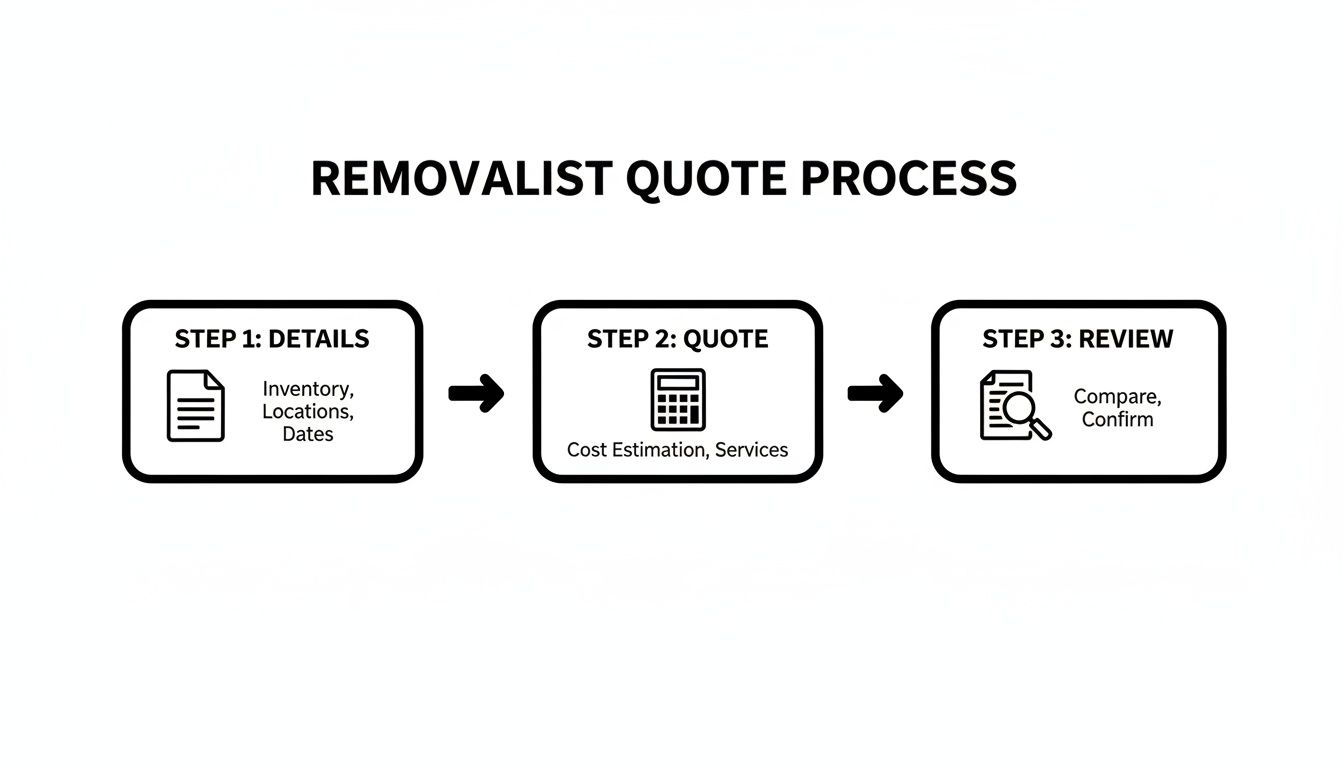
The very first step on any comprehensive checklist for moving house in Australia is to secure and compare detailed quotes from several professional removalists. This isn't just about finding the cheapest price; it's about understanding the value, service inclusions, and protections each company offers. Australian removalists vary significantly, and a detailed comparison protects you from hidden costs and ensures your belongings are handled by a reputable team.

Aim to get written quotes from at least 3 to 5 different companies. To ensure an accurate, apples-to-apples comparison, provide each company with the exact same inventory list and moving details, including access challenges like stairs or tight parking at either property. A Melbourne family planning an interstate move to Sydney, for example, should detail the volume of goods, any specialty items like a piano, and preferred moving dates to each prospective mover.

Key Questions to Ask Potential Movers:

When you receive a quote, dig deeper than the final price. Ask specific questions to clarify what you're actually paying for:

  • Is the quote fixed or an estimate? An estimate can change based on the actual hours worked, while a fixed quote offers cost certainty.
  • What type of insurance is included? Ask specifically about Public Liability and Transit Insurance and request a Certificate of Currency.
  • What are the charges for additional services? Clarify costs for packing materials, furniture assembly, or temporary storage if you might need them.
  • What is your cancellation policy? Understand any fees or notice periods required if your plans change.

Pro Tip: A reputable company like Get n Go Removals will provide a transparent, itemised quote. Be cautious of quotes that seem unusually low or are given verbally over the phone without a detailed inventory assessment. This is often a red flag for hidden fees later on. For more details on what to expect, you can explore the typical cost of movers in Melbourne to benchmark the quotes you receive.

2. Declutter and Sort Belongings by Category

A crucial part of any efficient checklist for moving house in Australia is a systematic decluttering process. Before you even start packing, go through every room and categorise all your possessions into four groups: keep, sell, donate, and discard. This step is not just about tidying up; it's a strategic move to reduce the volume of your belongings, which directly lowers your removalist costs, especially for weight-based interstate moves.

For instance, a Melbourne family downsizing from a large house to a smaller apartment can significantly cut expenses by selling excess furniture. Similarly, someone moving from Sydney to a smaller rental in Melbourne must be ruthless to ensure everything fits. By only moving what you truly need and love, you simplify the entire process from packing to unpacking, saving both time and money.

Key Decluttering Strategies:

To make the sorting process more manageable, adopt a methodical approach. Focus on one room at a time to avoid feeling overwhelmed.

  • Apply the 'One-Year Rule': If you haven't used an item in the last 12 months, seriously consider whether you need to keep it.
  • Sell Valuable Items: Use platforms like Gumtree or Facebook Marketplace to sell furniture, electronics, and other valuable goods. Take clear photos and list them 3-4 weeks before your move.
  • Donate to Charity: Give good-condition items to Australian charities like Vinnies or the Salvation Army. This helps the community and reduces landfill.
  • Dispose of Unwanted Items Responsibly: Arrange a hard rubbish collection through your local council, which is a free service in most Melbourne suburbs. For electronics, use designated e-waste recycling facilities to dispose of them safely and legally.

Pro Tip: Your moving quote is heavily influenced by the volume (cubic metres) of your goods. The less you have to move, the lower your quote will be. A professional mover will base their pricing on a detailed inventory, so completing your decluttering before you request quotes ensures you get the most accurate and cost-effective price. For a complete guide, explore these expert tips on how to declutter before you move.

3. Notify Service Providers and Update Address Details

An essential administrative task for your checklist moving house Australia is to methodically arrange the disconnection and reconnection of all your essential services. This includes utilities like electricity, gas, and internet, as well as updating your address with countless other organisations. Starting this process 3-4 weeks in advance is critical to ensure a seamless transition and avoid being left without power or connectivity on your first night.

Beyond utilities, you must update your address with financial institutions (banks, credit cards, superannuation), government bodies (ATO, Medicare, VicRoads), and any subscription services you use. A simple and effective tool for this is Australia Post's Mail Redirection service, which catches any mail sent to your old address for a set period, giving you a safety net while you update all your records.

Key Actions for Managing Services:

Organise these tasks with a simple spreadsheet to track what's been done and what's outstanding.

  • Schedule Disconnections/Reconnections: Contact your utility providers (electricity, gas, water, internet) at least two weeks before your move. Provide them with your move-out date for the old property and your move-in date for the new one.
  • Set Up Mail Redirection: Organise this with Australia Post online or in-person at least one week before you move.
  • Update Financial and Government Records: Inform your bank, employer, insurance companies, the ATO, and Medicare. Most of these can be updated online through their respective portals or via a myGov account.
  • Cancel or Transfer Local Services: Don't forget services tied to your old address, such as a gym membership, newspaper delivery, or local library card.

Pro Tip: Keep a digital and physical folder of all confirmation emails and reference numbers from your service providers. This documentation is invaluable if any disputes arise over final bills or connection dates. Having this information readily available can save you hours of stress and phone calls.

4. Book Your Moving Date and Confirm Truck/Equipment Requirements

Once you've selected your ideal removalist, the next critical task on your checklist for moving house in Australia is to formally book your moving date and confirm all logistical requirements. Securing your slot early is essential, particularly in Australia where peak periods like the end of the month, school holidays, and the end of the financial year see removalists booked out weeks or even months in advance. This step transforms your moving plan from a theoretical timeline into a concrete, scheduled event.

A crucial part of this process is confirming the correct truck size and necessary equipment. Your removalist should use your detailed inventory to allocate a vehicle that is neither too small, requiring multiple trips, nor too large, costing you unnecessary expense. For instance, a family moving from a three-bedroom house in Sydney to a new home in Melbourne will need a significantly larger truck than someone moving from a one-bedroom apartment locally. Proper planning ensures a smooth, single-day operation.

Key Confirmation Details for Your Booking:

When finalising your booking, get every detail in writing to prevent any day-of misunderstandings. A professional confirmation should include:

  • Date and Arrival Window: Lock in the specific date and an estimated arrival time (e.g., 8:00 AM – 9:00 AM).
  • Truck and Crew Size: Confirm the size of the truck and the number of movers assigned to your job.
  • Specialised Equipment: Verify that dollies, furniture pads, blankets, and any required hoisting equipment for apartment moves are included.
  • Access and Parking: Discuss and confirm logistics for both properties, including any lift bookings, loading zone restrictions, or potential parking challenges.

Pro Tip: Don’t underestimate the importance of preparation. If you’re moving from a high-rise apartment in Melbourne, contact your building management at least two weeks in advance to book exclusive use of the service lift. This simple action prevents costly delays and ensures your movers can work efficiently. A company like Get n Go Removals can often assist in coordinating these logistical details on your behalf.

5. Arrange Child Care and Pet Care on Moving Day

A critical, yet often overlooked, item on any checklist for moving house in Australia is organising off-site care for children and pets. Moving day is a chaotic environment filled with open doors, heavy lifting, and potential hazards. Ensuring your youngest family members and furry friends are safely elsewhere is paramount for their wellbeing and allows your professional removalists to work efficiently and without distraction. This strategic step minimises stress for everyone involved and prevents accidents.

For families across Australia, this could mean arranging for grandparents to take the kids for the day or booking a spot at a trusted local doggy daycare. The goal is to create a safe, focused environment where the moving team can navigate freely, significantly speeding up the process and reducing risks. For instance, a family moving from a busy Melbourne suburb can arrange a playdate for their children, ensuring they are well away from the moving truck and heavy furniture.

Key Actions for Organising Care:

To ensure this part of your move goes smoothly, proactive planning is essential. Start arranging care several weeks in advance, especially during peak moving seasons.

  • Book Well in Advance: Aim to secure professional caregivers, pet sitters, or daycare spots 3-4 weeks before your moving date to avoid last-minute availability issues.
  • Choose an Off-Site Location: The safest option is to have children and pets cared for at a separate location for the entire duration of the move, from the first box being loaded to the last one being unloaded.
  • Prepare a "Go-Bag": Pack a dedicated bag for your child or pet with essentials like snacks, drinks, toys, medications, and comfort items (like a favourite blanket or toy).
  • Provide Detailed Instructions: Give the caregiver all necessary information, including emergency contacts, your new address, feeding schedules, and any specific behavioural or medical notes.

Pro Tip: Inform your movers that the property will be free of children and pets. This allows them to plan their workflow for maximum efficiency and safety. A clear path without unexpected interruptions helps protect your belongings and the crew. For more detailed advice, especially regarding your animal companions, review our comprehensive guide on moving with pets to ensure a stress-free transition for them.

6. Pack Strategically and Create Detailed Room-by-Room Inventory

A crucial part of any checklist for moving house in Australia involves more than just putting items into boxes; it requires a systematic approach to packing and inventory management. This dual strategy involves using quality packing materials to protect your belongings while simultaneously creating a detailed, room-by-room inventory. This process not only prevents damage but also streamlines the unpacking process and provides essential documentation for any potential insurance claims.

For instance, a Melbourne family moving to a new suburb could implement a colour-coded system, assigning blue stickers for the kitchen, red for bedrooms, and green for the living room, allowing movers to place boxes in the correct rooms instantly. An office relocating across town might number each box and maintain a corresponding spreadsheet detailing its contents, ensuring critical files and equipment are located quickly to minimise operational downtime.

Key Tips for Effective Packing and Inventory:

To execute this step properly, focus on clarity, protection, and organisation. A methodical approach here saves immense time and stress later.

  • Label Clearly: Use a thick permanent marker to label boxes on at least two sides. Include the destination room and a brief summary of contents.
  • Create a Master Inventory: Number each box and maintain a master spreadsheet or notebook listing the number and its detailed contents. Keep this inventory with you on moving day, not in the truck.
  • Pack Appropriately: Use small boxes for heavy items like books and large boxes for light items like bedding. Never overpack a box; aim for a maximum weight of around 15kg to prevent injuries and box failure.
  • Use Colour-Coding: Purchase cheap, colourful stickers from a retailer like Bunnings Warehouse to assign a colour to each room. This provides a quick visual cue for movers.
  • Document Valuables: Take photos of valuable or fragile items before packing them. This serves as a record of their condition for insurance purposes.
  • Prepare an 'Open First' Box: Pack one box with essentials for your first 24 hours in the new home (kettle, tea, toiletries, tools, chargers) and label it clearly.

Pro Tip: While you can pack most items yourself, consider a professional service for your most fragile or valuable possessions. Get n Go Removals offers specialised packing services using premium materials to ensure delicate items like glassware, artwork, and electronics are transported safely. For a complete guide, review these essential packing tips for moving house to master the process.

7. Secure Appropriate Insurance Coverage (Transit and Contents Insurance)

Relying solely on the basic coverage offered by a removalist is a common oversight on any checklist for moving house in Australia. While professional movers carry Public Liability and basic Transit Insurance, these often have significant limitations, high excess fees, or may not cover the full replacement value of your goods. Securing dedicated transit and contents insurance provides a robust financial safety net, protecting your belongings from the moment they leave your old home until they are safely placed in your new one.

This step is especially critical for high-value items and long-distance moves, such as a family relocating from Sydney to Melbourne where belongings might be in transit for several days. Proper insurance covers unforeseen events like accidental damage, theft, or loss during transport. Furthermore, your new landlord or strata management may require proof of contents insurance before you even move in, so organising this early is essential for a smooth transition.

Key Questions to Ask Your Insurer and Mover:

Before committing, it’s vital to understand the specifics of the coverage you are purchasing or that which is provided by your removalist.

  • What is the total declared value covered? Ensure the policy covers the full replacement cost of your items, not their depreciated or secondhand value.
  • What are the specific exclusions? Policies often exclude items like jewellery, cash, important documents, or live animals. Be clear on what is not covered.
  • What is the excess amount? Clarify how much you would need to pay out-of-pocket in the event of a claim.
  • Does my existing contents policy cover goods in transit? Some home and contents policies offer limited transit cover, but it's crucial to confirm the extent and duration.

Pro Tip: Always document your valuable items with photos, serial numbers, and receipts before the move. This creates an inventory that will be invaluable if you need to make a claim. For specialised items, you may need additional protection, such as dedicated shipping insurance, to ensure they are fully covered. A reputable mover will be transparent about their own insurance, and you can always seek a separate, more comprehensive policy from providers like RACV or IAG.

8. Conduct Final Walkthrough of Old Property and Meter Readings

One of the most critical final tasks on your checklist for moving house in Australia is performing a detailed walkthrough of your old property after the removalists have finished. This final inspection is your last opportunity to document the property's condition, record final utility readings, and ensure nothing has been left behind. For renters, this step is absolutely essential for protecting your bond and preventing disputes with your landlord or property manager.

This process involves a meticulous check of every room, cupboard, and storage space once it's completely empty. It provides definitive proof of the state you left the property in, which is invaluable if any claims of damage arise later. For example, a Melbourne family renting an apartment can use dated photos of clean, empty rooms to contest an unjustified claim against their bond, potentially saving them hundreds of dollars. This simple action provides a clear record for all parties involved.

Key Actions for Your Final Walkthrough:

To ensure this final step is effective, follow a structured process. This is your last chance to tie up loose ends and leave the property on good terms.

  • Schedule it correctly: Conduct the walkthrough only after the removalists confirm every single item has been loaded onto the truck.
  • Document everything: Take time-stamped photos or a continuous video of every room, wall, floor, and fixture. Pay close attention to areas prone to wear and tear.
  • Record meter readings: Locate your electricity, gas, and water meters. Photograph the readings clearly, ensuring the meter number and date are visible. This is your proof for finalising utility bills accurately.
  • Check for forgotten items: Systematically open and check every single cupboard, drawer, built-in wardrobe, shed, and attic space. It's easy to overlook items in the heat of the moment.
  • Complete the condition report: For renters, fill out the exit section of your Property Condition Report, referencing your photos as evidence. Submit it to your agent or landlord promptly.

Pro Tip: Your removalist plays a key role in this final step. A professional team like Get n Go Removals will confirm with you once the property is completely clear, giving you the green light to begin your inspection without interruption. This ensures your documentation reflects the property's true state at handover.

9. Plan Efficient First-Day Unpacking and Furniture Placement

A crucial, yet often overlooked, part of any checklist for moving house in Australia is planning your first-day unpacking strategy before you even arrive. This proactive step transforms the potential chaos of arrival day into a calm, organised process. By deciding where your major furniture will go and prioritising essential items, you eliminate confusion and ensure immediate comfort in your new home.

The goal is to provide your removalists with a clear blueprint, so they can place heavy items in their final positions straight away. For example, a Melbourne family can create a simple, hand-drawn sketch of each room, indicating where the sofa, beds, and dining table should be placed. This prevents the exhausting task of shifting furniture around after the movers have left and allows you to focus on unpacking what truly matters first.

Key Steps for a Smooth First Day:

To execute this effectively, pre-planning is essential. A little preparation goes a long way in reducing stress and physical effort on moving day.

  • Measure everything beforehand: Before the move, measure your new rooms, doorways, and hallways. Then, measure your large furniture items like sofas, fridges, and wardrobes to ensure they will fit through access points.
  • Create a floor plan: Use a simple sketch or a smartphone app like Floorplanner to map out where each piece of furniture will go. Take a photo of this plan to share with your moving team.
  • Number the rooms: Assign a number to each room in your new home and label the corresponding boxes. This helps movers place boxes in the correct rooms without needing constant direction.
  • Pack a 'First Night' box: This is your survival kit. It should contain bedding, toiletries, medications, a change of clothes, phone chargers, and basic kitchen supplies like a kettle, mugs, and tea bags. Keep this box with you or have it loaded last so it's the first one off the truck.

Pro Tip: When the Get n Go Removals team arrives, provide them with a copy of your floor plan. A professional crew will appreciate the clear instructions, as it allows them to work more efficiently and place your furniture exactly where you want it. Prioritise having them assemble and place your bed first, so you have a comfortable space to retreat to at the end of a long day.

10. Register with Local Services and Update Official Documentation at New Address

Once you've unpacked the last box, a crucial administrative step on your checklist for moving house in Australia is to formally update your address across all official channels. This isn't just about ensuring you receive mail; it's a legal requirement for many services and ensures you maintain access to essential government and local amenities. Promptly updating your details with entities like VicRoads, the Australian Electoral Commission (AEC), and your local council prevents missed communications, potential fines, and service disruptions.

For instance, a person moving from Geelong to a new home in Melbourne must notify VicRoads of their new address within 14 days to keep their driver's licence and vehicle registration legally current. Similarly, updating your details with Services Australia ensures your Medicare and any Centrelink correspondence is sent to the correct property, avoiding delays in accessing healthcare rebates or benefits.

Key Documentation and Services to Update:

To ensure a seamless transition and remain compliant, prioritise updating the following records as soon as you move:

  • Driver's Licence and Vehicle Registration: In Victoria, you have 14 days to update your address with VicRoads. This can typically be done online.
  • Electoral Roll: It is compulsory for all eligible Australian citizens to update their enrolment details with the AEC. This ensures you can vote in federal, state, and local council elections for your new area.
  • Medicare and Centrelink: Update your details through your myGov account linked to Services Australia to ensure uninterrupted access to benefits and services.
  • Local Council: Contact your new local council to register for rates notices if you are a homeowner, or to find out about local services like pet registration and waste collection schedules.
  • Australian Taxation Office (ATO): Your myGov account is also the easiest way to inform the ATO of your new address.

Pro Tip: Create a master list of every organisation that has your address, from your bank and superannuation fund to subscriptions and online shopping accounts. Work through this list methodically and keep a digital or physical record of confirmation emails or letters for each update. This diligence ensures no critical communication is missed during the post-move period.

Australian Moving Checklist — 10-Item Comparison

Task Implementation Complexity 🔄 Resource Requirements ⚡ Expected Outcomes ⭐ Ideal Use Cases 📊 Key Advantages / Tips 💡
Notify Service Providers and Update Address Details Moderate–High: coordinate multiple providers and notice periods Time, account details, contact channels, Australia Post fee High ⭐: continuity of utilities; avoids missed bills All moves; essential for renters and interstate relocations Prevents interruptions — keep spreadsheet and written confirmations
Declutter and Sort Belongings by Category Moderate: multiple passes, emotional decisions Time, listing platforms, donation/disposal options, possible storage High ⭐: lower volume reduces cost and speeds unpacking Downsizing, interstate moves, cost-sensitive relocations Use one‑year rule, sell/donate early to cut moving volume
Obtain Multiple Moving Quotes and Compare Services High: coordinate inspections, compare policies and pricing Detailed inventory, time for research, insurer checks High ⭐: better pricing and protection; avoids underinsured movers Interstate or high-value moves; commercial relocations Provide identical inventories, verify insurance and references
Book Your Moving Date and Confirm Truck/Equipment Requirements Moderate: scheduling, lift/parking and equipment coordination Deposit/booking, truck size choice, permits, lift bookings High ⭐: secures date and correct equipment for an efficient move Peak season moves, apartment/multi‑storey moves Book off‑peak when possible; confirm truck size and lift access
Arrange Child Care and Pet Care on Moving Day Low–Moderate: arrange caregivers and backups Caregiver fees, bookings, emergency contacts High ⭐: safer environment; fewer interruptions Families with children/pets or high‑risk moves Book 3–4 weeks ahead; arrange care away from property
Pack Strategically and Create Detailed Room-by-Room Inventory High: time‑consuming and discipline required Packing materials, labels, inventory spreadsheet/apps, photos Very High ⭐: minimizes damage and speeds unpacking; aids insurance Long-distance moves, high‑value items, moves requiring claims Color-code, photograph valuables, keep master inventory with you
Secure Appropriate Insurance Coverage (Transit and Contents Insurance) Moderate: valuations and policy comparisons required Premiums, receipts, photos, insurer/broker interactions High ⭐: financial protection against loss/damage Interstate moves, high-value possessions, storage periods Compare policies, document items, declare full replacement value
Conduct Final Walkthrough of Old Property and Meter Readings Low–Moderate: thorough inspection and documentation Time, camera/phone, meter logs, condition report forms High ⭐: protects bond; ensures accurate final bills Renters, anyone leaving a property Take dated photos/video and record meter readings; share with landlord
Plan Efficient First-Day Unpacking and Furniture Placement Moderate: measurements and communication with movers Floor plan, measuring tape, labeled 'open first' box, photos High ⭐: faster settling-in and correct furniture placement Families, offices reducing downtime, anyone wanting quick setup Measure doorways, provide floor plan to movers, pack a 'first night' box
Register with Local Services and Update Official Documentation at New Address Moderate–High: multiple agencies and possible in-person visits ID, proof of address, online portals, time for appointments High ⭐: legal compliance and uninterrupted official communications All movers—essential for drivers, benefit recipients, voters Update driver/vehicle details within local deadlines; use myGov for Medicare/ATO updates

Let's Get You Moving: Partner with Melbourne's Trusted Removalists

Navigating a house move in Australia can feel like orchestrating a complex symphony. From the initial eight-week countdown involving decluttering and notifying service providers, to the final crescendo of moving day and settling into your new community, every step requires precision and planning. This comprehensive checklist moving house Australia has been designed to be your conductor's baton, guiding you through each critical phase.

By following this timeline, you've learned how to transform a mountain of tasks into manageable, actionable steps. We've covered the administrative essentials unique to Australia, such as updating your details with the Australian Electoral Commission and state-based vehicle registration bodies. We've delved into the practicalities of strategic packing, creating a detailed inventory, and the non-negotiable importance of securing the right transit and contents insurance to protect your valuables.

From Checklist to Reality: The Power of Flawless Execution

A plan, no matter how detailed, is only as good as its execution. The real value of this checklist is realised when each task is completed efficiently and without stress. Key takeaways to remember are:

  • Proactive Administration: Notifying utilities, forwarding mail, and updating official documents well in advance prevents last-minute panic and ensures a smooth transition of your essential services.
  • Strategic Decluttering: This isn't just about getting rid of things. It's about saving time, money, and energy by only moving what truly matters to your new home.
  • The Insurance Imperative: Never underestimate the importance of comprehensive insurance. It's the safety net that provides peace of mind, protecting your financial and sentimental investments from the unexpected.
  • Moving Day Logistics: Arranging care for children and pets, conducting a final meter reading, and having a first-night essentials box ready are small details that make a monumental difference on the day.

Mastering this process means you're not just moving boxes; you're orchestrating a positive, organised start to a new chapter in your life. It allows you to sidestep the common pitfalls of chaos and anxiety, freeing you to focus on the excitement of your new surroundings. The ultimate benefit is a move that feels controlled, efficient, and even enjoyable.

Your Professional Partner for a Seamless Melbourne Move

While this guide provides the roadmap, the journey itself can be physically and mentally demanding. This is where professional expertise becomes invaluable. For residents in Melbourne and those relocating along the East Coast, partnering with a trusted removalist bridges the gap between your detailed plan and a perfectly executed move.

A professional team like Get n Go Removals doesn't just transport your belongings. We bring years of experience in specialist handling of fragile items, the efficiency of professional packing services, and the security of company-owned, GPS-tracked trucks. Our police-checked, dedicated team understands the nuances of navigating Melbourne's diverse suburbs and the logistical complexities of interstate relocations. We handle the heavy lifting, the careful packing, and the secure transport, allowing you to walk into your new home with energy and enthusiasm.

Think of us as the final, and most crucial, item on your moving checklist: securing a team that guarantees your plan becomes a stress-free reality.


Ready to turn your comprehensive checklist moving house Australia into a seamless moving experience? Let Get n Go Removals Melbourne handle the heavy lifting with our professional, reliable, and friendly service. Contact us today for a free, no-obligation quote and discover why we are Melbourne's trusted choice for local and interstate moves.

READ MORE

The Ultimate End of Lease Clean Checklist: Secure Your Full Bond Refund

The final hurdle of any move isn't unpacking the last box; it's securing your full bond refund. In today's competitive rental market, a spotless property isn't just a courtesy—it's a financial necessity. Landlords and property managers meticulously inspect every corner, and even minor oversights like a dusty skirting board or a streaky window can lead to significant deductions from your deposit. The difference between a full refund and a costly dispute often comes down to attention to detail and a methodical approach. This is where a definitive end of lease clean checklist becomes your most valuable tool.

This comprehensive guide is your blueprint for a successful bond clean. We'll break down the entire process into a clear, room-by-room action plan that goes far beyond simple tidying. Forget generic advice; we're diving deep into the specifics that inspectors look for. You'll get actionable steps for tackling everything from degreasing oven rangehoods and sanitising bathroom grout to removing scuff marks from walls without damaging the paint.

We will cover the eight most critical cleaning zones that determine bond return success. By following this detailed checklist, you will have a clear strategy to ensure every nook and cranny meets the high standards required by property agents. This isn't just about cleaning; it's about systematically preparing the property for its final inspection, ensuring you hand back the keys with absolute confidence and your bond safely back in your bank account.

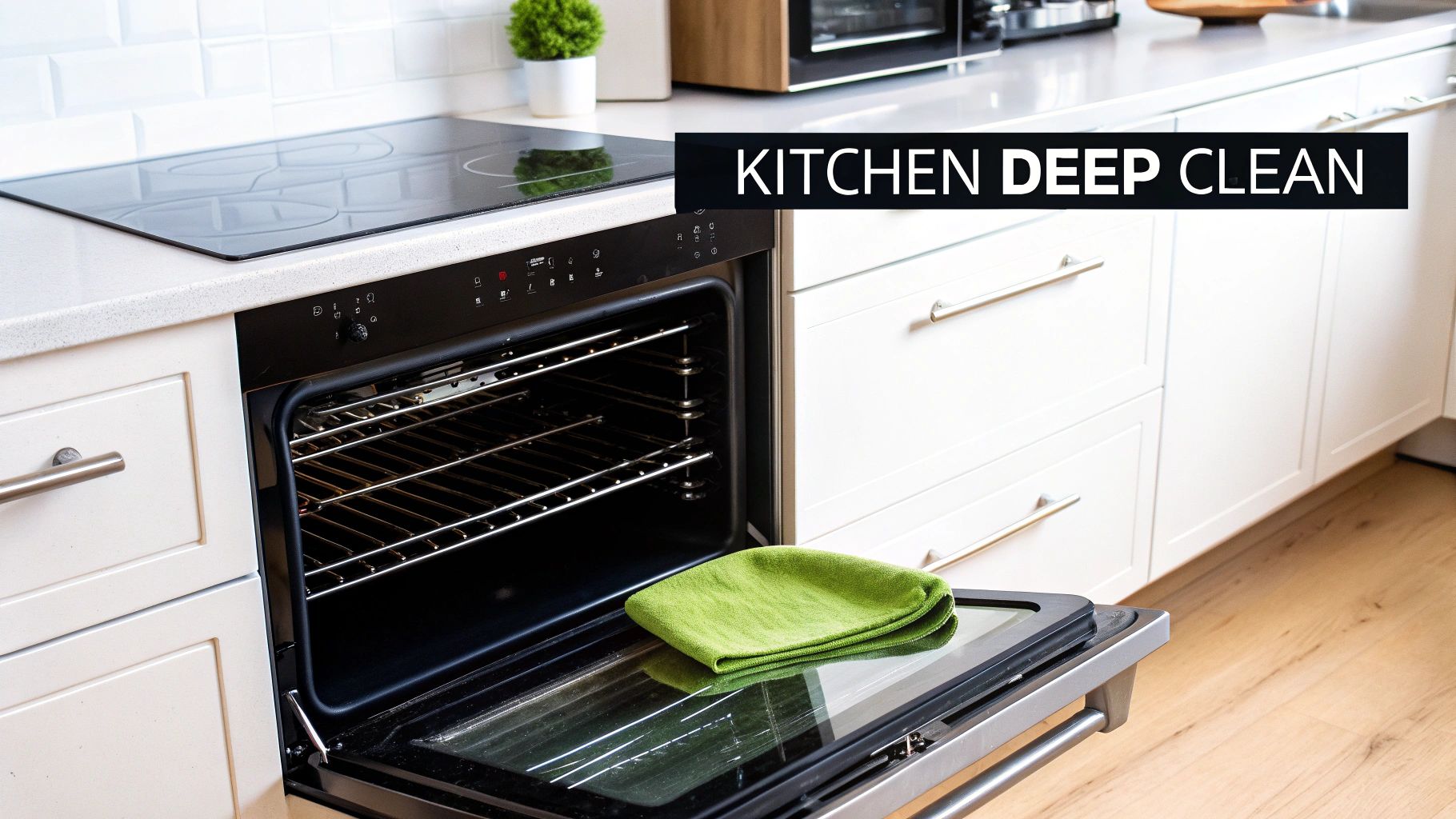
1. Kitchen Deep Clean: Appliances and Surfaces

The kitchen is often the first and most scrutinised area during a final property inspection, making it the top priority on any comprehensive end of lease clean checklist. Landlords and agents look for a level of cleanliness that returns the space to its original condition. This involves a deep, forensic-level clean of all appliances and surfaces, tackling months or years of accumulated grease, food residue, and limescale that a simple wipe-down won’t remove.

Modern kitchen with an open oven and a green cleaning cloth on the door, ready for a deep clean.

This process is non-negotiable for securing your full bond return. Professional bond cleaners frequently report that inadequate kitchen cleaning is a leading cause of bond deductions. A meticulously cleaned kitchen signals to the property manager that you’ve cared for the property, setting a positive tone for the rest of the inspection.

Actionable Cleaning Strategy

To tackle the kitchen effectively, follow a structured approach. It's wise to handle the kitchen cleaning after you’ve finished packing up your culinary items; our packing tips for moving house can help streamline this process so you can focus solely on cleaning.

  • Oven: Start here, as it's the most time-consuming. Remove racks and trays to soak in hot, soapy water or a specialised oven-cleaning solution. Use a non-abrasive scourer and oven cleaner for the interior, paying close attention to the glass door and baked-on grime.
  • Stovetop & Rangehood: Disassemble what you can, like cooktop elements and rangehood filters. Soak filters in a strong degreaser. Clean the stovetop surface thoroughly, ensuring all residue around the burners is gone.
  • Refrigerator & Freezer: Empty, unplug, and defrost the freezer if needed. Remove all shelves and drawers and wash them in warm, soapy water. Wipe down the interior, including the rubber seals, and don’t forget to clean the exterior and vacuum the coils at the back.
  • Microwave & Dishwasher: A simple trick for the microwave is to heat a bowl of water with lemon slices for two minutes; the steam will loosen grime for an easy wipe-down. For the dishwasher, clean the filter of any food debris and run an empty cycle with a specialised dishwasher cleaner.
  • Surfaces: Once appliances are done, degrease benchtops, splashbacks, and cabinet fronts. Polish stainless steel surfaces with a dedicated cleaner, wiping in the direction of the grain to prevent streaks.

2. Bathroom Deep Clean and Sanitization

Alongside the kitchen, the bathroom is a critical area that property managers inspect with a fine-tooth comb. Its condition is a direct reflection of the property's overall hygiene and maintenance. A thorough bathroom clean for an end of lease clean checklist goes far beyond a quick wipe of the sink; it demands a deep sanitisation process to eradicate soap scum, mould, mildew, and stubborn hard water stains.

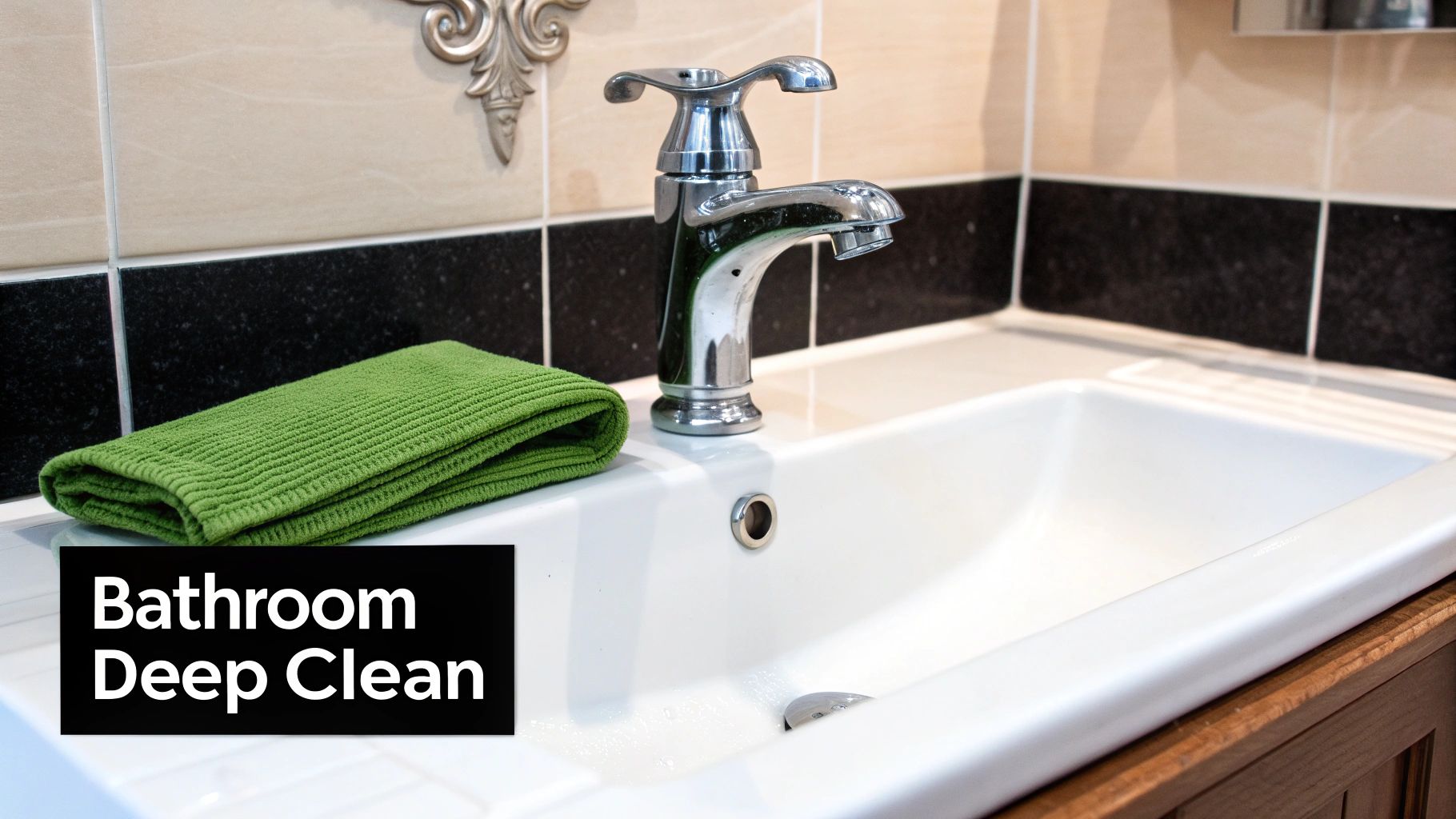
Close-up of a sparkling clean bathroom sink with a polished faucet and a folded green towel.

Failing to address these issues is a frequent cause of bond disputes. Rental inspections often flag mould and grout discolouration as primary reasons for deductions. Presenting a sparkling, sanitised bathroom demonstrates your commitment to returning the property in excellent condition, significantly improving your chances of receiving your full bond back.

Actionable Cleaning Strategy

A systematic plan is essential for a successful bathroom deep clean. Ensure you have adequate ventilation by opening windows and turning on the exhaust fan before you begin, especially when using strong cleaning agents.

  • Shower & Bathtub: Start by spraying shower screens, tiles, and the tub with a heavy-duty bathroom cleaner designed to dissolve soap scum and limescale. Let it sit before scrubbing with a non-scratch scourer. Pay special attention to the corners and tracks of the shower screen.
  • Grout & Tiles: Use a specialised grout cleaner, or a paste of bicarb soda and vinegar, and scrub with a firm-bristled grout brush. For persistent mould, a bleach-based product may be necessary, but test it on a small, hidden area first.
  • Toilet: Clean and disinfect the toilet inside and out, from the cistern and flushing button down to the S-bend and the floor around the base. Use a separate cloth and disinfectant for this area to avoid cross-contamination.
  • Vanity, Sink & Taps: Remove all items from the vanity. Clean the sink and polish the tapware to a high shine, removing any toothpaste residue or water spots. Wipe down all cabinet fronts and clean inside the drawers and cupboards.
  • Exhaust Fan & Fixtures: Dust and wipe the exhaust fan cover, as this is a commonly missed spot where dust and mould accumulate. Clean and polish mirrors, towel rails, and the toilet roll holder until they are streak-free.

3. Floor and Carpet Cleaning: The Final Touch

Floors bear the brunt of daily life and are a major focal point during the final inspection, making them a critical component of any end of lease clean checklist. Property managers will meticulously check for stains, embedded dirt, and general wear. Many tenancy agreements even stipulate that carpets must be professionally steam cleaned upon vacating, making this a non-negotiable step for getting your full bond back.

A person vacuums a clean, fluffy white carpet on a wooden floor in a bright living room.

Neglecting the floors is one of the quickest ways to incur a bond deduction. Whether it's a home with a mix of carpet and tiles or a modern apartment with polished concrete, each surface requires a specific approach. Demonstrating that you’ve invested in professional cleaning shows a high level of care and significantly strengthens your position during the final handover.

Actionable Cleaning Strategy

A systematic approach to floor cleaning ensures no area is missed and all surface types are treated correctly. This should be the very last task you complete after all other rooms are clean and all furniture has been moved out, preventing new scuffs or dirt from compromising your hard work.

  • Check Your Lease: Before you begin, review your tenancy agreement. Many contracts specifically require professional carpet steam cleaning and will ask for a receipt as proof.
  • Book Professionals Early: If required, schedule a professional cleaner for a day or two before the final inspection. This allows carpets adequate time to dry completely, preventing any musty odours.
  • Address Hard Floors: For tiles, vinyl, or laminate, a thorough vacuum and mop with a pH-neutral cleaner is essential to avoid streaks or damage. For those with hardwood floors, a specific guide on deep cleaning hardwood floors will provide invaluable advice for achieving impeccable results.
  • Point Out Stains: If using professionals, point out any specific problem areas like spills or high-traffic zones so they can apply targeted pre-treatments for the best possible outcome.
  • Document Everything: After cleaning is complete, take clear, well-lit photos of the carpets and hard floors. This documentation serves as your evidence of the property's condition should any disputes arise.

4. Wall Cleaning and Mark Removal

Over the course of a tenancy, walls inevitably gather marks, scuffs, and fingerprints. While these might seem minor, they are a major focus during a final inspection and a common reason for significant bond deductions. A comprehensive end of lease clean checklist must prioritise returning walls to their original, pristine condition, which goes far beyond a quick wipe. Landlords expect a level of care that shows the property has been well-maintained.

This step is crucial for protecting your bond. Property managers are particularly meticulous about wall conditions. Neglecting scuff marks from furniture, greasy fingerprints around light switches, or blu-tack residue can easily lead to disputes and financial loss. A thoroughly cleaned wall surface demonstrates respect for the property and significantly improves your chances of a full bond refund.

Actionable Cleaning Strategy

Tackle wall cleaning systematically after the rooms are empty to ensure you have clear access and don't miss any spots. This methodical approach prevents overlooking marks hidden behind furniture or artwork, which are often discovered only during the final inspection.

  • Initial Dusting: Begin by dusting all walls, skirting boards, and cornices with a microfibre mop or cloth. This removes loose dust and cobwebs, preventing them from turning into muddy streaks when you start wet cleaning.
  • Spot Cleaning Scuffs: For most common scuffs from shoes or furniture, a melamine foam sponge (like a Magic Eraser) is highly effective. Dampen the sponge slightly and gently rub the mark. Always test on a small, inconspicuous area first, as it can be mildly abrasive on some paint finishes.
  • Grease and Grime: For greasy marks, especially in kitchens or near dining areas, a solution of sugar soap or a gentle dishwashing liquid in warm water works well. Use a soft cloth, wring it out thoroughly to avoid drips, and wipe the area clean.
  • Adhesive and Blu-Tack Residue: Blu-tack and other adhesives can lift paint if pulled off hastily. Gently warm the residue with a hairdryer to soften the adhesive, then carefully roll it off with your finger. Use a specialised adhesive remover for any remaining sticky spots.
  • High-Touch Areas: Pay special attention to areas around light switches, door handles, and power points. These zones accumulate fingerprints and grime and are frequently checked by inspectors. A thorough wipe-down here is essential.

5. Window and Glass Cleaning for a Streak-Free Finish

Crystal-clear windows and glass surfaces can dramatically lift the appearance of a property, making spaces feel brighter and more meticulously maintained. This is a critical item on any end of lease clean checklist, as smudged or grimy glass is an immediate red flag for property managers during their final inspection. The cleanliness of windows, both inside and out, significantly influences the first impression and overall perception of how well the property has been cared for.

Environmental factors make this task even more crucial. Coastal properties contend with salt spray that leaves a stubborn film, while inner-city apartments accumulate traffic pollution and dust. Failing to properly address these issues is a common reason for bond deductions, as professional window cleaning can be a costly remediation for the landlord.

Actionable Cleaning Strategy

A systematic approach is key to achieving a professional, streak-free finish on all glass surfaces. This task is best left until most other interior cleaning is complete to avoid splashing dust or cleaning solutions onto your newly cleaned panes.

  • Prepare the Area: Before you start, use a brush or a vacuum with a crevice tool to clear all dirt, dust, and cobwebs from window sills, tracks, and frames. This prevents creating a muddy mess when you introduce a cleaning solution.
  • Choose Your Solution & Tools: A simple solution of one part white vinegar to ten parts water in a spray bottle is highly effective. For professional results, invest in a good quality squeegee and several microfibre cloths-one for washing and a separate dry one for polishing.
  • Master the Technique: Clean windows on an overcast day, as direct sunlight can cause the cleaning solution to dry too quickly, leaving streaks. To ensure every pane sparkles, consider these expert tips on how to clean windows like a pro for a flawless finish. Always wipe the squeegee blade with a clean cloth after each pass.
  • Don't Forget Other Glass: Extend your cleaning to all glass surfaces. This includes sliding glass doors (inside and out), mirrors in bathrooms and bedrooms, shower screens, and any glass balustrades. Use a separate clean, dry microfibre cloth for mirrors to prevent water spots.

6. Removal of Fixtures and Wall Repair

A crucial, yet often overlooked, part of any end of lease clean checklist is the careful removal of any fixtures or fittings you installed during your tenancy. This includes items like floating shelves, wall-mounted TV brackets, custom curtain rods, or additional storage units. Property managers expect the property to be returned to its original state, which means removing these items and repairing any resulting wall damage.

Failing to properly remove and repair can lead to significant bond deductions for wall damage, repainting, and professional patching services. Agents are particularly vigilant about wall condition. Properly addressing this step demonstrates respect for the property and is essential for a smooth bond return process.

Actionable Cleaning Strategy

Coordinating the removal of your items with your cleaning schedule is key to efficiency. This task should be completed before you begin cleaning walls and floors to avoid creating more mess. It also aligns perfectly with the packing process, allowing you to hand over these items to your removalists immediately.

  • Schedule Removal First: Before any deep cleaning, carefully uninstall all non-permanent items. This includes shelving, TV mounts, hooks, custom light fittings (if you're qualified to do so), and any stick-on products.
  • Repair Damage Immediately: Once an item is removed, address the holes left by screws or anchors. Use a spackling compound to fill the holes, let it dry completely, and then sand the area until it is perfectly smooth and flush with the wall.
  • Touch-Up Painting: For a seamless finish, apply a small amount of matching paint over the patched area. If you don't have the original paint, you may be able to get a small sample pot by taking a chip of the paint to a hardware store for colour matching.
  • Safe Packing and Transport: Ensure removed fixtures are properly packed to prevent damage during transit. For larger or more complex items, professional movers can provide the necessary expertise; our team can assist with careful disassembly and specialised packing as part of our furniture removal and storage in Melbourne services.
  • Final Wall Wipe-Down: After all repairs are dry and complete, perform a final wipe-down of the entire wall to remove any sanding dust or handprints, ensuring it's ready for inspection.

7. Rubbish and Unwanted Item Disposal

Properly managing waste is a crucial, yet often overlooked, part of any end of lease clean checklist. Leaving behind rubbish, old furniture, or personal belongings is a guaranteed way to incur a bond deduction, as property managers must pay for its removal. This final step ensures the property is completely empty and ready for the next tenants, reflecting your responsibility and care.

Simply leaving items on the kerb is not an acceptable solution and can lead to significant issues. In many areas, illegal dumping can attract substantial fines. A professional approach to rubbish disposal demonstrates to your landlord that you have completed your tenancy obligations thoroughly, leaving no loose ends that could jeopardise your bond.

Actionable Cleaning Strategy

Effective rubbish disposal requires planning. The key is to start early and understand your local council's regulations. Sorting your items systematically is the first step; our guide on how to declutter before you move offers a great framework for this process, helping you decide what to keep, donate, or discard.

  • Schedule Council Collection: Many councils offer hard rubbish collections. These services are often free but must be booked weeks in advance, so plan accordingly to align with your move-out date.
  • Donate Usable Goods: Items in good condition, such as furniture, clothing, or homewares, can be donated. Charities like Salvos and Vinnies are excellent options and can sometimes arrange for collection of larger pieces. This is a responsible, community-minded way to clear out unwanted items.
  • Separate and Recycle: Properly separate general waste from recyclables. This not only minimises your environmental impact but can also reduce disposal costs if you need to make a trip to a local transfer station.
  • Hazardous Waste: Never dispose of items like paint, chemicals, batteries, or electronics in general household bins. These require special disposal at designated facilities to prevent environmental harm.
  • Document Everything: For large items removed via council collection or professional services, take a quick photo of the empty space and the cleared kerbside as proof of proper disposal for your final inspection.

8. Final Walkthrough and Documentation

The final walkthrough is your last line of defence in securing your bond and should be a non-negotiable step in your end of lease clean checklist. This systematic inspection involves meticulously checking every room against your cleaning list and the original property condition report, documenting the final state of the property with photographic evidence. This process creates an indisputable record that verifies all cleaning tasks have been completed to the required standard, protecting you against potential disputes.

This step is critical in today's competitive rental market, where disagreements over cleanliness are common. Evidence presented to tenancy tribunals often hinges on the quality of photographic and video evidence from the move-out. Thorough documentation provides clear proof of your diligence, significantly speeding up the bond return process and preventing unfair deductions for issues that were pre-existing or addressed by your cleaning efforts.

Actionable Cleaning Strategy

Approach your final walkthrough like a professional property inspector. This quality assurance check should be the very last thing you do before handing back the keys, ensuring the property is in its best possible state. To stay organised throughout the entire moving process, refer to our comprehensive moving house checklist for Australia, which helps you schedule this final step effectively.

  • Use the Condition Report: Arm yourself with the original ingoing condition report. Go from room to room, comparing the final state to the initial notes and photos.
  • Comprehensive Photography: Take clear, well-lit photos of every room from multiple angles. Capture wide shots and close-ups of specific areas prone to disputes, such as ovens, stovetops, bathroom grout, and carpets.
  • Video Walkthrough: Consider taking a continuous video walkthrough of the entire property. Narrate as you go, pointing out the cleanliness of specific areas and showing that appliances are in working order.
  • Timestamp Your Evidence: Ensure your camera or smartphone has the date and time stamp feature enabled. This adds a layer of authenticity to your documentation, proving when the photos and videos were taken.
  • Document Pre-existing Damage: If you noted any pre-existing damage on your ingoing report, take a final photo of it to show it hasn’t worsened. This prevents you from being blamed for wear and tear that was already there.
  • Organise and Save: Create a dedicated folder on your computer or cloud storage for all photos, videos, and a copy of your signed cleaning checklist. Keep these records until your bond has been fully returned.

End-of-Lease Clean Checklist: At-a-Glance Comparison

Task 🔄 Complexity ⚡ Resources Needed ⭐ Expected Outcome 💡 Key Advantage
Kitchen Deep Clean High Degreasers, oven cleaner, scourers ⭐⭐⭐⭐ Grease-free, inspection-ready appliances Prevents major bond deductions; high visual impact.
Bathroom Sanitization Medium-High Descalers, grout brushes, proper ventilation ⭐⭐⭐⭐ Hygienic, mould-free, sparkling surfaces Eliminates health hazards; passes strict hygiene checks.
Floor & Carpet Cleaning Medium Steam cleaner (optional), mop, stain treatments ⭐⭐⭐⭐⭐ Restored appearance, odour removal Fulfills lease requirements; prevents costly replacement claims.
Wall Cleaning Low-Medium Magic erasers, mild detergent, touch-up paint ⭐⭐⭐ Scuff-free, clean appearance Low-cost way to make the entire property look well-maintained.
Window & Glass Cleaning Low-Medium Squeegee, microfibre cloths, vinegar solution ⭐⭐⭐ Streak-free finish, improved natural light Quick, high-impact visual upgrade that brightens the home.
Fixture Removal & Repair Medium Hand tools, spackle, sandpaper, matching paint ⭐⭐⭐ Seamless walls, items ready for transport Protects walls from damage; ensures full bond return.
Rubbish Disposal Medium Council bookings, transport to donation centres ⭐⭐⭐ Clutter-free property, no illegal dumping fines Avoids costly landlord-charged removal fees.
Final Walkthrough Low-Medium Smartphone/camera, original condition report ⭐⭐⭐⭐ Verifiable evidence to protect your bond Your ultimate insurance against unfair claims and disputes.

Make Your Next Move Your Easiest Move

You’ve reached the end of the ultimate end of lease clean checklist, and you are now armed with the knowledge to tackle every grimy corner and hidden dust bunny. This isn't just about cleaning; it's about reclaiming your full bond, leaving a positive impression, and closing a chapter of your life with confidence and peace of mind. The transition from one home to another is a significant undertaking, and mastering the final clean is a powerful step toward a stress-free relocation.

Let's recap the mission-critical takeaways from our deep dive. The key to success isn't just hard work; it's strategic planning and meticulous execution. You've learned that a systematic, room-by-room approach prevents you from feeling overwhelmed and ensures no detail is missed. Remember the importance of starting with the right supplies and allocating realistic timeframes for each major task, from degreasing the kitchen extractor fan to descaling bathroom taps.

Key Pillars for a Flawless Bond Return

The difference between a pass and a fail often lies in the details that tenants commonly overlook. As we've highlighted, property managers have a trained eye for specific problem areas. Mastering these is non-negotiable:

  • Kitchen Brilliance: Focus on the "grease and grime triangle": the oven, the rangehood filter, and the splashback. These are the first places an inspector looks.
  • Bathroom Sanctity: Mould in grout lines, soap scum on shower screens, and mineral build-up on fixtures are immediate red flags. A sparkling bathroom signals a well-maintained property.
  • Walls and Floors as Your Canvas: Scuff marks on walls and stains on carpets are often seen as tenant-caused damage. Addressing these with a magic eraser or a spot cleaner can save you hundreds of dollars.
  • The Power of Documentation: Your final walkthrough, complete with time-stamped photos and videos, is your ultimate insurance policy. It provides indisputable evidence of the property's condition upon your departure, protecting you from unfair claims against your bond.

Pro-Tip: Always work from the top down. Dust ceiling fans and light fixtures before cleaning walls, and clean walls before vacuuming or mopping floors. This simple principle prevents you from having to re-clean surfaces, saving you valuable time and energy.

Ultimately, this comprehensive end of lease clean checklist is more than a list of chores. It is a roadmap to a successful move. By dedicating the proper attention to your final clean, you honour your rental agreement, secure your financial deposit, and set the stage for a smooth and positive transition into your new space. The feeling of handing back the keys to a property that is cleaner than when you arrived is a powerful and rewarding accomplishment, marking the perfect end to one journey and a brilliant start to the next. While the cleaning is a huge part of the moving puzzle, it's just one piece. The logistics of packing, moving, and coordinating everything can quickly become overwhelming.


Ready to streamline your entire moving process? Let Get n Go Removals Melbourne handle the heavy lifting, packing, and transport, so you can focus on the final clean and your new beginning. Visit Get n Go Removals Melbourne to discover our full suite of services and make your next move your best one yet.

READ MORE

A Guide to Furniture Storage Costs in Melbourne: Smart Pricing for Your Move

So, you're looking to store some furniture in Melbourne and the big question on your mind is: how much is this going to set me back? The short answer is you can expect to pay anywhere from $90 to over $550 a month. The final price really depends on how much stuff you have – are we talking a few boxes, or the entire contents of a four-bedroom house? Understanding the factors that influence the furniture storage Melbourne cost is the first step to finding a solution that fits your budget and needs perfectly.

What Is the Average Cost of Furniture Storage in Melbourne?

Before we get into the nitty-gritty, it helps to have a ballpark figure in mind. Knowing the typical cost of storing furniture in Melbourne gives you a realistic starting point for your budget. Think of it as getting a basic quote before you start adding on the extras.

Let's be honest, with Melbourne's population growing and homes getting cosier, storage has become a pretty essential service for many people moving house or office. Across Australia, the average person is spending about $163 per month on self-storage, which works out to around $1,956 a year. Here in Melbourne, we’re right in line with those national trends, with storage facilities charging an average of A$304 per square metre. The demand is always there, which keeps the prices steady.

A row of self-storage units, one open showing moving boxes and furniture, under a sign 'AVERAGE COSTS'.

A Quick Guide to Monthly Rates

The easiest way to think about storage costs is to compare the units to different-sized rooms. A small unit is perfect for those extra bits and pieces, while a large one can swallow the furniture from a whole house. It’s pretty simple: the more space you need, the more you’ll pay each month.

To give you a clearer idea, we've put together a simple table breaking down the estimated monthly costs for common unit sizes in Melbourne. It’s a handy reference to see what you might get for your money.

Estimated Monthly Furniture Storage Costs in Melbourne

Unit Size (Approx.) Typical Contents Estimated Monthly Cost
1 – 3m³ (Small) A few boxes, small appliances, a couple of chairs $90 – $150
4 – 6m³ (Medium) Contents of a studio or small 1-bedroom apartment $150 – $250
7 – 15m³ (Large) Contents of a 2-bedroom apartment or small house $250 – $400
16m³+ (X-Large) Contents of a 3-4 bedroom family home, including whit $400 – $550+

This table should help you match your needs to a likely price point. Getting a good handle on how much stuff you actually have is always the best first step.

Key Takeaway: The volume of your belongings is the biggest factor in your storage cost. A quick inventory of your items will help you find a unit that’s just the right size—and price—for you.

If you’re keen to understand exactly how these prices are worked out, check out our detailed guide on self-storage costs. It’ll give you the full picture. Next, we'll break down all the other little things that can affect the final price, so you can make a truly informed choice.

What Actually Goes Into Your Storage Bill?

Ever wondered why two storage units in Melbourne that look almost the same can have wildly different price tags? It’s because the monthly rate is cooked up from a lot more than just square metres. Getting a handle on these key drivers is your best bet for finding a spot that fits your budget without skimping on security or quality.

Think of it like booking a flight. A last-minute business class seat will always cost more than an economy ticket you snagged months ago. The same logic applies here; your final furniture storage Melbourne cost really comes down to the specific features and flexibility you need.

Let’s pull back the curtain on what shapes your final bill.

Location, Location, Location

It’s the oldest rule in real estate, and it’s just as true for storage. The suburb your facility calls home plays a massive part in the price. A unit right in the Melbourne CBD or a trendy spot like South Yarra is going to cost a premium, thanks to higher land values and sheer convenience.

On the flip side, facilities in the outer suburbs—think Dandenong or Sunshine—are often much easier on the wallet. If you don't need to pop in and see your stuff every other day, choosing a facility a little further afield can mean big monthly savings. It's that classic trade-off: convenience versus cost.

How Big and For How Long?

This one’s the most straightforward piece of the puzzle. As we’ve covered, the bigger the unit, the higher the monthly fee. But the length of your stay is just as important. Most facilities are happy to offer a discount if you’re in it for the long haul.

  • Short-Term Storage: Perfect for bridging the gap during a move or renovation (think 1-3 months). This flexibility often comes at a higher monthly rate.
  • Long-Term Storage: The go-to for decluttering or if you’re heading overseas (6+ months). Committing to a longer period usually locks in a much better rate.

Booking for a longer stretch upfront can secure a great price and protect you from any rate hikes down the track. A bit of forward planning definitely pays off here.

The Bells and Whistles: Special Features

Not all storage is created equal. The extras a facility offers can add serious value and peace of mind, but they do nudge the price up. These are the premium features that are often well worth the investment, especially if you’re storing valuable or delicate furniture.

The demand for top-notch storage has grown, and Melbourne's market shows it. The city has seen a 41% long-term gain in average storage fee rates, now sitting around $388 per square metre annually. This surge shows just how much Melburnians value keeping their belongings in a secure, well-maintained space.

Key Insight: Premium features like climate control aren't just a luxury. They’re essential for preserving things like timber furniture, electronics, and artwork, protecting them from Melbourne's notorious temperature swings and humidity.

Here are the most common features that will influence your bill:

  • Climate Control: This keeps the temperature and humidity stable, stopping things from warping, growing mould, or getting mildew. It’s a non-negotiable for antiques, leather, and musical instruments.
  • Security Level: Basic security usually means a gated entrance and your own padlock. Premium security steps it up with 24/7 CCTV, individual unit alarms, and on-site staff—it costs more, but the protection is far superior.
  • Access Hours: Standard access during business hours is the most budget-friendly option. If you need 24/7 access to get to your things whenever you want, expect to pay a bit more for that freedom.

By understanding how location, duration, and these special features add up, you can make a much smarter decision about your furniture storage Melbourne cost. For a more detailed breakdown of pricing, check out our complete guide on Melbourne storage prices. It will help you figure out what you truly need and avoid paying for extras you won't use.

How to Choose the Right Storage Unit Size and Avoid Overpaying

Picking the right storage unit size is one of the biggest decisions you'll make, and it has a direct impact on your furniture storage Melbourne cost. It’s a classic mistake: renting a unit that’s way too big. You’re literally just paying to store air. Getting this right from the get-go means you only pay for the space you actually need.

Think of it like packing a suitcase. If you just chuck everything in, you’ll need a massive bag. But if you take a moment to fold and arrange things properly, you can fit a surprising amount into a much smaller case. The same logic applies to your furniture.

Which Storage Unit Size Do You Need?

To avoid overpaying, you first need to get your head around what different unit sizes actually look like and what they can realistically hold. An abstract number like '10 cubic metres' doesn't mean a lot to most people.

Let’s put it in real-world terms.

The table below breaks down the most common sizes to give you a clearer picture of what might work for you.

Unit Size Equivalent To What It Holds (Examples) Best For
Up to 5 m³ A large walk-in wardrobe Queen mattress, bed frame, a small dresser, and 15-20 medium boxes. Storing the contents of a single spare room or a student flat.
10 m³ A typical garden shed Furniture from a one-bedroom apartment: a sofa, coffee table, small dining set, fridge, and boxes. Small apartment moves or decluttering the home.
15 m³ A small single-car garage Contents of a standard two-bedroom home, including multiple large items like beds, wardrobes, and white goods. Families moving from a small house or townhouse.
20 m³ + A standard single-car garage or larger Everything from a three-bedroom house: multiple sofas, beds, fridge, washing machine, outdoor furniture, and many boxes. Larger family home moves or storing business inventory.

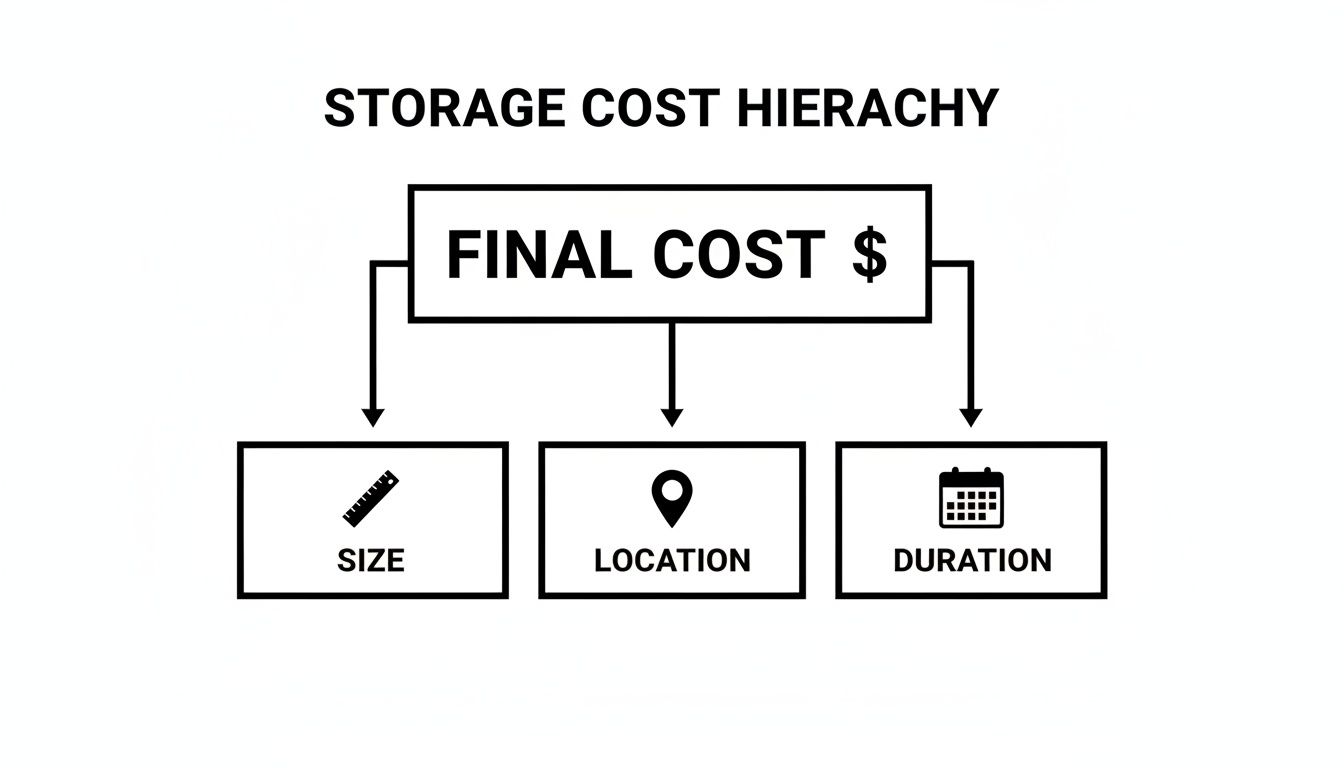
This infographic shows exactly how size, location, and how long you're storing for all feed into the final price you'll pay.

A storage cost hierarchy diagram showing the final cost determined by size, location, and duration.

As you can see, the physical size of your unit is one of the core things that sets your monthly bill.

Make a Quick Inventory List

Before you lock anything in, take five minutes to do a quick inventory. It doesn’t need to be a complex spreadsheet—a simple list in your phone's notes app is perfect. Just go room by room and jot down every major item you plan on storing.

Having that list gives you a much clearer picture of your total volume. For a really precise figure, you can use our handy cubic metre calculator to get an accurate estimate of the space you’ll need.

Pro Tip: Don't forget to think vertically! Most storage units have surprisingly high ceilings. Stacking boxes and smaller pieces on top of sturdy furniture is a brilliant way to use every inch of space, and it might just let you get away with a smaller, cheaper unit.

The Professional Packing Advantage

This is where calling in the experts really pays off. Professional removalists are masters of spatial logic. We've spent years packing trucks and storage units with Tetris-like precision. We know how to take apart bulky furniture, wrap it to be both protected and compact, and arrange everything to use every last centimetre.

Often, hiring professionals means you can fit everything into a smaller unit than you ever could on your own. That initial investment in our help can lead to some serious savings on your monthly storage bill down the track.

Looking Beyond the Sticker Price: Hidden Fees and Smart Add-Ons

The monthly rate you see advertised for a storage unit? That's almost never the full story. To get a real handle on the furniture storage Melbourne cost, you have to play detective and look beyond that headline number. It’s not about being distrustful; it’s about being smart with your money.

Think of it like booking a budget flight. The fare looks like a steal, but then you add your bags, pick a seat, and maybe grab some insurance. Storage works the same way. A fantastic monthly price can lose its shine pretty quickly once you tack on all the one-time fees and mandatory extras.

But it’s not all doom and gloom. Some of those "extras" are actually brilliant investments, turning a stressful job into a seamless experience. The trick is knowing which is which.

Uncovering Potential Hidden Costs

When you’re comparing storage options, you need to ask some direct questions about any costs that aren't baked into that monthly rent. Getting ahead of this can save you from a nasty surprise when the first bill lands.

Transparency is everything. You want to work with providers who are upfront about their pricing. It’s no different from any other service – you want to find companies that pride themselves on having no hidden charges or up-sells.

Keep an eye out for these common extra charges:

  • Administration Fees: A lot of places charge a one-off fee just to get your account set up. Expect this to be anywhere from $20 to $50.
  • Security Deposits: This is pretty standard. You'll likely need to pay a refundable deposit, usually equal to one month's rent. Just make sure you know exactly what you need to do to get it all back.
  • Mandatory Insurance: Don't be surprised by this one. Most good facilities will require your gear to be insured. Some will let you use your existing home and contents policy, but others will insist you buy theirs.
  • A Decent Lock: You’ll almost always have to bring your own padlock. Please, don't just grab a cheapie from the two-dollar shop. A solid, high-security disc lock is a small investment that offers serious protection for your stuff.

Getting a clear picture of these potential extras is crucial. We dive into similar principles in our detailed article on the hidden costs in moving house, which is well worth a read.

Why Some "Extras" Are Worth Every Cent

While you should absolutely be wary of sneaky fees, some add-on services are game-changers. They aren't just costs; they're investments in your time and sanity. Bundling services, especially with a company that handles both your move and your storage, can make life so much easier.

Think about these valuable additions that take the stress out of the equation:

  1. Professional Packing: Having experts pack your things isn't just a time-saver. They know how to protect your items properly for long-term storage, which seriously cuts down the risk of damage from things like moisture or pests.
  2. Furniture Disassembly & Reassembly: Big items like beds, tables, and wardrobes take up way less room when they're flat-packed. Letting the pros handle this saves you the headache and guarantees it all goes back together correctly on the other side.
  3. Integrated Transport: This is the big one. Instead of trying to line up a mover and a storage facility, you have one team do it all. They pick up your furniture, take it to storage, and then deliver it to your new place when you're ready. Less handling means less risk of damage.

The Single Biggest Perk: Using an all-in-one moving and storage service gives you a single point of contact. If anything goes sideways, there’s no finger-pointing between different companies. You just make one call and get it sorted.

At the end of the day, it's all about finding the right balance. By asking smart questions, you can dodge unexpected fees while also identifying the add-on services that offer genuine value, making your whole move feel effortless.

Practical Tips for Slashing Your Furniture Storage Bill

Knowing what drives the cost of storage is one thing, but actively bringing that final number down is where the real magic happens. With a few clever moves, you can seriously reduce your furniture storage Melbourne cost without skimping on a quality, secure space.

These aren't complicated secrets; they're just smart, practical tips that will keep more money in your pocket. A little bit of prep work before you even book a unit can pay off big time, whether you're storing for a few weeks or a full year.

Declutter Before You Store Anything

This is the number one, golden rule of saving money on storage. Every single thing you decide not to store is an item you don't have to pay for. Simple as that. Before you even think about packing, be ruthless with your decluttering.

Go through everything—furniture, clothes, boxes of old stuff. Ask yourself honestly: do I really need this? Will I actually use it when it comes out of storage? You can sell good-quality items, donate things to your local Salvos or Vinnies, or recycle anything that's seen better days. The less stuff you have, the smaller—and cheaper—your storage unit will be.

Think Long-Term to Save More

If you have a feeling you'll need storage for more than just a month or two, always ask about long-term discounts. Most storage places in Melbourne will give you a much better monthly rate if you commit to six months, a year, or longer. A month-to-month plan is great for flexibility, but you absolutely pay a premium for it.

Committing to a longer rental period upfront can lock in a lower rate that won't jump up on you. This one decision can easily save you hundreds of dollars over the year.

The Surprising Value of Professional Movers

This might sound like we're just talking up our own game, but hiring professional removalists can genuinely save you money. I know, there's an upfront cost, but hear me out—the long-term financial benefits are huge. Here’s why:

  1. Expert Space Packers: We are masters of Tetris. Seriously. Professionals can pack a storage unit with an efficiency that has to be seen to be believed. We often fit all your belongings into a smaller, cheaper unit than you'd manage on your own.
  2. Preventing Costly Damage: Clumsy packing and moving is the main reason furniture gets wrecked. The cost to repair a badly scratched antique table or replace a smashed TV is way more than the cost of hiring pros who use the right gear and techniques to protect your valuables from the get-go.
  3. Saving Your Time and Sanity: Your time is worth money. Do you really want to spend your weekends packing, renting a truck, and breaking your back lifting heavy furniture? We handle all that, so you can focus on everything else.

Hiring an expert team is an investment that protects your things and very often lowers your monthly storage bill.

Pack Smart and Stack High

How you pack your things makes a massive difference. Take apart big furniture items like bed frames, dining tables, and bookshelves to make them flatter and more compact. Use strong, similar-sized boxes that are easy to stack, and make sure you fill them to the top so they don't get crushed.

And don't forget to use the height of the unit! Most storage units have high ceilings for a reason. Stack your boxes and lighter items safely on top of your sturdiest furniture. This simple trick ensures you're using every single cubic metre you're paying for. By taking these steps, you can take control of your furniture storage Melbourne cost and make the whole experience a lot less painful on your wallet.

The Advantage of an All-In-One Moving and Storage Solution

Trying to juggle a moving company and a separate storage facility is a classic recipe for a headache. You end up with crossed wires, clashing schedules, and a lot of repeated effort. Let's be honest, coordinating two different services just means double the stress when you need it least.

This is where an all-in-one solution really makes a difference. When you opt for a company that handles both your move and your storage, the whole process becomes one smooth, connected operation. You get a single point of contact who’s across everything—from carefully packing up your home to safely getting your furniture tucked away in a secure unit.

People moving cardboard boxes with a white van in front of a modern house, an all-in-one move.

Why Bundling Is Better

The biggest win here is reduced handling. When one expert team manages your move from start to finish, your belongings are simply moved less often. Every single time an item is loaded or unloaded, there's a small risk of damage. A combined service minimises these touchpoints, which dramatically lowers the chances of any accidental scratches, dings, or breaks.

It’s a much smarter way to go, for a few clear reasons:

  • Seamless Coordination: Forget trying to line up the movers' arrival with the storage facility’s limited access hours. It's all managed by one team on one schedule.
  • Cost Efficiency: Bundling these services together often comes with savings, making the overall furniture storage Melbourne cost much easier on the wallet than paying two separate bills.
  • Total Accountability: With a single company in charge, there’s no finger-pointing. They are fully responsible for the care of your belongings through the entire journey.

If you want to take the complexity out of your next move, looking for providers who offer integrated moving solutions is a game-changer.

Key Takeaway: An all-in-one service isn't just about convenience. It’s a smarter, safer, and far more efficient way to handle your moving and storage needs.

By choosing one trusted partner for both moving and storage, you can turn a potentially chaotic time into a smooth, stress-free transition. To see how we bring these services together, check out our expert furniture removal and storage in Melbourne. Here at Get n Go Removals, we’re your partner for a complete, worry-free solution.

Your Top Furniture Storage Questions Answered

Alright, let's get those common questions sorted. When you're trying to nail down the furniture storage Melbourne cost, a few queries always seem to pop up. Answering these will give you the confidence to make the right call.

Let's dive into the questions we hear all the time.

Is Long-Term Storage Always Cheaper Per Month?

Yes, just about every time. Storage facilities love commitment and they'll reward you for it. If you sign up for six months or a year upfront, you’re almost guaranteed to get a better monthly rate than someone on a flexible, month-to-month plan.

It’s a bit like a gym membership or a phone plan – the longer the contract, the better the deal. If you know you’re in it for the long haul, locking in a rate is a seriously easy way to save a good chunk of cash.

Do I Really Need Climate Control for Wooden Furniture?

For any decent wooden furniture here in Melbourne, I’d say it's a very smart move. Our weather is famous for its four-seasons-in-one-day shenanigans, and those swings from damp cold to sticky heat can be brutal on timber.

Without a stable environment, wood can warp, crack, or even start growing mould. It might add a little to your monthly bill, but trust me, it’s a small price to pay to protect that beautiful antique dresser or solid oak dining table from permanent ruin.

What Kind of Insurance Is Necessary for My Items?

Most good storage spots will insist you have insurance. This isn't them trying to upsell you; it's a non-negotiable safety net for your stuff. You usually have two ways to go about it:

  1. Check Your Home & Contents Policy: Give your current insurer a call. Some policies will cover items you’ve put into storage, but you’ll probably need to let them know.
  2. Buy Insurance from the Facility: Most storage companies offer their own policies. They're built specifically for stored items and are often the simplest, most comprehensive option if your home policy doesn't cut it.

Whatever you do, don't skip this. Knowing your belongings are covered if the worst happens – think fire, theft, or a burst pipe – is worth every cent. Always get the insurance details sorted before you sign on the dotted line.

Can I Access My Storage Unit at Any Time?

This really depends on the facility, and it definitely affects the price. Your standard, budget-friendly option will probably limit you to regular business hours.

But if you need to grab something at 10 p.m. on a Tuesday or bright and early on a Sunday, you'll want a place that offers 24/7 access. It's a premium feature that costs a bit more, but for business owners or anyone with a hectic schedule, that total flexibility can be an absolute lifesaver.


Ready to find a secure, affordable, and straightforward storage solution for your furniture? At Get n Go Removals, we blend expert moving services with top-notch storage, giving you a completely seamless experience from start to finish. Let our team handle the heavy lifting. Get a free quote today!

READ MORE

The Ultimate Change Address Checklist: 10 Steps for a Flawless Move

Moving to a new home or office is an exciting chapter, but the administrative task of updating your address can feel overwhelming. From government agencies and banks to your favourite streaming services and local council, forgetting even one notification can lead to missed bills, lost mail, and unnecessary stress. This comprehensive change address checklist is designed to eliminate the guesswork and provide a clear, actionable blueprint for a successful move.

We've organised every crucial step into a structured timeline, detailing who you need to notify and when. This guide covers everything from updating Australia Post and redirecting your mail to informing financial institutions, utility providers, and even your employer. You'll find specific advice tailored for various scenarios, whether you're a homeowner or renter moving across Melbourne, a business coordinating an office relocation, or an individual planning an interstate move along the East Coast.

This isn't just a list; it's a strategic plan to ensure nothing falls through the cracks. By following these steps, you can prevent service disruptions, protect your personal information, and maintain continuity in your personal and professional life. Beyond just updating your address, a seamless move also includes securing your new residence. Consider understanding the costs involved with changing locks when you move into a new house to budget effectively for this essential security step.

Let's get started on ticking off those boxes and ensuring your new beginning is as smooth and organised as possible.

1. Notify Your Moving Company and Confirm Service Details

Before you start updating records with government agencies or financial institutions, your first critical notification should be to the team physically transporting your belongings. Formally notifying your removalist of your new address is a foundational step in any successful move. This communication ensures they can accurately plan logistics, allocate the right resources, and prevent costly delays on moving day.

Two men review moving documents next to a moving truck with cardboard boxes at a house.

This simple action is a cornerstone of an organised relocation and is a key part of any comprehensive change address checklist. It allows the moving company to finalise routes, anticipate access challenges, and provide an accurate final quote. A professional company, like Get n Go Removals Melbourne, often proactively confirms details such as settlement dates or lift bookings with customers 48 hours prior, but it's your responsibility to provide the initial, accurate information.

Actionable Tips for Confirmation

To ensure a seamless experience, follow these practical steps:

  • Provide Early Notice: Contact your removalist at least two to three weeks before your moving day with your new address and any changes to your inventory. This gives them ample time to adjust their schedule and planning.
  • Detail Access Information: Be specific about the access at both your old and new properties. Mention narrow driveways, stair-only access, lift booking requirements, or any clearway times for street parking. This information is vital for the moving team to come prepared.
  • Confirm a Day Before: A quick courtesy call or email 24-48 hours before the move to re-confirm the start time and addresses can prevent any last-minute miscommunications.
  • Share Contact Details: Ensure the company has your primary mobile number and a secondary contact person's number in case you are unreachable during the move.

By confirming these specifics, you not only help the removalists but also protect yourself from unforeseen issues and potential extra charges. Understanding how these details influence the final bill can be beneficial; you can get a clearer picture of moving company costs and ensure your budget stays on track.

2. Update Australia Post Address and Mail Redirection

After locking in your moving logistics, the next priority is ensuring your mail moves with you. Notifying Australia Post of your new address and setting up a mail redirection service is a crucial step in any change address checklist. This official process ensures that important letters, bills, and parcels sent to your old address are automatically forwarded to your new one, providing a vital safety net against missed correspondence during the transition period.

A person's hands are placing and retrieving mail from a black residential mailbox on a suburban street.

This service is more than a convenience; it's a fundamental part of a secure and organised move. It buys you precious time to update your details with every organisation individually without the risk of important documents like bank statements, medical results, or government notices getting lost. For instance, those undertaking an interstate move from Melbourne to Sydney can benefit greatly from a longer, 12-month redirection to catch any annual renewals or subscriptions that might be missed.

Actionable Tips for Mail Redirection

To guarantee no mail gets left behind, follow these practical steps:

  • Apply in Advance: Lodge your mail redirection application with Australia Post at least two weeks before your moving day. This provides enough time for the service to be activated and tested before you relocate.
  • Choose the Right Duration: While a standard redirection is often for three or six months, consider a 12-month service if you receive infrequent but important mail or are moving interstate. This offers a more comprehensive buffer.
  • Include All Names: Ensure you list every individual's name at your address, including all variations and maiden names, to ensure all mail is correctly forwarded.
  • Keep a Running List: As redirected mail arrives, use it as a prompt to contact the sender and update your address directly. This is a proactive way to make the redirection service a temporary solution, not a permanent one.

Properly managing your mail is a key task when you are moving into a new house, preventing identity theft risks and ensuring your financial and personal affairs remain in order without interruption.

3. Update Address with Government Agencies (Licensing and Registration)

After organising the physical move, your next priority is to update your details with key government bodies. Informing state and federal agencies of your new address is not just a box-ticking exercise; it's a legal requirement that ensures you remain compliant and can access essential services without interruption. Failing to update records for your driver's licence, vehicle registration, or electoral enrolment can lead to fines and significant administrative hassles down the line.

This step is a non-negotiable part of any thorough change address checklist. It ensures official mail, such as tax documents, voting information, and vehicle renewal notices, reaches you at your new home. For example, VicRoads typically processes licence and registration updates within 7-14 days. If you are relocating interstate, the process is more involved and will require additional documentation to transfer your licence and registration to the new state's authority.

Actionable Tips for Government Updates

To ensure a smooth transition with all necessary agencies, follow these practical steps:

  • Gather Proof of Address: Before you begin, collect necessary documents like a new utility bill, rates notice, or lease agreement. Having these ready will streamline the online or in-person update process.
  • Prioritise VicRoads: For Victorian moves, your driver's licence and vehicle registration should be your highest priority. You can update your details easily through the VicRoads online portal, which is often the quickest method.
  • Update Your Electoral Roll: Once you've moved, update your address with the Australian Electoral Commission (AEC) immediately. This ensures you are correctly enrolled to vote and helps avoid complications with jury duty notices being sent to your old address.
  • Keep Confirmation Records: Whether you update online, by phone, or in person, always save confirmation emails, reference numbers, or physical receipts as proof that you have completed the change of address.

4. Notify Banks and Financial Institutions of Address Change

After arranging the physical move, your next priority is to secure your financial information. Informing your banks, credit card providers, superannuation funds, and insurance companies of your new address is a non-negotiable step in your change address checklist. This action is crucial for preventing identity theft, ensuring you receive critical statements, and maintaining uninterrupted access to your financial services.

Failing to update these details can lead to sensitive documents like new credit cards or account statements being sent to your old address, leaving you vulnerable. Major Australian banks like Commonwealth Bank or NAB typically process address changes within a few business days, but it's your responsibility to initiate the update promptly. This proactive step safeguards your financial wellbeing and is a cornerstone of an organised relocation.

Actionable Tips for Financial Updates

To ensure a secure and smooth transition of your financial accounts, follow these practical steps:

  • Create a Master List: Before you do anything else, compile a comprehensive list of every financial institution you have a relationship with. This includes banks, credit card companies, superannuation funds, investment brokers, loan providers (car, personal), and insurers (health, car, life).
  • Update Two Weeks Prior: Aim to update your address with all primary financial institutions at least two weeks before your move. This provides enough time for their systems to process the change and redirect any mail already in transit.
  • Use Secure Online Portals: The safest and most efficient way to change your address is through secure online banking platforms or mobile apps. This method provides an instant digital record of your request.
  • Request and File Confirmations: For every update you make, whether online or over the phone, request a confirmation email or reference number. Keep these records in a dedicated folder until you've successfully received mail at your new address from each institution.
  • Don't Forget Super and Investments: Your superannuation and investment accounts are high-value assets. Ensure these are updated promptly to receive annual statements and important notifications, which are vital for your long-term financial planning.

Careful management of these notifications helps you maintain financial security and avoid unexpected issues. Proactively managing these details is just as important as budgeting for the move itself, helping you steer clear of the hidden costs in moving house that can arise from administrative oversights.

5. Update Subscription Services and Online Accounts

In today's digitally-driven world, your physical address is intrinsically linked to countless online profiles, from e-commerce sites to streaming services. Overlooking these accounts in your change address checklist can lead to misdirected deliveries, billing complications, and even potential security risks. Updating this information ensures a seamless transition for your online life, preventing lost parcels and service interruptions.

This step is about more than just convenience; it's a critical component of a secure and organised move. Platforms like Amazon, eBay, and Netflix rely on your address for both delivery logistics and billing verification. Failing to update them in a timely manner can cause your online orders to be sent to your old address or trigger fraud alerts on your payment methods, adding unnecessary stress during an already busy period.

Actionable Tips for Online Accounts

To methodically manage your digital footprint during a move, follow these practical steps:

  • Create a Master List: Before you start, compile a comprehensive list of all your online accounts. Include e-commerce sites (Amazon, eBay), streaming services (Netflix, Stan), food delivery apps, and any other subscriptions that use your physical address.
  • Prioritise and Update: Work through your list, updating your primary delivery and billing address in each account's settings. Start with the most frequently used services to minimise the risk of errors.
  • Use a Password Manager: If you have numerous accounts, a password manager can help you efficiently access each one, saving you the time and frustration of resetting forgotten passwords.
  • Review and Cancel: Use this opportunity to review your subscriptions. Cancel any services you no longer use to declutter your digital life and save money before you even move.
  • Check Billing Cycles: Be mindful of when your subscriptions renew. Aim to update your address well before the next billing date to ensure the change is processed correctly and avoid payment failures.

6. Update Healthcare Providers and Medical Records

Ensuring your healthcare providers have your new address is crucial for maintaining continuity of care and receiving important medical communications. This step involves more than just redirecting mail; it's about making sure appointment reminders, test results, and critical health information reach you without delay. Updating these records promptly is a vital part of any change address checklist, preventing potential health risks and administrative hassles.

This simple update ensures that your GP, dentist, specialists, and pharmacy can maintain accurate files, which is essential for prescriptions and referrals. For families, this ensures that every member’s health records are current, which is particularly important for ongoing treatments or school medical forms. For those moving interstate, it’s the first step in establishing a new network of trusted medical professionals in your new community.

Actionable Tips for Medical Record Updates

To keep your health management seamless during your move, follow these practical steps:

  • Request Records Early: Before you move, ask your current GP for a summary or a full copy of your medical records. This is especially important for interstate relocations, as it gives your new doctor immediate access to your health history.
  • Inform All Providers: Make a list of every healthcare provider you see, including your GP, dentist, optometrist, physiotherapist, and any specialists. Contact each one individually to provide your new address and effective date.
  • Update Your Pharmacy: Let your local pharmacy know you're moving. This ensures any repeat prescriptions or special orders can be seamlessly transferred or accessed at a pharmacy near your new home.
  • Check My Health Record: If you use Australia's My Health Record system, log in to your MyGov account and update your contact details there. This ensures any new information uploaded by providers is linked to your current profile.
  • Update Emergency Contacts: When you notify your providers of your new address, also take the opportunity to confirm and update your emergency contact information on file.

7. Notify Insurance Providers (Home, Auto, and Contents)

Updating your address with your insurance providers is a non-negotiable step in your relocation. This isn't just administrative paperwork; it's essential for maintaining valid coverage for your home, contents, and vehicle. Failing to inform insurers like AAMI, NRMA, or Allianz of your move can lead to denied claims or even policy cancellation, leaving your most valuable assets unprotected at a time you need security the most.

This notification is a critical component of any comprehensive change address checklist because your new address directly impacts your premiums. Factors like local crime rates, flood risk, and even traffic conditions can alter your risk profile. An interstate move from Melbourne to Sydney, for example, will likely change your car insurance rates. Proactively managing these updates ensures your coverage is accurate and reflects your new circumstances from day one.

Actionable Tips for Insurance Updates

To ensure continuous and correct coverage, follow these practical steps:

  • Notify Before You Move: Contact all your insurance providers at least one to two weeks before your moving day. This prevents any gaps in coverage during the transition period.
  • Update All Policies at Once: When you call, be prepared to update your home, contents, and car insurance policies simultaneously to ensure all records are aligned and nothing is missed.
  • Review Your Coverage: A move is the perfect opportunity to reassess your coverage limits. Your new home may have different features or a higher value, requiring adjustments to your policy to ensure you are not underinsured.
  • Confirm in Writing: After updating your details over the phone or online, always request a new Certificate of Currency or written confirmation reflecting the change of address. This document is your proof of continuous coverage.

8. Update Utilities and Service Providers (Water, Gas, Electricity)

One of the most crucial tasks on any change address checklist is organising the seamless transfer of your essential utilities. Arranging for your electricity, gas, water, and internet to be disconnected at your old property and connected at your new one ensures you aren't left in the dark or without Wi-Fi on moving day. Proactively managing these services prevents billing errors and service interruptions, making your transition into the new home far more comfortable.

Man connecting a green utility cable to a wall-mounted device, with an internet router and coiled cable on a desk.

This step involves coordinating with multiple companies to schedule disconnections and new connections, often requiring several weeks' notice. For instance, providers like Origin Energy or AGL may need two to four weeks to process a transfer in Victoria, while setting up a new NBN connection can take anywhere from one to four weeks. Timely communication is key to ensuring your services are active the moment you arrive.

Actionable Tips for Utility Transfers

To ensure a smooth and uninterrupted service transfer, follow these practical steps:

  • Provide Advanced Notice: Contact all your utility providers at least four to six weeks before your move. Gas services in particular can require longer lead times for disconnection and connection.
  • Schedule Final Readings: Request a final meter reading for electricity and water on your moving day to ensure you are only billed for your usage. It's also wise to photograph the meters at your old address after the final reading for your records.
  • Book Your Internet Connection: Arrange for your internet service to be installed on moving day or the day immediately following. This minimises downtime, which is especially important if you work from home.
  • Keep Records Handy: Have your account numbers and customer reference details available when you call. This will speed up the process and ensure the operator can access your information quickly.

Coordinating these services is a fundamental part of any successful relocation. By managing these tasks early, you can focus on the physical move without worrying about basic amenities.

9. Update Employer and Payroll Records

Among the flurry of utility and government notifications, it’s easy to overlook a crucial professional update: your employer. Informing your workplace of your new address is vital for receiving important documents like payslips, group certificates (income statements), and other official correspondence. This ensures your payroll, tax, and superannuation details remain accurate and compliant.

This step is a non-negotiable part of any comprehensive change address checklist, as outdated records can lead to significant administrative headaches. An incorrect address could mean your sensitive financial information is sent to the wrong location, or you could miss critical updates from your human resources department. Ensuring your employer has the correct details guarantees continuity in your professional life during your relocation.

Actionable Tips for Workplace Updates

To ensure a smooth transition with your employer, follow these practical steps:

  • Notify HR and Payroll Simultaneously: Send a formal email or use your company’s internal portal to update your address. Inform both the Human Resources (HR) department and the payroll office to ensure all systems are updated concurrently.
  • Update Your Superannuation Fund: While your employer makes contributions, you are responsible for keeping your personal details with your super fund manager current. Log in to your superannuation account online or call them directly to update your residential address.
  • Confirm the Change: Check your next payslip carefully to verify that your new address has been correctly recorded. This simple check can prevent future issues.
  • Update Emergency Contacts: Your move might mean your previous emergency contacts are no longer the most practical choice. Use this opportunity to review and update your emergency contact information with your workplace.
  • Inform Your Tax Agent: If you use a tax agent, remember to provide them with your new address. This is especially critical for self-employed individuals who need to ensure their details with the Australian Taxation Office (ATO) are up to date.

10. Update Local Council and Property Records

Ensuring your local council has your correct address is a vital step often overlooked in the chaos of moving. This notification guarantees that essential communications, such as rates notices, local service updates, and community information, are sent to your new home. It also ensures property records are accurate, which is crucial for homeowners and impacts things like voting enrolment and emergency service alerts.

This task is a critical part of any comprehensive change address checklist because it connects you to your new community's civic life. Councils like Melbourne City Council or Moonee Valley typically process these updates within a couple of weeks. For those moving interstate, you will need to register with your new state's local council and relevant property registries, a key consideration for any house relocation in Victoria or beyond.

Actionable Tips for Council Updates

To ensure a smooth transition with your local government, follow these practical steps:

  • Check the Council Website First: Most councils have a dedicated online portal or form for updating your details. This is usually the fastest and most efficient method.
  • Prepare Your Documents: Have proof of your new address ready. This could be a copy of your new lease agreement (for renters) or settlement documents (for homeowners).
  • Update Multiple Records: When you update your address for rates, check if you can also update your details for pet registrations, parking permits, and the local electoral roll at the same time.
  • Register for Services: Use this opportunity to sign up for council-specific services, such as hard rubbish collections, local newsletters, and emergency alerts via text or email.
  • Request Written Confirmation: Once the update is processed, ask for an email or letter confirming the change has been made. This provides a valuable record for your files.

10-Point Change of Address Checklist Comparison

Task Implementation Complexity 🔄 Resource Requirements ⚡ Expected Outcomes 📊 Ideal Use Cases 💡 Key Advantages ⭐
Notify Your Moving Company and Confirm Service Details 🔄 Medium — coordination, permits, timing ⚡ Low–Medium — time, contact info, inventory 📊 Accurate delivery, timely arrival, fewer surprises Long-distance or large-item moves; tight schedules ⭐ Prevents delivery errors; ensures correct truck/crew
Update Australia Post Address and Mail Redirection 🔄 Low — single application but lead time ⚡ Low — small fee, ID verification 📊 Redirected mail; reduced lost correspondence All movers; especially interstate relocations ⭐ Affordable protection against lost/bounced mail
Update Address with Government Agencies (Licensing & Registration) 🔄 High — multiple agencies, documentation ⚡ Medium — proof of address, IDs, possible fees 📊 Legal compliance; valid IDs and registrations Interstate moves; drivers and vehicle owners ⭐ Avoid fines, ensure driving and voting eligibility
Notify Banks and Financial Institutions of Address Change 🔄 Medium — separate providers, verification ⚡ Medium — ID checks, online/phone updates 📊 Secure accounts; correct statements and notices Anyone with bank/credit accounts or investments ⭐ Reduces fraud risk; ensures receipt of financial documents
Update Subscription Services and Online Accounts 🔄 Medium–High — many accounts to update ⚡ Medium — logins, passwords, 2FA steps 📊 Continued deliveries & billing; accurate recovery options Frequent online shoppers and subscription users ⭐ Prevents delivery/billing issues and facilitates returns
Update Healthcare Providers and Medical Records 🔄 Medium — multiple providers, record transfers ⚡ Medium — medical records, pharmacy details 📊 Continuity of care; prescription and appointment reliability Patients with ongoing treatments or prescriptions ⭐ Maintains treatment continuity and emergency contactability
Notify Insurance Providers (Home, Auto, Contents) 🔄 Medium — policy checks, premium reassessment ⚡ Medium — policy numbers, proof of address 📊 Maintained coverage; accurate premiums and claims Homeowners, renters, and vehicle owners ⭐ Preserves coverage and claim validity; avoids cancellations
Update Utilities and Service Providers (Water, Gas, Electricity) 🔄 High — scheduling connections and safety checks ⚡ High — bookings, possible deposits, technician visits 📊 Active utilities on move-in; correct final billing Essential for move-in day readiness ⭐ Prevents service interruptions and safety issues
Update Employer and Payroll Records 🔄 Low — HR/payroll notification required ⚡ Low — contact HR, provide new details 📊 Accurate payslips, super contributions, tax records Employed individuals and payroll-managed contractors ⭐ Ensures correct taxation and payroll delivery
Update Local Council and Property Records 🔄 Medium — council-specific processes ⚡ Low–Medium — proof of tenancy/ownership 📊 Correct rates notices, council services, emergency alerts Homeowners and renters entering new council area ⭐ Grants access to local services and correct billing

Ready for a Flawless Move? Let's Make It Happen

Moving, whether it's across Melbourne or interstate, represents a significant life transition. It’s a process filled with excitement for the future, but it also carries a substantial administrative load that can feel overwhelming. The detailed change address checklist we've walked through is more than just a list of tasks; it's a strategic roadmap designed to dismantle that overwhelm and replace it with control, confidence, and a sense of preparedness. By systematically addressing each notification-from government bodies like VicRoads and the ATO to your local council, utilities, and financial institutions-you are actively building a seamless bridge to your new life.

The Power of a Proactive Approach

The core takeaway from this comprehensive guide is the immense value of a proactive, organised approach. Waiting until the last minute to update your address details can lead to a cascade of preventable problems, including missed bills, delayed deliveries, potential security risks, and frustrating administrative headaches long after you’ve unpacked the last box.

Key insights to carry forward include:

  • Timeline is Everything: Starting the process 6-8 weeks before your move is not overly cautious; it's essential. This timeframe provides the necessary buffer to handle any delays, request new documents, and ensure service transfers happen without interruption.
  • Centralise Your Information: Before you begin, create a master document or folder (digital or physical) with all necessary account numbers, contact details, and login information. This simple act of preparation will save you hours of searching later.
  • Think Beyond the Obvious: While updating your driver's licence and bank details are top-of-mind, don't forget the smaller, often overlooked accounts. Think loyalty programs, online shopping profiles, magazine subscriptions, and even pet microchip databases. These are the loose ends that can cause minor but persistent annoyances if neglected.

From Checklist to Action: Your Next Steps

You now have the framework for a flawless transition. The next step is to transform this knowledge into action. Begin by downloading and customising the checklist to fit your specific circumstances. Are you a renter in Melbourne? Your list will have unique items like finalising your bond return and notifying your property manager. For renters, your move-out process might also include arranging for professional cleaning; a comprehensive end of lease carpet cleaning guide can be invaluable in ensuring you meet your tenancy agreement requirements.

If you're a homeowner, your focus will include tasks like updating property records with the local council and arranging final meter readings. For businesses, the complexity increases, involving ASIC, suppliers, clients, and internal payroll systems. The true benefit of this checklist lies in its adaptability.

Key Takeaway: A successful move is the direct result of careful planning and diligent execution. By treating your change of address process with the same importance as packing your fragile items, you ensure that the administrative side of your relocation is as smooth and secure as the physical one.

Ultimately, mastering your change address checklist is about protecting your time, your finances, and your peace of mind. It allows you to close the door on your old property with certainty and step into your new one with excitement, knowing that every detail has been managed. You've done the hard work of planning, and now you can focus on what truly matters: creating a home, settling into a new community, or launching the next phase of your business.


With your administrative tasks organised, let Get n Go Removals Melbourne handle the heavy lifting. Our experienced team provides reliable, professional removalist services across Melbourne and the East Coast, ensuring your move is as stress-free as your paperwork. Visit Get n Go Removals Melbourne to secure your transparent, obligation-free quote today.

READ MORE

Big Moving Boxes: Your Expert Guide to Packing and Moving in Melbourne

What if you could cut your packing time in half and drastically reduce moving-day stress? That’s the true power of using big moving boxes correctly. They aren't just oversized containers; they are a strategic tool for a faster, more organised, and far less overwhelming move, especially when dealing with bulky yet light items like bedding, pillows, and lampshades.

Why Big Moving Boxes Are a Game-Changer for Your Move

A room with stacked cardboard moving boxes, a blue sofa, and plants, indicating a home relocation.

Imagine two moving day scenarios. In the first, you’re navigating a maze of small, mismatched boxes, making countless trips to the truck. It's chaotic, physically draining, and saps your energy before the day is even half over.

Now, picture a different reality: a few stacks of large, uniformly organised boxes holding your belongings. The clutter is managed, the process is streamlined, and the day feels controlled and efficient.

This second scenario is entirely achievable with a smart packing strategy, where big moving boxes play a leading role. They are the unsung heroes of any efficient Melbourne relocation, designed to make your life simpler from the first item you pack to the last one you unload into your new home or office.

The Core Benefits of Using Larger Boxes

The primary advantage of large moving boxes is consolidation. Instead of juggling five small boxes for your linens, you can place them all into one large box. This simple change has a significant positive impact on your entire moving process.

  • Accelerated Packing: Quickly pack away bulky but lightweight items like doonas, blankets, cushions, and lampshades, drastically reducing the time spent on each room.
  • Reduced Trips: A lower box count means fewer journeys between your home and the moving truck, saving a surprising amount of time and physical effort on moving day.
  • Simplified Organisation: With fewer boxes to manage, labelling, tracking, and inventory become much easier, leading to a smoother, more logical unpacking experience.
  • Protection for Larger Goods: Awkwardly shaped items that don't fit standard boxes—like large toys or small appliances—can be securely packed and shielded from damage.

By incorporating large boxes into your moving plan, you aren’t just packing; you're implementing a system. This approach transforms a potentially frantic task into a calm, methodical process, setting the stage for a stress-free relocation.

Ultimately, selecting the right supplies is the foundational step towards a successful move. As seasoned experts in Melbourne relocations, the team at Get n Go Removals understands how much these details matter. We are committed to sharing professional insights and providing high-quality materials to ensure your move is as seamless as possible.

How to Choose the Right Box Size and Strength

Walking into a moving supply store can be overwhelming, but here's the secret: not all big boxes are the same. Choosing the right one isn't about guesswork; it's about matching the box's capabilities to its contents. Getting this right is the difference between a secure, damage-free move and the heart-stopping sound of a box failing mid-transit.

Think of it as using the right tool for the job. You wouldn't try to hammer a nail with a screwdriver, and you shouldn't pack a box of heavy books into a lightweight carton designed for pillows. Understanding the critical differences in size, capacity, and construction will empower you to pack smarter and keep your valuables safe.

The first crucial distinction to grasp is between single-wall and double-wall boxes.

  • Single-Wall Boxes: These are your standard cardboard boxes, ideal for lighter, bulkier items like pillows, doonas, clothing, and lampshades.
  • Double-Wall Boxes: These are the heavy-duty champions. Constructed with two layers of corrugated cardboard, they offer superior strength and rigidity. For dense, heavy items, these are non-negotiable.

A double-wall box provides that essential safety net for your heavier possessions, preventing the bottom from collapsing and ensuring the box maintains its structural integrity when stacked in the moving truck.

Decoding Box Sizes and Weight Limits

Beyond wall construction, consider volume and weight capacity. In Australia, moving box sizes are typically measured in litres (L), giving you a clear indication of their holding capacity. For big moving boxes, you'll generally find sizes ranging from 100L to 150L.

However, volume alone doesn't tell the full story. A large 150L box might seem perfect, but if it's a single-wall design, its weight capacity might only be 15-20 kg. In contrast, a heavy-duty double-wall box of the same size could safely hold 30 kg or more. Always check the manufacturer's specifications, which are usually printed on the box itself.

The golden rule of packing is simple: the heavier the items, the smaller and stronger the box should be. This prevents you from creating a dangerously heavy box and protects its structural integrity.

This principle is more relevant than ever. There's a significant trend of people moving from cities to regional areas in Victoria, with moves from capital cities to regions increasing. We witness this daily – families loading large, double-walled boxes with books, kitchenware, and linens for their journey. For a deeper look into these trends, you can check out the insights on Australian moving patterns.

Matching Your Items to the Right Big Box

To eliminate guesswork, we've created a straightforward guide. Use this table to quickly pair common household items with the appropriate box type, allowing you to pack with confidence.

If you're trying to estimate the total number of boxes you'll need, calculating the total volume of your belongings is a crucial step. Our guide on using a cubic metre calculator for your move is an excellent resource for planning your supply requirements.

Matching Your Items to the Right Big Box

Item Category Recommended Box Type Ideal Size (Litres) Max Weight (kg)
Linens, Pillows & Doonas Standard Single-Wall 100-150L 15-20 kg
Clothing & Towels Standard Single-Wall 100-120L 20 kg
Pots, Pans & Small Appliances Heavy-Duty Double-Wall 100L 25-30 kg
Books, Files & Photo Albums Heavy-Duty Double-Wall 50-75L (Book Box) 25 kg
Toys & Children's Items Standard Single-Wall 100-150L 15-20 kg
Lampshades & Decorative Pillows Standard Single-Wall 150L+ 10-15 kg

By following these guidelines, you can ensure every box is perfectly suited for its contents. You'll avoid overloading lighter boxes and make optimal use of heavy-duty ones for items requiring extra protection. It’s all about setting yourself up for a secure and efficient move from the very beginning.

Expert Techniques for Packing Large Boxes Safely

Packing big moving boxes is as much an art as it is a science. It’s not simply about filling a space; it's about strategically arranging your belongings to ensure everything arrives at your new home intact. Mastering a few professional techniques can make a significant difference, preventing potential damage and making the entire process smoother.

The process begins before a single item is placed inside. A flimsy, poorly prepared box is an invitation for disaster, regardless of how carefully its contents are arranged. Let's start with the essential steps to build a solid foundation.

Preparing Your Box for Success

First and foremost, you must properly reinforce the bottom of the box. Use high-quality packing tape—not masking tape or general-purpose tape. The professional ‘H-tape’ method is the industry standard for a reason.

  1. Seal the Centre Seam: Apply a long strip of tape directly along the main seam where the bottom flaps meet.
  2. Tape the Edges: Add two more strips of tape across the perpendicular edges, creating a distinct 'H' shape.
  3. Create a Cushion: Before packing, line the bottom with a soft material. Crumpled packing paper, old towels, or a soft blanket will absorb shocks from bumps during transit.

This simple preparation creates a strong, shock-absorbent base, which is your first line of defence in protecting your belongings.

A well-packed box is like a puzzle solved in reverse. You begin with the end goal—safe arrival—and build layers of protection from the bottom up, ensuring every piece fits snugly and securely.

Now, let's address the critical step of weight distribution. Think of it as building a pyramid: a wide, heavy base is needed to support the lighter items on top. This principle is absolutely vital when packing big moving boxes.

Mastering Weight Distribution and Void Filling

The fundamental rule is to place the heaviest items at the very bottom of the box. This creates a stable centre of gravity, making the box easier to lift and preventing it from tipping over. As you pack upwards, transition to medium-weight items, and finish with the lightest belongings at the very top.

However, even with perfect weight distribution, empty spaces inside the box are a significant risk. Items can shift, slide, and collide during the move. This is where void fillers become essential.

  • Use crumpled packing paper, bubble wrap, or soft items like towels and socks to fill every gap.
  • The goal is to create a snug fit where nothing can move. Give the box a gentle shake—you shouldn't hear any movement.
  • A properly filled box feels solid, with no rattling or shifting sounds.

This visual guide helps illustrate how the type of items you are packing should influence your choice of box strength.

As you can see, while single-wall boxes are suitable for light goods, your heavier items and valuables demand the superior protection of a double-wall box. When moving precious or fragile belongings, such as antique furniture, special care is required. You can find expert packing advice for shipping large furniture to help ensure a safe delivery. For particularly delicate items, our detailed guide on how to pack fragile items for moving offers more professional tips.

Finally, smart labelling is the finishing touch that elevates a good packing job to a great one. Clearly mark each box with its destination room (e.g., "Kitchen," "Main Bedroom") and a brief summary of its contents. This not only makes unpacking significantly easier but also helps the moving crew place boxes in the correct rooms upon arrival—a standard our Get n Go Removals valet packing service adheres to every day.

Where to Find the Best Moving Boxes in Melbourne

Sourcing high-quality packing boxes shouldn't add to your moving stress. For those moving in Melbourne, finding the right big moving boxes can feel like a challenge, but it doesn't have to be. Understanding your options is key to making a smart, budget-friendly choice that effectively protects your possessions.

The initial question is often whether to buy new boxes or find used ones. Both options have their pros and cons, which typically boil down to a trade-off between cost, convenience, and quality.

Buying New Versus Finding Used Boxes

The idea of obtaining free, used boxes from local businesses, community groups, or recycling centres is always appealing. While it seems like a great way to save money, this approach often carries hidden risks that can end up costing you more in the long run.

Used boxes can be a gamble. You have no knowledge of their history—what they previously held or how they were stored. This means they could be compromised by moisture, dirt, or structural fatigue from a previous heavy load, dramatically increasing the risk of failure mid-move.

Buying new boxes, on the other hand, provides guaranteed quality and reliability. They are clean, strong, and purpose-built for moving. It’s a small upfront investment for invaluable peace of mind.

The most straightforward and reliable solution is often the most direct one. Sourcing professional-grade materials from your moving company integrates this crucial step into your overall plan, ensuring a smoother experience from start to finish.

The Unmatched Convenience of Mover-Supplied Boxes

Choosing to get packing supplies from your removalist is about more than just convenience—it's about quality assurance. When you source big moving boxes from Get n Go Removals, you are receiving the exact same professional-grade materials our experienced crews use and trust on a daily basis.

Here’s why letting us handle the supplies is the smartest choice for your Melbourne relocation:

  • Guaranteed Durability: Our boxes are built to withstand the rigours of moving. They are tough, uniformly sized, and designed for secure stacking inside a moving truck, which maximises space and prevents shifting during transit.
  • Time-Saving Efficiency: Forget driving all over town searching for supplies. We can deliver everything you need—boxes, tape, packing paper, and more—directly to your door. This frees up your time and energy for other important moving tasks.
  • Expert Guidance: Not sure how many boxes you’ll need? Our team has extensive experience. We can provide an accurate estimate of the right quantity and types of boxes for your specific needs, so you don't overspend or run out mid-pack.

This integrated solution removes the guesswork and logistical stress from sourcing your materials. It’s one part of our commitment to providing a comprehensive, hassle-free moving service. To see how our team can manage every aspect of your move, from providing boxes to professional packing, learn more about our dedicated Melbourne packing service.

Ultimately, investing in high-quality boxes from a trusted source like your removalist is an investment in the safety of your belongings. It ensures every item, from bulky bedding to cherished keepsakes, is protected by materials specifically designed for the job.

Using Big Boxes for Speciality Moves and Storage

An open self-storage unit filled with stacked moving boxes, next to green roll-up doors.

While big moving boxes are essential for standard house moves, their true value is demonstrated in more complex situations like commercial relocations and long-term storage. When used correctly, these boxes are indispensable tools for maintaining efficiency, organisation, and protection.

A commercial office move is a race against time where every minute of downtime impacts the bottom line. Large, uniform boxes are invaluable in this scenario, allowing for the rapid packing of monitors, computer equipment, and office supplies, keeping everything consolidated and easy to locate upon arrival.

Using same-sized big boxes also facilitates the creation of a stable, secure stack inside the moving truck. This maximises space, prevents items from shifting and getting damaged, and ensures that vital business equipment arrives safely.

Perfecting the Office Relocation

An office move is focused on resuming business operations as quickly as possible. The primary goal is a seamless transition, and large moving boxes are instrumental in achieving this.

  • Minimised Downtime: Staff can pack their entire workstations—monitors, keyboards, files—into just one or two large boxes, making the process faster and more organised.
  • Systematic Unpacking: Clearly labelled, uniform boxes allow the moving crew to place everything in its correct location at the new office, accelerating the setup process.
  • Protection for Technology: Heavy-duty large boxes provide the necessary cushioning and strength to protect sensitive and expensive electronic equipment during transit.

The Essential Role in Interstate Relocations

Moving across state lines introduces additional complexities. Your belongings will travel hundreds or thousands of kilometres, subject to constant vibration and movement. In this context, heavy-duty big moving boxes are your primary line of defence.

Interstate relocations are common, with thousands of Australians moving across state lines each year. At Get n Go Removals, our weekly direct runs from Melbourne to Sydney and Brisbane are often filled with specialised containers, such as extra-large wardrobe boxes, which keep clothing pristine over the long journey.

For a long-distance move, consider your boxes as personal vaults on wheels. Investing in top-quality, sturdy large boxes is the single most effective measure you can take to ensure your belongings survive the journey.

Your Best Defence in Self-Storage

Whether you're downsizing, renovating, or simply decluttering, a storage unit can be invaluable. However, items left in storage are susceptible to dust, moisture, and pests. A properly sealed, durable box is your best shield against these elements.

Big moving boxes are ideal for storage as they allow you to group similar items together, such as seasonal clothing, holiday decorations, or archived documents. Using quality boxes prevents them from being crushed when stacked and creates a tight seal that keeps out environmental contaminants.

This organised approach not only protects your belongings but also makes it significantly easier to find what you need later. To make the most of your unit, explore our guide to Melbourne storage prices and options.

Let's be honest: packing your entire life into boxes is one of the most draining parts of any move. Even with the best strategy and a stack of big moving boxes, the sheer scale of the job can be overwhelming. Knowing when to call for backup isn't giving up; it's a smart, strategic decision to save your time, your sanity, and your valuables.

There are classic signs it’s time to hand the reins to professionals. If you’re facing a tight deadline, packing a large family home, or own a collection of priceless or highly fragile items, professional packing is a game-changer. It transforms the most time-consuming part of a move into a hands-off, worry-free experience.

Gaining Peace of Mind with Valet Services

This is where Get n Go Removals' premium valet and white-glove packing services excel. Our trained, police-checked team arrives with all the top-tier materials needed to pack your home or office with expert precision. We don’t just fill boxes; we implement a system designed for maximum protection, giving you complete peace of mind.

Our service covers every detail, including:

  • Expert handling of delicate items, from glassware to unique art pieces.
  • Systematic packing of each room, ensuring a logical and straightforward unpacking process.
  • Furniture disassembly and professional wrapping for safe transit.
  • Utilising professional-grade materials like heavy-duty boxes and premium protective padding.

The Smartest Choice for Complex Moves

In Australia’s dynamic housing market, professional packing has become a vital service. With a significant number of Australians planning a move in the next year, efficiency is more critical than ever, especially as many Melburnians relocate to regional areas. Our white-glove service is perfectly suited for these larger moves, using heavy-duty big boxes for everything from disassembled furniture to bulky items, which drastically reduces the risk of damage.

Professional packing is an investment in certainty. It guarantees that every box is packed to the highest standard, protecting your valuables and freeing you to focus on the other critical aspects of your move.

Engaging a professional service is also beneficial when it comes to decluttering. A major move often involves sorting through years of accumulated possessions. This is where professional junk removal services can be a lifesaver, helping you efficiently manage items you don't plan to take with you.

Ultimately, allowing us to handle the packing is about more than convenience. It’s about leveraging our experience to ensure your move is as smooth, secure, and stress-free as possible. To learn more, read our guide on the top benefits of using professional packing services.

Got Questions About Big Moving Boxes? We’ve Got Answers

Even the most organised packer has a few questions. To wrap up, we've compiled quick answers to the most common queries we hear from Melbournians using big moving boxes. Consider this your final checklist before you begin.

Each answer is designed to build on what you've learned and provide that extra confidence to pack like a professional.

So, How Many Big Moving Boxes Do I Actually Need?

This is a frequently asked question. As a general guideline, a typical three-bedroom house often requires around 15-20 large boxes. These are ideal for bulky but lighter items like bedding, clothes, and kitchenware. However, this can vary significantly based on your lifestyle and possessions.

The most reliable method is to conduct a room-by-room inventory. For a more precise estimate, an online moving calculator can be extremely helpful. It will give you a clearer picture of your actual needs, so you don't end up with a surplus of unused boxes or make a last-minute scramble for more.

Is It Okay to Pack Heavy Stuff in a Large Box?

This is a classic packing mistake: filling a large box with books. While a quality, double-walled large box can handle the weight, the real problem is that it becomes extremely heavy and difficult to lift safely, posing a risk of injury.

Here's the golden rule to remember: Big boxes are for big, light items. For heavyweights like books, crockery, or tools, always use smaller, more manageable book boxes. Your back (and your movers) will thank you for it.

What’s the Best Way to Label Big Boxes?

Clear and consistent labelling is the secret to a stress-free unpacking process. Use a thick, permanent marker to label at least two sides of every box—the top and one of the sides. This ensures you can identify the contents even when they are stacked.

Be specific with your labels. Instead of just writing "Kitchen," be more detailed. "Kitchen – Pots & Pans" or "Main Bedroom – Linens" will save you from opening multiple boxes to find a specific item.

Can I Reuse My Big Moving Boxes After the Move?

Absolutely! High-quality cardboard boxes are designed for more than one use. As long as they remain clean and structurally sound, you can flatten and store them for your next move. Alternatively, you can pass them on to friends, family, or others in your community.

Many people offer their used boxes for free on platforms like Facebook Marketplace or Gumtree. It’s a great way to help someone else, save them money, and keep perfectly good materials out of landfill.


Ready to stop worrying about sourcing your packing supplies? Get n Go Removals Melbourne provides professional-grade moving boxes and all the materials you need to ensure your belongings are safe and secure. Let us help you achieve a smooth, organised move.

Explore Our Professional Packing Services and Supplies

READ MORE

A Guide to Accurate Moving Interstate Quotes From Melbourne

Getting your head around moving interstate quotes is the first, and arguably most important, step in planning a successful relocation. A good quote isn't just a number; it's a detailed estimate that should clearly lay out all the costs involved—transport, labour, insurance, and even packing materials.

A reliable quote is defined by its transparency. It breaks down all the costs to ensure there are no nasty hidden fees, so you know precisely what you're paying for from the very beginning. This guide will provide you with the customer information needed to navigate your house or office move with confidence.

Decoding Your Interstate Removalist Quote

Planning an interstate move from Melbourne can feel like putting together a massive jigsaw puzzle, and the biggest piece is almost always the budget. The key to solving it? Understanding what actually goes into a professional removalist quote.

Think of a quote as more than just a price tag. It's a comprehensive plan that outlines every single service included in your move. For a professional team like us at Get n Go Removals, this document is all about providing total clarity and peace of mind.

A trustworthy quote will always break down several core components, making it crystal clear where your money is going. Typically, you'll see:

  • Transport Costs: This covers the actual journey of moving your life from Melbourne to your new state, influenced heavily by distance and fuel.
  • Labour Charges: The cost for the professional crew doing all the heavy lifting—loading, securing, and unloading your belongings.
  • Packing Materials: Fees for proper, high-quality boxes, protective wraps, and anything else needed to keep your items safe and sound.
  • Transit Insurance: This is the basic coverage that protects your possessions while they're on the road.

This whole process is actually pretty straightforward when you break it down.

A three-step flowchart illustrating the removalist quote process: details, quote estimation, and review.

As you can see, a precise quote always starts with you providing detailed information, and it ends with you carefully reviewing the final estimate. Simple.

Information Needed for a Precise Quote

To get the ball rolling and ensure the quotes you receive are as accurate as possible, it pays to have your details ready. Approaching a removalist unprepared is the fastest way to get a vague, unreliable estimate.

Gather these key details before you start making calls. It will save you time and help companies give you a solid, trustworthy price.

Information Category Specific Details to Prepare Why It Impacts Your Quote
Move Details Your current Melbourne address and the full address of your new home. Preferred moving dates. Distance is the single biggest cost factor. Dates affect availability and potential peak season pricing.
Inventory List A comprehensive list of all items to be moved, especially large furniture, appliances, and number of boxes. Volume and weight determine the size of the truck and the amount of labour required.
Specialty Items Note any items that need special care: pianos, pool tables, antiques, heavy gym equipment, or fragile artwork. These often require special equipment, extra crew members, and more time, which adds to the cost.
Property Access Details for both properties: Are there stairs? Is there lift access? What’s the parking situation? Long walkways? Difficult access increases the time and effort needed for loading and unloading, directly affecting labour costs.
Additional Services Do you need help with packing or unpacking? Will you require storage before or after the move? These are valuable add-on services that need to be quoted separately from the standard transport.

Having this information on hand shows you're serious and helps the removalist give you a quote you can actually rely on.

Why the Cheapest Quote Is Rarely the Best

It's tempting to just grab the lowest price you see. We get it. But believe us, the cheapest moving interstate quotes often end up costing you more in the long run.

Some companies will dangle a super attractive low price to get you in the door, only to hit you with a string of unexpected charges later. Think extra fees for stairs you told them about, "long-carry" fees from the truck to your door, or surprise fuel levies. These hidden costs can blow your budget completely out of the water.

A professional quote is a sign of a professional company. Vague estimates or quotes rattled off over the phone without a proper inventory are massive red flags. True professionals invest the time to understand your specific needs to provide an accurate, fixed-price proposal.

Spotting Red Flags in a Quote

To protect yourself, you need to learn how to spot the warning signs of a dodgy quote. A reliable estimate will always be provided in writing and should be itemised.

Be wary if a company seems hesitant to give you a detailed breakdown or gets cagey when you ask specific questions about their insurance or potential extra charges. A detailed quote isn't just for your budget; it's your contract, outlining exactly what services you can expect on moving day.

For a deeper dive into what you might expect to pay, check out our guide on the real cost of movers in Australia. By going into the quoting process with this knowledge, you can confidently pick a dependable moving partner for your big journey from Melbourne.

Getting Ready for an Accurate Moving Estimate

Want to know the secret to getting a rock-solid moving quote instead of a vague guess? It all comes down to your prep work. Before you even start calling around for moving interstate quotes, your number one job is to create a super-detailed inventory of everything you own. This isn't just a list; it's the very foundation of your moving budget.

When you give a removalist precise information right from the start, you take all the guesswork out of the equation. It means they don't have to tack on a "just-in-case" buffer, which saves you money and prevents those frustrating, last-minute charges from popping up on moving day.

A person holds a white card with 'DECODE YOUR QUOTE' next to a laptop on a wooden desk.

Create Your Master Inventory List

The best way to do this is to simply walk through your house, room by room, and list every single item you plan on moving. Don't rush it—be methodical.

A simple spreadsheet or a classic notebook works perfectly. The key is to be specific. Instead of just writing down "lounge furniture," break it down: one three-seater sofa, two armchairs, one coffee table, and one TV unit. That's the level of detail that makes all the difference.

  • Furniture and Appliances: Jot down every big-ticket item, from bed frames and mattresses to your fridge and washing machine.
  • Boxes: Try to estimate how many boxes you'll need for each room. As a starting point, plan for 10-15 standard boxes per room, but be honest about how much stuff you actually have and adjust accordingly.
  • Outdoor and Garage Items: It’s easy to forget what’s outside. Make sure you include the barbecue, lawnmower, bikes, and any tools hiding in the garage.

Pro Tip: This is the absolute best time to declutter. As you're making your inventory, sort things into three piles—keep, donate, or sell. Cutting down on the volume of your move is the single most effective way to lower your interstate relocation costs.

Flag Your Specialist and Fragile Items

Once you've got your main list sorted, make a separate one for anything that needs a bit of extra TLC. These are the items that can really affect a quote because they might require more crew, specialised gear, or custom packing.

Movers need a heads-up on these things to plan properly. Trust us, surprising them with a grand piano on moving day is a fast track to delays and extra fees.

Items to flag usually include:

  • Pianos or other large musical instruments
  • Pool or snooker tables
  • Heavy-duty gym equipment
  • Valuable antiques or artwork
  • Oversized mirrors and glass tabletops
  • Any furniture made of marble or heavy stone

To make things a bit easier, you can use our online cubic metre calculator to get a more accurate handle on the total volume of your belongings.

Document Property Access Details

Finally, the physical layout of your current Melbourne home and your new place is just as important as what's inside. Tricky access means more time and labour, and that cost gets passed on to you.

Be crystal clear about the following details for both properties:

  • Stairs: Are there stairs inside or out? How many flights? Are they narrow?
  • Lifts: Is there a lift? Will you need to book it with building management for a specific time?
  • Parking: Is there a dedicated spot for a big moving truck, or is it street parking only? Mention any clearways or parking restrictions.
  • Walkways: How far is the walk from where the truck can park to your front door? Is it a long, winding path?

Giving a removalist this complete picture—a detailed inventory, a list of special items, and clear access info—is how you empower them to give you the most accurate and reliable moving estimate possible. No surprises, no stress.

Understanding the Key Interstate Moving Cost Factors

Ever wondered why one moving quote can be thousands of dollars different from another? It’s not just random numbers on a page. Several key factors directly influence that final price, and understanding them is your best tool for reading between the lines of an estimate and managing your moving budget.

The biggest cost driver, by far, is the total volume of your belongings. Removalists price jobs based on the space your items will take up in the truck, measured in cubic metres (m³). A sparsely furnished one-bedroom apartment is a completely different ball game compared to a packed four-bedroom family home. It simply comes down to how much truck space and labour is required.

Distance is the next major piece of the puzzle. A move from Melbourne to Adelaide is a different logistical and financial beast than a trek across to Perth. The further you go, the higher the costs for fuel, driver wages, and overall transit time.

Clipboard with 'Create Inventory' text, pen, tape measure, and moving boxes for home organization.

Demand and Destination Hotspots

Beyond your personal inventory, bigger market forces are always at play. Interstate migration trends have a massive impact on route demand and, consequently, pricing. When a particular route is popular—like Melbourne up to Southeast Queensland—it can influence both the cost and the difficulty of securing a spot on a truck.

This isn't just a feeling; the data backs it up. As of June 2025, Queensland and Western Australia were the only states with positive net interstate migration. Queensland was the clear favourite, gaining a whopping 21,595 more residents than it lost to other states. This high demand for moves north can make booking a truck more competitive, especially during the busy season.

The Impact of Timing and Services

When you decide to move is another critical cost factor. Just like booking a holiday, the moving industry has a peak season. Summer months, school holidays, and the end of the month are always the busiest times, and you can definitely expect to pay a premium for booking then.

If you have a bit of flexibility, try scheduling your move for the middle of the month or during the off-season (like autumn or winter). It often results in a much friendlier quote. It's a simple case of supply and demand.

Finally, the specific services you choose will shape your final quote. A standard door-to-door move is the baseline, but any extras will naturally add to the price.

Common add-on services include:

  • Professional Packing and Unpacking: A full valet service where the team packs everything for you. A real lifesaver, but it comes at a cost.
  • Specialty Item Handling: Essential for delicate or oversized items like pianos, pool tables, or fine art that need extra care.
  • Storage Solutions: If there’s a gap between moving out and moving in, you might need to store your belongings for a while.
  • Disassembly and Reassembly: For tricky furniture like bunk beds or large wardrobes that won't fit through the door.

Each of these elements contributes to that final figure on your quote. Being aware of them helps you understand exactly what you're paying for and identify where you might be able to save a few dollars. For more on this, check out our guide on the hidden costs in moving house that can easily catch people by surprise.

Crucial Questions to Ask Before Hiring a Removalist

Getting a few moving interstate quotes is a great starting point, but the numbers on a page don't paint the full picture. If you want to really protect your belongings and ensure the whole experience goes off without a hitch, you’ve got to dig a little deeper.

Asking the right questions before you sign anything can be the difference between a smooth-sailing move and a stressful, expensive nightmare.

Think of it like an interview for a very important job—the job of moving your entire life across state lines. A genuinely professional removalist will welcome your questions and have clear, confident answers ready. If you get vague responses or sense any hesitation, that's a massive red flag.

Desk with moving boxes, a calculator, and a tablet displaying a moving route map for cost estimation.

Unpacking Their Insurance Coverage

This one is completely non-negotiable. Don't just tick a box by asking, "Are you insured?" You need to get specific to find out exactly what you're covered for if things go wrong.

Start with this: "What does your standard transit insurance include, and what are the exclusions?" This basic cover protects your goods while they're on the truck, but it often won't cover accidental damage that happens during the loading or unloading process. A good follow-up is asking about their public liability insurance, which covers any damage to your property (like a scraped wall or floor).

Finally, ask them what your options are for comprehensive, all-risk insurance. This is the top-tier cover that offers much broader protection and gives you real peace of mind.

Understanding Their Operational Model

How a company is structured has a direct impact on the quality and reliability of your move. The most important question here is, "Do you use your own trucks and full-time staff, or do you work with subcontractors?"

Companies that own their fleet and employ their own team, like Get n Go Removals, have far greater control over quality, timing, and accountability. Using subcontractors can sometimes introduce communication gaps or a drop in service standards.

The consistency of service is vital for an interstate move. When a company uses its own dedicated team, you know that the people who pack your life into a truck in Melbourne are part of the same professional system as those who will unload it at your new home.

Clarifying Timelines and Logistics

Logistics are the heart and soul of an interstate move, so absolute clarity is key. A vague delivery window can leave you camping out in an empty house for days on end.

Here are some vital logistical questions to lock down:

  • What is your typical delivery window for my specific route?
  • How do you communicate updates or manage unexpected delays on the road?
  • Can you confirm line-by-line what is included in my written quote?

Before you make that final call, do your homework and make sure you choose a reliable removal company that fits what you need. Understanding their process for handling delays and confirming every inclusion upfront will save you from nasty surprises later. For a complete overview, you can learn more about choosing the right removals firm for your move in our detailed guide.

Finalising Your Booking and Securing Your Move

You’ve compared your moving interstate quotes, asked all the important questions, and finally settled on a removalist that feels right. Great! Now it's time to lock it in and make your moving date official.

This final part of the process is all about the details. You'll want to formally accept the quote in writing—a simple email is perfect for this. It creates a clear record that you've agreed to the price and terms, moving you out of the quoting stage and into the booking phase.

Reviewing Your Confirmation Paperwork

Once you've given the green light, your chosen mover will send over the confirmation documents. This could be a formal contract, a booking confirmation email, or their detailed terms of service. Whatever form it takes, don't just give it a quick scan. Read every single line.

Think of this document as your safety net. It should be an exact match for everything you've discussed and agreed upon up to this point.

Here’s a quick checklist of what to double-check:

  • Correct Addresses: Make sure both your Melbourne pickup address and your new destination address are spot on. No typos!
  • Confirmed Dates: Your moving date and the estimated delivery window should be clearly stated and match your expectations.
  • Final Inventory List: The list of items being moved should be identical to the one you provided for the quote.
  • Total Cost: The final figure, including GST, should be exactly what you were quoted. Check for a clear breakdown of the deposit required, too.

If you find anything that doesn't look right, even if it seems minor, bring it up immediately. You need to get everything corrected before you pay a deposit to avoid any headaches or stress on moving day.

Scheduling and Timing Your Booking

When it comes to scheduling your move, booking well in advance is always the best approach. This is especially true if you're moving during a peak period, like the summer months or over school holidays. A good rule of thumb is to lock in your date 4-6 weeks ahead.

This is more important now than ever. Post-pandemic trends have shown a huge number of Australians are leaving the capital cities for regional areas. In fact, migration from cities to regional Australia has been running 20.5% higher post-COVID compared to pre-COVID averages. This puts a lot more pressure on removalist availability for those popular routes.

By finalising your booking early, you not only secure your preferred moving date but also give yourself valuable time to focus on other aspects of your relocation without the last-minute panic.

Taking these careful steps ensures your plan is solid, your booking is secure, and your move is as smooth as possible. For a better idea of what to expect from us, you can find more information in our transparent interstate moving pricing.

Got Questions About Your Interstate Move? We've Got Answers.

When you’re staring at a few different moving interstate quotes, a million questions can start racing through your mind. It’s completely normal. To give you some clarity and confidence, we've put together answers to the questions we hear most often from people moving out of Melbourne.

Getting your head around the logistics of a big move can feel like a lot, but having the right info makes a world of difference. Let's clear up some of those nagging doubts so you can focus on the exciting parts of your relocation.

How Far Out Should I Actually Book My Movers?

This is a big one, and our advice is always the same: the earlier, the better. For a move between states, you really want to be locking things in at least 4 to 6 weeks before your moving day. This is even more critical if you're aiming for a popular time.

The "busy season" for movers is pretty predictable:

  • The peak of summer (December through February)
  • Any school holiday period
  • That last week of the month when everyone's leases are up

Booking well in advance doesn't just guarantee you get the date you want; it often means you'll get a better price. Trying to book last-minute can get expensive fast, simply because trucks and crews are already spoken for.

What if My Settlement Date Gets Pushed Back?

It happens all the time in real estate—dates shift. Don't panic. Any decent removalist has a plan for this, but the key is to communicate, and do it quickly.

The second you think your dates might change, get on the phone with your moving company. The more warning you can give them, the easier it will be for them to shuffle things around without hitting you with hefty fees. Many companies, including us, can also arrange short-term storage, which is an absolute lifesaver if you have a gap between when you have to be out of your old place and into your new one.

Here’s a pro tip: Always ask about the company’s cancellation and rescheduling policy before you put down a deposit. Knowing the potential costs upfront can save you a nasty shock if things beyond your control force a change of plans.

Can I Bring My Pets and Plants on the Truck?

Moving with pets and plants needs a bit of extra thought. For your furry family members, a comprehensive stress-free guide to moving across country with cats is a great resource. But for safety and animal welfare reasons, most removalists aren't licensed to transport animals. You'll need to look into a specialised pet transport service to get them to your new home safely.

Plants can be surprisingly complex, too. Each state has its own quarantine laws to stop the spread of pests and plant diseases. Western Australia, for example, is notoriously strict. Before you get your heart set on moving your beloved fiddle-leaf fig, check the quarantine rules for the state you're moving to.

Why Does Migration Data Matter for My Move?

It might seem a bit random, but population trends have a direct impact on your move. By March 2025, Australia's population hit 27.54 million, and a massive 75% of that growth came from net migration. While Victoria got a lot of overseas arrivals, we're also seeing a huge number of people moving interstate, especially heading for Queensland and Western Australia.

This creates high demand on those routes, meaning trucks get booked up faster and prices can be more competitive. Knowing this just reinforces why booking ahead for those popular destinations is so important.


Making sense of an interstate move is what we do best. At Get n Go Removals, we believe in clear, honest quotes and being there to support you every step of the way. If you’re ready for a smooth, transparent relocation from Melbourne, let's talk.

READ MORE

Where to Get Moving Boxes: Your Ultimate Guide for a Smooth Melbourne Move

When you're planning a move in Melbourne, figuring out where to get moving boxes is one of the first hurdles. You essentially have three main paths: you can purchase new, professional-grade boxes from a trusted removalist, hunt for free used boxes at local businesses, or opt for renting durable plastic crates for a more sustainable approach.

The ideal choice for your move depends on a blend of your budget, your timeline, and how much protection you need for your belongings. This guide will walk you through each option to help you make the best decision for a stress-free relocation.

Your Quick Guide to Finding Moving Boxes in Melbourne

Sourcing the right moving boxes is a critical first step in organising a successful move. This isn't just about finding containers for your items; it’s about ensuring your valued possessions are transported safely from your old home to your new one without damage.

Relying on a mismatched collection of flimsy, second-hand boxes is often a recipe for disaster, leading to breakages and packing headaches. Conversely, investing in high-quality packing supplies from the start provides invaluable peace of mind.

To simplify your decision, we’ve created this straightforward flowchart. It helps visualise which option best aligns with your priorities.

A flowchart decision guide outlining options for acquiring moving boxes based on need and budget.

As you can see, the best path for you depends on whether you prioritise professional-grade protection, cost savings, or sustainability.

Moving Box Options at a Glance

To make your choice even easier, here is a direct comparison of the most common ways to source moving boxes. Consider what matters most for your specific moving situation: is it keeping costs low, ensuring maximum security for valuables, or achieving the highest level of convenience?

Source Typical Cost Quality & Durability Convenience Level Best For
Professional Removalist $$ Excellent, uniform strength High (often delivered) Protecting valuable or fragile items; a seamless, stress-free move.
Free/Used Sources $ (Free) Inconsistent, often weak Low (requires hunting) Non-fragile items like clothes and bedding; budget-conscious movers.
Renting Plastic Crates $$ Excellent, weather-resistant High (delivery & pickup) Eco-conscious movers; reducing waste and assembly time.

Ultimately, the decision balances cost, quality, and convenience. While the appeal of free boxes is strong, the security and reliability offered by professional supplies from a reputable mover like Get n Go Removals often prove to be the wisest investment for protecting your belongings.

The Professional Choice for Ultimate Peace of Mind

If you want absolute certainty that your belongings are protected during a move, the best answer to "where do you get moving boxes?" is simple: get them directly from your professional removalist. This is more than a convenience; it's a strategic decision for a seamless, damage-free relocation. There's a reason experts consider professional-grade supplies the gold standard.

Consider this analogy: when building a house, you wouldn’t use a random assortment of weathered, mismatched timber and expect a sound structure. The same principle applies to moving. Professional moving boxes are engineered for a single purpose: to keep your possessions safe during transit. Their uniform size allows them to be stacked perfectly inside a moving truck, creating a solid, stable wall of boxes.

A professional mover loading stacked brown cardboard boxes into a white delivery van on a street.

This precise fit eliminates the dangerous gaps and instability caused by mismatched boxes, dramatically reducing the risk of items shifting, being crushed, or breaking.

The Superiority of Professional Grade Materials

When planning a move in Melbourne, sourcing your boxes directly from a trusted local removal company like Get n Go Removals is the most intelligent approach. We provide premium, heavy-duty cardboard boxes as part of our comprehensive moving services. This aligns with a significant industry trend; Australia's corrugated boxes market, valued at USD 5.8 billion, is projected to reach USD 6.9 billion by 2033, reflecting a strong demand for quality domestic manufacturing.

For families utilising our valet packing service, the use of these superior materials enables us to virtually guarantee zero damage, fully supported by our public liability insurance.

However, a professional approach extends beyond standard cartons. Reputable movers offer a full suite of specialised containers designed for items that simply won't survive in a regular box.

  • Port-a-Robes: These are tall, wardrobe-like boxes featuring a built-in hanging rail. They allow you to transfer clothes directly from your closet to the box, ensuring they remain clean, uncreased, and ready to hang in your new home.
  • Picture & Mirror Boxes: Constructed with reinforced corners and adjustable designs, these boxes create a snug, protective shell around fragile artwork, mirrors, and large picture frames.
  • Electronics Boxes: These typically feature double-walled cardboard and specialised inserts designed to cushion sensitive equipment like TVs, computers, and sound systems from road vibrations and impacts.

This attention to detail and specialised equipment ensures every one of your belongings receives the specific protection it requires.

Streamlining Your Move with Expert Services

Ultimately, sourcing your boxes from your removalist is about more than just the cardboard; it's about integrating your packing supplies into a broader, stress-free moving service. It saves you the time and effort of hunting for boxes and, more importantly, sets the foundation for a flawless packing process.

When you combine high-quality, uniform boxes with an expert team, you create the most efficient system possible. It allows packers to work faster and more securely, ensuring the truck is loaded with maximum stability and care.

This synergy is most evident when you opt for a full-service move. Understanding the top benefits of using professional packing services highlights how having the right materials is a crucial component of a hands-off, worry-free relocation. Instead of guessing your box needs or struggling with flimsy containers, you receive exactly what is required for a safe and smooth move, providing you with priceless peace of mind.

Hunting for Free Moving Boxes: A Reality Check

When you're focused on keeping moving costs low, the idea of free moving boxes can seem like a major win. It's a popular cost-saving strategy, and with some effort, it is often possible to find boxes without spending any money.

A person collecting free cardboard boxes from outside a store on a sunny day.

The primary question is always where to find these freebies. The search typically involves visiting local establishments and asking if they have spare cardboard they are willing to part with.

Common Places to Find Free Boxes

If you are committed to the free route, your best strategy is to approach businesses that receive frequent deliveries, as they are often inundated with cardboard and happy to have it taken away.

Here are the most common sources:

  • Supermarkets and Grocery Stores: These are popular spots, but be aware that produce boxes can be damp, structurally weak, or carry lingering food odours.
  • Liquor Stores: Boxes for bottles are often sturdy, which is a plus. However, their smaller, specialised size can be awkward for packing most standard household items.
  • Local Community Groups: Check online platforms like Facebook Marketplace or Gumtree. You can frequently find posts from people who have just moved and are eager to offload a large quantity of used boxes.
  • Large Retailers: Think department stores, bookstores, or office supply shops. They process large amounts of cardboard daily, and a manager may be willing to let you take some.

While finding free boxes is certainly feasible, it's crucial to be realistic about the trade-off. This approach costs you valuable time—time spent travelling, inspecting boxes for quality, and potentially coming away empty-handed.

The Hidden Risks of Used Boxes

The real issue with free boxes isn't the search; it's the quality of what you find. You are essentially gambling with the safety of your belongings. Free boxes come with significant disadvantages that can quickly turn a smooth move into a stressful one.

The biggest risk is structural integrity. A used box has already been shipped, handled, and potentially exposed to moisture, which weakens the cardboard. A collapse in the moving truck could damage not just the contents of that box, but everything underneath it.

Here is a summary of the risks you face:

  • Inconsistent Sizes: Attempting to stack a random assortment of box shapes and sizes in a moving truck is like playing a high-stakes game of Jenga. This instability dramatically increases the risk of items shifting, toppling, and breaking.
  • Questionable Cleanliness: You have no way of knowing what was previously stored in these boxes. They could harbor dirt, pests, or sticky residues that you don't want transferred to your belongings.
  • Hidden Weaknesses: A box might appear intact, but its previous journey could have created hidden stress points or weakened corners that are prone to fail at the worst possible moment.

Free moving boxes may seem ideal for Melbourne renters, but it's important to understand why professional supplies are often the superior choice. While the national Corrugated Paperboard Container Manufacturing industry has faced challenges, the demand for quality boxes remains high. The printed boxes market is projected to reach USD 320.34 million by 2033. For an office move where every minute of downtime costs money, premium boxes are crucial for a safe and efficient transfer. The industry data is clear: bypassing the freebie hunt for reliable supplies is a proven method to reduce stress.

Ultimately, free boxes might suffice for soft, unbreakable items like pillows and linen. However, they pose a significant risk for your valuable or fragile possessions. As you budget, it's worth exploring the 12 top ways to find free moving boxes, but always weigh the potential savings against the potential cost of replacing damaged goods. For more ways to save without taking unnecessary risks, review our tips to keep your moving costs down.

Exploring Alternatives to Cardboard Boxes

While the traditional cardboard box is the first thing that comes to mind for moving, the world of packing supplies has evolved significantly. Modern alternatives can offer superior protection, greater convenience, and enhanced sustainability, transforming your packing marathon into a much smoother experience. Thinking beyond cardboard can genuinely improve your move.

One of the most popular and practical solutions today is renting heavy-duty plastic moving crates. This service has gained significant traction in Melbourne, and for good reason: it is incredibly convenient and eco-friendly. Unlike cardboard, these crates require no assembly or taping. They are delivered to your door ready to be packed, saving a considerable amount of time and effort.

Stacks of colorful plastic moving crates on wooden pallets inside an open garage with 'RENT CRATES' text overlay.

Their durable, weather-resistant construction protects your items from being crushed or exposed to moisture—a significant advantage for any Melbourne move. Best of all, once you've unpacked, the rental company collects them, eliminating the hassle of breaking down and disposing of a mountain of cardboard.

Specialised Containers for Complete Protection

For certain possessions, standard boxes and crates are simply inadequate. These items require specialised containers to ensure they arrive at your new home intact. Professional removalists like us at Get n Go Removals maintain a complete inventory of these solutions, designed for virtually any item, no matter how fragile or awkwardly shaped. This is particularly important if your belongings are going into temporary storage; our secure storage solutions in Melbourne are frequently used in conjunction with these extra-protective containers.

Speciality boxes aren’t a luxury; they’re essential for managing risk. Using the right container for artwork, fancy clothes, or antiques is the single best way to prevent damage that simply can't be repaired or replaced.

Here are a few of the essential specialty containers that make a significant difference:

  • Port-a-Robes: Think of these as a portable closet. They are tall boxes with a metal bar for hanging clothes. You can move garments directly from your wardrobe, which means they arrive wrinkle-free, clean, and ready to hang.
  • Picture and Mirror Boxes: These are constructed with reinforced, often double-walled, cardboard that forms a protective shell around fragile glass and frames. They are typically designed to telescope, allowing you to adjust them to fit different sizes for a secure fit around your art and mirrors.
  • Custom Crating: For extremely high-value or delicate items—such as antiques, sculptures, or sensitive electronics—a custom-built wooden crate offers the ultimate protection. They are made to measure, providing maximum defence against shocks, vibrations, and impacts during the move.

By exploring these alternatives and specialised options, you are doing more than just packing; you are actively investing in the safety of your belongings. It is a professional approach that ensures everything, from everyday t-shirts to treasured family heirlooms, receives the specific care needed for a damage-free move.

How Many Moving Boxes Do You Really Need?

Estimating the exact number of moving boxes you need is a classic moving day challenge. Underestimate, and you'll be making a last-minute scramble for supplies. Overestimate, and you'll waste money and be left with a mountain of cardboard to dispose of. The goal is to find that perfect balance.

The right number ultimately depends on two key factors: the size of your home and, just as importantly, your lifestyle. A minimalist in a two-bedroom apartment will require far fewer boxes than a family of collectors in the same size home.

A Starting Point for Your Estimate

Using your home's size as a baseline is an excellent way to get a general idea of your needs. While not perfectly precise, it provides a solid starting point before you begin cataloging every item you own. Think of it as a rough estimate before you fill in the specific details.

To help you get started, here's a simple guide for estimating your box requirements for a typical Melbourne move.

Estimated Box Count by Home Size

Home Type Small Boxes (Book Boxes) Medium Boxes (Standard) Large Boxes (Linen)
Studio Apartment 10 – 15 10 – 20 5 – 10
1-Bedroom Home 15 – 20 20 – 30 10 – 15
2-Bedroom Home 20 – 30 30 – 40 15 – 20
3-Bedroom Home 30 – 40 40 – 60 20 – 25
4+ Bedroom Home 40+ 60+ 25+

Remember, this is just a guide. If you have shelves overflowing with books, extensive wardrobes, or a large collection of decorative items, you will need to adjust these numbers upwards.

For a more precise calculation based on your actual belongings, a detailed tool can be invaluable. You can get a much clearer picture by using our handy cubic metre calculator, which helps translate your inventory into a quantifiable volume.

Pro Tip: Whatever number you land on, always add a buffer of about 10-15%. There are always forgotten items that pop up, from the contents of that one junk drawer to the things you were still using right up until moving day.

The Professional Advantage

Guesswork can be costly in both time and money. The most accurate way to determine your box needs is to have an expert assess your home. During an in-home consultation, an experienced team like Get n Go Removals can perform a quick and precise evaluation. Having assessed hundreds of homes, we have a trained eye for estimating volume at a glance.

A professional assessment removes all uncertainty. We ensure you have the exact number and types of boxes you need delivered to your door, saving you from overspending or the stress of a frantic, last-minute supply run.

When to Trust a Professional Packing Service

While knowing where to get moving boxes is a great first step, there are situations where simply having the right supplies isn't enough. Sometimes, the wisest decision is to step back and let trained experts handle the packing from start to finish. In these instances, a professional packing service transitions from a luxury to a strategic investment for a safe and efficient move.

This is particularly true for busy professionals whose demanding schedules leave no time for weeks of packing. For families with young children, it can be a lifesaver, as a professional team manages the chaos, ensuring the move is a smooth transition rather than a stressful ordeal.

Scenarios Demanding Expert Intervention

The decision to hire packers often comes down to protecting one of two valuable assets: your time or your possessions. If your move fits into any of these categories, engaging professionals is the most prudent choice you can make.

  • High-Value or Fragile Collections: If you own valuable art, delicate antiques, or extensive collections of fragile items like china or crystal, professional packers are non-negotiable. They use specialised materials and proven techniques to ensure these irreplaceable items are completely secure.
  • Large-Scale Office Relocations: For any business, downtime equals lost revenue. Professional packers work with speed and precision to minimise disruption, getting your office packed and ready for setup as quickly as possible. An essential office relocation checklist is invaluable for such a transition, and professional packing is almost always a key component.
  • Complex or Overwhelming Moves: Facing a large family home filled with a lifetime of belongings can feel completely paralysing. A professional team brings order to the chaos, methodically and efficiently packing your home room by room.

The Get n Go Removals Valet Experience

At Get n Go Removals, our valet packing and unpacking services are designed to provide you with total peace of mind. Our trained, police-checked staff handle every detail with precision and care. We use premium, industrial-strength materials to expertly wrap, box, and secure everything you own, from your cutlery drawer to your living room furniture.

The true value of a professional packing service isn't just about saving time. It’s about the complete removal of stress and the absolute confidence that your belongings are in the safest possible hands.

This hands-off experience allows you to focus on what truly matters—settling your family into a new home or getting your business operational again. When you understand why hiring removal services is the smart way to move, you’ll recognise that expert packing is the foundation of a truly seamless and worry-free relocation.

Your Moving Box Questions, Answered

Even the most organised move can have a few lingering questions, especially concerning the humble cardboard box. To help make your Melbourne move completely straightforward, we’ve answered some of the most common queries we receive from our clients.

Is It Cheaper to Buy Boxes or Get Them from My Removalist?

This is a classic dilemma. While purchasing boxes from a local hardware store might seem like the cheapest option initially, sourcing them directly from your removalist, like us at Get n Go Removals, often proves more cost-effective.

We purchase our packing materials in bulk, which allows us to secure better prices and pass those savings on to you. More importantly, we provide industrial-strength boxes engineered specifically for the rigours of a move. This drastically reduces the risk of box failure and damage to your valuable items. Furthermore, our experience enables us to accurately estimate your needs, so you don't waste money on unused boxes.

What’s the Best Way to Get Rid of Moving Boxes in Melbourne After My Move?

Most councils in Melbourne will collect flattened cardboard directly from your residential recycling bin.

If you have a large quantity of cardboard, your best option is to take it to a local recycling drop-off point for a single, efficient disposal. An excellent, eco-friendly alternative is to list your used boxes for free on community platforms like Facebook Marketplace. You'll be helping another person with their move while decluttering your new home.

Can I Use Plastic Tubs Instead of Cardboard Boxes?

Absolutely. Sturdy plastic storage containers can be a fantastic two-in-one solution, particularly for items you plan to put directly into long-term storage at your new home.

However, for the majority of your household goods, professional-grade cardboard boxes are superior. They are lighter, more affordable, and designed to be stacked tightly and safely within a moving truck—a process that is a bit of a science. A smart moving strategy often involves a combination of both: plastic tubs for storage-bound items and high-quality cardboard for everything else.


Ready to take the guesswork out of packing? Let Get n Go Removals Melbourne supply you with all the high-quality, professional-grade boxes and packing materials you need for a secure and stress-free move. Contact us today for a seamless relocation experience.
https://www.getngoremovals.com.au

READ MORE

Move Out Checklist 2026: Smooth Melbourne Move in 10 Steps

Moving can feel overwhelming, but a structured approach transforms chaos into control. This definitive move out checklist is your step-by-step roadmap, meticulously organised to guide you from the initial decluttering phase right through to the final handover. Whether you're moving a one-bedroom apartment across Melbourne or relocating an entire family home interstate, a detailed plan is the key to a smooth and efficient transition. It prevents last-minute panic, ensures no critical task is forgotten, and ultimately saves you time, money, and stress.

This guide is designed to be the only resource you'll need, breaking down the entire process into manageable timelines. We cover everything from eight weeks out to moving day and beyond. You will find actionable steps for:

  • Strategic Planning: How to properly conduct a home inventory, declutter effectively, and book professional moving services without the hassle.
  • Administrative Tasks: A clear guide to notifying utility providers, updating your address with government bodies like Australia Post and the AEC, and transferring important records.
  • Practical Execution: Systematic packing techniques, preparing your property for the final inspection to secure your bond, and coordinating moving day logistics, including lift bookings and parking permits in busy Melbourne suburbs.
  • Specialised Needs: Advice on arranging pet relocation, organising secure storage solutions, and planning for furniture assembly at your new home.

By following this comprehensive move out checklist, you can navigate your relocation with confidence, knowing every detail has been accounted for. Let’s get you moving the smart way.

1. Conduct a Home Inventory and Declutter

Before a single box is packed, the most crucial step in any successful move out checklist is a thorough home inventory and decluttering session. This foundational task involves systematically cataloguing your possessions to decide what to keep, sell, donate, or discard. It’s not just about tidying up; it's a strategic move that significantly reduces moving costs, simplifies the entire relocation process, and ensures you start fresh in your new home without unnecessary baggage.

Person sorting items on a tablet into 'KEEP' or 'SELL' categories, with donation boxes nearby.

Decluttering can reduce your moving volume by an astonishing 20-40%. For Get n Go Removals customers, this often means dropping down an entire truck size category, which directly translates into lower transportation costs and a faster, more efficient move day. This initial purge streamlines every subsequent step, from packing and labelling to unpacking at your destination.

How to Get Started

To tackle this task effectively, start at least 6-8 weeks before your moving date to avoid feeling rushed. The goal is to make deliberate, clear-headed decisions rather than frantic last-minute choices.

  • Use the Four-Box Method: Set up four distinct areas or boxes labelled: Keep, Sell, Donate, and Discard. As you go through each room, place every item into one of these categories.
  • Document Valuables: Take clear photos of valuable items. This creates a visual inventory for insurance purposes and provides ready-to-use images if you decide to sell them online.
  • Sell Locally: Platforms like Facebook Marketplace and Gumtree are excellent for selling unwanted furniture and household goods to buyers in the Melbourne area.
  • Schedule Pickups: Don't wait until the last minute. Book council hard rubbish collections or schedule a pickup from a local charity well in advance. This avoids having unwanted items cluttering your space right before the move.

Pro Tip: When assessing furniture, consider the layout of your new home. That oversized sofa might be perfect now, but will it fit through the doorway or overwhelm the new living room? Making these decisions early prevents moving items that won't work in your new space.

For a more in-depth guide on making smart decisions during this phase, you can discover more on how to declutter before you move. This initial effort pays dividends, making your entire move smoother and more organised.

2. Arrange Professional Moving Services and Confirm Booking

Once you have a clear picture of what you're taking, the next vital step in your move out checklist is to secure a reputable moving company. Arranging professional services is not just about hiring muscle; it’s about entrusting your belongings to experienced professionals who ensure a safe, efficient, and stress-free relocation. Booking early, especially during peak seasons like summer (December to February) in Australia, guarantees availability and locks in your preferred moving date.

Engaging a reliable firm like Get n Go Removals, with over a decade of five-star service in Melbourne, can make a significant difference. Professional movers are trained to handle everything from fragile items to heavy furniture, and they come equipped with the right tools and insurance. This protection provides peace of mind that is invaluable on a hectic moving day, whether you are moving across town or relocating interstate to Sydney or Brisbane.

How to Get Started

Aim to book your movers at least 4-6 weeks in advance. This gives you ample time to compare quotes and secure a slot that aligns perfectly with your settlement or lease-end date, avoiding last-minute surcharges and limited availability.

  • Gather Multiple Quotes: Contact several reputable companies to compare pricing, services, and availability. Be wary of quotes that seem too good to be true.
  • Verify Insurance: Always confirm that the company holds both Public Liability and Transit Insurance. This protects you and your possessions from accidental damage during the move.
  • Clarify Inclusions: Ask exactly what is covered in the quote. Does it include packing materials, furniture assembly/disassembly, or charges for stairs and difficult access?
  • Confirm Truck Size: Based on your home inventory, ensure the company allocates the correct truck size to avoid multiple trips or items being left behind. Companies like Get n Go Removals can expertly advise on this.

Pro Tip: For apartment moves in Melbourne, check if you need to book the building's lift and secure a dedicated parking permit for the moving truck. A professional moving company can often assist with this coordination, preventing costly delays and access issues on the day.

Properly vetting and booking your removalist is a cornerstone of a successful move. To help you make a confident decision, find out more about choosing the right removals firm for your move.

3. Notify Utilities and Service Providers of Disconnection

An often-overlooked but critical part of any move out checklist is managing the transfer of your utilities and services. This involves contacting your electricity, gas, water, and internet providers to schedule a disconnection at your old home and a seamless reconnection at your new one. Proper timing is everything; it prevents service gaps, ensures you aren’t paying for utilities you're no longer using, and guarantees your final bills are accurate.

Failing to schedule these transfers can lead to costly overlaps or, worse, arriving at your new home without power or internet. A well-organised utility transfer ensures a smooth transition, allowing you to settle in comfortably from day one. It’s a simple administrative task that has a huge impact on the success of your moving day and the first few days in your new property.

How to Get Started

Begin contacting your providers at least two to three weeks before your move. This provides ample time for them to process your requests and book technicians if required. A little forward planning prevents last-minute stress.

  • Create a Master List: Compile a list of all your service providers (electricity, gas, water, internet, Foxtel) along with your account numbers and their contact details.
  • Schedule Strategically: Arrange for disconnection at your old property for the end of moving day or the morning after. Schedule connection at your new property for the day before you arrive, ensuring everything is active when you walk in.
  • Keep Meticulous Records: After each call, note down the confirmation or reference number, the date of the call, and the name of the representative you spoke to. This is crucial for resolving any potential disputes.
  • Forward Your Mail: While contacting utilities, also arrange mail forwarding with Australia Post to catch any final bills or stray correspondence. This can be easily set up online.

Pro Tip: For internet services, consider keeping your old connection active until the morning after your move. This ensures you have a reliable connection to finalise any digital tasks or communicate with your moving team on the day without relying on mobile data.

4. Update Address with Government Agencies and Financial Institutions

One of the most critical administrative tasks in your move out checklist is formally updating your address with all relevant organisations. This step goes beyond simply redirecting mail; it’s about ensuring legal compliance, maintaining financial security, and guaranteeing that crucial documents from the ATO, banks, and electoral commissions reach you without interruption. Neglecting this can lead to missed bills, potential fraud, and significant administrative headaches down the line.

Failing to update your details can have serious consequences. For instance, in Victoria, you are legally required to notify VicRoads of a change of address within 14 days. Similarly, ensuring your details are correct with the Australian Electoral Commission (AEC) is vital for voting. For Get n Go Removals customers, especially those undertaking business relocations, updating ABN and GST registration details is a non-negotiable step to maintain compliance and business continuity.

How to Get Started

Begin this process 3-4 weeks before your move to allow ample time for all organisations to process the changes. A systematic approach ensures no one is forgotten, protecting your identity and finances during the transition.

  • Create a Master List: Compile a comprehensive list of every entity that has your address. This includes government bodies, financial institutions, insurance providers, employers, and subscription services.
  • Prioritise Official Bodies: Start with legal and financial priorities. Update your address with the ATO, the AEC, and VicRoads first. For those moving interstate, you'll need to update details with the relevant road authority in your new state.
  • Notify Financial Institutions: Contact your banks, superannuation funds, and any investment platforms. Most allow you to do this quickly and securely online through their portals.
  • Don't Forget Subscriptions: Update your address for everything from your gym membership and magazine subscriptions to streaming services that use location-based billing.

Pro Tip: Set up an Australia Post Mail Redirection service for at least six months. This acts as a safety net, catching any mail from organisations you may have accidentally missed and providing a clear record of who is still using your old address.

To ensure you cover all bases, our comprehensive moving house address change checklist provides a detailed breakdown of everyone you need to notify. Properly managing this task is a cornerstone of an organised and stress-free move.

5. Arrange Transfer of Medical and School Records

Beyond the logistics of moving boxes, ensuring continuity of care and education is a vital part of a well-executed move out checklist, especially for families. This step involves proactively arranging the transfer of medical records from current healthcare providers and managing school enrolments for children. It’s a crucial task that prevents disruptive gaps in health services and ensures a smooth academic transition, minimising stress for the entire family.

For families moving with Get n Go Removals, especially interstate from Melbourne to Brisbane or Sydney, coordinating these transfers early is key. A seamless handover of medical histories for those with chronic conditions, or securing a place in a new school, provides peace of mind. It allows you to focus on the physical move, knowing these essential life admin tasks are already handled.

How to Get Started

Start this process 4-6 weeks before your move date to allow ample time for administrative processing at both your old and new institutions. This buffer is critical for avoiding last-minute complications with document retrieval or school placements.

  • Request Records Early: Contact your GP, dentists, and specialists at least 2-3 weeks before moving. Ask for a complete copy of your records to be sent to your new provider or given to you directly.
  • Notify Schools: Inform your children's current school of the transfer date 4-6 weeks in advance. Simultaneously, contact the new school to understand their enrolment process and required documentation.
  • Gather Essential Documents: Obtain sealed copies of immunisation records and a full list of current prescriptions. Keep digital and physical copies of everything during the transition.
  • Research New Providers: If possible, register with a new GP or medical centre in your new suburb before you arrive. This ensures you can get an appointment quickly if needed after the move.

Pro Tip: When moving interstate, be aware of curriculum differences between states, such as Victoria's VCE and Queensland's QCE. Discussing this with the new school's administration early can help plan for any academic adjustments and ensure your child is placed in the appropriate year level and subjects.

6. Pack and Label All Boxes and Belongings Systematically

Systematic packing is the backbone of an organised move, transforming a potentially chaotic process into a streamlined operation. This step involves more than just putting items into boxes; it’s about a methodical approach to sorting, protecting, and labelling your belongings. A well-executed packing strategy not only prevents damage but also makes unpacking at your new home significantly faster and less stressful.

Close-up of hands labeling a cardboard shipping box with a pen, featuring 'PACK & LABEL'.

This task often accounts for 30-40% of the total time and stress associated with moving. For our clients, from those undertaking interstate moves requiring durable packing for long transit, to businesses needing specialised handling of IT equipment, a systematic approach is non-negotiable. It ensures every item arrives safely and can be located instantly, minimising downtime and confusion.

How to Get Started

Begin packing non-essential items 3-4 weeks before your move. This staggered approach prevents last-minute panic and allows you to be more thorough and organised. For a more detailed approach to organising your belongings, refer to an ultimate moving house packing checklist.

  • Pack Room-by-Room: Tackle one room at a time to keep items grouped logically. This makes unpacking a simple matter of distributing boxes to their designated rooms.
  • Use a Consistent Labelling System: On each box, clearly write the Room, a brief list of Contents, and its Priority (e.g., 'KITCHEN – Mugs & Kettle – OPEN FIRST').
  • Use Quality Materials: Invest in sturdy boxes, strong packing tape, and proper protective materials like bubble wrap and packing paper to safeguard your belongings.
  • Balance Box Weight: Pack heavy items like books and tools in small boxes, and light, bulky items like bedding and pillows in large boxes. Aim for a maximum weight of 20-25kg per box for safe handling.
  • Use Colour-Coding: Assign a different coloured marker or sticker to each room. This allows for quick visual identification of boxes on moving day, speeding up the unloading process.

Pro Tip: Create an 'Open First' box containing essentials for your first 24 hours in the new home. Include items like toiletries, a change of clothes, basic kitchen supplies (kettle, coffee, mugs), chargers, and any necessary tools for assembly.

For those with valuable, fragile items or limited time, consider a professional valet packing service. To master the fundamentals yourself, find out more about how to pack for moving house. Proper packing is a critical part of any successful move out checklist.

7. Arrange Pet Relocation and Update Pet Records

Moving can be stressful for the entire family, especially for your pets. A critical part of any comprehensive move out checklist is organising their safe relocation and ensuring all their records are in order. This process involves more than just transporting them; it’s about minimising their anxiety and guaranteeing a seamless transition of care. Proper planning prevents last-minute panic and ensures your furry, feathered, or scaled companions arrive at their new home safely and comfortably.

Arranging pet transport well in advance is crucial, particularly for interstate moves from Melbourne, which may involve specific state biosecurity rules. For Get n Go Removals customers, we understand that pets are family. While we focus on your belongings, we can advise on coordinating with professional, climate-controlled pet transport services to ensure your pet’s journey is as smooth and safe as your own. This forethought ensures continuity of care and a less stressful experience for everyone involved.

How to Get Started

Begin organising your pet's move at least 4-6 weeks before your relocation date. This timeline provides ample opportunity to book services, gather necessary documents, and prepare your pet for the change.

  • Update Identification: Before you move, update your pet’s microchip registration with your new address and contact number. Also, ensure they have a visible ID tag with the new details.
  • Gather Vet Records: Contact your current veterinarian to obtain a complete copy of your pet’s health and vaccination records. This is vital for establishing care with a new vet.
  • Book Transport: Research and book a reputable pet transport service, especially for long-distance or interstate moves. Ask about their climate-control measures and animal welfare policies.
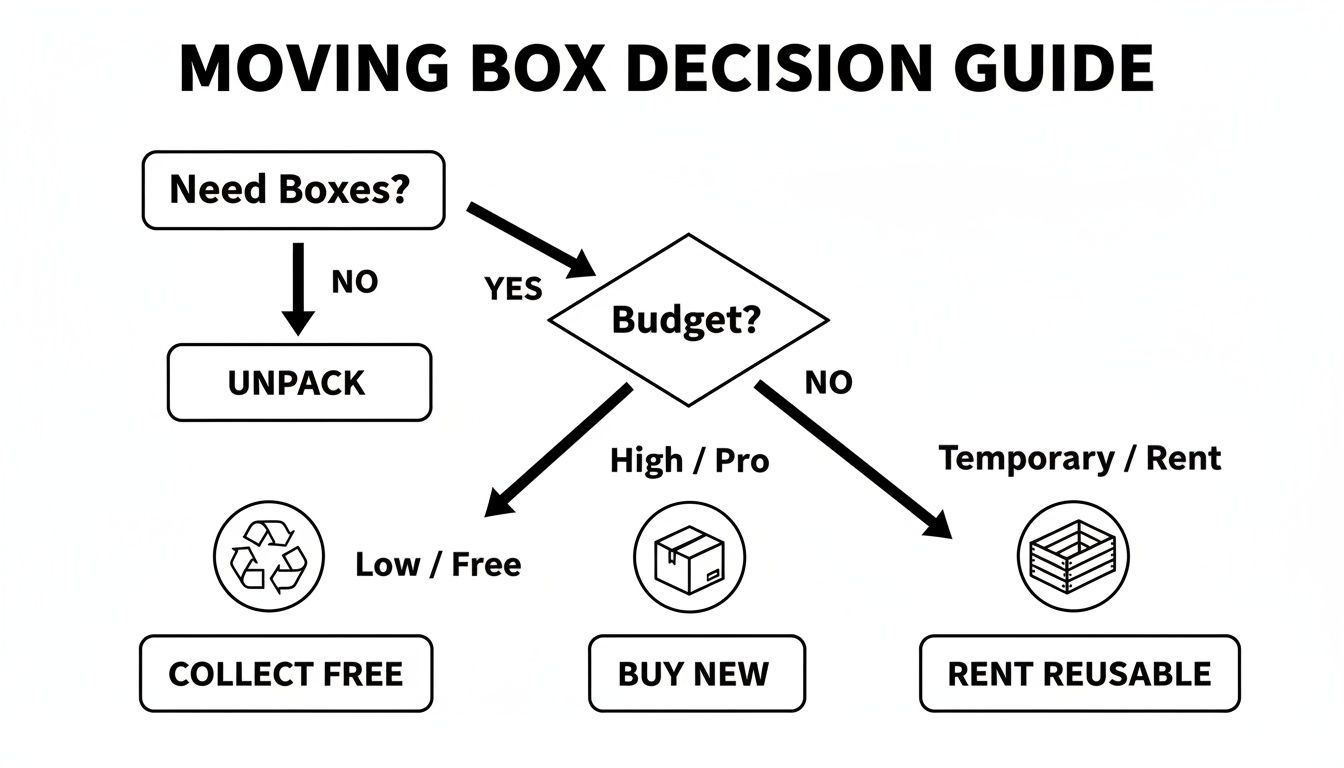
  • Prepare for Moving Day: On the day of the move, keep your pet in a secure, quiet room with their essentials to prevent them from getting underfoot or escaping.

Pro Tip: For interstate relocations, such as moving from Melbourne to Queensland or Western Australia, check the destination state’s government websites for any specific entry requirements, such as vaccination or quarantine rules. Preparing this documentation early prevents any delays at state borders.

8. Prepare Current Property for Handover and Final Inspection

The final step before closing the door on your old property is preparing it for handover and the final inspection. This crucial task on any move out checklist involves deep cleaning, completing minor repairs, and ensuring the property meets the agreed-upon conditions in your lease or sales contract. For renters, this is the key to securing a full bond return, while for sellers, it ensures a smooth settlement with the new owners.

Bright, empty room with wooden floors and white walls, featuring a clipboard and pen for final inspection.

Leaving the property in impeccable condition prevents disputes and potential damage claims. A meticulously executed handover reflects your care as a tenant or owner and finalises the moving process on a positive and professional note. This isn't just a courtesy; it's a contractual obligation that protects your financial interests and reputation.

How to Get Started

Aim to have the property completely empty before starting the final clean and repairs. This allows you to address every corner without obstruction and present the property in its best possible state for the formal inspection.

  • Schedule Professional Cleaning: Book a professional end-of-lease cleaning service for 1-2 days after your movers have cleared the property. Ensure they specialise in bond-back cleans, which typically cover ovens, carpets, and windows.
  • Complete Minor Repairs: Address small issues like patching nail holes, touching up paint scuffs, and tightening loose fixtures. These minor fixes demonstrate responsible care and prevent deductions from your bond.
  • Document Everything: Before handing over the keys, take a comprehensive set of photos and a video walkthrough of the empty, cleaned property. This visual evidence is invaluable if any disputes arise about the property's condition.
  • Review Your Lease Agreement: Re-read your lease to understand specific handover requirements. For renters, it's also wise to determine if your lease requires notarization for termination or other formal agreements with your landlord.

Pro Tip: Be present for the final inspection with your landlord or real estate agent. Walking through the property together allows you to address any potential issues on the spot and ensures everyone is in agreement before the bond is released or the sale is finalised. Keep copies of all cleaning receipts and inspection reports.

9. Arrange Secure Storage Solutions if Needed and Organise Furniture Assembly

Not every move is a straightforward A-to-B transition. Gaps between settlement dates, downsizing, or renovating can create a need for temporary storage, making this a critical item on any comprehensive move out checklist. Organising a secure place for your belongings provides flexibility and peace of mind, while pre-planning furniture disassembly and reassembly saves invaluable time and prevents damage on moving day.

Planning these logistics in advance is a strategic move that addresses common relocation headaches. For Get n Go Removals clients, integrating our storage solutions or furniture assembly services creates a seamless, all-in-one process. This is particularly beneficial for interstate moves from Melbourne, where items might need to be stored temporarily before the new home is ready, or for complex office relocations requiring professional handling of modular furniture.

How to Get Started

Begin coordinating storage and assembly services at least 3-4 weeks before your move. This ensures availability and allows for a smooth integration into your moving day schedule.

  • Assess Storage Needs Early: Determine precisely which items will go into storage and for how long. This will help you choose the right-sized unit and avoid paying for unused space.
  • Book a Secure Facility: Don't leave it to the last minute. Book a secure, accessible storage unit in advance. Consider climate-controlled options for sensitive items like electronics, artwork, or wooden furniture.
  • Schedule Furniture Services: Arrange for professional disassembly at your current home to ensure items are packed safely and efficiently in the truck. Concurrently, schedule reassembly at your new address to make settling in faster.
  • Create a Storage Inventory: Keep a detailed list or photo log of everything placed in your storage unit. This is vital for both insurance purposes and for easily locating items when you need them.

Pro Tip: When booking furniture services, be specific about complex items like antique wardrobes, pool tables, or multi-part workstations. Specialist items require specialist handling, and informing your removalist ensures they arrive with the right tools and expertise.

Proper planning of storage and furniture handling transforms potential moving day chaos into a well-organised operation. For a detailed breakdown of options and what to expect, you can learn more about Melbourne self-storage costs.

10. Plan Your Moving Day Logistics and Final Day Coordination

The success of your entire move hinges on the execution of the final day, making meticulous logistics planning a non-negotiable part of any comprehensive move out checklist. This step involves orchestrating the entire workflow for moving day itself, coordinating access, confirming timings with all parties, and ensuring a seamless transition. Effective final day coordination prevents costly delays, miscommunications, and the stress that comes from last-minute problem-solving.

A well-coordinated plan ensures that your professional movers, like the Get n Go Removals team, can operate at peak efficiency. For apartment moves in Melbourne, this means having lift access booked and ready. For house moves, it means clear parking and access paths. This level of organisation minimises downtime, protects your belongings, and helps you stick to a strict settlement or handover timeline.

How to Get Started

Begin finalising these details in the week leading up to your move, with a final confirmation call 24-48 hours beforehand. The goal is to create a clear, shared timeline for everyone involved.

  • Create a Detailed Timeline: Map out your moving day in 30-minute to one-hour increments. Include everything from the movers' arrival and the final walkthrough to the key handover and travel time.
  • Confirm with All Parties: Call your Get n Go Removals coordinator 24 hours prior to confirm the start time. Reconfirm the key exchange time with your real estate agent or landlord.
  • Arrange Property Access: For apartment buildings, book the service lift and loading bay well in advance. For houses, secure a dedicated parking spot for the moving truck, arranging a council permit if necessary.
  • Prepare for Payment: Ensure your chosen payment method is ready. If doing a bank transfer, double-check daily limits and have the correct account details on hand to avoid any delays upon completion.

Pro Tip: Designate one person as the primary point of contact for the moving crew on the day. This individual should brief the team on fragile items, specify the placement of key furniture at the new property, and be available to answer any questions, ensuring clear and efficient communication throughout the day.

A smooth moving day is the direct result of careful planning. By coordinating these final logistics, you ensure that the last step of your move out checklist is completed without a hitch.

10-Point Move-Out Checklist Comparison

Task 🔄 Complexity ⚡ Resource Requirements 📊 Expected Outcomes Ideal Use Cases ⭐ Key Advantages
Conduct a Home Inventory and Declutter Medium — room-by-room effort and decisions Low–Medium — time, storage space, apps/spreadsheets Reduced volume (≈20–40%), lower transport cost, faster unpacking Downsizing, cost-sensitive moves, long-distance relocations ⭐⭐⭐⭐ — lowers costs, creates insurance records, simplifies setup
Arrange Professional Moving Services and Confirm Booking Medium — vendor selection, quote comparison, scheduling High — moving fees, insurance, possible specialist handling Safe transport, reduced damage risk, guaranteed move date Interstate moves, heavy/special items, time-poor households ⭐⭐⭐⭐⭐ — expert handling, insurance coverage, efficiency
Notify Utilities and Service Providers of Disconnection Low — phone/email/online updates per provider Low — account details, time to call or submit forms Avoids service gaps, accurate final bills, smooth reconnection Every relocation (especially with strict reconnection timing) ⭐⭐⭐⭐ — prevents unexpected charges and service downtime
Update Address with Government Agencies and Financial Institutions Medium — multiple agencies and documentation Low — time, account info, possible fees Maintains legal compliance, secure mail, uninterrupted finances All moves; essential for legal/financial continuity ⭐⭐⭐⭐ — prevents fraud, ensures receipt of critical correspondence
Arrange Transfer of Medical and School Records Medium — consent, paperwork, potential fees Medium — time, authorisations, copies of records Continuity of care and education, fewer repeat tests Families with children, ongoing medical needs, interstate moves ⭐⭐⭐⭐ — preserves medical history and school placement continuity
Pack and Label All Boxes and Belongings Systematically High — extensive packing and organization High — packing materials, time, possible pro packers Reduced breakage, faster unpacking, easier inventory tracking Fragile/valuable moves, large households, long transit times ⭐⭐⭐⭐ — protects items and speeds settling-in
Arrange Pet Relocation and Update Pet Records Medium–High — health rules, microchip updates, transport Medium — vet fees, transport carriers, possible quarantine costs Safe pet transport, continued care, legal compliance for interstate moves Pet owners, interstate relocations, multi-pet households ⭐⭐⭐⭐ — ensures pet safety, continuity of care, updated ID
Prepare Current Property for Handover and Final Inspection Medium — cleaning, minor repairs, documentation Medium — cleaning/repair costs, time for touch-ups Higher chance of deposit return; smoother sale/handover Renters seeking bond return, sellers preparing final walkthrough ⭐⭐⭐⭐ — reduces disputes, improves sale/bond outcomes
Arrange Secure Storage Solutions & Organize Furniture Assembly Medium — assess needs, book units, schedule assembly Medium–High — storage fees, assembly labor, insurance Flexible timing, protected items, ready-to-install furniture Downsizing, settlement gaps, renovation or staging needs ⭐⭐⭐⭐ — provides flexibility and protects valuables
Plan Your Moving Day Logistics and Final Day Coordination High — many simultaneous details and contacts Medium — coordination time, possible fees for permits/lift bookings Minimized delays, coordinated handovers, clear accountability Settlement-day moves, apartment moves, complex multi-party moves ⭐⭐⭐⭐⭐ — prevents delays, ensures smooth, documented move

Ready for a Stress-Free Move? Let's Get Started!

Navigating the complexities of a move can feel overwhelming, but with the right strategy, it transforms from a stressful ordeal into a manageable project. This comprehensive move out checklist has been designed to serve as your roadmap, guiding you chronologically from the initial planning stages eight weeks out to the final moments after you’ve settled into your new space. We have broken down every critical task, from conducting a thorough home inventory and decluttering your life, to the meticulous process of packing, labelling, and arranging professional moving services.

The key to a successful relocation lies not just in doing the tasks, but in doing them at the right time. By addressing administrative duties like notifying utility providers and updating your address with government agencies well in advance, you prevent logistical headaches on moving day. Similarly, by systematically preparing your property for handover, arranging pet relocations, and planning for secure storage if needed, you create a buffer that absorbs unexpected challenges. This checklist isn't just a list; it's a strategic framework built to save you time, reduce stress, and protect your belongings.

Key Takeaways for a Seamless Transition

The most crucial lessons from this guide can be distilled into a few core principles. Proactive planning is paramount. Starting early allows you to secure the best movers, compare quotes without pressure, and declutter thoughtfully rather than frantically. Documentation is your best friend. From taking photos of your property's condition to keeping an inventory of your boxes, these records provide peace of mind and are invaluable in case of disputes.

Here are the most important actionable next steps to take right now:

  • Download and Print the Checklist: Make it tangible. Pin it to your fridge or keep it in a dedicated "moving binder" so you can physically tick off items as you complete them.
  • Book Your Movers: High-quality, reliable removalists, especially in busy areas like Melbourne, are often booked weeks or even months in advance. Securing your professional team should be one of your first concrete actions.
  • Start Small: Begin the decluttering process in a single, low-stakes area like a linen closet or a spare room. The momentum you build from this small win will make tackling larger areas feel much less daunting.

The True Value of a Meticulous Move Out Checklist

Mastering this process does more than just get your possessions from point A to point B. It ensures you meet all your legal and contractual obligations as a tenant or seller, safeguarding your bond or ensuring a smooth settlement. It minimises the risk of losing or damaging precious items and prevents the chaos of not knowing where essential items are when you arrive at your new home. Ultimately, a well-executed move provides a positive start to your next chapter, allowing you to focus on the excitement of a new beginning rather than the stress of a disorganised departure. By embracing a structured approach, you are not just moving house; you are orchestrating a smooth, efficient, and successful life transition.


When you're ready to put this checklist into action, partnering with the right team can make all the difference. For a truly seamless and worry-free experience, trust the experts at Get n Go Removals Melbourne. Our professional, police-checked team can handle every aspect of your move, from meticulous packing to secure transport and storage, ensuring your transition is as smooth as possible. Contact us today for a transparent, obligation-free quote and let us take the weight off your shoulders.

READ MORE

How to Move a Piano: A Comprehensive DIY Guide

Moving a piano is a significant undertaking that demands meticulous planning, specialised equipment, and considerable strength. It's a task where the risks of personal injury and costly damage to your instrument and property are exceptionally high. For the vast majority of people, especially when faced with a heavy upright piano or any type of grand piano, hiring professional piano movers is the safest and most logical choice.

However, if you're determined to tackle the challenge yourself, this comprehensive guide will walk you through the essential steps, techniques, and safety precautions required for a successful DIY piano move.

Deciding Between DIY and Professional Piano Movers

A person in a black hoodie and jeans measures a black upright piano with a yellow tape measure in a house entryway.

Before you enlist friends and family, it's crucial to understand what moving a piano truly entails. This is fundamentally different from moving a sofa or a heavy appliance. It is a complex, high-stakes procedure where your valuable instrument, your home, and your physical well-being are all at risk.

The decision to DIY or hire experts is a classic risk-versus-reward calculation. While the potential cost savings of a DIY move can be appealing, those savings can evaporate instantly if something goes wrong.

The True Weight of the Task

Pianos are not only extremely heavy but also incredibly delicate. Their weight is unevenly distributed, making them notoriously awkward and unpredictable to manoeuvre without proper training and equipment.

  • Upright Pianos: These common household instruments can weigh anywhere from a formidable 130 kg to an immense 375 kg.
  • Grand Pianos: Even a small "baby" grand piano typically starts around 250 kg, while concert grands can easily exceed 500 kg.

This immense weight, combined with fragile internal mechanics and a delicate polished finish, creates a high-stakes moving scenario. A single misstep on a staircase, a misjudged doorway, or a poorly secured strap can result in thousands of dollars in repairs to the piano, floors, or walls.

Assessing Your Home's Unique Challenges

Every property presents its own set of logistical hurdles. Before you begin, conduct a thorough walkthrough of the entire moving path, from the piano's current location to the moving truck.

  • Are there narrow hallways or tight 90-degree corners to navigate?
  • Will you need to manage flights of stairs, a common feature in many homes?
  • Is there a lift in your apartment building that requires advance booking and has weight limitations?

Each of these factors adds a layer of complexity that trained professionals are equipped to handle. Attempting to wrestle a 200kg instrument through these obstacles without experience is a recipe for disaster. This is where a significant advantage of hiring professionals becomes clear: the robust business insurance professional movers carry, which protects you from the financial consequences of any accidental damage.

A common misconception is that moving a piano is all about brute force. It’s not. It’s about balance, leverage, and precise coordination. Professional movers use specific techniques and specialised equipment to distribute the weight safely, protecting both the instrument and your property.

Moving a piano is a precision operation that demands real-world experience and a deep understanding of physics and logistics.

DIY vs Professional Piano Moving: A Quick Assessment

To help you make an informed decision, this table breaks down the key differences between the two approaches. Use it to weigh the critical factors and determine the safest method for your specific situation.

Factor DIY Approach (High Risk) Professional Service (Low Risk)
Safety & Injury Risk Extremely high. Risk of serious back, muscle, or crush injuries. Very low. Trained crew uses proper techniques and safety gear.
Equipment Requires renting or buying specialised dollies, straps, ramps, and pads. All necessary professional-grade equipment is provided.
Damage to Piano High risk of scratches, internal damage, or catastrophic drops. Minimal risk. Pianos are properly wrapped, secured, and handled.
Damage to Property High probability of damaged floors, walls, and door frames. Low risk. Movers use floor runners and protective padding.
Insurance Your standard home insurance likely won't cover damage from a DIY move. Fully insured. Covers damage to the piano and property.
Time & Effort Extremely time-consuming and physically draining. Fast and efficient. The team handles everything from start to finish.

Ultimately, hiring professionals is an investment in peace of mind.

While a DIY move might seem feasible for a small spinet piano on a ground floor with a straight path to the door, the risk escalates dramatically with every kilogram of weight and every corner you must turn. Our guide on choosing the right removals firm for your move can help you properly evaluate your options. For the vast majority of scenarios, the safety, efficiency, and security offered by a professional team provide value that far outweighs the cost.

Gathering Your Essential Moving Equipment

If you have evaluated the risks and are still confident in proceeding with a DIY move, your success hinges on having the right equipment. Attempting to move a piano without the proper tools is not just difficult; it is dangerous and invites disaster. For the safety of your piano, your home, and your moving team, using professional-grade equipment is non-negotiable.

This stage involves creating a protective cocoon around your piano. Before it moves a single inch, it must be thoroughly wrapped and secured for the journey. This is a systematic process of protecting every component.

The Foundation: Your Piano Dolly and Straps

The single most critical piece of equipment is a heavy-duty piano dolly (also known as a piano board or skid board). This is not the same as a standard furniture dolly. A proper piano dolly is a long, reinforced, carpeted platform specifically designed to handle the immense and unevenly distributed weight of a piano, which can range from 130 kg to over 375 kg. It provides a stable base, prevents tipping, and allows for controlled movement.

Equally important are the straps used to secure the piano to the dolly and, later, to the inside of the moving truck. Do not use simple ropes, which can stretch, slip, or snap under extreme tension. You must use weight-rated locking straps or ratchet straps. These allow you to winch the piano tightly to the dolly, creating a single, stable unit that won't shift during transit.

Protective Wrapping: The Layers of Defence

The polished finish is one of the piano's most vulnerable features. A minor scrape against a door frame can cause permanent, costly damage. Your primary defence is a set of thick, padded moving blankets.

Here is your checklist for wrapping and protection:

  • Padded Moving Blankets: You will need several thick, quilted blankets to cover every square inch of the piano's surface. Be generous—overlap them to ensure there are no exposed gaps.
  • Plastic Stretch Wrap: Once the blankets are in place, wrap the entire piano with plastic stretch wrap (industrial-strength cling film). This holds the blankets securely and prevents them from snagging or slipping.
  • Bubble Wrap and Tape: Use bubble wrap for extra padding on fragile parts, such as the legs and pedals. Secure it with packing tape, but ensure the tape never makes direct contact with the piano's wood finish, as it can strip the varnish.
  • Corner Protectors: Use specialised foam corner protectors or sturdy cardboard to shield the sharp corners, which are highly susceptible to impact.

Remember, the goal is to create a multi-layered shield. The blankets absorb shock, the stretch wrap provides stability, and the corner protectors defend against direct impacts. This is the same combination professionals use to guarantee a damage-free move.

Securing the Piano's Moving Parts

Before you begin wrapping, you must lock down all movable components of the piano. Forgetting to secure these parts is a common mistake that can lead to scratches or internal damage.

First, close and lock the keyboard lid to protect the delicate keys. If your piano lacks a lock, lower the lid and apply a long strip of low-adhesion painter's tape to keep it shut. Do not use strong packing tape for this purpose.

Next, address the pedals. Wrap them individually with bubble wrap or a small piece of blanket, then tape the wrapping securely. This prevents them from scratching the piano legs or becoming bent if the instrument needs to be tilted. By properly preparing the piano, you transform a fragile, unstable instrument into a secure, movable package, significantly increasing your chances of a successful move.

Mastering the Upright Piano Moving Technique

With the piano wrapped and your equipment ready, it's time for the most challenging phase. This is where brute force fails and smart technique prevails. Moving an upright piano is an exercise in careful coordination, where the top priority is protecting your team, your property, and the instrument.

Success depends on clear communication. Before lifting, walk the entire exit path with your team. Identify potential hazards such as tight corners, loose rugs, or uneven flooring. Ensure everyone understands their role and is prepared to communicate clearly and immediately.

The Tilt and Slide Manoeuvre

Your first major challenge is getting the piano onto the dolly. The goal is not to deadlift the entire instrument but to lift one side just enough to slide the dolly underneath—a classic leverage technique.

  • Position Your Team: You will need at least two people on one side of the piano and one or two on the other. Your strongest lifters should be on the side you intend to tilt upward.
  • Coordinate the Lift: On a clear count of "one, two, three," the lifting team should bend at the knees (never the back) and lift one end of the piano just a few centimetres off the ground.
  • Slide the Dolly: A fourth person should immediately slide the heavy-duty dolly under the centre of the piano, aiming for the balance point to ensure stability.
  • Lower with Control: On another coordinated count, the team should slowly and smoothly lower the piano onto the dolly, avoiding any sudden jolts.

Once the piano is on the dolly, secure it immediately with your weight-rated straps. This makes the piano and dolly a single, stable unit, which is crucial for maintaining control.

The most common mistake in DIY piano moves is attempting to lift the entire instrument at once. This is incredibly dangerous and a primary cause of back injuries. The 'tilt and slide' method uses simple physics to make the process safer and more manageable.

This technique is a perfect illustration of how proper methodology is superior to raw power. For more tips on handling bulky items, see our comprehensive guide on how to move heavy furniture safely and efficiently.

Navigating Tight Spaces and Corners

With the piano secured on the dolly, all movements should be smooth and deliberate. Rushing is your worst enemy. Approach every turn slowly, with one person guiding from the front and another steering from the rear.

It is crucial to keep the piano as upright as possible. Tilting it too far can damage the delicate internal mechanisms, known as the 'action'. Small, careful adjustments are the key to navigating tricky 90-degree corners without damaging your walls or door frames.

This quick visual guide illustrates the essential preparation steps.

A three-step diagram illustrating the piano preparation process: secure lid, wrap corners, and strap shut.

Following this sequence—securing the lid, wrapping the corners, and strapping it shut—transforms a fragile instrument into a protected package ready for transport.

Conquering the Stairs One Step at a Time

Stairs represent the most dangerous part of any piano move. This is where the risk of injury and damage increases exponentially and where professional experience is most valuable. If you proceed with a DIY approach, extreme caution is mandatory.

The 'one step at a time' method is the only safe way to navigate stairs.

  1. Team Positioning is Crucial: You need at least two strong people positioned below the piano to bear the weight and control the descent. Have one or two people above to guide it and act as a brake.
  2. A Dedicated Spotter: An additional person should act solely as a spotter. Their job is to observe the entire operation, provide clear instructions, and identify potential problems before they occur. The spotter should never attempt to lift.
  3. Use a Ramp (If Possible): If feasible, lay a sturdy moving ramp over the steps to create a smooth, inclined plane. If not, you must tackle each stair individually.
  4. Controlled Descent: The team at the bottom braces while the team at the top slowly pushes the piano forward until the dolly's wheels reach the edge of the step. Then, carefully lower it to the next step.
  5. Communicate Constantly: Continuous communication is essential. Use simple, clear commands like "Ready," "Lowering," "Stop," and "Clear" to keep the team perfectly synchronised.

Moving a piano down stairs is a slow, methodical process that demands significant strength and coordination. Treat each step as a distinct phase of the operation. Rushing can lead to a loss of control with devastating consequences for both the piano and, more importantly, your team.

Loading and Securing Your Piano for Transport

Two men carefully secure a large wooden piano with a yellow strap inside a moving truck.

You have successfully navigated the piano through your home. Now, one of the most critical and often overlooked stages remains: loading the instrument onto the moving truck and securing it for transport. A mistake at this stage can undo all your careful preparation.

The primary goal is to control momentum. Sudden stops or bumpy roads can exert immense forces on an improperly secured piano.

Safely Navigating the Loading Ramp

The loading ramp is a steep incline where gravity works against you. Your objective is to move the piano up the ramp with slow, steady control, eliminating any risk of it rolling back. A common mistake is trying to push the piano up the ramp from below.

Here is the professional team positioning:

  • The Pushers: At least two people should be at the bottom of the piano (the side closest to the ground) to provide the primary pushing force.
  • The Guides: One or two people should be at the front of the piano, walking backwards up the ramp. Their role is to steer and act as a crucial brake.

The entire movement must be coordinated and smooth. If you need to stop, the guides at the front must be prepared to brace the piano instantly. Constant communication is paramount.

Optimal Placement Inside the Truck

Once inside the truck, the piano's placement is vital. The safest location is against the front wall of the truck, known as the 'bulkhead'.

This placement serves two critical functions. First, it prevents the piano from lunging forward during sudden braking. Second, it provides a solid, flat surface to secure it against, which minimises side-to-side movement. The back of the piano should be flush against this front wall.

Securing the piano against the bulkhead is a non-negotiable rule for professional movers. It is the most stable point in the truck and dramatically reduces the risk of damage from road vibrations and inertia.

This simple placement choice is one of the most effective measures you can take to protect your piano during transit.

Using Ratchet Straps for a Secure Hold

Now, lock the piano down. You will need at least two heavy-duty ratchet straps. Flimsy bungee cords or rope are entirely inadequate. You will secure the piano to the sturdy wooden or metal slats that line the interior walls of a proper moving truck.

Follow this strapping procedure:

  1. Strap It Horizontally: Run the first strap across the front of the piano, about two-thirds of the way up. Thread it through the truck's side slats and tighten the ratchet until the piano is firmly pinned against the front wall.
  2. Add a Brace: Use the second strap to create a diagonal brace, forming an 'X' pattern if possible. This counteracts the bouncing motion caused by bumps in the road.
  3. The Wobble Test: Once strapped in, give the piano a firm push from the side. It should feel completely solid, as if it were part of the truck. If there is any movement, rocking, or wobbling, you must tighten the straps further.

Properly securing the piano is as crucial as wrapping it. The delicate internal parts are highly vulnerable to damage from constant vibration. A solid, secure hold is your best defence. Approach this task with the same diligence you would use for how to pack fragile items for moving.

Why Melbourne Locals Choose Get n Go Removals

After reviewing the immense effort, risk, and specialised equipment required for a piano move, it becomes clear why most people entrust this task to professionals. It's not merely about avoiding heavy lifting; it's about ensuring a valuable and often sentimental instrument is transported safely and without damage.

For residents of Melbourne, choosing a professional mover like Get n Go Removals offers more than just convenience—it provides peace of mind. You are handing over your piano to a team that understands the high stakes, transforming a risky endeavour into a guaranteed safe delivery.

Expertise Backed by a Decade of Experience

Melbourne's diverse architecture presents unique challenges, from the tight laneways of Fitzroy to the high-rise apartments of the CBD and the narrow staircases of heritage homes. Each move requires a tailored strategy.

With over 10 years of hands-on experience across Melbourne, our team has encountered and successfully managed nearly every possible scenario. This expertise goes beyond owning the right equipment; it’s about having the right strategy. Our movers know how to pivot a baby grand around a tight corner or safely hoist an upright over a balcony when necessary. This practical knowledge is gained only through years of dedicated work.

Furthermore, you can have complete confidence in the team entering your home. All our staff are full-time, police-checked employees, not temporary labourers. You get a cohesive crew that works together daily, ensuring a smooth and professional operation.

Specialised Equipment for a Specialised Job

A piano cannot be moved safely without the right tools. We operate our own company-owned fleet of well-maintained vehicles, ranging from 4.5 to 12 tonnes, all equipped with hydraulic lifts for safe and efficient loading.

Our specialised piano moving equipment includes:

  • Piano Trolleys and Skid Boards: These are custom-built to distribute the piano's weight evenly, protecting its structure and allowing for precise manoeuvring.
  • Heavy-Duty Ramps and Straps: All our equipment is weight-rated to secure the piano properly, both on the dolly and inside the truck, eliminating any shifting during transit.
  • Thick Padded Blankets and Protective Wraps: We meticulously wrap every piano to shield its finish from bumps, scratches, and Melbourne’s unpredictable weather.

By investing in professional-grade equipment, we remove all guesswork and risk from the process. Our tools are specifically designed to protect your instrument and your property, ensuring a damage-free move.

A Commitment to Stress-Free Service

We understand that moving is a significant life event. Our entire service is designed to be as smooth and stress-free as possible. This commitment is reflected in the hundreds of five-star reviews from satisfied customers across Melbourne, who consistently praise our punctuality, care, and professionalism.

This reliability extends to our comprehensive insurance coverage. While we take every precaution, you can relax knowing your move is fully protected by both Public Liability and Transit Insurance. This is a critical advantage over a DIY move, where you bear all financial risk. We are proud to be the trusted piano movers Melbourne locals rely on for their most precious belongings.

From the initial transparent quote to the final placement of your piano in its new home, we deliver a seamless experience built on trust and a proven track record.

Common Questions About Moving a Piano

Even with a detailed plan, questions can arise during a piano move. Having accurate answers can make the difference between a stressful day and a successful relocation. Here are some of the most common questions our Melbourne clients ask, with expert answers to provide clarity and confidence.

Does Moving a Piano Put It Out of Tune?

Yes, almost certainly. You should always plan to have your piano tuned after a move. While road vibrations play a role, the primary cause is the change in temperature and humidity between the old and new locations. These atmospheric changes cause the piano's wooden soundboard to expand or contract, which alters the tension of the strings.

Best practice is to allow the instrument to acclimate to its new environment. Wait two to four weeks before calling a professional piano tuner. This period allows the internal components to settle, ensuring that the new tuning will hold.

How Many People Does It Take to Move a Piano?

The number of people required depends on the piano's size and the moving path, but it is never a one or two-person job.

  • Upright Pianos: For a standard upright, a minimum of three to four strong, experienced individuals is recommended, especially if stairs or tight corners are involved.
  • Grand Pianos: Moving a grand piano should only be attempted by a professional crew. It typically requires four to six movers with the proper equipment, including a specialised grand board (piano skid).

It is crucial to remember that technique is more important than brute strength. A professional crew understands leverage, balance, and coordination, allowing them to move the instrument in a way that is nearly impossible for an amateur team to replicate safely.

The piano is just one piece of a larger puzzle. To manage the entire relocation process effectively, consider using an ultimate residential moving checklist.

What Is the Cost to Move a Piano in Melbourne?

The cost of a professional piano move in Melbourne can vary based on several factors: the type and size of the piano, the distance of the move, and any access challenges such as stairs, narrow hallways, or the need for a crane lift.

As a general guideline, a straightforward local move for an upright piano in the Melbourne area typically starts from around $300. For a more detailed breakdown of pricing, please see our guide on the piano removal cost. The most accurate way to determine the cost is to request a specific quote for your move.

Can I Store My Piano During a Move?

Yes, and it is often a wise decision, especially if there is a gap between moving out of your old home and into your new one. Professional movers offer secure, climate-controlled storage facilities specifically designed for delicate items like pianos.

These facilities are far superior to standard self-storage units, where fluctuations in temperature and humidity can cause serious, sometimes irreversible, damage to a piano's wood, felt, and internal mechanics. Whether you need storage for a few weeks or several months, professional storage ensures your instrument remains in a stable and protected environment.


When you need a team that combines years of local Melbourne experience, specialised equipment, and a genuine commitment to five-star service, trust Get n Go Removals. We will ensure your cherished instrument arrives safely, allowing you to focus on settling into your new home. Get your free quote today

READ MORE