A Comprehensive Guide to Moving Company Costs in Australia
Planning a move and trying to figure out the budget? You're not alone. Understanding the potential moving company cost is the first step in any successful relocation. In Australia, a local move within the same city typically falls between $470 and $1,350. For an interstate move, the costs are substantially higher, usually starting from $2,600 and increasing based on the distance and volume of your belongings.
But these numbers are just the beginning. To truly grasp what you'll pay, you need to understand the factors that shape your final quote. This guide will break down every element, from local hourly rates to the complexities of long-distance pricing, ensuring you can budget with confidence.
Your Quick Guide to Moving Costs in Australia
Grasping the potential costs of professional movers is essential for a smooth, stress-free relocation. The figures mentioned are a solid starting point, but your final quote will be tailored to your unique circumstances. The moving industry operates much like the travel sector; the final price depends on your destination, how much you're taking, and even the time of year.
Several key factors will influence your final moving cost:
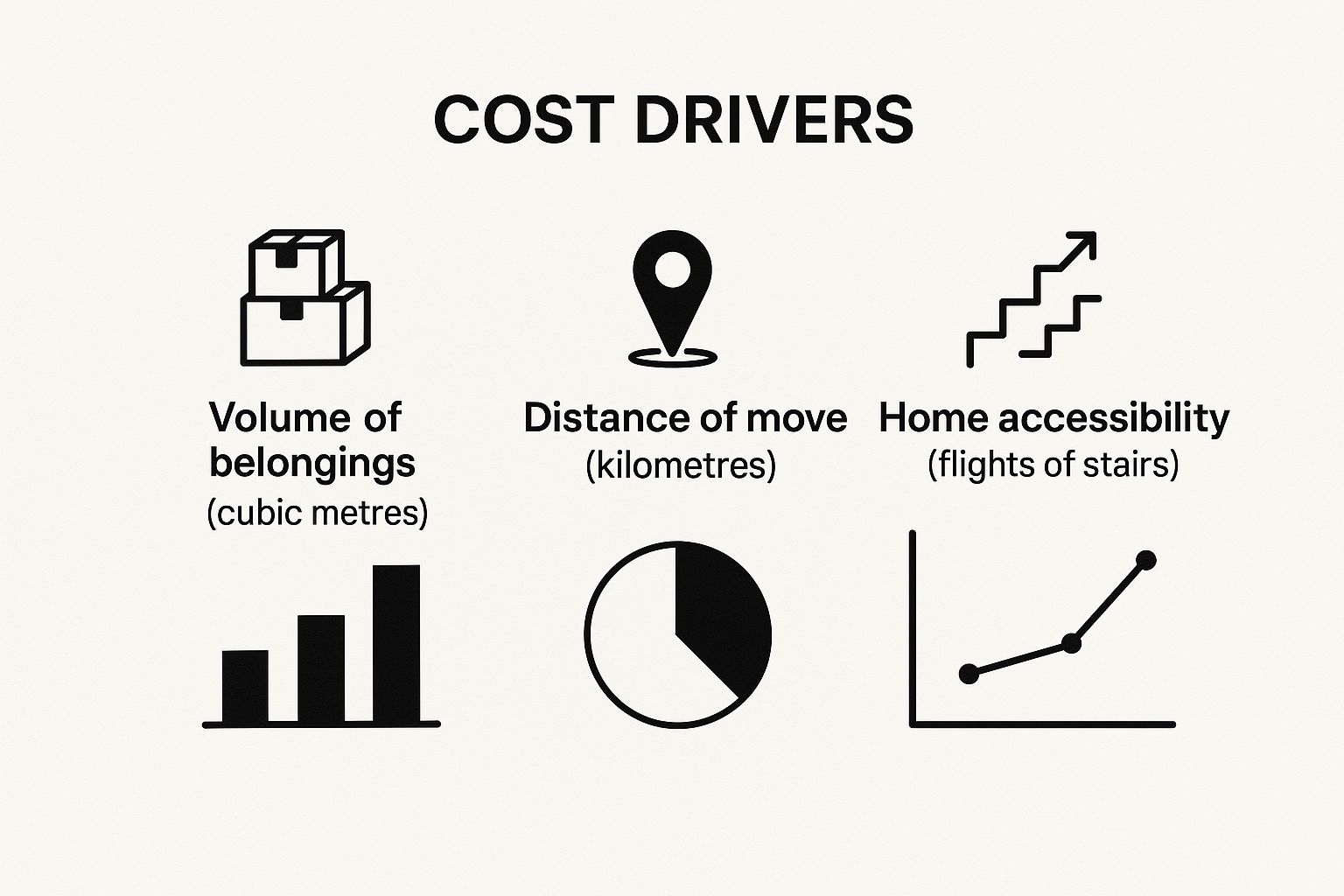
- Volume of Belongings: This is measured in cubic metres (m³) and is a primary cost driver.
- Travel Distance: The kilometres between your old and new home directly impact fuel and labour costs.
- Property Access: Difficult access, such as multiple flights of stairs, long driveways, or poor parking, can increase the time and effort required.
- Timing of Your Move: Moving during peak seasons like summer, weekends, or school holidays often comes at a premium.
Average Local Moving Costs
The cost of living and operating a business varies significantly between Australian cities, and this is reflected in moving prices. A local move in Melbourne or Brisbane might range from $470 to $850, while the same-sized move in Sydney or Adelaide could cost up to $1,350 and $1,250, respectively.
To provide a clearer picture, here is a breakdown of what you might expect to pay for a local move in some of Australia's major cities.
Average Local Moving Costs in Major Australian Cities
This table outlines the typical cost ranges for a standard local move, helping you set a preliminary budget.
| City | Average Cost Range |
|---|---|
| Melbourne | $470 – $850 |
| Sydney | $550 – $1,350 |
| Brisbane | $470 – $850 |
| Perth | $500 – $1,000 |
| Adelaide | $550 – $1,250 |
Remember, these figures are intended as a guide.
The only way to get a truly accurate number is to get a detailed quote that’s built around your specific move.
With these initial estimates, you can start building a realistic budget. To understand exactly how a professional quote is structured, take a look at our detailed moving company pricing structure. This is the best next step toward managing your moving expenses effectively.
Decoding Your Removalist Quote
Receiving a quote from a removalist can feel like deciphering a new language, with terms like "cubic metres" and "access fees" determining your final bill. Understanding this terminology is key to confidently evaluating any quote.
Think of the volume of your items as the luggage for your move. More belongings require a larger truck and more time, directly impacting the price. A small one-bedroom apartment might occupy 10-15 cubic metres (m³), whereas a large four-bedroom house could easily exceed 40m³.
The most effective way to estimate your volume is by creating a detailed inventory list. For a more precise calculation, using a storage calculator can be invaluable in understanding the space you need and the associated costs.
What Drives the Price Up or Down?
Beyond the volume of your possessions, several other factors will shape your final quote. The distance between properties is a significant element, especially for interstate moves where fuel and extended labour hours become major cost components.
Accessibility is another critical factor. If the moving team must navigate multiple flights of stairs, contend with a slow elevator, or park the truck a considerable distance from your entrance, it adds significant time and labour. This extra work is typically itemised on the quote as an access fee.
This infographic neatly summarises the three main pillars that influence your moving company cost.
Local Moves Versus Interstate Relocations

There is a vast difference between moving across town and relocating to another state, and the cost structure reflects this complexity. While both types of moves involve packing and transport, their pricing models are fundamentally different.
Understanding this distinction is the first step toward creating an accurate moving budget. A local move is often priced like a taxi service—you pay primarily for the time it takes. An interstate move, however, is more akin to shipping freight, where distance and volume are the dominant cost factors.
How Local Moving Costs Are Calculated
For local moves, the cost is almost always based on an hourly rate. This rate typically includes the movers' labour, the truck, and essential equipment like dollies and blankets. This transparent system is ideal for shorter distances where the primary task is loading and unloading.
Most companies also enforce a minimum call-out fee, which usually covers the first two to three hours of work. This ensures that even the smallest jobs are commercially viable. Therefore, if your move is completed in 90 minutes, you will likely still be billed for the two-hour minimum.
The Formula For Interstate Moving Costs
Interstate relocations operate on a different pricing model. An hourly rate is impractical for a journey spanning several days. Instead, the cost is derived from a complex calculation that accounts for the significant logistical undertaking.
The primary components of this pricing formula are:
- Cubic Metres (m³): The total volume of your belongings is the most significant factor, determining how much space they occupy on the truck.
- Distance: The kilometres between your old and new homes directly influence fuel consumption, driver wages, and transit time.
- Route Popularity: A frequently travelled route, such as Melbourne to Sydney, is often more cost-effective than a move to a remote area off the main transport corridors.
To put this into perspective, let's examine how these factors affect real-world pricing.
Cost Breakdown: Local vs. Interstate Moves
This table provides a clear, at-a-glance comparison of what you are paying for in each type of move.
| Factor | Local Move (Within City) | Interstate Move (Between States) |
|---|---|---|
| Primary Cost Driver | Time (Hourly Rate) | Volume (m³) and Distance (km) |
| Typical Price Range | $350 – $2,500 | $2,600 – $10,000+ |
| Minimum Charges | 2-3 hour minimum call-out fee | Based on a minimum volume of goods |
| Fuel Surcharge | Often included in the hourly rate | Calculated separately, based on distance |
| Additional Fees | Extra for difficult access (stairs, lifts) | Can include route-specific surcharges |
As illustrated, an interstate move is not merely a larger local move; it is a complex logistical operation. The pricing must account for large-scale transportation over vast distances, not just a few hours of labour.
The cost of moving across state lines has risen in line with fuel prices and the detailed planning involved. Relocating a typical three-bedroom house can cost between $2,600 and $5,850, with larger or more distant moves potentially exceeding $10,000. The final figure is always tied to the journey; a long-haul move over 1,500 km can easily surpass the $8,700 mark.
A long-distance move has many components. To help you stay organised, our comprehensive guide for long distance relocation offers practical tips to simplify the process.
Uncovering the Hidden Costs of Moving
The initial quote from a removalist is an excellent starting point, but it may not represent the final amount on your invoice. A successful move is one that stays within budget, which requires looking beyond the base rate to understand potential additional charges.
These are not "hidden" fees in a deceptive sense; they are conditional costs for services that fall outside a standard move. A typical quote assumes a ground-floor home with easy street access. If your property is on the fifth floor without a lift, or if the truck must park 50 metres away, the additional time and effort will incur fees for difficult access.
Awareness of these potential extras from the outset prevents unwelcome surprises on moving day.
Common Extra Charges to Watch For
Several factors can add to your final bill. Specialised items are a primary example. Moving a grand piano or a slate pool table requires unique skills, specialised equipment, and additional labour, all of which come at a premium. Similarly, services like disassembling and reassembling furniture or disconnecting appliances may be billed as add-ons. It is always wise to clarify what is included in the base price.
Here is a quick summary of common extra costs:
- Packing Materials: Unless you have opted for a full packing service, you will need to purchase your own boxes, tape, and protective wrap.
- Specialty Items: Pianos, pool tables, large artworks, and heavy gym equipment almost always incur a special handling fee.
- Furniture Disassembly/Reassembly: If you need large items taken apart and put back together, confirm if this service is an additional charge.
- Long Carry Fees: A charge may apply if the truck is parked a significant distance from your entrance, compensating for the extra labour involved.
- Stair Fees: Navigating multiple flights of stairs often results in an additional charge, sometimes calculated per flight, due to the increased time and physical exertion.
The key is to have a completely open chat with your moving company before you book. A good, reputable mover will be upfront about all potential charges, which helps you create a budget you can actually stick to. To really get into the details, you can learn more about the common hidden costs when moving house and how to sidestep them.
Moving Insurance and Other Expenses
Moving insurance is another critical consideration. While professional movers carry their own insurance, the standard carrier liability included is often minimal and may only cover a small fraction of an item's replacement value. For complete peace of mind, it is highly recommended to inquire about upgrading to comprehensive moving insurance.
Finally, remember the costs unrelated to the removalist's quote. If you are renting, the end-of-lease clean is a significant expense that is often underestimated. Following a quality end of lease cleaning guide can be the difference between receiving your full bond back or forfeiting a portion of it.
How to Dramatically Reduce Your Moving Costs

Now that you understand the components of a moving quote, it's time to take control of the final price. Reducing your moving company costs is about strategic and proactive planning. A few smart decisions can make a significant impact on your final bill without compromising on service quality.
The simplest way to save money is to move less stuff. Before you begin packing, conduct a thorough decluttering. Every item you sell, donate, or discard is one less item for the removalists to handle. This directly reduces both the volume of your move (a key factor in interstate pricing) and the time required (the basis for local pricing), putting more money back in your pocket.
Smart Strategies for a Cheaper Move
Beyond decluttering, several other tactics can lower your expenses. Consider the timing of your move, how you source packing materials, and how much of the labour you are willing to undertake yourself.
A few proven strategies include:
- Book a Mid-Week Move: Weekends are the peak period for movers, and this high demand typically translates to higher rates. If your schedule allows, booking your move on a Tuesday or Wednesday can often secure a more favourable hourly rate.
- Source Free Packing Materials: Instead of purchasing new boxes, explore alternatives. Check local community groups online or ask at supermarkets and liquor stores. Many businesses are happy to give away sturdy boxes they would otherwise recycle.
- Do Your Own Packing: While professional packing services offer immense convenience, they add a significant cost. Packing your own belongings is one of the most effective ways to reduce your overall quote.
Your moving date can have a surprisingly big impact on the cost. Try to aim for the middle of the month and steer clear of school holidays if you can. These are typically the quietest—and therefore cheapest—periods for removalists.
The Power of Multiple Quotes
Never accept the first quote you receive. It is best practice to obtain at least three detailed, written quotes from reputable moving companies. This not only helps you find the most competitive price but also provides a clear understanding of the market rate and gives you leverage for negotiation.
When comparing quotes, ensure you are making an "apples-with-apples" comparison. A suspiciously low quote may exclude essential services, lack adequate insurance, or contain hidden fees. Being well-informed is your best defence against overpaying. For more practical advice, explore these additional tips to keep your moving costs down, which offer a deeper dive into budgeting for your move.
Your Moving Cost Questions, Answered
Navigating the final cost of a move can be challenging. To provide clarity, we have compiled answers to some of the most common questions from our customers. This information should help you finalise your budget and proceed with confidence.
Is It Cheaper to Move on a Weekday?
Yes, in almost all cases. Weekends are the peak season for removalists, much like for holiday bookings. This high demand usually results in higher rates. If your schedule permits, booking your move between Monday and Thursday is one of the simplest and most effective ways to reduce your final bill.
Should I Tip My Movers in Australia?
Tipping is not a standard expectation in Australia. Unlike in some other countries, tipping culture is not widespread here, and your moving crew will not be anticipating a gratuity. However, if the team has delivered exceptional service and you wish to show your appreciation, a tip is always a welcome gesture. A positive online review or a direct thank you is equally valuable to the crew and the company.
How Can I Get the Most Accurate Moving Quote?
The secret to a reliable quote is providing complete and honest details. The accuracy of an estimate depends entirely on the quality of the information you provide. Give the moving company a comprehensive inventory of your belongings. Do not omit challenging items like a heavy piano, a bulky treadmill, or an antique wardrobe. It is also crucial to disclose any access issues at both properties, such as difficult stairs, a long driveway, or restricted parking. The more information the mover has upfront, the lower the risk of unexpected charges on your final invoice.
The best quotes come from total transparency. A professional mover will grill you for details, not to be difficult, but to make sure their estimate is spot-on. It protects you from unexpected costs when moving day finally rolls around.
Ready to get a clear, no-surprise quote for your upcoming move? The team at Get n Go Removals Melbourne provides transparent pricing and expert service for a stress-free relocation. Plan your move with confidence by visiting us at https://www.getngoremovals.com.au today.