
Your Ultimate House Moving Checklist for Australia: A Stress-Free Guide

Relocating can feel like a monumental task, but with a strategic plan, it transforms from overwhelming to organised. This comprehensive house moving checklist for Australia is your step-by-step guide to a seamless transition, designed to take the guesswork and stress out of your move. Forget the last-minute panic; we've broken down every crucial task into a clear, actionable timeline, covering everything from eight weeks out right through to settling into your new home.

This isn't just another generic list. We dive deep into the specifics that matter for an Australian move. You will learn precisely how to notify government bodies like the ATO and AEC, organise professional removalists or a DIY truck rental, and arrange essential services like postal redirection with Australia Post. Our guide covers creating a detailed inventory, labelling boxes like a pro, and managing the disconnection and reconnection of utilities to avoid any service gaps.

We'll walk you through updating your details with banks, superannuation funds, and subscription services, ensuring nothing important gets left behind. Whether you're moving across the street in Melbourne, relocating interstate to Sydney, or require specialised services for delicate items, consider this your ultimate roadmap to a flawlessly executed move. While our guide is tailored for Australia, for additional comprehensive guidance on planning a smooth transition, you might also find this article on Your Ultimate Moving House Checklist helpful. Let's get started on making your next move your best one yet.

1. Notify Government and Official Bodies

Long before the first box is packed, one of the most critical administrative tasks in your house moving checklist Australia is updating your address with various government and official bodies. Failing to do so can lead to missed correspondence, lapsed registrations, and potential legal or financial complications. This process ensures your legal identity, tax records, and voting enrolment are all seamlessly transferred to your new address.

Why It's a Priority

Your residential address is tied to numerous essential services and legal obligations. Forgetting to update it can have significant consequences. For instance, your driver's licence could become invalid, you might miss important tax documents from the Australian Taxation Office (ATO), or you could be removed from the electoral roll, forfeiting your right to vote in local, state, and federal elections.

Key Insight: Proactively managing these updates prevents a cascade of administrative headaches post-move. It's not just about receiving mail; it's about maintaining your legal and civic standing without interruption.

Who to Notify

Create a master list of all the agencies that need your new details. This typically includes:

  • Australian Taxation Office (ATO): Crucial for all your tax-related matters.
  • Australian Electoral Commission (AEC): To ensure you can vote in future elections.
  • Services Australia: For Centrelink, Medicare, and Child Support services.
  • State/Territory Transport Authority: Such as VicRoads or Transport for NSW, to update your driver's licence and vehicle registration.
  • State/Territory Land Titles Office: If you have bought or sold property.

Actionable Tips for a Smooth Update

To streamline this process, use a systematic approach. Begin collating necessary documents like proof of identity and your new address (e.g., a lease agreement or utility bill) at least six weeks before your move. Use online portals where available, as they are often the fastest way to make changes. Keep a record of when you submitted each change and request a confirmation receipt. For a more detailed breakdown, you can find a comprehensive moving house address change checklist to help you stay organised.

2. Update Financial and Banking Information

Alongside official government notifications, securing your financial identity is a paramount task on your house moving checklist Australia. You must inform every bank, credit card company, insurance provider, and superannuation fund of your new address. Overlooking this step can result in sensitive documents being sent to your old home, delays in detecting fraudulent activity, and a potential breakdown in essential financial services when you need them most.

Why It's a Priority

Your address is a primary security verification tool for most financial institutions. An outdated address can lead to missed statements, which not only contain sensitive information but are also key for tracking your finances. More critically, it can compromise your insurance policies; for example, your home and contents or car insurance premiums are directly tied to your residential address, and an incorrect one could void your cover in the event of a claim.

Key Insight: Updating your financial details is a crucial security measure. It ensures uninterrupted service, maintains the validity of your insurance policies, and protects you from potential identity theft or fraud linked to mail delivered to a previous address.

Who to Notify

Compile a comprehensive list of every financial entity you have a relationship with. This audit should include:

  • Banks and Credit Unions: Such as Commonwealth Bank, NAB, Westpac, and ANZ.
  • Credit Card Providers: Including American Express, Citibank, and any store-specific cards.
  • Insurance Companies: For home, contents, car, life, and health insurance (e.g., AAMI, Bupa, Medibank).
  • Superannuation Funds: To ensure you receive your annual statements and other important retirement updates.
  • Investment and Share Trading Platforms: Like CommSec or SelfWealth.
  • Buy Now, Pay Later Services: Such as Afterpay or Zip Pay.

Actionable Tips for a Smooth Update

Systematically work through your list about four to six weeks before your moving day. Utilise online banking portals or mobile apps for immediate updates, as they often provide instant confirmation. For insurance, notify providers of your move-in date as soon as it is confirmed, as your premium and coverage may change. Set a calendar reminder to follow up on any updates that aren't confirmed within a week and request a new statement be sent to your new address to verify the change has been processed correctly.

3. Organise Professional Movers or Arrange Transport

Securing your transport is a cornerstone of any successful move and a pivotal item on your house moving checklist Australia. Whether you opt for a full-service professional removalist or decide on a DIY truck rental, booking this element well in advance is essential. This step involves researching reputable companies, comparing detailed quotes, and locking in your dates to avoid last-minute stress and exorbitant costs, particularly during peak moving seasons.

Professional movers loading cardboard boxes onto a white moving truck in front of a house.

Why It's a Priority

The availability of quality removalists is finite, especially during summer and on weekends. Leaving this booking to the last minute can result in being forced to choose from less reputable or significantly more expensive options, or worse, finding no one is available at all. Early booking not only guarantees your preferred moving date but also gives you adequate time to vet companies, check for proper insurance, and understand all associated costs, preventing surprise fees.

Key Insight: Booking your movers 4-8 weeks in advance is not just a recommendation; it's a strategic move that provides peace of mind, budget control, and access to higher quality, reliable services.

Who to Notify

Once you have booked your movers, your primary communication will be with them. However, you also need to coordinate with:

  • Building/Strata Management: To book lifts, loading docks, or secure dedicated parking for the moving truck.
  • Local Council: In some areas of Australia, you may need a permit to park a large moving truck on the street.
  • Neighbours: A quick courtesy notice can prevent access issues and maintain good relations.
  • Your own schedule: Block out the entire day for the move and inform your workplace if you need to take time off.

Actionable Tips for a Smooth Update

To ensure a seamless moving day, obtain at least three written quotes based on an identical inventory of your belongings. Always verify a mover’s credentials, such as their Australian Furniture Removers Association (AFRA) membership, which ensures they meet industry standards for equipment and training. When organising transport, remember to account for all family members, including pets. Consult a comprehensive guide on how to travel with pets to ensure their journey is safe and stress-free. For a deeper dive into selecting the right team for your needs, you can find more information about professional movers and packers.

4. Create a Detailed Inventory and Labeling System

Beyond simply packing boxes, implementing a systematic inventory and labelling process is a cornerstone of an organised move. This method involves cataloguing your belongings and creating a clear, easy-to-understand system to track each box from your old home to your new one. A robust inventory is your best defence against lost items, damaged goods, and the overwhelming chaos of unpacking.

Why It's a Priority

Moving house is a complex logistical exercise, and without a proper tracking system, valuable or sentimental items can easily go astray. A detailed inventory provides a comprehensive record of your possessions, which is invaluable for insurance purposes if something is damaged or lost in transit. Furthermore, a clear labelling system dramatically simplifies the unpacking process, allowing you and your removalists to place boxes in their correct rooms immediately, saving hours of effort.

Key Insight: This isn't just about putting names on boxes; it's about creating a personal logistics system that provides control, accountability, and peace of mind throughout the entire moving journey.

Who to Notify

While this step doesn't involve notifying external bodies, it's about creating a master list for yourself and your moving company. A shared inventory ensures everyone is on the same page. Your master list should include:

  • Box Number: A unique identifier for each box (e.g., KITCHEN-01).
  • Designated Room: The room where the box should be placed in the new house.
  • Contents Summary: A brief description of what’s inside.
  • Condition Notes: Especially for high-value items like electronics or artwork.
  • Fragile Status: Clearly mark any boxes requiring special handling.

Actionable Tips for a Smooth Update

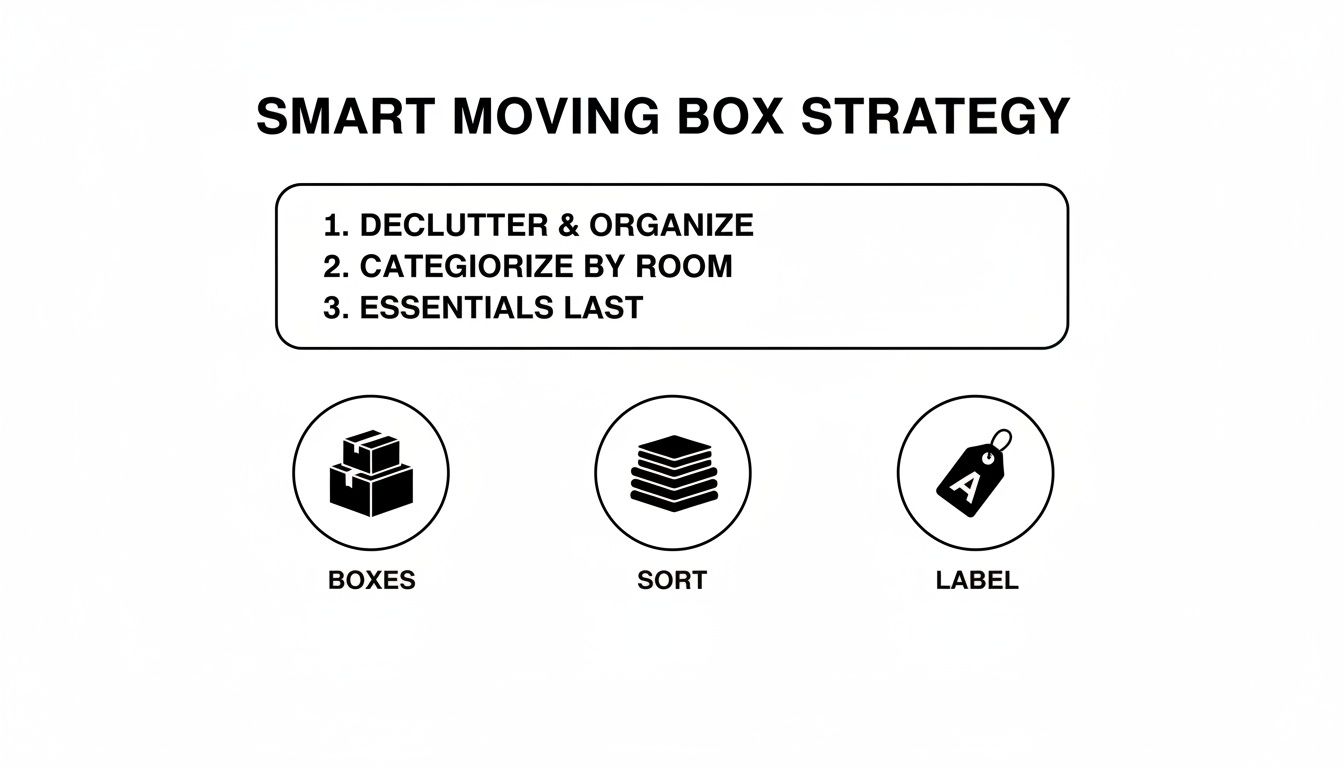
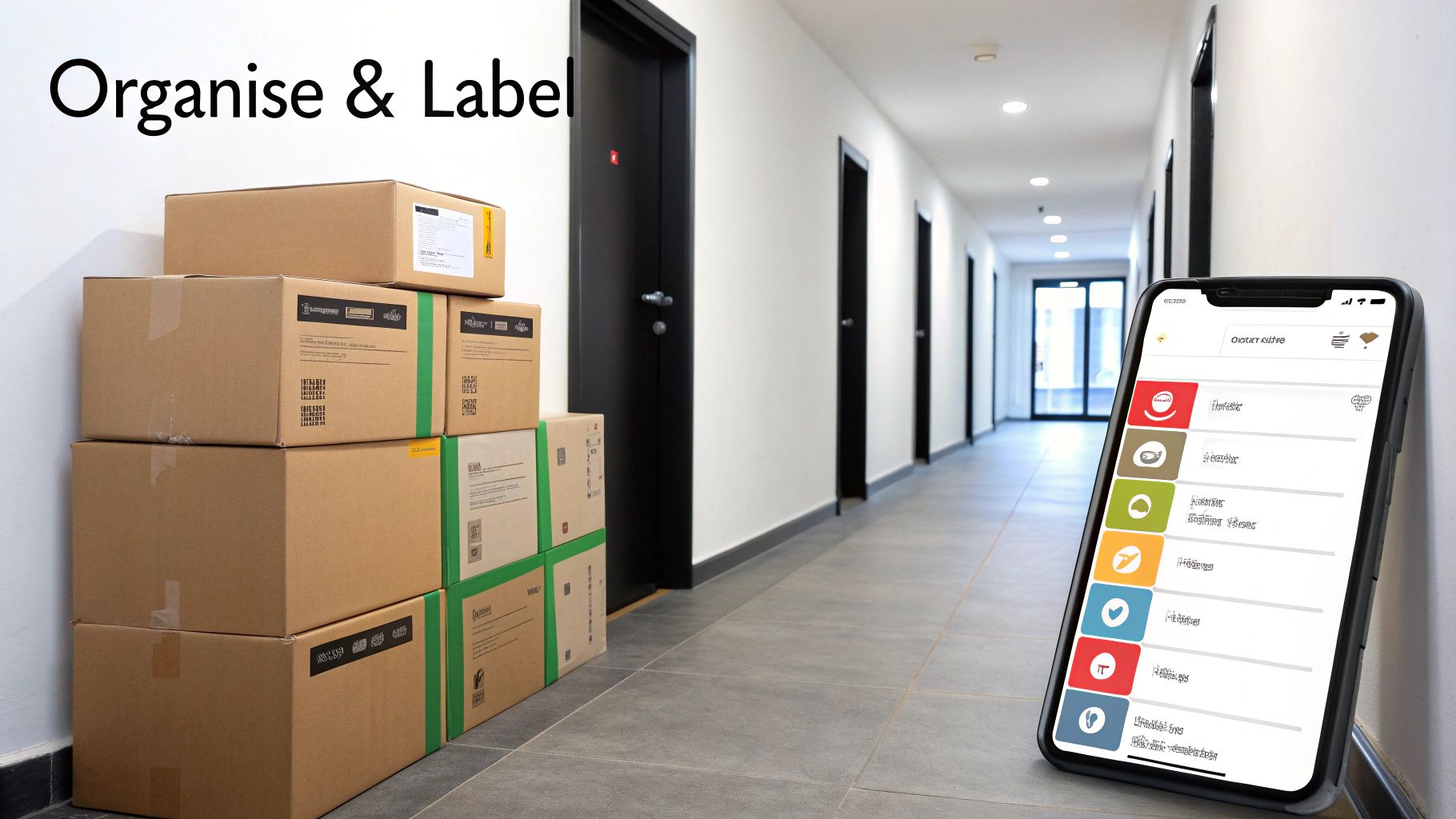
Begin your inventory at least two to three weeks before moving day. Use a digital spreadsheet or a dedicated app like Sortly to keep everything organised. As you pack, assign each box a number and label it on at least three sides for easy visibility. Consider a colour-coding system, using different coloured tape or labels for each room. For a deeper dive into effective strategies, explore expert advice on how to pack for moving. Keep a copy of your inventory with you on moving day to check off boxes as they arrive at your new home.

5. Arrange Utility Disconnection and Connection

A seamless transition into your new home depends heavily on the uninterrupted flow of essential services. A core component of your house moving checklist Australia involves meticulously arranging the disconnection of utilities at your old address and establishing connections at your new one. This task is not just about convenience; it's about avoiding paying for services you're no longer using and ensuring your new property is safe and liveable from the moment you arrive.

A man kneels outside a house, using his smartphone to arrange utilities with meters visible.

Why It's a Priority

Mismanaging utility transfers can lead to frustrating and costly outcomes. You could find yourself in a new home without electricity, hot water, or internet, or worse, continuing to pay bills for the previous property. It also poses a safety risk, particularly with gas connections, which require proper handling by professionals. By scheduling these services in advance, you ensure a smooth handover and a comfortable first night in your new home.

Key Insight: Moving presents a golden opportunity to review your utility providers. Use this time to compare plans and rates from different companies to potentially secure a better deal and save money in the long run.

Who to Notify

Your list of providers will cover electricity, gas, water, and telecommunications. Common Australian providers you might need to contact include:

  • Electricity & Gas: AGL, Origin Energy, EnergyAustralia, Alinta Energy, and various state-specific retailers.
  • Water: Your local council or regional water authority (e.g., Sydney Water, Yarra Valley Water).
  • Internet & Phone: Telstra, Optus, TPG, and numerous other NBN providers.

Actionable Tips for a Smooth Update

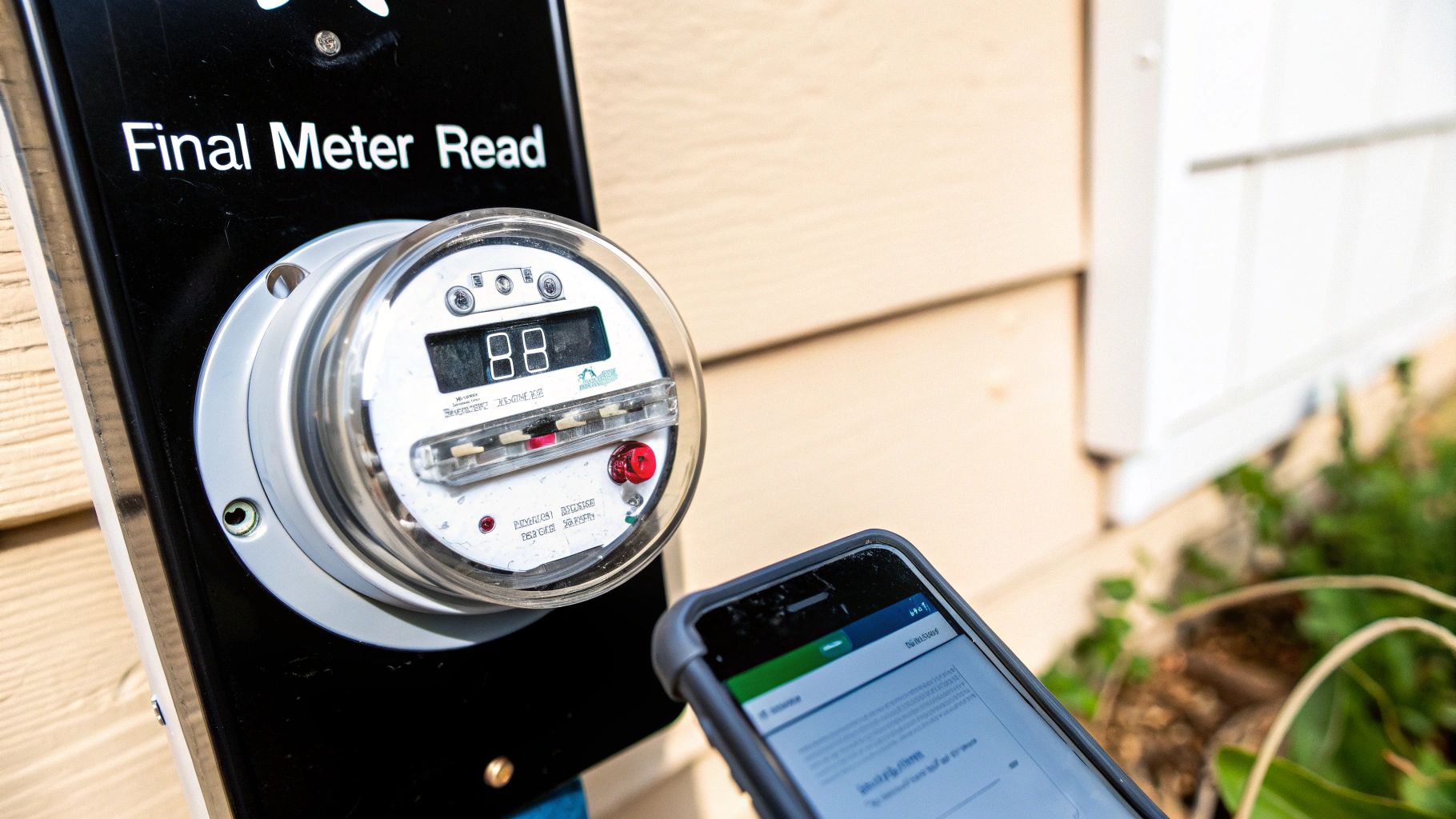
Contact your utility providers at least two to four weeks before your move date to give them ample notice. When you call, have your account numbers and specific disconnection/connection dates ready. Request a final meter reading at your old property and ensure you receive written confirmation of all service changes. To find the best deals, use comparison sites like Canstar or Finder to evaluate new electricity and internet plans before locking in a provider for your new address.

6. Update Subscriptions, Memberships, and Service Providers

Beyond government agencies and utilities, your personal and professional services form a web of connections tied to your current address. Updating subscriptions, memberships, and service providers is a crucial step in your house moving checklist Australia to ensure continuity of care, entertainment, and professional services without costly interruptions or missed deliveries. This task prevents everything from a lapsed gym membership to a missed specialist appointment.

Why It's a Priority

Failing to update these details can lead to a range of inconveniences. A magazine subscription could continue being delivered to your old address, your pet's microchip details might be outdated in an emergency, or a crucial professional registration could lapse. For healthcare, an incorrect address can mean missed appointment reminders or referral letters, potentially delaying important treatment. It’s about ensuring every part of your life, from leisure to health, transitions smoothly with you.

Key Insight: Systematically combing through your bank statements is the most reliable way to identify all recurring payments and subscriptions. This simple audit uncovers forgotten services and ensures nothing is overlooked during the move.

Who to Notify

Your list will be unique, but it should be comprehensive. Consider all aspects of your lifestyle:

  • Healthcare Providers: Your GP, dentist, optometrist, and any specialists.
  • Fitness & Lifestyle: Gym memberships (e.g., Anytime Fitness, F45), club memberships, and library cards.
  • Subscriptions: Streaming services (Netflix, Stan), magazines, meal kit deliveries (e.g., HelloFresh), and online retail accounts like Amazon.
  • Pet Services: Veterinarian clinics, groomers, and updating your pet’s microchip registration.
  • Professional Bodies: Any organisations related to your career, such as AHPRA for healthcare workers or your industry union.

Actionable Tips for a Smooth Update

Start this process at least four weeks before you move. Create a master spreadsheet by reviewing the last three to six months of your bank and credit card statements to catch all recurring debits. For online services, log in to each account and update your billing and shipping addresses directly. For local services like your GP or gym, a quick phone call is often the most effective method. Ensure you also cancel any location-specific memberships you won't be able to use after the move to avoid paying for services you can no longer access.

7. Plan Child and Education-Related Changes

When moving with a family, coordinating your children's educational and care transitions is a non-negotiable part of your house moving checklist Australia. This involves more than just finding a new school; it requires careful planning to ensure a smooth transition, transfer official records, and minimise disruption to their learning and social lives. Properly managing this step provides stability for your children during a period of significant change.

Why It's a Priority

A disorganised school or childcare transition can cause unnecessary stress for both parents and children. Delays in enrolment can lead to missed school days, while incomplete record transfers can affect class placement and access to support services. Securing a spot in a new childcare centre, especially in areas with long waiting lists, requires early and proactive communication to avoid gaps in care that could impact your work schedule.

Key Insight: A well-planned educational transition is fundamental to helping children feel settled and secure in their new community. It sets the foundation for their academic success and social integration long before the moving truck arrives.

Who to Notify

Your list should include both the old and new institutions to ensure a seamless handover of information and responsibilities. Key contacts include:

  • Current School/Childcare: To inform them of your departure date and request academic and health records.
  • New School Admissions Office: To manage enrolment, submit documentation, and confirm start dates. State-specific portals, like the NSW Department of Education's online enrolment system, can often streamline this.
  • New Childcare Centre Director: To secure a place, complete registration forms, and arrange orientation.
  • Before/After School Care Providers: To cancel existing arrangements and register for new services.
  • Extracurricular Activity Coordinators: Such as sports clubs or music tutors.

Actionable Tips for a Smooth Update

Start contacting new schools and childcare centres at least 4-6 weeks before your move. Request an official transfer of school records, including academic transcripts, immunisation history, and any special needs documentation. Once you receive confirmation of enrolment, schedule an orientation visit for your child to meet their new teachers and familiarise themselves with the environment. Remember to order new uniforms and school supplies well in advance to avoid last-minute stress. Planning these details is just as important as organising other aspects of the move, like finding care for your furry family members; you can learn more about moving with your pets on getngoremovals.com.au to ensure every family member is looked after.

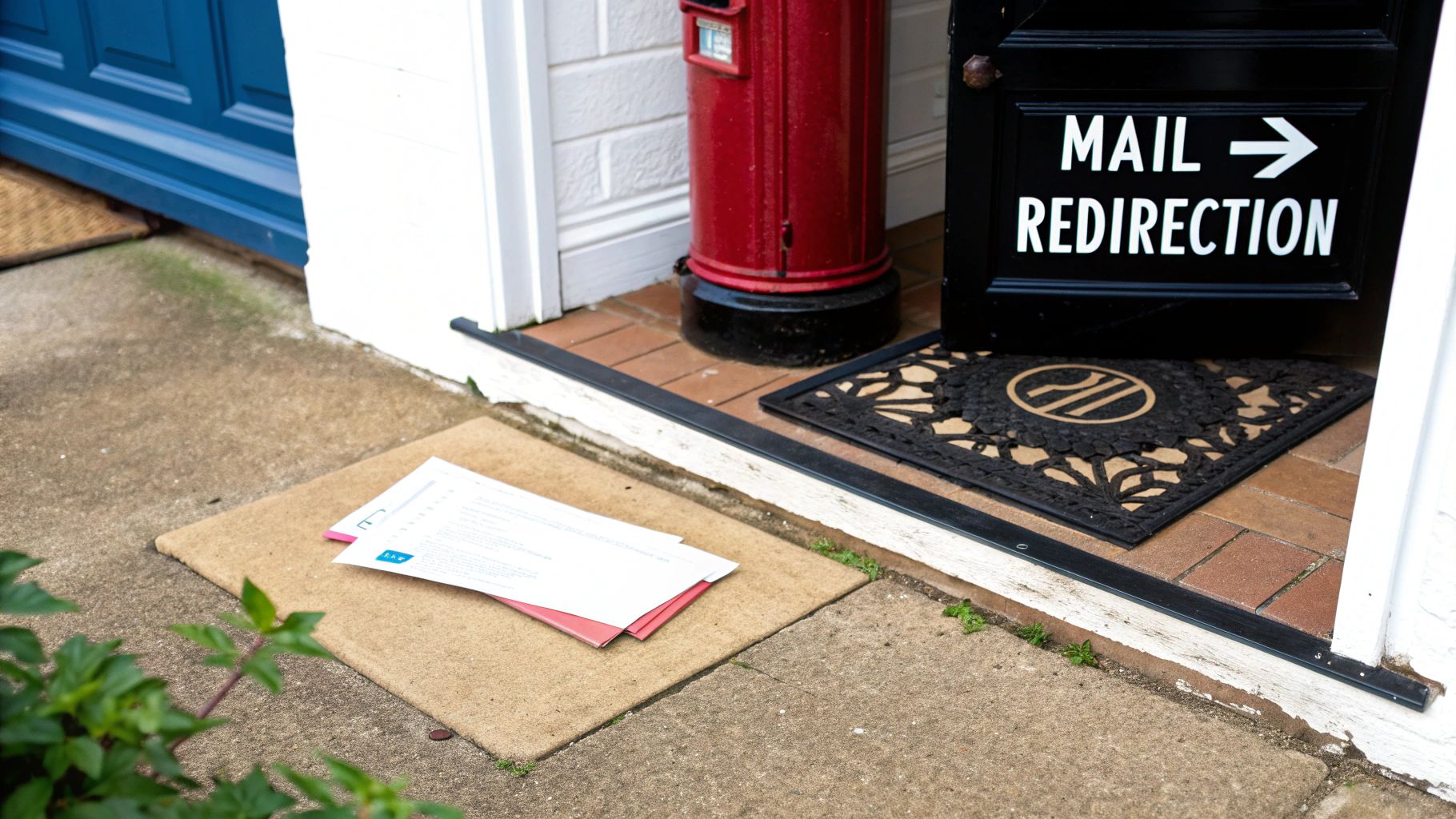
8. Arrange Postal Redirection Service

Even with diligent address updates, it’s inevitable that some mail will slip through the cracks and be sent to your old home. An indispensable safety net in your house moving checklist Australia is setting up a formal mail redirection service with Australia Post. This service forwards all mail addressed to you at your old property directly to your new one, ensuring you don’t miss critical documents, bills, or personal correspondence during the transition.

Why It's a Priority

Failing to redirect your mail can lead to more than just missed birthday cards; it can result in overdue bills, lapsed memberships, and even potential identity theft if sensitive documents fall into the wrong hands. It provides a crucial buffer period, giving you ample time to contact every single organisation and update your details without the pressure of missing something important immediately after you move.

Key Insight: Think of mail redirection as an insurance policy for your correspondence. For a small fee, you buy peace of mind, guaranteeing that your connection to financial, legal, and personal networks remains unbroken while you settle in.

Who to Notify

While the redirection service catches everything, your primary goal is still to update your address directly with all relevant parties. However, the redirection service ensures nothing is missed from less frequent senders, such as:

  • Previous employers: For end-of-year payment summaries.
  • Superannuation funds: For annual statements and updates.
  • Subscriptions: Magazines, loyalty programs, and online retailers.
  • Personal contacts: Friends or relatives who may not have your new address yet.
  • Annual renewals: For services or memberships you might have forgotten about.

Actionable Tips for a Smooth Update

To ensure a seamless transition, plan ahead. Apply for the service at least two to four weeks before your moving date to allow for processing. The Australia Post online portal is the most efficient way to set this up, and you can choose a redirection period of 3, 6, or 12 months. Opting for the 12-month service is highly recommended to cover annual correspondence. Once submitted, keep your confirmation details and reference number in a safe place in case you need to query the service. Remember, this is a temporary solution, so continue updating your address directly with organisations as redirected mail arrives.

9. Conduct Thorough Cleaning and Property Inspection

One of the final yet most crucial steps in your house moving checklist Australia is the meticulous cleaning of your old residence and the formal property inspection. This process is essential for renters aiming to secure their full bond refund and for homeowners preparing the property for its new occupants. A thorough clean and a well-documented inspection prevent disputes and ensure a smooth financial handover.

An 'END OF LEASE' sign prominently displayed on a shiny hardwood floor with a clipboard and pen.

Why It's a Priority

Your rental agreement legally requires you to leave the property in the same condition as when you moved in, minus fair wear and tear. Failing to meet this standard is the most common reason for landlords or property managers to make a claim against your rental bond. For sellers, presenting a clean and well-maintained property is a mark of good faith and ensures a positive final walkthrough with the new owners.

Key Insight: Documenting the property's condition with photos and detailed notes, both before your clean and after, provides indisputable evidence that can protect your bond from unfair claims. This diligence transforms a potentially subjective process into a factual one.

Who to Notify

While this step involves actions more than notifications, it requires coordination with specific parties. You will need to engage with:

  • Professional Cleaners: Specialised end-of-lease or bond cleaning services who understand the high standards required by property managers.
  • Property Manager/Landlord: To schedule the final move-out inspection after the property is completely empty and cleaned.
  • Carpet Cleaners/Pest Control: If your lease agreement specifically requires these services to be professionally completed.

Actionable Tips for a Smooth Update

Schedule your end-of-lease clean for the day after your removalists have cleared the property to ensure every corner is accessible. When booking, get a detailed quote that outlines the full scope of work, including ovens, windows, and carpets. Take extensive photos before and after the clean to document the property's condition. Always keep receipts for all professional services as proof of your efforts, which can be invaluable if a dispute over your bond arises with your state's tenancy authority.

10. Research and Plan for New Area Integration

Successfully relocating involves more than just moving your possessions; it requires integrating into a new community. A crucial part of your house moving checklist Australia is to thoroughly research your new area and create a plan for settling in. This proactive approach transforms an unfamiliar suburb into a familiar home, ensuring a smooth transition for you and your family by identifying essential services and community hubs ahead of time.

Why It's a Priority

Moving to a new locality without prior research can be disorienting and stressful. You might find yourself scrambling to find a GP accepting new patients, figuring out public transport routes for your commute, or simply locating the nearest decent coffee shop. Planning your integration helps minimise this post-move chaos, allowing you to establish new routines quickly and feel connected to your surroundings, which is vital for your overall wellbeing.

Key Insight: A well-researched transition plan is the bridge between a new address and a new home. It empowers you to build a support network and establish a sense of belonging from day one, rather than feeling like a stranger in your own neighbourhood.

Who to Notify

While this step is more about gathering information than notifying bodies, your research will inform who you need to contact. Your list will be unique to your needs but should include:

  • Local Council: To understand bin collection days, local regulations, and community facilities.
  • Healthcare Providers: Identify and contact local doctors, dentists, and specialists to check for availability and register as a new patient.
  • Schools and Childcare Centres: For enrolment enquiries and to understand catchment zones.
  • Utility Providers: Researching local providers for electricity, gas, and internet to set up connections.
  • Community Groups: Such as local sports clubs, libraries, or social groups to start building connections.

Actionable Tips for a Smooth Update

Start your research online at least four to six weeks before your move. Use tools like Google Maps to scout local amenities and read reviews. Join neighbourhood Facebook groups or Nextdoor to ask for recommendations from future neighbours. If you're moving to a major city, in-depth resources can be invaluable; for example, you can find a comprehensive guide for moving to Melbourne that covers suburbs, transport, and lifestyle. Once you arrive, make a point to attend a local event or visit the community centre to start making real-world connections.

Australia House Move: 10-Point Checklist Comparison

Item Implementation Complexity 🔄 Resource & Cost ⚡ Expected Outcome 📊⭐ Ideal Use Cases 💡
Notify Government and Official Bodies High 🔄 — multiple agencies, varying timelines Low cost; high time & documentation ⚡ High ⭐ — legal compliance, correct tax/voter/license records 📊 Mandatory for all moves; complete before moving
Update Financial and Banking Information Medium 🔄 — many institutions, some manual steps Low–moderate; online updates available ⚡ High ⭐ — ensures statement delivery, account security 📊 Essential if you hold bank, insurance, super accounts
Organize Professional Movers or Arrange Transport Medium–High 🔄 — quotes, verification, scheduling High cost ($2k–$15k+) and logistics ⚡ High ⭐ — efficient relocation, insured handling, less physical labor 📊 Long-distance, full-service moves, heavy/fragile items
Create a Detailed Inventory and Labeling System Medium 🔄 — time‑intensive upfront Low cost; time and possible app tools ⚡ High ⭐ — prevents loss, supports claims, speeds unpacking 📊 Valuable items, insurance claims, large households
Arrange Utility Disconnection and Connection Medium 🔄 — multiple providers, safety checks Moderate; connection fees and possible deposits ⚡ High ⭐ — continuous services, avoids extra charges 📊 All moves where uninterrupted utilities are required
Update Subscriptions, Memberships, and Service Providers Low–Medium 🔄 — many small contacts to update Low cost; time to compile and contact providers ⚡ Medium–High ⭐ — maintains services, correct billing 📊 People with recurring services, healthcare or pet providers
Plan Child and Education-Related Changes High 🔄 — enrollment windows, documentation Moderate; time and possible application fees ⚡ High ⭐ — smooth school transitions, minimal disruption 📊 Families with school-age children or interstate moves
Arrange Postal Redirection Service Low 🔄 — simple online or in-person setup Low cost ($35–45 for 12 months) ⚡ Medium–High ⭐ — captures missed mail during transition 📊 All movers as a safety net for forwarded mail
Conduct Thorough Cleaning and Property Inspection Medium 🔄 — multi-phase, coordination with agents Moderate–high (professional $300–$800+) ⚡ High ⭐ — maximizes bond return, reduces disputes 📊 Rental move-outs and end-of-lease handovers
Research and Plan for New Area Integration Medium 🔄 — comprehensive local research Low monetary cost; significant time investment ⚡ Medium–High ⭐ — faster settling, better service choices 📊 New city/suburb moves; families seeking local services

Your Smooth Move is Just a Plan Away

Navigating a house move in Australia can feel like a monumental task, but as we've detailed, it’s a challenge that can be conquered with systematic planning and organisation. By breaking down the process into manageable stages, from the initial eight-week decluttering blitz to the final box being unpacked, you transform a potentially chaotic experience into a controlled and streamlined transition. This comprehensive house moving checklist for Australia has been designed to be your steadfast guide, ensuring no critical detail is overlooked.

The true secret to a successful move lies not just in what you do, but when you do it. The timeline-based structure we've explored is crucial. Early actions, such as researching and booking reputable removalists, decluttering non-essential items, and starting a detailed inventory, create a powerful ripple effect. They prevent the last-minute panic that so often leads to stress, forgotten tasks, and unnecessary expenses. Similarly, addressing the administrative side of your move, like notifying government bodies, transferring utilities, and setting up mail redirection with Australia Post, is paramount for a seamless transition into your new life.

Key Takeaways for a Stress-Free Relocation

Mastering your move comes down to a few core principles that we’ve highlighted throughout this guide:

  • Proactive Planning is Non-Negotiable: The most common moving-day disasters stem from procrastination. Booking your movers, arranging permits, and starting your packing well in advance gives you the flexibility to handle unexpected issues without derailing your entire schedule.
  • Systematic Organisation Saves Time and Sanity: A methodical approach to packing, featuring a detailed inventory, a clear labelling system (like colour-coding by room), and an "essentials box," will make the unpacking process infinitely smoother. You’ll know exactly where your kettle, phone chargers, and bed linen are on that first night.
  • Attention to Detail is Everything: From taking final meter readings and photos of your old property to updating your address across all your financial, subscription, and government accounts, these small administrative tasks are vital. Overlooking them can lead to service disruptions, missed bills, or even identity-related complications down the line.
  • The Right Professional Partner is Invaluable: While a DIY move might seem cost-effective, the value of a professional, fully-insured removalist cannot be overstated. Their expertise in handling heavy furniture, navigating tricky access points, and ensuring the safety of your belongings provides unparalleled peace of mind and physical relief.

Ultimately, this checklist is more than just a list of tasks; it's a framework for taking control. By methodically working through each stage, you are not just moving your possessions, you are carefully orchestrating a major life event. The sense of accomplishment that comes from a well-executed move sets a positive tone for your new beginning, allowing you to focus on the excitement of settling into your new home and community, rather than recovering from a stressful relocation. Your smooth move is indeed just a plan away, and you now have the complete blueprint to make it happen.


Now that you're armed with the ultimate house moving checklist for Australia, the final step is to secure a moving partner who can execute your plan flawlessly. At Get n Go Removals Melbourne, we specialise in turning meticulous plans into reality with our reliable, fully-insured, and police-checked team. Let us handle the heavy lifting, from professional packing to interstate transport, so you can focus on settling in.


READ MORE

Moving Across States? Discover Interstate Moving Companies Cost and Save

So, how much does it actually cost to move interstate in Australia? On average, you can expect to see figures somewhere between $1,400 and $5,000 for a standard relocation. But think of that as a starting point. The final price tag really depends on how far you're going, how much stuff you have, and any extra services you need along the way.

Unpacking Your Interstate Moving Quote

A man reviews a cost breakdown document in front of a moving truck and house.

Figuring out the cost of an interstate move isn't like buying something off the shelf. It’s a bespoke service tailored to your specific needs. Every single detail of your move, from the number of boxes in your living room to the kilometres between your old and new postcodes, plays a part in shaping that final quote.

The two biggest players in this calculation are the distance of the move and the total volume of your belongings, which we measure in cubic metres (m³). Essentially, you’re paying for the space your life takes up on the truck and how far that truck has to travel to get it to your new home.

Core Cost Components

At its heart, your quote is built on three fundamental pillars that every professional removalist will factor in. Understanding these helps you see exactly where your money is going and why different companies might give you different numbers.

  • Transport and Labour: This is the nuts and bolts. It covers the fuel for the long haul, the wear and tear on the vehicle, and most importantly, the hard work of the professional movers who load and unload everything you own.
  • Volume of Goods: It's simple, really—the more you have, the more space and resources it takes to move it. Getting an accurate estimate of your household goods in cubic metres is absolutely crucial for a precise quote.
  • Essential Coverage: Any reputable moving company will include basic transit insurance in their quote. This gives you a foundational layer of security, protecting your belongings while they’re on the road.

Thinking about your moving quote this way—as a combination of distance, volume, and service level—demystifies the process. It transforms a single daunting number into a logical breakdown of services rendered, putting you in a better position to plan your budget effectively.

Recent data shows just how much these factors can swing the final bill. As mentioned, typical interstate moves range from $1,400 to $5,000, but that can easily climb higher for larger homes or a full cross-country journey from Perth to Brisbane.

At a Glance Cost Estimates

To give you a practical starting point for your budget, it helps to see some ballpark figures based on typical home sizes. Your quote will always be unique to your situation, but these numbers offer a realistic baseline for what you might expect.

For a deeper look at how local moves are priced, which can give you some extra context, check out our guide on how much moving companies cost in and around major cities.

The table below gives you a quick summary of estimated costs based on the volume of belongings you'd typically find in different-sized Australian homes.

Quick Guide to Average Interstate Moving Costs in Australia

Here’s a snapshot of what you might expect to budget for your interstate move, broken down by the size of your home.

Home Size Average Volume (Cubic Metres) Estimated Standard Cost Range
Studio Apartment 5 – 10 m³ $1,400 – $2,200
1-Bedroom Home 10 – 15 m³ $1,800 – $2,800
2-Bedroom Home 15 – 25 m³ $2,500 – $4,000
3-Bedroom Home 25 – 35 m³ $3,500 – $5,500
4+ Bedroom Home 35+ m³ $5,000+

Remember, these figures are just a guide. Your final cost will come down to the specifics of your move, including the exact distance and any additional services you choose.

The Three Big Factors That Shape Your Moving Quote

Every quote you get from an interstate moving company boils down to three key things. Once you get your head around these, you can see exactly how your move is priced, turning a confusing list of figures into something that actually makes sense. These aren't just random numbers on an invoice; they're the building blocks of the entire interstate moving companies cost.

So, what are they? It's all about the distance of your move, the volume of your stuff, and the timing of when you do it. Let's break down how each one plays a big part in the final price.

Factor 1: The Distance of Your Journey

It’s pretty obvious that moving further costs more, right? But the reason isn't just about the number of k's on the road. A long-haul trip, like from Melbourne all the way up to Cairns, has a lot of hidden operational costs that get bundled into your quote.

It's not just about the fuel, though that's a big slice of the pie. The costs also cover:

  • Driver Hours: Interstate truck drivers have strict rules about how long they can drive and when they must take breaks. This stretches out the travel time and, naturally, the labour costs.
  • Vehicle Wear and Tear: A cross-country journey puts a lot more strain on a truck than a quick trip across town. This contributes to higher maintenance and running costs for the removalist.
  • Logistical Complexity: Longer routes often mean dealing with multiple depots, different road conditions, and sometimes higher toll fees, all of which get factored into the price.

Factor 2: The Volume of Your Belongings

The second major factor is the amount of space your things take up, measured in cubic metres (). This is probably the one you have the most control over. When you book an interstate removalist, you're essentially renting a section of their truck.

Getting this volume calculation right is crucial. If you underestimate, you could be hit with extra charges on moving day when your stuff doesn't fit. Overestimate, and you might end up paying for empty space you didn't even use. Professional movers are great at estimating volume, but giving them a detailed inventory list is the best way to get a spot-on quote.

Think of it this way: The truck is a cargo plane and the distance is the flight path. The volume of your belongings is how many seats and how much luggage space you need to book. A single backpack is always going to be cheaper to send than an entire shipping container.

Factor 3: The Timing of Your Move

When you decide to move can have a massive impact on your final bill. The removals industry is a lot like any other service—it all comes down to supply and demand. If you move when everyone else is, it's going to cost you more. Simple as that.

Certain times of the year are considered "peak season" and will come with a higher price tag. To keep the interstate moving companies cost down, it's a good idea to try and avoid:

  • Summer Months: December through February is the busiest time for moving in Australia, thanks to school holidays and better weather.
  • Weekends: More people try to move on a Friday or Saturday, which drives up demand and prices.
  • Public Holidays: Booking a move over a long weekend or public holiday will almost always mean you're paying a premium.

By understanding these three factors—distance, volume, and timing—you'll be in a much better position to look at the quotes you receive and know what you're paying for. For a more detailed look at how this all comes together, check out our guide on the cost of movers. Being an informed customer is your best tool for getting a fair price and a smooth, stress-free move.

Understanding How Removalists Price Their Services

Ever wondered how a moving company takes a list of your belongings and turns it into a final quote? Getting a handle on their pricing models is the key to comparing quotes and finding genuine value. It cuts through the jargon and shows you exactly what you're paying for—and where you might be able to save a few dollars.

The most common way removalists calculate the interstate moving companies cost is by charging based on the volume of your goods. This is usually priced per cubic metre (m³). Think of the moving truck as a giant, empty container; you're essentially renting out a portion of that space to get your life from A to B.

The Standard Rate Per Cubic Metre

For most professional movers, the cubic metre is the go-to unit of measurement. It’s a straightforward approach that makes it fairly simple to estimate costs before the big day arrives. In Australia, pricing can vary quite a bit depending on the size and complexity of the move, but the industry has largely settled on this standard.

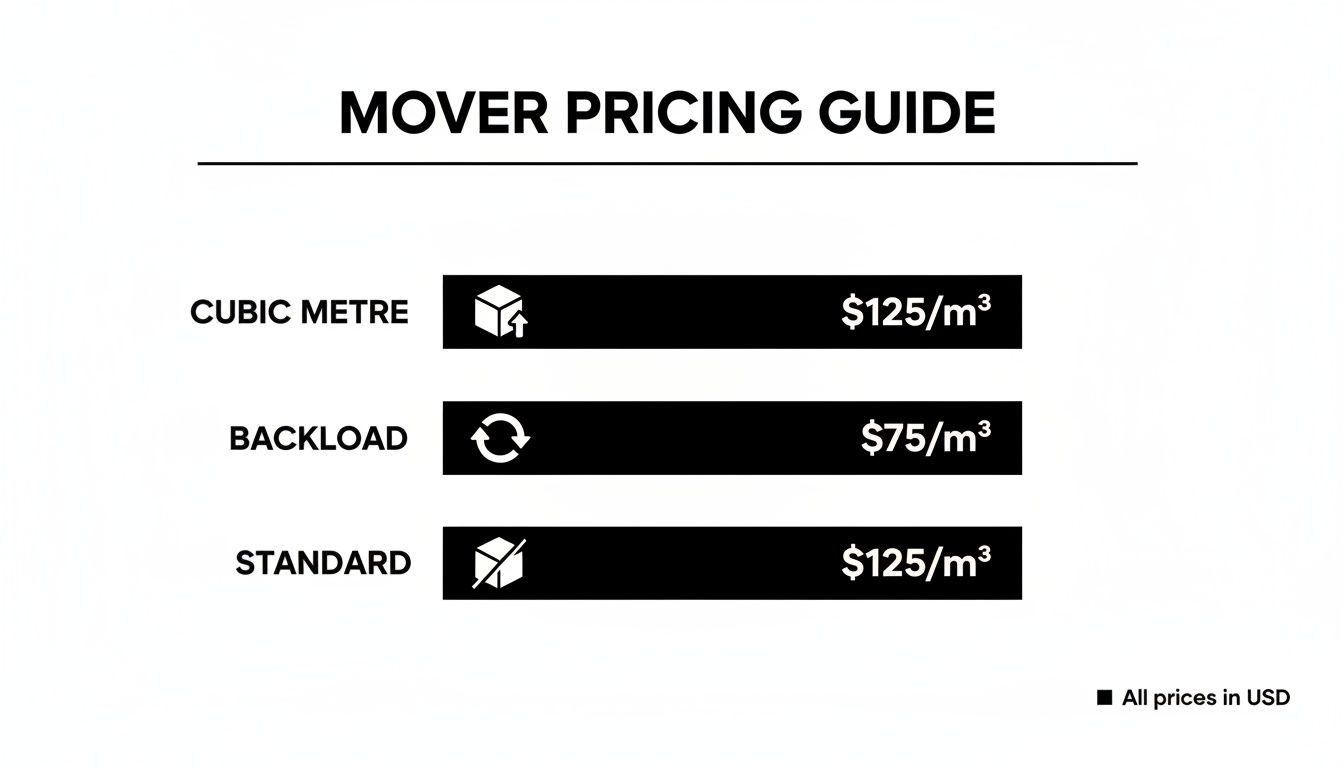
Interstate removalists typically charge between $100 to $150 per m³. This gives you a predictable way to budget. To get a reliable quote, you first need to know your total volume, which is why a good quality cubic metre calculator is such a useful tool.

A standard quote at this rate will almost always cover the essentials: the driver's time, the fuel for the long haul, and the labour for loading and unloading. But always, always ask what's not included. Things like packing materials or special handling for that antique mirror often come with an extra charge.

If you're curious about how other professional services structure their pricing, you might find this a complete guide to carpet cleaning costs in Melbourne an interesting read.

Introducing Backloading: A Smarter Way to Save

Beyond the standard model, there's a game-changing option that savvy movers use to slash their costs: backloading. It's a simple, brilliant concept that works out well for both you and the removalist.

Picture this: a moving truck drives from Melbourne to Sydney to drop off a full load. Instead of heading back with an empty truck—which is just burning fuel and money—the company offers that vacant space at a hefty discount. That, in a nutshell, is backloading.

Think of backloading as ride-sharing for your belongings. By booking a spot on a truck that's already heading in your direction, you share the operational costs—like fuel and driver wages—with the primary move, leading to substantial savings for you.

It's a genuine win-win. The moving company avoids unprofitable "empty miles," and you get professional moving services for a fraction of the usual price.

The Pros and Cons of Backloading

While the lower price is a massive drawcard, backloading does involve a trade-off. It's important to weigh up the good against the not-so-good to see if it's the right fit for your situation.

The Advantages:

  • Significant Cost Savings: This is the main reason people choose it. Backloading is often much, much cheaper than booking a dedicated truck because you're only paying for the space you use on a trip that was happening anyway.
  • Professional Service: You aren't getting a cut-rate service. You get the same experienced movers and quality of care, just accessed in a more budget-friendly way.
  • Eco-Friendly: Filling up trucks that would otherwise be empty means fewer vehicles on the road, which cuts down on fuel consumption and reduces the overall carbon footprint.

The Disadvantages:

  • Less Flexible Scheduling: Here’s the catch. Your move is tied to someone else's schedule. You might have to wait for a truck that has space and is heading your way, so specific pickup or delivery dates are rarely guaranteed.
  • Longer Transit Times: The truck might have other stops to make along its route, so your belongings could take longer to arrive compared to a direct, dedicated service.

Ultimately, the choice between a standard move and backloading comes down to your priorities. If you're on a tight budget and have a flexible timeline, backloading is an incredible way to lower your interstate moving companies cost. But if you absolutely must move on a specific date, a standard booking provides the certainty and reliability you need.

Comparing Interstate Moving Costs Across Australia

Pricing models and abstract figures are one thing, but nothing really hits home like seeing the numbers in black and white. To give you a real-world feel for how distance hammers your moving budget, let's break down some of Australia’s most common moving routes and their ballpark costs.

Seeing these figures helps you shift from just thinking about the move to actually planning for it financially. You can find a journey that looks a bit like yours and get a solid baseline for what to expect when the quotes start rolling in.

Major East Coast Routes

Moves up and down the well-worn eastern seaboard—think Sydney to Melbourne or Sydney to Brisbane—are the bread and butter of the industry. Because there are so many trucks running these routes, the logistics are more streamlined, which helps keep the costs relatively predictable.

  • Sydney to Melbourne (approx. 880 km): For a standard 3-bedroom home, you're typically looking at a cost somewhere between $3,500 and $5,500.
  • Sydney to Brisbane (approx. 920 km): This trip is very similar in price to the Sydney-Melbourne run, usually ranging from $3,800 to $5,800.

These prices reflect that sweet spot where a significant distance is balanced out by high-volume efficiency. If you're after more tips on finding the right crew for these popular journeys, our detailed guide on the best interstate removalists in Australia is a great place to start.

The image below gives you a clear idea of how different pricing methods can really change the final number on your invoice.

Mover pricing guide detailing costs for cubic metre, backload, and standard moving services in USD.

As you can see, backloading can offer some serious savings compared to paying the standard rate per cubic metre, making it an excellent option if you're trying to keep a lid on costs.

Cross-Country Relocations

The moment your move involves crossing the entire continent, the complexity—and the price tag—jumps significantly. A trip from the East Coast over to Perth or Adelaide involves massive distances, a whole lot more fuel, and many more hours behind the wheel for the drivers.

When you're looking at a proper long-haul move across the country, costs often land in the $7,000 to $12,000+ bracket. A move from Brisbane to Perth, for example, is one of the priciest routes you can take, with estimates climbing well over $12,000.

The big takeaway here? Distance is king when it comes to cost. A move that's four times longer, like Brisbane to Perth versus Sydney to Melbourne, can easily end up costing more than double. That’s because the operational expenses—fuel, wages, and wear and tear—don't just add up, they multiply.

Estimated Moving Costs for a 3-Bedroom Home on Major Routes

To put it all into perspective, here’s a straightforward comparison of what you might expect to pay for a standard 3-bedroom house move across some of Australia's key routes.

This table really highlights the direct link between the kilometres travelled and the final price you'll see on your quote.

Moving Route (From → To) Approximate Distance (km) Estimated Cost Range
Sydney → Melbourne 880 km $3,500 – $5,500
Sydney → Brisbane 920 km $3,800 – $5,800
Melbourne → Adelaide 730 km $3,200 – $5,000
Melbourne → Brisbane 1,670 km $4,500 – $6,500
Sydney → Perth 3,950 km $7,000 – $10,000+
Brisbane → Perth 4,300 km $7,500 – $12,500+

Seeing the numbers laid out like this turns abstract pricing into something you can actually work with. It gives you the power to budget with a bit more confidence for your big interstate move.

Avoiding Hidden Fees and Unexpected Charges

The first quote you get from an interstate moving company is a great starting point, but it's rarely the final number. The true interstate moving companies cost can easily climb when you factor in extra services or unexpected situations that weren't part of the initial price. Knowing what these potential extras are is your best line of defence against a last-minute budget blowout.

Think of that first quote like a basic airfare – it gets you from A to B, but things like checked baggage, seat selection, and snacks all cost extra. It's the same deal here. Services that save you a ton of stress, like getting the professionals to pack for you or disassemble tricky furniture, will almost always show up as separate line items on the bill.

Magnifying glass on a document titled 'HIDDEN FEES' with boxes, laptop, and pen.

Common Optional Services That Add to Your Bill

Most removalists offer a menu of services designed to make your move a whole lot easier. While they can be absolute lifesavers, these conveniences come at a price. It’s crucial to decide what you genuinely need and budget for it from the get-go.

Some of the most common add-ons include:

  • Professional Packing and Unpacking: If the thought of boxing up your entire home sends you into a panic, the movers can handle it. This service is usually priced based on how many hours and materials it takes.
  • Furniture Disassembly and Reassembly: Taking apart that complex IKEA wardrobe or your kid's bunk beds takes time and the right tools. This skill and effort will be reflected on your final invoice.
  • Secure Storage Solutions: Got a gap between leaving your old place and getting the keys to the new one? You’ll need to pay for storage. Costs will depend on how long you need it and how much space your stuff takes up.

Special Handling and Access Fees

Not everything you own is a standard cardboard box. Bulky, fragile, or unusually heavy items often need special equipment and extra muscle, which means a special handling fee. Think pianos, pool tables, massive artworks, or delicate antiques. Always mention these items upfront so they can be included in your quote accurately.

Another charge that catches people by surprise is all about access. If the moving truck can't get a park right out the front of your property, you might get hit with a "long carry" fee for the extra distance the crew has to walk. Likewise, navigating multiple flights of stairs or tricky apartment lifts adds a lot of time and hard work, which can result in extra labour charges.

A transparent moving quote should feel like a detailed receipt, not a mystery bill. If a price seems too good to be true, it likely is. Insist on an itemised quote that clearly separates the base transport cost from any potential add-ons or fees.

The Critical Role of Comprehensive Insurance

Any reputable mover will have basic transit insurance, but this coverage is often very limited. It typically only protects your belongings in a major disaster, like a truck fire or a serious accident on the road. For real peace of mind against the everyday bumps, drops, and scratches, comprehensive moving insurance is a smart move. To protect your belongings and your budget, it's worth understanding the different shipping protection and insurance policies available.

This extra cover means that if an item gets damaged, you’re covered for what it would cost to repair or replace it, not just a token amount based on its weight. When you think about the total value of everything you own, this small upfront cost can save you from a massive financial headache down the track.

For a deeper dive into what to watch for, our guide on the hidden costs in moving house has even more tips. By asking the right questions and knowing where extra charges might pop up, you can make sure your final bill has no nasty surprises.

Proven Strategies to Lower Your Moving Bill

Knowing what drives up the cost of a move is one thing; doing something about it is another. But with a bit of savvy planning, you can wrestle that final bill down significantly without having to sacrifice a quality, safe service. Think of this as your game plan for a much more affordable relocation.

The single most powerful tool you have to cut down the interstate moving companies cost is to simply move less stuff. It really is that simple. Since you’re paying by the cubic metre, every single thing you decide not to take is instant money back in your pocket.

Declutter Like You Mean It

Before a single roll of packing tape comes out, it’s time to get ruthless. Go through every room, every cupboard, and every forgotten drawer with a really critical eye. Ask yourself the hard questions: have I actually used this in the last year? Does it mean something to me, or is it just 'stuff'? Will it even work in my new place?

This isn't just about saving money, either. It’s about simplifying your entire move and getting a genuinely fresh start on the other side.

  • Sell: Jump on online marketplaces like Facebook Marketplace or Gumtree. You'd be surprised what you can get for furniture, old electronics, and other valuable bits and pieces you no longer need.
  • Donate: Drop off clothes, books, and household goods at a local Salvos or Vinnies. It helps out your community and lightens your load at the same time.
  • Dispose: Be honest about what's broken, expired, or just plain useless. A pre-move council cleanup can be an absolute lifesaver for getting rid of the junk.

By shedding the excess weight, you directly shrink the cubic metre measurement of your move, which in turn, shrinks your final quote.

Master the Art of Smart Packing

Hiring professional packers is a fantastic luxury, no doubt. But if you’re looking to save some serious cash, doing it yourself is a guaranteed win. Packing is a labour-intensive job, and by taking it on, you're wiping those labour costs right off your bill.

You can also get clever with your packing materials instead of buying everything brand new.

  • Ask local businesses: Your local supermarket, bottle-o, or department store often has stacks of sturdy boxes they're more than happy to give away.
  • Use what you already have: Suitcases, laundry baskets, and storage tubs are perfect for packing up clothes and other non-breakables.
  • Repurpose your linens: Instead of forking out for bubble wrap, use your towels, blankets, and even t-shirts to wrap up delicate items. It’s a smart, two-for-one packing strategy.

Leverage Backloading and Smart Scheduling

We mentioned backloading earlier, but it’s worth highlighting again because it's a huge money-saver. If you have some wiggle room with your moving dates, make a point of asking removalists about their backloading opportunities. Snagging a spot on a truck that’s already heading back empty is one of the most effective ways to slash your expenses.

Your moving schedule is a powerful bargaining chip. By avoiding peak demand, you place yourself in a much stronger position to secure a better rate.

The timing of your move plays a massive role, too. Weekends and the summer school holidays are absolute peak season for movers, which means peak prices. If you can manage it, schedule your move for a weekday in the middle of the month during the off-season (think autumn or winter). Demand is much lower, and moving companies are often more flexible on pricing just to fill their schedules.

And finally, a golden rule: never, ever accept the first quote you get. Always aim for at least three detailed, itemised quotes from reputable companies. This is the only way you can properly compare what you're getting for your money and ensure you're getting the best possible value for your big move.

Your Top Questions About Moving Costs, Answered

To make sure you feel completely ready for what's ahead, let's tackle some of the most common questions people ask about the cost of moving interstate. We’ll give you clear, straight answers to help you finalise your plans and move forward with total confidence.

How Far in Advance Should I Book My Removalist?

For the best prices and to make sure you get the dates you want, you should aim to book your removalists about 4-6 weeks in advance.

This is especially true if you’re planning a move during a busy period, like the summer months or over school holidays. Booking early helps you lock in a good rate and avoid the last-minute price hikes that happen when everyone is trying to book at once.

If you're eyeing a really budget-friendly option like backloading, giving yourself even more lead time is a smart move. It massively increases your chances of finding a truck with spare space that’s already heading exactly where you need to go, right when you need it.

Is a DIY Interstate Move Actually Cheaper?

It might look cheaper on paper at first, but a DIY move can be a bit of a wolf in sheep's clothing. The costs often sneak up on you.

Once you add up the truck rental, the shockingly high cost of fuel for a long-haul drive, proper insurance, and all the packing supplies, those initial "savings" can shrink dramatically. Sometimes, they disappear altogether.

Professional movers bring expertise and efficiency. They have the right insurance and, most importantly, they do all the heavy lifting. This saves you a world of time, stress, and protects your furniture from accidental damage. Always map out every single potential cost before you decide to go it alone.

What’s Included in a Standard Moving Quote?

A typical quote for an interstate move will usually cover the essentials: the truck, the fuel to get it there, the team's time for loading and unloading, and basic transit insurance for your goods while they're on the road.

But, and this is a big but, what’s considered "standard" can change from one company to the next. It is absolutely vital to get a detailed breakdown in writing so there are no grey areas.

Services that almost always cost extra include:

  • Professional packing and unpacking services.
  • Having the company supply boxes and packing materials.
  • Someone to handle furniture disassembly and reassembly.
  • The need for short-term or long-term storage.

Our best advice? Always insist on an itemised quote. It shows you exactly what you're paying for and is the best way to avoid any nasty surprises on moving day.


Ready to plan your move with clear, upfront pricing and zero guesswork? The team at Get n Go Removals Melbourne offers reliable and professional interstate moving services designed around you. Contact us today for a clear, no-obligation quote.

READ MORE

Moving Your Home: A Comprehensive Guide to the Cost of Moving House and How to Save

Trying to nail down the cost of moving house can feel a bit like catching smoke. Prices seem all over the place, but there’s a method to the madness. On average, you can expect the moving houses cost in Australia to be anywhere from $300 for a small local apartment move to over $6,000 for a bigger interstate relocation.

The final number on your invoice really boils down to a few key things: the size of your home, how far you're going, and any extra services you need. This guide is designed to provide you with all the customer information you need to confidently budget for your move, whether it's for your house or office.

Demystifying Your Moving Quote

Getting your head around a moving quote is the first step to creating a realistic budget and avoiding any nasty surprises on moving day. The good news is that the pricing structure is quite logical once you break it down.

For local moves—those just across town or to a nearby suburb—pricing is almost always by the hour. That hourly rate covers the professional movers, the truck, and the time it takes to get from your old place to the new one.

For interstate moves, however, the game changes. The cost is calculated based on the total volume of your belongings (measured in cubic metres) and the distance between your two homes.

A Snapshot Of Average Moving Costs

Let's look at some real-world numbers to give you a clearer picture. Data from across the industry shows that local removalist hourly rates typically land between A$35 and A$50 per mover. To see how this adds up for a full job, you can find detailed breakdowns of moving company costs.

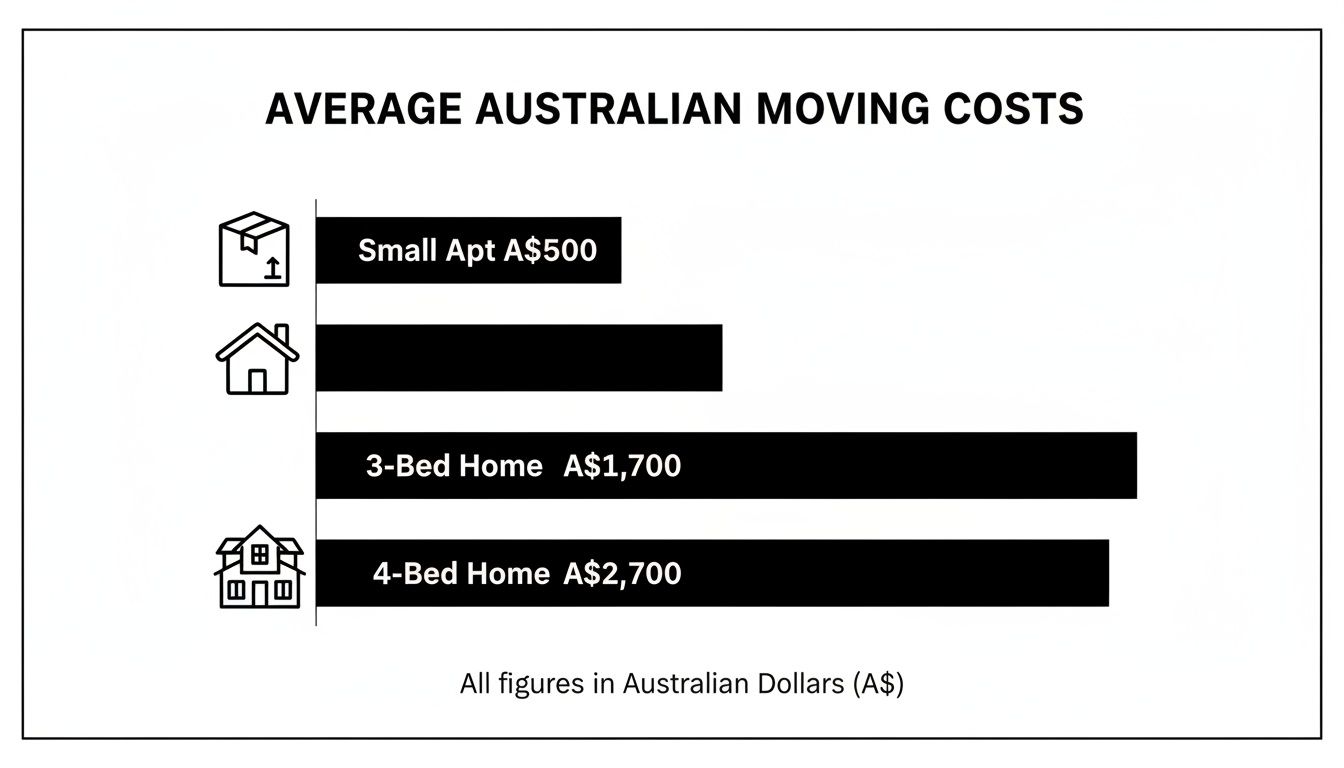
This chart provides a great visual representation of what you might expect to pay for a local move based on your home's size, making it easier to read and understand.

Bar chart displaying average Australian moving costs for various home sizes, including apartments and houses.

As you can see, the bigger the home, the more time and crew members are needed, which is directly reflected in the final cost.

To put it into perspective, here’s a quick table outlining what you might expect for a local move.

Estimated Local Moving Costs By Home Size

Home Size Typical Crew Size Estimated Hourly Rate (AUD) Estimated Total Cost (AUD)
Studio/1-Bedroom Apt 2 Movers $120 – $150 $360 – $750
2-Bedroom Home 2-3 Movers $150 – $180 $750 – $1,440
3-Bedroom Home 3 Movers $180 – $210 $1,260 – $2,100
4-Bedroom Home 4 Movers $220 – $260 $1,760 – $2,860+
5+ Bedroom Home 4-5 Movers $260 – $300+ $2,340 – $3,900+

These figures are a solid starting point, but remember they can shift based on things like property access (stairs, lifts) and travel time.

Recent analysis backs this up, showing a standard three-bedroom house move often takes six to eight hours. For a local job, that puts the total cost somewhere between A$1,470 and A$1,960. Knowing these benchmarks is the best way to start planning your move without breaking the bank.

The Key Factors That Shape Your Moving Quote

A moving truck parked outside a house with boxes on the porch and 'AVERAGE COSTS' text.

Ever wondered why two moving quotes for what seems like a similar job can be wildly different? The final moving houses cost isn't a number plucked from thin air; it’s a careful calculation based on a handful of key variables. Understanding these factors is the best way to interpret any quote like a pro and see exactly where your money is going.

Think of it this way: the more work, time, and resources your move demands, the higher the price tag will be. Every detail adds up, from the sheer volume of your possessions to how tricky your old and new properties are to access.

When you break it down, you can see how your specific situation translates into the final estimate. This knowledge is invaluable, helping you make smart decisions and even spot ways to trim your budget.

Volume and Size of Your Move

The single biggest factor that drives up the cost is, quite simply, how much stuff you have. For removalists, the world is measured in cubic metres (m³). A small one-bedroom apartment might only take up 10-15 m³ of truck space, but a four-bedroom family home can easily push past 40 m³.

More items mean you'll need a bigger truck, and it’s going to take the crew longer to load and unload everything. This has a direct impact on both the hourly rate for local jobs and the volume-based pricing you see for interstate relocations.

Distance and Travel Time

This one’s a no-brainer: how far you’re going plays a massive role. A quick hop across the suburb will always be more affordable than relocating to an entirely new city.

For local moves, the clock is always ticking. The bill includes the time it takes to get from the depot to your old house, then to your new one, and finally back to base. Unexpected peak-hour traffic can add more time—and cost—than you'd think. On long-distance moves, the kilometres travelled become a primary multiplier in the final invoice.

Access and Difficulty

So, how easy is it to actually get your furniture from the house to the truck? This is a critical question that can seriously affect your quote.

Navigating multiple flights of stairs, dealing with a long driveway where the truck can’t park close, or manoeuvring through tight corridors all add considerable time and labour to the job. These access challenges are often overlooked but can quickly inflate your moving costs.

Movers have to factor in the extra effort and time needed to work around these logistical hurdles safely. A tricky access point means a longer, more challenging day for the crew.

Additional Services Required

A standard move is pretty straightforward: load, transport, unload. But plenty of people need a bit of extra help, and these services will show up on the final bill. When you're budgeting, think about whether you'll need professional furniture assembly and disassembly services, as this can definitely change the final number.

Other common add-ons include:

  • Professional Packing: Getting the team to pack your boxes is a huge time-saver, but it's a premium service.
  • Packing Materials: The cost of boxes, tape, and bubble wrap if you get them from the moving company.
  • Specialty Items: Moving things like pianos, pool tables, or fragile antiques requires special gear and expertise.

Each of these services adds real value, but they also contribute to the total price. It’s worth deciding which jobs you can tackle yourself and where professional help is a smart investment. Being upfront about what you need from the get-go is the key to an accurate quote, and of course, choosing the right removals firm for your move is a huge part of the puzzle.

Navigating Interstate Moving Costs

Two movers carrying a beige sofa up outdoor stairs towards a house, one measuring with a tape, with 'COST DRIVERS' text.

Moving across state lines is a whole different ball game compared to shifting a few suburbs over. When it comes to the moving houses cost for an interstate move, removalists ditch the hourly rates. Instead, your quote is built on two key pillars: the total volume of your belongings (measured in cubic metres) and the sheer distance they need to travel.

This makes perfect sense when you think about it. A move from Sydney to Melbourne is a fundamentally different logistical operation than Perth to Brisbane, with huge variations in fuel, time, and labour. Your budget needs to be ready for these much bigger variables right from the start.

Dedicated Trucks vs Backloading

When you start getting quotes for an interstate move, you'll generally come across two main options, and they sit at very different price points. Understanding the difference is key to managing your budget effectively.

  • Dedicated Truck: Think of this as the premium, express service. You hire the entire truck just for your belongings. It gives you total flexibility on dates and guarantees the fastest possible delivery because the truck goes straight from your old place to your new one, no detours.
  • Backloading: This is the smart, budget-friendly choice. Backloading means your items share truck space with another customer's things, or they fill up an empty truck on its return journey. It’s a fantastic way to save a significant amount of money, but you need to be more flexible with your pickup and delivery dates.

Ultimately, the choice comes down to a trade-off between cost and convenience.

A dedicated truck gives you speed and certainty, which is perfect if you’re on a tight schedule. Backloading, on the other hand, is a savvy financial decision that can slash your costs if your timeline has some wiggle room.

Understanding Interstate Price Ranges

The financial jump from a local move to an interstate one is pretty significant. A local job might stay under $2,000, but relocating a standard three-bedroom house (around 25–35 m³) across state lines typically lands somewhere between A$3,600 and A$6,200 for a full-service move.

The good news? Opting for a backloading service can often cut that figure by up to 50%. You can get more details on these cost-saving strategies in our guide to finding the best interstate removalists in Australia.

Industry-wide, the numbers show that per-cubic-metre rates for standard moves kick off around A$145/m³. With backloading, that can drop to closer to A$95/m³. These figures really drive home why a detailed, volume-based quote is non-negotiable for an accurate interstate budget.

How Moving Costs Vary Across Australian Cities

A white semi-truck drives past stacked cardboard boxes on a highway with a city skyline and 'INTERSTATE COSTS' banner.

It’s a surprising fact, but the city you’re moving to has a huge say in your final moving houses cost. Just like a flat white costs more in one capital than another, the price of relocation changes from state to state. Understanding these regional quirks is vital, especially if you're planning an interstate move and trying to nail down a realistic budget.

So, what causes these price gaps? It boils down to local economic factors. The cost of running a removalist business—things like wages, fuel prices, and depot storage—can be wildly different between cities. Local demand for movers also plays a big part. Cities with lots of people moving in often have more competitive, and sometimes higher, pricing.

City to City Cost Comparisons

Recent data really shines a light on the stark differences in what people are paying to move into Australia’s major hubs. While a typical long-distance interstate move might fall somewhere in the A$6,000 to A$12,000 range, your specific destination can easily push that quote to one end of the scale or the other.

For example, figures from 2025 show Perth is currently the priciest capital city to relocate to, with an average inbound cost of around A$11,968. That's a fair bit higher than other major cities like Adelaide (A$8,956), Canberra (A$7,649), and Melbourne (A$7,017). These numbers prove just how much your destination can sway the final bill, and it’s worth exploring these moving price trends to understand the impact on your household budget.

Think of your destination as more than just a spot on the map—it’s a major line item in your moving budget. Getting your head around these city-specific costs means you can plan your finances with far more accuracy.

Why Your Destination Matters

Knowing about these regional price differences gives you a real advantage when you’re budgeting. If you’re tossing up between a couple of different cities, having a clear idea of the potential moving costs for each can help you make a much smarter decision.

To make this easier, we’ve put together a table that gives you a quick, at-a-glance comparison of average costs for major cities.

Average Inbound Moving Costs By Major Australian City

This table breaks down the average cost of moving into Australia's capital cities, highlighting the significant price variations you can expect depending on where you're headed.

Destination City Average Moving Cost (AUD)
Perth A$11,968
Adelaide A$8,956
Canberra A$7,649
Brisbane A$7,341
Melbourne A$7,017

Having this data is essential for setting realistic financial expectations and helps you dodge any nasty surprises as moving day gets closer.

Actionable Tips to Lower Your Moving Houses Cost

Knowing what goes into your moving quote is the first step, but the real power comes from actively finding ways to shrink that final moving houses cost. With a bit of forward planning and some smart moves, you can seriously trim the bill without making the whole process a chaotic mess.

Think of it like this: the more organised you are before moving day, the smoother and cheaper the actual move will be. Being proactive puts you back in control of the budget and helps you sidestep those sneaky extra expenses.

Declutter Before You Pack a Single Box

Honestly, one of the most effective ways to lower your moving bill is to simply have less stuff to move. Before you even think about calling for quotes, it's time for a proper clear-out of your whole home. Get into every room, every cupboard, and that forgotten corner of the garage, and be ruthless.

Why is this such a game-changer? Because every single item you get rid of is one less thing the movers have to pack, lift, carry, and load onto the truck. This directly shrinks the total volume (measured in cubic metres) of your belongings, which is a massive factor in what you pay, especially for interstate jobs. For local moves, it can slash the number of hours you're billed for.

Here's a solid rule to live by: if you haven't touched it in a year and it doesn’t hold any real sentimental value, it’s time for it to go. Sell what you can, donate the rest, and you'll lighten both your load and your final invoice.

Master the Art of Smart Packing

While getting the pros to pack for you is a fantastic time-saver, doing it yourself is a surefire way to cut costs. Taking the DIY route gives you total control over the packing process and how much you spend on materials.

  • Source Free Materials: Don't rush out and buy brand-new boxes. Start collecting them a few weeks in advance. Supermarkets, local community pages online, and bottle shops are usually more than happy to give away sturdy boxes they're just going to throw out.
  • Use What You Already Have: Get creative! Your towels, blankets, and even clothes make perfect padding for fragile items, saving you a fortune on bubble wrap. Big suitcases and laundry baskets are also great for moving bulky, non-breakable stuff.

By tackling the packing yourself, you completely remove a major labour cost from the equation. For even more ideas, check out our full list of tips to keep your moving costs down.

Be Strategic with Your Scheduling

When you book your removalist really matters. Demand for movers goes through the roof on weekends, around the start and end of the month, and during school holidays. Naturally, when demand is high, prices follow.

If you can, try to book your move for the middle of the week and the middle of the month. You’ll often find that a Tuesday or Wednesday move is significantly cheaper than a Saturday. For interstate moves, having some flexibility with your dates can also open the door to backloading deals, where you share truck space and split the cost. A little bit of wiggle room in your calendar can lead to some pretty big savings.

Uncovering the Hidden Costs of Moving

To budget for a move successfully, you need to look beyond just the cost of the truck and the crew. The final moving houses cost often has a few extra expenses that can really catch you by surprise if you're not ready for them.

These aren't shady fees slipped in at the last minute. They're genuine costs for extra services or tricky situations that fall outside of a standard, straightforward job. Knowing what these potential charges are ahead of time lets you build a much more realistic budget and helps you avoid that last-minute financial panic.

Beyond the Basics: What Else to Budget For

One of the most important—and most often overlooked—costs is moving insurance. While any reputable removalist will have basic transit cover, this usually only protects your things against a major disaster like a fire or a traffic accident while on the road. For real peace of mind, you’ll want to look at comprehensive protection.

Comprehensive insurance covers accidental damage that can happen during the packing, loading, or unloading process. It's the difference between being covered for a catastrophe and being covered for a dropped box of fragile glassware.

Another classic "hidden" cost is temporary storage. If there’s a gap between your move-out and move-in dates, you’ll need a secure spot to keep all your belongings. Naturally, that comes with its own rental fee.

Other costs can pop up on your final bill, too. Keep an eye out for things like:

  • Special Handling Fees: Pianos, massive artworks, or pool tables aren't your average bit of furniture. They need special equipment and know-how to move safely, which comes at an extra cost.
  • Difficult Access Surcharges: If the movers have to navigate multiple flights of stairs, deal with a long walk from the truck to your front door, or coordinate a tricky lift booking, expect a surcharge for that extra time and effort.
  • Cleaning Costs: This one hits renters hard. Beyond the move itself, you need to factor in the full end of lease clean cost to make sure you get your bond back.

When you plan for these possibilities, they stop being unexpected shocks and become calculated parts of your budget. For a deeper dive into what to watch out for, check out our guide on the most common hidden costs in moving house. It'll help you create a budget with no nasty surprises.

Your Moving Cost Questions Answered

Working out the budget for your move can bring up a lot of questions. To help you plan with a bit more confidence, we've put together some clear, straight-to-the-point answers to the questions we hear the most.

Is It Cheaper to Move on a Weekday?

Yes, absolutely. You'll almost always save money by moving on a weekday, especially between Tuesday and Thursday. Weekends and the days around the end of the month are peak times for removalists, so demand is high and so are the prices.

Booking your move for the middle of the week in the middle of the month can often land you a better hourly rate and give you more choice with scheduling. It's a simple switch that can directly lower your overall moving houses cost.

How Is the Volume of My Belongings Calculated?

Professional removalists work out the space your items will take up in cubic metres (m³). There are a couple of ways they do this: either by visiting your home for a physical assessment or by using a detailed inventory list you’ve put together.

An experienced assessor can often size up the volume just by looking, but online calculators can also give you a pretty good estimate by using the standard dimensions of common furniture items.

If there’s one thing to get right for an accurate quote, it’s your inventory. The more detailed and honest you are about what needs to be moved, the more reliable your estimate will be, saving you from nasty surprises on the big day.

What Does Moving Insurance Typically Cover?

This is something you really need to check directly with your chosen removalist, as policies can vary quite a bit. Most reputable companies will include basic transit insurance as part of their service. This usually covers your goods against major events like a fire or a traffic accident while they're on the truck.

What this basic cover often doesn't include is accidental damage that might happen while your things are being packed, carried, or handled. For complete peace of mind, it’s worth looking into comprehensive moving insurance. Your removalist can often help you arrange it, or you can go through a third-party provider. Always take the time to read the policy so you know exactly what is and isn’t covered.

How Does Backloading Actually Save Me Money?

Backloading is a seriously smart way to cut costs on interstate moves. The whole idea is that your belongings share truck space with other jobs on a truck that's already heading in your direction.

Instead of paying to hire the entire truck for yourself, you only pay for the portion of space your items use up. This simple change can result in savings of up to 50% compared to a standard, dedicated booking. It might require you to be a bit flexible with your moving dates, but it’s hands-down one of the best ways to bring down the cost of a long-distance move.


Ready to get a clear, transparent quote for your move? The team at Get n Go Removals Melbourne offers reliable, professional moving services with no hidden fees. Plan your seamless relocation by visiting us at https://www.getngoremovals.com.au.

READ MORE

Your Ultimate Moving Out Checklist for a Smooth Move in 2025

Moving house can feel like a monumental task, but it doesn't have to be chaotic. The secret to a seamless relocation lies in one powerful tool: a comprehensive moving out checklist. A well-organised plan transforms stress into confidence, ensuring no detail is overlooked, from the initial decluttering phase months in advance to the final clean on moving day. It provides a clear framework, preventing the last-minute scramble that so often accompanies a move.

Whether you're moving across Melbourne or heading interstate from Sydney to Brisbane, this guide is your step-by-step roadmap. We've structured this checklist into a clear timeline, breaking down every task into manageable steps across different time horizons. This approach allows you to tackle what's necessary at the right moment, from booking your professional movers eight weeks out to packing your essentials box the day before. The process isn't just about packing boxes; it involves precise coordination of utilities, updating official documents, and preparing your old property for handover. For those planning a full international relocation, a specialised guide like this Moving Netherlands Checklist can help organise the entire process on a much larger scale.

This article provides actionable advice tailored for Australian moves, including specific considerations for apartment lift bookings in Melbourne's CBD, coordinating settlement timings, and handling delicate items like pianos or pool tables. Our goal is to replace the overwhelming feeling of "Where do I even start?" with a clear, sequential plan. Forget last-minute panic; with this detailed moving out checklist, you'll be in complete control, ready to transition smoothly into your new home. Let's start organising your move, one checked box at a time.

1. Arrange Professional Moving Company or Transportation

The very first item on any comprehensive moving out checklist is securing your transport. This decision dictates your budget, timeline, and stress levels more than any other. Whether you opt for a full-service professional mover or a DIY truck rental, booking early is crucial to avoid last-minute panic. This step ensures your belongings are moved safely, efficiently, and on schedule.

Why This is Your First Step

Arranging your movers eight or more weeks in advance, especially for peak times like summer or the end of the month, is non-negotiable. Reputable companies get booked out quickly, and leaving it too late can mean settling for a less-than-ideal service or paying premium rates. This is particularly true for specialised interstate moves, such as from Melbourne to Sydney or Brisbane, where logistics require more significant lead time.

How to Choose the Right Option

Your choice depends on your budget, the volume of your belongings, and how much work you're willing to do yourself.

  • Full-Service Movers: Professional removalists like Get n Go Removals handle everything from packing and loading to transport and unloading. This is the most stress-free option, ideal for large homes, interstate relocations, or if you have valuable items like pianos that require expert handling. They provide the truck, skilled labour, and peace of mind with full insurance coverage.
  • DIY Truck Rental: Renting a truck puts you in control. This can be a cost-effective choice for smaller, local moves if you have the time and physical ability to do all the heavy lifting yourself.
  • Labour-Only Movers: A great middle ground, you rent the truck, and professionals handle the loading and unloading. This saves your back while keeping costs lower than a full-service move.

For those navigating a complex move, finding the right removalists near you can make all the difference. Always get at least three quotes, verify credentials and insurance (Public Liability and Transit Insurance are essential), and ask for a detailed, itemised quote to avoid hidden fees for things like stair access or long-carry distances. For apartment moves in Melbourne, remember to book the building’s lift and loading dock well in advance.

2. Change Address and Notify Important Organisations

Once your movers are booked, the next critical task is managing your mail and official records. Failing to update your address can lead to missed bills, lost personal documents, and security risks. You need to formally notify Australia Post and a wide range of organisations to ensure a seamless transition of your correspondence from your old home to your new one. This administrative task is a cornerstone of a well-organised moving out checklist.

Why This is a Top Priority

Updating your address early prevents critical mail from being lost or delayed. Important documents related to banking, insurance, government services like the ATO or Centrelink, and even your driver's licence all need to be directed to your new home. Starting this process 3-4 weeks before your move ensures all systems have time to update, preventing service disruptions and identity theft risks associated with mail being sent to your old address.

How to Create a Notification Plan

Systematically work through a list of everyone who needs your new address. Group them by category to ensure nothing is overlooked.

  • Government & Utilities: Notify Australia Post to set up mail redirection for at least 6-12 months. Update your details with the Australian Taxation Office (ATO), your state's road authority (e.g., VicRoads), the Australian Electoral Commission (AEC), and all your utility providers (electricity, gas, internet).
  • Financial Institutions: Inform your bank, credit card companies, superannuation fund, and any loan or investment providers. Most have simple online portals for this.
  • Health & Insurance: Update your address with Medicare, your private health insurer, life insurance, car insurance, and home and contents insurance providers. Don't forget your local GP, dentist, and other specialists.
  • Subscriptions & Memberships: Remember to update any magazine subscriptions, streaming services, gym memberships, and loyalty programs to keep your benefits and avoid billing issues.

Creating a comprehensive list is essential. For a detailed breakdown, you can reference this complete moving house address change checklist to ensure no one is missed. Keep a record of who you've notified and when to stay organised throughout the process.

3. Declutter and Sort Belongings

One of the most impactful steps in any moving out checklist is systematically sorting through your possessions. This is more than just a pre-pack tidy-up; it's a strategic process of deciding what to keep, donate, sell, or discard. Reducing the volume of your belongings not only lowers your removalist costs and simplifies unpacking but also allows you to start fresh in your new home without unnecessary clutter.

A person sorts clothes into labeled boxes: KEEP, DONATE, SELL, decluttering before moving.

Why This is a Crucial Step

Starting the decluttering process four to six weeks before your move prevents rushed, regretful decisions. The less you have to move, the faster and cheaper the relocation will be. A smaller inventory can significantly reduce your quote from professional movers, especially for interstate moves from Melbourne where costs are often calculated by volume or weight. It also ensures you aren't paying to transport and store items you no longer need or want.

How to Declutter Effectively

Tackling this task room by room or by category can make it feel much more manageable. The goal is to be decisive and organised in your approach.

  • The Four-Box Method: Set up four distinct boxes or zones labelled: Keep, Donate, Sell, and Discard. As you go through items, place each one into its designated category immediately. This simple system forces a decision and prevents piles from mixing.
  • The KonMari Method: Popularised by Marie Kondo, this approach involves sorting by category (clothes, books, papers) rather than by room. You handle each item and ask if it "sparks joy." If not, you thank it for its service and let it go.
  • Be Ruthless: A practical rule of thumb is to let go of anything you haven't used in the past year. For sentimental items that are bulky or impractical to keep, take a digital photo to preserve the memory without taking up physical space.

For those wanting a deeper dive, learning how to declutter before you move can transform the task from a chore into a cleansing experience. Once you've sorted everything, schedule a single, large donation pick-up with an organisation like the Salvos, and list valuable items on Facebook Marketplace with clear photos and competitive pricing for a quick sale. For an in-depth look at organising your packing process after decluttering, this ultimate moving house packing checklist provides a fantastic, comprehensive guide.

4. Update Identification and Documentation

An often-overlooked yet critical part of any moving out checklist is updating your personal identification and official documentation. This step involves more than just forwarding mail; it’s about legally notifying government bodies of your new residential address. Neglecting this can lead to missed renewal notices, fines for non-compliance, and significant issues proving your identity or residency down the track.

Why This is a Critical Step

Government agencies, from VicRoads to the Australian Electoral Commission (AEC), legally require you to update your address within a specific timeframe after you move. For instance, in Victoria, you must notify VicRoads of your new address within 14 days. Keeping your details current ensures you receive essential correspondence, maintain your right to vote in the correct electorate, and avoid any legal penalties associated with outdated information.

How to Manage Your Updates

Tackling this task systematically prevents it from becoming overwhelming. Create a list of all official documents and start updating them one by one, prioritising those with legal deadlines.

  • Driver’s Licence and Vehicle Registration: This should be at the top of your list. In Victoria, you can update your address with VicRoads online through a myVicRoads account, which is the quickest and easiest method. This single action updates both your licence and any vehicles registered in your name.
  • Electoral Roll: Updating your enrolment with the Australian Electoral Commission (AEC) is mandatory. You can easily change your address on the AEC website, ensuring you are registered correctly for federal, state, and local council elections.
  • Australian Taxation Office (ATO): Inform the ATO of your new address to ensure you receive all tax-related correspondence. This can be done online via myGov by linking your account to the ATO’s online services.
  • Other Licences and Concessions: Don’t forget to update any professional licences, Working with Children Checks, or concession cards (like a Health Care Card) you may hold. Each organisation will have its own process, so check their respective websites for instructions.

To simplify the process, gather necessary documents like your driver's licence and proof of your new address before you start. Many of these changes can be made online, saving you time and effort compared to visiting a service centre in person.

5. Secure Moving Boxes and Packing Supplies

Once your transport is booked, the next logical step in any moving out checklist is gathering your packing arsenal. Securing the right quantity and quality of moving boxes and supplies is fundamental to protecting your belongings. From sturdy boxes and strong tape to bubble wrap and packing paper, having everything on hand before you start packing prevents last-minute scrambles and ensures a smooth, organised process.

Packing supplies, including boxes and tape, next to an open closet filled with clothes.

Why This is a Crucial Step

Underestimating the number of boxes you need is one of the most common moving mistakes. Running out of supplies mid-pack disrupts your momentum and can lead to using subpar containers that risk damaging your items. Starting to collect boxes and supplies at least four to six weeks before your move date gives you ample time to source what you need without pressure, allowing you to focus on the task of packing itself.

How to Source the Right Supplies

Your approach to sourcing supplies can be tailored to your budget, environmental concerns, and the nature of your belongings. A mix-and-match strategy often works best.

  • Purchase New Moving Kits: The most reliable option is to buy new. Specialised moving boxes are designed for strength and uniform sizing, which makes them easier for removalists to stack securely in the truck.
  • Source Used Boxes: You can often find free, high-quality boxes from local retailers. Liquor stores are an excellent source for sturdy boxes designed to hold heavy glass bottles, making them perfect for books or kitchenware.
  • Use Household Items: Don't overlook what you already own. Towels, blankets, linens, and even clothing can be used as padding for fragile items, saving you money on bubble wrap and reducing waste. Wardrobe boxes are a fantastic investment for moving hanging clothes without folding them.

For a comprehensive guide on sourcing materials, learn more about where to find moving boxes to make your hunt more efficient. Always get more boxes than you think you'll need; it's far better to have a few spares than to run out. Remember to have markers, packing tape, and labels ready so you can seal and catalogue each box as you go.

6. Create Detailed Inventory of Valuables and Insured Items

An often-overlooked yet critical task in any moving out checklist is creating a detailed inventory of your valuables. Documenting high-value possessions, from electronics and jewellery to artwork and collectibles, provides essential proof of ownership and condition. This record is your primary defence against loss or damage and is indispensable should you need to file an insurance claim.

Woman using a smartphone to photograph her jewelry and other valuables for documentation.

Why This is a Crucial Step

While professional removalists handle items with care, accidents can happen during transit. Without a pre-move inventory, proving an item was damaged or lost becomes incredibly difficult. This documentation serves as a baseline, showing the exact condition of your belongings before they were loaded onto the truck. It simplifies the claims process and ensures you are fairly compensated.

How to Create an Effective Inventory

Modern technology makes this process straightforward. Your goal is to create a clear, organised, and easily accessible record.

  • Photograph and Video Everything: Use your smartphone to take clear, well-lit photos of each valuable item from multiple angles. For electronics, capture a shot of the serial number. A video walkthrough of your home, where you narrate and point out key items, is also an excellent way to document their condition.
  • Use Digital Tools: Apps like Sortly or a simple spreadsheet in Google Sheets can help you organise your inventory. Create columns for the item name, a brief description, its estimated value, and its serial number.
  • Compile Important Documents: For high-value items like artwork, antiques, or designer furniture, gather any receipts, certificates of authenticity, or professional appraisals. Scan these and save digital copies with your photo inventory.

Store your inventory in a secure cloud service like Google Drive or Dropbox so you can access it from any device, anywhere. Be sure to keep this digital record separate from your physical belongings and provide a copy to your moving company before moving day. This simple step provides powerful peace of mind during a hectic time.

7. Arrange Professional Moving Company or Transportation

One of the most critical items on any moving out checklist is securing your transportation. This decision directly impacts your timeline, budget, and overall stress levels. Whether you decide on a full-service professional removalist, a DIY truck rental, or a hybrid approach, booking well in advance is essential to avoid last-minute complications and ensure your belongings are moved safely and efficiently.

Why This is a Crucial Step

Arranging your removalists at least four to six weeks before your move, especially during peak seasons like summer or the end of the month, is highly recommended. Reputable companies get booked out quickly, and delaying this decision can lead to settling for a less-than-ideal service or paying inflated rates. This is particularly vital for complex interstate moves, such as from Melbourne to Sydney, where logistics demand significant lead time.

How to Choose the Right Option

Your choice will depend on your budget, the volume of your belongings, and how much hands-on work you are prepared to do.

  • Full-Service Removalists: Companies like Get n Go Removals can manage every aspect of your move, from professional packing and loading to transport and careful unloading at your new home. This is the most stress-free option, perfect for large homes, interstate relocations, or if you own specialty items like a piano that requires expert handling. They provide the truck, skilled labour, and peace of mind with comprehensive insurance.
  • DIY Truck Rental: Renting a truck gives you complete control over the moving process. This can be a cost-effective choice for smaller, local moves if you have the time, energy, and physical ability to do all the heavy lifting yourself.
  • Labour-Only Movers: This offers a great middle ground. You rent the vehicle, and professionals handle the physically demanding tasks of loading and unloading. This saves your back while keeping costs lower than a full-service move.

For anyone navigating a move, finding the right removalists near you can make all the difference. Always obtain at least three quotes, confirm their credentials and insurance (Public Liability and Transit Insurance are essential), and request a detailed, itemised quote to avoid hidden charges for things like stair access or long-carry distances. For apartment moves in Melbourne, remember to book the building’s lift and loading dock well ahead of time.

8. Research and Plan New Neighborhood and Community

A crucial part of your moving out checklist involves looking beyond the four walls of your new home and investigating the community you're joining. This research helps manage expectations, eases the transition for your entire family, and ensures your new location truly fits your lifestyle. Understanding local services, transport, and culture beforehand turns an unknown area into a familiar and welcoming new beginning.

Why This is an Essential Step

Arriving in a new neighbourhood without any prior knowledge can be disorienting and stressful. Taking the time to research a few weeks before your move allows you to identify essential services like doctors, supermarkets, and schools, and plan your new daily routines. For families, this step is vital for a smooth school transition, and for professionals, it helps in understanding commute times and local amenities that support a healthy work-life balance.

How to Effectively Research Your New Area

Leverage online tools and on-the-ground exploration to get a comprehensive picture of your new community.

  • Digital Reconnaissance: Use Google Maps to locate nearby grocery stores, pharmacies, parks, and hospitals. Websites like GreatSchools.org provide valuable ratings and reviews for local schools, while community apps like Nextdoor or local Facebook groups offer insights from current residents.
  • In-Person Visits: If possible, visit the neighbourhood at different times, such as a weekday morning, an evening, and a weekend. Walk around to get a feel for the atmosphere, noise levels, and general upkeep of the area.
  • Check Commute and Transport: Use Google Maps traffic predictions for different times of the day to estimate your new commute. Investigate public transport options, including train and tram lines, bus routes, and their frequency.

For those making a significant relocation, such as moving to a new city, a comprehensive guide can be invaluable. Exploring a detailed guide to Melbourne's neighbourhoods can help you understand the unique character of different suburbs before you even start packing. This research ensures you not only move your belongings but also successfully move your life.

9. Transfer or Set Up Subscriptions and Memberships

An often-overlooked part of any moving out checklist is managing your digital and lifestyle subscriptions. From streaming services and gym memberships to magazine deliveries, failing to update these details can lead to service interruptions, billing errors, or paying for services you can no longer use. This step ensures a seamless transition of your daily comforts and routines to your new home, preventing both inconvenience and unnecessary expenses.

Why This is a Crucial Step

This task is best tackled around two to four weeks before your move. While it might seem less urgent than packing boxes, many services require notice for cancellation or transfer, especially annual subscriptions or memberships with fixed contracts like gyms. Forgetting to update a delivery address for a subscription box or magazine means your items end up at your old residence. More importantly, auditing your subscriptions now is a perfect opportunity to declutter your expenses and save money.

How to Manage Your Services Effectively

A systematic approach is the most efficient way to handle this task. Start by creating a master list of all your recurring payments.

  • Audit and Organise: Create a simple spreadsheet listing every subscription and membership. Include details like the service name, monthly/annual cost, renewal date, and how to update it (online portal, phone call). This is the perfect time to identify and cancel services you no longer use.
  • Digital Subscriptions: For services like Netflix, Spotify, or news publications, log into your account online and update your billing address in the settings. This is crucial for services that use your postcode for content or billing verification.
  • Physical Memberships and Deliveries: Contact your gym, local clubs, or professional organisations directly. They may have a specific transfer process or require you to join a new branch. For physical deliveries like magazines or meal kits, update your address through their website well in advance of the next scheduled delivery.

Before you finalise your updates, research alternatives in your new neighbourhood. You might find a better-equipped gym or a local publication that is more relevant. Always request a confirmation email after making any changes to your accounts to ensure your moving out checklist is properly actioned and you have a record of the update.

10. Prepare Home for Final Walkthrough and Cleaning

Once your belongings are out, the final critical task is preparing the property for the handover. This involves a thorough clean and making minor repairs to ensure the home is in the same condition you received it, minus fair wear and tear. This step is a non-negotiable part of any moving out checklist, as it's directly tied to securing your full rental bond refund or ensuring a smooth property settlement.

Why This is a Crucial Final Step

A meticulous clean and final walkthrough serve as your last opportunity to protect your financial interests. For renters, the landlord or property manager will use this inspection to assess for damages or cleaning issues that could justify deductions from your bond. For sellers, it confirms you have met the contractual obligations of leaving the property in a specific condition. Documenting this process with photos and video provides indisputable evidence of the property's state upon your departure.

How to Prepare for a Successful Handover

Your approach will depend on your time, energy, and the stringency of your lease or sale agreement. A spotless presentation leaves no room for dispute.

  • Professional End-of-Lease Cleaning: Hiring a professional service is often the most reliable way to meet agency standards. These cleaners specialise in move-out cleans, tackling everything from ovens and range hoods to carpets and windows, providing a receipt as proof for your landlord.
  • DIY Deep Cleaning: If your budget is tight, you can clean yourself. Be prepared for a significant effort. This means cleaning inside all cupboards and appliances, scrubbing bathrooms, washing walls, and steam cleaning carpets if required by your lease.
  • Minor Repairs: Address small issues like filling nail holes with spackle and touching up scuffs with matching paint. Replace any burnt-out light bulbs and ensure all fixtures are working correctly.

Before the final walkthrough, take a comprehensive set of photos and a continuous video of every room, cupboard, and appliance. During the inspection with your landlord or agent, have your original condition report handy to compare. Politely point out any pre-existing damage noted at the start of your tenancy. Always request written confirmation of the bond release or successful settlement to formally close this chapter of your move.

10-Point Moving-Out Checklist Comparison

Task 🔄 Complexity ⚡ Resources & Cost 📊 Expected Outcomes 💡 Ideal Use Cases ⭐ Key Advantages
Notify Utilities and Service Providers 🔄🔄🔄 (coordination across companies) ⚡ Moderate — calls, account info, possible deposits; timeframe 2–4 weeks 📊 High — uninterrupted services; avoids vacant-home charges ⭐⭐⭐⭐ Moving between residences; avoiding utility overlap ⭐ Prevents unexpected bills; ensures services ready
Change Address with USPS & Organizations 🔄🔄 (simple but many contacts) ⚡ Low — $1.10 USPS fee + time to update accounts; 3–4 weeks prep 📊 High — mail continuity and reduced identity risk ⭐⭐⭐⭐ All moves where mail continuity matters (bills, legal mail) ⭐ Affordable safety net; protects important mail
Declutter and Sort Belongings 🔄🔄🔄🔄 (time-intensive decisions) ⚡ Moderate — time 4–6 weeks; potential revenue from sales 📊 Very High — lower move cost, easier unpacking ⭐⭐⭐⭐⭐ Long-distance moves; downsizing; first-time organizers ⭐ Reduces costs and future clutter; can generate income
Update Identification & Documentation 🔄🔄🔄🔄 (multiple agencies, varying rules) ⚡ Moderate–High — fees $10–$50 per document; possible in-person visits 📊 Critical — legal compliance; smooth verifications ⭐⭐⭐⭐ Interstate moves; voters; vehicle ownership transfers ⭐ Avoids legal/verification problems; maintains voter/DMV records
Secure Moving Boxes & Packing Supplies 🔄🔄 (sourcing and organizing) ⚡ Variable — $0–$500+ depending on new/rented supplies; start 4–6 weeks 📊 High — protects items; streamlines packing ⭐⭐⭐⭐ Every move; especially fragile or large households ⭐ Protects belongings; reusable options reduce waste
Create Inventory of Valuables & Insured Items 🔄🔄🔄 (detailed documentation) ⚡ Low–Moderate — time 2–3 weeks; apps or cloud storage 📊 High — evidence for claims; quick loss detection ⭐⭐⭐⭐ Moves with high-value items; hiring movers; insurance claims ⭐ Strengthens insurance claims; deters loss complications
Arrange Professional Movers or Transportation 🔄🔄🔄🔄🔄 (quotes, verification, scheduling) ⚡ High — $500–$10,000+ depending on service; book 6–8 weeks 📊 Very High — faster, less physical risk; insurance available ⭐⭐⭐⭐⭐ Long-distance moves; heavy/large households; limited time ⭐ Saves labor/time; offers insurance and handling expertise
Research & Plan New Neighborhood & Community 🔄🔄 (research + visits) ⚡ Low — online tools and time 2–4 weeks 📊 Medium — smoother settling and informed choices ⭐⭐⭐ Moves to unfamiliar areas; families; school concerns ⭐ Reduces anxiety; helps prioritize unpacking and errands
Transfer or Set Up Subscriptions & Memberships 🔄🔄 (many small updates) ⚡ Low — time 2–3 weeks; possible cancellation savings 📊 Medium — prevents interruptions; can lower costs ⭐⭐⭐ Moves with many digital/physical subscriptions ⭐ Prevents service gaps; opportunity to cut costs
Prepare Home for Final Walkthrough & Cleaning 🔄🔄🔄 (cleaning + repairs + documentation) ⚡ Moderate — $200–$500 for pros or DIY time 1–2 days 📊 High — maximizes deposit/closing smoothness ⭐⭐⭐⭐ Renters closing leases; sellers completing transactions ⭐ Increases chance of full deposit return; avoids disputes

Your Move is Complete: What Happens Next?

Congratulations, you have navigated the complexities of relocation and made it to the other side. By methodically working through a comprehensive moving out checklist, you have transformed what is often a chaotic process into a manageable and organised transition. The boxes are in your new space, the truck has pulled away, and a new chapter is officially waiting to be written. This moment, however, isn't just an end point; it's the beginning of the final, and arguably most rewarding, phase: turning a new house into a home.

The journey from initial planning eight weeks out to the final sweep of your old property was built on a foundation of proactive decisions. You didn't just pack boxes; you decluttered your life, sorted your belongings, and created a detailed inventory. You managed the critical administrative tasks, from notifying utility providers and updating your address with Australia Post to ensuring all your important paperwork was secure. Each step, from sourcing the right packing supplies to arranging for a professional moving company, was a crucial piece of a much larger puzzle.

Key Takeaways for a Seamless Transition

The true value of this moving out checklist lies not just in the tasks themselves, but in the structured, timeline-based approach. The difference between a stressful move and a smooth one often comes down to timing and preparation.

  • Proactive Planning is Paramount: Addressing tasks weeks in advance prevents last-minute panic. Arranging movers, booking apartment lifts in Melbourne, and starting the decluttering process early are non-negotiable for a stress-free experience.
  • Organisation is Your Best Asset: A detailed inventory of valuables, a clearly labelled box system, and a "first-night" essentials box are simple strategies that yield enormous benefits. Knowing where your kettle, phone chargers, and toiletries are on the first night is a game-changer.
  • Don't Underestimate the Details: Small administrative tasks can have big consequences if forgotten. Updating your driver’s licence, transferring subscriptions, and confirming settlement times for interstate moves are just as important as lifting the heavy furniture.

Actionable Next Steps: Settling In and Thriving

With the physical move complete, your focus now shifts to creating your new environment and finalising the transition. The first few days and weeks are critical for setting a positive tone for your new life. Unpack systematically, prioritising rooms like the kitchen and bedrooms to establish a sense of normalcy quickly. Take this opportunity to thoughtfully place furniture and decor, creating a space that reflects your personality and meets your needs.

This is also the time to explore and connect. Take a walk around your new neighbourhood, introduce yourself to your neighbours, and discover local cafes, parks, and shops. Finalise any outstanding administrative updates, such as enrolling children in a new school or finding a local doctor. By embracing this final phase with the same diligence you applied to the moving out checklist, you ensure your transition is not only smooth but also joyful and fulfilling. Mastering this process isn't just about moving belongings; it's about successfully launching the next stage of your life with confidence and peace of mind. Welcome home.


When your next move is on the horizon, remember that a great checklist is only as good as the team executing it. For a truly seamless and careful moving experience in Melbourne or interstate, trust the family-owned experts at Get n Go Removals Melbourne. Let our professional team handle the heavy lifting, so you can focus on the excitement of your new beginning.

READ MORE

A Definitive Guide on How to Move a Piano

Moving a piano isn't just heavy lifting; it’s a delicate operation that demands specialised equipment and a skilled team. Successfully getting one from A to B is all about careful planning. You've got to assess everything from the piano's size and the path you'll take, to using the right techniques to prevent injury and damage. Trust me, it’s a lot more involved than just hauling a heavy piece of furniture.

Deciding if You Should Move a Piano Yourself

Person measuring the height of an upright piano with a yellow tape measure in a hallway, assessing moving risk.

Before you even think about grabbing a corner, you need to understand what you're up against. A piano isn’t like a big couch. It's a finely tuned instrument with a weirdly top-heavy build and a centre of gravity that can shift unexpectedly. The internals are incredibly fragile and can be wrecked by a single jolt or the wrong kind of handling.

This initial assessment is the most critical part of the entire process. It’s where you decide if a DIY move is a calculated risk you’re willing to take, or if calling in the professionals is the smarter, safer bet.

Key Factors to Consider

First up, what kind of piano are we talking about? The type makes a massive difference. A small upright, which can still weigh over 130 kg, is a totally different beast to a baby grand or a concert grand, which can easily top 500 kg.

Next, walk the path the piano needs to travel, from its current spot to the truck. Are there tight corners? Narrow hallways? What about stairs? Every one of these obstacles makes the job exponentially harder and riskier.

You also have to be honest about your crew and gear. Do you have enough strong, reliable people who actually know how to lift properly? Do you have a proper heavy-duty dolly, weight-bearing straps, and thick moving blankets?

The reality is that moving a piano is a high-stakes job. One wrong move can lead to thousands of dollars in damage to the instrument, your home, or worse, serious personal injury.

The Real Risks of a DIY Piano Move

The potential for getting hurt is no joke. Moving pianos is a genuinely hazardous task. National workplace statistics show that manual handling—lifting, pushing, and pulling—is the number one cause of work-related injuries for Australian workers. The sheer weight and awkward shape of a piano put incredible stress on your body, skyrocketing the risk of back injuries and other musculoskeletal problems.

At the end of the day, it's a simple risk-versus-reward calculation. Saving a few bucks is always tempting, but you have to weigh that against the potential cost of piano repairs, wall repairs, or medical bills. When you really look into the benefits of hiring removal services, you’ll see why professional expertise is often the smartest investment for something so valuable.

Assembling Your Piano Moving Toolkit

Essential gear, including a piano, rolled mats, and blankets, prepared on trolleys for moving.

Trying to shift a piano without the right gear is a recipe for disaster. We're not talking about just making the job harder; we're talking about causing serious, expensive damage to the instrument, your floors, your walls, and maybe even yourself. This isn't a task for a standard hand trolley and a couple of old towels from the cupboard.

You're up against an enormous, oddly-shaped weight. The proper equipment is designed specifically for this challenge, giving you the leverage, protection, and stability that everyday household items simply can't provide. Let’s get into exactly what you need to pull this off safely.

Must-Have Piano Moving Equipment

A few pieces of gear are completely non-negotiable. Think of these as your core essentials. Moving without them is just asking for trouble and significantly increases the risk of something going very wrong.

First up, and most importantly, is a heavy-duty four-wheel furniture dolly. You need one that’s rated for at least 450kg and has large, soft rubber wheels. Hard plastic wheels will scratch your floors and won’t absorb any of the bumps along the way.

Next on the list are weight-bearing moving straps, sometimes called lifting straps. These aren't just ropes; they are professional harnesses designed to use leverage, making the piano feel much lighter. They work by distributing the weight across your body’s strongest muscles, taking the strain off your back and arms.

Finally, you'll need a good supply of high-quality, thick moving blankets. These are your piano's best friend, protecting its delicate finish from bumps, scratches, and scrapes. They'll also save your walls and door frames from getting dinged up in the process.

Sourcing Your Gear

For specialised items like heavy-duty dollies and straps, your best bet is usually an equipment hire shop. For blankets and other packing materials, it’s often cheaper to buy them outright. If you're wondering where to look, our guide on where to find moving boxes has some handy tips that apply here too.

A pro tip from the field: always have more gear than you think you’ll need. One extra blanket or strap can be the difference between a smooth, successful move and a costly mistake.

To make things easier, we've put together a table breaking down the gear into what's absolutely essential versus what's nice to have. This will help you get prepared without overspending on equipment you might not need.

Essential vs Optional Piano Moving Equipment

Equipment Item Purpose Priority Level
Heavy-Duty Furniture Dolly Safely supports and rolls the piano's immense weight across flat surfaces. Essential
Weight-Bearing Straps Uses leverage to significantly reduce lifting strain and improve control. Essential
Thick Moving Blankets Protects the piano's finish and your property from scratches and damage. Essential
Packing Tape & Stretch Wrap Secures blankets in place and protects against dust and moisture. Essential
Work Gloves with Grip Provides a secure hold on the piano and straps, preventing slips. Essential
Stair-Climbing Dolly A specialised dolly with tracks or wheels designed for safely navigating stairs. Optional
Piano Skid Board A padded board used for sliding grand pianos on their side. Optional
Floor Runners/Cardboard Protects flooring from scratches, dirt, and scuffs along the moving path. Optional

Having these items on hand ensures you’re ready for the job, rather than improvising halfway through and risking damage. Preparation is everything.

Preparing the Piano and Clearing Your Path

Believe it or not, a successful piano move is pretty much decided before you even lift a single kilogram. It’s all in the prep work. Getting the piano and its environment ready transforms what could be a high-risk disaster into a smooth, manageable job. This is where you prevent damage to the piano, your floors, your walls, and your sanity.

First up, let's get the piano itself secure. The most delicate parts are usually the ones people forget about. Start with the keyboard lid. If it’s got a lock, fantastic – use the key and lock it up tight. If there's no lock, just close it and use painter's tape to hold it shut. Never use strong adhesives like duct tape, as it'll ruin the finish.

Now, it's time to wrap the whole instrument up like a present. Grab several thick moving blankets and cover every square inch of the piano’s surface. Really focus on the vulnerable spots like the corners, the legs, and the pedals. Once the blankets are on, use packing tape or plastic stretch wrap to hold them snugly in place. You're basically creating a thick, protective cocoon that can handle a few minor bumps along the way.

One of the biggest mistakes we see is people taping directly onto the piano’s wood finish. Always, always make sure the tape only touches the moving blankets or the stretch wrap. You don't want to leave sticky residue or, even worse, peel off the varnish.

Mapping Out a Clear Route

With the piano all wrapped and protected, your attention needs to shift to its travel path. This part is just as crucial as wrapping the instrument itself. You need a completely clear and safe route from where the piano is now all the way to the moving truck.

Get your tape measure out and start measuring everything. Check the width and height of the piano, then measure every doorway, hallway, and tight corner it needs to pass through. Don't forget to account for the dolly, which will add a few extra centimetres to the piano's height.

  • Doorways and Hallways: Measure them at their narrowest points. Is there enough room for the piano to get through without a struggle?
  • Stairwells: What's the ceiling height like? How wide is the staircase? Is there enough room to pivot on the landings?
  • Obstacles: Get everything out of the way. We're talking rugs, furniture, pot plants—anything that could possibly get in the way or trip someone up.

This kind of detailed planning is what stops you from getting the piano jammed in a doorway halfway through the move. The challenges of navigating tight spaces in an apartment, for example, require specific foresight. If you're dealing with lifts and narrow corridors, you can find valuable tips in our guide on how to plan for an apartment move that apply here as well.

Protecting Your Home from Damage

Finally, protect your property. A heavy piano on a dolly can do thousands of dollars worth of damage to floors and walls if you're not careful. Lay down some floor runners or flattened cardboard boxes along the entire route to protect your hardwood, tile, or carpet.

For the walls, pay close attention to tight corners that are just asking to be bumped. Taping some cardboard or even an extra blanket to these spots can provide that extra bit of protection. This is the kind of foresight that separates a stressful, expensive move from a successful one. Taking an extra twenty minutes to do this now can honestly save you hours of frustration and a heap of cash on repairs later.

Executing the Move with Proper Technique

Alright, the piano's prepped, your path is clear, and the team's ready. This is where the real work begins. Moving a piano isn't about brute strength; it’s a game of precision, communication, and smart technique. It all comes down to understanding leverage and balance, making sure everyone knows exactly what they’re doing and what’s happening next.

This is the ultimate test of your team's coordination. Before a single hand touches the piano, pick a leader. This person’s only job is to call the shots—clear, simple instructions. They'll be the eyes of the operation, warning everyone about upcoming obstacles like doorways, tight corners, or even a small step down. Everyone else just needs to listen and react.

Keep the commands simple and direct. Things like "lifting on three," "slowly forward," "left turn coming up," and "watch that corner" are perfect. This constant chatter stops any sudden, jerky movements that could easily throw the piano off balance or make someone lose their grip.

To get a quick visual of the prep work leading up to this point, here’s a simple breakdown.

A three-step process for piano preparation: protect, measure path, and clear path.

As you can see, protecting the piano and its surroundings is always the first priority for a smooth move.

Lifting and Securing the Piano to the Dolly

With everyone in position, it's time to get the piano onto its wheels. For a standard upright, you’ll want at least two people on each end. Place the dolly right next to the piano, running parallel to one of its long sides.

On the leader's count, the team will lift one side of the piano just high enough to get the dolly underneath—a few centimetres is all it takes. The goal is to slide the dolly directly under the piano's centre of gravity, which is usually a bit towards the back and slightly off-centre. Nailing this placement is absolutely crucial for stability.

Once the dolly is in position, gently lower the piano onto it. Give it a little test-rock before you start moving. If it feels wobbly or unstable in any way, lift it back up and reposition the dolly. That extra minute spent here can save you from a disaster down the line.

A common mistake we see is placing the dolly too far forward or back. This creates an uneven load that's incredibly difficult to control. You want the piano's weight distributed perfectly across the dolly for maximum stability.

Manoeuvring Through Your Home

Now the slow and steady part begins. With one person guiding at the front and another at the back, start rolling the piano along your cleared path. Move at a casual walking pace, and try to keep the dolly's wheels as straight as you can.

When you hit a tight 90-degree corner, the person at the front will guide the turn while the person at the back helps pivot the piano. It’s a slow, deliberate dance. If you’re dealing with other big items, our guide on how to move heavy furniture has some extra tips that will definitely come in handy here.

Whether you're using dollies and straps or not, using your body correctly is non-negotiable. Always master safe lifting techniques to protect your back and maintain full control throughout the move.

Tackling Stairs with Upright and Grand Pianos

Let's be clear: stairs are the most dangerous part of moving a piano. Full stop. For an upright piano, you need a solid team of at least three to four strong individuals. The piano needs to stay as level as possible, which means the person at the bottom of the staircase will be taking the brunt of the weight.

Move one step at a time, with the leader calling out every single movement. The people at the top act as guides, controlling the speed, while the person at the bottom provides the core support.

Grand pianos are a whole different beast. The legs and pedals have to be removed, and the main body is carefully placed on its side onto a special piece of gear called a piano board or skid board. Honestly, this is an advanced manoeuvre that really should be left to the pros.

It’s no surprise that the Australian removalists industry generated an estimated AU$2.6 billion in revenue in 2025. Complex jobs like piano removals require a level of coordination and expertise that defines the professional sector. This is precisely why, for the trickiest moves, calling in specialists is often the smartest choice.

Loading and Securing the Piano for Transport


You’ve made it this far, but the final physical stage of the move—getting the piano safely into the truck—is where a single mistake can undo all your hard work. Success here all comes down to having the right vehicle for the job.

Trying to dead-lift a piano from the ground up into a moving truck isn't just ridiculously difficult; it's downright dangerous. A truck with a hydraulic lift or a sturdy, low-angle ramp is an absolute must. This piece of equipment is your best friend, letting you roll the piano smoothly into the truck without any risky, back-breaking lifting.

Positioning for a Safe Journey

Once you've got the piano up the ramp or lift, where you place it inside the truck is crucial for its safety. The golden rule is to position the piano against the front wall of the truck, the one closest to the driver's cab. This wall is called the bulkhead, and it's the strongest, most stable part of the cargo area.

Get the piano sitting upright with its back flush against this wall. This simple step minimises any potential for movement and gives you a solid surface to secure it against. Try to get it centred, too, as this helps distribute its considerable weight as evenly as possible.

The most common cause of damage during a move is improper securing. Even a perfectly placed piano can turn into a wrecking ball inside a moving truck if it's not anchored down properly. Never, ever assume its weight alone will keep it in place.

Anchoring the Piano Firmly

With the piano in position, it's time to lock it down for the ride. You'll need several heavy-duty ratchet straps for this – don't even think about using flimsy bungee cords. Aim for at least two to three straps to create an anchor that won't budge.

  • Horizontal Straps: Loop one or two straps horizontally across the main body of the piano. Secure them tightly to the anchor points, or tie-down rails, on the truck's interior walls. Crank the ratchet until the piano is pressed firmly against the bulkhead.
  • Vertical or Angled Straps: Run another strap over the top of the piano and down to anchor points on the floor or lower walls. This is your secret weapon against bouncing or vertical shifts when you hit the inevitable bumpy patch of road.

Before you even think about closing those truck doors, give every single strap a final check to make sure it's taut and secure.

Driving with a Precious Load

Finally, it's time to hit the road. Remember, you're not just driving a truck; you're chauffeuring a delicate, surprisingly top-heavy instrument. You need to adjust your driving style.

That means accelerating gradually from a standstill, taking corners much slower than you normally would, and leaving plenty of room to the car in front to avoid any sudden braking. Every sharp turn or abrupt stop puts a huge amount of strain on the straps and risks damaging your piano. Drive smoothly, and your piano will get to its new home in perfect tune and perfect condition.

Comparing DIY Costs vs Professional Mover Rates

So, you’ve mapped out all the steps. You know the gear you need, how to wrap the piano, and the theory of getting it onto a truck. Now for the million-dollar question: is all that effort and risk actually worth the money you might save? Let's break down the real costs of a DIY attempt versus calling in the pros.

A DIY move looks cheaper on the surface, but those costs sneak up on you. You're looking at hiring a truck with a ramp, renting a proper heavy-duty dolly and straps, and buying a stack of quality moving blankets. But the real costs are the "hidden" ones—your time, the physical strain on you and your mates, and the massive financial hit if that piano takes a tumble.

Breaking Down Professional Piano Mover Rates

Hiring professionals, on the other hand, gives you a clear, all-inclusive price. That quote covers their expertise, specialised gear, and, most importantly, insurance. It’s always a good idea to get familiar with what goes into a mover's quote; this guide on decoding the cost of professional movers is a great place to start.

Here in Australia, a few key things will shape the final price. The type and size of your piano are the biggest factors, followed by the distance of the move and any tricky access points like stairs, tight corners, or narrow hallways.

The true value in a professional mover isn't just the muscle; it's the peace of mind. You're paying for a team that has done this hundreds of times, knows how to handle the unexpected, and is fully insured if things go sideways.

Honestly, for something as heavy and delicate as a piano, hiring professional movers is almost always the better choice. For a local move involving a standard upright piano in Australia, you're generally looking at a starting price of around AU$250–$350. If you have a baby grand or a property with difficult access, the price is more likely to fall between AU$450 to AU$800.

Moving interstate is a whole different ball game. Prices for both uprights and grands can range anywhere from AU$800 to AU$2,500, depending heavily on the distance and the specifics of the job. You can get a more detailed breakdown of how these factors come into play by looking into piano moving prices.

When you stack these figures against the total cost, risk, and sheer hassle of a DIY move, the best path forward for your piano usually becomes pretty clear.


Moving a piano is a specialised skill that requires precision, the right gear, and a whole lot of experience. If you've weighed it all up and decided that professional help is the smartest, safest way to go, then trust the experts at Get n Go Removals Melbourne. Our team has the training and equipment to get your piano to its new home without a scratch, giving you complete peace of mind. Contact us today for a transparent, obligation-free quote.

READ MORE

The Ultimate Guide to Moving Boxes and Packing for Effortless Relocation

“Moving boxes and packing” isn’t just tossing belongings into cartons—it’s a strategic process that safeguards your possessions, streamlines loading and unloading, and eliminates last-minute stress. From selecting the ideal box for each room to layering fragile items with precision and labeling every container clearly, this guide delivers expert-level insights to make your move smooth, efficient and worry-free.

Five Essential Steps for Smooth Moving Boxes and Packing

Thorough planning and methodical execution are the cornerstones of any successful relocation. Follow these five steps to optimize your moving boxes and packing workflow:

  1. Choose Room-Specific Boxes
  2. Sort Items by Fragility and Priority
  3. Cushion Delicates with Protective Materials
  4. Colour-Code and Label Each Box
  5. Sketch a Truck Loading Plan

Each decision—from box style to stacking order—reduces risk and saves time. One family packed their entire kitchen in under two hours; another friend completed a master bedroom in a single afternoon by following these exact steps.

Room-Specific Box Selection

Identify the right carton for each category of items:

  • Wardrobe Boxes for hanging garments, avoiding wrinkles
  • Dish Barrels with cell kits for plates, bowls and glassware
  • Medium Boxes lined with towels or foam for décor and knick-knacks

This tailored approach ensures efficient packing and effortless unpacking.

Concise Five-Step Workflow

• Pick boxes that align with each room’s contents
• Separate items into “everyday,” “seasonal” and “fragile” groups
• Wrap delicate pieces in bubble wrap, foam or towels
• Use colour labels and descriptive tags on every side
• Map out the truck’s weight distribution before loading

Grouping similar items and using the right materials can shorten both packing and unpacking by 20–30%.

Key Actions for Efficient Moving Boxes and Packing

Action Purpose
Select Room-Specific Boxes Match size and strength to contents
Sort and Group Belongings Accelerate packing and unpacking
Cushion Fragile Items Prevent damage in transit
Colour-Code and Label Instantly identify box contents
Plan Truck Layout Achieve balanced, efficient loading

“Balancing box weight and clear labelling cuts unpacking time by up to 30%.”

For deeper planning advice, explore our guide on starting your packing journey.

Understanding Moving Box Types and Materials

Not all moving boxes are created equal. Wall construction, flute profile and board strength determine how well a carton protects your items.

A Melbourne resident discovered that single-wall boxes sufficed for linens but failed to support a stack of cookbooks on a 300-km trip. Switching to double-wall cartons solved the issue entirely.

Screenshot from https://en.wikipedia.org/wiki/Corrugated_box

Comparison of Common Moving Box Types

Box Type Best Use Durability Rating
Single-wall Linens, cushions Moderate
Double-wall Heavy books, tools High
Wardrobe Hanging clothes Moderate
Dish barrel Plates, glassware High
Reusable crate Bulky or irregular items Very High

Australia’s corrugated boxes market was valued at USD 5.8 billion in 2023 and is projected to reach USD 6.9 billion by 2033, driven by e-commerce and sustainable packaging trends.

Flute Profiles and Board Strength

  • A-Flute: Maximum cushioning for delicate glassware
  • B-Flute: Enhanced stacking strength for jars and books
  • C-Flute: Balanced shock absorption and rigidity

Ratings like ECT (Edge Crush Test) or BCT (Box Compression Test) indicate how much weight a carton can bear. Double-wall cartons feature two liners and two flutes for extra support.

Sustainability and Rental Schemes

“Opting for rental crates can reduce packing waste by 50% in a typical move.”

Real-world examples:

  • Sydney family: Spent $35 on single-wall cartons, upgraded for $10 more to double-wall and avoided breakages.
  • Geelong mover: Paid 25 cents extra per recycled-fibre box and kept a kitchen bin bag out of landfill.
  • Bulk online orders often save 20% on five dozen boxes or more.

Test a sample box under load before a large purchase. For sourcing tips, visit where to find moving boxes.

Packing Strategies for Every Belonging

A structured approach lets you pack more in less time. Below are targeted strategies to protect various belongings.

Wardrobe Boxes for Clothing

  • Hang work shirts, dresses and coats to avoid wrinkles
  • Group by season or occasion for speedy unpacking
  • Place a sheet of kraft paper at the bottom to absorb moisture
  • Label the hanging rail with room names for instant sorting

Library Boxes for Books

  • Use double-wall library boxes to handle heavy loads
  • Reinforce seams and corners with extra tape
  • Insert cardboard dividers to separate genres
  • Seal every opening with high-tack packing tape

“Reinforcing library cartons cuts mishaps by over 30%.”

Packing Fragile Kitchenware

Dish barrels shield your plates and glassware in transit:

  • Cushion the base with foam or towels
  • Nest plates upright between cardboard dividers
  • Wrap each glass individually with bubble wrap or paper
  • Fill remaining gaps with crumpled paper

This method reduces breakages by up to 70%.

Handling Oddly Shaped and Heavy Items

  • Bicycles: Remove handlebars, secure separately in labeled bags
  • Flat-screen TVs: Use adjustable TV cartons with corner protectors
  • Furniture legs and lamp stands: Wrap and tape screws in zip-lock bags

For more detailed advice, check packing tips for moving house.

Sealing and Stacking for Safe Loading

Apply tape in an “H” pattern across all seams—top and bottom—for maximum security.

Box Category Best Stacking Position
Heavy items Bottom layer
Medium boxes Middle layers
Light and fragile Top layer

“Layering from heavy at the bottom to light at the top cuts shifting issues by up to 40%.”

Electronics and Valuables Packing

  • Use original packaging or rigid crates lined with closed-cell foam
  • Place gadgets in padded envelopes before securing them in crates
  • Label all sides with “Fragile Electronics”
  • Store cords in separate, labeled zip-lock bags

Final Packing Pointers

  • Label each box on multiple sides with contents and destination room
  • Prepare an Open First essentials box with snacks, basic tools and first-aid supplies
  • Keep scissors, a utility knife and extra tape handy for last-minute fixes
  • Give each sealed box a gentle shake test to detect movement

“Proper packing paves the way for smooth moves and stress-free unpacking.”

Protecting Fragile Items with the Right Materials

Fragile items wrapped in protective materials

Layering the right materials creates a fortress around delicate items. Use multiple padding layers for total peace of mind.

Layering Materials for Maximum Cushioning

  1. Small-bubble wrap that conforms to curves
  2. Loose-fill peanuts or foam inserts to eliminate voids
  3. Corner guards to absorb edge impacts
  • Wrap each wine glass stem in kraft paper before bubble wrap
  • Protect mirrors with a cardboard panel under bubble wrap
  • Slide electronics into antistatic, foam-lined containers

Advanced Wrapping Techniques

  • For wine glasses: Wrap the bowl and stem separately, then nest them
  • For mirrors: Place a cardboard sheet on the glass face, wrap, then stand upright in a corner-guarded crate

“Advanced layering can cut fragile damage by over 50%.”

Comparing Protective Materials

Material Purpose Best Use
Bubble wrap Shock absorption Stemmed glass and ceramics
Packing paper Scratch prevention Painted surfaces and mirrors
Foam inserts Gap filling and jolt protection Electronics and small gadgets
Corner guards Edge reinforcement Picture frames, table tops

Always pack a trial box to identify any weak points before your full move.

Troubleshooting Common Packing Challenges

  • Listen for rattles—repack if you hear a shift
  • Replace torn paper and add foam corners to vulnerable spots
  • If standard foam is too rigid, switch to flexible EPE foam

Real-World Fragile Packing Example

A Melbourne collector wrapped wine glass stems in kraft paper, encased them in small-flute bubble wrap, and nestled bowls in foam trays. Every piece survived intact on a 200-km move—proof that meticulous layering pays off.

Organising and Labelling Boxes for Easy Unpacking

Moving Labels On Boxes

A clear labelling system transforms moving boxes and packing from chaos into a logical, colour-coded roadmap.

Colour-Coded Labelling System

  • Assign a distinct colour to each room (e.g., green for kitchen, blue for bedrooms)
  • Use waterproof labels and permanent markers
  • Create a master legend sheet on your phone or in print

A Melburnian family moving into a multi-level home slashed confusion by 25% thanks to a strict colour scheme.

Tracking with Digital Tools

Pair stickers with a simple mobile spreadsheet or app:

  • Columns for box number, sticker colour, room and contents
  • Photos of each label uploaded to the cloud
  • Shared access for on-the-fly updates

A Geelong-to-Sydney move using Trello boards flagged a missing box before the truck departed—saving hours of hindsight searches.

Prioritise Essentials for Day One

Mark your must-open-first boxes with a red sticker or special symbol. Include:

  • Tea kettle, bedding, toiletries and basic kitchenware
  • First-aid kit, phone chargers, essential tools

Refer to our Moving House Checklist The Only Guide You Will Ever Need to cross off every item.

Choosing Sustainable Moving Box Options

Eco-friendly packing choices protect both possessions and the planet. From recycled cartons to reusable garment bags, greener alternatives are increasingly budget-friendly.

Recycled Fibre Box Choices

  • Look for FSC certification and clear recycled-content labels
  • Many suppliers offer trial packs to test fit and strength
  • Recycled cartons cost just cents more yet reduce landfill waste by 30%

“Our move generated 30% less packing waste after switching to recycled-fibre cartons,” reports a Melbourne household.

Option Waste Generation Typical Cost (AUD)
Single-use Boxes High AU$40–AU$80
Rental Crates Low AU$35–AU$60
Garment Bags Very Low AU$25–AU$45
Recycled Cartons Moderate AU$30–AU$55

Rental Crates and Reusables

  • Find local depots via council or online platforms
  • Inspect crates for damage before accepting
  • Note pick-up/drop-off points to avoid fees

RFID-tracked containers are emerging, offering real-time location updates and fewer lost items.

Calculating Carbon Footprint

  1. Multiply the number of single-use boxes by 4.2 kg CO2e
  2. Compare with emissions from reusable crates over multiple trips
  3. Factor in return-trip efficiencies

Reusing containers can cut moving emissions by at least 50%.

Blended solutions—recycled cartons, rental crates and garment bags—deliver sustainability, cost savings and flexibility.

Frequently Asked Questions

How Many Boxes Do I Need for a Three-Bedroom Home?

Budget on roughly six medium cartons per room, plus extras for kitchenware and bedding:

  • Bedrooms: 6 medium cartons each
  • Kitchen essentials: 4 boxes
  • Living areas: 5 medium + 2 large cartons
  • Office/miscellaneous: 4 medium or small cartons

How to Pack Fragile Kitchenware

Use dish barrels or cartons with cell kits:

  1. Line the base with foam or towels
  2. Position plates vertically with dividers
  3. Wrap glasses in paper and bubble wrap
  4. Fill gaps with crumpled paper

“A proper dish barrel reduces breakages by 70%.”

Saving Money on Supplies

  • Source free boxes from local stores or community groups
  • Repurpose towels, sheets and clothing as padding
  • Buy in bulk to secure 20%+ discounts on box bundles
  • Pack soft items into suitcases or duffel bags
Strategy Savings Potential
Community free boxes Moderate
Bulk box bundles 20%
Household textiles as padding Low cost
Reusable crate rentals Up to 50%

Ready to simplify your next move?
Contact Get n Go Removals Melbourne today for expert packing advice, premium moving boxes and professional packing services.

READ MORE

Where Do You Get Boxes for Moving? 7 Top Spots in Melbourne for 2025

The question, 'where do you get boxes for moving?' is often the first domino to fall when planning a relocation. The right boxes not only protect your prized possessions but also streamline the entire packing and unpacking process. A stack of mismatched, flimsy cartons can turn an organised move into a logistical nightmare, risking damage to your valuables and adding unnecessary stress to an already busy time.

This guide cuts through the noise, offering a comprehensive look at the best places across Melbourne and beyond to source quality packing supplies. We'll explore everything from premium, full-service packing solutions that handle it all for you, to budget-friendly retail giants and innovative, eco-conscious hire services. To ensure your boxes are securely sealed and your belongings safe, don't forget to procure quality packaging tape.

Whether you're moving a one-bedroom apartment, relocating a corporate office, or planning a large family move interstate, finding the right boxes is the cornerstone of a smooth transition. This list provides direct links and actionable insights for each option, helping you make an informed choice for your house or office move. Let's dive into the top options that ensure your belongings are secure, organised, and ready for their new home.

1. Professional Packing Services

When the question is "where do you get boxes for moving," sometimes the best answer isn't just about the boxes themselves, but the expertise that comes with them. For those in Melbourne seeking a comprehensive, stress-free solution, a professional packing service from an experienced removalist offers a premium, all-inclusive package that handles everything from sourcing materials to the final unpacking. This service is the definitive choice for anyone who values time, security, and professional handling over the DIY approach.

A professional packer carefully wrapping items for moving

This isn't merely a box delivery service; it’s a full-scale, white-glove operation designed to manage your entire packing process. The team, often backed by years of industry experience, consists of full-time, police-checked professionals. They arrive equipped with industry-grade packing materials, including specialised boxes for fragile items, ensuring every possession is meticulously protected.

Key Strengths and Features

The standout advantage of this service is its end-to-end management. It's an ideal solution for busy professionals, families managing complex moves, or anyone needing to relocate high-value or delicate items.

  • Valet Packing and Unpacking: The team packs your entire home or office and can also unpack everything at your new destination, placing items exactly where you want them. This transforms a week of stressful labour into a seamless, hands-off experience.
  • Specialist Handling: Professional removalists excel where others falter. They have proven expertise in moving awkward, heavy, or priceless items like pianos, pool tables, and antiques, using custom-built crates and specialised equipment.
  • Insured and Secure: Peace of mind is paramount. The service is backed by both public liability and transit insurance, so your belongings are protected from the moment they are packed until they are delivered.
  • Logistical Excellence: Operating 24/7, the team coordinates complex logistics, including lift bookings and working around tight settlement deadlines. This reliability is a crucial asset for apartment moves and time-sensitive business relocations. For those needing guidance on the fundamentals, their guide on how to pack for moving offers valuable insights.
Feature Comparison Professional Packing Service Standard DIY Approach
Box Sourcing All industry-grade materials provided Self-sourced, often inconsistent quality
Labour Full-service packing & unpacking by experts Entirely self-managed
Insurance Public liability & transit included Relies on personal or no coverage
Specialist Items Expert handling for fragile/large items High risk of damage
Time Commitment Minimal, fully managed service Significant, often days or weeks

Ultimately, choosing a professional packing service is about investing in a smooth, secure, and professionally managed relocation. While a custom quote is required, the value delivered through expertise, comprehensive insurance, and sheer convenience makes it a powerful and efficient answer to your moving needs.

Learn more at: Get n Go Removals Melbourne Packing Service

2. Bunnings Warehouse

When you need a reliable, one-stop shop for moving supplies, Bunnings Warehouse is a household name across Australia for good reason. It offers an extensive and accessible range of moving boxes and packing materials, making it a go-to option if you're wondering where do you get boxes for moving with the convenience of same-day pickup.

Bunnings excels in providing a wide variety of cartons suitable for almost any moving need. Their selection covers everything from light-duty boxes for clothes and linen to heavy-duty, twin-cushioned cartons designed for fragile items like kitchenware and electronics. You'll also find specialty boxes, such as port-a-robes for crease-free transport of hanging clothes and slimline boxes perfect for mirrors or artwork.

Why It’s a Top Choice for Movers

The primary advantage of Bunnings is its vast network of physical stores. With locations in most Melbourne suburbs and regional centres, you can easily use their Click & Collect service to have your order ready for pickup in just a few hours. This is invaluable for last-minute packing needs.

Beyond boxes, Bunnings is a comprehensive resource for all packing accessories. You can grab everything in one trip:

  • Packing tape and tape guns
  • Bubble wrap and protective foam
  • Furniture covers and moving blankets
  • Marking pens and labels

Navigating Pricing and Availability

Pricing is competitive, particularly for individual standard-sized boxes, which often range from $2 to $4. While they may not offer the steep bulk discounts of specialist suppliers, the per-unit cost is excellent for those who need a specific number of boxes rather than a fixed bundle. To get the most accurate stock levels and pricing, it's best to set your local store on their website, as availability can vary. This ensures the information you see is relevant to your nearest location.

Website: bunnings.com.au

Pro Tip: Before visiting, use the Bunnings website to check the aisle and bay number for each product at your selected store. This saves significant time wandering through the large warehouse.

3. Officeworks

Often thought of for stationery and tech, Officeworks is also an excellent and convenient answer to the question of where do you get boxes for moving. The national retailer provides a consistent and reliable supply of its own-brand moving cartons, packing materials, and value-packed kits, making it a strong contender for movers who appreciate transparent pricing and sustainability.

Officeworks focuses on quality standard-sized boxes, often featuring sustainability credentials like FSC certification and recycled content. Their product range is clearly detailed online with dimensions and capacity, which simplifies the planning process and helps you accurately estimate how many boxes you'll need. This clarity is a significant advantage for organised movers looking to avoid last-minute surprises.

Officeworks moving boxes and packing supplies

Why It’s a Top Choice for Movers

The main drawcard for Officeworks is the combination of accessibility and value. With stores across Melbourne and nationwide, their Click & Collect service allows for quick pickups, while home delivery offers convenience for larger orders. Their own-brand (PPS) moving cartons are available individually or in cost-effective multi-packs, such as 10-packs of standard boxes, which helps bring down the per-unit cost.

In one visit or online order, you can secure almost all your packing essentials:

  • Standard and heavy-duty moving cartons
  • Bubble wrap and protective paper
  • Packing tape and dispensers
  • Labels and permanent markers

Navigating Pricing and Availability

Officeworks' pricing is competitive, especially on their multi-pack carton bundles which offer great value. Individual boxes are also reasonably priced, making it easy to buy exactly what you need. While their selection of specialty boxes like port-a-robes or TV cartons may be more limited than dedicated moving suppliers, their stock of standard sizes is consistently reliable.

For the most efficient experience, use their website to check stock levels at your local store before heading out. Delivery fees are calculated at checkout and vary based on your location and order size, so factor this in when comparing costs. Proper packing is key to a smooth move, and for more detailed guidance, see our comprehensive packing tips for moving house.

Website: officeworks.com.au

Pro Tip: Sign up for an Officeworks membership to get free delivery on orders over $55 and receive special offers. This can make a significant difference in cost if you're buying a large quantity of boxes and supplies.

4. Storage King – Box Shop

As a leading name in self-storage solutions, Storage King offers more than just space; their in-house "Box Shop" is a highly convenient and specialised resource for anyone figuring out where do you get boxes for moving. It combines the ease of online shopping with the practical support of a nationwide network of physical stores, making it a powerful option for sourcing high-quality packing materials.

Storage King's selection is curated specifically for moving and storage. They offer everything from standard light and heavy-duty cartons to specialty items like port-a-robes and archive boxes. A key advantage is their pre-configured moving packs, which bundle various box sizes and essential supplies like tape and bubble wrap, simplifying the purchasing process for different-sized homes.

Storage King - Box Shop

Why It’s a Top Choice for Movers

The primary benefit of Storage King is the expert advice available. Unlike general hardware stores, their staff specialise in moving and storage, offering practical guidance on how many boxes you might need or the best way to pack fragile items. This hands-on support, combined with their product range, provides a complete solution. Their connection to the storage industry also makes them an ideal choice for those who need to pack items for both moving and long-term keeping. For more insights on how these services align, you can explore the benefits of integrated storage solutions in Melbourne.

In one stop, you can collect:

  • Pre-made moving value packs
  • Specialty cartons (wine, TV, archive)
  • Protective materials like furniture covers and butcher's paper
  • Padlocks, tape, and other accessories

Navigating Pricing and Availability

Storage King offers both Click & Collect and delivery options. While individual box prices are competitive, their moving packs often provide the best value. It’s important to select your local store on their website, as pricing and stock levels can differ between locations. This also ensures you see accurate delivery fees and timeframes for your area. The website clearly flags products made from Australian and recycled board, which is a great feature for environmentally conscious movers.

Website: storageking.com.au/collections/moving-packing-boxes

Pro Tip: If you're unsure about quantities, visit a local Storage King in person. The staff can help you build a custom packing kit based on the size of your home, preventing you from over-buying or running out of supplies mid-pack.

5. Kennards Self Storage – Box Shop

For those looking for a specialist supplier that blends convenience with cost-saving initiatives, Kennards Self Storage – Box Shop is a standout option. Operating as both an online store and a physical "Box Shop" at over 90 locations, it offers a dedicated solution if you are wondering where do you get boxes for moving with added sustainability benefits.

Kennards is more than just a place to buy new boxes. Their range includes standard and heavy-duty cartons, specialty boxes like wine and archive boxes, and a full suite of packing supplies. A key differentiator is their popular buy-back program and the availability of second-hand boxes, providing a more eco-friendly and budget-conscious way to pack up your home or office.

Kennards Self Storage - Box Shop

Why It’s a Top Choice for Movers

The primary appeal of Kennards is its unique blend of commercial-grade products and consumer-friendly programs. Their buy-back system is a major draw: once you’ve finished moving, you can return your used Kennards boxes for a refund, reducing both your overall cost and environmental impact. This makes it an excellent choice for anyone who dislikes accumulating cardboard after a move.

Furthermore, their storefronts are designed for quick and easy transactions. With most locations open 7 days a week and offering ample parking, you can swiftly pick up what you need. Their comprehensive online store also provides:

  • Multi-buy discounts on popular box sizes (e.g., save when you buy 10 or more).
  • Click & Collect service for fast in-store pickup.
  • Flat-rate metro delivery for added convenience.
  • A full selection of tape, bubble wrap, and furniture protection.

Navigating Pricing and Availability

Kennards offers transparent online pricing, with clear multi-buy discounts displayed on their website. For example, a standard "Tea Chest" carton might be around $5 individually, but drop to under $4.50 when purchased in a pack of 10. While their new boxes are competitively priced, the best value comes from their second-hand stock, though availability can vary between locations.

It's wise to check your local store's stock online before visiting, especially if you're after used boxes. For those considering pairing their move with a storage solution, you can learn more about the costs of self-storage units to better budget your entire relocation.

Website: kss.com.au/box-shop

Pro Tip: When you purchase from Kennards, keep your receipt safe. You'll need it to take full advantage of the buy-back program after you’ve successfully unpacked.

6. PACK & SEND

For those who need more than just boxes, PACK & SEND offers an integrated solution that combines professional-grade packing materials with expert logistics services. As a national courier and logistics network, it’s a brilliant answer to the question of where do you get boxes for moving, especially when you also need specialised packing advice or shipping services for valuable or fragile items.

PACK & SEND provides a comprehensive inventory of moving supplies across its hundreds of service centres. Their range extends beyond standard cartons to include purpose-built packaging solutions for delicate items like wine, electronics, and artwork. This makes them an ideal choice if your move involves high-value goods that require professional-grade protection.

Why It’s a Top Choice for Movers

The key advantage of PACK & SEND is its one-stop-shop model. You can not only purchase high-quality, removalist-grade boxes but also access professional packing services on the spot. This is invaluable for anyone who feels overwhelmed by the task of packing or is concerned about properly securing fragile belongings. Their staff can provide expert advice and even pack your items for you.

Their extensive network also means you can seamlessly tie your packing needs to shipping solutions, whether you're moving locally or interstate. In one visit, you can:

  • Purchase cartons, void fill, and protective wrap
  • Get advice on packing sensitive electronics or antiques
  • Organise professional packing for specific items
  • Arrange for courier or freight services for your packed goods

Navigating Pricing and Availability

Pricing at PACK & SEND is reflective of their specialised, service-oriented model. While individual standard cartons may be more expensive than at large-format hardware stores, the quality is often higher, and you are paying for the convenience of expert support. Their value truly shines when you require specialist boxes, such as those for wine bottles or custom-sized items, which are difficult to find elsewhere.

Stock and delivery fees can vary between local service centres, so it's best to contact your nearest location directly. Many centres offer over-the-counter purchases, allowing you to get what you need without waiting for delivery.

Website: packsend.com.au/packing-solutions/diy-packaging

Pro Tip: If you have just a few high-value or awkwardly shaped items, consider buying standard boxes from a budget retailer and visiting PACK & SEND specifically for their specialist cartons and professional packing services for those key pieces.

7. Boomerang Box

For those seeking an eco-friendly and incredibly efficient answer to the question "where do you get boxes for moving?", Boomerang Box offers a modern alternative to traditional cardboard. This service rents out heavy-duty, reusable plastic moving crates, delivering them to your door before your move and collecting them from your new home afterwards, eliminating waste and hassle.

Boomerang Box

Boomerang Box is designed for convenience. The crates are sturdy, water-resistant, and require zero assembly, saving you precious time and the frustration of building and taping cardboard boxes. They arrive clean, ready to be packed, and are designed to stack neatly and securely on top of each other, maximising space in the moving truck. This makes them ideal for apartment, home, and office relocations.

Why It’s a Top Choice for Movers

The primary advantage of Boomerang Box is its all-in-one hire model that prioritises sustainability and efficiency. The service is built around a simple process: you order a package based on the size of your home, they deliver the crates and a dolly, and you pack. After you've moved and unpacked, they come and pick everything up.

The eco-friendly aspect is a significant drawcard. By opting for reusable crates, you directly contribute to reducing cardboard waste. When considering reusable options like this, it's also worth exploring broader strategies on how to reduce plastic waste during your move to minimize environmental impact.

The service includes:

  • Durable, stackable plastic moving boxes
  • A wheeled dolly for easy transport
  • Eco-friendly packing labels
  • Convenient delivery and collection service

Navigating Pricing and Availability

Boomerang Box operates on a transparent package-based pricing system. You select a bundle suited for a one-bedroom apartment up to a five-bedroom house, with costs calculated on a weekly hire basis. This predictability is excellent for budgeting, as the price includes delivery and pickup within their designated service areas. You simply book online, choose your delivery date, and they handle the rest. It's crucial to check their website to confirm if your old and new addresses fall within their service zone.

Website: boomerangbox.com.au

Pro Tip: When booking, consider adding an extra week to your hire period if you anticipate needing more time to unpack. Extending the hire later is possible but is often more cost-effective when planned from the beginning.

Top 7 Places to Get Moving Boxes

Provider 🔄 Implementation complexity ⚡ Resources & cost (logistics) ⭐ Expected quality / 📊 Results 💡 Ideal use cases & key advantages
Professional Packing Service High — requires scheduling, specialist handlers and coordination Premium cost; insured movers, specialist materials, 24/7 slots, storage available ⭐⭐⭐⭐ — professional, insured packing and unpacking; specialist item care Built-for-you moves with tight timelines; white‑glove handling, single point of contact
Bunnings Warehouse Low — self-serve purchase and pickup Low per-box price; wide store network, same‑day pickup or delivery ⭐⭐ — standard cardboard options; reliable for general use Buy everything in one trip; budget‑friendly and fast pickup
Officeworks Low — straightforward retail purchase Mid-range cost; multi‑pack value buys, sustainable options, nationwide pickup/delivery ⭐⭐⭐ — consistent sizes and clear specs; eco credentials on paper products Planned moves needing standard boxes and sustainability labeling
Storage King – Box Shop Low–Medium — retail with in‑store advice available Mid-range; click & collect, delivery, heavy‑duty and recycled board options ⭐⭐⭐ — durable cartons and practical packing support Bundling boxes with storage needs; local pickup and recycled choices
Kennards Self Storage – Box Shop Low–Medium — retail + used‑box handling Competitive with multi‑buy discounts; new and second‑hand options, buy‑back program ⭐⭐–⭐⭐⭐ — cost-effective, quality varies when used boxes chosen Cost‑sensitive moves and sustainability via used‑box buy‑back
PACK & SEND Medium — retail plus optional professional packing service Higher per‑unit cost; specialist packaging and nationwide service centres ⭐⭐⭐⭐ — removalist‑grade and specialist packaging for fragile items When you need packing + courier/shipping integration and expert packing
Boomerang Box Low for user (no assembly) but service‑area dependent Rental fees with delivery & pickup; weekly/package pricing, reusable crates ⭐⭐⭐ — sturdy, water‑resistant and predictable performance Short‑term moves wanting eco‑friendly, no‑assembly crates and included pickup

Choosing the Right Boxes for a Flawless Move

Navigating your moving logistics starts with one fundamental decision: figuring out where you get boxes for moving. As we've explored, the Melbourne market offers a diverse range of options, each tailored to different needs, budgets, and moving philosophies. Your choice is not just about finding containers; it's about selecting a strategy that aligns perfectly with the scale and complexity of your relocation.

Recapping Your Best Options

Let’s quickly summarise the key takeaways. For the ultimate hands-off, stress-free experience, a professional packing service provides an all-in-one solution. They supply high-quality, specialised materials and the expertise to pack your belongings securely, saving you invaluable time and effort. This is the premium choice for those prioritising convenience and professional handling for their house or office move.

On the other hand, for the DIY mover, major retailers like Bunnings Warehouse and Officeworks offer incredible accessibility and a wide variety of standard and specialty boxes. These are go-to destinations for those who prefer to manage their own packing timeline and want to purchase materials as needed. Similarly, dedicated storage facilities like Storage King and Kennards Self Storage provide robust, purpose-built boxes designed for durability, making them an excellent choice if your move involves a period of storage.

For those with a focus on sustainability and efficiency, innovative services like Boomerang Box present a compelling alternative. Renting reusable plastic crates not only minimises environmental impact but also simplifies the packing and unpacking process, eliminating the need for tape and box assembly.

Making the Right Decision for Your Move

So, how do you choose the best source for your moving boxes? The ideal approach depends entirely on your specific circumstances.

  • For Maximum Convenience and Security: If your schedule is tight, you have a large number of fragile or valuable items, or you simply want to eliminate the stress of packing, a full-service packing and removalist company is the clear winner.
  • For the Hands-On, Budget-Conscious Mover: If you have the time and prefer to pack yourself, visiting retailers like Bunnings or Officeworks provides the flexibility and affordability you need.
  • For the Eco-Friendly and Organised Mover: If reducing waste is a top priority, renting reusable boxes from a service like Boomerang Box is a smart, modern, and efficient choice.

By carefully considering your budget, timeline, and personal priorities, you can confidently decide where to get boxes for moving. Equipping yourself with the right materials is the first and most crucial step towards a seamless and successful transition to your new home or office. You are not just packing items; you are laying the foundation for a smooth new chapter.


Ready to make your move completely effortless? Let the experts handle everything. The team at Get n Go Removals Melbourne offers professional packing services, supplying all the high-quality boxes and materials needed to secure your belongings for a safe journey. Visit Get n Go Removals Melbourne to get a free quote and turn a stressful pack into a seamless experience.

READ MORE

Your Ultimate Change of Address List When Moving House in 2025

Moving house is an exciting new chapter, but it comes with a mountain of administrative tasks. One of the most critical, yet easily overlooked, jobs is notifying everyone of your new address. Failing to complete a thorough change of address can lead to frustrating consequences, including missed bills that affect your credit score, lost personal documents, and even an increased risk of identity fraud if sensitive mail falls into the wrong hands. A disorganised approach almost guarantees that something important will be forgotten in the chaos of packing and coordinating logistics.

To make your transition seamless, we’ve created the ultimate, expert-approved change of address list when moving house. This comprehensive guide is designed for anyone moving locally within Melbourne, relocating interstate along the East Coast, or even organising a complex office move. It breaks down exactly who you need to notify, the ideal time to do it, and the most efficient methods for updating your details.

This isn’t just a generic list; it's a strategic action plan. We'll cover everything from essential government bodies and financial institutions to your digital subscriptions and loyalty programs, ensuring nothing falls through the cracks. By following this structured checklist, you can prevent administrative headaches and ensure your important mail arrives at your new doorstep from day one. Let's get you organised for a smooth and stress-free move.

1. Australia Post (Postal Service)

Your first and most crucial step in any change of address list when moving house is notifying Australia Post. Arranging a mail redirection service is the ultimate safety net, ensuring that any mail sent to your old address is automatically forwarded to your new one for a designated period. This simple action prevents critical documents, bills, and personal letters from falling into the wrong hands, safeguarding you against identity theft and missed payments.

Mail on a doormat outside a house with a 'Mail Redirection' sign on the black door, next to a red post box.

This service acts as a buffer, giving you precious time to update your address directly with every company and service provider without the stress of missing something important. Recent movers consistently report that the redirection service catches unexpected mail from organisations they had completely forgotten about, proving its value time and again. It is also an indispensable tool for those taking extended holidays or working interstate, ensuring a secure and uninterrupted flow of mail.

How to Set Up Mail Redirection

The process is straightforward and can be completed online or in person at a Post Office. You will need to provide proof of identity and details of everyone at the address whose mail needs to be redirected. You can select the duration of the service, typically for 1, 3, 6, or 12 months, with options for concessions. For an in-depth guide, explore our complete moving house address change checklist for more details.

Pro Tip: While mail redirection is fantastic, it doesn't cover most parcels or courier deliveries. Treat it as your primary safety measure for letters while you proactively update your delivery address with online retailers and other services.

Actionable Steps for a Smooth Transition

  • Apply Early: Submit your redirection application at least 5-7 business days before your move to guarantee it is active on moving day.
  • Keep Your Records: Save your application reference number. You will need it if you have to amend or inquire about your service.
  • Verify Activation: A few days before you move, consider sending a test letter to your old address to confirm the redirection is working correctly.
  • Don't Get Complacent: Use the service as intended: a temporary solution. Pay close attention to the mail that gets redirected and use it as a prompt to update that specific sender with your new details immediately.

2. Bank & Financial Institutions

Immediately after organising mail redirection, your next priority on the change of address list when moving house should be your financial institutions. Informing your bank, credit union, and any other financial service providers of your move is a critical security measure. This ensures that new debit and credit cards, bank statements, and sensitive financial correspondence are sent directly to your new home, significantly reducing the risk of mail fraud and identity theft.

A desk with a laptop, multiple credit cards, a document, and a pen. Text reads 'UPDATE BANK DETAILS'.

Failing to update these details can lead to major complications, from declined online purchases due to a billing address mismatch to missing important notifications about your accounts. Many major Australian banks, including Commonwealth Bank, NAB, and Westpac, now offer simple online portals or mobile app features to update your details in minutes. This immediate action protects your financial well-being and ensures seamless access to your funds throughout the moving process.

How to Update Your Financial Details

Most institutions provide multiple channels for updating your address. The quickest method is typically through your online banking portal or mobile app, which often uses two-factor authentication for security. Alternatively, you can visit a branch in person with identification or call their customer service line. Remember to update the billing address for all associated debit and credit cards, as this is often a separate step.

Pro Tip: Don't forget about less obvious financial accounts. This includes superannuation funds, share trading platforms, personal loan providers, and any 'buy now, pay later' services like Afterpay or Zip Pay. Create a master list to ensure none are missed.

Actionable Steps for a Smooth Transition

  • Create a Financial Checklist: Before you do anything, list every single financial account you hold. This includes savings, cheque, credit cards, superannuation, investments, and loans.
  • Update Your Billing Address First: Your credit and debit card billing address is used for online purchase verification. Update this information immediately to avoid transaction failures after you move.
  • Check for Automatic Payments: Review any automatic payments or direct debits tied to your old address, as some billers may use this address for correspondence, creating unexpected moving costs. Discover more about the hidden costs in moving house to stay on budget.
  • Request Confirmation: After updating your details, ask for a confirmation email or letter. File this away with your other moving documents for your records.

3. Australian Taxation Office (ATO)

Informing the Australian Taxation Office (ATO) is a non-negotiable task on your change of address list when moving house. As the government body responsible for taxes and superannuation, the ATO needs your correct address for all official correspondence. Failing to update them can lead to serious consequences, including missed tax assessments, delayed refunds, and lost communication about your superannuation.

This update ensures the continuity of your tax affairs and prevents your sensitive financial information from being compromised. The ATO uses your address to send critical documents such as your notice of assessment after lodging a tax return. Ensuring they have your correct details is fundamental to maintaining a compliant and stress-free financial record during your move.

How to Update Your Address with the ATO

The most efficient method is through your myGov account, which is linked to the ATO's online services. This allows for instant updates and ensures your details are consistent across multiple government services. You can also update your address via your registered tax agent, by phone, or by mail. You will need your Tax File Number (TFN) and other personal details for verification.

Pro Tip: If you run a business with an Australian Business Number (ABN), you must update your business, trading, and postal addresses separately through the Australian Business Register (ABR). These details do not automatically update when you change your personal ATO record.

Actionable Steps for a Smooth Transition

  • Update Promptly: Change your address with the ATO as soon as your move is confirmed, ideally just before or immediately after you relocate.
  • Use myGov: If you haven't already, link the ATO to your myGov account. It is the quickest and most secure way to manage your personal tax details.
  • Check Superannuation: Your super fund also needs your new address. While some updates may filter through from the ATO, it is best practice to notify your fund directly to ensure you receive annual statements and other important notices.
  • Confirm the Change: After updating online or by phone, log back in a few days later to confirm the new address has been successfully registered on their system.

4. Australian Electoral Commission (AEC)

An essential, non-negotiable task on any change of address list when moving house is notifying the Australian Electoral Commission (AEC). This ensures you are correctly enrolled to vote at your new address, preventing fines for not voting and ensuring you can participate in local, state, and federal elections. Timely notification keeps your enrolment details current and fulfils your civic duty.

By law, you must update your enrolment within 21 days of moving. This single notification handles your voting registration, making it an efficient and vital step in the moving process. It ensures you receive all necessary voting information and are ready for any upcoming elections without any last-minute stress.

How to Update Your Enrolment

The AEC has streamlined this process, allowing you to complete the entire update online through their official website. You will typically need to provide your driver's licence number or Australian passport number for verification. The process is quick, simple, and ensures your democratic rights are maintained.

Pro Tip: If you are moving to a new federal electorate, updating your address with the AEC is particularly important. Your new address determines who represents you in parliament and which polling stations you can use on election day.

Actionable Steps for a Smooth Transition

  • Act Promptly: Update your enrolment with the AEC online as soon as you have moved into your new property to comply with the 21-day legal requirement.
  • Check Your Enrolment: After submitting your update, use the AEC's "Check your enrolment" tool a week later to confirm your new address is correctly listed on the electoral roll.
  • Update State Electoral Commissions: While the AEC manages federal elections, it's wise to double-check if your state's electoral commission (e.g., VEC in Victoria, ECQ in Queensland) requires a separate update, although AEC updates often sync automatically.
  • Inform All Household Members: Remind every eligible voter in your household to update their own enrolment details individually.

5. Insurance Providers (Home & Contents)

A critical, and often overlooked, item on your change of address list when moving house is notifying your insurance providers. Your home and contents insurance policies are calculated based on your specific address, as location is a primary factor in assessing risk. Failing to update these details can render your policy invalid, leaving you completely unprotected against theft, damage, or unforeseen events at your new property.

Your premium is directly tied to factors like the suburb's crime rate, local environmental risks (like bushfires or flooding), and the construction materials of your new home. This is why it’s not just a simple administrative update; it’s a fundamental reassessment of your coverage. For example, comparison sites often show that insurance premiums can vary by hundreds of dollars between neighbouring postcodes, highlighting how significant this single change is.

Updating your address also presents a perfect opportunity to review and adjust your coverage. Your new home may have different security features, or you might need to adjust the total value of your contents. A prompt update ensures your policy accurately reflects your new circumstances, providing complete peace of mind from day one.

How to Update Your Insurance Policy

Most major insurers like Allianz and QBE offer quick and easy online portals or phone services to update your address. You will need your policy number and the full details of your new property, including its construction type, age, and any security systems like alarms or deadlocks. It is also wise to get new quotes, as your current provider may no longer be the most competitive for your new location.

Pro Tip: Don't forget to ask about 'transit insurance'. Many policies do not automatically cover your belongings while they are being moved between properties. You may need to arrange a separate, temporary cover for moving day itself to protect against accidental damage.

Actionable Steps for a Smooth Transition

  • Notify Early: Contact your insurer at least two weeks before you move to arrange for the policy to be transferred or updated from your move-in date.
  • Avoid Coverage Gaps: Confirm the exact date and time your old policy ends and the new one begins to ensure you are continuously covered throughout the moving process.
  • Review Your Contents Value: Moving is an ideal time to reassess the value of your possessions. For guidance on creating an inventory, our packing tips for moving house can be a useful resource.
  • Get It in Writing: Always request a new Certificate of Currency or policy document that clearly states your new address and updated coverage details for your records.

6. Healthcare Providers (Doctor, Dentist, etc.)

Ensuring your healthcare providers have your new address is a non-negotiable part of any change of address list when moving house. Your GP clinic, dentist, and any specialists need your correct details for crucial communications, including appointment reminders, test results, and referral letters. Maintaining an accurate address with Medicare is also vital for claims and benefits.

An outdated address can lead to missed appointments and, more critically, delays in receiving important health information or prescriptions. Forgetting this step can create significant stress and administrative headaches at a time when your health should be a priority. It's essential to update Medicare and then notify each of your healthcare providers individually.

How to Update Your Medical Records

First, update your address with Medicare through your myGov account or the Express Plus Medicare app. After that, contact each of your healthcare providers. Many modern clinics allow you to update your details online through a patient portal. If this option is not available, you may need to call or visit the practice in person with proof of your new address.

Pro Tip: If you are moving outside your current GP's catchment area, you will need to find and register with a new local practice. Start this process before your move to avoid any gaps in healthcare coverage, and ensure you have at least a one-month supply of any repeat prescriptions to cover the transition period.

Actionable Steps for a Smooth Transition

  • Notify Early: Contact your healthcare providers at least two to four weeks before you move to inform them of your new address and moving date.
  • Update Medicare First: Your Medicare details are central to your public healthcare records. Make this your first step in updating health-related contacts.
  • Request Prescriptions: If you rely on repeat medication, request a new prescription before you move to ensure you have an adequate supply.
  • Update All Providers: Don't forget to separately notify your dentist, optometrist, physiotherapist, and any other private or specialist clinics you attend. Their records are not automatically linked to Medicare.

7. Employer & Payroll

Ensuring your employer has your new details is a critical, yet often overlooked, part of any change of address list when moving house. Your HR and payroll departments rely on this information for everything from sending payslips and annual tax summaries (Income Statements) to updating your superannuation contributions and general employee records. An incorrect address can lead to delays in receiving vital documents, misdirected confidential information, and potential tax complications.

Keeping your employment records current ensures seamless communication and legal compliance. Many large organisations now utilise online HR portals like Workday, making the process as simple as logging in and updating a field. This direct control minimises administrative errors and puts the power to maintain accurate records directly in your hands, ensuring your employment and financial information remains secure and up-to-date.

How to Update Your Employer

The method for updating your address will vary depending on your workplace. Many modern businesses use self-service HR systems, while others may require you to complete a form or send a formal email to the HR or payroll manager. Regardless of the process, it is vital to act promptly to prevent any disruption to your pay or superannuation.

Pro Tip: Don't just tell your direct manager. While it is good practice to keep them informed, they often don't have the authority to change your details in the official payroll or HR system. Always follow the official company procedure.

Actionable Steps for a Smooth Transition

  • Notify Early: Inform your HR department at least two weeks before your move. This gives them ample time to process the change before the next payroll cycle.
  • Use Official Channels: Always use the designated method, whether it's an online portal, a specific form, or a direct email to the HR department.
  • Provide Proof: Be prepared to offer proof of your new address, such as a new utility bill or your updated tenancy agreement, as some companies require it for verification.
  • Confirm the Update: After the next pay cycle, check your payslip to confirm that your new address has been correctly recorded in the system.
  • Consider Company Assets: If you have a company car, a designated parking spot, or other company property linked to your address, ensure you update these details with the relevant department as well.

8. Utilities (Gas, Electricity, Water & Internet)

Managing your utilities is a time-sensitive task that is absolutely essential in any change of address list when moving house. Failing to notify your gas, electricity, water, and internet providers can lead to being charged for services you no longer use at your old address, or arriving at your new home to find the power or internet disconnected. A smooth transfer ensures continuity of service and accurate final billing, preventing unexpected costs and major inconveniences on moving day.

A smartphone held up to an electricity meter with a digital display that reads "Final Meter Read" on a house wall.

This process involves two key parts: disconnecting services at your old residence and connecting them at your new one. For some providers like your internet service, it may be a simple transfer. For energy, moving to a new area might be the perfect opportunity to compare plans from providers like AGL, Origin Energy, or EnergyAustralia to ensure you're getting the best rate. Proactively managing these accounts prevents billing errors and ensures your new house feels like home from the moment you arrive.

How to Transfer Your Utility Services

Each provider will have its own process, but most can be managed online or over the phone. You will need your account numbers and the dates for disconnection at your old property and connection at your new one. For a comprehensive guide on managing these and other crucial moving tasks, our complete moving house checklist provides a detailed timeline. Remember to take final meter readings at your old home and initial readings at your new one as a personal record.

Pro Tip: Don't assume the same water company services your new address, as providers are often specific to the council or region. Always check which company is responsible for the water supply at your new postcode and set up an account accordingly.

Actionable Steps for a Smooth Transition

  • Book in Advance: Contact all your utility providers at least 4-6 weeks before your move. This gives them ample time to schedule disconnections and new connections, which is especially important during peak moving seasons.
  • Take Meter Readings: On your last day, take photos of your gas, electricity, and water meters. This photographic evidence can be invaluable if a dispute arises over your final bill.
  • Confirm Connection Dates: Double-check with your providers that services will be active at your new home the day before you move in. The last thing you want is to arrive with a truck full of belongings and no power.

  • Check the First Bill: Once you receive your first bill at the new address and the final bill for the old one, review them carefully to ensure the dates and meter readings are correct.

9. Vehicle Registration & Licensing

Keeping your vehicle-related documents up to date is a legal requirement and a critical part of any change of address list when moving house. Failing to notify the relevant state or territory transport authority can lead to fines, demerit points, and missed correspondence for vital notices like registration renewals, traffic infringements, or safety recalls. Ensuring your details are correct prevents your licence from being suspended or your vehicle from being unregistered without your knowledge.

This process covers your driver's licence, vehicle registration (rego), and any toll accounts linked to your car. Each state has a slightly different process, but most now offer convenient online portals to update your details in minutes. Forgetting this step can cause significant administrative headaches, especially if an important notice is sent to your old address and you only discover the issue months later.

How to Update Your Vehicle Details

Most state transport authorities, such as VicRoads in Victoria or Transport for NSW, require you to update your address within 14 days of moving. This can typically be done online through their respective websites, in person at a service centre, or sometimes by phone. You will need your licence number and vehicle details handy. Remember to update your CTP (Compulsory Third Party) insurance provider and any toll tag accounts (like Linkt) separately.

Pro Tip: Your vehicle registration and insurance premiums can be affected by your new postcode. Some suburbs have higher or lower risk profiles, so inform your insurance provider immediately to ensure your policy remains valid and your premium is accurate.

Actionable Steps for a Smooth Transition

  • Update Your Licence First: Your driver's licence is often the primary proof of identity and address. Update it as soon as you move.
  • Update Each Vehicle: If you own multiple vehicles (cars, motorcycles, trailers), you must update the registration address for each one individually.
  • Check Toll Accounts: Don't forget to log into your e-toll or tag provider's website to change your address and prevent invoices from going astray.
  • Confirm with Your Insurer: After updating the transport authority, call your car insurance provider. Confirm your new "garaging address" to maintain full coverage and adjust your premium if necessary.

10. Online Accounts & Digital Services

In our digitally connected world, your physical address is intrinsically linked to your online identity. Failing to update your details across various online accounts and digital services is a modern moving pitfall. From e-commerce sites like Amazon and eBay to streaming platforms like Netflix and essential payment services like PayPal, your old address can cause delivery errors, billing failures, and even create security vulnerabilities.

Overhead view of a tablet, moving boxes, and a plant on a white background, highlighting online address updates.

This step on your change of address list when moving house is crucial for maintaining seamless service and security. An incorrect billing address can lead to subscription cancellations for services like Spotify or Apple Music, while an outdated delivery address could send your online purchases to the previous occupants. Systematically updating these accounts prevents logistical headaches and ensures your digital life transitions smoothly along with your physical one.

How to Update Your Digital Accounts

Most platforms allow you to update your address within your account settings, usually under a "Profile," "Billing," or "Shipping" section. Major accounts like your Apple ID or Google Account are high-priority as they often sync payment and address information across multiple apps and devices. Create a simple spreadsheet to track which accounts you've updated to ensure nothing is missed during this critical process.


Pro Tip: Don't just add your new address; be sure to delete your old one from e-commerce sites. This simple action prevents accidentally selecting the wrong address during a quick checkout, a common and frustrating mistake after a move.

Actionable Steps for a Smooth Transition

  • Prioritise Key Accounts: Start with services that have your payment information, such as Amazon, PayPal, and any "buy now, pay later" services, to avoid billing issues.
  • Audit Saved Addresses: Check web browsers like Chrome or Safari that autofill address information and update them to reflect your new residence.
  • Verify Subscription Services: Log in to streaming services (Netflix, Stan) and software subscriptions to confirm the billing address on file is current.
  • Use Your First Purchase: Make a small online purchase for delivery to your new home. This forces you to check and update your saved address, as detailed in our comprehensive moving into a new house checklist.

Change-of-Address: 10-Item Contact Comparison

Item Implementation Complexity (🔄) Resource / Effort (⚡) Expected Outcomes (📊) Ideal Use Cases (💡) Key Advantages (⭐)
Australia Post Low — simple online/post setup 🔄 Low — small fee, minimal documents ⚡ Reliable redirection; reduces lost mail 📊 ⭐⭐⭐ Moving homes, expats, short-term forwarding 💡 Broad coverage for letters; essential safety net ⭐⭐⭐
Bank & Financial Institutions Medium — multiple providers to update 🔄🔄 Moderate — ID/proof per institution ⚡⚡ Prevents fraud; ensures statements & billing accuracy 📊 ⭐⭐⭐ Updating billing, credit accounts, card delivery 💡 Protects finances and credit record accuracy ⭐⭐⭐
Australian Taxation Office (ATO) Low–Medium — online via myGov 🔄🔄 Low — free to update; proof helpful ⚡ Ensures correct tax records, notices, refunds 📊 ⭐⭐ Tax filing, superannuation admin, business records 💡 Official tax record update; links to myGov ⭐⭐
Australian Electoral Commission (AEC) Low — usually online/phone 🔄 Low — free but proof required ⚡ Correct voting enrolment and local services 📊 ⭐⭐ Mandatory notification after move; voting 💡 Prevents fines; maintains right to vote ⭐⭐
Insurance Providers Low–Medium — may need new quotes/review 🔄🔄 Medium — detailed property info; possible premium changes ⚡⚡ Maintains policy validity and claim eligibility 📊 ⭐⭐ Changes in property type/area; before coverage lapse 💡 Avoids invalid claims; opportunity to find better rates ⭐⭐
Healthcare Providers Low — portal/phone; may need re-registration 🔄 Low — ID; possible re-registration if distant ⚡ Ensures prescriptions/appointments reach you 📊 ⭐⭐ Continuity of care, repeat prescriptions, new GP 💡 Maintains medical records; prevents missed medication ⭐⭐
Employer & Payroll Low — HR portal or form; proof needed 🔄 Low — official proof; payroll processing time ⚡ Accurate payslips, tax/pension communication 📊 ⭐⭐ Payroll tax accuracy, superannuation updates, notices 💡 Keeps payroll/tax and super records correct ⭐⭐
Utilities (Gas, Electricity, etc) Medium — coordinate multiple providers 🔄🔄 Medium — meter reads, possible connection fees ⚡⚡ Correct final bills and active new connections 📊 ⭐⭐ Final meter reads, setup broadband/energy at new address 💡 Avoids billing overlap; ensures uninterrupted service ⭐⭐
Vehicle Registration (VicRoads, etc) Low — online portal but some paper forms 🔄 Low — minimal info; quick processing time ⚡ Updated licence, registration and vehicle records 📊 ⭐⭐ Driver's licence address, rego, toll account updates 💡 Free official update; prevents fines and delays ⭐⭐
Online Accounts & Digital Services Medium — many accounts to update 🔄🔄 Medium — time, passwords, payment verification ⚡⚡ Correct deliveries, billing, and improved account security 📊 ⭐⭐ E‑commerce, subscriptions, payment services, streaming 💡 Reduces delivery issues; secures billing & subscriptions ⭐⭐

Ticking Off the Final Box: Making Your Move a Success

Navigating the labyrinth of administrative tasks is often the most underestimated part of moving house. You’ve now journeyed through the definitive change of address list when moving house, covering every critical entity from government bodies like Australia Post and the Australian Taxation Office (ATO) to the everyday services that keep your life running smoothly. By methodically working through this comprehensive checklist, you are building a strong foundation for a seamless and stress-free transition.

The power of this list lies not just in its breadth but in its structured approach. We’ve dissected the process into manageable categories, from the non-negotiable government and financial updates to the essential utility transfers and often-overlooked digital and personal subscriptions. This ensures that no stray piece of mail gets lost and no critical service is interrupted, saving you from potential identity theft risks, missed payments, and significant logistical headaches down the line.

Key Takeaways for a Flawless Transition

To crystallise the insights from this guide, let’s recap the most crucial takeaways that will transform your moving experience from chaotic to controlled:

  • Start Early and Create a Master Checklist: Procrastination is the enemy of a smooth move. Begin the change-of-address process at least four to six weeks before your moving day. Use a digital spreadsheet or a physical notebook to track who you've contacted, the date of the request, and any confirmation details.
  • Prioritise High-Stakes Contacts: Certain updates carry more weight than others. Government agencies (ATO, AEC, Centrelink), financial institutions, and your employer should be at the very top of your list. Delays with these can have immediate financial and legal repercussions.
  • Confirm, Don't Assume: After submitting an address change request, always follow up to confirm it has been processed correctly. A quick phone call or checking your account online can prevent a minor error from escalating into a major problem.
  • Leverage Digital Tools: Many organisations now offer simple online portals for updating your details. This is often faster and more efficient than mailing forms or waiting on hold. Keep your digital security in mind and use strong, unique passwords for each service.

Mastering this process is about more than just avoiding inconvenience; it's about taking control of your personal administration and safeguarding your identity and finances during a period of significant change. Beyond the immediate address changes, considering the broader implications of your move, especially when you are seeking insights on moving cities or countries, can help ensure a smooth transition. A well-organised move allows you to focus on the excitement of setting up your new home, rather than chasing down misdirected bills and important documents.

Ultimately, this comprehensive change of address list when moving house is your strategic roadmap. By following it diligently, you are not just moving your belongings; you are efficiently and securely relocating your entire life. This empowers you to close the door on your old property with confidence and step into your new one with peace of mind, ready to begin your next chapter on the right foot.


While you expertly manage the paperwork, let our team handle the physical logistics with precision and care. Get n Go Removals Melbourne specialises in seamless residential and office relocations, ensuring your belongings are transported safely and efficiently. Contact Get n Go Removals Melbourne today for a transparent quote and experience a five-star move without the stress.

READ MORE

Finding the Best Moving Company Melbourne: Your 2025 Guide to a Stress-Free Move

Relocating in Melbourne, whether from a cosy studio apartment or a sprawling family home, presents a unique set of challenges. From navigating the city's distinct suburbs and laneways to safeguarding your precious belongings during transit, the success of your move hinges almost entirely on choosing the right removalist. This guide is expertly designed to simplify that critical decision, offering a clear and comprehensive comparison of Melbourne’s leading moving services to help you make an informed choice.

We’ve done the heavy lifting for you, analysing everything from insurance coverage and pricing structures to specialised services like professional packing and secure storage. Our goal is to provide you with the actionable information needed to select the best moving company Melbourne can provide for your specific circumstances. We delve into what makes each service stand out, so you can confidently book a team that ensures a smooth, efficient, and stress-free moving day.

Each profile includes direct links and detailed insights to help you compare your options effectively. When researching, pay close attention to recent customer experiences; a well-maintained Google Business Profile often provides the most current and transparent feedback, offering a reliable snapshot of a company's professionalism and service quality. This list is your definitive resource for finding a trusted partner for your Melbourne relocation.

1. Get n Go Removals Melbourne

Get n Go Removals Melbourne stands out as a premier choice for those seeking a seamless, secure, and professional relocation experience. As a family-owned business with over a decade of dedicated service, they have cultivated a reputation for reliability and meticulous care, making them a top contender for the best moving company Melbourne has to offer. Their approach combines the accountability of a seasoned local operator with the comprehensive services expected of a major logistics provider, catering to a wide array of residential and commercial needs.

The company’s strength lies in its foundation of trust and professionalism. Every member of the moving crew is a full-time, police-checked employee, not a subcontractor. This commitment ensures a consistent standard of service from a team that is professionally vetted, trained, and accountable. This is a crucial differentiator for clients entrusting their most valuable possessions, from family heirlooms to critical business equipment, to a moving service.

Get n Go Removals Melbourne team with moving trucks

Core Strengths and Service Offerings

Get n Go Removals excels by offering a fully integrated moving solution designed to minimise stress and maximise efficiency. Their services are not just about transport; they encompass the entire relocation lifecycle.

  • Specialised Handling: They are proficient in moving delicate and bulky items that other movers might decline. This includes expert handling of pianos, pool tables, and other oversized furniture, complete with careful disassembly and reassembly services.
  • Premium Packing Services: For those short on time or seeking a truly hands-off experience, their valet white-glove packing and unpacking service is a standout feature. Using high-quality packing materials, their team meticulously packs your entire home or office and then unpacks everything at the destination, placing items exactly where you want them.
  • Comprehensive Logistics: Operating their own fleet of company-owned trucks (ranging from 4.5 to 12 tonnes) provides greater control over scheduling and vehicle maintenance. This is complemented by secure short-term and long-term storage solutions, ideal for clients navigating settlement gaps or downsizing.
  • Interstate Connectivity: Get n Go Removals facilitates stress-free moves beyond Victoria with weekly direct runs connecting Melbourne to Sydney, Brisbane, and other key East Coast destinations. This scheduled service offers a reliable and cost-effective alternative to engaging larger, less personal national carriers.

Why It Stands Out

What truly distinguishes Get n Go Removals is their customer-centric operational model. Every client is assigned a single point of contact, streamlining communication and ensuring clear accountability from the initial quote to the final box being placed. This personalised approach is reflected in their numerous five-star reviews, which provide powerful social proof of their consistent performance. Their flexible 24/7 scheduling and expertise in coordinating with building managers for lift bookings and settlement timings make them an exceptionally practical choice for complex urban and apartment moves.

Pros:

  • Insured and police-checked full-time moving crew for ultimate peace of mind.
  • Specialist services including white-glove packing, piano moving, and furniture assembly.
  • Company-owned fleet and secure storage facilities for end-to-end control.
  • Reliable weekly interstate runs to major East Coast cities.
  • Single point of contact and a strong record of positive customer reviews.

Cons:

  • Pricing requires a tailored quote; no flat rates are published on their website.
  • While strong on the East Coast, fully flexible nationwide coverage may be limited.

Website: https://www.getngoremovals.com.au

2. Muval

Muval offers a modern solution to an age-old problem: finding a reliable removalist without spending hours on the phone. It’s not a moving company itself but an Australian-wide marketplace that lets you compare, choose, and instantly book vetted Melbourne movers online. This platform is ideal for those who value transparency and efficiency, providing an instant overview of available removalists, their pricing, and customer ratings for your specific moving date.

Muval

The primary advantage is the ability to filter your search based on what matters most to you, whether it's the lowest price, the best reviews, or specific availability. Each listing clearly outlines what’s included, from the number of movers and truck size to any complimentary insurance coverage, ensuring there are no surprises on moving day. For a detailed comparison, you can read this Muval profile to see how it measures up against traditional services.

Key Features and User Experience

Muval's platform simplifies the entire booking process. After entering your move details, you receive a list of quotes you can book on the spot. This removes the back-and-forth negotiation and follow-up calls typical of the industry.

  • Service Offerings: Covers everything from local Melbourne apartment moves to large-scale interstate relocations. Optional services like professional packing, furniture assembly, and even utilities connection can be added during booking.
  • Booking Process: The interface is user-friendly and intuitive. You get instant, fixed-price quotes, allowing you to secure your preferred mover in minutes.
  • Customer Support: A dedicated support team is available to assist throughout the process, providing a single point of contact even though you’re booking with an independent mover.

Pro Tip: When using Muval, pay close attention to the specific terms and insurance coverage offered by the individual removalist you select. While the platform vets its partners, the final service standards can vary between providers.

The main drawback of a marketplace model is this potential for variation. While one mover might offer comprehensive coverage, another's might be more basic. However, Muval's strength lies in its ability to surface these details upfront, empowering you to make the most informed choice for your needs and find one of the best moving company Melbourne options for your specific date and budget.

3. Find a Mover

Find a Mover operates as a quote comparison platform, designed to simplify the search for the right removalist in Melbourne. Instead of you contacting multiple companies one by one, the site lets you post your moving details just once. This request is then sent to a network of vetted local and interstate movers, who return with competitive quotes, allowing you to compare prices, services, and reputations all in one place.

Find a Mover

The platform's key advantage is its emphasis on verified customer feedback. Each moving company profile features an extensive history of reviews and an average star rating, giving you a transparent look at their track record. This system helps you quickly shortlist providers based not just on price, but on proven reliability and customer satisfaction. To understand more about how these comparison sites work and how to find a local mover, you can explore this guide on how to find the right removalists near you.

Key Features and User Experience

Find a Mover streamlines the initial research phase of hiring a removalist by bringing the options directly to you. The process is straightforward: detail your move, submit the request, and wait for the offers to arrive.

  • Service Offerings: The network covers a wide range of needs, from small apartment moves within Melbourne to complex interstate relocations. You can specify requirements for packing services, furniture disassembly, and storage.
  • Booking Process: After submitting your job, you will receive quotes via email or phone from interested removalists. You then communicate directly with the companies to finalise the booking, giving you a chance to ask specific questions.
  • Customer Support: The platform provides a directory and quote system, but once you engage with a mover, your primary point of contact will be that specific company.

Pro Tip: Be prepared to receive multiple calls or emails from different movers. Have a clear list of your inventory and key questions ready to ensure you can quickly and accurately compare the quotes you receive.

The main drawback is that you are interacting with multiple businesses, which can lead to a flurry of follow-up communications. However, this is also a strength, as the direct competition often results in more competitive pricing, making Find a Mover an excellent tool for finding a cost-effective and highly-rated option for the best moving company Melbourne has to offer.

4. Upmove

Upmove operates as a comprehensive booking platform rather than a direct removalist, offering a powerful tool for Melburnians seeking control and clarity over their moving budget. It connects users with a wide network of local moving companies, providing instant quotes and transparent pricing guides. This platform is particularly useful for those who want to understand typical cost bands for their move before committing, making it one of the best moving company Melbourne search tools available.

Upmove

The key differentiator for Upmove is its emphasis on upfront cost transparency. The platform publishes detailed cost guides that break down average moving expenses in Melbourne, helping you benchmark the quotes you receive. This educational approach empowers users to budget effectively and spot a fair deal. To get a better sense of how these costs are calculated, you can explore this in-depth guide on Melbourne moving expenses for a detailed breakdown.

Key Features and User Experience

Upmove streamlines the process of finding and booking a mover, catering to a wide range of needs from single-item transport to full-scale house relocations. Its large network also increases the likelihood of finding available movers, even on short notice or during peak weekend slots.

  • Service Offerings: The platform accommodates everything from small jobs to large residential moves, including specialty items like pianos or pool tables. You can compare movers based on their specific service inclusions.
  • Booking Process: Users submit their move details and receive multiple quotes from vetted professionals. Many movers on the platform offer fixed-price options, which helps to avoid unexpected costs on moving day.
  • Customer Support: Upmove provides a centralised support system to assist with booking queries, acting as an intermediary between you and the chosen moving company.

Pro Tip: For the most accurate fixed-price quote on Upmove, be as detailed as possible with your inventory list. An inaccurate list is the most common reason for price adjustments on the day of the move.

The primary drawback, as with any marketplace, is that the quality of the final service is dependent on the individual company you select. However, the platform's review and rating system provides a reliable way to vet potential movers. Upmove's strength lies in its ability to offer choice, pricing clarity, and excellent availability, making it a strong contender for anyone organising a move in Melbourne.

5. Allied Moving Services (Melbourne)

Allied Moving Services brings a legacy of experience and a vast global network to the Melbourne removals market. As one of the world's largest moving companies, Allied operates as a direct service provider, managing every step of the process from local moves within Melbourne to complex international relocations. This is an ideal choice for those who prefer dealing with a single, established company that offers a comprehensive suite of services, including professional packing, secure storage, and transit insurance.

Allied Moving Services (Melbourne)

The primary advantage of choosing a global brand like Allied is its standardised process and quality control, underscored by its ISO 9001 quality accreditation. Their Melbourne branch provides a local point of contact, ensuring you receive personalised service backed by national and international resources. This structure is particularly beneficial for interstate or overseas moves where seamless coordination is critical. You can learn more about what to look for when choosing the right removals firm for your move to see how established companies fit into the picture.

Key Features and User Experience

Allied focuses on a traditional, consultative approach where quotes are customised to your specific needs. This involves a detailed assessment of your requirements to provide an accurate, all-inclusive price rather than an instant online estimate.

  • Service Offerings: Provides a full spectrum of services, including local, interstate, and international moving. Specialised offerings include vehicle transport, pet relocation, professional packing/unpacking, and secure, climate-controlled storage solutions.
  • Booking Process: The process begins with a request for a quote, followed by a consultation with a moving specialist. While less immediate than online marketplaces, this method ensures a highly tailored and accurate plan for your move.
  • Customer Support: With a dedicated Melbourne office, clients have direct access to a local team for coordination, questions, and support throughout their entire relocation journey.

Pro Tip: When requesting a quote from Allied, be as detailed as possible about your inventory, access points at both properties, and any special care items. This will help them create the most accurate quote and prevent any unexpected costs later on.

The main drawback is that pricing is not immediately transparent, requiring a consultation process to receive a bespoke quote. While public reviews on external sites are mixed, Allied's long history and robust internal training processes make it a strong contender, particularly for those who value the security and coordination of a large, experienced organisation. Their ability to handle every aspect of a move end-to-end positions them as one of the best moving company Melbourne options for complex relocations.

6. Grace Removals (Melbourne)

Grace Removals is a cornerstone of the Australian moving industry, offering a highly structured and comprehensive service for those undertaking significant relocations. With a dedicated branch in Hallam, they specialise in managing the complexities of local, interstate, and international moves, making them a top choice for individuals and families needing more than just a truck and two movers. Their approach is built on meticulous planning and professional execution from start to finish.

Grace Removals (Melbourne)

The primary advantage of choosing Grace is their full-service model, which begins with a detailed pre-move assessment. A consultant conducts an in-home or phone consultation to accurately scope your needs, evaluate access, and create a tailored moving plan. This ensures precise quoting and minimises the risk of unforeseen issues on moving day. For those planning a large-scale relocation, this level of detail makes Grace Removals one of the best moving company Melbourne options for a stress-free experience.

Key Features and User Experience

Grace’s process is designed for clarity and peace of mind, replacing instant online quotes with personalised consultations to ensure accuracy. Their website serves as a detailed information hub and a starting point for engaging their services.

  • Service Offerings: Provides a complete suite of services including professional packing, secure storage, vehicle transport, and comprehensive transit protection options like their Easycover policy.
  • Booking Process: The journey starts with an online quote request or estimator tool, which leads to a follow-up consultation with a moving expert who provides a detailed, obligation-free quote.
  • Customer Support: Clients receive a dedicated moving consultant as their single point of contact, ensuring consistent communication and support throughout the entire relocation process.

Pro Tip: During your in-home consultation, be as detailed as possible about fragile items, difficult access points, or any special requirements. This allows the Grace team to allocate the right resources and provide the most accurate quote.

The main trade-off for this personalised service is the lack of instant pricing; you must wait for the consultation and quote. Additionally, their lead times can be longer during peak moving seasons due to the in-depth nature of their full-service model. However, for anyone prioritising reliability and comprehensive management for a complex move, the thorough planning offered by Grace Removals is a significant benefit.

7. Kent Removals & Storage (Melbourne)

Kent Removals & Storage is a legacy Australian mover with over 75 years of experience, making it a household name for comprehensive relocation services. It offers a robust solution for local, interstate, and international moves, coordinated through a nationwide branch network. This established presence makes Kent a go-to for those seeking an all-in-one provider that combines moving with secure, containerised storage solutions across Melbourne.

Kent Removals & Storage (Melbourne)

The primary advantage of choosing Kent is its integrated service model. Clients can manage their entire relocation and storage needs through a single, well-known provider, benefiting from detailed packing systems and multiple insurance options. This broad coverage is particularly useful for complex interstate moves where origin and destination coordination is critical. You can explore how their integrated furniture removal and storage service works to understand the benefits of a combined approach.

Key Features and User Experience

Kent’s approach is consultative, focusing on creating a customised moving plan rather than offering instant online quotes. The process begins with a detailed assessment of your needs, ensuring every aspect of the move is planned meticulously, from packing delicate items to coordinating storage.

  • Service Offerings: Specialises in local Melbourne moves, long-distance interstate relocations, and international shipping. They provide professional packing, unpacking, secure containerised storage, and specialist services for fragile items.
  • Booking Process: Unlike digital platforms, booking with Kent requires direct contact for a consultation and a tailored quote. This traditional method suits those who prefer a detailed discussion and a personalised moving strategy.
  • Customer Support: With a nationwide network of branches, Kent provides localised support and coordination at both ends of your move, which is a significant asset for interstate relocations.

Pro Tip: When requesting a quote from Kent, be as detailed as possible about your inventory and any access challenges at either property. This will help them create a more accurate and fixed-price plan, minimising the chance of unexpected costs on moving day.

The main drawback of this traditional model is the lack of upfront pricing, which requires a consultation process. Additionally, while the brand is well-established, customer experiences can vary between different branches and the complexity of the job. However, for those prioritising brand familiarity and an integrated moving and storage solution, Kent remains one of the best moving company Melbourne choices available.

Top Melbourne Movers Comparison at a Glance

Provider Service Model Best For Key Advantage Pricing Model
Get n Go Removals Direct Mover (Local & Interstate) Quality-focused moves, specialty items, and interstate runs to the East Coast. In-house, police-checked crew; single point of contact; white-glove service. Custom Quote
Muval Online Marketplace Quick comparisons, instant online booking, and nationwide coverage. Instantly book vetted movers online with transparent pricing and ratings. Instant Quote
Find a Mover Quote Comparison Receiving multiple competitive quotes from a single request. Extensive network of movers and a strong focus on verified customer reviews. Multiple Quotes
Upmove Booking Platform Budget-conscious moves and finding last-minute availability. Upfront cost guides and fixed-price options from a large network. Instant/Fixed Quote
Allied Moving Services Global Mover Complex interstate and international relocations. ISO-accredited quality standards and a comprehensive global network. Custom Quote
Grace Removals National Mover Large-scale moves requiring detailed planning and comprehensive insurance. In-depth pre-move consultations and dedicated moving consultant. Custom Quote
Kent Removals National Mover Moves requiring integrated, long-term storage solutions. Nationwide network and specialised containerised storage options. Custom Quote

Making Your Final Choice for a Perfect Melbourne Move

Navigating the landscape of Melbourne's removalist industry can feel overwhelming, but with the right information, you can make an informed and confident decision. We've explored a range of options, from dedicated moving companies to large-scale marketplaces and national franchises. Each presents a unique model designed to cater to different priorities, whether it's budget, convenience, or specialised care for your cherished belongings.

The key takeaway is that the "best moving company Melbourne" has is not a one-size-fits-all answer; it’s the one that aligns perfectly with your individual circumstances. Your ideal partner depends on the specifics of your move: the size of your home, the nature of your items, your timeline, and your budget.

Actionable Steps to Your Ideal Mover

Before you commit, it's crucial to take a step back and synthesise what you've learned. Use this final checklist to guide your decision-making process and ensure no detail is overlooked.

  1. Define Your Priorities: Are you looking for the absolute lowest price, or is the peace of mind that comes with comprehensive insurance and a highly trained, in-house team more important? Do you require specialised services like piano moving, antique handling, or valet unpacking? Clearly ranking your non-negotiables will instantly narrow down your choices.
  2. Compare Quotes Intelligently: When you receive quotes, don't just look at the final number. Scrutinise what's included. Does the price cover GST, fuel levies, and insurance? Are there hidden fees for stairs, difficult access, or weekend moves? A slightly higher quote from a reputable company like Get n Go Removals might offer greater value and protection than a deceptively cheap estimate from an unvetted provider on a marketplace.
  3. Verify Credentials and Reviews: Always check for Australian Business Number (ABN) registration and insurance documentation. Look beyond the star ratings on review platforms and read the actual comments. Pay attention to how companies respond to both positive and negative feedback, as this reveals their commitment to customer service and accountability.
  4. Ask Probing Questions: A professional moving company will welcome your questions. Enquire about their team’s training, the type of trucks they use, and their specific protocols for protecting furniture and fragile items. Their ability to provide clear, confident answers is a strong indicator of their expertise and reliability.

Choosing the right moving partner transforms a potentially stressful event into a seamless transition. By focusing on your specific needs and conducting thorough due diligence, you can secure a service that not only transports your possessions but also delivers genuine peace of mind. Your perfect Melbourne move is entirely achievable with the right preparation and the right team by your side.


Ready to experience a seamless, stress-free move with a team that prioritises care and accountability? For a personalised quote from a dedicated and highly-rated local team, contact Get n Go Removals Melbourne. Let us show you why we are considered one of the best moving company Melbourne residents trust for their most important moves.

READ MORE