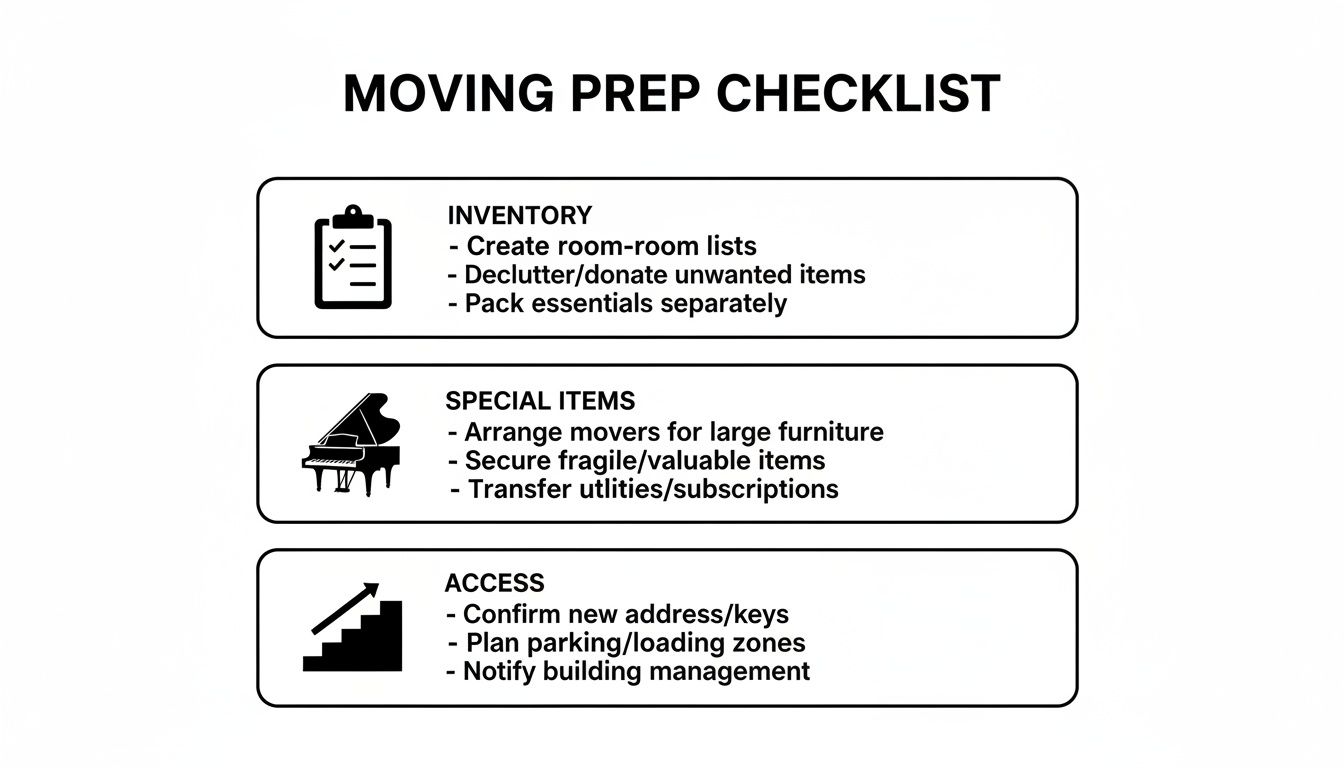
The Ultimate 2026 Moving House Checklist Change of Address Guide

Moving house is a monumental task, but updating your address shouldn't be the most stressful part. Overlooking a crucial update can lead to missed bills, lost mail, and compliance headaches. This is your definitive moving house checklist for change of address, meticulously organised to guide you through every notification, from two months out to your first week in your new home. We’ll cover every essential service, from government agencies like the ATO and VicRoads to your local council, utilities, and subscriptions.

This comprehensive guide is designed to eliminate the guesswork. We'll show you exactly who to notify, when to notify them, and the most efficient way to do it. You'll find direct links and screenshots for key platforms like myGov, Australia Post's Mail Redirection service, and the Australian Electoral Commission (AEC), ensuring you can update your details quickly and correctly. To ensure all your records are updated for a seamless relocation, refer to this comprehensive easy step-by-step guide on how to change your address when moving, which complements our checklist.

Whether you're moving across Melbourne or relocating interstate, this guide ensures nothing falls through the cracks. We provide specific, actionable steps tailored for Melbourne residents, including how to handle VicRoads, your local council rates, and water billing transfers. Our goal is to streamline the administrative side of your move, allowing you to focus on the more important part: settling into your new space. With this checklist, you can transition smoothly, confident that every detail has been organised.

1. Australia Post — Mail Redirection (official)

The very first action on any comprehensive moving house checklist change of address should be setting up an official mail redirection with Australia Post. Think of it as your essential safety net; it catches any mail sent to your old address while you work through the long list of organisations you need to notify. This service ensures critical documents, bills, and even eligible parcels are automatically forwarded to your new home, preventing missed payments and lost information from the moment you move.
![A family smiling and packing boxes for their house move, highlighting the start of the change of address process.](https://cdn.outrank.so/3480eb7a-59b3-411c-a003-0118d5
06deb8/screenshots/b0f7d765-e19e-4e00-8599-6a378e389759/moving-house-checklist-change-of-address-moving-family.jpg)

This service is indispensable for both local Melbourne moves and interstate relocations, providing immediate peace of mind. It acts as a fallback, giving you the breathing room needed to update every single account without the stress of something important slipping through the cracks. For an even more streamlined process, explore our complete moving house address change checklist to see how mail redirection fits into the broader timeline.

Key Features and Pricing

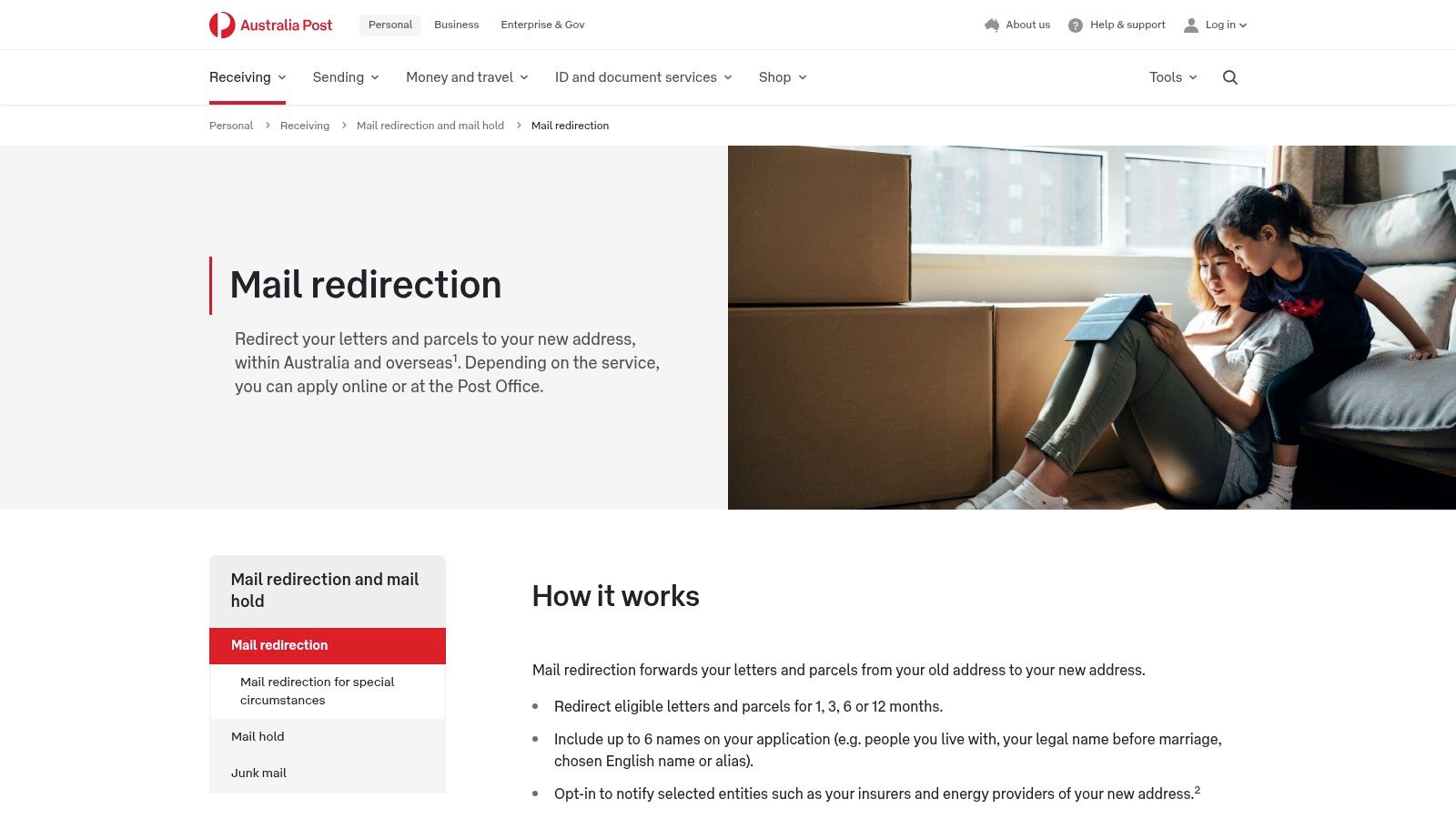
Australia Post offers flexible options to suit different households and moving situations. You can apply easily online with digital identity verification or in-person at a Post Office with the required identification.

  • Service Types: Choose between Personal, Concession, and Home Office/Business redirection plans. A single personal application can cover up to six individual names.
  • Duration: Options range from 1, 3, 6, or 12 months, and you can easily extend or alter your service online if needed.
  • Optional Notifications: During setup, you can opt-in for Australia Post to notify selected partner organisations, like major insurers and energy providers, of your new address on your behalf.
  • Pricing: A standard personal redirection starts from $38.50 for one month, with discounts available for longer durations and concession card holders.

Why It's an Essential First Step

While you must still contact every organisation directly, a mail redirection is the non-negotiable first step that protects you from day one. It’s a simple, official, and nationwide solution that guarantees continuity.

Pros:

  • Instant and official fallback to prevent lost mail
  • Simple online application and management portal
  • Works across Australia, perfect for interstate moves
  • Covers letters and most domestic parcels

Cons:

  • Does not cover all items (e.g., some international mail, registered post requiring ID at the original address)
  • It is a temporary solution; you are still responsible for updating senders directly

Website: https://auspost.com.au/receiving/mail-redirection-mail-hold/redirection

2. myGov — Central place to update government-linked services

After securing your mail with Australia Post, the next critical step in your moving house checklist change of address is updating your details with key government agencies. The myGov platform is your official, secure hub for this task. It allows you to update your address once in your profile and then push that change to multiple linked services, such as the Australian Taxation Office (ATO), Medicare, and Centrelink, saving you significant time and effort.

This centralised approach prevents the hassle of logging into several different government portals and re-entering the same information repeatedly. By consolidating these essential updates, myGov streamlines a crucial part of the moving process, ensuring your government records, tax information, and healthcare details are accurate and sent to your new address without delay. It’s an indispensable tool for anyone moving within Melbourne or interstate.

Key Features and Pricing

The primary benefit of myGov is its efficiency and security. It acts as a single, trusted gateway to your personal government information, making administrative tasks simpler and safer. The service is completely free to use.

  • Service Types: myGov provides a single sign-in to a range of Australian Government services. You can link services like the ATO, Medicare, Centrelink, My Health Record, and the National Disability Insurance Scheme.
  • Address Update Function: Once you update your address in your myGov profile settings, it can be shared with your linked services. This one-to-many update feature is its core advantage for movers.
  • Guidance and Resources: The platform also offers official guidance pages that outline who you need to notify when you move home, acting as a reliable checklist.
  • Pricing: The myGov service is free for all Australian residents.

Why It's an Essential Second Step

While mail redirection is your safety net, myGov is your first major proactive update. Updating your details here ensures that critical government communications are sent directly to your new home from the outset. This is vital for receiving important documents like tax notices, Medicare statements, and social security correspondence. For more advice on organising your move, check out our essential moving house tips for a smoother transition.

Pros:

  • Saves time by updating multiple government agencies at once
  • Official, secure, and direct method for updating records
  • Reduces the risk of errors from re-entering data on multiple sites
  • Provides clear, centralised help and guidance content

Cons:

  • Requires a myGov account and for services to be linked beforehand
  • Does not cover all government bodies (e.g., state-based services like VicRoads) or any private organisations

Website: https://my.gov.au

3. Services Australia — Changing your address (Medicare/Centrelink/Child Support)

Updating your details with Services Australia is a critical component of any moving house checklist change of address, particularly if you receive payments or services through Centrelink, Medicare, or Child Support. This isn't just an administrative task; it's a legal requirement that can directly impact your payments and eligibility for benefits like Rent Assistance. Failing to notify them promptly, often within 14 days for Centrelink recipients, can lead to payment suspensions or debts.
A person on a laptop, focused on updating their address online with Services Australia.

Services Australia provides a centralised and official pathway to update your address across its major programs via your myGov account. This streamlined approach ensures your government records are accurate, preventing disruptions to essential services and support. Managing this step early is an effective way to reduce stress when moving home, as it ticks off several crucial updates in one go.

Key Features and Process

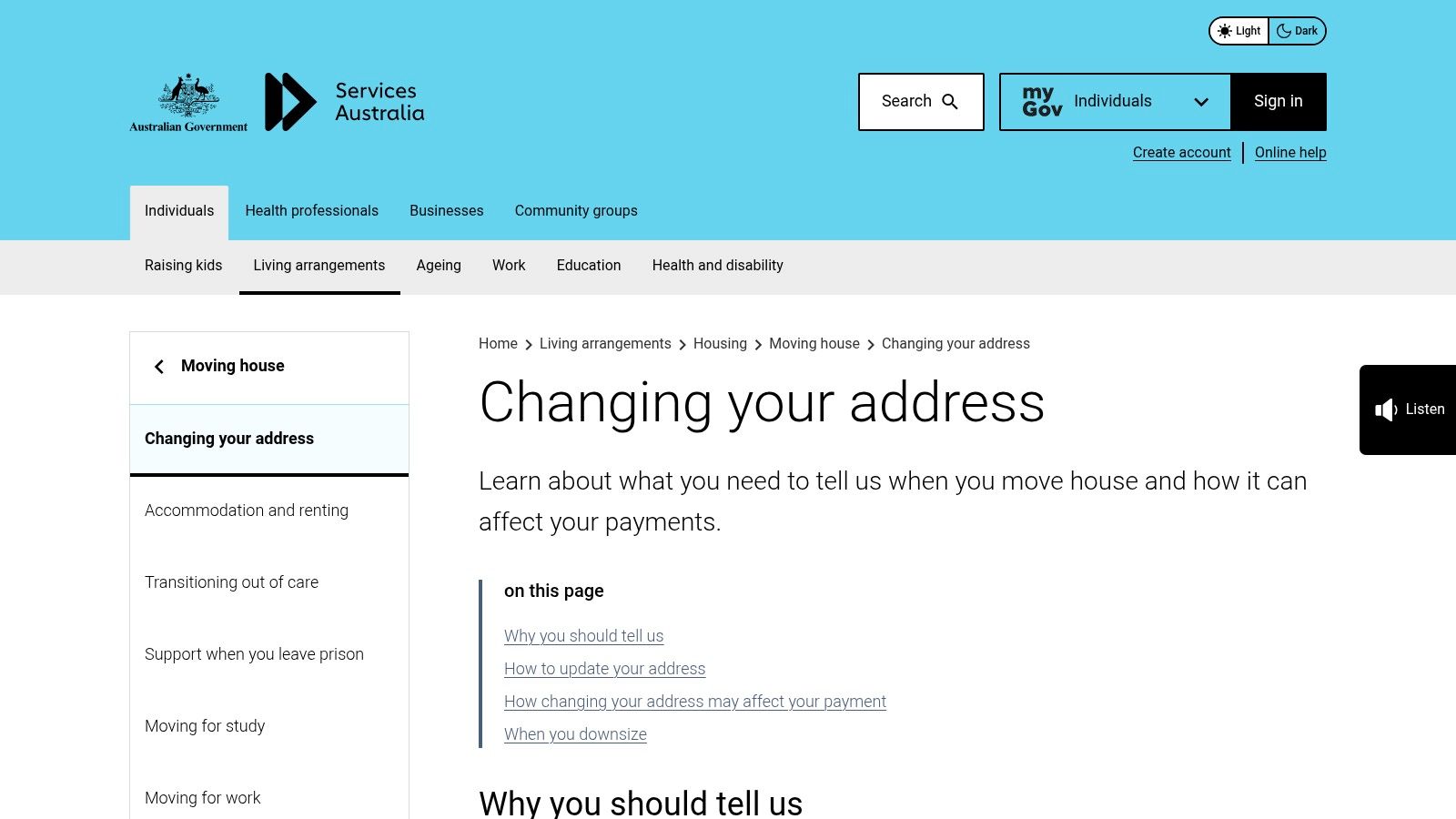
The primary method for updating your address is online through your myGov account, which links directly to your Centrelink, Medicare, and other government services. The platform guides you through the process for each specific service.

  • Centralised Updates: Use your linked myGov account to access and update details for Centrelink, Medicare, and Child Support in one secure environment.
  • Program-Specific Guidance: The website provides clear, step-by-step instructions tailored to each service, outlining exactly what information is needed.
  • Impact on Payments: It offers crucial information on how your change of address can affect entitlements, such as calculating new Rent Assistance rates or other location-based payments.
  • Multiple Access Points: If you cannot update details online, the site provides links to mobile apps (Express Plus Centrelink, Express Plus Medicare) and alternative contact methods.

Why It's an Essential Government Update

Unlike commercial services, this is an official and mandatory update for anyone interacting with federal government support and health systems. Keeping these details current ensures compliance and the seamless continuation of your services and payments. It's a non-negotiable step for millions of Australians.

Pros:

  • Official, secure, and direct way to meet legal obligations
  • Centralised update process via a single myGov login
  • Provides clear information on how your move affects payments
  • Reduces the risk of payment delays, debts, or loss of benefits

Cons:

  • Does not update any other non-government organisations
  • Some complex situations may still require a phone call or in-person visit with additional documentation

Website: https://www.servicesaustralia.gov.au/changing-your-address-if-youre-moving-house

4. VicRoads — Update your address (licence and vehicle registration)

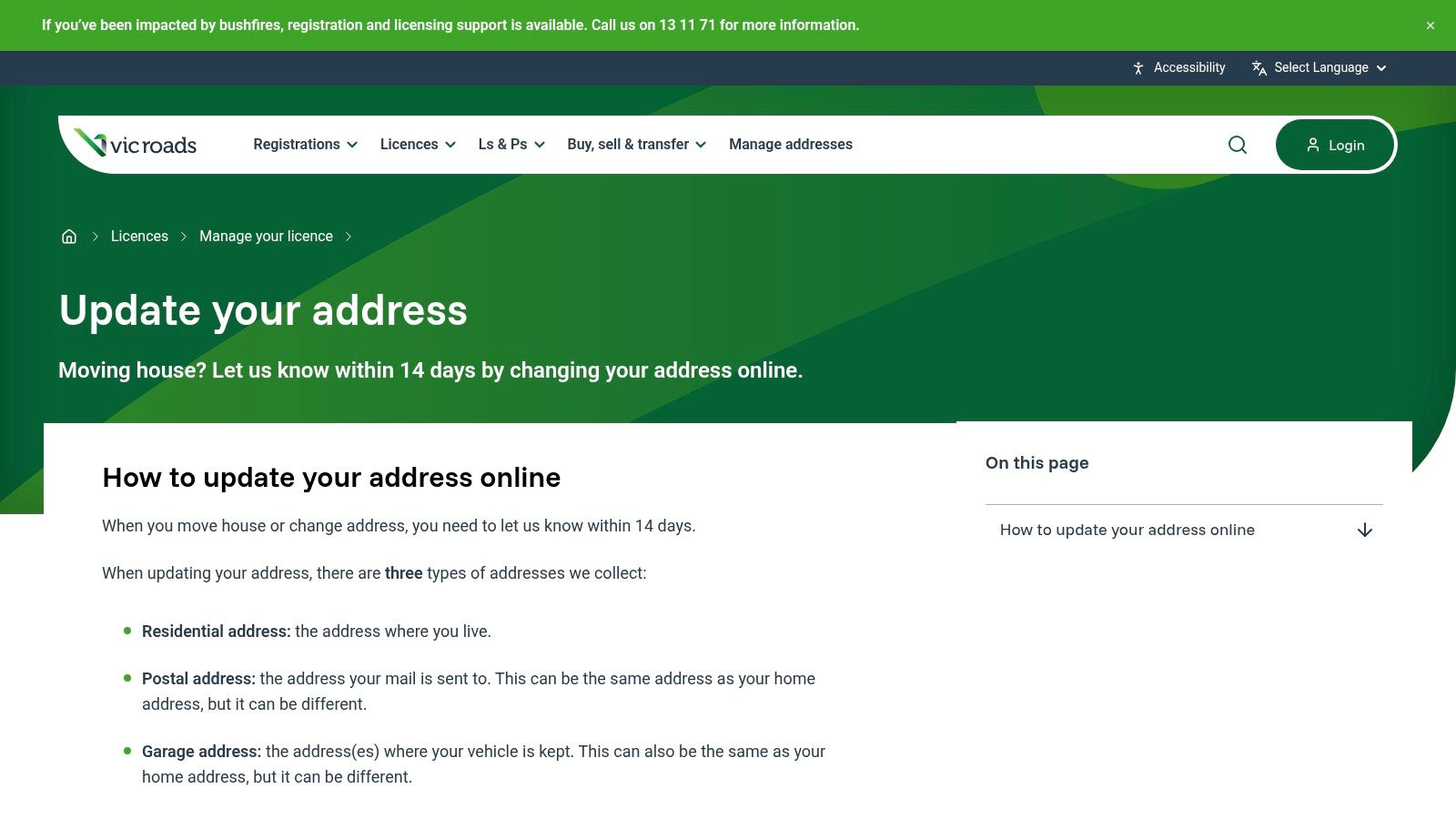
For anyone moving within or to Melbourne, updating your details with VicRoads is a critical and legally required step in your moving house checklist change of address. This isn't just about getting a new licence card; it's about ensuring your vehicle registration, toll notices, and any official correspondence from Victoria’s road authority reach you at your new address. Failing to do so can lead to missed renewal reminders or even fines.
A person using a laptop to update their personal details online, representing the VicRoads change of address process.

The Victorian government mandates that you notify VicRoads of your new residential address within 14 days of moving. This applies to your driver's licence, learner permit, and any vehicles registered in your name. Conveniently, this entire process can be completed online through the myVicRoads portal, making it a quick task you can tick off your list as soon as you have your new address confirmed.

Key Features and Requirements

Updating your details is straightforward and designed for ease of use, with no associated fees for a simple address change. The online system is available 24/7, so you can handle it at a time that suits your moving schedule.

  • Online Portal: The primary method is via a personal myVicRoads account, which allows you to update your residential, postal, and even your vehicle's garage address in one go.
  • Comprehensive Updates: A single update applies to both your licence/permit and all vehicles registered under your name in Victoria.
  • Legal Obligation: Remember that any mail VicRoads sends to the address on their file is legally considered to have been received by you. Promptly updating avoids any potential complications.
  • No Cost: There is no fee to change your address with VicRoads. You will only incur a fee if you choose to order a new licence card showing the updated address, which is generally not required.

Why It's an Essential Legal Step

Unlike some other address changes that are merely for convenience, this one is a legal requirement. It ensures you remain compliant as a driver and vehicle owner in Victoria and guarantees you receive time-sensitive documents like registration renewals, traffic infringements, and toll invoices.

Pros:

  • Legally required, ensuring compliance with Victorian road laws
  • Free and simple online process via the myVicRoads portal or app
  • Updates both licence and vehicle records simultaneously
  • Helps avoid missed fines, tolls, and registration renewal notices

Cons:

  • A strict 14-day update window applies after moving
  • Does not link to other government agencies like the ATO or AEC; you must update them separately
  • Failing to update can result in serious consequences if important notices are missed

Website: https://www.vicroads.vic.gov.au/licences/manage-your-licence/update-address

5. Australian Electoral Commission — Update my enrolment (AEC)

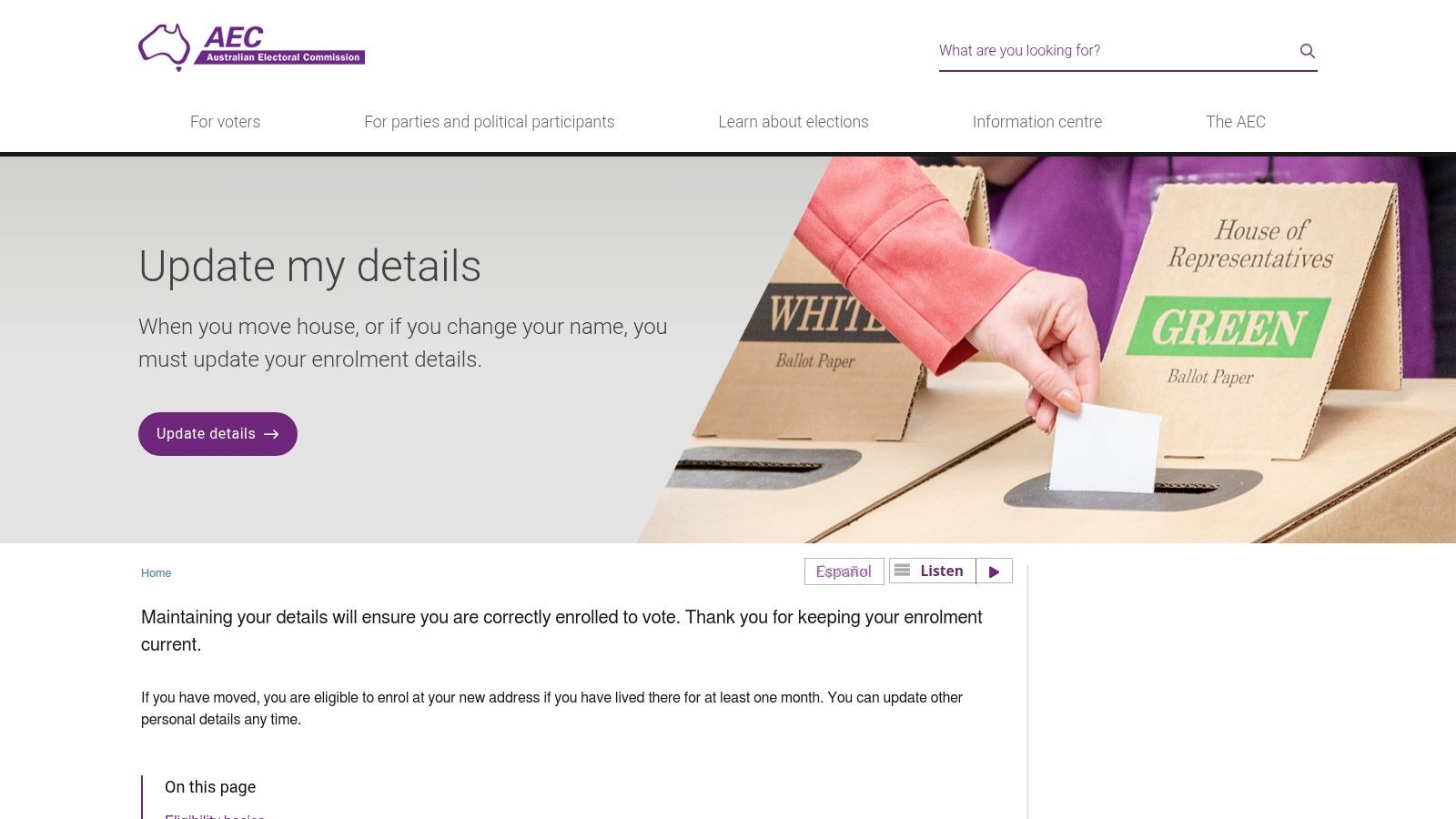
A crucial but often overlooked step in any moving house checklist change of address is updating your details with the Australian Electoral Commission (AEC). This ensures you can participate in federal, state, and local council elections and that you receive important voting information at your new address. Keeping your enrolment details current is a legal requirement for all eligible Australian citizens and a fundamental part of settling into your new community.
A person casting their vote into a ballot box, symbolising the importance of updating electoral enrolment.

The AEC provides a streamlined online portal that makes this task simple and quick. It coordinates with state-based electoral bodies, like the Victorian Electoral Commission (VEC), so one update covers all levels of government. This civic duty is an essential part of your move, ensuring your voice is heard in your new electorate and avoiding potential fines for not voting.

Key Features and Process

The AEC's online system is designed for ease of use, allowing you to update your enrolment in just a few minutes. The process is completely free and secure.

  • Unified System: A single online update covers your enrolment for federal, state, and local government elections, simplifying what could otherwise be a complicated process.
  • Flexible Identity Verification: You can verify your identity using details from your Australian driver's licence, Australian passport, or Medicare card.
  • Timing Requirement: It is important to note that you should have lived at your new address for at least one month before updating your enrolment. This ensures the new address is your primary place of residence.
  • Online and Paper Forms: While the online update is fastest, paper forms are also available for those who prefer or require them.

Why It's an Essential Post-Move Task

Updating your enrolment is a key responsibility after moving house. Neglecting this step can lead to missing out on crucial election information or being removed from the electoral roll, making it harder to vote.

Pros:

  • Free and fast online process to keep your enrolment details correct
  • Ensures you can vote in the correct electorate for all elections
  • Prevents fines for failing to vote
  • Single update covers federal, state, and local rolls

Cons:

  • You must wait one month after moving before you can update
  • It is a separate process and does not update other government services like VicRoads or Centrelink

Website: https://www.aec.gov.au/enrol/update-my-details.htm

6. realestate.com.au — Interactive Moving House Checklist (national)

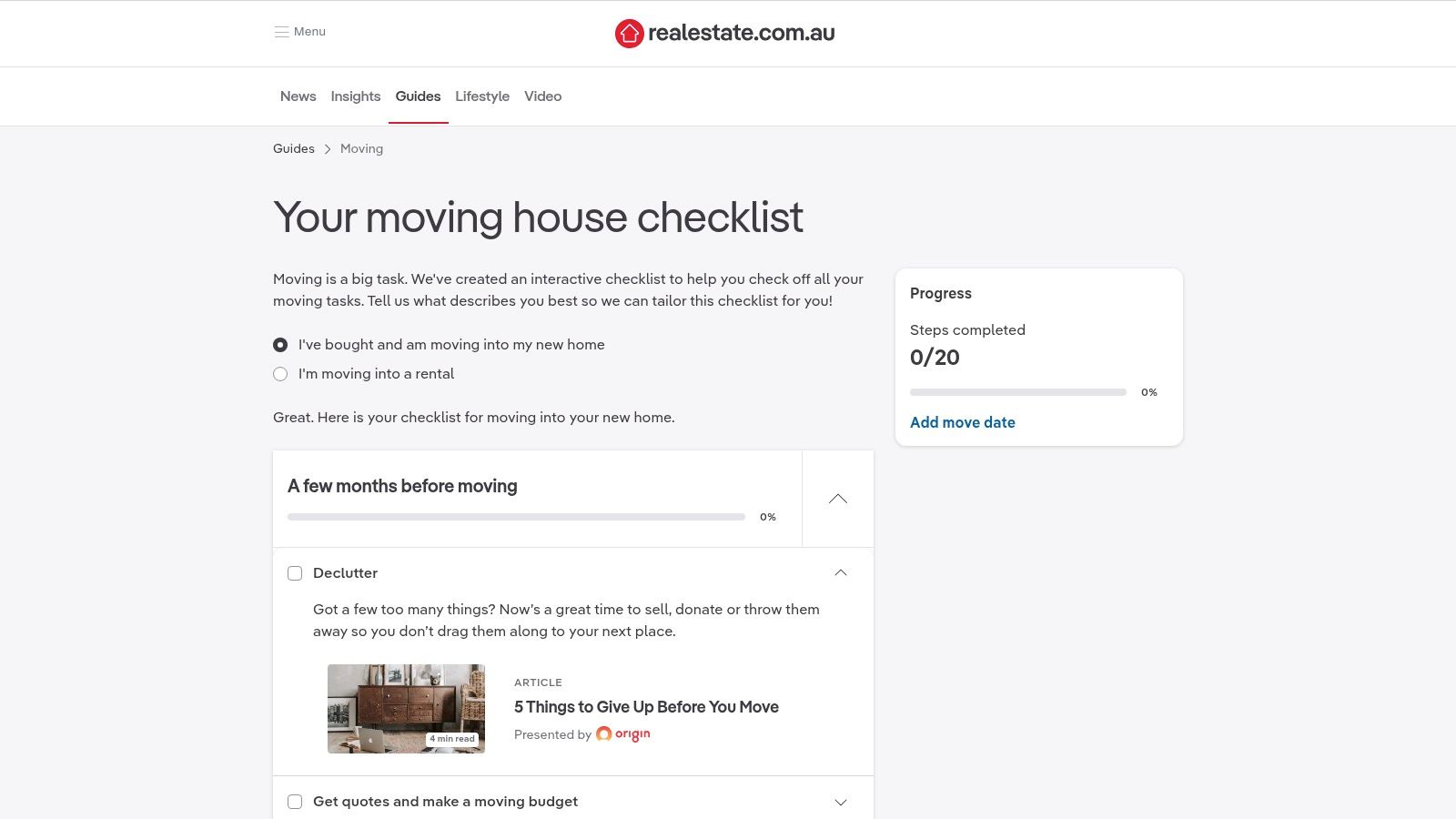
Beyond individual address updates, managing the entire moving process requires exceptional organisation. The interactive checklist from realestate.com.au serves as a comprehensive project management tool, centralising the numerous tasks involved. It broadens the scope of a standard moving house checklist change of address by integrating these updates into a wider timeline of moving-related activities, from decluttering weeks before the move to setting up utilities on arrival.
realestate.com.au — Interactive Moving House Checklist (national)

This free planner is designed to guide you through every stage, offering reminders and direct links for key actions like organising mail redirection and contacting service providers. It customises its suggestions based on whether you are a buyer or a renter, ensuring the advice is relevant to your specific situation. For a deeper dive into organising your move, our complete moving house checklist for Australia provides an excellent framework to use alongside this tool.

Key Features and Pricing

The tool is a free resource designed to simplify the moving journey by consolidating tasks and providing helpful guidance in one accessible location.

  • Customisable Timelines: The checklist is tailored for buyers versus renters, acknowledging the different tasks and legal requirements for each.
  • Progress Tracking: Users can tick off completed tasks, providing a clear visual overview of what has been done and what still needs attention.
  • Comprehensive Categories: It covers everything from administrative tasks (insurance, address updates) to practical logistics (booking removalists, packing supplies, utility connections).
  • Free Planning Resource: Access to the checklist and associated moving guides is completely free, supported by one of Australia's most recognised real estate platforms.

Why It's a Valuable Planning Tool

While not an official service for changing your address, this interactive checklist excels at providing structure and preventing overwhelm. It ensures you don't forget crucial steps that go beyond simple address updates, like final meter readings or organising bond cleaning.

Pros:

  • Excellent free tool for organising the entire moving process
  • Consolidates dozens of moving tasks into one manageable list
  • Customised advice for both renters and homeowners
  • Backed by a trusted brand with extensive property-related resources

Cons:

  • Includes promotional content and links to partner services
  • Acts as a guide; you must still complete all official address changes yourself

Website: https://www.realestate.com.au/advice/your-moving-house-checklist/

7. Connectnow — Free utility connection concierge

One of the most time-consuming parts of any moving house checklist change of address is contacting individual utility providers to disconnect services at your old home and establish them at your new one. Connectnow offers a streamlined solution, acting as a free concierge service that handles this entire process for you. It simplifies a complex task into a single point of contact, saving you hours of phone calls and potential coordination errors.

This service is a game-changer for anyone moving, whether across Melbourne or interstate. Instead of juggling separate accounts for electricity, gas, and internet, you provide your details once, and their Australian-based team coordinates the rest with their panel of providers. This service fits perfectly within our broader guide, which you can explore in this moving into a new house checklist, to ensure all your essential services are active from day one.

Key Features and Pricing

Connectnow removes the friction from setting up essential home services, all at no cost to you. Their business model is based on receiving a commission from the providers they partner with, meaning the service is completely free for movers.

  • Service Types: Arrange connections and disconnections for electricity, gas, internet, phone, and Pay TV.
  • Process: You complete a single online form with your move details. An Australian-based consultant then calls you back to discuss options and finalise the arrangements.
  • Provider Panel: They compare and organise services from a selected panel of well-known Australian utility and telecommunication companies.
  • Pricing: The service is 100% free for customers. You only pay the standard rates and connection fees charged directly by your chosen utility provider.

Why It's an Essential Time-Saver

While you could contact every provider yourself, a concierge service like Connectnow consolidates a dozen phone calls into one. It significantly reduces the administrative burden during a stressful move, allowing you to focus on packing and logistics.

Pros:

  • Saves a significant amount of time and effort
  • Completely free service for the user
  • Manages both new connections and existing disconnections
  • Reduces the chance of forgetting a key utility provider

Cons:

  • Comparison is limited to providers within their partner network, not the entire market
  • You still have to pay the standard connection fees from the utility companies
  • The final service terms and conditions are set by the individual providers

Website: https://connectnow.com.au/

7-Point Change-of-Address Services Comparison

Service Implementation complexity 🔄 Resource requirements ⚡ Expected outcomes 📊 Ideal use cases 💡 Key advantages ⭐
Australia Post — Mail Redirection (official) Low — apply online or at Post Office with ID Low cost + minimal admin (from $38.50) High — letters/eligible parcels forwarded temporarily Short‑term fallback while updating contacts; interstate moves Official nationwide service; optional notifications to selected senders
myGov — Central place to update government‑linked services Medium — requires myGov account and service linking Low time once linked; initial setup required High for linked services — updates multiple agencies at once Updating ATO, Medicare, Centrelink and other linked government records Secure, centralised updates; saves duplicate agency updates
Services Australia — Changing your address (Medicare/Centrelink/Child Support) Medium — sign‑in paths and program‑specific steps Moderate — may need documents or phone contact High — ensures correct payments and entitlements Recipients of Centrelink/Medicare/Child Support; avoid compliance issues Clear, official guidance on how moves affect entitlements
VicRoads — Update your address (licence and vehicle registration) Low — online via myVicRoads or app (legal requirement) Low time; must update within 14 days to comply High — licence/registration records updated; avoid fines Victorian drivers/vehicle owners needing legal record update Legally required; 24/7 online updates and mobile app
Australian Electoral Commission — Update my enrolment (AEC) Low — online form; identity verification needed Low effort; timing restriction (usually 1 month at new address) High — keeps federal/state/local enrolment correct Voters who moved and must vote in new electorate Fast online update; preserves voting rights at correct location
realestate.com.au — Interactive Moving House Checklist (national) Low — user customisable tool, web interface Low time to customise; free to use Moderate — better planning and fewer missed tasks Movers who want a consolidated task list and reminders Customisable checklist, progress tracking and practical guides
Connectnow — Free utility connection concierge Low — submit online form and receive call‑back Low user effort; provider fees still apply for services Moderate‑High — consolidated utility connections and disconnections People who want one intake for electricity, gas, internet, phone, Pay TV Free concierge service; handles multiple utilities and reduces errors

From Checklist to Complete: Let Us Handle the Heavy Lifting

You’ve meticulously worked through your moving house checklist change of address, ticking off every digital notification and mail redirection. From updating your details on myGov and with VicRoads to ensuring your utilities are seamlessly transferred via Connectnow, the administrative side of your move is now firmly under control. This systematic approach, leveraging tools like the Australia Post Mail Redirection service and the AEC’s online portal, is the first crucial step towards a smooth transition into your new home.

By breaking down the process into a structured timeline and distinct categories, you’ve transformed a potentially overwhelming task into a series of manageable actions. You now understand the critical importance of notifying government bodies, financial institutions, and service providers well in advance. This foresight prevents lost mail, service interruptions, and the last-minute stress that often accompanies a move. You’ve organised the paperwork, now it’s time to perfect the physical relocation.

Key Takeaways for a Flawless Move

To synthesise the information covered, let’s revisit the most critical takeaways from this comprehensive guide:

  • Start Early, Finish Calmly: The single most effective strategy is to begin the change-of-address process at least four to six weeks before your move. This provides ample time for mail redirection to activate and for all organisations to update their records.
  • Centralise with Digital Tools: Utilise central hubs like myGov to update multiple government services (Medicare, Centrelink) at once. This efficiency is your greatest asset during a busy period.
  • Don’t Forget the Locals: For Melbourne residents, remembering to update your local council for rates and pet registration, as well as your specific water retailer, is essential to avoid billing complications.
  • Prioritise Your Communications: Your financial institutions (banks, superannuation funds) and insurance providers should be at the top of your list to ensure financial security and continuous coverage for your home, contents, and vehicle.

While this checklist focuses on household moves, businesses undertaking a relocation might find a professional office IT relocation service guide invaluable for their technology setup.

Your Next Step: From Paperwork to Packing

With the administrative checklist complete, the focus now shifts to the physical logistics of your move. The same principles of organisation and planning apply. While the tools we've discussed manage your data, a professional moving service manages your most valuable possessions. You need a team that operates with the same level of care and precision that you’ve applied to your address changes.

As a top-rated, family-owned Melbourne moving company with over a decade of dedicated experience, we understand that a successful move is about more than just transport. It’s about trust, reliability, and peace of mind. Our team of full-time, police-checked professionals provides a seamless experience, from expert packing and careful furniture disassembly to secure transit in our company-owned fleet. Whether you’re moving across Melbourne, relocating interstate to Sydney or Brisbane, or require secure storage, we offer transparent pricing and a dedicated point of contact to eliminate stress. Let us handle the heavy lifting, so you can focus on settling into your new home.


Now that your moving house checklist change of address is sorted, let Get n Go Removals Melbourne manage the physical journey with the same level of professional care. Visit Get n Go Removals Melbourne to receive a comprehensive, obligation-free quote and ensure your move is as organised and stress-free as your paperwork.

READ MORE

Storage Prices Melbourne: The Ultimate 2024 Cost Guide

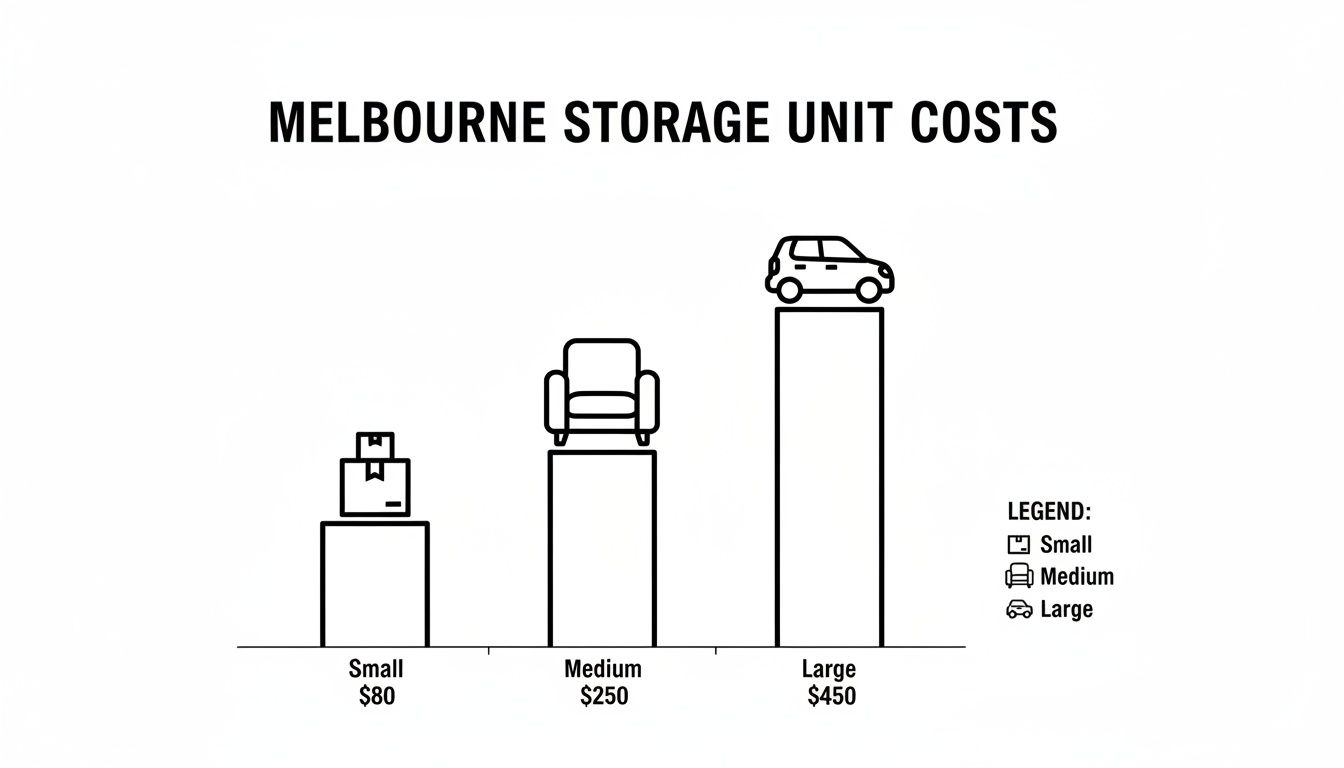
Trying to pin down the exact cost of a storage unit in Melbourne can feel a bit like guesswork. As a guide, you can expect to pay anywhere from $80 a month for a small locker to over $450 for a large, garage-sized space. The final price tag depends on a few key things: the size of the unit, its location within Melbourne, how long you need it, and any special features like climate control or 24/7 access.

This guide breaks down every factor, giving you the clarity needed to find the perfect storage solution for your house or office move without overpaying.

Decoding Melbourne Storage Prices: What Drives the Cost?

So, how do storage companies actually land on these numbers? It might seem complex, but understanding the basics is the first step to making a smart choice, whether you’re moving house, clearing out clutter for a renovation, or storing business stock.

The biggest factor, hands down, is the size of the unit.

Think of it like buying a coffee. A small espresso costs a lot less than a giant iced latte with all the trimmings. In the same way, a compact locker for a few archive boxes will always be cheaper than a unit big enough to swallow the contents of a three-bedroom home. This simple relationship between size and price is the core of how all storage is priced.

Typical Price Brackets for Melbourne Storage

To help you budget, storage prices in Melbourne tend to fall into a few predictable brackets based on square metres. Knowing these rough ranges makes it much easier to compare quotes from different facilities. The trick is to match your belongings to the right-sized unit so you’re not paying for empty air.

If you want to see how different options stack up, our guide to storage solutions in Melbourne is a great place to start.

This chart gives you a quick visual breakdown of what you can expect to pay each month for small, medium, and large units around the city.

A bar chart comparing Melbourne storage unit costs for small, medium, and large sizes, with visual icons and prices.

As you can see, the price jumps significantly as you go from a small unit for boxes and odds and ends to a large one that can hold furniture, appliances, or even a vehicle.

To give you a clearer idea, here’s a quick summary of what you might expect to pay.

Estimated Monthly Storage Prices in Melbourne

This table breaks down the typical monthly costs for different self-storage unit sizes across Melbourne, giving you a handy reference for planning your budget.

Unit Size (Approx.) Typical Use Case Average Monthly Price Range
2-3 sqm A few boxes, small furniture (e.g., student dorm room) $80 – $140
4-6 sqm Contents of a 1-bedroom apartment $150 – $220
7-9 sqm Contents of a 2-bedroom apartment or small house $230 – $350
10-15 sqm Contents of a 3-bedroom house $360 – $480
15+ sqm Contents of a 4-5 bedroom house, or for commercial inventory/vehicle $450+

These are just ballpark figures, of course. The actual price you're quoted will depend on the specific facility and the other factors we'll dive into next.

Key Takeaway: Space is the single biggest driver of storage costs. The most effective way to keep your budget in check is to accurately figure out how much room you actually need.

Getting to grips with how providers set their rates is a bit like understanding how any business goes about building a pricing model. It helps you see why prices can vary so much from one suburb to the next. While this gives you a starting point, we'll now look at how things like location, access, and how long you need storage for can change those initial estimates.

How Unit Size and Type Shape Your Final Quote

When you're trying to figure out storage prices in Melbourne, the first and most important thing to look at is the physical size of the unit. Think of it like booking a hotel room: you wouldn't get the penthouse suite if all you need is a single room for the night. The trick is to find that sweet spot—enough space for your things without paying for air.

It’s easy to get bogged down in measurements like "3×3 metres" or "6×3 metres." So, let's put that into perspective. A small 3x3m unit is about the size of a standard Aussie spare bedroom. It's perfect for everything from a one-bedroom flat, easily fitting a bed, small sofa, TV, and around 20-30 moving boxes.

If you’re packing up a typical three-bedroom house, you’ll probably need something bigger, like a 6x3m unit. That’s roughly the same size as a single-car garage. This space can comfortably take on major appliances like your fridge and washing machine, large furniture sets, and stacks of boxes. Getting this right is the key to avoiding the classic mistake of overestimating and wasting money.

A long row of beige self-storage units with brown doors, an end unit is green, with a 'PRICE SNAPSHOT' banner.

Different Storage Types and Their Costs

Beyond just the dimensions, the type of storage you choose really sways the monthly cost. Not all storage is built the same, and the right one for you comes down to what you're storing.

You'll generally come across these options:

  • Standard Self-Storage Units: These are your bread-and-butter, most affordable choice. Think of them as a secure, private room or garage-style space in a large facility. They offer great protection from the weather but don't have any internal temperature regulation.
  • Climate-Controlled Storage: This is the premium option where the unit's temperature and humidity are kept in a specific, stable range. It costs a bit more, but for sensitive items, it's non-negotiable.
  • Mover-Managed Storage: Often offered by professional removalists, this service bundles moving and storage into one neat package. Your belongings are professionally handled, packed into secure modules, and kept in a private warehouse, offering top-notch security and total convenience.

Picking the right type is all about what you're putting away. For garden tools, sturdy furniture, or general household bits and pieces, a standard unit is usually more than enough. But for certain valuables, that extra cost for a specialised unit is a smart investment. For a deeper look at these, you can check out our detailed guide on how much self-storage costs.

When Climate Control Is Worth the Extra Money

Melbourne’s four-seasons-in-one-day weather can be brutal on delicate belongings. Hot summers and damp winters can cause real damage over time. Climate-controlled units cost more because they run HVAC systems 24/7, but this extra spend is what protects your most precious items.

You should seriously consider a climate-controlled unit if you are storing things like antique wooden furniture, musical instruments (especially pianos), electronics, artwork, important documents, or vintage clothing. The stable environment stops wood from warping, prevents mould and rust, and protects against the degradation that extreme temperature swings and humidity can cause.

The pricing tiers in Melbourne are structured pretty clearly around these factors. A tiny 1x1x1m locker might kick off with a promotional rate around $22.50 per month. This scales up to medium 3x3m units, which usually sit between $180–$250. Large, garage-style 6x3m units can fetch $300–$450 or more, especially with those tempting introductory offers. It’s always worth exploring a detailed breakdown of local pricing to see how the different options can fit your budget.

The Impact of Location on Melbourne Storage Costs

Anyone who's ever looked at Melbourne's property market knows the golden rule: location is everything. Well, the exact same principle applies when you're looking for a storage unit. The postcode of your facility has a massive say in the final price you'll pay, and knowing how this works can save you a serious amount of cash.

Think of it like renting an apartment. A place in South Yarra is always going to cost you more than a similar one out in Sunshine. It’s no different for storage. A unit in a prime inner-city suburb carries a premium price tag. It's not arbitrary; it's simple economics. The land value in places like Richmond, Port Melbourne, or the CBD is through the roof, and those costs inevitably get passed on to the customer.

So, if you need to be able to pop in and grab things at a moment's notice, the convenience of a central spot comes with a higher monthly bill. For a local business that needs daily access to stock, that extra cost can be a worthwhile trade-off.

Why Inner City Storage Costs More

It’s not just about the high price of land, either. A few key factors are at play that ramp up the cost in central Melbourne:

  • Higher Demand: The inner suburbs are packed with apartment dwellers and businesses, all fighting for a very limited amount of space. This competition naturally drives prices up.
  • Accessibility: Facilities near major roads and commercial centres are just plain convenient, and you pay for that ease of access.
  • Operational Costs: It's not just rent. Things like council rates and utilities are generally more expensive closer to the CBD, and all of that gets baked into your storage fee.

This creates a really clear price gap across the city. In some cases, facilities in the inner suburbs can be up to 50% more expensive than ones further out. If you're weighing up your options, our guide to storage units and prices near you is a great place to start comparing what's on offer locally.

The Financial Advantage of Outer Suburbs

If you don't need daily, immediate access to your things, looking towards Melbourne's outer suburbs is the single best way to slash your storage bill. Areas like Werribee in the west, Frankston in the southeast, or Epping up north offer much more competitive prices for the exact same amount of space.

Sure, the drive might take a bit longer, but the savings can be huge. This is especially true for long-term storage, like when you’re in between houses or putting office furniture away for a few months. It's a game-changer, letting you make a smart call that balances your budget with convenience.

Key Insight: For long-term storage, the money you save by choosing a facility in an outer suburb will almost always outweigh the inconvenience of a longer drive. We're talking hundreds of dollars saved over the rental period.

To give you a real-world picture of this, let's look at the price difference. A standard unit in West Melbourne might set you back around $290 a month, while a similar unit in a popular spot like Richmond could be as much as $350. Contrast that with more budget-friendly suburbs like Werribee or Frankston, where you can often find large units for somewhere between $250–$300. That's a massive saving for anyone willing to store their gear a bit further afield.

This table gives you a quick snapshot of the price differences you can expect for a standard medium-sized unit across the city.

Melbourne Suburb Storage Price Comparison (Medium Unit)

Suburb Type Example Suburb Estimated Monthly Price
Inner City Richmond / South Yarra $280 – $380
Middle Suburbs Preston / Box Hill $220 – $300
Outer Suburbs Werribee / Frankston $180 – $250

Once you understand how geography affects the price, you can pick a storage solution that actually fits your needs. If you’re storing items you won't need for a while, looking beyond the city centre is the smartest financial move you can make.

What Else Affects Your Storage Price?

The weekly or monthly rate you see advertised is often just the starting point. Beyond the obvious things like the size of the unit, a few other crucial factors can quietly nudge your final bill up or down. To budget accurately and avoid any nasty surprises, you need to know what these are.

Aerial view of Melbourne cityscape, coastline, and green fields with 'LOCATION MATTERS' text overlay.

One of the biggest variables is how long you plan to stick around. Much like your phone or internet plan, storage facilities tend to reward commitment with better rates.

The Trade-Off Between Flexibility and Discounts

Deciding how long you’ll need storage for has a direct impact on your wallet. Most facilities will give you two main options, each with its own pros and cons.

  • Month-to-Month Flexibility: This is the go-to for most people. It gives you the freedom to end your rental with just a bit of notice. It’s perfect if you’re in a bit of a holding pattern, like waiting for a settlement date, but you'll usually pay a bit more for that convenience.
  • Long-Term Commitment: If you know you’re going to need storage for six months, a year, or even longer, you can often lock in a much better rate. By prepaying or signing a longer agreement, some places will knock 5-15% off the standard monthly price.

So, if you're planning a big home renovation or heading overseas for a while, committing to a longer term is a smart move that can save you a fair bit of cash.

When you're comparing storage prices in Melbourne, make sure you ask about discounts for longer commitments. Even a small monthly saving really adds up over a year, potentially putting hundreds of dollars back in your pocket.

The Cost of Convenience and Access

How you get to your stuff – and when – also plays a part in the price. Not all units are created equal, and facilities will charge a premium for features that make your life easier.

For example, a ground-floor, drive-up unit will almost always cost more than the exact same size unit on an upper level that you have to access via a lift. You're paying extra for the sheer convenience of parking your car or truck right at the door, which makes loading and unloading a whole lot faster. For a business shifting inventory or a family with heavy furniture, that extra cost is often well worth it for the time and back-breaking effort it saves.

In the same way, 24/7 access can add to your monthly fee. Most facilities have pretty generous opening hours, but the ability to get to your belongings at any time of the day or night is a premium feature. It costs more for the facility to provide that securely, and that cost is passed on.

The Non-Negotiable: Insurance

Finally, there’s one cost that catches a lot of people by surprise: insurance. Pretty much every reputable storage facility in Melbourne will require you to have insurance for your stored goods. This isn’t just an upsell; it’s a non-negotiable part of the deal that protects both you and the facility.

You’ve usually got two ways to handle this:

  1. Facility-Provided Insurance: Most places offer their own insurance policy, which you can just add to your monthly bill. It's the simplest option.
  2. Your Own Policy: Some facilities might let you use your existing home and contents insurance, but you'll need to check that it specifically covers items stored off-site.

This is an essential cost, so make sure you factor it into your budget from the very beginning. That way, there are no shocks when it’s time to sign the rental agreement.

Actionable Tips for Reducing Your Storage Bill

Knowing what drives storage prices in Melbourne is half the battle. Now it's time to put that knowledge to work and actually trim down your costs. With a few clever moves, you can make a real dent in your monthly storage bill without giving up on security or easy access. It really just comes down to smart planning.

One of the easiest wins? Declutter before you even start searching for a unit. Be ruthless about it. Every single item you can sell, donate, or toss is one less thing you need to pay to keep. This one step alone can often mean you can get away with a smaller, and much cheaper, unit.

Maximise Your Space and Find Deals

Once you’ve whittled down your belongings, the next job is packing like a pro. Think of it as a real-life game of Tetris – the aim is to use every last centimetre of the space you’re paying for.

Here’s a quick checklist to help you save:

  • Book Online: A lot of storage facilities have online-only specials or first-month-free deals that you simply won't get if you just show up. Always have a look at their websites first.
  • Pack Smart: Using boxes of the same size makes stacking a breeze. Take apart bulky furniture like bed frames and dining tables; they take up way less room stored on their side.
  • Go Vertical: Don’t be afraid to stack high. Put your heavy, solid items on the bottom to create a stable base, then pile the lighter things on top. Just remember to leave a little aisle so you can get to the stuff at the back without a major excavation.

Pro Tip: You're paying for the height of the unit, not just the floor space. Stacking well is one of the best tricks in the book for getting maximum value and possibly even dropping down a unit size.

The Financial Sense of Bundling Services

Here’s a strategy that often gets overlooked: bundling your moving and storage with the same trusted company. This isn’t just about making life easier; it's a solid financial decision. A professional removals team are masters at packing a storage unit for maximum efficiency, often squeezing your belongings into a smaller space than you ever could on your own.

That expertise translates directly into money saved. Renting a smaller unit month after month quickly adds up, and those savings can easily cover the cost of the professional packing service. On top of that, it just makes the logistics simpler, cuts down on stress, and gives you one point of contact for the whole job. If you’re looking for an all-in-one solution, checking out options for short-term storage in Melbourne that are linked to a moving service is a great starting point.

For anyone keeping a close eye on the budget, this can be a genuine game-changer. You can find surprisingly affordable self-storage in Melbourne if you know where to look. For instance, a compact 9m³ unit might go for around $180 per month, which works out to a very competitive $20 per m³. When you pair this with an experienced moving company, the savings become even more obvious; two professional removalists can pack 10m³ in an hour for about $170, a far more efficient use of time and money than some standalone services.

Finding the Right Partner for Your Move and Storage

Choosing where to store your belongings in Melbourne goes far beyond just comparing monthly fees. The lowest storage prices Melbourne can offer won't matter if the service is dodgy or unreliable. It’s about finding a genuine partner you can trust with your possessions, whether for a few weeks during a house move or for several months while relocating your office.

Looking beyond the price tag means figuring out what real value you’re getting. This starts with the absolute fundamentals: security and the quality of the facility itself. You need to know your items are not just being stored, but properly protected.

A person's hands are marking a grid on a clipboard next to a Rubik's cube and cardboard storage boxes.

Assessing True Value and Security

Before you even think about signing on the dotted line, you have to dig into the security measures a facility has in place. Any trustworthy provider should offer robust protection that lets you sleep at night.

Here are the non-negotiables to look for:

  • Comprehensive CCTV Surveillance: We’re talking 24/7 video monitoring that covers every access point, hallway, and loading bay. No blind spots.
  • Secure Access Control: Modern, professional facilities will have electronic gated access that requires a unique PIN code to get in and out.
  • Individually Alarmed Units: This is a fantastic extra layer of security. It alerts staff if your specific unit is opened without authorisation.
  • Facility Cleanliness: Honestly, a clean, well-kept facility is a huge clue. It shows a professional operation that actually cares about its customers' belongings.

Beyond the facility's built-in security, you might also need to think about things like getting a solid lock for your unit. If you ever find yourself locked out or need an upgrade, having reliable local Melbourne locksmith services on call is a lifesaver.

The Advantage of an All-in-One Service

One of the best ways to keep the whole process smooth and stress-free is to choose a company that handles both your move and your storage. It just makes sense. Using an integrated service simplifies every single logistical headache.

Instead of trying to be the middleman between a moving company and a separate storage facility, you have one point of contact. One team that’s accountable for everything.

This integrated approach is about more than just convenience; it’s about investing in peace of mind. Knowing your move is managed from start to finish by one fully insured, police-checked team dedicated to your needs is invaluable.

This seamless process means total accountability. The same professional team that packs and transports your items is responsible for keeping them safe in storage. This completely eliminates any finger-pointing between different companies and guarantees a consistently high standard of care.

For anyone navigating the chaos of relocating, discovering the value offered by the best moving companies in Melbourne that provide integrated services can make all the difference. Ultimately, partnering with a trusted all-in-one provider like Get n Go Removals transforms a potentially stressful ordeal into a well-managed and secure experience.

Frequently Asked Questions About Melbourne Storage

To help you get your plans locked in, we've pulled together some of the most common questions we hear from Melburnians about storage. Here are some straightforward answers to help you make the right call.

How Much Storage Space Do I Need for My House?

Figuring out the right amount of space can feel a bit like guesswork, but there's a pretty reliable rule of thumb we use in the industry. A standard 3-bedroom house usually fits quite comfortably into a 3x6m storage unit — that's about the same size as your average single-car garage.

If you're in a smaller 1-2 bedroom apartment, you'll likely find a 3x3m unit is more than enough room for all your furniture and boxes.

The best way to know for sure? Grab a pen and paper and do a quick inventory. Jot down your big items (couches, beds, fridge, washing machine) and get a rough count of your moving boxes. This simple step takes just a few minutes and gives you a much clearer picture, so you don't end up paying for empty space you just don't need.

Is Storage Insurance Required in Melbourne?

Yes, it almost always is. Just about every reputable storage facility in Melbourne will require you to have insurance for your goods. Think of it as a non-negotiable that protects both you and the facility if something unexpected happens.

You've usually got two main options here:

  • Take out the facility's insurance: Most storage providers offer their own policy, which is super convenient as you can just add it to your monthly bill.
  • Use your existing policy: Some places might let you use your current home and contents insurance, but you absolutely have to check the fine print to confirm it specifically covers items being kept in an off-site storage location.

Our advice? Always ask about the insurance requirements before you sign on the dotted line. It’ll save you any nasty surprises down the track.

What Is the Difference Between Self-Storage and Mover Storage?

The biggest difference really boils down to convenience and who does the heavy lifting. With self-storage, you’re renting an empty unit at a big facility, and you’re entirely responsible for packing the car or truck and moving everything in and out yourself.

Mover storage, which is the kind of all-in-one solution we offer, rolls two big jobs into one. A professional moving company comes to your home, picks up your belongings, and transports them directly to their own secure warehouse. It's a far more streamlined process, saving you the time, physical effort, and hassle of trying to coordinate a mover and a separate storage facility.

When you choose mover storage, you've got one expert team handling everything from your old front door to the new storage space. It means a seamless, accountable process from start to finish.


When you need a moving partner that offers both expert transport and secure storage solutions, you can trust the experienced team at Get n Go Removals Melbourne. We provide a single point of contact for a genuinely stress-free relocation. Visit us at https://www.getngoremovals.com.au to see how we can simplify your next move.

READ MORE

Where to Find packing boxes to buy for a Melbourne Move

When it comes to packing boxes to buy, your best bet is always the sturdy, professional-grade stuff you can get directly from your removalist. These aren't just any old boxes; they're specifically designed for moving, which means they stack properly in the truck and will actually protect your things far better than flimsy second-hand or retail options. The real secret to an organised, damage-free move is using a smart mix of sizes, including those specialised boxes for the awkward or fragile stuff.

Your Ultimate Guide To Buying Packing Boxes

Cardboard packing boxes stacked in a home living room with a 'Packing BOX Guide' sign.

Moving house or office in Melbourne is a huge undertaking, no doubt about it. But picking the right packing materials can turn a mountain of stress into a totally manageable process. It all starts with the boxes—they are the foundation of a good move. Think of this guide as your game plan, full of practical advice to help you dodge common pitfalls like overstuffed boxes or using weak ones that fall apart and put your belongings at risk.

Making the right choices from the get-go really does set the tone for your entire relocation. It’s not just about finding things to put your stuff in; it’s about creating a system that keeps everything safe and makes unpacking on the other side so much easier.

Understanding the Moving Industry Context

The logistics of moving house are part of a massive industry here in Australia. In fact, the removalist sector’s revenue is tipped to grow by 2.8% in the 2025-26 period, mostly because more people are moving locally and interstate again. For Melbourne families and businesses, this means that trusted movers are thriving by offering top-notch packing boxes and materials as part of their service. You can read up on these industry trends and their impact on moving services in Australia.

This consistent demand just goes to show how crucial reliable packing supplies are. Professional removalists know better than anyone that the success of a move literally starts with the quality of the boxes.

A well-packed box is your first line of defence against damage. Choosing professional-grade materials isn’t an expense; it’s an investment in protecting the things you own, from everyday essentials to irreplaceable heirlooms.

First Steps in Your Packing Journey

Before you buy a single box, it helps to get your head around two key ideas that will make all your decisions easier:

  • Box Strength: You’ll see "single-wall" and "double-wall" cardboard mentioned. The difference is huge. Double-wall boxes are non-negotiable for anything heavy like books, or fragile like glassware. They offer way more strength and protection.
  • Quantity Estimation: Running out of boxes halfway through packing is one of the most frustrating parts of moving. A quick estimate based on the size of your home will help you buy the right amount from the start, saving you a mad dash to the shops later.

Once you’ve got these fundamentals down, you’re in a great position to start your packing journey with confidence. This guide will walk you through all the details, making sure you have exactly what you need for a smooth, organised move.

Choosing the Right Types and Sizes of Moving Boxes

When you start looking for packing boxes to buy, it doesn’t take long to realise that one size definitely does not fit all. Using the wrong box for the job is a bit like trying to wear shoes that are three sizes too big—sure, it might work in a pinch, but it’s clumsy, inefficient, and you're just asking for a disaster. Getting the types and sizes right from the get-go is the absolute key to protecting your belongings and keeping your move organised.

Think of your collection of boxes as a specialised toolkit. Each box has a specific purpose, designed to carry certain items safely and efficiently. A small, sturdy box is your best friend for heavy books, while a large but lightweight one is perfect for all your pillows and doonas.

Standard Moving Boxes: The Workhorses of Your Move

Most of your stuff will end up in just a few standard types of cardboard boxes. Knowing what each one is for helps you avoid those classic moving mistakes, like creating a box that’s way too heavy to lift or leaving your fragile items with enough room to rattle around and break.

Here are the essentials you’ll be working with:

  • Book Cartons (Small Boxes): These are small but they are mighty. Their whole purpose is to handle heavy, dense things like books, vinyl records, tools, and all those cans from the pantry. Their compact size is a feature, not a bug—it stops you from overpacking and creating a box that’s impossible to move safely.
  • Standard Boxes (Medium Boxes): This is your versatile, all-rounder box. It’s perfect for a massive range of household items, from kitchen appliances and kids' toys to photo albums and general décor. You get a great balance of packing space and manageable weight.
  • Tea Chests (Large Boxes): Don't be fooled by their large size; these boxes are strictly for light, bulky items. Think bedding, pillows, towels, and larger kitchen gear like pots and pans. Never, ever fill these with heavy items. They can become dangerously heavy and are much more likely to fall apart under the strain.

Speciality Boxes for Ultimate Protection

Beyond the standard trio, there’s a whole world of specialty boxes designed to give tailored protection to your most awkward or valuable possessions. These are the problem-solvers that give you real peace of mind, ensuring everything from your favourite suit to your fine china arrives in one piece.

For instance, when looking at your options, choosing the right box can make all the difference, from heavy-duty moving boxes to specialized boxes like those for delicate Christmas decorations.

The golden rule of packing is simple: match the box to the item. A wardrobe box isn't a luxury; it's a necessity for keeping your clothes crease-free. A dish pack isn't overkill; it's smart insurance for your kitchenware.

Some of the most useful specialty boxes include:

  • Wardrobe Boxes: These tall boxes are a game-changer. They come with a built-in metal bar, so you can hang clothes directly from your closet into the box. This saves an incredible amount of time on ironing and organising when you get to your new place.
  • Dish Packs (Dish Barrels): Built with double-wall cardboard for extra strength, these are absolutely essential for packing fragile kitchen items. Many even come with cell dividers to separate plates, glasses, and mugs, stopping them from chipping or smashing in transit.
  • Picture and Mirror Boxes: These are specifically designed to protect your framed art, mirrors, and large photos. They’re often adjustable or come in sections that you can fit together, creating a custom-sized protective sleeve for each piece.
  • TV and Electronics Boxes: If you’ve long since thrown out the original packaging for your electronics, these heavy-duty boxes are a must. They’re built to handle bumps and often include foam inserts for that extra layer of cushioning.

By putting together a smart packing plan with the right mix of standard and specialty boxes, you’re really setting yourself up for a successful move. For more in-depth strategies, have a look at our guide on how to pack for moving house to make sure every single item is secured properly.

Estimating How Many Packing Boxes You Need

Figuring out exactly how many packing boxes to buy is one of the first, and biggest, puzzles you’ll face when moving. It’s a real balancing act. Buy too few, and you’ll be making frantic, last-minute trips to the shops. Buy too many, and you're left with a mountain of cardboard to get rid of once you've unpacked. The goal is to land right in that sweet spot, and thankfully, it’s more science than guesswork.

While the size of your home or office is the obvious starting point, your lifestyle is just as important. A minimalist in a two-bedroom apartment will have a very different box count to a family of collectors living in the exact same space.

A General Guide by Home Size

A room-by-room inventory is the most accurate method, but a general estimate based on your home's size is a fantastic way to get the ball rolling. It helps you budget and plan, making sure you have the bulk of what you need from day one. For a really clear picture of your total volume, a professional tool like our cubic metre calculator can be a massive help.

To get you started, we've put together a handy table to help estimate your box needs.

Estimated Number of Boxes Needed by Home Size

Home Size Small Boxes (Book/Carton) Medium Boxes (Standard) Large Boxes (Tea Chest) Specialty Boxes (Wardrobe, Picture)
1 Bedroom 10-15 15-20 5-10 2-4
2 Bedrooms 15-25 20-30 10-15 4-6
3 Bedrooms 25-35 30-45 15-20 6-8
4+ Bedrooms 35-50 45-60 20-25 8-12

Remember, this is a starting point. Adjust these numbers up or down based on how long you've lived in your home and the amount of stuff you own.

Start with a Room-by-Room Breakdown

The most reliable way to nail your box count is to walk through your home, one room at a time. Each space has its own unique mix of items, which means different box types and quantities.

Here’s a rough guide to get you thinking:

  • Kitchen: This is almost always the most box-heavy room. You’ll likely need 10-15 boxes, including sturdy dish packs for fragile plates and glasses, plus small book cartons for heavy pantry items, small appliances, and cookbooks.
  • Bedrooms: Plan for around 5-10 boxes for each bedroom. This typically means a mix of medium boxes for folded clothes and décor, large tea chests for doonas and pillows, and at least one wardrobe box for hanging clothes.
  • Living Area: This space usually needs about 8-12 boxes. You’ll want small boxes for books and DVDs, medium ones for electronics and cushions, and specialty picture boxes for any artwork or mirrors.
  • Office: For a home office or a full business relocation, you'll need specialised archive boxes for documents and sturdy cartons for computers and monitors. The number of boxes varies widely based on the amount of paperwork and equipment.

Lifestyle and Length of Residency Matter

Two households in identical homes can have completely different packing needs. The simple truth is, the longer you've lived somewhere, the more you've likely gathered. Someone who has been in the same house for a decade will almost always need more boxes than a person who only moved in last year.

Think about your own habits. Are you a book lover with shelves that are groaning under the weight? A fashion enthusiast with a wardrobe to match? These collections demand a serious number of specific boxes, so be sure to factor them into your count.

A great rule of thumb is to start with an estimate of 10-15 boxes per person in your household. From there, add more based on how long you've lived there and whether you have big collections of books, clothes, or kitchen gear.

Here is a quick look at some common specialty boxes and what they are best suited for.

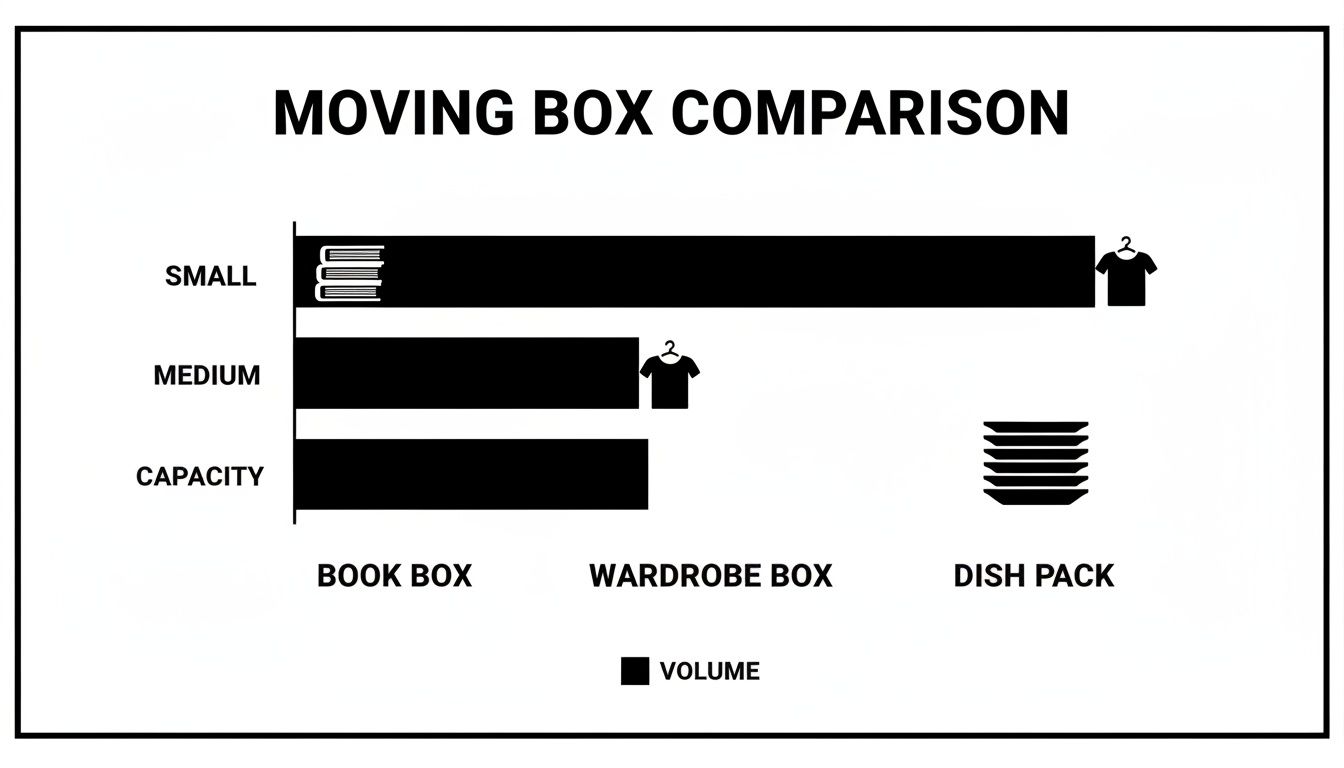
Infographic comparing moving box volumes. Features small, medium, and various box types like book, wardrobe, and dish pack.

As you can see, specialty boxes like wardrobe and dish packs are built for a specific job, protecting your most important items and working alongside your standard boxes. Getting the right mix makes all the difference.

Where to Find Quality Packing Boxes in Melbourne

Once you’ve figured out what kinds of boxes you need and how many, the next big question is: where do you actually get them? In Melbourne, you’ve got a few options, but they are definitely not all created equal. The source you choose can be the difference between a smooth move and a box of broken heirlooms.

Making the right choice here is so important, especially when you’re moving anything valuable or delicate. It can be tempting to just grab the cheapest boxes you can find, but investing in quality materials is one of the most non-negotiable parts of a successful move.

Sourcing Boxes Directly from Your Removalist

Honestly, the most reliable and straightforward way to get your hands on professional-grade moving boxes is to get them straight from your removalist, like us here at Get n Go Removals. It just simplifies everything, giving you one point of contact for your move and your supplies.

There are some real advantages to doing it this way:

  • Designed for Transit: The boxes you get from a professional mover are built for the job. They’re engineered to handle the bumps, jolts, and stacking that happen in the back of a moving truck without getting crushed.
  • Guaranteed Quality: You know you're getting clean, new, and sturdy boxes. This completely sidesteps the risks that come with second-hand boxes, which might have hidden weaknesses, damp spots, or even unwanted pests.
  • Correct Specifications: We supply the exact same boxes our own professional packing teams use every day—from the standard tea chests to specialty wardrobe and picture cartons.

Choosing your mover as your box supplier isn’t just about convenience; it’s about alignment. You get materials perfectly suited for the moving process, recommended by the very experts who will be handling them.

Comparing Professional vs Retail and Second-Hand Boxes

Sure, you can find moving boxes at big hardware stores or on online marketplaces, but the quality can be a real gamble. Retail boxes are usually made for a general audience and might not have the same crush resistance as the professional ones. And second-hand boxes from community groups or the local supermarket? They're the riskiest choice of all, because you have no idea what they've been through.

The need for good supplies is only growing. Interstate moves in Australia are projected to involve 180,000 to 220,000 people annually in 2025, which means a huge demand for reliable packing materials for major routes like Melbourne to Sydney. We're also seeing a 10.5% growth in people leaving the city for regional areas, with many Melburnians heading to places like Bendigo and Geelong. You can find more insights on Australia's population movements from the ABS.

Why a Single Point of Contact Streamlines Your Move

Let's face it, organising a move feels like juggling a dozen different tasks at once. When you get your boxes from Get n Go Removals, you're knocking two major jobs off your list with one call. No need to spend hours researching different suppliers or arranging separate deliveries for your packing gear.

We can deliver everything you need right to your door, making sure you have the right quantity and quality from the very start. This integrated approach saves you time, cuts down on stress, and gives you peace of mind knowing your packing efforts are built on a foundation of professional-grade materials.

To dive deeper into your options, have a look at our detailed guide on where to find moving boxes in Melbourne. It’s all about making your relocation seamless, from the first box you tape up to the last one we unload.

Pro Packing Tips and Essential Moving Supplies

Hands wrapping an item in bubble wrap on a table with packing supplies like tape and boxes, illustrating packing tips.

Getting the right packing boxes to buy is a huge first step, but how you pack them is what really counts. The right technique is the difference between a smooth, damage-free move and a chaotic one that leaves you with a massive headache when it's time to unpack.

Think about it: packing isn’t just about stuffing things into a space. It’s a real skill. It's about balancing weight, protecting your most delicate items, and creating a system so you’re not lost when you arrive at your new home. With a few tips from the pros and the right gear, you can pack with the same confidence as our experienced moving teams.

Nailing the Basics of Packing

A great pack job comes down to a few core principles. Get these right, and you'll sidestep all the common moving day dramas like collapsing boxes, shattered valuables, and throwing your back out lifting a box that’s way too heavy.

Here are the non-negotiables our crews live by:

  1. Get the Weight Right: The golden rule? Heavy things on the bottom, light things on top. This creates a solid base and stops your fragile items from getting crushed. And please, don't overstuff a box. If you can't lift it safely, it's a hazard.

  2. Cushion Everything: Empty space is your enemy. Any gaps let your belongings shift, rattle, and break in transit. Use packing paper, bubble wrap, or even soft fillers like towels and blankets to fill every nook and cranny for a snug fit.

  3. Wrap Your Fragiles: Every single fragile item needs to be wrapped individually in paper or bubble wrap. For things like plates, always stack them vertically on their edge—never flat. They are surprisingly stronger this way and far less likely to crack under pressure.

The Simple Power of a Good Labelling System

A well-labelled box is a gift you give your future self. It turns unpacking from a frustrating guessing game into a logical, room-by-room process. You don't need anything fancy, just a simple and consistent system to stay in control.

Your labelling should always include:

  • The Room: Clearly write which room the box is headed for (e.g., "Kitchen," "Master Bedroom", "Office").
  • A Quick Summary: Briefly list the main contents ("Pots & Pans," "Harry's Books", "Server Cables").
  • Clear Warnings: Use a thick marker to write "FRAGILE" or "THIS WAY UP" in big, bold letters on a few different sides.

An organised move is a calm move. A detailed labelling system is your roadmap to a stress-free unpacking experience, ensuring you can find your coffee maker or phone charger without tearing open every single box.

If you really want to get organised, you could even look into professional tools like label printer machines for perfectly clear, consistent labels.

Must-Have Supplies (Besides the Boxes)

While boxes are the star of the show, they can't do it all alone. You’ll need a few other key supplies in your toolkit to make sure everything is sealed, cushioned, and organised properly. Don't cheap out on these—quality supplies make a world of difference.

Here’s your shopping list:

  • Good Quality Packing Tape: Cheap tape is a nightmare. It doesn't stick properly and can pop open mid-move. Invest in strong, wide packing tape to seal every box without worry.
  • Bubble Wrap: An absolute must for electronics, artwork, mirrors, and anything else that's extra delicate.
  • Packing Paper: Perfect for wrapping your everyday fragile items like glasses and dishes. It's clean, effective, and stops things from scratching each other.
  • Permanent Markers: Grab a couple of thick, black markers so your labels are bold and easy to read from a distance.

With these supplies in hand and a few good techniques, you'll be set for a much smoother move. For a deeper dive, check out our complete guide on packing tips for moving house.

When to Hire Professional Packing Services

Even with the best plan and all the right packing boxes to buy, the sheer physical effort of packing up an entire home or office can be completely overwhelming. It's often the single most time-consuming and stressful part of any move. This is where professional packing services become a real game-changer, turning a daunting marathon into a seamless, hands-off experience.

Hiring experts isn’t just about clawing back some time; it’s about investing in peace of mind. It’s a smart choice for anyone who wants to minimise disruption, protect their valuable belongings, and make sure the whole move is handled with professional precision from the very start.

Scenarios Where Professional Packing Makes Sense

While anyone can benefit from an extra pair of hands, certain situations make hiring professional packers an incredibly savvy move. If you find yourself nodding along to one of these scenarios, a valet service could be the key to a stress-free relocation.

Consider hiring professional packers if:

  • You're Facing a Tight Deadline: A sudden job transfer or a tight settlement date can leave you with no time to spare. Professional teams can pack an entire household in just a fraction of the time it would take most people.
  • You Have a Demanding Schedule: Trying to juggle a full-time job, family commitments, and the endless logistics of a move can stretch anyone to their breaking point. A packing service lets you focus on your daily life while we handle the hard yakka.
  • You're Moving a Large Home or Office: Packing a four-bedroom family home or an entire office is a massive undertaking. Teams of experts can tackle the sheer volume of work efficiently and safely.
  • You Own High-Value or Fragile Items: Got antiques, artwork, or delicate electronics? Professional packers use industry-grade materials and proven techniques to give them maximum protection.

Our Valet and White-Glove Services Explained

At Get n Go Removals, our valet packing and unpacking services are designed to give you a truly comprehensive, door-to-door solution. We don't just put things in boxes; we manage the entire process with meticulous care from start to finish.

This kind of service is becoming more and more vital as many Melburnians are making the move to regional Victoria. Recent data shows that migration from capital cities to areas like Bendigo and Greater Geelong surged by 10.5% in the March 2025 quarter. In fact, moves post-COVID are a huge 20.5% higher than they were before the pandemic. Our flexible 24/7 scheduling and premium materials provide the secure, seamless transition these movers need. You can find more insights about these moving industry trends on austate.com.au.

Choosing a valet service transforms your move from a stressful chore into a managed project. It's the ultimate solution for protecting your time, energy, and valuable possessions, ensuring you arrive at your new property feeling organised and ready to start fresh.

When you book our valet services, here's what you can expect:

  • All-Inclusive Materials: We bring absolutely everything needed, including professional-grade boxes, packing paper, bubble wrap, and heavy-duty tape.
  • Expert Packing: Our trained staff will carefully wrap and pack every single item, from the cutlery in your kitchen drawers to the clothes in your wardrobe.
  • Systematic Organisation: We label everything clearly, which makes unpacking at the other end logical and much more efficient.
  • Full Unpacking Option: We can also unpack everything at your new home, placing items on benches and flat surfaces so it's easy for you to settle in.

By entrusting your packing to a professional team, you're not just buying convenience; you're ensuring every last detail is handled correctly. To get a better sense of the advantages, explore the top 5 benefits of using professional packing services and see how it can truly transform your move.

Your Packing Box Questions Answered

Even after reading a comprehensive guide, there are always a few lingering questions that pop up as you're finalising your moving plans. We get it. Getting straight answers to these last-minute queries can make all the difference, helping you tackle the final hurdles with confidence.

Think of this section as your quick-reference guide for the most common questions we hear about buying and using packing boxes for any house or office move. With these answers, you'll be set to pack efficiently and keep your belongings safe, just like the pros do.

Can I Reuse Old Boxes for My Move?

While it might seem like a thrifty way to save a few dollars, using old boxes from the supermarket or ones you've found online comes with some serious risks. You just never know their history. They often have hidden weaknesses, like structural fatigue from a previous life, unseen moisture damage, or even unwanted pests.

For a secure move, especially when you're packing fragile or heavy items, we always recommend using new, high-quality moving boxes. If you're really set on reusing some older boxes, save them for non-breakable things like clothes or linen, and give them a very thorough inspection for any signs of damage or dampness first.

Is It Cheaper to Buy Boxes in a Kit?

For most people, yes, buying boxes as part of a moving kit is definitely the more cost-effective way to go. Removalist companies often put together discounted packages that are tailored to different home sizes. These kits are great because they include a smart mix of box sizes plus other essentials like packing tape and paper.

Buying a pre-made kit doesn't just save you money compared to hunting down each item individually; it saves you a ton of time. It takes all the guesswork out of figuring out what you need, making sure you have a solid supply to get started.

The team at Get n Go Removals can advise you on the best value kit for your situation, whether you’re moving out of a one-bedroom apartment or a large family home.

How Should I Pack Electronics and Fragile Items?

Your electronics and other fragile possessions need a bit of extra TLC to make sure they arrive in one piece. If you’ve still got the original packaging they came in, that's always your best bet. If not, find a sturdy, double-wall box that's just a little bit bigger than the item itself.

Here’s the simple process our professional packers follow:

  1. Wrap the item completely in a few layers of bubble wrap, taping it securely.
  2. Cushion the bottom of the box with a good layer of scrunched-up packing paper.
  3. Place your wrapped item inside and then fill in all the empty space around it with more paper. You don't want it to be able to shift around at all.
  4. Seal it up and clearly label the box with "FRAGILE," drawing arrows to show which way is up.

For your really high-value electronics or irreplaceable family heirlooms, it's worth considering our professional valet packing service for that guaranteed protection and total peace of mind.

When Is the Best Time to Start Packing?

A good rule of thumb is to start packing at least 2-4 weeks before your moving day. This gives you enough time to work at a comfortable pace without that last-minute feeling of being rushed and overwhelmed.

Begin with the things you use least often—think books, off-season clothes, spare room decor, and anything hiding in the back of cupboards or in the garage. For an office move, start with archived files, surplus stationery, and non-essential equipment. Leave your everyday essentials for the final week. Starting early really does reduce the stress and helps you pack in an organised, thoughtful way, which makes the unpacking process so much easier on the other side.


Ready to get the best packing materials for your Melbourne move? The expert team at Get n Go Removals offers professional-grade moving boxes, specialty cartons, and all the essential supplies you need for a safe and organised relocation. Contact us today to order your supplies or to learn more about our valet packing services.

READ MORE

Interstate Moving Quotes: Your Ultimate Guide to Accurate Rates

Planning a major move across state lines, perhaps from Melbourne to Brisbane, can feel like assembling a complex puzzle. Your interstate moving quote is more than just a price—it's the blueprint, the single most important roadmap for a smooth, stress-free relocation. Think of it as the foundational plan for your entire move.

Your Quote Is the Blueprint for a Successful Move

An interstate move is a significant undertaking, both logistically and financially. Whether you’re relocating from Melbourne to Sydney, sunny Brisbane, or clear across to Perth, you're not just shifting boxes; you're moving your entire life. This is precisely why a detailed, transparent moving quote is your most valuable tool. It establishes clear expectations and forms a solid agreement between you and your chosen removalist.

A professional quote should meticulously break down every cost, ensuring you aren't ambushed by surprise fees on the final invoice. It transforms a vague estimate into a concrete plan, covering everything from the precise volume of your belongings to any specialised services you might need. It’s less of a price tag and more of an architectural blueprint for your journey.

Person reading a moving roadmap document by a window, with a moving truck and city in view.

Why Clarity in a Quote Matters

Attempting to navigate an interstate move without a clear plan is a recipe for stress. A comprehensive quote ensures everyone is on the same page, which is critical given the constant flow of people moving between states. Recent data highlights this constant motion, with Victoria's population seeing 73,032 interstate arrivals and a nearly equal 73,809 departures. This high volume underscores the necessity of reliable and transparent moving services.

A high-quality quote will clearly itemise the following:

  • The total volume of your goods, measured in cubic metres (m³).
  • The cost of transportation, including any fuel levies.
  • Charges for additional services like professional packing, unpacking, or short-term storage.
  • The specifics of the insurance coverage protecting your possessions during transit.

This level of detail empowers you to make an informed decision, comparing options based on genuine value rather than just the final number. If you're also transporting a vehicle, the same principles of clarity apply. You can learn more by demystifying car transport quotes.

The best interstate removalists provide quotes that are detailed, transparent, and easy to understand. A vague or confusing quote is often a direct reflection of the quality of service you can expect to receive.

Ultimately, investing the time to thoroughly understand your moving quote is the first—and most crucial—step toward a seamless relocation. It’s your best defence against unwelcome surprises on moving day.

How to Prepare for an Accurate Moving Quote

Want an interstate moving quote you can truly count on? It all boils down to preparation. A vague request will inevitably lead to a vague estimate, often inflated to cover unknown variables. To secure a precise, reliable quote, you must provide your removalist with a crystal-clear picture of what the job entails.

A small investment of your time upfront puts you firmly in control. By eliminating guesswork for the moving company, you minimise the risk of surprise fees and ensure the final bill aligns with the initial quote. It’s the most effective way to keep your budget on track from the very beginning.

Create a Rock-Solid Inventory List

The foundation of any accurate quote is a detailed inventory. Removalists base their pricing on the total volume of your belongings, measured in cubic metres (). Forgetting to list items is the single most common reason people face unexpected costs on moving day.

The most effective method is to go room by room, listing every single item to be moved. Be meticulous!

  • Living Room: Three-seater sofa, armchair, coffee table, TV unit, bookshelf, floor lamp.
  • Dining Room: Six-seater dining table, six dining chairs, buffet cabinet, large rug.
  • Bedrooms: Queen bed frame and mattress, two bedside tables, tallboy dresser, desk and chair.
  • Outdoor/Garage: BBQ, lawnmower, two bicycles, five large storage tubs.

Don't overlook smaller items that add up, such as kitchen appliances, pot plants, or that heavy box of books tucked away in the corner. For a helpful starting point, an online tool can provide a reliable estimate of your total volume. Our cubic metre calculator for your move is a quick and user-friendly way to get this crucial number.

A complete inventory list isn't just a suggestion—it's essential. Think of it as a contract between you and your mover. It protects both parties from misunderstandings about the actual volume of goods being transported.

Flag All Speciality and Fragile Items

Let's be realistic: not all furniture is created equal. Certain items require special handling, extra padding, or even specific equipment to be moved safely, all of which impacts the cost. It is vital to point these items out to your removalist right from the start.

Consider anything that is unusually heavy, large, fragile, or valuable. Trying to hide a piano until moving day won't save you money—it will only cause significant logistical problems and likely result in extra charges when the crew arrives unprepared.

Be sure to declare common specialty items like these:

  • Pianos or pool tables
  • Glass-top dining tables or large, heavy mirrors
  • Marble or stone benchtops
  • Delicate artwork or sculptures
  • Heavy gym equipment, like treadmills or weight racks
  • Large, antique wardrobes that cannot be disassembled

Giving your movers advance notice allows them to allocate the right team and equipment for the job, ensuring your most precious items arrive at your new home in one piece.

Assess Property Access at Both Ends

The final piece of the puzzle is evaluating the access at both your current and future properties. What might seem straightforward to you could pose a logistical nightmare for a large moving truck. Being transparent about access helps prevent delays and frustrating extra fees for difficult entry.

Walk around both properties and consider potential challenges. Inform your mover about:

  • Driveway Issues: Is it excessively steep, narrow, or unpaved? Are there low-hanging tree branches?
  • Apartment Buildings: Do we need to book a lift? Are there specific time restrictions for moving in or out?
  • Staircases: Mention any flights of stairs, particularly if they are narrow or have tight turns.
  • Parking Restrictions: Is there a clear, legal parking space for a large truck? Will a council permit be required?

By addressing these three key areas—your inventory, special items, and property access—you provide the removalist with everything they need for a fixed, reliable quote. A little diligence now is your best defence against surprises later.

Decoding The Fine Print on Your Quote

Receiving an interstate moving quote can feel like being handed a document in a foreign language, filled with industry jargon and line items that aren't immediately clear. However, taking the time to understand exactly what you're reviewing is your single best defence against hidden charges.

The first thing to check is how the company calculates its charges. Some use weight, while others use volume (cubic metres). In Australia, volume is the industry standard for a good reason—it’s a far more predictable measure of how much space your belongings will occupy in the truck. A weight-based quote can change dramatically on moving day after the truck is weighed, leaving you with an unexpected and unwelcome bill.

Understanding Core Charges

Once you've confirmed it's a volume-based quote, you'll see several core components that make up the total price. Knowing what each one covers is crucial for comparing your interstate moving quotes fairly.

You will almost always find these charges on a legitimate quote:

  • Labour Charges: This covers the cost of the professional crew responsible for the heavy lifting—loading your items at your old home and unloading them at the new one. This is typically estimated based on the size of your move and the projected time required.
  • Fuel Levy: As fuel prices fluctuate, most movers include a fuel levy. This is usually a percentage added to the transport cost to cover the diesel needed for the long-haul journey.
  • Packing Materials: If you've requested the removalists to handle the packing or simply supply materials, you’ll see a specific charge for items like boxes, tape, bubble wrap, and protective furniture blankets.

To ensure these charges are quoted accurately from the outset, you need to provide the right details. This checklist highlights the key information required.

A moving prep checklist detailing tasks for inventory, special items, and access arrangements before a move.

As shown, a detailed inventory, transparency about special items, and clear access information are the three pillars of a quote you can truly rely on.

Insurance: The Two Types You Need To Know

Insurance is one of the most frequently misunderstood aspects of a moving quote. It isn't a single entity; it's typically divided into two distinct types of coverage. Misunderstanding this can leave you significantly out of pocket if an unexpected event occurs.

Transit Insurance is what most people are familiar with. It specifically covers your belongings against damage or loss while they are in transit between your old and new homes. This would apply in cases of a vehicle accident, fire, or theft from the truck.

Public Liability Insurance, on the other hand, protects property and people. For example, if a removalist accidentally damages a wall in your apartment building's common area or the lift, this insurance covers the repair costs.

A reputable removalist will always hold both types of insurance and should have no issue providing Certificates of Currency as proof. Never assume you're covered—always request the documentation.

What's Included vs. What Costs Extra

The most common cause of moving day budget blowouts is assuming a service is included when it's an optional add-on. A good, transparent quote will make this distinction clear, but it's always wise to read carefully and ask direct questions. Our guide on the hidden costs in moving house delves deeper into common oversights.

To simplify the process of comparing quotes, it helps to understand what is generally considered a standard inclusion versus an optional extra.

Standard Inclusions Vs. Optional Add-On Services

This table breaks down what you can typically expect to be part of a base-level quote and which services will add to your final bill.

Service Component Typically Included in Standard Quote? Description & Key Considerations
Standard Loading & Unloading Yes The moving crew will load items from your home into the truck and unload them at the destination.
Basic Furniture Disassembly Often Simple items like bed frames or table legs are usually included. Be sure to confirm this, as complex items may not be.
Transit Insurance Yes Basic cover for your goods while on the truck is standard, but the level of cover and any excess can vary significantly.
Valet Packing & Unpacking No This is a premium "white-glove" service where the team packs and/or unpacks everything for you. A huge time-saver, but a definite add-on.
Furniture Reassembly Sometimes Reassembly of the basic items they took apart is often included, but complex flat-pack furniture may incur an extra fee.
Short-Term Storage No If there's a gap between your move-out and move-in dates, storage will be an additional line item on your quote.
Shuttle Service Fee No If the large interstate truck can't get down your street, a smaller shuttle vehicle may be needed at an extra cost.

By asking the right questions and understanding each line item, you transform a confusing document into a powerful decision-making tool. You'll be able to compare your interstate moving quotes effectively, ensuring you choose a mover based on real value, not just an attractive but potentially misleading price.

The Critical Questions to Ask Before You Book

Receiving a detailed quote is an excellent start, but it's only half the story. The price on paper means little if the company behind it cannot deliver a professional and reliable service.

Before you consider signing any agreement, you need to ask insightful questions. This is how you vet the company you are about to entrust with your possessions. These questions are designed to cut through the sales pitch and reveal how a company genuinely operates. Think of it as your final interview before hiring them for a very important job.

Operations and Staffing Inquiries

First, you need to know who will be physically handling your belongings and what equipment they will be using. This is a non-negotiable area. The difference between a dedicated in-house team and a network of unknown subcontractors is immense.

Start by asking, "Do you use your own trucks and full-time staff, or do you subcontract the work?" A company that owns its fleet and employs its own team has direct control over training, quality standards, and scheduling. Subcontracting introduces uncertainty, as your move could be passed to a third party you've never vetted.

Continue with these critical follow-up questions:

  • "What is your contingency plan for unexpected delays, such as a truck breakdown or major traffic incidents?" A professional company will have a clear protocol. A less organised one might leave you stranded.
  • "Will I have a single point of contact throughout my move?" A dedicated moving coordinator can make a world of difference, saving you from being passed between departments for a simple update.
  • "Are your staff police-checked and professionally trained?" This question directly addresses the trustworthiness and competence of the people who will be in your home.

Logistics and Delivery Timelines

Understanding a company's logistics is key to setting realistic expectations for your delivery timeline. The two most common methods for interstate moves are direct routes and backloading, each with different implications for your schedule.

A company running direct weekly routes offers predictability. They operate trucks between major cities like Melbourne and Sydney on a set schedule, allowing them to provide a much firmer delivery window. This is ideal when you're on a tight deadline for work or family commitments.

In contrast, backloading involves a mover filling an empty truck on its return journey from another job. While it can sometimes be cheaper, it offers far less certainty. Your delivery is entirely dependent on another move's schedule, and you may have to wait until the truck is fully loaded before it departs, potentially leading to significant delays. Knowing which model a company uses helps you align their service with your needs.

Always get the estimated delivery window in writing. A vague response like "sometime next week" is a major red flag. A professional removalist should be able to provide a specific date range, such as "delivery between Tuesday and Thursday."

Insurance and Claims Processes

Even with the most meticulous removalists, accidents can happen. That's why understanding a company's insurance coverage and claims process before you book is absolutely essential. Don't wait until an item is damaged to discover how they handle problems.

This is a crucial part of knowing how to choose the best interstate removalists, and a company's transparency in this area is very telling.

Ask them directly, "Can you please provide a copy of your Certificates of Currency for both Transit and Public Liability insurance?" Any reputable company will provide this without hesitation. This documentation proves their coverage is active and legitimate.

Equally important is asking, "What is your exact process for filing a claim if an item is damaged?" Their answer reveals their level of organisation and customer focus. A clear, straightforward process demonstrates accountability. A vague or complicated response suggests you could face a difficult battle if something goes wrong. This single question could save you immense stress later.

Spotting Red Flags to Avoid Moving Scams

An interstate moving quote that seems too good to be true almost always is. Navigating the world of removalists can be tricky, but knowing the warning signs of a potential scam is your best defence against a moving day catastrophe.

It's about protecting yourself, your budget, and your belongings by learning to identify untrustworthy operators before they get anywhere near your home.

The sheer volume of interstate moves in Australia creates a busy market for both reputable firms and opportunistic scammers. A significant trend is the migration from capital cities to regional areas, with a 20.5% surge above pre-pandemic levels. This movement, especially from hubs like Melbourne, means more people are seeking removalists, which unfortunately creates more targets for fraudulent operators. You can find more details in these Australian interstate moving statistics.

A hand holds a clipboard with a checkmark, warning to avoid moving scams with a van in the background.

Unrealistic Quotes and Vague Details

The most common bait used by dodgy operators is an unbelievably low price. They'll offer a cheap quote over the phone without a proper inventory, only to dramatically increase the price on moving day. Suddenly, your possessions are held hostage until you pay their new, inflated fee.

A professional company will always require a detailed inventory list or conduct a survey before providing a firm quote.

Beyond the price, pay close attention to the details—or lack thereof.

  • Vague Insurance Information: If they cannot promptly provide a Certificate of Currency for their Public Liability and Transit Insurance, walk away. The risk is not worth it.
  • No Physical Address: A legitimate business has a depot or office. If their only contact information is a mobile number and a generic email address, it’s a massive red flag.
  • Unmarked Trucks: Professional movers are proud of their brand. If a generic, unbranded rental truck arrives, it often indicates a fly-by-night operation with no real investment in their business.

A quote that is significantly lower than all others is not a bargain; it's a warning. Quality service, well-maintained equipment, and trained staff have real costs that cannot be undercut by 40-50% without cutting dangerous corners.

High-Pressure Tactics and Payment Demands

Scammers thrive on creating a sense of urgency. They'll pressure you to book immediately, often claiming a "special price" is only available for a limited time. A reputable mover will provide a detailed quote and ample time for you to review it and ask questions.

The biggest warning sign of all is a demand for a large cash deposit.

While a small booking deposit can be standard, a request for a large upfront payment—especially in cash—is highly suspicious. Reputable companies offer secure payment methods like credit cards, which provide a layer of consumer protection. If a company insists on cash only, it's often to avoid leaving a traceable paper trail. You can see what legitimate customer experiences look like by checking out reviews of cheap removalists in Melbourne.

The Problem with Moving Brokers

Finally, be extremely cautious with moving brokers. These are essentially sales companies that do not own trucks or employ movers. They book your job and then sell it to the lowest-bidding carrier they can find.

This often results in a complete disconnect in service. The company you thought you hired is not the one that shows up, and the crew could be unreliable, uninsured, or unprofessional.

Always ask directly: "Are you a broker or the actual removalist who will be performing my move?" Working directly with the moving company from start to finish is the only way to ensure accountability.

Frequently Asked Questions About Interstate Moving Quotes

Even after thorough planning, a few last-minute questions often arise. Getting clear, honest answers is the final step before you can book your interstate removalist with complete confidence. Here are some of the most common queries we receive from customers planning their move.

How Far in Advance Should I Get Quotes?

For the best rates and a choice of moving dates, start gathering interstate moving quotes approximately four to six weeks before your planned move. This is especially crucial if you're moving during the peak season, which in Australia is typically from November to February.

This timeframe allows you to properly vet different companies, compare their offerings without feeling pressured, and secure your preferred moving day before the best crews are fully booked. Arranging everything at the last minute almost always results in higher costs and fewer options.

Binding vs Non-Binding Quotes Explained

It's vital to understand the type of quote you're receiving, as it directly affects your final cost. There are two main types:

  • A binding quote is a fixed price. What you are quoted is what you pay, provided you don't add significant items to the inventory list you provided.
  • A non-binding quote is essentially an estimate. The final bill is calculated after your belongings are on the truck and have been weighed or measured. This means the price can, and often does, increase.

For genuine peace of mind and no unwelcome surprises, a binding quote from a trustworthy mover is always the superior choice. It is your best protection against unexpected price hikes on moving day.

Is It Cheaper to Move at a Certain Time of Year?

Yes, absolutely. Moving costs are highly seasonal. The summer months are consistently the most expensive time to move due to high demand. If your timeline is flexible, you can often secure a much better price by moving in the off-peak season, such as autumn or winter.

Additionally, moving mid-week or mid-month is usually cheaper than on a weekend or at the end of the month when many leases expire. A little flexibility can lead to significant savings. While budgeting, it's also wise to research the cost of living at your destination, particularly if you are considering some of the most expensive suburbs in Australia.

Are My Belongings Automatically Insured?

Any reputable removalist will include Public Liability and Transit Insurance as part of their standard service. However, the level of coverage and the excess you would have to pay can vary dramatically between companies. Never assume you are fully covered.

Always ask to see the policy details in writing. For high-value or sentimental items, taking out additional comprehensive moving insurance is a very wise decision. For more detailed information, please visit our comprehensive moving company FAQs.


Ready to get a clear, no-obligation quote for your interstate move? The experienced team at Get n Go Removals Melbourne provides transparent, detailed quotes and reliable service you can trust. Plan your move with us today!

READ MORE

The Ultimate Moving House Change Address Checklist: 10 Critical Updates for a Smooth Move

Moving to a new home is an exciting milestone, but the administrative task of updating your address across countless organisations can feel overwhelming. From government bodies like the ATO and VicRoads to your local council, bank, and even your favourite streaming service, a long list of places needs to know about your move. Overlooking a crucial notification can lead to serious consequences, including lost mail, missed bills, service interruptions, and potential identity security risks. The process is more than just a simple admin task; it's a critical step in securing your personal information and ensuring continuity in your daily life.

This is where a detailed moving house change address checklist becomes an indispensable tool. It transforms a daunting mountain of tasks into a manageable, step-by-step process. Our guide is designed to eliminate the guesswork, providing a clear, actionable roadmap to ensure a seamless transition. To assist you with all aspects of your relocation, consider incorporating a comprehensive moving checklist into your planning.

Organised by priority and category, this checklist breaks down precisely who you need to notify and when. We cover everything from setting up mail redirection with Australia Post to updating your superannuation fund and transferring your gym membership. With over a decade of experience helping Melburnians and interstate movers, the team at Get n Go Removals has refined this process to its core essentials. Follow our expert tips to tick every box with confidence, prevent common oversights, and make your relocation a resounding success right from the start.

1. Update Australia Post Address and Set Up Mail Forwarding

One of the first and most crucial tasks on your moving house change address checklist is organising a mail redirection service with Australia Post. This service acts as a safety net, automatically forwarding letters, bills, and packages sent to your old address to your new one. It ensures you don't miss critical correspondence, like bank statements, renewal notices, or personal letters, during the transition period while you're updating your details everywhere else.

This process is straightforward and can be set up online, in person at an Australia Post office, or via mail. You'll need to provide proof of identity and details for both your old and new addresses. For those moving outside of Australia, the process differs; for example, understanding how to redirect your mail in the UK involves using the Royal Mail’s specific service, which is vital for a smooth international transition.

How to Implement Mail Forwarding

  • Choose a Duration: Australia Post offers redirection for 1, 3, 6, or 12 months. Consider the 12-month option to give yourself ample time to update all your accounts without pressure.
  • Apply in Advance: It's best to submit your application at least one to two weeks before your moving day. This allows sufficient time for the service to be activated, preventing any mail from slipping through the cracks.
  • Include All Names: Ensure you include the full names of every individual moving, including different last names, to guarantee all mail is correctly redirected.
  • Keep Your Confirmation: Once your application is processed, you will receive a confirmation. Keep this document handy as it contains your reference number and the service end date.

Get n Go Removals Pro Tip: Don't rely solely on mail forwarding. Use the redirected mail that arrives as a real-time checklist. Each piece of forwarded mail is a prompt to contact that specific sender and update your address directly with them. This proactive approach ensures a permanent and seamless transition.

2. Notify Government and Statutory Authorities (VicRoads, ATO, Centrelink)

A critical step in any moving house change address checklist is updating your details with key government and statutory bodies. These organisations, including VicRoads, the Australian Taxation Office (ATO), and Centrelink, rely on your current address for official correspondence, legal notices, and benefit administration. Failing to update them can lead to missed licence renewals, tax documents going astray, or disruptions to essential payments, making it a non-negotiable task.

Ensuring these agencies have your new address is vital for maintaining legal compliance and seamless access to services. For instance, if you're undertaking a house relocation in Victoria or moving interstate, VicRoads requires you to update your address within 14 days to keep your driver's licence and vehicle registration valid. Similarly, the ATO needs your correct address to send important tax-related information, and Centrelink requires it for the proper administration of any benefits or support you receive.

How to Update Your Government Records

  • Gather Your Documents: Before you begin, collect all necessary identification and reference numbers. This includes your driver's licence, vehicle registration details, Tax File Number (TFN), and your Centrelink Customer Reference Number (CRN).
  • Prioritise VicRoads: If you are moving within or out of Victoria, you must notify VicRoads of your new address within 14 days of moving. This can typically be done online through your myVicRoads account for maximum convenience.
  • Use Online Portals: Most government updates can be managed efficiently online. Use your myGov account to link and update services like the ATO and Centrelink simultaneously, saving you significant time and effort.
  • Keep Confirmation Records: After updating your details with each agency, you will receive a confirmation email or reference number. Save these confirmations in a dedicated folder as proof that you have completed this essential step.

Get n Go Removals Pro Tip: Create a master list of all government agencies you need to contact. Tick them off one by one as you complete the update. Setting a specific time in your calendar, perhaps the day after your move, to handle all these updates at once can make the process more organised and less overwhelming.

3. Update Financial Institution Records (Banks, Credit Cards, Superannuation)

Next on your moving house change address checklist is updating your details with all financial institutions. This includes your banks, credit card providers, loan companies, investment firms, and superannuation funds. Keeping this information current is essential for security, ensuring you receive critical documents like statements and tax summaries, and maintaining regulatory compliance. An incorrect address can lead to sensitive information being lost or delayed, potentially causing security risks or missed payment deadlines.

A laptop displaying a banking website next to credit cards and a smartphone on a wooden desk.

Whether you're moving within Melbourne or interstate, failing to update your financial records can disrupt access to your accounts or delay the arrival of new bank cards. Most institutions now allow you to update your address instantly online or through their mobile banking app, which is far more convenient than visiting a branch. Handling these updates proactively is a small task that prevents significant headaches later, particularly when managing the overall cost of movers and other moving expenses.

How to Update Your Financial Records

  • Create a Master List: Before you begin, compile a comprehensive list of every financial institution you have a relationship with. Include current accounts, savings, credit cards, personal loans, mortgages, and your superannuation fund.
  • Prioritise Online Updates: The quickest method is to log in to your online banking portal or mobile app. Navigate to the 'Profile' or 'Settings' section to find where you can edit your personal details and residential address.
  • Verify the Changes: After updating your details, look for a confirmation email or message. It's also wise to check that the address on your next statement is correct.
  • Don't Forget Super: Your superannuation fund sends out important annual statements. Ensure they have your new address so you can keep track of your retirement savings and any associated insurance policies.

Get n Go Removals Pro Tip: Schedule a specific time block, about two weeks before your move, dedicated solely to updating financial and government records. Doing this in one focused session makes the process efficient and reduces the chance of forgetting an important account. Keep all confirmation emails in a dedicated "Move" folder in your inbox for easy reference.

4. Update Insurance Policies (Home, Contents, Vehicle Insurance)

A critical step in any comprehensive moving house change address checklist is notifying your insurance providers of your new address. Failing to do so can render your policies for home, contents, and vehicles invalid, potentially leaving you without cover when you need it most. Your new address directly impacts your premiums and coverage levels, as factors like location, property type, and local risk profiles are central to how insurers calculate their rates.

This process involves contacting each of your insurers to provide your move date and new property details. For instance, Melbourne homeowners need to ensure their home and contents insurance is updated before moving day. This guarantees that coverage is active at the new address from the moment your belongings arrive, protecting you against unforeseen events like theft or damage during the initial settling-in period.

How to Update Your Insurance Policies

  • Notify Insurers in Advance: Contact your insurance companies at least one to two weeks before you move. This provides ample time for them to process the changes and issue new policy documents without any lapse in coverage.
  • Provide Accurate Property Details: Be prepared to share specific information about your new home, such as its construction materials (e.g., brick, weatherboard), age, and security features like alarms or deadlocks. For vehicle insurance, you'll need to specify where the car will be parked (e.g., garage, on-street).
  • Review and Confirm Premium Changes: Your premium will likely change. Ask for the new cost before finalising the update, as it may be an opportunity to compare quotes and ensure you are still getting a competitive rate.
  • Keep Detailed Records: Always keep a record of your conversations, including the date and the name of the representative you spoke with. Save any confirmation emails or letters as proof that you have updated your policy.

Get n Go Removals Pro Tip: Don't just update your address; use this opportunity to reassess your level of cover. Moving often involves acquiring new furniture or electronics. Review your contents policy to ensure the sum insured is still adequate to cover the replacement cost of all your possessions at your new home.

5. Register Change of Address with Local Council and Utilities

A critical step in your moving house change address checklist is notifying your local council and all utility providers. Updating these organisations ensures correct billing for rates, a seamless transition of essential services like electricity, gas, and water, and continued access to local services. This avoids the stress of incorrect bills being sent to your old address or arriving at your new home to find the power or internet disconnected.

A man in sunglasses works on an electric utility meter attached to the side of a brick house, setting up utilities.

For anyone moving, from apartment dwellers within Melbourne to families relocating interstate, coordinating these updates is vital for service continuity. You will need to contact your current providers to arrange a final meter reading and disconnection, and then set up new accounts or transfer existing ones to your new address. For a comprehensive overview of all moving tasks, explore our complete moving house checklist for Australia to ensure nothing is overlooked.

How to Update Council and Utility Details

  • Notify Utilities in Advance: Contact your electricity, gas, water, and internet providers at least one to two weeks before your moving day. This gives them ample time to schedule the final and initial meter readings and process your request.
  • Schedule Connections: Aim to have services disconnected at your old property at the end of your move-out day and connected at your new home the day before or the morning of your move-in. This ensures you have power and water from the moment you arrive.
  • Record Meter Readings: On moving day, take photos of the final meter readings at your old property and the initial readings at your new one. This is a valuable record to verify the accuracy of your final and first bills.
  • Update Your Council Address: Contact your local council to update your address for rates notices and voter registration. This can typically be done online through their website or by visiting a local service centre.

Get n Go Removals Pro Tip: Ask your utility providers about any fees associated with disconnection, reconnection, or special meter reads. Clarifying these costs upfront helps you budget accurately and avoid unexpected charges on your final bill. Also, inquire about the expected timeframe for receiving your final bill to close out the account properly.

6. Update Employment and Payroll Records with Employer

An often-overlooked but essential part of any moving house change address checklist is notifying your employer. Your employment records are linked to critical financial and legal documents, including your payslips, annual payment summaries (formerly group certificates), superannuation contributions, and emergency contact details. Failing to update this information can lead to significant delays in receiving important mail and potential issues with your tax and retirement savings.

Keeping your employer informed ensures continuity and accuracy in your financial records. It guarantees that sensitive documents are sent to your new, secure address and not your old one. This simple administrative task is crucial for maintaining accurate records with both your employer and government bodies like the Australian Taxation Office (ATO), ensuring everything from your pay to your superannuation is correctly managed.

How to Update Your Employment Details

  • Provide Advance Notice: Inform your Human Resources (HR) or payroll department of your new address at least one to two weeks before you move. This gives them adequate time to process the change in their systems before the next pay cycle.
  • Use Written Communication: Submit your change of address in writing, preferably via email. This creates a documented record of your request, which can be useful if any discrepancies arise later.
  • Confirm the Update: A few days after submitting your request, follow up with HR or payroll to confirm that your new address has been successfully updated in their system.
  • Verify Your Next Payslip: Once you receive your first payslip after moving, carefully check that your new address is printed correctly. This is the final confirmation that the update has been processed.
  • Check Your Superannuation: Confirm that your superannuation fund has also been updated with your new address, as this information is often linked to your employer's records.

Get n Go Removals Pro Tip: Coordinate the timing of your address update with your employer and the ATO. Updating both around the same time prevents inconsistencies between your payslips and your official tax records. By managing these details efficiently, you can focus more on the physical aspects of the move, where using professional removal services can significantly reduce stress and workload.

7. Update Professional Licenses and Registrations (Trade, Health, Legal)

For professionals in licensed fields, updating your address with the relevant regulatory body is a non-negotiable part of your moving house change address checklist. Neglecting this step can lead to missed renewal notices, compliance issues, and even jeopardise your professional standing. Regulatory bodies like the Victorian Building Authority (VBA) for trades, the Australian Health Practitioner Regulation Agency (AHPRA) for medical professionals, or state law societies for legal practitioners require current contact details to maintain your registration and ensure important correspondence is received.

Updating these details ensures your license remains valid and you continue to receive critical communications about your registration, industry updates, and continuing professional development obligations. For example, a carpenter relocating from Geelong to Melbourne must inform the VBA of their new address to stay compliant. Similarly, a doctor moving their practice must update their AHPRA registration to reflect their new primary place of practice.

How to Update Your Professional Registrations

  • Consult the Official Portal: Most regulatory bodies now have online portals where you can update your details instantly. Check your organisation’s website for the specific procedure, as some may still require a form to be submitted.
  • Time it with Renewals: A convenient time to update your address is during your annual license or registration renewal period. This streamlines the process and ensures all your information is correct for the year ahead.
  • Check Grace Periods: Some bodies allow a grace period, often up to 30 days after you move, to update your address. However, it's best practice to do this before your moving day to avoid any potential lapses in communication.
  • Keep Confirmation Records: After updating your details, you should receive a confirmation email or letter. Save a digital and physical copy of this confirmation for your professional records as proof of compliance.

Get n Go Removals Pro Tip: Create a specific folder in your email inbox or a physical file labelled "Professional Registrations" for your move. Store all correspondence related to your address change here, including confirmations and reference numbers. This organised approach makes it easy to track your updates and quickly access documentation if required.

8. Update Subscription Services and Memberships (Streaming, Gyms, Clubs)

Often overlooked in the chaos of moving, updating your various subscriptions and memberships is a key part of any thorough moving house change address checklist. From streaming services and magazine deliveries to local gym memberships and professional associations, failing to update these accounts can lead to service interruptions, billing errors, or missed communications. Ensuring your details are current prevents inconvenience and guarantees you can enjoy your services without a hitch in your new home.

This task involves more than just your billing address; it also pertains to your physical location for services like gyms or clubs and the delivery address for physical goods like subscription boxes. For example, customers relocating within Melbourne need to decide whether to transfer a gym membership to a new branch or cancel it if the new location is inconvenient. Proactively managing these updates ensures a smooth continuation of services you value and helps you avoid paying for things you can no longer use.

How to Update Your Subscriptions and Memberships

  • Compile a Master List: Before you start, create a comprehensive list of all your active subscriptions and memberships. Go through your bank and credit card statements to identify any recurring payments you might have forgotten.
  • Prioritise Online Accounts: Many services like Netflix, Spotify, or online newspapers allow you to update your address and billing information instantly through your online account portal. Tackle these first as they are the quickest to complete.
  • Contact Local Services Directly: For local memberships, such as a gym, library, or a community club, a phone call or in-person visit is often required. Contact them at least two to three weeks before you move to understand their transfer or cancellation policies.
  • Verify Billing Information: After updating your address with a service, double-check that your payment method (like a credit card or direct debit) also reflects the new billing address to prevent payment failures.

Get n Go Removals Pro Tip: Use your move as an opportunity to conduct a "subscription audit". As you go through your list, critically evaluate each service. Are you still using that magazine subscription or gym membership? Cancelling unused services before you move not only saves you money but also simplifies your checklist and reduces administrative tasks during a busy time.

9. Update Medical and Healthcare Provider Records

Ensuring your healthcare providers have your new address is a critical step in your moving house change address checklist. This update guarantees that you continue to receive vital correspondence such as appointment reminders, test results, updated prescriptions, and billing information without interruption. Failing to notify them can lead to missed appointments or delays in receiving important medical documents, which can have significant health implications.

This task involves more than just your family doctor; you must contact every healthcare professional you see, including specialists, dentists, optometrists, and physiotherapists. It's also crucial to update your details with Medicare and any private health insurance fund you are with. For those relocating long distances, such as an interstate move from Melbourne to Brisbane, this process also involves arranging the transfer of your medical history to new providers in your destination city.

How to Update Your Healthcare Records

  • Notify Providers in Advance: Contact each of your healthcare providers at least one to two weeks before you move. This can usually be done via a phone call or through their online patient portal.
  • Request Medical Records: If you are moving to a new area and need to find new doctors, request copies of your medical records. This ensures your new practitioner has a complete health history from day one.
  • Update Medicare and Health Insurance: You can update your address with Medicare online through your myGov account or by visiting a Service Australia centre. Similarly, log in to your private health insurer’s online portal or call them directly to update your contact details.
  • Arrange Referrals and Prescriptions: For interstate moves, ask your current GP for referrals to specialists in your new city. It's also wise to get any necessary prescriptions refilled before you leave to ensure you have an adequate supply during the transition.

Get n Go Removals Pro Tip: Create a master list of all your family's healthcare providers, including their names, clinics, and phone numbers. As you contact each one to update your address, tick them off the list. This organised approach prevents any provider from being accidentally overlooked in the chaos of moving.

10. Update Online Shopping and Delivery Accounts (Amazon, eBay, Online Banking)

In our digitally connected world, failing to update your online shopping and delivery accounts can lead to misdelivered packages and significant frustration. This step in your moving house change address checklist is vital for ensuring everything from your weekly groceries to new furniture arrives at your new home, not your old one. It involves methodically going through platforms like Amazon, eBay, Uber Eats, and even your online banking portals to switch over both your shipping and billing addresses.

Forgetting this task can create a logistical nightmare, especially if you have recurring subscriptions or pre-orders scheduled. A package sent to your old address is not only an inconvenience but also a security risk. Taking the time to update these details proactively prevents lost goods and ensures your financial information remains secure, preventing potential payment declines due to address mismatches. This simple action supports a seamless transition, letting you focus on more complex tasks like unpacking, which can be made easier with strategic packing tips for moving house.

How to Update Your Online Accounts

  • Audit Your Accounts: Make a list of all websites and apps where you have saved address information. This includes e-commerce giants, food delivery services, subscription boxes, and payment platforms like PayPal.
  • Update Before Moving Day: Log in to each account at least a few days before you move. Navigate to the account settings or address book section and add your new address.
  • Set as Primary/Default: Crucially, set your new address as the primary or default shipping and billing address. This ensures all future orders automatically use the correct location.
  • Delete the Old Address: Once you have officially moved, go back into your accounts and completely remove your old address. This eliminates any chance of accidentally selecting it during checkout.
  • Check Payment Methods: Don't forget to update the billing address associated with your saved credit and debit cards to prevent transaction failures.

Get n Go Removals Pro Tip: After updating your details, place a small, low-cost order from one of your frequently used sites to be delivered a day or two after you move in. This acts as a real-world test, confirming that the system has registered your new address correctly and giving you peace of mind for future purchases.

10-Item Change-of-Address Checklist Comparison

Item 🔄 Implementation Complexity 💡 Resource Requirements ⭐ Expected Outcomes / 📊 Impact Ideal Use Cases ⚡ Key Advantages
Update Australia Post Address & Set Up Mail Forwarding Low 🔄: simple online form, quick setup Minimal 💡: small fee, internet access, confirmation number ⭐⭐⭐: high mail continuity for letters/small parcels; 📊 reduces missed correspondence Short-term moves or to catch post during relocation ⚡ Fast setup (1–2 business days); affordable
Notify Government and Statutory Authorities (VicRoads, ATO, Centrelink) Medium 🔄: multiple agencies, mixed processes Moderate 💡: ID, licence, TFN, forms; some postal steps ⭐⭐⭐: maintains legal/tax/benefit records; 📊 prevents penalties or service issues Inter-state moves; changes of residency or vehicle registration ⚡ Ensures legal compliance; mostly free
Update Financial Institution Records (Banks, Credit Cards, Superannuation) Low–Medium 🔄: per institution updates, identity verification Moderate 💡: account list, ID, online/phone access ⭐⭐⭐: secures accounts and statement delivery; 📊 reduces fraud/missed notices Anyone with bank/credit/super accounts prior to moving ⚡ Often immediate; improves account security
Update Insurance Policies (Home, Contents, Vehicle Insurance) Low–Medium 🔄: online/phone; possible inspection Moderate 💡: policy numbers, property details, possible inspections ⭐⭐: maintains coverage validity; 📊 may change premiums Homeowners, renters, and vehicle owners moving address ⚡ Usually immediate; prevents policy voiding
Register Change of Address with Local Council and Utilities Medium 🔄: multiple providers, scheduling & meter reads Moderate 💡: provider accounts, meter readings, reconnection scheduling ⭐⭐⭐: ensures service continuity & correct billing; 📊 avoids disconnection/final bill issues New residence move-in where utilities must be activated ⚡ Prevents service interruptions; aligns billing
Update Employment and Payroll Records with Employer Low 🔄: HR portal or email update Low 💡: employer contact, written confirmation ⭐⭐: ensures payslips/tax docs delivered; 📊 keeps payroll records accurate Employed persons needing accurate payslips and tax reporting ⚡ Quick (often <24h); no cost
Update Professional Licenses and Registrations (Trade, Health, Legal) Medium–High 🔄: regulatory forms, possible statutory requirements Moderate 💡: licence numbers, ID, possible declarations or fees ⭐⭐⭐: preserves compliance and public register accuracy; 📊 avoids disciplinary issues Licensed professionals required to notify regulatory bodies ⚡ Protects credentials; often free to update
Update Subscription Services and Memberships (Streaming, Gyms, Clubs) Low 🔄: many accounts but simple online/phone changes Low 💡: login credentials, brief time per service ⭐⭐: maintains service access and correct billing; 📊 prevents membership disruption Digital subscribers and local service members ⚡ Immediate for online services; reduces billing issues
Update Medical and Healthcare Provider Records Low–Medium 🔄: phone/portal updates; record transfers may be needed Moderate 💡: patient IDs, Medicare details, request for records ⭐⭐⭐: ensures continuity of care; 📊 prevents missed test results/appointments Patients moving, especially interstate or with ongoing care ⚡ Often quick by phone; critical for prescriptions/referrals
Update Online Shopping and Delivery Accounts (Amazon, eBay, Online Banking) Low 🔄: one-click updates per account Low 💡: account logins, payment method verification ⭐⭐: reduces delivery failures; 📊 improves order success rate Frequent online shoppers and those with in-transit orders ⚡ Immediate effect; prevents misdelivered packages

Stay Organised and Ensure a Smooth Move with Professional Help

Navigating the intricate web of address updates is arguably one of the most demanding administrative tasks associated with moving house. From notifying government bodies like the ATO and VicRoads to ensuring your bank, insurance providers, and even your favourite streaming services know where to find you, the process requires meticulous planning and execution. This comprehensive moving house change address checklist has been designed to serve as your definitive roadmap, breaking down a potentially overwhelming process into manageable, time-based actions.

The true value of mastering this process lies in preventing the logistical chaos that can follow a move. A single missed notification can lead to lost mail, delayed deliveries, security vulnerabilities, or even lapses in critical services and insurance coverage. By systematically working through the checklist, you create a seamless transition, ensuring continuity in every aspect of your life. You’ve taken the first crucial step by organising your administrative tasks; now, you can focus on the physical logistics with confidence.

Key Takeaways for a Flawless Transition

To recap, the most critical elements for a successful change of address strategy are timing, centralisation, and verification.

  • Timing is Everything: Begin the process early. Many organisations, particularly government agencies, require notice or have processing times. Starting a few weeks before your move prevents a last-minute rush and ensures all changes are effective by your moving day.
  • Create a Centralised Record: Use a digital spreadsheet or a dedicated notebook to track who you’ve contacted, the date of contact, and any confirmation numbers. This document becomes your single source of truth, preventing double-ups and highlighting any entities you may have missed.
  • Prioritise High-Stakes Updates: Focus first on government (ATO, Centrelink, Electoral Commission), financial institutions (banks, superannuation), and insurance providers. These are foundational and have the most significant impact if overlooked.
  • Don't Forget the Digital Footprint: In today's world, updating online shopping accounts, payment gateways like PayPal, and food delivery apps is just as important as traditional mail. A forgotten update can send your packages or your pizza to your old address.
  • Set Up Mail Redirection as a Safety Net: No matter how thorough your moving house change address checklist is, something might slip through. Australia Post's Mail Redirection service is an essential backup, catching any mail sent to your old address and giving you a chance to update the sender directly.

Ultimately, the goal of this checklist is to empower you. By transforming a daunting list of chores into a structured, actionable plan, you reclaim control over your move. This level of organisation doesn't just prevent problems; it actively contributes to a positive, stress-free moving experience. It allows you to shift your energy from paperwork to the more exciting aspects of setting up your new home and starting a new chapter. While you manage the administrative side, consider partnering with professionals who can handle the physical demands with the same level of care and expertise.


With your address changes expertly managed, let Get n Go Removals Melbourne handle the heavy lifting. Our professional, police-checked team specialises in seamless local and interstate moves, ensuring your belongings arrive safely so you can settle in without stress. Visit Get n Go Removals Melbourne to get a transparent quote and make your next move your easiest one yet.

READ MORE

The Ultimate Melbourne Moving Out List for 2026: 10 Steps for a Flawless Move

Moving out, whether across a Melbourne suburb like Fitzroy or planning a major interstate relocation to Sydney, can feel like a monumental task. The key to a smooth, efficient, and damage-free transition isn't just about hiring a truck; it's about meticulous, forward-thinking planning. A comprehensive moving out list is your single most powerful tool, transforming what can be a chaotic process into a series of clear, manageable steps. This guide is designed to be your ultimate blueprint for a seamless move.

This isn't just another generic checklist. We've created a detailed roadmap specifically for Melbourne residents, addressing the unique challenges you might face, such as coordinating apartment lift bookings in the CBD, navigating settlement day logistics, and understanding the nuances of interstate removals. From the crucial initial decluttering phase, weeks before your move, right through to conducting the final property inspection and handing over the keys, this checklist will serve as your trusted companion.

We have organised the 10 most critical tasks into a logical timeline to ensure nothing is overlooked. By following these steps, you can avoid common pitfalls, save time, and significantly reduce stress. This detailed moving out list ensures you transition into your new home or office with confidence and ease, knowing every detail has been accounted for. Let's get started on making your next move your best one yet.

1. Declutter and Sort Belongings

Before you pack a single box, the most crucial step on your moving out list is a thorough declutter. This process involves systematically sorting through every item you own and deciding its fate. By categorising your possessions, you significantly reduce the volume of goods to be moved, which directly translates into lower transportation costs and less labour time, saving you money and stress. A comprehensive declutter is the foundation of an efficient, organised move.

The Four-Pile Method

The most effective way to tackle this is with the "four-pile" method. Designate distinct areas or use large, labelled boxes for each category:

  • Keep: Items that are essential, valuable, or hold sentimental meaning. These are the things that will make the journey to your new home.
  • Sell: Possessions in good condition that you no longer need but someone else might value. Melbourne's active online marketplaces are perfect for this. For example, a family moving from Richmond to Brisbane could list their outdoor setting on Facebook Marketplace, while a business downsizing its office might sell surplus desks and chairs.
  • Donate: Usable items that you don't wish to sell. Local Melbourne charities like Vinnies or the Salvos often offer collection services for larger furniture items if scheduled in advance.
  • Discard: Anything broken, expired, or no longer usable. Check with your local council for hard rubbish collection dates or disposal centre locations.

Pro Tip: Start this process 6-8 weeks before your moving day. Going room by room prevents you from feeling overwhelmed and ensures you don't miss anything. As you sort, you might find many old gadgets you no longer need. Consider your options for where to sell old electronics to turn clutter into cash.

For more in-depth strategies, our guide on how to declutter before you move provides a complete walkthrough. This initial effort not only streamlines your packing but also helps our team at Get n Go Removals provide a more accurate quote and a faster, more efficient moving day.

2. Create and Maintain a Moving Inventory List

Once you've decided what's coming with you, the next essential task on your moving out list is to create a detailed inventory. This is a comprehensive record of every item being moved, including quantities, brief descriptions, and notes on their current condition. An accurate inventory serves as your primary tool for organisation, ensuring no box or piece of furniture is left behind, and provides critical documentation for any potential insurance claims. It is an indispensable step for both local Melbourne moves and complex interstate relocations.

A person reviews an inventory checklist on a tablet, with cardboard boxes stacked nearby, indicating organization.

Digital and Physical Tracking Methods

Leveraging simple tools can make inventory management seamless. Whether you prefer a digital spreadsheet or a physical notebook, the key is consistency. A robust inventory helps everyone stay accountable and organised.

  • Digital Tools: Use apps like Google Sheets or dedicated moving apps to create your list. You can easily add photos, update statuses, and share the document. A business client moving their Melbourne office could use a shared spreadsheet to track IT assets and furniture, ensuring every workstation is accounted for.
  • Numbering System: Assign a unique number to every box and piece of furniture. Record this number on your master list next to a description of its contents and the room it belongs in.
  • Condition Photos: Before packing fragile or high-value items, take clear, date-stamped photos to document their pre-move condition. This is crucial for interstate moves, such as relocating antique furniture from Melbourne to Sydney, where transit insurance claims require proof.
  • Keep Multiple Copies: Maintain both a digital copy in the cloud and a physical copy with you on moving day. This redundancy ensures you always have access to your master list.

Pro Tip: Share a copy of your inventory with your Get n Go Removals team ahead of time. This transparency allows us to understand the scope of your move better, helps us load the truck more strategically, and ensures complete accountability for all your belongings from start to finish.

A well-maintained inventory list provides peace of mind and transforms a potentially chaotic process into a structured, manageable task. It is your ultimate checklist for ensuring everything arrives safely at your new destination.

3. Book Your Moving Company and Confirm Details

Once you have an accurate idea of what you need to move, the next critical item on your moving out list is securing a reliable moving company. Booking professional removalists well in advance ensures their availability on your preferred date, especially during peak seasons in Melbourne. It allows you to lock in pricing, coordinate logistics like lift access in apartment buildings, and gives you peace of mind knowing your move is in experienced hands. This step transforms the abstract plan of moving into a concrete, scheduled event.

Key Steps for Booking Your Movers

To ensure a smooth and transparent process, follow these essential steps when selecting and confirming your removalist:

  • Book Early: Aim to book your moving company 6-8 weeks before your move date. This is crucial for those in Melbourne apartment complexes who need to reserve lifts or for anyone planning an interstate move from Melbourne to cities like Sydney or Brisbane.
  • Get Quotes: Request detailed, itemised quotes. A quality quote will be based on the volume of your goods (often determined after your declutter), access details at both properties, and any special requirements. Be wary of quotes that seem too good to be true.
  • Confirm All Details: Discuss any potential challenges upfront, such as narrow hallways, flights of stairs, or difficult parking. For businesses, this includes organising after-hours office relocations to minimise operational downtime.
  • Verify Credentials: Check for positive Google reviews, confirm the company has fully insured and police-checked staff, and ensure you receive a written confirmation of all agreed terms, costs, and dates.

Pro Tip: When booking, ask about the company’s policy for settlement day moves. Timing can be tight, so a flexible company like Get n Go Removals, known for its 24/7 service, can be a lifesaver if there are unexpected delays with key collection.

Engaging professionals is about more than just muscle; it's about expertise and efficiency. For a deeper look into the benefits, our guide explains why hiring removal services is the smart way to move. Locking in a trusted team like ours early means one less major stressor on your moving out list.

4. Arrange Utilities Disconnection and Connection

One of the most critical administrative tasks on your moving out list is organising your utilities. This involves coordinating the disconnection of services at your current Melbourne property and arranging for their connection at your new home. Managing this process correctly prevents you from paying for electricity, gas, or internet you are no longer using and, most importantly, ensures your new home is comfortable and functional from the moment you arrive. A seamless utility transition is a hallmark of a well-planned move.

Your Utilities Checklist

To avoid any service interruptions, a systematic approach is essential. Create a master list of all your current providers and follow these steps:

  • Contact Providers: Reach out to your electricity, gas, water, and internet providers at least 2-4 weeks before your move. Some companies may require more notice, so earlier is always better.
  • Schedule Disconnection: Arrange for services at your old address to be disconnected. The ideal time for this is the day after you have moved out, ensuring you have power and water for moving day cleaning.
  • Schedule Connection: Book the connection of services at your new address to happen on, or the day before, your move-in date. A family moving into a new build in Werribee will want their electricity and water active before our Get n Go Removals team even arrives.
  • Final Meter Readings: Request a final meter reading for your old property to ensure your final bill is accurate. Provide a forwarding address for this last account statement.
  • Renters' Note: If you are renting, check your tenancy agreement. Some utilities, like water, may be managed by the landlord or owner's corporation, so clarify your specific responsibilities.

Pro Tip: Keep a digital or physical folder with all your utility account numbers, confirmation emails, and scheduled dates. This central record is invaluable if you need to follow up with any providers during the busy moving period.

Properly managing your utilities is a non-negotiable step for a stress-free transition. For interstate moves, such as relocating an office from Melbourne to Sydney, researching and contacting new providers in your destination city should be done 6-8 weeks in advance to account for different state regulations and provider lead times.

5. Update Address with Important Institutions

An often-overlooked yet critical task on your moving out list is updating your address with all relevant institutions. This administrative step ensures you continue to receive important mail, maintain service continuity, and protect your identity. Neglecting this can lead to missed bills, lapsed insurance policies, or even security risks. For anyone moving within, to, or from Melbourne, promptly notifying organisations of your new address is fundamental to a smooth transition.

The Address Change Checklist

The most effective way to manage this is with a comprehensive checklist, started 4-6 weeks before you move. Systematically work through every personal, financial, and governmental connection.

  • Government & Utilities: Notify the Australian Taxation Office (ATO), the Australian Electoral Commission (AEC), and VicRoads for your driver’s licence and vehicle registration. You will also need to arrange the disconnection and connection of services like electricity, gas, and internet.
  • Financial Institutions: Contact your bank, credit card companies, superannuation fund, and any loan providers. This is a top priority to ensure financial statements and new cards are sent to the correct address.
  • Health & Insurance: Update your details with Medicare, your private health insurer, doctor, dentist, and any other medical specialists. Don't forget to update your home, contents, and car insurance providers to ensure your coverage remains valid.
  • Subscriptions & Memberships: Inform any subscription services (magazines, delivery boxes), loyalty programs, and club memberships (like your local gym) of your move.

Pro Tip: Set up a mail redirection service with Australia Post for at least 6-12 months, especially for an interstate move. This provides a crucial safety net, catching any mail from organisations you may have accidentally missed.

For a detailed list to ensure you don't miss anyone, refer to our complete moving house address change checklist for a step-by-step guide. Taking care of these administrative tasks early allows you to focus on the physical move, knowing our Get n Go Removals team can handle the heavy lifting on the day.

6. Plan Packing Strategy and Gather Packing Materials

With your belongings decluttered, the next step on your moving out list is to develop a systematic packing strategy and gather all necessary materials. A methodical approach to packing is non-negotiable for a smooth move; it protects your valuables, simplifies the unpacking process, and ensures our removalists can load the truck efficiently. This planning phase is crucial whether you're moving a small apartment across Melbourne or undertaking a large family relocation to Sydney.

A 'Packing Plan' sign is surrounded by cardboard moving boxes, bubble wrap, tape, and packing tools.

Room-by-Room Packing and Labelling

The most effective way to maintain order is to tackle your home one room at a time. This prevents chaos and ensures items stay grouped logically. As you pack, a clear labelling system is your best friend.

  • Essential Supplies: Before you start, acquire sturdy moving boxes in various sizes, quality packing tape, bubble wrap, packing paper (avoid newspaper for items that can be stained), and permanent markers.
  • Colour-Coding: A popular Melbourne trend is using different coloured tapes or stickers for each room. Assign blue for the master bedroom, yellow for the kitchen, and green for the living room. This allows for quick identification and placement of boxes in your new home.
  • Detailed Labelling: On each box, clearly write the destination room, a brief summary of its contents (e.g., "Kitchen – Pots and Pans"), and "FRAGILE" if necessary. This helps our team handle your items with appropriate care. For businesses, inventory stickers can be invaluable for tracking office equipment.

Pro Tip: Start packing non-essential items, like out-of-season clothing or decorative pieces, 4-6 weeks before your move. Pack heavy items like books in small boxes and light items like linens in large boxes to keep them manageable. Always fill boxes completely, using scrunched paper to prevent items from shifting during transport.

For a complete checklist and expert techniques, see our detailed guide on how to pack for moving. If the task seems daunting, Get n Go Removals offers professional packing services, utilising premium materials to ensure everything from your fine art to your everyday dishes arrives safely.

7. Arrange Storage Solutions if Required

Not every move is a direct A-to-B journey. Sometimes, a gap between your move-out and move-in dates is unavoidable, or you may simply be downsizing. Arranging a storage solution is a critical step on your moving out list if you need a secure, temporary home for your belongings. This provides invaluable flexibility, turning a logistical headache into a manageable part of your transition. A well-planned storage strategy is the key to navigating settlement delays, renovations, or interstate relocations without stress.

Finding the Right Storage Fit

Choosing the appropriate storage depends entirely on your specific circumstances and the nature of the items you're storing. Consider these common scenarios:

  • Settlement Gaps: A family moving from an apartment in South Yarra to a new house in Geelong with a two-week settlement delay can use a short-term storage unit to keep their household goods safe.
  • Interstate Relocation: Someone relocating from Melbourne to Brisbane might store their main furniture shipment for a month while they live in temporary housing and finalise their new home.
  • Downsizing: Seniors moving into a smaller retirement village can store treasured family heirlooms and sentimental items they don't have space for but wish to keep.
  • Renovations: If you're renovating your new home before moving in, placing your possessions in storage protects them from dust, damage, and paint spills.

Pro Tip: Book your storage unit at least 4-6 weeks in advance, especially during Melbourne's peak moving season (summer and school holidays). Always opt for a climate-controlled unit for sensitive items like wooden furniture, electronics, artwork, and important documents to protect them from temperature fluctuations and humidity.

At Get n Go Removals, we can seamlessly integrate storage into your moving plan. Our team can move your items directly from your old property into a secure storage facility and then deliver them to your new home when you're ready. This coordinated approach saves you from double-handling your belongings and ensures a smooth, organised process.

8. Notify Landlord or Sell/List Current Property

Whether you are renting or selling, formally handling the end of your current property arrangement is a critical administrative step in your moving out list. This process ensures you meet all legal obligations, avoid financial penalties, and create a smooth transition out of your old home and into the new one. Properly managing this step provides the necessary timeline for organising final inspections, bond returns, or property settlements, preventing stressful last-minute complications.

Key Actions for Renters and Homeowners

The specific actions depend on your living situation, but the principle of clear, timely communication is the same. Both renters and sellers in Melbourne must coordinate their departure date carefully.

  • For Renters: The first step is to review your lease agreement to confirm the required notice period, which is typically 28 days in Victoria, but can vary. You must provide your landlord or property manager with a formal, written "Notice to Vacate". For example, a tenant moving from a South Yarra apartment should email their notice and keep a copy for their records, ensuring they comply with their lease terms to secure a full bond refund.
  • For Homeowners: The process involves coordinating with your real estate agent and conveyancer. Once your property is sold, the settlement date becomes your D-day. You must plan your move to be completed before this date. For instance, a family selling their house in Essendon needs to book their removalists to align perfectly with the settlement day to hand over the keys to the new owners without any overlap.

Pro Tip: For renters, take detailed photos of the property's condition before you hand back the keys, especially after the final clean. This creates a visual record that can be crucial in preventing disputes over your bond return.

Properly timing this notification is essential. It allows you to schedule your move with Get n Go Removals well in advance, ensuring our team is available on your preferred date, especially during peak moving seasons in Melbourne.

9. Organize Specialty Item Handling and Transport

Certain possessions on your moving out list demand more than just a standard box and tape. Items like grand pianos, pool tables, delicate antiques, or valuable artwork require specialised handling, equipment, and expertise to ensure they arrive at your new home undamaged. Arranging for professional specialty transport is a non-negotiable step for protecting these significant investments and ensuring they are moved safely and securely.

Two professional movers carefully transport a large, wrapped black piano on a wooden floor.

Planning for Your Valuables

The key to a successful specialty move is early and detailed planning. These items often require a site assessment to determine the best extraction method and necessary equipment. For instance, a Melbourne music school moving a concert grand piano will need a different approach than a homeowner in Toorak relocating an antique grandfather clock.

  • Identify Early: As soon as you begin planning your move, list every item that may need a specialist. This includes large, heavy, fragile, or high-value possessions.
  • Research Specialists: Look for removalists with proven experience in your specific item. Get n Go Removals, for example, has dedicated teams trained in moving pianos and pool tables across Melbourne and interstate.
  • Verify Insurance: Confirm that the company’s insurance policy provides adequate coverage for your valuables. You may need to arrange additional transit insurance for items of exceptionally high worth.
  • Document Everything: Take detailed photos and videos of your specialty items from all angles before the movers arrive. This provides a clear record of their pre-move condition.

Pro Tip: Schedule a pre-move consultation. For complex items like a full-size slate pool table, our team can visit your home to assess access points, measure doorways, and plan the disassembly and reassembly process, ensuring a smooth operation on moving day.

Understanding how to protect your valuables is critical. For more detailed advice, explore our comprehensive guide on how to pack fragile items for moving. By entrusting these prized possessions to our experienced team at Get n Go Removals, you gain peace of mind knowing they are in capable hands.

10. Conduct Final Walkthrough and Deep Clean

The final step before handing over the keys is a meticulous walkthrough and deep clean. This process is your last chance to ensure nothing is left behind and that the property meets the condition required by your lease or sale agreement. For renters in Melbourne, this is a non-negotiable part of securing your full bond return. For homeowners, it ensures a smooth, professional handover to the new owners, upholding the terms of your contract.

The Checklist Approach

A systematic, room-by-room approach is the most effective way to guarantee a comprehensive clean and inspection. Once our Get n Go Removals team has cleared the property, you can begin your final check.

  • Final Inspection: Walk through every room, including garages and outdoor sheds. Check inside all cabinets, cupboards, and wardrobes to ensure they are completely empty. Test all light fixtures, taps, and appliances to confirm they are in working order.
  • Deep Cleaning: This goes beyond a standard surface wipe. It involves cleaning ovens, scrubbing grout, washing windows, and shampooing carpets if necessary. For instance, a tenant leaving a South Yarra apartment will need to ensure the balcony glass is spotless and the kitchen is degreased to meet agent standards.
  • Documentation: Take detailed photos and videos of the clean, empty property. This creates a visual record of its condition upon your departure, which can be invaluable in resolving any potential disputes with landlords or new owners.

Pro Tip: Schedule your deep clean for the day after your move, and your final walkthrough for the day you hand back the keys. This prevents last-minute scuffs or dirt from undoing your hard work. For sparkling floors, a guide on choosing the best cleaning products for hardwood floors can be incredibly useful.

To make this crucial task on your moving out list less stressful, many Melburnians opt for professional end-of-lease cleaning services. They understand the specific requirements of property managers and can often guarantee their work, providing receipts that strengthen your bond claim.

10-Point Moving-Out Checklist Comparison

Item Complexity 🔄 Resource Requirements ⚡ Expected Outcomes ⭐📊 Ideal Use Cases Key Advantages & Tips 💡
Declutter and Sort Belongings Moderate; time-intensive decisions Low; time, boxes, donation/logistics Reduced volume, lower transport costs, easier unpacking Downsizing, cost-sensitive local or interstate moves Start 6–8 weeks out; use four-pile method; photograph items to sell
Create and Maintain a Moving Inventory List High; detailed and time-consuming Medium; device, camera, app or spreadsheet, time Proof for insurance, faster issue resolution, organized unpacking Moves with high-value items, commercial or interstate relocations Use digital tools, date-stamped photos, number boxes and keep master list
Book Your Moving Company and Confirm Details Moderate; coordination and paperwork Medium; budget for deposit, time to compare quotes Secured date, trained staff, correct equipment and insurance Apartment lifts, settlement-day moves, interstate transfers Book 4–8 weeks early; confirm lifts/equipment; get written terms
Arrange Utilities Disconnection and Connection Low–Moderate; timing-sensitive admin Low; account info, calls/emails, possible fees Utilities active on arrival, avoided extra billing Any move where services needed day one Make a contact list 8 weeks out; schedule disconnect/connect around move
Update Address with Important Institutions Moderate; many contacts to notify Low; time, proof of address for some bodies Continued mail/service, reduced fraud risk, correct records All moves; especially interstate (mail redirection) Prioritize banks & government; use Australia Post redirection; keep confirmations
Plan Packing Strategy and Gather Materials Moderate–High; requires technique and time Medium–High; boxes, wrap, tape, labels, storage space Minimized damage, efficient truck use, faster unpacking Fragile, long-distance, or high-value moves Start 4–6 weeks early; color-code/label; reserve premium materials for valuables
Arrange Storage Solutions if Required Low–Moderate; contracting and logistics Variable; rental fees, packing, insurance Flexible timing, secure holding, staged move support Settlement delays, renovations, downsizing, staged business moves Book early in peak season; use climate-control for valuables; inventory stored items
Notify Landlord or Sell/List Current Property Moderate; legal/administrative deadlines Low–Medium; documentation, cleaning/sale prep costs Lease compliance, bond return, aligned settlement Renters giving notice; sellers coordinating settlement Provide written notice, schedule inspections, photograph property condition
Organize Specialty Item Handling and Transport High; assessments and specialist coordination High; specialist crews, equipment, custom crating, insurance Safe transport of irreplaceables, reduced damage risk Pianos, pool tables, fine art, antiques, wine collections Identify early, request specialist quotes, obtain extra insurance
Conduct Final Walkthrough and Deep Clean Moderate; thorough inspection and coordination Low–Medium; time, cleaning service fees, documentation Maximized bond/sale outcome, fewer disputes, smooth handover Renters ending lease; sellers finalizing settlement Use room-by-room checklist, photograph final condition, hire cleaners 1–2 days prior

Making Your Melbourne Move a Success Story

Relocating your home or office is far more than just transporting items from one address to another; it's a significant life transition that sets the stage for a new chapter. The process can feel overwhelming, with countless tasks pulling for your attention. However, as we've detailed throughout this guide, a comprehensive and well-executed moving out list is the most powerful tool you have to transform a potentially chaotic experience into a streamlined, manageable, and even positive event.

By methodically working through each stage, from the initial decluttering and inventory creation to the final deep clean and key handover, you have built a solid foundation for success. You have taken control of the timeline, anticipated potential hurdles, and put measures in place to protect your valuable assets. This isn't just about ticking boxes; it's about proactively managing one of life’s biggest projects with foresight and precision.

Key Takeaways for a Seamless Transition

Let’s recap the cornerstones of a successful Melbourne move that we've covered:

  • Early Planning is Non-Negotiable: The "two months out" approach isn't an arbitrary suggestion. It provides the necessary buffer to declutter thoughtfully, research and book a reputable mover like Get n Go Removals, and handle administrative tasks without last-minute panic.
  • Documentation is Your Safety Net: An accurate moving inventory, photo documentation of your belongings, and copies of all agreements (leases, moving contracts) protect you financially and legally. This paperwork is your best friend during a move.
  • Logistics are King: Coordinating the disconnection and reconnection of utilities, updating your address with every relevant organisation, and arranging professional transport for specialty items are the logistical linchpins that ensure your life continues without interruption after moving day.
  • The Final Steps Matter Immensely: A thorough deep clean and a meticulous final walkthrough are not just about fulfilling your obligations as a tenant or seller. They are about leaving a property in good standing, securing your bond return, and closing your previous chapter on a positive and respectful note.

Mastering your moving out list is about more than just efficiency. It’s about preserving your peace of mind. When you know that every detail has been considered, from the packing of your most fragile heirlooms to the redirection of your mail, you can focus on the excitement of your new beginning rather than the stress of the transition. You’ve laid the groundwork to arrive at your new Melbourne home or office not just with your belongings, but with your energy and enthusiasm intact.

This structured approach empowers you to navigate the complexities of moving within Melbourne, or even interstate, with confidence. You've learned how to prepare, what to expect, and how to execute each step like a professional. Now, all that's left is to take that final, decisive step and turn your well-laid plans into a successful reality.


Ready to put your ultimate moving out list into action with a team that values precision and care as much as you do? Let Get n Go Removals Melbourne handle the heavy lifting, professional packing, and secure transport, so you can focus on your new beginning. Visit our website at Get n Go Removals Melbourne to get a transparent, obligation-free quote and book Melbourne's most trusted moving professionals today.

READ MORE

The Ultimate Checklist for Moving House in Australia

Moving house is consistently ranked as one of life's most stressful events, but it doesn't have to be. With careful planning and a comprehensive checklist, you can navigate the complexities of relocating within Australia, whether it's across Melbourne or interstate, with confidence and ease. This definitive checklist for moving house Australia is designed to be your trusted companion, breaking down the entire process into manageable, actionable steps. From the initial decluttering phase eight weeks out to settling into your new home, we'll guide you through every critical task.

This guide provides a strategic timeline, ensuring you know exactly what to do and when to do it. We will cover everything from booking the right removalist and managing utilities to crucial administrative updates like changing your address with official bodies and packing like a professional. You'll find specific advice tailored for Australian moves, including tips for navigating apartment building requirements in cities like Melbourne, such as booking lifts and securing moving permits, and essential steps for interstate relocations.

We will also explore options for professional packing and valet services, arranging secure storage, and preparing for moving day logistics to minimise downtime. Forget the chaos and overwhelming last-minute panic. This is your strategic roadmap to an organised, efficient, and successful move, designed to get you from your old front door to your new one with minimal hassle. Let's get started on making your next move your smoothest one yet.

1. Declutter and Inventory Your Belongings (6-8 Weeks Before Moving)

Before a single box is packed, the most crucial step in any successful move is a thorough declutter and inventory process. This isn't just about getting rid of old things; it's a strategic move that directly reduces the volume of goods you need to transport, which in turn lowers your removalist costs and simplifies the entire packing process. Starting this 6 to 8 weeks before your move date provides ample time for thoughtful decisions, avoiding last-minute stress.

Why It's a Top Priority

A systematic clear-out is the foundation of an efficient move. Every item you decide not to take is one less thing to pack, carry, unpack, and find a place for in your new home. This is a key part of any comprehensive checklist for moving house in Australia, as it saves time, money, and significant physical and mental energy. Creating a detailed inventory alongside this process is also vital for insurance purposes, helping you accurately document the condition of your belongings before they are handled by movers.

Actionable Decluttering Strategies

Adopt a structured approach to make the task manageable. Many find success with the "four-box method": label four boxes as Keep, Donate, Sell, and Discard/Recycle. Go through your home room by room, sorting every item into one of these categories.

  • Sell: List valuable but unwanted items on platforms like Gumtree or Facebook Marketplace to generate extra cash for your move.
  • Donate: Contact local charities such as Salvos or Vinnies to arrange collection for good-quality furniture, clothing, and homewares.
  • Discard: For items that are broken or no longer usable, you need an efficient disposal plan. To efficiently manage the disposal of items you no longer need, investigate the various junk removal services that can help clear out your home.

As you sort, create a simple spreadsheet inventory. List high-value items, their condition, and their designated room in the new house. Take photos of electronics, artwork, and antiques as a visual record for insurance claims, should the need arise. For a more in-depth guide, explore these expert tips on how to declutter before you move.

2. Research and Book Your Removalist (6-8 Weeks Before Moving)

Once you have a clear idea of what you’re taking, securing a reliable removalist is the next critical step. This isn't a task to leave until the last minute; booking well in advance ensures you get a reputable company on your desired date, especially during peak seasons like spring or school holidays. Aim to start this process 6 to 8 weeks before your move, giving you time to research, compare quotes, and lock in the right team for your needs.

Two men reviewing documents outdoors, a laptop on a table, and a white moving truck in the background.

Why It's a Top Priority

Your removalist is the team you entrust with all your worldly possessions, so making the right choice is paramount. An early booking prevents the stress of scrambling for availability and allows you to secure a fair price. It also gives you a fixed date to work towards, turning your move from an abstract idea into a concrete plan. This step is a cornerstone of any effective checklist for moving house in Australia, as it dictates the logistics of your entire moving day, from truck access to insurance coverage.

Actionable Booking Strategies

A methodical approach to booking will ensure no detail is overlooked. Start by getting at least three detailed quotes from reputable, insured companies. Be prepared to provide your inventory list to get an accurate estimate on truck size and cost.

  • Confirm Key Details: Before paying a deposit, get written confirmation of the move date, start time, truck size, and the number of movers assigned.
  • Discuss Access: Inform the company of any potential challenges, such as tight driveways, apartment lift bookings, or parking permits required by your local council.
  • Specialty Items: Clearly communicate if you have oversized or fragile items like pianos, antique furniture, or valuable artwork that require specialist handling.
  • Verify Insurance: Ask for a copy of their public liability and transit insurance certificates. Understand what their policy covers and what it excludes.

Thoroughly vetting your options is crucial. For more guidance on what to look for, review this detailed guide on choosing the right removals firm for your move.

3. Notify Utilities and Service Providers (2-4 Weeks Before Moving)

One of the most common oversights in a move is the timely management of utilities, leading to service gaps at the new property or, worse, paying for services at your old address. Arranging the disconnection and connection of essential services like electricity, gas, water, and internet should be actioned at least 2 to 4 weeks before your move date. This proactive step prevents inconvenient disruptions and ensures you avoid costly billing errors.

Why It's a Top Priority

Failing to properly manage utility transfers is a significant and avoidable stressor. A crucial part of any checklist for moving house in Australia is ensuring a seamless transition of services. This guarantees your new home has power and internet from day one while protecting you from paying for the new resident's usage at your old property. It also ensures final bills are sent to the correct address, preventing accounts from going into arrears and potentially affecting your credit history.

Actionable Utility Transfer Strategies

Create a master list of all your current providers and their contact details. Begin contacting them around four weeks from your moving date to schedule the finalisation and transfer of your accounts. This gives you plenty of time to resolve any issues and compare plans if you decide to switch providers.

  • Key Utilities: Contact your electricity and gas retailers (e.g., AGL, Origin Energy, EnergyAustralia) and your local water authority. Schedule a final meter reading for your moving day or the day after you vacate.
  • Internet and Phone: Notify your broadband provider (e.g., Telstra, Optus, TPG) to arrange a service transfer or a new connection. NBN connections can sometimes take weeks to activate, so booking this early is critical to avoid being offline.
  • Other Services: Don't forget subscription services like Foxtel, home security monitoring, or any other regular household providers.

When you call, have your account numbers and new address details ready. Always request a confirmation number or a written confirmation email for both the disconnection and new connection dates. For a comprehensive guide covering every service you need to update, review this detailed moving house address change checklist.

4. Update Your Address with Government and Financial Institutions (2-4 Weeks Before Moving)

Once your move is confirmed, one of the most critical administrative tasks is to systematically update your address across all essential government and financial institutions. This is not just about ensuring your mail arrives at the right place; it's a crucial step to maintain continuity of services, meet legal obligations, and protect your identity. Starting this process 2 to 4 weeks before your move date allows enough time for changes to be processed, preventing critical documents from going astray.

Why It's a Top Priority

Failing to update your details can lead to significant issues, from missing important tax documents and fines to a lapse in insurance coverage or even potential identity theft. For any checklist for moving house in Australia, this task is non-negotiable as it ensures you remain compliant with state and federal requirements, such as those for your driver's licence and electoral enrolment. A timely update guarantees that banks, superannuation funds, and government bodies like Centrelink or the Australian Taxation Office (ATO) can always reach you with important correspondence.

Actionable Update Strategies

Create a master list of every organisation that holds your address. Work through it methodically, prioritising the most critical services first. Many updates can be completed online, saving you considerable time and effort.

  • Government: Update your details with the Australian Electoral Commission (AEC) online to ensure you can vote. Notify the ATO via your myGov account and contact Centrelink if you receive payments. Your state's road authority (e.g., VicRoads, Service NSW) also requires prompt notification, often within 14 days of moving.
  • Financial: Log into your online banking portals to update your address for all accounts, credit cards, and loans. Don’t forget to contact your superannuation fund, financial advisor, and any share registries.
  • Services & Subscriptions: Inform your employer’s payroll department, your private health insurer, and Medicare. Finally, update your address for any magazine subscriptions, loyalty programs, and online shopping accounts to ensure a seamless transition for all your deliveries and communications.

5. Arrange for Professional Packing or Gather Packing Materials (4-6 Weeks Before Moving)

Around 4 to 6 weeks before your move, you need to make a critical decision: will you pack your own belongings or hire professionals? This choice significantly impacts your time, budget, and the safety of your possessions. Opting for professional packing services saves immense time and effort, while a DIY approach offers more control and potential cost savings if done correctly.

Professional packer carefully wrapping items with bubble wrap next to stacks of cardboard boxes.

Why It's a Top Priority

The quality of your packing directly determines the condition in which your items arrive at their new destination. Poor packing is a leading cause of damage during transit. Whether you choose professional packers who use industry-grade materials and techniques or you source high-quality supplies yourself, this step is a non-negotiable part of a successful checklist for moving house in Australia. Proper packing not only protects your belongings but also streamlines the loading, transportation, and unpacking stages, making the entire process more efficient.

Actionable Packing Strategies

Your approach will depend on whether you hire help or do it yourself. Many people opt for a hybrid model, engaging professionals for fragile or bulky items like artwork, pianos, or antique furniture, while packing less delicate items themselves.

  • Professional Services: If you have a large household, valuable items, or limited time, professional packing is a wise investment. Packers are trained to efficiently wrap and box items to minimise risk, and their services often come with insurance coverage for professionally packed goods. You can explore the many advantages of professional packing services to see if it's the right fit for you.
  • DIY Packing: If you pack yourself, invest in proper materials. Avoid supermarket boxes, which can be weak or dirty. Instead, purchase sturdy moving boxes from a hardware or storage facility. Get more boxes than you think you need, along with ample packing paper, bubble wrap, strong tape, and markers.
  • Labelling System: Whichever method you choose, a clear labelling system is essential. Mark each box with its destination room (e.g., "Kitchen," "Main Bedroom") and a brief list of its contents. Using different coloured markers for each room can make identifying boxes at a glance even easier on moving day.

For a visual guide on packing techniques, the following video offers excellent tips:

6. Arrange Child and Pet Care During the Move (2-4 Weeks Before Moving)

The chaos of moving day, with its constant noise, open doors, and flurry of activity, can be a highly stressful and potentially unsafe environment for children and pets. Arranging dedicated care for them is a non-negotiable step that ensures their safety and wellbeing. It also allows your removalists to work without obstruction, significantly improving the efficiency and speed of the move. Booking this care 2 to 4 weeks in advance is essential to secure trusted options and avoid last-minute panic.

Why It's a Top Priority

A smooth moving day depends on focus and clear communication, which is impossible when you're simultaneously supervising toddlers or calming anxious pets. Securing alternative care is a critical part of any checklist for moving house in Australia because it minimises risk and stress for everyone involved. It prevents children from getting underfoot near heavy furniture and stops pets from bolting through an open door. This foresight allows you to dedicate your full attention to directing your moving team and managing the logistical tasks at hand.

Actionable Care Strategies

A proactive plan ensures your loved ones are happy and secure while the heavy lifting happens. Consider a range of options based on your family's needs and be sure to confirm all arrangements a week before the move.

  • For Children: Arrange a full-day playdate at a friend's house or have a trusted family member, like a grandparent, take them for a special outing. Alternatively, hiring a professional babysitter from a reputable service can provide dedicated care in a familiar environment away from the move.
  • For Pets: Book a spot at a trusted local kennel or cattery well in advance. If your pet is anxious, having a friend or a dedicated pet-sitter look after them at their home can be a less stressful option. Pack a 'comfort bag' for them containing their favourite toys, blanket, food, and any necessary medications.
  • Interstate Pet Transport: For long-distance relocations, managing pet transport requires special planning. When coordinating your move, especially if it's interstate, consider exploring these 7 Smart Ways to Transport Pets Across Country safely.

Always provide caregivers with detailed instructions, your new address, and emergency contact numbers. This simple planning step transforms a potentially frantic day into a streamlined and secure process for the entire family.

7. Confirm Parking and Access Arrangements (3-4 Weeks Before Moving)

Overlooking parking and access is a common but costly mistake that can derail your moving day. Securing clear, legal parking for the moving truck and confirming access routes at both your old and new properties are non-negotiable tasks. This involves liaising with councils, building managers, or strata committees to ensure a seamless transition, preventing expensive delays, fines, or even the inability for the removalists to start the job.

Why It's a Top Priority

Logistical planning is a cornerstone of any effective checklist for moving house in Australia. A large removalist truck needs significant space to park and a clear path to your front door. Without pre-arranged access, movers may be forced to park far away, dramatically increasing the labour time and your final bill due to a "long carry." In high-density urban areas or apartment complexes, failing to book a lift or secure a permit can bring the entire move to a halt, causing immense stress and logistical chaos.

Actionable Strategies for Access

Proactive communication and early booking are key. As soon as you have your moving date, contact all relevant parties at both locations to understand and secure the necessary permissions.

  • Book Lifts and Loading Docks: If moving into or out of an apartment, contact the building or strata management immediately to book exclusive use of the service elevator and loading bay. Many buildings require several weeks' notice.
  • Secure Council Permits: For on-street parking, especially in inner-city suburbs, you may need to apply for a permit from the local council. Start this process at least 4 to 6 weeks in advance to avoid disappointment.
  • Communicate with Movers: Inform your removalist of the exact truck size required and confirm it will fit in the designated space. Provide them with detailed written instructions, including any height restrictions, access codes, and contact numbers for building management.
  • Inform Neighbours: As a courtesy, let your neighbours at both properties know about your move date and the potential for a large truck to be parked nearby. This simple step can prevent access disputes on the day.

8. Prepare for Possible Storage Needs (2-4 Weeks Before Moving)

Moving timelines don't always align perfectly. A settlement delay, a gap between rental agreements, or a decision to downsize can create a temporary need for secure storage. Proactively arranging a storage solution is a critical step that prevents last-minute panic and ensures your belongings remain safe and protected during transitional periods. Planning for this possibility 2 to 4 weeks before your move provides enough time to find a suitable facility that meets your specific needs.

Why It's a Top Priority

Anticipating a potential storage requirement is a key part of any robust checklist for moving house in Australia. It provides a crucial safety net for common moving challenges, such as a two-week gap between property settlements or the need to stage a move while renovations on your new home are completed. Having a storage plan in place offers flexibility and peace of mind, knowing your possessions are securely managed rather than being rushed into an unsuitable temporary location.

Actionable Storage Strategies

Begin by assessing your specific situation to determine the type and duration of storage you'll require. Your needs will differ greatly if you're downsizing long-term versus bridging a short gap between properties.

  • Estimate Duration: Be realistic about how long you'll need the unit. A short-term solution for a settlement gap is different from long-term storage for downsizing.
  • Assess Item Needs: Valuables like artwork, pianos, antiques, and sensitive electronics require a climate-controlled environment to prevent damage from temperature fluctuations and humidity.
  • Confirm Insurance: Check if your home contents insurance extends to items in storage or if you need to purchase additional coverage from the facility. Always clarify the coverage limits.
  • Inventory Everything: Create a detailed inventory list, with photos, of all items going into storage. This is essential for insurance purposes and for locating items later.

Many removalist companies offer integrated moving and storage solutions, which can streamline the entire process. Before committing, it's wise to get a clear picture of what's involved. To better understand the financial aspect, you can explore this detailed guide on what to expect with self-storage costs. Always ask about access hours, security features, and any minimum contract periods before signing an agreement.

9. Pack an Essentials Box and Plan Your First 24 Hours (1 Week Before Moving)

The final hours of moving day are chaotic, and arriving at a new, empty house can be overwhelming. A dedicated ‘essentials box’ and a structured post-move plan are your best defence against this stress, ensuring immediate comfort and a smooth transition. This involves packing a separate, clearly marked container with items you'll need within the first 24-48 hours and outlining a realistic unpacking schedule to regain a sense of normalcy quickly.

A black bin labeled 'OPEN FIRST' filled with essential items sits on a doormat.

Why It's a Top Priority

After a long day of physical exertion, the last thing anyone wants to do is frantically search through dozens of boxes for a toothbrush, phone charger, or clean towel. An essentials box, sometimes called a 'first night box', eliminates this frustration. This crucial part of any checklist for moving house in Australia provides immediate access to necessities, allowing you to rest and recuperate. Pairing this with a post-move plan prevents the unpacking process from becoming an endless, disorganised chore, giving you clear, achievable goals for the first few weeks.

Actionable Strategies for Your First Night and Beyond

Prepare your essentials box in the final days leading up to the move, keeping it separate from everything else. A bright, colour-coded plastic tub is ideal as it stands out and protects its contents.

  • Essentials Box Contents: Pack this box with items for each key area:

    • Bathroom: Toilet paper, hand soap, towels, toiletries, and any essential medications.
    • Kitchen: A kettle, tea/coffee, mugs, basic cutlery, paper towels, and non-perishable snacks.
    • Tech & Documents: Phone chargers, a multi-board, and a waterproof folder with critical documents like passports and lease agreements.
    • Comfort: A change of clothes for everyone, pyjamas, and clean bedding for the first night.
  • Create a Phased Unpacking Plan: Don't try to do everything at once. Create a simple timeline to manage the process systematically.

    • Day 1: Assemble beds and unpack bedding. Set up the bathroom essentials and the kettle area in the kitchen.
    • Days 2-3: Focus on fully unpacking the kitchen and arranging major living room furniture.
    • Week 1 & 2: Tackle remaining rooms one by one, such as bedrooms, the office, and storage areas, setting realistic daily targets.

9-Point Moving House Checklist Comparison (Australia)

Task Complexity 🔄 Resources ⚡ Expected outcomes 📊 Ideal use cases 💡 Key advantages ⭐
Declutter and Inventory Your Belongings 🔄 Moderate–High — methodical, room-by-room decisions ⚡ Time (6–8 weeks), storage for sale items, inventory tools (spreadsheets/photos) 📊 Reduced volume, smaller truck requirement, insurance-ready records 💡 Large households, downsizing, long-distance moves ⭐ Lower moving costs; simpler unpacking; clearer insurance claims
Book Your Removalist and Confirm Details 🔄 Moderate — scheduling, quotes, specialist needs ⚡ Early booking (8–12 wks), deposit/funds, documentation 📊 Secured move date, correct truck size, insured professional service 💡 Peak season moves, interstate or complex logistics ⭐ Professional handling; peace of mind; liability cover
Notify Utilities and Service Providers 🔄 Low–Moderate — multiple providers to contact ⚡ Calls/online forms 2–4 wks prior, meter readings, account info 📊 No service gaps, avoided billing overlaps and reconnection fees 💡 Any move where continuity of services matters ⭐ Prevents interruptions and unexpected charges
Update Your Address with Government and Financial Institutions 🔄 Moderate — many organizations with varying processes ⚡ Time (1–4 wks), ID/documents, online portals or visits 📊 Accurate records, uninterrupted mail and financial communications 💡 Moves requiring legal/financial continuity (tax, benefits) ⭐ Prevents missed notices, fraud risk, and administrative delays
Arrange for Professional Packing or Gather Packing Materials 🔄 Low–High — depends on full pro service vs DIY ⚡ Cost for pro packers or time/materials for DIY (boxes, wrap, blankets) 📊 Better protection in transit; faster unpacking with pros 💡 Fragile/high-value items or limited-time households ⭐ Reduced damage risk; major time savings with professionals
Arrange Child and Pet Care During the Move 🔄 Low–Moderate — booking and timing coordination ⚡ Care fees, advance booking (2–4 wks), comfort/medical items 📊 Safer, calmer move day; fewer disruptions 💡 Families with young children or anxious pets ⭐ Safety and efficiency; removalists can work uninterrupted
Confirm Parking and Access Arrangements 🔄 Moderate — permits, building approvals, lift bookings ⚡ Permit fees, lead time (4–6 wks), coordination with management 📊 Smooth loading/unloading; fewer delays and fines 💡 Apartment moves, inner-city streets, restricted access sites ⭐ Avoids fines, booking conflicts and move-day delays
Prepare for Possible Storage Needs 🔄 Low–Moderate — select facility and insurance options ⚡ Storage fees (short/long), climate-control premium, inventory tracking 📊 Flexible timing; secure holding of belongings during gaps 💡 Timing gaps, renovations, downsizing excess items ⭐ Bridges timing mismatches; protects items long-term
Essentials Box and Post-Move Plan 🔄 Low — focused planning and single-box packing ⚡ Small container, curated essentials list, basic supplies 📊 Immediate comfort and quicker return to routine after move 💡 Every move; especially first-night or long-distance moves ⭐ Reduces stress; ensures access to critical items and documents

Making Your Next Move Your Best Move

Navigating the complexities of a house move, whether across Melbourne or interstate, can feel like an immense undertaking. However, by transforming this monumental task into a series of manageable steps, the entire process becomes significantly less daunting and far more organised. This comprehensive checklist for moving house Australia has been designed to serve as your definitive roadmap, guiding you from the initial planning stages, eight or more weeks out, right through to settling into your new home.

The journey begins with proactive preparation. Taking the time to declutter and create a detailed inventory isn't just about reducing the volume of items to be moved; it's a critical step in gaining clarity, estimating costs, and starting fresh in your new space. Similarly, booking a reputable removalist well in advance secures your preferred date and ensures you partner with a team equipped to handle your specific needs, be it a high-rise apartment move in the CBD or a large family home relocation.

From Logistics to a Fresh Start

Mastering the administrative side of a move is where many people feel the pressure, but it’s also where meticulous planning pays the most significant dividends. The key takeaway is to approach these tasks systematically. Notifying utility providers, updating your address with government bodies like the ATO and AEC, and arranging mail redirection with Australia Post are not just items to tick off a list; they are foundational actions that ensure a seamless transition of your life from one address to the next.

Key Insight: A successful move is not merely the physical transportation of goods. It is a carefully orchestrated project where logistical planning and administrative diligence converge to minimise disruption and set you up for success in your new environment.

This guide has emphasised the importance of specifics: confirming lift bookings and council permits for inner-city moves, arranging care for children and pets to ensure their safety and your peace of mind on moving day, and strategically packing an "essentials box" to make your first night comfortable and stress-free. Each of these steps contributes to a smoother, more controlled experience.

Turning a Plan into a Positive Experience

Ultimately, the value of a thorough checklist lies in its ability to empower you. It provides structure amidst potential chaos, offers a clear path forward, and frees up your mental energy to focus on the excitement of starting a new chapter. By following this guide, you have moved beyond generic advice and are now equipped with actionable strategies tailored to the Australian context. You understand the nuances of interstate vehicle registration, the importance of transit insurance, and the practicalities of coordinating with your chosen removalist.

Your next move doesn't have to be a source of stress. With this detailed checklist for moving house Australia in hand, you have the framework to execute a well-organised, efficient, and even enjoyable relocation. Celebrate each milestone, from the last box packed to the first meal in your new home. You've done the hard work, and now you are ready to make your next move your absolute best one yet.


Ready to turn your checklist into action with a team that understands every detail? Get n Go Removals Melbourne offers expert local and interstate removalist services, professional packing, and secure storage solutions to make your transition seamless. Let our experienced team handle the heavy lifting, so you can focus on settling in.

READ MORE

Finding House Movers Near Me A Complete Melbourne Guide

Searching for reliable house movers near me? Don't leave your booking to the last minute. The most reputable removalists in Melbourne are often secured weeks, or even months, in advance, especially during peak moving seasons. Proactive planning is the single most effective strategy to ensure a smooth, efficient, and stress-free relocation.

Why Finding The Right Local Movers Is So Crucial

Initiating your search for house movers in Melbourne can feel overwhelming. A simple online query for "house movers near me" unleashes a flood of options, making it tempting to select the first result. However, dedicating time to identify a genuinely professional team is non-negotiable for safeguarding your belongings and your peace of mind.

A superior moving company offers more than just heavy lifting. They provide invaluable expertise, proven reliability, and the logistical coordination essential for navigating the complexities of a move. Choosing an inexperienced or unprofessional crew can quickly devolve into a nightmare of damaged furniture, unexpected fees, and costly delays that disrupt your entire settlement timeline. A true professional, by contrast, acts as a dedicated project manager for your move, ensuring every detail is executed with precision and care.

The Rush for Aussie Relocations

The demand for high-quality removalists has surged dramatically. Across Australia, the search for "house movers near me" is intensifying as people relocate more frequently and over greater distances. This isn't just a perception—the data confirms a significant trend.

The 2025 Muval Index revealed that nearly one in three Australians (28%) are planning to move in the next 12 months, while 23% have already relocated in the past year. This means over half the population is either settling into a new home or in the process of packing. You can delve deeper into the factors driving these trends in the 2025 Muval Index.

This immense demand directly affects the availability of top-tier movers. Attempting to book a reputable company with only a week or two's notice will likely result in disappointment, as their schedules are typically full. This is precisely why discerning Melburnians secure their moving dates four to six weeks in advance.

Your move is one of life's most significant logistical challenges. Partnering with an experienced, family-owned operator like Get n Go Removals means you're not just hiring a truck—you're securing a dedicated team with the local expertise and commitment needed to manage the pressure flawlessly.

The Value Of Local Expertise

Navigating Melbourne’s diverse suburbs demands a mover with profound local knowledge. An experienced crew understands the city's unique challenges, from manoeuvring a truck down a narrow Fitzroy laneway to coordinating with building management for a service lift in a Southbank high-rise. This street-smart insight is invaluable and often differentiates a seamless move from a chaotic one.

Here’s what a seasoned local removalist delivers:

  • Punctuality and Reliability: They possess an intimate knowledge of Melbourne's traffic patterns, allowing them to schedule your move strategically to avoid peak congestion, saving you both time and money.
  • Professional Equipment: They arrive equipped with the correct tools for the job—high-quality dollies, protective blankets, and a clean, well-maintained truck perfectly sized for your requirements.
  • Peace of Mind: Entrusting your valuables to fully insured, police-checked professionals provides reassurance, allowing you to focus on the excitement of settling into your new home.

A Practical Vetting Checklist For Melbourne Movers

So, you’ve searched for “house movers near me,” but how do you distinguish the true professionals from the risky operators who could turn your moving day into a disaster? It requires more than a cursory glance at search results. A robust vetting process is your most effective defence.

Consider this your guide to performing thorough due diligence. It will empower you to identify reputable movers and partner with a team that respects your belongings as much as you do.

Before you begin, remember that the best movers are booked well in advance. Planning ahead is your first strategic step.

Flowchart outlining the benefits of booking movers in advance to avoid rush fees and ensure availability.

Verify Their Business Credentials

The initial check is the simplest yet most revealing. Every legitimate business in Australia must have an Australian Business Number (ABN). You can verify this in seconds on the official Australian Business Register website.

A missing or invalid ABN is a significant red flag. It suggests the operator is likely not registered for GST, paying taxes, or conducting a legitimate business. This has serious implications for insurance, accountability, and your legal recourse if something goes wrong.

Next, look for a physical address—a depot or an office. A real company has a base of operations. An operator with only a mobile number and no physical presence is unlikely to have the same level of investment or accountability as a professional moving company.

Dive Deep into Online Reviews and Reputation

Online reviews provide a transparent window into a company's real-world performance. Don't just look at the star rating; read the detailed comments on platforms like Google, Trustpilot, and social media pages.

Pay close attention to how they respond to feedback, both positive and negative. A professional company engages with criticism constructively, seeking to resolve issues. A less reputable operator might become defensive or ignore complaints entirely.

Also, look for consistent patterns. Do customers frequently praise their punctuality, communication, and care? Or are there recurring complaints about hidden fees, damaged furniture, or crews arriving late? These patterns are a reliable indicator of the experience you can expect. For more on this, see our guide on choosing the right removals firm for your move.

Confirm Comprehensive Insurance Coverage

This is non-negotiable. A professional mover must carry adequate insurance to protect your belongings, their staff, and your property. You must ask for proof of two essential policies:

  • Public Liability Insurance: This covers accidental damage to property (e.g., scraped floors, dented walls) or personal injury during the move.
  • Transit Insurance: This protects your belongings while they are in transit on the truck, covering events like fire, theft, or traffic accidents.

A mover who is hesitant to provide a Certificate of Currency for their insurance policies should be avoided at all costs. Reputable companies like Get n Go Removals are transparent about their coverage because it is a cornerstone of their professional promise to you.

Without this protection, you could be personally liable for any mishaps. Do not assume your home and contents insurance covers your goods while in transit—most policies explicitly exclude this.

Professional Mover vs Risky Operator: What To Look For

This table clearly breaks down the key differences between a trustworthy professional and an operator you should avoid.

Attribute Professional Mover (e.g., Get n Go Removals) Risky Operator (Warning Signs)
Business Status Has a valid, verifiable ABN and a physical depot. No ABN, uses only a mobile number, no physical address.
Insurance Provides proof of Public Liability and Transit Insurance. Vague about insurance or cannot provide a Certificate of Currency.
Staffing Employs full-time, trained, and police-checked staff. Uses casual, untrained day labourers with no background checks.
Vehicles & Equipment Operates a clean, well-maintained, company-owned fleet. Uses unmarked rental trucks or old, poorly maintained vehicles.
Pricing & Payment Offers transparent, detailed quotes and accepts multiple payment methods. Demands cash-only payments, provides vague quotes with hidden fees.
Customer Service Has a dedicated contact person and professional communication channels. Poor communication, difficult to reach, unresponsive to queries.

By keeping these points in mind, you will be well-equipped to filter out unreliable operators and find a house mover you can genuinely trust.

How To Get A Truly Accurate Moving Quote

Comparing moving quotes can often feel like comparing apples and oranges. An initial price that seems like a bargain may conceal a host of additional costs that only surface on your final invoice. Securing a genuinely accurate quote isn't about finding the lowest price; it's about understanding exactly what you are paying for to avoid unpleasant surprises on moving day.

The key is to ask the right questions. When you contact local house movers near me, your objective should be to obtain a crystal-clear, itemised breakdown. This is the only way to make a fair comparison and is the hallmark of a truly professional moving company.

A man in work overalls and a light blue polo shirt writes on a clipboard, likely preparing an accurate moving quote in a living room.

Unpacking The Fee Structure

First, you need to understand how a mover structures their fees. Most Melbourne companies operate on an hourly rate, but the details are crucial. For larger or long-distance moves, some may offer a fixed-price quote.

Do not hesitate to ask for a full explanation of their pricing model. A transparent mover will gladly walk you through it. This conversation is vital for distinguishing between a rough estimate and a firm, binding quote—the latter of which is essential for accurate budgeting.

Here are a few key pricing questions to ask:

  • Do you charge a depot-to-depot fee, or does the clock only start upon arrival at my property?
  • Is there a minimum booking time (e.g., a 2-hour minimum)?
  • Are your rates different for weekends or public holidays compared to weekdays?

These questions help you avoid the common pitfall of a low hourly rate that is inflated by hidden travel time or call-out fees.

What Is And Is Not Included

The quote itself is only one part of the puzzle. What is actually included in that price is equally important. A professional quote should explicitly detail every service covered.

For instance, does the price include the use of protective blankets, shrink wrap for mattresses, and trolleys? Are there additional charges for services like basic furniture disassembly and reassembly, or for using specialised equipment like a piano trolley?

A trustworthy mover provides an all-inclusive quote. If a company is vague about what’s covered or attempts to add extra charges for essential protective gear, consider it a major red flag. True professionals integrate these necessities into their standard service.

Planning For Potential Challenges

Every move has unique challenges, and it is vital to communicate these to your mover upfront. Failing to mention potential obstacles can lead to unexpected costs or frustrating delays on the day.

Be completely transparent about your property. The more detail you provide, the more accurate your quote will be, and the better prepared the crew will be. A good starting point is to request a detailed online moving quote, which will prompt you for all this crucial information.

To help your mover provide the most precise estimate, ensure you cover these points:

  • Access Issues: Inform them about any narrow driveways, steep hills, or streets with difficult parking that could pose a challenge for the truck.
  • Stairs and Lifts: Be specific about the number of flights of stairs at both locations. For apartment moves, confirm the availability of a lift and, critically, whether it needs to be booked in advance.
  • Heavy or Awkward Items: Always declare specialty items, such as pianos, pool tables, heavy marble tabletops, or oversized gym equipment. These often require additional personnel and specific equipment, which will naturally impact the final cost.

By having these candid conversations, you provide the moving company with all the information they need to quote accurately. This transparency protects you from last-minute price hikes and ensures your chosen house movers near me arrive fully equipped to handle your job efficiently.

Mastering The Logistics Of Your Melbourne Move

Moving house involves far more than just packing boxes and watching a truck depart. The true challenge, particularly in a bustling city like Melbourne, lies in mastering the behind-the-scenes logistics. From coordinating with building managers to navigating council regulations, these details can make or break your moving day if not planned meticulously.

Nailing these logistics is what separates a smooth, seamless move from a chaotic, stressful one. An experienced moving company with deep local knowledge anticipates these hurdles and plans accordingly, ensuring everything runs like clockwork—which is crucial when facing a tight settlement deadline. This is where professional expertise truly proves its worth.

Securing Access For Apartments And Buildings

Moving into or out of a Melbourne apartment building or high-rise office involves a specific set of rules. Unlike a standalone house, you cannot simply park the truck and begin unloading. Most buildings have strict procedures to ensure safety and fairness for all residents.

Your first point of contact should be your building manager or body corporate—and you must reach out well in advance. You will need to book the service lift for a specific time slot for your exclusive use. Neglecting this step could result in hours of waiting or, worse, being denied access entirely, throwing your entire schedule into disarray.

Furthermore, many buildings have designated loading bays with specific height restrictions or time limits. A professional mover will always request these details upfront to ensure their truck can access the site without any last-minute complications.

Navigating Council Parking And Permits

One of the most significant logistical challenges of moving in Melbourne is parking the truck. In many inner-city suburbs like Richmond, South Yarra, or Fitzroy, street parking is highly contested and often requires a permit. You cannot simply hope to find a space large enough for a 4.5-tonne truck directly outside your property.

To avoid a hefty parking fine or forcing the moving crew into a long, inefficient carry, it is wise to consult your local council. Most councils offer temporary parking permits for residential moves, allowing your truck to occupy a designated space for a set period, which greatly simplifies the process.

A professional moving company understands these local nuances. They are familiar with council rules and can advise on the best course of action, saving you the stress of a last-minute parking scramble and ensuring the crew has safe, direct access to your home.

The Growing Trend Of Regional Relocations

When people search for house movers near me, it is not always for a local move. A significant trend is reshaping Victoria's moving landscape: an increasing number of Melburnians are exchanging city life for regional hubs like Geelong, Ballarat, and Bendigo. This type of relocation demands a completely different set of logistical skills.

This trend is supported by data. The Regional Australia Institute’s Regional Movers Index shows that migration from capital cities to regional areas has been running approximately 20.5% higher per quarter post-COVID. For Melbourne residents, this translates to a high demand for movers who can handle both tight inner-city jobs and longer regional relocations with a versatile fleet of 4.5–12 tonne trucks.

A regional move requires careful planning around travel times, fuel, and ensuring the team is prepared for a much longer day. This highlights the value of selecting a company with a proven track record in both dense urban environments and long-distance Victorian relocations.

To effectively manage the logistics and minimise stress, a solid plan is essential. It’s worth exploring a comprehensive 7-step guide for moving house to ensure all bases are covered. For a more detailed checklist, you may find our own guide, the essential moving home to-do list, particularly helpful.

Exploring Services Beyond Just Moving Boxes

When you begin searching for "house movers near me," you are likely focused on transporting your belongings from Point A to Point B. However, a modern professional moving company offers a comprehensive suite of services designed to eliminate stress and streamline the entire process, transforming a potentially chaotic event into a smooth, organised transition.

Understanding the available services is key to customising the move to your specific needs. You can select the services that best suit your situation, whether you require a full end-to-end solution or just assistance with the most challenging aspects. This flexibility allows you to create a moving plan that aligns with your schedule, budget, and personal preferences.

Two professional movers in white gloves carefully wrap items with bubble wrap for a white-glove service.

Valet Packing And Unpacking Services

Imagine leaving your old house in the morning and arriving at your new one that evening to find every box unpacked, the beds made, and your kitchen essentials neatly placed in the cupboards. This is not a fantasy—it's the reality of a valet or 'white-glove' packing and unpacking service. For busy professionals, families with young children, or anyone who dreads the monumental task of packing, this service is a game-changer.

A professional packing crew arrives with all necessary high-quality materials—sturdy boxes, bubble wrap, packing paper, and more. They systematically pack your entire home, from delicate glassware to bulky bedding, labelling each box to ensure it reaches the correct room. Upon arrival, they don't just leave the boxes; they unpack everything, put items away, and remove all packing debris.

The primary benefit of a valet service is the recovery of your time and mental energy. Instead of living amidst a sea of boxes for weeks, you can begin enjoying your new home and neighbourhood from day one.

Furniture Disassembly And Reassembly

Some of the most daunting items to move are large, modern pieces of furniture, such as complex IKEA wardrobes, king-sized bed frames, or sprawling modular sofas. Attempting to disassemble them yourself without the correct tools or instructions often leads to stripped screws, chipped panels, and considerable frustration.

Professional disassembly and reassembly services are invaluable in these situations. The moving crew has the expertise and proper equipment to dismantle your large furniture efficiently and safely, keeping all small parts organised. At your new home, they reassemble everything perfectly in your desired location. This saves you a significant headache and prevents the damage that is all too common with DIY attempts.

Secure Storage Solutions When You Need Them Most

Sometimes, moving dates do not align perfectly. You may be downsizing, renovating, or facing a gap between settlements, leaving you with more belongings than space. In these instances, access to secure storage is an absolute lifesaver.

Reputable moving companies often provide flexible storage solutions, whether you need to store your items for a few days, several weeks, or longer. Arranging storage through your mover is far more efficient than organising it independently. The crew can load your items directly from your home into the storage unit and then deliver them to your new residence when you are ready.

This service is increasingly relevant as rising living costs drive lifestyle changes. The 2025 Muval Index found that 27.3% of recent movers did so to reduce their expenses. A significant part of this involved downsizing, with 18.1% giving up their garage or storage space, which underscores the high demand for smart packing and short-term storage. You can read more about these Australian moving trends on view.com.au. For a seamless transition, explore our options for furniture removal and storage in Melbourne.

Common Questions About Hiring House Movers

Even after thorough research and planning, a few last-minute questions often arise. This is completely normal. Having clear answers to these final queries builds confidence and ensures you are fully prepared for moving day.

We frequently address these questions from our Melbourne clients, so we've compiled the answers here to provide clarity and peace of mind. Consider this your final checklist for tying up any loose ends.

What’s The Deal With Moving Insurance?

This is a critical question. Any professional mover will carry two key types of insurance as standard: Public Liability and Transit Insurance. Public Liability covers accidental damage to the property (e.g., a scuff on a wall or a dent in a door frame), while Transit Insurance protects your belongings while they are on the truck.

However, it is crucial to understand that this is not the same as a comprehensive, all-risks insurance policy. The mover's insurance covers specific incidents as defined in their policy but generally does not cover accidental damage that may occur during the normal handling and carrying of items.

If you have particularly valuable antiques or fragile items, you may wish to arrange additional moving insurance through a third-party provider for complete peace of mind. A reputable mover will be transparent about the scope of their coverage and can often recommend specialised brokers.

How Should I Prepare My Home For Moving Day?

A small amount of preparation on your part can significantly enhance the efficiency and smoothness of moving day. The primary goal is to provide the crew with a clear, safe path from your items to the truck.

Here’s a quick checklist to prepare your home:

  • Clear the Pathways: Ensure all hallways, doorways, and stairs are completely clear. Remove any clutter, boxes, or loose rugs that could pose a trip hazard.
  • Protect Your Floors: While our team uses protective blankets, laying down old sheets or cardboard in main walkways offers an extra layer of protection.
  • Secure Pets and Children: An open front door can be an invitation for a pet to wander off. It is best to keep pets and small children in a secure, closed-off room with snacks and toys to keep them happy and safely out of the way.
  • Pack a "First Night" Box: This is a classic moving tip for a reason. Pack a box with essentials you will need immediately: toiletries, medications, phone chargers, a kettle, and fresh bedding. Label it clearly and ensure it is the last item loaded onto the truck so it can be the first one off.

Taking these simple steps helps the team work faster and more safely, which, on an hourly rate move, ultimately saves you money.

What Happens If Something Gets Damaged?

In the rare event that an item is damaged, a professional company will have a clear process for resolution. The most important step is to notify the moving crew immediately, before they have left your property.

They will document the issue on the spot and ask you to complete a claim form. The company will then investigate the matter and, according to their policy, work with you to arrange a repair or a fair settlement. Honest and open communication is paramount.

A reputable mover stands by their work and will not disappear if an issue arises. Their process for handling claims is a testament to their professionalism and commitment to customer satisfaction. This is a key reason why choosing an established, insured operator is so vital.

For renters, moving out presents its own set of questions regarding obligations, cleaning, and the crucial task of securing your security deposit.

If you have more specific questions or wish to explore further details, our comprehensive FAQs about moving in Melbourne is packed with additional information.


Ready to experience a seamless, stress-free move with a team you can trust? Get n Go Removals has over a decade of experience helping Melbourne families and businesses relocate with care and professionalism. From expert packing to secure storage, we handle every detail so you don't have to.

Get Your Free, No-Obligation Moving Quote Today!

READ MORE

The Ultimate Moving House Change of Address Checklist: 10 Essential Steps

Moving house is a monumental task, but the administrative side of changing your address can feel even more daunting. Between coordinating removalists, packing boxes, and planning logistics, it's easy to forget who you need to notify and when. Forgetting a crucial update can lead to missed bills, lost personal documents, and even interruptions in essential services. This ultimate moving house change address checklist is your comprehensive guide to ensuring a seamless transition, preventing lost mail, and avoiding costly administrative headaches.

We've broken down every essential step into a clear, actionable timeline, guiding you from four weeks before your move right through to settling into your new home. This isn't just a list; it's a strategic plan designed to keep you organised and in control. Whether you're moving across a Melbourne suburb, relocating an entire office, or coordinating an interstate transfer, this guide provides the specific, practical details you need.

By following this detailed plan, you can sidestep the common pitfalls that cause stress during a move. You'll know exactly which government bodies, financial institutions, and service providers to contact, and precisely when to do it. Think of this as your central command centre for all address-related tasks, ensuring nothing falls through the cracks. Supported by the logistical expertise of professional removalists, you can focus on the excitement of your new space, confident that the paperwork is handled. Let's dive into the ten critical notifications you can't afford to miss, transforming a complex process into a series of simple, manageable steps.

1. Notify Australia Post and Redirect Mail

Topping our moving house change address checklist is one of the most crucial and time-sensitive tasks: formally redirecting your mail. This official service from Australia Post acts as a safety net, automatically forwarding all mail addressed to your old home to your new one for a set period. It's the single best way to ensure you don’t miss critical documents like bills, car registration renewals, bank statements, or even unexpected personal correspondence during the transition.

A laptop displaying mail and a box labeled 'REDIRECT MAIL' on a doorstep, signifying a change of address.

This service is a non-negotiable step for anyone moving, from a Melbourne family relocating to a new suburb to a business executing a commercial move across town. It buys you precious time to update your address with every single company and organisation you deal with, without the risk of important items getting lost.

How to Implement Mail Redirection

Setting up your redirection is straightforward and can be done a few weeks before your move. Australia Post offers flexible pricing, starting from $35.50 for one month for individuals, with longer periods available for better value.

  • Online: The quickest method is via the Australia Post website. You'll need to verify your identity, but you get instant confirmation.
  • In-Person: Visit any post office with proof of identity and your old and new address details.

Pro Tip: For interstate relocations, such as moving from Melbourne to Sydney or Brisbane, a 6 or 12-month redirection is highly recommended. It provides an extended buffer to catch annual renewals and less frequent correspondence that might otherwise be missed.

While mail redirection is a fantastic tool, it should be used in conjunction with proactively updating your details. It's a key part of an organised move, working alongside other essential tasks outlined in a comprehensive moving house checklist to ensure a smooth transition without any administrative headaches.

2. Update Address with Banks and Financial Institutions

Just as important as managing your physical mail, updating your address with all financial institutions is a non-negotiable step in any moving house change address checklist. This includes your banks, credit card providers, insurance companies, superannuation funds, and any investment firms. Failing to notify them in a timely manner can lead to serious issues, from delayed statements and missed fraud alerts to potential account access problems and security vulnerabilities.

Hands holding a credit card next to a smartphone showing a payment icon on a white desk.

This task is critical for everyone, whether you're a Melbourne homeowner finalising a property settlement or a business owner managing a commercial relocation. Your financial records are tied to your registered address for identity verification, so ensuring this information is current protects your assets and maintains seamless access to your accounts during the busy moving period.

How to Update Your Financial Details

Most financial institutions offer simple ways to update your details, but it's vital to act early as processing times can vary. Aim to complete these updates at least two weeks before your moving day to ensure all systems are synchronised by the time you're in your new home.

  • Online Banking Portals: The fastest and most common method. Log in to your bank's website or mobile app and navigate to the personal details or profile section to change your address.
  • Phone Banking: Call your institution's customer service line. Be prepared to answer several security questions to verify your identity.
  • In-Person: Visit a local branch with proof of identity (like a driver's licence) and proof of your new address if required.

Pro Tip: After updating your details, request a confirmation email or reference number for your records. This provides proof of the change and is useful if any correspondence is still sent to your old address. It’s also wise to check your superannuation fund details, as this is often overlooked.

Updating your financial details ensures continuity and security. For those moving interstate, such as to New South Wales, this process might also involve reviewing your home loan. If you need local advice, you may want to find a mortgage broker in NSW to help manage your existing mortgage or explore new financing options.

3. Update Driver's License and Vehicle Registration

An essential legal requirement on any moving house change address checklist is updating your driver's license and vehicle registration. Australian state laws mandate that your residential address on these documents is current, typically within 14 days of moving. This isn't just about compliance; it ensures your primary photo ID is accurate and that crucial communications, such as registration renewals and traffic infringement notices, reach you without delay.

Whether you're moving to a new Melbourne suburb or undertaking a significant interstate relocation to Sydney, keeping your transport authorities informed is non-negotiable. For business owners, this step extends to updating the registration details for all company fleet vehicles to maintain accurate records and avoid potential fines.

How to Update Your License and Registration

Most states have streamlined this process, often allowing you to update both your license and vehicle registration in a single transaction. In Victoria, for instance, you can typically notify VicRoads online.

  • Online Portal: The most convenient method is through your state's transport authority website (e.g., VicRoads, Service NSW, TMR Queensland). This usually requires an account and can be done in minutes.
  • In-Person: Visit a customer service centre with proof of identity and your new residential address (like a utility bill or lease agreement).
  • By Phone: Some authorities may allow updates over the phone, though online or in-person methods are more common.

Pro Tip: When moving interstate, you will need to apply for a new license and registration in your destination state. Research the specific requirements, required documents, and timeframes well before your move to ensure a seamless transition and avoid any period of being unlicensed or unregistered.

4. Update Utilities and Service Provider Accounts

A critical component of any moving house change address checklist involves managing your essential services. Notifying your electricity, gas, water, and internet providers of your move is vital to ensure a seamless transition. This step prevents you from paying for utilities at your old address after you've left and guarantees that your new home is comfortable and connected from day one. Proper coordination is key to avoiding service gaps or unexpected final bills.

This task is universal, whether you're a Melbourne apartment dweller arranging a move with professional movers or a business coordinating complex office relocations. Forgetting this step can lead to significant administrative headaches, leaving you without power or internet just when you need them most during the unpacking process.

How to Organise Your Utility Transfers

Begin contacting your providers at least three to four weeks before your move date. This gives them ample time to schedule the disconnection at your old property and the connection at your new one. Many companies now offer streamlined online moving portals to manage this process.

  • Schedule in Advance: Contact each provider (electricity, gas, water, internet) to book disconnection and connection dates that align with your settlement or handover day.
  • Confirm Details: Take note of any new account numbers, confirmation details, and appointment times provided by the utility companies.
  • Meter Readings: Request a final meter reading at your old property to ensure your final bill is accurate. Be prepared to provide an initial reading at your new home if required.

Pro Tip: When booking your internet connection, schedule it for a few days after you move in. It can sometimes take time for national address databases to update, and booking the connection slightly later can prevent technical delays and ensure the technician has clear access.

Managing utilities is a non-negotiable step that works hand-in-hand with the other items on your checklist. A professional moving service can offer scheduling flexibility that accommodates the specific time windows provided by utility companies, ensuring your move day runs smoothly without any hitches.

5. Notify Employer and Update Payroll Information

An often-overlooked yet critical task in any moving house change address checklist is updating your details with your employer. This is about more than just ensuring your payslips arrive at the right place; it directly impacts your tax records, superannuation contributions, and important company correspondence. Neglecting this step can lead to significant administrative headaches, especially around tax time.

This step is essential for anyone changing their primary residence, whether you're a Melbourne-based employee moving to a new suburb or a professional undertaking an interstate relocation. Accurate address details on your employer's payroll system ensure your payment summary (formerly group certificate) is correct and that you remain compliant with the Australian Taxation Office (ATO).

How to Update Your Employer Details

The process is generally straightforward and should be initiated as soon as you have a confirmed moving date. Most companies have a dedicated HR or payroll department to handle these changes, and it's vital to provide them with clear and timely information.

  • Formal Notification: Contact your HR or payroll department in writing (an email is usually sufficient). Clearly state your old address, your new address, and the date from which the new address will be effective.
  • Superannuation: When you update your payroll details, it's the perfect time to confirm your superannuation fund also has your new address. Your employer can often assist with this or direct you to the correct process.
  • Confirmation: Always request written confirmation that your details have been successfully updated in the system. Keep this confirmation for your records.

Pro Tip: For interstate moves, such as relocating from Melbourne to Brisbane for work, have a discussion with your employer about any potential changes to your tax residency status or state-specific payroll tax obligations. This proactive conversation can prevent future complications.

Keeping your employment records current is a fundamental part of an organised move. It works hand-in-hand with other logistical preparations, ensuring that all aspects of your personal and professional life are seamlessly transitioned. For a broader view of all necessary tasks, exploring a comprehensive moving home to-do list can provide valuable context and prevent anything from falling through the cracks.

6. Update Subscription Services and Memberships

An often-overlooked part of any moving house change address checklist involves updating the myriad of subscriptions and memberships that are part of modern life. From your weekly meal kit delivery to your professional association magazine, these services need your new address to function correctly. Failing to update them can lead to missed deliveries, billing errors, or a lapse in services you rely on daily.

This step is just as important for a local Melbourne move as it is for an interstate relocation. It ensures a seamless transition of your lifestyle, preventing the frustration of a favourite magazine being sent to the old address or a crucial industry journal going missing. It's an administrative task that directly impacts your day-to-day convenience and professional life.

How to Update Your Subscriptions and Memberships

The best approach is to be systematic. Start by listing every subscription and membership you have, from digital services with a billing address to physical deliveries and local memberships.

  • Audit and Update: Go through your bank statements to create a comprehensive list. For each service, log in to your online account portal, which is the fastest way to update your address and payment details.
  • Location-Specific Services: For memberships tied to a physical location, like a gym or local library, you'll need to contact them directly. If moving from Melbourne to Brisbane, for instance, you'll likely need to cancel the old membership and sign up for a new one in your new city.

Pro Tip: Use your move as an opportunity to declutter your subscriptions. As you list each service, ask yourself if you still use it. Cancelling unused subscriptions before you move can save you money and simplify your administrative load. Keep all email confirmations of your address changes in a dedicated folder for easy reference.

7. Update Medical and Healthcare Records

Ensuring continuity of care is a vital part of any successful move, making medical record updates a non-negotiable item on your moving house change address checklist. This step involves proactively informing your entire network of healthcare providers about your new address. It’s essential for receiving appointment reminders, test results, and critical health information without interruption, and it's the first step in transferring care if you’re moving to a new area.

This task is crucial for everyone, from a young family in Melbourne needing to keep their GP details current to an individual managing a chronic condition during an interstate move to Sydney. A simple address update prevents vital prescriptions from being misdirected and ensures that in an emergency, your records are accurate and accessible. It’s a foundational step for maintaining your health and well-being throughout the moving process.

How to Update Your Healthcare Providers

Contact your providers at least two to three weeks before your move to give them ample time to update their systems. This includes your General Practitioner (GP), dentist, optometrist, and any specialists you see regularly.

  • In-Person or by Phone: For local clinics, a quick call or visit is often the most direct way to update your details and request any necessary record transfers.
  • Online Patient Portals: Many modern practices use online portals where you can log in and securely update your personal information yourself.
  • Update Medicare: Don't forget to update your address with Medicare through your myGov account. This ensures you continue to receive important correspondence and rebates correctly.

Pro Tip: If you rely on regular prescriptions, ask your doctor for a two or three-month supply before you move. This provides a crucial buffer, giving you time to find and register with a new GP in your new location without the stress of running out of essential medication.

8. Update Insurance Policies and Coverage

A critical, yet often overlooked, item on any moving house change address checklist is updating your various insurance policies. Your address is a primary factor in determining your premiums and coverage validity for everything from home and contents to car insurance. Failing to notify your providers of your move can render your policies void, leaving you dangerously exposed to financial loss in the event of theft, damage, or an accident at your new property.

Items for moving house including a cardboard house, keys, boxes, and an insurance checklist.

This step is essential for maintaining continuous protection. For a Melbourne homeowner finalising a settlement, this means ensuring your new building insurance is active from the moment you take possession. For renters moving apartments, it means your contents insurance covers your belongings at the new address from day one. It's a non-negotiable task for a seamless and secure relocation.

How to Update Your Insurance Policies

Contact your insurers as soon as you have a confirmed moving date to arrange a smooth transition of coverage. This simple action ensures you are fully protected throughout the moving process and immediately upon arrival at your new home.

  • Contact All Providers: Reach out to every insurer you have a policy with, including home, contents, landlord, car, and even health insurance.
  • Provide Key Details: Have your policy numbers, new address, and exact moving date ready. Inform them of any changes that might affect your policy, such as new security systems or a different garage type for your vehicle.
  • Confirm Coverage In Writing: Request written or email confirmation that your policies have been updated with the new address and are effective from your move-in date. Do not consider the task complete until you have this proof.

Pro Tip: Your car insurance premium is heavily influenced by where the vehicle is parked overnight. Moving from a regional area to a dense Melbourne suburb, or vice versa, will likely change your premium. Updating this detail is crucial for maintaining valid cover.

Properly managing your insurance updates not only secures your assets but can also be an opportunity to review your coverage. Ensuring your policy reflects your new circumstances is a smart financial move, and you can explore other tips to keep your moving costs down to further manage your budget.

9. Update Government and Electoral Registration

Maintaining your civic responsibilities and ensuring access to government services makes this a vital step in your moving house change address checklist. Updating your address with key government bodies, such as the Australian Electoral Commission (AEC), Centrelink, and the Australian Taxation Office (ATO), is not just good practice; it's often a legal requirement. This ensures you can vote correctly, receive important government correspondence, and maintain eligibility for benefits without interruption.

Whether you're a Melbourne family moving to a new council area or a veteran relocating interstate, failing to update these records can lead to fines, missed voting opportunities, or a delay in crucial payments. Proactively managing these updates is a cornerstone of an organised move, preventing future administrative complications and stress.

How to Update Your Government Records

Most government agencies have streamlined online portals to make address changes simple. You should aim to complete these updates as soon as you have moved into your new home, as many have specific timeframes for notification.

  • Australian Electoral Commission (AEC): It is compulsory for all Australian citizens over 18 to vote and keep their enrolment details current. You can update your address easily online via the AEC website.
  • Centrelink & Medicare: If you receive any payments or services, you must notify them of your new address, typically within 14 days. This can be done through your myGov account linked to Centrelink or by using the Express Plus Centrelink mobile app.
  • Australian Taxation Office (ATO): You can update your address with the ATO at any time through your myGov account, by phone, or via your registered tax agent.

Pro Tip: Keep digital or physical copies of any confirmation receipts or reference numbers you receive after updating your details. These can be invaluable if any issues arise with your records during the transition period.

Updating official records is a critical task that helps secure your civic and financial standing post-move. By tackling these administrative duties methodically, you can significantly reduce stress when moving home and focus on settling into your new environment.

10. Coordinate with Real Estate and Property Management

A critical administrative task in any moving house change address checklist is managing the transition with property stakeholders. Whether you're a renter ending a lease or a buyer finalising a purchase, clear communication with real estate agents, landlords, or property managers is essential for a smooth handover. This step ensures your departure is compliant with your lease agreement and your arrival at the new property is seamless.

For renters in Melbourne, this involves providing formal notice, organising the final inspection, and ensuring a swift bond refund. For property buyers, it means coordinating settlement times, key collection, and gaining access for your moving team. Properly managing this communication prevents last-minute access issues, financial disputes over bonds, or delays that can throw your entire moving day schedule into chaos.

How to Coordinate with Property Managers

Effective coordination should begin as soon as your moving date is confirmed. The goal is to create a clear timeline of actions for both vacating your old property and occupying your new one, leaving no room for misunderstanding.

  • Provide Written Notice: Review your lease agreement for the required notice period, typically a minimum of 28 days in Victoria. Submit your notice in writing via email, clearly stating your final day of tenancy.
  • Schedule the Final Inspection: Arrange a time for the final "bond inspection" with your agent. This is your opportunity to walk through the property together and address any potential issues that could affect your bond.
  • Confirm Key Collection: If you are moving into a new property, confirm the exact time and process for collecting the keys, especially if it is contingent on a settlement time.
  • Document Everything: Take detailed photos or videos of the old property after it has been completely emptied and cleaned. This evidence can be invaluable in case of any bond disputes.

Pro Tip: Align your moving schedule directly with your property manager's timeline. For instance, if settlement is scheduled for 2 PM, ensure your removalist team is booked for the afternoon. A flexible moving company can adapt to these precise timings, preventing costly waiting periods or rescheduling fees.

Coordinating these details is fundamental to a stress-free move. It guarantees that all legal and contractual obligations are met, allowing you to focus on the logistics of the move itself, knowing the property handover is professionally managed.

Comparison of 10 Change-of-Address Tasks

Item 🔄 Complexity ⚡ Resources & Speed 📊 Expected outcomes 💡 Ideal use cases ⭐ Key advantages
Notify Australia Post and Redirect Mail Low — simple online/phone/in‑person setup Low cost ($11–$66); minutes to set up; immediate confirmation Mail forwarded for 1–12 months; reduces lost correspondence Interstate moves, short-term relocations, ensuring bills arrive ⭐⭐⭐⭐ Affordable; covers most mail types; quick peace of mind
Update Address with Banks and Financial Institutions Medium — multiple institutions; identity verification may be needed Varies: online fastest; processing typically 1–14 days; IDs required Accurate statements, fraud alerts, uninterrupted financial services Mortgage holders, investors, anyone receiving financial notices ⭐⭐⭐⭐ Prevents missed statements and identity risks
Update Driver's License and Vehicle Registration Medium–High — state-specific rules; separate processes May require office visit and fees; legal timeframes (e.g., 14 days in VIC) Legal compliance; correct ID and vehicle ownership records Drivers, vehicle owners, interstate relocations ⭐⭐⭐⭐⭐ Legally required; avoids fines and ownership issues
Update Utilities and Service Provider Accounts Medium — several providers and coordination needed Moderate effort; 2–4 weeks' notice recommended; possible connection fees Continuous utility service at new property; correct final billing New home moves, coordinating service cutover on moving day ⭐⭐⭐⭐ Ensures service continuity and billing accuracy
Notify Employer and Update Payroll Information Low–Medium — internal HR processes and approvals possible Minimal cost; notify 2 weeks before or immediately after; employer confirmation Correct payslips, tax docs, superannuation and benefits handling Employees changing residence or tax status ⭐⭐⭐ Ensures accurate pay and tax records
Update Subscription Services and Memberships Low — many accounts to track; mostly self‑service online Quick per account; time-consuming if many services; online portals preferred Continued access, correct billing, membership materials delivered Consumers with multiple subscriptions; opportunity to audit services ⭐⭐⭐ Keeps services active; chance to cancel unused subscriptions
Update Medical and Healthcare Records Medium — record transfers and provider changes possible Plan 2–3 weeks; request records and prescription buffers; may need new provider research Continuity of care; uninterrupted prescriptions and referrals Chronic patients, ongoing treatments, families moving interstate ⭐⭐⭐⭐ Critical for uninterrupted healthcare and prescriptions
Update Insurance Policies and Coverage Medium — reassessment, possible inspections and premium changes Contact insurers 1–2 weeks before; may incur inspection fees or premium adjustments Maintains valid coverage and correct claim handling at new address Homeowners, renters, car owners changing location ⭐⭐⭐⭐ Prevents coverage gaps; ensures claims remain valid
Update Government and Electoral Registration Low–Medium — separate agencies; proof of residence sometimes required Usually online; complete within 2 weeks for electoral and welfare services Voting eligibility, continued welfare payments, correct ATO records Voters, Centrelink/DVA recipients, tax filers ⭐⭐⭐ Ensures legal compliance and benefit continuity
Coordinate with Real Estate and Property Management Medium — lease terms, inspections, settlement coordination Give 4–6 weeks' notice for leases; attend inspections; coordinate key handover Bond refunds, smooth property handover, timely access to new property Renters ending leases, buyers coordinating settlement ⭐⭐⭐⭐ Avoids disputes; aligns moving day with property access

Your Move, Perfectly Organised and Executed

Navigating a house move is a complex project, balancing the physical logistics of packing and transport with a significant administrative workload. By methodically working through this comprehensive moving house change address checklist, you have transformed a potentially chaotic process into a structured, manageable plan. You've addressed the critical pillars of a successful transition: ensuring your mail follows you with Australia Post, securing your finances by updating banks and credit providers, and maintaining legal compliance by updating your driver's licence and electoral roll details.

The value of this systematic approach cannot be overstated. It's about more than just ticking boxes; it's about safeguarding your identity, ensuring continuity of essential services like electricity and internet, and preventing the financial and logistical headaches that arise from missed communications. From coordinating with your conveyancer for a smooth settlement to notifying your local council about rates, each step is a crucial piece of the puzzle. Forgetting even a seemingly small detail, like a favourite subscription box or a gym membership, can lead to unnecessary costs and frustrations down the line. This checklist is your strategic roadmap, designed to eliminate those oversights and empower you to focus on the excitement of creating a new home.

Key Takeaways for a Seamless Transition

To truly master your move, distil the process down to these core principles:

  • Start Early, Finish Strong: The timeline is your most powerful tool. Begin the change-of-address process at least four to six weeks before your moving day. This proactive approach provides ample time to handle any unexpected delays, especially with government agencies or utility providers.
  • Create a Centralised Hub: Don't rely on scattered notes or memory. Use our downloadable checklist or a digital equivalent to track every notification. Record confirmation numbers, contact persons, and dates for every update you make. This creates an invaluable log you can refer back to.
  • Prioritise High-Impact Items: While every item on the checklist is important, some have more immediate consequences if missed. Focus first on financial institutions, government IDs (like your driver's licence), and essential utilities. These form the foundation of your administrative security.

Ultimately, the goal is to orchestrate a move where the administrative side is so well-managed it becomes background noise. This allows your energy to be channelled into the more personal aspects of the move: packing treasured belongings, planning your new space, and saying goodbye to your old neighbourhood. To ensure your entire relocation is perfectly organised and executed, consider investing in a variety of supplies. High-quality packing materials, for instance, are essential for protecting your valuables during transit, and you can often find comprehensive home moving kits that provide everything you need in one convenient package.

By dedicating time to this crucial administrative work upfront, you are investing directly in your own peace of mind. You are building a seamless bridge from your old life to your new one, ensuring no important connections are lost along the way. Your new chapter deserves a clean, organised, and stress-free start, and a meticulously executed change of address checklist is the key to unlocking it.


Now that your administrative tasks are under control, ensure the physical move is just as seamless. For a stress-free experience from packing to placement, trust the professional, police-checked team at Get n Go Removals Melbourne. Let our family-owned business handle the heavy lifting, so you can focus on settling in.

READ MORE