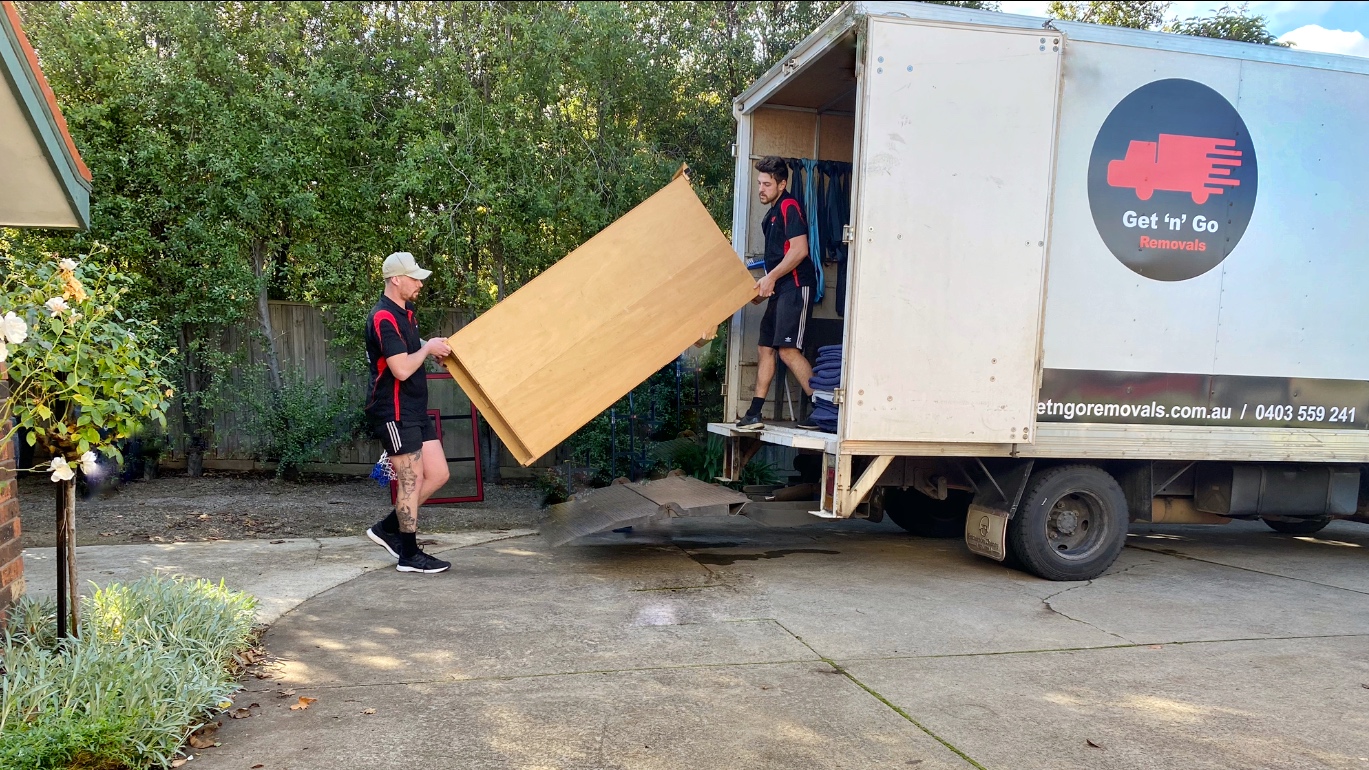
When moving one of the most commonly asked and searched for questions is “how much does it cost to move a house in Melbourne? with the costs of living rising in Melbourne continuously over the last few years, lots of industries rates have increased. We hope we can help give you a good idea of what an average Melbourne mover will cost.
Moving costs in Melbourne typically vary depending on many factors but on avarage moving a house in Melbourne cost between:
studio/1 bedroom apartments will cost between: $340.00 – $680.00
2 Bedroom apartment/house will range between: $680.00 – $1020.00
3 Bedroom apartment/house will range between: $1,040.00 – $1,520.00
4 Bedroom apartment/house will range between: $1485.00 – $2,640.00
Moving Houses factors that will determine how much your move will cost in Melbourne
Preparation
The organisation of the customer on moving day goes a long way to saving time and money when moving. Here are some of the ways you can save time and money in preparation
Factors That Can Affect The Cost Of Your Move in 2025
Parking – When it comes to moving day a HUGE factor of how much your move will cost is how far the removalists will have to cart the furniture to the truck. By making sure you have reserved your park in front of your house if you have on street parking will make a massive difference!
Property Size – The size of your home and the amount of furniture you have will be a factor on how much your Melbourne removalists will cost. Larger houses will take much longer to pack, wrap and transport to your new Melbourne residence than a typical small apartment.
Amount Of Furniture – How much furniture you have will be a big element in how much your move will cost in Melbourne. if you have a big home with little furniture (because you are a minimalist) this is great and will help save money on your move. Having said that a small home that is overcrowded with furniture can end up costing the same if not more than a big home with little furniture!
Elevators – When moving around Melbourne elevators are everywhere and go a long way to calculating how long and how much your move will cost! some elevators are great and have truck friendly loading bays and big lifts, while others you have to park on street and go thru the foyer, in some cases even having to load thru the carpark.
Stairs – Stairs are great…..NOT! Stairs come in all shapes and tricky angles and always make things that little bit harder when moving. For instance furniture not fitting up stairway will then need to be lifted over balconies (if there is a balcony) this can contribute to how much your move will end up costing in Melbourne
it is always best to alert you mover of these factors so you can get a more accurate quote
How Long Does It Take Removalists To Pack For An Average Move?
Preparing for a move involves packing. weather you want to pack yourself or use a removalist companies packing service, below we will give you an estimate of how long it takes for us to prepare your home for a move, based from previous home packs we have completed. Please not all moves are different and these are just a guideline to go by.
Studio/1 bedroom apartment
2 bedroom aprtment/house
3 Bedroom apartment/house
4 Bedroom apartment/house
1.5 – 3 hours
2.5 – 4 hours
4.5 – 7 hours
7 – 11 hours
times can vary depending on number of packers
How Long Will An Average Move Take?
An average move varies depending on volume of furniture and the size of house. The following estimates are taken from various jobs we have completed. Remembering the factors above will contribute to the cost of your move also, and that every move is different
Studio/1 bedroom apartment
2 bedroom aprtment/house
3 Bedroom apartment/house
4 Bedroom apartment/house
2 – 4 hours
4 – 6 hours
5 – 7.5 hours
7 – 11 hours
times can vary depending on number of movers
How Get ‘n’ Go Removals Compares To Other Melbourne Removalists
In the removal industry you will always be able to find lower or higher hourly rates. It is important to consider that a experienced removalist will be able to do your job in a quick and efficient manner, while always protecting your belongings. So at the end of the day its not so much about how much moving houses cost in Melbourne. But making sure you choose the right company that will get it done efficiently and professionally. Saving you time and money.
Make sure to take these things into consideration when deciding on removalists in Melbourne for your move.
Make sure to check reviews online via Facebook, Google to make sure these companies add up before deciding!
Do they have insurance in place?
We hope we have answered your question of “how much does moving houses cost in melbourne”
Do you need a removalist for your move? Let us help fill out our contact form below or give us a call on 0403559241
You've booked the new premises, told the leadership team, and chosen a moving date. Then someone asks whether the internet will be live, whether the lift is reserved, and who's responsible for the old office keys. That's when a simple move starts looking like a business continuity project.
A practical office moving plan protects more than desks and filing cabinets. It keeps people safe, gives IT time to make the new workplace functional, supports lease compliance, and gives staff, clients and suppliers enough notice to adjust. In Melbourne, market conditions and formal notice requirements also affect whether moving now is sensible, whether you can negotiate better premises, and how much time you really have.
Why Your Office Moving Plan Matters More Than Boxes
A Monday morning move can fail before the first truck arrives. Staff reach the new office and find unlabelled boxes blocking walkways, workstations without power, phones that haven't been activated and a reception area with no clear instructions. The removal itself may have been completed, but the business still isn't ready to operate.
A complete plan treats relocation as a controlled operational change. It connects the lease, building access, people, furniture, technology, records, communications and reopening checks. Packing is one workstream, not the entire project.
Practical rule: The move isn't finished when the last item leaves the truck. It's finished when each department can work safely and the business can serve customers.
What the plan must protect
Start with four outcomes:
Continuity: Critical teams know where to work, what systems they need and who resolves problems.
Safety: Employees and contractors aren't exposed to avoidable lifting, trip or access hazards.
Compliance: Lease notices, building requirements, consultation and handover records are assigned and documented.
Control: A named person can make decisions when the schedule changes.
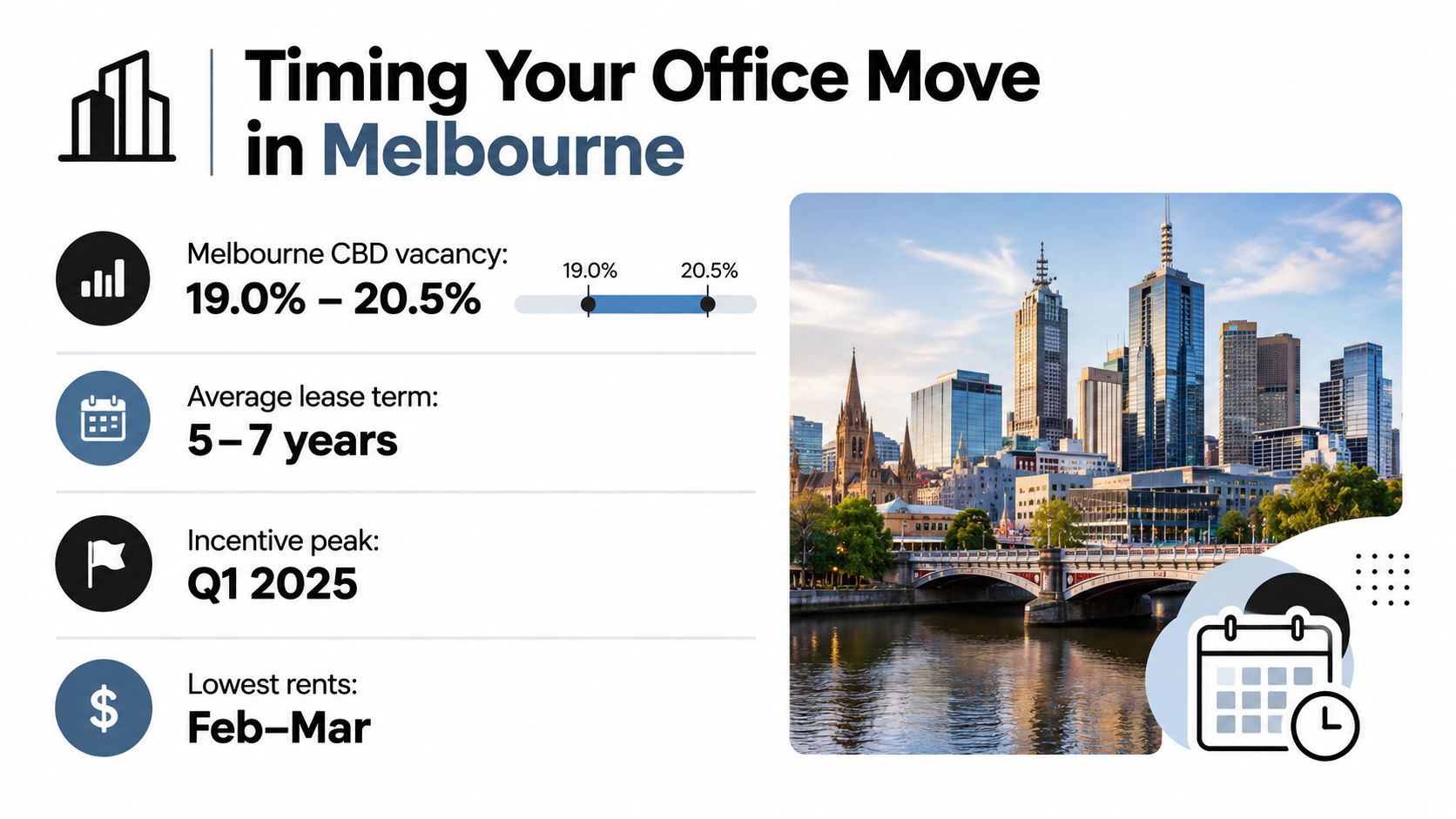
A Melbourne move also needs commercial judgement. The Property Council of Australia reported Melbourne CBD vacancy at 18.0% in January 2025, 17.9% in July 2025 and 19.0% in January 2026, with the January 2026 level described as the highest since 1997. Melbourne's sublease vacancy was 1.6%, while St Kilda Road reached 29.1% in July 2025 and 31.8% in 2026, showing that availability differs sharply between submarkets. The Melbourne office market data supports a useful planning question: should the business relocate, or use the move to renegotiate space, timing or fitout obligations?
Change needs ownership, not just announcements
Employees often worry about commuting, desk allocation, equipment and disruption. Supervisors need a clear message sequence, feedback route and escalation process. Practical change management tips for supervisors can help managers support staff while the project team handles the physical work.
Your plan should therefore name owners for the timeline, lease, employee consultation, inventory, IT, packing, transport, communications and final approval. That structure prevents the common failure where everybody is informed but nobody is accountable.
Build Your Timeline and Assign Clear Ownership
A relocation can lose weeks before anyone packs a box. Set the move date only after checking the lease position, building access, IT dependencies, compliance lead times and the condition of the new premises. That sequence protects the business from paying for space it cannot use or discovering that a carrier, lift or internet connection is unavailable.
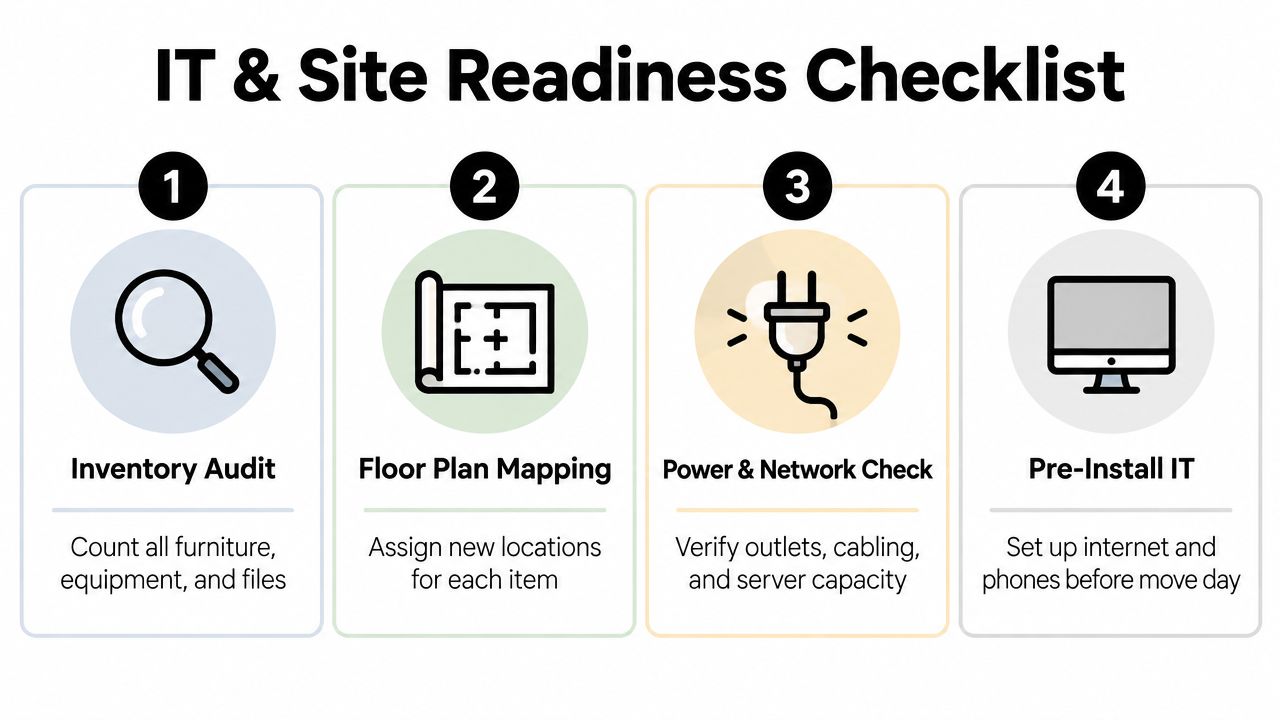
Australian office-moving guidance recommends starting IT and site planning 3–6 months ahead. The work includes mapping the floor plan, checking outlets, booking the internet service provider, testing data connections and scheduling a Day 1 walkthrough. The office moving timeline guidance provides a useful sequence, so urgent tasks receive attention before move day rather than competing with routine packing.
A working relocation schedule
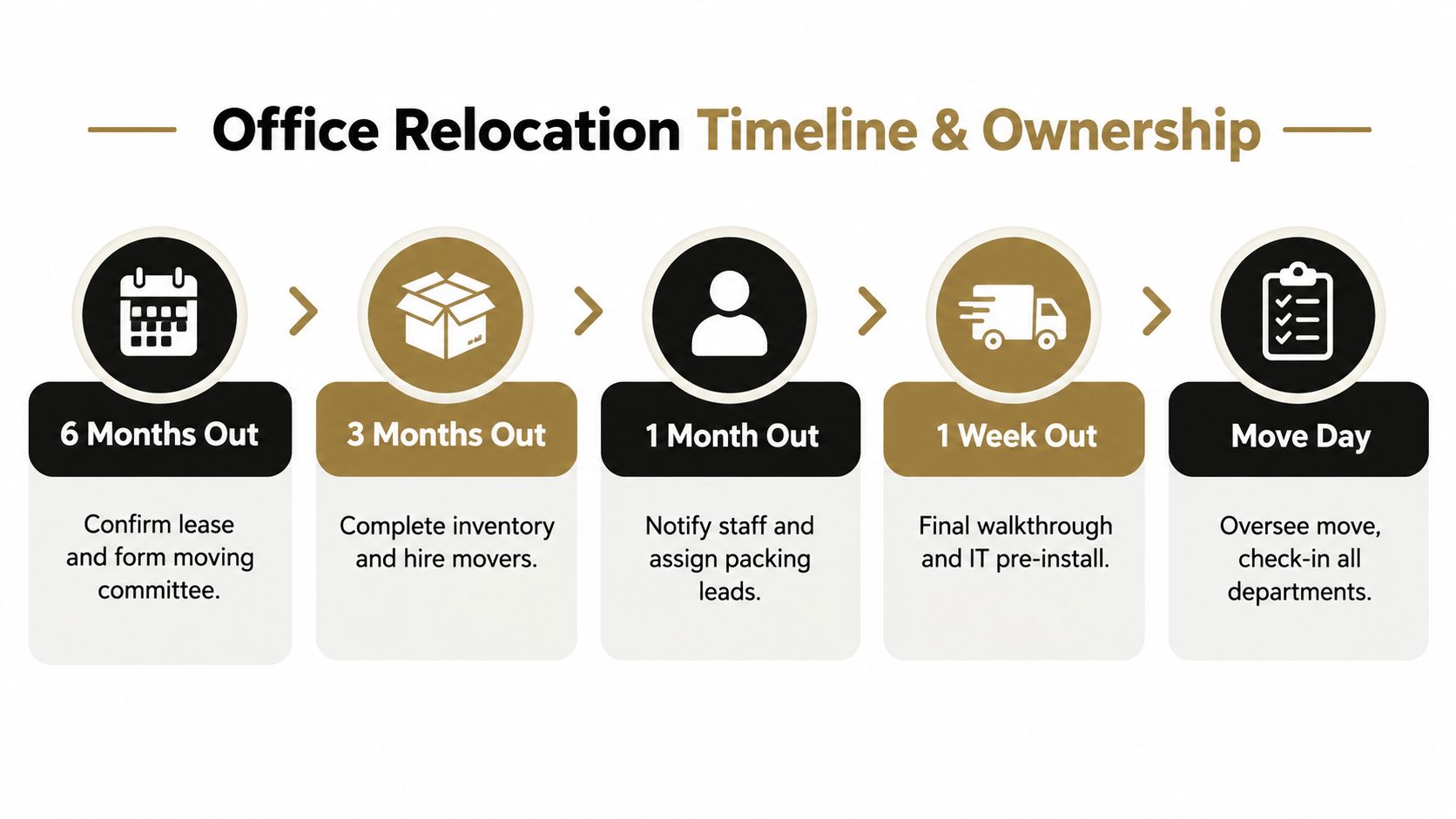
Six months out, confirm the lease, inspect the new premises, form the moving committee and appoint one move coordinator. The coordinator owns the master schedule, records decisions and remains the main contact for the mover, building managers, IT and department leads. Give the coordinator authority to escalate blocked decisions, not just maintain a spreadsheet.
Three months out, complete the inventory and decide what will move, be disposed of or stored. Approve the floor plan and book the moving crew. Check access routes, loading areas, lift requirements and building rules that may limit delivery times. Raise WHS consultation early, especially where staff will pack, lift or work around contractors.
One month out, notify staff and external stakeholders, assign packing leads and begin with archived files and items that are not needed for daily work. Set one labelling convention, document each department's responsibilities and confirm how confidential records will be secured.
One week out, complete the final walkthrough, reconfirm lift and loading arrangements, test installed IT and issue staff instructions. Hold brief status checks to close open decisions. Keep the schedule visible in a shared location, while the coordinator maintains the decision log and action list.
Move day requires a supervisor at each site, or one appointed lead who can move between locations. Supervisors check inventory, direct items to labelled rooms, keep access paths clear and record damage or missing items immediately.
Use a simple ownership matrix
Workstream
Accountable owner
People consulted
Lease and exit
Business owner or facilities lead
Property manager, solicitor
Employee consultation
Move coordinator and department leads
Employees and HSRs
IT readiness
IT lead
Internet and phone suppliers
Inventory and packing
Department packing leads
Staff using each area
Transport and access
Move coordinator
Removal crew and building manager
Reopening approval
Business owner
IT, facilities and health and safety representatives
Consult employees and health and safety representatives early. Identify manual-handling risks, then provide suitable trolleys, ladders, boxes and personal protective equipment. WorkSafe Victoria warns that “safe techniques” alone do not adequately control hazardous manual handling. Change the task, equipment or load instead of asking people to lift more carefully.
IT planning needs its own workstream. IT project planning with CloudOrbis Inc. can help structure dependencies, testing and ownership before technical tasks become urgent.
Give staff enough notice to clear personal items, label equipment and confirm what they must pack themselves. Suppliers need a delivery window, contact number and access procedure. One coordinator should issue final instructions, so the mover, building teams and departments are working from the same information.
Use Melbourne Market Conditions and Lease Rules to Time Your Move
A move planned around truck availability alone can leave a business paying for the wrong footprint or waiting on a lease decision. Melbourne's office market gives relocation teams room to separate the commercial decision from the physical move. In Q2 2026, Melbourne CBD office vacancy reached 20.5%, with about 1.1 million square metres of vacant stock. Quarterly net absorption was -6,300 square metres, while the preceding 12 months recorded 23,900 square metres, below the 10-year annual average of 28,300 square metres. JLL's Melbourne office market coverage records these conditions and shows Melbourne CBD vacancy above Sydney's 13.3% and Brisbane's 10.2% in the same reporting cycle.
The figures do not guarantee a particular rent or incentive. They do give a tenant useful bargaining context. Ask about commencement dates, fitout support, make-good flexibility, a smaller footprint or a sublease arrangement, especially where landlords are competing for occupiers. The timing of your physical move should follow the commercial outcome, not determine it.
Decide whether moving everything is still the right move
High vacancy can reveal options a standard moving checklist misses:
Reduce area: Review attendance patterns and storage needs before committing to the same footprint.
Improve quality: A smaller, better-configured premises may support operations more effectively than a larger outdated office.
Delay expansion: If hiring or growth plans have softened, avoid paying for space that will not be used.
Split locations: Some teams may work from a central office while operational functions use a fringe site.
Use a sublease: Existing surplus space may have value if the lease permits assignment or subletting.
Melbourne metropolitan office vacancy was 14.2% in September 2025, down from 15.2% at the start of that year, according to earlier PCA-linked reporting covered by the same JLL market coverage. CBD and metropolitan figures describe different submarkets. Check the specific conditions for St Kilda Road, Southbank or another fringe location before applying a CBD assumption to the premises you are considering.
Put formal notice dates before truck dates
Review the lease before booking transport. In Victoria, a renter ending a fixed-term rental agreement must give 28 days' notice, and notice can be delivered by post, email or by hand to the rental provider. Consumer Affairs Victoria's renter notice guidance explains the regulated process.
Commercial arrangements may follow different rules. A Victorian commercial-lease relocation clause may require a landlord to give at least 3 months' notice when relocating a tenant's business premises for renovations or alterations. The tenant may have a right to terminate within 1 month of receiving that notice. The landlord may also need to provide the work details, evidence that vacant premises are required, alternative premises on the same term and reasonable relocation costs. Review The AustLII clause description alongside the actual lease.
Government tenancy arrangements can set other thresholds. Victorian government tenancy materials refer to a 120-day Notice to Vacate in a departmental relocation policy, and at least 90 days' notice before the end of certain private-landlord tenancy agreements lasting more than six months. The Victorian tenancy management manual shows why the contract and occupancy type must be confirmed before scheduling.
Compliance planning may need 6–12 months, employee consultation may begin 3–6 months ahead, and safety inspections may be scheduled at least 30 days before occupancy, as outlined in the Australian compliance-focused material supplied for relocation planning. Use those windows to start legal, facilities and WHS reviews early. They are planning prompts, not a substitute for professional advice.
For broader local planning considerations, use this guide to moving to Melbourne alongside the lease review and site assessment.
Inventory IT and Site Readiness Without Day One Surprises
The new office should be operational before employees arrive. A clean floor plan won't help if the internet is pending, a server cabinet has no suitable capacity or a meeting room has no usable connection point.
Start with an inventory that records furniture, equipment, files and specialist items. Mark each item as move, dispose, store, replace or review. This avoids paying to transport broken furniture or carrying unnecessary archive material into a smaller workplace.
Build the destination before packing the origin
Map each item to a destination room or workstation. Use room names that appear on the floor plan, box labels and mover instructions. “Marketing” is useful. “Box 14” isn't.
Check the route as well as the room. Measure large furniture against doors, corridors, lifts and turning points. Confirm loading zones, building access, protective requirements, lift bookings and the hours when contractors can work. A final walkthrough should identify surfaces that need protection and areas that must remain clear for staff or visitors.
Treat telecommunications as a critical path
Australian office-moving guidance recommends starting technical and site-planning tasks 3–6 months ahead, including floor-plan mapping, power and network outlet checks, ISP booking, data backup and testing, and a Day 1 walkthrough. NBN or telecommunications installation can require 4–6 weeks of lead time, making activation one of the most common causes of an otherwise complete office reopening being delayed. JLL's office moving checklist provides the relevant benchmark.
The IT lead should document:
Connectivity: Confirm the service order, installation access, demarcation point and testing responsibility.
Network: Map outlets, switches, wireless coverage and equipment locations.
Phones: Confirm number porting, handsets, reception routing and fallback contact methods.
Data: Back up systems, test restoration and record who approves the result.
Security: Check access cards, alarms, cameras and visitor procedures.
Don't disconnect everything at once. Stage the transition so essential systems remain available until the agreed cutover. Keep a tested backup and a written escalation list rather than relying on one person remembering every supplier number.
Specialist equipment needs its own handling instruction. Label fragile technology separately, photograph cabling before disconnection and use protective materials suited to the item. For servers or sensitive infrastructure, server relocation specialists may be considered alongside the internal IT plan, with responsibility for shutdown, transport, recommissioning and testing clearly divided.
On the first morning, walk the site with facilities, IT and department leads. Check access, lighting, temperature, internet, phones, printers, meeting rooms, kitchen facilities and emergency paths before staff settle in.
Packing Transport and Communication That Minimise Downtime
Packing works best when it follows the destination layout. Give each room or department a label, colour or code that appears on boxes, furniture tags and the floor plan. A box marked “Finance, records, open first” is easier to place than one marked only with a person's name.
Begin with items the business can live without, such as archived files, spare stationery and decorative material. Keep essential documents, chargers, access information and first-day supplies in a controlled kit that travels with the move coordinator rather than disappearing into a general load.
Protect the load and the route
Use strong cartons for files, protective wrap for screens and padding for furniture edges. Don't overfill boxes, particularly with paper. Staff should pack personal desk contents only if the project rules make that safe and clear, while movers or trained leads handle awkward furniture, heavy equipment and disassembly.
Photograph complex workstation and cable arrangements before dismantling. Place screws and fittings in labelled bags attached to the relevant item. Keep walkways and fire routes clear, and separate items that need special handling from standard office furniture.
A staged loading order can reduce confusion. Load non-essential items first, keep critical equipment visible and direct unloading by room rather than dumping everything in one central area. The receiving lead should check labels against the inventory as items enter.
Plan the working hours around the business
After-hours or weekend transport can reduce disruption, but it isn't automatically the right choice. It may increase coordination pressure, affect staff availability and require specific building approvals. Compare the operational value of an out-of-hours move with the access, labour and supervision requirements before committing.
Keep an essential team operational where possible. That might mean preserving a temporary workstation area, moving customer-service equipment first, or arranging a controlled remote-work period. Clients and suppliers should receive the new address, effective date and temporary contact method through a planned communication sequence.
Use one source of truth for updates. The move coordinator can issue:
Early notice: Explain the reason, broad timing and staff responsibilities.
Final notice: Confirm the move window, reopening plan, contacts and what staff should bring.
Day 1 update: Report what is operational and where unresolved issues should go.
Building managers need vehicle details, access times, lift bookings, loading instructions and insurance documentation where required. Suppliers need delivery directions and the date from which the new address applies. Update invoices, websites, online listings and client communications once the move is confirmed.
For a coordinated service covering packing, furniture disassembly, transport and related office relocation tasks, review office relocation services against your inventory and access requirements rather than comparing transport alone.
Final Checks and Your Office Moving Plan Template in Action
The final walkthrough should close the move with evidence, not memory. At the old office, inspect cupboards, meeting rooms, storage, service areas and secure records. Record keys, access devices, damage, cleaning, repairs, waste removal and anything left behind.
Consumer Affairs Victoria separates guidance on notice, breaking a rental agreement and goods left behind. Its moving-out and eviction framework reinforces that vacating involves lease and handover responsibilities, not only furniture removal.
At the new office, test department access, IT, assembled furniture and clear safety paths. Give staff a short orientation covering exits, amenities, meeting rooms, first aid, access controls and defect reporting. A Melbourne coordinator should also confirm that WHS actions and building sign-offs are complete before the first full operating day.
Keep the plan reusable
Use a template that records decisions, owners and exceptions:
Project details: Addresses, move date, lease milestones and building contacts.
Owners: Move coordinator, facilities, IT, WHS, department leads and final approver.
Inventory: Item, destination, handling requirement, status and exception.
Readiness: Floor plan, power, network, telecommunications, access and inspection sign-off.
Packing and transport: Materials, labels, priority items, secure records, vehicle access, loading sequence, lift booking, crew contact and receiving lead.
Communications and close-out: Staff, clients, suppliers, property managers, Day 1 updates, keys, leftover goods, damage records and lessons learned.
A filled row makes the format usable: Inventory: Boardroom table. Destination: Level 3 Meeting Room 3.02. Handling: Disassemble legs, wrap glass. Status: Move.
Use this office move project plan template as a starting structure, then adapt it to lease dates, building rules, workplace risks, systems and operating hours.
Review the first week while details remain fresh. Record access problems, label confusion, IT faults and floor-plan changes. That record supports the next expansion or space reduction.
Get n Go Removals Melbourne can coordinate packing, furniture disassembly and reassembly, protective equipment, transport and storage. Visit Get n Go Removals Melbourne early to discuss inventory, access requirements and the move window before lease deadlines and building bookings restrict your options.
The lease renewal lands in your inbox on a Monday morning. Your Melbourne team is already late to its stand-up, the move date is only weeks away, and nobody can answer the basic questions. Which desks are staying? Who owns the IT cutover? Has the new building approved the loading dock booking? Is the server room documented anywhere?
That's when an office move stops being a furniture problem and becomes a business continuity problem. Office relocation services should coordinate the decisions, people, technology, access arrangements and transport that keep your organisation operating while the premises change around it.
Australia has a mature removals market. Australia Post reports that around 1.14 million Australians move house each year, with about 84% using its Mail Redirection service.Australia Post's movers statistics The broader Australian removals industry is valued at about A$2.6 billion in 2026, with 8,310 businesses operating in the sector.IBISWorld data reported through Australia Post's market context Commercial relocation sits inside that established network, but office moves demand more planning than a typical household transfer.
The practical answer is a staged project with a clear scope, a named coordinator, documented IT handovers and a realistic downtime plan. The sections below focus on the calls that protect your budget and your first working day at the new premises.
The Monday Morning a Team Realises They Need to Move
At 8.47 am, the coffee is still too hot to drink when the operations manager opens the lease email. The landlord wants a decision. The proposed handover date is six or eight weeks away. The office has no current asset list, no confirmed floor plan and no person assigned to the technology cutover.
The signals appear quickly. Shared inboxes fill with forwarded mail because the address-change process hasn't been assigned. Staff ask whether they'll sit on the north or south side of the new floor. Someone discovers that the server room has grown through years of improvised equipment changes, yet nobody has a current diagram of the racks, switches or cabling.
A rushed move usually fails in handovers rather than on the road. The truck can arrive on time while the business still loses productivity because desks are placed against the wrong wall, access cards aren't active, printers aren't connected, or confidential records are mixed with general cartons.
Treat the move as a business project
A capable relocation provider should give you more than labour and vehicles. You need a move plan, an asset register, access checks at both buildings, a floor-by-floor sequence and a person who can make decisions when the building manager, IT supplier and internal team disagree.
The first meeting should establish:
Scope: What is moving, what is being disposed of, what is being stored and what will be purchased new?
Ownership: Who approves the budget, signs off the floor plan and authorises changes?
Continuity: Which teams, systems and customer services must remain available?
Access: What are the lift, loading dock, loading-zone and security requirements?
Handover: Who confirms that every floor, workstation and technology area is ready?
Practical rule: If nobody owns the IT cutover, nobody owns the move.
Melbourne adds its own friction. A CBD tower may require lift reservations, loading-dock windows, public liability documents and strict delivery rules. A suburban office may offer easier vehicle access but still have narrow doors, stairs or shared car-park restrictions. These details belong in the plan before the crew arrives, not in a phone call made on move morning.
Office relocation services earn their place by absorbing that coordination burden. Your internal team should make business decisions and communicate with staff. The mover should turn those decisions into a controlled sequence that covers scoping, cost, timing, IT, downtime and final placement.
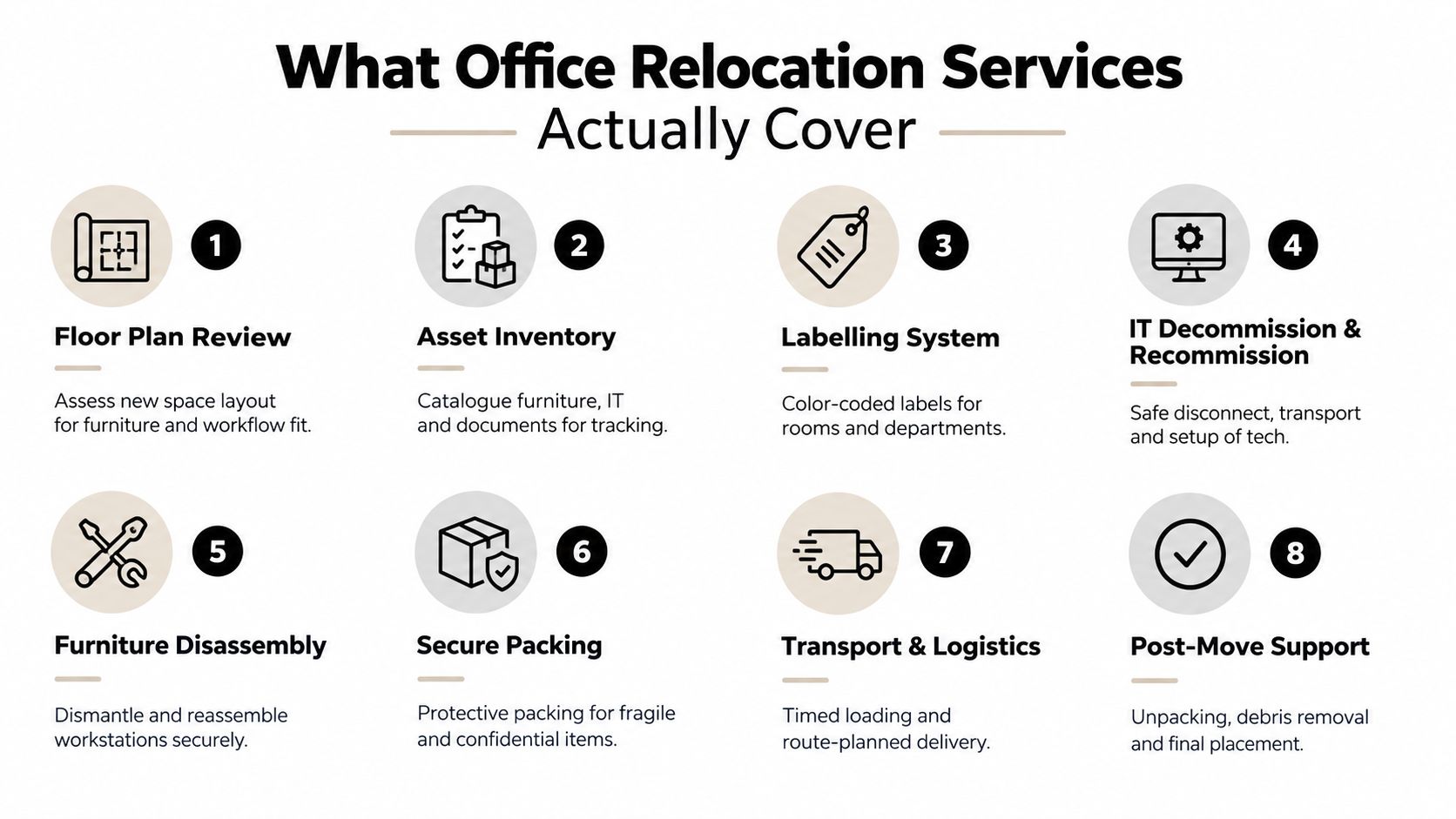
What Office Relocation Services Actually Cover
A credible quote should read like a project scope, not a sentence promising a “stress-free move”. Ask the provider to show exactly what happens before, during and after transport. That makes competing proposals easier to compare and exposes missing work before it becomes a variation.
Start with the site and inventory
The planning visit should include a review of the current and new floor plans, an asset inventory and an access audit at both sites. The inventory needs more detail than “desks and boxes”. Record workstations, monitors, printers, server racks, archive cartons, shelving, kitchen equipment, whiteboards and specialist items.
A good labelling system connects each item to its destination. Use room, department or zone codes that match the new floor plan. A relocation manager should act as the single point of contact, coordinating your facilities lead, IT supplier, building managers and removal crew.
Protect, disconnect and prepare
Packing requirements vary by item. Documents belong in secure crates or clearly identified archive cartons. Monitors and printers need protective wrapping. Confidential records need controlled handling and a chain-of-custody process. Workstations may need decommissioning, with components labelled so reassembly doesn't become a guessing game.
Technology should be treated as its own workstream. Confirm who disconnects servers, racks, phones, network equipment and workstations. The scope should state whether the mover handles transport only, or whether it also supports disconnection, cabling, reassembly and testing.
Sequence the physical move
On move day, the crew should load by destination sequence rather than by convenience. Labels should support tracking from the origin floor to the receiving room. Furniture disassembly and reassembly must include workstations, shelving, whiteboards and other fixtures, while kitchen equipment needs suitable protection and placement.
The handover doesn't finish when the last carton enters the building. Include unpacking, debris removal, final placement and a next-day snag process. The first business day often reveals small but disruptive faults, such as a missing monitor arm, a misaligned workstation or a cable that wasn't connected to the intended desk.
For a Melbourne commercial move, compare a provider's written scope with the service details on its commercial office removalists Melbourne page. If the quote leaves out access coordination, IT responsibilities or post-move fixes, ask for those exclusions in writing.
A relocation can also be a good time to replace ageing workplace equipment. If staff are returning to a refreshed kitchen or breakout area, review practical options such as these best water dispensers for work before the new fit-out is finalised.
What Drives the Cost of an Office Move
An office relocation quote is shaped by handling complexity, access and scope. The floor area alone won't tell you what the move will cost. A compact office with server racks, archive records and difficult loading access may require more planning than a larger space with lightweight furniture and a clear dock.
The inventory establishes the physical baseline. Workstations, archive boxes, server racks, printers and specialist equipment have different packing, handling and insurance requirements. Ask the mover to separate these categories rather than combining every item under a broad “office contents” description.
Access can change the labour plan quickly. Lift bookings, loading-dock hours, security procedures, stairs, restricted vehicle access and CBD street parking all affect sequencing. In Port Phillip, a formal temporary parking permit can be arranged for a moving truck, and the council states that the moving company's name should replace registration details on the application. The listed parking reservation fee is $50 per permit.Port Phillip Council's temporary parking permit guidance
Distance matters, but fleet strategy matters too. One larger truck may reduce repeated loading, while multiple smaller runs can work better where access is restricted or floors need to be moved in phases. After-hours and weekend work can increase the quote while reducing the commercial cost of staff sitting idle.
Cost Driver
Effect on Quote
Why It Matters
Inventory and item type
More handling, packing or specialist labour
Fragile, heavy and confidential items need different controls
Building access
May add bookings, waiting time or additional labour
Lifts, docks and street access determine the move sequence
Transport plan
Changes vehicle and crew requirements
One large load isn't always practical in Melbourne buildings
Disconnect and reconnect work adds specialist coordination
Technology faults can extend the outage
Reassembly and unpacking
Adds labour but reduces day-two disruption
Staff can return to usable workstations sooner
Phasing and timing
Weekend or floor-by-floor work affects labour planning
The right window can protect revenue-generating activity
Insurance selection
Changes protection and risk allocation
Confirm limits, exclusions and excess before signing
For a broader explanation of what influences removal pricing, review this guide to the cost of movers. The useful comparison isn't the cheapest headline figure. It's the quote with the clearest inclusions, exclusions, assumptions and responsibility for variations.
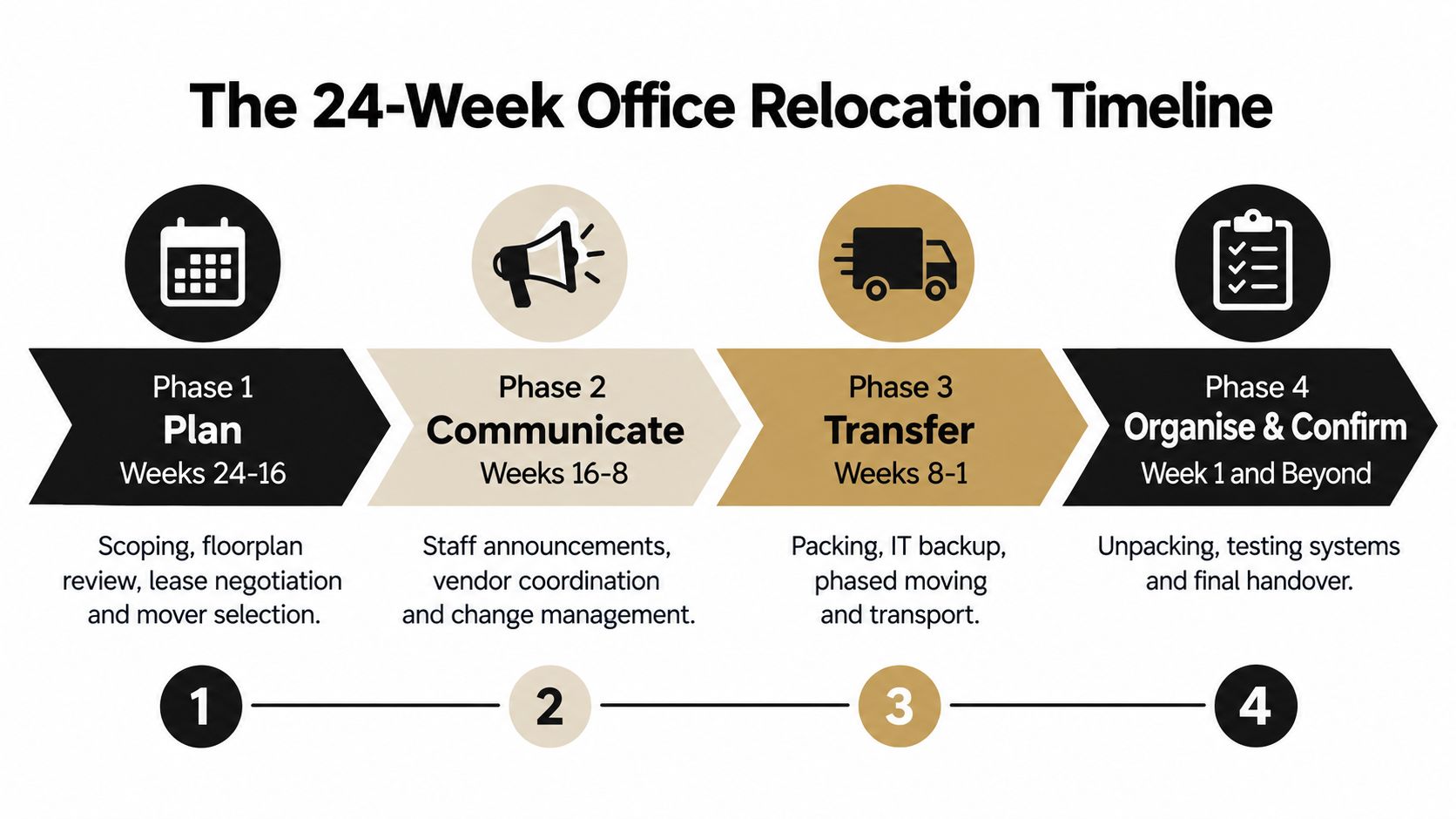
The 24-Week Office Relocation Timeline
Start earlier than feels necessary. Australian workplace guidance recommends coordinating an office relocation during construction, up to 24 weeks before move-in, and organising the work through plan, communicate, transfer, organise and confirm phases.JLL's Australian office relocation guide A separate Australian moving guide recommends beginning three to six months ahead, with phased moves, off-hours execution and IT planning.Chess Moving's office relocation guidance
Weeks 24 to 16, plan
Confirm the business case, lease terms, construction status and target handover. Review the new floor plan against furniture, power, network access, meeting areas and storage. Appoint the internal relocation lead and request site visits from commercial movers.
Select the provider only after comparing scope, access assumptions, insurance and IT responsibilities. Put the decision in writing. A cheap quote that excludes lift bookings or workstation reassembly isn't cheap once the missing work appears.
Weeks 15 to 8, communicate
Announce the move to staff with practical information, not just the new address. Explain desk allocation, personal-item rules, access-card timing, transport changes and the date when mail, suppliers and customers should use the new address.
Coordinate IT vendors, building managers, furniture suppliers and any storage provider. Begin asset tagging and order packing supplies. This is also the point to identify items that should be archived, donated, recycled or replaced rather than transported.
Weeks 7 to 2, transfer
Label every workstation, department area and carton against the destination floor plan. Archive files that don't need to travel immediately. Confirm server-room access, network requirements, lift reservations and loading arrangements.
Run the IT backup and cutover plan separately from the furniture schedule. Decide which teams can move first and which services must remain operational until the final window. For general moving-time planning context, businesses can also use this guide to how long it takes to move house, while recognising that an office requires additional coordination.
Final two weeks, organise and confirm
Walk through both buildings with the relocation manager. Check access cards, security rules, lift protection, loading zones, floor protection and emergency contacts. Confirm the day-of run sheet, crew arrival, loading order, destination sequence and contingency arrangements.
Budget time after the physical move for settling in. Australian office relocation guidance recommends treating the first two weeks after the move as a post-move settling period, not as an instant return to normal.Onyx Removals' office relocation project plan The final checklist should include IT testing, missing-item checks, furniture adjustments, debris removal and landlord handover.
How Professional Movers Cut Downtime to a Minimum
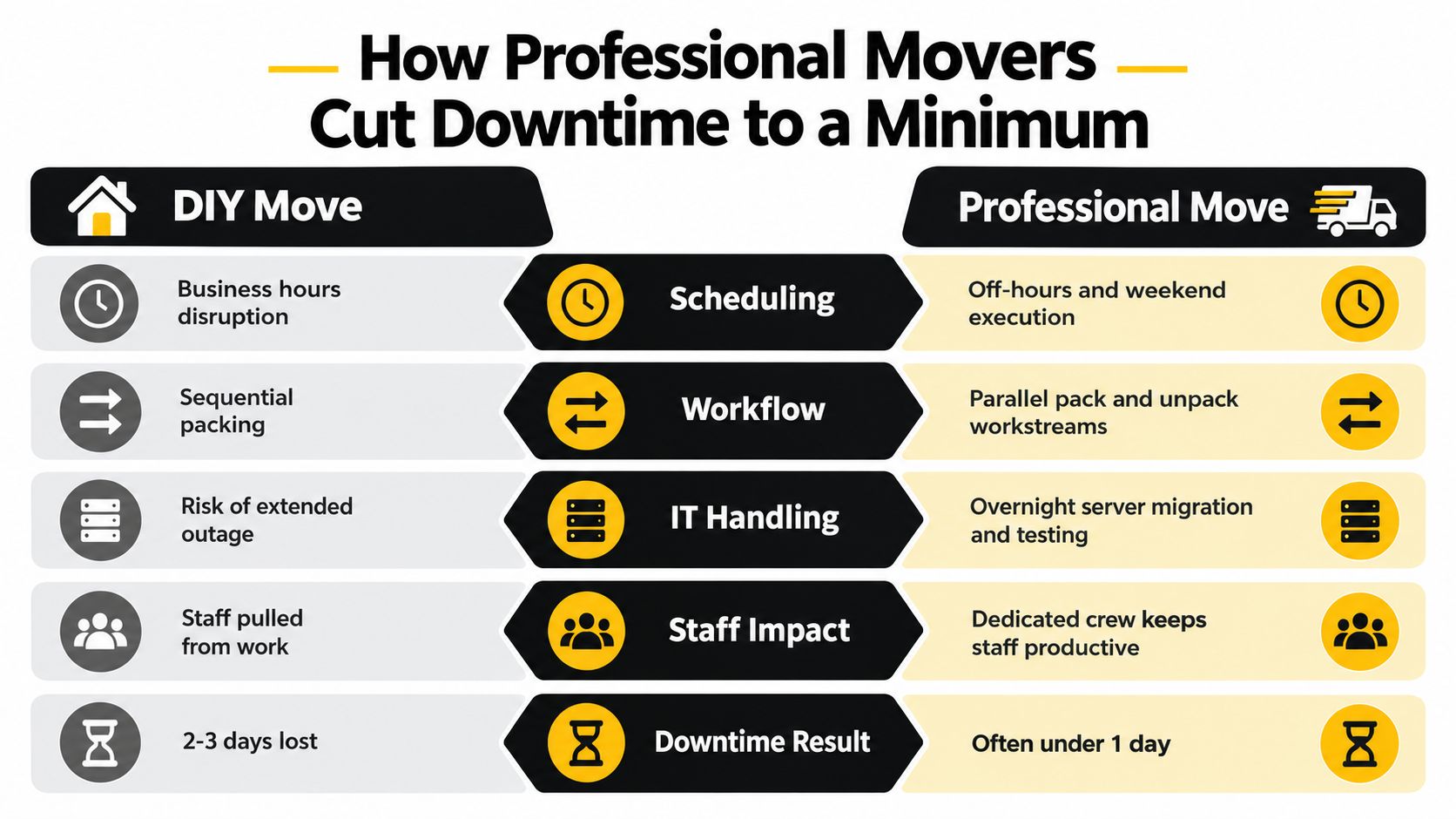
Downtime falls when the move is designed around business operations rather than truck availability. That means moving work in parallel, protecting critical systems and preparing the destination before staff arrive.
Off-hours execution is the first lever. Pack non-essential areas while teams are working, then move the remaining workstations during an agreed evening or weekend window. The schedule should reflect your busiest customer periods, payroll deadlines, trading activity and support obligations.
Run parallel workstreams
A professional crew can pack one floor while another team stages furniture at the new site. IT can decommission equipment in a controlled sequence while the movers clear completed areas. At the destination, labelled workstations can be assembled by zone rather than waiting for the entire office to arrive.
This approach only works when the floor plan is accurate. A desk placed in the wrong zone creates more than a cosmetic problem. It can interrupt power access, network connections, team seating and staff communication, forcing the crew to redo work after the move.
Treat IT as a handover, not a carton
Label cables at both ends. Photograph rack layouts before disconnection. Record device locations and test the receiving network before employees return. Critical systems need a defined backup, shutdown, transport, reconnection and verification sequence.
One coordinator should control changes to the run sheet. Without that role, your IT supplier may assume the removal crew is handling a task that the crew has excluded, while the building manager waits for an access confirmation from someone else.
A self-managed move can look economical because employees provide the labour. The hidden cost is the work they stop doing, the time spent locating items and the delay caused by untested systems. A professional plan assigns packing, transport, placement and reassembly to a dedicated crew, leaving staff to manage decisions and communications.
Operational test: The move is successful when employees can find their workstations, connect to the systems they need and serve customers without waiting for the removal team.
For a Melbourne crew that combines packing and moving support, review the scope described for movers and packers in Melbourne. Ask specifically how the provider handles parallel work, after-hours access, IT coordination and next-day snags.
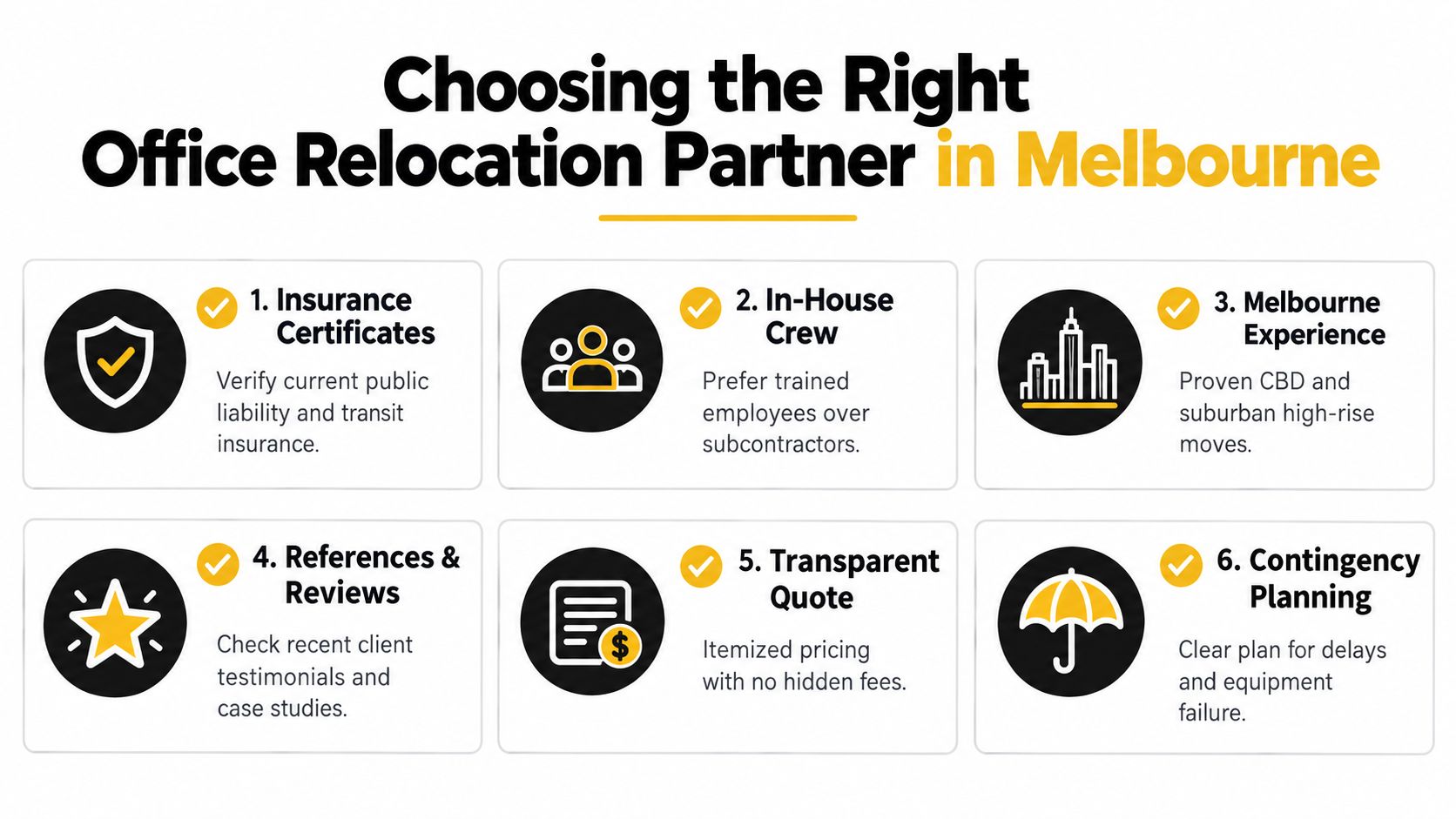
Choosing the Right Office Relocation Partner in Melbourne
Your relocation partner should prove operational control before you compare prices. Shortlist providers that can show current documents, named supervisors, suitable vehicles, building-access planning and a written scope. A move is a staged business decision, so the provider must protect trading time as well as furniture.
Check the evidence before the price
Request current public liability and transit insurance certificates. Confirm covered items, exclusions and excesses for office equipment. Australian government relocation guidance places responsibility for personal and household-goods insurance with employees, while the Department of Finance covers standard insurance up to a maximum of $80,000 in household-goods value under its policy framework.Department of Finance relocation expenses guidance That arrangement does not replace commercial contents advice. Put every insurance responsibility in writing.
Ask whether the crew is employed in-house or supplied by subcontractors. Get the names of the site supervisor and project coordinator, then confirm who remains accountable if equipment is damaged, access changes or the program slips.
Review the provider's Melbourne fleet and availability. CBD loading windows, lift bookings and staged deliveries can restrict the plan. A company-owned fleet with suitable truck sizes may reduce handover risk, but the largest truck is rarely the answer. Require a suitable primary vehicle and a credible backup arrangement.
Reject vague proposals
For a complex office, insist on a site visit. Reject a firm quote prepared without inspecting the building, a proposal that hides exclusions, or an operator that cannot explain its approach to lifts, server rooms and access rules.
Use this filter:
Insurance documents: Verify current certificates, limits and exclusions.
Named coordinator: Get one accountable contact for the project.
Written scope: Require inclusions, exclusions and variation triggers.
Comparable references: Request examples with similar access, technology or staffing requirements.
Contingency plan: Confirm the response to lift failure, delayed handover or damaged equipment.
Clear labour model: Establish who performs the work and how the supervisor checks quality.
Get n Go Removals Melbourne is one provider to assess against these requirements. Its published information describes commercial relocations, packing, furniture disassembly and reassembly, protective equipment, transport, storage, a company-owned fleet, full-time police-checked staff, public liability and transit insurance, and a single point of contact.Get n Go Removals Melbourne
Compare those documents and the site process with a broader guide to the best moving companies in Melbourne. Choose the provider that fits your building, schedule, IT handover and risk profile, not the one with the most polished sales copy.
Why a High-Vacancy Market Can Be the Right Time to Move
Melbourne's vacancy conditions give tenants more choice, but choice only creates value when you compare the cost of staying with the cost of changing premises. National CBD vacancy was 15.9% in January 2026, while Melbourne CBD vacancy reached 19.0%. Enquiry volumes rose 19% in the first half of 2026, according to the Property Council of Australia market analysis.Property Council of Australia's 2026 CBD office market analysis
That combination points to an active decision window. Landlords with empty space may be more open to discussing rent, fit-out contributions, incentives and rent-free fit-out periods. The exact offer depends on the building, lease structure and tenant profile, so model the whole occupancy cost rather than negotiating only the face rent.
A relocation also gives you a chance to correct an office that no longer fits. The Property Council reported that just over two-thirds of businesses that moved premises during the past three years upgraded to a better-quality office building.CBRE and Property Council of Australia occupancy reporting That supports a strategic view of relocation. Businesses aren't always chasing more desks. They may be seeking better access, amenity, building quality, employee experience or a layout that supports hybrid attendance.
Current workplace demand also requires sharper space planning. National net absorption reached 364,635 square metres in the 12 months to January 2026, the strongest result since 2018. In the latest reported period, 52% of relocating tenants expanded and 14% downsized.Broker News coverage of the 2026 office demand data Use those figures as market context, not as a reason to copy another tenant's footprint. Forecast attendance, shared-desk use, meeting demand and likely headcount before committing to a floor.
Factor
Relocate Now
Delay 12 Months
Lease leverage
More opportunity to negotiate incentives and fit-out support
Current options may change, and suitable space may be committed
Workplace quality
Move into a building that better supports staff and clients
Continue paying for limitations in the existing premises
Hybrid planning
Design capacity around actual attendance and future needs
Carry an unsuitable layout while uncertainty continues
Downtime
Plan the disruption once and align it with lease and fit-out dates
Risk a compressed move when lease or project deadlines arrive
Fit-out decisions
Coordinate construction, technology and furniture as one project
Pay for interim fixes that may not support the next lease term
Strategic timing
Treat relocation as an operating decision
Preserve flexibility, but delay the benefits and planning work
The right next step is not to book a truck. Request a site-and-stocktake walkthrough from a Melbourne commercial mover, then use the inventory, floor plan and downtime plan to test whether the lease opportunity works financially. Providers that coordinate office contents with IT and access work can help place the move into a low-disruption window, including periods such as December or February when those dates suit your business and building.
Get n Go Removals Melbourne can coordinate commercial office relocations with packing, furniture disassembly and reassembly, protective equipment, transport, storage and a single point of contact. Visit Get n Go Removals Melbourne to request a walkthrough and detailed quotation that matches your Melbourne site, access requirements and staged move calendar.
You've booked the new Melbourne office, told leadership the move will happen over a weekend, and promised staff they'll be working normally on Monday. Then the fit-out approval slips, the NBN activation isn't confirmed, the freight lift is unavailable during your preferred window, and half the desks arrive without destination labels. The trucks aren't the problem. The missing dependencies are.
A reliable office relocation timeline starts with the date people can occupy the new workplace, then works backward through approvals, procurement, technology, building access, communication and packing. The physical move may take only a weekend, but the decisions that make that weekend possible often run for months. That approach suits Melbourne businesses managing leases, fit-outs, changing headcounts and strict continuity requirements.
Why Your Office Relocation Timeline Decides Downtime
A Monday-morning office move can fail before the first workstation is lifted. Staff arrive at the new address, but access cards aren't active. The furniture is in place, but the network cabinet hasn't been commissioned. The removal team has delivered the right boxes, but nobody knows which department owns them. Each issue looks small in isolation. Together, they stop people working.
Office relocation is therefore a business continuity project, not just a transport booking. Lease notice periods, headcount changes, restructures and expansion all affect when a business needs space and how much space it needs. The Australian Bureau of Statistics recorded 1.0 million people changing jobs in the year ending February 2026, a 7.2% job mobility rate (Australian Bureau of Statistics job mobility data). The previous year, just under 8% of employed people, or 1.1 million people, changed employer or business. That level of workplace change makes relocation a recurring operational issue rather than an unusual event.
Melbourne's property conditions can add another layer. An iMOVE CRC report recorded nationwide office vacancy rising from roughly 8% in January 2020 to 13% in January 2023, while 96 firms in its sample, about 10%, had relocated since the onset of the pandemic (iMOVE CRC report on future cities and regions). Businesses have been reconsidering location, floor area, layout and lease strategy. That means the project often includes more than moving existing furniture from one address to another.
The move date is rarely the critical path
The most common planning error is to start with a truck booking. In Melbourne, the better starting point is the occupancy date, meaning the date the new premises is ready for staff. Office fit-outs commonly require 6 to 12 weeks on site, with another 4 to 8 weeks for design and approvals. Long-lead items can add 8 to 12 weeks, according to Melbourne office fit-out guidance (Riverside Projects office fit-out guide).
Recent market conditions reinforce that caution. CBD vacancy reached 14.8% in H2 2025, while industry reporting cited national office vacancy at 15.9% in early 2026. The same industry commentary noted that tenants were taking 14 months or more for 1000sqm deals, showing why available space doesn't automatically mean a fast relocation (Caden Office Leasing vacancy review).
Practical rule: If the new office isn't approved, connected and accessible, you don't have a move date. You have an aspiration.
A useful timeline gives every task an owner, a deadline and a dependency. The relocation lead should run a weekly progress check with the landlord, fit-out team, IT provider, furniture supplier and moving contractor. Leadership should receive a short report showing what's complete, what's blocked and which decision is needed. That discipline protects revenue, staff productivity and client service far more effectively than asking everyone to work faster during move week.
The phased plan below works for small teams and larger Melbourne offices alike. You'll adjust the lead time for complexity, but the principle stays the same: plan backward from occupancy and protect the first working day.
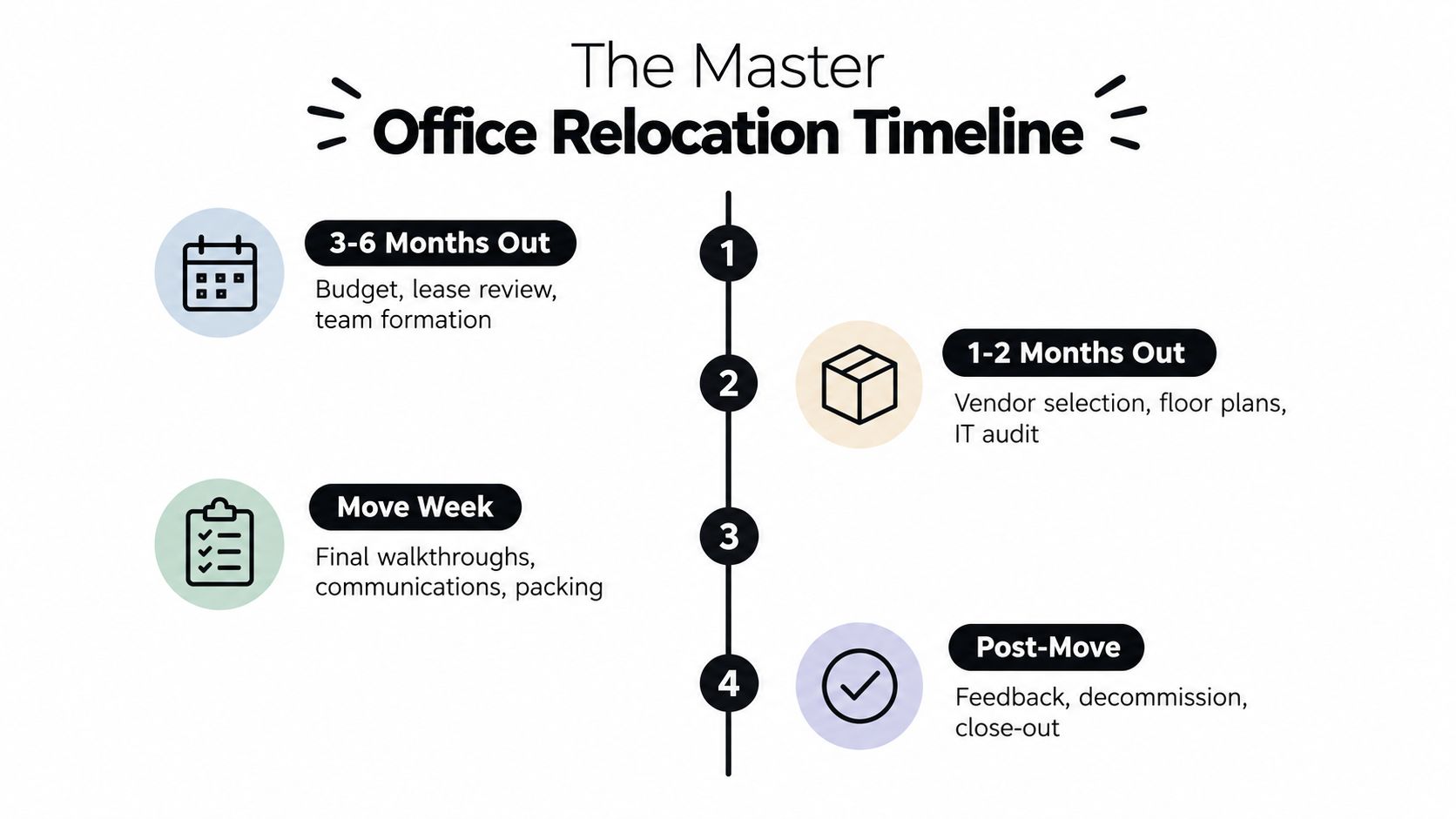
The Master Office Relocation Timeline From Six Months to Post Move
A workable office move has several clocks running at once. The lease clock controls the premises. The fit-out clock controls occupancy. The IT clock controls connectivity. The packing and access clock controls the physical move. Put them on one shared plan, because a delay in one stream can make the others useless.
Three to six months out
The relocation lead should establish the project before suppliers begin quoting. Confirm the budget, review the current lease, inspect the new premises and validate the floor plan against actual headcount and equipment. The internal team should include a decision-maker, operations or facilities owner, IT lead, people or communications lead and finance contact.
At this point, check whether the new office is move-in ready. If it needs a fit-out, treat design, approvals, procurement, landlord works and handover as separate milestones. Don't approve a truck date until the project team has confirmed practical occupancy, not just lease commencement.
Core responsibilities include:
Budget owner: Allow for moving services, fit-out, furniture, technology, building charges and any storage requirement.
IT lead: Audit workstations, servers, cabling, phones, Wi-Fi requirements and business-critical systems.
Department heads: Confirm what can be discarded, archived, packed or moved first.
Relocation lead: Maintain the master schedule and run weekly progress checks.
Eight to twelve weeks out
Supplier coordination becomes the priority. Confirm the moving contractor, furniture installer, IT provider, connectivity supplier and any specialist trades. The IT lead should document the shutdown and restart sequence, rack location, cabling plan, power requirements, Wi-Fi coverage and testing responsibilities.
A dedicated office relocation technology checklist can help the IT and facilities teams identify technology dependencies before they become move-week faults. Use it alongside a floor plan that shows desks, meeting rooms, printers, storage, network equipment and high-priority teams.
Four to six weeks out
Packing and communication now become visible to staff. Issue boxes, labels and department instructions. Labels should identify the destination room, workstation or team, not merely the employee's current location. Confirm the new address, contact details, visitor instructions and client-facing updates.
Australian move-planning guidance recommends updating ASIC address details and Australian Business Register records 6 to 8 weeks before the move, then confirming vendor bookings and loading dock arrangements 2 to 4 weeks before moving day (The Work Project office relocation checklist). If those tasks aren't complete, assign an owner immediately rather than leaving them with a general department.
Moving week
The relocation lead should hold a final walkthrough at both properties. Confirm access cards, keys, lift bookings, dock times, utilities, cleaning, floor protection and security arrangements. IT should verify that connectivity, cabling, racks, power and restart procedures are ready before anyone begins disconnecting equipment.
The final communication should state when staff can enter, where they should report, what they should bring, how seating works and who handles issues. A simple chain of command prevents staff from sending access, furniture and technical problems to different people without resolution.
Post move
The project remains open until the new office works in practice. Test connectivity, phones, printers, meeting-room equipment, access control and workstation layouts. Keep an issue register with an owner and priority, then review it regularly through the first weeks.
A staged Australian office move plan can include 1 to 4 weeks post-move for review and decommissioning, after which the team closes outstanding landlord, storage, asset and compliance tasks (Get n Go office move project plan). The physical relocation is complete when the trucks leave. The business relocation is complete when people can work normally.
Sample Timelines for Small Medium and Large Offices
Office size is only one variable. A small business with a complex server environment or a substantial fit-out may need more time than a larger team moving into a serviced space. Use headcount as a starting point, then add time for construction, technology, interstate logistics, furniture procurement and building restrictions.
Office Size
Planning Window
Key Focus Areas
Small office, under 20 staff
8 to 12 weeks
Lease checks, lean supplier coordination, essential IT, packing and a controlled weekend move
Medium office
3 to 6 months
Lease and fit-out coordination, staged IT preparation, furniture planning, communications and weekend execution
A small office can move on a leaner schedule when the new space needs little work. The relocation lead can combine facilities, supplier and communications duties, but IT still needs a named owner. The physical move may take 1 to 3 days, usually over a weekend, according to Australian office relocation guidance (Upmove office relocation guide).
The main risk is assuming that fewer people means fewer dependencies. A small team may rely heavily on one internet connection, one phone system or one person who knows how everything is configured. Photograph cabling before disconnection, label every endpoint and test the first workstation before unpacking the rest.
Medium offices
Medium businesses usually need a full 3 to 6 months for planning and preparation. The time goes into confirming the lease, validating the floor plan, ordering furniture, coordinating IT and preparing departments to pack consistently. Stage high-priority teams first, especially those serving clients or relying on specialised systems.
A weekend move reduces disruption, but it doesn't remove the need for a fallback plan. Keep a clear list of critical functions, responsible managers and the conditions required before staff return.
Large offices
Large organisations should begin at least 6 to 12 months ahead when the project includes design, fit-out, vendor selection or phased occupation. The relocation may require floor-by-floor sequencing, executive approvals, specialist equipment handling and multiple building interfaces.
A formal governance rhythm earns its keep. Use a master programme, a risk register and weekly decision meetings. Don't let the moving contractor become responsible for unresolved construction, lease or technology decisions. Their work starts after the premises and operating conditions are properly defined.
For practical packing and sequencing advice, review these tips for making an office move go smoothly, then adapt the process to your building's access rules and your team's operating hours.
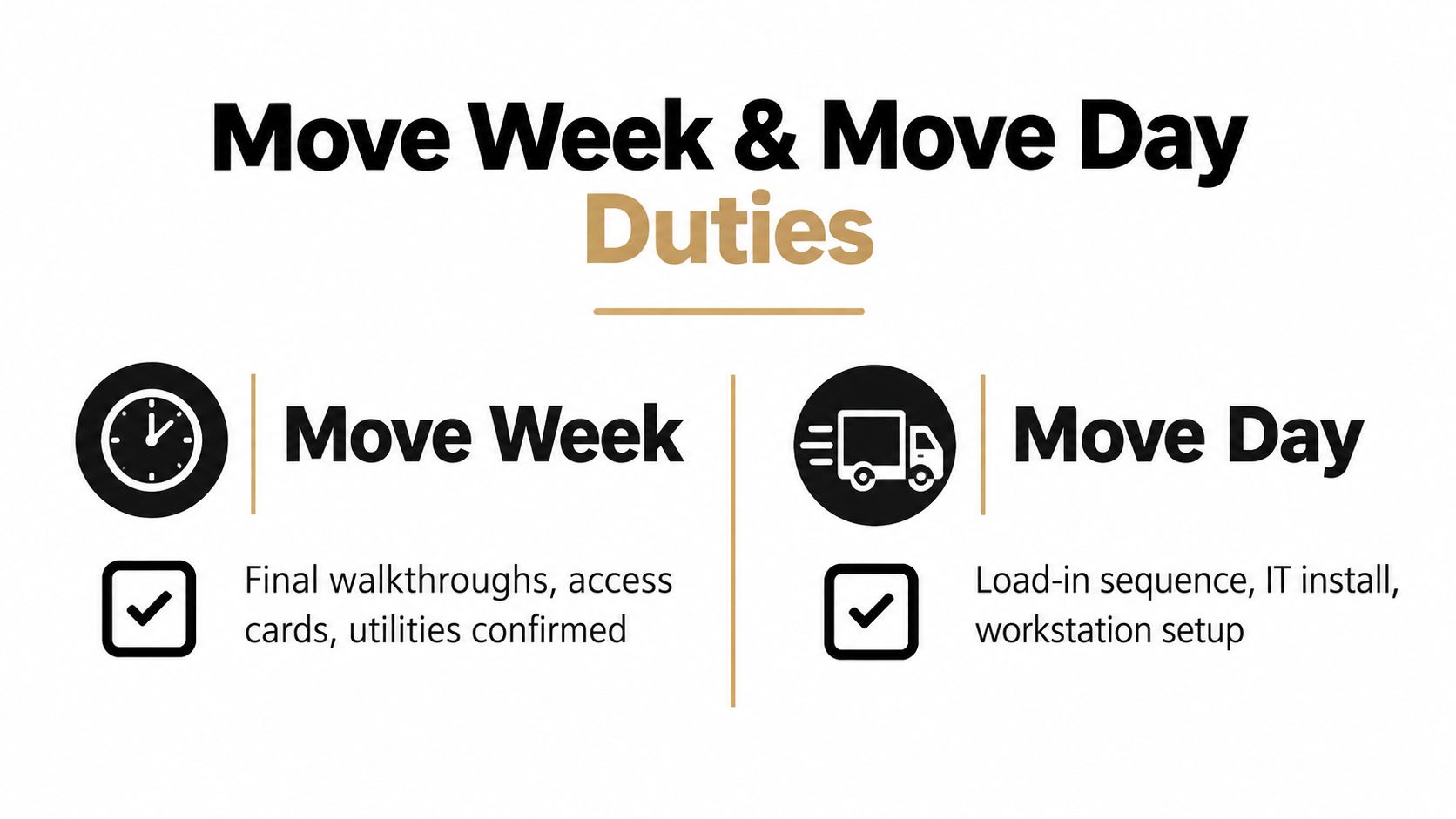
Move Week and Move Day Duties That Keep Business Running
Move week should feel controlled, not heroic. Every task should answer three questions: who owns it, when is it checked and what happens if it fails? The relocation lead should keep one live schedule rather than allowing IT, facilities, movers and department heads to work from separate versions.
Seven days before
Run the final walkthrough with building management. Check the freight lift, loading dock, access cards, door widths, floor protection, parking, security procedures and after-hours contacts. Confirm that utilities and connectivity are active or have a named technician and escalation path.
The IT lead should check the shutdown and restart sequence for critical systems. That includes NBN or carrier activation, internal cabling, rack setup, power, Wi-Fi coverage and the order in which systems return online. Allied's Australian project guidance highlights these readiness checks and identifies skipped IT checks, unlabelled cables and poor team staging as common sources of extended downtime (Allied business relocation project guidance).
The final working day
Staff should finish personal packing, clear confidential material and attach labels to every box and cable bundle. The department lead signs off each area, while IT photographs server rooms, racks and desk connections before anything is unplugged.
Create a first-day kit containing chargers, power boards, printer supplies, cleaning items, stationery, access information and basic tools. It prevents a simple missing cable or empty printer tray from becoming the first problem reported to leadership.
Move day sequence
The exact hours depend on the building, but the sequence should remain deliberate:
Access check: The site lead confirms building access, lift availability and protection before loading begins.
Priority load: Movers load sensitive equipment and high-priority work areas according to the agreed sequence.
Receiving check: The new-site lead verifies room, floor and workstation destinations as items arrive.
IT installation: The technology team positions racks, connects priority equipment and begins testing before general unpacking.
Workstation setup: Furniture and equipment are placed against the validated floor plan, with cables kept attached to their labelled endpoints.
Walkthrough: The relocation lead records damage, missing items, access faults and unsafe conditions before sign-off.
Close-out: The old office receives a final sweep, while the new office gets a first operational test.
Move-day discipline: Don't allow everyone to solve problems independently. Use one relocation lead, one building contact, one IT lead and one representative for each priority department.
Professional packing can be useful where staff need to keep operating until late in the week or where equipment requires careful protection. Services such as professional packing for office moves can reduce inconsistent labelling and keep department heads focused on business operations.
Business continuity planning should also cover access failure, connectivity delays, damaged equipment and temporary workspace needs. A practical resource on how to build operational resilience in 2025 can help leadership connect relocation risks with broader operational controls.
Coordinating IT Permits Lift Bookings and People Without Delays
A move can lose a day even when the trucks and movers arrive on time. The usual causes sit earlier in the sequence: an unapproved loading dock, a lift booking that does not match building access, or an internet service that has not been tested. Build the dependency map from the occupancy date backward, then assign an owner and confirmation point to every task.
Technology dependencies
The IT lead should confirm carrier activation, internal cabling, rack setup, power, Wi-Fi coverage, and the shutdown and restart sequence for business-critical systems. Label cables and endpoints before disconnection. A cable that looks obvious on Friday night can become a long fault-finding exercise on Saturday.
Agree on acceptance tests before move week. Name the person responsible for checking internet access, phones, printers, meeting rooms, security systems, and priority applications. Record the result, the time tested, and any workaround. Staff should not be the first people to discover a failed connection on Monday.
Building dependencies
Put lift and loading dock bookings on the same schedule as IT. Confirm access hours, permit requirements, contractor induction, lift protection, and the building security contact. A truck waiting outside while the dock is unavailable creates delay, extra handling, and pressure on the installation sequence.
Give administrative updates clear owners. Update ASIC and Australian Business Register records 6 to 8 weeks before the move. Confirm vendor bookings and loading dock reservations 2 to 4 weeks before moving day, following the timing set out in The Work Project relocation checklist. Store emails, permits, booking references, and approvals in the project record.
People and stakeholder notice
Staff, clients, and suppliers need instructions that change their behaviour. Give the first formal notice and reminder cycle 4 to 6 weeks before the move where downtime, lift bookings, visitor access, or IT continuity affect them. At least two weeks' notice is the stated minimum in the regional relocation guidance (Allied Australian business relocation guidance).
Victoria has separate workplace-change notice thresholds. Victorian Government VPS guidance states that a temporary change within a work area requires at least 24 hours' notice. A temporary move to a different work area requires at least two weeks' notice, as does a permanent change within a work area unless a shorter period is agreed (Victorian Government usual place or places of work guidance.pdf)).
Use one communication register for staff, clients, suppliers, building management, and emergency contacts. Include the relocation lead, IT owner, facilities contact, and department representatives. For Melbourne businesses coordinating the physical move, commercial office removalists in Melbourne can be listed alongside those owners, with each booking and approval tied to the occupancy date.
Post Move Follow Ups and Your Next Steps to Settle In
The first morning shows whether the sequence held. The following weeks decide whether the workplace becomes usable and stable. Keep the relocation lead active after the trucks leave. Log each fault, assign an owner, and rank it by business impact, not by who reports it most loudly.
Test connectivity, phones, printers, meeting rooms, access cards, Wi-Fi coverage, workstations, and visitor entry. A failed executive display can wait. A disconnected customer service team can affect the business. Address safety, access, and critical technology issues first, then work through furniture, storage, and presentation matters.
The first week
Walk the new premises with facilities and department leads. Check wayfinding, room names, signage, storage, cleaning, kitchen supplies, and emergency information. At the old premises, complete the final sweep, photograph the condition, and confirm the landlord's handover requirements.
Keep the issue register open through the initial review period. Australian office relocation planning guidance allows 1 to 4 weeks post-move for review and decommissioning, giving the team time to close defects, return access items, clear storage, and finalise the old site.
If furniture or records cannot move immediately, controlled short-term storage for office items can keep the new workplace clear while outstanding work is completed.
The close-out
Hold a short review with the relocation team and department representatives. Record what caused delays, which supplier dependencies were difficult, whether the floor plan matched reality, and what should change before the next lease cycle. Keep decisions, unresolved defects, and assigned owners in one close-out record.
Your next steps are practical. Name one coordinator, set the occupancy date, map dependencies backward from a functional workplace, and confirm IT and building access early. Run weekly checks until the issue register is closed. The truck booking is one milestone, not the plan.
Get n Go Removals Melbourne can coordinate commercial office relocations with packing, furniture disassembly and reassembly, protective equipment, transport, and secure storage options. Visit Get n Go Removals Melbourne to discuss your occupancy date, access requirements, and a move sequence designed to minimise disruption.
You're moving across Melbourne, comparing a straightforward local house move with the extra demands of packing, apartment access, storage or an interstate settlement. The cheapest hourly rate may not produce the lowest final cost if the quote excludes stairs, lift bookings, packing materials, insurance, storage or specialist handling.
The best home removals choice depends on service scope, coverage, protection, scheduling and quote transparency. This guide compares seven Melbourne removalists by the job they're best equipped to handle, from standard local moves to white-glove packing, storage and complex interstate logistics. Pricing is generally quote-based in the supplied information, so request an itemised estimate and confirm access conditions, insurance, storage terms and every add-on before you book.
1. Get n Go Removals Melbourne
Best for flexible Melbourne moves, specialist items, office relocations and East Coast routes
Get n Go Removals Melbourne is the strongest all-round choice for households and businesses that want one provider to manage the move from planning through delivery. This family-owned Melbourne removalist has more than 10 years of experience, uses full-time, police-checked staff and operates a company-owned fleet ranging from 4.5 to 12 tonne trucks.
That combination suits standard house and apartment moves, but the service extends well beyond basic furniture transport. The team handles office relocations, event and commercial transport, furniture disassembly and reassembly, pianos, pool tables, valet white-glove packing and unpacking, plus short- and long-term storage. Public liability and transit insurance, premium packing materials and protective equipment add useful safeguards for valuable or awkward belongings.
Why it stands out
Get n Go is particularly practical when the move has several moving parts. A single point of contact can coordinate a settlement date, apartment lift booking, packing crew, storage requirement and delivery schedule without forcing you to manage separate suppliers. Flexible 24/7 scheduling also helps customers working around tight handover windows or business operating hours.
Weekly direct runs connect Melbourne with Sydney, Brisbane and key East Coast destinations. That makes the company a natural fit for customers relocating between Melbourne and major East Coast cities, although nationwide or remote regional coverage may require additional coordination.
Practical rule: Ask for the written quote to separate labour, packing, materials, storage, insurance and specialist-item charges.
The main limitation is that no flat-rate or sample pricing is published in the supplied information, so you'll need a quote. Before booking, use the essential moving home to-do list to organise access, valuables, utilities and items that need special preparation.
Choose Get n Go if: you want end-to-end support, specialist handling, secure storage, office moving capability or a flexible Melbourne to East Coast service.
2. Grace Removals Melbourne
Best for assessment-led full-service relocations
Grace Removals suits households that want more than loading and unloading. Its Melbourne service combines home removals with professional packing, valet-style unpacking, storage, optional exit cleaning and utility transfer assistance through Grace Connect. That breadth is useful for renters managing a lease handover or homeowners who want to limit the number of contractors involved in moving day.
The key advantage is the in-home assessment and fixed-price quotation process. A site visit gives the provider an opportunity to review the inventory, access, stairs, lifts and packing requirements before presenting the quote. It also gives you a better basis for comparing the full moving scope rather than relying on a basic hourly estimate.
Where the trade-off sits
Grace is a strong fit when convenience matters more than finding the leanest removal-only package. Packing, unpacking, storage, cleaning and utility support can simplify the move, but each additional service affects the final quote. There's no public rate card in the supplied information, so quick price comparisons aren't possible without contacting the company.
Grace also offers interstate and international network coverage, making it suitable for customers whose move extends beyond Melbourne. If you're comparing providers, review this Melbourne moving companies guide and ask whether the quote includes only transport or the full relocation package.
Choose Grace if: you want an in-home assessment, fixed-price quote and coordinated support for packing, storage, cleaning and utilities.
3. Allied Moving Services Melbourne
Best for interstate or larger moves requiring formal insurance options
Allied Moving Services is built for customers who want a broad national and international network behind their relocation. Its Melbourne operation provides household packing, furniture removals, storage and moving support for local, interstate and overseas requirements.
The most important differentiator is the Allied Insurance Centre, which provides transit and storage insurance in-house under an Australian Financial Services Licence. That can make the insurance conversation more straightforward, particularly for customers moving a substantial inventory or placing belongings into storage during a longer transition.
Allied also supports international relocations through a global network and tracking capability. That wider reach is useful when the move involves multiple stages, overseas coordination or a delivery destination outside the usual Melbourne service area.
Check the scope before signing
Allied uses quote-only pricing in the supplied information. The final amount depends on the inventory, distance and service level, so it isn't the right option if you want an instant hourly rate. Ask for a written breakdown covering packing, transport, storage, insurance and any access-related work.
For interstate planning, compare the proposed collection and delivery windows with the timing of your lease, settlement or temporary accommodation. The long-distance removalists guide can also help you identify the questions to ask before committing to a larger relocation.
Choose Allied if: insurance structure, national reach and project support matter more than instant price comparison.
4. Kent Removals & Storage Melbourne
Best for combined moving, containerised storage and vehicle relocation
Kent Removals & Storage is a practical choice when moving home is only one part of the logistics. The company provides local, interstate and international household moves, with packing, storage, insurance options and car relocation available through the same provider.
Its containerised storage service is especially relevant for customers who can't move directly from one property to the next. Kent can arrange pickup and loading at the residence, reducing the need for you to organise a separate transport stage before storage. That setup may suit renovation moves, settlement gaps, downsizing or interstate relocations where delivery dates don't align.
A useful single-provider option
Keeping moving, storage and vehicle relocation with one company can simplify communication. You'll still need to confirm how access, loading, storage duration, insurance and final delivery are treated in the quote. Containerised storage also makes it important to ask whether the container remains sealed, how items are protected and how retrieval or redelivery is scheduled.
Kent promotes a transparent quote process with no hidden-fee claim, but public rates aren't listed in the supplied information. The price will vary with volume, access, distance and add-ons. Customers needing storage should review these storage solutions in Melbourne and compare the total logistics plan rather than transport alone.
Choose Kent if: you need one supplier for household removals, containerised storage and potentially vehicle relocation.
5. WridgWays
Best for established coverage and structured move planning
WridgWays brings a long operating history to local, interstate and international relocations. Founded in 1892, the company offers household moving, packing and storage services supported by a national branch network.
That history is most valuable for customers who want a recognisable operator with planning material available before moving day. Pre-move resources and checklists can help first-time movers organise inventory, documents, packing decisions and access requirements before the crew arrives.
Plan the quote around your actual move
WridgWays is suitable for Melbourne households moving locally, across Australia or overseas. Its broad scope means you can ask about packing and storage as part of the same relocation, but pricing is entirely quote-based in the supplied information. There's no published rate card, so you'll need to provide inventory and destination details before comparing the offer.
A detailed inventory matters. Include large furniture, fragile items, appliances, outdoor equipment, stairs, narrow driveways, loading restrictions and any storage requirement. If you're moving interstate, use this best interstate removalists guide to structure your questions about timing, delivery windows and responsibility for goods in transit.
Choose WridgWays if: you value a long-established operator, national branch coverage and practical planning resources.
6. Chess Moving Melbourne
Best for complex relocations with local, interstate or international connections
Chess Moving is an Australian-owned provider with Melbourne branch support and a broad service scope. It handles local, interstate and international moves, with packing, storage and insurance options available for relocations that may involve more than one transport stage.
The company's national footprint is useful when a move starts in Melbourne but ends elsewhere in Australia or overseas. International insurance options can also help customers structure protection for a more complex journey, although the policy terms must be reviewed carefully before acceptance.
Ask about handovers
Complex relocations require clarity about who controls the goods at each stage. Ask whether the Melbourne team manages the full move, when another branch or partner becomes involved, how tracking works and who handles any damage or delay claim.
Chess has minimal public pricing in the supplied information, and the final cost depends on volume and service scope. That makes a personalized consultation essential. Give the company a complete inventory and explain whether you need packing, storage, international coordination or delivery to a difficult-access property.
Choose Chess if: your move may involve interstate or international connections and you want an Australian-owned provider with broad coverage.
7. Dawson Moving & Storage Melbourne
Best for flexible packing levels from a Melbourne-based operator
Dawson Moving & Storage is a Melbourne-based, family-run removalist that has operated since 1927. It handles residential moves across Melbourne, Australia-wide relocations and overseas moves, with packing and secure storage available for customers who need more than transport.
The flexible packing model is the main attraction. Customers can request partial packing for fragile or difficult items while handling simpler belongings themselves, or choose a more complete service. That gives you control over the balance between preparation work and professional assistance.
Dawson also provides in-house secure storage, moving checklists and free quotes. The Melbourne headquarters may appeal to customers who prefer a Victorian operator for a local move, while the broader service supports interstate and overseas requirements.
Match the packing level to the inventory
There's no public rate list in the supplied information. The quote will depend on inventory, access, distance and add-ons, so describe exactly which rooms or items you want packed. Fragile-only packing may suit a household that has time to box books and clothing, while full-service packing makes more sense when work, family or a short settlement window leaves little preparation time.
Choose Dawson if: you want a long-established Melbourne operator and the flexibility to choose partial packing, fragile-item support or a fuller service.
⭐⭐⭐ 📊 Flexible service delivery; local expertise and secure storage
Melbourne households wanting flexible pack levels and local operator
Nearly century-old family business; flexible services and claimed competitive quotes
Choose With Confidence Before Moving Day
The best home removals provider is the one that matches your actual job. A basic apartment move with easy access needs a different service from an office relocation, a piano move, a lease gap requiring storage or an interstate transfer with a fixed settlement date.
Ask every shortlisted removalist for a written quote based on the same information. Provide the inventory, collection and delivery suburbs, preferred dates, stairs or lifts, parking restrictions, packing level, storage duration and specialist items. If one provider receives less detail than another, the quotes won't be comparable.
Before booking: Confirm what the quote includes, who manages the move, how the crew will access both properties and what happens if the schedule changes.
Insurance needs specific attention. Ask what public liability, transit or storage insurance covers, whether customers must declare high-value items, how exclusions work and who manages a claim. Consumer Affairs Victoria's public warning on CBD Movers recorded 89 Victorian complaints between January 2022 and June 2023 involving issues including damage, overcharging and failure to accept liability, so liability handling and complaint history deserve direct questions before payment or booking. Read the Consumer Affairs Victoria warning through the ABC's report.
Timing matters in Melbourne. The Australian Bureau of Statistics reported that 1.14 million Australian households, or 12% of all households, moved at least once in the previous 12 months in 2019–20, while more than 40% had moved within the previous five years. The ABS also recorded 11.1% of people as interstate movers in both 2016 and 2021, and found that 39.6% of people who left Greater Melbourne between 2020 and 2021 stayed within Victoria. Those figures support planning for both local Melbourne corridors and interstate demand. Review the ABS housing mobility data.
January is particularly competitive. Budget Direct's 2024 data found that Australians were up to 50% more likely to move in January than in any other month, with January representing 17.62% of moves in the ACT, 17.27% in Tasmania and 13% to 16% across NSW, Victoria, Queensland, South Australia and Western Australia. Book early if your settlement, lease expiry or office shutdown falls around the start of the year. See Budget Direct's moving-month data.
Match the provider to the job:
Get n Go Removals for a flexible Melbourne or East Coast relocation, specialist handling, office moving, packing and storage.
Grace Removals for an assessment-led move with packing, cleaning, utility support and other relocation extras.
Allied or Chess for broader national or international network requirements and more complex coordination.
Kent for combined moving, containerised storage and vehicle relocation logistics.
WridgWays for established coverage and useful pre-move planning resources.
Dawson for flexible packing levels from a long-established Melbourne-based operator.
Get n Go is the clearest fit when you want one Melbourne team to coordinate residential or commercial moving, premium packing, specialist items, secure storage and regular East Coast routes. Visit Get n Go Removals Melbourne to request a custom quote, confirm the available schedule and discuss the access, packing, insurance and storage details of your move.
Get n Go Removals Melbourne provides house and apartment moves, office relocations, specialist piano and pool table handling, white-glove packing, furniture assembly and secure short- or long-term storage. Visit Get n Go Removals Melbourne to arrange an itemised quote for your Melbourne or East Coast relocation and plan moving day with one experienced point of contact.
You're standing in a half-packed Melbourne lounge room, surrounded by cartons that came from three different shops. One is sagging at the base, another is too large to lift safely, and the “heavy duty” label on the third means very little once it's filled with books. The removalist booking is fixed, the lift window is closing, and you're starting to realise that packing cases for moving aren't just containers. They control how quickly the job runs, how safely belongings travel, and how much the move finally costs.
Australia sees around 1.14 million household moves each year, and about 84% of people use Australia Post's Mail Redirection service, according to Australian moving-box guidance. Melbourne's share of that activity creates a familiar supply problem: people buy cases too late, choose by appearance rather than load, and then pay for the consequences through broken items, re-packing and wasted truck space.
This guide takes the removalist's view. It explains which cartons earn their place, when plastic crates make sense, how many cases a home usually needs, and when professional packing is worth the labour cost.
Why the Right Packing Cases Make or Break Your Move
A weak carton rarely fails at the moment you expect. It holds together while you carry it across the room, then buckles when a heavier case sits on top in the truck. A large box seems efficient until someone fills it with crockery, struggles to lift it, and leaves it half-packed because it has become unsafe.
That creates double-handling. Someone repacks the contents into smaller cases, the crew shifts boxes to find a stable stack, and fragile belongings lose the protection they had at the start. The original carton might have been cheap, but the extra labour and damaged contents aren't.
The three costs hidden inside a carton
The right case affects three parts of the move at once:
Protection: A rigid, correctly sized carton supports its contents and resists crushing during stacking.
Speed: Consistent sizes make the packing area easier to organise and let movers build tighter, more stable loads.
Total cost: The purchase price is only one part of the calculation. Replacements, additional packing materials, disposal and extra labour can cost more than the original cartons.
People often focus on the number of boxes, but the shape and strength of each box matter just as much. Dense items belong in compact cases. Light, bulky items need volume without excessive weight. Fragile goods need partitions, cushioning and enough internal support to stop movement.
Removalist rule: If you can't comfortably lift a packed case, it isn't ready for the truck.
A sensible packing system also separates the job into zones. Keep empty cartons, tape, markers and paper together. Pack one room at a time, label at least two sides, and keep an open-first case with medication, chargers, toiletries and basic bedding. For practical guidance on avoiding the errors that lead to re-packing, use this moving-home packing mistakes guide.
For breakables, don't rely on newspaper alone. Clean packing paper, tight wrapping and correctly filled voids give glassware and ceramics a better chance of arriving intact. This guide to a damage-free move with packing paper is useful when you're preparing fragile items without professional assistance.
The Main Types of Packing Cases and When to Use Them
Start with the load, not the carton name. Books, bedding, hanging clothes and framed artwork all need different shapes because their weight, bulk and vulnerability differ.
Small cartons for dense loads
Small book cartons are the workhorses for books, files, tools and compact kitchen equipment. Their limited capacity stops you from turning a manageable case into an unsafe block of weight. Put the heaviest items at the base, fill remaining gaps so the contents can't shift, and seal the top with strong packing tape.
Medium cartons suit mixed household contents. Use them for pots, toys, lamps, folded clothing and smaller appliances, but don't treat “medium” as permission to combine everything from a room. A carton containing cookware should be labelled differently from one containing linen, even if both cases are the same size.
Large cartons for light, bulky items
Large cases are best for bedding, towels, cushions, doonas and linen. They give soft goods room without creating an unreasonable lifting load. They're a poor choice for books, crockery or tools because the finished carton becomes difficult to carry and unstable when stacked.
Purpose-built cases solve awkward problems
A wardrobe carton has a hanging bar, allowing suits, dresses and coats to travel upright rather than folded into creases. Keep the rail evenly loaded and don't overfill the case, or the garments will compress and the box will become awkward to move.
Picture and mirror boxes use telescoping sections to accommodate flat, delicate surfaces. Wrap the frame or glass separately, protect the corners, and mark the case clearly. A television carton should match the screen's dimensions and have cushioning around the panel, while a dish pack with double-walled construction and dividers gives plates and glasses individual support.
Plastic stackable cases suit moves involving storage, moisture exposure or repeated handling. They're particularly useful when cartons need to remain sealed for a while. For a broader look at reusable storage formats, browse the Pacific Mobile Structures storage lineup.
Match the case to the household scenario:
Book-heavy study: Small reinforced cartons.
Standard apartment: Medium cartons, with selected large cases for linen.
Family wardrobe: Wardrobe cartons for hanging garments.
Fragile kitchen: Dish packs with dividers.
Long-haul or delayed storage: Stackable plastic cases for vulnerable contents.
For room-by-room preparation, this packing tips resource for moving house provides a useful checklist without replacing good judgement about load weight.
Cardboard vs Plastic Cases and Specialty Boxes Compared
You are halfway through a Melbourne move when a cheap carton splits under a load of books. The replacement case costs time, the contents need repacking, and the removal crew still has to handle the extra mess. Choose cases by weight, moisture risk and how often they will be handled, not by appearance alone.
Cardboard is the sensible default for most household goods. Single-wall cartons suit light items and short moves. Use double-wall or reinforced cases for books, crockery, tools and interstate transport, where crushing and repeated handling are more likely. Cardboard keeps upfront spending low and is easy to label, recycle or dispose of after delivery.
Plastic crates earn their cost when you will reuse them, require uniform stacking, or expect storage and changing weather. They resist moisture and keep their shape through repeated trips. Account for collection, storage and any deposit. A rental can cost more than cardboard if the relocation stretches out.
Specialty cartons are protective equipment. A wardrobe box keeps hanging garments upright without forcing them into creases. A dish pack separates plates and glasses. A purpose-sized screen carton protects an expensive television more reliably than a makeshift cardboard-and-blanket arrangement.
Material
Avg Cost per Case
Max Load
Reusability
Best For
Standard cardboard
A$2–A$6
Light to moderate loads
Limited
General household packing
Value-pack cardboard
Roughly A$2–A$4
Light to moderate loads
Limited
Larger carton orders
Double-wall cardboard
Varies by supplier
Moderate to heavier loads
Some reuse
Books, crockery and longer moves
Plastic crate
About A$5.40 for the first week in Victoria, plus A$1.25 per additional week
Moderate, depending on crate
High
Storage, staged moves and moisture exposure
Specialty carton
A$7–A$19
Purpose-specific
Usually limited
Wardrobes, mirrors and artwork
The cardboard and specialty ranges above come from Australia-focused moving-box cost guidance. Use plastic when repeated handling, storage or wet conditions justify the hire cost. Choose cardboard when low upfront spending and simple disposal matter more.
Order a mix, not a single carton type. Use compact reinforced cases for dense goods, medium cartons for everyday contents, larger cases for linen, and specialty protection for items that cannot tolerate improvisation. For practical sourcing options, read this guide on where to find moving boxes.
How Many Cases You Need and the Right Sizes to Order
A medium moving carton holds about 0.06 cubic metres, or roughly 40 to 50 litres, according to Australian moving-box volume guidance. That equals approximately 16 to 17 medium cartons per cubic metre, giving you a practical way to check whether your order fits the truck or storage space.
Use the household estimate as a starting point. A studio or one-bedroom move often needs 25 to 30 boxes, while a three-bedroom home may require 70 to 80, based on Australian relocation guidance. The estimate excludes the contents hidden in cupboards, garages, sheds and storage areas. Homes occupied for longer than five years also tend to need about 20% more packing capacity.
Home size
Small cases
Medium cases
Large cases
Wardrobe boxes
Estimated volume
Studio or one bedroom
6–8
12–16
4–6
1–2
Approximately 1.5–2 cubic metres
Two-bedroom apartment
8–12
18–24
6–8
2–4
Approximately 2.5–3 cubic metres
Three-bedroom house
15–20
40–48
12–16
4–6
Approximately 4.5–5 cubic metres
Treat these figures as an ordering framework, not a fixed quota. Add capacity for a full garage, a substantial book collection or long-term storage. Reduce it after a serious declutter. For a more precise load estimate, use this cubic metre calculator for moving.
A practical Melbourne apartment example
For a two-bedroom Melbourne apartment, order medium cartons for general contents, small cases for books and cookware, and large cases for linen. Add wardrobe cartons only where clothing needs to stay hanging. The right mix prevents dense items from turning large cartons into unsafe loads.
Leave room for proper lifting. A carton filled to the top is not automatically efficient, and overloaded cases slow stairs, lifts and narrow-street loading. Compare the estimated cubic metres with the vehicle booked before ordering, particularly when Melbourne parking restrictions or limited lift access can shorten the loading window.
Buying Versus Renting Cases Versus Hiring a Valet Pack
On a tight Melbourne moving schedule, the cheapest case can create the most expensive delay. Compare the case price with packing time, storage space, disposal, and the risk of cartons sitting around after settlement.
Buy cardboard for a straightforward move when you can pack gradually and store empty cases. Standard cartons usually cost about A$2–A$6 each, while value packs bring them to roughly A$2–A$4. Specialty cases, including port-a-robes and picture or mirror boxes, can reach A$7–A$19. Use these as planning ranges, then check current Melbourne retailer prices before ordering.
Renting plastic crates suits a short, organised move. One Victorian rental model charges about A$5.40 per box for the first week and A$1.25 for every additional week. Uniform crates save disposal work and keep a temporary move orderly, particularly when you are moving between properties on a tight schedule. Confirm delivery, collection, deposit, cleaning, and late-return terms. A low weekly rate is not a low total cost if access or timing adds fees.
The labour equation
Professional packing changes the calculation. Melbourne packing-service guidance places assistance at around A$125–A$300 per service hour, with full-house estimates around A$390–A$1,950, depending on home size and crew size, as outlined in Melbourne packing-service pricing guidance. A separate Melbourne estimate puts a three-bedroom pack at approximately A$1,170–A$1,560 with a three-person crew.
Choose a valet pack when settlement, lift bookings, interstate timing, or fragile contents leave little time for mistakes. Skip it for a small move with uncomplicated belongings and enough days to pack yourself. Paying for labour makes sense when a missed loading window or damaged item costs more than the service.
The supplied comparison visual uses a different illustrative benchmark for a three-bedroom move, including approximately 40 boxes and two hours of valet work. Treat it as a scenario, not a quote. The final total depends on case types, packing scope, access conditions, crew, and rental terms.
Budget test: Buy when you can pack steadily. Rent when reuse and convenience matter. Hire a valet pack when your schedule or fragile inventory is worth more than the labour saving.
For a staged move, renting keeps spare cartons from filling the new property before unpacking. For a family home with preparation time, buying gives you control over sizes and packing pace. For offices, high-value collections, and interstate relocations, professional packing reduces delays caused by inexperienced loading decisions.
Packing Techniques for Fragile and High Value Items
The truck is booked, the lift window is short, and a carton of glasses is rattling before it reaches the hallway. Fix that risk with weight distribution first. Put dense items at the bottom, lighter pieces above, and fill every void so contents cannot shift. Use small cartons for heavy goods and larger ones for light, bulky contents, following Australian packing advice for removalists.
A carton must remain rigid when lifted. Keep ordinary cases to around 15–20 kilograms, using the lower end for fragile contents and long-distance transport. Double-corrugated or reinforced cartons provide better protection, as recommended by Allied's Australian packing tips. For step-by-step wrapping and void-fill methods, see how to pack fragile items for moving.
Build protection in layers
Wrap glasses and ceramics separately in clean packing paper. Place rolled corrugated cardboard between flat items, and pack plates vertically instead of creating a tall stack that can crush at the base. Linen can fill small gaps, but it should not be the only barrier around valuable glass or sharp edges.
Electronics need foam or shaped cushioning around screens and hard corners. Bag and label cables separately. Double-box vulnerable equipment by placing a cushioned inner carton inside a larger case, with protection between both walls.
Assess artwork and antiques individually. Protect corners, keep pressure away from painted or polished surfaces, and use acid-free tissue where contact could mark a delicate finish. Packing peanuts suit broad voids, while tightly crumpled paper usually supports household items more securely because it can be positioned around each piece.
Prepare large appliances properly
Tape washing-machine and refrigerator doors closed, keeping adhesive off finished surfaces. Remove loose shelves, trays and fittings, wrap them separately, and cushion exposed edges. Mark fragile faces and keep cases upright where the contents require it.
Keep passports, jewellery, laptops, medication and important documents out of ordinary moving cases. Carry them in a personal essentials bag or secure vehicle. A labelled carton can still enter storage or sit beneath heavier items, so valuable and irreplaceable belongings need their own chain of control.
Your Moving Day Packing Case Checklist
Treat this as the job sheet you'll use when the lounge room is busy and everyone is asking what goes where.
The night before
Create staging zones: Keep sealed cases together by room, with a clear path to the exit.
Label visible faces: Write the destination room, contents and fragile status on at least two sides.
Separate essentials: Keep medication, documents, chargers, toiletries, basic food and a change of clothes with you.
Check carton condition: Reject damp, crushed or soft cases before loading.
Prepare the kit: Put tape, markers, scissors, spare paper and a small tool kit in one accessible container.
On moving morning
Load by stability: Put heavier cases low and light linen cartons higher in the stack.
Protect the awkward items: Secure wardrobe cartons so their doors can't swing, and pad picture, mirror and screen cases.
Redistribute weight: If one carton is too heavy, open it and move contents into a smaller case.
Keep valuables separate: Carry important documents, jewellery, medication and personal electronics yourself.
Load the open-first case last: It should be the first case available at the new property.
At the destination
Place cases by room: Don't create a second sorting job in the hallway.
Open priority rooms: Set up the bathroom, bedroom and basic kitchen items before decorative contents.
Inspect specialty cases: Check artwork, glassware and electronics before disposing of packaging.
Return hired crates: Confirm the rental collection date and any additional-week charges.
Flatten cardboard: Break down usable cartons for future packing and place unwanted cardboard into the appropriate recycling stream.
Get n Go Removals Melbourne can supply packing materials and handle packing, unpacking and valet white-glove services for homes, apartments, offices and interstate relocations. If you want the cases chosen, packed and loaded around your Melbourne access and timing requirements, visit Get n Go Removals Melbourne to discuss the move.
A pallet removal job often starts with a deceptively simple request: clear the timber pallets from a warehouse, apartment basement, office loading area, or garage before the next delivery arrives. The difficulty appears when the crew finds narrow access, mixed loads, damaged boards, uncertain weights, limited lift access, or pallets that can't be treated as rubbish. Melbourne pallet removals need planning around dimensions, safe working loads, equipment, site access, and the recovery route after collection.
A sound removal plan protects the goods, the building, the workers, and the final disposal outcome. The practical question isn't only how to get pallets off your property. It's whether each pallet can be reused, repaired, recovered for energy, or needs another disposal pathway.
When Melbourne Businesses and Homes Need Pallet Removal
A warehouse in Dandenong may be clearing stock before a lease handover. In the CBD, an office relocation might leave archives, workstations, boxed equipment, and display materials secured on pallets. A strata manager may face a basement clear-out where pallets have accumulated beside household goods, old furniture, and building materials. Each job looks different, but the handling problems are similar: the load is unitised, heavy, awkward to access, and often unsuitable for ordinary rubbish collection.
A pallet can make goods easier to move with the right equipment, but it also concentrates weight in one footprint. That affects floors, ramps, lift bookings, truck selection, and the sequence of loading. A residential customer may have pre-packed crates that need moving through a garage or driveway, while an event organiser may need pallets collected immediately after pack-down. The same removalist can't assume that a warehouse dock, a domestic driveway, and a basement loading zone offer the same conditions.
Common triggers for a removal
Warehouse consolidation: Surplus pallets and palletised inventory may block aisles, loading areas, and access to racking.
Office relocation: Archives, IT equipment, furniture, and boxed files often need staged transport rather than one continuous move.
Lease or fit-out handover: Pallets, packaging, and loose freight may need clearing while contractors work around the site.
Event transport: Exhibition stands, furniture, and equipment may arrive palletised and require coordinated collection after the event.
Residential moves: Large crates and grouped household goods can need pallet handling even when the destination is a home or apartment.
The property itself matters as much as the freight. Lift dimensions, driveway gradients, door clearances, loading-zone restrictions, and the condition of the floor can determine whether a pallet jack or tail lift is suitable. For broader moving and storage requirements, customers can review furniture removal and storage in Melbourne alongside their pallet plan.
Practical rule: Treat the pallet, its contents, and the access route as one handling problem. Separating those decisions is how delays and damage begin.
Understanding Australian Standard Pallet Dimensions and Load Limits
The Australian domestic standard pallet is commonly specified at 1165 × 1165 mm, with a square footprint designed around local warehousing, rail, and domestic freight systems. Australian pallet size guidance also identifies an overall height around 150 mm, a typical unloaded weight range of 25–35 kg, and four-way forklift entry. That format isn't the same as the Euro or export-oriented sizes, so a Melbourne removal crew needs the actual pallet footprint before planning trailer space or storage.
The square profile helps align goods with Australian warehouse and container systems, improving cube efficiency and reducing re-handling during pickup, transfer, and storage, as described in Melbourne freight pallet guidance. In operational terms, that means the footprint can support predictable forklift access and racking compatibility. It doesn't guarantee that every truck, lift, aisle, or storage bay will accept a loaded pallet without checking clearances.
Capacity depends on construction and condition
Load ratings vary because a new heavy-duty pallet, a light-medium pallet, and a reconditioned pallet don't perform identically. Standard pallet capacity information commonly distinguishes a static capacity of up to 5,000 kg from a dynamic capacity of about 1,000–1,500 kg, with some industry guides citing a rated working load up to 2,000 kg, depending on construction.
A separate Melbourne freight reference describes practical payload bands of 500 kg for light loads, 1,000 kg for medium loads, and 1,000+ kg for heavy-duty use. Those bands aren't a substitute for the pallet's marking or manufacturer instructions. They're a prompt to verify the pallet grade, load distribution, travel conditions, and storage arrangement before lifting.
Planning detail
Why it matters
1165 × 1165 mm footprint
Determines floor, trailer, racking, and doorway fit
Approx. 150 mm pallet height
Allows pallet jack and forklift access
Four-way entry
Gives operators more options in restricted areas
Dynamic working load
Controls safe movement during loading and transport
Static working load
Applies to stationary storage, not vehicle movement
Use a cubic metre calculator for removal planning to estimate the broader shipment, but don't rely on volume alone. Weight distribution and safe working load control the handling decision.
Service Options for Pallet Transport and Storage
Pallet removal services generally fall into three practical levels. The right choice depends on whether the customer has already prepared the load, whether the goods need protection beyond ordinary transport, and whether the destination is ready to receive everything immediately.
Standard pickup and delivery suits stable, wrapped pallets positioned near an accessible loading point. The customer normally needs to identify the pallet count, confirm approximate weights, clear the route, and ensure someone can release and receive the goods. This option can be efficient for a warehouse transfer where the freight is already labelled and the dock is available.
Assisted handling adds equipment and labour for awkward access, internal movement, or staged loading. It works better for offices, apartment buildings, and properties without a conventional dock. The crew may need to move goods from a storage room to a truck, protect walls and floors, and coordinate with building management.
When white-glove handling earns its place
White-glove service makes sense when the pallet contains fragile furniture, finished interiors, valuable displays, sensitive office equipment, or goods that need unpacking at the destination. Packing can include protective blankets, corner protection, shrink-wrapping, and furniture disassembly. For loads exposed to dust or movement during staged transport, customers may also consider custom stretchhood packaging film as a packaging resource, subject to the product and handling method.
The trade-off is straightforward. More preparation and handling reduce the work left to the customer, but they require a clearer scope and more time on site. A rapid event teardown may need a simple collection plan, while a phased office relocation benefits from labels, inventory control, scheduled storage, and a single contact.
Storage changes the transport plan
Storage is useful when the new premises aren't ready, a settlement date shifts, or an office needs to vacate before the replacement site is available. Pallets should remain stable, protected, and identifiable throughout the holding period. A Melbourne storage solution can form part of a staged move, but the booking should specify whether the goods remain palletised, whether access is required during storage, and whether delivery will happen in one release or several.
Don't book a basic curbside service for goods that need internal placement, disassembly, or storage staging. Likewise, don't pay for white-glove handling when the freight is already secure, labelled, and dock-ready. The efficient service is the one that matches the actual handling risk.
Fleet and Equipment Considerations for Safe Handling
Manual lifting is the wrong starting point for heavy hardwood pallets. WorkSafe Victoria recommends eliminating manual lifting of hardwood pallets and prioritising mechanical aids, including four-wheel trolleys, lifters, pallet lift tables, and vacuum lifters. Its pallet racking operation and maintenance guidance also states that the safe working load must not be exceeded for the unit load, pallet beam, or bay, with the SWL taken from manufacturer instructions or AS 4084.2:2023.
The equipment choice should follow the route, not the other way around. A forklift may suit a warehouse dock, but a tail lift and pallet jack may be more appropriate at a home or street-level commercial site. A lift table can reduce awkward height changes, while a four-wheel trolley can help move individual pallets or components across a controlled surface.
A safe loading sequence
Inspect the pallet and load. Look for broken boards, unstable stacking, loose wrap, shifted cartons, and unknown weight.
Confirm the SWL. Check the pallet, racking bay, lifting equipment, and vehicle restraints. Never assume the nominal pallet size proves the capacity.
Clear the travel path. Remove trip hazards, protect vulnerable walls and floors, and confirm door and lift clearances.
Use mechanical aids. Avoid asking workers to lift hardwood pallets manually. Position forks or pallet-jack wheels correctly before movement.
Restrain the freight. Use suitable straps, bracing, and protective materials so the load can't shift in transit.
Overloading can raise the risk of musculoskeletal injury and racking failure. Placing the heaviest items low, keeping the centre of gravity controlled, and using mechanical handling reduces the chance of a tip, collapse, or uncontrolled movement. A practical plant ops logistics reliability guide can also help managers think about equipment condition and operational reliability. For labour and vehicle coordination, a two-man removalist and van service may suit smaller or more constrained jobs.
Navigating Local Regulations and End-of-Life Pathways
Removal isn't the same as recycling. Once pallets leave a Melbourne site, their next pathway depends on type, condition, contamination, ownership, and recovery channel. A clean, intact pallet may be suitable for reuse. A damaged pallet may have refurbishment value. A single-use pallet may be directed to energy recovery, including cement kilns or other energy-from-waste facilities, rather than returning to circulation.
National packaging data records a 26.4% redemption rate for reusable timber pallets, and it also identifies recovery of some single-use pallets for energy production. Those figures show why a removal company shouldn't promise that every collected pallet will be recycled in the same way. The recovery result depends on what the crew collects and how the receiving facility classifies it. Australian packaging consumption and recovery data provides the relevant national context.
Separate the material before collection
A mixed hard-waste pile makes recovery harder. Keep reusable pallets away from wet waste, chemicals, soil, broken glass, and general rubbish. Mark pallets that belong to a pooling or hire system and confirm the return process rather than treating them as owned timber.
Victoria's waste system also matters to operational planning. The Victorian local government waste data dashboard publishes annual local-government data through 2023-24 and includes a recovery and disposal projection model extending to 2053-54. Sustainability Victoria's latest published series reports 10,765,300 tonnes recovered compared with 15,333,069 tonnes generated. These figures describe the broader system, not the guaranteed outcome for one removal job.
For a warehouse or strata clear-out, ask three direct questions before booking:
Can it be reused? Check cleanliness, structural condition, ownership, and standard size.
Can it be refurbished? Separate repairable boards from pallets with major structural damage.
Does it need recovery or disposal? Keep contaminated, broken, or unsuitable timber apart so the provider can route it accurately.
That approach produces a more honest environmental claim and can affect fees, timing, and the handling method.
How to Prepare and Book Your Pallet Removal
Good preparation starts before the truck is assigned. The removal provider needs enough information to choose equipment, labour, storage capacity, and the correct vehicle access plan. A vague description such as “some pallets behind the office” leaves too much risk unresolved.
A practical preparation checklist
Count and classify the pallets. Record the number, material, approximate condition, and whether they're owned, hired, or pooled.
Inspect the load. Check for broken boards, leaning stacks, loose cartons, exposed nails, moisture, and unstable wrapping.
Record dimensions and weights. Use the Australian footprint where applicable, but identify oversized pallets and unusual loads separately.
Confirm safe working loads. Check markings and manufacturer information. Don't place an unknown load into racking until its capacity is established.
Separate recovery streams. Keep reusable, repairable, contaminated, and general waste items apart.
Photograph the site. Show the loading point, access route, stairs, lift, ramp, driveway, gate, and any tight turns.
Arrange building access. Book loading docks, service lifts, concierge access, security clearance, and loading-zone windows.
Check street requirements. Where parking or vehicle positioning affects public space, confirm whether council approval or a permit is needed.
Nominate one contact. Give the crew one person who can approve sequencing, answer site questions, and sign off the collection.
Confirm the recovery outcome. Ask whether pallets will be reused, repaired, sent for energy recovery, or handled through another approved stream.
A commercial site may also need a work method statement, induction, traffic plan, or landlord approval, depending on the property and scope. Racking removal, anchor extraction, floor repairs, and pallet collection shouldn't be bundled casually. They require separate checks because the crew may need different tools and controls.
Use guidance for choosing a removals firm when comparing providers. Ask for written confirmation of the pallet count, access assumptions, insurance, storage requirements, transport route, and any exclusions. If the job involves interstate movement, confirm where responsibility transfers and how damaged or refused freight will be handled.
Book early when the move depends on a settlement, lift reservation, event pack-down, or lease handover. Tight schedules can be managed, but only when the site details are accurate and the decision-maker is available.
Frequently Asked Questions About Pallet Removals
Can household goods and commercial pallets share a truck?
They can, provided the vehicle has enough cube and payload capacity, the goods are separated and protected, and the loading sequence prevents commercial stock from being crushed or blocked by household items. The Australian pallet footprint can also affect how efficiently mixed goods use the vehicle, especially when palletised freight must remain stable during transit.
What insurance should I ask about?
Ask the provider to explain public liability insurance and transit insurance separately. Public liability concerns injury or property damage connected with the work, while transit cover concerns eligible goods while they're being transported. High-value commercial stock needs an accurate inventory, declared value where required, and clear exclusions. Don't assume that a general moving quote automatically provides the level of cover your business needs.
Are interstate pallet removals different?
Melbourne to Sydney or Brisbane movements need a confirmed delivery address, access plan, pallet dimensions, handling instructions, and a clear receiving contact. Weekly direct runs can help coordinate recurring movements, but the sender still needs to check destination access, unloading equipment, and whether the receiving site accepts the pallet type.
What happens if the pallet is damaged?
Stop and isolate it before lifting. A damaged pallet may need repacking, transfer to another pallet, repair, or a different recovery route. Never conceal structural damage under wrap, because the load can shift during forklift movement or vehicle transport.
Can a removal happen outside ordinary business hours?
Flexible scheduling can help with settlements, building restrictions, events, and urgent clear-outs. The practical limit is site safety, equipment availability, access approval, and whether the receiving location can accept the delivery. Confirm the full sequence rather than booking only the pickup window.
What information should I provide for a quote?
Give the provider the pallet count, dimensions, approximate weights, photographs, contents, collection and delivery addresses, stairs or lifts, loading-zone conditions, storage needs, and preferred dates. That information produces a more realistic plan than a pallet count alone.
Get n Go Removals Melbourne can coordinate palletised household, office, commercial, and event loads with packing, equipment, interstate transport, and secure storage options. For a practical assessment of your access, load limits, and recovery requirements, visit Get n Go Removals Melbourne and provide the site details before booking.
A typical Melbourne pool table move runs $350 to $650 for a local job and can climb past $1,500 for interstate or large tables. That range covers far more than loading a table onto a truck, including dismantling, slate handling, protective wrapping, transport, reassembly, levelling, and any access problems at either address.
You're probably looking at the table right now and wondering whether the quoted price makes sense. A slate pool table can weigh 220 kg to 454 kg, while many slate-bed models sit around 270 kg to 450 kg or more; three-piece slate sections alone may weigh 70 kg to 115 kg each (Australian pool table moving guidance). That's why a low hourly estimate can become an expensive mistake if the mover hasn't inspected the route.
The useful question isn't “What's the pool table movers price?” It's “Which parts of this job can I control?” Table size, distance, access, timing, condition, and whether you combine the table with a house move all affect the final quote.
What a Pool Table Movers Price Actually Covers
You're standing in the garage, looking at a heavy slate table that appears impossible to shift without damaging the floor, wall, or table. The quote may seem excessive until you separate the job into its actual stages.
A proper service usually begins with a site walk-through or photo assessment. The crew needs to understand the table's construction, the route through the property, doorway widths, stairs, flooring, parking, and the destination room. This assessment prevents a crew from arriving with the wrong equipment or discovering that the slate can't pass through a tight turn.
The work inside a standard service
A specialist team generally handles the following:
Preparation: Disconnect lighting rigs or overhead fixtures that obstruct the table, then protect nearby walls and floors.
Disassembly: Remove pockets, rails, felt, slate, frame, and legs in the correct order. The slate needs particular care because it's heavy and brittle.
Protection: Wrap each component in padded blankets or suitable protective material, then secure everything so parts don't rub or shift during transport.
Transport: Load the pieces onto a suitably padded truck, often using a tail lift or specialist handling equipment.
Reassembly: Rebuild the frame, return the slate, refit the rails and cloth, position the table, and level it on the new floor.
Labour dominates the bill because the crew spends time handling individual components safely, not driving between suburbs. A short move with stairs, narrow doorways, or a difficult parking position can cost more than a longer move with clean, ground-level access.
Before accepting a quote, check whether it includes disassembly, reassembly, levelling, refelting, access charges, insurance, and waiting time. General moving cost guidance can help you understand how labour and service inclusions are normally presented in a broader relocation quote (moving cost information).
Practical rule: If a quote only says “move pool table” without describing the dismantling, protection, reassembly, and levelling work, it isn't detailed enough to compare.
The Main Cost Drivers Behind Pool Table Moving
The pool table movers price usually moves according to five practical levers. Some are fixed by the table itself, while others can be improved before moving day.
Size and construction
A larger table needs more handling space and usually contains heavier slate. Melbourne guidance lists base prices of $450 to $650 for a 7-foot table, $500 to $750 for an 8-foot table, $600 to $900 for a 9-foot table, and $800 to $1,200 or more for tables of 10 feet and above (Melbourne pool table removal pricing). A 12-foot tournament table can exceed $1,550 before access surcharges, according to the same guide.
Access
Access is the silent price driver. Stairs, tight corners, narrow doorways, poor parking, long carries, lifts, and uneven ground all add handling time. Send photos of both properties, not just a picture of the table.
Distance and route
Distance affects fuel, travel time, vehicle availability, and whether the crew must return without a suitable backload. Local work is priced differently from regional and interstate work, where transport planning becomes more involved.
Floor and finish
The destination floor affects the final levelling work. A table placed on an uneven surface may need additional shimming and adjustment, while a worn cloth may need replacing rather than re-stapling.
Timing
Weekends, urgent bookings, and restricted settlement windows reduce scheduling flexibility. Ask for a clear rate rather than assuming a premium is included or excluded.
Cost Driver
Typical Impact on Quote
Table size and slate construction
Larger tables sit in higher published base-price bands
Stairs and tight access
Adds labour, handling risk, and sometimes specialist equipment
Local distance
Often fits published Melbourne or local-move ranges
Regional or interstate distance
Can push the total into the higher national range
Cloth and levelling condition
May add restoration and finishing work
Timing and availability
Less flexible bookings can attract higher charges
A national Australian guide places pool table removal anywhere from $100 to $2,200, with local moves commonly between $100 and $300 and interstate moves reaching $2,200 (Australian removal cost guide). Treat that as a broad market spread, not a promise. Your table and property access decide where your job lands.
Local Versus Interstate Pool Table Movers Price
For a straightforward Melbourne metro move, the published city range is $350 to $650, while local moves under 50 km are commonly listed between $300 and $750 (Australian pool table moving costs). That's the sensible starting point for a standard table with clear access, but it isn't a fixed Melbourne tariff.
The national guide reports an Australian average of $550, with Melbourne's lower end sitting below that figure while still allowing room for dismantling, access, and labour complexity (Melbourne and Australian price benchmarks). Sydney is listed at $400 to $700, Brisbane at $350 to $700, Perth at $362 to $633, Adelaide at $300 to $600, Gold Coast at $370 to $648, and Canberra at $376 to $659.
Regional and interstate work can rise to $600 to $1,500 or more, depending on distance and labour time (national pool table relocation ranges). A separate Australian guide gives an interstate average of about $2,200, which shows why route planning matters more than a simple kilometre calculation (national removal pricing).
Move Type
7ft or 8ft Table
9ft Snooker Table
Melbourne local move
$350 to $650 published range
Often toward the higher end because of size
Regional or interstate move
$600 to $1,500 or more depending on route
Can exceed $1,500 as weight and handling increase
Interstate work costs more because the table occupies dedicated vehicle space, requires longer transport planning, and may need coordinated handling at both addresses. Don't compare an interstate quote with a local hourly rate. Compare the complete service, including pickup, transit, delivery, reassembly, levelling, insurance, and any storage requirement.
For broader interstate relocation planning, this guide on choosing interstate removalists is useful because the same questions about insurance, vehicle arrangements, and delivery responsibility apply to a pool table.
How Table Size and Slate Weight Shape the Quote
Table size determines more than the playing area. It affects the slate, frame, rails, lifting method, vehicle space, and number of people required to move each component safely.
Australian guidance places standard slate pool tables between 220 kg and 454 kg, with many slate-bed models weighing 270 kg to 450 kg or more (slate pool table weights). On a three-piece table, individual slabs may weigh 70 kg to 115 kg each. That is why a crew dismantles the table instead of trying to tilt and carry it intact.
What the mover needs to know
Send the table's brand, model, size, and any information about the slate. If you don't know the specifications, photograph the table from all sides and include the underside, rail fittings, ball-return system, and manufacturer label.
The quote should reflect the actual handling requirements rather than rely on the table's advertised length. A large frame with awkward legs can be harder to manoeuvre than a smaller table with clean component separation.
Table Size
Slate Weight
Crew Size
Labour Expectation
6ft to 7ft
Varies by construction
Based on component weight and access
Lower end of the quoted range when access is simple
8ft
Often a substantial slate-bed table
Multiple trained handlers may be required
Mid-range handling requirement
9ft
Heavier and more difficult to manoeuvre
Larger or more experienced crew may be needed
Higher labour requirement
10ft or larger
Significantly more demanding
Specialist planning and handling
Highest published base-price band
Don't accept a made-up labour-hour promise from a mover who hasn't seen the route. Stairs, tight corners, and second-storey rooms can matter as much as the table's dimensions.
For practical guidance on handling heavy household items, see this resource on moving heavy furniture safely. The key point is simple: a slate table is a precision item, not ordinary furniture.
Hidden Costs That Can Blow Out a Cheap Pool Table Move
A bargain quote normally assumes a clean job, reusable cloth, easy access, and a table in good condition. The invoice grows when the crew finds problems that weren't mentioned during quoting.
Restoration after disassembly
Refelting is the most obvious additional cost. Australian pricing sources place refelting at about A$285 to A$515, with extra labour around A$100 to A$299 (Australian refelting and moving costs). If the felt is already stretched, faded, torn, or brittle, moving it may expose damage that was hidden under the rails.
Levelling and reassembly also deserve their own line items. The crew may need to adjust feet, use shims, correct slate alignment, reconnect rails, and ensure the playing surface sits properly on the new floor.
Access and liability
Ask whether the quote allows for:
Long carries: Extra distance from the truck to the door can add labour.
Stairs and tight turns: Difficult routes may require additional equipment or crew.
Crane or specialist lifting: Upper-storey access may need a separate solution.
Storage: Pickup and delivery windows may not align.
Slate damage: Confirm whether the mover's cover addresses cracking during handling.
Property damage: Check whether walls, floors, doorframes, and third-party claims are covered.
A mover who excludes slate damage but presents a low headline price hasn't necessarily offered value. You need to understand who carries the risk before the table leaves the room.
The broader warning applies to any relocation quote. This guide to hidden moving costs explains why exclusions and access assumptions should be written down rather than left to a phone conversation.
Ask for this in writing: disassembly, wrapping, transport, reassembly, levelling, cloth handling, access charges, waiting time, insurance, and storage.
Moving Versus Selling and Buying a New Pool Table
Moving isn't automatically the cheapest choice. It makes sense when the table is valuable, well maintained, difficult to replace, or carries genuine sentimental value. It makes less sense when the table is worn and the move includes long distance, stairs, refelting, and restoration.
A local move for an existing mid-range 8-foot table may sit around $400 to $600, while a quality new table of similar size can start around $2,500 to $4,000 delivered. Those replacement figures are part of the scenario comparison here, not a universal retail price, so inspect the table's condition and included delivery service before deciding.
A premium 9-foot table moved interstate can exceed $1,500 once transport and handling are included. A comparable new specialist-retailer table may cost $5,000 to $9,000, making relocation more attractive if the existing table is structurally sound and the destination access is manageable.
Scenario
Move Cost
New Table Cost
Sell and Buy Used
Mid-range 8ft table, local
$400 to $600
$2,500 to $4,000 delivered
Sell for $200 to $800, then arrange local transport
Premium 9ft table, interstate
May exceed $1,500
$5,000 to $9,000
Sell for $200 to $800, then source a suitable local table
Older or damaged table
Add restoration costs
Depends on replacement quality
Often worth comparing carefully before moving
A used purchase can undercut both options, but only if you can verify the slate, frame, rails, cloth, and levelling condition. The seller's low price means little if the table needs immediate restoration.
For broader guidance on protecting floors and furniture during relocation, Flacks Flooring's moving furniture advice provides useful context. My recommendation is to compare the complete cost, not just the mover's first number.
Smart Ways to Lower Your Pool Table Movers Price
You can reduce the quote without gambling with the slate. The best savings come from removing uncertainty and reducing crew waiting time.
Prepare the route before the crew arrives
Clear furniture, rugs, boxes, and decorative items from the path. Measure doorways, hallways, stairwells, and lift entrances, then send photos showing awkward turns and parking restrictions.
Choose a better booking window
Midweek and mid-month availability is often easier to secure than peak periods. Ask the mover whether a flexible arrival date allows the job to be placed efficiently with other work.
Bundle the table with your house move
If you're already moving furniture, ask whether the pool table can be included in the same booking. One coordinated crew, one vehicle arrangement, and one access plan may cost less than arranging a separate specialist visit.
Remove only what you're qualified to remove
You may be able to remove pockets or accessible fittings, but don't dismantle slate, rails, or felt unless the mover agrees in writing. A small preparation task isn't worth causing a cracked slab or damaged cloth.
Reuse existing felt when it's sound. If the cloth needs replacement anyway, ask whether refelting can be completed during the same service rather than booking another visit.
Use this moving cost reduction checklist when preparing the rest of the relocation. Get two or three itemised quotes, ask about prompt-payment terms, and reject any quote that hides access assumptions.
The largest saving usually comes from accurate information. A mover can price a clear route properly. A mover forced to investigate stairs, parking, and doorway clearance on moving day has to protect the quote with contingency.
Getting the Right Quote and the Right Mover
A ballpark figure is useful for budgeting, but you need a written itemised quote before booking. Start by sending the mover enough detail to price the job without guessing.
Send a complete job brief
Include:
Table identity: Brand, model, approximate age, and playing size.
Slate details: Thickness or a clear photograph of the underside and bed.
Route measurements: Narrowest doorway, stair width, landing turns, and available parking.
Service requirements: Disassembly, transport, reassembly, levelling, cloth reuse, refelting, and storage.
A good quote should separate labour, transport, disassembly, reassembly, levelling, insurance, and possible access charges. If the mover refuses to explain what the price includes, keep looking.
Questions to ask before paying a deposit
Ask who performs the work, whether subcontractors will be involved, and what training or experience the crew has with slate tables. Confirm what happens if the slate cracks, the felt tears, property damage occurs, or the crew can't complete the planned route.
Check the deposit amount, cancellation terms, arrival window, payment timing, and public liability cover. Transit insurance should be explained in plain language, including exclusions and claim procedures.
Booking standard: Don't confirm until the scope, price, access assumptions, insurance, and responsibility for reassembly are all in writing.
For Melbourne customers arranging a home or office relocation alongside specialist furniture handling, Get n Go Removals Melbourne provides pool table transport, furniture disassembly and reassembly, packing, storage, and interstate moving services. Visit Get n Go Removals Melbourne with your table details and access photos, then request an itemised quote that makes every cost visible before moving day.
You're halfway through a Melbourne move when the pool table becomes the problem nobody planned for. The front door looks wide enough, but the slate won't turn through the hallway. The apartment lift has a weight limit and a booking window. A furniture trolley that handled the sofa now flexes under the table frame, while an unprotected corner threatens the wall, felt and timber rail.
Pool tables aren't ordinary bulky furniture. They combine concentrated weight, rigid slate, fragile playing surfaces and awkward footprints, so the right pool table moving equipment must match both the load and the route. The safest setup usually includes mechanical aids, protective padding, restraints and tools for controlled disassembly, not a group of people trying to lift the table in one piece.
Why Pool Table Moving Equipment Matters
A pool table can look stable because it's designed to remain still. That stability becomes a liability during a move. The frame distributes weight through its legs, the slate needs to remain supported, and the rails and felt can suffer damage from twisting, dragging or careless stacking.
A common failure starts with an apparently simple plan. Someone slides a dolly beneath the assembled table, another person lifts the opposite end, and the group tries to guide it through a doorway. The dolly may be suitable for a cabinet, but not for a long, uneven load with a high centre of gravity. As the table turns, the frame can shift, a leg can take excessive force, or the slate can flex against the cabinet.
The better approach is to treat the table as several different loads. Remove the pockets, rails, felt and slate where the construction allows it. Wrap each component separately, protect corners, label the hardware and move the slate with equipment designed for heavy, rigid panels. Australian moving guidance also recommends separate wrapping and labelled bags for bolts and brackets, helping protect the felt and timber rails during reassembly (Australian pool table moving guidance).
The damage equipment prevents
Inadequate equipment causes predictable problems:
Cracked slate: A dropped edge or unsupported panel can damage the playing surface.
Torn felt: Dragging rails or lifting felt from the wrong point can make the cloth unusable.
Scratched timber: Bare frames and legs rub against truck floors, walls and other furniture.
Strained movers: Awkward lifting encourages twisting and uncontrolled lowering.
Misaligned reassembly: Unlabelled bolts and brackets make it harder to return every component to its original position.
Access makes the job more difficult than the weight alone suggests. Stairs, narrow corridors, lift entrances, sharp turns and short loading zones all affect the equipment choice. A trolley that works across a garage floor may be unsuitable on steps, while a large dolly may not fit inside an apartment lift.
Practical rule: Choose equipment after inspecting the route, not just after looking at the table.
A professional removalist becomes the sensible option when the table has slate, access includes stairs or lifts, the route requires a hydraulic tail lift, or the available equipment doesn't have clearly suitable capacity and dimensions. For broader planning around the value of specialist help, see this guide to why hiring removal services is the smart way to move.
Understanding Pool Table Weight and Dimensions
A table's advertised size does not determine the moving setup. Total mass, slate construction, component dimensions and available clearance decide whether ordinary removal equipment is suitable. A family table that separates into manageable parts may suit a properly rated dolly. A full-size traditional table can require specialist separation, crating and mechanical support, particularly when stairs, narrow doorways or an apartment lift limit how the load can be positioned.
In Australia, a standard slate pool table commonly weighs about 220 kg to 454 kg. Some locally sold 7-foot slate tables weigh around 260 kg, while 8-foot models weigh around 280 kg (Australian pool table moving weight guidance). A single-person lift is not realistic at those loads. Movers need equipment that spreads the weight, keeps the load controlled and fits the route.
Traditional Australian Alcocks full-size tables have listed weight ranges of roughly 590 kg to 1,010 kg, depending on size and model. Family tables commonly range from about 180 kg to 355 kg. A 10-foot model can exceed 700 kg, while a 12-foot table can approach 1,000 kg (Australian billiard-table specifications). The difference affects more than truck capacity. It determines whether the table can pass through a doorway, be positioned in a lift, or needs dismantling before it reaches the loading area.
Slate construction changes the job
Modern tables often use a three-piece slate system, with each slab weighing about 80 kg to 120 kg (Australian slate handling guidance). Each panel needs even support during removal, carrying and transport. A one-piece slate has a different handling profile, requiring a larger support surface, more movers and a route with fewer difficult turns.
Slate thickness also affects rigidity and load. Australian information identifies 19 mm one-piece slate, while product listings specify 20 mm three-piece slate (Australian slate construction information). Point impacts and unsupported edges can crack a panel, so protective padding alone is not enough.
Footprint affects the trolley and truck
The playing surface of a 9-foot table is 2.54 m by 1.27 m, while an 8-foot table is 2.34 m by 1.17 m (Australian billiards and pool dimensions). Rails, wrapping and handling space make the complete component larger. Measure doorways, stair landings, lift entrances and truck access before booking equipment. Use this guide to how to measure furniture and check the load volume with a cubic metre calculator using the disassembled parts.
Essential Lifting and Transport Equipment
A Melbourne pool table may clear the front door but still fail at the first stair turn or lift entrance. Choose equipment around the access route, not just the table's weight. The setup must support the load, control movement, protect surfaces and keep the route manageable. A trolley with a high capacity is still unsuitable if its deck is too narrow, its wheels catch on thresholds or the load sits off-centre.
Dollies and piano trolleys
A furniture dolly suits a cleared frame, wrapped slate on a properly supported platform or grouped components that remain low and stable. Choose a broad, solid deck, non-marking wheels and a frame that keeps the load centred. Small hard casters can roll well on smooth concrete, then catch on door thresholds, damaged paving or uneven apartment driveways.
A piano trolley helps control a tall, balanced component through a straight route. Check its load rating, upright support and wheel locks before loading. It does not make stairs safe by itself. Stair flights, landings and tight turns need enough people, a clear movement plan and equipment suited to the route. In an apartment, confirm the lift booking, door width and platform dimensions before the trolley arrives.
WorkSafe Victoria recommends mechanical aids and wheeled equipment for heavy or awkward objects, with the trolley matched to the object's weight and dimensions (WorkSafe Victoria manual-handling guidance).
Straps, pads and load control
Use lifting straps when the component and attachment points allow the load to be shared between movers. Keep the arrangement symmetrical. Do not run straps across exposed felt, cushion noses or delicate corners.
Ratchet straps hold wrapped components in place during loading, transport and unloading. Tighten them enough to stop movement without crushing the frame or rails. Place padding between the strap and finished timber, then add corner protection wherever webbing could cut into blankets or packaging.
Moving blankets protect cabinets, rails and legs from scuffs. Wrap parts separately and secure each blanket so it cannot slide or bunch beneath a panel. Slate must remain separated from hard surfaces. Padding only works when it stays positioned.
Load-control rule: Straps hold the load still. They do not replace level support or correct an overloaded trolley.
Hydraulic equipment and small essentials
A truck-mounted hydraulic lift can reduce the height difference between the ground and vehicle, particularly when a long slate section is already secured on a trolley. Confirm the platform size, approach angle and overhead or side clearance before moving day. A lift that cannot accept the trolley width creates another manual lift at the kerb.
Keep a screwdriver, socket wrench, power drill, staple remover, lifting straps, blankets and carts together. Marker pens, labels, bags and tape keep hardware matched to each rail, pocket and frame section. If a hydraulic trolley or pump is involved, check these hand hydraulic pump maintenance tips before loading.
For large household items, this guide to how to move heavy furniture reinforces the same rule: select mechanical assistance for the object and route, rather than using whatever equipment happens to be available.
Specialized Tools for Slate Handling
Slate deserves its own handling plan. It's dense, rigid and vulnerable at the edges, yet it must often travel through routes that weren't designed for large stone panels. The right equipment controls the panel without forcing movers to grip thin edges or carry the entire load with their hands.
Clamps and carrying handles
Slate clamps or purpose-built carrying handles distribute pressure across a controlled section of the panel. They give movers a more secure grip and reduce the temptation to lift from a corner. Inspect the clamp jaws, padding and locking action before use. A clamp that slips under load is more dangerous than no clamp at all because it creates false confidence.
Move one slab at a time unless the equipment and crew are specifically designed for a different arrangement. Keep the panel supported from multiple points, communicate every lift and lower it onto a flat, padded surface. Never place slate directly onto concrete, a steel truck floor or an uneven dolly deck.
Disassembly tools that protect the table
The usual dismantling kit includes a socket wrench, screwdriver, power drill and staple remover. Remove pockets and rails first, then release the felt carefully and expose the slate screws. Keep a separate labelled bag for each component's bolts and brackets. A photograph of each connection can prevent forced reassembly later.
Avoid using a power drill at high speed when a screw is resisting. Stripped heads, damaged timber and sudden tool movement are common results. A hand tool gives better feedback around delicate fittings.
Crating and panel protection
Wrap slate separately and protect the corners before securing it in a crate or on a reinforced platform. Crating becomes increasingly important for larger Australian tables, where the frame, slate and accessories may need separate heavy-duty handling. A specialist Australian crate-maker identifies a finished packed crate height of about 200 mm to 250 mm after wrapping and crating (Australian pool table crating guidance). That height can affect truck loading, trolley stability and apartment lift clearance.
A crate should prevent sideways movement without pressing directly against the playing surface. Use padding that fills voids, but don't wedge material so tightly that it transfers impact into the slate.
Coordinating the lift
Before lifting, nominate one person to give commands. That person calls the lift, stop, turn and lower, while the others maintain their position and watch corners. Clear the route first, keep hands away from pinch points and stop immediately if the panel begins to tilt.
If the route involves stairs, a specialist crew with appropriate equipment is safer than improvising with straps and household tools. For specialist handling, piano movers in Melbourne work with similar principles of controlled movement, equipment matching and access planning.
Rental Versus Purchase Decisions
Renting makes sense when the move is a one-off and the required equipment is specialised. Purchasing can be practical for a removalist, billiards retailer, venue operator or property manager who expects repeated handling. The decision shouldn't be based only on the hire price. Transporting the rental item, checking its condition and returning it within the agreed window also matter.
The table below gives a decision framework without inventing prices. Suppliers vary widely, and a reputable hire provider should confirm the equipment's capacity, dimensions and suitability for the route before accepting the booking.
Equipment Cost Comparison
Equipment Type
Purchase Cost
Rental Cost (per day)
Recommendation
Furniture dolly
Varies by load rating and build quality
Varies by supplier and availability
Rent for a single move, purchase for regular relocation work
Piano trolley
Varies by trolley design and restraint system
Varies by supplier and availability
Rent when the route requires it, inspect brakes and wheels first
Ratchet straps
Varies by length, rating and hardware
Often supplied or hired with equipment
Purchase a suitable set for repeat use
Moving blankets
Varies by thickness and condition
Varies by quantity and hire period
Purchase if you move regularly, rent for a carefully planned one-off
Slate clamps
Varies by design and padding
Specialist availability varies
Rent or engage a specialist unless you handle slate often
Protective crate
Varies with size and construction
Custom hire availability varies
Arrange through a specialist when the table needs crating
What to inspect before accepting a rental
Check that the wheels rotate freely, the platform is flat, the brakes hold and the straps have no cuts, fraying or damaged buckles. Ask whether the rated capacity applies to the complete trolley configuration, not just an individual component.
Measure the equipment against the route. A trolley that fits the table may not fit the lift doorway, stair landing or truck tail lift. Confirm the booking period allows time for disassembly, access delays and reassembly rather than planning around an unrealistically narrow window.
A hybrid setup often works best. Buy labels, tape, basic tools and straps, then rent the larger trolley or slate clamps for the move. If you're comparing a specialist crew with a general removal option, this guide to choosing the right removals firm for your move can help you assess equipment, experience and scope of service.
Safety Protocols and Common Mistakes
Pool table moving equipment controls risk only when the crew uses it properly. WorkSafe Victoria guidance supports mechanical aids and wheeled containers for heavy or awkward objects, with equipment matched to the load's weight and dimensions.
A controlled lifting sequence
Begin with a route check. Remove rugs, boxes and, where appropriate, doors that restrict the turning area. Protect walls, flooring and lift interiors before moving any component. In Melbourne apartments, confirm the lift booking and loading access before the table is dismantled. A delayed booking can leave heavy slate blocking a hallway.
Use one clear command system. One person directs the move, everyone stops on that command, and nobody changes grip without warning the team. Keep the panel close to the body where possible, maintain a stable stance and avoid twisting while carrying.
Gloves protect hands from sharp edges, but they cannot stabilise a poor grip. Use slate clamps or handles where suitable, keep fingers away from gaps, and lower each panel onto prepared support instead of dropping it onto a trolley.
Stop the move if equipment bends, a wheel catches, a strap slips or the route no longer gives the crew room to work.
Mistakes that cause avoidable damage
Moving the assembled table through a tight route: The frame can twist, legs can shift, and the table may strike walls or door frames.
Using an undersized dolly: Small wheels and narrow platforms become unstable at thresholds, on ramps or during turns.
Pulling by the felt or rail: These surfaces are not safe lifting points and can tear or loosen.
Leaving hardware unlabelled: Reassembly takes longer and increases the chance of incorrect fitting.
Stacking slate without separation: Direct contact between panels can damage edges.
Relying on straps alone: Restraints cannot correct poor support, an overloaded trolley or an unsafe ramp.
Skipping the lift booking: Apartment access can fail before the equipment reaches the table.
Stairs, ramps and vehicles
Stairs require a dedicated plan and controlled handling. Confirm that the trolley suits the stair width and landings, protect the nosings, and keep people above and below the load clear of pinch zones. On narrow landings, reposition the load only when every person has stable footing and the route is clear.
A ramp must be secured, correctly positioned and free of obstacles. Do not substitute extra helpers for equipment that cannot hold or control the load.
For vehicle loading, a hydraulic lift provides a controlled transition from ground level to the truck deck. Inside the vehicle, place wrapped slate on a stable, protected base and restrain it so braking, cornering and road vibration cannot shift it. If stairs, difficult turns or a fragile high-value table exceed the crew's equipment or access, use a specialist removalist rather than improvised gear.
Access Planning and Clearance Requirements
Access should be checked before hiring equipment, not after the table is partly dismantled. Measure the narrowest doorway, hallway width, stair width, landing depth, lift entrance, lift interior and truck loading area. Measure the disassembled slate with its wrapping, clamps and trolley, because a panel that fits alone may not fit as a supported load.
A 9-foot playing surface measures 2.54 m by 1.27 m, while an 8-foot playing surface measures 2.34 m by 1.17 m. The slate is only part of the moving envelope. Blankets, trolley rails and the movers' hands need room to work, particularly where the route turns.
Measure the route, not just the room
Measure each narrow point, rather than trusting the apparent width of an open hallway. Check door hinges, handles, skirting boards, handrails, light fittings and ceiling changes. A sharp corner can restrict movement more than a doorway, since the panel may need diagonal clearance to rotate.
For practical room and furniture measurement methods, use this resource on measuring for furniture and mattresses as a starting point. Apply the same method from the table room to the truck, including every turn and staging area.
Photograph awkward corners and record the measurements. A removalist can then choose equipment that suits the property instead of arriving with a trolley that cannot turn.
Apartment and workplace planning
Apartment moves require early confirmation of lift dimensions, lift capacity, booking rules, protection requirements and loading-zone access. The wrapped component and trolley must fit through the lift entrance and inside the car together. If they cannot, decide where the component will wait and how lift doors and common areas will stay clear.
Book the lift for the actual moving window, and confirm whether building staff require padding, certificates or a loading-zone reservation. A short booking can leave a crew holding a slate panel in a corridor while access expires.
Workplaces bring different restrictions. Check loading docks, security access, freight-lift rules, evacuation paths and the time available for the move. On Melbourne streets with limited stopping space, position the truck close enough for a short, protected transfer without blocking pedestrians or building access.
Solve the route before moving day
If measurements fail, options include removing a door, changing the trolley, using another entrance, staging smaller loads or arranging a hydraulic lift. Do not find the problem while slate is suspended in a hallway. If stairs, tight turns or lift limits exceed the crew's equipment, use a specialist removalist rather than improvised gear.
Quick Reference Equipment Checklist
Use this checklist during the site inspection and before loading:
Before disassembly
Route measurements: Check doorways, stairs, landings, lifts and the truck loading area.
Hand tools: Prepare a screwdriver, socket wrench, power drill and staple remover.
Labels and bags: Keep bolts and brackets organised by rail, pocket and frame section.
Protection: Have moving blankets, corner padding and floor protection ready.
During disassembly
Component order: Remove pockets, rails, felt and slate carefully.
Slate support: Use slate clamps or suitable carrying handles, with multiple movers.
Mechanical aid: Use a furniture dolly or piano trolley matched to the load and route.
Separate wrapping: Wrap slate, rails, frame, legs and accessories individually.
Loading and reassembly
Hydraulic access: Use a suitable truck lift where ground-level loading is difficult.
Stable placement: Keep slate on a flat, padded support surface.
Restraints: Secure components with heavy-duty ratchet straps without crushing padding.
Final check: Reassemble methodically and inspect the playing surface before use.
If the trolley doesn't fit, the wheels don't lock or the route includes stairs you can't control, stop and change the plan. Get n Go Removals Melbourne can disassemble, transport and reassemble pool tables with equipment suited to Melbourne homes, apartments and office access constraints. Visit Get n Go Removals Melbourne to discuss the table, route and required moving support before moving day.
Supermarkets, bottle shops and local online community groups are the best first stops for free moving boxes, while pharmacies, bookstores and retailers can fill specialist needs. Match each box to the weight of its contents, then check it for moisture, pests, odours and weak seams before use.
You're probably looking at a half-packed room, a moving date that's getting close and far more belongings than your existing shopping bags can handle. Buying every carton is convenient, but it isn't the only option. In Melbourne, cardboard moves continuously through supermarkets, retail stockrooms, community exchanges and recycling channels, so a careful collection plan can provide much of what you need for free.
The key is to combine sources rather than depend on one lucky pickup. Use clean grocery cartons for general household goods, divided bottle-shop boxes for fragile items, strong book cartons for dense loads and online groups to fill gaps in size or quantity. Ask at sensible times, take only what you can transport, and reject anything damp, crushed, contaminated, pest-affected or strongly scented.
APCO data supports why these channels are practical in Australia. Its 2022–23 figures record 69,000 tonnes of boxboard and cartonboard recovered against 37,000 tonnes consumed, while its earlier 2018–19 dataset records 288,000 tonnes placed on market and 131,000 tonnes recovered. Those figures show how much carton material passes through retail and recovery systems, although not every recovered box is suitable for moving. For more planning ideas, see this guide to free moving boxes.
1. Local Supermarkets and Grocery Stores
Supermarkets are usually the most accessible place to begin. Coles, Woolworths, Aldi and independent grocers receive produce, pantry goods and general stock in cartons designed for repeated handling. Produce cartons can be particularly useful because they're often compact, rigid and easy to carry, although their condition varies depending on the contents and how they were stored.
Ask at the customer service desk rather than taking boxes from a loading area. Staff may direct you to a stockroom or tell you when the next delivery is being unpacked. Mid-morning after early restocking can work well, but the best window depends on the individual store's delivery routine. A smaller grocer in Carlton, Footscray or Box Hill may be more flexible than a busy major chain, so try several nearby locations instead of waiting for one store to produce everything.
Choose grocery cartons carefully
Use clean, dry cartons for towels, pantry items, toys and lighter kitchenware. Avoid boxes with produce residue, soft bottoms, split corners or signs of insects. A box that feels sturdy while empty can fail once filled with crockery, so test the base and reinforce sound seams with proper packing tape.
Practical rule: Ask before taking boxes, bring a vehicle if you're collecting a large stack, and leave damaged cartons for recycling.
Free cartons can reduce the need to buy supplies, particularly when you combine them with sensible ways to keep moving costs down. Store collected boxes somewhere dry and flat, and don't accept more than you can inspect and transport safely.
2. Liquor and Bottle Shops
Bottle shops produce some of the most useful free cartons for fragile household goods. Wine and spirit boxes are built to protect glass bottles, so they often have stronger construction and internal dividers. Those compartments can separate glasses, mugs, ornaments and small appliances without allowing every item to shift together.
Dan Murphy's, BWS and independent bottle shops are worth approaching, as are specialist wine stores that may have premium cartons in good condition. Ask an employee whether empty boxes are available rather than searching near bins or stock areas without permission. Stock-taking and delivery periods may provide better access, but staff availability matters too, so a quiet visit is more considerate than arriving during a busy service period.
Match dividers to the contents
Keep the dividers in place when packing stemware, bottles, vases or other narrow fragile items. Remove them when the carton needs to hold a larger object, but add wrapped cushioning so the item can't slide into the walls. These boxes also suit toiletries, candles and small kitchen equipment when the individual compartments make organisation easier.
Inspect every cell and flap for compression, tears or moisture. Glass packaging can still be dirty, dusty or scented, particularly if a carton has been stored near a spill. Air it out before use, and use clean paper or towels around anything that could absorb an odour.
Stack divided cartons with their bases level and keep them manageable for the person carrying them. Their vertical strength helps, but no box becomes safe because it came from a bottle shop.
3. Pharmaceutical and Medical Supply Retailers
Pharmacies receive medicines, health products, cosmetics and equipment in protective cartons that are often clean and well formed. Chemist Warehouse, Priceline Pharmacy and independent pharmacies may have useful small and medium-sized boxes after restocking. These cartons suit electronics, toiletries, documents, small appliances and other items that benefit from a clean interior.
Ask the pharmacist or store manager rather than interrupting staff serving customers. Restocking periods can be productive because cartons are being emptied, but each pharmacy follows its own schedule. Independent shops in Toorak, South Yarra and Malvern may be able to set aside boxes if you explain what you need and when you'll collect them.
Clean cardboard is valuable for more than appearance. Dust, leaked products and strong smells can transfer to clothing, linen and upholstered items.
Reserve them for sensitive loads
Use pharmacy cartons for smaller valuable objects, chargers, computer accessories, bathroom supplies and wrapped fragile goods. Retain any clean internal cardboard supports or padding that arrive with the packaging. Don't assume every medical-supply carton is automatically suitable, however. Check for crushed corners, opened seams, chemical odours, leaks and labels indicating liquid contents.
Collect gradually if the shop can't provide a full batch. A polite request followed by a reliable pickup is more likely to lead to useful cartons than promising to collect and leaving a pile behind. Never remove boxes from a public recycling area unless the business or building manager has approved it.
4. Bookstores and Libraries
Books travel in cartons that need to tolerate dense, heavy contents, which makes bookstores and libraries valuable sources for strong small and medium boxes. Gleebooks, public library branches and book distribution operations may have surplus cartons after new acquisitions, stock processing or community donations.
These boxes work well for books, records, tools, cookware and office files. They're not ideal for a large load of lightweight clothing because their strength can encourage overfilling. A full book carton becomes difficult to lift quickly, and an awkward heavy box can damage its seams or injure the person carrying it.
Ask before a book-processing cycle
Contact a library branch in advance if you need a group of cartons. Staff may not keep boxes on the public floor, and a branch might have only a few available after unpacking deliveries. Used-book donation areas can be productive, as can local book clubs and reading groups whose members may be coordinating their own box reuse.
Label dense cartons clearly and keep each load manageable. Put heavier books at the bottom, fill gaps so they don't move and avoid mixing fragile objects with hardcovers unless you've added proper cushioning. This guide to packing books for moving explains why distributing book weight matters during transport.
Stack cartons with the heaviest stable loads low in the vehicle. Don't rely on a box's reinforced construction to compensate for careless packing or an overloaded base.
5. Electronics and Appliance Retailers
Electronics and appliance retailers receive televisions, computers, refrigerators and kitchen equipment in large corrugated cartons with protective foam, moulded inserts and internal supports. JB Hi-Fi, Harvey Norman, The Good Guys and independent appliance showrooms may have packaging that's far more suitable for a television or delicate appliance than a random recycled carton.
Call before travelling. Large boxes may be compacted quickly, and a store may need to keep packaging for returns or warranty handling. Ask whether recent deliveries, customer cancellations or unpacked returns have produced cartons you can take. A manager can also tell you which days are most useful for collection.
Reuse the internal protection
Foam corners, folded cardboard and clean protective sleeves can cushion mirrors, monitors and framed items. Large appliance cartons are also useful for clothing, doonas, towels and other soft goods, provided the box is dry and can be carried through doorways. Smaller electronics cartons can be flattened and used as protective layers between furniture or around corners.
Keep original-shaped inserts with the item they fit whenever possible. Otherwise, label them so you know which materials belong together. Before packing, inspect the carton for crushed edges, punctures and missing panels. A premium-looking appliance box still needs intact flaps and a sound base.
A short visual demonstration can help you plan fragile packing before collecting cartons.
For fragile household goods, combine firm cartons with suitable wrapping and fragile-item packing guidance. Oversized boxes shouldn't be filled with dense objects because they have spare capacity.
6. Online Marketplaces and Community Groups
Online exchanges are often the fastest way to find boxes left over from a recent move. Facebook Marketplace, Gumtree Free listings, Buy Nothing groups, Freecycle and suburb-based community groups connect someone clearing a garage with someone preparing a move. Melbourne guides specifically recommend alerts on Marketplace and Gumtree because free listings can disappear quickly, and local-pickup posts are time-sensitive. See this Melbourne moving-box resource for the same hyperlocal approach.
Search by suburb and post a specific request. “Boxes wanted” is less useful than stating the sizes you can collect, whether you need clean cartons for fragile items and when you can pick them up. Camberwell, South Yarra, Hawthorn, Fitzroy and other suburb groups may produce responses from neighbours who've just unpacked.
Make collection easy for the donor
Respond promptly, confirm the quantity and ask for current photos. Arrange a defined pickup time, bring enough space in your vehicle and don't leave a donor waiting. If the cartons are stacked outside, confirm they're protected from rain before setting off.
Specify the load: Ask for book cartons, wardrobe-style cartons, kitchen boxes or general household cartons rather than accepting an unknown pile.
Confirm condition: Check that the boxes are dry, odour-free and free from insects before collection.
Close the loop: Thank the donor and repost usable cartons after your move so the local exchange continues.
The guide to finding moving boxes can help you combine online sources with nearby retail pickups. Don't collect boxes from a stranger's property without clear permission, and use sensible precautions when arranging private collection.
7. Restaurant, Café and Food Service Suppliers
Restaurants, cafés and catering businesses receive cartons for produce, dry goods, beverages and kitchen supplies. Food-service cartons are often compact and practical for pantry items, utensils, towels and smaller household goods. Their condition depends on what they carried, so a produce carton may be useful while a box with oil, liquid or food residue should be rejected.
Approach family-owned restaurants and cafés during quiet periods, not at the height of lunch or dinner service. Mid-afternoon can give the manager time to answer, while catering companies and food suppliers may be able to offer larger batches if you call ahead. Carlton, Abbotsford, Collingwood, Coburg and bayside precincts such as Brighton and Sandringham can provide several nearby businesses to contact in one trip.
Keep food odours out of your move
Open every carton and inspect the base, corners and inner surfaces. A clean exterior doesn't guarantee a clean interior, and odours can transfer to clothing or soft furnishings. Air sound boxes out, then use crumpled clean paper or a light amount of bicarbonate of soda only if the carton is otherwise dry and structurally sound.
Offer to collect during an off-peak window so staff don't need to store boxes for you. Take only the amount you can carry and secure in your vehicle. Never block a service lane or loading area while waiting for cartons, and don't remove packaging from a rear area without staff approval.
8. Clothing and Textile Retailers
Fashion stores and department retailers receive garments, accessories and textiles in clean cartons that are often well suited to clothing and soft furnishings. Cotton On, Myer, David Jones and independent boutiques may have boxes after stock changes or new-season deliveries. These cartons are useful for shirts, linen, towels, cushions and other items that don't need heavy-duty compression resistance.
Visit mid-week or during a quiet trading period. Staff are more likely to help when they aren't serving a queue or processing a delivery. Seasonal stock changes can create a cluster of available cartons, but don't assume a particular retailer will have them on a particular day. Call first if you need a large collection.
Protect fabrics from retail debris
Remove hangers, plastic sleeves and tissue that you don't need, but keep clean tissue paper if it can wrap delicate items. Check for staples, torn edges, dust and moisture before placing clothing inside. Don't use a carton with a strong perfume or chemical smell for garments, bedding or upholstered pieces.
Clothing cartons are usually a poor choice for dense books, crockery or tools. Their value is clean storage and manageable packing, not maximum load strength. Fold clothing rather than compressing it until the flaps strain, and label each carton by room or category so unpacking doesn't become a second sorting project.
9. Office Supply and Furniture Retailers
Office retailers and furniture showrooms receive boxes for desks, chairs, filing systems, printers and stationery. Officeworks and independent commercial-furniture suppliers may have cartons suited to files, monitors, office accessories and household items that need a firm container. Larger furniture packaging can also provide protective cardboard for tabletops, doors and other flat surfaces.
Call ahead if you're organising a business relocation. A retailer may be willing to hold suitable cartons from an incoming delivery, but it may not have space to store them indefinitely. Ask about returns-processing areas as well, since unpacked returned goods can create clean protective packaging.
Keep office cartons practical
Use copy-paper boxes for documents and smaller office items because their uniform shape and carry handles make them easy to stack. Don't fill them with dense files beyond a manageable carrying weight. Larger furniture cartons suit lightweight equipment, chairs and soft protective materials better than concentrated loads.
For an office move: Consistent box sizes simplify labelling, stacking and lift access, but strength still matters more than appearance.
Collect during an agreed off-peak period and avoid obstructing staff or delivery crews. Keep foam corners, cardboard supports and protective sheets for monitors, artwork and furniture edges. A detailed packing guide for moving can help you decide which cartons should carry documents, equipment and personal items.
10. New Home Construction Sites and Builders' Merchants
Builders' merchants, hardware retailers and new-home projects receive fixtures, fittings, tools and materials in large cartons. Bunnings, Mitre 10 and independent suppliers may have useful packaging, while construction sites can accumulate boxes from kitchens, bathrooms and other installation deliveries.
Always ask the site supervisor, store manager or builder before approaching a work area. Construction sites contain hazards, moving vehicles and restricted zones, so don't enter a loading area or take packaging from a skip without permission. Daytime contact is generally more practical because the responsible staff are present, but arrangements vary by site.
Clean and stage construction cartons
Construction dust, sawdust, fasteners and insulation fibres can make a carton unsuitable for household belongings. Shake out and inspect each box outdoors, then wipe clean surfaces where appropriate. Reject cartons with damp patches, sharp debris, chemical residue, torn bases or weather damage.
Use sound heavy-duty cartons for tools, cookware and other dense loads, but distribute weight across several boxes instead of creating one unmanageable lift. Large cartons can be awkward in apartment corridors and lifts, so check the route before filling them. If you're storing collected boxes before moving day, keep them in a dry garage or enclosed area. Weather-resistant packaging is not waterproof packaging.
Top 10 Places for Free Moving Boxes
Source
🔄 Implementation complexity
⚡ Resource & availability
⭐ Quality (protection)
📊 Expected outcomes
💡 Ideal use cases / Key advantages
Local Supermarkets and Grocery Stores
Low, ask staff or collect after deliveries
High, abundant; varies by store/day
⭐⭐⭐⭐, sturdy produce boxes
High volume of free boxes; mixed condition and sizes
Bulk moves, heavy items; visit mid-morning and build relationships
Liquor and Bottle Shops
Low, polite request at counter
Medium, consistent but fewer boxes
⭐⭐⭐⭐⭐, very sturdy with dividers
Excellent protection for fragile items; smaller sizes
Glassware, bottles, organized small items; use/remove dividers as needed
Pharmaceutical and Medical Supply Retailers
Medium, may need to ask staff
Low–Medium, steady small sizes
⭐⭐⭐⭐, clean, pharmaceutical-grade
Clean boxes with internal padding; limited size variety
Electronics, valuables, and fragile goods; retain padding for protection
Bookstores and Libraries
Medium, often request/reserve in advance
Medium, specialized heavy-duty boxes
⭐⭐⭐⭐, engineered for weight-bearing
Ideal for heavy/dense items; limited size variety
Books and heavy household items; contact branches ahead for bulk
Electronics and Appliance Retailers
Medium, call ahead for large boxes
Low–Medium, premium large sizes
⭐⭐⭐⭐⭐, premium padding and foam inserts
Superior protection for valuable/bulky items; fewer quantities
TVs, appliances, electronics; reuse foam and flatten small boxes
Online Marketplaces & Community Groups
Medium–High, requires monitoring and quick response
Variable, can request exact sizes; timing-dependent
⭐⭐⭐⭐, often gently used, high-quality
Flexible matches and bonus packing materials; reliability varies
Specific sizes, last-minute needs; join multiple local groups and act fast
Restaurant, Café & Food Service Suppliers
Low–Medium, approach off-peak times
High, regular daily deliveries
⭐⭐⭐⭐, food-grade, clean and durable
Clean, commercial-quality boxes; possible food odours
Kitchen items, heavy loads; collect mid-afternoon and freshen if needed
Clothing and Textile Retailers
Low, request during restocking
Low–Medium, seasonal availability
⭐⭐⭐, clean, moderate strength
Good for soft goods and neat packing; limited strength for heavy items
Clothing, linens, delicate textiles; remove hangers and reuse tissue paper
Office Supply & Furniture Retailers
Medium, requires coordination/reservation
Low–Medium, large commercial boxes
⭐⭐⭐⭐, commercial-grade, reinforced
Reliable protection for furniture and office equipment; bulky
Business moves, furniture, high-value items; reserve in advance
New Home Construction Sites & Builders' Merchants
Medium–High, arrange permission/collection
Variable, potential for large quantities
⭐⭐⭐⭐, industrial-strength, weather-resistant
Very durable and large; may be dusty and heavy
Oversized items, outdoor storage, heavy loads; clean boxes and enlist helpers
Choose the Right Boxes Before Moving Day
Free boxes work best as a planned mix. Start with nearby supermarkets, bottle shops, pharmacies and other retailers that turn stock over regularly. Use online community groups to fill gaps in size and quantity, especially when someone in your suburb has just finished unpacking. Keep the strongest cartons for books, kitchenware, tools and equipment, and use cleaner lighter cartons for clothing, linen and soft goods.
Australian recovery data explains why council recycling channels and recycling centres can also be logical places to ask about reusable cartons. APCO's Paper and Paperboard factsheet records 2,897,221 tonnes of corrugated cardboard placed on market and 2,118,637 tonnes recovered in Australia, while the same packaging data notes a 61% total packaging recycling rate. Those channels handle substantial material, but recovery streams aren't curated moving-supply stores. A carton from a recycling area may be wet, taped, labelled, crushed or contaminated.
National packaging information also highlights an important limitation. Paper and paperboard recovery was reported at roughly 59% to 66% in 2023–24, depending on the dataset, meaning a substantial share still goes to landfill. The practical lesson for Melbourne movers is simple: availability doesn't equal suitability. Inspect every box before it enters your home.
Use this inspection sequence:
Dry cardboard: Reject soft, swollen or water-marked panels.
Firm seams: Press the base and corners to find separation or crushing.
Intact flaps: Make sure the flaps close fully without excessive bending.
Clean interiors: Look for food residue, dust, leaking products and strong odours.
Pest-free surfaces: Check folds, tape lines and dark marks for insects or eggs.
Manageable weight: Pack fewer dense items rather than overloading a strong-looking carton.
Ask permission before taking boxes and collect only what you can transport securely. Don't place questionable packaging around fragile, valuable or sensitive belongings. If you're moving interstate, carrying heavy furniture, managing a lift booking or packing an office under time pressure, professional support can reduce handling risk. Get n Go Removals Melbourne provides residential and commercial moving, packing and unpacking, furniture disassembly, storage and specialist handling across Victoria and interstate, with packing materials available when free cartons don't cover every requirement.
If you want help with the move after collecting your boxes, Get n Go Removals Melbourne offers house and apartment moves, office relocations, professional packing and unpacking, furniture handling, storage and interstate transport. Contact the team to discuss your box plan, packing needs and moving-day logistics.