
Melbourne to Sydney Movers: Your Complete Relocation Guide
You've exchanged contracts on a Sydney property, your Melbourne lease is ending, and the removal date appears to fit neatly between the two. Then the settlement time shifts, the apartment lift booking disappears, or the truck schedule turns out to be more complicated than a map estimate. That's how a carefully planned interstate move becomes a stressful moving day.
Reliable Melbourne to Sydney movers plan around more than kilometres. They account for truck capacity, fatigue rules, loading conditions, building access, settlement uncertainty, insurance, packing quality, and the possibility that your new home won't be ready when expected. This guide focuses on those practical details, so you can book the right service and avoid the delays that catch people out.
Understanding the Melbourne to Sydney Moving Corridor
A Melbourne family may be moving because of work, a Sydney renter may be chasing a new lease, or a business may be transferring staff and equipment north. Each move looks different on paper, but they share the same corridor, the same road network, and many of the same scheduling constraints.
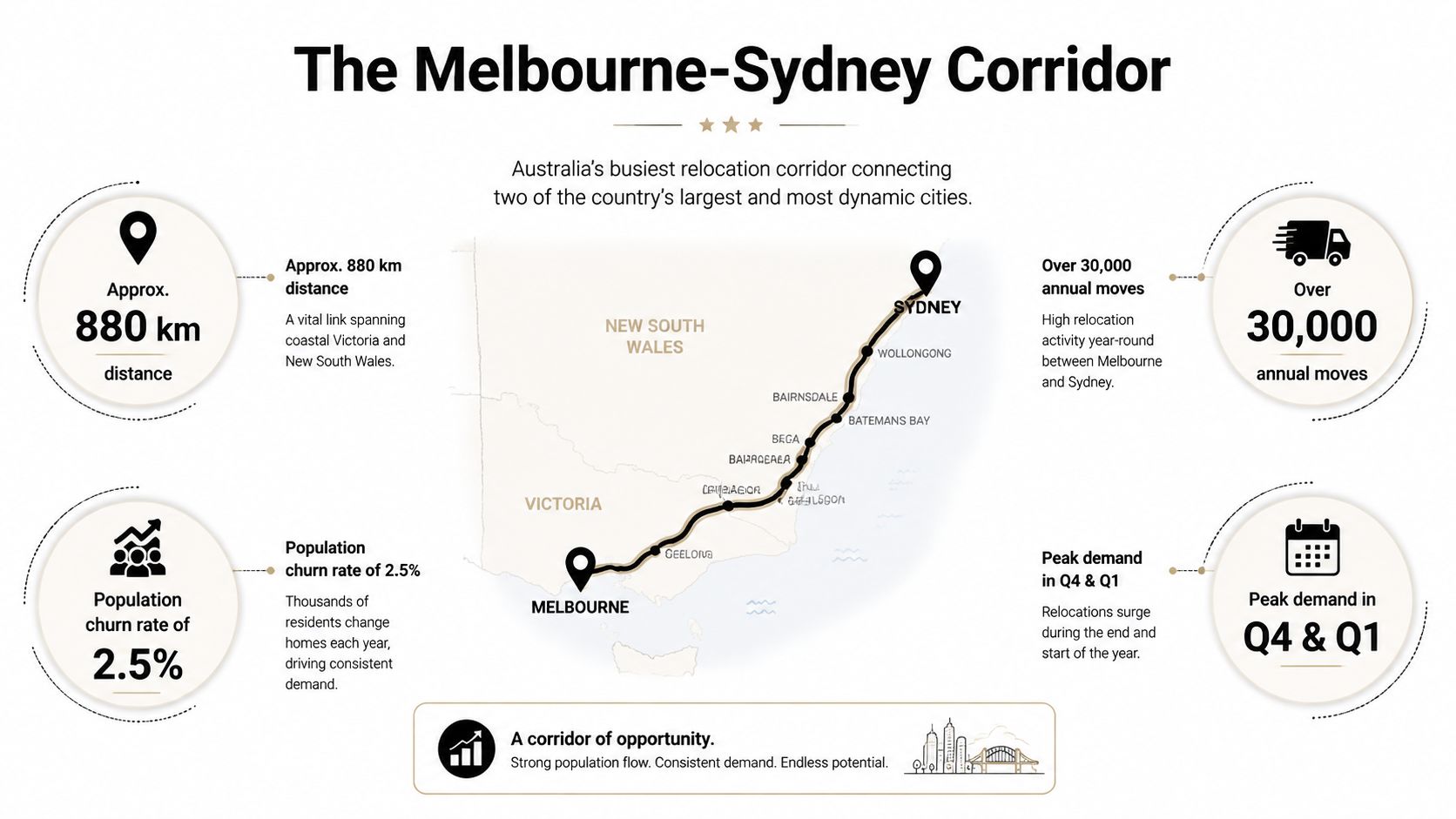
The route sits inside a much broader pattern of population movement. In the 2024–25 financial year, Sydney recorded net internal migration of -33,282 people, while Melbourne recorded -8,554, according to ABS regional population data. Both cities still grew overall because overseas migration remained strong. Sydney added 78,403 overseas migrants and Melbourne added 81,168, producing total population growth of 75,230 and 105,030, respectively, in the same year.
Why population churn affects availability
The important point isn't that people leave Melbourne or Sydney. Both capitals continue to receive new households, students, workers, and internationally arriving residents while other residents move interstate or to regional areas. That creates east coast churn, with removal capacity needed in both directions and at different times.
The corridor also carries a large freight task. The National Transport Commission describes the broader north-south corridor as dominated by road freight, with road accounting for 90.8% of market share. The corridor moved about 60 million tonnes of freight in 2007, and 53.2% of freight flows were between New South Wales and Victoria, as reported in the National Transport Commission's freight corridor report.
That freight activity matters to household movers because removal trucks use the same busy roads as commercial freight. Traffic, access restrictions, rest-area availability, and city delivery windows all influence the schedule. NSW was also the largest source of interstate arrivals in the census-era movement snapshot, contributing 17.6% of national interstate arrivals, while Victoria contributed 16.9%, according to the same NTC report.
Practical rule: Treat this as a scheduled freight operation, not a simple car trip with furniture in the back.
A mover familiar with the route can coordinate pickup and delivery windows more realistically, especially when your move involves an apartment, a narrow street, a business premises, or a settlement date. For route-specific planning, review the Sydney to Melbourne removals service information and confirm whether your preferred dates align with the operator's interstate schedule.
Transit Times and Heavy Vehicle Compliance
A road-distance estimate is useful, but it isn't a delivery promise. One route reference lists Melbourne to Sydney at roughly 713 kilometres with an estimated one-way drive time of about 9 hours, while another lists the Hume Highway basis at 858 kilometres and 10.5 driving hours. The difference comes from the route and calculation method, as shown by these Melbourne to Sydney transport route details.
That variation is only the starting point. A moving truck doesn't travel at car-trip speed once loading, access delays, breaks, refuelling, traffic, and unloading are included. A customer who hears “nine hours” may assume a same-day delivery is automatic. A coordinator sees a chain of dependent tasks that can move the delivery window.
Fatigue rules change the schedule
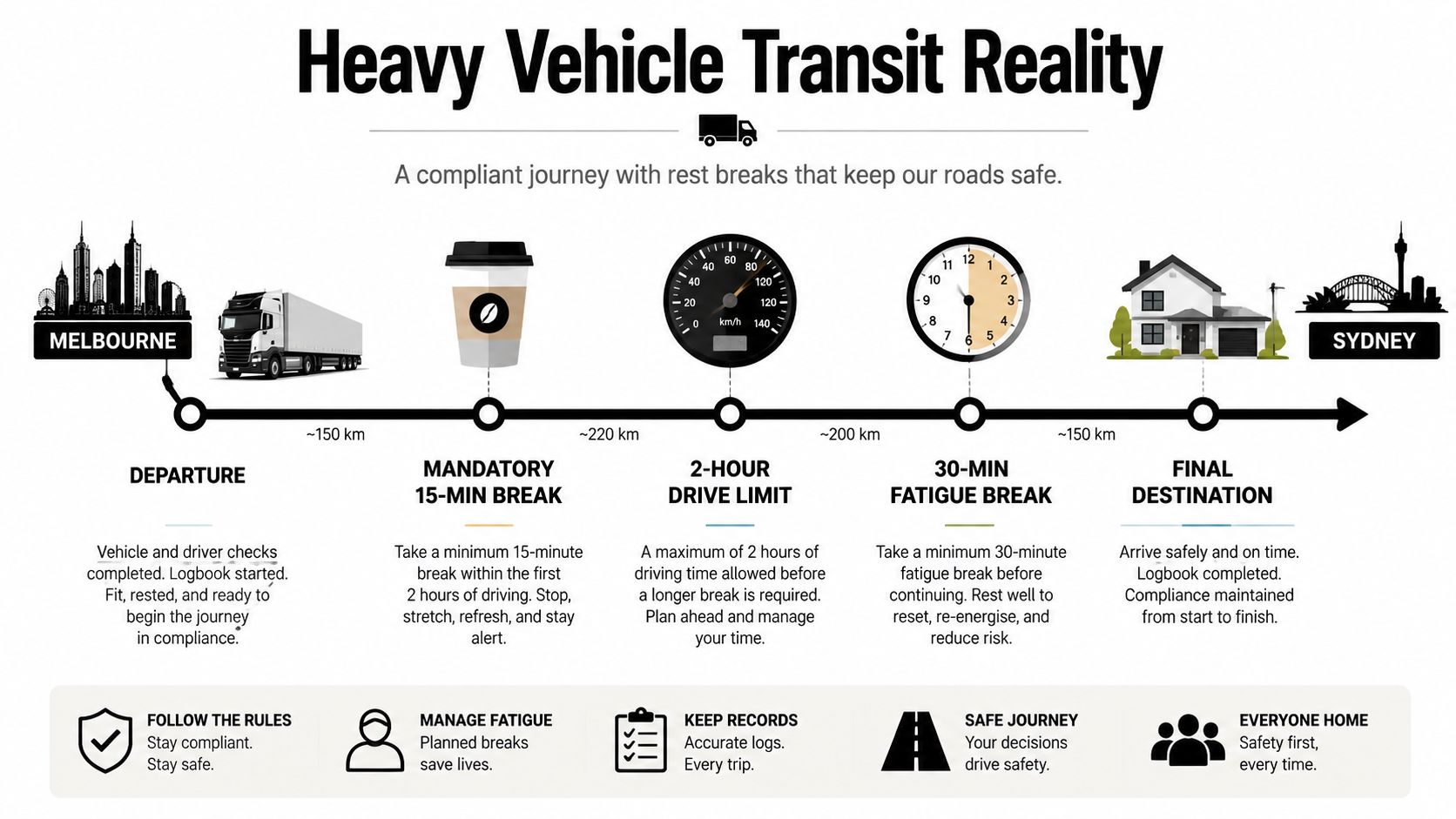
A heavy vehicle over 12 tonnes GVM falls under Australia's fatigue-regulated heavy-vehicle rules. Under standard-hours operations, the NSW heavy vehicle handbook specifies a maximum of 12 hours of work in any 24-hour period, with at least 7 continuous hours of stationary rest. The NHVR fatigue-management guidance also sets minimum rest requirements during the working day.
Those requirements affect the entire moving operation. Work includes more than uninterrupted driving. Loading, securing goods, dealing with building access, waiting for a lift, unloading, and handling delays can all consume the driver's available duty time. If pickup starts late or delivery access isn't ready, the driver can't ignore fatigue limits to preserve an original ETA.
How a compliant plan usually works
A responsible operator may use overnight staging, a driver change, or a delivery window that allows the truck to stop legally before continuing. The exact plan depends on vehicle class, driver arrangements, freight volume, pickup conditions, and the agreed service.
NHVR's national rest-area information shows that rest facilities are part of the managed road network, not an optional convenience. BITRE's interstate freight analysis also identifies a substantial freight task on the NSW to Victoria link, reinforcing why route efficiency and rest planning matter for capacity.
For trucks in the 4.5 to 12 tonne range, planners still need to consider rest-area spacing, facility quality, city access windows, fuel use, and unloading reliability. These factors can influence whether a settlement-day delivery remains practical.
A useful moving brief should therefore ask:
- What is the delivery window: Is it a firm appointment or a flexible period?
- Who controls access: Will a building manager, concierge, agent, or site supervisor be present?
- What happens if access fails: Can the truck wait, stage nearby, or deliver to storage?
- How is fatigue managed: Does the operator explain overnight staging or driver arrangements clearly?
For broader planning principles, the long-distance relocation guide provides useful context. The safest promise is a realistic window built around compliance, not an attractive but fragile drive-time estimate.
Strategic Booking and Settlement Day Planning
Interstate moves fail more often from timing conflicts than from distance. Your removal date must work with settlement, lease expiry, key release, lift access, parking, utility connections, and the mover's available truck and crew.
The planning process should begin with the least flexible date. That might be settlement, the end of a tenancy, a commercial handover, or a building booking. Work backwards from there and leave room for a change that you can't control.
Build the timeline in the right order
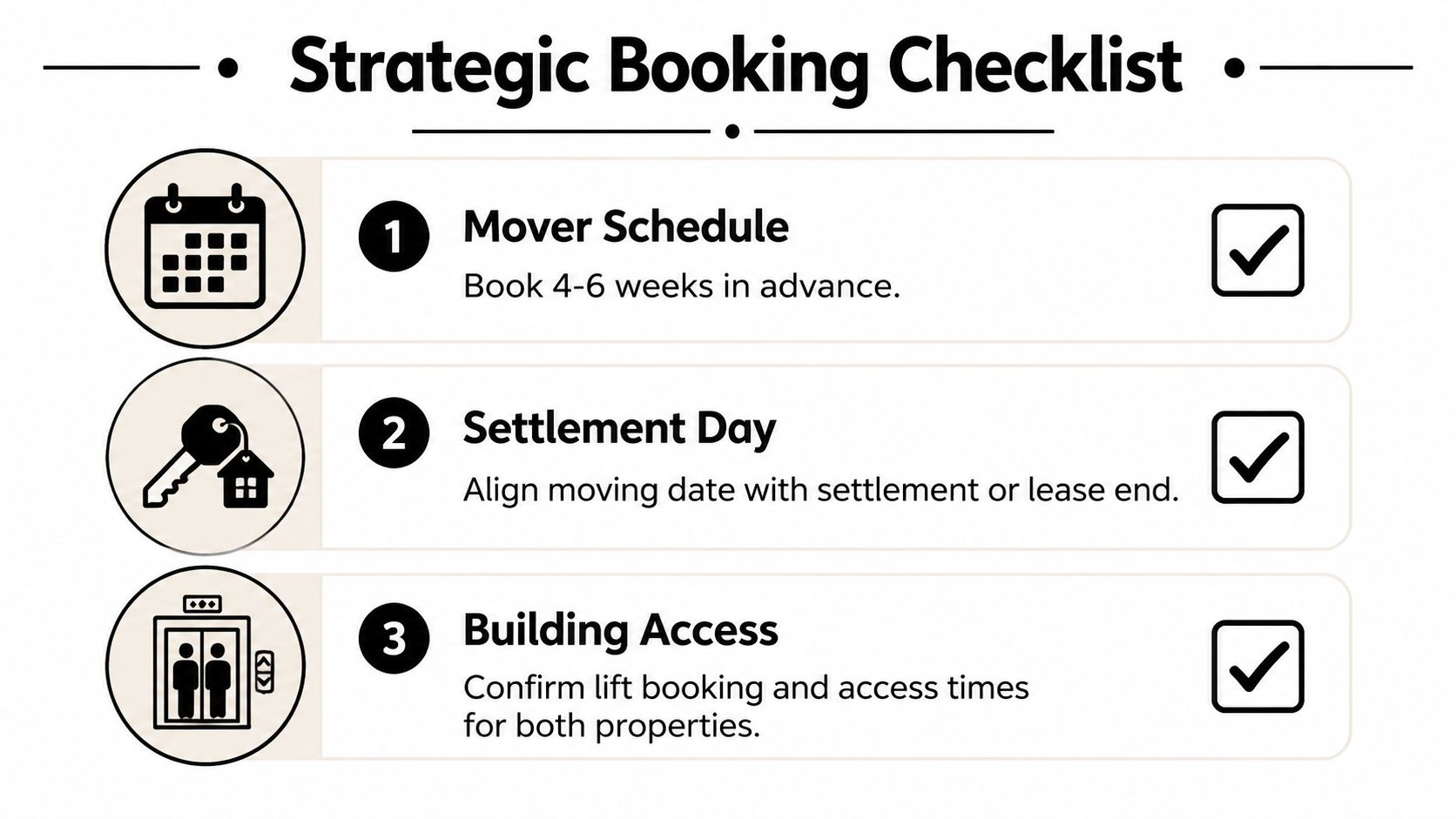
Confirm the property handover. Ask your conveyancer, agent, landlord, or building manager when keys will be available. Contract dates and practical access times aren't always identical.
Reserve the removal window early. Peak periods create pressure on trucks and crews. A four to six week booking lead time is a sensible planning target when your move falls into a busy period, particularly if you need packing, specialist handling, storage, or a specific delivery window. This is planning guidance, not a guaranteed availability rule.
Book lifts and loading zones. Apartment buildings may require separate reservations at both ends. Confirm the lift size, padding requirements, loading dock rules, time limits, and permitted vehicle dimensions.
Arrange utilities. The Energy and Water Ombudsman Victoria says energy and water providers generally need at least two business days' notice to arrange meter reads and energisation. Check the moving in and out utility guidance before the truck arrives.
Create a fallback. If settlement slips or keys aren't released, you may need temporary accommodation, storage, or a revised delivery appointment. Discuss these options before signing, rather than during a driver's waiting time.
Protect the handover day
Don't schedule the truck for the first possible minute after settlement unless every party has confirmed access. A short delay at the solicitor, bank, agent, or building desk can prevent the crew from entering the property and can affect later commitments.
Keep an essentials bag with identification, chargers, medication, documents, toiletries, basic tools, and items needed for the first night. The night-before moving checklist can help you separate those necessities from the packed household goods.
A strong booking record should show the pickup address, delivery address, contact people, access restrictions, inventory, agreed service level, and contingency process. If any of those details change, tell the coordinator immediately. Small updates are manageable before loading begins. They become expensive once the truck is full.
Choosing the Right Service Level for Your Move
The cheapest-looking option isn't always the lowest-cost decision. A load-and-go move may suit a prepared household with everything boxed and labelled, but it can create extra work if furniture must be dismantled, fragile goods need specialised protection, or the new property isn't ready on delivery day.
A full packing service costs more than customer-packed cartons, but it transfers the preparation, material selection, wrapping, and loading sequence to an experienced crew. The right choice depends on your available time, the value and fragility of your belongings, the complexity of access, and whether storage sits between homes.
Service Level Comparison
| Service Tier | Best For | Key Inclusions |
|---|---|---|
| Transport only | Organised customers with goods ready to load | Loading, securing, transport, and unloading |
| Assisted move | Households needing help with bulky items | Loading support, furniture protection, and selected disassembly |
| Packing and moving | Customers short on time or managing fragile goods | Packing materials, wrapping, carton preparation, loading, transport, and unloading |
| Valet white-glove service | High-value interiors, delicate belongings, or demanding schedules | Detailed packing, protective handling, furniture disassembly and reassembly, unpacking, and placement |
| Move with storage | Customers facing a gap between properties | Collection, secure short- or long-term storage, and later delivery |
Match the service to the risk
Pianos, pool tables, antiques, glass cabinets, artwork, oversized sofas, and commercial equipment need more than ordinary blankets and a strong back. They may require specialist equipment, extra crew members, disassembly, protective wrapping, and a clear path through both properties.
Furniture disassembly can improve access and reduce handling risk, but only when the crew has the right tools and records how each item is reassembled. Photographing connections and labelling hardware helps, although specialist movers should handle complex or delicate pieces.
Storage is useful when your Melbourne property settles before the Sydney home is available, when a lease overlaps, or when renovation delays block access. Confirm how goods are inventoried, protected, accessed, and returned. A secure company-owned facility may be preferable to leaving furniture in an unsuitable garage, loading area, or temporary room.
For a practical selection framework, use this guide to choosing interstate removalists. Ask for an itemised scope so you can compare like with like. A low quote that excludes packing, stairs, long carries, storage, or specialist handling may not remain low once the work starts.
Navigating Insurance and Liability
“Fully insured” sounds reassuring, but it doesn't answer the question most customers need resolved: are my belongings covered while they're being moved?
A removalist may hold vehicle insurance and public liability insurance without including goods-in-transit cover for your contents. Australian moving insurance guidance warns that vehicle cover isn't the same as contents cover, and some operators use “fully insured” to describe protection for their vehicles rather than the customer's goods. The Australian moving insurance guidance explains why customers should check the policy scope instead of relying on the phrase alone.

Separate the types of cover
Vehicle insurance generally relates to the truck itself and may address collision or vehicle damage. It doesn't automatically compensate you for a damaged television, table, instrument, or carton.
Public liability insurance addresses certain third-party injury or property damage situations. It isn't a substitute for insurance on your household goods.
Goods-in-transit or moving insurance is the cover category that directly concerns possessions while they're being transported. The policy may include exclusions, valuation rules, excesses, packing requirements, fragile-item conditions, or limits for customer-packed goods.
Canstar notes that possessions damaged during a move may not be covered by a home insurance policy or by the removalist, and that a separate moving or transit insurance policy may be needed. It also explains that, under Australian Consumer Law, a removalist is generally liable when damage was caused by its negligence, as outlined in this interstate moving cost and insurance guide.
Questions to ask before booking
- What policy applies to my goods: Ask for the name of the cover and a written summary of what it includes.
- Who provides the cover: Confirm whether it comes from the removalist, an insurer, or a separate policy you must arrange.
- What are the exclusions: Check customer-packed cartons, electronics, glass, artwork, plants, food, jewellery, documents, and items that weren't listed.
- How do I report damage: Ask about photographs, time limits, inventory records, claim forms, and assessment procedures.
- What protection applies during storage: Transit cover may not be identical to storage cover.
For wider context on carrier insurance obligations and compliance, the My Safety Manager insurance guide is a useful reference. Keep your own inventory, photograph valuable items before loading, and retain the quote, terms, condition reports, and delivery paperwork. Clear records make a claim easier to assess.
Packing Strategies for Long-Haul Transit
A local move can tolerate a rushed carton or a poorly labelled room. A Melbourne to Sydney relocation has less margin for weak packing because goods face longer handling cycles, road vibration, stacking pressure, and multiple access points.
Professional packing earns its value through consistency. Crews choose suitable cartons, wrap fragile pieces properly, protect furniture corners, and load heavier items in a way that limits movement. They also know which belongings should remain upright, which need special crating, and which shouldn't travel at all.
Start with a deliberate sort
Before buying materials, divide everything into four groups:
- Keep and move: Items that belong in the new home and justify their handling.
- Sell: Furniture or appliances that have value but aren't worth transporting.
- Donate: Usable goods that can help someone else.
- Dispose or recycle: Broken, unsafe, or low-value items that create unnecessary volume.
Decluttering reduces loading time and makes the new home easier to organise. It also prevents the common mistake of paying to transport things that were going to be replaced anyway.
Pack for the unloading team
Use strong cartons of consistent sizes where practical. Don't overfill books or crockery, and don't leave empty space around fragile goods. Wrap each piece, fill voids, tape cartons securely, and label every box with the destination room and a brief contents description.
A clear label such as “kitchen, glassware, open carefully” is more useful than “box 14”. Keep a separate first-night group containing bedding, towels, basic kitchen equipment, chargers, clothes, medication, and important papers.
Large furniture needs protection before it reaches the truck. Moving blankets, stretch wrap, corner guards, mattress bags, and appropriate straps help protect surfaces and prevent contact damage. The professional house-packing tips provide a useful preparation reference.
Professional packing makes most sense when you have a tight settlement, a large inventory, fragile interiors, or limited time. Customer packing can work well when you start early and follow a clear system. The poor compromise is hurried packing on moving morning, when cartons remain open, valuables aren't documented, and the crew must wait while decisions are made.
Why Experience Matters on the East Coast Run
A dependable interstate move depends on coordination between people, vehicles, buildings, and dates. A mover can have a polished website and still struggle if the person quoting the job isn't involved in access planning, the truck changes without warning, or the customer has to repeat the inventory to several departments.
Look for a clear chain of responsibility. You should know who confirms the booking, who checks access, who handles changes, and who can answer questions on pickup and delivery day.
The operational checks that matter
Fleet suitability comes first. A company-owned fleet ranging from 4.5 to 12 tonne trucks can provide different capacity options for household, apartment, office, and commercial moves. The truck must still suit your street, loading zone, building restrictions, inventory, and route plan.
Staff and handling standards matter just as much. Full-time, police-checked staff, protective equipment, furniture disassembly, specialist handling, and documented packing procedures reduce the number of unknowns. Ask who will handle pianos, pool tables, artwork, heavy safes, or sensitive business equipment.
Scheduling transparency protects both sides. A quote should identify what's included, what may trigger additional charges, the expected pickup and delivery windows, storage terms, access requirements, and cancellation or postponement conditions. Transparent pricing is more useful than a low headline figure that excludes difficult access or packing.
Route experience is valuable because weekly direct runs can make planning more predictable than an ad hoc transfer. Get n Go Removals Melbourne offers residential and commercial relocations, packing, specialist handling, storage, a company-owned fleet, a single point of contact, and flexible 24/7 scheduling. Its published service information also describes weekly interstate runs between Melbourne and Sydney, with moves taking about 24 to 48 hours, subject to the agreed service and operating conditions.
A final vetting checklist
Before you commit, confirm:
- The written scope: Inventory, packing, disassembly, protection, storage, delivery, and exclusions.
- The access plan: Stairs, lifts, loading zones, parking, narrow streets, and building time limits.
- The transit plan: Delivery window, fatigue-compliant scheduling, staging, and communication during delays.
- The cover: Vehicle, public liability, goods-in-transit, storage insurance, exclusions, and claims process.
- The contact structure: One accountable coordinator who can update the plan when settlement or access changes.
- The evidence: Recent five-star reviews, route experience, and a record of handling moves similar to yours.
The right Melbourne to Sydney movers don't just load furniture and drive north. They turn a chain of risks into an organised sequence, with realistic timing and clear decisions when something changes.
Get n Go Removals Melbourne can coordinate residential and commercial relocations between Melbourne and Sydney, including packing, furniture disassembly, specialist handling, storage, and settlement-sensitive scheduling. Visit Get n Go Removals Melbourne to discuss your inventory, access conditions, preferred dates, and the right service level for your move.