Valet Unpacking Services: What They Are and How They Work
You've finally reached your new Melbourne home. The removal truck has gone, your shoulders are aching, and the rooms are filled with sealed cartons. Somewhere in that pile are the kettle, coffee machine, bed linen, school bags and the kitchen items you need for tomorrow morning. The move may be technically finished, but normal life still feels out of reach.
That's the point at which many households realise that transport is only one part of relocating. Sorting, opening, placing, organising and clearing away the packaging can create a second job after the first one is over. Valet unpacking services are designed to handle that transition, particularly when apartment access, work commitments or physical strain make a DIY unpack unrealistic.
The Problem With Moving Without Unpacking Help
A family can arrive at a new property with the heavy lifting completed and still face a difficult evening. The beds may not be made, the cookware may be buried, and every room can look like a temporary storage area rather than a home. Even when everyone is motivated, deciding which carton belongs where and what should be opened first takes energy that may already be spent on moving day.
A national Airtasker moving report found that Australians spend an average of 14.8 hours on packing and unpacking, with the typical spend for packing or unpacking help at about A$188 nationwide, and state averages ranging from A$174 to A$248. (Airtasker's Australian moving report) A separate Australian moving-cost report says moving a single property can take up to 86 hours from beginning to end. (Australian moving-cost guidance)

The real burden after delivery
The problem isn't only the number of boxes. It's the combination of time pressure, decision fatigue and repetitive manual handling. A dual-income household may need to return to work quickly, while parents may need bedrooms, uniforms and kitchen essentials ready before the next school or work day. A person recovering from an injury, managing a chronic condition or dealing with an exhausting move may not be able to spend several evenings bending over cartons.
Safe Work Australia treats unpacking as a manual-handling task and provides guidance for workers unpacking shipping containers. (Safe Work Australia manual-handling guidance) The practical risks include repeated lifting, bending, twisting and carrying. Reducing the number of times each item is handled, keeping cartons close to their destination and working at a more suitable height can make the task safer and more controlled.
Practical rule: The best unpacking workflow reduces touches. A carton should move from the truck to the correct room, not from the truck to a hallway, then to a spare room, then back again.
Get n Go Removals has seen this pattern across Melbourne houses and apartments. A useful preparation reference is this guide to common packing mistakes when moving home, because poor labels and mixed cartons create extra work at the destination. Protecting bedding during transport also helps you start clean, so consider this practical resource on how to keep your mattress clean while moving before the truck arrives.
What Valet Unpacking Services Actually Mean
Valet unpacking is a managed post-delivery service, not just a person opening boxes. The crew follows an agreed room plan, removes items from cartons, places them where they belong and clears the resulting packaging. Depending on the provider and quotation, the work may also include furniture placement, reassembly, priority-room setup and careful handling of fragile belongings.
The scope needs to be agreed before booking. A proper conversation should cover whether the team will:
- Open cartons: Remove tape and packaging carefully, rather than treating every box as general labour.
- Place belongings: Carry items to their labelled rooms and position them according to your instructions.
- Organise rooms: Arrange kitchenware, clothing, books or décor where the agreed scope includes organisation.
- Remove waste: Break down empty cartons and collect bubble wrap, foam and other packing materials.
- Handle furniture: Place or reassemble selected furniture if that work forms part of the quote.
How it differs from other options
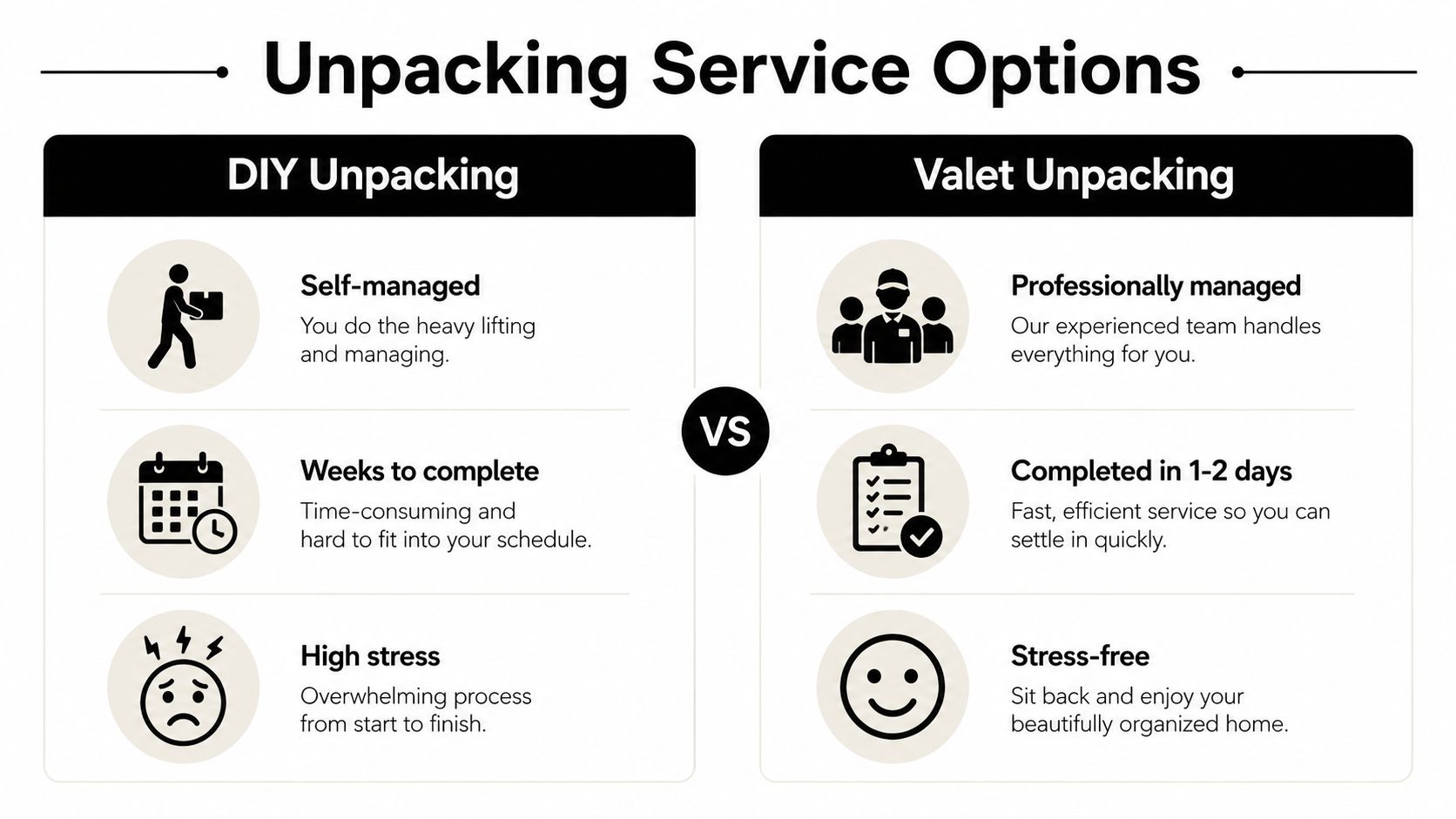
DIY unpacking costs less in direct labour because you provide the labour yourself, but you also carry the time, sorting and disposal burden. Basic labour-only assistance may open cartons and carry items, while leaving you to decide where everything goes and what happens to the packaging. Valet service is more structured, which is why it suits clients who value a ready-to-use home or office rather than a pile of opened boxes.
| Service Type | Box Opening | Item Placement | Packaging Removal | Room Organisation | Typical Cost Range |
|---|---|---|---|---|---|
| DIY unpacking | Homeowner-managed | Homeowner-managed | Usually left to homeowner | Self-managed | No separate service charge |
| Labour-only help | Usually included | Limited or instruction-based | Confirm before booking | Usually limited | Depends on labour scope |
| Valet unpacking | Managed room by room | Included within agreed scope | Confirmed as part of service | Included where specified | Varies by property and scope |
Commercial relocations can benefit as well. An office may need desks, monitors, files and equipment distributed into assigned areas so staff can resume work without spending the first days sorting cartons. The same principle applies to a home, but the priority is usually bedrooms, bathroom essentials and a functioning kitchen.
The Step-by-Step Valet Unpacking Process
A well-run service starts before the first carton is opened. The crew needs a clear destination plan, visible labels and an understanding of which rooms matter most on arrival. Preparation doesn't need to be complicated, but it must be specific enough to prevent guesswork.
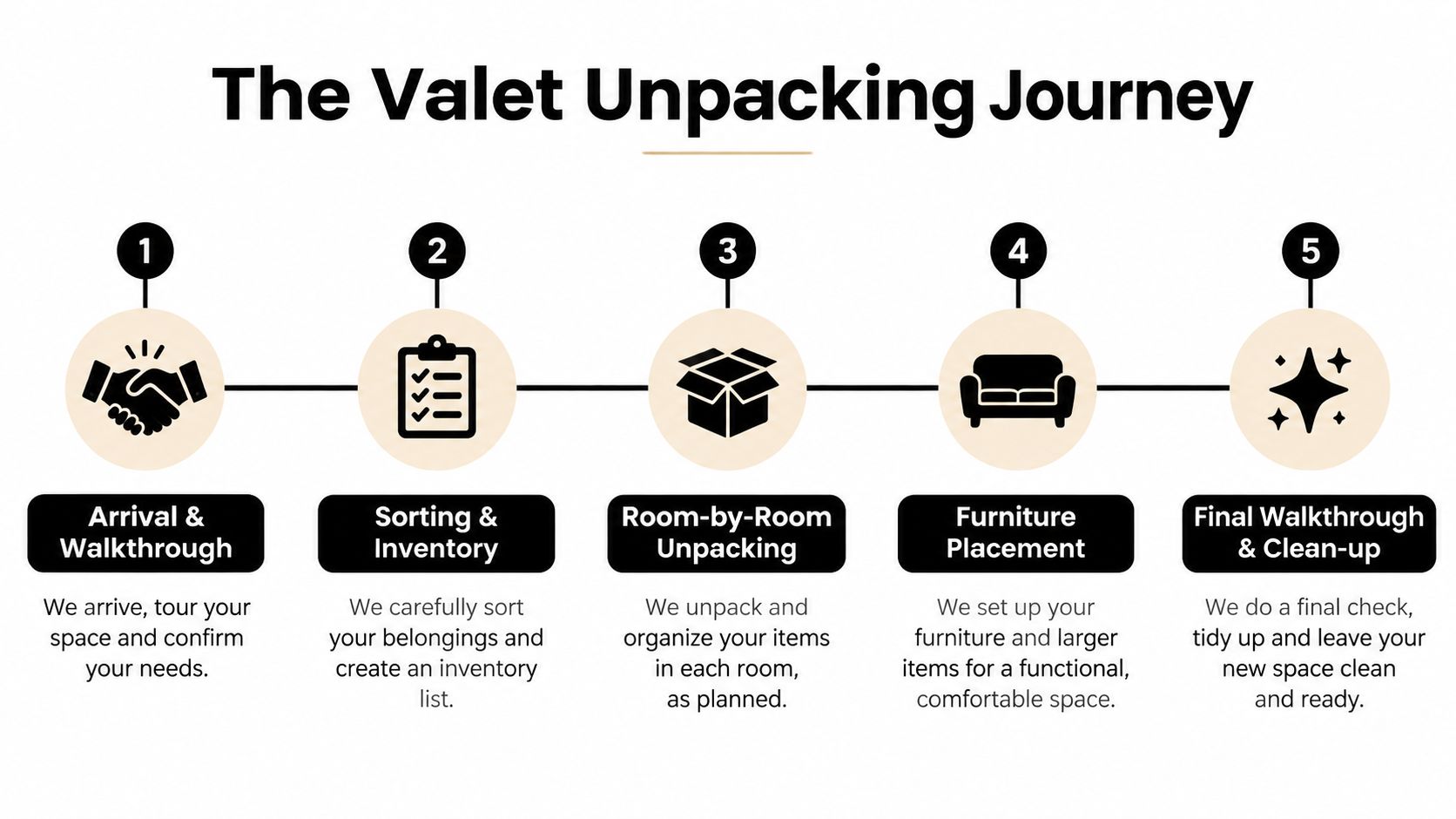
Arrival and room planning
The first stage is an on-site walkthrough. The crew checks access, confirms the room names, identifies priority cartons and asks about items that need special care. If the labels say “main bedroom”, “kitchen” or “study”, those instructions should match the plan discussed with the removalist.
Cartons are then offloaded and staged close to their intended destinations. A bedroom may be prioritised so the bed linen and personal essentials are available early. A kitchen may follow, with cookware, coffee equipment and everyday items unpacked before decorative pieces.
Room-by-room execution
The team opens each carton, removes the contents and carries them directly to the assigned room. Fragile items need slower handling and a clear surface for inspection. Clothing may be transferred into wardrobes or drawers where agreed, while books and kitchenware can be grouped according to the homeowner's preferred arrangement.
Furniture placement should happen in the right order. Large pieces need to be positioned before smaller items fill the room, otherwise the crew may have to move the same belongings repeatedly. Selected furniture can also be reassembled if that is included in the service scope.
Use a clear guide to packing for moving to improve the quality of the destination workflow. Good packing supports good unpacking. Strong cartons, sensible weight distribution and room-specific labels allow the crew to work quickly without compromising care.
Completion and removal
The final stage is a walkthrough. You check that priority rooms are usable, confirm the placement of key belongings and identify anything requiring adjustment. Empty cartons are broken down, bundled and removed according to the agreed service.
The difference between a tidy finish and an opened-box finish often comes down to this last stage. If packaging remains throughout the home, you still have a disposal project after the crew leaves. If waste removal is included and completed properly, the property is much closer to normal use.
Melbourne Apartment Unpacking Challenges and Solutions
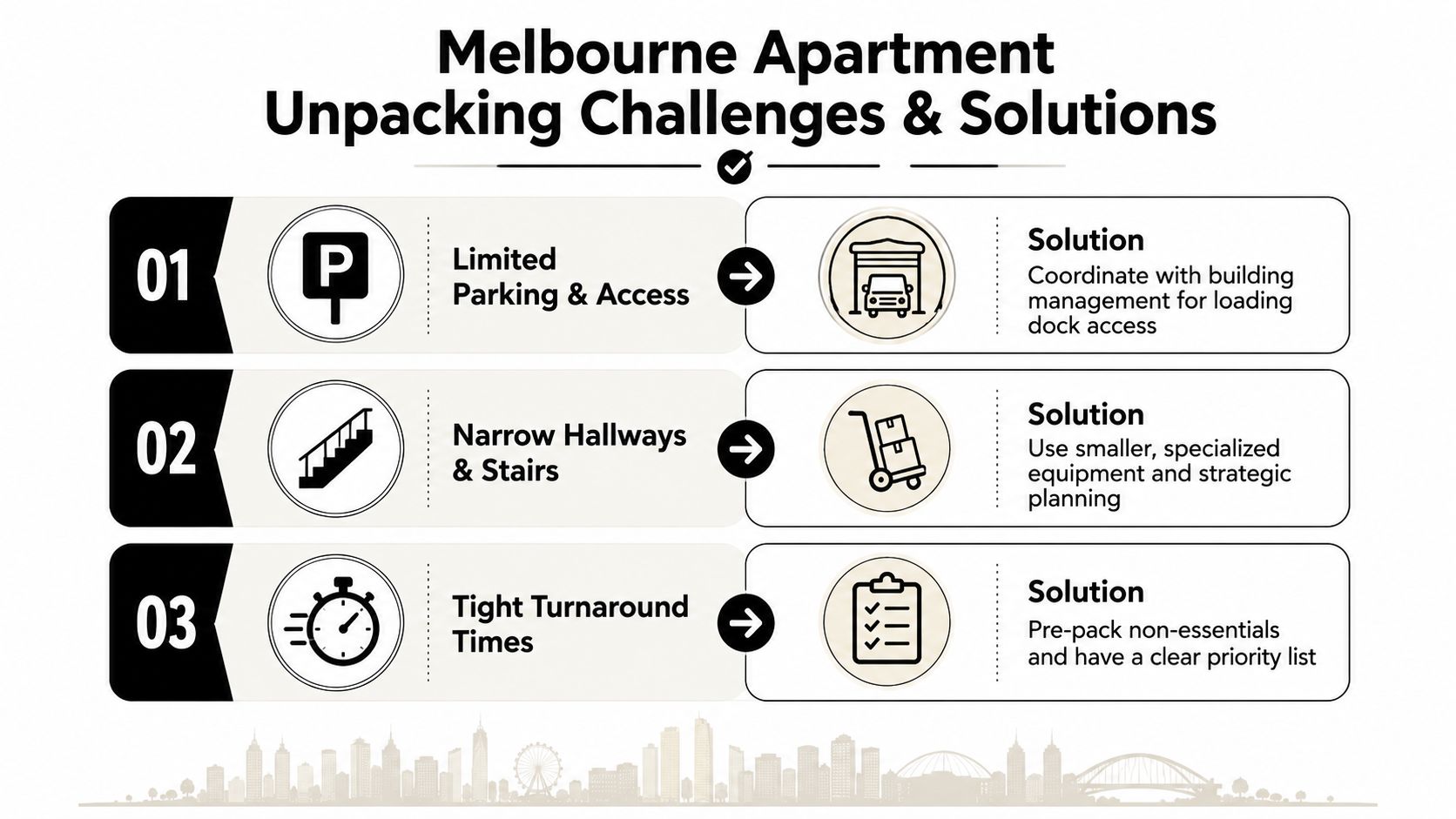
Apartment moves in Melbourne are governed by building rules that don't apply in the same way to a detached house. Service lifts may need to be booked for two to four hours, often seven to fourteen days in advance, with a refundable bond and protection for shared areas such as carpet runners, lift padding and door guards. (Melbourne apartment relocation guidance)
That fixed window changes the unpacking equation. The crew must coordinate delivery, staging, placement and carton removal without allowing the lift booking to expire. Poor sequencing can lead to rebooking delays, additional labour hours and extra handling of fragile items.
Access planning matters more than people expect
Parking, loading docks, concierge procedures and corridor protection all need to be confirmed before move day. A crew may be ready to work, but the job can still lose time if the loading area isn't available or the building requires a particular booking process.
| Factor | Typical Requirement | Impact on Unpacking |
|---|---|---|
| Service lift | Booking for a fixed access window | Work must be sequenced tightly |
| Booking lead time | Often arranged in advance | Late planning can restrict available dates |
| Building protection | Bond, runners, padding or door guards | Materials and compliance checks add preparation |
| Room allocation | Clearly labelled cartons | Reduces questions and repeated handling |
| Crew density | Matched to apartment size and access | More labour may be needed to finish within the window |
Larger apartments generally need greater labour density when the access window remains fixed. That makes crew sizing and pre-labelled room allocation control variables, not optional extras. A smaller team may cost less per booking but take longer, which can be a poor trade if the building restricts access.
Before booking, ask who will confirm the lift, who supplies protective materials, how the team will stage cartons and what happens if the slot is exceeded. This guide to planning an apartment move can help you prepare the building information before requesting a quotation.
Understanding Pricing and Value of Valet Unpacking
The price of unpacking depends on the amount of labour, the number of rooms, the level of organisation and the access conditions. Australian pricing references describe lighter unpacking support at about $80 to $250, while mid-sized homes may fall around $500 to $1,200. Broader market guides commonly quote unpacking add-ons at roughly $80 to $120 per hour. (Australian unpacking price guidance)
Those figures describe different service scopes, so they shouldn't be compared as if they were identical products. A light carton-opening service isn't equivalent to a full white-glove arrangement that places belongings, handles fragile items and removes all packaging. Ask for the work to be described in writing rather than relying on the label “unpacking”.
The value question for Melbourne households
DIY unpacking has no separate service invoice, but it still consumes time. Airtasker's report puts the average Australian packing and unpacking burden at 14.8 hours, with help averaging about A$188 nationally. (Airtasker moving report) For a dual-income household, the relevant comparison may be paid work, missed commitments, weekend recovery time and the cost of living in an unusable home.
Valet unpacking is more likely to make sense when:
- The settlement is time-sensitive: You need bedrooms and essential rooms working immediately.
- The property has difficult access: A fixed lift window makes inefficient DIY staging costly.
- The household has limited capacity: Repetitive lifting and bending aren't suitable for everyone.
- The move is complex: Fragile items, furniture reassembly or room-specific organisation add coordination.
- Work resumes quickly: A service can reduce the amount of unpaid evening labour after delivery.
DIY may still be sensible for a smaller move, flexible timetable or household that wants to decide the final location of every item personally. The wrong reason to buy valet unpacking is the assumption that it will organise possessions you haven't sorted. Decluttering and decisions about what belongs in each room still need homeowner input.
Read the quote carefully
Queensland Government consumer guidance says customers should confirm exactly what is included in a removalist's quoted price, including whether packing and unpacking form part of the service. (Queensland Government removalist guidance)
Also ask about insurance. Canstar explains that transit insurance may cover goods while they're being packed and unpacked, loaded and unloaded, in transit and in cases of removalist mishandling, but it isn't a legal requirement in Australia. (Canstar transit insurance guidance) Check the actual policy terms, exclusions and claim process before work begins.
For broader moving-cost context, review this breakdown of the cost of movers and compare like with like. A transparent quote should identify labour, access conditions, placement, reassembly, waste removal and any possible extra charges.
How to Prepare for Valet Unpacking Services
The quality of a valet unpacking job is largely decided before the crew arrives. Labels, access and priorities give the team a reliable map. Without them, workers spend time asking questions, moving cartons temporarily and revisiting rooms.
Prepare the destination
Use room-specific labels on every carton, including a short description such as “daily cookware”, “winter clothing” or “bathroom supplies”. Create a priority list for the first rooms to make usable. Keep essential documents, medication, valuables and personal items separate if you don't want them handled by the crew.
Declutter before packing. Donate, sell or discard items that shouldn't travel, and keep those belongings physically separate from the removal inventory. Moving unwanted items and asking someone else to organise them later adds work without improving the result.
Furniture should be disassembled where appropriate, with fasteners stored in labelled bags. Confirm which pieces need reassembly and which surfaces require protection. If you're redesigning storage during the move, a practical guide to built-in wardrobes can help you think through wardrobe capacity and layout before clothing is placed.
Confirm access and scope
For an apartment, arrange the service lift, loading access, building contact and protection requirements early. Give the removalist the booking details and explain any restrictions on parking, corridors, stairs or loading docks.
Before the crew arrives, confirm:
- Labels: Every carton has a destination room.
- Priorities: Bedrooms, kitchen and bathroom essentials are clearly identified.
- Decluttering: Items not being kept are removed from the move.
- Furniture: Disassembly and reassembly responsibilities are agreed.
- Access: Lift, parking and building requirements are confirmed.
- Waste: Carton, plastic and foam removal are included or excluded in writing.
- Insurance: Transit cover and exclusions are understood.
- Contact: One person can answer placement questions on the day.
Don't block walkways with loose belongings, leave fragile cartons unmarked or assume packaging removal is automatic. Check this advice on what to do the night before movers arrive so the property is ready for an efficient start.
Get n Go Removals Melbourne offers residential and commercial removals with valet white-glove packing and unpacking, furniture disassembly and reassembly, protective equipment, storage and scheduling support for settlements and lift bookings. The service can provide one point of contact from the first box packed to the last box unpacked.
If your Melbourne move involves a tight apartment lift window, a quick return to work or more cartons than you can comfortably manage, discuss the exact unpacking scope before booking. Visit Get n Go Removals Melbourne to arrange a quote covering room placement, furniture handling, packaging removal and access requirements.