Business Moving Checklist: 10 Steps for Melbourne
A Melbourne office move rarely fails because someone forgot a cardboard box. It fails because the lift booking clashes with the truck, the internet activation slips, staff aren't sure who owns each task, or the handover date arrives before the old premises are ready for inspection. A fixed settlement or lease deadline leaves little room for improvisation.
The practical answer is to work backwards from moving day. This business moving checklist covers the physical move, building access, technology continuity, specialist handling, records, compliance evidence and the final handover, whether you're relocating across Melbourne or travelling interstate. Victoria's official relocation checklist treats a business move as a coordinated project involving inventory, utilities, insurance, paperwork, address updates, movers, access arrangements and post-move checks, not merely transport. (Victorian Government relocation checklist)
Use the steps below to assign responsibility, protect revenue during downtime and keep one reliable record of decisions. For broader practical ideas on reducing waste during an office transition, see these Reworx Recycling relocation tips.
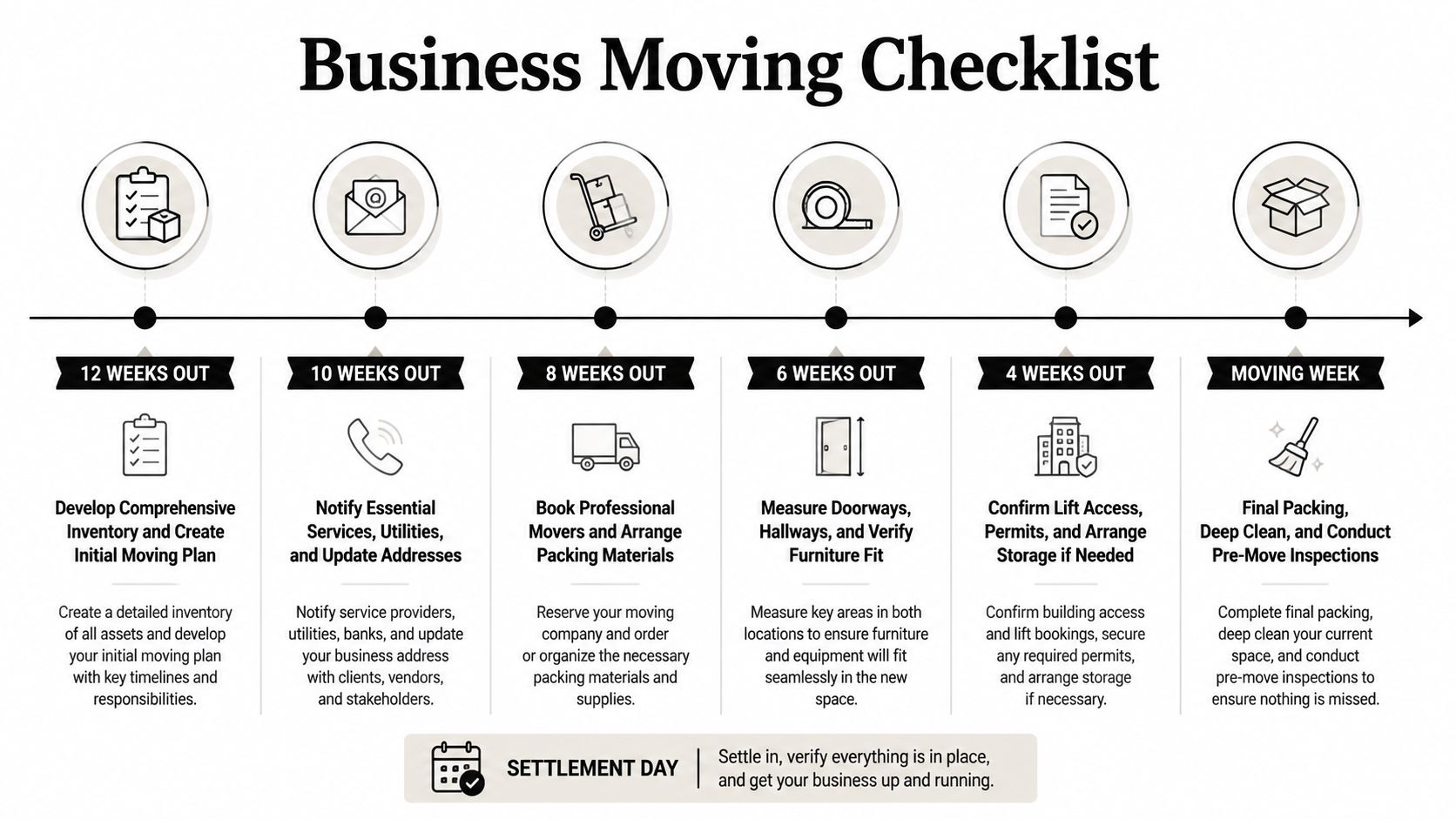
1. Create a Comprehensive Moving Inventory and Timeline
Start with an asset register, not packing tape. Walk through every room, storage area and shared facility, then record what will move, what will be sold or donated, what needs specialist handling and what can be securely destroyed. A Melbourne business may need separate categories for desks, meeting-room furniture, monitors, network equipment, archived files and kitchen items. An interstate move also needs a packing priority, so essential equipment isn't buried behind low-priority cartons.
A spreadsheet works well because it can hold the item description, current location, destination, condition, owner, packing status and arrival check. Add photographs for valuable or fragile assets, particularly where pre-existing damage could later be confused with transit damage. Victoria's business relocation checklist specifically calls for an inventory before moving and adds a final property inspection and financial and insurance review after arrival. (Victorian relocation planning requirements)
Work backwards from the handover
Set the handover date first, then add decision points for the lease, fit-out, utilities, IT cutover, packing, access approvals and transport. Keep one owner beside every task. A business with several departments should nominate a coordinator and ask each department to confirm its own equipment and document requirements.
Practical rule: If an item has no owner, destination or condition record, it isn't ready to move.
Use the register to remove redundant furniture, duplicate equipment and outdated files before requesting a quote. A clear scope helps the moving team plan labour, vehicle capacity and protective materials, while the same record can support an insurance notification if something is damaged.
For technology-dependent businesses, coordinate the physical inventory with a cloud migration checklist, so the move doesn't become an accidental data project.
2. Notify Essential Services and Update Your Address
Administrative work can determine whether the new office functions on arrival. Build a provider register covering electricity, water, gas, internet, phones, security, alarms, EFTPOS, printers, cleaning, waste collection, insurance, banks, software vendors, clients and government records. Record the contact, notification date, requested activation or disconnection date, confirmation number and person responsible.
For an office moving between Melbourne buildings, arrange the new connection before cancelling the old one. For an interstate move, coordinate both locations in parallel. Internet circuits and phone services may require site information, building approval or technician access, so don't leave them until moving week. JLL's Australian office moving guidance prioritises early scope, role ownership, budgeting, scheduling and IT coordination, including long-lead telephone and network circuits. (Australian office IT relocation checklist)
Keep an evidence trail
Save every confirmation in a shared relocation folder. Update the website, invoices, email signatures, business listings, customer portals and supplier accounts after the new address is operational. A small business relocation guide also highlights lease review, landlord notification and advising the Australian Business Register and ATO within 28 days of relocation. (Australian address-change guidance for businesses)
- Utilities: Record final readings and connection dates for each site.
- Mail: Arrange Australia Post redirection early enough to catch invoices and official correspondence.
- Customers: Tell customers where deliveries, collections and appointments will occur.
- Building contacts: Keep the old and new facilities managers in the shared contact sheet.
For a household or office address-change sequence, use this moving house address change checklist as a practical cross-check.
3. Arrange Professional Packing and Protective Equipment
Packing decisions should follow risk, not convenience. Standard cartons may suit stationery and lightweight office supplies, but monitors, servers, artwork, glass, instruments and specialist furniture need suitable padding, wrapping or crating. Use smaller, manageable cartons for dense materials such as files, and don't mix confidential records with general rubbish or untracked personal items.
A commercial pack should also support the inventory. Label every carton with its destination, department, contents, handling instruction and priority. Use a consistent naming system across floors and teams. A carton marked only “miscellaneous” creates work at both ends, especially when several crews are unloading into a new office.

Separate the specialist stream
Identify pianos, pool tables, artwork, laboratory items, fragile displays and sensitive electronics during the quotation stage. Ask who supplies the wrapping, whether items travel separately, how they'll be secured and how the delivery condition will be recorded. For valuable items, photograph each surface and document existing marks before packing.
The same approach applies to compliance records. AUSTRAC requires relevant AML/CTF, customer due diligence and transaction records to be retained for at least 7 years, so those files need an inventory, secure transport plan and controlled storage decision rather than casual disposal. (AUSTRAC record-keeping checklist)
Watch the practical packing demonstration before deciding whether your team can handle fragile items internally.
If staff are packing their own areas, review these common packing mistakes before cartons are sealed.
4. Book Transport and Confirm Lift Access Requirements
Transport is only one part of the booking. The truck must arrive when the building allows loading, the crew must have a clear route, and the destination must accept the delivery within its access window. Melbourne CBD towers, apartment buildings and strata properties may require lift reservations, loading-bay rules, truck-height details, certificates of currency and written approval from building management.
Ask the facilities contact for the move-hour restrictions, goods-lift dimensions, loading location, parking conditions, access cards and emergency contact. Confirm the slot in writing and send the same information to the removalist. Public moving guidance also recommends checking lift bookings and truck parking ahead of the move, particularly where managers control goods-lift access. (Australian lift and access planning guidance)
Match the vehicle to the building
A larger vehicle can reduce trips, but it may not fit a basement, loading dock or narrow Melbourne street. A smaller vehicle may access the site more easily but create extra handling and scheduling pressure. Provide an accurate inventory, floor plan, parking information and any interstate delivery constraints before the vehicle is allocated.
- Old site: Confirm lift protection, loading access and the departure inspection.
- New site: Confirm the lift, access cards, parking and floor protection.
- Roadside logistics: Check whether council approval or a parking permit is required.
- Contingency: Give the coordinator a plan for delayed access, not just the mover's phone number.
For apartment-specific preparation, use this apartment move planning guide. The same mechanics apply to offices with shared lifts and controlled loading areas.
5. Measure Doorways, Hallways and Furniture Fit
A floor plan can show that a desk belongs in a room without proving the desk can reach that room. Measure the furniture and the route. Record the length, width, height and depth of large items, then compare those dimensions with doorway openings, hallway widths, stair turns, lift interiors and clearance around frames and handrails.
This matters in older Melbourne apartments, converted warehouses and offices with narrow corridors. A meeting table might fit comfortably in the destination room but fail at the lobby turn. A large sofa may need to travel vertically, be dismantled or be excluded from the move. Interstate transport makes the decision more important because an unsuitable item can create cost and delay after it has already travelled a long distance.
Create a route record
Take photographs or video of tight corners and send them to the moving coordinator. Note whether doors can be removed, whether lift padding is required and whether furniture legs, shelves or handles can come off safely. Don't assume a measurement taken from a building plan reflects the usable opening on moving day.
Measure the route, not just the room. A successful placement is impossible if the access path fails.
For heavy items, confirm the handling method before the crew arrives. This heavy furniture moving guide can help identify pieces that need extra planning, disassembly or specialist equipment.
6. Arrange Secure Short-Term or Long-Term Storage if Needed
Storage gives a move flexibility when possession dates don't align. A Melbourne business may leave its old office before the new fit-out is complete, while an interstate relocation may need a staged delivery rather than one immediate unload. Storage can also support downsizing, a temporary consolidation or a renovation without forcing the team to make rushed disposal decisions.
Book storage alongside transport and connect every stored item to the master inventory. Record the container or unit reference, access conditions, insurance documents, owner and intended release date. Photograph the contents before the door is closed, then keep a copy of the inventory outside the unit.
Choose storage by the contents
General furniture and sealed cartons may need secure, accessible storage. Electronics, artwork, paper records and other sensitive goods may need a more controlled environment. Ask about access hours, handling assistance, protection from moisture and the process for adding or removing items.
- Bridge storage: Use it when the old and new access dates don't match.
- Staged delivery: Release essential equipment first and non-critical items later.
- Records storage: Separate active files from retention material and archive items.
- Business continuity: Keep the equipment needed to operate out of storage.
Victoria's records management guidance says records no longer needed for administrative purposes should be transferred to off-site storage or Public Record Office Victoria. It also identifies permanent records more than 25 years old that no longer serve an administrative purpose for transfer to PROV for state archives. (Victorian Auditor-General records management checklist)
If storage is part of the plan, review the available short-term storage option before finalising the move sequence.
7. Create a Room-by-Room Unpacking Strategy and Setup Plan
Arrival isn't the finish line. The new premises should become usable in a deliberate order, with the items required for work or daily living separated from those that can wait. For an office, that usually means access control, network equipment, phones, payment systems and essential workstations before decorative items or surplus storage.
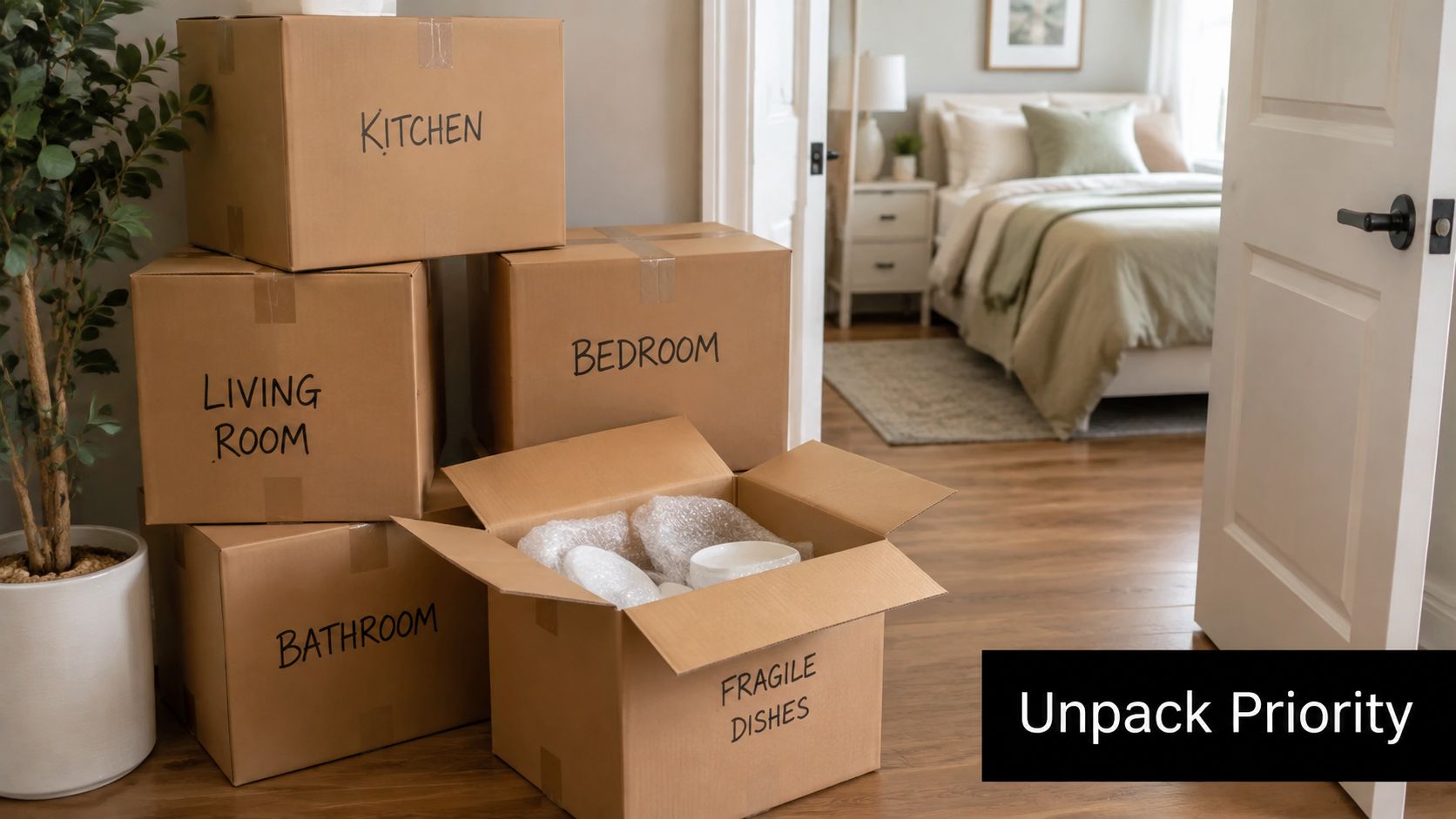
Assign each department a destination and a setup owner. Number cartons by priority, then place the highest-priority cartons where the responsible person can reach them without moving other stock. A family move may put kitchen, bathroom and bedroom essentials first. A commercial move may put IT infrastructure and customer-facing equipment ahead of individual desk accessories.
Define the first operating period
Write a short setup plan that states what must work before staff or customers return. Include internet, phones, printers, EFTPOS, alarms, meeting rooms, bathrooms, kitchen facilities and emergency contacts. Recent Australian relocation guidance recommends sequencing internet before phones, EFTPOS and alarm systems, then printers, while rehearsing the IT cutover and confirming permits and lift bookings. (Australian downtime prevention guidance)
- Priority one: Connectivity, security, communications and essential equipment.
- Priority two: Workstations, shared equipment and operational supplies.
- Priority three: Storage, presentation items and non-critical furniture.
- Final check: Test systems with the people who use them every day.
Keep chargers, medication, documents, access cards and basic tools in a clearly marked essentials container. A written setup order reduces repeat handling and gives managers a realistic basis for communicating the first day back.
8. Arrange Furniture Disassembly and Reassembly Services
Disassembly is useful when furniture cannot travel safely through the building, but it creates a new control problem: loose hardware, missing instructions and uncertain reassembly responsibility. Decide early which desks, beds, shelving systems, meeting tables and entertainment units will be dismantled. Photograph each item in its assembled state before work begins.
Use separate, labelled hardware bags for every item. Keep screws, brackets and keys with the furniture they belong to, not in one shared box. For modular office systems, label panels and frames according to the new floor plan so the crew can rebuild the correct configuration without guesswork.
Confirm the hand-back standard
Ask who will disassemble, who will reassemble and what happens if access to the new site is delayed. Reassembly may need to occur in stages if the new office is still undergoing fit-out. For businesses, establish whether desks must be fully functional before staff return and who tests power, cable routing and storage locks.
Before the truck leaves: photograph the disassembled pieces, count the hardware packs and record any pre-existing damage.
Specialist items need a separate conversation. Pool tables, large safes, complex shelving and unusual machinery may require trained handling and a specific delivery route. Include assembly instructions or manufacturer diagrams in the job file, then test drawers, doors, locks, stability and moving parts immediately after reassembly.
The lowest upfront quote isn't always the lowest total cost if staff spend days rebuilding workstations or searching for missing parts. Compare the convenience of a managed service with the control and savings of doing simple items internally, then reserve professional help for pieces where mistakes can cause damage or delay.
9. Verify Insurance Coverage and Document Valuable Items
Insurance paperwork belongs in the pre-move file, not in a carton. Ask the removalist for current public liability and transit insurance details, then confirm what the policy covers, what it excludes, how claims are lodged and whether high-value items need separate declarations. Building management may require a Certificate of Currency before approving commercial access.
A 2026 Melbourne CBD office-relocation guide states that premium commercial buildings commonly request public liability cover of at least $20 million, and advises confirming both public liability and transit insurance before moving day. This is industry guidance, not a universal government rule, so verify the specific requirement with your building manager and removalist. (Melbourne CBD office relocation insurance guidance)
Build evidence before packing
Photograph valuable equipment, furniture, artwork and electronics from several angles. Record serial numbers, condition, ownership and supporting receipts or valuations. For a business, match each photograph to the asset register, so an incident can be reported precisely rather than described from memory.
- Policy documents: Save certificates, schedules and claim contacts in the shared relocation folder.
- Condition evidence: Record scratches, dents and faults before wrapping.
- Specialist cover: Ask specifically about pianos, artwork, collectibles and sensitive equipment.
- Access approval: Send required insurance documents to building management before the move.
Don't describe insurance as a substitute for careful handling. It protects against defined risks, subject to the policy terms. Good wrapping, route planning, supervision and signed condition records remain the first line of protection.
10. Conduct Pre-Move Deep Clean and Post-Move Inspections
The final cleaning and inspection protect more than appearances. They create evidence about the condition of the old premises, support lease obligations and reveal any damage at the new site before responsibility becomes unclear. Victoria's official relocation checklist includes a thorough inspection after the move and a final review of financial and insurance arrangements. (Victorian post-move checklist)
Schedule cleaning after most items have left, then photograph empty rooms, walls, floors, ceilings, kitchens, bathrooms, loading areas and any existing damage. For a commercial tenant, compare the result with the lease and make-good obligations. A professional clean may be appropriate where the landlord expects a particular standard, but cleaning alone won't resolve repairs, removed fittings or reinstatement work.
Inspect both sites
At the new location, photograph floors, walls, doors, lifts and shared access areas before unloading where possible. Repeat the inspection after placement and record any new marks with timestamps. Ask the landlord, agent or building manager to acknowledge the condition report when practical.
- Old premises: Confirm rubbish removal, abandoned property, keys, access cards and final meter information.
- New premises: Check utilities, access, lighting, security, internet readiness and visible damage.
- Lease close-out: Confirm make-good tasks, notice obligations and the handover contact.
- Evidence: Store written reports, photographs and correspondence together.
For a specialised cleaning comparison outside Australia, see office cleaning services in Manchester, but apply Melbourne lease requirements and building instructions to the actual job.
10-Point Business Moving Checklist Comparison
| Item | Complexity 🔄 | Resource Requirements ⚡ | Outcomes & Impact ⭐📊 | Ideal Use Cases 📊 | Quick Tips 💡 |
|---|---|---|---|---|---|
| Create a Comprehensive Moving Inventory and Timeline | Moderate–High 🔄, detailed planning and ongoing updates | Time, spreadsheet/app, photos, household input | ⭐ High organization; 📊 accurate quotes, easier insurance claims | Large homes, businesses, interstate moves | 💡 Use a shared spreadsheet/app; photo valuables; update monthly |
| Notify Essential Services and Update Your Address | Moderate 🔄, multiple contacts and follow-ups | Time, provider contacts, documentation | ⭐ Continuous services; 📊 avoids missed bills and penalties | All relocations; critical for interstate and renters | 💡 Build a master provider list; request mail redirection 2–3 weeks prior |
| Arrange Professional Packing and Protective Equipment | Low–Moderate 🔄, scheduling and specification of services | Cost for materials and labor; specialty packing supplies | ⭐ Lower damage risk; 📊 faster packing and easier unpacking | Moves with fragile/valuable items or long-distance transport | 💡 Discuss specialty items early; label boxes clearly |
| Book Transport and Confirm Lift Access Requirements | Moderate 🔄, logistics, permits and building coordination | Booking fees, permits, building approvals, vehicle selection | ⭐ Reliable move timing; 📊 minimizes day-of delays | Apartment moves, commercial buildings, peak-season relocations | 💡 Book 4–6 weeks ahead; contact building management 8 weeks prior |
| Measure Doorways, Hallways, and Furniture Fit | Low 🔄, straightforward but requires access | Tape measure or digital tools; access to both properties | ⭐ Prevents damage; 📊 avoids last-minute returns or disassembly | Moves with large furniture or narrow access points | 💡 Measure frames and furniture (incl. legs); photograph measurements |
| Arrange Secure Short‑Term or Long‑Term Storage if Needed | Low–Moderate 🔄, booking and inventory management | Storage fees, insurance, transport to storage | ⭐ Resolves timing gaps; 📊 provides staging/flexibility | Non-aligned settlement dates, downsizing, staged moves | 💡 Book storage with transport; photo and inventory stored items |
| Create a Room‑by‑Room Unpacking Strategy and Setup Plan | Low 🔄, prioritization and labeling | Time, labels, possible white‑glove service cost | ⭐ Faster functional setup; 📊 reduces post-move chaos | Busy households, professionals, offices needing quick setup | 💡 Prioritize kitchen/bath/bed; label boxes with priority numbers |
| Arrange Furniture Disassembly and Reassembly Services | Low–Moderate 🔄, coordination and skilled labor | Skilled technicians, extra service fees, hardware storage | ⭐ Protects furniture; 📊 ensures correct reassembly and function | Large, modular or specialty furniture and office systems | 💡 Photograph before disassembly; label and secure hardware packets |
| Verify Insurance Coverage and Document Valuable Items | Low–Moderate 🔄, paperwork and valuations | Possible premiums, time for photos and receipts | ⭐ Financial protection; 📊 clearer, faster claims process | High‑value items, long‑distance/interstate moves | 💡 Obtain policy details in writing; photograph and keep receipts |
| Conduct Pre‑Move Deep Clean and Post‑Move Inspections | Low–Moderate 🔄, scheduling and documentation | Cleaning fees, camera/video, time for inspections | ⭐ Maximizes deposit recovery; 📊 documents condition to prevent disputes | Renters, property sales, commercial lease terminations | 💡 Schedule cleaning 2–3 days before leaving; timestamp photos |
Turn the Checklist Into a Controlled Handover
A successful relocation ends with a controlled handover, not the moment the last carton crosses the threshold. Before moving day, run a confirmation sweep with the coordinator, facilities contacts, IT lead and department owners. Verify the truck booking, loading route, lift reservation, parking, access cards, delivery window and emergency contacts.
Check the evidence folder for the latest inventory, photographs, insurance certificates, lease documents, utility confirmations and condition reports. Confirm that specialist items have a named handler and that every stored asset has a release plan. If a permit or licence must transfer, check the applicable Victorian process early. The Victorian relocation material shows that some regulatory transfers can involve pre-lodgement forms, a declaration of the right to occupy, public notices and a red-line plan, depending on the application. (Victorian licence and permit relocation steps)
Assign one coordinator
One person should own the master schedule and make the final call when access, transport or setup changes. That doesn't mean one person performs every task. Department leads, IT staff, building managers, cleaners and movers should each have defined responsibilities, deadlines and escalation contacts.
A shared record prevents the common failure where one person has the lift booking, another has the utility reference and nobody has the current floor plan. Use a simple status system such as pending, confirmed, completed and issue raised. Keep the record accessible to authorised staff, especially during an interstate move where the delivery team and receiving team may be separated.
Protect the first operating day
Test connectivity before staff return. Confirm phones, internet, printers, EFTPOS, alarms, servers, access control and shared equipment in the order that operations depend on them. Keep a small continuity plan for delayed activation, including temporary communication channels, manual payment procedures where appropriate and a clear customer message.
The Australian business market also shows why relocation planning remains relevant. At 30 June 2023, Australia had 2,589,873 actively trading businesses, with 406,365 entries and 356,216 exits during the year, representing a 16.0% entry rate and a 14.0% exit rate. (Australian Bureau of Statistics business counts) Businesses regularly open, close, reorganise and change premises, so a reusable process is more valuable than a one-off packing list.
Office use is also recovering unevenly. National CBD office occupancy averaged 76% of pre-COVID levels in Q1 2024, up from 70% in Q4 2023 and 67% a year earlier, while Q1 recorded 33,300 square metres of positive net absorption and a 14.7% CBD vacancy rate. By 2024, annual net absorption across Australian CBD office markets reached 163,500 square metres, the highest annual result since 2018. (Australian CBD office market data) The practical implication is clear. Melbourne businesses need relocation plans that support staged occupancy, changing workplace requirements and minimal downtime.
Complete the final sweep. Confirm access, inventory, insurance documents, utilities, responsible people, records, storage and priority setup tasks. Then discuss transport, packing, storage, furniture handling and scheduling with Get n Go Removals Melbourne, using the company's website to match the service plan to your premises and handover date.
Get n Go Removals Melbourne provides residential and commercial transport, packing, storage, furniture disassembly and reassembly, with scheduling designed around Melbourne access requirements and interstate relocations. Visit Get n Go Removals Melbourne to discuss your inventory, building access, specialist items and preferred move date.