Top Long Distance Movers in Australia | Expert Moving Tips
Embarking on a long-distance move can feel like a monumental task, but the secret lies in breaking it down into manageable steps. Hiring professional long distance movers is the critical first step in transforming a daunting challenge into a streamlined process, providing peace of mind that your belongings will cross state lines safely and efficiently.
Ultimately, a well-structured plan is your strongest defence against the stress that inevitably accompanies a major relocation.
Your Essential Long Distance Moving Checklist
Relocating across the country is a complex logistical operation. Without a clear plan, it’s incredibly easy to feel overwhelmed by the sheer volume of tasks. This is where a detailed checklist becomes your most valuable tool, acting as a roadmap from the moment you decide to move until the last box is unpacked in your new home.
By breaking the entire process into smaller, actionable steps, you can maintain control and ensure no critical details are missed. A successful interstate move begins long before the truck arrives; it starts with meticulous planning, strategic budgeting, and a clear understanding of your specific needs.
This process flow provides a high-level overview of the core stages involved in planning a long-distance move from the outset.
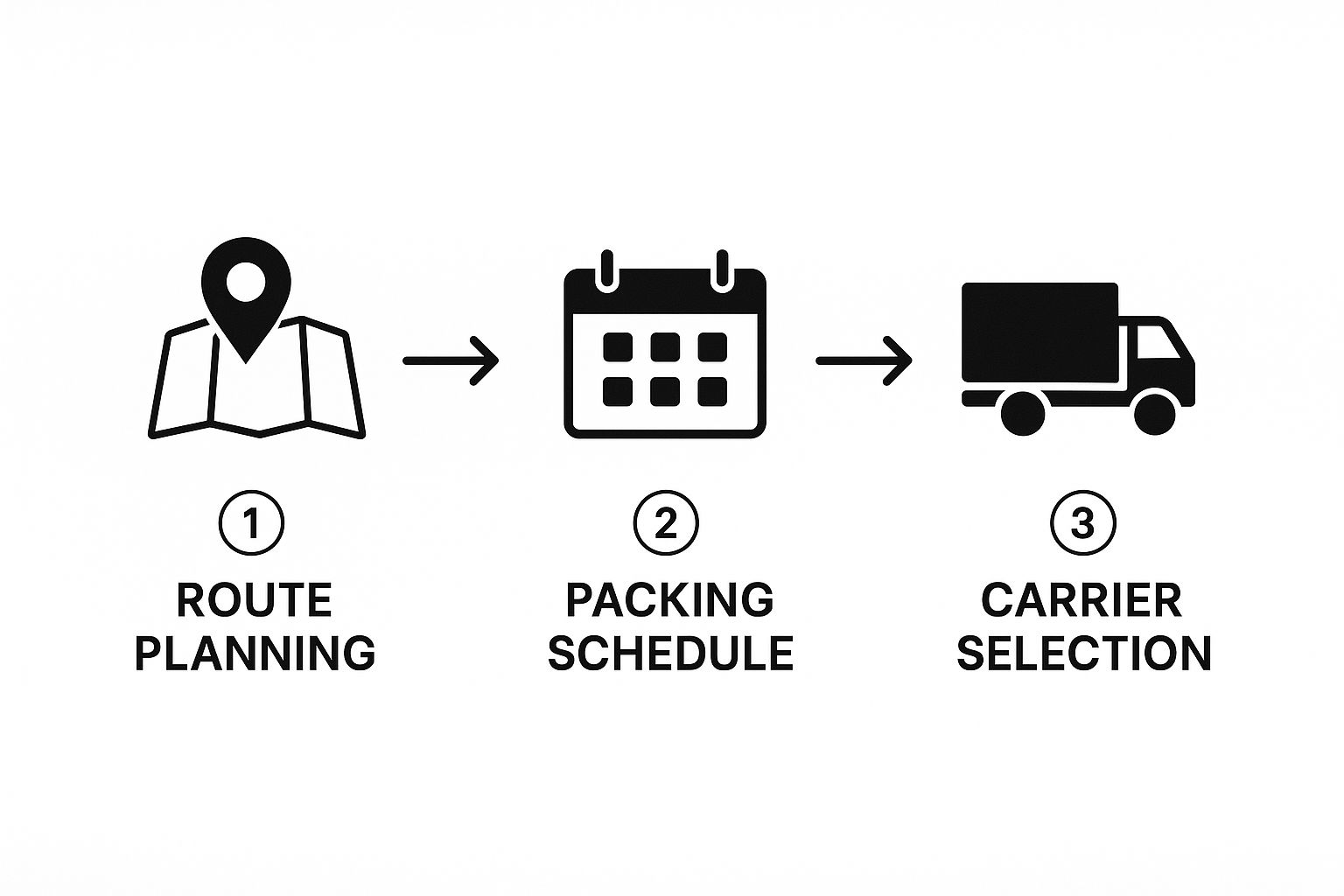
As illustrated, foundational elements like route planning, scheduling, and selecting the right carrier are the cornerstones of a smooth, professionally executed move.
Establish a Realistic Moving Budget
First and foremost, you must gain a firm grip on the financials. Moving costs can accumulate with surprising speed, so creating a detailed budget from the very beginning is non-negotiable. It's crucial to look beyond the movers' primary fees and account for all the ancillary expenses that inevitably arise.
Ensure your budget includes line items for:
- Professional Mover Fees: This is the largest expense and will vary based on the distance and volume of your belongings.
- Packing Supplies: Even if you hire professional packers, you may need extra boxes, tape, or bubble wrap for last-minute items.
- Transit Insurance: Essential for protecting your valuables during a long-haul journey. This is not an area to cut corners.
- Travel Costs: Factor in your personal expenses for flights, fuel, accommodation, and meals during transit.
- Utility Connection Fees: There are often administrative costs associated with establishing services at your new address.
Create a Comprehensive Home Inventory
Before you can obtain accurate quotes from long distance movers, you must know precisely what you are moving. A detailed home inventory is an absolute necessity. This list serves two critical functions: it enables moving companies to provide a precise estimate, and it is essential for insurance purposes should anything be lost or damaged.
Go through your home room by room and document every item you intend to take. A simple spreadsheet or a dedicated inventory app works perfectly. List each item, note its current condition, and assign an estimated replacement value. This is also the ideal opportunity to declutter—decide what can be sold, donated, or discarded. The less you move, the lower your costs will be. For a more detailed guide on getting organised, check out our article on the essential moving home to-do list.
A thorough home inventory is the single most effective tool for receiving accurate moving quotes. Without it, you are essentially guessing, which can lead to unexpected costs on moving day.
Understand Different Moving Services
Not all moving services are created equal, and the optimal choice depends entirely on your budget and how much of the work you're willing to undertake. Professional long distance movers offer a spectrum of services designed to meet diverse customer needs.
Familiarise yourself with the common options available:
- Full-Service Packing: The movers handle everything, from wrapping your fragile dishes to boxing up your entire household. This is the most convenient option, but also the most expensive.
- Partial Packing: You can hire movers to pack specific rooms (like the kitchen) or only your most fragile items, such as artwork, mirrors, and electronics.
- Self-Pack: You are responsible for all packing. The movers handle only the loading, transport, and unloading of your prepared boxes and furniture. This option saves money but requires a significant time investment.
- Backloading: A cost-effective choice where you share truck space with other customers moving along a similar route. It’s ideal for smaller moves or if you have flexible dates, but be aware that transit times can be longer due to multiple stops.
To help you stay on track, here is a simplified timeline of key actions to take in the weeks leading up to your move.
Long Distance Moving Timeline and Key Actions
| Timeframe | Key Action | Pro Tip |
|---|---|---|
| 8 Weeks Out | Research moving companies and get at least three quotes. | Look for movers who specialise in interstate relocations and check their reviews thoroughly. |
| 6 Weeks Out | Start decluttering and create your home inventory. | Sort items into "keep," "sell," "donate," and "discard" piles. Be ruthless! |
| 4 Weeks Out | Book your chosen mover and confirm all details in writing. | This is also a good time to order your packing supplies if you're self-packing. |
| 2 Weeks Out | Begin packing non-essential items. | Clearly label every box with its contents and the room it belongs in at the new house. |
| 1 Week Out | Confirm final arrangements with your movers and pack an "essentials box". | Your essentials box should contain items you'll need immediately upon arrival. |
| Moving Day | Do a final walkthrough of your empty home. | Make sure nothing is left behind and that you have all important documents with you, not on the truck. |
This timeline is a flexible framework, but it provides a solid structure to ensure you aren't scrambling at the last minute. The key is to start early and tackle tasks systematically.
Why Australians Are Moving Long Distance
A significant demographic shift is underway in Australia. For decades, the dominant aspiration was a fast-paced urban life, but thousands are now fundamentally rethinking that paradigm. This is more than a fleeting trend; it represents a major shift in what people value in their home, community, and overall lifestyle.
The traditional narrative was straightforward: move to a major city for career advancement. Now, that script has been completely rewritten. A growing number of Australians are looking beyond the metropolitan fringe, seeking more space, a stronger sense of community, and a higher quality of life. This trend is keeping professional long distance movers busier than ever, facilitating families' transitions from the urban grind to the expansive possibilities of regional Australia.

This movement is, at its core, a search for balance—exchanging a postcode for a lifestyle that offers greater fulfilment.
The Great Regional Migration Unpacked
The concepts of a 'sea change' or 'tree change' have been part of the Australian lexicon for years, but the current movement is on an entirely different scale. It's a sustained exodus from capital cities, driven by crystal-clear motivations: lower costs and superior lifestyle opportunities.
The data confirms this trend. Research from the Regional Australia Institute highlights a massive 10.5% increase in people relocating from capitals to regional areas compared to previous years. Interestingly, the demographic leading this charge is not just young professionals but also older, more established individuals with greater capital, seeking better prospects for homeownership and an improved living environment. Even today, the trend remains 20.5% higher than pre-COVID levels, demonstrating its significant staying power. You can dive deeper into Australia's great regional migration on findamover.com.au.
The data is clear: the migration to regional Australia is not a temporary blip. It's a lasting societal change driven by a collective re-evaluation of what makes a high-quality life, with people moving from cities to regions outnumbering those going the other way by 25%.
This shift has a tangible impact, not only on the cities being left behind but also on the regional towns experiencing a sudden boom. It is reshaping local economies, influencing property markets, and redefining community dynamics.
Economic Drivers and Lifestyle Gains
Ultimately, this migration boils down to two key factors: finance and well-being. The cost of living in major cities like Sydney and Melbourne has become prohibitive for many families. Housing, in particular, has escalated to a point where the traditional Australian dream of homeownership feels unattainable for a significant portion of the population.
A brief comparison of property prices immediately highlights the appeal of regional living. The price of a cramped city apartment can often secure a large family home with a substantial backyard in a regional town. This level of financial relief is a powerful motivator.
However, the decision is not purely financial. The lifestyle advantages are a massive component of the equation. People are making a conscious choice for:
- Less Congestion: Exchanging hours of traffic for shorter, more pleasant commutes.
- More Space: Access to larger homes, bigger blocks of land, and more green spaces.
- Community Connection: The opportunity to live in a place with a genuine sense of belonging and neighbourly connection.
- Work-Life Balance: The normalisation of remote work means many professionals are no longer tethered to a physical city office.
Combined, these factors transform a long-distance move from a mere change of address into a strategic investment in a better future. It is a calculated decision aimed at achieving a healthier, happier, and more financially stable life.
How to Vet and Choose the Right Movers
Selecting the right moving company is unequivocally the most critical decision you will make for your long-distance move. It is the single factor that determines whether you experience a smooth, stress-free relocation or a nightmare of lost items, hidden fees, and logistical headaches.
Your choice of mover will dictate whether your possessions arrive safely, on schedule, and within budget. This is not a decision to be rushed. Investing the time to properly vet potential long distance movers will pay significant dividends. You must look beyond the initial quote and scrutinize the details that signify a professional, reliable, and trustworthy operation.
Start with the Non-Negotiables
Before comparing prices, there are several absolute must-haves for any legitimate moving company. Consider this your initial filter. If a company cannot meet these basic criteria, they should be removed from consideration, regardless of how attractive their quote may seem.
Your first checks should always cover:
- Proper Licensing and ABN: A legitimate Australian business must have an Australian Business Number (ABN), which can be verified online in seconds. This is the bare minimum requirement for any professional service provider.
- Transit Insurance: This is distinct from general liability insurance. Transit insurance specifically covers your goods while they are in the mover's care—during loading, in transit, and during unloading. Request a Certificate of Currency to ensure their policy is valid and current.
- Professional Association Membership: While not legally required, membership in an organisation like the Australian Furniture Removers Association (AFRA) is a strong indicator of quality. AFRA members are held to high industry standards, are regularly audited, and must maintain specific equipment and insurance policies.
These credentials are not mere formalities; they are your first and most effective line of defence against fraudulent or incompetent operators.
Deconstructing the Moving Quote
Once you have a shortlist of companies that pass the initial checks, it's time to obtain quotes. A good rule of thumb is to get at least three. However, simply choosing the cheapest option is a classic and often costly mistake. You must understand precisely what each quote includes and, more importantly, what it excludes.
A professional quote should be a detailed, itemised document, not just a single figure in an email. Scrutinize it for hidden fees that can inflate your final bill. These often appear as additional charges for services you may have assumed were standard.
A vague quote is a red flag. A reputable mover will provide a clear breakdown of all costs, including fuel levies, stair fees, and charges for handling bulky items. If it's not in writing, assume it's not included.
Here’s a practical tip: create a simple spreadsheet to compare your quotes side-by-side. Check if their estimates for the volume of your goods (in cubic metres) are consistent and if they have all included the same services. A quote that is significantly lower than the others could indicate an inexperienced estimator or, worse, a strategy to impose surprise charges later. For more tips on this, our detailed article on how to choose the best interstate removalists is an excellent resource.
Asking the Right Questions
A quote only tells part of the story. The best way to gauge a company's professionalism and experience is to speak with them directly and ask targeted questions. Their responses—and what they fail to mention—can be very revealing.
Prepare a list of questions to ask every mover you are considering. This ensures you are comparing like for like.
Key Questions for Your Potential Mover:
- Do you have experience with my specific route? A company that regularly services the route between Melbourne and Brisbane will have superior logistical knowledge compared to one that rarely makes the trip.
- What is your claims process? In the unfortunate event of damage, how straightforward is it to file a claim? A clear, well-defined process is a positive sign.
- Are your staff full-time employees or contractors? Companies that use their own trained, police-checked staff typically deliver a more consistent and reliable service.
- What is your cancellation policy? Unforeseen circumstances can arise. You need to understand the implications if your moving dates change.
- Can you explain the difference between your binding and non-binding estimates? A binding estimate is a fixed price, whereas a non-binding estimate can increase if your shipment's weight or volume exceeds the initial estimate. Clarifying which type of quote you are receiving is crucial for budget management.
By combining thorough research with insightful questions, you can see past the sales pitch and select a moving partner you can genuinely trust to handle your relocation with the necessary care and professionalism.
The Financial Side of an Interstate Move
For a growing number of Australians, a long-distance move is less about a change of scenery and more about a calculated financial decision. The choice to relocate interstate is often driven by a careful analysis of long-term economic benefits, effectively turning the move into a strategic investment in future stability.
This is not merely about pursuing a lifestyle dream; it is a direct response to the economic pressures many are experiencing. As families and professionals evaluate their options, they are looking beyond their current postcodes to find a better equilibrium between income, living costs, and overall quality of life. The journey with long distance movers frequently begins not with packing boxes, but with a spreadsheet.

Cost of Living as the Main Driver
The single greatest catalyst behind this national trend is the relentless rise in the cost of living. In Australia's major cities, housing prices, daily expenses, and transportation costs have spiralled, placing immense strain on household budgets. For many, the allure of a high city salary is quickly eroded by these staggering expenditures.
This financial pressure is forcing a nationwide re-evaluation of what constitutes financial security. People are discovering that a slightly lower salary in a more affordable city can result in significantly more disposable income and a faster path to homeownership. It is a calculation that is transforming a lifestyle preference into an economic imperative.
A key issue is that wage growth has not kept pace with inflation. Recent figures show that while the cost of essentials continues to climb, wages grew by a modest 3.2%. This gap has a real-world impact, with research revealing that an astonishing 70% of Australians have either taken on a second job or are considering it simply to make ends meet. This is a clear indicator that the existing economic model is not sustainable for a large segment of the population.
The Economic Pull of New Destinations
As people seek financial relief, certain cities are emerging as clear beneficiaries. Locations like Perth and Brisbane are becoming hotspots for those seeking affordability without sacrificing career opportunities or lifestyle amenities.
These cities offer a compelling financial proposition:
- More Affordable Housing: The difference in median property prices between Sydney or Melbourne and cities like Perth can be hundreds of thousands of dollars, making the dream of homeownership attainable once more.
- Lower Daily Expenses: From groceries to public transport, the day-to-day cost of living is often noticeably lower, freeing up capital for savings or investments.
- Strong Job Markets: Growing economies in these states mean robust professional opportunities, dispelling the outdated myth that a successful career can only be built in the largest capital cities.
This powerful combination of factors has completely reshaped the moving landscape. A recent survey found that 54% of professionals were actively planning to move for better value, higher pay, or improved affordability.
Viewing your long-distance move through a financial lens is crucial. Calculate not just the upfront moving costs, but the potential decade-long savings on housing, commuting, and daily living. The return on investment can be life-changing.
Calculating Your Potential Savings
To fully grasp the benefits, it is essential to perform the calculations. Start by comparing your current expenses to projected costs in your target city. Research median house prices, average rent, typical grocery bills, and transportation costs.
Next, research salary expectations for your profession in the new location. You may be surprised to find that even with a similar or slightly lower salary, your overall financial position improves dramatically due to the lower cost of living. When planning your budget, remember to account for all variables; our guide on the hidden costs in moving house can help you build a comprehensive financial picture. This type of strategic financial planning is what ensures your move is a step towards a more secure and prosperous future.
Expert Packing Strategies for a Long Haul
Packing for a long-distance move is an entirely different discipline compared to a local relocation. When your belongings will travel hundreds or even thousands of kilometres, every item must be secured with precision. The vibrations, temperature fluctuations, and sustained movement on the road demand a superior level of care from the very first box you seal.
Proper packing is your primary defence against damage. For professional long distance movers, a well-packed home signals a smooth journey ahead. Conversely, poorly packed boxes can lead to shifting and breakage, placing all contents within the truck at risk.
Choosing the Right Materials
Your packing strategy is only as effective as the materials you use. Flimsy, second-hand boxes from a supermarket are simply not adequate for an interstate move. Investing in high-quality packing supplies is non-negotiable for protecting your valuables.
Start with the basics, but prioritise heavy-duty quality:
- Double-Walled Boxes: These are essential for anything fragile, including glassware, electronics, and artwork. They provide an extra layer of structural integrity that resists crushing and impact far better than standard single-walled boxes.
- Specialised Wraps: For furniture, standard plastic wrap is insufficient. Use thick moving blankets and padded paper to protect wood surfaces from scratches and dents. For upholstered items, use shrink wrap over the blankets to protect against dirt and moisture.
- Quality Tape: Do not compromise on packing tape. Use a strong, high-grade tape and apply it generously using the "H-tape" method—sealing across the centre seam and then along both edge seams to create a highly secure closure.
Using the right materials from the outset prevents the common packing failures that lead to damage during a long-haul transit.
Proven Techniques for a Secure Load
How you pack your boxes is just as crucial as what you pack them in. A common mistake is creating boxes that are either too heavy or too light. An overloaded box can split open, while an under-filled one can collapse when another box is stacked on top of it.
As a general rule, aim for a maximum weight of around 20 kilograms per box. This makes them manageable to lift and significantly less likely to fail under stress.
Here are a few professional techniques to guide you:
- Cushion from the Bottom Up: Always begin with a layer of crushed packing paper or bubble wrap at the bottom of the box before placing any items inside.
- Heaviest Items First: Place the heaviest items at the bottom and build up with progressively lighter ones. This creates a stable centre of gravity and prevents delicate items from being crushed.
- Fill All Gaps: Empty space is your enemy. Gaps allow items to shift and collide during transit. Use packing paper, towels, or soft linens to fill every void and ensure a snug fit.
- Label with Detail: Do not just write "Kitchen." Be specific: "Kitchen – Fragile – Plates & Bowls." It also helps to add the destination room and an arrow indicating which way is up.
Creating a detailed inventory list as you pack isn't just good practice; it's essential. This master list is your ultimate proof of possession for any insurance claims and your roadmap for a logical, stress-free unpacking process at your new home.
What You Should Never Pack
Equally important as knowing how to pack is knowing what not to pack on the moving truck. Any reputable long distance mover will provide a list of non-allowable items, which typically includes anything hazardous, perishable, or of high personal value.
These items should either be disposed of responsibly before the move or transported with you personally.
Items to Keep Off the Truck:
| Category | Examples | Why You Shouldn't Pack Them |
|---|---|---|
| Hazardous Materials | Aerosols, paints, cleaning supplies, propane tanks, petrol | These items are flammable, corrosive, or explosive and are illegal to transport in a moving truck. |
| Perishables | Refrigerated or frozen food, open food containers, plants | They can spoil, attract pests, and create a significant mess during a multi-day journey. |
| Personal Valuables | Passports, important documents, medication, jewellery, laptops | These items are irreplaceable and should be kept with you at all times for security and immediate access. |
For a deeper dive into organising your packing process, our guide on where to start when packing to move house offers an excellent framework. By taking a thoughtful and strategic approach, you give your belongings the best possible chance of arriving in the same condition they left.
Your Guide to Delivery Day and Settling In
The journey with your long distance movers concludes when the truck arrives at your new home. Delivery day is the final critical stage, and your preparedness can make the difference between a smooth transition and a chaotic one. This is your opportunity to verify that everything has arrived safely and begin the exciting process of settling in.

With a solid plan for managing the unloading process and a checklist for subsequent tasks, you can turn this final leg of your journey into a seamless experience.
Managing the Truck's Arrival
When the movers arrive, your primary role is to direct the process. Before the first box is unloaded, conduct a brief walkthrough of your new home with the crew leader. Point out the location of each room and explain your labelling system. This simple step ensures furniture and boxes are placed in their correct destinations, saving you hours of manual labour later.
Have your inventory list ready. As items are carried in, check them off against your list. This is the most effective method to confirm that everything you shipped has arrived. Do not feel rushed during this process; a reputable moving team will expect and accommodate your need for thoroughness.
Inspecting Your Belongings and Handling Claims
As your items are brought inside, perform a quick visual inspection for any obvious signs of damage. Pay close attention to fragile items and the corners and surfaces of wooden furniture. If you identify any damage, make a note of it directly on the inventory sheet or the movers' copy of the Bill of Lading before you sign any paperwork.
If you discover damage after the movers have departed, do not panic. Reputable moving companies have a clear process for handling claims.
- Document Everything: Take clear photographs of the damage from multiple angles.
- Don't Throw Anything Away: Retain the damaged item and its original packing materials as evidence for the claim.
- Contact Your Mover Promptly: Most companies have a specific timeframe for filing a claim, so it is best to initiate contact as soon as possible to begin the process.
Having your detailed inventory list and clear photos is your best asset when filing a claim. It removes any guesswork and provides solid proof, which is crucial for getting things sorted out quickly.
Your Essential Settling-In Checklist
Once the truck is gone and the final paperwork is signed, the focus shifts to transforming your new house into a home. Prioritising the essentials will help you feel comfortable and organised much more quickly. A little forward planning for this stage is invaluable, especially after a long move. Our guide on what to do the night before movers arrive also contains useful tips to help you prepare for a smoother delivery day.
Here is a simple checklist to get you started:
- Connect Core Utilities: Ensure your electricity, gas, water, and internet are scheduled for connection on or before your arrival day.
- Locate Your Essentials Box: This should be the very first box you open. It contains everything you need for the first 24 hours, such as toiletries, medications, phone chargers, and basic kitchen supplies.
- Update Your Address: Begin notifying key organisations of your move. Prioritise government bodies (e.g., ATO, electoral commission), your banks, insurance providers, and any subscription services.
- Explore Your New Neighbourhood: Take a walk or drive to locate local essentials like the nearest grocery store, pharmacy, medical clinic, and petrol station.
By systematically working through these final steps, you can transition smoothly from a successful long-distance move to being comfortably settled in your new community.
Your Long-Distance Moving Questions, Answered
Embarking on a major interstate move is a significant undertaking, and it's natural to have numerous questions. Here, we address some of the most common queries we receive. Understanding these key details is a crucial step towards a stress-free relocation.
What’s the Real Cost of a Long-Distance Move in Australia?
There is no single fixed price, as the cost is determined by the distance of your move, the volume of your belongings (typically measured in cubic metres), and the level of service you require.
However, to provide a general estimate, moving an average 3-bedroom house interstate typically costs between $3,500 and $8,000. The most accurate way to determine your cost is to obtain at least three detailed, itemised quotes from reputable long distance movers for a direct comparison.
How Early Should I Book My Movers?
Our professional recommendation is to book your movers at least 6-8 weeks prior to your intended moving day. This is particularly important if you are moving during peak seasons, such as summer or school holidays, when demand is highest.
Booking early significantly increases the likelihood of securing your preferred dates and may also result in more competitive pricing before schedules become fully booked.
What is Backloading? And Is It Right For Me?
Backloading is a cost-effective moving solution that involves sharing space on a truck that is making a return trip from another delivery. In essence, you are only paying for the space your items occupy on a truck that would otherwise be travelling empty.
This is an excellent option if you have a smaller volume of goods or if your moving dates are flexible. It's important to note that because the truck may be making multiple stops, the delivery timeframe can sometimes be longer than a dedicated service.
When you’re ready for a seamless and professional move, the experienced team at Get n Go Removals Melbourne has your back. We manage every single detail of your long-distance relocation with genuine care and expertise. Get your free quote online today!