
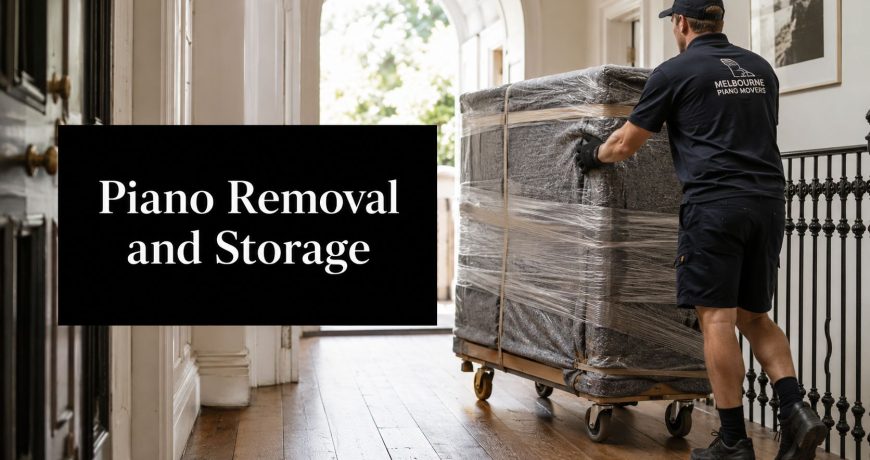
Piano Removal and Storage: A Practical Melbourne Guide
You're halfway through a Melbourne move when the piano becomes the problem nobody allowed for. The upright cleared the lounge, but it won't turn through the hallway. The apartment lift has a booking window, the stair landing is shared, and the storage unit is waiting at the other end. A piano move succeeds or fails before anyone touches the first strap, because the sequence of access, preparation, transport and storage matters more than any single piece of equipment.
Pianos have been difficult to relocate in Australia since the country's earliest colonial days. Australia's first piano arrived with the First Fleet in 1788, and historical accounts describe pianos being hauled across the continent by horse, bullock and camel, with some lost or damaged during transport. That history still reflects the practical reality of piano removal and storage today. Australian historical reporting on the country's first piano provides useful context for why specialist handling developed in the first place.
Why Piano Removal and Storage Deserves Its Own Plan
A Carlton terrace can expose a bad plan quickly. An upright weighing around 250 kg is wedged in a hallway, one end is close to the skirting board, and the only workable route crosses a shared stair landing. One person is measuring the turn while another is trying to negotiate access with a neighbour. At that point, the move and the storage arrangement are no longer separate jobs. They're one operation with two phases.
The first phase is where the piano lives during the move. That may mean a protected position in the truck, a short holding period, or a direct transfer into a storage facility. The second is where it lives afterwards, whether that's a temporary storage room during settlement, a long-term warehouse, or another home. If the destination can't accept the instrument in the same position and condition in which it leaves the property, the transport plan is incomplete.
Weight changes the access decision
A piano has a troublesome combination of high weight, awkward shape and delicate internal parts. Australian guidance places upright piano weights at roughly 130 kg to 375 kg, while grands can weigh about 220 kg to 650 kg, depending on the model. Those figures come from Australian piano-moving guidance on humidity and instrument weight. Ordinary furniture can often be tilted, dragged or briefly rested while a team adjusts its grip. A piano punishes that approach.
A stair carry can work when the stairs are wide, the turns are open, the handrails can be protected and the crew has a controlled route. A lift must be booked when the piano and its handling equipment can fit only within a narrow access window. A crane may be the only honest answer when a grand cannot safely turn through a stairwell or pass through the available doors. Pretending otherwise transfers the risk to walls, banisters, the instrument and the people carrying it.
Practical rule: Decide the route and the receiving environment before choosing the wrapping or storage unit.
Storage deserves the same scrutiny as the removal. A unit that looks dry can still expose timber, felt, strings and finish to repeated humidity changes. For owners comparing transit cover, storage responsibility and liability, it's sensible to insure your next move before the piano leaves the room.
This is a field-tested Melbourne workflow, not a generic moving checklist. The useful question isn't “Who can lift the piano?” It's, “What must happen next, and what must already be ready when it does?”
Preparing the Piano and the Home Before Moving Day
The access call happens before the wrapping call. Before moving day, someone needs to establish the instrument's dimensions, weight, route, building rules and receiving conditions. Without that information, even a capable crew can arrive with the wrong dolly, insufficient protection or no practical way to reach the truck.
Start with the instrument
Typical Melbourne planning ranges are useful, but the model and construction still matter. An upright may weigh 200 to 280 kg, a baby grand 280 to 350 kg, and a concert grand 450 to 550 kg. Those planning figures are drawn from the specialist handling data cited earlier. Digital pianos are a separate, lighter problem, although their cases and stands still need protection from knocks and moisture.
Before the crew arrives:
- Secure moving parts. Lock the fallboard and key lid. Remove the music desk and pedal lyre if they're designed to come off safely.
- Control accessories. Tape down loose bench castors and measure the piano with the bench attached if both pieces must follow the same route.
- Record condition. Photograph the cabinet, keyboard area, pedals, corners and nearby walls before packing. This creates a clear condition record.
- Clear the route. Remove rugs, plant stands, ornaments and furniture from the planned path. Pets and children should stay away while the load is moving.
Measure the home like an operator
A standard doorway may be around 820 mm wide, while many uprights are approximately 1500 to 1600 mm deep, so width alone doesn't answer whether the piano will pass. Check the door swing, hallway width, ceiling height, stair rise, landing depth and the angle available at each turn. Measure the lift's clear depth and internal door opening, not just the advertised cabin size.
| Piano Type | Approx. Weight | Typical Width x Depth | Minimum Doorway Width | Notes |
|---|---|---|---|---|
| Upright | 200 to 280 kg | Confirm on site | Around 820 mm may be available | Check depth, door swing and stair turns |
| Baby grand | 280 to 350 kg | Confirm on site | Confirm with the handling position | Lift and stair geometry often decide the route |
| Concert grand | 450 to 550 kg | Confirm on site | Confirm with specialist access planning | Crane access may be required |
| Digital piano | Lighter than acoustic models | Confirm on site | Confirm stand and case dimensions | Protect electronics and detachable parts |
Use a detailed essential moving home to-do list to keep the building and household tasks organised. For apartments, obtain the lift slot in writing, confirm loading-zone restrictions and check whether a concierge or building manager must attend. If a crane window is possible, coordinate road access, weather exposure and the receiving room before the booking is confirmed.
Packing and Wrapping the Piano Correctly
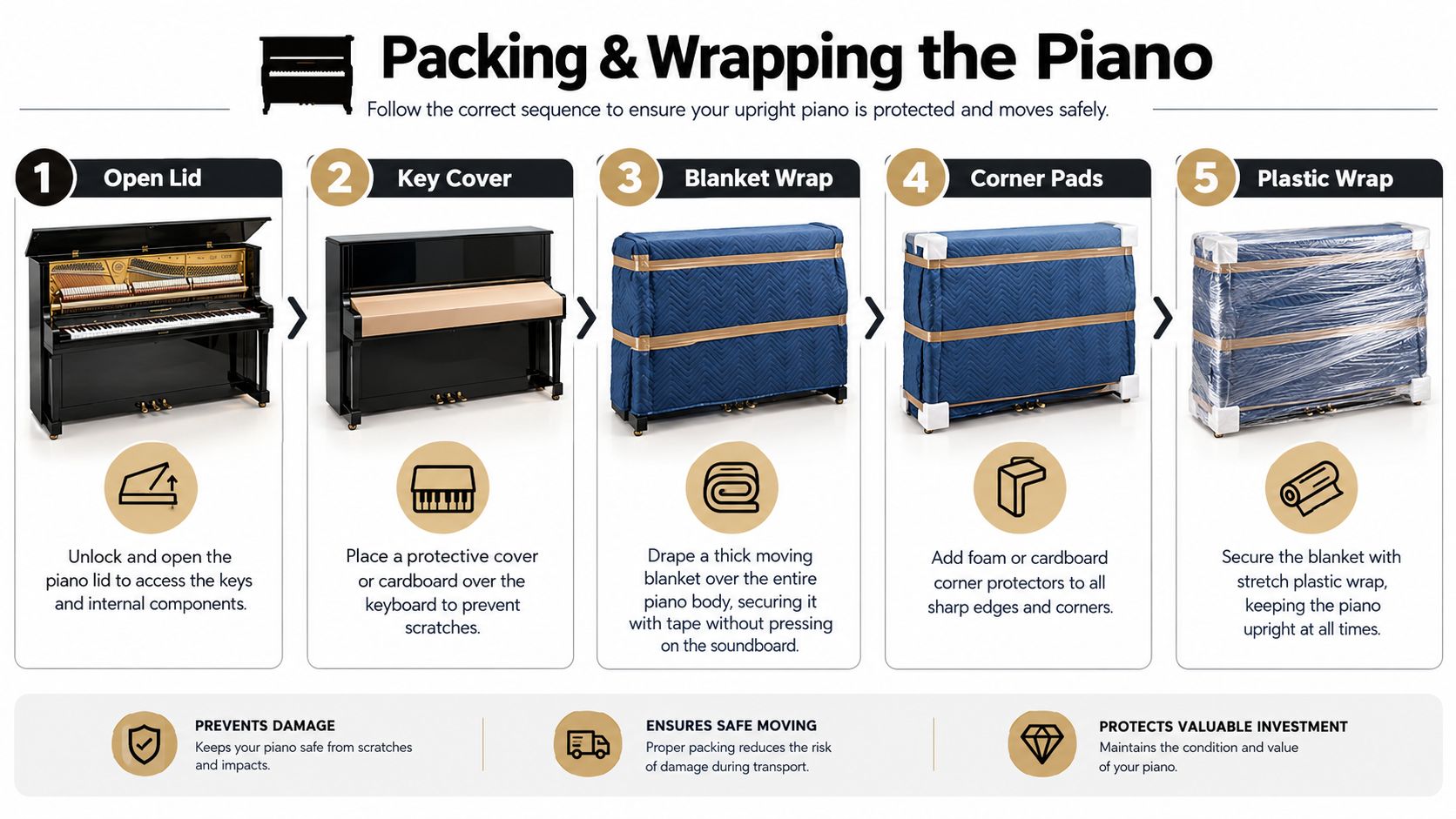
Packing a piano isn't a pile of blankets beside the front door. It's a strict sequence designed to keep the instrument upright, keep loose parts from moving and prevent the cabinet from taking direct contact with walls, ramps or trolley frames.
Begin at the keyboard end. Slide the bench pedals inward, lock the fallboard and secure the key cover so it can't open while the piano is being handled. Remove the music desk where possible, and wrap pedals so they can't swing into the cabinet or catch on a doorway.
Build protection from the edges out
Apply corner guards to the top lid corners and keyboard edges before the main blanket layer. These points meet walls and doorframes first, particularly on terrace turns and apartment corridors. Next, cover the body fully with heavy-duty furniture blankets, securing the blankets with stretch wrap rather than compressing vulnerable panels.
Add a thick blanket skirt around the base. It protects the cabinet from trolley scuffs and gives the handling team a padded contact zone. Tape the lid closed, but place the tape over protective material so adhesive doesn't mark the finish. Plastic wrap can then help shield the wrapped body from moisture during a short transfer, but it shouldn't be treated as a substitute for stable storage conditions.
The recommended upright workflow is:
- Lock first. Secure the fallboard, key lid and other loose components before the piano is moved.
- Guard exposed corners. Fit protection to the lid, keyboard edges and sharp cabinet points.
- Blanket the body. Cover the entire cabinet with heavy moving blankets.
- Protect the base. Add a padded skirt where the dolly or trolley may contact the cabinet.
- Wrap for transfer. Use stretch wrap over the blankets to hold them in place and provide moisture protection.
- Check the position. Keep the instrument in its natural upright position throughout the move.
Australian storage guidance also recommends keeping the piano upright, securing loose parts, placing the heaviest movers at the dolly end and ensuring at least two people support the load. It specifically warns against tipping the piano backwards using gravity, because the weight can quickly overpower the handlers. The upright piano storage workflow from Kent Removals and Storage supports that handling sequence.
For broader fragile-item preparation, the fragile packing guide for moving is useful, but a piano still requires piano-specific handling. The upright-position rule is absolute. If the wrapping arrangement forces the instrument onto its side, the wrapping arrangement is wrong, not the piano.
Loading, Transporting and Unloading the Piano Safely
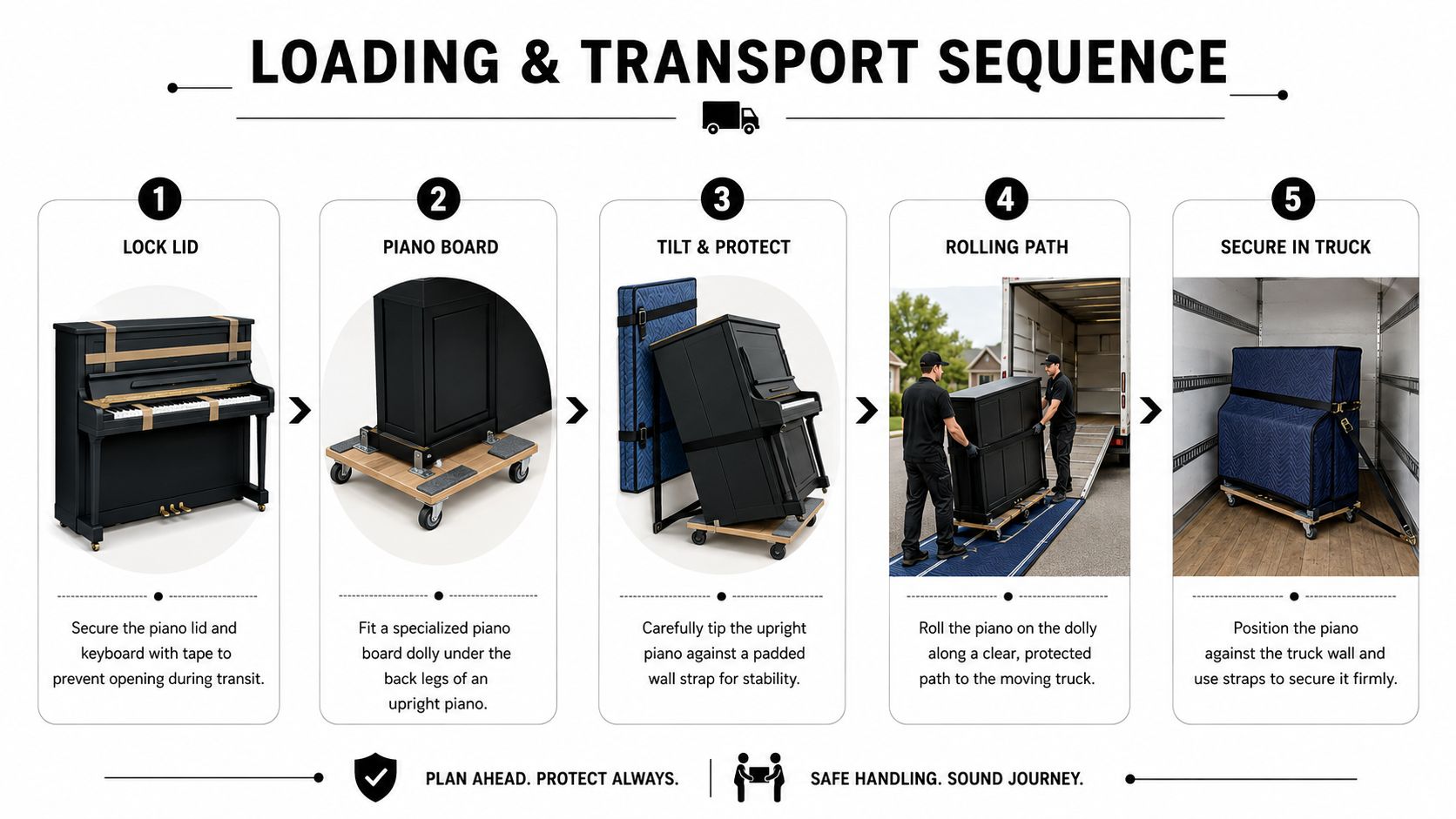
The loading sequence controls the force placed on the piano and the people handling it. For an upright, the team locks the lid and keyboard, fits a piano board dolly under the back legs, and tips the instrument carefully against a padded wall strap. The route to the truck should be clear and protected, with a minimum 1.8 metre aluminium ramp available where a ramp is required.
A piano must never be lifted by its legs. Legs and pedals aren't designed to act as carrying handles, and a sudden shift can damage the cabinet or injure the person underneath. On an ascent, the keyboard end should face the ramp so the crew can control the load and the spotter can watch the leading path.
Crew roles matter more than raw strength
A 250 kg upright needs at least a three-person crew, including one dedicated spotter, for a controlled move through ordinary access. The spotter watches doorframes, wall clearances, ramp edges and the position of the dolly. The other movers control the load at the frame and dolly end, rather than trying to pull from a leg or cabinet panel.
Truck preparation is part of loading:
- Use rubber matting. It reduces sliding and cushions vibration at the contact points.
- Pad the wall. A protected bulkhead stops lateral sway from transferring into the cabinet.
- Strap through the frame. Ratchet straps should secure the piano through a suitable structural frame point, never across the lid.
- Keep it vertical. The piano should travel upright and stable, not resting on its back or side.
The unloading sequence reverses the loading sequence. The receiving path must be ready before the straps come off. Threshold lips deserve attention because a small edge can stop a dolly wheel abruptly, while driveway gradients over 5 degrees can alter the load's centre of gravity and increase rolling force. The most exposed moment is when the dolly wheels leave solid ground. The crew needs a clear command, stable footing and a spotter watching the transition.
The practical guidance in how to move heavy furniture safely stops being enough on its own. A piano has to be controlled as a single, upright load, not treated as a large cupboard.
Storage Conditions That Protect the Instrument
A Melbourne garage may look convenient, but convenience doesn't make it suitable piano storage. The risk is repeated moisture cycling, not just the fact that the piano is inside a storage space. Timber, felt, metal components and the piano's finish all respond to changes in temperature and relative humidity, which can contribute to tuning drift, sticking keys, wood movement and joint damage.
Australian piano-care guidance commonly places a stable storage environment around 18 to 22°C, with relative humidity between 45% and 70%, ideally around 50% to 55%. Other specialist advice uses a narrower target of 15 to 21°C and 42% to 55% relative humidity. Melbourne piano-care guidance on acclimatisation and storage explains why a piano may need 4 to 6 weeks in a new environment before retuning.
Another Australian source warns that pianos may be quickly damaged or destroyed when relative humidity rises above 55% or falls below 35%, and advises against sheds, garages, carports, verandas and similar spaces. Piano Masters' storage advice recommends a shaded unit inside a building with humidity kept as stable as possible.
Compare the room, not just the price
| Storage Option | Climate Stability | Monthly Cost (AUD) | Insurance Compatible |
|---|---|---|---|
| Self-storage unit | Often variable, especially in uninsulated spaces | Confirm with provider | Confirm exclusions and cover limits |
| Climate-controlled warehouse | Designed for more stable conditions | Confirm with provider | Confirm transit and storage cover |
| Friend's spare room | Depends on heating, airflow and moisture control | Usually an arrangement between parties | Confirm household policy limitations |
| In-home repositioning | Usually the most familiar environment | No separate storage fee | Check household policy and relocation cover |
Don't place a piano directly on a concrete floor. Keep it upright and use suitable racking or a stable raised platform that won't obstruct the dolly or create a tipping hazard. Leave airflow around the instrument, keep it away from direct sunlight, heaters, vents and condensation risk, and avoid airtight coverings that trap moisture against the finish.
A short-term unit can work when the environment is stable and the access plan is sound. An uninsulated container, shed or garage is a poor bargain if the piano later needs repairs or extended stabilisation. For storage planning, review the options described in long-term storage in Melbourne and ask specifically about temperature monitoring, humidity control, racking, pest management, access and insurance responsibility.
When to Hire a Specialist Piano Mover
The DIY question isn't only about whether a few people can lift the weight. It's about whether they can control the instrument through the entire route without suitable boards, skids, straps, padding and access planning.
For a typical 250 kg upright, specialist piano moving commonly sits around $250 to $450, while a baby grand may be around $450 to $800. Those figures are stated in the Australian specialist guidance supplied for this article. Hiring two general removalists without piano equipment may still cost around $180 to $280, yet the lower initial price can carry a much higher damage risk because ordinary moving gear doesn't solve piano-specific balance and protection problems.
Access constraints change the calculation
Specialist handling becomes the sensible choice when the route includes:
- A stair carry over four steps, particularly where the landing is narrow or the turn is tight.
- A doorway under 760 mm, where cabinet angle and protective padding leave little tolerance.
- A heritage terrace, especially with cantilevered stair turns and delicate walls or banisters.
- An apartment lift booking, where the clear lift area needs to be at least 1200 mm by 2000 mm for the planned handling arrangement.
A specialist team should bring equipment such as piano skids, lockable lids, leg boots and stair-climbing dollies. Public liability cover up to $10 million may also be relevant when the route passes through shared apartment areas or heritage properties. Confirm the actual policy, exclusions and certificate before booking rather than assuming every removalist carries the same protection.
| Scenario | DIY Cost (AUD) | Specialist Cost (AUD) | Recommended Choice |
|---|---|---|---|
| Clear ground-floor upright route | Confirm equipment and labour costs | About $250 to $450 for a typical upright | Compare access and insurance, specialist handling remains safer |
| Baby grand with open access | Confirm equipment and crew requirements | About $450 to $800 | Specialist |
| Stairs over four steps | Lower upfront labour may not include piano gear | Confirm after inspection | Specialist |
| Doorway under 760 mm | Cost is difficult to assess without an access plan | Confirm after survey | Specialist |
| Apartment lift with tight clearance | Add building and booking requirements | Confirm after access assessment | Specialist |
The practical decision rule is straightforward. If the piano is worth more than four times the specialist fee, or if any significant access constraint exists, book the specialist rather than gambling on generalist labour. Piano movers in Melbourne can be one option to assess alongside the access, equipment and insurance details that matter for the job.
Final Checklist for a Stress-Free Piano Move
A reliable piano move follows a sequence. Each checkpoint prepares the next one, so the crew isn't forced to improvise with a heavy instrument halfway through a hallway or loading zone.
Before the crew arrives
- Lock the instrument. Secure the lid and tape the keys or key cover closed.
- Measure the route. Check doorways, hallway widths, stair rises, landing depth, lift clearances and stair turns.
- Confirm building access. Book the apartment lift in writing, reserve loading access and notify the building manager.
- Arrange specialist access. Book a crane window when the piano can't safely negotiate the available stairs or doors.
- Record condition. Photograph the piano and the route-side walls before wrapping begins.
During removal and transport
- Protect the cabinet. Fit corner guards, heavy blankets, a padded base skirt and suitable outer wrap.
- Use the right dolly. Position the piano board under the back legs and keep the instrument upright.
- Assign the crew. Use a minimum four-person team for the planned dolly-and-ramp sequence, including a dedicated spotter.
- Prepare the truck. Use rubber matting, wall padding and straps through the frame, never across the lid.
- Control the transitions. Treat threshold lips, gradients over 5 degrees and the point where dolly wheels leave solid ground as separate hazards.
At the storage destination
- Check the room first. The receiving space should stay around 18 to 22°C with stable humidity, within the Australian guidance ranges cited earlier.
- Keep it raised. Rack the piano off the concrete floor while maintaining a safe, upright position.
- Exchange documents. Confirm the removalist's insurance certificate and the storage provider's coverage and exclusions.
- Plan acclimatisation. Allow the instrument to settle in its new environment before arranging retuning, which may take 4 to 6 weeks according to the Melbourne piano-care guidance linked above.
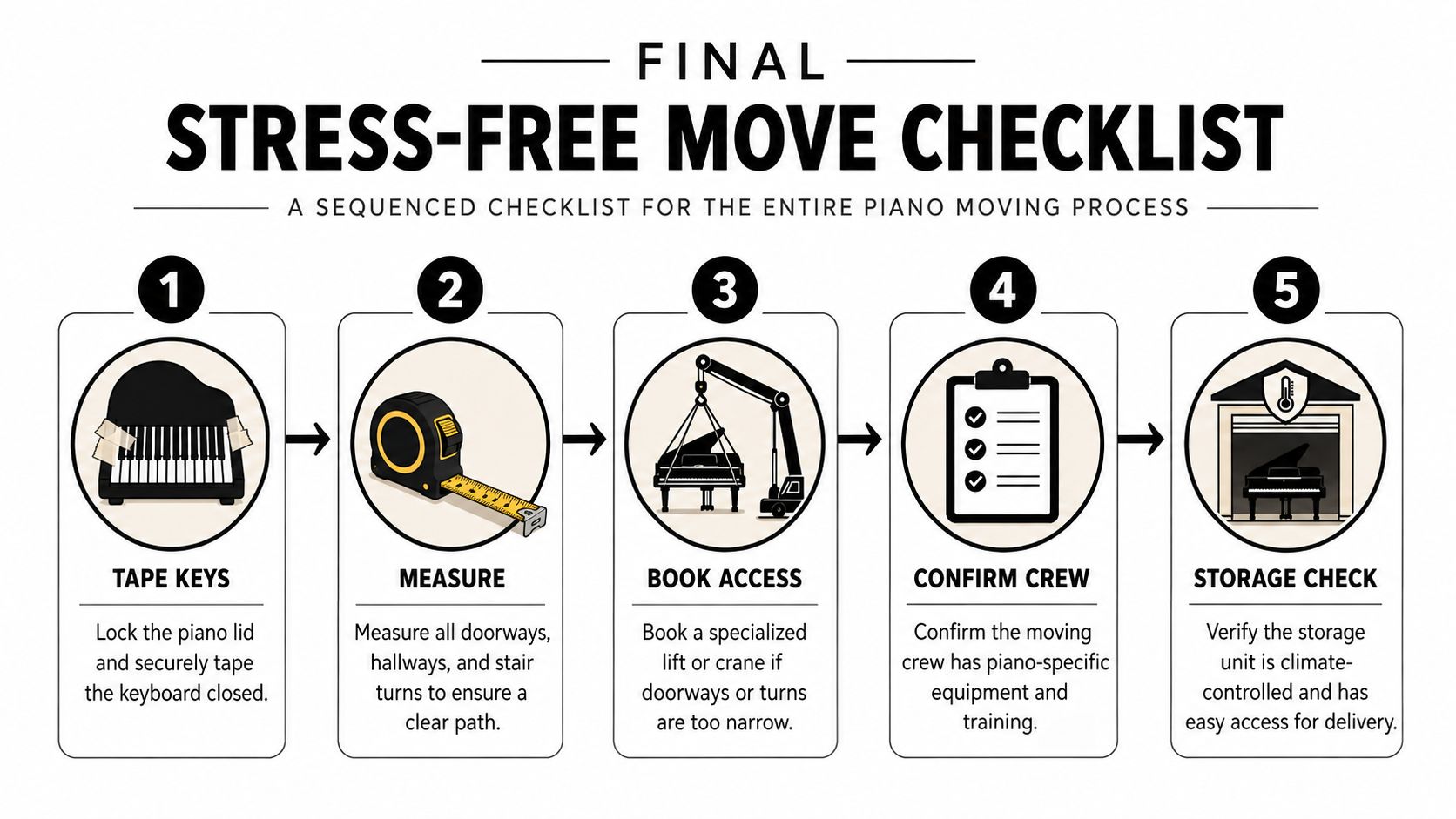
The three Melbourne checkpoints that catch the most failures are simple: apartment access booked in writing, the storage unit racked off the concrete floor, and insurance certificates exchanged between the removalist and storage provider. The order of operations, not any single strap or blanket, is what gets a 300 kg instrument from a Brunswick terrace to a Bayswater storage unit without a cracked soundboard, damaged banister or voided insurance claim.
Get n Go Removals Melbourne can coordinate piano removal, apartment lift bookings, specialist equipment, transit protection and short- or long-term storage across Melbourne and Victoria. Visit Get n Go Removals Melbourne to arrange an access assessment and a practical removal-and-storage plan before moving day.