Australia’s Interstate Moving Cost Uncovered

So, what's the real cost of moving interstate? It's the million-dollar question, isn't it? For a typical three-bedroom home in Australia, you're generally looking at a range between $2,600 and $5,850. The final figure on your quote really boils down to two main things: how much stuff you have and how far you're moving it.

Decoding Your Interstate Moving Cost Estimate
A white moving truck is parked on a residential street in front of a house with moving boxes on a pallet, indicating a relocation.

Planning a move across state lines can feel like a bit of a maze, especially when you're trying to nail down a budget. That final price tag on a moving quote can seem like it's pulled out of thin air, but there's a real method to the madness. Once you understand the core parts of the calculation, you're in a much better position to make smart choices and even find a few ways to save some cash.

Think of your moving quote less as a single, scary number and more as a breakdown of all the work, logistics, and muscle needed for your specific journey. At the heart of it all are the two biggest players: the volume of your goods (measured in cubic metres) and the distance of the move.

Estimated Interstate Moving Costs at a Glance

To give you a clearer picture, here's a quick look at some average costs. Keep in mind these are just estimates, but they provide a handy baseline for what to expect.

Household Size Short Distance (e.g. SYD-MEL) Long Distance (e.g. BNE-PER)
1 Bedroom/Studio $1,500 – $2,800 $2,500 – $4,500
2-3 Bedroom Home $2,600 – $4,500 $4,000 – $6,500
4+ Bedroom Home $4,000 – $7,000+ $6,000 – $10,000+

As you can see, the jump in price between a shorter hop and a cross-country trek is significant, and it only gets bigger the more you have to move.

Why Volume and Distance Matter Most

Every single thing in your home, from the big comfy sofa to that box of old university textbooks, takes up precious space in a truck. Professional removalists need to calculate this total volume to figure out what size truck is needed and how much labour the job will require. It's a critical part of the equation.

Distance is the other side of the coin. A run from Sydney to Melbourne is a relatively straight shot down the Hume. But a move from Brisbane all the way over to Perth? That's a whole different beast. Longer distances mean more fuel, more hours on the road for the crew, and more complex logistics, all of which naturally add to the cost.

Beyond the Basics: What Else to Consider

While the amount of stuff and the distance are the heavy hitters, a few other things can nudge your quote up or down. It’s good to be aware of these from the get-go.

  • Extra Services: Need a hand with the packing and unpacking? Or maybe you need to store your things for a few weeks between places? These are fantastic, time-saving add-ons that will adjust your total cost.
  • Specialty Items: Moving a piano, a pool table, or that priceless piece of art isn't a standard job. These items need special equipment and handling, which comes with an extra charge to ensure they arrive safely.
  • Vehicle Transport: If you're not keen on driving your car across the country, you'll need to factor in vehicle transport. This will be a separate but important line item in your overall moving budget. For a closer look at what's involved, this guide to understanding car transport cost is a great resource.

Getting a handle on these core components is the first step to truly understanding your quote. If you want to dive even deeper, our guide on decoding the cost of movers breaks it down even further.

The Four Key Drivers of Your Moving Quote

Think of your final moving quote not as a single price, but as a recipe with four main ingredients. Each one plays a crucial role in determining your total interstate moving cost, and understanding them puts you in the driver's seat of your budget. When you know what removalists are looking at, you can make smarter decisions about how you plan everything.

Let's break down these four key drivers: the distance of your journey, the volume of your belongings, the timing of your move, and the level of service you choose.

1. Distance: The Further You Go, The More It Costs

This is the most straightforward factor. Just as a long-haul flight from Sydney to Perth costs significantly more than a quick trip to Melbourne, a longer move costs more. It all comes down to simple logistics and resources.

Longer distances mean:

  • More Fuel: A truck travelling from Brisbane to Perth will burn through far more fuel than one heading from Melbourne to Adelaide.
  • More Time: The journey itself takes longer, which means paying for drivers' time, potential overnight stays, and other costs that rack up on the road.
  • Increased Wear and Tear: Covering thousands of kilometres puts more strain on the truck, and this maintenance cost is naturally factored into the price.

Essentially, every kilometre added to your move adds a small but steady cost to your final bill.

2. Volume: How Much Space Do You Need?

After distance, the sheer volume of your belongings is the next biggest influence on your quote. In the removals industry, space is money. Your goods are measured in cubic metres (m³), which is the total three-dimensional space they occupy inside the truck.

Imagine you're trying to fit everything into a set of packing boxes. The more boxes you need, the larger the truck required and the more work it takes to load and unload. That's exactly how removalists see it. A one-bedroom apartment might only take up 10-15 m³, while a four-bedroom family home could easily top 40-50 m³.

Accurately estimating your volume is your single best tool for controlling costs. The less you move, the less you pay—it's that simple. Decluttering before you even ask for a quote can lead to some serious savings.

This is also why getting an in-home or detailed video survey is so important. A professional can properly assess your volume, making sure you get a precise quote and the right-sized truck for the job.

3. Timing: When You Move Matters

Booking your move is a lot like buying airline tickets for a holiday. If you try to fly at Christmas, you're going to pay a premium. The very same principle applies to moving.

The "peak season" for moving in Australia is typically during the summer months (December and January), lining up with school holidays and the festive season. Demand skyrockets during this period, and as you'd expect, prices rise to match.

On the flip side, moving during the "off-season" like winter, or mid-week and mid-month, can often unlock better pricing. Removalists have more availability and may offer more competitive rates to fill their schedules. If you have some flexibility, scheduling your move for a Tuesday in July instead of a Saturday in January could save you hundreds.

4. Service Level: From Basic to All-Inclusive

Finally, your interstate moving cost is shaped by how much of the work you want the professionals to handle. You can choose a service level that fits your budget and energy levels, ranging from a no-frills approach to a completely hands-off experience.

Here’s a look at the typical spectrum:

  • Basic Service (You Pack, We Drive): This is your most budget-friendly option. You're responsible for packing all your boxes and getting your furniture ready. The removalists simply load the truck, transport your things, and unload them at your new home.
  • Partial Packing Service: This is a popular middle ground where you pack most items but leave the tricky or fragile things—like kitchenware, artwork, or electronics—to the professionals. It gives you peace of mind for your most delicate possessions without the cost of a full pack.
  • Full-Service (White Glove): This is the premium, stress-free option. A team arrives and handles absolutely everything: packing every single item in your home, disassembling furniture, loading, transporting, unloading, reassembling furniture, and even unpacking boxes in their designated rooms.

Choosing the right service level is all about balancing convenience with cost. While a full-service move is more expensive, it can save you dozens of hours of work and a whole lot of stress. Deciding on the best approach often comes down to finding the right company, so it helps to understand how to choose the best interstate removalists to match what you're looking for.

How Moving Costs Vary Between Major Cities

It’s a common question we get: why does moving cost so much more between certain cities? The simple answer is that not all interstate moves are created equal. The logistics involved in shifting your life from Sydney to Melbourne are worlds apart from relocating from Brisbane to Perth, and the interstate moving cost will absolutely reflect that.

Think of it like this: Australia's major cities are dots on a map, and the routes between them are the transport lines. Some are popular, high-traffic expressways, while others are long, winding backroads. Your final quote depends heavily on which of these paths you're taking.

Popular Routes and Their Price Points

Shorter, well-trodden routes between the eastern capitals are usually the most budget-friendly. The path between Sydney and Melbourne, for example, is one of the busiest in the country. This means more trucks are making the trip, which creates more competition and keeps prices down. We actually dive deeper into this specific journey in our guide on removals from Sydney to Melbourne.

On the flip side, a cross-country move is a whole different ball game. Any journey that involves crossing the Nullarbor Plain is a massive undertaking for a removalist team. That kind of trek means a huge increase in fuel, driver hours, and overall operational costs—all of which gets factored into your quote.

The main cost drivers for any city-to-city move really boil down to a few key things.
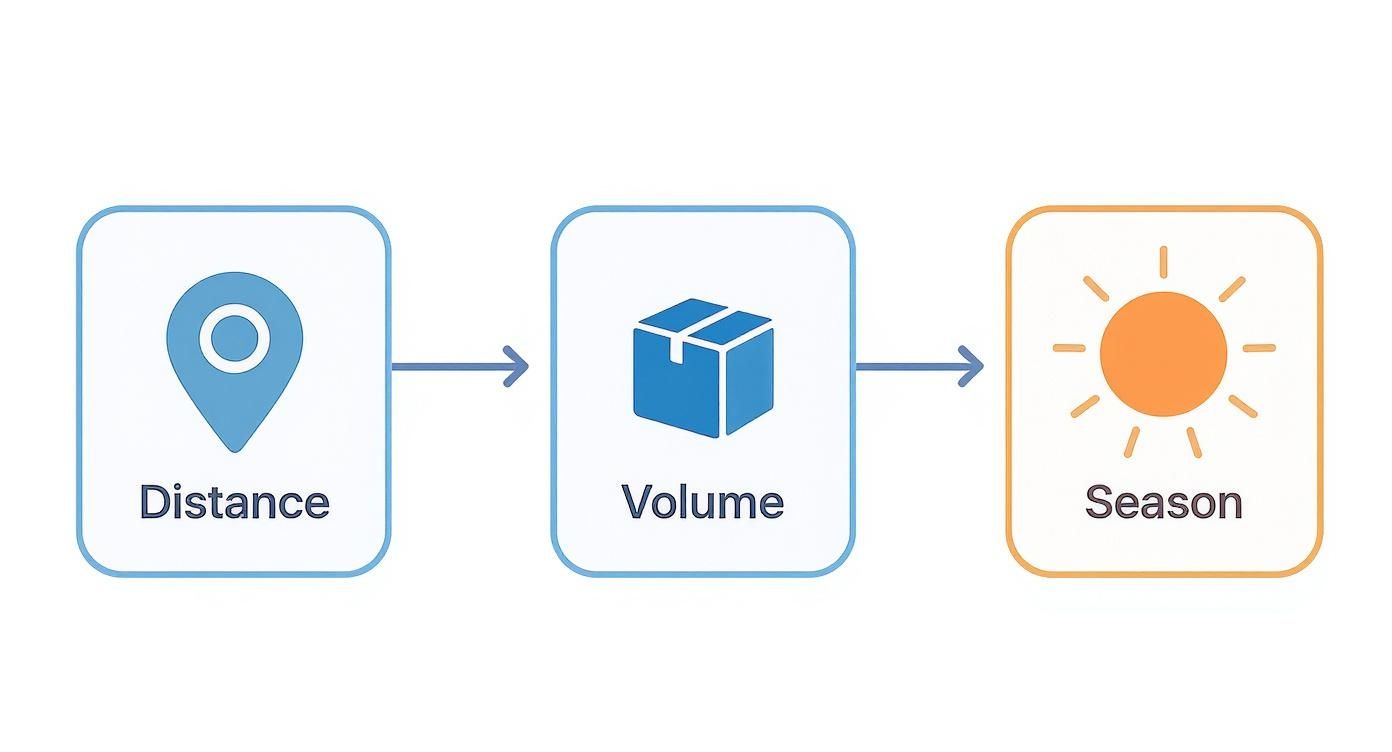
A flowchart illustrating three factors: Distance (location pin), Volume (box), and Season (sun icon).

As you can see, the distance, the amount of stuff you have, and even the time of year all come together to determine your final price. This is exactly why the quotes for different city pairings can look so different.

Comparing Costs Across Australia

Let's put some real numbers to this to give you a clearer picture. The price difference between various city routes can be pretty dramatic.

Moving a standard home from Brisbane all the way over to Perth, for instance, can set you back anywhere from $7,000 to over $12,000. But, if you move that same household from Brisbane to Adelaide—a much shorter trip—you're looking at a cost closer to the $3,500 – $5,500 mark.

Meanwhile, those popular east coast routes like Sydney to Brisbane are often around $2,800 to $4,800, and the Melbourne to Sydney run can be even more affordable.

Key Takeaway: The further you go and the more complex the journey, the higher the cost. Moves along the east coast are generally easier on the wallet than those heading to or from Western Australia or the Northern Territory.

To make budgeting a bit easier, we’ve put together a table showing typical costs for moving a 3-bedroom home between some of Australia's most common routes.

Typical Interstate Moving Costs by Australian City Route

Moving Route Average Distance (km) Estimated Cost Range (AUD)
Melbourne to Sydney 880 km $2,400 – $4,200
Sydney to Brisbane 920 km $2,800 – $4,800
Melbourne to Brisbane 1,670 km $3,500 – $5,500
Adelaide to Sydney 1,400 km $3,800 – $6,000
Brisbane to Perth 4,300 km $7,000 – $12,000+
Sydney to Perth 3,950 km $6,500 – $11,000+

These figures really highlight just how much your start and end points matter. Getting a handle on these regional price differences is the first step to building a realistic budget for your move. When you know what to expect for your specific route, you can plan much more effectively and avoid any nasty financial surprises come moving day.

Unpacking the Hidden Costs of Moving

The first quote you get from a removalist is a fantastic starting point, but it's rarely the final figure. Think of it as the tip of the iceberg. To create a realistic budget for your interstate moving cost, you need to account for all the little extras that can pop up along the way.

These "hidden" costs aren't about removalists being sneaky; they're for services and situations that fall outside a standard, straightforward move. Getting a handle on these potential add-ons before you book is the secret to avoiding a budget blowout. It puts you in the driver's seat, allowing you to ask the right questions and plan for the real cost, not just the base price.

Let's pull back the curtain on the most common extra charges you're likely to see.

Common Add-Ons and Surcharges

Many of the services that make a move genuinely hassle-free are considered optional extras. The key is to decide which ones you really need and factor them into your budget from day one.

Here’s a quick checklist of services that will almost always add to your final bill:

  • Professional Packing Services: If the thought of boxing up your entire life gives you a headache, professional packers are a godsend. This can be anything from just packing your fragile kitchenware to a full "white glove" service where they handle absolutely everything.
  • Packing Materials: Unless you’ve been hoarding boxes for months, you’ll need to pay for them. The cost of boxes, tape, bubble wrap, and packing paper will appear as a separate line item on your invoice.
  • Specialty Item Transport: Got a grand piano, a slate pool table, or a priceless piece of art? These aren't your average items. They require special gear, extra muscle, and a lot more care, which means they come with a separate, higher price tag to get them moved safely.
  • Short-Term Storage: Is there a gap between your move-out and move-in dates? It’s a common scenario. You’ll probably need to store your belongings for a few days or weeks, and that comes at a cost. If you're exploring this, it’s a good idea to know how much you can expect self-storage to cost as you plan.

Navigating Access and Insurance Fees

Beyond the optional services, certain logistical hurdles and essential protections can also bump up your total cost. These are often non-negotiable fees tied to the specific circumstances of your pickup or delivery locations.

One of the most frequent surprises is a difficult access fee. If the moving truck can't park right near your front door, or if the crew has to deal with multiple flights of stairs, long hallways, or a tiny lift, it means more time and labour. This is usually billed as an hourly surcharge or a flat fee.

Transit insurance is another big one. While basic liability might be included in your quote, it often provides only minimal coverage. For an interstate move, you really want comprehensive transit insurance. It covers the full replacement value of your goods and is a non-negotiable investment for the peace of mind it buys you.

Finally, don't forget the costs of leaving your old place behind. Landlords can be particular, and being aware of common security deposit deductions — especially around end-of-lease cleaning — will help you budget for every single part of your move.

Questions to Ask Your Removalist

To make sure your quote is as close to the final price as possible, you need to go in armed with the right questions. Being proactive is the single best way to sniff out any potential hidden costs.

Before you sign on the dotted line, make sure you ask:

  1. Is this quote a fixed price, or could it change on moving day?
  2. What specific situations would trigger a "difficult access" fee?
  3. Are packing materials included in the price, or is that charged separately?
  4. What level of insurance is included, and what are my options to upgrade to full coverage?
  5. Are there any other potential surcharges I should know about, like for fuel, travel time, or waiting periods?

Getting clear answers to these questions upfront helps you build a truly realistic budget. It ensures your interstate move is as financially smooth as it is physically.

Actionable Strategies to Lower Your Moving Bill

Person planning a move, reviewing documents and costs with moving boxes nearby.

Knowing what drives your interstate moving cost is one thing, but actually getting that final bill down is where the real magic happens. The good news is, you have more control over the price than you probably think.

With a few clever strategies, you can make a serious dent in your moving expenses. It's not about cutting corners or sacrificing quality; it’s about moving smarter. Let's walk through the most effective ways to make your move more affordable without adding to the stress.

Unleash the Declutter Dividend

This one is simple: the less stuff you move, the less you pay. Every single item you decide to leave behind shaves money off your bill by reducing the total volume (measured in cubic metres) of your shipment. Think of it as your "declutter dividend"—a direct cash saving for every box you don't bring.

Kick off your decluttering mission at least 4-6 weeks before moving day. This gives you plenty of time to be ruthless. Go through your home room by room and sort everything into three piles: keep, donate/sell, and toss.

  • Sell: Use platforms like Facebook Marketplace or Gumtree to find new homes for good-quality furniture and electronics. That cash can go straight into your moving budget.
  • Donate: Local charities will gladly take clothes, books, and household goods that are still in great nick.
  • Toss: Be honest about what's broken, expired, or just won't be used again, and dispose of it responsibly.

By slashing your total volume, you not only lower the base cost of the move but might even avoid needing a larger, more expensive truck. It’s the single most powerful cost-saving move you can make.

Master the Art of Strategic Scheduling

Just like booking a flight, when you move has a huge impact on what you'll pay. The removals industry has clear peak and off-peak seasons, and if you have some wiggle room in your schedule, you can unlock some serious savings.

The busiest time for movers in Australia is during the summer months (December-January), as well as over school holidays and on weekends. Demand skyrockets, and so do the prices.

If you can, aim for the off-season to get the best deals. You'll find things are much more affordable if you schedule your move for:

  • Mid-week: A Tuesday or Wednesday move is almost always cheaper than a Friday or Saturday.
  • Mid-month: The start and end of the month are hectic with lease turnovers. Aim for the middle two weeks instead.
  • Winter: Things quieten down from May to August, which means removalists are more competitive with their pricing.

Booking your move during these quieter times can trim a very noticeable amount off your interstate moving cost.

Demystify Backloading for Big Savings

Ever heard of backloading? It’s one of the industry's best-kept secrets for a cheap interstate move. Put simply, backloading is like carpooling for your belongings.

Picture this: a removals truck finishes a job from Melbourne to Sydney. Instead of driving all the way back empty, the company offers that space to someone else at a huge discount.

This is a win-win. The removalist has already covered their main running costs for the trip, so they can offer you a fantastic rate. The only trade-off is a bit of flexibility—you’ll need to work with their existing schedule since your items are sharing the ride. If your dates aren't set in stone, always ask your removalist if a backloading spot is available for your route.

Know Which DIY Tasks Save the Most

While hiring professional removalists is the best way to ensure a smooth, stress-free move, taking on a few tasks yourself can definitely help the budget. The trick is to be strategic about which jobs you tackle.

Here are the DIY tasks that give you the most bang for your buck:

  • Source Your Own Packing Materials: Don't buy everything brand new. You can get free boxes from local supermarkets, bottle shops, or community groups online.
  • Pack Your Own Stuff: A full packing service is a major expense. You can save hundreds by packing non-fragile items like clothes, books, and linen yourself.
  • Disassemble Your Furniture: If you're handy with a screwdriver, taking apart beds, tables, and other flat-pack items saves the movers a ton of time, which can lower your labour costs.

By focusing your DIY efforts here, you can make a real difference to your final bill. For more great ideas, check out these extra tips to keep your moving costs down and make sure you’re getting the best possible value.

Your Moving Cost Questions, Answered

As your moving day gets closer, it's totally normal to have a few last-minute questions pop into your head. Getting clear on the finer details is the best way to make sure your interstate moving cost stays on budget and the whole experience is as stress-free as possible.

To wrap things up, we've pulled together some of the most common questions we hear from people just like you. Here are some straight, no-nonsense answers to give you the confidence you need to lock in your move.

How Far in Advance Should I Book Interstate Removalists?

This is a big one, and getting the timing right can make a huge difference. Leave it too late, and you risk facing higher prices or discovering that all the good removalists are already booked out.

As a general rule, try to book 4-6 weeks in advance. This gives you a good window to lock in your preferred date and gives the moving company plenty of time to sort out their logistics without rushing.

But, if you're eyeing a move during the peak season—think December to January or over the school holidays—you need to get in much earlier. For these crazy-busy times, aim to book 8-12 weeks ahead. Not only will you secure your spot, but you'll often lock in a better rate before the prices jump due to high demand.

Is It Cheaper to Move Myself Interstate?

On the surface, going the DIY route looks like a great way to save a few bucks. You rent a truck, rope in a few mates, and get it done, right? In reality, it’s rarely that simple or that cheap.

Once you start tallying up all the hidden costs, the price difference between DIY and hiring pros starts to shrink pretty quickly. You have to factor in:

  • Truck Rental: That's just the starting price, before you even think about petrol.
  • Fuel: A big truck heading across the country drinks an enormous amount of fuel. The cost adds up fast.
  • Accommodation: Unless you plan on driving for 24 hours straight, you’ll need to pay for motels along the way.
  • Insurance: You'll have to organise separate insurance for both the rental truck and all your belongings.
  • Your Time and Effort: This is the biggest one people forget. Are you ready for the back-breaking labour and the days you'll need to take off work?

For a long-haul interstate move, professional removalists are almost always the more cost-effective—and definitely less stressful—option. They save you from the huge physical effort and the logistical nightmare of trying to coordinate a cross-country move all by yourself.

What Is Backloading and How Does It Save Money?

Backloading is a clever industry trick for cutting down your interstate moving cost, but not many people know about it. Essentially, you're buying up the empty space on a removalist truck that's already heading back home after finishing another job.

Think of it like carpooling for your furniture. The truck is already making the trip, so the company can sell you that empty space at a hefty discount. It's a win-win: they don't have to drive an empty truck, and you get a fantastic price.

The only catch with backloading is flexibility. Your move has to fit into the removalist's pre-existing schedule. So, if your moving dates aren't set in stone, it's an absolutely brilliant way to save a significant amount of money.

What Kind of Insurance Do I Really Need?

This is a critical question, so listen up: never assume that a standard moving quote includes comprehensive insurance for your goods. Most basic liability offered by removalists is very limited and will only cover a tiny fraction of the replacement cost if something goes wrong.

Your first step should be to call your current home and contents insurance provider. Ask them if your policy covers your possessions while they're in transit. Some do, but many don't.

If you’re not covered, you should seriously consider getting comprehensive transit insurance. This policy covers the full replacement value of your items against accidental loss or damage during the move. It’s a small extra cost that buys you priceless peace of mind when everything you own is on the back of a truck.


Ready to get a clear, transparent quote for your interstate move? The experienced team at Get n Go Removals Melbourne is here to make your relocation smooth and affordable. Contact us today for a detailed estimate with no hidden surprises. Find out more at https://www.getngoremovals.com.au.
READ MORE

Storage Rates Melbourne: An Expert Guide to 2024 Pricing

When you start exploring storage rates in Melbourne, the costs can vary significantly, typically ranging from $90 to over $500 per month. This wide spectrum is primarily determined by the size of the unit you need and any specialised features it includes.

To put it into perspective, a compact locker ideal for a few boxes might cost you less than $100 monthly. However, if your goal is to store the entire contents of a three-bedroom family home, you should budget for something closer to $450 or more. Understanding these figures is the first step toward finding the perfect balance between cost and convenience.

Understanding Typical Storage Rates in Melbourne

Decoding storage prices in Melbourne requires a clear understanding of what you’re paying for. While unit size is the most significant cost driver, factors such as location and premium features like climate control also play a crucial role in shaping the final monthly fee.

Whether you're moving house and need temporary storage for furniture, or you're a business owner managing inventory, grasping the typical price brackets is essential for securing a solution that fits your budget and operational needs.

A long row of beige self-storage units with tan roller doors, an asphalt drive, and green grass.

The Melbourne self-storage market is experiencing high demand, which naturally supports firm pricing. A recent market analysis pegged the average storage fee at approximately AUD 388 per square metre per year. Even more telling is the fact that revenue per available metre (RevPAM) grew by 3.2% over just six months, highlighting the dynamic and active nature of the current market.

A Snapshot of Melbourne Storage Costs

To provide a clear and actionable overview, we've compiled a quick guide to what you can expect to pay for the most common self-storage unit sizes in Melbourne. This table is designed to help you accurately budget for your personal or business storage requirements.

For a more in-depth exploration of all available options, we recommend reviewing our comprehensive guide to storage solutions in Melbourne.

Estimated Monthly Self-Storage Rates in Melbourne

This table breaks down the typical monthly price ranges for common self-storage unit sizes in Melbourne, serving as a practical reference for anyone needing personal or small business storage.

Unit Size (Approx.) Suitable For Estimated Monthly Rate (AUD)
Small (1.5m x 3m) Boxes, small furniture, contents of a studio apartment $90 – $180
Medium (3m x 3m) Contents of a one or two-bedroom apartment $180 – $320
Large (3m x 6m) Furnishings from a three-bedroom family home $320 – $480
Extra Large (3m x 9m) Contents of a four-bedroom home or business inventory $450 – $600+

These figures offer an excellent starting point, but remember that prices can fluctuate based on several other key factors, which we will explore next.

Key Factors That Drive Your Storage Costs

To accurately forecast your final storage bill, it's crucial to understand what truly influences the price. The advertised rate is rarely the full story, as several key variables can significantly adjust the monthly cost up or down.

By breaking down these cost drivers, you can make more informed choices that align with both your budget and your specific needs. It all begins with the most obvious factor, but the subsequent details are where the real opportunities for savings lie.

Unit Size and Location

The most significant factor determining your base rate is, without a doubt, the unit size. As demonstrated in the price table, a large unit capable of holding the contents of a three-bedroom house will naturally cost more than a small locker for just a few boxes. It's a simple principle: you pay for the space you occupy.

Location is the next major influencer. A storage facility situated in a prime area like South Melbourne or Richmond will invariably have higher rates due to premium real estate costs and greater convenience. Conversely, facilities located in the outer suburbs often provide much more competitive pricing for the same amount of space. For those looking to save, the short drive can translate into substantial long-term savings.

To better understand these price dynamics, it's helpful to consider the perspective of a facility owner. Factors such as property costs, operational expenses, and market demand, as outlined in guides on the economics of starting a self-storage business, play a massive role in the final price you pay.

Rental Duration and Access Needs

The length of time you plan to store your items also has a significant impact on the total cost. Most storage providers offer better rates for longer commitments.

  • Short-Term Rentals: A month-to-month arrangement provides maximum flexibility but almost always comes at the highest standard rate.
  • Long-Term Agreements: Committing to a 6 or 12-month rental can often unlock attractive discounts, sometimes reducing the monthly bill by 15% or more.

Furthermore, the type of access you require can affect the price. While most facilities offer standard business-hour access, some provide 24/7 access for an additional fee. This premium is typically for those who need to retrieve items outside of the usual 9-to-5, such as a business owner managing inventory after hours.

Premium Features and Amenities

Finally, any special features or amenities will contribute to your monthly bill. The most common premium feature is climate control, which maintains a stable temperature and humidity level. This is essential for protecting sensitive items like wooden furniture, electronics, artwork, and important documents from Melbourne’s fluctuating weather. Expect this feature to add 20-30% to the standard unit price.

Other features, such as enhanced security measures, drive-up access for easy loading, or inclusive insurance coverage, are also factored into the final storage rate. When you're in the midst of a move, bundling services can be a highly effective strategy. Our integrated approach to furniture removal and storage in Melbourne helps streamline the entire process, ensuring both your move and storage are handled with professional care.

Personal Self-Storage vs Business Warehousing Rates

When it comes to storage, the needs of a family moving house are fundamentally different from those of an e-commerce business managing its inventory. Consequently, their pricing models are worlds apart. Understanding the distinction between personal self-storage and commercial warehousing is the first step toward finding a solution that fits your budget and meets your specific requirements.

For individuals and families, personal self-storage is defined by simplicity and flexibility. You'll typically find a straightforward month-to-month payment structure, which is perfect for temporary needs like a house move or a major decluttering project. Many facilities also offer introductory promotions, such as the first month free or a discount, to attract new customers.

This model is designed for easy access and convenience. You rent a private, secure unit and can access it as needed. The storage rates in Melbourne are generally transparent, making it simple to budget for each month.

The Business-Focused Warehousing Model

In contrast, commercial warehousing is engineered for business operations, and its pricing structure is more complex. Instead of renting a single unit, businesses are usually leasing much larger spaces or paying based on the actual volume of goods being stored.

The primary difference lies in the unit of measurement. Personal storage is priced per unit, whereas warehousing often operates on a per-pallet price or charges by the square metre. It is designed to integrate seamlessly into a broader supply chain.

For example, a business might pay a fixed rate for each pallet of stock it holds per week or month. This allows their storage costs to scale dynamically with inventory levels—a variable cost that aligns with the natural ebbs and flows of business.

Analysing Long-Term Commercial Leases

Long-term leases are standard in the commercial sector. These agreements, which can span a year or more, provide businesses with the operational stability they need. This is where Melbourne’s industrial storage rates become particularly relevant.

The main factors driving storage costs apply to both personal and commercial scenarios, as illustrated below.

Infographic illustrates three key storage cost factors: volume, location, and temperature control.

This demonstrates how factors like size, location, and premium features are universal cost drivers, even if the final price structure differs greatly between a self-storage unit and a full-scale warehouse.

Recent data shows that warehouse and industrial storage rates in Melbourne have remained relatively stable. The national median for pallet storage is approximately AUD 4.53 per pallet per week. For leasing, industrial rates in Greater Melbourne typically fall between AUD 200 to 500 per square metre annually. This level of consistency is invaluable for businesses attempting to budget for their long-term logistics. For a more detailed analysis, you can consult a market report on Melbourne's 3PL and warehousing rate trends.

To help you see the differences at a glance, here’s a quick breakdown of the two main storage types.

Storage Type and Rate Comparison

Feature Personal Self-Storage Commercial Warehouse Storage
Typical User Individuals, families, small businesses E-commerce, logistics, larger businesses
Pricing Model Per unit, per month Per pallet, per square metre, or volume-based
Lease Term Flexible, month-to-month Long-term leases (1+ years are common)
Common Use Moving house, decluttering, storing personal items Inventory management, order fulfillment, distribution
Access Frequent, often 24/7 access to a private unit Scheduled access, often integrated with logistics services
Services Basic security, trolleys, packing supplies for sale Forklift services, inventory tracking, pick-and-pack
Cost Structure Simple, fixed monthly rate More complex, often includes service fees and variable costs

Ultimately, the right choice depends entirely on your specific use case. A homeowner requires the simple, accessible model of personal self-storage, while a growing business will derive far more value from the scalable, integrated services offered by commercial warehousing.

Choosing the Right Storage Unit Size to Avoid Overpaying

One of the most common ways to inflate your storage bill is by selecting the wrong unit size. Many people overestimate the space they need, leading them to pay for empty air month after month. The goal is to find a unit that perfectly accommodates your belongings, ensuring you don’t waste a single dollar on unused space.

Getting this right isn't about guesswork; it's about smart planning. By taking a moment to catalogue what you're storing and familiarising yourself with common unit dimensions, you can accurately determine your needs and control your costs from the outset.

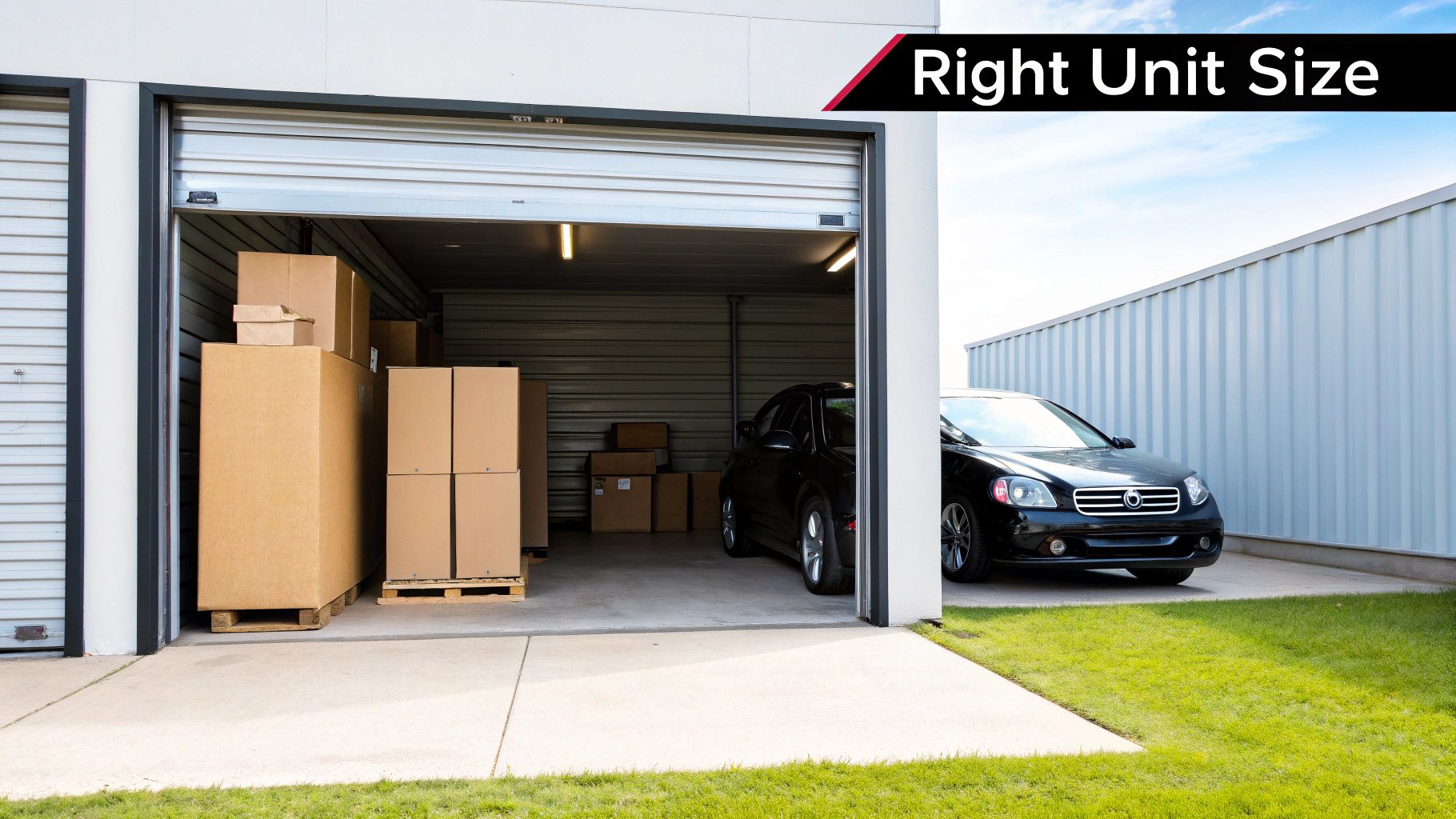
Open self-storage unit with stacked cardboard boxes and a black car, highlighting unit size options.

This simple step ensures the storage rates Melbourne facilities offer align with what you actually require, saving you from unnecessary expenses before you even lock the door.

Visualising Common Storage Unit Sizes

To make an informed decision, it's helpful to visualise what can realistically fit into standard storage units. Instead of just thinking in metres, try comparing them to familiar spaces in your home.

  • Small Unit (e.g., 1.5m x 3m): This is roughly the size of a large walk-in wardrobe. It’s perfect for storing seasonal items, numerous boxes, small furniture like a desk or chest of drawers, or the contents of a studio apartment.
  • Medium Unit (e.g., 3m x 3m): Think of this as the size of an average bedroom. It can comfortably hold the furniture from a one or two-bedroom apartment, including larger items like a queen-sized bed, sofa, and a dining set.
  • Large Unit (e.g., 3m x 6m): This is comparable in size to a standard single-car garage. It’s the ideal choice for storing the contents of a two or three-bedroom house, including major appliances, multiple large furniture sets, and dozens of boxes.

A critical mistake is underestimating the vertical space available. Most storage units have high ceilings, allowing you to stack boxes and arrange furniture strategically to maximise capacity.

How to Accurately Estimate Your Needs

The most effective way to avoid paying for excess space is to create a quick inventory before you begin your search for a unit. Simply listing all your larger items—sofas, beds, tables, whitegoods—is an excellent starting point.

Once you have your list, you can be more precise. For a highly accurate calculation of the total volume your belongings will occupy, use a tool like our handy cubic metre calculator to get a reliable estimate. This removes the guesswork and points you directly to the most cost-effective unit size for your needs.

Finally, remember that strategic packing makes a significant difference. By dismantling furniture like bed frames and tables, you can substantially reduce the required floor space. Using uniformly sized boxes also allows for safe and stable stacking, ensuring you make the most of every square metre you're paying for.

Actionable Tips for Reducing Your Storage Expenses

Securing the most competitive storage rates Melbourne has to offer is much simpler when you know a few industry strategies. With a smart approach, you can significantly reduce your monthly costs without compromising on the quality or security you need. These practical steps will help you find an excellent unit that fits your budget.

Optimise Your Space and Possessions

One of the easiest ways to save money is to simply store fewer items. Before you start packing, dedicate time to thoroughly sort through your belongings. This is the perfect opportunity to sell, donate, or discard items you no longer use, which directly reduces the storage volume you require. For practical advice to get you started, check out this guide on how to declutter before you move.

Once you've decided what to keep, the next step is to pack efficiently. Disassemble bulky furniture like bed frames and dining tables to make them as flat as possible. Using sturdy, uniformly sized boxes is a game-changer, as it allows you to stack them securely to the ceiling, maximising every inch of vertical space. You might find this strategy allows you to rent a smaller, and therefore cheaper, unit.

Choose Your Location and Timing Wisely

The location of your storage facility has a massive impact on the price. Unsurprisingly, facilities in prime, inner-city locations will always cost more due to high real estate values. If you're willing to consider options in suburbs a short drive from the city centre, you can often find much lower rates for the exact same size unit.

When you rent can also lead to significant savings. The moving industry has its peak seasons, typically during summer and school holidays. If your timeline is flexible, try to book your storage unit during the off-season, such as winter. Demand is lower then, and facilities are often more willing to offer promotions to fill their units.

For businesses, this logic can be applied on a larger scale. When storing inventory, exploring broader supply chain cost reduction strategies can help you identify ways to minimise stock levels, which in turn lowers your overall storage costs.

Lock in Long-Term Deals and Promotions

Never underestimate the value of commitment and special offers. Many storage companies provide significant discounts to customers willing to sign a longer-term lease. Pre-paying for six or twelve months upfront can often reduce your monthly rate by 15-20%.

Finally, always be on the lookout for move-in promotions. It’s common for facilities to offer deals like "first month free" or "50% off for three months" to attract new customers. These introductory offers can provide substantial upfront savings, making the initial cost much more manageable. By combining a few of these tips, you'll be in a great position to secure a fantastic rate.

Understanding Rates for Specialised Storage Solutions

Sometimes, a standard storage unit just isn't sufficient. For items that require specialised care, Melbourne's storage market offers a range of tailored solutions. These are premium options designed for belongings that need specific environmental conditions or enhanced security, and they naturally come with a higher price tag. Understanding these costs is key to properly protecting your most valuable assets.

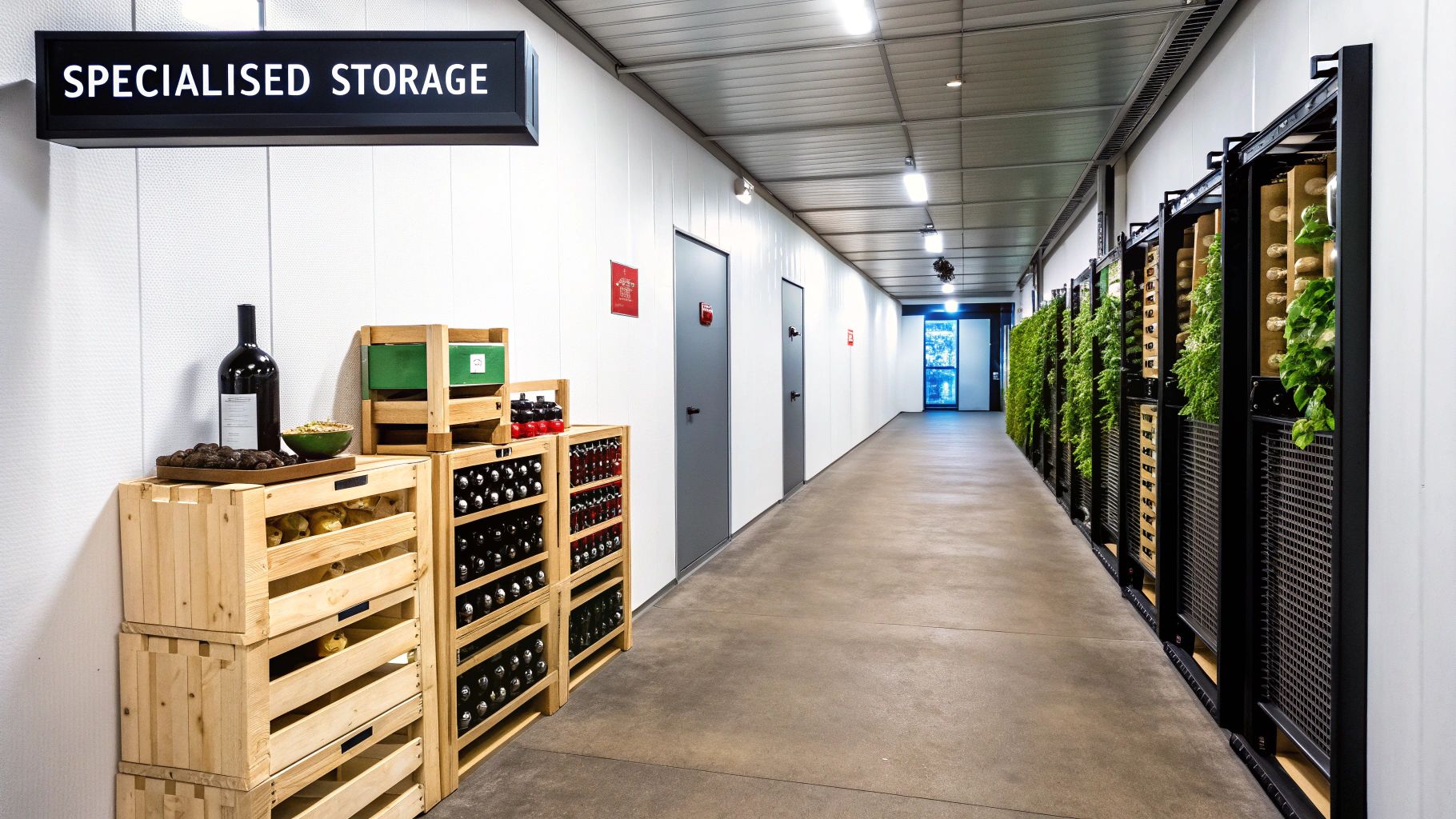
Inside a specialized storage facility showing wine, truffles, and a vibrant vertical garden.

The most common specialised option is climate-controlled storage. These units maintain a consistent temperature and humidity, which is vital for preserving delicate items like fine art, antiques, wine collections, and sensitive electronics, especially given Melbourne's unpredictable weather. You can expect to pay approximately 20-30% more for a climate-controlled unit compared to a standard one of the same size. Consider this extra cost an insurance policy against warping, mould, and rust.

High-Security and Business-Focused Storage

Beyond climate control, you'll find high-security storage facilities. These locations offer advanced surveillance, individual unit alarms, and stringent access controls, making them perfect for storing high-value collections or critical business documents. The price for this level of security varies depending on the specific measures in place.

For businesses, specialised storage can become highly technical, such as data centres. Melbourne’s data centre storage market is a significant component of Australia's storage industry, known for efficient designs that leverage renewable energy and cool ambient temperatures for over 1,800 hours of free air cooling annually. This Victorian market segment is projected to reach USD 820 million by 2030, highlighting its importance. You can explore the Australian data centre storage market and its growth on mordorintelligence.com for more details.

Ultimately, when considering specialised storage, the higher rate is a direct reflection of the advanced protection you receive. It’s a wise investment to safeguard assets that are difficult, or even impossible, to replace.

Frequently Asked Questions About Melbourne Storage

When researching storage options, numerous questions can arise, particularly regarding costs and contract details. To help you make an informed decision with confidence, we've compiled answers to the most common queries about storage in Melbourne.

Clarifying these details upfront ensures there are no unwelcome surprises down the line.

Is It Cheaper to Book Storage Online or in Person?

Booking your storage unit online is almost always the more cost-effective option. Storage facilities frequently run web-only promotions and offer better rates on their websites that are not available to walk-in customers. It's a smart strategy to compare online prices before visiting a facility in person.

Do I Need to Pay a Security Deposit?

This varies from one facility to another. Many modern storage providers in Melbourne have eliminated security deposits. However, some may still require a small, refundable deposit, while others might charge a one-time administration fee upon signing the agreement.

Always request a full breakdown of all initial costs before signing any contract. A reputable provider will be completely transparent about every potential fee—including deposits, insurance, and lock purchases—so you know exactly what you’re paying for from day one.

Are There Hidden Fees I Should Be Aware Of?

It is crucial to inquire about any potential extra charges beyond the monthly rent. Common "hidden" fees can include mandatory insurance coverage, the requirement to purchase a specific type of lock from the facility, late payment penalties, and even cleaning fees if the unit is not left in pristine condition.

Can I Get a Discount for Long-Term Storage?

Yes, absolutely. Most storage facilities in Melbourne are happy to offer attractive discounts for longer-term rental commitments. If you can pre-pay for six or twelve months, you can often secure the best possible monthly rate, saving a significant amount of money over time.

For more general queries, our comprehensive list of frequently asked questions provides even more insights.


Planning a move and need a seamless storage solution? Get n Go Removals Melbourne integrates secure, affordable storage with our expert removalist services, giving you a single point of contact for a stress-free experience. Visit us at https://www.getngoremovals.com.au to get a transparent quote today.

READ MORE

Decoding Interstate Moving Costs in Australia

Embarking on a move to another state is a massive step, and getting a handle on the costs involved is the first hurdle. So, how much are you looking at? In Australia, the average interstate moving costs typically land somewhere between $1,400 and $5,000. The final figure truly hinges on the volume of your belongings and the distance of your journey.

For a clearer picture, moving a standard three-bedroom house usually costs between $3,625 to $5,075 for a traditional, dedicated removalist service.

A Snapshot Of Your Moving Budget

Trying to budget for an interstate move can feel like assembling a complex puzzle. Nailing down the costs early on is the most critical piece, helping you make informed decisions and avoid last-minute financial stress. The price isn't a single flat figure; it’s a composite of various factors, from the volume of your goods to the specific moving service you select.

To give you a clearer idea, let's break down the numbers. While a standard move for a three-bedroom home (around 25-35 cubic metres) sits in the $3,625 to $5,075 range, there are more strategic ways to relocate. Opting for a flexible service like backloading can dramatically slash that cost, bringing it down to between $2,375 and $3,325. This represents a significant saving and highlights why understanding your options is paramount.

For those who appreciate the details, current industry rates place standard moves at approximately $176.78 per cubic metre. In contrast, backloading can start from as low as $95 per cubic metre, as highlighted in a comprehensive analysis of Australian moving costs on bestratedtransport.com.au.

Comparing Standard Moves And Backloading

So, what’s the real difference between these services? A standard move is akin to chartering a private jet—you secure the entire truck for your exclusive use, with a fixed, predictable schedule. It's built for convenience. Backloading, on the other hand, is more like a ride-share for your belongings; you share truck space with other customers' items, which significantly reduces the cost. The trade-off is a need for more flexibility with your delivery window.

Our team of expert long distance movers can guide you through which option best aligns with your timeline and budget.

To simplify this further, let's examine a quick table that breaks down the potential costs.

Estimated Interstate Moving Costs At A Glance

This table provides a rough guide to what you might expect to pay when moving between major Australian cities. It compares the prices for a standard, dedicated removalist service against the more budget-friendly backloading option.

Home Size (Bedrooms) Average Volume (Cubic Metres) Estimated Standard Cost Range Estimated Backloading Cost Range
1-Bedroom Home 5-10 m³ $1,400 – $2,500 $750 – $1,500
2-Bedroom Home 15-20 m³ $2,500 – $3,800 $1,500 – $2,500
3-Bedroom Home 25-35 m³ $3,625 – $5,075 $2,375 – $3,325
4+ Bedroom Home 40+ m³ $5,000 – $8,000+ $3,500 – $5,500+

As you can see, the savings with backloading become even more significant as the size of your home increases. It's a fantastic option if you have some flexibility in your moving schedule.

Here's how it plays out for different home sizes:

  • 1-Bedroom Home (5-10 m³): A smaller move like this is practically designed for backloading. You can easily save hundreds of dollars.
  • 2-Bedroom Home (15-20 m³): This is often the sweet spot. It’s well worth getting quotes for both standard and backloading services to compare the value proposition.
  • 3-Bedroom Home (25-35 m³): As we've seen, the savings can exceed a thousand dollars if you choose the right service.
  • 4+ Bedroom Home (40+ m³): For large family homes, the price gap between a standard move and backloading is massive, making it a seriously attractive way to reduce expenses.

What Actually Determines Your Moving Bill?

Have you ever looked at a moving quote and wondered how the final number was calculated? It’s not an arbitrary figure. Your total interstate moving costs are determined by a combination of key factors. Think of it as a formula with four main variables: the volume of your belongings, the distance of the move, the accessibility of your properties, and the timing of your relocation.

Understanding these elements allows you to see precisely what you’re paying for. It transforms the large, mysterious number on the quote into a clear, itemised breakdown, empowering you to plan more effectively and potentially reduce costs. Let’s delve into the components that make up your moving bill.

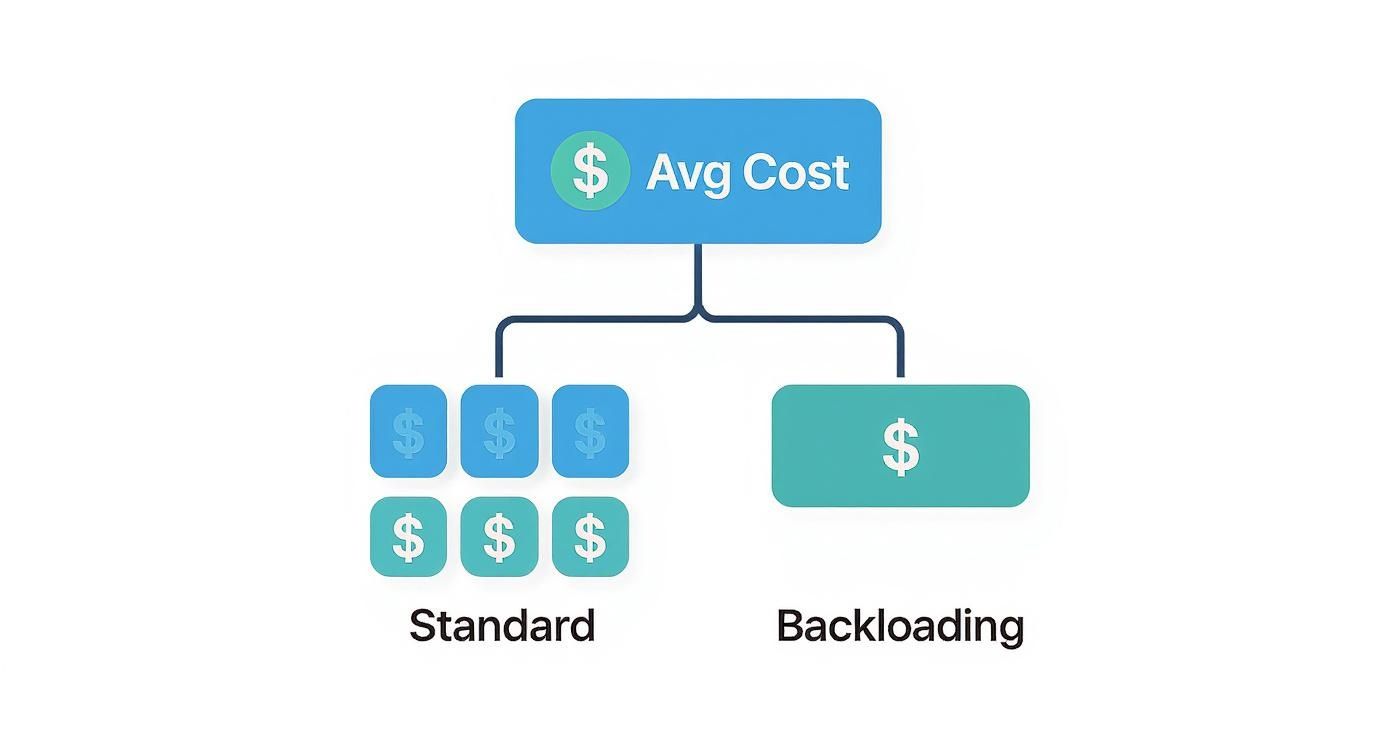
The flowchart below provides a quick visual comparison of the two primary pricing models for interstate moves, illustrating the difference between a standard dedicated service and a backloading option.

Flowchart showing average cost split between standard and backloading payment models.

As you can see, while a standard move provides a dedicated truck, backloading can be a much more economical choice because you are sharing the transport space and associated costs.

Volume: The Foundation Of Your Quote

The single most significant factor driving your moving bill is volume. In simple terms, this is the total space all your belongings occupy in the truck, measured in cubic metres (m³). The more items you have, the higher the price. It's not just about the quantity of things, but their overall size. A couple of large, bulky sofas can easily take up more room than dozens of small boxes.

Professional removalists are experts at estimating volume. They will typically request a detailed inventory of your items or conduct a virtual or in-person walk-through of your home to calculate this figure accurately. This is precisely why a thorough declutter before you request a quote is one of the most effective ways to lower your interstate moving costs. Less stuff means less space, which translates directly to less money.

Distance: The Long Haul Factor

It’s self-evident that the distance of your move plays a massive role in the final cost. A relocation from Sydney to Brisbane presents a completely different logistical challenge than a cross-country journey from Sydney to Perth. Longer distances mean more fuel consumption, more hours on the road for the crew, and consequently, higher labour costs.

Distance also influences factors like fuel levies, which can add up substantially on long-haul routes. Consider the 2024 figures: a standard move from Perth to Sydney is approximately $5,412, but this can drop to around $3,000 with a backloading service. Similarly, a Perth to Melbourne move might be $5,614 for a standard service, with a backloading price of $2,873. Fuel levies can account for about 20% of the cost for trips over 80 kilometres, and toll fees might add another $15 to $50.

Key Takeaway: The further the truck has to travel, the more you should expect to pay. This isn't just about fuel; it covers vehicle wear and tear and the wages for the team's transit time.

Accessibility: How Easy Is The Job?

Accessibility refers to how easy—or difficult—it is for the removalists to transport your belongings from your house to the truck and vice versa at the destination. This is one of the hidden factors that can add unexpected charges to your bill if not disclosed upfront.

Consider the potential hurdles at both your origin and destination properties:

  • Stairs: Are you living on the third floor of an apartment building with no lift? Each flight of stairs adds extra labour and time.
  • Parking: Can the moving truck park directly outside your front door? If the crew has to carry everything over a significant distance (known as a "long carry"), this adds to the labour time and cost.
  • Lifts: Does your building require a specific lift booking? Any delays or restricted access can disrupt the schedule and increase the cost.
  • Narrow Streets: If a large truck cannot get close due to tight street access, a smaller shuttle vehicle may be required, which is an additional expense.

Being transparent about these details from the outset allows the moving company to provide a much more accurate quote. For a deeper dive into how these factors affect pricing, please see our guide on understanding moving company costs.

Timing: When You Choose To Move

Finally, when you move can make a significant difference to the price. Much like the travel industry, the removalist business has distinct peak and off-peak seasons.

  • Peak Season (Higher Cost): Summer, school holidays, and the end of the month are invariably the busiest periods. Demand is at its peak, so prices increase accordingly.
  • Off-Peak Season (Lower Cost): Moving in autumn or winter, mid-month, and during the middle of the week is almost always more affordable. Companies have more availability and may offer better rates to fill their schedules.

If your schedule allows for flexibility, planning your move for an off-peak period is a simple yet highly effective way to reduce your final bill.

Reading Between The Lines Of Your Quote

Receiving a moving quote can sometimes feel like trying to decipher a complex code. You see various line items, industry jargon, and a final total at the bottom. While that total commands your attention, the real key to avoiding a budget blowout on moving day is understanding how the removalist arrived at that number. It’s about looking beyond the basic transport fee to grasp the full story of your interstate moving costs.

This is where you can take genuine control of your budget. When you know what to look for, you can identify potential extra charges before they arise and ask the right questions to ensure your quote is truly all-inclusive. Let’s pull back the curtain on the common add-ons and hidden fees that can inflate your final invoice.

Common Add-On Services And Their Costs

Most removalists offer a menu of optional services designed to make your move less stressful. These are conveniences that come with a price tag, and it is entirely your decision whether they are a worthwhile investment for your circumstances.

  • Professional Packing: If the thought of wrapping every plate and boxing up your entire life is causing you stress, this service is a lifesaver. Professional packers can complete the job in a fraction of the time, but it will add to the cost, typically between $300 and over $1,500, depending on the size of your home.

  • Packing Materials: Even if you pack yourself, you will still need boxes, tape, and protective wrap. You can certainly source these yourself, but purchasing them directly from your removalist is often more convenient, though usually slightly more expensive. Budget anywhere from $100 to $400+ for a complete set of materials.

  • Furniture Disassembly and Reassembly: That complex flat-pack wardrobe or king-sized bed frame may need to be dismantled to fit through the door. Removalists are proficient at this, but it will be listed as a separate charge on your quote. This can add $75 to $300 to your bill, based on the complexity of the furniture.

  • Temporary Storage: Is there a gap between leaving your old residence and gaining access to the new one? You’ll need a place to store your belongings. Many movers offer this service, with prices depending on the volume of your goods and the duration of storage required.

It is always best to be clear about which of these services you require from the outset. Adding them on at the last minute is almost always more expensive.

Shining A Light On Hidden Fees

Even more frustrating than optional extras are the surprise charges that can appear on your final invoice. These "hidden" fees are not usually malicious; they often arise from access issues or delays that were not factored into the original quote.

A truly transparent quote should account for all foreseeable challenges. The best way to avoid surprises is to provide your removalist with every detail about both your pickup and delivery locations.

Here are the most common culprits to watch for:

  • Stair Carry Fee: If your apartment is on the third floor and there is no lift, you can expect an additional charge. This fee covers the extra time and physical effort required from the crew.
  • Long Carry Fee: This fee applies when the moving truck cannot park directly outside your front door. If the team has to carry everything beyond a certain distance (e.g., 15-20 metres), a fee is usually added to cover the extra labour.
  • Shuttle Service Fee: If you live on a narrow street or in an area where a large moving truck cannot fit, a smaller "shuttle" truck may be needed to transport your goods from the main truck to your door. This can be a significant additional cost.
  • Waiting Time or Delay Fee: If you are not ready when the movers arrive, or if the settlement on your new home is delayed, you could be charged an hourly rate for the crew's downtime.

The best way to get a firm quote and avoid these issues is to provide a detailed inventory of your belongings. For an excellent tool to assist with this, you can calculate the volume of your items with our handy cubic metre calculator. This helps ensure you are not paying for truck space you do not need. By being upfront about any potential obstacles, you provide the removalist with all the information necessary to offer a fixed price you can rely on.

Proven Strategies To Reduce Your Moving Costs

Understanding the factors that influence your moving quote is one thing, but actively taking steps to lower that final number is where you can make a real impact. With a few strategic moves, you can significantly reduce your interstate moving costs without turning your relocation into a stressful ordeal. It’s all about being savvy and knowing where your efforts will yield the greatest financial benefit.

Consider this section your strategic plan for a more affordable move. We will explore practical, proven tips—from the substantial savings of backloading to simple actions like decluttering and sourcing free boxes. Each strategy is straightforward and designed to put you in control of your budget.

A person signs a clipboard next to a moving truck loaded with cardboard boxes, with text 'Save on Moving'.

Embrace The Power Of Backloading

If there is one secret weapon for slashing your moving bill, it is backloading. Imagine it as a carpool for your furniture. When a moving truck completes a job and needs to return to its home base, it often travels empty. Backloading allows you to book that empty space for your belongings, meaning you only pay for one leg of the journey, not the round trip.

This simple concept can lead to enormous savings, often reducing your transport bill by up to 50% compared to booking a dedicated truck. The only consideration is that you may need to be more flexible with your delivery dates. However, for most people, the money saved far outweighs this.

Declutter Before You Do Anything Else

Every single box, piece of furniture, and decorative item you move adds to the total volume of your load. Since volume is a primary driver of your final price, the logic is simple: the less you move, the less you pay. Before you even request a quote, be ruthless with decluttering.

Go through each room and sort everything into three categories: keep, donate/sell, and discard. This not only reduces the amount you need to transport but selling unwanted items can also generate some extra cash. It simply doesn't make financial sense to pay to move something you no longer need or want.

By eliminating just 10% of your belongings, you could save hundreds of dollars on your final moving bill. It’s the most direct way to control the primary cost factor of your move.

Master The Art Of DIY Packing

While hiring professionals to pack for you is incredibly convenient, that convenience comes at a significant cost. If you are budget-conscious, rolling up your sleeves and packing yourself is a guaranteed way to save a substantial amount of money.

Start several weeks before the move and tackle it one room at a time. It certainly requires effort, but the savings can easily amount to several hundred dollars or even more, depending on the size of your home. For extra guidance, check out these tips to keep your moving costs down to make your DIY packing even more efficient.

Source Your Packing Materials For Free

The cost of new boxes, tape, and bubble wrap can accumulate quickly. With a little forward planning, however, you can find most of what you need without spending a cent.

  • Local Businesses: Supermarkets, liquor stores, and large retail outlets often have stacks of sturdy cardboard boxes they are happy to give away. Simply ask a manager for the best time to collect them.
  • Online Marketplaces: Check websites like Facebook Marketplace or Gumtree. You will often find people who have just moved and are eager to dispose of their perfectly good boxes.
  • Creative Padding: Use what you already own! Towels, blankets, sheets, and even clothing are perfect for wrapping fragile items, which means you won't need to purchase rolls of bubble wrap.

When you're trying to trim the budget, it's also worth looking into whether you can find a cheap interstate courier service to handle a few smaller or single items separately.

Choose Your Moving Date Wisely

When it comes to moving, timing is everything. The removals industry has its own peak and off-peak seasons, and the date you choose can have a massive impact on your quote.

To secure the best possible rates, try to book your move during the off-season, which is generally from February to September. Avoid school holidays and the end of the month, as this is when demand (and prices) skyrockets. If you have the flexibility, aim for a weekday move—particularly from Tuesday to Thursday—as weekends are always the most expensive.

To make it even clearer, here’s a quick checklist to help you identify where the savings are.

Your Cost-Saving Checklist For An Interstate Move

Action Item Standard Approach (Higher Cost) Money-Saving Alternative Potential Savings
Transport Booking a dedicated moving truck for your exclusive use. Using a backloading service to share truck space. Up to 50% on transport costs.
Volume Moving everything you own, including unwanted items. Decluttering and selling/donating items before getting a quote. $100s – $1,000s, depending on volume.
Packing Paying for a full professional packing service. Packing all boxes and items yourself. $300 – $1,000+
Materials Buying brand-new boxes, tape, and bubble wrap from a supplier. Sourcing free boxes and using household linens for padding. $100 – $300+
Timing Moving on a weekend, during school holidays, or at month's end. Booking a mid-week move during the off-peak season (Feb-Sep). 15-30% on the total moving cost.

A little bit of planning really does go a long way. By implementing even a few of these strategies, you can make your interstate move significantly more affordable without adding extra stress.

Navigating The Australian Removalist Industry

Choosing a company for your interstate move can feel like an overwhelming task. You are not just booking a truck; you are entrusting your entire household of possessions to a team of people. To make the right decision, it helps to understand the Australian removalist industry itself. It is a large, competitive market, which is beneficial for finding a good price but also means you must be vigilant to avoid unreliable operators.

When you understand the business side of things, you become a more discerning customer. It puts the figures on your quote into context, helping you recognise why some prices are fair and why others are likely too good to be true. This insight allows you to evaluate companies based on their professionalism and value, not just the final dollar amount.

The Scale Of The Moving Market

The Australian moving industry is a significant contributor to the national economy. It has experienced substantial growth and is now valued at approximately $2 billion annually as of 2025. The majority of this revenue comes from long-distance and interstate moves, which generate $786.2 million—a substantial 42.6% of all revenue.

With roughly 14,000 companies competing for business, the market is described as "highly fragmented." This simply means there is a vast number of different movers, which explains the wide variation in prices and service quality you will encounter. For a deeper look at these trends, the ABS has some great data on interstate migration patterns.

This fierce competition is a double-edged sword. While it encourages companies to offer competitive deals, it can also create a "race to the bottom" where some operators cut corners on safety, training, and equipment to provide an unbelievably low quote.

The sheer number of movers means that thorough research is non-negotiable. A cheap price might be tempting, but it could end up costing you dearly in terms of reliability, professionalism, and the safety of your belongings.

Understanding The Costs Behind The Quote

So, what are you actually paying for when you receive a quote? While fuel and truck maintenance are significant expenses, the single largest cost for any moving company is labour. Of the industry's $2 billion annual revenue, a staggering $1.2 billion is allocated to wages.

This highlights why professional movers charge what they do. You are paying for the skill, physical labour, and time of a properly trained crew. Reputable companies invest in their people—through proper training, background checks, and fair wages—and this is always reflected in their pricing.

When weighing your options, consider what a fair price actually secures for you:

  • A well-maintained fleet of trucks that are unlikely to break down mid-journey.
  • Experienced, full-time staff who know how to handle your furniture and precious items with care.
  • Comprehensive insurance coverage, such as public liability and transit insurance, to protect you if something goes wrong.
  • Professional equipment, from trolleys and protective blankets to straps that keep everything secure.

Understanding these operational costs helps you view a quote not just as a number, but as a reflection of the quality and security you are receiving for your money. For guidance on identifying the best in the business, our article on the best interstate removalists in Australia offers valuable tips to help you find a truly trustworthy partner for your move.

Your Final Interstate Moving Checklist

Let's consolidate everything into a practical action plan. Think of this checklist as your roadmap for a calm, affordable, and organised interstate move. We’ve broken it down by timeline, transforming a massive undertaking into a series of simple, manageable steps.

Following this will minimise stress and keep your interstate moving costs under control, ensuring there are no unpleasant surprises.

8 Weeks Before Your Move

The focus now is on planning and research. The work you do at this stage will save you significant stress later. This is where you lay the foundation for a smooth relocation.

  • Build Your Moving Budget: Outline every potential cost. Go beyond the removalist fee—include packing supplies, travel expenses, and even the takeaway meals for your first night.
  • Shop Around for Removalists: Begin getting quotes from at least three different companies. Don't just look at the price; compare their insurance policies, services offered, and online customer reviews.
  • Start the Big Cull: This is the perfect time to go through every room and declutter ruthlessly. Create piles for keeping, selling, donating, and discarding. Fewer items mean a cheaper move.

4 Weeks Before Your Move

With one month to go, things are becoming more tangible. This is the time to finalise your decisions and begin the hands-on preparation. Staying organised is your best strategy.

Pro Tip: This is the ideal time to arrange insurance. You need to ensure your belongings are covered from door to door. Review your current policies or look into specific moving insurance. For a detailed overview, this guide on Home Insurance Personal Property Coverage is an excellent resource.

  • Book Your Removalist: Have you found the right company? Lock them in. Get your moving dates confirmed and ensure you have everything in writing—every service, every cost, every detail.
  • Gather Your Supplies: It's time to assemble your packing toolkit. Stock up on boxes, packing tape, bubble wrap, and high-quality markers.
  • Pack the Non-Essentials: Begin with items you won't need for the next few weeks, such as books, out-of-season clothing, spare linens, and decorative objects.
  • Handle the Life Admin: Start notifying relevant parties of your move. Arrange for utilities to be connected at the new address and disconnected at the old one. Update your address with your bank and subscriptions, and set up mail forwarding.

1 Week Before Your Move

It’s the final countdown. This week is about double-checking details and packing the remaining items. Completing these tasks now will ensure moving day runs as smoothly as possible.

  • Check In with Your Removalist: Give them a quick call to confirm their arrival time and review any access details, like tricky parking or stairwells.
  • Finish Packing: Box up everything else. Prepare an "essentials box" with everything you'll need on the first night: toiletries, phone chargers, medications, a kettle, coffee, and basic kitchen supplies.
  • Prep Your Appliances: Defrost the fridge and freezer (don't leave this until the last minute!). Disconnect the washing machine and ensure it's fully drained.
  • Secure Important Documents: Gather all crucial paperwork—passports, birth certificates, moving contracts—and keep them with you in a safe, easily accessible place.

On Moving Day

The big day is here. Your primary role is to direct the process and ensure the plan comes together. Be available to answer questions and guide the movers.

  • Protect Your Floors: Before any boxes are moved, lay down old sheets, cardboard, or protective coverings to prevent scuffs on your carpets and floors.
  • Supervise the Loading: Remain present while the truck is being loaded. You can point out fragile boxes and answer any questions the crew may have.
  • Do One Last Lap: Once the truck is full, walk through your empty home one final time. Check every cupboard, corner, and the garage to ensure nothing has been left behind.
  • Sign Off on the Paperwork: Before the truck departs, carefully review the inventory list (bill of lading) and sign it. This document is your official record of what is on board.

Frequently Asked Questions

When you are planning a major move, questions are bound to arise. To help you feel completely prepared, here are some direct answers to the most common queries we receive about interstate moving costs.

Is It Cheaper To Move My Own Furniture Interstate?

At first glance, a DIY move might seem more economical, but hidden costs can quickly add up. You must account for truck rental, fuel for a very long journey, packing materials, potential accommodation, and the value of your own time and physical effort. It's a significant undertaking.

For long distances across Australia, hiring a professional is often the more financially prudent and far less stressful option. Services like backloading can be surprisingly affordable, removing the complex logistics from your plate so you don't have to manage everything yourself.

How Can I Get The Most Accurate Moving Quote?

The secret to obtaining an accurate quote is simple: provide comprehensive details. A precise inventory list is your most valuable tool. List every piece of furniture, estimate the number of boxes, and be sure to highlight any particularly large, heavy, or fragile items.

It is also crucial to be upfront about any access challenges at both your origin and destination properties. Are there flights of stairs? A long driveway? Is parking difficult? Mentioning these factors from the outset prevents unexpected charges. A pro tip: offering a video call walkthrough with the removalist is an excellent way to ensure your quote is solid.

What Is The Best Time Of Year To Move Interstate?

If your schedule has some flexibility, you can save a significant amount of money. The most affordable time to move is during the off-peak season, which in Australia generally runs from February to September.

To maximise your savings, avoid school holidays and the last few days of the month. This is when demand, and consequently prices, skyrockets. A move booked for the middle of the week and middle of the month will almost always be cheaper than a Friday or weekend slot.

Do I Really Need Moving Insurance?

Absolutely, yes. While professional removalists are extremely careful, the reality is that incidents can occur when your life's possessions are travelling thousands of kilometres. Many people assume their standard home and contents insurance covers their items in transit, but most policies do not.

Any reputable mover will offer transit insurance, which is specifically designed to protect your goods while they are being moved. It is a small price to pay for complete peace of mind, ensuring your valued belongings are properly protected from door to door.


Ready to get a clear, no-nonsense quote for your big move? The team at Get n Go Removals Melbourne has been making interstate relocations smooth and affordable for over a decade. We use our own fleet and our full-time, police-checked staff, so you know your belongings are in the safest hands possible. Plan your stress-free move by visiting us at https://www.getngoremovals.com.au today.

READ MORE

Where Can You Get Moving Boxes? Your Ultimate Sourcing Guide

Sourcing the right moving boxes is a crucial first step for a stress-free relocation. You have several avenues to explore, from purchasing new boxes at major retail chains and specialised packaging suppliers to finding them for free at local businesses in your community.

Whether you decide to buy new for guaranteed quality and uniformity or hunt down used boxes to cut costs, Melbourne offers a wealth of options to get you fully equipped for your move. This guide will walk you through every choice, helping you make the best decision for your budget, timeline, and belongings.

A Comprehensive Guide to Finding the Best Moving Boxes

A stack of moving boxes next to a wooden table with a 'MOVING BOXES GUIDE' sign, documents, and a potted plant.

The task of gathering enough boxes and packing supplies can feel overwhelming, but it doesn't have to be. Knowing where to look is half the battle. This guide will provide a clear roadmap, helping you find the perfect boxes for every single item in your home or office, ensuring everything arrives safely at your new destination.

Understanding Your Options: Buy, Find, or Hire?

Before you begin your search, it's essential to understand your main options. Your final decision will likely be a balance of cost, convenience, and the level of protection your items require.

The Australian market for corrugated boxes is valued at a substantial USD 4.9 billion and continues to grow, driven by the dynamic rental market in major cities. This robust industry means you have an excellent array of choices right at your fingertips.

So, what are your primary choices?

  • Buying new boxes: This is your best bet for acquiring clean, sturdy, and uniformly sized boxes, which are ideal for stable stacking in a moving truck.
  • Finding free boxes: An excellent choice if you're on a tight budget. This requires more effort to find boxes that are in good condition.
  • Using a professional service: Many removalists (like us!) offer high-quality packing materials as part of their comprehensive services, which can be a significant time-saver.

To give you a clearer picture, here's a quick rundown of where you can source your boxes and what to expect from each option.

Quick Guide to Sourcing Moving Boxes

Source Type Typical Cost Best For Key Consideration
Retail Stores (Bunnings, Officeworks) Low to Medium Convenience and a wide variety of sizes for specific needs. Costs can add up quickly if you need a large quantity of boxes.
Packaging Suppliers Low to Medium Buying in bulk and sourcing specialty boxes for fragile items. Often have minimum order quantities, making them better for large moves.
Removalist Companies Included in Service / Medium High-quality, uniform boxes and ultimate convenience. The best value when bundled with a full moving service.
Online Marketplaces (Gumtree, FB) Free to Low Saving money and finding good quality used boxes from recent movers. Quality and availability can be inconsistent and require quick action.
Local Businesses (Supermarkets, Liquor Stores) Free Sourcing basic boxes for non-fragile items like clothes or books. Boxes may be irregular sizes, have branding, or show minor wear.

This table should help you weigh the pros and cons to determine the most effective strategy for your specific move and budget.

Planning Your Box-Hunting Strategy

The most effective approach is often a hybrid one. You could purchase new, specialty boxes for your fragile items, like the television and artwork, while sourcing free, standard-sized boxes from local businesses for durable goods like books, clothes, and linen.

For a deeper dive into organising your move, from sorting your belongings to packing them efficiently, check out this expert guidance on preparing for an out-of-state move.

A successful move begins long before the truck arrives. Taking the time to gather the right packing materials is a critical first step. It ensures your belongings are protected and makes the entire unpacking process significantly easier.

Ultimately, the goal is to equip yourself with the right supplies so you can pack with confidence and minimise stress on moving day.

Where to Buy New Moving Boxes for Maximum Protection

Sometimes, you simply need the reliability of brand-new moving boxes. It eliminates guesswork and guarantees your belongings are safe inside clean, sturdy cardboard that won’t fail under pressure. This is non-negotiable for fragile items, such as your dinnerware, electronics, or other valuable possessions.

Buying new also ensures all your boxes are uniform in size, which makes a world of difference when stacking them securely in the moving truck. You'll find a massive range at major hardware and office supply stores, which are great one-stop shops for grabbing tape, bubble wrap, and markers at the same time.

The most significant advantage of buying new is peace of mind. You know exactly what you’re getting: clean, strong boxes without any prior moisture damage, pests, or structural weak points that could put your possessions at risk.

Top Spots for Quality Packing Supplies

Don't overlook dedicated storage facilities as another excellent source. Their entire business revolves around moving and storing goods, so they often stock professional-grade boxes in various specialised sizes—from wardrobe boxes with metal hanging bars to partitioned boxes designed specifically for glassware.

The demand for high-quality packaging is immense. In Australia, the corrugated paperboard container manufacturing industry was recently valued at around $3.5 billion, driven by a busy rental market and frequent relocations. This strong industry means you can easily find premium boxes at your local hardware store or from packaging specialists. You can learn more about Australia's packaging industry trends to get a sense of the market size.

Estimating Your Box Needs

So, how many boxes do you actually need? A good rule of thumb is to aim for a variety of sizes. For a standard one-bedroom apartment, you'll likely need about 10 small boxes for heavy items like books, 8 medium boxes for general household goods, and 5 large boxes for light, bulky items like pillows and linens.

Of course, if the thought of sourcing boxes and packing everything yourself feels overwhelming, you have other options. Exploring the top benefits of using professional packing services can show you how an expert team can handle the entire process, bringing all the high-quality materials directly to your door.

How to Get Free Moving Boxes in Your Community

Moving on a budget? Scoring free moving boxes is one of the easiest ways to reduce your costs. With a bit of strategic thinking, you can gather all the sturdy, used boxes you'll need without spending a cent. Your local area is filled with opportunities if you know where to look.

Many local businesses receive shipments multiple times a week and are usually happy to offload the empty cardboard. This approach not only saves you money—it’s also an excellent way to recycle and reduce waste.

Tapping Into Local Businesses

Consider the types of shops that receive large, regular stock deliveries. Supermarkets, liquor stores, and major office supply retailers are goldmines for clean, strong boxes. The key is to ask politely and time your visit correctly.

Try visiting on a weekday morning, shortly after they've unpacked their latest shipment. Approach a store manager, explain that you're moving house, and ask if they have any spare boxes. Most are happy to help you clear out what would otherwise go into their recycling bin.

  • Fruit and veggie boxes are surprisingly sturdy and often come with built-in handles, which is a major advantage.
  • Liquor store boxes are highly sought after because they are designed to hold heavy glass bottles, making them perfect for books or other dense items.
  • Copy paper boxes from retailers like Officeworks typically have lids and are incredibly durable for smaller, heavier objects.

Always inspect any used boxes before taking them. Look for signs of moisture, pests, or unpleasant odours to ensure they are safe for your belongings. A clean, dry box is a safe box.

Leveraging Online Community Platforms

Beyond local shops, your digital neighbourhood is another fantastic resource. Online marketplaces are teeming with people who have just moved and are eager to get rid of their mountain of boxes. It's a brilliant way to find high-quality, purpose-built moving boxes that have only been used once.

Look on platforms such as:

  • Facebook Marketplace
  • Gumtree
  • Local community groups (search for "Pay It Forward" or your suburb's name)

People often list their entire moving kit for free—including boxes, packing paper, and bubble wrap. It's worthwhile to set up alerts for "moving boxes" so you get a notification as soon as a new listing appears.

Of course, the fewer items you have to move, the fewer boxes you'll need. To get a head start, check out our guide on how to declutter before you move; it's a simple way to lighten your load.

Ordering Moving Boxes Online for Ultimate Convenience

Let's be realistic—who has time to drive all over town hunting for boxes? Having everything delivered straight to your door is a game-changer, especially when you're already juggling countless other moving tasks. For a truly hassle-free experience, ordering online is the most efficient solution.

Reputable online packaging suppliers have become one-stop shops for everything you need. You can browse, compare, and purchase all your supplies from the comfort of your couch, freeing up valuable time for other priorities.

The Benefits of Online Moving Kits

One of the biggest advantages of shopping online is the availability of curated moving kits. These aren't just random assortments of boxes; they are thoughtfully bundled to suit different-sized homes, from a one-bedroom apartment to a large family house.

Most kits come with a variety of box sizes and all the essentials, like packing tape, bubble wrap, and marker pens. Not only is this often more cost-effective than buying each item separately, but it also removes the guesswork from determining what you actually need. To make the most of your supplies, check out our guide on how to pack for moving—it’s full of expert tips to help you get organised.

Ordering online gives you complete control over your packing timeline. When you know exactly when your supplies will arrive, you can schedule your packing days and stay on track, avoiding that all-too-common last-minute panic.

Choosing a Reputable Online Supplier

With so many options available, it’s crucial to select a reliable seller. The Australian paper and paperboard packaging market is massive—handling 4.63 billion tonnes of material, with corrugated boxes making up over 42% of that volume. This means more choice, but also a greater need to do your research. You can read the full research about Australian packaging trends if you're interested in the market details.

Before you finalise your purchase, check a few key things. Look for suppliers with clear product descriptions, positive customer reviews, and transparent policies.

Here’s a quick checklist of what to look for:

  • Shipping Times: Does the delivery window align with your moving schedule?
  • Return Policies: It’s good to know your options in case you order too many boxes or an item arrives damaged.
  • Box Quality: Look for details on the cardboard grade or ply. You need durable boxes that will hold up during transit.

Choosing the Right Box for Every Item

Using the right type of box for each item is a small detail that can make or break a move. While it sounds obvious, it is surprisingly easy to overlook. Getting this wrong can be the difference between your favourite vase arriving in one piece or opening a box of ceramic fragments.

Think of it this way: you wouldn't use a shoebox to transport your television. The same logic applies to everything you own. Standard moving boxes are great for most everyday items, but your heavier or more delicate belongings require something more robust.

This simple flowchart can help you decide if you need to go beyond a basic box order and invest in a specialised moving kit.

A flowchart demonstrating how to order moving boxes, starting with 'START', followed by a decision 'Do you need supplies?', leading to a 'YES' option.

The key takeaway here is clear: determining the supplies you actually need upfront will save you from potential stress and damage down the line.

Matching Box Type to Your Belongings

For items like fragile kitchenware, heavy electronics, or dense collections of books, heavy-duty, double-walled boxes are your best friend. Their reinforced construction prevents the bottom from giving out mid-lift and provides extra cushioning against the inevitable bumps and jolts of transit.

It’s also crucial to have a good mix of box sizes on hand. Small boxes are perfect for your heaviest items, as they keep the weight manageable and easy to lift. Conversely, large boxes are brilliant for light, bulky things like pillows, linens, and lampshades.

A classic mistake is cramming a large box full of books. Not only does it become dangerously heavy to carry, but the risk of the box splitting open and damaging its contents increases significantly.

To give you a clearer picture, we've put together a quick guide on what box to use for specific items. Think of it as your cheat sheet for a smarter, safer pack.

Moving Box Type and Best Use Guide

Box Type Recommended Contents Weight Limit (Approx.) Pro Tip
Small (Book) Box Books, tools, canned goods, DVDs, heavy ornaments 15-20 kg Keep them heavy but manageable. Easy to stack without crushing the boxes below.
Medium (Standard) Box Kitchen appliances, toys, pots & pans, photo albums 20-25 kg Your all-rounder. Perfect for most household items that aren't overly heavy or bulky.
Large (Linen) Box Bedding, towels, clothing, cushions, lampshades 15-20 kg Ideal for light, puffy items. Avoid overpacking with heavy objects to prevent breakage.
Port-a-Robe Hanging clothes (jackets, dresses, suits) 25-30 kg Your clothes arrive wrinkle-free, which is a lifesaver for quickly setting up your new wardrobe.
Picture/Mirror Box Artwork, mirrors, framed photos, large flat screens Varies Use plenty of bubble wrap and ensure a snug fit to prevent any movement inside the box.

Using this table as a starting point will help you allocate your belongings more efficiently, making both packing and unpacking a smoother process.

Estimating Your Box Needs

To avoid that dreaded last-minute dash for more supplies, it’s wise to create a rough checklist. Walk through your home, room by room, and tally what you'll likely need. As a benchmark, a typical one-bedroom apartment might require around 25 boxes in total, distributed across different sizes.

Here’s a quick way to think about it:

  • Small Boxes: The go-to for books, tools, and pantry items.
  • Medium Boxes: Ideal for kitchen appliances, children's toys, and decorative pieces.
  • Large Boxes: Fill these with bedding, towels, and clothes.
  • Specialty Boxes: Don’t forget these for your mirrors, artwork, and large-screen TV.

Of course, protecting your delicate items involves more than just the box itself. For a detailed walkthrough, our guide on how to pack fragile items for moving is packed with expert techniques to ensure everything arrives in one piece.

A Few Final Questions About Moving Boxes

Even the most organised move can present a few last-minute questions, especially regarding the humble cardboard box. We get asked these all the time, so here are some quick, practical answers to help you get packed and ready with more confidence.

How Many Boxes Do I Actually Need?

Figuring out the exact number of boxes is always an estimation. As a rough starting point, a one-bedroom apartment typically requires about 25 boxes of mixed sizes. Of course, this number can vary significantly depending on your lifestyle—a minimalist might need fewer, while a collector will certainly need more.

For a more tailored estimate, think in categories:

  • Small Boxes: You'll want 6-10 for heavy items like books, tools, and kitchen gadgets.
  • Medium Boxes: Plan for 5-8 for most of your general household goods.
  • Large Boxes: Around 3-5 should suffice for lighter, bulky items like quilts, pillows, and lampshades.

What’s the Best Thing to Do With Boxes After the Move?

Once the last item is unpacked, you'll inevitably be left with a mountain of cardboard. Instead of sending it all to a landfill, there are several excellent, eco-friendly options.

Recycling is the obvious choice, but remember to remove all the packing tape first. Better yet, offer them for free on platforms like Facebook Marketplace or Gumtree. You'd be surprised how many people are looking for free boxes and will happily come and collect them from you.

If you have more questions about the moving process beyond just boxes, our moving FAQs page is filled with extra tips and answers.

Can I Just Use Old Boxes from the Supermarket?

Absolutely, but it pays to be selective. Sourcing free boxes from local shops is a fantastic way to save money, but always inspect them thoroughly before you start packing.

Look out for any signs of moisture, pests, or old food stains. Your best bet is to get boxes from a liquor store—they’re designed to hold heavy glass, so you know they are sturdy and reliable.

After the move, you might find you have other things to dispose of. For a final clean-up, it can be very helpful to know what household items can go in a skip.


Ready to make your move seamless with high-quality packing supplies and professional service? Get n Go Removals provides everything you need, from durable moving boxes to expert packing assistance. Contact us today for a free quote.

READ MORE

Your Ultimate Guide to Finding Movers & Packers Near Me in Australia

Finding trustworthy movers and packers near me typically starts with a quick online search, but it's easy to get overwhelmed by the sheer number of options. The key to a stress-free move is having a solid, well-thought-out plan.

Your strategy should begin with verifying their credentials and ensuring they are fully insured. Next, you need to gather several detailed quotes to truly understand the costs involved. Finally, lock in your booking well in advance. This straightforward approach helps you avoid unreliable operators and paves the way for a seamless moving experience.

Starting Your Search for Local Movers and Packers

Choosing the right removalist is arguably the most critical decision you'll make for your entire move. You aren't just transporting boxes from one location to another; you are entrusting your entire household of possessions to a team of professionals. Investing time in thorough research from the outset will save you significant stress and potential heartache later on.

Instead of defaulting to the first quote or the cheapest price you find, a bit of upfront diligence is crucial. Your initial task is to create a shortlist of potential companies. A great starting point is to look for local movers with a strong reputation within your community. For those in Melbourne, our guide on finding reliable removalists near me is an excellent resource to kickstart your search.

Understanding the Current Moving Landscape

The removalist industry in Australia is in a constant state of flux, influenced by economic shifts and evolving lifestyle preferences. A significant recent trend is the migration of people from major cities to regional areas.

For example, there was a 10.5% increase in people moving from metropolitan hubs to regional Australia between the December 2024 and March 2025 quarters. This isn't just a statistic; it directly impacts your move. It means that movers, particularly those servicing regional routes, may get booked up faster, and pricing could be affected. This is a crucial factor to consider during your planning phase.

Your Initial Vetting Process

Before you request a single quote, a quick background check can effectively filter out companies that aren't worth your time. A professional and reputable moving company will be transparent and have nothing to hide.

Here’s a concise checklist to guide your initial vetting:

  • Professional Online Presence: Do they have a well-designed, professional website? It should feature clear contact details, including a physical address, not just a mobile number.
  • Authentic Customer Reviews: Don't solely rely on testimonials featured on their website. Check independent review platforms like Google or Facebook for genuine, detailed feedback from previous customers.
  • Comprehensive Service Offerings: Scrutinise what they actually provide. Do they offer the specific services you require, such as professional packing, secure short-term storage, or specialised handling for delicate items like pianos or valuable artwork?

This simple, three-step process is the bedrock for finding a mover you can confidently trust.

A three-step process for finding movers: Verify with a shield, Compare with a checklist, and Insure with an umbrella.

Mastering these core steps—verification, comparison, and insurance—is what differentiates a stressful, problematic move from a successful, smooth one.

Decoding Quotes to Avoid Hidden Moving Costs

A person in a denim jacket is using a laptop with 'LOCAL MOVERS' on screen and holding a smartphone.

Receiving a moving quote is one thing; thoroughly understanding it is another. An unusually low estimate might seem like a victory, but it is often a major red flag. Hidden charges have an unpleasant tendency to appear on the final invoice, transforming a great deal into a budgetary disaster.

The first critical detail to clarify is whether you are receiving a binding or non-binding quote. A binding quote is a fixed price—what you are quoted is what you pay, provided you don't add significant extra items to the move. A non-binding quote, conversely, is an estimate. The final cost can fluctuate based on the actual time and resources required for the move.

Spotting Common Hidden Charges

Many initial quotes only cover the basics, leaving ample opportunity for extra fees to be added on moving day. By knowing what to look for, you can ask the right questions from the beginning and ensure your quote is genuinely all-inclusive.

Be vigilant for these common add-ons that can inflate your bill:

  • Stair Fees: You can be charged for each flight of stairs the moving crew has to navigate at either your origin or destination property.
  • Long-Carry Fees: If the moving truck cannot park directly outside your door, you might incur an extra fee for every metre they have to carry your belongings beyond a specified distance (e.g., 20 metres).
  • Heavy Item Surcharges: Large, heavy, or awkward items like pianos, pool tables, or large safes require special equipment and additional labour, which almost always comes with a separate fee.
  • Disassembly/Reassembly: Never assume that dismantling your bed or reassembling your office desk is included in the standard service. It is often billed as an extra charge.

A trustworthy moving company will transparently outline these potential costs in their quote or clearly state what is not included. If an estimate seems ambiguous or too good to be true, it almost certainly is.

For a more in-depth look at budgeting for your move, our guide on the cost of movers provides a clearer picture of what to expect.

A quick review of this table illustrates how service inclusions can vary dramatically.

Comparing Moving Service Inclusions

Service Feature Basic Service (Self-Pack) Full-Service Packing Premium Service (Pack & Unpack)
Truck & Movers ✅ Included ✅ Included ✅ Included
Basic Furniture Protection ✅ Included ✅ Included ✅ Included
Packing Supplies ❌ Not Included ✅ Included ✅ Included
Packing of Boxes ❌ You pack everything ✅ Movers pack all items ✅ Movers pack all items
Furniture Disassembly ⚠️ Often an extra fee ✅ Typically included ✅ Included
Furniture Reassembly ⚠️ Often an extra fee ✅ Typically included ✅ Included
Unpacking Boxes ❌ You unpack everything ❌ You unpack everything ✅ Movers unpack everything
Box & Debris Removal ❌ Your responsibility ❌ Your responsibility ✅ Included

Always confirm precisely what your selected service level covers to avoid any unwelcome surprises on moving day.

The Problem with 'Too-Good-to-Be-True' Pricing

Let’s consider a common scenario. You're searching for "movers & packers near me" and receive two quotes. Company A provides a tempting flat rate of $900. Company B sends a detailed, itemised quote totalling $1,300. The cheaper option seems obvious, right?

But then moving day arrives. Company A adds $150 for the three flights of stairs at your old apartment, another $100 because they had to park down the street, and $150 to reassemble your furniture. Suddenly, your "cheap" $900 move has become a $1,300 reality—the exact same price as the upfront, transparent quote from Company B, but with a significant amount of added stress and frustration.

If you're interested, understanding how moving companies create estimates can provide more insight into what should be included from the start.

The lesson is clear: always insist on a written, itemised quote that meticulously lists every potential charge. It is the only way to compare services accurately and select a mover who prioritises transparency over hidden fees.

How to Vet Removalists for a Stress-Free Move

When you're entrusting a company with all your worldly possessions, a quick glance at star ratings is simply not enough. Properly vetting a potential mover involves a few straightforward checks that can mean the difference between a seamless move and a complete disaster. This process isn't just about finding the cheapest quote; it's about ensuring you hire legitimate, professional, and accountable movers.

First and foremost, let's confirm you are dealing with a legitimate business.

Confirming They Are a Real Business

Any credible removalist in Australia will be a registered business. Do not hesitate to ask for their Australian Business Number (ABN). You can verify it in seconds using the official ABN Lookup service online. This single step confirms they are a genuine, trading company, not just an individual with a van and a Facebook page.

A verifiable physical address is another non-negotiable. If a company only lists a P.O. Box or displays a vague "service area" on its website, proceed with caution. A quick search on Google Maps can be very illuminating. If their listed address is a residential home or an empty lot, that's a significant red flag. A professional operation will have a depot or office where their fleet is based.

It’s also beneficial to understand the current state of the moving industry. Through 2024 and 2025, demand in the Australian moving sector reached a 20-year low, with online searches for removalists dropping by a substantial 22% since 2019. This downturn, linked to the housing crisis, means that while established companies face challenges, it also attracts unscrupulous operators looking to make a quick profit.

Insurance is Non-Negotiable

You should never simply assume a moving company is insured. You must ask for proof of two crucial types of insurance:

  • Public Liability Insurance: This protects you if the movers accidentally damage property, such as gouging a wall in your rental or damaging a common area in an apartment complex.
  • Transit Insurance: This is the most critical one. It specifically covers your belongings while they are in the movers' custody—from the moment they are loaded onto the truck until they are safely delivered to your new home.

A professional mover will have no hesitation in providing you with their Certificates of Currency for both policies. If they become defensive or make excuses, that is your signal to walk away. The risk of using an uninsured mover is simply too high.

For more insights on distinguishing professionals from amateurs, our guide on choosing the right removals firm for your move offers additional useful tips.

Reading Between the Lines of Reviews

Online reviews are an invaluable tool, but you must learn to read them critically. Look for specific details. A review stating, "They showed up on time, wrapped my antique dresser with care, and expertly reassembled my complicated bed frame," provides far more insight than a generic "Great service!"

Pay close attention to how a company responds to negative feedback. A professional, constructive response indicates they value customer feedback and are committed to improvement. A company that engages in arguments with unhappy clients is one to avoid.

Finally, the quality of their equipment and materials speaks volumes. Seeing what kind of packaging supplies recommended by movers can give you an indication of their professional standards. Taking these extra small steps is what ensures your possessions are in genuinely safe hands.

Choosing the Right Packing Service for Your Needs

A service worker inspecting paperwork next to a white van in a residential area.

Let's be honest, packing is easily the most exhausting and time-consuming part of any move. It invariably takes longer than anticipated, and the sheer volume of belongings can feel overwhelming. The good news is, you don't have to face it alone.

When searching for movers and packers, you'll discover that most professional companies offer various levels of packing assistance. It’s all about finding the optimal balance between your budget and the amount of your own time and effort you wish to invest.

Full-Service Packing

This is the ultimate hands-off solution. The moving crew arrives and packs literally everything for you—from the cutlery in your kitchen drawers to the clothes in your wardrobe. They provide all the high-quality materials, such as boxes, tape, bubble wrap, and packing paper, and their expertise ensures everything is handled with professional care.

While it is the premium option, the benefits are immense. You reclaim dozens of hours, significantly reduce the risk of items being damaged due to improper packing, and free yourself up to manage the myriad other tasks associated with moving day. If your budget allows, it's well worth exploring the top benefits of using professional packing services to determine if it’s the right choice for you.

Fragile-Only Packing

Perhaps you're comfortable packing clothes and books, but the thought of wrapping all your glassware and your grandmother's antique mirror fills you with anxiety. This is where fragile-only packing is the perfect compromise.

The professionals come in and handle only the high-risk, delicate items. This typically includes:

  • Kitchenware: China, wine glasses, and delicate serving dishes.
  • Artwork & Mirrors: Custom wrapping and crating for your valuable pieces.
  • Electronics: Large-screen TVs, computers, and other sensitive equipment.

You pack the durable, straightforward items, and they manage the rest. This allows you to save a considerable amount of money while still getting expert protection where it matters most.

This hybrid approach offers a fantastic balance of professional security and cost-effectiveness. It ensures your most precious and breakable items receive the expert attention they require, giving you peace of mind without the full-service price tag.

DIY Packing with Professional Materials

Opting for the full DIY route is the most budget-friendly option, but this is one area where you absolutely must not compromise on the quality of your supplies. Used boxes from the supermarket or old towels are not adequate substitutes for proper moving materials. Your movers can supply you with industry-grade moving boxes, paper, and tape designed specifically for the rigours of relocation.

If you decide to pack yourself, here are a few professional tips:

  • Create an "Essentials Box": This is a lifesaver. Pack one box with everything you'll need for your first 24 hours in the new house: toiletries, medications, a change of clothes, phone chargers, and the kettle with a couple of mugs. Keep this box with you at all times.
  • Label Everything Specifically: Don't just write "Kitchen" on a box. Be precise: "Pots and Pans" or "Glassware – FRAGILE." It is also extremely helpful to label which room the box should go into at the destination. This streamlines the unpacking process immensely.
  • Protect Your Tech: Before unplugging your TV and computer, take a quick photo of the cable configuration on your phone. It will save you a major headache later. If you have the original boxes, use them. If not, wrap electronics securely in blankets and bubble wrap.

Mastering Moving Day Logistics and Coordination

All your meticulous planning culminates in how the final few hours unfold. With the boxes sealed and the truck booked, ensuring moving day itself proceeds without a hitch is what distinguishes a stressful move from a smooth one. A little coordination can transform potential chaos into a well-oiled machine.

On the day, your role is essentially that of a project manager. Begin by giving the moving company a quick call on the morning of the move to confirm the crew's arrival time. It’s a small gesture, but it ensures everyone is aligned from the start.

Getting Your Home Ready for the Crew

Before the removalists even arrive, your first task is to prepare the space so they can work efficiently and safely. This isn’t just about being helpful—it’s about protecting your belongings and preventing any damage to the property.

Think of your home as a temporary worksite. The primary goal is to clear the way for the crew.

  • Create Clear Pathways: Ensure there is an easy, unobstructed path from every room to the front door. Roll up rugs, remove doorstops, and move any small furniture that could pose a trip hazard.
  • Protect Your Surfaces: While good movers will bring their own protective blankets, laying down old sheets or flattened cardboard on high-traffic floor areas can provide extra peace of mind.
  • Set Up a "Do Not Touch" Zone: Have a box of first-night essentials or important documents you plan to transport yourself? Place them all in one designated spot—a spare bathroom is ideal—and affix a clear sign to the door so the crew knows to leave that area untouched.

These simple steps can make a massive difference in the speed and efficiency of the loading process.

You are not there to do the heavy lifting; you are there to direct the operation. Be available to answer questions, point out boxes marked 'fragile', and ensure the team leader understands the plan.

This level of on-the-day organisation is crucial. The removalist industry is a significant component of the Australian economy, and it operates on logistics. In 2025, the industry is projected to generate approximately AUD 2.6 billion in revenue, with long-distance moves being a major contributor. These large-scale operations depend on precision, and your move should be no different. For a deeper analysis, you can read the full research on removalist industry trends.

Your Role During Loading and Unloading

While the crew is loading the truck, remain available but stay out of their direct path. Your main responsibility here is to supervise and communicate with the crew leader, checking items off your inventory list as they are loaded onto the truck.

The final walkthrough is absolutely non-negotiable. Before the truck door is closed, walk through every room, cupboard, and wardrobe in your old home one last time with the moving supervisor. This is your final opportunity to ensure nothing has been left behind.

Upon arrival at your new home, your role reverses. Now you are directing the crew on where each box and piece of furniture should be placed. Providing clear guidance at this stage makes the unpacking process a thousand times easier. This final check confirms that your move is successfully completed.

Answering Your Top Questions About Movers and Packers

Two young men carefully examine a detailed floor plan on the ground, strategizing for a moving day.

Even with the most comprehensive plan, you're likely to have a few questions as moving day approaches. This is completely normal. Gaining clarity on the smaller details is key to feeling confident that everything is under control.

To assist you, we’ve compiled straightforward answers to the questions we frequently hear from people searching for "movers and packers near me". Consider this as a way to fill in any gaps so no small detail is overlooked.

How Far In Advance Should I Book Movers in Australia?

The ideal time to book your removalists is 4-6 weeks before your moving date. This is particularly important if you are moving during a peak period, such as the summer months or school holidays, when demand is highest.

If you are planning a larger, more complex interstate move, allow for an even greater buffer. Aim to book around 8 weeks in advance. This additional time is a game-changer, giving you ample opportunity to calmly gather quotes, research different companies, and secure your preferred date without any last-minute stress.

While some companies may accommodate last-minute bookings, you will likely pay a premium and have far fewer options. A little forward planning is your best strategy for securing a quality crew at a reasonable price.

What's The Difference Between Transit Insurance and My Home Insurance?

This is a critically important distinction that often causes confusion. Transit insurance is a specialised type of cover offered by your moving company. It protects your belongings while they are in the physical care of the movers—this includes during packing, loading, transport, and unloading.

In contrast, your standard home and contents insurance policy typically offers very limited (or no) coverage once your possessions leave your property boundary. It is absolutely essential to review your policy documents to understand exactly what is and isn't covered on moving day.

To ensure your belongings are fully protected against any unforeseen incidents, always investigate the comprehensive transit insurance offered by your removalist. It is a small price to pay for complete peace of mind.

Are There Items Movers and Packers Won't Take?

Yes, absolutely. For crucial safety and legal reasons, professional movers have a list of prohibited items they cannot transport. You will need to make alternative arrangements to move these items yourself.

This list almost always includes:

  • Hazardous Materials: Flammable liquids like petrol and paint, explosives such as fireworks or ammunition, corrosives like acid, and compressed gases like the propane tank for your BBQ.
  • Perishables: Any food that can spoil, including all items from your refrigerator and freezer.
  • Living Things: This includes pets and house plants, neither of which can be safely transported in the back of a moving truck.

Before you begin packing, simply ask your chosen moving company for their specific list of prohibited items. And if you have more questions, you can find a wealth of additional answers in our detailed frequently asked questions section.

Should I Tip Movers in Australia?

In Australia, tipping your moving crew is not a standard practice or an expectation. Movers here are paid a full wage for their labour, so unlike in some other countries, a tip is not considered a necessary part of their income.

That being said, if your crew provides absolutely exceptional service, goes above and beyond, and treats your belongings with outstanding care, a tip is always a wonderful and much-appreciated gesture.

Other excellent ways to show your gratitude include offering them cold drinks and snacks throughout the day, or taking a few minutes to leave a positive online review that mentions the crew members by name.


Planning your next move? Let the experienced, professional team at Get n Go Removals Melbourne handle the heavy lifting. From expert packing to secure transport, we provide a seamless, stress-free relocation experience. Contact us today for a transparent, obligation-free quote!

READ MORE

Finding Business Moving Companies Near Me: An Expert Guide

Before you even begin searching for "business moving companies near me", it's crucial to understand that a successful commercial move is won long before the trucks arrive. The outcome is determined not on moving day, but in the weeks and months of meticulous planning leading up to it. Victory lies in a solid plan, a realistic budget, and crystal-clear communication with your team. Nailing this groundwork sets the stage for a smooth, efficient relocation, preventing the chaos and unforeseen costs that plague unprepared businesses.

Laying the Groundwork for Your Commercial Move

Relocating an entire business operation can feel overwhelming, but the key is to break the monumental task into a series of manageable, strategic steps. Long before you start gathering quotes from professional movers, you must get your own house in order. This initial phase is your opportunity to define the precise scope, budget, and timeline that will guide every subsequent decision, ensuring a seamless transition from start to finish.

Assemble Your Internal Moving Team

First and foremost, a move of this scale cannot be a one-person job. Designate a dedicated project manager or a small internal team to champion the relocation. This person or group will serve as the central command hub, coordinating communication between employees, suppliers, and the moving company you ultimately select.

Their core responsibilities must include:

  • Creating a Master Timeline: This detailed schedule should extend far beyond the moving day itself. It must encompass everything from IT infrastructure migration and updating your business address on all marketing materials to finalising new office layouts, with firm deadlines for each milestone.
  • Setting a Comprehensive Budget: Your budget must account for more than just the movers' fees. Factor in costs for new furniture, IT setup and cabling, potential renovations, and, most critically, the financial impact of any operational downtime.
  • Communicating with Staff: Keeping your team informed is essential for maintaining morale and productivity. Regularly communicate key dates, expectations, and progress updates. Clear, consistent communication prevents anxiety and ensures everyone feels like a valued part of the process.

Conduct a Comprehensive Asset Inventory

You cannot get an accurate moving quote without knowing exactly what you're moving—it's that simple. A meticulous inventory is non-negotiable. Walk through your entire premises, from every office to every storeroom, and document everything. This includes workstations, servers, chairs, filing cabinets, specialised equipment, and even archived documents.

This process is invaluable for several reasons. It forces you to make critical decisions about what to move, what to decommission or recycle, and what may require temporary storage. A detailed inventory list is the single most powerful tool you have for obtaining precise, comparable quotes from potential moving partners.

As you plan, it’s wise to be aware of what can go wrong. To proactively address potential headaches, review these common office relocation pitfalls to avoid.

A well-planned move is about more than logistics; it's about ensuring business continuity. The ultimate goal is to minimise disruption so your team can return to full productivity as swiftly as possible. Every hour invested in planning saves several hours of chaos on moving day.

The Australian logistics sector is a cornerstone of our national economy. The wider freight transportation industry was valued at approximately USD 969.7 million and is projected to reach an impressive USD 3.86 billion by 2033. This significant growth underscores the high demand for sophisticated and efficient moving solutions for businesses.

For more hands-on advice, explore our guide on 9 tips to make sure your office move goes smoothly.

How to Vet and Select the Right Local Movers

Choosing your moving partner is arguably the most critical decision in the entire relocation process. The right choice ensures minimal downtime and a seamless transition. A poor choice, however, can lead to a cascade of problems, including costly delays, damaged equipment, and overwhelming stress.

The secret is to look beyond the initial price and delve into the qualities that define a reliable commercial moving company. It requires more than a cursory online search; you need a structured approach to evaluate potential partners, ensuring they are not just capable but are the perfect fit for your specific business needs. This involves verifying their credentials, understanding their insurance coverage, and assessing their experience with moves of a similar scale and complexity.

Verifying Credentials and Insurance

Before engaging in detailed discussions, start with the fundamentals. Any professional business moving company should provide their documentation without hesitation. Do not take their word for it; ask to see physical proof.

Here is what you must verify:

  • Business Licensing and ABN: Confirm they are a legitimate, registered Australian business with a valid Australian Business Number (ABN).
  • Public Liability Insurance: This is non-negotiable. It protects you against claims for third-party property damage or injury occurring at either your old or new premises.
  • Transit Insurance: This policy covers your assets while they are in transit on the moving truck. Ensure you understand the coverage limits and any specific exclusions.

A company that is hesitant or refuses to provide its insurance certificates is a major red flag. A reputable mover is proud of their comprehensive coverage, as it demonstrates their professionalism and commitment to protecting all parties involved.

Effective upfront planning helps you know precisely what to look for during this vetting phase. This chart breaks down the core pillars of preparing for your business move.

Flowchart outlining business move preparation steps: Timeline, Budget, and Team, with related icons.

This visual reinforces how finalising your timeline, budget, and internal team provides clarity before you even begin contacting movers.

Analysing Quotes and Reviews

Once you have a shortlist of insured and licensed candidates, it's time to compare their offerings and reputation. Whatever you do, do not let price be your sole criterion. A deceptively cheap quote from an inexperienced crew can ultimately cost you far more in damaged assets and extended operational downtime.

When reviewing quotes, insist that they are itemised and transparent. A vague, single-figure estimate is another warning sign. A professional quote will meticulously break down costs for labour, truck usage, packing materials, and any specialised services like IT relocation. This detailed breakdown is the only way to make an accurate, apples-to-apples comparison and avoid hidden fees on the final invoice.

Reading online reviews is a vital step, but you must learn to read between the lines. Look for consistent patterns in customer feedback. Are multiple clients praising their punctuality, communication, and care? Or are there recurring complaints about damages, hidden fees, and poor communication? While researching, look for articles that highlight industry leaders, such as these insights on top rated office movers.

To help you stay on track, we've created a quick checklist.

Essential Mover Vetting Checklist

Use this table as a quick-reference guide during your calls and meetings. It’s designed to ensure you cover all critical bases when evaluating a potential moving partner.

Vetting Criteria What to Look For Red Flags to Avoid
Licensing & ABN A valid Australian Business Number (ABN). Easily verifiable online. No ABN provided, or details don't match the company name.
Insurance Proof Current Certificates of Currency for Public Liability and Transit Insurance. Hesitation to provide documents; expired certificates.
Quote Detail An itemised breakdown of all costs (labour, trucks, materials, etc.). A single lump-sum figure with no details.
Experience Specific examples of similar-sized business moves they have completed. Vague answers; only has experience with residential moves.
Online Reviews Consistent positive feedback on communication, care, and punctuality. Recurring complaints about damages, hidden fees, or being late.
On-Site Assessment They insist on an on-site visit or detailed video call for an accurate quote. Willing to give a firm quote over the phone without seeing the scope.

This checklist isn't exhaustive, but it covers the non-negotiables that separate true professionals from unreliable operators.

This meticulous process—from verifying insurance to comparing detailed quotes—is your best defence against a chaotic and stressful relocation. For those starting their search, finding qualified local movers begins with identifying proven removalists near me who specialise in commercial projects. Taking these steps ensures you partner with a team that will protect your assets and respect your timeline.

What Do Commercial Moving Services Actually Involve?

It is essential to recognise that not all movers are created equal. This becomes abundantly clear when planning a business relocation. Moving a home is one challenge, but uprooting an entire commercial operation—complete with servers, specialised equipment, and sensitive documents—is an entirely different undertaking.

The key to a successful transition is understanding the full spectrum of services a professional commercial mover offers. It's about customising a moving package that perfectly fits your business needs and, most importantly, keeps costly downtime to an absolute minimum.

When you search for "business moving companies near me," you will find that the best partners offer far more than just transportation. They provide a comprehensive suite of specialised solutions designed to manage every facet of a corporate move with expert precision.

Core Specialised Moving Services

Beyond simply transporting items from point A to B, a professional commercial mover's true value lies in their expertise with complex business assets. This specialisation ensures every part of your operation is handled with the care it requires.

Key services to look for include:

  • IT Relocation: This is a non-negotiable service for modern businesses. It includes the secure disconnection, anti-static packing, transportation, and complete reconnection of your technology infrastructure—from servers and data racks to every employee workstation.
  • Furniture Disassembly and Reassembly: An experienced crew should be proficient at dismantling complex modular furniture, workstations, and shelving, then expertly reassembling them at the new location according to your floor plan.
  • Professional Packing and Unpacking: Trained packers using commercial-grade materials can securely pack everything from office supplies to fragile electronics, significantly accelerating the process at both ends of the move.

Advanced and Industry-Specific Logistics

For businesses in certain sectors, the logistical challenges are even more complex. This is where an experienced commercial mover truly demonstrates their value, offering tailored solutions for unique requirements.

A medical lab, for instance, cannot simply place microscopes in a standard box. A manufacturing business requires genuine experts to handle heavy machinery. Reputable movers provide specialised logistics for industries that demand extra care, such as secure chain-of-custody protocols for sensitive legal documents or custom crating for high-value artwork and equipment.

Understanding the full scope of what commercial office removalists in Melbourne can manage is a crucial step in your planning process.

Understanding these specialised services is not just a 'nice-to-have'—it's essential. It allows you to create a highly accurate request for a quote, preventing scope creep and ensuring every component of your move is handled by qualified professionals.

This level of detail is part of a massive industry. The wider freight and logistics market in Australia, which encompasses these moving services, is projected to reach approximately USD 122 billion by 2030. This growth highlights the critical reliance of businesses across the country on these expert transport solutions. You can find more insights on the Australian freight and logistics market on mordorintelligence.com.

Preparing Your Office and Team for Moving Day

Two people preparing for a business move with many cardboard boxes and a checklist.

It is often said that a successful office relocation is 90% preparation and only 10% execution. This is absolutely true. Once your moving partner is selected, the focus must shift inward to preparing your employees and physical space for the transition.

By engaging your employees early and tackling key logistics ahead of time, you can transform potential chaos into a smooth, well-orchestrated operation. This stage is defined by crystal-clear communication and systematic organisation. The goal is to ensure that every person knows their role, every box is clearly labelled, and every administrative task is completed long before the trucks arrive.

Empower Your Team with Clear Instructions

Your employees are your greatest asset during a move, but they can only help if they know what is expected of them. Provide each staff member with a simple, easy-to-follow checklist detailing their responsibilities. This small step works wonders in preventing last-minute confusion and ensures their personal and professional items are handled correctly, freeing up the professional movers to focus on the heavy lifting.

A good checklist should cover:

  • Packing Personal Belongings: Set a firm deadline for employees to pack their personal desk items into provided boxes.
  • Securing Digital Files: Remind everyone to back up important local files to the company's cloud storage or central server before their workstations are disconnected.
  • Handling Personal Equipment: Establish a clear process for staff who use personal equipment, such as ergonomic chairs or special monitors, in the office.

This proactive communication makes your team feel involved and valued, turning them into active participants who are invested in the move's success.

Implement a Universal Labelling System

A disorganised unpacking process is a direct path to extended downtime. You can avoid this by creating a simple, universal labelling system that everyone—your staff and the movers—can understand at a glance. A colour-coded system is often the most effective approach.

For example, assign a different colour to each department or zone in the new office. Every box, piece of furniture, and computer monitor from a specific department gets a sticker of the corresponding colour. This intuitive system allows the moving crew to place everything in the correct area immediately upon arrival, dramatically speeding up the final setup.

Do not overlook the power of simple solutions. A well-organised labelling system is one of the highest-impact, lowest-cost strategies for ensuring a fast and efficient move-in day. It directs the flow of traffic and prevents the common "where does this go?" bottleneck.

Coordinate Building and Utility Logistics

Finally, address the administrative tasks that are often overlooked but can completely derail a move. Contact the building management at both your old and new locations well in advance. You must reserve loading docks and service elevators for your moving day to avoid any logistical conflicts.

Simultaneously, schedule the transfer of your essential utilities. Arrange for internet, electricity, and phone lines to be activated at the new location the day before you move in. This prevents any service gaps and ensures your business is ready to get back online with minimal interruption.

DIY Packing vs. Professional Packing Services

Deciding whether to handle packing in-house or hire professionals is a significant decision. While DIY packing may seem like a cost-saving measure, it often leads to increased downtime and a higher risk of damage if not executed correctly. If your team is already operating at full capacity, it is worth exploring the top 5 benefits of using professional packing services to understand how experts can save valuable time and reduce risk.

Here’s a quick comparison to help you weigh the options:

Aspect DIY Packing (In-house) Professional Packing Service
Cost Lower upfront cost, but potential hidden costs from downtime and damages. Higher upfront cost, but often saves money by minimising downtime.
Time & Efficiency Very time-consuming; pulls employees away from their core duties. Extremely fast and efficient, allowing your team to remain productive.
Materials & Equipment You must source all boxes, tape, and protective materials yourself. All high-quality packing materials and specialised equipment are provided.
Safety & Liability Higher risk of injury to employees and damage to sensitive equipment. Professionals are trained, insured, and liable for any damages.
Organisation Relies on your internal system, which may lack professional rigour. Experts use proven systems for labelling and inventory for a smooth unpack.

Ultimately, the right choice depends on your team's capacity, the complexity of your office equipment, and your tolerance for operational downtime. For most businesses, the efficiency and peace of mind offered by a professional service represent a worthwhile investment.

Executing a Smooth Move and Settling In

Two men are moving boxes and office equipment in a brightly lit office space.

When moving day arrives, your role transitions from strategic planner to on-site director. All the meticulous planning has led to this moment, and a calm, organised approach is essential to keep everything on track. The key to success is managing the day itself and the critical first few hours in your new space with precision.

Your top priority is to have a single, designated point of contact on-site. This person acts as the commander of the operation, directing the moving crew, answering questions, and resolving the minor issues that inevitably arise. Without this clear leadership, movers are left to guess, leading to confusion and costly delays.

Final Sweep of the Old Premises

Before you hand back the keys, a thorough final sweep of your old office is non-negotiable. It is astounding what can be overlooked in the organised chaos of a move. This is not a quick glance; it requires a methodical check of every room, cupboard, and corner.

This final inspection should include:

  • Checking All Rooms and Closets: Ensure no stray boxes, personal items, or company assets have been left behind.
  • Inspecting for Property Damage: Document the condition of the space after everything has been removed. Take photographs for your records.
  • Confirming Utility Shutdown: Verify that all non-essential services have been properly disconnected as scheduled.

This final step provides closure and protects your business from potential disputes or forgotten assets. It is your last opportunity to ensure nothing valuable is left behind.

Strategic Unpacking at Your New Headquarters

Upon arrival at your new headquarters, resist the urge to start unpacking everything at once. A strategic approach is what will get your business operational again quickly. The priority should always be getting your core functions online first.

Your movers should be directed to place items according to your pre-planned floor layout and labelling system—this is where your diligent preparation pays off. The very first boxes to be unpacked must be those containing your essential IT infrastructure.

The "IT First" rule is golden in any commercial move. Your business cannot function without its servers, computers, and phone systems. Focus all initial efforts on providing your tech team with the access and equipment they need to re-establish connectivity.

Post-Move Inspection and Claims Process

After the last box is off the truck, your work is not quite finished. Now is the time for a careful inspection of all your furniture, equipment, and the new premises. Check for any dings, scratches, or more significant damage that may have occurred during transit.

If you find any issues, document them immediately with photographs and notify your moving company right away. This is why understanding their claims process beforehand is so important, as there are often strict timeframes for reporting damages. A truly professional moving company will have a clear, straightforward procedure to resolve any issues promptly, ensuring your business can settle in with complete confidence.

Your Business Moving Questions Answered

Even the most well-organised business move can present unexpected challenges. As you search for "business moving companies near me," you will encounter different pricing structures, insurance policies, and service terms. Getting clear, straightforward answers to your questions is the only way to make a confident decision and avoid unwelcome surprises on moving day.

Let's address some of the most common queries we hear from business owners planning a relocation.

How Are Commercial Moving Quotes Calculated?

This is invariably the first question, and for good reason. The cost of a commercial move is far more complex than a residential one. It's not just about the number of boxes. A professional mover will base your quote on a detailed assessment of several key factors.

These factors include:

  • Volume and Weight: The total amount of furniture, bulky equipment, and inventory to be moved.
  • Access Conditions: The logistical realities at both locations. Are there lifts or stairs? Is there a proper loading dock? What is the parking situation?
  • Specialised Services: Do you require IT disconnection and reconnection, workstation disassembly, or professional packing services?
  • Manpower Required: The number of crew members needed to complete the job safely and within your required timeline.

A reputable company will always insist on an on-site inspection or a detailed video walkthrough before providing a fixed-price quote. Be extremely wary of any mover who offers a firm price over the phone without a thorough assessment of the job's scope.

What Kind of Insurance Should My Movers Have?

This is non-negotiable. Understanding insurance is about protecting your business assets. There are two essential types of coverage you must verify. The first is Public Liability Insurance, which covers accidental damage to the building or injury to a third party during the move.

The second is Transit Insurance, which specifically covers your goods while they are on the moving truck. You should always ask to see a Certificate of Currency for both policies. This document proves that their coverage is active and sufficient for the value of your assets.

Peace of mind comes from knowing you're fully covered. A professional mover will be transparent about their insurance because it's a mark of their commitment to protecting your business. Don't be afraid to ask for the details; it’s a standard part of the vetting process.

Can Movers Handle Specialised or Heavy Equipment?

Yes, but you must ask this question upfront. Professional commercial movers possess the proper equipment—such as hydraulic lifts, heavy-duty dollies, and ramps—and trained staff to handle almost any item. This includes heavy machinery, industrial equipment, delicate servers, and sensitive medical devices.

When discussing your needs, be incredibly specific about any oversized, fragile, or high-value items. This allows the moving company to plan accordingly and arrive with the right resources to relocate your most valuable assets safely. If you have more detailed questions, you can always check out a comprehensive moving company FAQ page for more insights.

The moving industry in Australia is a significant sector, particularly in population hubs like Sydney, Melbourne, and Brisbane, where the demand for reliable movers is highest. A key success factor for any moving company is strategic location near these major cities, which enables them to offer timely, premium services. This highlights the importance of proximity for both movers and their clients. You can find more statistics on the Australian home moving industry on ibisworld.com.


Ready to make your business move seamless and stress-free? At Get n Go Removals Melbourne, we combine years of commercial moving experience with a commitment to professional, reliable service. Contact us today for a detailed, no-obligation quote and let our expert team handle the heavy lifting.

READ MORE

The Ultimate Moving Checklist Australia: Your Step-by-Step Guide for 2025

Moving house can be an overwhelming prospect, but with a meticulously organised plan, the entire process becomes manageable and stress-free. Whether you're relocating your business across town, moving your family interstate, or simply shifting apartments in Melbourne, a clear, step-by-step approach is the key to success. This definitive moving checklist Australia guide breaks down the entire relocation journey into 10 crucial tasks, ensuring no critical detail is overlooked. From notifying government bodies and arranging utilities to the physical logistics of packing and transport, we'll guide you through each stage for a seamless transition.

Our comprehensive list is designed for Australians, covering everything from the initial planning stages weeks out from your move to settling into your new space. We’ve tailored these insights to address the unique requirements of moving within Australia, such as notifying services like Australia Post, Medicare, and state-based vehicle registration authorities. For those entering the property market as part of their relocation, consulting an ultimate first home buyer checklist can be incredibly beneficial in parallel with this guide. Let's get you ready for a smooth move into your new home or office, starting with the essentials every Australian needs to tackle.

1. Notify Australia Post of Your Address Change

One of the first and most critical tasks on any Australian moving checklist is formally updating your address with Australia Post. This step ensures that your mail is redirected from your old address to your new one, preventing crucial documents like bills, government correspondence, financial statements, and personal letters from getting lost. Neglecting this can lead to missed payments, security risks, and significant inconvenience.

Two cardboard boxes are stacked on a porch next to a black mailbox, with a house and green lawn in the background.

The mail redirection service acts as a safety net, catching any mail sent to your old address after you've moved. Whether you're a professional relocating interstate for a new job or a family moving to a different suburb, this service provides peace of mind that nothing important will be missed during the transition.

How to Implement This Step

Setting up mail redirection is a straightforward process that can be completed online or at a local post office. It is a vital part of any comprehensive moving house address change checklist.

  • Act Early: Organise the redirection at least one to two weeks before your moving day to ensure it activates on time.
  • Choose Your Timeline: Australia Post offers redirection for 1, 3, 6, or 12 months. If you are unsure how long it will take to update all your contacts, opting for a longer period is a wise investment.
  • Keep Records: Once you've set up the service, keep the confirmation email or receipt as proof.
  • Be Proactive: While the service is reliable, it's still best practice to manually notify key organisations like your bank, employer, and the Australian Taxation Office (ATO) of your new address.

2. Update Your Address with State and Federal Government Services

Beyond managing your mail, it is a legal requirement to update your address with various state and federal government bodies. This crucial step ensures you remain compliant with regulations for tax, voting, driving, and vehicle registration. Failing to update these records promptly can lead to fines, missed government communications, and complications with your legal identity and obligations.

This process is a non-negotiable part of any Australian moving checklist, as it affects everything from receiving your tax return to maintaining your eligibility to vote. For instance, if you move interstate, you will need to transfer your driver's licence and vehicle registration to your new state of residence, a process with strict time limits.

How to Implement This Step

Updating government services requires a systematic approach, as different agencies must be contacted individually. It’s essential to tackle this task methodically to ensure nothing is overlooked.

  • Create a List: Compile a list of all necessary agencies, including the Australian Taxation Office (ATO), Australian Electoral Commission (AEC), and your state’s road and traffic authority (e.g., VicRoads, Service NSW).
  • Adhere to Timelines: Many states require you to update your driver's licence address within 14 days of moving. Similarly, the AEC requires you to update your enrolment details within one month.
  • Update the ATO: Ensure the Australian Taxation Office has your new address to receive important correspondence, especially around tax time.
  • Keep Confirmation Records: After updating each service online or in person, save any confirmation emails, receipts, or transaction numbers as proof of the change.

3. Arrange Utilities and Update Connection Details

Ensuring a seamless transition into your new home means having essential services like electricity, gas, water, and internet ready from day one. Arranging the disconnection at your old property and connection at your new one is a non-negotiable part of any Australian moving checklist. This step prevents the inconvenience of arriving at a dark, cold, and disconnected house, allowing you to settle in comfortably immediately.

A person connects a black internet router near utility boxes on a house wall with a smartphone.

Whether you're moving to a metropolitan area with NBN Co connectivity or a regional location with different providers, organising utilities in advance is crucial. Properly managing these accounts also ensures you receive a final, accurate bill for your old address and avoid paying for services you no longer use, a key task in any thorough moving into a new house checklist.

How to Implement This Step

Coordinating with multiple providers like Origin Energy or AGL requires forward planning. The process involves scheduling both a final reading and disconnection at your current home and a new connection at your future one.

  • Book Well in Advance: Contact your utility providers at least four weeks before your move. This provides enough time to schedule technicians if needed, especially for new internet connections.
  • Stagger Your Dates: Arrange for disconnection at your old property to occur the day after you move out. Schedule connection at your new home for the day before or the day of your arrival to ensure everything is working when you get there.
  • Compare and Connect: Research the best internet options (NBN, 5G, etc.) available at your new address. Moving is an excellent opportunity to compare plans and find a better deal.
  • Confirm Final Readings: Request a final meter reading at your old property to ensure you are only billed for your actual usage. Keep a record of these readings for your reference.

4. Update Banking and Financial Institution Records

Ensuring your financial institutions have your new address is a non-negotiable step in your moving checklist. From your bank and credit card providers to your superannuation fund and insurance companies, failing to update your details can lead to missed statements, potential security breaches, and even lapses in crucial insurance coverage. Timely updates ensure you continue receiving sensitive financial mail securely and remain compliant with institutional requirements.

Updating your financial records promptly is essential for maintaining the validity of your insurance policies. For instance, moving to a new suburb or state can significantly impact your car, home, and contents insurance premiums. Your new location might be in a different risk zone for theft, floods, or fires, which directly affects your policy terms and costs. Keeping these details current is a core part of any effective moving house checklist for Australia.

How to Implement This Step

Managing your financial updates systematically prevents critical oversights. Start by compiling a list of every financial service provider you use and update them methodically, preferably online through their secure portals.

  • Act Within Two Weeks: Aim to notify all financial institutions of your new address within two weeks of your move.
  • Verify the Change: After updating your details, check your next statement or log in online to confirm the new address has been correctly registered.
  • Review Insurance Policies: When updating your address with insurers, ask if the change affects your premium or coverage. This is especially important for interstate moves.
  • Update Superannuation: Don't forget your super fund. An accurate address ensures you receive annual statements and important communications regarding your retirement savings.

5. Book Your Moving Company and Arrange Transportation

Selecting and booking a professional moving company or organising your own transport is a cornerstone of any successful Australian move. This step involves researching reputable removalists, comparing quotes, scheduling dates, and ensuring you have adequate insurance to protect your belongings during transit. It's a significant logistical task that directly impacts the cost, stress, and efficiency of your relocation.

Two movers load cardboard boxes into a white moving truck parked in front of a house.

Whether you're undertaking a major interstate move from Sydney to Melbourne or simply moving across town, engaging professionals can save you time and prevent damage to your valuables. Alternatively, for smaller local moves, a DIY approach with a hired truck might be more cost-effective. The key is to assess your needs early and secure your arrangements well in advance.

How to Implement This Step

Finding the right moving solution is crucial for a smooth transition and should be a priority on your moving checklist in Australia. Research and early booking are essential, especially during peak seasons.

  • Book Early: For interstate moves, aim to book your removalist 4 to 8 weeks in advance. For local moves, 2 to 4 weeks is usually sufficient, but booking earlier is always safer.
  • Verify Credentials: Look for movers who are members of the Australian Furniture Removers Association (AFRA). This accreditation ensures they meet high standards for training, equipment, and service.
  • Get Multiple Quotes: Contact at least three different companies to get detailed, written quotes. Compare not just the price but also the inclusions, such as packing materials, insurance coverage, and disassembly/reassembly services.
  • Check Insurance: Confirm the removalist’s insurance coverage and determine if you need additional transit insurance for high-value items. Don't assume your home and contents insurance will cover goods in transit. For more guidance, see this detailed guide on choosing the right removals firm for your move.

6. Transfer or Update Subscriptions and Memberships

An often-overlooked task in any comprehensive moving checklist Australia is updating your various subscriptions and memberships. This crucial step ensures uninterrupted access to services you enjoy and prevents billing errors, missed deliveries, or security issues related to your personal data being sent to an old address. Failing to update these can lead to everything from a missed monthly subscription box to a lapsed professional membership.

Whether it’s your local gym membership, a streaming service like Stan, or a professional body membership, each requires your new address to function correctly. This is particularly relevant for services with regional variations, like certain media content or nationwide gym chains that may have different facilities or pricing structures depending on the location.

How to Implement This Step

Methodically updating your services prevents future headaches. The key is to be organised and proactive, addressing each subscription well before your moving day arrives.

  • Create a Master List: Before you start packing, compile a detailed list of every subscription and membership you hold. This includes gyms (e.g., Fitness First), streaming services (Netflix, Foxtel), professional bodies (e.g., CPA Australia), and physical delivery boxes (e.g., wine or meal kits).
  • Review and Cancel: Use this move as an opportunity to declutter your recurring expenses. Review your list and cancel any services you no longer use or need, saving money in the process.
  • Check for Service Availability: If you're moving interstate, confirm that your current services are available at your new location. Some gym chains or delivery companies may not operate in certain regional areas.
  • Update Billing and Delivery Details: Log into each account online or call their customer service to update both your billing and delivery addresses simultaneously. Do this about two weeks before you move.

7. Register Your Vehicle and Update License Details

A crucial and legally mandated task on any Australian moving checklist is updating your vehicle registration and driver's license details. This must be done with your state or territory's transport authority promptly after relocating. Failing to do so can result in fines, demerit points, and potential complications with insurance claims, as your official records will not reflect your current residential address.

This administrative step ensures you remain compliant with road laws and that all correspondence, such as registration renewals and infringement notices, is sent to the correct address. Whether moving across suburbs or interstate, keeping your vehicle and license information current is a non-negotiable part of a responsible move, protecting you legally and financially.

How to Implement This Step

Updating your details is generally a straightforward process, with most states offering convenient online services to avoid queues at a physical service centre. It's an essential item for your moving checklist Australia to ensure a seamless transition.

  • Act Promptly: Most states, like NSW and Victoria, legally require you to update your address within 14 days of moving. For interstate moves, you will need to transfer your registration and license to the new state entirely, which often has a tighter timeframe.
  • Gather Your Documents: Have proof of identity and your new residential address (like a utility bill or lease agreement) ready. For interstate transfers, you may also need a vehicle inspection certificate.
  • Use Online Portals: Take advantage of digital services like Service NSW, VicRoads, or the Queensland Department of Transport and Main Roads to update your details quickly and efficiently from your new home.
  • Inform Your Insurer: Once your registration address is updated, immediately notify your car insurance provider. Your premium may be adjusted based on your new postcode, and having an incorrect address can void your policy.

8. Notify Medical and Healthcare Providers

Ensuring a seamless transition of your healthcare is a non-negotiable part of any Australian moving checklist. Informing your general practitioner (GP), dentist, specialists, and pharmacist of your move prevents disruptions to your care, such as missed appointment reminders, delayed test results, or lost prescriptions. This is especially crucial for individuals managing chronic conditions or families with ongoing medical needs.

Whether you're moving to a regional area where new providers may be scarce or relocating interstate where specialist referral systems differ, proactive communication is key. This step guarantees that your medical history remains accessible and your health continues to be a priority, no matter where your new home is. A well-organised move considers not just your belongings, but your well-being too.

How to Implement This Step

Managing your healthcare information during a move requires a methodical approach to ensure nothing is overlooked. A smooth handover protects your continuity of care and simplifies interactions with new medical professionals.

  • Request Medical Records: Before you move, ask your current GP for a copy or a summary of your medical records. This provides your new doctor with a complete health history.
  • Update Medicare Details: Change your address with Medicare as soon as possible. This can be easily done online through your myGov account linked to Medicare.
  • Research New Providers: If possible, identify and register with a new GP, dentist, and pharmacy in your new suburb or city before you move.
  • Transfer Prescriptions: Inform your regular pharmacy of your move. They can advise on how to transfer any remaining prescriptions or provide you with a list of your current medications.
  • Notify Specialists: If you see any specialists, such as a cardiologist or dermatologist, inform their offices of your new address and ask about the process for transferring referrals if you are moving interstate.

9. Arrange Childcare, School Enrollment, and Education Services

For families with children, one of the most significant parts of any moving checklist in Australia is managing the transition of childcare and schooling. This step is crucial for ensuring educational continuity and a smooth emotional adjustment for your children. Organising these services well in advance minimises disruption and provides stability during an otherwise unsettled period.

Whether you are moving from Sydney to Perth and navigating a new state education system or simply securing a place in a high-demand Melbourne childcare centre, proactive planning is essential. A well-managed school transition helps children feel secure and excited about their new home, making the entire relocation process easier for the whole family.

How to Implement This Step

Managing your child's educational move requires research, timely applications, and clear communication with both old and new institutions. Getting this right provides peace of mind that their learning and development will not be compromised.

  • Research Early: Begin researching schools and childcare centres in your new area three to six months before your move. Consider factors like curriculum, reputation, and proximity.
  • Enrol Promptly: Popular schools and childcare facilities often have long waiting lists. Enrol your children as early as possible, sometimes up to 12 months in advance, to secure a spot.
  • Transfer Records: Contact your child’s current school to request their academic records and transfer documents. Provide these to the new school to facilitate a smooth placement process.
  • Plan a Visit: If possible, arrange for your child to visit their new school or meet their new teachers before their first day. This can help ease anxiety and build familiarity.

10. Declutter and Organise Belongings Before Packing

A crucial, often underestimated, part of any moving checklist in Australia is to systematically declutter your home before you even think about packing a single box. This process involves sorting through all your possessions and deciding what to keep, sell, donate, or dispose of. By reducing the volume of items you need to move, you can significantly lower removalist costs, simplify the packing process, and ensure a fresh, organised start in your new home.

Whether you're downsizing from a large family house to a city apartment or simply clearing out years of accumulated possessions, decluttering is non-negotiable. It transforms the overwhelming task of moving into a manageable project, saving you time, money, and stress. A well-organised move begins with a well-organised home.

How to Implement This Step

Tackling decluttering room by room makes it far less daunting. By starting early and using a structured approach, you can make significant progress. For a more detailed guide, explore these expert tips on how to declutter before you move.

  • Start Early: Begin decluttering at least 6-8 weeks before your moving date to avoid a last-minute rush.
  • Use the Four-Box Method: Set up four distinct areas or boxes labelled: Keep, Sell, Donate, and Dispose. Address every item with this system.
  • Sell or Donate Unwanted Items: Use platforms like Facebook Marketplace or Gumtree to sell valuable items. For donations, schedule a pickup with Australian charities like Vinnies or the Salvos.
  • Dispose of Rubbish Thoughtfully: For items that can't be sold or donated, check your local council's hard rubbish collection dates or hire a skip bin. When dealing with old gadgets, it is important to learn how to dispose of electronic waste responsibly to protect the environment.
  • Be Ruthless: A good rule of thumb is to let go of anything you haven't used in the past year.

Australian Moving Checklist — 10-Point Comparison

Task Implementation complexity 🔄 Resource requirements ⚡ Expected outcomes ⭐📊 Ideal use cases & tips 💡
Notify Australia Post of Address Change Low 🔄 — simple online or in‑office process Low ⚡ — fee AUD $11.50–$30; internet/visit High ⭐📊 — reliable temporary mail redirection Essential early step; update 1–2 weeks prior; choose longer period if unsure 💡
Update Address with State and Federal Government Services Medium–High 🔄 — multiple agencies, differing rules Medium ⚡ — time, ID docs; some in‑person visits Critical ⭐📊 — legal compliance, tax and voting accuracy Required for interstate moves; update within statutory timeframes and keep confirmations 💡
Arrange Utilities and Change Connection Details Medium 🔄 — coordinate multiple providers and dates Medium ⚡ — connection fees AUD $50–$200; scheduling High ⭐📊 — services available at move‑in; avoids disruption Contact 4–6 weeks ahead; arrange final meter reads and compare providers 💡
Update Banking and Financial Institution Records Medium 🔄 — multiple institutions, possible verifications Low–Medium ⚡ — online forms, ID checks High ⭐📊 — ensures statements, insurance and tax documents reach you Update within 2 weeks; verify statements and insurance implications 💡
Book Moving Company and Arrange Transportation High 🔄 — quotes, scheduling, insurance choices High ⚡ — cost AUD $2,000–$15,000+ (interstate); logistics High ⭐📊 — reduced damage risk, time saved, insured transport Get 3–5 quotes; book 4–8 weeks ahead; verify AFRA and written inclusions 💡
Transfer or Update Subscriptions and Memberships Low–Medium 🔄 — many small accounts to update Low ⚡ — mainly online account time Medium ⭐📊 — prevents service/billing interruptions Make a subscription list; update immediately and cancel unused services 💡
Register Vehicle and Update License Details Medium 🔄 — state‑specific processes and time limits Medium ⚡ — fees AUD $30–$150; proof of residence Critical ⭐📊 — legal compliance and valid ID/registration Update within 14 days (varies); use online services where available and carry documents 💡
Notify Medical and Healthcare Providers Medium 🔄 — multiple providers; record transfers Medium ⚡ — time to request/transfer records; Medicare update High ⭐📊 — continuity of care; correct prescriptions and notices Request records before moving; update Medicare online and find new local providers if needed 💡
Arrange Childcare, School Enrollment, and Education Services High 🔄 — enrollment timelines and waitlists High ⚡ — long lead times, documentation, research High ⭐📊 — ensures education continuity and placement Research 3–6 months ahead; enroll early and request school records; plan for waitlists 💡
Declutter and Organize Belongings Before Packing Medium 🔄 — time‑intensive sorting process Low–Medium ⚡ — time, possible sale/donation logistics High ⭐📊 — lower moving costs, easier unpacking, less clutter Start 6–8 weeks out; use 4‑box method (Keep/Sell/Donate/Dispose); sell or donate unwanted items 💡

Ready to Make Your Move? Let's Get Started

Navigating a move, whether it's across Melbourne suburbs or interstate to a new city, can feel like a monumental task. The sheer volume of administrative updates, logistical planning, and physical labour can easily become overwhelming. However, by transforming this mountain of work into a series of manageable steps, you reclaim control and pave the way for a smooth, organised transition into your new home or office.

This comprehensive moving checklist for Australia has been designed to do exactly that. We’ve broken down the entire process, from the initial eight-week countdown to the final tasks after you’ve unpacked the last box. The key takeaway is simple but powerful: proactive planning is your greatest asset. Addressing critical tasks like notifying Australia Post, updating your details with Services Australia, and arranging utility connections well in advance prevents last-minute chaos and ensures continuity of essential services.

Mastering Your Relocation Strategy

The most successful moves are not about luck; they are the result of methodical preparation. Think of this checklist as your strategic blueprint. Each item, from booking a reputable moving company to decluttering your belongings, is a crucial component that contributes to the overall success of your relocation.

Remember these core principles we've covered:

  • Start Early: Time is your most valuable resource. Beginning the process two months out gives you the breathing room to handle unexpected issues without stress.
  • Be Systematic: Work through the checklist chronologically. Tackling tasks in a logical order, like organising your belongings before you start packing, saves significant time and effort down the line.
  • Centralise Your Records: Keep a dedicated moving folder or digital document with all your important contacts, booking confirmations, and receipts. This simple organisational habit is a lifesaver on a hectic moving day.

By embracing this structured approach, you do more than just get from Point A to Point B. You minimise the risk of misplaced mail, service disruptions, and the financial strain of last-minute bookings. You create a seamless experience that allows you to focus on the excitement of starting a new chapter, rather than the stress of the move itself. Your future self will thank you for the diligence you put in today.


Ready to tick off the most important item on your list? Partnering with a trusted, professional removalist is the cornerstone of a stress-free move. Let the experienced, police-checked team at Get n Go Removals Melbourne handle the heavy lifting with expert care and efficiency. Get n Go Removals Melbourne offers a seamless service, from professional packing to secure transport, ensuring your belongings arrive safely so you can focus on settling in.

READ MORE

Finding the Best Moving Services Near Me: A Melbourne Guide

Before you dive into a Google search for "moving services near me," taking a moment to plan can save you time, money, and a massive headache. The key to a smooth, stress-free move is understanding exactly what you need before you even start looking for a removalist.

This initial self-assessment is the secret weapon for getting an accurate quote and finding a moving company that’s perfectly suited for your job. A little preparation now is the best way to prevent unexpected costs and chaos on moving day.

How to Assess Your Melbourne Moving Needs

A successful move in Melbourne doesn’t start with taping up the first box. It begins with a detailed and honest inventory of your home or office. By creating a comprehensive list, you provide potential movers with the crucial information they need to allocate the right-sized truck, the right number of crew members, and the correct equipment for the job.

This isn't just about counting boxes; it's about understanding the specific challenges of your relocation. This process transforms a potentially chaotic event into a well-structured and manageable project.

Estimate Your Moving Volume

The total volume of your belongings, measured in cubic metres (m³), is the single biggest factor influencing the cost and logistics of your move. An accurate estimate ensures the removalists select the right truck, saving you from paying for wasted space or, worse, requiring multiple costly trips.

Walk through every room—including the garage, balcony, and shed—and list all your major items. Pay close attention to bulky furniture like sofas, beds, wardrobes, and dining tables. For a precise calculation, you can use our easy online tool to learn how to use a cubic metre calculator for your move.

Identify Specialty and Fragile Items

Let’s be honest: some items are more challenging to move than others. Do you own anything that requires special handling or extra care? It's essential to create a separate list for these items.

Common specialty items that require expert attention include:

  • Pianos or large musical instruments: These are notoriously heavy, delicate, and require specialised equipment and expertise.
  • Antiques or fine art: Your valuable pieces need superior protection and movers with experience in handling such items.
  • Pool tables or gym equipment: These almost always require professional disassembly and reassembly at the new location.
  • Large glass items: Think glass tabletops, large mirrors, or delicate display cabinets.

Informing the moving company about these items in advance allows them to bring the necessary protective materials and assign their most experienced team members to your job.

Determine Your Required Service Level

Next, decide how much assistance you actually need. Moving services are not a one-size-fits-all solution. A fantastic first step is to learn How to Declutter Your House. Reducing the amount of stuff you need to move will make the entire process cheaper and simpler.

By clarifying your service needs—from a simple labour-hire to a complete pack-and-move—you empower yourself to get a quote that truly reflects the work required, ensuring no hidden costs or misunderstandings.

Once you’ve decluttered, consider which service level fits your budget and timeline. Are you looking for a full white-glove service where professionals handle everything from packing your kitchen to unpacking your wardrobe? Or do you just need skilled movers to load and transport the boxes you've packed yourself?

Knowing this helps you filter your search for the right moving services near me and communicate your expectations clearly from the start. This is particularly important in Australia's moving industry, a significant $2 billion AUD sector where local moves account for 29% of all revenue. Getting this right makes all the difference.

Finding and Vetting Reputable Melbourne Movers

With countless removalists in Melbourne, finding a genuinely reliable one can feel overwhelming. A quick search for "moving services near me" will generate a long list, but that’s just the beginning. The real work is vetting these companies to find one that is trustworthy, professional, and properly insured.

This vetting process is your best defence against rogue operators and the moving-day disasters we all want to avoid. Taking the time now to check credentials, read reviews effectively, and compare quotes isn't just about finding the lowest price—it’s about securing peace of mind.

Verify Insurance and Credentials

Before discussing a quote, your first step should be to verify insurance. Any professional moving company must have Public Liability Insurance (to cover accidental damage to your property) and Transit Insurance (to protect your belongings while on the truck).

Don't just take their word for it.

Request to see their Certificate of Currency for both policies. A legitimate company will provide this without hesitation. If they become defensive or make excuses, consider it a major red flag. This insurance is your safety net, ensuring you're not left with the bill if something goes wrong.

How to Read Online Reviews Effectively

Online reviews are an invaluable resource, but you need to know how to interpret them. A company with a perfect 5-star rating from hundreds of reviews might seem ideal, but it’s wise to look closer.

Instead of focusing solely on the star rating, delve into the content of the reviews.

  • Look for patterns: Are the same crew members consistently praised by name for their excellent service? This is a strong positive signal.
  • Check for specifics: Vague comments like "great service" offer little insight. Look for detailed accounts of how the team handled a difficult staircase or carefully protected a valuable antique.
  • Analyse the negative feedback: How does the company respond to criticism? A professional, solution-oriented reply indicates good customer service. A defensive or dismissive response does not.

Focus on comments that mention punctuality, communication, and the care taken with belongings. These are the qualities that distinguish a good mover from a great one. The most genuine feedback often tells a complete story, covering what went well and how the team managed any unexpected issues.

The most insightful reviews are often the balanced ones—those that mention a minor hiccup but praise the company for how quickly and professionally they sorted it out. This shows real-world problem-solving, a crucial skill for any moving team.

The Importance of Multiple Quotes

Obtaining at least three different quotes is essential. This isn’t just about finding the best price; it’s a practical test of each company's responsiveness, professionalism, and transparency. A company that promptly provides a detailed, written quote demonstrates its commitment to good business practices.

Pay close attention to the questions they ask when you request a quote. Do they inquire about property access, flights of stairs, or special items? A thorough mover seeks to understand the full scope of the job to provide an accurate price upfront. This initial interaction is often a strong indicator of the service quality you can expect on moving day.

For those considering packing assistance, our guide on professional movers and packers in Melbourne offers a deeper look at what to expect from a comprehensive, end-to-end service.

How to Compare Quotes and Understand Moving Costs

A moving quote is more than just a price; it's the blueprint for your entire move. Learning to read the details is crucial for avoiding unpleasant surprises. The goal isn't simply to find the cheapest option, but to identify the best value and a team you can trust.

First, you need to understand the different pricing structures movers use. A professional removalist will be transparent about their costs, so you know exactly what you're paying for.

Hourly Rates vs Fixed Prices

In Melbourne, you will primarily encounter two pricing models: hourly rates and fixed-price quotes.

An hourly rate is often ideal for smaller, local moves where the total time is relatively easy to estimate. It offers flexibility, but always ask if there’s a minimum charge—most companies have a two or three-hour minimum.

A fixed-price quote provides complete budget certainty, making it perfect for larger homes or complex relocations where variables could extend the day. As long as the inventory and access details you provided are accurate, the price is locked in. For more detail on what to expect, read our guide on how much moving houses costs in Melbourne.

Spotting Potential Hidden Fees

An exceptionally low quote can quickly become the most expensive if it's hiding extra charges. A reputable mover is upfront about all costs, but it’s important to know what to look for.

Always ask if the quote includes fees for:

  • Stair Charges: Many companies add a fee for the extra labour involved with stairs.
  • Long Carries: If the truck cannot park close to your door, you may be charged for the time it takes to carry items a long distance.
  • Heavy or Oversized Items: Pianos, pool tables, and heavy marble furniture almost always incur a special handling fee.
  • Packing Materials: Are boxes, tape, and bubble wrap included, or will they be an additional charge?

This graphic is a great reminder of the three pillars of vetting a moving company.

A graphic titled 'Vetting Movers' with three options: Insurance, Reviews, and Quotes.

It highlights that a detailed, transparent quote is just as crucial as proper insurance and positive reviews.

A truly transparent quote should be all-inclusive. If a price seems too good to be true, it likely is. Don't be afraid to question every detail and ensure the final figure covers the entire job from start to finish.


Comparing Moving Service Quotes

With several quotes in hand, it’s time for an apples-to-apples comparison. This table breaks down what to look for in each part of the quote to help you make an informed decision beyond just the price tag.

Quote Component What to Check For Red Flags to Watch Out For
Base Rate Is it a fixed price or an hourly rate? If hourly, is there a minimum charge (e.g., 2 or 3 hours)? An unusually low hourly rate designed to reel you in, often compensated by hidden fees later.
Included Services Does the quote specify disassembly/reassembly of furniture? Does it include placement of items in designated rooms? Vague descriptions like "standard moving service" without any specific details.
Additional Fees Look for line items for stairs, long carries, difficult access, or special handling for heavy/awkward items. A quote with no mention of potential extra fees. This often means they’ll surprise you with them on moving day.
Insurance & Liability Is Transit Insurance included? What is the level of cover? Is there an option to purchase additional protection? No mention of insurance at all, or a statement that says they are "not liable for any damages."
Team Size & Vehicle Does it specify how many movers will be on the job and the size of the truck? A mismatch, like sending two movers for a 5-bedroom house, which will drag out the hours and inflate the final cost.
GST Is GST included in the final price, or will it be added on top? Prices quoted "plus GST" without making it clear, leading to a 10% surprise on your final bill.

By carefully reviewing each of these components, you can see the true value each removalist offers, ensuring there are no financial shocks when it’s time to settle the bill.

Your Guide to a Stress-Free Moving Day

Two professional movers carry a large sofa into a new house, with 'MOVING DAY TIPS' text.

A successful move is determined by the preparation you do before the truck arrives. The day itself doesn’t have to be a frantic rush. With a solid plan, it can be a smooth and organised transition into your new home.

The key is to focus on what you can control beforehand: smart packing, clear communication with your movers, and preparing for the first night in your new space.

Smart Packing Strategies for an Easier Unpack

Your packing method directly impacts how easily you settle in. Don't just throw items into boxes randomly. Be strategic. Label every box with its destination room (e.g., "Kitchen – Cutlery," "Main Bedroom – Linens") and a brief description of the contents. This simple step saves immense time and frustration later.

For fragile items, use ample protection. Bubble wrap, packing paper, or even spare towels and blankets can cushion your glassware, dishes, and artwork. Understanding different wrapping materials is also beneficial; for instance, a helpful guide to shrink wrap vs stretch wrap can be a lifesaver for securing and protecting larger furniture.

Pro Tip: Pack heavy items like books in small boxes and light, bulky items like pillows and quilts in large ones. This makes boxes easier to lift and helps prevent injuries.

Prepare an "Essentials Box"

Imagine arriving at your new home late at night, exhausted, and having to search through dozens of boxes for a toothbrush. This is precisely why an "essentials box" is a moving-day lifesaver.

This should be the last box you pack and the very first one you open. It’s your survival kit for the first 24 hours.

Your essentials box should include:

  • Basic Toiletries: Toothbrushes, toothpaste, soap, and toilet paper.
  • A Change of Clothes: Comfortable attire for everyone in the family.
  • Kitchen Basics: A kettle, tea/coffee, mugs, and snacks.
  • Important Tools: A box cutter, a small toolkit for basic furniture assembly, and phone chargers.
  • Key Documents: Keep your moving contract and other vital personal documents with you, not on the truck.

Maintaining Clear Communication with Your Movers

The day before your move, call your removalist to confirm all the key details. Don't leave anything to chance.

You should reconfirm:

  1. Arrival Time: Pinpoint the exact time the crew is scheduled to arrive.
  2. Contact Person: Get the name and mobile number of the team leader or driver for the day.
  3. Access Details: Remind them of any potential access issues at either property, such as narrow driveways, lift bookings, or parking restrictions.

Clear, proactive communication is the key to a stress-free move. This simple check-in ensures everyone is on the same page and helps prevent delays. It's one of the best ways to reduce stress when moving home. When the team arrives, a quick walk-through to highlight fragile boxes and provide specific instructions will set the day up for success.

Navigating the Current Australian Moving Landscape

The moving industry is dynamic, influenced by the broader economy and the housing market. Understanding the current climate for removalists in Australia can give you an advantage when searching for "moving services near me," allowing you to plan more effectively.

When fewer homes are being bought and sold, demand for movers decreases. This creates a unique market dynamic that can benefit those who know when and how to book their move.

Understanding the Current Market Dynamics

Recently, the Australian moving industry has experienced significant shifts. The housing affordability crisis has reduced the frequency of home moves, leading to what some industry insiders have called the quietest year for removalists in two decades. This downturn is reflected in record-low Google search interest for movers.

This slowdown has also affected moving trends, with some regions like the ACT seeing an influx of residents while the NT experiences an outflow. This market is vastly different from previous years. If you have flexibility with your moving dates, you may find greater availability and potentially more competitive rates.

With overall demand lower, professional moving companies often have more wiggle room in their schedules. This means you’re in a stronger position, especially if you can book your move for a weekday or mid-month.

How This Affects Your Move

What does a quieter market mean for you?

Primarily, it can mean more choices and less pressure to book a good crew far in advance. In the peak seasons of past years, securing a top-rated mover required booking weeks or even months ahead.

Now, you will likely find it easier to book a reputable company on shorter notice. This is a significant advantage if your settlement dates are uncertain or if you're working with a tight timeline. It adds some much-needed flexibility to what is often a stressful process.

Of course, regardless of market demand, safety remains a top priority. It's always wise to stay informed about current COVID-19 moving precautions to ensure a smooth and safe experience for your family and the moving crew. A little knowledge goes a long way in feeling prepared and confident.

Your Top Moving Questions, Answered

Even with a solid plan, questions often arise when searching for moving services near me. Getting clear answers is the final step to feeling 100% confident in your choice of removalist.

Here are the answers to some of the most common questions we receive from people planning a move in Melbourne.

How Much Notice Should I Give a Moving Company?

While the current market offers more flexibility, it's always best to be prepared. To secure your preferred date with a quality company, aim to book at least four to six weeks in advance.

This is especially critical if you plan to move during a peak period, such as:

  • The end of the month (when leases typically expire).
  • A weekend, which is always in high demand.
  • The summer school holidays.

Booking early not only secures your spot and rate but also gives you ample time to get organised without last-minute panic.

Do I Need to Pay a Deposit?

Yes, and it’s a positive sign. It is standard practice for professional moving companies in Melbourne to require a deposit to secure your booking. This indicates they are a legitimate business that manages its schedule effectively.

A deposit confirms your commitment and reserves the truck and crew exclusively for you. The amount varies but is typically a percentage of the estimated cost or a small flat fee. Ensure you receive a proper receipt and a booking confirmation email that details your deposit and the cancellation policy.

A deposit request is a hallmark of a professional, organised moving company. Be very cautious of any mover who doesn't require one, or even worse, asks for the entire payment upfront in cash.

What Happens if My Belongings Are Damaged?

This is one of the most important questions to ask every mover you get a quote from. A professional removalist will carry two crucial types of insurance: Public Liability and Transit Insurance. Transit Insurance covers your goods while on the truck, but the level of protection can vary significantly.

You need to ask specifically what their policy covers and if there is an excess payable in the event of a claim. For high-value items like antiques, art, or expensive electronics, you may want to consider arranging your own additional moving insurance for complete peace of mind. A trustworthy mover will be transparent about their insurance and liability.

Should I Tip the Movers?

In Australia, tipping is not a standard or expected practice. Professional movers are paid a proper wage for their hard work.

However, if the crew has delivered an exceptional service—being incredibly careful, efficient, and professional—a tip is always a genuinely appreciated gesture. Often, clients show their gratitude by offering cold drinks and snacks during the day, which a hardworking crew will always appreciate. Another excellent way to show your thanks is to leave a positive online review, mentioning the movers by name.


We've covered some common questions people have when looking for moving services in Melbourne. To make it even easier, here's a quick summary of frequently asked questions.

Frequently Asked Questions

Question Answer
When is the cheapest day to move in Melbourne? Mid-week and mid-month days (Tuesday, Wednesday, Thursday) are typically cheaper as they are outside of the peak weekend and end-of-month rush.
How do I know if a moving company is legitimate? Look for a professional website, clear contact information, positive online reviews, Australian Business Number (ABN), and proof of insurance.
What won't movers take? Most companies will not transport hazardous materials (paint, chemicals, gas bottles), perishable food, plants, or pets. Always confirm their specific list of prohibited items.
Should I empty drawers before moving? Generally, yes. It's best to empty drawers from dressers and chests. The contents add weight and can shift during transit, potentially damaging the furniture.

Hopefully, these answers give you the clarity and confidence to book the right team for your move.


Ready to stop searching and start moving? The experienced team at Get n Go Removals Melbourne is here to make your next relocation seamless and stress-free. From local Melbourne moves to interstate relocations, we provide reliable service you can count on. Get in touch with us for a free quote.

READ MORE

A Complete Guide to Hiring Local Moving Companies

Even a move across town can feel like a monumental task. While you might be tempted to save a few dollars by doing it yourself, hiring a professional local moving company is the smartest way to get from your old home to your new one without the stress. They are the experts in everything from navigating tight staircases with your sofa to handling peak-hour traffic, ensuring a much smoother experience than going it alone.

Why Hiring a Local Mover Beats Doing It Yourself

Moving to a new place, even if it’s just a few suburbs over, is a significant undertaking. The DIY route can seem appealing at first—rent a truck, rally some friends, and you're set, right? However, the hidden costs, physical exhaustion, and the high risk of something going wrong can quickly turn a cost-saving attempt into a major headache.

A local move is exactly what it sounds like: any relocation within the same city or region, typically a trip under 80 kilometres that can be completed in a single day. This is the bread and butter for Australian removalists, with industry data revealing that local moves represent a massive 56.7% of all relocations.

The Value of Professional Expertise

When you hire professional movers, you’re not just paying for physical strength; you’re investing in experience. They arrive with the right equipment, a proven strategy, and the technical knowledge to protect both your belongings and your property. They know how to pad door frames, expertly wrap fragile items, and load the truck with precision so that nothing shifts or breaks during transit.

More importantly, you are buying peace of mind. Knowing your life’s possessions are in the care of an insured, accountable team is invaluable. If you opt for the DIY route and a friend drops your television or you scratch the floorboards in your rental, the responsibility—and the cost—falls squarely on you.

The true cost of a DIY move extends beyond the truck rental and packing supplies. It includes lost time, the physical toll, and the significant gamble you take with your irreplaceable items. A professional service is an investment in ensuring the job is done right.

Comparing Your Options Head-On

So, how do you make the right choice? The decision between hiring professional help and doing it yourself ultimately comes down to balancing cost, effort, and risk. To help you determine the best path for your situation, let's compare the two options side-by-side.

Hiring a Mover vs a DIY Move

This table breaks down the key differences between hiring professional local movers and undertaking a do-it-yourself move to help you decide which is right for you.

Aspect Hiring Local Movers DIY Move
Cost Higher upfront cost but often all-inclusive. Lower initial cost, but hidden expenses (fuel, equipment hire, food for friends) can add up.
Effort & Time Minimal physical effort. Frees up your time to focus on other moving tasks. Extremely time-consuming and physically demanding. You're responsible for everything.
Expertise & Safety Professionals use proper techniques and equipment to prevent injury and damage. High risk of personal injury and damage to belongings or property without experience.
Efficiency Experienced crew works quickly and efficiently, often completing the move in a fraction of the time. Slower process, especially with inexperienced helpers. Can take an entire weekend.
Liability Reputable movers are insured, offering protection against loss or damage. You are fully responsible for any damage to your items, the truck, or the properties.

Ultimately, both paths have their pros and cons that suit different situations. Understanding how to reduce stress when moving home starts with making the right choice here, as it can truly set the tone for your entire relocation experience.

What Services Local Movers Really Offer

When you imagine hiring a local moving company, you probably picture a couple of strong people and a truck. But that’s just the beginning. Modern removalists provide a comprehensive menu of services you can customise, allowing you to create a moving day package that perfectly suits your needs and budget.

You can opt for the standard lift-and-shift service or choose a complete, hands-off experience where you barely lift a finger. It’s all about getting the precise level of support you require.

At the core of any move are three essential pillars: loading, transport, and unloading. The crew will professionally load your pre-packed boxes and furniture, strategically arranging them in the truck to maximise space and prevent shifting. They will then transport everything to your new home and carefully unload it, placing items in the rooms you designate. This basic service alone removes the most physically demanding and risky parts of moving from your to-do list.

But where a professional team truly excels is in the additional services they offer—the ones that can transform a week of stress into a seamless transition.

Full-Service Packing and Unpacking

Let's be honest: for most people, packing is the most dreaded part of moving. It's a slow, often emotional process that can take over your life for weeks. This is where full-service packing becomes a complete game-changer.

A professional packing crew arrives with all necessary supplies—high-quality boxes, wrapping paper, bubble wrap, tape, and more. They then systematically pack up your entire home with an efficiency that is hard to believe. They are trained to handle everything, from your delicate glassware to that awkwardly shaped lamp. You can book this service for your entire house or just for challenging rooms like the kitchen.

And it doesn't stop there. Unpacking services mean the team will unbox everything at your new residence, placing items on benchtops and tables, ready for you to put away. Best of all, they remove the mountain of used boxes and packing materials, so you're not living in a cardboard fortress for the next month. To learn more, discover the top benefits of using professional packing services.

A full packing service isn't just about saving time; it's about peace of mind. Professionals know exactly how to wrap and secure fragile items, which dramatically cuts down the risk of breakages compared to doing it yourself.

Specialised Item Handling

Do you have a piano, a massive slate pool table, a grandfather clock, or a valuable piece of art? These are not average items, and they require specialised knowledge and equipment to be moved safely. Any reputable local moving company will have crews specifically trained for these complex jobs.

  • Pianos and Pool Tables: They will use custom dollies, ramps, and heavy-duty padding to protect these heavy yet surprisingly delicate items, ensuring they arrive without a scratch.
  • Antiques and Artwork: Your fragile and irreplaceable pieces can be custom-crated or wrapped using museum-quality techniques to shield them from vibrations and bumps during transit.
  • Large Furniture Disassembly and Reassembly: That enormous wardrobe or complex bed frame that was a nightmare to assemble? The movers can professionally dismantle it and reassemble it correctly in your new home.

Flexible Storage Solutions

Sometimes, moving dates don't align perfectly. You might need to vacate your old property a week before your new one is ready. This is where professional storage solutions are an absolute lifesaver.

Instead of frantically searching for and renting a separate self-storage unit, your moving company can transport your belongings directly to their own secure, often climate-controlled facility. This is far more convenient because the same trusted team handles your items from start to finish. Whether you need storage for a few days or several months, it’s a hassle-free solution to bridge the gap between homes.

Understanding Local Moving Costs in Australia

A well-planned budget is your best friend for a stress-free move. Understanding how local moving companies calculate their prices is the key to interpreting quotes accurately, managing your finances, and avoiding any unpleasant surprises on moving day. It’s not just about the final number; it's about knowing exactly what you're paying for.

In Australia, local movers typically use one of two pricing models: an hourly rate or a fixed flat fee. Determining which one is best for you depends on the size and complexity of your move.

Hourly Rates vs Flat Fees

Most local moves, especially for apartments and smaller houses, are billed at an hourly rate. This is a straightforward "pay for what you use" system. You are charged for the total time the crew is on the job, from the moment they arrive at your old home until the last box is placed in the new one.

This model is transparent and ideal for smaller jobs where the scope is well-defined. However, it is essential to ask whether travel time from their depot is included in the billable hours. This is a common practice, often referred to as a "depot fee" or "call-out fee," and you want to be aware of it upfront.

For larger, more complex relocations—such as a five-bedroom house with difficult access—a mover might offer a fixed or flat-fee quote. This price is locked in after they have conducted a detailed assessment of your home and belongings. It provides complete certainty on the cost, meaning the price won't change even if the job takes longer than anticipated. This is excellent for peace of mind but relies on a thorough in-home or virtual survey to be accurate.

The most important step in getting an accurate quote is the initial survey. A professional moving company will insist on seeing what needs to be moved, either in person or via video call, before giving you a price. Quotes given over the phone without a visual inspection are often just guesswork.

Key Factors That Influence Your Final Bill

Several predictable factors will always directly impact the final cost of your move. Knowing what they are helps you anticipate expenses and potentially find ways to save money.

Here are the main cost drivers:

  • Volume of Belongings: This is the most significant factor. More items require a larger truck and more time to load and unload. A one-bedroom flat might take a two-person crew 3-5 hours, whereas a four-bedroom house could easily extend to 8-10 hours or more.
  • Property Access: Navigating stairs, long walkways, or slow, tight lifts adds considerable time and effort. A ground-floor home with a driveway right out front will always be cheaper to move than a third-floor apartment with no lift.
  • Travel Distance: Even for a local move, the distance between your old and new homes matters, particularly when paying by the hour. More time spent in traffic means a higher final bill.
  • Moving Date: Timing is crucial. Weekends, the end of the month, and the peak summer season are always in high demand, and rates increase accordingly. If you can be flexible and book a mid-week, mid-month move, you will often secure a better price.
  • Specialty Items: Pianos, pool tables, heavy marble furniture, or delicate antiques require extra crew members and specialised equipment to move safely, which adds to the overall cost.

For a more detailed breakdown, our complete guide on the cost of movers in Australia provides deeper insights to help you budget for your relocation.

Spotting Red Flags in a Moving Quote

Obtaining multiple quotes is a smart strategy, but be wary of any that seem significantly lower than the others. An unusually cheap quote can be a major red flag, often indicating hidden fees, inexperienced labour, or inadequate insurance.

Always insist on a written quote that clearly itemises all potential charges. It should list the hourly rates, any call-out fees, and additional costs for services like packing or handling specialty items. A reputable local moving company will be completely transparent and happy to walk you through every line item, ensuring you have a crystal-clear understanding of what you are paying for.

How to Choose a Reputable Local Mover

Choosing the right moving company is the most critical decision you will make for your relocation. Get it right, and a potentially stressful day transforms into a smooth, efficient operation. Get it wrong, and you could face damaged belongings, unexpected fees, and immense frustration.

Taking the time to properly vet local moving companies is not just about saving money; it’s about entrusting a company with all your possessions. A truly professional removalist will be upfront, fully insured, and have a long history of satisfied customers. Your task is to distinguish the professionals from the risky operators who are all too willing to cut corners.

Start with Solid Research

Your search for a trustworthy mover begins with creating a solid list of potential candidates. Don't just stop at the first page of a search engine—cast a wider net to find the best local teams in your area.

  • Ask for Recommendations: This is your best starting point. Talk to friends, family, or colleagues in your area. A referral from someone you trust is often the most reliable information you can get.
  • Check Local Community Groups: Local Facebook groups and online community forums can be a goldmine for honest, unfiltered feedback on removalists in your suburb.
  • Look for Professional Affiliations: In Australia, look for movers who are members of bodies like the Australian Furniture Removers Association (AFRA). Membership indicates they have met specific standards for equipment, training, and professionalism.

Once you have a shortlist of three or four companies, the real investigation can begin.

Digging Deeper into Credentials and Reviews

With your list in hand, it's time to verify their credentials and see what past customers are saying. This step will help you eliminate any unqualified or untrustworthy options before you request a quote.

First, every legitimate business in Australia must have an Australian Business Number (ABN). You can easily check a company's ABN for free on the official Australian Business Register website. If a mover cannot provide one or the details do not match, this is a significant red flag. Do not proceed with them.

Next, dive into online reviews. No company is perfect, but you are looking for consistent patterns in the feedback.

A few negative reviews are normal, but pay close attention to how the company responds. A professional mover will address complaints thoughtfully, while a poor one might ignore them or become defensive. That response often tells you more than the original complaint.

Look for detailed reviews that describe the entire moving experience, from the initial call to the final box being delivered. Be wary of a string of vague, one-line positive reviews, as they can sometimes be fake. Focus on reviews that feel genuine and provide specifics. Checking multiple platforms will give you a more accurate picture, and it's always a good idea to explore our own guide on how to interpret reviews for cheap removalists in Melbourne.

Asking the Right Questions is Key

After completing your research, it’s time to contact your top choices. Pay attention to how they handle your call or email—it speaks volumes about their professionalism. A professional company will be patient, thorough, and happy to answer all of your questions.

Here are the absolute must-ask questions:

  1. What type of insurance do you provide? You need specifics on their Public Liability and Transit Insurance. Ensure you understand what is covered, the excess, and the process for making a claim if something goes wrong.
  2. Are your movers full-time employees or subcontractors? Companies that use their own trained, police-checked employees typically offer a more reliable and accountable service.
  3. What is your experience with moves similar to mine? If you live in a high-rise apartment with a tricky lift or have special items like a piano, you need to know they have successfully handled those challenges before.
  4. Can you provide a detailed, itemised quote in writing? A verbal quote is not sufficient. Insist on a written agreement that clearly breaks down the hourly rate, call-out fees, and any other potential charges.

A reputable local mover will welcome these questions and provide clear, confident answers. This diligence ensures you are hiring a true partner for your move, giving you peace of mind that your belongings are in safe, capable hands.

Making Sense of Moving Contracts and Insurance

The fine print is often the last thing anyone wants to deal with after weeks of planning a move. But when it comes to your service agreement and insurance documents, they’re your most important safeguards. Understanding these details protects both your belongings and your wallet from any unpleasant surprises.

Signing a moving contract you don’t fully understand is a recipe for unexpected costs and significant stress. Before you put pen to paper, you need to be crystal clear on what you’re agreeing to, what protection you have, and what happens if something goes wrong.

Decoding Your Moving Insurance

Every professional removalist in Australia is required to have certain insurance policies. However, figuring out what they actually cover can be confusing. The key is to know the difference between the basic liability included in your quote and the more comprehensive cover you might need to arrange yourself.

The standard protection offered by most movers is Transit Insurance. This policy covers your goods against major events while they are on the truck—such as a fire, flood, collision, or overturning. It is crucial to understand what this does not cover, which is often accidental damage that occurs during loading or unloading.

Think of basic transit insurance as a safety net for catastrophes on the road. It isn't a policy that covers a mover accidentally dropping a box or scratching your antique dresser. For that level of protection, you’ll need to look at other options.

This is why many people choose to obtain more complete coverage.

  • Public Liability Insurance: This is the mover's own insurance. It covers damage to your property (like scuffed walls or floors) or public property. Always confirm your mover has this.
  • Full Cover or Accidental Damage Insurance: This is an optional, additional policy you can often purchase through the removalist or a third-party insurer. It protects your items against accidental damage at any point during the move, from packing to placement in your new home.

Before moving day, ask your mover for a copy of their insurance Certificate of Currency. You'll want to clarify the coverage limits, the excess you would have to pay on a claim, and the exact steps to follow if you need to report any damage.

Breaking Down the Moving Contract

Your moving contract—also known as a service agreement or bill of lading—is the legally binding document that outlines every detail of your move. It is the single source of truth for the job, so you must ensure it perfectly matches what you have agreed upon. A golden rule: never sign a blank or incomplete contract.

A professional agreement should be clear, detailed, and leave no room for confusion.

Key Elements to Verify Before You Sign

Don't just skim the document. Take your time to carefully check a few key sections to ensure everything is correct. If you spot any discrepancies, question them and have them corrected in writing before you sign.

Here’s your final contract checklist:

  1. Your Details and Addresses: Double-check that your name, phone number, and both the pickup and delivery addresses are 100% correct. A simple typo here can cause significant delays.
  2. Inventory List (The "Ullage"): The contract should include a detailed inventory of everything being moved, especially high-value or fragile items. This list is essential for any potential insurance claims.
  3. Agreed-Upon Rates: Whether you’ve agreed on an hourly rate or a fixed price, the cost structure must be clearly spelled out. Confirm any call-out fees, travel time charges, and the rates for additional services like packing.
  4. Dates and Times: The scheduled date of the move and the estimated arrival time for the crew should be explicitly written down.
  5. Claims Process: The contract must outline the company’s official procedure for reporting lost or damaged goods, including the timeframe for filing a claim.

Taking a few extra minutes to review these documents thoroughly provides complete peace of mind. It turns a page of legal jargon into your guarantee of a professional, accountable move.

Your Ultimate Moving Day Preparation Checklist

A smooth, stress-free moving day doesn't happen by magic. It is the direct result of smart planning that begins weeks before the truck arrives. By getting a head start on key tasks, you can transform a potentially chaotic day into a well-organised operation, ensuring you are 100% ready when your local moving companies arrive.

The secret is to think ahead and follow a structured timeline. This simple approach is the best way to avoid the last-minute panic that often leads to forgotten tasks and unnecessary stress.

The Weeks Leading Up to Your Move

Long before moving day, your preparation should be well underway. This is the ideal time for decluttering, getting organised, and completing all the important administrative tasks that are easy to forget in the final rush.

  • Four Weeks Out: This is the time to declutter. Systematically go through each room and make firm decisions about what you are keeping, donating, selling, or discarding. This can significantly reduce the volume of items you need to move, often lowering your final costs.
  • Three Weeks Out: Begin contacting your essential services to inform them of your change of address. This includes utility providers (gas, electricity, internet), your bank, insurance companies, and any subscription services. Now is also the time to set up mail forwarding with Australia Post.
  • One Week Out: Call your moving company to confirm all the final details. Double-check the arrival time and review any special instructions. This is also the perfect time to pack a "first night" box with essentials: toiletries, medications, a change of clothes, phone chargers, and basic kitchen supplies like a kettle and mugs.

For a comprehensive guide, our complete moving house checklist for Australia is your best resource to ensure nothing is overlooked.

Prepping Your Home for the Movers

On the day before and the morning of your move, your focus should shift to making the house safe and efficient for the removalist crew. A clear path allows them to work faster and, more importantly, helps protect your belongings.

Ensure all walkways, hallways, and staircases are completely clear of boxes or clutter. It's also a smart move to protect vulnerable spots. Consider laying down protective coverings on floors in high-traffic areas or padding sharp wall corners to prevent dings and scratches.

Your main job on moving day is to act as the project manager. Be present and available to answer questions, but try not to get in the crew's way. Trust their expertise and let them do what they do best.

Your Role on Moving Day

When the crew arrives, introduce yourself to the team leader or foreman. This person will be your primary contact for the day. Do a quick walkthrough of your home with them, pointing out any particularly fragile items or boxes that require special care.

Once the truck is fully loaded, it is absolutely critical to do one final sweep of your old home. Check every room, cupboard, and wardrobe to ensure nothing has been left behind.

When you arrive at your new home, your job is to direct the movers on where you want the large furniture pieces placed. Before they leave, conduct a final walkthrough of the new property with the crew leader to confirm everything has arrived safely before you sign off on the paperwork. Job done.

Got Questions About Hiring Local Movers?

Once you start finalising the details of hiring a moving company, a few common questions often arise. To ensure you feel completely prepared for the big day, we've compiled straightforward answers to the queries we hear most often from people planning a local move.

How Far in Advance Should I Book Movers?

Ideally, you should book your local moving company at least four to six weeks before your planned moving date. This is especially important if you are moving during a peak period, such as the summer, the end of the month, or on a weekend.

Booking early gives you a much better chance of securing a top-rated removalist on your preferred date. If you're moving during the off-season, you might be able to book with two or three weeks' notice, but allowing more time is always the best way to avoid last-minute stress.

Is Tipping Movers Expected in Australia?

No, tipping is not a standard practice or expectation for movers in Australia. Professional removalists are paid a full wage, and the quoted price is what you should expect to pay.

That said, if your moving crew does an outstanding job and you wish to show your appreciation, a tip is always welcomed. An even more common and equally appreciated gesture is to offer the team cold drinks and snacks, especially on a long, hot day.

What Items Will Movers Not Transport?

For safety, legal, and insurance reasons, there is a strict list of hazardous materials that professional movers are prohibited from transporting. This policy is not flexible and is designed to protect your belongings, the crew, and the public.

Common items on the do-not-transport list include:

  • Flammable materials like petrol, paint tins, solvents, and gas cylinders.
  • Corrosives, including car batteries, acids, and potent cleaning chemicals.
  • Explosives, such as fireworks, ammunition, and flares.

Most companies will also decline to transport perishable food, live plants, or pets. It is crucial to get a specific list of prohibited items from your mover well before moving day. This will give you ample time to arrange alternative transportation for those items.


Planning your next move requires a partner you can trust to handle every detail with care and professionalism. Get n Go Removals Melbourne has over a decade of experience providing reliable, fully insured moving services for homes and businesses. Our full-time, police-checked staff are ready to make your relocation seamless. For a transparent quote from a top-rated Melbourne removalist, visit us at https://www.getngoremovals.com.au.
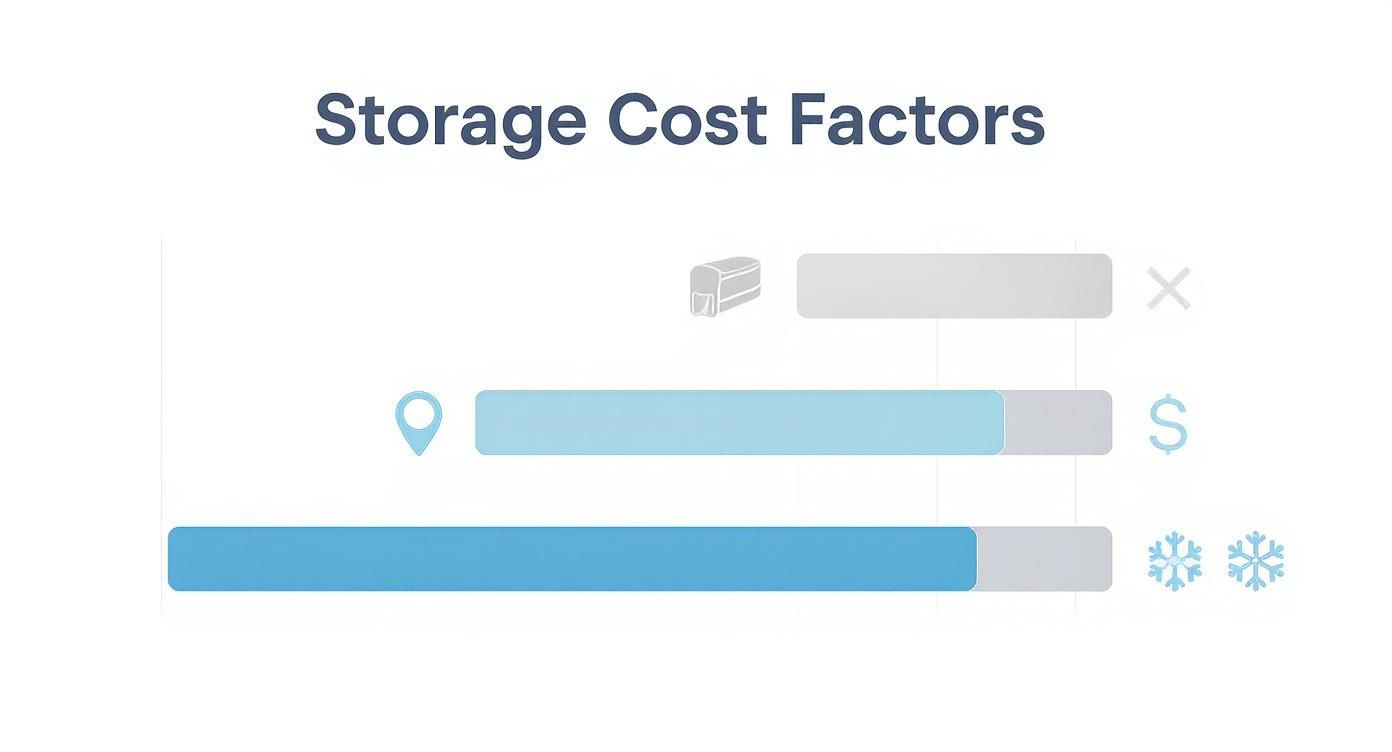
READ MORE