Storage Prices Melbourne: The Ultimate 2024 Cost Guide
Trying to pin down the exact cost of a storage unit in Melbourne can feel a bit like guesswork. As a guide, you can expect to pay anywhere from $80 a month for a small locker to over $450 for a large, garage-sized space. The final price tag depends on a few key things: the size of the unit, its location within Melbourne, how long you need it, and any special features like climate control or 24/7 access.
This guide breaks down every factor, giving you the clarity needed to find the perfect storage solution for your house or office move without overpaying.
Decoding Melbourne Storage Prices: What Drives the Cost?
So, how do storage companies actually land on these numbers? It might seem complex, but understanding the basics is the first step to making a smart choice, whether you’re moving house, clearing out clutter for a renovation, or storing business stock.
The biggest factor, hands down, is the size of the unit.
Think of it like buying a coffee. A small espresso costs a lot less than a giant iced latte with all the trimmings. In the same way, a compact locker for a few archive boxes will always be cheaper than a unit big enough to swallow the contents of a three-bedroom home. This simple relationship between size and price is the core of how all storage is priced.
Typical Price Brackets for Melbourne Storage
To help you budget, storage prices in Melbourne tend to fall into a few predictable brackets based on square metres. Knowing these rough ranges makes it much easier to compare quotes from different facilities. The trick is to match your belongings to the right-sized unit so you’re not paying for empty air.
If you want to see how different options stack up, our guide to storage solutions in Melbourne is a great place to start.
This chart gives you a quick visual breakdown of what you can expect to pay each month for small, medium, and large units around the city.
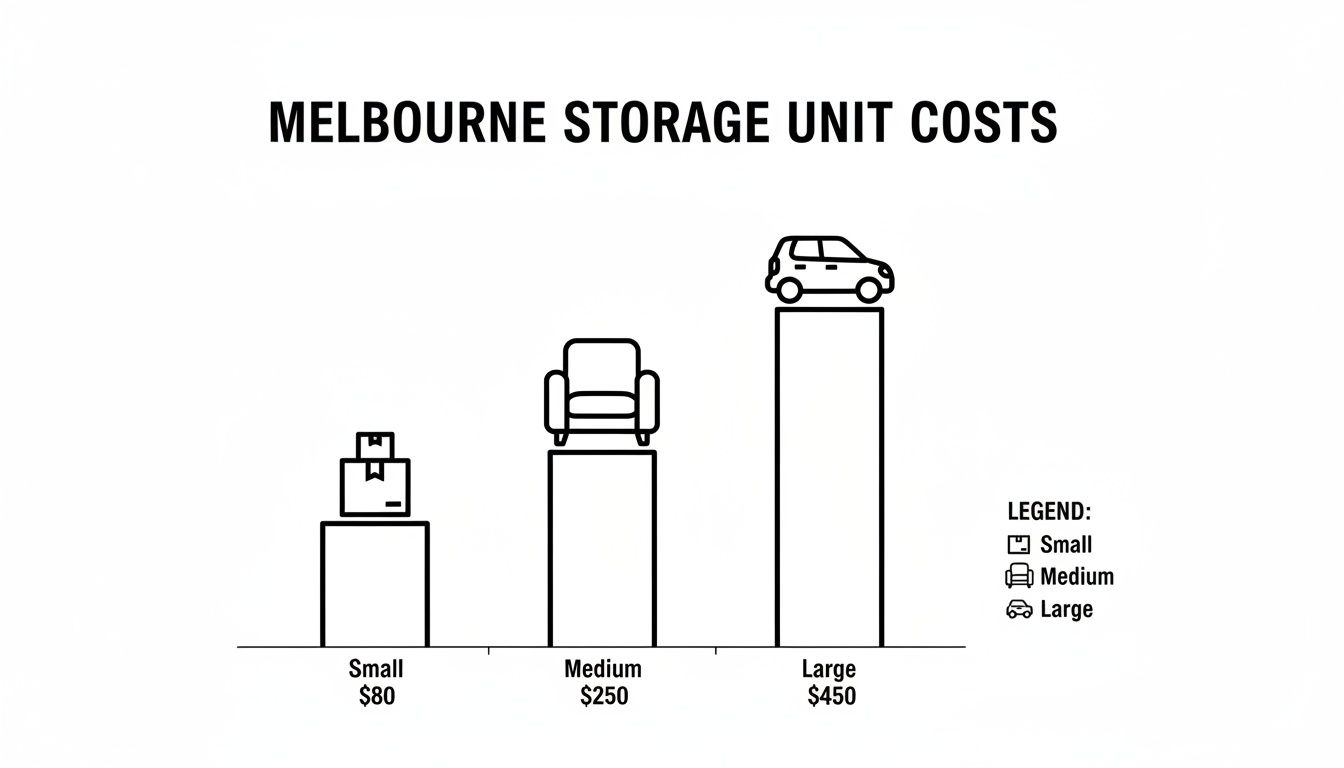
As you can see, the price jumps significantly as you go from a small unit for boxes and odds and ends to a large one that can hold furniture, appliances, or even a vehicle.
To give you a clearer idea, here’s a quick summary of what you might expect to pay.
Estimated Monthly Storage Prices in Melbourne
This table breaks down the typical monthly costs for different self-storage unit sizes across Melbourne, giving you a handy reference for planning your budget.
| Unit Size (Approx.) | Typical Use Case | Average Monthly Price Range |
|---|---|---|
| 2-3 sqm | A few boxes, small furniture (e.g., student dorm room) | $80 – $140 |
| 4-6 sqm | Contents of a 1-bedroom apartment | $150 – $220 |
| 7-9 sqm | Contents of a 2-bedroom apartment or small house | $230 – $350 |
| 10-15 sqm | Contents of a 3-bedroom house | $360 – $480 |
| 15+ sqm | Contents of a 4-5 bedroom house, or for commercial inventory/vehicle | $450+ |
These are just ballpark figures, of course. The actual price you're quoted will depend on the specific facility and the other factors we'll dive into next.
Key Takeaway: Space is the single biggest driver of storage costs. The most effective way to keep your budget in check is to accurately figure out how much room you actually need.
Getting to grips with how providers set their rates is a bit like understanding how any business goes about building a pricing model. It helps you see why prices can vary so much from one suburb to the next. While this gives you a starting point, we'll now look at how things like location, access, and how long you need storage for can change those initial estimates.
How Unit Size and Type Shape Your Final Quote
When you're trying to figure out storage prices in Melbourne, the first and most important thing to look at is the physical size of the unit. Think of it like booking a hotel room: you wouldn't get the penthouse suite if all you need is a single room for the night. The trick is to find that sweet spot—enough space for your things without paying for air.
It’s easy to get bogged down in measurements like "3×3 metres" or "6×3 metres." So, let's put that into perspective. A small 3x3m unit is about the size of a standard Aussie spare bedroom. It's perfect for everything from a one-bedroom flat, easily fitting a bed, small sofa, TV, and around 20-30 moving boxes.
If you’re packing up a typical three-bedroom house, you’ll probably need something bigger, like a 6x3m unit. That’s roughly the same size as a single-car garage. This space can comfortably take on major appliances like your fridge and washing machine, large furniture sets, and stacks of boxes. Getting this right is the key to avoiding the classic mistake of overestimating and wasting money.
Different Storage Types and Their Costs
Beyond just the dimensions, the type of storage you choose really sways the monthly cost. Not all storage is built the same, and the right one for you comes down to what you're storing.
You'll generally come across these options:
- Standard Self-Storage Units: These are your bread-and-butter, most affordable choice. Think of them as a secure, private room or garage-style space in a large facility. They offer great protection from the weather but don't have any internal temperature regulation.
- Climate-Controlled Storage: This is the premium option where the unit's temperature and humidity are kept in a specific, stable range. It costs a bit more, but for sensitive items, it's non-negotiable.
- Mover-Managed Storage: Often offered by professional removalists, this service bundles moving and storage into one neat package. Your belongings are professionally handled, packed into secure modules, and kept in a private warehouse, offering top-notch security and total convenience.
Picking the right type is all about what you're putting away. For garden tools, sturdy furniture, or general household bits and pieces, a standard unit is usually more than enough. But for certain valuables, that extra cost for a specialised unit is a smart investment. For a deeper look at these, you can check out our detailed guide on how much self-storage costs.
When Climate Control Is Worth the Extra Money
Melbourne’s four-seasons-in-one-day weather can be brutal on delicate belongings. Hot summers and damp winters can cause real damage over time. Climate-controlled units cost more because they run HVAC systems 24/7, but this extra spend is what protects your most precious items.
You should seriously consider a climate-controlled unit if you are storing things like antique wooden furniture, musical instruments (especially pianos), electronics, artwork, important documents, or vintage clothing. The stable environment stops wood from warping, prevents mould and rust, and protects against the degradation that extreme temperature swings and humidity can cause.
The pricing tiers in Melbourne are structured pretty clearly around these factors. A tiny 1x1x1m locker might kick off with a promotional rate around $22.50 per month. This scales up to medium 3x3m units, which usually sit between $180–$250. Large, garage-style 6x3m units can fetch $300–$450 or more, especially with those tempting introductory offers. It’s always worth exploring a detailed breakdown of local pricing to see how the different options can fit your budget.
The Impact of Location on Melbourne Storage Costs
Anyone who's ever looked at Melbourne's property market knows the golden rule: location is everything. Well, the exact same principle applies when you're looking for a storage unit. The postcode of your facility has a massive say in the final price you'll pay, and knowing how this works can save you a serious amount of cash.
Think of it like renting an apartment. A place in South Yarra is always going to cost you more than a similar one out in Sunshine. It’s no different for storage. A unit in a prime inner-city suburb carries a premium price tag. It's not arbitrary; it's simple economics. The land value in places like Richmond, Port Melbourne, or the CBD is through the roof, and those costs inevitably get passed on to the customer.
So, if you need to be able to pop in and grab things at a moment's notice, the convenience of a central spot comes with a higher monthly bill. For a local business that needs daily access to stock, that extra cost can be a worthwhile trade-off.
Why Inner City Storage Costs More
It’s not just about the high price of land, either. A few key factors are at play that ramp up the cost in central Melbourne:
- Higher Demand: The inner suburbs are packed with apartment dwellers and businesses, all fighting for a very limited amount of space. This competition naturally drives prices up.
- Accessibility: Facilities near major roads and commercial centres are just plain convenient, and you pay for that ease of access.
- Operational Costs: It's not just rent. Things like council rates and utilities are generally more expensive closer to the CBD, and all of that gets baked into your storage fee.
This creates a really clear price gap across the city. In some cases, facilities in the inner suburbs can be up to 50% more expensive than ones further out. If you're weighing up your options, our guide to storage units and prices near you is a great place to start comparing what's on offer locally.
The Financial Advantage of Outer Suburbs
If you don't need daily, immediate access to your things, looking towards Melbourne's outer suburbs is the single best way to slash your storage bill. Areas like Werribee in the west, Frankston in the southeast, or Epping up north offer much more competitive prices for the exact same amount of space.
Sure, the drive might take a bit longer, but the savings can be huge. This is especially true for long-term storage, like when you’re in between houses or putting office furniture away for a few months. It's a game-changer, letting you make a smart call that balances your budget with convenience.
Key Insight: For long-term storage, the money you save by choosing a facility in an outer suburb will almost always outweigh the inconvenience of a longer drive. We're talking hundreds of dollars saved over the rental period.
To give you a real-world picture of this, let's look at the price difference. A standard unit in West Melbourne might set you back around $290 a month, while a similar unit in a popular spot like Richmond could be as much as $350. Contrast that with more budget-friendly suburbs like Werribee or Frankston, where you can often find large units for somewhere between $250–$300. That's a massive saving for anyone willing to store their gear a bit further afield.
This table gives you a quick snapshot of the price differences you can expect for a standard medium-sized unit across the city.
Melbourne Suburb Storage Price Comparison (Medium Unit)
| Suburb Type | Example Suburb | Estimated Monthly Price |
|---|---|---|
| Inner City | Richmond / South Yarra | $280 – $380 |
| Middle Suburbs | Preston / Box Hill | $220 – $300 |
| Outer Suburbs | Werribee / Frankston | $180 – $250 |
Once you understand how geography affects the price, you can pick a storage solution that actually fits your needs. If you’re storing items you won't need for a while, looking beyond the city centre is the smartest financial move you can make.
What Else Affects Your Storage Price?
The weekly or monthly rate you see advertised is often just the starting point. Beyond the obvious things like the size of the unit, a few other crucial factors can quietly nudge your final bill up or down. To budget accurately and avoid any nasty surprises, you need to know what these are.

One of the biggest variables is how long you plan to stick around. Much like your phone or internet plan, storage facilities tend to reward commitment with better rates.
The Trade-Off Between Flexibility and Discounts
Deciding how long you’ll need storage for has a direct impact on your wallet. Most facilities will give you two main options, each with its own pros and cons.
- Month-to-Month Flexibility: This is the go-to for most people. It gives you the freedom to end your rental with just a bit of notice. It’s perfect if you’re in a bit of a holding pattern, like waiting for a settlement date, but you'll usually pay a bit more for that convenience.
- Long-Term Commitment: If you know you’re going to need storage for six months, a year, or even longer, you can often lock in a much better rate. By prepaying or signing a longer agreement, some places will knock 5-15% off the standard monthly price.
So, if you're planning a big home renovation or heading overseas for a while, committing to a longer term is a smart move that can save you a fair bit of cash.
When you're comparing storage prices in Melbourne, make sure you ask about discounts for longer commitments. Even a small monthly saving really adds up over a year, potentially putting hundreds of dollars back in your pocket.
The Cost of Convenience and Access
How you get to your stuff – and when – also plays a part in the price. Not all units are created equal, and facilities will charge a premium for features that make your life easier.
For example, a ground-floor, drive-up unit will almost always cost more than the exact same size unit on an upper level that you have to access via a lift. You're paying extra for the sheer convenience of parking your car or truck right at the door, which makes loading and unloading a whole lot faster. For a business shifting inventory or a family with heavy furniture, that extra cost is often well worth it for the time and back-breaking effort it saves.
In the same way, 24/7 access can add to your monthly fee. Most facilities have pretty generous opening hours, but the ability to get to your belongings at any time of the day or night is a premium feature. It costs more for the facility to provide that securely, and that cost is passed on.
The Non-Negotiable: Insurance
Finally, there’s one cost that catches a lot of people by surprise: insurance. Pretty much every reputable storage facility in Melbourne will require you to have insurance for your stored goods. This isn’t just an upsell; it’s a non-negotiable part of the deal that protects both you and the facility.
You’ve usually got two ways to handle this:
- Facility-Provided Insurance: Most places offer their own insurance policy, which you can just add to your monthly bill. It's the simplest option.
- Your Own Policy: Some facilities might let you use your existing home and contents insurance, but you'll need to check that it specifically covers items stored off-site.
This is an essential cost, so make sure you factor it into your budget from the very beginning. That way, there are no shocks when it’s time to sign the rental agreement.
Actionable Tips for Reducing Your Storage Bill
Knowing what drives storage prices in Melbourne is half the battle. Now it's time to put that knowledge to work and actually trim down your costs. With a few clever moves, you can make a real dent in your monthly storage bill without giving up on security or easy access. It really just comes down to smart planning.
One of the easiest wins? Declutter before you even start searching for a unit. Be ruthless about it. Every single item you can sell, donate, or toss is one less thing you need to pay to keep. This one step alone can often mean you can get away with a smaller, and much cheaper, unit.
Maximise Your Space and Find Deals
Once you’ve whittled down your belongings, the next job is packing like a pro. Think of it as a real-life game of Tetris – the aim is to use every last centimetre of the space you’re paying for.
Here’s a quick checklist to help you save:
- Book Online: A lot of storage facilities have online-only specials or first-month-free deals that you simply won't get if you just show up. Always have a look at their websites first.
- Pack Smart: Using boxes of the same size makes stacking a breeze. Take apart bulky furniture like bed frames and dining tables; they take up way less room stored on their side.
- Go Vertical: Don’t be afraid to stack high. Put your heavy, solid items on the bottom to create a stable base, then pile the lighter things on top. Just remember to leave a little aisle so you can get to the stuff at the back without a major excavation.
Pro Tip: You're paying for the height of the unit, not just the floor space. Stacking well is one of the best tricks in the book for getting maximum value and possibly even dropping down a unit size.
The Financial Sense of Bundling Services
Here’s a strategy that often gets overlooked: bundling your moving and storage with the same trusted company. This isn’t just about making life easier; it's a solid financial decision. A professional removals team are masters at packing a storage unit for maximum efficiency, often squeezing your belongings into a smaller space than you ever could on your own.
That expertise translates directly into money saved. Renting a smaller unit month after month quickly adds up, and those savings can easily cover the cost of the professional packing service. On top of that, it just makes the logistics simpler, cuts down on stress, and gives you one point of contact for the whole job. If you’re looking for an all-in-one solution, checking out options for short-term storage in Melbourne that are linked to a moving service is a great starting point.
For anyone keeping a close eye on the budget, this can be a genuine game-changer. You can find surprisingly affordable self-storage in Melbourne if you know where to look. For instance, a compact 9m³ unit might go for around $180 per month, which works out to a very competitive $20 per m³. When you pair this with an experienced moving company, the savings become even more obvious; two professional removalists can pack 10m³ in an hour for about $170, a far more efficient use of time and money than some standalone services.
Finding the Right Partner for Your Move and Storage
Choosing where to store your belongings in Melbourne goes far beyond just comparing monthly fees. The lowest storage prices Melbourne can offer won't matter if the service is dodgy or unreliable. It’s about finding a genuine partner you can trust with your possessions, whether for a few weeks during a house move or for several months while relocating your office.
Looking beyond the price tag means figuring out what real value you’re getting. This starts with the absolute fundamentals: security and the quality of the facility itself. You need to know your items are not just being stored, but properly protected.
Assessing True Value and Security
Before you even think about signing on the dotted line, you have to dig into the security measures a facility has in place. Any trustworthy provider should offer robust protection that lets you sleep at night.
Here are the non-negotiables to look for:
- Comprehensive CCTV Surveillance: We’re talking 24/7 video monitoring that covers every access point, hallway, and loading bay. No blind spots.
- Secure Access Control: Modern, professional facilities will have electronic gated access that requires a unique PIN code to get in and out.
- Individually Alarmed Units: This is a fantastic extra layer of security. It alerts staff if your specific unit is opened without authorisation.
- Facility Cleanliness: Honestly, a clean, well-kept facility is a huge clue. It shows a professional operation that actually cares about its customers' belongings.
Beyond the facility's built-in security, you might also need to think about things like getting a solid lock for your unit. If you ever find yourself locked out or need an upgrade, having reliable local Melbourne locksmith services on call is a lifesaver.
The Advantage of an All-in-One Service
One of the best ways to keep the whole process smooth and stress-free is to choose a company that handles both your move and your storage. It just makes sense. Using an integrated service simplifies every single logistical headache.
Instead of trying to be the middleman between a moving company and a separate storage facility, you have one point of contact. One team that’s accountable for everything.
This integrated approach is about more than just convenience; it’s about investing in peace of mind. Knowing your move is managed from start to finish by one fully insured, police-checked team dedicated to your needs is invaluable.
This seamless process means total accountability. The same professional team that packs and transports your items is responsible for keeping them safe in storage. This completely eliminates any finger-pointing between different companies and guarantees a consistently high standard of care.
For anyone navigating the chaos of relocating, discovering the value offered by the best moving companies in Melbourne that provide integrated services can make all the difference. Ultimately, partnering with a trusted all-in-one provider like Get n Go Removals transforms a potentially stressful ordeal into a well-managed and secure experience.
Frequently Asked Questions About Melbourne Storage
To help you get your plans locked in, we've pulled together some of the most common questions we hear from Melburnians about storage. Here are some straightforward answers to help you make the right call.
How Much Storage Space Do I Need for My House?
Figuring out the right amount of space can feel a bit like guesswork, but there's a pretty reliable rule of thumb we use in the industry. A standard 3-bedroom house usually fits quite comfortably into a 3x6m storage unit — that's about the same size as your average single-car garage.
If you're in a smaller 1-2 bedroom apartment, you'll likely find a 3x3m unit is more than enough room for all your furniture and boxes.
The best way to know for sure? Grab a pen and paper and do a quick inventory. Jot down your big items (couches, beds, fridge, washing machine) and get a rough count of your moving boxes. This simple step takes just a few minutes and gives you a much clearer picture, so you don't end up paying for empty space you just don't need.
Is Storage Insurance Required in Melbourne?
Yes, it almost always is. Just about every reputable storage facility in Melbourne will require you to have insurance for your goods. Think of it as a non-negotiable that protects both you and the facility if something unexpected happens.
You've usually got two main options here:
- Take out the facility's insurance: Most storage providers offer their own policy, which is super convenient as you can just add it to your monthly bill.
- Use your existing policy: Some places might let you use your current home and contents insurance, but you absolutely have to check the fine print to confirm it specifically covers items being kept in an off-site storage location.
Our advice? Always ask about the insurance requirements before you sign on the dotted line. It’ll save you any nasty surprises down the track.
What Is the Difference Between Self-Storage and Mover Storage?
The biggest difference really boils down to convenience and who does the heavy lifting. With self-storage, you’re renting an empty unit at a big facility, and you’re entirely responsible for packing the car or truck and moving everything in and out yourself.
Mover storage, which is the kind of all-in-one solution we offer, rolls two big jobs into one. A professional moving company comes to your home, picks up your belongings, and transports them directly to their own secure warehouse. It's a far more streamlined process, saving you the time, physical effort, and hassle of trying to coordinate a mover and a separate storage facility.
When you choose mover storage, you've got one expert team handling everything from your old front door to the new storage space. It means a seamless, accountable process from start to finish.
When you need a moving partner that offers both expert transport and secure storage solutions, you can trust the experienced team at Get n Go Removals Melbourne. We provide a single point of contact for a genuinely stress-free relocation. Visit us at https://www.getngoremovals.com.au to see how we can simplify your next move.