Your Complete Guide to Choosing Removalists in Point Cook

Considering a move to Point Cook? You've made a great choice. It's a fantastic prospect, but with the suburb's rapid growth, finding reliable removalists in Point Cook requires smart planning. Thousands of families and businesses are drawn to the area annually, creating intense demand for professional movers. To ensure a smooth transition into this vibrant community, booking a trusted team well in advance is essential.

What's Driving Point Cook's Explosive Growth?

Point Cook is more than just growing; it's experiencing a remarkable boom. Once a quiet outer suburb, it has transformed into one of Melbourne's most sought-after postcodes, attracting everyone from young families to professionals and entrepreneurs. This isn't by chance—it's the result of a perfect blend of lifestyle, opportunity, and a strong community spirit that makes it an ideal place to establish roots.

This significant influx of new residents directly impacts the moving industry. The schedules of the best local removalists fill up quickly. Therefore, being proactive about planning your move isn't just recommended; it's a crucial step to secure a team that possesses intimate knowledge of the area.

A Premier Destination for Families and Professionals

So, what is the main draw? The appeal of Point Cook comes down to a few key factors that resonate with a diverse range of people.

  • Affordable, Modern Homes: The area offers a fantastic selection of contemporary housing, from spacious family homes to chic townhouses, often at prices more accessible than those in suburbs closer to the CBD.
  • A Genuine Community Atmosphere: With top-tier schools, beautiful green spaces like Sanctuary Lakes, and vibrant shopping centres, Point Cook provides all the essential infrastructure for a comfortable and fulfilling family life.
  • The Best of Both Worlds: It offers the perfect balance—close enough to the city for a convenient commute, yet just a short drive from the stunning beaches of the Bellarine Peninsula. It’s that ideal sweet spot between urban convenience and coastal relaxation. For more insights on finding your perfect spot, our comprehensive guide to moving to Melbourne can be a valuable resource.

A Thriving Local Economy

The area's growth is also fueled by a robust local economy. The entire Wyndham region has evolved into a major hub for employment and new business ventures. The statistics are compelling: the region's population is projected to soar from 292,000 in 2021 to an estimated 457,000 by 2040—a staggering 56% increase.

In Point Cook East alone, employment saw a significant jump of 5.4% in the 12 months leading up to June 2025. The unemployment rate is an impressively low 1.9%, far below the Greater Melbourne average of 4.6%.

This economic dynamism means that when you move here, you're not just changing your address—you're becoming part of a vibrant, forward-thinking community. It also underscores why securing dependable removalists in Point Cook early is so critical to stay ahead of the high demand and start your new chapter seamlessly.

Cracking the Code: What Do Removalists Cost in Point Cook?

Determining the cost of professional movers can often feel like a guessing game. However, a quality quote from a reputable Point Cook removalist isn't an arbitrary figure; it's a transparent breakdown of all the services required to execute your move efficiently and without stress. The final cost is ultimately shaped by the unique specifics of your relocation.

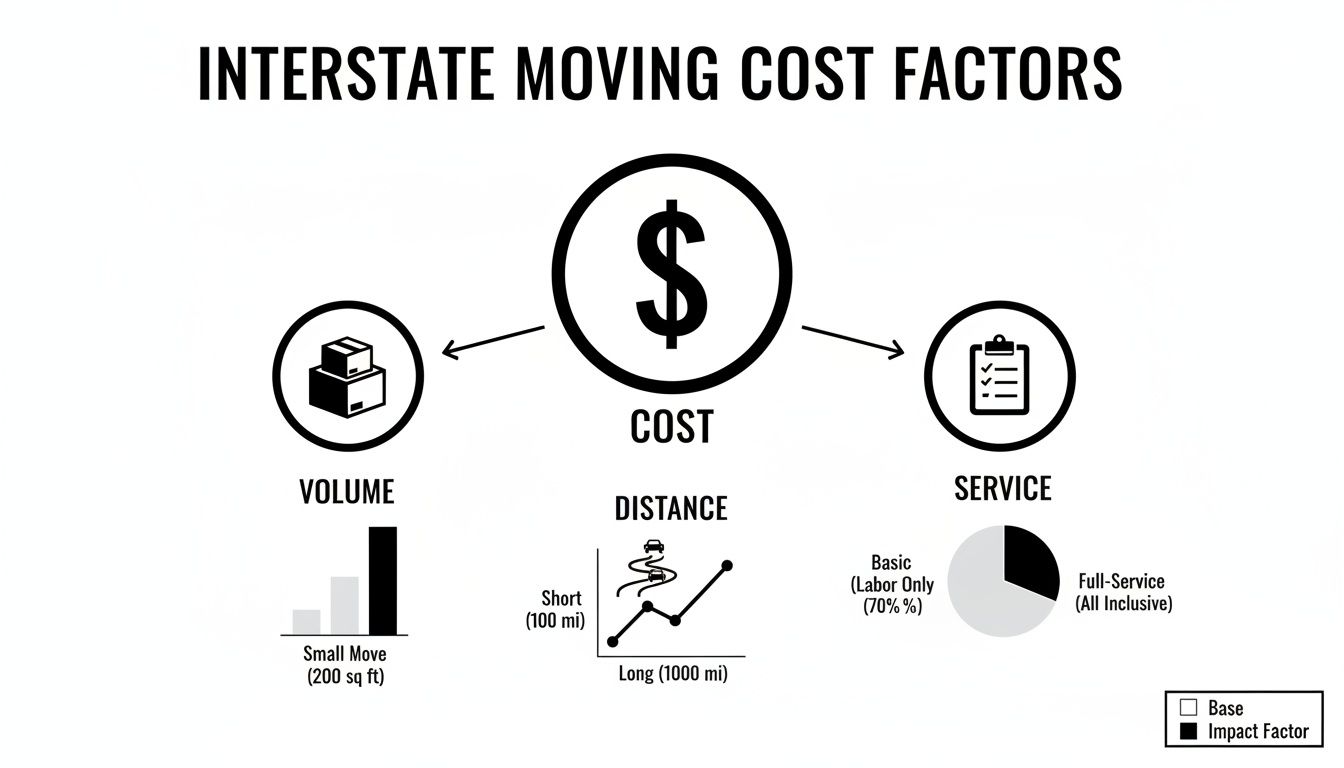
The primary factors influencing your quote are the size of your home and the volume of your belongings. A one-bedroom apartment is, naturally, a much quicker job than a large four-bedroom family house. The distance between your old and new properties is another key factor, as are any access challenges—such as multiple flights of stairs, narrow corridors, or difficult parking situations. These elements all add time and labour to the job.

It’s no secret that Point Cook is booming, and this growth is a big reason why finding quality movers is so important.

Infographic showing Point Cook's 5-year growth: Population +56%, Jobs +5.4%, Unemployment 1.9%.

The data clearly illustrates a thriving community with a strong job market and a rapidly expanding population, which keeps reliable removalists in constant high demand.

Typical Moving Costs You Can Expect

So, what constitutes a realistic budget? Melbourne-wide averages provide a solid baseline. The median hourly rate for a two-person team with a truck typically hovers around $130, with most quotes falling between $110 and $159 per hour.

For a standard 3-bedroom house, you can generally expect a total cost ranging from $660 to $1,118, which usually covers about five hours of work. It’s worth noting that recent industry-wide cost increases are pushing hourly rates closer to the $140-$190 range. For a more in-depth analysis, explore our guide on how much moving houses costs in Melbourne.

To offer a clearer perspective, here is a quick overview of what you might expect for different property sizes in the Point Cook area.

Estimated Moving Costs in Point Cook

Service / Property Size Average Hourly Rate (2 Movers) Estimated Total Cost
Studio / 1-Bedroom Flat $130 – $150 $390 – $600 (3-4 hours)
2-Bedroom Home $135 – $160 $675 – $960 (5-6 hours)
3-Bedroom Home $140 – $170 $840 – $1,360 (6-8 hours)
4-Bedroom Home $150 – $190 $1,200 – $1,900+ (8-10+ hours)

Please remember these are estimates! The most accurate way to determine your cost is to request a detailed quote tailored to your specific moving needs.

What Your Quote Should Always Include

A transparent quote is the hallmark of a professional moving company. It should clearly itemise all costs, from the hourly rate and number of movers to any potential additional charges.

  • Call-Out or Travel Fees: Some companies charge a flat fee to cover the travel time from their depot to your location and back.
  • Stair Levies: If your property has multiple flights of stairs, expect an additional fee. This is labour-intensive work that requires more time and physical effort.
  • Specialty Items: Large or delicate items like pianos, pool tables, or oversized furniture require specialised handling and equipment, and the price will reflect this.

Understanding the components of a quote allows you to budget effectively and avoid unexpected costs on moving day. A trustworthy mover will be completely upfront about all potential charges.

If you wish to delve deeper into the factors that influence moving prices, this resource offers a great guide to decoding the cost of professional movers. Armed with this knowledge, you can compare quotes confidently and select the best team for your needs.

How to Choose a Trustworthy Moving Company

Let's be candid: not all removalists are created equal. Selecting the right one is arguably the most critical decision for a stress-free move. A professional crew can transform a day of potential chaos into a smooth, efficient operation. An unprofessional one, however, can quickly lead to a nightmare of damaged valuables, hidden fees, and immense regret.

Your objective is to find a team that will treat your belongings with the same care and respect that you would.

The challenge lies in the fact that Melbourne’s removals industry, despite generating a massive $2.6 billion annually, is not without its pitfalls. Customer complaints have been rising, from 656 in 2019 to 726 in 2020. Industry experts believe this is just the tip of the iceberg, estimating the actual number of problematic moves could exceed 3,600 in a single year.

This is precisely why conducting thorough due diligence is not just advisable—it's absolutely essential.

Your Vetting Checklist: The Non-Negotiables

To differentiate the professionals from the pretenders, you must insist on a few fundamental criteria. Consider these the non-negotiables—the absolute must-haves for any moving company you’re considering.

  • Comprehensive Insurance: Never consider booking a mover that cannot provide proof of Public Liability and Transit Insurance. This is your crucial safety net in the unfortunate event of damage to your property or possessions while in transit.
  • Permanent, Vetted Staff: Always inquire whether their team consists of full-time employees or subcontractors. Companies that invest in hiring, training, and police-checking their own staff consistently deliver a higher, more reliable standard of service and accountability.
  • Company-Owned Fleet: A business that owns its fleet of trucks is a strong indicator of a stable, professional operation. It shows they have invested in the proper equipment for the job and aren't simply a middleman outsourcing your move.

A trustworthy removalist is transparent from the very first contact. They should be more than willing to answer questions about their team, insurance, and equipment without hesitation. If they become evasive or defensive, consider it a major red flag.

Questions to Ask Before You Book

Once you've shortlisted a few companies that meet the above criteria, it’s time to delve into the specifics. Asking the right questions will reveal everything you need to know about their operational standards and what you can expect on moving day.

Here are some crucial questions to ask:

  1. "Can you walk me through all potential extra charges?" This is vital. Inquire about call-out fees, stair charges, or additional costs for specialty items like pianos. A professional company will be completely transparent about every possible cost.
  2. "What kind of protective gear do you use?" You want to hear that they use heavy-duty blankets, shrink wrap, and appropriate dollies and trolleys to protect your furniture, floors, and walls.
  3. "Who will be my point of contact on moving day?" Knowing who to contact if an issue arises provides peace of mind and ensures clear, simple communication throughout the process.

Equipped with this knowledge, you can confidently select the best removalists in Point Cook for your needs. While organising your move, you might also be considering other services. This could include learning how to choose a reliable cleaning service for your old or new home. For more local advice, take a look at our guide to finding top removalists near you.

Your Stress-Free Point Cook Moving Checklist

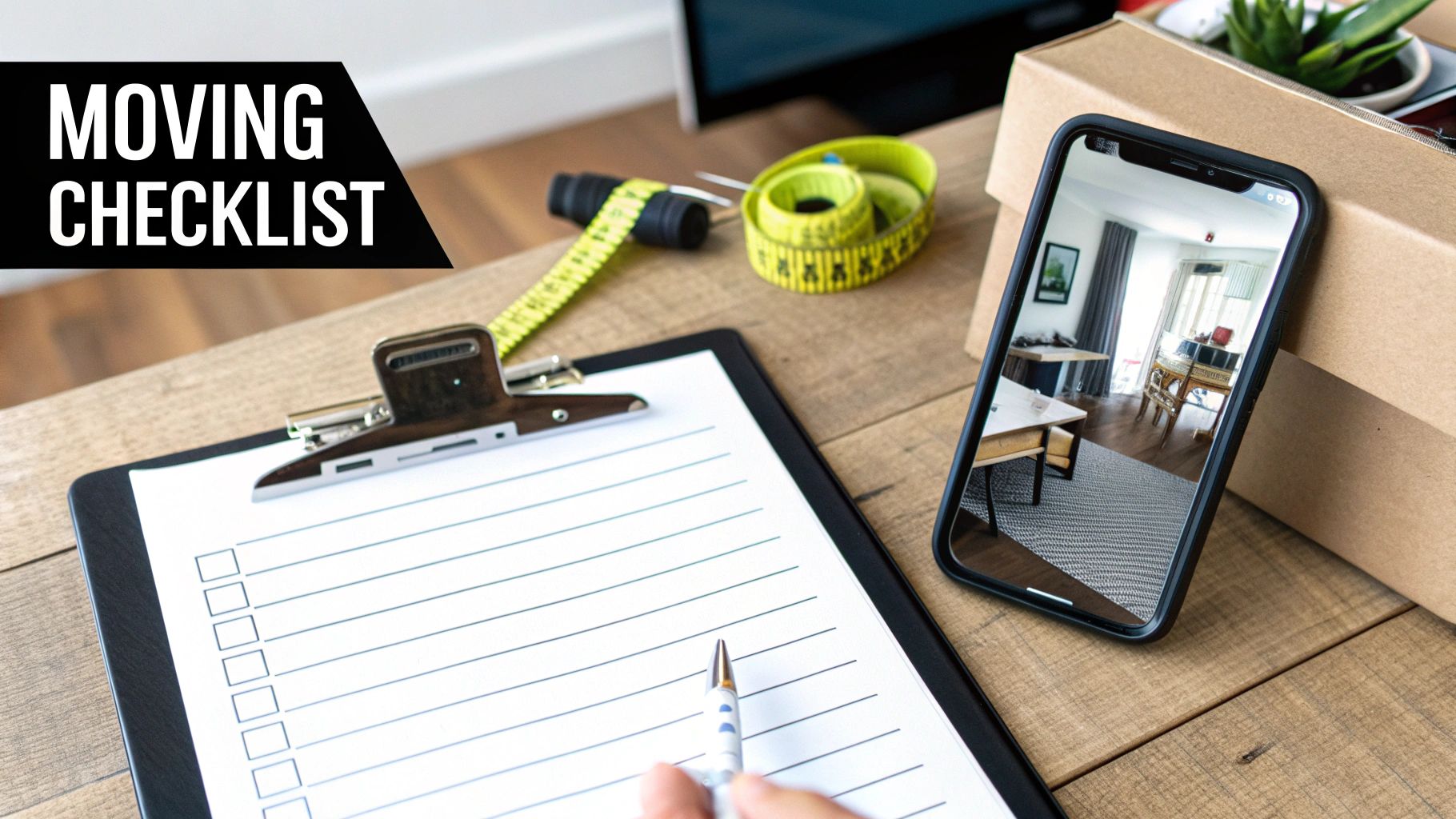
A successful move ultimately comes down to meticulous planning. By breaking down the monumental task of relocating into manageable, week-by-week actions, you can avoid the overwhelming last-minute panic. This checklist is your strategic tool for staying organised and in control as you prepare to move with your chosen removalists in Point Cook.

A desk with a 'Moving Checklist' screen, keys, notebook, pen, and moving boxes.

The key to a smooth process is starting early. Beginning approximately two months before your moving date provides ample time to declutter, organise, and book your movers without feeling rushed.

Your Moving Countdown Timeline

To simplify the process further, here is a timeline outlining the critical steps from eight weeks out to the day of the move. Following this countdown will help ensure no important details are overlooked.

Timeline Key Tasks Pro Tip from Get n Go
8 Weeks Out Declutter ruthlessly and research removalists. Sort items to keep, donate, sell, or discard. Obtain quotes from several reputable removalists in Point Cook and confirm your booking. Premier movers in high-demand areas like Point Cook get booked out weeks in advance, especially for weekend moves. Secure your date early to avoid missing out.
4 Weeks Out Gather packing supplies and start packing non-essentials. Collect boxes, tape, and protective wrap. Begin packing items you don't use daily, such as books, seasonal clothing, and extra bedding. Label every box clearly with its contents and designated room. This simple step will save you immense time and frustration during unpacking.
2 Weeks Out Notify key parties and plan for pets and kids. Contact utility companies to schedule disconnections and reconnections. Update your address with banks, subscriptions, and the AEC. Moving day can be stressful for children and pets. Arranging a sitter or a playdate ensures they remain safe, happy, and clear of the moving activity.
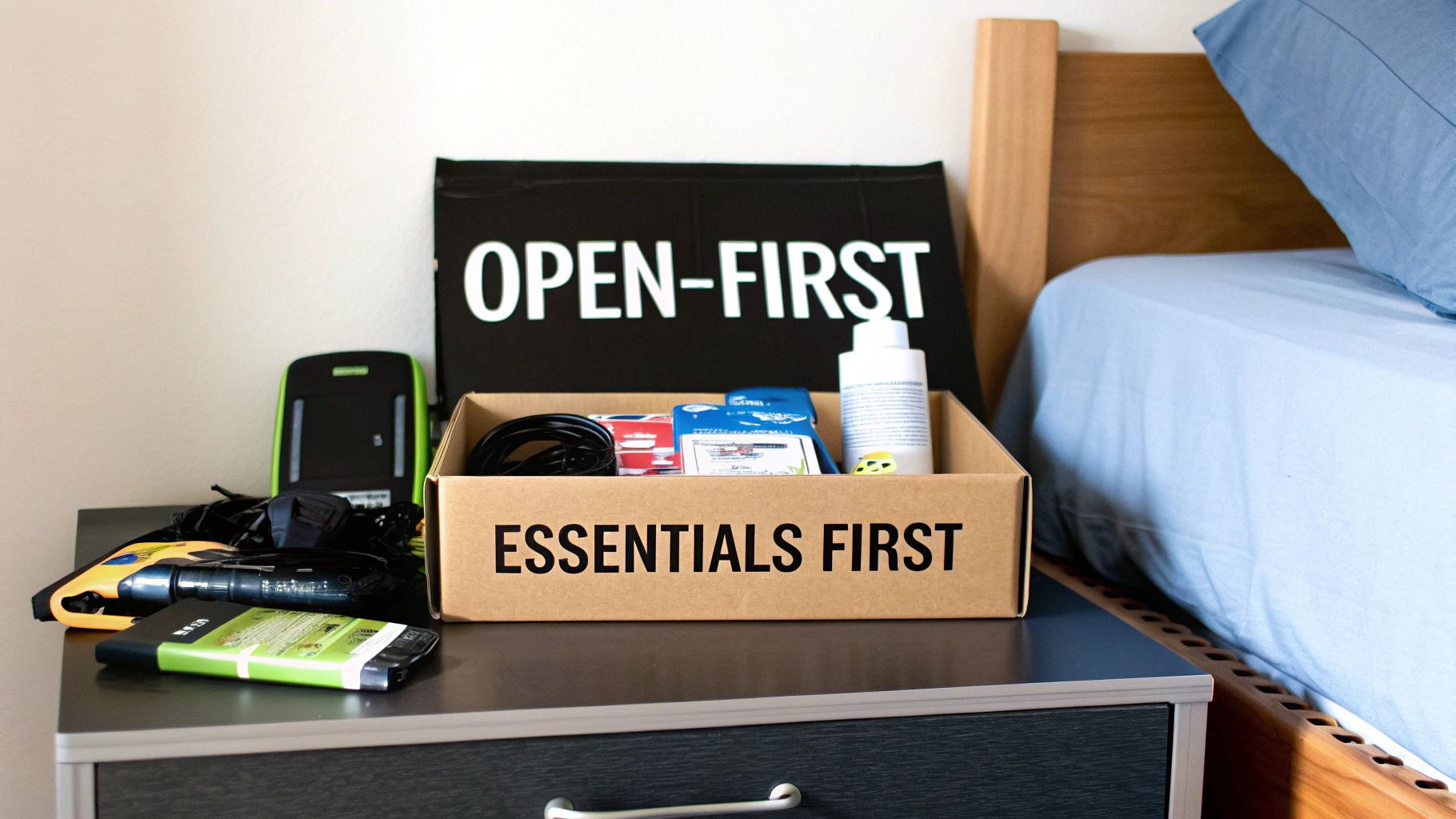
1 Week Out Confirm with your movers and pack your 'essentials' box. Call your removalist to confirm the arrival time and any final details. Your 'essentials' box is your first-night survival kit. Pack it with toiletries, medications, chargers, snacks, a kettle, and basic tools.

Adhering to a timeline like this transforms a potentially overwhelming project into a series of achievable steps. By tackling a small amount each week, you'll arrive on moving day feeling prepared and in control, rather than stressed and exhausted.

For an exhaustive guide covering every detail, refer to our complete moving house checklist for Australia. It's the ultimate resource for a seamless relocation.

So, Why Choose Get n Go Removals as Your Moving Partner?

Selecting the right moving company is the most critical decision you'll make for a successful relocation. You have the checklist and you know what to look for—now, let's introduce the team that puts all those principles into practice. For countless residents in Point Cook, Get n Go Removals is the trusted name for a move that is professional, efficient, and genuinely stress-free.

Two professional movers in blue uniforms loading a beige sofa into a white moving truck.

We are a family-owned business with over a decade of hands-on experience right here in Melbourne. This allows us to combine deep local expertise with a steadfast commitment to customer care. We understand the unique challenges of navigating Point Cook's diverse neighbourhoods—from coordinating access in new housing estates to liaising with apartment building managers.

Our Promise: Trust and Reliability You Can Count On

Trust is paramount when you're entrusting your possessions to others. We have built our reputation on transparency and professionalism, ensuring you feel supported from the initial phone call to the moment the final box is placed in your new home. For us, this isn't just a job; it's our family's reputation on the line with every move.

Our commitment to being the most reliable removalists in Point Cook is founded on a few core principles:

  • Fully Insured for Your Peace of Mind: We maintain comprehensive Public Liability and Transit Insurance. This means from door to door, your belongings are protected, providing you with complete peace of mind.
  • A Team of Permanent, Vetted Professionals: We do not use subcontractors. Our team consists of full-time, police-checked employees who are rigorously trained in safe lifting techniques, furniture protection, and exceptional customer service.
  • Transparent and Upfront Pricing: We champion honest, clear communication. You will receive a detailed quote with no hidden fees or unexpected charges. The price we quote is the price you pay, allowing you to budget with confidence.

The Get n Go Difference: It’s All in the Details

What truly distinguishes us is our investment in quality equipment and refined processes. We own and operate our entire fleet of modern, clean, and meticulously maintained trucks, ranging from 4.5 to 12 tonnes. This enables us to assign the perfect vehicle for your move, whether you're in a compact apartment or a large family home.

Our professional movers arrive equipped with everything needed to execute the job flawlessly and protect your belongings.

We never cut corners. Every job includes heavy-duty blankets, protective padding, industrial-grade shrink wrap, and specialised trolleys to safeguard your furniture, appliances, and both your old and new properties from any damage.

A Full Range of Services, Built Around You

We recognise that no two moves are identical. That's why we offer a comprehensive suite of services that can be customised to meet your exact requirements. Our mission is to alleviate the burden of moving, so you can focus on the excitement of starting your new chapter in Point Cook.

Here’s how we can assist you:

  • Expert Packing and Unpacking: Our trained team can manage all aspects of packing, using high-quality materials to ensure everything is secure. We can also assist with unpacking to help you get settled in your new home faster.
  • Furniture Disassembly and Reassembly: Don’t worry about complex bed frames or large dining tables. We will professionally dismantle them for transport and reassemble them correctly in your new home, placed exactly where you want them.
  • A Single Point of Contact: You will have a dedicated contact person throughout the entire moving process. This ensures clear communication and a coordinated effort, so you’re never left wondering who to talk to.

Common Questions About Moving in Point Cook

Even with the most thorough planning, a few last-minute questions can arise as moving day approaches. This is completely normal! To provide you with complete confidence for your move with your chosen removalists in Point Cook, we've compiled answers to the questions we hear most frequently from our clients.

Consider this a final checklist for your peace of mind. Our goal is to be fully transparent, so you know exactly what to expect for a smooth and successful move.

How Do You Protect My Furniture and Property?

This is our absolute top priority. Our professional team arrives with more than just a truck; they come equipped with a comprehensive set of protective gear to keep both your belongings and your properties in immaculate condition.

This includes:

  • Heavy-duty moving blankets to wrap each piece of furniture, preventing scratches, scuffs, and impact damage.
  • Industrial-grade shrink wrap to secure drawers and protect upholstered items like sofas from dirt and moisture.
  • Specialised trolleys and dollies designed to move large, heavy items such as refrigerators and washing machines safely, without marking your floors.

We exercise extreme care in both the home you are leaving and the one you are moving into. Our objective is to leave walls, doorways, and floors in the exact same condition as we found them.

What Happens If My Move Takes Longer Than Expected?

We understand that unexpected delays can happen. A move can be affected by factors like traffic, a delay in receiving keys, or challenging access at the new property.

If your move extends beyond the estimated time, there is no need to worry. We simply continue working at the agreed-upon hourly rate, billed in small increments to ensure you only pay for the time you actually use. The team leader will keep you informed throughout the day, so you are always aware of the progress. We pride ourselves on our flexibility and commitment to completing the job to the highest standard, regardless of any challenges that may arise.

Clear communication is paramount. Our on-site team leader will provide you with regular updates, ensuring there are no surprises on your final invoice. Your peace of mind is our primary concern.

Are There Any Items You Cannot Move?

For the safety of our team, your possessions, and the public, there are specific items we are legally prohibited from transporting. This is a standard practice across the entire removals industry.

Typically, this list includes:

  • Hazardous materials (such as flammable liquids, gas bottles, paints, and corrosive chemicals).
  • Perishable food items.
  • Live plants and animals.
  • Firearms and ammunition.

If you are unsure about a particular item, please contact us beforehand. We are always happy to clarify what we can and cannot transport and can often advise on the best way to move those items yourself. For a more detailed list, please visit our company FAQs page.


Ready to experience a seamless and stress-free move in Point Cook? The team at Get n Go Removals Melbourne is here to help. Get a free, no-obligation quote online today!
READ MORE

Why You Need a Professional Pool Table Mover in Melbourne

Thinking about moving that pool table yourself? It might seem like a straightforward way to save a few dollars, but when you're dealing with an item that can weigh up to 800 kilograms, a "DIY" approach can quickly turn into a costly disaster. Moving your house or office is complex enough without adding this high-stakes task to your list.

A pool table isn't just another heavy piece of furniture; it's a precision-engineered instrument. Attempting to move it without specialised knowledge and equipment often leads to irreparable damage, serious personal injury, or a table that never plays correctly again. It’s a classic case of a money-saving idea backfiring spectacularly, turning a cherished possession into a source of frustration.

Why a DIY Pool Table Move Is a Costly Mistake

It’s tempting to round up a few strong friends and attempt a simple lift-and-carry. The problem is, this completely overlooks the complex construction of a pool table. It requires a specific disassembly and reassembly process that the average person has no experience with, turning a simple relocation into a high-risk gamble.

The sheer weight is the first, most obvious hurdle. A slate pool table is monstrously heavy, creating a significant risk of injury without specialised gear. Imagine dropping a single piece of slate—which can easily weigh over 100 kilograms. It won’t just dent the floor; it will almost certainly crack, rendering your table useless and leaving you with a huge repair bill.

The Hidden Risks Beyond Heavy Lifting

Even if you somehow manage the weight, the real trouble lies in the technical details. A professional pool table mover understands the intricate anatomy of your table, from the rails and cushions to the delicate slate seams. This expertise is what prevents a simple move from becoming a repair nightmare.

Here’s what often goes wrong in a DIY move:

  • Irreparable Slate Damage: The slate is the heart of your table. It must be carefully removed, transported perfectly flat or on its edge, and often crated. The slightest chip, crack, or warp from being handled incorrectly will permanently ruin the playing surface.
  • Frame and Leg Damage: Trying to move the table in one piece places enormous stress on the joints, legs, and frame. This is a fast track to warping the structure, causing irreparable instability or even a total collapse.
  • Felt Tears and Stretching: The felt (or cloth) must be removed with care and then re-stretched using professional tools. If the tension isn't perfect, you’ll end up with wrinkles, bubbles, and a slow, unpredictable ball roll, making the table unplayable.

Melbourne Scenarios Gone Wrong

Here in Melbourne, the challenges get even trickier. Think about navigating the tight corridors of a heritage terrace house in Fitzroy, squeezing into a compact apartment lift in Southbank, or tackling a narrow, winding staircase in a Richmond townhouse. These architectural quirks demand professional planning.

We've seen it all. People attempting to pivot a massive slab of slate around a tight corner, only to end up with a huge gouge in the wall and a broken table. These well-intentioned moves can result in thousands of dollars in repairs—far more than the cost of hiring a professional pool table mover in the first place. For more general advice on tackling bulky items, check out our guide on how to move heavy furniture.

The truth is, moving a pool table isn't about brute force; it’s about precision, knowledge, and the right tools. Without these, you are gambling with a valuable investment.

Ultimately, bringing in an expert team like Get n Go Removals is the only surefire way to get your table disassembled, transported, and reassembled with the meticulous care it deserves. It’s the guarantee that it will play just as perfectly in its new home as it did in its old one, protecting your investment for years to come.

Decoding Pool Table Moving Costs in Melbourne

Figuring out the cost for a professional pool table mover in Melbourne isn't as simple as getting a single fixed price. The final quote is a careful calculation based on several key factors, each reflecting the expertise, specialised equipment, and meticulous labour required to move such a massive and delicate item without a scratch. Understanding this breakdown helps you budget effectively and appreciate the value you receive.

The starting point for any quote is almost always the table itself. A larger, heavier table with a three-piece slate system is inherently more complex and will require more manpower and time than a smaller, single-slate table. This forms the base cost upon which other variables are added.

After that, property access is a major consideration. Navigating a tight staircase in a Fitzroy terrace, squeezing through narrow hallways in a CBD apartment, or even dealing with a few awkward steps can significantly increase the job's complexity. These challenges require more strategic planning and often specialised equipment, which will be factored into the price.

Key Factors That Shape Your Quote

A professional quote isn't just an arbitrary number; it's a careful calculation based on the specifics of your move. To provide an accurate estimate, any reputable pool table mover will need to know a few key details that directly influence the difficulty and time required for the job.

Here's what they'll likely ask about:

  • Table Size and Slate: Are we dealing with a 7-foot pub-style table or a 12-foot tournament behemoth? Is the slate a single solid piece, or is it the more common (and more complex) three-piece design?
  • Property Access: Are there stairs, lifts, or tight corners involved at either the pickup or delivery address? A simple ground-floor-to-ground-floor move is always the most straightforward and cost-effective.
  • Travel Distance: Like any removalist service, the distance between your old and new locations plays a role, covering fuel and the crew's travel time.
  • Felt Condition: Do you plan to reuse the existing felt, or is this the perfect opportunity to have a new one installed? Adding a refelting service will increase the total cost but is a great way to refresh your table during reassembly.

Knowing these details upfront helps you provide clear information and get a precise, no-surprises quote. For a wider view of relocation expenses, feel free to check out our detailed guide on the cost of movers in Melbourne.

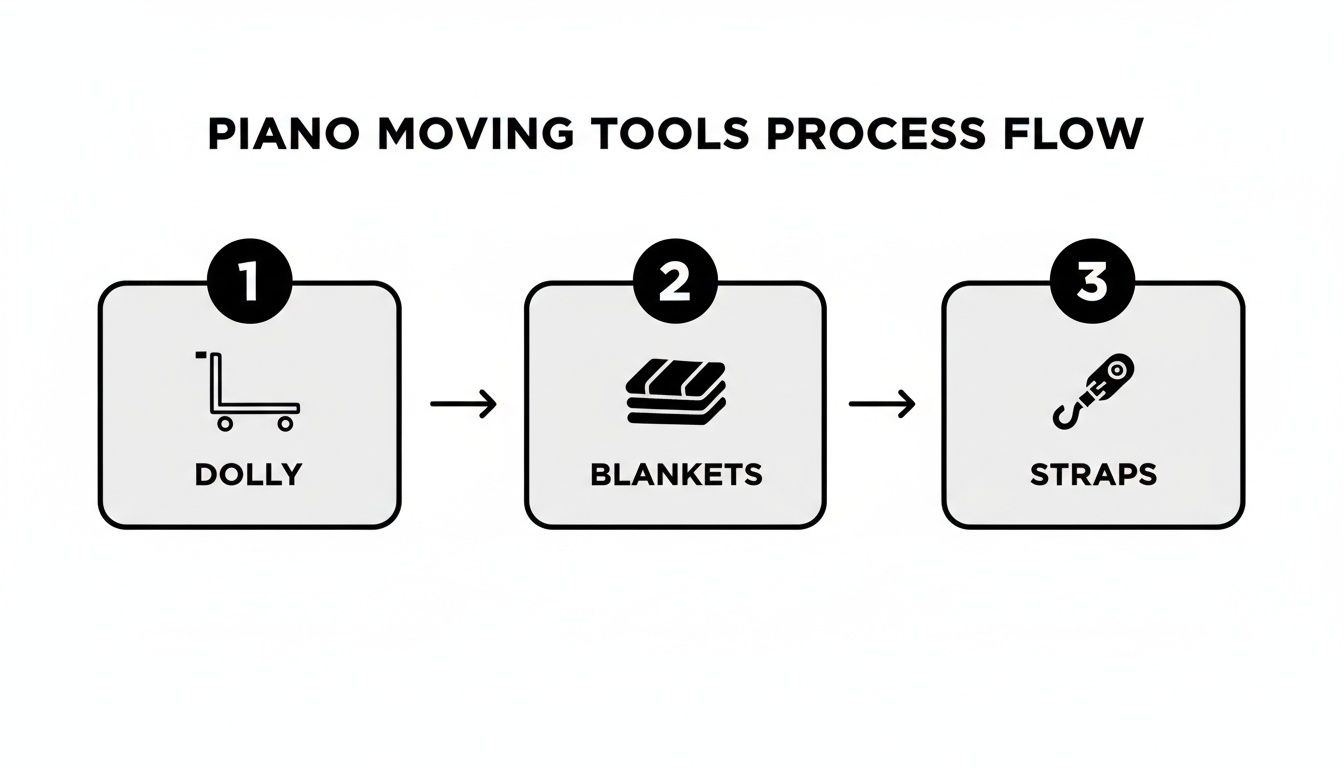
A professional fee covers so much more than just muscle. It includes specialised dollies, protective wrappings, precision levelling tools, and the comprehensive insurance needed to protect your investment from start to finish.

We've put together a quick table to give you a rough idea of what to expect. Remember, these are just estimates, and your final quote will depend on the unique factors of your move.

Estimated Pool Table Moving Costs in Melbourne

This table shows how different factors can impact the final price of moving your pool table professionally.

Table Size Average Base Cost (Ground Floor) Potential Additional Fees
7-foot $450 – $650 Stairs, difficult access, long travel distance, refelting.
8-foot $500 – $750 Stairs, difficult access, long travel distance, refelting.
9-foot $600 – $900 Stairs, difficult access, long travel distance, refelting.
10-foot+ $800 – $1,200+ Stairs, difficult access, long travel distance, refelting.

As you can see, factors like navigating a flight of stairs or opting for new felt can adjust the price, but this investment ensures the job is done right.

In Melbourne, where a pool table is a common feature in many homes and offices, hiring a professional is a smart decision. Local relocations can vary, but for a standard service including disassembly, transport, and perfect reassembly, you should anticipate a cost that reflects the high level of skill involved.

It's important to remember that these tables, especially the slate models popular in Australian homes, can weigh anywhere from 300 to 800 kilograms and require a highly trained team. Ultimately, paying for a professional service is an investment that protects you from the much higher financial—and emotional—cost of a DIY attempt gone wrong.

How Table Size Influences Your Moving Strategy

It’s easy to look at a pool table and just see one large, heavy item. But in the world of professional removals, the specific dimensions are the single most important detail shaping the entire moving plan. The difference between shifting a standard 7-foot "pub-style" table and a massive 12-foot tournament behemoth isn't just about needing more muscle; it’s a completely different logistical challenge.

The most significant factor is the sheer weight. A smaller table might have a single piece of slate weighing around 200-250 kg. That’s already a serious lift requiring a team. But the slate on a full-size professional table can easily exceed 450 kg, often split into three separate pieces. This extra weight doesn’t just mean you need more people; it demands specialised equipment like slate dollies and a far more meticulous disassembly to ensure no piece cracks under its own weight. A professional pool table mover will completely overhaul their approach based on these specifications.

From Pub Tables to Tournament Giants

Your typical 7-foot table is designed for homes and pubs. Its components are generally more manageable, and once disassembled, the slate pieces can usually be navigated through standard doorways and hallways. For a skilled crew, it's a relatively straightforward job.

The complexity increases significantly with a 9-foot or 12-foot table. The slate pieces themselves are much larger and heavier, turning tight corners, narrow staircases, or the small lifts common in Melbourne apartment buildings into major logistical obstacles that require expert problem-solving.

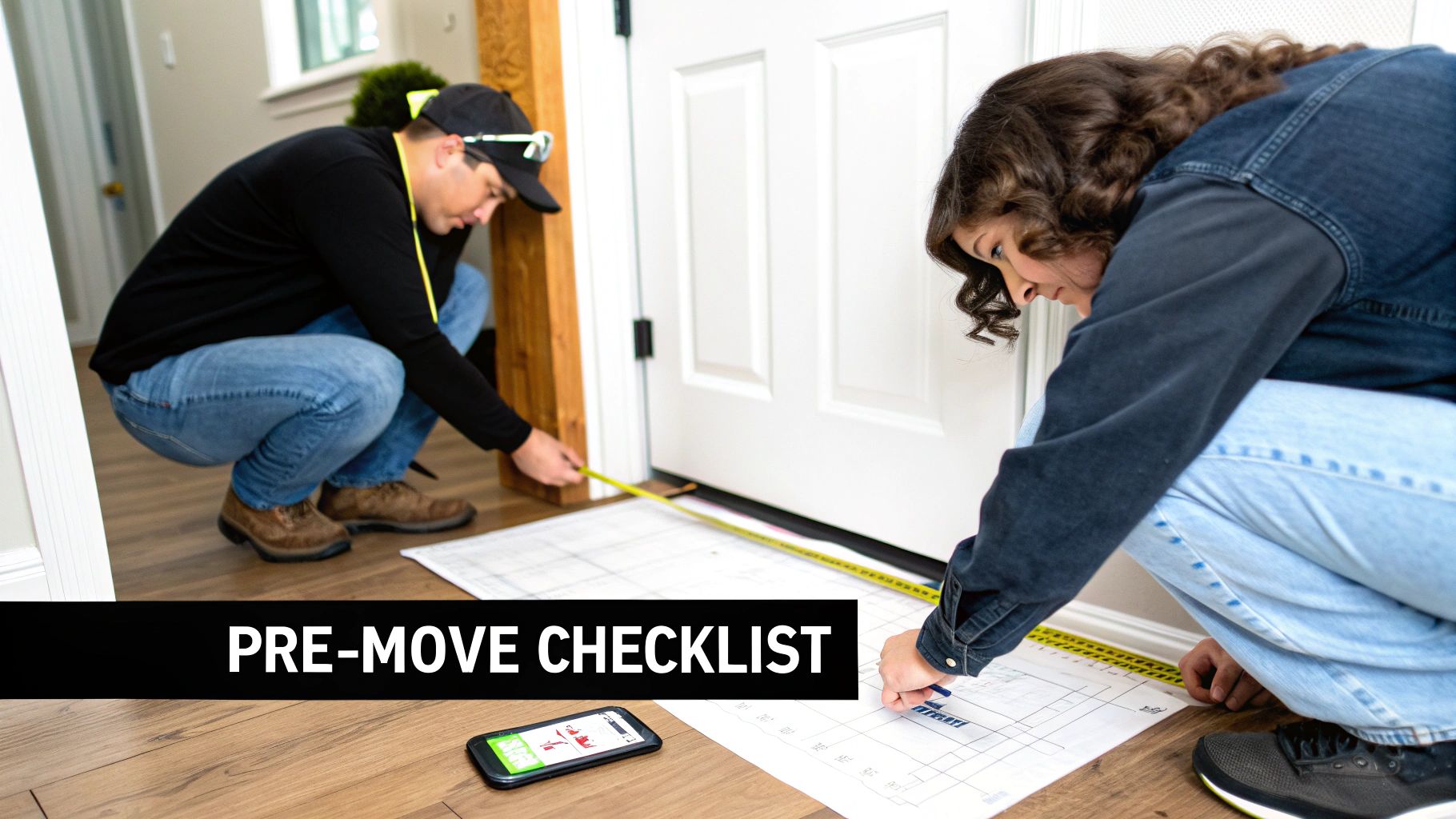
For larger tables, a pre-move site inspection is almost always non-negotiable. It’s the only way for the moving team to accurately measure doorways, assess staircase angles, and determine if specialised equipment—or in rare cases, even a crane lift via a balcony—is necessary.

How Size Directly Affects Your Quote

When you’re requesting a quote, providing accurate dimensions is crucial. It’s the best way to get an accurate price and avoid any unexpected issues or costs on moving day. The size and complexity of the job are the biggest factors in determining the final cost.

For example, moving a 6 or 7-foot table on a ground floor in Melbourne might average around $550. However, that price can jump to over $1,550 for a 12-foot tournament table, and that’s before factoring in access challenges like stairs or tight turns. As you can see, size is the primary cost driver. You can get a better sense of how dimensions affect the overall load with our handy cubic metre calculator.

Industry data confirms this, showing that moving a larger 9-foot model often requires a site inspection, with stairs alone potentially adding $200 or more to the final bill. By giving your pool table mover the exact details from the start, you’re ensuring they arrive with the right team and the right equipment for a smooth, stress-free move.

The Anatomy of a Professional Pool Table Move

So, what truly separates a professional pool table mover from a standard removalist? It’s not just about brute strength. It's a precise, multi-stage process that treats your table like the finely-tuned instrument it is. Once you understand the detailed steps involved, you can see the real craftsmanship behind a seamless relocation.

The entire process begins long before any heavy lifting occurs. A professional team kicks things off with a systematic disassembly. This isn't just about unscrewing a few bolts; it’s a careful deconstruction where every single component is handled with its preservation and the upcoming journey in mind.

Meticulous Disassembly: The First Critical Step

The first components to be removed are the pockets and rails. Each bolt is carefully taken out and tracked, and the cushioned rails are handled gently to avoid any nicks or dents that could affect ball rebound and ruin your bank shots later. Getting this right is fundamental to how the table plays after the move.

Next comes one of the most delicate parts of the operation: removing the felt. Amateurs often rip it off, guaranteeing you’ll need to buy new felt. A professional, however, will use specialised tools to carefully pull out staples or release adhesive. This preserves the cloth so it can be perfectly re-stretched and re-fitted at your new location, saving you money and hassle.

A professional move is a choreographed sequence. Every action, from removing the first bolt to the final levelling, is performed with the specific goal of preserving the table's integrity and playability.

Protecting the Heart of the Table: The Slate

With the felt gone, the heart of the table is exposed—the heavy slate slabs. Depending on your table, this could be a single piece or, more commonly, three separate slabs. Each one is incredibly heavy and surprisingly brittle, a dangerous combination that makes it highly susceptible to cracking if not handled perfectly.

Experts will carefully lift out the slate, often using suction grips for a secure hold. Each piece is then immediately wrapped in heavy-duty moving blankets or placed into a custom-built wooden crate for transport. This step is non-negotiable. Slate must be transported vertically on its edge or perfectly flat to prevent stress fractures. It's the most critical part of ensuring your table survives the move unscathed. The level of care here is similar to what's needed for other large, delicate items, much like the process we follow for our specialist piano movers in Melbourne.

This infographic gives you an idea of the common sizes professionals deal with, each demanding a slightly different approach.

A process flow diagram illustrates small (7 feet), medium (9 feet), and large (12 feet) pool table sizes.

As you can see, the jump from a standard 7-foot table to a 12-foot beast significantly changes the scale of the slate and frame, which calls for even more specialised handling.

Precision Reassembly and Perfect Levelling

Once your table has arrived safely at its new home or office, the entire process is reversed with the same painstaking attention to detail. The frame is reassembled first, ensuring every joint is solid and secure. Then, the slate pieces are carefully laid back in place. The seams between them are filled with beeswax and scraped perfectly smooth to create a single, flawless playing surface.

Finally, the job is completed with two vital steps:

  1. Re-felting: The original felt is carefully re-stretched across the slate, eliminating any potential for wrinkles or loose spots that would disrupt ball roll and throw off your shots.
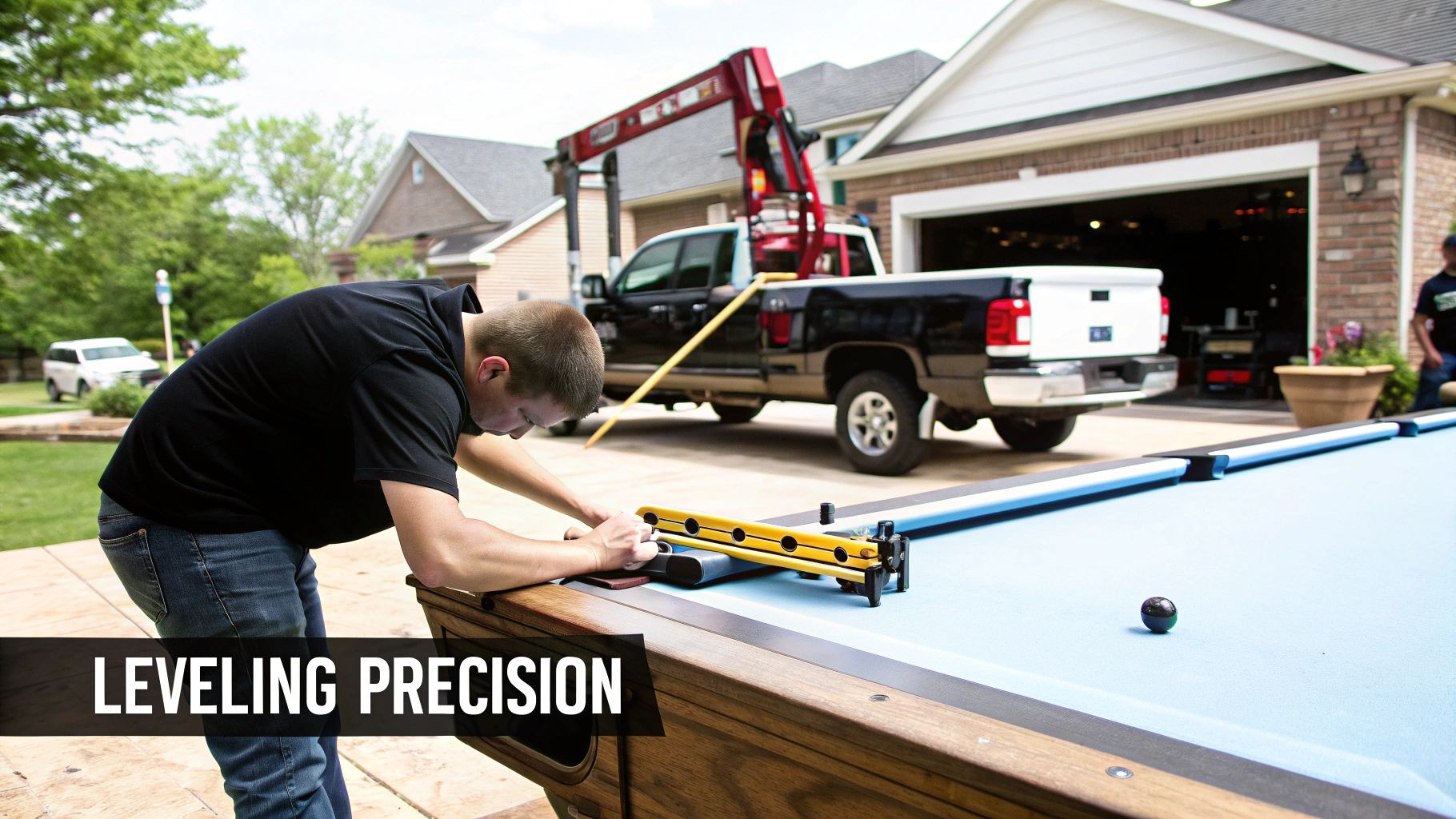
  2. Precision Levelling: Using a machinist’s level, the team makes minute adjustments to the legs and frame until the surface is absolutely flat. This is what guarantees a true, fair game every time you play.

This entire detailed process, from careful disassembly to flawless reassembly, is what truly defines a professional pool table mover. It's an investment in skill and specialised equipment that protects your table and ensures it’s ready for a game the moment we're done.

How to Choose the Right Pool Table Mover

Professional movers carefully transport a large, wrapped item while a specialist completes delivery paperwork.

Selecting the right crew to handle your pool table is the most critical decision you'll make in this process. It’s vital to understand that not all removalists are created equal. A general moving company, however competent, often lacks the specialised equipment and specific expertise required for this precise job. Entrusting your table to a non-specialist is a significant gamble.

What you need is a genuine pool table mover. These professionals bring more than just muscle; they come with years of dedicated experience, a steady hand, and the right tools for every step. Your mission is to find a dedicated expert in Melbourne who will treat your table with the respect it deserves, ensuring it arrives safely and is perfectly reassembled in its new spot.

Verifying Insurance and Credentials

Before you even start comparing quotes, the first and most crucial step is to verify their insurance. This is a non-negotiable checkpoint that instantly separates the legitimate professionals from the risky operators. Any reputable mover will have comprehensive insurance to protect you against unforeseen circumstances.

When speaking with potential movers, be direct. Ask about their Commercial General Liability (CGL) insurance, which covers property damage or injuries that could occur during the move. In addition, they must have transit insurance to protect your table while it's on the truck.

Ask for a certificate of currency for both public liability and transit insurance. A legitimate company like Get n Go Removals will happily provide this, giving you complete peace of mind that your valuable asset is protected.

Key Questions for Your Potential Mover

Once you've confirmed they are properly insured, it’s time to delve into the specifics of their process. The answers to a few smart questions will reveal their level of expertise and help you determine if they are the right fit for your needs.

Here’s a quick checklist of what to ask:

  • Do you use full-time employees or subcontractors? A company with its own trained, full-time team has far greater control over quality and consistency. Subcontractors can be a mixed bag in terms of experience and accountability.
  • What specific equipment do you use for pool tables? You want to hear them mention items like slate dollies, custom-built crates, professional levelling tools, and an ample supply of heavy-duty moving blankets.
  • Can you provide recent testimonials from other pool table clients? Genuine reviews that specifically mention pool table moves are invaluable. They are a strong indicator of their experience and a track record of satisfied customers.

Choosing the right removals firm can feel overwhelming, but a clear checklist makes it much simpler. For more in-depth advice, you can check out our guide on choosing the right removals firm for your move. By asking the right questions and prioritising specialist experience, you can confidently select a pool table mover who will protect your investment every step of the way.

Common Questions About Moving Your Pool Table

To help you feel completely prepared for moving day, we’ve put together answers to some of the most common questions our clients ask. This quick FAQ is designed to give you clear, straightforward information and make the whole process feel less daunting. Our goal is to ensure you have complete confidence, from your first call with us to the final, perfectly-levelled setup in your new home or office.

How Long Does a Pool Table Move Take?

This really depends on the table itself and the access at both your old and new properties. For a standard 7- or 8-foot table with straightforward ground-floor access at each end, the entire job—disassembly, transport, and reassembly—usually takes between 3 to 5 hours.

Of course, certain factors can extend this timeline. If you have a larger table, or if there are stairs, tight corners, or a long distance to travel, that will add to the overall time. A reliable pool table mover will always provide a more precise time estimate after gathering all the specific details of your job.

Do I Need to Do Anything to Prepare?

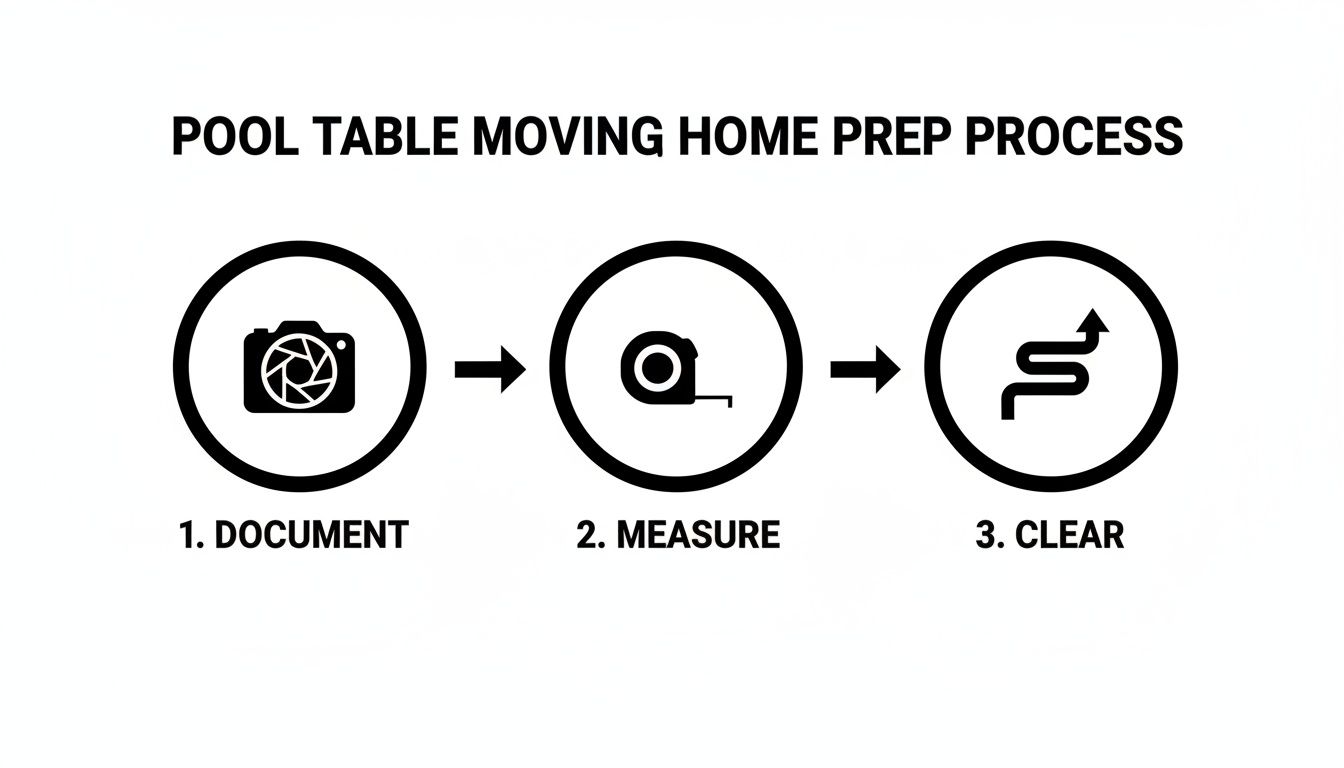
Your main task is to clear the path for the moving team. Ensure the room the table is being moved from, and the one it’s going to, are as clear as possible. This means moving other furniture, rolling up rugs, and shifting any obstacles out of the way, both within the rooms and along the route the movers will take.

The more space our team has to work, the more efficiently and safely they can handle the heavy components. A clear path prevents accidental bumps and ensures a smoother disassembly and reassembly process.

Also, if you're in an apartment or office building, it’s a great idea to book the service lift in advance. This one simple step can prevent significant delays on moving day and ensure a seamless transition.

Can You Move My Pool Table to Another State?

Absolutely. While much of our work is local within Melbourne, we regularly handle interstate relocations. When you're moving a pool table to another state, the logistics become more complex. This involves longer transit times and sometimes different crating requirements to ensure the slate is completely protected during a long journey.

It's crucial to hire a pool table mover with proven experience in long-distance transport. They will have the correct procedures, equipment, and insurance to get your table from Victoria to its new home, wherever that might be. Always mention any interstate plans upfront so you can receive an accurate quote and a realistic timeline for your move.


Ready to move your pool table without the stress and risk? Trust the specialists at Get n Go Removals Melbourne to handle your prized possession with the expert care it deserves. Contact us today for a free, no-obligation quote and experience a seamless move from start to finish. Learn more at https://www.getngoremovals.com.au.

READ MORE

Free Boxes for Moving: Your Ultimate Guide to Finding Them in Melbourne

Moving house can be an expensive undertaking, but your packing supplies don't have to break the bank. This guide is your ultimate resource for uncovering the most reliable spots across Melbourne to find sturdy, free boxes for moving for your home or office relocation. Think of it as your secret weapon for slashing moving costs right from the very start.

Your Comprehensive Guide to Sourcing Free Moving Boxes in Melbourne

Cardboard moving boxes stacked on a blue hand truck on a house porch, ready for relocation.

Relocating in Melbourne comes with its own set of costs, but tracking down packing materials shouldn't add to the financial strain. The hunt for free boxes has become a savvy move for budget-conscious people all over Victoria. It’s a simple yet highly effective way to cut down on one of the many expenses that come with setting up in a new home or office.

Why Sourcing Free Boxes is a Smart Move

Here in Australia, the DIY approach to finding packing materials is less of a trend and more of a practical, resourceful solution. Let's get practical: for a typical 2-bedroom apartment move—a common scenario in Melbourne where over 30% of residents rent—you’ll likely need around 20-30 boxes. Sourcing these for free can easily save you over $100, money that is much better spent elsewhere. This reduces financial stress and frees up your mental energy to focus on the logistics of the move itself.

But the benefits extend far beyond immediate savings:

  • Eco-Friendly and Sustainable: Reusing cardboard boxes is a fantastic way to be environmentally conscious. You're actively reducing waste and giving perfectly good materials a valuable second life.
  • Strengthens Community Ties: Using platforms like Gumtree or local Facebook groups often means you're connecting directly with neighbours who've just moved. It’s a great opportunity to build local goodwill before you've even unpacked.
  • Empowering and Resourceful: There's a genuine satisfaction that comes from being resourceful and taking firm control of your moving budget from day one.

Plan Your Search for a Seamless Move

Finding a sufficient number of quality boxes requires a bit of forward-thinking, but it's completely achievable. The secret is knowing precisely where to look and what to look for. This guide will walk you through Melbourne's most reliable local sources, from major retailers to the digital community noticeboards.

Of course, moving involves more than just collecting boxes. For those tackling a larger relocation, a robust long-distance moving checklist is an absolute lifesaver to ensure no detail gets overlooked. Preparation is the key to a stress-free experience, whether you're moving across the city or across the country.

Uncovering Free Boxes at Local Retail Stores

A person collects free cardboard boxes from a large stack in a store with t-shirts and a sign.

It might not be the first place that springs to mind, but Melbourne’s local retail scene is a fantastic and often overlooked source of high-quality, free boxes for moving. Supermarkets, department stores, and various specialty shops receive daily deliveries, leaving them with a surplus of sturdy cardboard that’s perfectly suited for packing your belongings.

The trick lies in knowing who to ask and the best way to approach them.

Your best bet is to start with large-format retailers and supermarkets. Think about the stores that sell bulky or heavy items—their boxes are specifically designed to handle significant weight. We're talking about your local Woolworths or Coles, and even larger stores like Big W or Officeworks. These businesses process dozens of boxes every single day.

A Winning Strategy for Retail Stores

Timing and courtesy are your most powerful tools here. If you rush in during the Saturday morning peak, you’re likely to get a swift "no." Instead, try visiting during a quieter period, like a weekday morning, when staff aren't overwhelmed with customers.

Your best approach is to find a manager or a team member working in the stockroom area. A simple, friendly inquiry works wonders. Just explain that you're moving house nearby and ask if they have any spare cardboard boxes they're about to recycle. Most of the time, they are more than happy to help you out—after all, it saves them the task of breaking the boxes down.

Identifying the Best Boxes for Your Move

Remember that not all boxes are created equal. When presented with a stack to sort through, it pays to be selective to ensure your belongings are properly protected.

Here’s what you should be looking for:

  • Produce Boxes: The boxes used to ship apples, bananas, or potatoes are absolute workhorses. They are often double-walled to protect the contents, making them ideal for heavy items like books, kitchen appliances, and tools.
  • Electronics and Appliance Boxes: These are literally engineered to keep fragile goods safe during transit, making them a perfect choice for your own delicate items. Plus, they're usually clean and in excellent condition.
  • Liquor Store Boxes: Boxes from your local bottle shop are a hidden gem. They often come with cardboard dividers inside, which are a lifesaver for packing glasses, jars, or any other items that need to be kept separate and secure.

Here’s a crucial piece of advice: always give the boxes a quick inspection before you take them. Look for any signs of dampness, food residue, or pests. You only want to bring clean, dry, and structurally sound boxes into your home.

Building a good rapport with a local store manager can be a game-changer, especially for a larger move. If you anticipate needing a steady supply over a few weeks, let them know. Many are happy to set boxes aside for you, creating a win-win situation for everyone.

A little bit of strategic planning here can genuinely save you a significant amount on your moving budget.

Tapping into Online Communities for Your Packing Supplies

In today's digital world, finding free boxes for moving can be as simple as a few clicks. Melbourne is buzzing with online communities where people who've just settled into their new homes are more than happy to pass on their leftover packing materials. It's a fantastic, eco-friendly method to get what you need without impacting your moving budget.

Your first stops should be platforms like Facebook Marketplace and Gumtree. These sites are a treasure trove of listings from locals all over Melbourne, from Footscray to St Kilda, who are eager to clear out the cardboard clutter after their move. A quick search for "free moving boxes" or "cardboard boxes" will almost always yield a healthy list of options.

How to Master Your Online Search

When it comes to free items online, speed is of the essence. Listings for quality moving boxes get snapped up quickly, so you need to be prompt and maintain a friendly approach.

Here are a few expert tips that really work:

  • Activate Alerts: Both Gumtree and Facebook Marketplace have alert features. Use them. You’ll get a notification the moment a new listing for free boxes goes live in your area, giving you a competitive edge.
  • Join Local Community Groups: This is a major one. Search on Facebook for community groups specific to your suburb, like the "Brunswick Good Karma Network" or "St Kilda Community Hub." These hyper-local groups are filled with neighbours willing to help each other out.
  • Post a 'Wanted' Ad: Don't just wait for listings to appear. Be proactive and post a polite message explaining you're moving and are on the lookout for boxes.

Not sure what to write? Feel free to adapt this template:

"Hi neighbours! My family and I are moving house in a couple of weeks and we're on the hunt for some cardboard boxes to help with our packing. If you've recently moved and have any you'd like to get rid of, we would be incredibly grateful to take them off your hands! We can arrange a quick and easy pickup. Thanks so much!"

Arranging a Safe and Smooth Pickup

Once you've found a source, clear communication is paramount. Be polite and flexible when arranging a time to collect the boxes. Always double-check the address and be punctual. Remember, someone is doing you a favour, so making the process as hassle-free as possible for them goes a long way.

With Australia’s interstate moves hitting an average of 200,000 annually, and thousands of local shifts happening in Victoria every month, there's a constant flow of used boxes entering these online communities. It's a tried-and-true method for Melbourne movers and a great addition to our other tips to keep your moving costs down.

How to Properly Inspect and Prepare Used Boxes

Scoring a haul of free moving boxes is a brilliant start, but don't start packing just yet. Taking a few minutes to inspect and prepare them is the crucial step that separates a smooth move from a sidewalk disaster. Skipping this can quickly turn your money-saving hack into a costly headache.

Think of yourself as a quality control manager for your own move. Your mission is to identify and discard any boxes that might fail under pressure. A weak or compromised box is just asking for trouble on moving day.

What to Look For During Inspection

Before a box earns its place in your packing arsenal, give it a quick but thorough inspection. You’re looking for any red flags that signal it's not up to the task.

Here are the main things to watch out for:

  • Signs of Moisture: Look for water stains, unusual discolouration, or a soft, warped texture. A box that has been wet has lost its structural integrity and is essentially useless for moving.
  • Pests or Odours: Check for tiny holes, droppings, or any strange smells. The last thing you want is to accidentally transport critters or a musty odour into your new home.
  • Grease or Food Stains: Boxes from supermarkets or restaurants can sometimes have oily patches. This grease can easily transfer to your belongings, so it's best to avoid these.

Remember, the strength of the box is paramount. If a corner is already crushed or a seam looks like it's about to tear, don't risk it. It's far better to recycle a questionable box now than to watch its bottom give way while you're carrying your grandmother's precious dinner set.

A diagram showing a three-step process for finding free boxes: Post, Spot, Pickup.

Reinforcing and Preparing Your Boxes

Once you’ve selected the best boxes from your collection, a little reinforcement can make a world of difference. Grab some good-quality packing tape and focus on the bottom seams.

Run one solid strip of tape right down the main seam where the flaps meet. Then, add two more strips across it to create a strong 'H' pattern. This simple trick adds significant extra strength and prevents unexpected blowouts. For anything particularly heavy or delicate, you might want to see how our professional team packs fragile items for moving to ensure everything is rock-solid.

With your boxes reinforced, the final preparation is all about organisation. Knowing exactly what's inside each one will save you a world of frustration during unpacking. For some excellent systems and tips, check out this guide on How to Label Moving Boxes. A few minutes of prep now makes moving day—and the first few days in your new home—infinitely smoother.

When Buying New Boxes Is the Smarter Choice

Hunting down free boxes for moving around Melbourne is a brilliant way to cut costs, there's no doubt about it. But there are times when your time, energy, and peace of mind are worth more than the money saved.

Scouring the suburbs for quality used boxes can be a significant time commitment. When you're facing a tight deadline or dealing with precious, fragile, or valuable belongings, making the decision to invest in new, purpose-built moving materials is often the shrewdest move you can make.

The peace of mind that comes with brand-new boxes is invaluable. Unlike their pre-loved counterparts, you won't be second-guessing hidden weaknesses, strange odours, or wondering if you've accidentally brought home some unwanted pests. They provide a clean, strong, and consistent foundation for a smooth and secure packing process.

The Clear Advantages of Professional Packing Materials

Purpose-built moving boxes are engineered for one specific job: getting your belongings from A to B safely. They offer a level of sturdiness and efficiency that a random assortment of used boxes simply cannot match. This consistency is a massive advantage when it comes to loading the truck.

Consider these key benefits:

  • Uniform Sizing: New boxes are a removalist's dream. They stack perfectly in the truck, creating stable, secure tiers that are far less likely to shift, topple, or be crushed during transit. This protects all of your belongings.
  • Guaranteed Strength: You can pack heavy items like books, plates, and electronics with complete confidence, knowing the bottom isn't going to suddenly give way. This is a risk you take with every used box.
  • Specialised Protection: For awkward items like artwork, large mirrors, or your best suits, specialised wardrobe and picture boxes offer tailored protection that you simply won't find sitting outside a supermarket.

For a typical 3-bedroom house move, you might need around 70 boxes. While finding all of those for free is a huge saving, it's often a smart strategy to mix and match. Source what you can for free, but supplement with professional materials for your most important items to ensure they arrive in one piece. You can learn more about finding the right balance between cost and secure packing.

Investing in quality materials for your most important possessions isn't just about buying cardboard; it's about buying the confidence that your valuables are properly protected.

Our Professional Packing and Material Supply Services

We understand completely. At Get n Go Removals, we know that for many people, packing is the single most overwhelming part of moving.

That’s why we offer solutions tailored to your exact needs. We can deliver our premium-grade packing materials directly to your door, or we can step in and handle everything with our full, white-glove packing and unpacking service. Our experienced team uses a systematic approach and the best supplies to ensure every single item is secured correctly, saving you countless hours and a great deal of stress.

Free Boxes vs Professional Packing Services

Deciding between sourcing your own boxes and opting for a professional service comes down to your priorities. To help you weigh the options, here's a quick comparison of what to expect from each approach.

Factor Free Used Boxes Professional Packing Solutions
Cost $0 (just your time and petrol). Involves a financial cost for materials and/or labour.
Time Investment High. Requires hunting, collecting, and cleaning boxes. Minimal. Materials are delivered or everything is done for you.
Quality & Strength Inconsistent. Varies greatly, may have weaknesses or damage. High. New, strong, and specifically designed for moving.
Protection Level Basic. Not ideal for very fragile or valuable items. Excellent. Uniform sizes stack securely and protect contents.
Convenience Low. Can be a logistical challenge to find enough quality boxes. High. A stress-free, efficient, and reliable solution.
Best For Budget-conscious moves with sturdy, non-fragile items. Moves with tight timelines, valuable items, or anyone wanting to reduce stress.

Ultimately, the right choice depends on your specific move. A hybrid approach often works best: use free boxes for durable goods like clothes and books, and invest in professional materials or services for the fragile and valuable items that matter most.

Answering Your Top Questions About Moving Boxes

Even the most organised mover has questions pop up during the packing frenzy. To give you more clarity, we’ve tackled some of the most common queries we get from Melburnians about finding and using packing boxes. Nailing these details can make all the difference on moving day.

How Many Free Boxes Do I Actually Need?

Figuring out the right number of boxes is one of the trickiest parts of the process. You don't want to be left scrambling for more at the last minute, but you also don’t want a cardboard mountain taking over your new living room. The perfect number depends on the size of your home and, just as importantly, how much stuff you own.

As a general starting point for a typical Melbourne home, these numbers are a reliable guide:

  • 1-Bedroom Apartment: You'll likely need around 20-30 boxes. This usually covers the essentials for one or two people across a kitchen, bedroom, and living space.
  • 2-Bedroom Home: Plan for somewhere between 30-50 boxes. This accounts for the extra bedroom and the typical increase in kitchen and living room items.
  • 3-Bedroom House: Aim for 50-80 boxes. Families tend to have significantly more belongings, so it’s always smart to gather a larger supply.

Here's my top tip from years in the industry: always get more boxes than you think you need. It is far less stressful to have a few spares than to be desperately hunting for more the night before the truck arrives. A quick walk-through of each room, mentally tallying what needs packing, will give you a much more accurate count than a wild guess.

Are Grocery Store Boxes Strong Enough for Heavy Items?

That's a fantastic question, and the honest answer is: it really depends. You need to become a bit of a box detective. Some boxes you find at the supermarket are absolute gold, while others wouldn't be safe holding a couple of pillows.

The ones you should actively seek out are the produce boxes—specifically, those used to ship hard fruits and vegetables like apples, bananas, or oranges. These are almost always made from double-walled corrugated cardboard designed to survive long journeys, making them perfect for heavy items like books, dishes, or kitchen gadgets.

Conversely, you should give a hard pass to the flimsy boxes that held items like cereal, biscuits, or chips. That thin packaging simply isn't built to carry any real weight and will almost certainly fail. Also, be sure to avoid anything that shows signs of being wet or having held leaky products.

What Should I Do with All My Boxes After I've Moved?

Once the last item is unpacked and you're finally settling in, the best thing you can do is pay it forward. You’ve just benefited from a great community recycling loop, so now it’s your turn to help the next person on the hunt for free boxes for moving.

Flatten down any boxes that are still in good condition and post a listing on the same platforms you found them, like Gumtree or your local Melbourne Facebook group. It’s a simple gesture that saves someone else money and keeps perfectly good cardboard out of landfill.

If some boxes are looking a bit worse for wear after the move, don't just toss them in the general waste. Break them down and place them in your council recycling bin. This ensures the cardboard gets properly processed and contributes to Victoria's recycling efforts.

Is It Safe to Get Boxes from Someone on Gumtree or Facebook?

For the most part, yes, it’s a very safe and common way to get your hands on boxes. The vast majority of people listing them are just like you—they’ve just moved and are keen to clear the clutter from their new place. Think of it as a community of movers helping each other out.

That said, it’s always wise to use common sense when meeting anyone from an online ad. Try to arrange the pickup during daylight hours, and if possible, meet in a public spot. If you are collecting from their home, it never hurts to bring a friend or family member along with you.

Before you start loading up your car, give the boxes a quick inspection for any of those red flags we discussed, like damp patches or signs of pests. Taking these simple precautions will help ensure your box-hunting mission is both safe and successful. If you have any more questions about the moving process, you'll likely find the answers on our extensive FAQs page.


When free boxes aren't cutting it, or you simply want the peace of mind that comes with professional-grade materials, Get n Go Removals Melbourne is here to help. From supplying top-quality packing materials to handling the entire packing job for you, we make sure your belongings are safe and your move is stress-free. Explore our packing services today!

READ MORE

Office Moving Melbourne: A Complete Guide to a Seamless Relocation

Relocating your Melbourne office is a monumental project, and it's about so much more than just shifting desks and chairs. This is a strategic business decision that directly impacts your team's productivity, operational continuity, and ultimately, your bottom line. A successful commercial relocation hinges on a detailed, forward-thinking plan, turning what could be a chaotic disruption into a smooth transition and an opportunity for growth.

Why Your Melbourne Office Move Demands a Strategic Plan

An office move is easily one of the most complex logistical challenges any business will face. Attempting to manage it without a clear roadmap is a direct path to extended downtime, unforeseen costs, and a highly frustrated team. A well-thought-out strategy, however, transforms this potential headache into a genuine opportunity to enhance your workplace culture and operational efficiency.

Putting in the planning time ensures every detail is meticulously covered, from migrating your critical IT systems to coordinating lift access with building management. For a deeper dive into all the moving parts, this comprehensive guide to office relocations is a great resource to get you started.

Melbourne's Evolving Commercial Landscape

The decision to move is often sparked by growth, downsizing, or simply the need for a more strategic location. Melbourne’s office market has undergone dramatic shifts recently, making these strategic decisions more critical than ever.

Since 2020, the city’s CBD has added a staggering 584,100 square metres of new office space—a 12.2% increase in total stock. This boom, combined with new hybrid work models, led to high vacancy rates. In early 2025, the CBD vacancy rate sat at 18%, significantly above the national average. This unique market presents both challenges and opportunities for businesses planning an office move in Melbourne.

The Core Benefits of a Planned Relocation

Taking a structured approach to your office move delivers tangible benefits that protect your business from the chaos of a poorly executed relocation.

  • Minimised Downtime: A detailed plan allows you to schedule the physical move over a weekend or after hours. Your team can pack up on a Friday and walk into a fully functional, ready-to-go workspace on Monday morning, ensuring business continuity.
  • Budget Control: Professional planning provides a transparent view of all costs upfront. Expenses like council permits, IT setup, and 'make-good' lease clauses won't emerge as last-minute surprises that blow your budget.
  • Boosted Team Morale: When a move is organised and communication is clear, it removes a significant amount of stress from your employees. They feel valued and can stay focused on their roles instead of worrying about logistical uncertainties.
  • Operational Efficiency: A relocation is the perfect opportunity to rethink your office layout, daily workflows, and technology. You have the chance to design and build a more productive and collaborative environment from the ground up.

Ultimately, understanding why hiring professional removal services is a smart move is the foundational step towards achieving a seamless, stress-free transition for your entire organisation.

Building Your Relocation Blueprint and Timeline

A successful office move in Melbourne is built on one thing: a comprehensive plan. "Winging it" is a recipe for chaos, blown budgets, and immense stress for your staff. By mapping out every stage months in advance, you transform a daunting project into a series of clear, manageable steps.

Think of this timeline as your project's command centre. It breaks the entire process into smaller, achievable goals, providing clarity for your team and keeping all vendors accountable.

This guide outlines the key phases of your relocation journey, from initial strategic planning right through to settling into your new, optimised workspace.

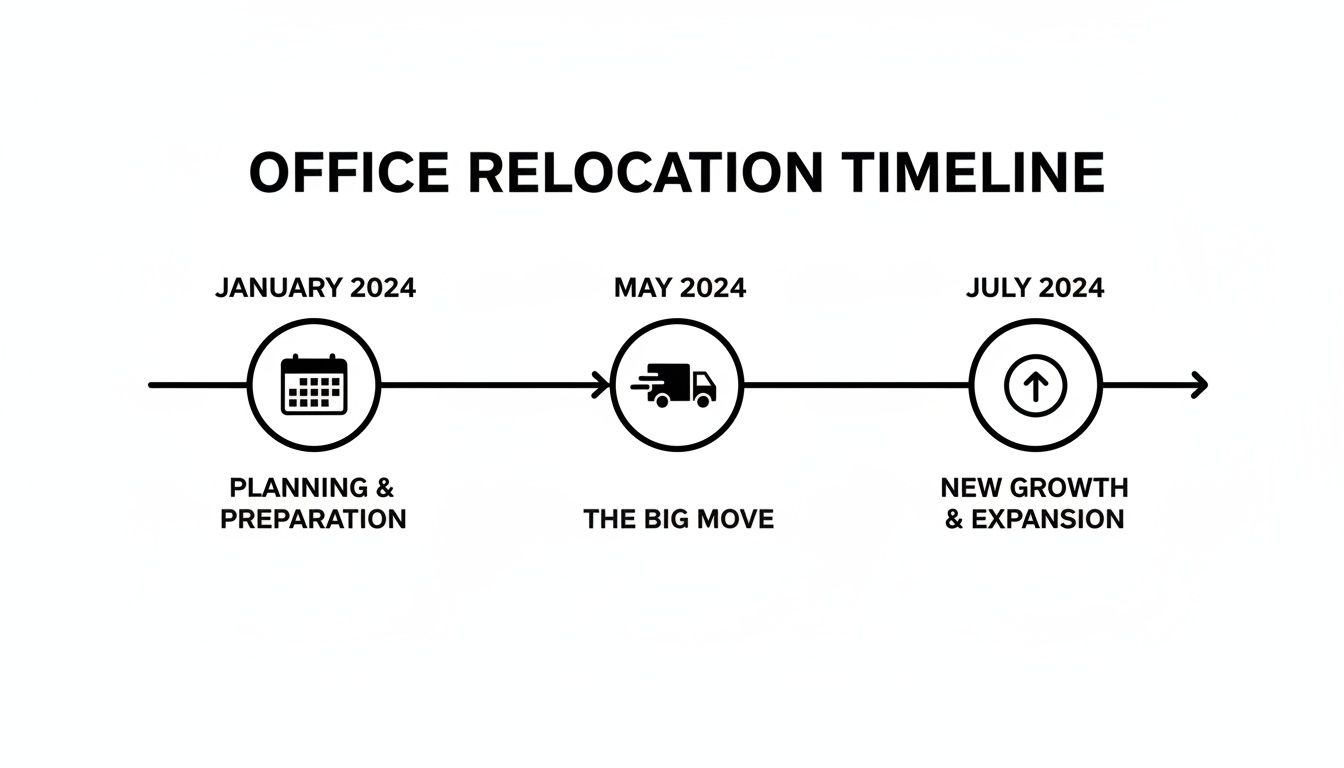
Timeline graphic illustrating office relocation stages: planning, moving, and new growth throughout 2024.

As you can see, a smooth move is a marathon, not a sprint. Each stage is designed to be strategic, ensuring no detail is overlooked.

The Foundation Phase: 3 to 6 Months Out

Your journey begins long before a single box is packed. This early stage is all about strategy and laying the groundwork that will define the entire project's success.

First, appoint an internal move coordinator or a small committee. This person or group will serve as the central point of contact for staff, vendors, and building managers, keeping the project on track and ensuring communication flows smoothly.

Next, you must set a realistic budget. This goes beyond the removalist's fee. You need to factor in costs for new furniture, IT upgrades, bond cleaning at the old premises, and any 'make-good' clauses in your current lease. A detailed budget prevents costly surprises down the line.

Finally, conduct a full audit of your current assets. Go room by room to determine what’s coming with you, what can be sold or donated, and what needs to be disposed of. This is also the perfect time to identify needs for new furniture or technology.

The Coordination Phase: 1 to 2 Months Out

As moving day approaches, the focus shifts from high-level strategy to logistical details. This is where all the pieces of the puzzle begin to fit together.

A critical task now is to finalise the floor plan for the new office. Work with designers and department heads to map out the precise location for every team, desk, and piece of equipment. This plan is an invaluable tool for the movers, IT technicians, and your own team on day one.

This is also the time to engage your IT team heavily. A seamless technology transition is non-negotiable. They must plan every detail, from server migration and data backups to setting up the network and ensuring every workstation is online and functional from the moment you move in.

Don't forget to sort out any permits! For many office moves in Melbourne, particularly in the CBD or inner suburbs, you may need council permits for truck parking or to book a loading dock. Missing this crucial step can lead to significant delays and fines.

The Final Stretch: The Last 4 Weeks

The final month is about locking in details, communicating clearly, and making final preparations. Meticulous attention to detail now will ensure a much smoother move day.

Your primary focus should be your communication plan. Inform all employees about key dates, their responsibilities (like packing personal desk items), and the move-day schedule. You also need to notify all external partners—clients, suppliers, and service providers—of your new address and the date of the change.

During these last few weeks, maintain constant communication with all your vendors.

  • Confirm Dates and Times: Double-check your bookings with the removalist, IT technicians, cleaners, and any other involved parties.
  • Provide Final Details: Share the finalised floor plan and any specific access instructions with your moving crew.
  • Arrange Access: Ensure keys, security cards, and lift access are organised for both the old and new buildings.

To give you a clearer picture, we've created a comprehensive timeline checklist. This breaks down key tasks into a manageable schedule, ensuring nothing slips through the cracks as you count down to moving day.

Office Relocation Timeline Checklist

Timeframe Before Move Key Planning Tasks Logistics & Coordination Communication
3-6 Months Appoint move coordinator. Set budget. Review lease agreements. Audit current assets (furniture, IT). Research and get quotes from removalists. Begin space planning for the new office. Announce the move internally to key stakeholders.
2-3 Months Finalise new office floor plan. Order new furniture and equipment. Select your removalist and other vendors. Book removalist. Plan IT infrastructure migration. Start decluttering and disposing of unwanted items. Notify staff of the moving date. Create a detailed communication plan for employees, clients, and suppliers.
1-2 Months Assign packing responsibilities to departments/staff. Organise 'make-good' repairs for the old office. Arrange necessary council/building permits. Coordinate with IT for network setup. Schedule cleaners for both locations. Send out official change-of-address notifications to clients and suppliers. Update company website and materials.
Last 4 Weeks Distribute packing materials (boxes, labels). Confirm insurance coverage for the move. Finalise move schedule with all vendors. Arrange access (keys, security fobs, lift bookings) for the move team. Send regular update emails to staff with packing instructions and move-day logistics.
Move Week Complete all packing. Clearly label all boxes and furniture with their new location. Pack an "essentials" box. Conduct a final walkthrough with vendors. Confirm disconnection/reconnection of utilities. Remind staff of the final schedule and their roles. Set up an out-of-office message for the moving period.
Move Day Supervise movers at both locations. Ensure protection for floors/walls. Check off inventory as it's loaded/unloaded. Guide movers according to the floor plan at the new office. Begin workstation and IT setup. Be available to answer staff questions. Send a "welcome to the new office" communication.

Following a structured timeline like this is the most effective way to keep your office relocation organised, on schedule, and within budget, making the entire process far less stressful for everyone involved.

When building your blueprint, looking into dedicated storage units for offices can be a smart move to manage furniture and equipment. It’s especially useful for archiving documents or storing surplus items you don't need immediately. Finding the right professional assistance is a key part of this process; learn more about finding the right business moving companies near me to handle the logistics.

Mastering Your Move Day Logistics

The difference between a move day from hell and one that’s barely a blip on the radar always comes down to on-the-day logistics. Get it right, and your team walks into a productive new space on Monday morning. Get it wrong, and you're facing frustrating delays and unexpected costs.

Success boils down to three core elements: a flawless IT migration, a careful plan for your furniture and physical assets, and expert navigation of Melbourne's unique building and street-level challenges. A failure in any of these areas can quickly derail your move.

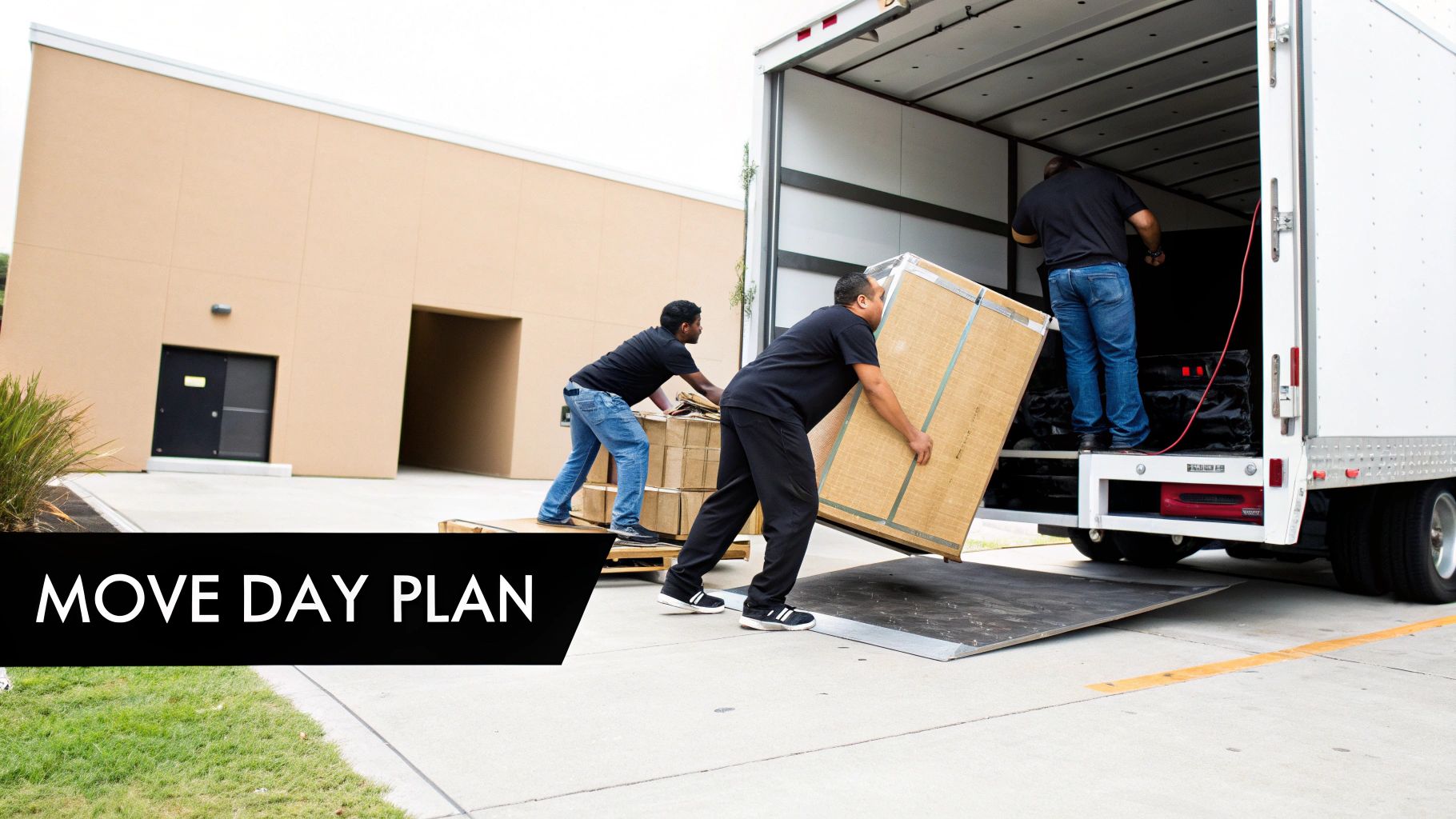
Three men load large boxes and items onto a moving truck using a ramp on move day.

Executing a Seamless IT Migration

Your technology is the central nervous system of your business. A bungled IT move can bring operations to a complete standstill. The goal is zero downtime, which demands a specialist plan that goes far beyond simply unplugging monitors.

This is a job for your IT team or a third-party tech specialist, who must be involved weeks in advance. They need to map out the entire process, from decommissioning servers and backing up data to getting the network fully operational at the new office. This is a technical task that should never be left to general movers.

Here’s what your IT migration plan must cover:

  • Servers and Network Gear: This is the heart of your operation. It should be the absolute last thing disconnected at the old office and the very first thing connected, configured, and tested at the new one. No exceptions.
  • Workstation Reconnection: A simple but brilliant tactic: create a clear labelling system. Every computer, monitor, and peripheral must be matched to a specific desk on the new floor plan. This single step prevents hours of chaos and confusion.
  • Data Security: Before a single piece of hardware is moved, ensure everything is securely backed up. Whether to the cloud or an off-site server, a verified backup is your non-negotiable safety net.

Handling Furniture and Equipment with Care

Moving office furniture requires more than just brute strength. Modern workstations can be complex, and delicate equipment needs expert handling to avoid expensive damage. A systematic approach is essential.

Professional office removalists are skilled at dismantling and reassembling modular desks, partitions, and shelving systems. This is crucial for navigating tight doorways and ensuring everything is reassembled correctly at the destination, protecting your investment.

Key Takeaway: A move is the perfect opportunity for a clear-out. Audit your inventory and identify any furniture that’s broken, outdated, or unsuitable for the new space. Arranging for ethical disposal or donation beforehand saves time, effort, and money on move day.

Sensitive equipment like large-format printers, plotters, and specialised machinery requires extra care. We use industrial-grade wraps, custom crates, and purpose-built trolleys to ensure these high-value assets arrive in the exact same condition they left. For tips on packing smaller items, take a look at our guide on essential packing tips for moving.

Navigating Melbourne-Specific Building Logistics

This is where local, on-the-ground experience provides immense value. The unique challenges of moving within Melbourne’s CBD and inner suburbs can completely derail a relocation if you’re not prepared. High-rise buildings, narrow laneways, and strict council regulations demand meticulous forward planning.

One of the most common—and costly—mistakes we see is failing to coordinate with building management at both locations. It is absolutely essential to sort out these details well in advance to ensure the truck and crew have the required access.

Here's a checklist of Melbourne-specific hurdles you must clear:

  1. Loading Dock Bookings: Nearly every commercial building in Melbourne requires you to book a time slot for the loading dock. These slots fill up quickly, especially on Fridays, so book as early as possible.
  2. Dedicated Lift Access: You will almost certainly need to book a dedicated goods lift. This often requires arranging for a building manager to be present to lock it off for your exclusive use, which can sometimes involve a fee.
  3. Council Parking Permits: Attempting to park a large moving truck on the street in the CBD, Southbank, or Fitzroy without a permit is a recipe for disaster. You must apply to the local council in advance, or you risk fines and having nowhere to park.

Managing these logistics is a standard part of any professional office moving Melbourne service. A reputable local mover understands the specific permit requirements and has established relationships with building managers, taking a huge amount of stress off your plate. This expertise is particularly important as Melbourne has reclaimed its status as Australia's top moving destination, capturing 28% of all inbound metro moves recently. You can find more details in these fascinating reports on Australia's moving and migration statistics.

How to Minimize Business Downtime During Your Move

Every hour your business is offline during a move translates to lost revenue and productivity. The primary goal of a robust relocation strategy is to shrink that window of disruption as much as humanly possible. A perfectly executed move means your team powers down on a Friday afternoon and walks into a fully operational, connected, and organised new office on Monday morning.

This seamless transition doesn’t happen by chance; it is the result of intelligent scheduling and strategic delegation. For any business undertaking an office move in Melbourne, mastering this aspect is key to protecting your bottom line.

A desk with a laptop displaying 'DAY ONE', a work bag, stationery, and a phone, suggesting a fresh start.

The current commercial property landscape in Melbourne adds another layer of urgency. A significant post-pandemic shift has left the CBD with soaring office vacancy rates, hitting 18% in January 2025—a huge jump from the pre-COVID figure of just 3.4%. While this provides more negotiating power to secure a great space, it also intensifies the pressure to operate with maximum efficiency. You can get more details from the Property Council of Australia's market analysis.

Embrace the After-Hours Advantage

The single most effective way to maintain business operations is to schedule the physical move outside of your standard 9-to-5 working hours. In almost every case, this means booking a weekend or after-hours move.

The logic is simple but incredibly powerful. By having professionals handle the heavy lifting while your business is naturally closed, you eliminate any conflict between moving-day chaos and revenue-generating activities.

Weekend Move Scenario: Picture this. Your team finishes work as normal on Friday. Over the weekend, the movers pack, transport, and set up everything at the new location. On Monday, your staff arrive at their new desks, log in, and resume their work with zero interruption to the business week.

This approach transforms what could be a multi-day operational halt into a smooth, background process that happens seamlessly.

Delegate Packing and Unpacking

It might seem cost-effective to have your employees pack their own desks, but this is almost always a false economy. Every hour your team spends wrapping monitors or boxing up files is an hour they aren't dedicating to their core job functions. The "soft cost" of that lost productivity adds up quickly.

Engaging professional packing and unpacking services is a game-changer for efficiency.

  • Expert Packers: They are trained to pack office equipment securely and swiftly, using the right materials to protect everything from fragile tech to bulky furniture.
  • Systematic Unpacking: We work directly from your new floor plan to place every box and piece of furniture in its designated spot, ready for your team to connect and start work.
  • Focus and Continuity: Your employees remain focused on their core responsibilities right up until the last minute, ensuring client work and projects continue without interruption.

By delegating this labour-intensive task, you empower your team to do what they do best, making the entire relocation far more efficient. You can explore the full suite of options from our Melbourne commercial office removalists.

Prepare for a Productive First Day

A smooth start in the new space is vital for morale and a swift return to full productivity. Clear communication and thoughtful preparation are your best tools here.

Ensure every team member receives a detailed floor plan well before moving day. It should clearly show the location of their new desk, along with key areas like meeting rooms, kitchens, and bathrooms. This simple step eliminates the "where do I go?" confusion and helps everyone feel settled from the moment they arrive.

Another highly effective strategy is the 'Day One Essentials' kit. This is a clearly marked box for each employee containing everything they need to be productive immediately:

  • Laptop and chargers
  • Keyboard and mouse
  • Essential documents or files
  • Personal items like photos or stationery

By ensuring these boxes are the last to be packed and the first to be opened, you guarantee every employee can get online and start working within minutes of arriving. It’s a small detail that makes a massive difference in achieving a zero-downtime move.

Settling In and Finalizing Your Relocation

The moment the last box is placed in your new office, it’s easy to breathe a sigh of relief. While the heavy lifting is certainly over, the crucial work of settling in has just begun. This final phase is essential for transforming the new space into a fully functioning business hub and ensuring a smooth transition for your entire team.

The move isn't truly "complete" until every item is accounted for and all administrative details are finalised. Getting this stage right sets the tone for your company's success in its new Melbourne home.

Conduct a Thorough Post-Move Audit

Before your moving team signs off, it is vital to conduct a final walkthrough of the new premises. This isn't just a quick glance; it's a systematic audit to confirm that every aspect of the move has been completed to your satisfaction.

With your inventory checklist in hand, walk through the space with your move coordinator. Check that all furniture, equipment, and labelled boxes have arrived and are in their designated spots as per the floor plan. This is also the time to inspect for any damage that may have occurred during transit.

Pro Tip: Do not rush this process. A professional moving company will expect and encourage a detailed final inspection. It is far easier to address any issues, such as a missing box or a scuffed desk, while the crew is still on-site.

This final check ensures accountability and provides complete peace of mind before you officially sign off and finalise the project.

Manage the Unpacking Process Systematically

Now that everything is in place, the task of unpacking begins. A strategic approach here can make a world of difference, preventing chaos and getting your team back to full productivity much faster. If you’ve opted for a professional unpacking service, the crew will handle this efficiently.

If your team is managing it themselves, provide clear guidance to avoid a disorganised free-for-all.

  • Prioritise Workstations First: The primary goal is to get your team operational. Focus on unpacking computers, monitors, keyboards, and the 'Day One Essentials' boxes for each employee so they can log in and resume work.
  • Tackle Communal Areas Next: Once workstations are functional, move on to shared spaces like the kitchen, meeting rooms, and supply closets. This helps restore a sense of normalcy and office culture.
  • Set a Deadline for Personal Items: Encourage staff to unpack their personal desk items within the first day or two. This small step helps them feel settled and fosters a sense of ownership over their new workspace.

A systematic unpacking process prevents the new office from feeling like a temporary storage unit for weeks on end.

Finalise Critical Administrative Updates

With the physical move handled, the last crucial step is updating your business details across all platforms. Overlooking this administrative task can lead to missed deliveries, confused clients, and even service interruptions. Your new address must be officially registered everywhere your business has a presence.

Create a comprehensive checklist to ensure nothing is missed:

  1. Government and Legal Bodies: Update your address with ASIC, the ATO, and any other relevant regulatory bodies.
  2. Online Presence: This is vital. Immediately update your Google Business Profile, company website, social media pages, and any online directories you're listed in.
  3. Suppliers and Service Providers: Notify your bank, insurance provider, utility companies, and all key vendors of your new address.
  4. Clients and Customers: Send a formal communication to all clients, informing them of your new location and updated contact details.

Organise for the Long Term

A new office provides a fantastic opportunity to implement better organisational systems from day one. It's the perfect time to consider how you'll manage assets that don't fit into the immediate floor plan. For items like surplus furniture, archival documents, or seasonal equipment, using a professional service can be a highly effective strategy. Learn more about how secure storage solutions in Melbourne can help keep your new workspace clutter-free and efficient right from the start.

Your Top Melbourne Office Moving Questions Answered

Moving your entire business generates a lot of questions. We understand. From determining the budget to ensuring your team isn't left unproductive, getting the right answers upfront is a game-changer. Here’s a rundown of the most common queries we receive about office moving in Melbourne, with practical, straightforward advice to help you plan effectively.

How Is the Cost of an Office Move in Melbourne Calculated?

There is no one-size-fits-all price for an office move, as the final cost depends on several key factors. The primary drivers are the size of your office, the volume of items to be moved, the distance between locations, and any additional services required.

A detailed quote will factor in the number of workstations, any specialised equipment (like server racks or heavy machinery), and the access conditions at both buildings. Navigating a multi-storey building with strict lift booking times or accessing a tight CBD laneway requires more planning and manpower, which naturally influences the price.

Additional services also impact the cost:

  • Professional Packing and Unpacking: A full-service option that saves your team a significant amount of time and lost productivity.
  • IT Disconnection and Reconnection: A specialist service required to ensure your technology is handled correctly and securely.
  • Furniture Disassembly and Reassembly: Essential for modular desks, workstations, and large boardroom tables.

While a small office move might cost a few thousand dollars, a large corporate relocation is a more substantial investment. The only way to get an accurate figure is through an on-site assessment. This allows for a transparent, detailed quote you can trust, whether it's a fixed price or an hourly rate.

What Is the Best Way to Move Without Disrupting Our Business?

Minimising downtime is the absolute number one priority for any commercial relocation. The most effective strategy to achieve this is to schedule the physical move outside of your standard business hours.

By far, the best and most popular approach is the weekend move. This allows your team to finish their work week as normal on Friday, then walk into a fully set-up, operational new office on Monday morning. It transforms a potentially major disruption into a seamless background event.

To execute this, you need to partner with professional movers who offer flexible, 24/7 scheduling. Furthermore, utilising a full-service packing and unpacking team enables your staff to remain productive on their core tasks right up until the last minute, ensuring a genuinely uninterrupted transition.

What Should I Look for in a Melbourne Office Removalist?

Choosing the right moving partner is absolutely critical. You need a company with proven, specific experience in commercial relocations—not just a residential mover. Always verify that they hold comprehensive insurance, including Public Liability and Transit Insurance, to protect your assets during the move.

A reputable firm will own and operate a fleet of well-maintained trucks and employ trained, full-time staff rather than casual contractors. They should also provide a dedicated move coordinator for a single point of contact and insist on an on-site inspection before delivering a detailed quote. A quick review of their online reviews and client testimonials will also reveal a great deal about their track record for reliability and quality of service.

Are We Responsible for Arranging Parking Permits?

In most cases, yes, the client is responsible for arranging parking. Securing a permit for the moving truck is particularly important in busy areas of Melbourne like the CBD, Southbank, Docklands, and other inner-city suburbs. Your moving company should provide clear guidance on what your local council requires.

Failing to secure the correct permits can result in significant fines and costly delays on move day if the truck has nowhere to legally park. It is crucial to discuss all parking and building access details—such as booking loading docks and service lifts—with your move coordinator well in advance.


Ready to plan an office move that's smooth and efficient? The expert team at Get n Go Removals Melbourne has been handling commercial relocations for over a decade, offering solutions designed to minimise your downtime and protect your gear. Contact us today for a detailed, no-obligation on-site quote.

READ MORE

House Move Cost: A Comprehensive Guide to Budgeting Your Move

So, what is the real house move cost in Melbourne? On average, you can expect to pay anywhere from $380 for a small apartment move up to $880 or more for a larger family home.

The final figure on your invoice comes down to several key factors: the size of your property, the number of movers required, and the total time the job takes. Let's break down these elements so you can create an accurate budget and plan a seamless transition to your new home.

Your Quick Guide to House Move Costs in Melbourne

Trying to determine moving costs can feel like hitting a moving target. The good news is, the pricing structure is usually straightforward. Most Melbourne removalists operate on an hourly rate that scales based on the volume of your belongings which, in turn, is related to the size of your home.

Understanding these figures is the first crucial step towards a smooth, stress-free relocation.

The primary drivers of your quote are the number of removalists needed and the size of the truck they require. A small one-bedroom apartment might only necessitate two movers and a compact truck, whereas a sprawling four-bedroom family home will demand a larger team and vehicle to complete the job efficiently in a single trip.

Understanding Average Moving Expenses

To give you a practical starting point, let's examine what people typically pay for different home sizes across Melbourne. For a one-bedroom apartment, you’re looking at an average of around $380. A two-bedroom property usually averages about $450.

As the property size increases, a standard three-bedroom house move often comes in around $660, and a four-bedroom home can easily reach $880 or more. These prices are all based on hourly rates that can range from $75 to $300, depending on the crew size and truck required for your specific needs.

A well-planned move is a cost-effective move. By understanding the key variables—from truck size to the number of movers—you empower yourself to get an accurate quote and avoid unexpected expenses on moving day.

Estimated Local Melbourne Moving Costs By Home Size

To make things even clearer, here is a quick-reference table. It outlines the average costs you can expect for a local move within Melbourne, providing a solid baseline for your budget.

Home Size Average Cost (AUD) Typical Truck Size Ideal For
1-Bedroom Apartment $350 – $550 4.5 Tonne Students, couples, or minimalists
2-Bedroom Home $450 – $750 6.5 Tonne Small families or couples with more furniture
3-Bedroom Home $650 – $950 8 Tonne Growing families with standard household items
4+ Bedroom Home $880 – $1,500+ 10-12 Tonne Large families with extensive furniture & belongings

Of course, choosing the right team is just as important as knowing the cost. To ensure you're partnering with a reliable crew, check out our guide on selecting the best moving companies in Melbourne.

The Real Factors That Shape Your Moving Quote

Have you ever received two moving quotes for what seems like the exact same job, only to find the prices are worlds apart? The number of bedrooms in your home is merely a starting point. Your true house move cost is determined by a handful of crucial factors that dictate the time, labour, and resources your specific move demands.

Understanding these variables is the key to interpreting your quote accurately and avoiding any unwelcome surprises on moving day. It’s less about the property type and more about the real-world logistics of transporting your life from point A to point B, safely and efficiently.

The Volume Of Your Belongings

The single biggest factor that shapes your moving quote is the total volume of your possessions, which we measure in cubic metres ().

Think of the moving truck as a giant, empty container. The more of that container you need to fill, the more the move will cost. This is why a minimalist in a two-bedroom apartment might have a cheaper move than a family in a one-bedroom unit packed to the rafters with furniture, boxes, and heirlooms.

This is precisely why experienced removalists focus on volume, not just the room count. We are mentally calculating the space required for:

  • Large Furniture: Sofas, beds, wardrobes, and dining tables.
  • Appliances: Refrigerators, washing machines, and dryers.
  • Boxes: The total number and sizes of your packed boxes.
  • Miscellaneous Items: Things like bicycles, pot plants, and that bulky BBQ on the balcony.

A larger volume necessitates a bigger truck and likely more movers to load and unload everything efficiently. This directly increases the hourly rate and the total time your move will take.

This diagram breaks down the core components that build up to your final moving quote.

Diagram illustrating house move cost factors, including hourly rate, home size, and truck size, with a related bar chart.

As you can see, the size of your home dictates the truck and hourly rate required, creating a direct link between how much stuff you have and the final bill.

Travel Distance And Time

The next significant piece of the puzzle is the distance between your old and new homes. This impacts the quote in two primary ways: the cost of fuel and the time the moving team spends on the road. A move across a few Melbourne suburbs will naturally be cheaper than relocating to a regional town hours away.

However, it's not just about the kilometres. Removalists must also factor in travel time, which can be challenging with Melbourne's traffic. A move booked in the middle of peak hour might take longer than one scheduled for mid-morning, adding to the total hours you're billed for.

Key Takeaway: The quote you receive is a professional estimate of the total time involved. This includes the crew's travel to your first address, the loading, the drive to the new place, the unloading, and their trip back to the depot.

Property Access And Logistics

How easy is it to get your furniture in and out of each property? This is where logistics can make a massive difference to your house move cost. Difficult access means more time and labour for the moving team, which translates directly to a higher final bill.

Consider these two scenarios:

  1. Scenario A: A ground-floor house with a driveway right out front. The truck can park next to the door. The movers can wheel everything out on trolleys in a straight, easy line.
  2. Scenario B: A third-floor apartment with no lift, a narrow stairwell, and the only parking is 50 metres down the street. Every single item must be carried down three flights of stairs and along a public footpath.

The move in Scenario B will take significantly longer and be much more physically demanding for the crew. The final bill will be higher, even if the volume of furniture is identical to Scenario A.

Common access challenges that can add to your cost include:

  • Stairs and Lifts: Hauling furniture up and down multiple flights of stairs is time-consuming. Even with a lift, it may need to be booked, and it can create a bottleneck if it’s slow or small.
  • Parking Proximity: If the truck has to park a long way from your door, it creates what we call a "long carry." This adds a surprising amount of time to both loading and unloading.
  • Difficult Angles: Tight hallways, sharp corners, or narrow doorways can turn moving a large sofa or fridge into a time-consuming puzzle.

By getting a handle on these three core factors—volume, distance, and access—you can better understand the quotes you receive. For a deeper dive, you can learn more about the overall cost of movers and see how pricing is structured. This knowledge puts you in the driver's seat, allowing you to prep your home properly and give your removalist the clear info they need for the most accurate estimate.

Navigating Interstate Moving Costs From Melbourne

Moving house within Melbourne is one thing, but crossing state lines is a different ball game entirely. When you’re looking at an interstate move from Melbourne, the house move cost increases significantly, and for good reason. It’s not just a longer drive; it's a major logistical operation involving meticulous planning, more resources, and specific expertise.

Think of a local move as a courier delivery across town. An interstate move, by contrast, is more like a freight operation. It involves long-haul trucking, adherence to different state regulations, much higher fuel costs, and compensating a driving team for days, not just hours. This complexity is what contributes to the higher price tag.

Why Interstate Moves Cost More

To understand the price difference, you need to look beyond the kilometres. Several key factors contribute to the final quote when you're moving from Melbourne to a destination like Sydney or Brisbane.

  • Long-Haul Logistics: A truck travelling hundreds or thousands of kilometres consumes substantially more fuel, incurs more tolls, and experiences more wear and tear. The drivers are also on the road for multiple days, which naturally increases labour costs.
  • Coordinated Scheduling: Unlike a local job completed in a day, interstate moves must be integrated into established transport routes. This ensures your belongings arrive within a specific timeframe and requires a highly organised network to execute successfully.
  • Higher Insurance Premiums: Protecting your possessions over such a long journey carries greater risk. Comprehensive transit insurance is essential for interstate moves, and the premiums are higher to cover the extended time and distance.
  • Specialised Equipment: The large trucks used for long-haul routes are built for multi-day trips and require a higher standard of maintenance to remain reliable and safe over vast distances.

When you combine all these elements, you can see why it’s a much more involved process that demands a higher level of service and planning from your removalist.

Typical Costs For Moving From Melbourne

We've seen a significant number of Victorians heading north recently, chasing lifestyle changes or entering different property markets. This trend has helped establish clearer pricing for popular routes. For instance, with Brisbane house prices soaring 53.9% in just two years, it's become a major destination for people leaving Melbourne. Consequently, moving costs have also risen. A 1-bedroom or studio move to Brisbane now sits around $4,400–$4,900, while a large 4-bedroom home can range from $7,900–$8,400.

To give you a better idea, here is a quick overview of what you can expect to pay for a move from Melbourne to the two most common East Coast cities.

Cost Comparison For Interstate Moves From Melbourne

This table provides estimated price ranges for moves to Sydney and Brisbane to help you start budgeting. Remember, these are ballpark figures. Your final quote will always depend on the exact volume of your belongings and any additional services you require.

Home Size Estimated Cost To Sydney (AUD) Estimated Cost To Brisbane (AUD)
1-Bedroom / Studio $4,300 – $4,700 $4,400 – $4,900
2-Bedroom Home $4,700 – $5,100 $4,900 – $5,300
3-Bedroom Home $5,600 – $6,000 $5,800 – $6,200
4+ Bedroom Home $7,700 – $8,200 $7,900 – $8,400

These numbers help paint the picture, but there's a key piece of advice to keep in mind when you're getting quotes.

Crucial Insight: The cheapest quote for an interstate move is rarely the best one. A professional company with regular, established weekly routes between major cities offers reliability and efficiency. It gives you peace of mind knowing your belongings won't be delayed or handled by some random third party.

Selecting a removalist with a proven track record is vital for a smooth long-distance relocation. If you're planning that big leap, it's well worth checking out our detailed guide on the best interstate removalists in Australia to ensure you partner with a professional. This is one of the most important decisions you'll make for a safe and stress-free move to your new home.

Uncovering The Hidden Costs Of Moving

It’s a story we hear all too often. The final moving invoice arrives, and the total is significantly higher than the original quote. That initial excitement about your new home suddenly turns into a major financial headache. The best way to manage your house move cost is to enter the process with your eyes open, fully aware that the initial estimate isn’t always the final price.

A reputable quote should be a promise, not just a ballpark figure. To achieve that clarity, you need to know exactly where potential extra charges might be hiding. Let's illuminate the usual suspects so you can ask the right questions upfront and avoid any unpleasant surprises on moving day.

A concerned woman reviews documents at a table with a moving box and 'HIDDEN FEES' text.

Fees For Packing And Materials

One of the fastest ways a moving budget gets blown out is through packing supplies. Some quotes only cover the labour and the truck, leaving you to foot the bill for every roll of tape, sheet of bubble wrap, and box the team uses on the day.

This can add up quickly, especially when you need specialty items like portable wardrobes for clothes or heavy-duty cartons for kitchenware. If your removalist is handling the packing, ensure you clarify whether materials are included in the packing fee or if they are billed as a separate line item.

Pro Tip: Always ask your moving company for a detailed price list for their materials. A transparent mover will have no problem telling you the cost per box, tape roll, and protective wrap, so you know exactly what you’re paying for.

Surcharges For Access And Specialty Items

Logistical challenges are a classic source of unexpected fees. If the moving truck cannot park directly out front, you could be looking at a ‘long carry fee’. This covers the extra time and effort required to haul everything over a significant distance from your door to the truck. Similarly, navigating several flights of stairs without a lift will almost certainly add to the cost.

On top of access issues, some items simply require more work, and that comes at a price.

  • Pianos and Pool Tables: These are incredibly heavy and awkward. They require special equipment and movers with the right experience for safe relocation.
  • Antiques and Fine Art: Valuable or particularly fragile items may need custom crating or extra padding, which will be an added expense.
  • Difficult Furniture: That complex bed frame or large wardrobe that needs to be disassembled and reassembled? That all adds to the labour time and, consequently, your bill.

You must mention these items when requesting a quote to avoid surprises. Understanding every line item is crucial; for a deeper dive, check out our guide on what affects moving company costs.

Charges For Delays And Rescheduling

In the removals industry, time is money. If the movers arrive and you’re still frantically packing, that delay will cost you, especially if you are paying by the hour.

Changing your move date at the last minute can also be costly. Most companies will charge a cancellation or rebooking fee because they have already rostered a crew and allocated a truck for you. Always check the company's policy on rescheduling before you confirm a booking. Remember, moving involves more than just the movers; don't forget to factor in other potential expenses by checking a guide to move-out cleaning costs, another cost that people often overlook.

By discussing all these potential costs with your removalist from the outset, you can turn a vague estimate into a solid budget you can rely on. A little planning upfront saves a world of financial stress later, allowing you to focus on the exciting part—settling into your new place.

Smart Strategies To Lower Your House Move Cost

Knowing what increases your house move cost is one thing, but using that knowledge to your advantage is where the real savings are made. You don't need to cut corners or risk your valuables to save money. It’s all about making smart, strategic choices that trim your moving budget without compromising on quality or safety.

With a bit of planning, you can make a serious dent in that final bill. Every adjustment, from when you book to how you prepare your belongings, adds up to significant savings.

Declutter Before You Get Quotes

The easiest way to reduce your moving bill? Move less stuff. It’s that simple. As we've discussed, volume is a massive factor in your quote, so a ruthless declutter before you even request estimates is your single most powerful money-saving strategy.

Go through every room, cupboard, and garage corner. Create three piles: keep, sell/donate, and discard. By shrinking the total volume of belongings you're moving, you may be able to use a smaller truck or reduce the crew's working hours, putting money directly back in your pocket.

Be Flexible With Your Moving Date

Timing is a huge factor in the moving industry. Weekends, the end of the month, and school holidays are peak times for removalists, and high demand naturally leads to higher prices. If you have some flexibility in your schedule, booking your move mid-week can result in substantial savings.

  • Tuesdays and Wednesdays are typically the quietest days for moving companies.
  • Mid-month bookings are almost always cheaper than the end-of-month rush.
  • Avoiding public holidays will help you steer clear of peak-period surcharges.

By shifting your move to an off-peak day, you’ll not only save money but you will often find the moving crew has more time and flexibility for you.

A mid-week move can sometimes save you up to 20-30% compared to a weekend booking. It's a simple switch that can have a significant impact on your overall house move cost.

Pack Yourself, But Do It Right

Taking on the packing yourself is a classic way to slice labour costs from your bill. But here’s the crucial warning: a poor packing job can lead to broken items, which completely negates any money you thought you saved.

If you decide to go the DIY packing route, do not skimp on proper materials. Use sturdy, double-walled boxes for heavy items, use ample bubble wrap or packing paper for anything fragile, and label every single box with its contents and destination room. This level of organisation not only protects your belongings but also makes the unloading process much faster, saving you time and money at your new home. For more insights on financial planning, you can find a helpful guide on saving for a house.

Source Your Own Packing Materials

While your removalist can supply you with high-quality packing materials, sourcing them yourself is another excellent way to cut costs. And you don't always need to buy them brand new.

Consider these options:

  • Local community groups: Check Facebook Marketplace or local forums. People are often eager to give away their used moving boxes.
  • Retail stores: Your local supermarket or bottle shop often has a stack of strong, clean boxes they’re happy to part with for free.
  • Friends and family: Just ask around! Chances are someone you know has recently moved and has a garage full of boxes you can borrow.

Always give used boxes a quick inspection to ensure they're clean, dry, and strong enough to keep your belongings safe during transit.

The Cheapest Quote Is Not Always The Best Value

Finally, a word of caution. It is tempting to simply accept the cheapest quote you receive, but this can backfire spectacularly. A price that seems too good to be true might be a red flag for an uninsured or inexperienced operator.

A professional, reputable moving company has costs for a reason: they invest in well-trained staff, properly maintained trucks, and comprehensive insurance. These elements are your safety net against expensive damage, frustrating delays, and immense stress. The few hundred dollars you might save on a rock-bottom quote can vanish instantly if an antique furniture piece is broken or your new television is damaged.

Always focus on value, not just the price. Look for a company that provides a transparent quote, can show proof of insurance, and has a history of positive customer reviews. For more actionable advice, explore our detailed tips to keep your moving costs down while ensuring a safe and secure move.

Beyond The Move: Valet And Storage Services

A successful move is about more than just transporting boxes from point A to point B. It's about making the entire transition feel less like a chaotic ordeal and more like a well-managed project. This is where extra services, often called valet or white-glove services, come into play.

Instead of viewing them as costly add-ons, consider them an investment in your own sanity. You're trading a little more on your house move cost for a massive return in saved time, reduced stress, and the freedom to focus on important tasks—like managing work and family during the upheaval.

A man in black uniform uses a cart to move cardboard boxes into a storage unit with a 'Valet Service' sign.

Professional Packing And Unpacking Services

Ask anyone who has moved, and they will tell you the single most exhausting part is the packing. It’s a marathon of wrapping, boxing, and labelling that can drag on for weeks. Handing this task over to professionals removes the entire burden from your shoulders.

A trained crew arrives with all necessary supplies—proper boxes, bubble wrap, and special cartons for fragile items. They can pack your entire home with incredible efficiency, ensuring every item is secure and clearly marked for its destination.

  • Speed and Efficiency: A task that might take you a full week can often be completed by a professional team in a single day.
  • Superior Protection: These teams are trained to handle delicate items like glassware, artwork, and electronics, which significantly reduces the risk of damage.
  • Full Unpacking: Upon arrival at your new home, they can unpack everything onto benches and flat surfaces. They can even reassemble your furniture so you can start settling in immediately.

Furniture Disassembly And Reassembly

Modern furniture can be a significant challenge. From complex bed frames to large IKEA wardrobes, many items need to be taken apart to fit through doorways without causing damage. It's a fiddly job that's easy to get wrong if you lack the right tools or patience.

Adding this service to your move makes practical sense. The removalist team will expertly disassemble your large items at the old house and reassemble them correctly in the right rooms at your new place. No stripped screws, no wobbly tables—just furniture that's ready to use from day one.

Think of these services as a direct investment in your time and energy. By outsourcing the most physically and mentally demanding tasks, you free yourself up to focus on what really matters—coordinating settlement, setting up utilities, and preparing for life in your new space.

Secure Storage Solutions

Sometimes, moving dates don't align perfectly. Perhaps you're downsizing, renovating, or have a gap between settlement dates. This is where secure storage becomes a lifesaver, not just a place to store old items.

Professional moving companies offer clean, secure, and monitored storage facilities that are perfect for:

  • Bridging Settlement Gaps: Store your entire household securely while you wait for the keys to your new property.
  • Decluttering For Sale: Staging your home to achieve the best sale price is much easier when you can move excess furniture and personal clutter into temporary storage.
  • Long-Term Needs: If you're heading overseas or travelling for an extended period, long-term storage keeps your belongings safe until you return.

These services are a game-changer, especially in a fast-moving property market. In our experience, around 20-40% of clients add services like packing, which, while increasing the total bill, dramatically cuts down on the stress and risk of doing it all yourself. With Melbourne property prices on the rise, this kind of support becomes even more valuable for navigating a complex move. You can find more details on these projections on Melbourne property prices.

Got Questions About Moving Costs? We've Got Answers

We've covered the main factors that shape your moving budget, but you likely still have a few questions. Let's address some of the most common queries we hear from people planning their move.

Is It Cheaper To Move On A Weekday?

Yes, it almost always is. Weekends and public holidays are peak times for removalists, and high demand naturally pushes prices up.

If you have the flexibility, booking your move on a Tuesday or Wednesday is often the most cost-effective option. You will likely find better hourly rates and have more choice with booking times, which can make a real difference to your final house move cost.

How Much Notice Should I Give A Moving Company?

To secure the best price and your preferred date, aim to book your removalist at least 4-6 weeks in advance.

This is especially important if you are moving during a busy season, such as summer or during school holidays. For larger interstate moves, providing even more notice is a smart strategy to ensure all logistics align perfectly.

Does Moving Insurance Cover Everything?

This is a critical question, and the answer is usually no. It is crucial to understand what your coverage includes.

The basic transit insurance most movers offer typically only protects your belongings while they are physically on the truck. It may not cover accidental damage that occurs during packing or unpacking if you do it yourself. Always request the specific details of the insurance policy. For highly valuable items, it is wise to consider additional coverage for complete peace of mind.


Ready to get a clear, no-surprises quote for your move? The team at Get n Go Removals Melbourne is here to help with local and interstate moves that are built around you.

Plan your stress-free move by visiting us at https://www.getngoremovals.com.au.

READ MORE

The Definitive Guide to Professional Pool Table Moving

Moving a pool table is a whole different ball game compared to shifting regular furniture. It demands a specialised skill set, blending raw strength with almost surgical precision. Many people mistakenly believe it's a simple DIY job, but this approach often leads to disaster—think cracked slate, a warped frame, or torn felt. It's a costly learning curve that's best avoided.

Why Pool Table Moving Requires Specialist Skills

Two men carefully use yellow straps to move a heavy pool table, showcasing specialized moving skills.

Thinking you can move a pool table like a dining table is the first and biggest mistake. You can’t just flip it on its side and shuffle it out the door. Attempting this is a near-guarantee of serious damage to the frame, the legs, or the incredibly heavy slate concealed beneath the felt.

The process is less about brute force and more about a careful, methodical disassembly and reassembly. It requires specific tools, a deep understanding of the table's construction, and a team trained to handle significant weight safely.

The Challenge of Immense Weight and Fragility

The heart of any quality pool table is its slate playing surface. This component is exceptionally heavy and, surprisingly, very brittle. A typical full-sized, three-piece slate table can weigh anywhere between 300-500kg. Each individual slab of slate can tip the scales at 80-100kg or more.

Moving this requires at least 3-4 strong individuals who understand proper lifting techniques—using their legs, not their backs. Professionals can complete the job in 4-8 hours, whereas a novice attempt can drag on for days and comes with a shocking 25% damage rate from misaligned slates, making a perfectly flat playing surface impossible to restore.

A pool table is a finely calibrated instrument. One wrong move can crack the slate, a component that can cost thousands to replace. It’s a high-stakes task where professional expertise is not a luxury, but a necessity.

Precision in Disassembly and Reassembly

Beyond its sheer weight, a pool table is an intricate puzzle of pockets, rails, felt, and slate. Each component must be removed in a specific sequence to prevent damage.

This is far more complex than just unscrewing a few bolts. It involves:

  • Careful Rail Removal: The rails must be detached without scuffing the wood finish or damaging the cushions.
  • Felt Preservation: The felt is typically stapled or glued. Removing it gently so it can be reused without rips or stretches is a delicate operation.
  • Systematic Labelling: Every screw, bolt, and bracket needs meticulous labelling. Without this, achieving a perfect reassembly is nearly impossible.

Skipping these steps can result in a wobbly table, unresponsive rails, or a playing surface that is anything but level. The skills required are similar to those for other large, delicate items; you can see similar challenges detailed in our guide on how we move a piano in Melbourne. This methodical approach is precisely why a professional pool table moving service is a smart investment over a risky weekend project with friends.

Preparing Your Home for a Smooth Move

A successful pool table relocation doesn't begin on the day the truck arrives. It starts long before the first bolt is turned. Just like any major project, preparing your home and the table itself is a critical part of the process. A bit of upfront planning ensures moving day is safer and far more efficient.

First, document everything. Use your phone to take comprehensive photos of your pool table from every angle. Be sure to get close-ups of any existing scuffs, marks, or unique characteristics. This creates a clear "before" record, providing peace of mind and a useful reference for reassembly.

Next, you’ll need to know your table's exact size. Most are standard 7ft, 8ft, or 9ft tables, measured along the length of the playing surface. Knowing the dimensions is crucial so the moving team can bring the right equipment and have an adequate number of personnel.

Mapping Out the Moving Path

Once you have the basics down, it's time to scout the route. This means the entire route, from the table's current position to its final spot in your new home or office. This isn't a quick glance; you'll need a tape measure and a keen eye for potential problems.

Measuring every doorway, hallway, and stairwell at both locations is non-negotiable. Don’t forget to check for tricky corners and low ceilings – these are common obstacles in many Melbourne properties, from older inner-city terraces to modern suburban builds. If you spot a potential bottleneck, flag it immediately.

Planning the route is like a dress rehearsal for the move. Identifying a narrow staircase or a tight turn in advance allows the moving team to bring specialised equipment, preventing delays and potential damage on the day.

After clearing the path, consider the table's final placement. It’s not just about getting it through the door. You need to plan the room's layout carefully. Getting some ideas on how to arrange furniture in your living room can be a huge help, ensuring there's ample space for players to take shots without hitting walls.

Essential Tools and Professional Materials

A professional team arrives with more than just muscle; they bring a specific toolkit designed for the job. Attempting to move a pool table without the right gear is a recipe for disaster, risking damage to the table, your property, or even personal injury.

The toolkit for a proper pool table move is extensive. While our guide, The Essential Moving Home To-Do List, covers general moving prep, a pool table demands a more specialised approach.

Here are some of the non-negotiable items that the pros use:

  • Socket Wrench Set: Absolutely essential for carefully removing rail and leg bolts without stripping the hardware.
  • Power Drill with Multiple Bit Attachments: This makes short work of the numerous screws holding the slate and frame together.
  • Staple Remover or Needle-Nose Pliers: Needed to gently detach the felt from the slate without ripping it, enabling reuse.
  • Furniture Dollies and Sliders: Heavy-duty dollies are a must for moving the slate pieces. Each one can weigh over 100kg, and these tools help move them safely without damaging your floors.
  • Premium Moving Blankets and Padding: Every finished component, especially the wooden rails and legs, needs to be wrapped in thick, protective blankets to prevent scratches and dings in transit.
  • Labelling Materials: Pros use ziplock bags, masking tape, and markers to label every bolt and bracket. This meticulous system ensures a perfect reassembly.

The presence of this specialised gear is a clear sign you’re dealing with a serious, professional moving service. It’s what separates a risky DIY attempt from a secure, damage-free relocation of your valuable table.

Taking Apart and Packing Your Pool Table

This is where the real work begins, and technical know-how is invaluable. The secret to a successful pool table moving day lies in the disassembly. Rushing this stage or performing steps out of order is a surefire way to get stripped bolts, ripped felt, and a great deal of frustration. It’s a job that demands patience, not brute force.

The primary goal is to protect every single piece, from the smallest screw to the massive slate slabs. You are deconstructing a precision piece of furniture, and every part must be returned to its exact original position.

Before touching a single screwdriver, there are a few foundational steps to get right. This simple graphic breaks down the essential prep work.

Infographic outlining three steps for pool table moving home preparation: document, measure, and clear.

As you can see, a smooth move starts with documenting your table's condition, measuring all pathways, and clearing any obstacles well before disassembly begins.

First Up: Pockets and Rails

The first components to be removed are the pockets. Depending on your table's style, they are usually attached with staples, screws, or bolts. Proceed gently—yanking them out can easily damage the wooden frame or tear the leather.

Once the pockets are off, you can access the bolts holding the rails in place, which are found on the underside of the table. A socket wrench is the best tool for this job, allowing you to loosen the bolts without stripping the heads. As each rail is removed, label its position (e.g., "head rail," "left side rail"). This small step takes seconds but saves a world of guesswork during reassembly.

Carefully Removing and Saving the Felt

The felt is arguably the most delicate part of the table. Whether it’s stapled or glued down, it requires careful handling if you plan to reuse it. A cheap replacement felt might only cost a few hundred dollars, but high-quality cloth is significantly more, so it's worth taking your time.

If it's stapled, use a proper staple remover or needle-nose pliers to lift each one out individually. If it's glued, patience is key. Slowly and carefully peel it back, perhaps using a scraper for assistance, ensuring not to stretch or tear the fabric. Once it’s off, fold it loosely—never crease it—and place it in a clean bag to protect it from dust and moisture.

The condition of the felt has a huge impact on how the table plays. Rushing the removal can create permanent wrinkles or tears, forcing a costly replacement. An extra 30 minutes of care here can easily save you hundreds of dollars.

Unbolting and Lifting the Slate

You’ve now reached the heart of the table: the slate. This is the heaviest and most fragile part of the assembly, requiring your full attention. Most modern tables use a three-piece slate, with each slab weighing anywhere from 80kg to over 150kg.

The slate pieces are typically screwed directly to the frame. To create a perfectly smooth playing surface, the screw heads are often covered with beeswax or putty. You’ll need to scrape this away carefully to access them.

This is absolutely not a one-person job. You need at least two, and ideally three, strong helpers to lift each slab. The key is to lift it perfectly straight up, keeping the weight evenly distributed. Any twisting or pressure on one spot can cause a catastrophic crack. Handling heavy items like this has specific safety protocols; for more tips, review our guide on how to move heavy furniture safely.

The Make-or-Break Step: Meticulous Packing

With everything disassembled, your focus must shift to protection. Proper packing is the only thing that will shield your table from the bumps and rattles of the move. This is not the time to cut corners with flimsy materials.

  • Rails and Legs: Every wooden piece—rails, legs, and frame sections—must be wrapped individually in thick, high-quality moving blankets. Use packing tape or stretch wrap to hold the blankets firmly in place so they don’t slip off in transit.

  • Hardware and Small Parts: This is where your labelling pays off. Place all the screws, bolts, and brackets from each part into their own Ziploc bags and label them clearly. For best practice, tape the bag directly to the wrapped component it belongs to. No more mystery screws!

  • The Slate Slabs: Protecting the slate is your number one priority. Wrap each piece in multiple layers of moving blankets. For ultimate protection, especially on an interstate move, professionals build custom wooden crates for the slate. This creates a solid shell that makes chips, cracks, and fractures virtually impossible.

Following a careful disassembly and packing process like this is how you protect your investment. It ensures every piece arrives at your new home or office ready for a flawless reassembly, which is the hallmark of a professional pool table moving job.

Ensuring Safe Transport and Perfect Reassembly

Man precisely leveling an outdoor pool table with a specialized tool and a moving truck nearby.

With every part of your pool table carefully dismantled and packed, the physical journey begins. This is where meticulous planning and preparation pay off, as moving these incredibly heavy pieces is a serious test of strength and strategy. Having the right equipment and using safe handling techniques is not just a good idea—it's absolutely essential.

You are not just moving a piece of furniture; you are transporting several hundred kilograms of slate, timber, and hardware. A standard moving van and a bit of muscle simply won't suffice. Professional pool table moving is a specialised service that relies on purpose-built vehicles and precise methods to ensure nothing is damaged along the way.

The Logistics of Safe Slate Transportation

The slate pieces are the heart of your table and also its most fragile and valuable components. Moving each slab requires a coordinated team effort. Team members must lift with their legs, keep their backs straight, and maintain constant communication. One wrong move could result in personal injury or a cracked piece of slate.

Furniture dollies are non-negotiable for this task. They allow the crew to roll the heavy slabs smoothly, significantly reducing the risk of dropping or scraping them. When it's time to load, the slate must be transported vertically, standing on its long edge. Laying it flat in a van is a recipe for disaster, as it can easily crack under its own weight from road vibrations.

This is exactly why dedicated moving trucks are a must. A proper professional setup will include:

  • A Hydraulic Lift: Makes loading and unloading the heavy slate slabs safe and efficient, eliminating risky manual lifting.
  • Secure Strapping: Inside the truck, the slate pieces must be strapped tightly to the walls. This prevents them from shifting, sliding, or toppling over during transit.
  • Sufficient Space: A proper truck provides enough room to transport everything without stacking components on top of each other, preventing scratches and pressure damage.

This kind of specialised transport becomes even more critical for long-distance moves. There has been a notable increase in pool table relocations as Melbourne families and businesses move interstate, according to recent data on Victorian moving trends from 2021-2023. The average cost for these Melbourne-to-East Coast moves sits around $2,200, which typically includes padded transport in 12-tonne trucks and, crucially, re-levelling at the destination. You can read more about what’s driving these moves at Find a Mover.

Rebuilding the Frame with Precision

Once you've arrived at the new location, the reassembly process begins. Think of it as disassembly in reverse, but with an even greater need for precision. The first task is to rebuild the frame in its final designated spot.

Using the labels you carefully created earlier, reattach the legs to the main frame. Ensure every single bolt is tightened properly to create a rock-solid foundation. Any wobble at this stage will only get worse, making a perfectly level playing surface impossible to achieve.

Sealing the Slate for a Flawless Surface

With the frame solid and in position, it's time to gently place the slate pieces back on top. Again, this is a job for a strong, coordinated team. Line up the slabs according to your labels, ensuring they fit together as snugly as possible with minimal gaps.

Now for the step that truly separates a professional job from a DIY attempt. The seams between the slate pieces must be perfectly sealed to create a single, continuous playing field. Pros use beeswax or a specialised slate putty. The material is melted or spread into the seams and then scraped completely flush with the slate, leaving no bumps or ridges behind.

The quality of the seam seal is paramount. An uneven seam will cause balls to roll off-course, completely ruining the game. This precise, patient work is a hallmark of an expert installation.

The Final, Critical Step: Levelling the Table

The slate is sealed, the felt is re-stretched and stapled—you're on the home straight. But the last step is the most important one: levelling. A pool table can't be "close enough." It must be perfectly flat, from every rail to every corner.

While a regular carpenter's level might get you in the ballpark, professionals use a high-precision machinist's level. This tool is far more sensitive and is the only way to guarantee a truly accurate, tournament-quality surface.

The process involves:

  1. Placing the level in the centre of the table to check it both lengthwise and widthwise.
  2. Moving the level to different spots all over the playing surface to identify any high or low areas.
  3. Making tiny adjustments by using shims under the slate or tweaking the table’s built-in leg levellers until the bubble sits dead centre, no matter where the level is placed.

This meticulous attention to detail ensures every shot rolls true, giving you the professional-quality game you paid for. Once it's perfect, the rails and pockets are reattached, and your table is ready for its first game in its new home.

If your move involves more than just the pool table, we can help with that too. You can explore our complete solutions for furniture removal and storage in Melbourne.

Understanding Pool Table Moving Costs

When considering moving a pool table, one of the first questions that comes to mind is, "How much is this going to cost?" The reality is, there's no single price tag. The final cost is a combination of different factors, all specific to your table and the details of your move.

Understanding what goes into the quote helps you budget properly and, more importantly, helps you identify a fair, transparent price. Every detail, from the size of your table to the layout of your property, plays a part.

Key Factors That Shape Your Quote

At its core, the price you pay reflects the labour, risk, and logistics involved. Professional movers evaluate several key variables before providing a solid estimate.

Here’s a breakdown of the primary cost influencers:

  • Table Size and Type: It’s simple – larger tables mean heavier slate and more work. A standard 7-foot slate table is a much different challenge than a hefty 12-foot tournament table. While you might find an MDF (non-slate) table, which is lighter and cheaper to move, the vast majority of quality tables are slate.
  • Moving Distance: A local job within Melbourne will always be more affordable than an interstate move to Sydney or Brisbane. Long-haul moves involve more fuel, more time on the road, and more complex logistics.
  • Access and Complexity: This is a major factor. Are there stairs involved? What about narrow hallways, tight corners, or elevators? Every obstacle adds time, complexity, and risk to the job, which naturally increases the labour cost.

A move from a ground-floor house to another ground-floor house will always be the most straightforward and affordable option compared to a relocation involving a multi-storey apartment building.

Realistic Cost Ranges for Melbourne Moves

To give you a clearer idea, let’s talk numbers. Based on industry rates here in Melbourne, the average cost to move a pool table locally starts around $400 but can climb quickly from there.

For a standard 6 or 7-foot table, you're often looking at an average of $550. This rises to around $600 for an 8-foot model and can reach as high as $1,550 for massive 12-foot billiards tables.

For interstate moves from Melbourne to major cities like Sydney or Brisbane, which Get n Go Removals handles weekly, the price can range from $1,000 to $2,200. This reflects the extra distance and specialised handling required to ensure a safe arrival.

A professional company won't just give you a single number. A good quote is itemised, spelling out all potential charges so there are no surprises on moving day. This transparency protects you and ensures you know exactly what you’re paying for.

What a Professional Quote Should Always Include

When you receive a quote for pool table moving, it needs to be more than just a final figure. A trustworthy mover will provide a detailed breakdown so you can see where your money is going.

A complete, professional quote should cover:

  1. Labour Costs: This includes the team's time for disassembly, packing, loading, transport, unloading, reassembly, and precision levelling.
  2. Transportation Fees: The cost of using the right truck – one equipped with a hydraulic lift and proper securing gear.
  3. Packing Materials: The price for quality moving blankets, padding, and any custom crating needed for the slate.
  4. Insurance Coverage: It must confirm you're covered by Public Liability and Transit Insurance to protect your table and property.
  5. GST: All taxes should be clearly stated and included in the final price.

Knowing what to look for in a quote puts you in a much better position to compare options and make an informed decision. For a broader look at moving expenses, check out our guide on the average cost of movers in Melbourne.

Common Questions About Moving a Pool Table

Even with a comprehensive guide, it's normal to have a few questions. Moving a pool table is a major undertaking, and you want to ensure it's done right. Here are the answers to some of the most common queries we receive.

Can You Move a Pool Table Without Taking It Apart?

Attempting to move a slate pool table in one piece is one of the biggest and most expensive mistakes you can make. While it might seem like a shortcut, the frame and legs are not designed to support the massive, concentrated weight of the slate while being tilted and moved.

This can easily twist the frame, snap the legs, or crack one of the slate slabs—a catastrophic outcome. Any professional will insist that complete disassembly is the only correct method. It’s the only way to protect the table's structural integrity and safely navigate it through doorways and tight spaces. The only exception might be a very lightweight, non-slate table, but even then, it's a significant risk.

How Long Does a Professional Pool Table Move Take?

The timeframe really depends on the size and complexity of your table, plus the access at both the pickup and delivery locations. For a standard local move in Melbourne, a professional team will typically require between 4 to 8 hours to complete the entire job properly.

This includes every step from start to finish:

  • Methodical and careful disassembly.
  • Wrapping and packing every component.
  • Safe transportation to the new location.
  • Unloading and reassembling the table.
  • The crucial final step of precision levelling.

A DIY attempt can easily consume an entire weekend and often results in a table that is wobbly or unlevel.

Does Moving a Pool Table Affect Its Level?

Yes, absolutely. Every single time a pool table is moved, it must be professionally re-levelled in its new position. The playing surface is not a single slab; it's composed of separate pieces of slate that must be perfectly aligned and sealed.

A pool table's level is incredibly sensitive. Just shifting it a few centimetres in the same room can throw the whole thing off. After a full move, re-levelling isn’t just a suggestion—it's absolutely essential if you want the balls to roll true.

Is My Pool Table Covered by Insurance During the Move?

When you hire a reputable, insured moving company, your pool table should be fully covered. Professionals carry Public Liability Insurance (to protect your property) and Transit Insurance (to cover your belongings while on the truck). It's crucial to research companies that offer professional moving services to ensure your table is handled by insured experts. If you move it yourself or hire someone without proper insurance, you assume all financial risk if something goes wrong.


Moving a pool table correctly requires experience, proper equipment, and a focus on precision. At Get n Go Removals Melbourne, we provide your table with the specialised care it needs for a seamless and stress-free move. Ready to get it done right? Contact us today for a clear, no-obligation quote. https://www.getngoremovals.com.au

READ MORE

How Do I Move a Piano Safely and Without Damage

Thinking about moving a piano yourself? It’s easy to look at it as just another big piece of furniture, but that's a perspective that often leads to some really expensive mistakes. Pianos aren't just heavy; they're incredibly delicate instruments with a surprisingly fragile internal structure. One wrong move can cause damage that’s impossible to fix.

The Real Risks of a DIY Piano Move

Let’s be honest, trying to move a piano without professional help is a huge gamble. The potential for disaster is high, both for the instrument and for you.

Close-up of a black piano with a blurry person walking down a hallway, featuring 'Know The Risks' text.

Inside a piano, you've got thousands of tiny, perfectly calibrated parts. The "action," which connects the keys to the hammers, can get knocked out of alignment with just a small jolt. This leads to keys that stick, don't make a sound, or play at weird volumes. Even worse, a sudden drop could crack the cast-iron plate or the soundboard—core components that are a nightmare (and a fortune) to repair.

A piano is more than a beautiful piece of furniture; it's a complex machine. The average upright piano has over 7,000 moving parts, and a grand piano can have over 12,000. Each one is a potential point of failure during an amateur move.

It's also crucial to understand the unique physical challenge. Unlike a sofa or a bookshelf, a piano's weight isn't spread out evenly. Most of the mass is concentrated in the top-heavy back frame, which makes it dangerously unstable and prone to tipping over.

Common DIY Moving Disasters

We've seen it all. People trying to move a piano without the right know-how often run into the same devastating problems. One of the most common mistakes is using the wrong gear. A standard two-wheel dolly just won't cut it; the piano can easily slide off or topple.

Another classic pitfall is underestimating how many people you need. Two or three mates are rarely enough. A successful piano move takes a coordinated team of at least four people, each with a specific job—lifting, guiding, and spotting the instrument through every single turn and doorway.

Clear communication is absolutely non-negotiable. When the stakes are this high, a misunderstanding can lead to serious injury or damage in a split second. Reliable, instant communication is a critical safety measure, as highlighted in discussions around two-way radio solutions in health and safety.

The Hidden Costs of Property Damage

The risk isn't just to the piano. Many DIY attempts end with serious damage to the house, creating a whole new set of expensive headaches.

  • Floors and Stairs: A piano can weigh anywhere from 150 to over 500 kilograms. Dragging or dropping something that heavy can gouge hardwood floors, crack tiles, and even cause structural damage to your staircase.
  • Walls and Doorways: Getting a piano around tight corners and through narrow doorways is a massive challenge. Without the right technique, you're almost guaranteed to scrape paint, dent plaster, and chip wooden doorframes. Those little repairs add up fast.
  • Personal Injury: The most serious risk of all is personal injury. Strained backs, crushed fingers, and broken toes are all too common when untrained people try to handle such a heavy, awkward object. The financial and personal cost of a bad injury far outweighs any money you might save on movers.

If you're planning a bigger move, getting the right techniques down is essential for all your large items. You might find our guide on how to move heavy furniture useful to protect both your belongings and yourself. Making an informed decision starts with recognising these potential disasters and weighing them against the cost of bringing in the experts.

Your Professional Pre-Move Planning Checklist

A successful piano move comes down to careful preparation, not brute force. Before anyone even thinks about lifting, a solid plan is your most powerful tool. This isn't just about avoiding a few scratches on the finish; it’s about protecting a valuable, complex instrument and making sure everyone involved stays safe.

Two people measure a floor plan with a tape measure, preparing for a move.

Your first job is to become a master of measurements. Grab a tape measure and map out the entire journey, from where the piano sits now to its final spot in the truck. Meticulous planning at this stage is what prevents those stressful, potentially damaging moments later on.

Measure Twice Move Once

First things first, get the exact dimensions of the piano—height, width, and depth. Then, it's time to meticulously measure every single part of its exit path. Don't just eyeball it; precision here is absolutely key.

  • Doorways and Hallways: Record the width and height of every doorway and hallway the piano has to go through. Don't forget to account for things like doorstops or bulky hinges that might make the opening narrower than you think.
  • Stairwells: This is where things get tricky, so be extra thorough. Measure the width of the stairs, the ceiling height at its lowest point, and the clearance you have on any landings or turns.
  • Tight Corners: Take a hard look at any sharp turns. Will the piano need to be tilted on its side? Is there enough room to pivot without scraping up your walls?

Mapping all this out gives you a clear blueprint for the move. It helps you spot potential bottlenecks before you're stuck with a 300-kilogram instrument jammed in a hallway. For a wider view on organising your entire relocation, have a look at our guide on the essential moving home to-do list.

Assemble A Coordinated And Capable Team

Moving a piano is definitely not a two-person job, and it's not a casual favour you can ask of a few mates. You need a coordinated team of at least four strong individuals who can communicate well and work together as a unit. Assigning roles beforehand is a pro tactic that stops confusion in its tracks.

  • Lifters: These are the primary muscle, responsible for the actual heavy lifting.
  • Spotters: They act as the eyes on all sides, watching for obstacles and guiding the lifters.
  • Navigator: This is the team leader who has memorised the path and calls out clear instructions.

This kind of structure transforms a potentially chaotic effort into a controlled, safe operation. Unfortunately, statistics show that untrained attempts often go wrong.

Verify Your Insurance Coverage

Before you lift a single thing, the most important phone call you can make is to your insurance provider. So many people just assume their standard home and contents insurance will cover any mishaps during a move. In most cases, that's a very costly mistake to make.

A standard home insurance policy often has exclusion clauses for damage to high-value items that happens during a DIY move. This means if you drop your piano down the stairs, you're likely on your own for the full cost of repairs or replacement.

This is exactly why transit insurance is so critical. It’s a specific policy designed to cover your belongings while they are being moved between properties. Don't even think about starting the move without confirming you have this coverage. The peace of mind it offers is invaluable, turning a high-stakes gamble into a protected investment.

Getting Your Hands on the Right Moving Gear

Trying to shift a piano with nothing but muscle and optimism isn't just a bad idea; it's a surefire way to cause some serious, expensive damage. The right equipment is what stands between a successful move and a disaster, protecting both your instrument and your home. Without the proper tools, you're just asking for trouble.

Getting prepped starts with gathering the right kit. This isn't like moving a heavy couch where you can get by with a bit of brute force. A piano's unique combination of immense weight, awkward shape, and delicate guts demands a more professional approach.

The Foundation: A Proper Piano Dolly

First things first, you need a four-wheel piano dolly. I’m not talking about the standard two-wheel hand truck you'd use for boxes or a fridge. A piano dolly is a heavy-duty, low-profile platform with four sturdy, swivelling wheels built to handle concentrated weight and let you move in any direction smoothly.

A standard hand truck is designed for vertical loads and becomes dangerously unstable with something as top-heavy as a piano. A real piano dolly, on the other hand, keeps the centre of gravity low and stable, giving your team the control you need to navigate tight spots. Its rubber-capped surface is also a huge help in stopping the piano from slipping.

Protecting Your Investment: Heavy-Duty Straps and Blankets

Once you've got the dolly sorted, your next essentials are heavy-duty moving straps and thick, padded moving blankets. Think of these as your first and best line of defence against scratches, gouges, and internal damage.

  • Moving Straps: Go for heavy-duty, locking moving straps or ratchet straps, not flimsy bungee cords. You'll need them to lock the piano onto the dolly and, later, to secure it inside the moving truck. The locking mechanism is non-negotiable—it ensures the straps won’t slip under the incredible tension from the piano’s weight.
  • Padded Moving Blankets: The finish on a piano is surprisingly delicate. You’ll want at least three to four thick, quilted moving blankets. These aren’t just for a light dusting of protection; you’re aiming to create a thick, protective cocoon around the entire instrument.

These materials are every bit as important as the dolly. Along with blankets for the piano, you'll probably need other packing supplies. If you're wondering where to get them, have a look at our detailed advice on where to find moving boxes and other materials.

Before you even think about lifting that piano, you need to make sure you have everything on hand. I've seen too many moves go sideways because someone thought they could "make do" without a key piece of equipment.

Essential Piano Moving Equipment Checklist

Use this checklist to gather the necessary tools and protective materials for a safe piano move. We've separated the absolute must-haves from optional items.

Item Purpose Where to Source
Piano Dolly (4-Wheel) Provides a stable, low-profile base for moving the piano. Moving supply stores, equipment hire shops.
Heavy-Duty Moving Straps Secures the piano to the dolly and inside the truck. Hardware stores, moving supply companies.
Padded Moving Blankets Protects the piano's finish from scratches and impact. Moving supply stores, can often be hired.
Work Gloves Improves grip and protects hands from injury. Any hardware or safety supply store.
Packing Tape Secures blankets in place (never apply to the piano). Office supply or hardware stores.
Screwdriver/Wrench Set May be needed for removing legs on a grand piano. Your own toolbox or any hardware store.
OPTIONAL: Hump Strap A specialised lifting strap to help with stairs. Specialised moving equipment suppliers.
OPTIONAL: Plywood/Ramps To create smooth paths over thresholds or grass. Hardware or building supply stores.

Having this gear ready to go before you start is a game-changer. It turns a chaotic, risky job into a controlled, methodical process.

The Wrapping and Securing Process

With all your materials gathered, it's time to wrap the piano. This isn't a race. Work slowly and methodically, making sure every vulnerable point is covered before anyone attempts a lift.

First, lock the keyboard lid. If it doesn't have a lock, just close it and make sure your wrapping holds it shut tight to protect the keys. Use a moving blanket to wrap the entire body of the piano, tucking it in carefully around all the corners and edges.

Now, give some extra attention to the most fragile parts:

  1. Legs and Pedals: These are notoriously easy to break. Wrap each leg individually with a padded blanket and secure it with packing tape. Just make sure the tape only ever sticks to the blanket, never the piano's finish. The pedals and the pedal lyre need extra padding, too.
  2. Keyboard Lid: Even when it’s locked, this area can take a hit. Your main blanket wrap should provide a nice thick layer of protection right across the front of the piano.
  3. Casters: If your piano has those little metal wheels (casters), remember they're just for show. They are not designed for moving and can be a real hazard. Make sure they're locked or secured so they don’t roll when you're trying to get the piano onto the dolly.

Remember, the whole point is to create a seamless, impact-absorbing shield.

Once the piano is fully wrapped, use your moving straps to hold the blankets snugly in place. This ensures all that protection stays put while you tilt and manoeuvre the instrument.

Only after the piano is completely wrapped and secured should your team even think about lifting it onto the dolly. This careful preparation is exactly what separates a professional, damage-free move from a costly DIY mistake. Taking the time to get and use the right materials is the single most important thing you can do to protect your piano.

Executing the Move With Proven Techniques

Alright, the planning's done and your gear is ready to go. This is the moment where all that careful prep pays off. Moving a piano isn't about brute force; it's a delicate dance of technique, clear communication, and a whole lot of patience.

Before we get into the nitty-gritty, let's look at the basic toolkit. These are the non-negotiables that make the whole operation possible.

A process flow diagram illustrating essential piano moving tools: dolly, blankets, and straps.

As you can see, each tool has its moment to shine. The dolly gets it mobile, the blankets protect it, and the straps keep it secure. One flows into the next.

Now, it’s critical to understand that you can't just move an upright the same way you'd move a grand. They are completely different beasts, each needing its own specific approach to avoid a very expensive disaster.

Mastering the Upright Piano Lift

For an upright, it all comes down to the 'tip and lift' – the coordinated move to get it safely onto the dolly. Your team has to be perfectly in sync for this. The main goal here is to put as little stress as possible on the piano's legs, as they're surprisingly fragile.

Get your team into position, ideally with two people on each end. The person in charge – the navigator – needs to be the only one calling the shots.

On their count, one side lifts just a fraction while the other side gently tilts the piano back—just enough to slide the dolly underneath its centre point. You never want to tilt it more than you absolutely have to. Once the dolly is in place, you’ll slowly lower the piano back down, making sure the weight is perfectly balanced.

Here's the golden rule for upright pianos: always keep them vertical. Never, ever lay an upright on its back or front. Doing so can wreck the internal mechanics—the action and hammers—leading to some seriously expensive repairs.

With the piano sitting securely on the dolly, you're ready to roll. Every movement should be slow and deliberate. Have spotters clear the path ahead and keep an eye out for any stray obstacles.

The Careful Dismantling of a Grand Piano

A grand piano is a whole other level of complexity. Honestly, this isn't a job to tackle unless you're extremely confident in your skills. Unlike an upright, a grand has to be partially taken apart to be moved safely. This means removing the pedal lyre and legs before strapping it onto a special skid board, also known as a piano board.

Here’s the general sequence of events:

  • Remove the Pedal Lyre: This is the T-shaped part holding the pedals, usually attached with a few screws and dowels. Detach it carefully and wrap it up in its own moving blanket.
  • Position the Piano Board: With team members supporting the keyboard side, the piano is lifted onto its straight side, which should be resting on padded blankets on the floor. Slide the piano board underneath and strap it tightly to the piano's body.
  • Detach the Legs: Once the body is secure on the board, you can unscrew the legs one by one. Wrap each leg immediately in a blanket to stop it from getting scratched.

This is an intricate process that really requires you to know your way around a piano's construction. For your other valuable items, our guide on how to pack fragile items for moving offers some great advice that you can apply across the board.

Navigating Stairs and Tight Corners

Stairs are the final boss of piano moving. This is where slow, controlled movements and perfect communication become absolutely non-negotiable. The 'stair-by-stair' method is your safest bet.

If you can use a ramp, do it. It’s always the better option. If not, the piano has to be carried. You’ll need people at the top and bottom, using lifting straps to distribute the weight. The piano is moved one step at a time, with the team pausing after each step to reset their grip and balance. The trick is to keep the piano as level as possible the entire time.

Tight corners demand a similar level of precision. Before you even get to the corner, stop and figure out your angle of attack. The dolly will let you pivot, but it has to be done slowly. One person should guide the front end around while someone else watches the back to make sure it doesn’t scrape the wall.

And don't forget your house! Protecting your floors and walls is just as important as protecting the piano. If you've got timber floors, it's worth reading up on how to protect your hardwood floors during a move.

Constant, clear communication is everything. The navigator should be the only one giving commands like "lift," "lower," "turn," or "stop." This avoids confusion and makes sure everyone is working as one cohesive unit. It’s the most physically demanding part of the job, but with the right techniques, you can get it done safely.

Loading and Transporting Your Piano Like a Pro

Getting the piano out of the house is a huge milestone, but don't celebrate just yet. The journey in the truck is where a lot of DIY moves hit a snag. Bumps in the road, sudden stops, and the sheer weight of the instrument shifting can cause serious damage. Getting the loading and securing part right isn't just a good idea—it's absolutely critical.

First things first, you need the right vehicle. We're talking about a truck with either a hydraulic lift or a proper ramp—one that's long, wide, and sturdy. Trying to deadlift a piano into the back of a truck is a recipe for disaster, risking serious injury and almost certain damage to the instrument. A ramp or lift gives you a controlled and stable way to get it loaded, taking the most dangerous part of the equation out of your hands.

Strategic Positioning Inside the Truck

Once you've got the piano up the ramp and into the truck, where you put it is non-negotiable. For the best stability and safety, the piano has to be positioned flush against the front wall of the cargo area—that's the one right behind the driver's cab. This simple step stops it from building up momentum and smashing forward if you need to brake unexpectedly.

You'll want to place the piano with its longest, flattest side against this wall. For an upright piano, this is its back. If you're moving a grand piano on a piano board, its long, flat side goes against the wall.

Never, ever place a piano in the middle of the truck or near the rear door, no matter how convenient it seems. The risk of it shifting is just too high. A piano that starts sliding around can cause catastrophic damage to itself and everything else in the truck.

Securing the Piano for Transit

With the piano snug against the front wall, it's time to lock it down tight. This is where your heavy-duty ratchet straps earn their keep. You’ll need at least two, threaded through the truck's built-in anchor points or E-tracks along the walls.

  • Strap Placement: Drape the straps over the top of the padded piano. Make sure they lie flat without any twists, as this ensures even pressure.
  • Tensioning: Crank the ratchet straps until they are drum-tight. When you push on the piano, it should feel like it's part of the truck itself, with absolutely zero wobble or give.
  • Padding: Double-check that your moving blankets are still bunched up nice and thick between the straps and the piano's finish. This cushioning is vital to prevent the pressure and road vibrations from leaving scuffs and scratches.

The cost of moving these beautiful instruments can swing quite a bit, especially in a city like Melbourne. For a standard upright piano, usually weighing between 136-363kg, you might be looking at $300-$600 for a local move. But for a baby grand (250-400kg), the price can easily jump by 50-100% because of its awkward size and delicate nature. Obstacles like stairs really add to the bill, which is a big factor when you consider that nearly 40% of Melbourne apartments have at least one flight. You can find out more about the different variables in our guide to piano moving prices and factors in Melbourne.

Driving With Extreme Caution

Driving with a piano in the back is a completely different ball game. You're now the guardian of thousands of delicate, moving parts. It’s time to switch to a super defensive and deliberate driving style.

  • Speed: Keep it slower than you normally would. There are no prizes for getting there fast.
  • Turns: Take every corner wider and slower than usual to prevent the piano's weight from shifting.
  • Braking: Forget about sudden stops. Leave a much bigger gap between you and the car in front so you have plenty of time to ease onto the brakes.

Once you arrive at your destination, unloading is just the loading process in reverse. Go slow, keep the communication clear with your team, and stay in control every second. A little patience in this final stretch makes all the difference, ensuring your piano arrives in perfect tune and condition.

Knowing When to Call for Professional Help

Let's be honest. The most important part of moving a piano safely is knowing your own limits. After all the planning, there's a moment you have to step back and ask: is doing this myself actually a good idea, or am I just being stubborn?

Recognising when it's time to call in the pros isn't giving up. It's a smart, calculated decision that puts safety first. The goal is a confident choice that protects your piano, your house, and most importantly, you and your mates from getting hurt. Sometimes, the smartest move is letting an expert take the wheel.

Clear Red Flags Demanding Expert Intervention

Some situations should be an immediate, non-negotiable "no" for a DIY move. These are the jobs where the risk skyrockets, and the specialised gear and experience of a professional team become absolutely essential. Trying to tackle these on your own is just asking for trouble.

If any of these sound familiar, it's time to pick up the phone:

  • Any Grand Piano: Full stop. Taking apart, securing, and reassembling a grand piano is a highly specialised skill. This is not the time for a YouTube tutorial and a "she'll be right" attitude.
  • Multiple Flights of Stairs: A few steps are one thing, but two, three, or more flights of stairs? The risk of a catastrophic drop, serious property damage, and severe injury goes up exponentially with every level.
  • Heritage or Fragile Properties: Got delicate floorboards, narrow Victorian hallways, or old plaster walls that would crack if you looked at them funny? The potential for expensive, heartbreaking damage is just too high.
  • Awkward or Tight Access: Trying to navigate a spiral staircase, a tight basement opening, or manoeuvre the piano over a balcony? These moves often require cranes and hoists. This is firmly in professional-only territory.

If your move involves any of these, the decision is already made for you. For a better idea of what the professionals handle in these tricky situations, have a look at our guide on professional piano movers in Melbourne.

The True Cost of a DIY Mistake

It's easy to get fixated on the upfront cost of hiring movers, but that’s a very shortsighted way to look at it. The real maths involves comparing that fee against the potentially devastating cost of a DIY attempt gone wrong.

The cost to move a piano in Melbourne can range from $483 to $869 for a local job, often influenced by things like tight terrace houses and apartment building rules. In stark contrast, amateur moves see a 20-30% higher rate of damage to fragile internal components. Hiring an expert could literally save you thousands in repairs. You can discover more insights about these piano moving costs on Airtasker.

When you weigh the cost of professional movers against the potential for thousands of dollars in piano repairs, property damage, and medical bills from an injury, hiring experts often proves to be the more financially sound choice.

At the end of the day, you're protecting a major investment. A professional moving team doesn't just bring muscle and equipment; they bring insurance and accountability. It's their job to take on the risk so you don’t have to, ensuring your piano arrives safe and sound.


When the risks are too high and the task demands expertise, trust the professionals. For a seamless, fully insured, and stress-free piano move in Melbourne or interstate, Get n Go Removals Melbourne has the experience and equipment to protect your valuable instrument. Contact us today for a transparent quote and let our expert team handle the heavy lifting. https://www.getngoremovals.com.au

READ MORE

Decoding Interstate Movers Cost: Your Ultimate Guide to Savings

Planning a big move across state lines is an exciting time, but one of the first things on your mind is probably the cost. Let’s be honest, nobody likes surprises when it comes to the final bill, and understanding the real interstate movers cost is the first step to a stress-free relocation.

On average, an interstate move from a major city like Melbourne can set you back anywhere from $2,500 for a small apartment to over $7,500 for a large family home. This all depends on where you're headed and just how much stuff you have. Routes like Melbourne to Sydney or Melbourne to Brisbane are well-trodden, but prices are still shaped by the distance, the size of your home, and the level of service you need.

What Is the Real Cost to Move Interstate from Melbourne?

Figuring out the budget for an interstate move is a big deal. The final price tag isn't just a random number; it's a careful calculation based on a few key things that all work together.

The two biggest factors that will drive your moving quote are the volume of your belongings (measured in cubic metres) and the distance to your new front door. It’s a straightforward formula: a larger home naturally has more furniture and boxes, which takes up more room in the truck and needs more hands on deck. In the same way, a longer journey means higher fuel costs and more time on the road for the moving crew.

Typical Price Ranges from Melbourne

To give you a clearer idea, let's look at some estimated costs for common moves out of Melbourne. Think of these numbers as a realistic starting point. They show how prices shift depending on your destination and how much you're moving, but remember they are just averages. Your specific situation will determine your final quote.

The moving industry is always evolving. For instance, moving a standard 2-3 bedroom home from Melbourne to Sydney in 2026 is projected to cost between $4,400 and $4,900. This reflects a slight adjustment from 2025 figures, which ranged between $4,000 and $7,500 for similar moves. Factors like fuel prices, truck availability, and high demand along the East Coast all play a part in these shifts.

Key Takeaway: The price of your interstate move is a direct reflection of the resources required. More belongings and a longer distance will logically result in a higher cost, making an accurate home inventory essential for a precise quote.

To help you visualise the potential costs, we've put together a table with some average estimates for popular routes. And if you happen to be planning the opposite trip, our guide on moving from Sydney to Melbourne has some great insights for you.

Estimated Interstate Moving Costs from Melbourne

Here's a quick look at average moving costs for popular routes originating from Melbourne, based on the size of your home.

Home Size Estimated Cost to Sydney Estimated Cost to Brisbane Estimated Cost to Adelaide
1 Bedroom Apartment $2,500 – $3,500 $3,000 – $4,000 $2,400 – $3,200
2 Bedroom Home $3,500 – $4,800 $4,000 – $5,500 $3,000 – $4,500
3 Bedroom Home $4,500 – $6,000 $5,000 – $7,000 $4,200 – $5,800
4 Bedroom Home $6,000 – $8,000+ $7,000 – $9,000+ $5,500 – $7,500+

These figures should give you a solid ballpark for what to expect. Keep in mind that extra services like packing, storage, or handling specialty items will adjust the final price.

Deconstructing Your Quote: What Drives Interstate Moving Prices?

Ever looked at a moving quote and felt like you needed a decoder ring to figure it out? That final number might seem a bit mysterious, but the logic behind the interstate movers cost is actually pretty straightforward. It all boils down to three core components that every professional removalist uses to put your estimate together.

Think of it like planning a big road trip. The size of the vehicle you need (how much stuff you're taking), how far you're driving, and the level of service you want along the way all play a part in the final cost. In the moving world, these are the 'Big Three' that shape your quote.

To help you see how it all connects, here’s a quick visual of what’s driving your moving expenses.

Diagram illustrating interstate moving cost factors: volume, distance, and service options.

As you can see, the final price tag is a direct result of how the volume of your goods, the distance of the move, and the services you choose all interact.

The Volume of Your Belongings

The first, and usually most significant, factor is volume. We measure this in cubic metres (m³). It’s not about how heavy your things are, but the physical space they take up in the truck. A grand piano and a huge stack of feather doonas might have completely different weights, but both eat up valuable real estate on the truck.

This is exactly why getting an accurate inventory of your home is so important. A precise list lets us calculate the right-sized truck and the crew needed to load it efficiently. If you underestimate how much stuff you have, you could end up with a truck that’s too small, which creates a whole lot of stress and last-minute problems on moving day.

A detailed inventory is the foundation of an accurate quote. The more precise you are about what needs to be moved—from the large sofa down to the last box of books—the more reliable your initial estimate will be.

The Distance of Your Journey

Next up is distance. This is about more than just the number of kilometres between your old front door and your new one. The distance part of your quote covers a few crucial logistical costs that are non-negotiable for a safe and successful interstate move.

These costs are influenced by:

  • Fuel Consumption: A fully loaded removals truck making its way from Melbourne to Sydney uses a serious amount of fuel.
  • Driver Hours: Australian regulations are strict about driving hours to keep everyone safe on the road. A long-haul trip means paying for the driver's time, including mandatory rest stops and sometimes overnight stays.
  • Route Logistics: The actual route can make a difference, too. Toll roads, remote delivery spots, or tricky terrain can all add to the operational cost of the trip.

It makes sense that a move from Melbourne to Adelaide will have a different distance cost than a much longer haul up to Brisbane. It all comes down to the resources required. For a deeper dive, you can learn more about the overall cost of a moving company in our detailed guide.

The Level of Service You Choose

Finally, your quote is shaped by the level of service you're after. No two moves are the same, and what you need from us will influence the final price. It’s like choosing between a standard flight ticket and a first-class, all-inclusive package.

A standard move generally covers the loading of your pre-packed boxes and furniture, transport, and unloading at the other end. But let’s be honest, many people choose to add extra services to save time and sidestep the stress. These premium options will naturally affect your budget.

Some of our most common add-on services include:

  • Professional Packing: Our crew can expertly pack up your whole home, from delicate kitchenware to the clothes in your wardrobe, using top-quality materials.
  • Furniture Disassembly & Reassembly: We can take apart those bulky beds, dining tables, and other large items and put them all back together perfectly in your new place.
  • Specialty Item Handling: Things like pianos, pool tables, or fragile antiques need special equipment and know-how, which is factored into the cost.
  • Unpacking Services: This is the ultimate white-glove service. We don't just unload; we unpack your boxes and place items right where you want them.

Each of these services adds a ton of value by saving you a mountain of effort, but it's good to know how they contribute to your total interstate movers cost. Once you understand these three pillars—Volume, Distance, and Service—you'll be able to read any quote like a pro and make smart choices that suit your budget and your moving day goals.

Uncovering Hidden Costs and Optional Services

The first quote you receive is really just the starting point for your moving budget. What often causes the most stress are the unexpected extras that can sneak up on you. A smart approach to budgeting for your interstate movers cost means looking past that initial base price and thinking about what else might be needed.

Most reputable companies aren't trying to hide fees; they’re usually just offering optional services or have standard charges for specific, tricky situations. Getting a handle on these possibilities ahead of time turns a nasty surprise into a planned expense, letting you build a realistic budget without any last-minute panic.

Cardboard moving boxes, financial documents, and a calculator on a desk with 'HIDDEN COSTS' text.

Essential Add-Ons Worth Considering

Some extra costs aren't about problems, but about investing in your own convenience and peace of mind. While they bump up the total, they can save you a mountain of time, stress, and sometimes even money down the track.

Here are a few valuable services to think about:

  • Transit Insurance: Even the best professional movers can’t control everything. Transit insurance is your safety net, protecting the value of your possessions against unforeseen bumps in the road during their long journey. It provides much better coverage than any standard liability.
  • Storage Solutions: It’s pretty common for settlement dates to not line up perfectly. If you have a gap between leaving your old place and getting the keys to the new one, secure storage is a lifesaver. It keeps your things safe and sound until you’re ready for them.
  • Professional Packing Materials: Using proper, high-quality moving boxes and packing supplies makes a world of difference. It seriously cuts down the risk of damage, especially for fragile items, compared to whatever you can find for free.

Navigating Potential Surcharges

Some homes are just trickier to move into or out of. Situations that require more time, muscle, or special equipment from the crew can lead to extra charges. Knowing about these ahead of time lets you chat with your removalist and build them right into your budget.

Pro Tip: Be totally upfront about the access at both properties when you ask for a quote. Sending a few photos or doing a quick video call helps your mover spot any challenges and give you a far more accurate price from the get-go.

Common fees related to property access include:

  • Stair or Lift Fees: Hauling heavy furniture up several flights of stairs or dealing with building management to book a lift takes extra labour and coordination.
  • Long Carry Fees: If the truck can't park near your front door, the team has to carry everything a long way. This happens a lot in apartment complexes or on busy streets with no direct parking and adds significant time and effort.
  • Difficult Access Fees: Narrow driveways, steep hills, or tight hallways can really slow things down. Sometimes it means using a smaller "shuttle" vehicle to get items to the main truck, which will incur an extra charge.

Planning for these things is key. For a deeper dive, check out our guide that explores the common hidden costs in moving house and how you can sidestep them.

Ultimately, working with a removalist like Get n Go Removals, who includes premium protective padding and wrapping as a standard part of our service, helps reduce some of these risks. By making sure your furniture is properly protected from the start, we minimise the chances of damage that could lead to costly repairs later on—turning a service into a saving.

Backloading vs Direct Transit: Which Is Right for You?

When you start looking at quotes for a big move across state lines, you'll quickly notice that how your stuff gets transported makes a huge difference to the final price. It’s not just about getting your life from Point A to Point B; it's about picking the service that actually fits your budget, your timeline, and what you value most.

The choice usually boils down to two main options: backloading or a dedicated direct transit service.

Think of it like this: backloading is the rideshare of the moving world. You're essentially carpooling your furniture with other people, which is fantastic for your wallet. Direct transit, on the other hand, is like booking a private charter. The truck is all yours, giving you a much more predictable, streamlined experience from start to finish.

The Backloading Model Explained

So, what is backloading, really? It's a clever, cost-effective system where your belongings hitch a ride on a truck that's already heading in your direction, often on its return trip from another job. This way, the removalist isn't driving an empty truck, and you get a great deal by only paying for the space you use and the one-way journey.

Backloading is an absolute winner if your number one priority is keeping costs down. The trade-off? Because the truck has to make multiple stops to pick up and drop off items for different customers, your delivery window is a lot more flexible—and usually longer. You’ll need a bit of patience with the delivery dates, but the savings can be pretty significant.

The Direct Transit Advantage

Direct transit—sometimes called an exclusive or dedicated service—is the classic way of moving. When you book this, you’re reserving the whole truck and the entire crew just for your move. No detours, no other pick-ups, no other drop-offs. The truck drives directly from your old home to your new one.

This approach gives you maximum control and complete peace of mind. You get a firm moving date and a much tighter, more predictable delivery timeframe. Plus, your belongings are handled far less; they’re loaded once at your old place and aren’t touched again until they’re unloaded at your new home, which really minimises the risk of damage. While this is a premium service with a higher price tag, the certainty and speed it offers are a top priority for many people relocating interstate. For those planning a significant journey, taking a look at options for long-distance removalists can offer more insight into these dedicated services.

The difference in cost between these two models is a big reason why you see such a wide range of prices. For a standard 3-bedroom home, Australia's interstate moving costs typically fall between $3,900 and $5,000 (excluding GST). However, popular routes like Sydney to Melbourne can drop to as low as $765–$2,520 for a smaller 1-bedroom load, which almost always reflects a backloading opportunity.

Backloading vs Direct Transit: A Head-to-Head Comparison

To make the decision a little easier, let's break down the key differences side-by-side. This table weighs up the pros and cons of sharing truck space versus booking your own dedicated truck for an interstate move.

Backloading vs Direct Transit: A Head-to-Head Comparison

Feature Backloading Direct Transit Best For
Cost Lower cost, as you only pay for the space you use. Higher cost, as you are paying for the entire truck and a dedicated crew. Budget-conscious movers with flexible schedules.
Speed Slower, with a wider delivery window (can be days or weeks). Faster, with a direct route and a precise delivery date. Individuals who need their items to arrive by a specific date.
Flexibility Less flexible. Your schedule must align with the truck's existing route. Highly flexible. You choose the exact pick-up and delivery dates. Those with tight timelines, like starting a new job or a fixed settlement.
Security Higher chance of items being moved around to access other loads. Minimal handling. Items are loaded once and not touched until final delivery. Anyone with high-value, fragile, or sentimental belongings.

Ultimately, the best choice really hinges on your personal situation. If your budget is the driving factor and your timeline has some wiggle room, backloading is a fantastic way to save a serious amount of money. But if you value speed, predictability, and the absolute minimal handling of your possessions, investing in a direct transit service delivers invaluable peace of mind.

How Your Moving Date Impacts Your Final Bill

Did you know that when you move can affect your final bill almost as much as what you move? It's a powerful factor that often gets overlooked, but timing your interstate relocation can make a massive difference to the total interstate movers cost. Think of it like booking a flight or a hotel – the moving industry runs on the same principles of supply and demand.

Choosing your moving date strategically is one of the smartest ways to manage your budget. By getting a handle on the industry's peak and off-peak periods, you can dodge the highest prices and lock in a much better deal without sacrificing the quality of service.

Peak Season vs. Off-Peak Season Pricing

The moving industry has a very clear peak season, which lines up perfectly with the warmest months and school holidays. In Australia, this busy period typically runs from late spring through summer (October to February).

So, why does this happen? It’s pretty straightforward. Families prefer to move when the kids are on a school break to keep disruptions to a minimum. Plus, let's be honest, the sunny weather makes the whole process a lot more pleasant. But this surge in demand means removalists' schedules fill up fast, trucks become a hot commodity, and prices naturally climb.

On the flip side, the off-peak season offers some breathing room:

  • Autumn (March to May): A quieter time after the summer frenzy has died down.
  • Winter (June to August): This is usually the slowest and most affordable time of year to book a move.
  • Early Spring (September): A great window before the end-of-year rush starts to build.

Booking your move during these less hectic months can unlock significant savings simply because there’s less competition for available trucks and crews.

The Mid-Week and Mid-Month Advantage

Beyond the seasons, prices can even shift within a single month. The beginning and end of the month are always chaotic for movers. This is driven by the rental cycle – most leases expire on the last day of the month, creating a huge bottleneck of people all trying to move at once.

By simply shifting your move to the middle of the month—say, between the 10th and the 20th—you can often find better availability and lower rates. The same logic applies to the days of the week. Fridays and weekends are always in high demand, while a Tuesday or Wednesday move is usually much friendlier on the wallet.

The timeline for an interstate haul also plays into these calculations. For example, moving from Melbourne to Sydney (an 800-1,300km trip) can take anywhere from 3 to 10 days. The cost for a 2-3 bedroom home on this route to Brisbane averages $4,900-$5,300, while a massive trek to Perth could take up to 21 days, which naturally increases labour costs. It's important to factor these transit times into your planning, and you can dive deeper into how distance affects costs in this detailed analysis of Australian moving data.

By combining these timing strategies—booking a mid-week, mid-month move during an off-peak season—you put yourself in the best possible position to reduce your interstate movers cost. It’s all about planning a smarter, more cost-effective move right from the start.

Your Checklist for Getting an Accurate Moving Quote

Knowledge is power when you're trying to lock in a fair and accurate interstate movers cost. To sidestep any nasty surprises on moving day, you need to give your removalist a crystal-clear picture of what's involved. This checklist will walk you through gathering every last detail for a precise, no-obligation quote you can actually rely on.

A moving checklist on a clipboard with a pen, measuring tape, smartphone showing a room, and a moving box.

When you follow this process, you're not just a customer; you become an informed partner in your own move. By working together, we can make sure the price you see is the price you pay.

Step 1: Create a Detailed Home Inventory

This is the big one. The most critical step is creating a thorough inventory of everything you plan to move. Accuracy here is non-negotiable because it directly determines the volume (cubic metres) of your belongings.

  • Go Room by Room: Don't try to do it all at once. Start in one room and list every single piece of furniture, from the big couch right down to the little bedside tables.
  • Don’t Forget Hidden Spaces: It's easy to overlook the stuff tucked away. Be sure to include items in the garage, shed, attic, and any outdoor areas like patio furniture or those heavy pot plants.
  • Estimate Your Boxes: Give a realistic guess of how many boxes you'll have for each room. A word of advice? Be generous. It's always better to overestimate than underestimate.

A detailed inventory prevents misunderstandings down the track. The more information your mover has, the sharper their quote will be, eliminating the risk of needing a bigger truck or extra crew on the day.

Step 2: Note Specialty and Fragile Items

Let's be honest, not all items are created equal. Certain belongings need special handling, specific equipment, or just some extra TLC, all of which can influence the final cost. It's best to point these out right from the start.

Make a separate list of anything that fits the bill, like:

  • Pianos or pool tables
  • Large, heavy artworks or mirrors
  • Fragile antiques or glass cabinets
  • Complex gym equipment

Step 3: Assess Property Access at Both Ends

How the crew gets your things in and out of your properties is just as important as what they're moving. Being clear about access prevents delays and those frustrating potential surcharges.

Think about the following for both your current home and your new one:

  • Parking: Is there dedicated space for a large removals truck? Or is it a tricky street?
  • Stairs and Lifts: Note the number of flights of stairs. If there's a lift, will it need to be booked with building management?
  • Pathways: Are there long, winding walkways, steep driveways, or tight hallways to navigate?

Being upfront about these details is a massive part of choosing the right removals firm for your move and building a transparent partnership. When comparing quotes and after the move, having clear financial documents is essential. Learning to create a flawless itemized receipt template can help you track every expense and double-check all the charges.

Frequently Asked Questions About Interstate Moving Costs

We get it. Planning an interstate move comes with a lot of questions, especially when it comes to the budget. Here are the answers to some of the most common queries we hear from our customers, designed to give you clarity and confidence as you plan.

Is It Cheaper to Move My Furniture or Buy New?

This is a big one, and the answer is almost always a clear "yes" – it's far cheaper to move what you already own.

Think about it this way: to furnish a new 2-3 bedroom home from scratch, you could easily be looking at a bill north of $15,000. That's a huge expense that typically dwarfs the interstate movers cost for your existing items. Getting a proper quote gives you a hard number to work with, so you can compare the two and make a smart financial call based on facts, not guesswork.

How Far in Advance Should I Book to Get the Best Price?

To give yourself the best shot at a great rate and your preferred moving date, we always suggest booking 4-6 weeks in advance. This is particularly important if you’re planning a move during busy periods like summer or school holidays when trucks and teams get booked out fast.

Booking early just gives you more options and helps you dodge the higher prices that come with last-minute demand. If you're moving in a quieter season, you can often get away with 2-4 weeks' notice and still lock in a good deal.

Our Recommendation: If you have the flexibility, aim for a mid-week, mid-month move in autumn or winter. This combo almost always delivers the most competitive pricing and the best availability, giving your budget some much-needed breathing room.

Can I Get a Fixed Price for My Interstate Move?

Absolutely. Any professional mover worth their salt should provide a detailed, fixed-price quote once all the details are locked in. This is based on a proper assessment of your inventory, the access at both your old and new homes, and any extra services you need.

Once you’ve agreed on the specifics, you get a firm price. This means no nasty surprises or hidden fees on moving day – just one clear number you can confidently budget for. It’s all about giving you financial peace of mind.

What Kind of Insurance Is Included in My Quote?

Your standard quote will always include public liability and transit insurance. This is the foundational cover that protects your belongings from major events while our team is handling them and while they're on the truck making their way to your new home.

If you have items that are particularly valuable or have sentimental meaning, we can always talk through options for more comprehensive insurance. This provides that extra layer of protection for total peace of mind. Beyond moving specifics, it's always beneficial to know where to find answers to common questions. For instance, a well-structured page on general frequently asked questions can guide you through various topics.


Ready to get a clear, upfront cost for your move? Get n Go Removals provides detailed, no-obligation quotes tailored to your exact needs. Request your free estimate today and plan your interstate move with confidence.

READ MORE

The Ultimate New Home Moving Checklist: Your Guide to a Seamless Move

Moving to a new home should be an exciting milestone, not an exhausting logistical puzzle. Yet, the sheer volume of tasks—from sorting years of belongings and coordinating transport to transferring utilities and updating your address—can quickly become overwhelming. This isn't just another list of reminders; it's a strategic, timeline-based new home moving checklist designed by relocation experts to transform potential chaos into a seamless transition. Forget the stress of last-minute scrambles and overlooked details.

We have structured this guide to provide a clear, actionable roadmap for your entire relocation journey. We will guide you step-by-step through every critical phase, starting from a full eight weeks out and continuing right through to the final box being unpacked in your new space. Our master guide aims to be the only one you'll ever need, covering everything from initial planning to settling in, but you can also consult a comprehensive moving checklist for additional insights.

Whether you're moving into a new apartment across Melbourne, relocating your family interstate up the East Coast, or coordinating a complex office move, this comprehensive plan provides the detailed, practical advice needed for an organised and efficient move. By breaking down the process into manageable, time-sensitive tasks, from decluttering and booking professional movers to arranging specialised valet services and creating a first-night essentials kit, you can regain control and focus on the excitement of starting fresh. This checklist is your blueprint for a successful, stress-free move.

1. Create a Detailed Moving Timeline & Budget

A successful move doesn’t happen by accident; it's the result of meticulous planning. The first and most crucial step in any new home moving checklist is to establish a comprehensive timeline and a realistic budget. Think of this as the master blueprint for your entire relocation, breaking down a massive project into manageable, time-sensitive tasks that prevent last-minute chaos and financial surprises.

This foundational document acts as your single source of truth, guiding you from eight weeks out all the way to your first month in the new property. By assigning deadlines to tasks like decluttering, booking removalists, and organising utilities, you create a structured workflow that ensures nothing falls through the cracks. For example, a well-planned timeline prevents the frantic search for a last-minute removalist in Melbourne's peak season, which often leads to inflated costs and limited availability.

Why This is Essential

A detailed plan transforms an overwhelming process into a series of achievable goals. It gives you control, clarity, and the ability to anticipate challenges before they arise. A moving budget, tracked alongside your timeline, is equally vital. It forces you to account for every expense, from the major costs like professional removalists to the smaller, often overlooked items.

Key Insight: A well-structured moving timeline and budget can significantly reduce day-of delays and unexpected expenses. Professional removalists often see clients who have a customised plan experience a smoother, more efficient move day.

How to Implement It:

  • Start Early: Begin planning at least eight weeks before your moving day. Use a digital tool like Trello, Asana, or a simple spreadsheet to map out weekly tasks.
  • Categorise Your Budget: Divide your budget into fixed costs (removalist fees, storage hire, insurance) and variable costs (packing supplies, cleaning services, food for moving day).
  • Track Everything: Diligently record every expense. This helps you stay on track and identify areas where you might be overspending. Understanding the full financial picture is key; be sure to account for often-overlooked expenses by reading up on the hidden costs of moving house.
  • Review Weekly: Set aside time each week to review your progress against the timeline and check your spending against the budget. This allows you to make necessary adjustments before small issues become big problems.

2. Declutter & Inventory Your Belongings

One of the most impactful yet often-dreaded tasks on any new home moving checklist is decluttering. This is your golden opportunity to shed the weight of items you no longer need, use, or love. By sorting through your belongings early, you not only reduce the volume of things to pack, move, and unpack, but you also significantly cut down on removalist costs and moving time. A thorough inventory, created simultaneously, acts as a crucial tracking tool for the entire process.

This dual-action step streamlines your move by ensuring you only transport what truly matters. It transforms the physical act of moving into a thoughtful process of curation for your new life. For instance, a Melbourne family preparing for an interstate move recently donated over 50 items to local charities, saving an estimated $200 on their removal costs and making their move significantly lighter and more organised.

A woman uses a phone and laptop to declutter and inventory items, surrounded by moving boxes.

Why This is Essential

Decluttering directly translates to a more efficient and cost-effective move. Fewer items mean fewer boxes, less time for professional movers to load the truck, and potentially a smaller vehicle. An inventory, on the other hand, provides peace of mind. It allows you to track high-value items, ensure everything arrives at your new home, and simplifies the process of making an insurance claim in the unlikely event something is lost or damaged.

Key Insight: Professional movers confirm that clients who declutter and create an inventory experience a faster, more organised load-in and load-out. This preparation minimises confusion and ensures high-priority boxes are handled correctly.

How to Implement It:

  • Adopt the Four-Box Method: As you go through each room, set up four distinct zones or boxes: Keep, Sell, Donate, and Discard. This forces a decisive and organised approach.
  • Start the Process Early: Begin decluttering at least six to eight weeks before your move. This gives you ample time to hold a garage sale, list items online, or arrange for charity pickups without feeling rushed.
  • Create a Digital Inventory: Use a spreadsheet or a dedicated app to list the contents of each box and photograph valuable items like electronics, artwork, and collectibles. This creates a clear record for insurance and unpacking.
  • Don't Let Overwhelm Stop You: The thought of sorting through an entire house can be paralysing. To make the task of clearing out your current residence less daunting, discover the best way to declutter your home when you're paralyzed by overwhelm, setting you up for a stress-free transition. For more focused moving strategies, you can also explore a comprehensive guide on how to declutter before you move.

3. Hire Professional Movers & Secure Bookings

Choosing the right removalist is one of the most impactful decisions you'll make in your new home moving checklist. This step goes beyond simply transporting items; it involves entrusting your most valuable possessions to a team of professionals who will manage the heavy lifting, logistics, and safe transit of your entire household. Securing your booking early ensures you get a reputable company on your preferred date, avoiding the stress of last-minute arrangements.

A professional moving company provides the expertise, equipment, and efficiency that a DIY move often lacks. They are experienced in navigating tight stairwells, protecting fragile furniture, and loading a truck for maximum safety and space optimisation. For example, a client's interstate office relocation from Melbourne to Sydney was completed on a tight deadline thanks to our weekly direct runs, a logistical feat difficult to coordinate independently.

Why This is Essential

Hiring a professional team drastically reduces physical strain, saves you valuable time, and provides peace of mind. Reputable removalists are insured, which protects you from financial loss in the unlikely event of damage to your belongings. It transforms a day of potential chaos and back-breaking work into a streamlined and organised process, allowing you to focus on settling into your new home rather than the logistics of getting there.

Key Insight: The best removalists are booked out weeks, or even months, in advance, especially during peak seasons like summer or the end of the month. Early booking is non-negotiable for a stress-free move.

How to Implement It:

  • Book Early: Schedule your move at least four to six weeks in advance to secure your preferred date and avoid peak pricing.
  • Compare & Verify: Research and gather quotes from at least three reputable companies. Check their online reviews, verify their Australian Business Number (ABN), and confirm their insurance policies.
  • Confirm Logistics: If you live in an apartment, confirm lift and loading dock bookings with your building manager for both your old and new properties. Inform your removalist of any access challenges.
  • Read the Fine Print: Carefully review the terms of service, including insurance coverage limits and any potential extra fees, before signing a contract. Understanding the full scope of services is essential, and you can find trusted movers and packers near you to get a comprehensive quote.

4. Gather Premium Packing Materials

The integrity of your belongings during a move rests heavily on the quality of your packing materials. Sourcing premium supplies is a non-negotiable part of any successful new home moving checklist, as it provides the first line of defence against scratches, dents, and breakages. Investing in sturdy boxes, protective wraps, and specialised containers is not an extra cost; it's essential insurance for your valuables.

This step involves looking beyond secondhand supermarket boxes, which often lack structural integrity, and sourcing materials designed specifically for the rigours of transport. High-quality, double-walled boxes won't collapse under weight, professional-grade packing paper prevents scuffs without leaving ink stains, and furniture blankets protect large items from damage. For instance, a piano owner relocating interstate can avoid disaster by using a specialist cradle and padding to ensure their instrument arrives without a single scratch.

Why This is Essential

Using the right materials transforms packing from a gamble into a strategic process. It drastically reduces the risk of damage, saving you the heartache and expense of replacing cherished or valuable items. Quality supplies make the packing process itself more efficient, allowing you to stack boxes safely and securely in the moving truck, maximising space and preventing shifts during transit.

Key Insight: Professional removalists can immediately tell the difference when clients use high-quality, uniform packing materials. The move is faster, safer, and more organised, as properly packed boxes are easier to handle and load securely.

How to Implement It:

  • Order from Professionals: Source your materials directly from your removalist. They can provide standardised, sturdy boxes and specialised supplies that are guaranteed to be high quality.
  • Get a Variety of Supplies: Your inventory should include small, medium, and large boxes, packing tape, bubble wrap, packing paper, and markers. Also, consider specialty items like wardrobe boxes for clothing and cell packs for glassware.
  • Don't Skimp on Padding: Keep extra padding materials like bubble wrap and furniture blankets on hand for irregularly shaped items or for filling gaps inside boxes to prevent movement.
  • Plan for Afterwards: Once you’ve unpacked, plan to recycle or resell your leftover boxes. Many removalist companies offer box buy-back programs. If you're struggling with where to begin, you can learn more about where to find moving boxes that are fit for the job.

5. Label & Colour-Code Boxes

Simply labelling boxes with "kitchen" or "bedroom" is a good start, but a truly efficient move requires a more sophisticated system. Implementing a strategic labelling and colour-coding process transforms unloading from a chaotic guessing game into a streamlined, assembly-line-like operation. This method, inspired by the hyper-organised logistics of major fulfilment centres, ensures every box lands exactly where it belongs without you needing to direct every step.

This systematic approach is a cornerstone of any professional new home moving checklist. It empowers your removalists to work faster and more accurately, placing items in their designated rooms immediately upon arrival. For example, a simple green sticker can instantly tell a mover a box belongs in the main bedroom, while a blue one signals the study, eliminating confusion and saving hours of sorting time later.

Cardboard moving boxes with colorful dot stickers and markers, next to a 'LABEL & COLOUR-CODE' sign in a hallway.

Why This is Essential

A clear organisational system significantly reduces move-in day stress and physical effort. It prevents piles of miscellaneous boxes from accumulating in your living room and allows you to start unpacking the most critical items first. This level of organisation is especially crucial during complex moves, such as office relocations, where minimising downtime is paramount.

Key Insight: A robust labelling system is the single most effective way to accelerate the unpacking process. Professional moving teams can unload a home significantly faster when boxes are clearly colour-coded and labelled, allowing them to place everything in the correct room on the first go.

How to Implement It:

  • Assign a Colour Per Room: Before you start packing, assign a unique colour to each room in your new home. Use coloured tape or large dot stickers that are easily visible from a distance.
  • Create a Master List: Keep a notebook or a digital document that maps out your system. List each box number, its corresponding room (and colour), and a brief summary of its contents (e.g., Box #12, Kitchen-Green, "Everyday plates and cutlery").
  • Be Specific with Labels: On each box, write the destination room, the box number, and a brief description of the contents. Add a "FRAGILE" or "HEAVY" warning where necessary.
  • Label Multiple Sides: Apply labels and colour-coded stickers to at least two sides of each box (the top and one side). This ensures the information is visible even when boxes are stacked.

6. Pack Room-by-Room & Essentials Kit

Attempting to pack an entire home at once is a recipe for stress and disorganisation. The key to maintaining control and efficiency is to tackle the process systematically, one room at a time. This methodical approach, a core component of any effective new home moving checklist, simplifies packing, labelling, and unpacking, ensuring a smoother transition from your old property to your new one.

A bedside table with a box labeled 'Essentials First' containing essential items for a new home setup.

The second part of this strategy is preparing an "open-first" essentials kit. This is a dedicated box or suitcase filled with everything you'll need immediately upon arrival. Think about that first chaotic night: you’re exhausted, and the last thing you want is to rummage through dozens of boxes for a toothbrush or phone charger. This kit is your survival pack for the first 24-48 hours.

Why This is Essential

The room-by-room method prevents cross-contamination of items, making unpacking logical and straightforward. When boxes are organised by room, you can place them directly in their designated spaces, allowing you to settle in far more quickly. The essentials kit eliminates immediate stress, providing comfort and functionality right away, turning a potentially frantic first night into a manageable experience.

Key Insight: An "open-first" essentials box is the most underrated tool for a smooth move-in day. Professional movers notice that clients who have one prepared are significantly less stressed and more organised upon arrival at their new home.

How to Implement It:

  • Start with Least-Used Rooms: Begin packing in areas you use infrequently, such as a spare bedroom, study, or formal dining room. Leave high-traffic areas like the kitchen and master bedroom until last.
  • Create Your Essentials Kit: Pack a separate, clearly labelled box or bag with items for each family member. Include toiletries, a change of clothes, medications, phone chargers, toilet paper, basic tools (screwdriver, box cutter), snacks, and instant coffee.
  • Keep it Separate: Ensure your essentials kit travels with you in your car, not in the moving truck. This guarantees you have immediate access to it, no matter what.
  • Label Precisely: As you pack each room, label every box with its contents and the destination room in your new home. For example, "Kitchen – Cutlery & Utensils" or "Main Bedroom – Linens".

7. Notify Utilities & Change Address

One of the most disruptive aspects of moving is the potential loss of essential services like electricity or internet. This critical step in your new home moving checklist involves the methodical transfer of all utilities and the formal updating of your address with key organisations. It’s about ensuring a seamless transition, so your new house feels like a home from the moment you walk in, with lights that switch on and Wi-Fi that connects.

This process requires proactive communication with multiple providers, from energy and water suppliers to your internet and council services. You need to arrange for disconnection at your old address and connection at your new one, carefully timing the switchover to avoid any period without service. For instance, a savvy Melbourne renter avoided weeks of internet downtime by contacting their NBN provider and booking an activation appointment three weeks before their move-in date, ensuring connectivity on day one.

Why This is Essential

Neglecting this step can lead to significant inconvenience and even financial penalties. You could find yourself in a new home without power, hot water, or internet, or worse, continue paying for services at your old address long after you’ve left. A timely change of address also ensures important documents, from bank statements to driver's licence renewals, are sent to the correct location, preventing potential identity theft and late fees.

Key Insight: Professional removalists recommend scheduling utility connections for the day before you move in and disconnections for the day after you move out. This small buffer provides a safety net against unexpected delays and ensures services are active when you arrive.

How to Implement It:

  • Create a Master List: Two to three weeks before your move, compile a list of all service providers you need to contact. This includes electricity, gas, water, internet, phone, and council rates.
  • Book Connections/Disconnections: Contact each provider to schedule the final meter reading and disconnection at your current property and the connection at your new one.
  • Redirect Your Mail: Organise mail redirection through Australia Post at least one week before your move. This is a crucial backstop for any mail you may have forgotten to update.
  • Update Official Records: Promptly update your address with the Australian Electoral Commission (AEC), VicRoads, your bank, superannuation fund, and insurance providers. For a comprehensive guide, use a dedicated moving house address change checklist to ensure no one is missed.

8. Arrange Specialised Handling & Valet Services

Not all possessions are created equal, and some require far more than a standard moving box. For items that are irreplaceable, exceptionally fragile, or simply too complex to move safely, arranging for specialised handling is a non-negotiable part of any comprehensive new home moving checklist. This involves engaging experts for white-glove packing, custom crating, and transport of high-value or cumbersome items like pianos, antique furniture, fine art, and pool tables.

This service goes beyond traditional moving by treating your most prized possessions with the meticulous care they demand. It ensures that an item’s financial, sentimental, or historical value is preserved from your old home to your new one. For example, a collector moving a 19th-century painting interstate from Melbourne would use a valet packing service to ensure the artwork is crated in a climate-controlled, custom-built container, protecting it from vibrations, temperature fluctuations, and impact.

Why This is Essential

Standard removalist services are designed for efficiency with common household goods, but they may lack the specific equipment and expertise for unique challenges. Specialised handling mitigates the significant risk of damage to items that are difficult or impossible to repair or replace. It provides peace of mind, knowing that your most valuable assets are being managed by professionals trained in handling delicate and oversized objects, complete with the right insurance coverage.

Key Insight: Booking a specialised valet or white-glove service is an investment in preservation. The cost is minimal compared to the potential financial and emotional loss of damaging a one-of-a-kind item.

How to Implement It:

  • Book Well in Advance: These services require detailed planning. Contact your removalist at least four to six weeks before your move to discuss your specialty items and book the service.
  • Provide Detailed Information: Be ready to supply photos, precise dimensions, and weight for any item needing custom crating or special handling. This ensures the team arrives with the correct materials and equipment.
  • Document Everything: Photograph your high-value items from multiple angles before they are packed. This provides a clear record of their condition for insurance purposes, creating an essential baseline in the unlikely event of a claim.
  • Confirm Insurance Coverage: Verify that the service includes adequate insurance for the full value of your items. Don’t assume your standard moving insurance will cover specialised goods without explicit confirmation.

9. Final Clean & Property Inspection

The final tasks at your old property are just as important as the first tasks at your new one. A thorough final clean and a detailed property inspection are non-negotiable steps in your new home moving checklist. This crucial stage ensures you meet the obligations of your lease or sale agreement, helps secure the return of your full bond, and provides a clean slate for the next occupants.

This process involves a deep clean of the property after all belongings have been removed, followed by a final walk-through. For renters, this is the moment to compare the property's condition against the original entry report. For sellers, it's about handing over the home in the agreed-upon state. A meticulous approach here prevents disputes and financial penalties, closing this chapter of your life on a positive and professional note.

Why This is Essential

A proper clean and inspection are your final responsibilities and your best protection. Neglecting this can lead to costly cleaning fees deducted from your bond or potential legal issues after a sale. Documenting the property’s condition with time-stamped photos provides undeniable proof, safeguarding you against claims of damage you didn't cause. It’s a critical step for a smooth, conflict-free handover.

Key Insight: Professional end-of-lease cleaning services are often a sound investment. They understand the specific standards required by property managers and can significantly increase the likelihood of a full bond return. For instance, a business client of ours booked an end-of-lease clean and passed their final inspection with zero deductions.

How to Implement It:

  • Schedule Strategically: Book professional cleaners for the day after your removalists have cleared the property. This gives them an empty space to work efficiently without obstruction.
  • Create a Cleaning Checklist: Work room by room, covering often-missed spots like skirting boards, window tracks, light fittings, and inside cupboards and ovens.
  • Document Everything: Take detailed, dated photos and videos of every room in both the old and new properties during your final inspection. This creates a clear record of condition before you hand back keys or as you take possession.
  • Attend the Final Inspection: If possible, be present for the final walk-through with the property manager or new owner. This allows you to address any potential issues on the spot and ensures a transparent handover of keys and access codes.

10. Unpacking Strategy & Home Setup

The physical move might be over, but the final, crucial phase is transforming a house full of boxes into a functional home. A systematic unpacking strategy is the last, essential item on your new home moving checklist. Instead of randomly opening boxes, a prioritised plan allows you to regain a sense of normalcy quickly, setting up essential areas first and preventing the dreaded "unpacked box" clutter that can linger for months.

This methodical approach involves tackling rooms in order of importance, starting with those you need for daily living, like the kitchen and bedrooms. By focusing your energy where it matters most, you restore functionality to your home in record time. This strategy prevents the overwhelming feeling of being surrounded by chaos and ensures you can enjoy your new space sooner rather than later.

Why This is Essential

A deliberate unpacking plan is about more than just putting things away; it's about reclaiming your home and your routine with minimal disruption. It turns a monumental task into a series of manageable steps, ensuring that you can cook a meal, have a shower, and sleep comfortably on your very first night. This organised process significantly reduces post-move stress and helps you settle in more efficiently.

Key Insight: A priority-based unpacking plan can dramatically accelerate your home setup. For example, one of our commercial clients restored over 80% of their office functionality within 24 hours simply by following a pre-defined, room-by-room unpacking schedule.

How to Implement It:

  • Start with the Essentials Box: Locate your "Open First" box immediately. It should contain items like toiletries, medications, a change of clothes, phone chargers, and basic tools.
  • Prioritise Rooms: Begin with the kitchen, setting up the coffee maker and essential appliances. Next, assemble beds and make them up in the bedrooms. These two areas provide immediate comfort and routine.
  • Assemble Large Items First: Before unpacking smaller boxes, focus on assembling bulky furniture like beds, tables, and sofas. This clears floor space and defines the layout of each room.
  • Create a Donation Pile: As you unpack, keep a designated box or area for items you realise you no longer need. If something remains in a non-essential box after 48 hours, question whether it truly has a place in your new home.

10-Step New Home Moving Checklist Comparison

Task 🔄 Complexity (implementation) ⚡ Resources (requirements) 📊 Expected outcomes (impact) ⭐ Ideal use cases (effectiveness) 💡 Key advantages (tips)
Create a Detailed Moving Timeline & Budget Medium — planning and ongoing updates Low–Medium: time, planning tool (Gantt/spreadsheet) Clear deadlines & cost control; fewer last-minute issues ⭐⭐⭐⭐ Complex or long moves; shared or multi-stage relocations Early planning (≥8 weeks); weekly budget reviews
Declutter & Inventory Your Belongings Medium — time‑intensive and emotional Low: time, camera, spreadsheet or app Reduced volume/cost; easier claims and special handling 📊⭐⭐⭐ Downsizing, long-distance moves, cost-sensitive moves Use four-box method; photograph valuables
Hire Professional Movers & Secure Bookings Low–Medium — research and coordination High: removalist fees, insurance, booking lead time Experienced handling; lower damage risk; streamlined communication ⭐⭐⭐⭐⭐ Heavy loads, limited timeframes, interstate moves Book 4–6 weeks ahead; verify insurance limits
Gather Premium Packing Materials Low — sourcing and organising supplies Medium: material cost, short-term storage space Fewer breakages; uniform stacking and professional finish 📊⭐⭐⭐ Fragile items, long transit, high-value possessions Order from mover; keep extra padding
Label & Colour-Code Boxes Low — simple systematic process Low: labels, colour stickers, markers, (optional) QR tags Faster unloading and unpacking; fewer misplaced items ⭐⭐⭐⭐ Multi-room homes, large teams, apartment moves One colour per room; number boxes sequentially
Pack Room-by-Room & Essentials Kit Medium — discipline to finish rooms sequentially Low: boxes, essentials kit items, vacuum bags Manageable process; immediate day‑one comfort 📊⭐⭐⭐ Families, first-night needs, staged unpacking Mark essentials box clearly; pack seldom-used rooms first
Notify Utilities & Change Address Low–Medium — multiple admin steps Low: time, possible reconnection fees Avoid service interruptions and lost mail ⭐⭐⭐⭐ All moves, critical for rentals and tight move-ins Coordinate disconnection a day after move-out; redirect mail
Arrange Specialized Handling & Valet Services High — custom planning and lead time High: premium fees, bespoke crating, measurements Minimised damage for valuables; professional setup ⭐⭐⭐⭐⭐ Pianos, antiques, fine art, bespoke items Book ≥4 weeks ahead; photograph items for insurance
Final Clean & Property Inspection Low–Medium — time‑sensitive on moving day Low–Medium: cleaning supplies or paid service Maximise bond return; reduce post-move claims 📊⭐⭐⭐ End-of-lease, rental handovers, property sales Schedule cleaners day before move-out; take dated photos
Unpacking Strategy & Home Setup Medium — phased plan and coordination Low–Medium: time, helpers, basic tools Faster restoration of normal life; reduced decision fatigue ⭐⭐⭐⭐ Offices needing quick functionality, new-home setups Unpack essentials first; assemble large items early

From Checklist to Comfort: Your Next Move Starts Here

You’ve reached the end of our comprehensive new home moving checklist, but it’s really the beginning of your next chapter. Moving house is often cited as one of life’s most stressful events, but with a structured plan, it transforms from a mountain of chaos into a series of manageable, achievable steps. This guide was designed to be your blueprint, a detailed roadmap to navigate every stage of the process, from the initial eight-week countdown to settling into your new space.

By breaking down the mammoth task of relocation into a timeline, you've turned overwhelming ambiguity into actionable clarity. You now understand the critical importance of early planning, from creating a realistic budget to decluttering with purpose. This isn't just about getting rid of old things; it's about curating the life you want to live in your new home, ensuring every item you move is worth the effort and space.

Key Takeaways for a Seamless Relocation

Let's distill the core principles that will make the biggest difference in your move:

  • Proactive Planning Over Last-Minute Panic: The single most impactful takeaway is the power of starting early. Booking professional movers, ordering packing supplies, and notifying utility providers well in advance eliminates the majority of moving-day stress. Your future self will thank you for the diligence you show today.
  • Systematic Organisation is Non-Negotiable: A successful move is an organised one. From creating a detailed inventory to implementing a strategic labelling system (like colour-coding by room), these small organisational acts have a massive cumulative effect. They save countless hours and immense frustration during the unpacking phase.
  • The "Essentials Box" is Your Lifesaver: We can't overstate the value of a well-packed essentials kit. Having immediate access to toiletries, medications, chargers, basic tools, and a change of clothes on the first night provides a crucial sense of comfort and control amidst the sea of boxes.
  • Don't Underestimate the Paperwork: The physical move is only one part of the equation. Systematically updating your address with every relevant organisation, from your bank and superannuation fund to subscriptions and the Australian Electoral Commission, is vital. A simple checklist for these administrative tasks prevents critical mail from being lost and ensures a smooth transition of your life, not just your belongings.

Putting Your Plan into Action

This new home moving checklist is more than just a list; it’s a framework for execution. The real value lies not in simply reading it, but in actively implementing it. Start by printing it out or saving it to a digital task manager. Set reminders in your calendar for key deadlines, like "Book Movers" or "Arrange Utility Disconnection."

Share the checklist with anyone helping you move, whether it's family, friends, or your professional moving team. A shared plan ensures everyone is on the same page, working cohesively towards the same goal. Remember, the goal isn't just to move your possessions from Point A to Point B. The ultimate goal is to begin life in your new home with a sense of peace, excitement, and organisation. By following this detailed guide, you are not just moving house; you are setting the foundation for a positive and seamless start in a new environment. Your successful move is a direct result of the preparation you invest upfront.


Turning this detailed checklist into a reality requires a partner you can depend on. For a stress-free move in Melbourne or interstate, Get n Go Removals Melbourne offers the professional expertise to handle every item on your list, from secure packing and transport to specialised services. Let our experienced, police-checked team manage the logistics so you can focus on the excitement of your new home.

READ MORE