

A Guide to Accurate Moving Interstate Quotes From Melbourne
Getting your head around moving interstate quotes is the first, and arguably most important, step in planning a successful relocation. A good quote isn't just a number; it's a detailed estimate that should clearly lay out all the costs involved—transport, labour, insurance, and even packing materials.
A reliable quote is defined by its transparency. It breaks down all the costs to ensure there are no nasty hidden fees, so you know precisely what you're paying for from the very beginning. This guide will provide you with the customer information needed to navigate your house or office move with confidence.
Decoding Your Interstate Removalist Quote
Planning an interstate move from Melbourne can feel like putting together a massive jigsaw puzzle, and the biggest piece is almost always the budget. The key to solving it? Understanding what actually goes into a professional removalist quote.
Think of a quote as more than just a price tag. It's a comprehensive plan that outlines every single service included in your move. For a professional team like us at Get n Go Removals, this document is all about providing total clarity and peace of mind.
A trustworthy quote will always break down several core components, making it crystal clear where your money is going. Typically, you'll see:
- Transport Costs: This covers the actual journey of moving your life from Melbourne to your new state, influenced heavily by distance and fuel.
- Labour Charges: The cost for the professional crew doing all the heavy lifting—loading, securing, and unloading your belongings.
- Packing Materials: Fees for proper, high-quality boxes, protective wraps, and anything else needed to keep your items safe and sound.
- Transit Insurance: This is the basic coverage that protects your possessions while they're on the road.
This whole process is actually pretty straightforward when you break it down.
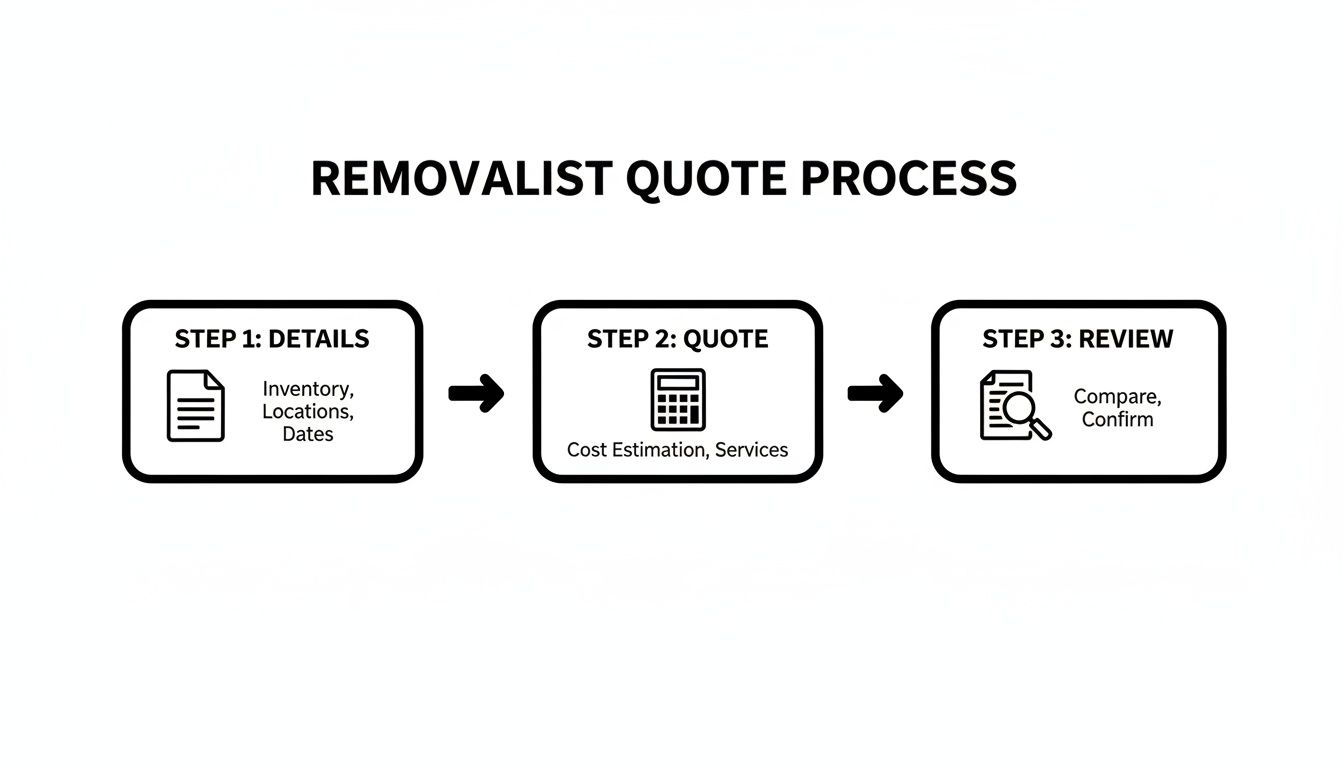
As you can see, a precise quote always starts with you providing detailed information, and it ends with you carefully reviewing the final estimate. Simple.
Information Needed for a Precise Quote
To get the ball rolling and ensure the quotes you receive are as accurate as possible, it pays to have your details ready. Approaching a removalist unprepared is the fastest way to get a vague, unreliable estimate.
Gather these key details before you start making calls. It will save you time and help companies give you a solid, trustworthy price.
| Information Category | Specific Details to Prepare | Why It Impacts Your Quote |
|---|---|---|
| Move Details | Your current Melbourne address and the full address of your new home. Preferred moving dates. | Distance is the single biggest cost factor. Dates affect availability and potential peak season pricing. |
| Inventory List | A comprehensive list of all items to be moved, especially large furniture, appliances, and number of boxes. | Volume and weight determine the size of the truck and the amount of labour required. |
| Specialty Items | Note any items that need special care: pianos, pool tables, antiques, heavy gym equipment, or fragile artwork. | These often require special equipment, extra crew members, and more time, which adds to the cost. |
| Property Access | Details for both properties: Are there stairs? Is there lift access? What’s the parking situation? Long walkways? | Difficult access increases the time and effort needed for loading and unloading, directly affecting labour costs. |
| Additional Services | Do you need help with packing or unpacking? Will you require storage before or after the move? | These are valuable add-on services that need to be quoted separately from the standard transport. |
Having this information on hand shows you're serious and helps the removalist give you a quote you can actually rely on.
Why the Cheapest Quote Is Rarely the Best
It's tempting to just grab the lowest price you see. We get it. But believe us, the cheapest moving interstate quotes often end up costing you more in the long run.
Some companies will dangle a super attractive low price to get you in the door, only to hit you with a string of unexpected charges later. Think extra fees for stairs you told them about, "long-carry" fees from the truck to your door, or surprise fuel levies. These hidden costs can blow your budget completely out of the water.
A professional quote is a sign of a professional company. Vague estimates or quotes rattled off over the phone without a proper inventory are massive red flags. True professionals invest the time to understand your specific needs to provide an accurate, fixed-price proposal.
Spotting Red Flags in a Quote
To protect yourself, you need to learn how to spot the warning signs of a dodgy quote. A reliable estimate will always be provided in writing and should be itemised.
Be wary if a company seems hesitant to give you a detailed breakdown or gets cagey when you ask specific questions about their insurance or potential extra charges. A detailed quote isn't just for your budget; it's your contract, outlining exactly what services you can expect on moving day.
For a deeper dive into what you might expect to pay, check out our guide on the real cost of movers in Australia. By going into the quoting process with this knowledge, you can confidently pick a dependable moving partner for your big journey from Melbourne.
Getting Ready for an Accurate Moving Estimate
Want to know the secret to getting a rock-solid moving quote instead of a vague guess? It all comes down to your prep work. Before you even start calling around for moving interstate quotes, your number one job is to create a super-detailed inventory of everything you own. This isn't just a list; it's the very foundation of your moving budget.
When you give a removalist precise information right from the start, you take all the guesswork out of the equation. It means they don't have to tack on a "just-in-case" buffer, which saves you money and prevents those frustrating, last-minute charges from popping up on moving day.

Create Your Master Inventory List
The best way to do this is to simply walk through your house, room by room, and list every single item you plan on moving. Don't rush it—be methodical.
A simple spreadsheet or a classic notebook works perfectly. The key is to be specific. Instead of just writing down "lounge furniture," break it down: one three-seater sofa, two armchairs, one coffee table, and one TV unit. That's the level of detail that makes all the difference.
- Furniture and Appliances: Jot down every big-ticket item, from bed frames and mattresses to your fridge and washing machine.
- Boxes: Try to estimate how many boxes you'll need for each room. As a starting point, plan for 10-15 standard boxes per room, but be honest about how much stuff you actually have and adjust accordingly.
- Outdoor and Garage Items: It’s easy to forget what’s outside. Make sure you include the barbecue, lawnmower, bikes, and any tools hiding in the garage.
Pro Tip: This is the absolute best time to declutter. As you're making your inventory, sort things into three piles—keep, donate, or sell. Cutting down on the volume of your move is the single most effective way to lower your interstate relocation costs.
Flag Your Specialist and Fragile Items
Once you've got your main list sorted, make a separate one for anything that needs a bit of extra TLC. These are the items that can really affect a quote because they might require more crew, specialised gear, or custom packing.
Movers need a heads-up on these things to plan properly. Trust us, surprising them with a grand piano on moving day is a fast track to delays and extra fees.
Items to flag usually include:
- Pianos or other large musical instruments
- Pool or snooker tables
- Heavy-duty gym equipment
- Valuable antiques or artwork
- Oversized mirrors and glass tabletops
- Any furniture made of marble or heavy stone
To make things a bit easier, you can use our online cubic metre calculator to get a more accurate handle on the total volume of your belongings.
Document Property Access Details
Finally, the physical layout of your current Melbourne home and your new place is just as important as what's inside. Tricky access means more time and labour, and that cost gets passed on to you.
Be crystal clear about the following details for both properties:
- Stairs: Are there stairs inside or out? How many flights? Are they narrow?
- Lifts: Is there a lift? Will you need to book it with building management for a specific time?
- Parking: Is there a dedicated spot for a big moving truck, or is it street parking only? Mention any clearways or parking restrictions.
- Walkways: How far is the walk from where the truck can park to your front door? Is it a long, winding path?
Giving a removalist this complete picture—a detailed inventory, a list of special items, and clear access info—is how you empower them to give you the most accurate and reliable moving estimate possible. No surprises, no stress.
Understanding the Key Interstate Moving Cost Factors
Ever wondered why one moving quote can be thousands of dollars different from another? It’s not just random numbers on a page. Several key factors directly influence that final price, and understanding them is your best tool for reading between the lines of an estimate and managing your moving budget.
The biggest cost driver, by far, is the total volume of your belongings. Removalists price jobs based on the space your items will take up in the truck, measured in cubic metres (m³). A sparsely furnished one-bedroom apartment is a completely different ball game compared to a packed four-bedroom family home. It simply comes down to how much truck space and labour is required.
Distance is the next major piece of the puzzle. A move from Melbourne to Adelaide is a different logistical and financial beast than a trek across to Perth. The further you go, the higher the costs for fuel, driver wages, and overall transit time.

Demand and Destination Hotspots
Beyond your personal inventory, bigger market forces are always at play. Interstate migration trends have a massive impact on route demand and, consequently, pricing. When a particular route is popular—like Melbourne up to Southeast Queensland—it can influence both the cost and the difficulty of securing a spot on a truck.
This isn't just a feeling; the data backs it up. As of June 2025, Queensland and Western Australia were the only states with positive net interstate migration. Queensland was the clear favourite, gaining a whopping 21,595 more residents than it lost to other states. This high demand for moves north can make booking a truck more competitive, especially during the busy season.
The Impact of Timing and Services
When you decide to move is another critical cost factor. Just like booking a holiday, the moving industry has a peak season. Summer months, school holidays, and the end of the month are always the busiest times, and you can definitely expect to pay a premium for booking then.
If you have a bit of flexibility, try scheduling your move for the middle of the month or during the off-season (like autumn or winter). It often results in a much friendlier quote. It's a simple case of supply and demand.
Finally, the specific services you choose will shape your final quote. A standard door-to-door move is the baseline, but any extras will naturally add to the price.
Common add-on services include:
- Professional Packing and Unpacking: A full valet service where the team packs everything for you. A real lifesaver, but it comes at a cost.
- Specialty Item Handling: Essential for delicate or oversized items like pianos, pool tables, or fine art that need extra care.
- Storage Solutions: If there’s a gap between moving out and moving in, you might need to store your belongings for a while.
- Disassembly and Reassembly: For tricky furniture like bunk beds or large wardrobes that won't fit through the door.
Each of these elements contributes to that final figure on your quote. Being aware of them helps you understand exactly what you're paying for and identify where you might be able to save a few dollars. For more on this, check out our guide on the hidden costs in moving house that can easily catch people by surprise.
Crucial Questions to Ask Before Hiring a Removalist
Getting a few moving interstate quotes is a great starting point, but the numbers on a page don't paint the full picture. If you want to really protect your belongings and ensure the whole experience goes off without a hitch, you’ve got to dig a little deeper.
Asking the right questions before you sign anything can be the difference between a smooth-sailing move and a stressful, expensive nightmare.
Think of it like an interview for a very important job—the job of moving your entire life across state lines. A genuinely professional removalist will welcome your questions and have clear, confident answers ready. If you get vague responses or sense any hesitation, that's a massive red flag.

Unpacking Their Insurance Coverage
This one is completely non-negotiable. Don't just tick a box by asking, "Are you insured?" You need to get specific to find out exactly what you're covered for if things go wrong.
Start with this: "What does your standard transit insurance include, and what are the exclusions?" This basic cover protects your goods while they're on the truck, but it often won't cover accidental damage that happens during the loading or unloading process. A good follow-up is asking about their public liability insurance, which covers any damage to your property (like a scraped wall or floor).
Finally, ask them what your options are for comprehensive, all-risk insurance. This is the top-tier cover that offers much broader protection and gives you real peace of mind.
Understanding Their Operational Model
How a company is structured has a direct impact on the quality and reliability of your move. The most important question here is, "Do you use your own trucks and full-time staff, or do you work with subcontractors?"
Companies that own their fleet and employ their own team, like Get n Go Removals, have far greater control over quality, timing, and accountability. Using subcontractors can sometimes introduce communication gaps or a drop in service standards.
The consistency of service is vital for an interstate move. When a company uses its own dedicated team, you know that the people who pack your life into a truck in Melbourne are part of the same professional system as those who will unload it at your new home.
Clarifying Timelines and Logistics
Logistics are the heart and soul of an interstate move, so absolute clarity is key. A vague delivery window can leave you camping out in an empty house for days on end.
Here are some vital logistical questions to lock down:
- What is your typical delivery window for my specific route?
- How do you communicate updates or manage unexpected delays on the road?
- Can you confirm line-by-line what is included in my written quote?
Before you make that final call, do your homework and make sure you choose a reliable removal company that fits what you need. Understanding their process for handling delays and confirming every inclusion upfront will save you from nasty surprises later. For a complete overview, you can learn more about choosing the right removals firm for your move in our detailed guide.
Finalising Your Booking and Securing Your Move
You’ve compared your moving interstate quotes, asked all the important questions, and finally settled on a removalist that feels right. Great! Now it's time to lock it in and make your moving date official.
This final part of the process is all about the details. You'll want to formally accept the quote in writing—a simple email is perfect for this. It creates a clear record that you've agreed to the price and terms, moving you out of the quoting stage and into the booking phase.
Reviewing Your Confirmation Paperwork
Once you've given the green light, your chosen mover will send over the confirmation documents. This could be a formal contract, a booking confirmation email, or their detailed terms of service. Whatever form it takes, don't just give it a quick scan. Read every single line.
Think of this document as your safety net. It should be an exact match for everything you've discussed and agreed upon up to this point.
Here’s a quick checklist of what to double-check:
- Correct Addresses: Make sure both your Melbourne pickup address and your new destination address are spot on. No typos!
- Confirmed Dates: Your moving date and the estimated delivery window should be clearly stated and match your expectations.
- Final Inventory List: The list of items being moved should be identical to the one you provided for the quote.
- Total Cost: The final figure, including GST, should be exactly what you were quoted. Check for a clear breakdown of the deposit required, too.
If you find anything that doesn't look right, even if it seems minor, bring it up immediately. You need to get everything corrected before you pay a deposit to avoid any headaches or stress on moving day.
Scheduling and Timing Your Booking
When it comes to scheduling your move, booking well in advance is always the best approach. This is especially true if you're moving during a peak period, like the summer months or over school holidays. A good rule of thumb is to lock in your date 4-6 weeks ahead.
This is more important now than ever. Post-pandemic trends have shown a huge number of Australians are leaving the capital cities for regional areas. In fact, migration from cities to regional Australia has been running 20.5% higher post-COVID compared to pre-COVID averages. This puts a lot more pressure on removalist availability for those popular routes.
By finalising your booking early, you not only secure your preferred moving date but also give yourself valuable time to focus on other aspects of your relocation without the last-minute panic.
Taking these careful steps ensures your plan is solid, your booking is secure, and your move is as smooth as possible. For a better idea of what to expect from us, you can find more information in our transparent interstate moving pricing.
Got Questions About Your Interstate Move? We've Got Answers.
When you’re staring at a few different moving interstate quotes, a million questions can start racing through your mind. It’s completely normal. To give you some clarity and confidence, we've put together answers to the questions we hear most often from people moving out of Melbourne.
Getting your head around the logistics of a big move can feel like a lot, but having the right info makes a world of difference. Let's clear up some of those nagging doubts so you can focus on the exciting parts of your relocation.
How Far Out Should I Actually Book My Movers?
This is a big one, and our advice is always the same: the earlier, the better. For a move between states, you really want to be locking things in at least 4 to 6 weeks before your moving day. This is even more critical if you're aiming for a popular time.
The "busy season" for movers is pretty predictable:
- The peak of summer (December through February)
- Any school holiday period
- That last week of the month when everyone's leases are up
Booking well in advance doesn't just guarantee you get the date you want; it often means you'll get a better price. Trying to book last-minute can get expensive fast, simply because trucks and crews are already spoken for.
What if My Settlement Date Gets Pushed Back?
It happens all the time in real estate—dates shift. Don't panic. Any decent removalist has a plan for this, but the key is to communicate, and do it quickly.
The second you think your dates might change, get on the phone with your moving company. The more warning you can give them, the easier it will be for them to shuffle things around without hitting you with hefty fees. Many companies, including us, can also arrange short-term storage, which is an absolute lifesaver if you have a gap between when you have to be out of your old place and into your new one.
Here’s a pro tip: Always ask about the company’s cancellation and rescheduling policy before you put down a deposit. Knowing the potential costs upfront can save you a nasty shock if things beyond your control force a change of plans.
Can I Bring My Pets and Plants on the Truck?
Moving with pets and plants needs a bit of extra thought. For your furry family members, a comprehensive stress-free guide to moving across country with cats is a great resource. But for safety and animal welfare reasons, most removalists aren't licensed to transport animals. You'll need to look into a specialised pet transport service to get them to your new home safely.
Plants can be surprisingly complex, too. Each state has its own quarantine laws to stop the spread of pests and plant diseases. Western Australia, for example, is notoriously strict. Before you get your heart set on moving your beloved fiddle-leaf fig, check the quarantine rules for the state you're moving to.
Why Does Migration Data Matter for My Move?
It might seem a bit random, but population trends have a direct impact on your move. By March 2025, Australia's population hit 27.54 million, and a massive 75% of that growth came from net migration. While Victoria got a lot of overseas arrivals, we're also seeing a huge number of people moving interstate, especially heading for Queensland and Western Australia.
This creates high demand on those routes, meaning trucks get booked up faster and prices can be more competitive. Knowing this just reinforces why booking ahead for those popular destinations is so important.
Making sense of an interstate move is what we do best. At Get n Go Removals, we believe in clear, honest quotes and being there to support you every step of the way. If you’re ready for a smooth, transparent relocation from Melbourne, let's talk.