Storage During Renovation: A Melbourne Homeowner’s Guide

You start with the fun part. New kitchen. Better bathroom. Floors that finally match. Then the practical question lands hard: where is everything going while the work happens?

That's the point where many renovations stop feeling exciting and start feeling cramped. Dining chairs end up in the hallway, the coffee machine lives on a laundry shelf, and the spare room turns into a pile of lamps, art, bedding, and boxes with no system behind it. Trades lose access, dust gets everywhere, and you end up moving the same furniture multiple times.

Good storage during renovation fixes that early. It gives the project room to breathe, protects what you own, and keeps the house liveable if you're staying put. In Melbourne homes, especially apartments, terraces, and tighter suburban layouts, that planning often matters just as much as the renovation itself.

Why Smart Storage Is a Renovation Game Changer

A typical renovation starts with one room and quickly spills into three. The kitchen contents move into the dining area. The dining area moves into the living room. Then the builder asks for a clear path, the plaster dust starts travelling, and suddenly every surface in the house is doing a job it was never meant to do.

That's why smart storage during renovation changes the whole experience. It turns a messy shuffle into a controlled move. Instead of reacting each day, you make one clean decision about what stays accessible, what leaves the house, and what needs extra protection.

A stressed couple standing in a messy room filled with cardboard boxes during a home renovation project.

In Australia, owner-occupier alterations and additions were valued at AUD 12.6 billion in 2023–24, with kitchen and bathroom upgrades among the top categories, according to this renovation storage overview. That tells you this isn't some edge-case problem. Temporary storage sits right in the middle of how major home improvements get done.

What good storage changes on site

The immediate benefit is access. Trades can work faster when they're not stepping around stacked chairs, loose boxes, or a fridge pushed into the corridor.

The second benefit is protection. Dust from demolition doesn't stay politely inside one doorway. It gets into fabric, joins, electronics, artwork, and timber finishes.

Practical rule: If an item matters to you, don't leave it close enough to “probably be fine.”

Why an integrated mover and storage setup makes sense

For larger renovations, the smoothest arrangement is often one where packing, lifting, transport, and storage are coordinated together. That removes the double-handling that happens when homeowners pack in a rush, hire a vehicle, load badly, then unload into a unit they've guessed the size of.

An integrated service also means you're not solving the job in fragments. You're solving the logistics once. If you want to compare what that looks like in practice, this guide to furniture removal and storage in Melbourne shows the combined approach many renovators use when the project is too large for a spare room fix.

First Step Auditing Your Space and Storage Needs

Most storage problems start with one mistake. People estimate by eye. That's how a “small renovation” turns into a lounge room full of unlabelled boxes and nowhere to sit.

Start with a room-by-room audit. Don't just list furniture. Include what fills the furniture. Kitchen cabinets, bathroom cupboards, wardrobes, linen, pantry overflow, desk equipment, laundry supplies, kids' items, wall art, lamps, and everything sitting on open shelving all count.

A four-step Storage Audit Checklist infographic guide for organizing items before placing them into storage.

The reason this matters in Melbourne is simple. The 2021 ABS Census found the average Australian dwelling houses 2.5 people, and apartments and townhouses are common in urban centres such as Melbourne, which means many renovators don't have a spare room or empty garage waiting to absorb the mess. That context is outlined in this housing and renovation planning article.

Use the three-zone method

A practical audit works best when you sort items into three groups before you pack anything.

  1. Daily-use essentials
    Keep these in a clean part of the home you can still function from. Think clothes for the next couple of weeks, medication, chargers, school gear, a basic kitchen kit, towels, and important paperwork.

  2. Non-essential items for storage
    These are the things you won't need during the works but still want back in good condition. Decorative items, extra dining chairs, occasional tables, spare appliances, books, out-of-season clothing, and most room contents usually fall here.

  3. Sensitive items needing extra care
    Artwork, timber furniture, electronics, musical items, framed mirrors, sentimental pieces, and anything moisture or temperature can affect should be separated early so they don't get packed like everyday goods.

Measure first, then book

A proper inventory should include rough dimensions for larger pieces. Sofas, bed frames, buffets, fridges, desks, and bookcases affect storage size far more than loose cartons do.

Use a simple worksheet or spreadsheet with:

  • Item name
  • Room it came from
  • Whether it stays or goes
  • Fragile or sensitive status
  • Disassembly needed
  • Return destination after renovation

If you want a more practical way to estimate volume before booking, a cubic metre calculator helps take some guesswork out of the process.

The audit questions that save headaches later

Ask these before you move a single box:

  • How much of the home is affected? A bathroom project can stay contained. Flooring, rewiring, or a kitchen renovation usually affects surrounding rooms too.
  • Will you need regular access? If yes, don't bury essential items deep in off-site storage.
  • How long could the project really run? Builders work to schedules, but variations, materials, and sequencing can shift dates.
  • Is your garage available? In plenty of homes, the garage is already half-storage and half-workshop before renovation starts.

Clear thinking at audit stage saves you from paying twice. Once in labour, and again in damage or delays.

Choosing Your Storage Solution On-Site vs Off-Site

There isn't one perfect option for every renovation. The right setup depends on access, space, item type, and how much effort you want to spend moving things around yourself. Small cosmetic jobs can survive with an internal shuffle. Major works usually can't.

A comparison chart outlining four storage solutions: on-site, portable containers, off-site storage, and full-service moving.

Quick comparison

Option Works well for Main upside Main drawback
On-site spare room or garage Small, short projects Easy access, no extra travel Dust spread, limited space, higher clutter risk
Portable storage container Frequent access jobs Close by, flexible access Needs on-site space
Off-site storage unit Longer or larger projects Gets contents away from the site You still need to load, transport, and unload
Full-service moving and storage Major renovations One coordinated move with less handling Less DIY control, relies on booking ahead

On-site storage inside the home

Using a spare room, study, or garage can work for a simple repaint, a bedroom update, or a quick bathroom renovation. It's immediate, and your items stay close.

But this option fails fast when the footprint expands. Dust travels. So do tools, ladders, cut materials, and workers. The room you hoped would remain untouched often becomes a pass-through or overflow zone.

On-site internal storage works when:

  • The project is tightly contained
  • You can shut doors and isolate the area
  • The stored items aren't blocking movement
  • You won't need to restack the room every second day

Portable containers and off-site units

Industry guidance suggests a portable on-site container or a month-to-month unit is ideal when you need frequent access, and it also notes that climate-controlled storage is recommended for electronics, wood furniture, and artwork to reduce humidity and temperature damage, as explained in this remodel storage guide.

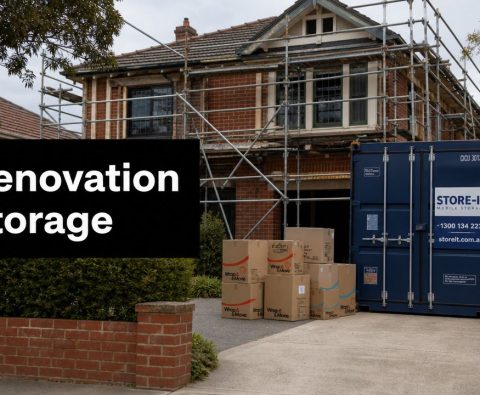
A portable container suits projects where you're living at home and need practical access to belongings without driving across Melbourne. It's useful when the renovation affects one side of the house, not the whole property.

An off-site unit makes more sense when:

  • The house needs to be cleared properly
  • The driveway or garage must stay available
  • You want belongings away from dust and site traffic
  • You don't need to grab items every day

Here's a quick visual overview before deciding:

Where integrated mover storage fits

This is the option many people overlook. They compare container versus unit, but forget the labour problem sitting underneath both choices.

A mover-and-storage setup suits substantial renovations because it reduces handoffs. The same booking can cover packing, furniture protection, disassembly, transport, and storage placement. That matters when you've got heavy timber furniture, fragile wall art, tight stair access, apartment lifts, or a builder who needs the home cleared on a specific date.

One practical example is short-term storage arranged alongside removals, where the transport and storage timing can be coordinated around the renovation schedule rather than handled as separate jobs.

If the renovation is big enough that you're dreading the physical move before the building work even starts, that's usually a sign DIY storage isn't the efficient choice.

The Logistics Plan Packing Protecting and Moving

Once the storage option is sorted, execution matters more than intention. A poor packing job can damage belongings before the renovation even begins. The cleanest system is to empty the work zone fully, protect each item by material type, and make sure every box and furniture piece can be identified without opening half the load.

A person carefully packing a framed picture wrapped in protective bubble wrap into a cardboard box.

The most effective operational method is to clear the work zone completely before demolition begins, then split belongings into daily-use, storage, and sensitive categories, using a detailed inventory so everything can be returned correctly after the job. That process is outlined in this renovation storage advice.

Pack by material, not just by room

Room labels help with unpacking, but protection should follow the item itself.

  • Timber furniture should be clean, dry, and wrapped with moving blankets or protective pads. Don't tape directly onto finished timber.
  • Glassware and crockery need sturdy cartons, internal cushioning, and sensible weight distribution. Heavy boxes fail at the bottom.
  • Framed art and mirrors need edge protection and upright placement, not flat stacking under random boxes.
  • Electronics should be bagged or wrapped to reduce dust exposure, with cords labelled separately.
  • Soft furnishings such as cushions, doonas, and linens should go into sealed cartons or heavy-duty bags so they don't absorb dust and site grime.

Disassemble the right pieces

Some furniture should stay assembled if moving it in one piece is safer. Other pieces become far easier to protect and stack once broken down.

Disassemble when it helps with:

  • Access through narrow halls or stairwells
  • Reducing strain on joints and legs
  • Safer stacking in storage
  • Preventing scratched walls and door frames

Keep hardware in labelled bags and attach those bags to the relevant item or place them in one clearly marked hardware carton.

Build an inventory you'll actually use

A good inventory isn't complicated. It just needs to be consistent.

Use:

  1. A numbered box system
    Write a number on each carton and log what's inside.
  2. Room origin and room destination
    “From kitchen, back to new pantry” is far more useful than “miscellaneous”.
  3. Photo records for complex setups
    Take quick phone photos of cable connections, shelving layouts, and furniture assembly before disassembly.
  4. Special handling notes
    Mark cartons that must stay upright or stay accessible.

The inventory isn't only for unpacking. It's what stops a renovation return from turning into a scavenger hunt.

Think about site exposure and security

Renovation sites create more risk than homeowners expect. Open doors, temporary access, parked trades vehicles, skip bins, exposed materials, and shifted routines all change how secure a property feels. If you're storing items on-site or leaving packed goods in a garage before collection, it's worth understanding broader construction site security issues so access points, temporary fencing, and visibility aren't afterthoughts.

For fragile goods, the packing method matters as much as the storage location. If you need a practical guide for breakables, this advice on how to pack fragile items for moving covers the basics that prevent chips, cracks, and crushed boxes during handling.

Timing Insurance and Costs Your Renovation Storage Budget

Storage during renovation becomes expensive when the timing is loose. Not always because the storage itself is unreasonable, but because homeowners book too early, pack twice, or keep paying while waiting for trades to finish one more stage.

The cleanest approach is to line your storage plan up with the builder's sequence. You want contents out shortly before demolition or strip-out, not weeks before if the house still needs to function. On the return side, don't schedule move-back for the day cabinetry goes in or painters finish. Wait until the dusty work is done and the house is ready to receive furniture properly.

Where the budget usually goes

Most renovation storage costs sit in a few practical buckets:

  • Storage hire
    Month-to-month arrangements suit uncertain timelines better than rigid terms.
  • Removal labour
    Heavy lifting, stairs, distance from truck to property, and awkward access all affect effort.
  • Packing materials
    Cartons, tape, wrapping, picture protection, mattress covers, and furniture padding add up quickly.
  • Disassembly and reassembly
    Beds, dining tables, shelving, and desks often need more handling than owners expect.
  • Insurance or cover arrangements
    This is the line item people skip until they realise standard home cover may not operate the way they assume once goods are in transit or stored elsewhere.

Bundled versus pieced-together booking

A pieced-together setup can look cheaper at first. Then the hidden work appears. You source cartons from one place, hire a vehicle or organise access to one, recruit help, load badly, unload into storage, and repeat the whole job when the renovation ends.

A bundled move-and-store arrangement often gives you a clearer schedule and fewer handling points. That matters because many renovation damages happen in the move itself, not in the storage period.

Insurance questions worth asking

Ask direct questions before anything leaves the home:

Question Why it matters
Does my contents policy cover items once they're moved out for renovation? Some owners assume it does without checking the conditions
Is there separate cover for transit? Damage can happen during loading, driving, or unloading
Is stored furniture covered the same way as goods in the home? Off-site storage changes the risk profile
Do I need an inventory for claims support? A clear record helps if anything is disputed

If you're comparing likely charges, this breakdown of Melbourne storage prices is a useful starting point for budgeting the storage side properly.

Your Melbourne Renovation Storage Checklist

A smooth renovation usually comes down to one thing. Good sequencing. When storage is planned in the right order, the whole job feels lighter.

The checklist

  • Audit and plan
    List what's in each affected room, decide what stays accessible, and identify sensitive items early.
  • Select and book
    Match the storage type to the project size, access needs, and how much labour you want to handle yourself.
  • Pack and protect
    Use proper cartons, furniture protection, hardware bags, and an inventory that makes move-back simple.
  • Move out before demolition
    Don't leave “just a few things” in the work zone. Those items become obstacles immediately.
  • Confirm return timing
    Bring goods back after dusty works, painting, and heavy traffic have finished.
  • Check site security during the project
    If your home is partly open, partly occupied, or seeing regular contractor access, it helps to review practical guidance on construction site security in Melbourne.

If you need frequent access and have space on-site, a portable option usually makes sense.
If the home needs to be cleared properly, off-site storage is cleaner.
If your priority is minimal labour, fewer handoffs, and one coordinated booking, an integrated mover-and-storage setup is usually the sensible call.

Renovations are disruptive, but they don't have to feel chaotic. Once the storage side is organised, you can focus on the build decisions instead of spending every night shifting furniture from one room to another.

Frequently Asked Questions About Renovation Storage

Can I access items while they're in storage during renovation?

Usually, yes, but it depends on the setup you choose. On-site storage gives the easiest access. Off-site storage can work well too, but only if you've packed with access in mind. Keep daily-use items separate and don't bury essentials behind furniture and sealed cartons.

What shouldn't go into renovation storage?

Avoid storing anything dangerous, perishable, or likely to leak. Important documents, passports, jewellery, and highly personal valuables are often better kept directly with you rather than packed away with general household goods.

How early should I book storage before renovation starts?

Book once your renovation dates are firm enough to act on, especially if access is tricky, you're in an apartment, or the project needs a specific clear-out day. The more complex the move, the less useful last-minute booking becomes.

Is on-site or off-site storage better for a kitchen renovation?

That depends on how much access you need. If you'll be using a temporary kitchen and want regular access to cookware and appliances, on-site can be practical. If the renovation is dusty, wide-ranging, or affecting adjacent rooms, off-site usually keeps the house more usable.

Should I pack myself or use professional help?

DIY packing can work for light, straightforward items if you're organised and have time. Professional packing is often worth it for fragile goods, large homes, and projects with tight dates, because it reduces rushed decisions and poor protection.


If you're planning storage during renovation and want the move, packing, and storage side handled in one coordinated job, Get n Go Removals Melbourne can help you organise a practical solution that fits your timeline, access needs, and the scale of your renovation.


READ MORE

Best Removalists Melbourne Reddit: Top 7 Movers for 2026

Planning a move in Melbourne and ending up buried in Reddit threads? That usually means you already know the problem with most “top mover” lists. They tell you who's popular, but not how to tell whether a recommendation will hold up when you've got a lift booking, a settlement deadline, or fragile furniture that can't be replaced.

That's why “best removalists Melbourne Reddit” is such a common search. People want real experiences, not polished ad copy. They also want a shortcut through conflicting opinions, because one person's “amazing” mover can be another person's disaster once access issues, stairs, waiting time, or insurance come into play.

This guide gets to the point. These are the Melbourne movers that come up repeatedly in community discussion and practical comparison. What's more, this isn't just a roundup. It also shows you how to read Reddit recommendations properly, what to verify before paying a deposit, and which trade-offs matter most for apartments, houses, offices, and interstate jobs.

One thing is clear in Victoria. Independent review platforms now play a major role in trust, with ProductReview's Victoria furniture-removalist listings explicitly based on consumer ratings from Australian users rather than provider claims, which tells you how much buyers rely on third-party evidence in a crowded market (ProductReview Victoria removalist category).

1. Get n Go Removals Melbourne

Get n Go Removals Melbourne

Need a mover that still looks like a good choice after you read the Reddit comments closely?

Get n Go Removals Melbourne stands out for a simple reason. It fits the kind of move where cheap hourly pricing stops being the main decision point. If your job includes stairs, apartment access rules, storage, large furniture, or specialist items, the critical factor is whether the company has the crew, equipment, and process to keep the day under control.

That matters because Melbourne pricing is rarely as simple as the headline number. Comparison sites show that hourly rates, minimum booking periods, and how travel time is charged can change the final bill significantly (Find a Mover Melbourne pricing guide). Get n Go does not publish a public rate card, so you need a quote. For complex jobs, that is often the more useful approach anyway, because a flat advertised rate can hide the details that drive cost.

Why Reddit-style recommendations point here

This is the type of operator that tends to hold up better once you move past one-off anecdotes and start checking the basics. Get n Go is a family-owned Melbourne business with more than 10 years of experience, and its service range is broader than a standard small-move setup.

They handle:

  • Local home and apartment moves
  • Office and commercial relocations
  • Packing and unpacking
  • Furniture disassembly and reassembly
  • Storage
  • Specialist items such as pianos and pool tables
  • Interstate East Coast moves

The operating model also matters. They use a company-owned fleet, employ full-time police-checked staff, and carry public liability and transit insurance. Those details do not guarantee a perfect move, but they do reduce the common problems readers complain about on Reddit, such as unclear accountability, inconsistent crews, and confusion over damage claims.

Vetting tip: If Reddit recommends a mover, verify the staff model, insurance, fleet ownership, and scope of service before treating that recommendation as reliable.

Where it fits best

Get n Go makes the most sense for moves where coordination matters as much as price.

Strong fit for:

  • Large local moves with difficult access or tight timing
  • Apartment relocations with lift bookings or restricted loading windows
  • Special handling jobs involving fragile, bulky, or high-value items
  • Interstate moves where direct East Coast runs help with planning

Their 24/7 availability is also useful for settlement-day moves and buildings with narrow access windows. That is a practical advantage, not just a marketing extra.

Trade-offs to consider

No mover is the right fit for every job, and for this reason, readers should separate Reddit enthusiasm from actual suitability.

Possible drawbacks:

  • You need to request a quote. Fast price comparison is easier with companies that publish entry rates.
  • Weekly interstate runs suit planned jobs better than urgent ones.
  • This is less of a budget-first option if your move is small, simple, and flexible on timing.

If you are comparing this company with another frequently mentioned option, this guide to Man With A Van is a useful side-by-side next step.

For readers using community feedback as a shortlist, Get n Go is a good example of how to judge a recommendation properly. Do not stop at “people say they were good.” Check whether the company structure matches the kind of move you have.

2. Man With A Van

Man With A Van

Man With A Van gets mentioned a lot because it feels organised. That sounds basic, but in removals, documented process is often what separates a smooth move from an expensive argument. They've been around a long time, they run a large company-owned fleet, and they make their pre-move process and terms easier to understand than many competitors.

For standard home and apartment moves, that's a real advantage. You can usually tell when a mover has invested in systems rather than relying on ad hoc crew habits. Online estimators, booking workflows, and clear preparation guidance reduce friction before move day even starts.

Where it works well

This is a good option for people who want predictability. Student moves, apartment relocations, household jobs, and smaller commercial moves all fit their model well. Their onsite packing materials shop is also useful if you're trying to keep everything under one roof.

Independent ranking pages covering Melbourne removalists increasingly emphasise “real reviews,” performance history, and trust signals over simple sponsored placement, which matches why operators like this stay visible year after year (Homemove Melbourne removalist rankings).

If a mover has clear terms, a documented process, and a known fleet, you're already reducing risk before the truck arrives.

Trade-offs to know

Pros:

  • Reliable process: Clear prep steps, booking flow, and terms reduce surprises.
  • Strong reputation for care: Community feedback often highlights punctuality and communication.
  • Useful extras: Box shop and multiple truck sizes make planning easier.

Cons:

  • Peak availability can be tight: Popular movers often fill fast around weekends and end-of-month dates.
  • Can feel pricey: Some customers see them as higher-end for straightforward local jobs.

If you're weighing them against other established operators, compare their process quality with this roundup of 2 Man With A Van options. That's the right lens for this category. Not just “who's cheapest,” but “who's least likely to create problems on the day”.

Website: Man With A Van

3. Little Red Trucks

Little Red Trucks

Little Red Trucks is one of those names that comes up when people want a “safe pick”. Not flashy. Not niche. Just a mover many Melburnians recognise and are comfortable recommending.

They've built that reputation around tidy presentation and straightforward service. Clean trucks, trained staff, and a simple quote flow don't sound exciting, but they matter. Customers notice when a company looks prepared before it touches a single item.

Why Reddit users tend to like them

One standout feature is the reusable tub system. If you hate cardboard chaos, their Little Red Tubs are a practical alternative to boxes and can make packing, stacking, and unpacking more efficient. That especially suits apartment moves and short local relocations where convenience matters as much as cost.

Their mixed-gender crews and local focus also appeal to people who care about professionalism and comfort on move day, not just speed.

Pros:

  • Well-regarded for value: Often seen as a balanced option between budget and polish.
  • Strong local familiarity: Plenty of positive word-of-mouth for standard Melbourne moves.
  • Reusable tubs: A practical packing option if you want less waste and less mess.

Cons:

  • Peak dates go early: Weekend and end-of-month demand can narrow your options.
  • Some mixed reports: Stair fees or minor damage issues do appear in some customer discussions.

The practical takeaway

Little Red Trucks is usually a good shortlist candidate for local moves where you want a recognised brand without stepping straight into big national-operator territory. But don't let a familiar name replace basic due diligence. Compare the quote wording, included equipment, and access assumptions before you commit.

That's where broader selection advice helps. This guide on choosing the right removal firm for your move is useful because it forces you to evaluate the mover, not just the online sentiment.

Website: Little Red Trucks

4. Top Removals

Top Removals

Top Removals sits in the full-service camp. If you don't just need transport, but also packing, unpacking, furniture taken apart and reassembled, storage, or office moving support, they make sense to consider.

That full-service positioning is why they come up in recommendation threads from people who've done larger or more involved moves. A mover that can handle more stages of the job is often easier to manage than coordinating separate services yourself.

Where they fit best

They're a solid option for households that want more support than a standard truck-and-labour booking. The same goes for office relocations, where downtime and setup order matter more than shaving a bit off the quote.

The trade-off is that quote-based pricing becomes more variable as complexity rises. Access conditions, packing scope, waiting time, and storage all affect value, so direct quote comparison matters more here than star ratings.

Better movers explain what they're charging for. Worse movers wait until moving day to reveal it.

Independent Australian guidance on choosing Melbourne removalists stresses AFRA accreditation, written quotes, and insurance cover as the key technical checks, especially when comparing providers on risk rather than hype (Move My Stuff Melbourne removalist guidance).

Pros and cons

Pros:

  • Broad service scope: Packing, unpacking, storage, and office moves all sit within their offer.
  • Good fit for repeatable process: Helpful if you want more than raw transport labour.
  • Strong personal recommendations: They show up in community discussions for professionalism.

Cons:

  • No public rate card: You'll need to go through quoting.
  • Complex jobs change pricing fast: Access and scope can materially alter the final figure.

If you're comparing full-service options, it helps to read real-world commentary on cheap removalists Melbourne reviews before deciding whether “cheap” is good value for your move.

Website: Top Removals

5. TWO MEN AND A TRUCK (Australia)

TWO MEN AND A TRUCK (Australia)

Some people don't want a boutique operator. They want a recognisable national brand with established systems, scalable fleet capacity, and standardised processes. That's the appeal of TWO MEN AND A TRUCK.

For ordinary suburban moves, that can be enough. They tend to suit customers who value availability, centralised booking, and familiarity over a more bespoke service experience. If you're moving a larger home or coordinating an office relocation, the operational scale is useful.

Best use case

This is often a good fit for straightforward jobs where the service requirements are clear and the pickup and delivery conditions are conventional. They're also worth considering for interstate planning if you'd rather deal with a national network than piece together logistics yourself.

Their limitations are the usual ones for larger brands. Quotes can come in higher than smaller independents for shorter local jobs, and public pricing transparency isn't the drawcard.

Pros:

  • Scalable capacity: Good option for larger homes, suburban runs, and office jobs.
  • National reach: Useful for interstate coordination.
  • Structured systems: Processes and policies are easier to find than with many smaller operators.

Cons:

  • May cost more for simple moves: Smaller independents can be sharper on short local hops.
  • Less personalised feel: Some customers prefer a single accountable owner-operator relationship.

A lot of Reddit-style searching treats “best” like a popularity contest. That misses the real issue. Consumer guidance in Victoria highlights that moving disputes often involve pricing, delays, damage, and unclear exclusions, which is why detailed quotes and a proper understanding of what's included matter more than brand familiarity alone (Muval Melbourne removalist guide).

Website: TWO MEN AND A TRUCK Australia

6. North Removals

North Removals has a different appeal. It feels closer to the owner-operated end of the market, with more emphasis on responsiveness, direct communication, and no-hidden-cost messaging.

That's attractive if you dislike big-brand call-centre energy. Customers often want quick answers, clear updates, and a sense that the people quoting the job understand the work, not just the booking software.

Why people shortlist them

Their communication style is one of the stronger selling points. SMS and email alerts sound small, but they reduce the uncertainty that makes moving stressful. They also emphasise in-house staff and modern trucks, which are both positive trust signals when you're filtering Reddit recommendations into a real shortlist.

Pros:

  • Responsive communication: Helpful if timing and coordination matter.
  • In-house crews: Reduces concerns about outsourced labour quality.
  • Interstate capability: Broadens the use case beyond local metro jobs.

Cons:

  • Smaller operator constraints: Busy dates may disappear quickly.
  • Quote-only pricing: You'll still need direct contact for exact costs.

What to compare before booking

North Removals is worth considering if you prioritise contact quality and want a mover that presents itself as transparent and service-led. Still, compare the estimate carefully against access conditions, waiting time assumptions, and any item-specific handling.

That becomes even more important once you start comparing local versus regional or interstate jobs. A practical benchmark for that thinking is this guide to how much moving houses costs in Melbourne, because it helps frame where quote differences usually come from.

Website: North Removals

7. Queer Move

Queer Move

Queer Move stands out because it has a more distinct identity than most movers on this list. The company's focus on inclusive, respectful service resonates with renters, apartment movers, and customers who want a team that's explicit about communication and boundaries.

That clarity carries through into pricing too. Publicly available hourly rates and short billing increments make them easier to assess than quote-only operators, especially if you're doing a smaller local move and want fewer surprises.

Where they shine

Apartment and renter moves are the obvious fit. Their two-person crews, equipped trucks, and straightforward approach work well when you've got a practical, smaller-scale job and want transparency.

This matters in Melbourne because inner-city moves are often shaped less by distance and more by access constraints. Existing coverage of the best removalists in Melbourne often skips critical friction points, like lift bookings, loading dock restrictions, after-hours access, and settlement-day timing, even though those issues can define whether a move runs smoothly (Easy Peasy Removals Melbourne article).

For inner-Melbourne apartments, ask about building access before you ask about boxes. That's what decides whether the schedule holds.

Pros and cons

Pros:

  • Published pricing: Easier to compare if you want transparency upfront.
  • Strong word-of-mouth: Often recommended as a thoughtful alternative to mainstream movers.
  • Good apartment fit: Especially appealing for renters and smaller local jobs.

Cons:

  • Area and day constraints: Coverage can be narrower than larger operators.
  • Office response windows are limited: Not ideal if you need instant after-hours coordination.

Queer Move is a smart option when respect, transparency, and smaller-job suitability are higher priorities than fleet scale or broad interstate coverage.

Website: Queer Move

Top 7 Melbourne Removalists, Reddit Comparison

Which names keep coming up on Reddit, and which ones still hold up after a basic quote and service check?

That matters because Reddit is useful for spotting patterns, not for outsourcing your decision. A company can get warm word-of-mouth for one type of move and still be a poor fit for yours. The table below compares the seven names against the factors that usually decide whether a recommendation is usable: booking clarity, fleet and crew setup, likely service outcome, and the job types each mover suits best.

Provider Booking and service setup 🔄 Fleet and crew resources ⚡ Likely result 📊 Best fit 💡 Key strengths ⭐
Get n Go Removals Melbourne Moderate. Full-service quoting, specialist handling, flexible scheduling High. Company fleet, packing materials, insured crew Consistent moves with better support for complex jobs Homes, offices, specialty items, interstate runs, storage Insured team, broad service coverage, one contact point
Man With A Van Low to moderate. Clear checklist, online booking, defined terms High. Large fleet, packing supply options, established admin systems Punctual moves with fewer avoidable surprises Home moves, student moves, small commercial jobs Damage guarantee, well-defined process, dependable scheduling
Little Red Trucks Low. Simple quote and booking flow Moderate. Modern vehicles, reusable tub option Careful handling and fair value Apartments, budget-conscious moves, lower-waste moves Reusable tubs, trained crews, steady reputation
Top Removals Moderate. Full-service planning with checklists Moderate to high. Packing, unpacking, storage, experienced crews Reliable end-to-end relocations Residential and office moves needing more support Wide range of services, written guides, repeat recommendations
TWO MEN AND A TRUCK (Australia) Moderate. Central booking systems with multiple service options High. National fleet and broader scheduling capacity Predictable standard moves and scalable interstate jobs Larger homes, offices, interstate relocations National coverage, scalable capacity, established systems
North Removals Low. Direct communication and straightforward quoting Moderate. In-house crews and modern equipment Responsive service with clear updates Local and regional moves where communication matters Transparent quotes, owner involvement, clear communication
Queer Move Low. Clear hourly pricing and firm service boundaries Low to moderate. Two-person crews, equipped trucks Respectful service and strong fit for smaller jobs Renters, apartment moves, inclusive and trauma-informed relocations Published rates, respectful approach, recent word-of-mouth strength

A practical read on this table:

  • Use Reddit to build a shortlist, not to pick a winner. Repeated praise is useful, but only after you match it to your move type.
  • The right mover changes with the job. Apartment access, settlement deadlines, packing help, and specialty items shift the shortlist fast.
  • Bigger operators usually offer more scheduling depth. Smaller operators often win on direct communication and simpler quoting.
  • Published rates help with early filtering. They do not replace a written scope that covers stairs, travel time, waiting time, and access issues.

A key advantage of comparing Reddit sentiment this way is context. A name that gets recommended for a one-bedroom Brunswick apartment move is not automatically the right call for a family home in the eastern suburbs, an office relocation, or an interstate run. Read the recommendation, then test whether the company's setup matches the job in front of you.

Making Your Final Choice Which Mover is Right for You

Still wondering how to turn Reddit recommendations into a booking decision you can trust? Start with fit, not popularity.

A removalist that gets repeated praise on Reddit may still be wrong for your move. A one-bedroom apartment move with good lift access needs a different setup than a family home, a settlement-day relocation, or a job with storage, packing, and fragile items. The right choice comes from matching the company's operating model to the job in front of you.

Use Reddit to build a shortlist. Use your quote process to choose.

Before you book, pressure-test each option against the details that usually cause disputes or delays:

  • Written scope: Check whether travel time, stairs, waiting time, disassembly, reassembly, and packing materials are listed clearly.
  • Insurance: Ask what cover applies in transit and on-site, and ask for exclusions in plain language.
  • Crew structure: Confirm whether the mover uses employees or subcontractors, because accountability can look different.
  • Fleet and access planning: Make sure truck size, lift access, driveway limits, loading zones, and fragile-item handling have been discussed before move day.
  • Timing discipline: If you have settlement deadlines or building booking windows, ask how the company handles late running jobs.

Weak quotes usually become apparent under certain conditions. If a price looks sharp but the scope is vague, expect variation charges or confusion on the day.

Get n Go Removals is worth shortlisting if your move has more moving parts than a basic apartment job. As noted earlier, the business covers local moves, office relocations, packing, storage, specialist handling, and direct interstate runs. That broader service range can make coordination easier when you want one company responsible for the whole job.

If you are moving artwork, antiques, or other high-risk items, standard removalist questions are not enough. The same handling issues that matter when selecting the right art movers apply here too. Ask about wrapping method, load restraint, claims process, and who is responsible if something goes wrong.

A practical final step:

  1. Shortlist two or three movers from the names Reddit mentions most often.
  2. Get each quote in writing.
  3. Compare scope, exclusions, and accountability before you compare price.

That approach gives Reddit the role it is good at. Finding names people keep coming back to. Your vetting process does the rest.

READ MORE

Warehouse Storage Solutions: Melbourne Guide 2026

If you're dealing with a house move, a growing stockroom, or an event schedule that's tighter than the loading zone booking, storage stops being a background detail very quickly. It becomes the thing that decides whether everything runs smoothly or turns into a week of double-handling, misplaced items, and avoidable stress.

That's why good warehouse storage solutions matter to more than warehouse managers. A homeowner between settlement dates needs safe access to furniture without turning the garage into a maze. A small business needs overflow space that still lets staff find stock fast. An event organiser needs gear packed, held, and dispatched in the right order, not just stacked wherever it fits.

Why Smart Storage Is More Than Just Space

Individuals often begin by asking one question. How much room do I need?

That's understandable, but it's rarely the right starting point. In practice, storage works when it gives you control, not just capacity. A room full of cartons, furniture, marketing collateral, or spare stock can still be badly stored if nobody can reach what they need without shifting five other things first.

In Melbourne, this shows up every day in fairly ordinary situations. A family sells before they buy and needs furniture out of the house for a short period. A retailer runs out of backroom space before a seasonal delivery lands. An events team finishes one activation on a Sunday and needs staging, signage, and display stock held safely until the next job. The problem isn't just “too much stuff”. The problem is timing, access, handling, and keeping order while everything else is moving.

What smart storage actually solves

Good warehouse storage solutions usually fix a few problems at once:

  • Access pressure: you can retrieve what matters without unloading half the site
  • Handling risk: heavy or awkward items aren't stacked in ways that create damage or injury problems
  • Timing gaps: storage bridges the period between pickup, delivery, installation, or settlement
  • Space waste: vertical room and layout are used properly instead of relying on floor clutter
  • Security concerns: higher-value stock and equipment are held in a controlled environment

For businesses holding valuable stock or equipment, security planning also matters beyond the shelving layout. It's worth understanding the broader issues involved in protecting logistics and distribution centers, especially if your goods are moving in and out regularly.

Storage during a move is a workflow issue

When removals teams talk about storage, they're usually talking about workflow. The easiest jobs are not the ones with the least furniture. They're the ones where the storage plan matches the delivery plan.

If you need short or long term furniture holding, a practical starting point is to look at furniture removal and storage in Melbourne as one connected process instead of booking moving and storage separately and hoping the handover lines up.

Practical rule: If you'll need to touch the same item more than once before final delivery, the storage layout matters as much as the storage size.

That's the shift people often miss. Smart storage isn't paying for empty square metres. It's buying back order, speed, and peace of mind.

Decoding Your Needs A Practical Assessment Checklist

The quickest way to choose the wrong storage is to focus only on floor area. Before comparing warehouse storage solutions, work through what you're storing, how often you'll need it, and what would cause trouble if the setup is wrong.

A five-step checklist titled Decoding Your Needs, showing factors to consider when choosing storage solutions.

Start with the inventory, not the building

A sofa, a pallet of boxed stock, and a crate of event lighting don't behave the same way in storage. One is bulky and damage-prone. One needs clean counting and fast retrieval. One often comes with cables, accessories, and fragile parts that go missing if packed loosely.

A simple first pass should cover:

  • What are the items? Furniture, cartons, stock, equipment, documents, displays, or mixed loads
  • What's the value? Financial value matters, but replacement difficulty matters too
  • What's awkward? Long items, heavy pieces, fragile goods, or irregular shapes change the storage plan
  • What must stay together? Teams waste time when accessories, fixings, and labels get split from the main item

If you're unsure on volume, use a cubic metre calculator before asking for quotes. It won't replace a site assessment for complex jobs, but it will stop you guessing wildly and paying for the wrong amount of space.

Access decides the layout

Many people overbuy density and underbuy usability. A tightly packed storage arrangement can look efficient until someone needs one carton from the back, one chair from a stack, or one banner stand buried behind packing materials.

Ask yourself:

Need What to check
Frequent access Do you need regular retrieval, stock rotation, or ad hoc pickups?
Occasional access Can the goods sit deeper in storage without causing delays?
Urgent access Will someone need same-day or scheduled release windows?
Sequenced access Do items need to come out in delivery order, event order, or room order?

Dense storage only works when the retrieval pattern is simple. If access is mixed or unpredictable, a little extra aisle space often saves far more time later.

Safety, environment, and duration

Safe Work Australia reports that manual tasks remain one of the main sources of serious workers' compensation claims, and in warehouse settings dense layouts can increase bending, reaching, and travel if they aren't designed around task flow, as discussed in this warehouse safety and storage guidance. That matters for both business inventory and temporary household storage. The densest option isn't always the smartest option.

Check these points before you commit:

  • Security: Do the goods need controlled access, records, or higher protection?
  • Environmental needs: Are you storing anything sensitive to heat, dust, or damp conditions?
  • Insurance: What is and isn't covered while the goods are stored and handled?
  • Duration: Short-term move storage needs flexibility. Long-term business storage needs consistency and clear records.
  • Handling safety: Will staff need to bend, climb, stretch, or manually shift too much stock to reach items?

A sensible checklist saves money, but it also prevents the common mistake of buying “maximum storage” when what you need is usable storage.

Common Warehouse Storage Solutions Explained

Most warehouse storage solutions fall into a few practical categories. The terms can sound technical, but the easiest way to understand them is by asking what each setup helps you do.

An infographic displaying three common warehouse storage solutions: pallet racking, shelving systems, and mezzanine flooring.

Australia's industrial market is pushing more operators toward vertical thinking. The national industrial vacancy rate was 1.4% in the first half of 2024, and around 4.3 million square metres of industrial space was due for completion between 2024 and 2026, which has encouraged greater focus on vertical utilisation and storage density according to this overview of Australian warehouse storage trends. In plain terms, businesses can't rely on endless cheap floor expansion. They have to use the space they already have better.

Pallet racking for boxed and repeatable stock

Think of pallet racking as a vertical library for inventory. It gives each pallet or load a defined place, which is why it works well for businesses with cartons, packaged stock, archived materials, or repeatable product lines.

It tends to suit:

  • Wholesale and retail overflow
  • E-commerce stock holding
  • Commercial relocations with boxed assets
  • Document and archive storage in larger volumes

The advantage is visibility and order. You can label locations, group similar stock, and retrieve items without turning the whole storage area upside down. The downside is that it's less useful for oversized household furniture or irregular event pieces unless those items are packed onto pallets properly.

Shelving systems for smaller hand-picked items

Shelving is the organised library version of storage. It's built for smaller, mixed items that staff need to handle manually rather than by forklift or pallet jack.

This setup works when you need:

Storage type Best fit Watch-out
Open shelving Small cartons, parts, boxed accessories Can get messy quickly without labels
Heavy-duty shelving Mixed stock, records, event kits Weight limits still matter
Bin-based shelving Components, fixings, consumables Poor discipline leads to mispicks

For small businesses, shelving often beats more complex systems because it stays flexible. You can re-slot products, separate fast movers, and make access easier without major fit-out changes.

Bulk storage for furniture and oversized items

Bulk storage is closer to a secure oversized garage. It's suited to large, awkward, or non-standard items that don't belong on neat rows of shelving.

That includes:

  • lounges and dining settings during house moves
  • office furniture waiting on fit-out dates
  • exhibition stands and display pieces
  • machinery, props, and irregular commercial equipment

Bulk storage is simple, but it still needs structure. The common mistake is treating it like a dumping zone. When oversized goods aren't grouped, wrapped, and labelled properly, retrieval becomes slow and damage risk rises.

Mezzanine floors for height, not footprint

A mezzanine is basically adding a second storey inside the warehouse. It can separate slower stock from active floor operations or create room for packing benches, archives, and support stock without relocating.

You'll usually consider mezzanine space when floor area is tight but ceiling height is workable. It can be useful, but only if movement between levels is practical. If staff are constantly hauling frequently accessed goods up and down, it creates a new bottleneck instead of solving one.

For people comparing options in Melbourne, storage solutions in Melbourne usually make more sense when matched to the actual item type first. The right system is the one that fits how the goods move, not the one with the most impressive warehouse terminology.

Choosing the Right Solution for Your Situation

A family settles out of one Melbourne home on Friday and cannot get keys to the next place until Tuesday. A small online retailer in the eastern suburbs has stock stacked in a garage and orders slipping. An event team needs banners, lighting and display pieces out in dispatch order for a weekend bump-in. All three need storage, but they do not need the same setup.

A man in a garage contemplating storage organization with cardboard boxes and plastic storage bins.

The practical choice comes down to three things. How often the goods need to be touched, how quickly they must be retrieved, and how much visibility you need while they are in storage. If you get those three right, the storage method usually becomes obvious.

The homeowner between settlement dates

This is one of the most common short-term storage jobs we see across Melbourne. The truck is booked, the old place has to be handed over, and the new address is not ready because of settlement timing, repairs, cleaning, or an interstate leg of the move.

For that kind of job, simple and controlled usually beats complex. Furniture, whitegoods and cartons need secure holding, careful loading, and a clear inventory. They do not need a pick face or warehouse staff walking in and out of the load every day.

The better fit is usually bulk storage with disciplined preparation:

  • furniture wrapped and grouped by room
  • cartons labelled for first access versus late access
  • an inventory that separates stored items from direct-delivery items
  • a confirmed release date, or at least a release window

The trade-off is access. Dense storage is space-efficient, but it slows retrieval if you suddenly need one specific item. If there is any chance you will need the cot, work setup, medication, school uniforms, or kitchen basics before final delivery, set those aside at the start and mark them clearly.

That one decision saves a lot of grief.

The small e-commerce business with overflow stock

For smaller businesses, the primary issue is rarely just lack of room. It is the time lost to messy stock flow. Orders take longer to pick, receivals get left in the way, and fast movers end up buried behind slow lines. Industry guidance from the Warehousing Education and Research Council consistently points to picking and labour efficiency as major warehouse cost pressures, which is why layout matters so much once stock starts moving regularly.

The question for a growing retailer is straightforward. Do you need static storage, or do you need storage that supports daily order work?

If stock mainly sits until a weekly replenishment run, reserve storage with clear labelling may be enough. If the business is packing orders every day, the setup needs proper pick locations, logical SKU grouping, and a basic stock-control process that staff can follow without guessing.

A sensible approach usually looks like this:

Need Practical solution
Mixed SKU access Shelving or selective racking with clear slotting
Overflow holding Separate reserve stock from daily pick faces
Faster order prep Put fast movers close to packing benches
Inventory clarity Use a simple WMS or a disciplined stock register
Growth flexibility Add modular storage instead of fitting out for next year's volume too early

For businesses comparing options, it also helps to understand Melbourne storage pricing for business and household use before choosing between overflow space and a fuller 3PL-style service.

Get n Go Removals Melbourne can be one option for businesses that need combined transport, storage, and handling support rather than just empty floor area.

A quick visual on handling and layout can help here:

The event manager with short-term storage pressure

Event stock has a different pattern again. It often arrives in batches, leaves on a run sheet, comes back mixed after bump-out, and needs checking before the next job. That means the best event storage setup is built around sequence and reset, not just capacity.

Large display items, stands and staging pieces often suit bulk storage. Smaller accessories, branded materials, cables, fixings and spares usually need shelving or containerised grouping so they stay with the event they belong to. Packing by event zone or install order makes dispatch faster and reduces on-site scrambling.

The common failures are predictable:

  • accessories separated from the stand or display they belong to
  • no return check after bump-out
  • vague labels such as "misc"
  • next-up dispatch items blocked by low-priority stock

For event work, dense storage is not always the right answer. Quick, ordered retrieval usually matters more than fitting every item into the smallest footprint.

The Cost of Warehouse Storage What to Expect

A family between homes, a Brunswick retailer with overflow stock, and an event team staging gear for a weekend activation can all ask for “warehouse storage” and receive very different quotes. That is normal. Storage pricing reflects how the goods will be received, stored, accessed, and sent back out, not just how much floor area they occupy.

A pie chart displaying a breakdown of typical industry costs associated with warehouse storage and management.

What usually drives the quote

In Melbourne, the quote usually comes down to six practical factors:

  • Space used: cubic volume often matters more than square metres, especially for stacked furniture, cartons, and irregular items
  • Length of stay: a short stop between settlement dates is priced differently from stable long-term storage
  • Handling: receival, unloading, re-stacking, picking, and dispatch all take labour
  • Access pattern: occasional planned access is cheaper to service than frequent or same-day retrievals
  • Inventory control: item-level scanning, stock counts, and reporting add administration time
  • Extra services: transport, pick and pack, pallet wrapping, or coordination with couriers and installers sit outside basic storage

That last point catches people out. A low monthly rate can still become an expensive job if every access request creates a separate handling charge.

Cheap rates can hide expensive retrieval

The best question to ask is simple. “What happens if I need three cartons, one chair, or one event kit back tomorrow?”

The answer tells you whether the provider has set the job up for access or buried everything to maximise density. For homeowners, that might mean paying extra and waiting days to retrieve a pram, cot, or work desk packed too far back. For a small business, it can mean staff standing around while stock is located. For an event crew, it can mean missing a bump-in window because the accessories came out separately from the stand they belong to.

A useful quote should make these points clear:

Question Why it matters
How do you measure storage volume? Helps avoid billing disputes and lets you compare providers properly
What access is included in the rate? Shows whether retrievals are limited, booked, or charged each time
Are inbound and outbound handling fees separate? Many quotes exclude receival and dispatch labour
Do you track items individually or by load only? Matters for business stock, archived files, and event materials
Are there minimum terms or notice periods? Important for temporary move storage and short campaigns

One more trade-off matters on the East Coast, especially for clients juggling tight dates. Flexible short-term storage often costs more per week than stable long-term storage, but it can still save money overall if it prevents rushed removals, double handling, or a failed delivery window.

If you want a local benchmark before comparing providers, review current Melbourne storage prices and then ask each warehouse exactly what is included in that figure.

From Plan to Placement Implementation and Optimisation

Choosing a storage method is only half the job. The result depends on how the goods are packed, labelled, placed, and recorded on day one.

Prepare goods for retrieval, not just storage

People naturally pack for departure. They should really pack for return.

Use a simple sequence:

  1. Group by destination or function
    Keep each room, stock category, or event kit together. Mixed cartons save space for about a day, then waste time for weeks.

  2. Label for a stranger, not for yourself
    “Office” isn't enough. “Office. monitors and docking gear” is better. Labels should make sense even if someone else receives, stores, or dispatches the item.

  3. List priority items separately
    Settlement kits, daily business stock, or next-event materials should be marked before loading, not remembered later.

  4. Protect awkward pieces properly
    Furniture corners, glass tops, electronics, and framed items need wrapping that survives movement in and out of storage.

  5. Leave logical access paths
    If something may come out early, don't bury it behind long-term stock.

Small layout decisions save a lot of trouble

Optimisation doesn't need to mean robotics or a major refit. In many Melbourne operations, the biggest gains come from simple discipline.

Good practice usually looks like this:

  • Fast movers forward: Place high-turn stock or priority cartons where they can be reached first
  • Heavy items low: Reduce unsafe lifting and keep stacks stable
  • Clear aisles: Don't win space by blocking access
  • Consistent labels: One naming pattern beats clever shorthand
  • Inventory snapshots: Update the record after each movement, not at the end of the month

Automation can help in the right setting, but smaller facilities often get better value first from tidy zoning, selective racking, and clearer stock control. The expensive system isn't automatically the rational one.

Compliance matters for business clients

For businesses storing goods on behalf of others in Australia, a warehouse licence is often required, and licensed operators must maintain specific security controls and inventory records. That's a key compliance issue when choosing a 3PL provider for imported goods in Melbourne, as outlined in this guidance on warehouse licence requirements.

That point matters if you're a retailer, importer, distributor, or project manager using third-party storage. Before signing anything, ask:

  • Who legally controls the goods in storage?
  • What records are maintained on receival and dispatch?
  • What security controls apply to the site?
  • Can the provider support inspections or stock verification if needed?

If you need storage combined with transport back out to site, it helps to look at furniture storage and delivery as one operational process rather than separate bookings.

A storage system is working properly when retrieval feels boring. The item is where it should be, the label is clear, and nobody needs to improvise.

Your Next Steps with Get n Go Removals

The right warehouse storage solutions don't just hold goods. They remove friction from moving, trading, and delivering. For a household, that means furniture stays protected and accessible during a settlement gap. For a business, it means stock is easier to control and dispatch. For an event team, it means gear leaves in the right order and comes back into storage without chaos.

The practical move is to choose a setup that fits your access pattern, handling needs, and timeframe. Not the densest option by default. Not the most technical option by default. Just the one that makes the next step easier.

If you're also thinking about where storage operations are heading more broadly, this guide on how to master 2026 supply chain automation is a useful read for understanding the bigger operational direction, especially for growing businesses.


If you need help planning a move, overflow storage, commercial holding, or event logistics, contact Get n Go Removals Melbourne for a customized quote and a practical storage plan that fits how your items need to move.

READ MORE

House Cleaning Cost: Your 2026 Melbourne Pricing Guide

In Melbourne, standard house cleaning usually sits within the broader Australian benchmark of A$25 to A$75 per cleaner per hour, and a typical 2,000 sq ft home often lands around A$110 to A$320 for a standard clean. The final price depends on the type of clean, the size of the home, and whether you need an end-of-lease standard that protects your bond rather than a basic tidy-up.

Moving day budgets usually start with the obvious items. Truck hire, removalists, packing materials, utility transfers, maybe storage. Then the cleaning quote arrives, and suddenly the numbers feel less predictable.

That's where a lot of renters and homeowners get caught. Cleaning is one of the last jobs in the move, but it can become one of the most important. For renters, it's tied directly to the condition report, final inspection, and whether the property is returned in the state the agent or landlord expects. For sellers, it affects presentation and handover. For anyone moving on a tight schedule, it also affects stress.

Budgeting Your Move Beyond the Boxes

You load the truck, hand over the keys, and then the agent books the final inspection. That is usually the moment cleaning stops feeling optional and starts affecting your bond.

Cleaning costs catch people out because they sit near the end of the move, when the budget is already stretched. The mistake is treating it like a small add-on. In practice, end-of-lease cleaning is part of the move itself. If the property does not meet the standard in the entry condition report, you can lose time arguing with the agent, pay for a return clean, or risk a deduction from the bond.

The price also shifts faster than people expect. Two rentals with the same layout can produce very different quotes. One has been kept in good order and only needs detail work. The other needs oven cleaning, shower screens scrubbed, skirting boards wiped, cupboards emptied and cleaned inside, and pet hair removed from carpets.

For budgeting, I tell clients to start with the outcome they need. If you are leaving a rental, the target is not a cheap clean. The target is a property that is ready for final inspection without last-minute problems.

Practical rule: Budget for the cleaning standard your lease exit requires, not the lowest advertised price.

That usually means checking scope before comparing quotes. A basic house clean and an end-of-lease clean are not the same job, even if both are described as "full cleaning" in an ad.

A simple way to keep control of the cost is to do three things early:

  • Describe the property clearly: Include bedrooms, bathrooms, living areas, balcony, laundry, garage, and whether the oven, windows, blinds, or carpets need attention.
  • State the condition accurately: Grease, mould, hard water marks, pet hair, wall scuffs, and heavy dust all add labour.
  • Budget the move as one job: Cleaning, removals, packing, access times, and key handover all affect each other. It helps to review the broader hidden costs in moving house before locking in dates and suppliers.

Book it early and the rest of the move gets easier. You get better quote accuracy, more choice on timing, and a better chance of finishing the tenancy without a dispute over cleaning.

Understanding House Cleaning Pricing Models

Cleaning quotes get easier to judge once you know what the cleaner is selling. For a move-out clean, you are usually paying for labour, detail, and the risk of missing items that matter at final inspection. That is why two quotes for the same property can look different even before anyone starts talking about extras.

Some cleaners bill by time. Others give a fixed price for the whole job after reviewing the property. A few use room count or floor area as a starting point, then adjust for kitchens, bathrooms, windows, and condition. If you want a broader market reference point, you can learn about cleaning prices with Estimatty, but the model matters more than the headline figure.

A diagram outlining the six primary factors that influence and drive up professional house cleaning costs.

Comparing the main pricing models

Pricing Model Best For Pros Cons
Hourly rate Smaller homes, lighter cleans, properties already kept in good order Flexible, straightforward, useful when the scope may change Final cost can rise if grime, pet hair, or overlooked detail adds time
Flat-rate fee End-of-lease cleans, larger homes, tenants who need cost certainty Easier to budget, clearer for bond-related cleaning, fewer billing surprises Only works well when the inclusions are written down properly
Per-room pricing Homes where room count reflects the work reasonably well Simple to compare at a glance Misses the difference between a light spare room and a bathroom with heavy scale
Floor-area pricing Larger homes and early-stage estimates Quick way to build a rough quote Often too blunt for kitchens, bathrooms, internal cupboards, and detailed finish work

Which model suits an end-of-lease clean

For regular upkeep, hourly pricing can be fair. For end-of-lease work, fixed pricing is usually safer.

The reason is simple. Bond cleaning is judged by result, not by how many hours were spent on site. Tenants need to know whether the oven, inside cupboards, shower glass, skirting boards, and other inspection points are included. A low hourly rate can look attractive, then become expensive once the cleaner starts adding time for jobs you assumed were standard.

Flat-rate quotes are often better for move planning because they give you a firmer number to work around removals, key return, and utility cut-off times. The trade-off is that a fixed quote is only as good as the scope behind it. If the quote says "full clean" and nothing else, ask questions.

A useful quote lists the tasks. A weak quote leaves the hard parts open to debate later.

Room count and floor area can still help with first-pass estimates, but they should not be the final basis for a bond clean. A one-bedroom apartment with heavy kitchen grease and mould in the bathroom can take more effort than a tidy two-bedroom unit. This is also why it helps to compare cleaning with the rest of your relocation budget, including moving company cost considerations in Melbourne. Timing and access affect both jobs.

What standard usually includes and what often costs extra

A standard house clean usually covers general surface wiping, floors, bathroom cleaning, and basic kitchen attention. That suits maintenance cleaning.

An end-of-lease clean goes further because the goal is inspection readiness. Inside cupboards, skirting boards, window tracks, wall marks, splashbacks, and appliance detailing often sit in that category. Carpet steam cleaning, exterior windows, blind cleaning, balcony pressure washing, and rubbish removal are commonly priced separately.

Read the checklist before you compare the number. That is how you avoid paying twice for the same job, or worse, saving a little upfront and losing part of the bond later.

Key Factors That Drive Up Cleaning Costs

The quote usually jumps for one reason. The cleaner expects the job to take longer than it sounds on paper.

For movers, that matters because end-of-lease cleaning is tied directly to the final inspection. A place can be small and still be expensive to clean if the kitchen is greasy, the bathroom has scale, or the property has been packed around for weeks. In bond terms, cleaners are pricing the risk of missed details as much as the floor area.

A price list infographic showing the estimated costs for various house cleaning services in Melbourne for 2026.

Condition matters more than many people expect

I see this often during move-outs. Two tenants leave similar apartments, but one has kept on top of grease, dust, and bathroom buildup, while the other has let it stack up for months. The second job takes more labour, more chemicals, and more checking before the cleaner is comfortable calling it inspection-ready.

The usual cost drivers are practical ones:

  • Kitchen buildup: Oven grease, stovetop residue, splashback grime, and sticky cupboard fronts slow everything down.
  • Bathroom detailing: Soap scum, hard-water marks, grout discolouration, and cloudy shower glass need repeated work.
  • Clutter and blocked access: Cleaners lose time working around bags, loose items, and half-emptied cupboards.
  • Pet-related cleaning: Fur, odour treatment, extra vacuuming, and marks near doors or skirting boards increase labour.
  • Delicate or awkward surfaces: Textured floors, glass panels, blinds, and detailed fittings take longer to clean properly.

If you want a useful outside reference for how providers break down scope, you can learn about cleaning prices with Estimatty.

Add-ons can change a cheap quote into an expensive one

Tenants often fall into this trap. The headline number looks reasonable, then the tasks that matter for the property manager are priced separately.

Oven cleaning, internal windows, wall spot cleaning, carpet steam cleaning, blind cleaning, balcony washing, and rubbish removal are common examples. On a routine clean, some of these may be optional. On an end-of-lease clean, they are often part of what decides whether the agent raises issues.

Ask for the extras in writing. If the oven, rangehood, window tracks, or inside cupboards are likely inspection points, they need to be listed clearly before you compare providers.

The type of clean changes the labour profile

A regular house clean is about presentation. An exit clean is about handover.

That difference affects how a cleaner works through the property. They spend more time on edges, fittings, inside storage areas, and marks that would be ignored in a normal maintenance visit. The job also has less margin for shortcuts because a missed item can mean a callback, delay the key return, or put part of the bond at risk.

Preparation helps keep that cost under control. Clearing shelves, tossing rubbish, and removing leftover packing materials will not turn a heavy clean into a light one, but it does stop paid cleaning time being wasted on access problems. Before you lock in the booking, it helps to sort out how to declutter before you move so the cleaner can focus on the actual bond-cleaning work.

House Cleaning Prices in Melbourne 2026

You hand back the keys, the agent walks through the property, and the bond comes down to whether the place meets vacate standard. That is why cleaning costs need to be budgeted as part of the move, not treated as a last-minute extra.

Melbourne customers still ask the same question. What should a fair quote look like in 2026? There is no single citywide rate, because end-of-lease jobs are priced by labour, condition, and inspection risk. A cheap figure can be fine for a light touch-up. It is rarely enough for a proper vacate clean where the oven, bathrooms, cupboards, and window tracks all need attention.

Early in the process, it helps to have a room-by-room reference for what an exit clean usually involves.

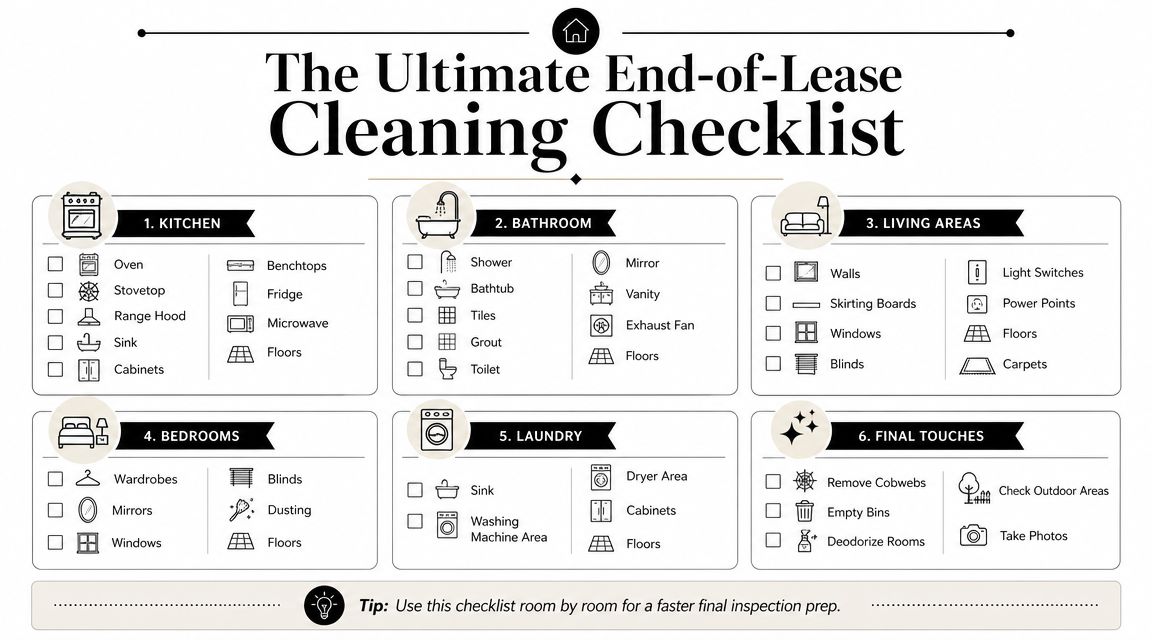
A helpful infographic showing an end-of-lease cleaning checklist for kitchens, bathrooms, bedrooms, and laundry areas.

Why Melbourne quotes can feel higher

Melbourne pricing often reflects the cost of sending a compliant, insured team to do detailed work under time pressure. End-of-lease cleaning is not the same as a regular weekly service. The cleaner is working to inspection standard, and that usually means more time on grease, soap scum, built-up dust, marks, fittings, and inside storage areas.

The job can also become harder to deliver if access is awkward. Apartment towers with lift bookings, limited parking, key collection, or tight agent deadlines all add labour friction. If the clean has to happen on the same day as the move, the margin for delays gets smaller fast.

I see this regularly with relocations. A customer tries to save money by booking the cheapest cleaner available, then ends up paying again for a return visit after the property manager picks up missed items. That is where the actual cost shows up. Extra cleaning, delayed key return, and bond disputes.

What to watch for in a Melbourne quote

A quote is only useful if it tells you what standard is being priced and what work is included.

Look for these points:

  • Type of clean: Standard house clean, deep clean, or end-of-lease clean
  • Included tasks: Oven, rangehood, internal windows, skirting boards, inside cupboards, and wet areas
  • Property access: Stairs, lifts, parking, key handover, and whether utilities are still connected
  • Timing: Same-day move and clean bookings often cost more because delays affect both trades
  • Re-clean policy: Whether the cleaner will return if the agent raises reasonable issues after inspection

If you are pricing the whole relocation at once, it helps to compare cleaning against the rest of your moving budget. This guide to moving house costs in Melbourne gives a clearer picture of where cleaning sits alongside transport, packing, and access costs.

A short visual explainer can also help when you're comparing jobs and deciding how much work the property really needs.

The best quote is not the lowest one. It is the one that matches the condition of the property, the standard your agent will inspect against, and the timetable for a low-stress move.

DIY vs Professional Cleaning The Real Tradeoffs

The fundamental choice isn't just “Can I clean this myself?” It's “What am I saving, and what am I risking?”

For some moves, DIY is perfectly reasonable. For others, it becomes a false economy because the property needs more than a general clean and you're already stretched by packing, lifting, paperwork, and time pressure.

When DIY makes sense

DIY usually works best if the home has been well maintained and you can spread the work over several days. It also helps if you already have the right products, a reliable vacuum, mop system, buckets, cloths, gloves, and the energy to do detail work after the furniture is out.

DIY is often the better option when:

  • The property is already in good condition: No major grease, mould, or heavy grime.
  • You have time after the move-out: Not just an hour before key return.
  • The inspection standard is modest: For example, an owner-occupied sale handover rather than a strict rental vacate.
  • You're confident with detail work: Skirting boards, inside cupboards, switches, and window tracks are where people often fall short.

When professional cleaning usually wins

A move-out clean is often closer to a deep clean than a standard clean. One pricing guide estimates that deep cleans are about 30% to 60% higher than standard maintenance cleaning, with a 2,000 sq ft home estimated at about $180 to $280 for standard maintenance and $280 to $400 for a deep clean, based on LeadDuo's pricing guide.

That difference reflects labour, not marketing. Deep work means more time on fixtures, grime buildup, and detailed surfaces.

If you're exhausted from packing and moving, the “cheap” DIY option can end up costing more in re-cleaning, missed inspection items, or lost time.

Professional cleaning usually makes the most sense when bond return matters, when the kitchen and bathrooms need real restoration, or when your move has to run on a tight timetable. The same logic applies to packing. If you're trying to protect time and reduce chaos, it's worth looking at the benefits of using professional packing services alongside the cleaning decision.

The hidden cost of doing it yourself

The hidden cost isn't only products. It's decision fatigue and physical effort.

After a move, people often underestimate how hard it is to clean an empty property properly. Empty rooms show every mark. Empty cupboards reveal crumbs and dust. Bathrooms look harsher under inspection lighting than they did when the home was furnished.

That's why the smartest choice is often the one that protects your time, your energy, and the standard required at handover.

How to Get Accurate Quotes and Save Money

The fastest way to get a bad cleaning quote is to give vague information. “Three-bedroom house, need a clean” doesn't tell a provider enough to price properly.

The best quotes come from clear job details. That helps you compare providers on scope, not just on headline price.

What to give a cleaner before they quote

Send the essentials upfront:

  • Property details: Bedrooms, bathrooms, kitchen, laundry, living areas, study, balcony, garage if relevant.
  • Type of clean required: Standard, deep, or end-of-lease.
  • Condition notes: Grease, pet hair, mould spots, marks on walls, neglected appliances.
  • Access details: Stairs, lift, parking, key pickup, deadline for completion.
  • Must-do items: Oven, internal windows, fridge, cupboards, skirting boards, carpets if they form part of your required standard.

Photos help. A short list helps even more. Cleaners can quote faster when they know what they're walking into.

Questions worth asking before you book

Use a checklist instead of relying on assumptions:

  1. What exactly is included in the quoted clean?
  2. Are oven, windows, and appliance interiors included or extra?
  3. Is the quote fixed, or can it change on the day?
  4. What conditions would trigger extra charges?
  5. Do you supply all products and equipment?
  6. Can you work to an end-of-lease checklist if I provide one?
  7. What happens if the agent flags missed items after the clean?

If you want another framework for understanding how cleaning bids are structured, Pebb resources for cleaning bids can be a helpful reference point for scoping labour and task-based work.

Simple ways to keep the cost under control

You don't need gimmicks to save money. The practical wins are usually straightforward.

  • Declutter before the cleaners arrive: They clean faster when surfaces and floors are clear.
  • Defrost and empty the fridge early: If the fridge interior needs cleaning, don't make the team wait for ice to melt.
  • Remove rubbish first: Cleaners shouldn't be spending paid time bagging general move-out waste unless that's part of the job.
  • Separate repairs from cleaning: If hooks, damage, or broken fittings need attention, sort those before the clean.
  • Book with enough buffer: Last-minute jobs reduce your options and can push you into paying more for rushed scheduling.

A good quote saves money because it reduces surprises. A cheap but vague quote usually does the opposite.

The Ultimate End-of-Lease Cleaning Checklist

For renters, the final clean isn't just about appearance. It's a bond-risk decision.

One of the biggest gaps in public advice is the difference between a normal house clean and a compliant exit clean. Bond disputes often hinge on the property's condition, and many pricing guides don't clearly quantify the extra work involved in a proper move-out clean that includes ovens, walls, and carpets, as discussed in Workiz's guide to cleaning cost and pricing.

A comprehensive end-of-lease cleaning checklist for residential homes divided by rooms and tasks for final inspection.

Kitchen

This is usually the room that decides whether a clean feels professional.

  • Oven and stovetop: Remove grease, baked-on residue, and food debris.
  • Rangehood and filter: Wipe exterior surfaces and degrease where buildup is visible.
  • Cupboards and drawers: Clean inside and outside, especially handles and corners.
  • Benchtops and splashbacks: Remove grease film and marks.
  • Sink and taps: Polish away residue and water marks.
  • Floor edges: Mop properly, not just the centre of the room.

Bathrooms and laundry

Bathrooms fail inspections for detail, not effort. Laundry areas get missed because they look secondary.

  • Shower recess and screen: Remove soap scum and residue.
  • Toilet: Clean bowl, seat, hinges, and surrounding floor.
  • Vanity and mirror: Wipe all surfaces and edges.
  • Exhaust fan and vents: Remove visible dust.
  • Laundry sink and taps: Clean residue and lint.
  • Cabinet fronts and floors: Don't ignore corners and behind doors.

Agents often check the areas tenants skip when they're tired. Tracks, switches, handles, and cupboard interiors matter because they show whether the job was finished properly.

Bedrooms, living spaces, and final details

The last pass is where bonds are won or lost.

  • Floors: Vacuum or mop every room after furniture is out.
  • Skirting boards: Dust and wipe where needed.
  • Window sills and tracks: Remove dust and debris.
  • Light switches and power points: Wipe finger marks.
  • Doors and frames: Spot clean marks and dust along edges.
  • Wardrobes and built-ins: Empty, wipe shelves, and clear dust from corners.
  • Walls: Spot clean only where needed and safe for the paint finish.
  • Cobwebs: Check ceilings, corners, and outdoor entry points.

Use this checklist whether you're doing the work yourself or checking a professional clean before the keys go back. It's much easier to fix a missed item before inspection than to argue about it later.

House Cleaning FAQ For Movers

Do I need to supply cleaning products and equipment

Usually, professional cleaners bring their own products and tools, but you should confirm that when you book. If the property has delicate stone, timber, or specialty finishes, mention them in advance so the team can use the right products.

Should I be at the property while the cleaners work

Not always. Many people hand over access and return near the end. What matters more is clear instructions, working utilities, and a way to confirm any must-do items before the team starts.

Is professional cleaning worth it for a rental move-out

Often, yes. The value isn't just labour. It's the standard of finish during a stressful part of the move. If your bond depends on the result, paying for a stronger clean can be easier than trying to fix problems after inspection.

What's the difference between a standard clean and an end-of-lease clean

A standard clean focuses on ongoing maintenance. An end-of-lease clean is more detailed and inspection-focused. It usually includes the neglected areas that a weekly clean doesn't target, such as cupboard interiors, skirting boards, and appliance detailing.

Can I book cleaning for the same day as the move

You can, but it's risky if timing is tight. Delays with keys, settlement, lift bookings, or the truck can compress the cleaner's window. If possible, leave a buffer so the property can be cleaned after everything is fully removed.

What should I do before the cleaners arrive

Empty the property, remove rubbish, disconnect or empty appliances if needed, and leave power and water on. If you're handling some tasks yourself, finish those first so the cleaner isn't working around half-complete jobs.

What if I only need help with the hardest areas

That can be a smart compromise. Some movers do the basic wiping and floors themselves, then book help for the oven, bathrooms, or windows. It won't suit every lease standard, but it can reduce cost while still improving the final result.

Is a cheap quote a good deal

Sometimes, but not automatically. A low number only helps if the scope is clear and the result meets the standard you need. For moving jobs, the cheapest quote often becomes expensive when re-cleans, missed tasks, or timing problems appear.


If you're planning a move and want the whole job to run smoothly, Get n Go Removals Melbourne can help take pressure off the process. From home and apartment moves to packing, unpacking, storage, and careful coordination around tight schedules, the team handles the relocation side so you can stay focused on handover, cleaning, and getting settled in your next place.

READ MORE

10 Best Areas to Live in Sydney Australia for 2026

Moving to Sydney is an exciting prospect, but with over 600 suburbs, choosing where to plant your roots can be overwhelming. This guide cuts through the noise, offering an in-depth look at some of the best areas to live in Sydney, Australia. We'll explore everything from cosmopolitan city hubs to relaxed beachside havens, providing the practical information you need to make a confident decision.

Whether you're moving interstate from Melbourne or relocating from overseas, our insights on lifestyle, cost, and amenities are essential. We also cover crucial moving logistics to help you plan a smooth transition, from finding the right removalist to organising short-term storage. This isn't just about finding a postcode; it's about discovering a community that fits your life. Let's find your perfect Sydney neighbourhood.

1. Mosman – Luxury Harbourside Living

Mosman represents the pinnacle of luxury living on Sydney's prestigious Lower North Shore. Perched on a peninsula with breathtaking harbour views, this suburb is defined by its grand homes, leafy streets, and an affluent community. Its combination of natural beauty, including Balmoral Beach and Sydney Harbour National Park, with high-end boutiques and cafes makes it one of the best areas to live in Sydney, Australia for those seeking an exclusive lifestyle with convenient city access. The suburb is particularly popular with high-net-worth individuals, executives, and families prioritising access to top-tier schools like Mosman High School and Queenwood.

Properties range from architecturally designed waterfront mansions to elegant heritage homes, with median house prices often exceeding $5 million and weekly rents for houses averaging around $2,500.

Relocation Insights for Mosman

Moving into a premium suburb like Mosman requires meticulous planning. For families relocating from Victoria, coordinating with a specialist interstate removalist is crucial to manage the logistics of long-distance transport. If you are organising removals from Sydney to Melbourne, Get n Go Removals offers tailored services that ensure a seamless transition for your valuable possessions.

Pro Tip: Schedule your move for a weekday outside of peak hours (10 am – 2 pm) to avoid significant traffic delays on the Harbour Bridge and Military Road. For high-value items, engage a removalist offering white-glove packing and specialist handling for art, wine collections, and designer furniture.

2. Double Bay – Cosmopolitan Chic

Double Bay is Sydney's most sophisticated eastern suburb, renowned as an epicentre of high fashion, fine dining, and cosmopolitan culture. This vibrant neighbourhood attracts young professionals, entrepreneurs, and affluent families who appreciate world-class dining, designer shopping, and cultural precinct accessibility. Its blend of urban sophistication with a village atmosphere makes it one of the best areas to live in Sydney, Australia for those seeking exceptional lifestyle amenities. It is a magnet for young professional couples relocating for career opportunities and entrepreneurs drawn to its dynamic business community.

Properties consist of luxury apartments, charming Art Deco buildings, and elegant freestanding homes, with median apartment prices around $1.8 million and weekly house rents often exceeding $3,000.

Relocation Insights for Double Bay

Moving to Double Bay requires coordination, especially given its bustling retail and dining scene. For apartment moves, which are common here, it is essential to plan carefully due to potential space constraints and building access rules. Understanding local home insurance in Double Bay is also a vital step to protect your new residence and belongings.

Pro Tip: Schedule your move for a mid-week, off-peak period (like a Tuesday or Wednesday between 10 am and 2 pm) to avoid the heavy traffic on New South Head Road. Coordinate with a removalist familiar with boutique building access and consider secure storage for seasonal items to maximise your living space.

3. Neutral Bay – Inner-City Village Feel

Neutral Bay offers a charming village atmosphere on Sydney's Lower North Shore, blending inner-city convenience with a welcoming suburban feel. This suburb attracts a diverse mix of young professionals, families, and downsizers who value its tree-lined streets, bustling cafes, and strong community spirit. Its unique position provides easy access to the CBD while maintaining a peaceful, residential character, making it one of the best areas to live in Sydney, Australia. The area is ideal for those who want a balanced lifestyle, with amenities like Forsyth Park and the Neutral Bay Club catering to an active community.

Properties vary from classic federation homes to modern apartment complexes. The median price for apartments is around $1.3 million, while weekly rents for two-bedroom units average approximately $850.

Relocation Insights for Neutral Bay

Moving into a popular and established suburb like Neutral Bay requires organisation, particularly when dealing with apartment buildings. Those downsizing from larger homes should consider furniture assessment services to ensure items fit in older, character apartments. A professional removalist can help plan the logistics for a stress-free move.

Pro Tip: Always book elevator access well in advance for apartment moves, and schedule your relocation for a mid-week slot to avoid the weekend congestion on local roads like Military Road. If there's a gap between leases, secure storage is a practical solution to keep belongings safe during the transition period.

4. Paddington – Bohemian Heritage Charm

Paddington is a vibrant eastern suburb celebrated for its iconic Victorian terrace houses, bohemian culture, and a thriving arts scene. This creative neighbourhood attracts artists, designers, and young professionals who value heritage architecture and a strong community identity. Its blend of street markets, galleries, and unique boutiques makes it one of the best areas to live in Sydney, Australia for those seeking distinctive urban living with excellent CBD connectivity.

A row of historic Victorian terrace houses with iron lace balconies along a tree-lined Sydney street.

Properties consist mainly of beautifully preserved terraces, with median house prices around $3.5 million and weekly rents averaging $1,300 for a house. Its unique character and amenities justify the investment for many.

Relocation Insights for Paddington

Moving into Paddington requires careful coordination due to its narrow streets and heritage properties. The tight access can be challenging, so understanding the potential moving company cost is essential for budgeting a professional service that is equipped for these conditions. Booking removalists experienced with Victorian homes is a wise decision.

Pro Tip: Schedule your move on a weekday to avoid the famous Paddington Markets traffic on Saturdays. For space-constrained terraces, arrange valet packing and furniture disassembly services to ensure everything fits through tight doorways and hallways without causing damage to the historic architecture.

5. Surry Hills – Inner-City Trendy Living

Surry Hills is a dynamic inner-city suburb, blending bohemian heritage with a vibrant, contemporary culture. Its energetic atmosphere attracts young professionals, creative entrepreneurs, and design-savvy residents who thrive on urban living. Famed for its sophisticated dining, boutique retail, and strong community spirit, it stands out as one of the best areas to live in Sydney, Australia for those seeking a cosmopolitan lifestyle with outstanding transport connectivity and a distinct local identity.

A stylish woman walks down a sunny Sydney street past a sidewalk cafe with outdoor seating.

The area is dominated by stylishly renovated Victorian terraces and modern apartment complexes. A typical two-bedroom apartment rents for around $1,100 per week, while house prices often start from $2 million.

Relocation Insights for Surry Hills

Moving to a high-demand, trendy suburb like Surry Hills requires forward planning. Professionals in hospitality or fashion moving from interstate should arrange for flexible scheduling with removalists to align with tight lease transitions. For anyone downsizing or managing business inventory, secure storage is a practical solution. To ensure your belongings are protected during transit, it's beneficial to get expert advice on how to pack for moving.

Pro Tip: Book your removalist well in advance, as weekend and end-of-month slots fill up quickly. Schedule your move for a mid-week, off-peak period (e.g., Tuesday at 10 am) to avoid the narrow one-way streets becoming congested with local traffic and delivery trucks.

6. Randwick – Eastern Beaches Lifestyle

Randwick offers a superb blend of beachside living and city convenience in Sydney's sought-after eastern suburbs. This family-oriented neighbourhood is defined by its proximity to iconic beaches like Coogee and Clovelly, excellent schools, and a bustling local shopping precinct known as "The Spot". Its unique position makes it one of the best areas to live in Sydney, Australia, for families, young professionals, and beach enthusiasts wanting a balanced lifestyle with suburban comfort and easy city connectivity.

Properties in Randwick vary from Federation-era family homes to modern apartment complexes, with median house prices around $3.5 million and house rentals averaging $1,400 per week.

Relocation Insights for Randwick

Moving to a popular coastal suburb like Randwick requires some strategic planning, especially during peak seasons. For instance, families relocating from cooler climates like Melbourne for the beach lifestyle should consider the timing of their move to avoid the busy summer holiday period when removalists are in high demand. Arranging professional packing is also wise to protect sensitive electronics and furniture from the salt-laden air.

Pro Tip: Schedule your move for a weekday to avoid the heavy weekend traffic heading to the eastern beaches. Consider using secure, climate-controlled storage for seasonal beach equipment like surfboards and kayaks to keep your home clutter-free and protect your gear from the humid environment.

7. Bondi – Iconic Beach Suburb Lifestyle

Bondi is Sydney's most iconic beach suburb, a world-famous destination synonymous with sun, surf, and a vibrant social scene. This energetic neighbourhood attracts a cosmopolitan mix of international professionals, creative entrepreneurs, and beach enthusiasts. It’s an ideal choice for those who want iconic Australian beach living combined with urban sophistication, making it one of the best areas to live in Sydney, Australia for an active and social lifestyle. The community is diverse, with a strong focus on health, wellness, and outdoor activities.

A lifeguard tower and a person sunbathing on the sandy shore of Bondi Beach in Sydney.

The property market in Bondi consists of modern apartments, Art Deco flats, and a limited number of freestanding homes. Median unit prices are around $1.4 million, while weekly rents for two-bedroom apartments often sit near $1,000.

Relocation Insights for Bondi

Moving to a high-demand, densely populated area like Bondi requires smart logistics. For a well-organised move, it helps to follow a detailed moving house checklist for Australia to ensure no detail is overlooked. Professional movers familiar with the area can navigate the narrow streets and parking challenges typical of Bondi.

Pro Tip: Book your move on a weekday during the off-season (May-August) to avoid extreme tourist congestion. Given the limited parking and smaller living spaces, consider using a valet service for packing and unpacking, and arrange secure storage for seasonal items like surfboards or winter gear.

8. Woollahra – Inner-Eastern Sophistication

Woollahra is a picture of inner-eastern sophistication, celebrated for its heritage architecture, thriving art gallery scene, and an upscale, village-like atmosphere. This elegant neighbourhood attracts affluent families, art collectors, and professionals who appreciate its blend of historic charm and contemporary refinement. Woollahra is considered one of the best areas to live in Sydney, Australia for those valuing architectural beauty, cultural engagement, and strong property appreciation. The suburb’s refined lifestyle is supported by high-end boutiques on Queen Street, exceptional private schools like Reddam House, and its proximity to Centennial Park.

Properties in Woollahra are dominated by Victorian-era terrace houses and grand manors, with median house prices typically around $4.8 million and weekly house rentals averaging approximately $2,200.

Relocation Insights for Woollahra

Moving into a heritage-rich suburb like Woollahra requires specific attention to detail, particularly for those with valuable collections. For example, art collectors and design professionals should engage moving services that offer specialist handling for fragile items. If you have fine art, antiques, or collectibles, ensure your removalist provides custom crating and climate-controlled transport to protect your investments during the move.

Pro Tip: Plan your move on a weekday and be aware of heritage conservation rules and narrow street access. Discuss any potential council restrictions with your removalist in advance. Booking a company experienced with heritage properties ensures they have the right equipment and techniques to navigate tight spaces without causing damage.

9. Clovelly – Beachside Character Living

Clovelly offers a unique take on Sydney’s eastern beaches lifestyle, blending a village atmosphere with its famed sheltered cove. Known for its intimate, artistic community, this suburb attracts creative professionals, young families, and anyone seeking authentic coastal living away from the intense crowds of its larger neighbours. Its strong neighbourhood identity and local culture make it one of the best areas to live in Sydney, Australia for those valuing community connection and a relaxed, character-filled environment. The area is popular with artists, media professionals, and families drawn to Clovelly Public School and the local surf club.

Properties here are a mix of charming Californian bungalows, modern apartments, and architectural homes, with median house prices around $3.8 million and house rentals averaging $1,600 per week.

Relocation Insights for Clovelly

Moving to a tight-knit, high-demand coastal suburb like Clovelly requires tactical planning. Access can be challenging, especially on weekends when beachgoers flock to the area. Professional movers with experience in beachside properties are essential for navigating narrow streets and protecting items from the salty air.

Pro Tip: Schedule your move for a weekday to avoid the weekend beach traffic and parking congestion. Discuss access with your removalist beforehand and consider secure storage for seasonal gear like surfboards and kayaks to keep your new home clutter-free.

10. Manly – Beachside Village Paradise

Manly embodies a vibrant, beachside village atmosphere on Sydney's iconic Northern Beaches. Famous for its pristine sand, relaxed coastal lifestyle, and strong community feel, this suburb is a paradise for families, young professionals, and beach lovers alike. It offers an ideal blend of sun-soaked living with sophisticated urban conveniences, including a thriving local business precinct and cafe culture. For those dreaming of a coastal escape without sacrificing city perks, Manly is one of the best areas to live in Sydney, Australia. It's particularly appealing to remote workers seeking a better lifestyle and retirees downsizing to beachside apartments.

Properties in Manly vary from classic apartments to modern family homes, with median house prices around $4.2 million and average weekly rents for houses sitting at approximately $2,000.

Relocation Insights for Manly

Moving to Manly requires specific planning, particularly due to its location and popularity. For example, families arriving from other states will find that booking with the best interstate removalists in Australia well in advance is essential, especially during the busy summer months. A professional team can handle complex logistics and ensure your belongings are protected from potential salt-air exposure during transit and unloading.

Pro Tip: Plan your move on a weekday and be mindful of the ferry schedule, as ferry arrivals can cause temporary congestion around the Manly Wharf precinct. To avoid access issues, discuss street parking and loading zones with your removalist ahead of time, particularly if you are moving into an apartment complex with limited access.

Top 10 Sydney Suburbs Comparison

Suburb 🔄 Moving complexity ⚡ Resource needs ⭐ Expected lifestyle / quality 💡 Ideal for 📊 Key advantages
Mosman – Luxury Harbourside Living High — narrow streets, heritage homes, limited access; expert movers required Car‑dependent access, white‑glove packing, secure storage, premium materials ⭐⭐⭐⭐⭐ Luxury harbourside living; strong investment appeal; $2.5M–$8M+ Affluent families, executives, private‑school households Spectacular harbour views, top schools, strong capital growth
Double Bay – Cosmopolitan Chic Medium — apartment moves, lift/stair handling, parking limits Good public transport, boutique removalists, secure wardrobe storage ⭐⭐⭐⭐ Cosmopolitan, fashion‑forward village; $1.8M–$6M Young professionals, entrepreneurs, creatives World‑class dining & shopping, walkable precinct, excellent CBD access
Neutral Bay – Inner‑City Village Feel Medium — mix of terraces & apartments; adaptable strategies needed Train links, advance lift bookings, family‑friendly packing ⭐⭐⭐⭐ Community‑oriented village feel; good value; $1.3M–$4.5M Families, downsizers, professionals seeking balance Village atmosphere, strong transport, more affordable than inner‑east
Paddington – Bohemian Heritage Charm High — narrow Victorian terraces, heritage restrictions, limited truck access Specialist disassembly, valet packing, weekday scheduling ⭐⭐⭐⭐ Bohemian heritage character; active arts scene; $1.5M–$5M Artists, designers, culturally engaged professionals Heritage architecture, markets, vibrant creative community
Surry Hills – Inner‑City Trendy Living Medium — apartment dominant, lift/stair logistics, competitive parking Early removalist booking, secure storage, flexible scheduling ⭐⭐⭐⭐ Trendy inner‑city lifestyle; strong dining culture; $1.4M–$4.8M Young professionals, creative entrepreneurs Vibrant dining/cafe scene, excellent CBD proximity, high demand
Randwick – Eastern Beaches Lifestyle Low–Medium — bus‑dependent access, seasonal beach congestion Plan for peak season, salt‑air protective packing, storage for beach gear ⭐⭐⭐ Family beachside lifestyle, solid schools; $1.1M–$3.8M Families, beach enthusiasts, school‑focused households Beach proximity, strong schools, community amenities
Bondi – Iconic Beach Suburb Lifestyle High — heavy tourist congestion, steep/narrow streets, limited parking Advance booking, valet services, secure surf/seasonal storage ⭐⭐⭐⭐⭐ Iconic beach living with high demand and cost; $1.2M–$4.5M International professionals, beach lifestyle seekers World‑famous beach, vibrant social scene, strong amenities
Woollahra – Inner‑Eastern Sophistication High — heritage listings, narrow streets, specialist handling required Climate‑controlled storage, art movers, council approval planning ⭐⭐⭐⭐⭐ Sophisticated heritage living; cultural & school prestige; $1.6M–$6M Affluent families, art collectors, heritage enthusiasts Outstanding heritage architecture, galleries, top private schools
Clovelly – Beachside Character Living Medium — village streets, beach‑season parking, limited large‑truck access Salt‑air protection, weekday moves, small‑scale removalists ⭐⭐⭐ Beachside village charm; affordable vs major beaches; $900K–$3.2M Artists, young families, beach lovers seeking community Intimate cove, authentic village feel, lower prices than major beaches
Manly – Beachside Village Paradise Medium — ferry coordination, varied terrain, summer congestion Coordinate ferries, salt‑air protection, secure holiday storage ⭐⭐⭐⭐ Relaxed beach village with strong amenities; $900K–$3.8M Families, remote workers, retirees seeking coastal life Scenic ferry commute, family‑friendly beaches, solid retail precinct

Making Your Sydney Move Smooth and Successful

Choosing from the best areas to live in Sydney, Australia is the exciting first step, but a seamless transition is what truly transforms a new address into a home. From the leafy, harbourside streets of Mosman and Neutral Bay to the vibrant, cosmopolitan energy of Surry Hills and Paddington, this guide has shown that Sydney offers a perfect pocket for every lifestyle. Whether you’re drawn to the iconic surf of Bondi and Manly or the sophisticated village atmosphere of Woollahra, your ideal community is waiting.

The key takeaway is that the "best" suburb is entirely personal. It’s the one that aligns with your budget, commute, and lifestyle aspirations. Your next steps should involve creating a shortlist based on these factors, planning a visit if possible, and researching the local market trends. For those making a significant move, such as relocating from interstate or even overseas, the logistical planning becomes just as important as the destination. For example, if you are making an international corporate move, there are specific tips for international corporate housing that can simplify finding a suitable place.

However, the physical move itself presents its own set of challenges, from navigating narrow heritage streets to coordinating access for high-rise apartments. This is where professional expertise becomes invaluable. An experienced interstate removalist doesn't just transport your belongings; they provide local knowledge and logistical support. By partnering with a trusted team for packing, transport, and even secure storage, you remove the stress and uncertainty from the equation. This allows you to focus purely on the excitement of starting your new chapter in one of the world's most beautiful cities.


Ready to make your Sydney dream a reality without the moving-day stress? Get n Go Removals Melbourne specialises in interstate moves, offering weekly services to Sydney with the expertise to handle any challenge. Visit Get n Go Removals Melbourne for a transparent quote and let our professional team manage your move from start to finish.

READ MORE

Inter State Transport: Your Ultimate Melbourne Guide 2026

Moving interstate usually starts the same way. One tab open for rental listings or settlement dates, another for school enrolments or office fit-outs, and a growing feeling that the actual move is bigger than expected. Most Melbourne customers aren't worried about the idea of a new start. They're worried about the handover between homes, the truck arrival window, the safe handling of furniture, and whether everything shows up when it should.

That concern is reasonable. An interstate move isn't just a longer local move. It has more timing dependencies, more planning around access, and more pressure on packing quality because your goods are travelling far beyond the usual suburban run. In Australia, interstate transport sits on a small number of major corridors, and the practical reality is that moves between cities often involve very long distances and tightly planned schedules.

Customers moving from Melbourne to Sydney or Brisbane often ask the same first questions. How does the process work? What affects cost? How long will it take? What happens if the destination has poor access? Those are the right questions to ask.

Your Interstate Move from Melbourne Starts Here

A typical call comes from someone standing in a half-packed lounge room in Melbourne, trying to line up several moving parts at once. They've signed a lease in Sydney, or they're heading to Brisbane for work, and the date looked manageable until they started listing everything that has to happen in order. Keys, elevators, fragile items, pet travel, utilities, storage, address changes. Suddenly the transport side feels like the part that could throw everything off.

That's where a calm process matters.

A first interstate move always feels more uncertain than it should because the intricate processes behind the scenes are rarely visible. They see a truck on moving day. They don't see the booking checks, access questions, load planning, wrapping standards, route timing, or the way a well-run company builds a schedule around real conditions instead of guesswork.

If you're still comparing providers, it helps to look at a team that already handles a broad mix of Melbourne jobs, from local homes and apartments through to larger relocations. A good starting point is reviewing removalists near you in Melbourne so you can compare service style, access experience, and communication before you commit.

Practical rule: If a mover can't explain the full journey from uplift to delivery in plain English, they probably won't manage surprises well on the day.

The good news is that interstate transport becomes far less stressful once you break it into stages. You don't need to solve everything at once. You need a realistic plan, honest timing, and a mover who checks the details that usually get missed.

What Interstate Transport from Melbourne Involves

An interstate move has a clear operational sequence. Once you understand the sequence, the process stops feeling vague and starts feeling manageable.

In Australia, interstate transport is structurally concentrated on the east coast, with the National Land Transport Network linking major cities such as Melbourne, Sydney and Brisbane. That corridor-based system makes route reliability and careful scheduling critical for runs that often exceed 1,000 kilometres, as outlined in this overview of interstate transport corridors.

A professional infographic illustrating the step-by-step process of interstate transport services from Melbourne.

Phase one is the quote and planning stage

Here, the move is won or lost.

A proper quote isn't just a price list. It's a planning document. The mover should ask what you're taking, whether there are stairs, whether the pickup or delivery address has loading restrictions, whether you need packing, and whether any items need special handling. If they don't ask those questions, they're not really pricing the job. They're estimating blind.

For a deeper look at how long-distance jobs are structured, this guide for long-distance relocation is useful background reading before you lock in dates.

Phase two is uplift in Melbourne

“Uplift” means collection day. The crew arrives, protects floors and key furniture pieces where needed, loads in a safe order, and records what's travelling.

The loading pattern matters more on interstate work than many customers realise. Heavy items, fragile cartons, mattresses, tall furniture, and awkward pieces all need the right placement because they're travelling much further than they would on a suburban job.

Phase three is linehaul

Linehaul is the long-distance transport leg between cities. The easiest way to think about it is this. Local moving gets your goods out of the property. Linehaul gets them across the state border on the main corridor.

This is why established east coast routes matter. Professional movers don't usually reinvent the route for each job. They work within proven schedules, departure windows, compliance requirements, and delivery sequences.

Linehaul is where interstate moving becomes a logistics job, not just a lifting job.

Phase four is delivery and unloading

Delivery is the final handover, but it's not just “reverse the load”. The destination property often changes the plan. Apartment lifts, narrow driveways, access hours, building rules, and where each item needs to go all affect the unload.

A smooth interstate move usually looks uneventful from the customer side. That's the point. Good planning removes friction before the truck turns up.

Decoding Interstate Moving Costs and Transit Times

The two questions customers care about most are simple. What will it cost, and when will my things arrive?

The answer to both depends on more than distance. Interstate pricing is shaped by the space your goods take up in the truck, the labour needed at each end, and the complexity of both properties. Timing depends on service type, scheduling, and how your job fits into the broader run.

What usually affects the price

The biggest cost drivers are practical, not mysterious. A larger household takes more truck space. Difficult access means more labour. Added services increase handling time and material use.

Common pricing factors include:

  • Volume of goods: Movers often price around the load size, commonly described in cubic metres or by the inventory list.
  • Property access: Stairs, long walks from truck to door, lift bookings, or limited loading areas can change labour time.
  • Special items: Pianos, pool tables, antiques, oversized furniture, gym equipment, and motorbikes need extra preparation.
  • Packing level: Owner-packed moves usually cost less than full packing, unpacking, and furniture reassembly.
  • Storage needs: If settlement dates don't align, the move may need a storage leg before final delivery.

If you want a broader breakdown of typical moving charges, this page on the cost of movers helps frame the main variables.

Dedicated truck versus consolidated service

This is one of the most important trade-offs.

A dedicated truck carries only your load, or primarily your load, from Melbourne to destination. It usually gives tighter timing and fewer handling points, but it often costs more.

A consolidated service combines multiple compatible jobs on a scheduled corridor run. That can be more economical, but the timing window is usually broader because the truck sequence needs to work across several pickups and deliveries.

Customers sometimes compare this decision to vehicle transport because the trade-off is similar. If you want context on how transport pricing changes over long distances in another logistics category, this resource on compare 2000-mile car transport costs is a useful parallel.

Estimated interstate transit times from Melbourne

These timeframes are best treated as planning windows, not promises detached from access, service type, and schedule.

Destination City Estimated Transit Time (Business Days)
Sydney Short transit window, often scheduled on regular east coast runs
Brisbane Moderate transit window, depending on service type and load coordination
Canberra Similar to Sydney corridor timing, subject to booking schedule
Gold Coast Comparable to Brisbane timing, with local delivery access affecting final handover
Adelaide Usually shorter than northbound east coast runs, depending on departure schedule

Ask for a delivery window, not just a date. The answer tells you whether the mover is speaking from an actual schedule or from wishful thinking.

What slows a move down

Transit delays usually come from one of four causes:

  1. Late booking, which limits your place on scheduled runs.
  2. Incomplete inventory, which causes load plan changes.
  3. Access problems at destination, especially in apartments or regional properties.
  4. Mismatch between service expectations and budget, such as wanting dedicated timing on a consolidated price.

The best quotes are the ones that explain these trade-offs clearly before pickup day.

Navigating Insurance Legalities and Mover Liability

Insurance is where many customers assume they're covered, only to discover later that they didn't understand what was included. Interstate moving is not the time to be vague about risk.

The first distinction to understand is this. Public liability and transit protection for your goods are not the same thing. One relates to damage or incidents involving third-party property or premises. The other concerns the items you've entrusted to the mover during transport and handling.

A stack of insurance policy documents with a pen resting on top, in front of a delivery truck.

What to check before you book

Ask direct questions and ask for plain answers.

  • What cover applies to my goods in transit: Don't assume all loss or damage scenarios are automatically included.
  • What packing conditions apply: Some transit cover depends on who packed the items and how they were packed.
  • What documentation will I receive: You want confirmation in writing, not a verbal summary.
  • What happens if there is a claim: The claims pathway should be clear before the move starts.

A serious mover should also be able to explain operational compliance, not just paperwork. Professional interstate transport operates under the Heavy Vehicle National Law, enforced by the National Heavy Vehicle Regulator, which harmonises rules for mass, load restraint, and driver fatigue across participating jurisdictions. In practice, that means a compliant Melbourne-to-Sydney job requires multi-jurisdiction checks before loading, as outlined in this reference on interstate access and compliance frameworks.

Why legal compliance matters to customers

Customers sometimes think compliance is a back-office issue. It isn't.

If a company cuts corners on vehicle condition, load restraint, route suitability, or driver fatigue management, the risk lands on your move. Safety standards affect whether your goods travel on a well-prepared vehicle with a realistic schedule or on an overcommitted run that's already under pressure.

A cheap quote can become an expensive problem if the company hasn't done the legal and operational checks before pickup.

Your role in reducing risk

Customers have responsibilities too. Declare unusual items. Mention fragile goods, access issues, steep driveways, mezzanines, and anything that might affect loading or unloading. If the crew arrives to surprises, the plan changes under time pressure, and that's when mistakes become more likely.

Clear inventories, honest access details, and written confirmation of cover are the basics. None of that is optional on an interstate job.

Specialist Transport for Pianos Pool Tables and Vehicles

Some items need more than care. They need a different method entirely.

A fridge, sofa, and dining table can usually move well with standard wrapping, tie-downs, and solid loading technique. A grand piano, slate pool table, artwork, motorbike, or collector furniture piece is another category. These jobs require the right equipment, enough trained hands, and a plan for each stage from extraction to delivery.

A professional mover carefully covering a grand piano with a protective blanket inside a moving truck.

Pianos need controlled handling

Pianos aren't just heavy. They're awkward, weight-biased, and sensitive to impact. Uprights and grands each need different handling methods, and stairs or tight turns can completely change the equipment required.

Professional crews typically assess:

  • Access path: Door widths, turns, flooring, thresholds, ramps, and stairs.
  • Protection method: Quilted blankets, secure strapping, corner protection, and stable positioning in the truck.
  • Loading gear: Piano trolleys, tailgate lifters, skates, and tie-down points suited to the instrument.

If you're pricing this kind of move specifically, these piano moving prices give useful context for the extra labour and handling involved.

Pool tables usually need disassembly

A proper slate pool table is rarely moved as-is. It's usually dismantled, protected in sections, transported carefully, then reassembled and levelled at the destination. The danger isn't only breakage. It's also poor reinstallation that leaves the table playing badly.

The same principle applies to bulky gym equipment, marble-top furniture, and fragile display cabinets. The cost comes from skilled handling, not just extra muscle.

A closer look at specialist handling techniques is worth watching here:

Vehicles and motorbikes need separate planning

When customers ask whether a car or bike can go with household goods, the answer depends on the service model and the item itself. In some cases, vehicle transport is arranged as a separate logistics stream because restraints, loading systems, and insurance conditions differ from standard furniture removals.

The key question isn't “Can you take it?” It's “What method are you using, and how is it secured?” That's the detail that separates a specialist service from a vague yes.

Valuable and awkward items should never be treated as add-ons. They need their own handling plan before moving day.

Coordinating Packing Storage and Weekly Direct Runs

Packing, storage, and scheduling are often treated as separate decisions. In practice, they work best when planned together.

A customer might be vacating a Melbourne apartment before the new interstate property is ready. Another may be downsizing and unsure what will fit. An office move may need staged packing so daily operations can continue until the final handover. These aren't unusual complications. They're normal parts of inter state transport, and they're easier to manage when the move plan includes all three pieces from the start.

Choosing the right packing level

There's no single correct way to pack. The right option depends on time, budget, and the type of goods you're moving.

Some customers prefer a partial service. They pack clothes, books, and personal items themselves, then leave fragile kitchenware, artwork, or awkward furniture protection to the movers. Others want full packing and unpacking because work, kids, or settlement timing leave no room to do it properly.

A sensible packing plan usually falls into one of these approaches:

  • DIY packing with supplied materials: Suitable if you're organised and have enough lead time.
  • Partial professional packing: Good for breakables, glassware, electronics, and high-risk items.
  • Full-service packing and unpacking: Best when time is tight or the move involves a large home or office.

Storage works best as part of the same move plan

Storage is most useful when it bridges a timing gap cleanly. That might be a short period between settlement dates, or a longer hold while a renovation or construction finish is delayed.

The practical benefit of integrated storage is control. Your goods are packed, documented, loaded, stored, and redelivered under one coordinated plan rather than being handed across multiple providers. If you're comparing options, these Melbourne storage prices are a helpful reference point for short-term and longer-term arrangements.

Why weekly direct runs matter

Australia's interstate freight task is dominated by road freight, which carries the vast majority of domestic freight by volume. Operationally, that means professional interstate removals are planned around scheduled departures, driver hours, and vehicle types on the main corridors linking cities such as Melbourne, Sydney and Brisbane, not just around raw distance, as discussed in this overview of interstate system conditions and performance.

That matters for customers because scheduled direct runs usually produce a cleaner process than ad hoc transport. Your move can be aligned with a known departure pattern rather than squeezed into whatever space appears at the last minute.

Get n Go Removals Melbourne states that it operates weekly direct east coast runs, which is the kind of service structure many customers look for when they want more predictable timing between Melbourne and major interstate destinations.

What works and what doesn't

The smoothest interstate moves usually have three things in common:

  • Packing is finished before the crew arrives: Not half-finished, not “almost done”.
  • Storage is arranged before it becomes urgent: Last-minute storage decisions create rushed handling.
  • The departure run matches the customer's actual timeline: Not the ideal one, the actual one.

What tends not to work is trying to save money by underestimating the job. Customers underquote volume, leave access details out, or assume they can finish packing the night before. Those choices usually cost more in stress than they save in price.

Your Step-by-Step Interstate Relocation Checklist

A good checklist protects you from avoidable mistakes. It also gives you a way to test whether your mover is organised. If they can't answer practical questions at each stage, keep looking.

An infographic titled Your Interstate Relocation Checklist showing five organized steps from eight weeks before to moving day.

Eight weeks before

Start with the decisions that affect everything else.

  • Shortlist movers: Compare communication quality, service inclusions, and how thoroughly they ask about access and inventory.
  • Declutter properly: Don't pay to move items you already know you won't keep.
  • Check destination details: Confirm building rules, delivery windows, lift bookings, driveway access, and parking constraints.

If you're considering different storage formats during planning, this article on shipping container storage gives useful general context on storage use cases and practical trade-offs.

Four weeks before

This is where the move becomes real. Bookings, notices, and early packing should already be underway.

  • Pack non-essentials: Seasonal items, books, décor, archived files, and rarely used kitchenware can go first.
  • Notify providers: Utilities, schools, insurers, banks, subscriptions, and delivery services all need address updates.
  • Confirm inventory changes: If you add or remove major items after quoting, tell the mover now.

Two weeks before

Final planning matters more than speed at this stage.

A major overlooked risk in interstate transport is the last-mile destination. Route-specific permits, height and weight limits, and local access constraints can create problems at delivery even when the highway leg goes smoothly, as noted in this guidance on underserved access and transport constraints.

That's why customers should double-check:

  • Driveway and street access: Can a larger truck reach the property safely?
  • Building restrictions: Are there fixed loading times, basement height limits, or concierge booking rules?
  • Room placement instructions: Label clearly so the crew doesn't have to guess at delivery.

The most frustrating interstate delays often happen at the destination address, not on the road.

One week before

This week is about reducing pressure on moving day.

  1. Pack an essentials kit with chargers, medications, documents, toiletries, clothes, and basic kitchen items.
  2. Finish loose jobs like dismantling anything you've agreed to handle yourself.
  3. Confirm booking details in writing including address, contact numbers, preferred arrival windows, and payment arrangements.

Moving day and arrival

Stay available, but don't micromanage the crew. Good movers work faster when they have clear access and one decision-maker.

Before the truck leaves Melbourne:

  • Do a final walkthrough: Check cupboards, garage shelves, outdoor areas, and storage cages.
  • Secure keys and documents: Keep them with you, not inside a random box.
  • Confirm the destination contact: Especially if someone else will receive the goods.

At delivery, inspect the access path first. Open doors, protect pets, direct room placement, and raise any concerns before unloading starts.

Critical questions to ask any interstate mover

These questions reveal a lot very quickly:

  • What exactly is included in the quote, and what would count as a variation?
  • How do you handle difficult access at pickup or delivery?
  • Is the service dedicated or consolidated?
  • What cover applies to my goods while in transit and storage?
  • What happens if my destination date changes?
  • How are fragile or specialty items prepared and loaded?
  • Who is my contact person if plans change during transit?

The right mover won't be annoyed by these questions. They'll answer them clearly.


If you're planning an interstate move and want a straightforward discussion about timing, packing, storage, and delivery access, Get n Go Removals Melbourne is one Melbourne-based option to contact for practical advice and a written moving plan.

READ MORE

Get N Go Removals Albury: Your Stress-Free Move in 2026

If you're planning a move in or around Albury, you're probably juggling too many moving parts at once. Lease dates, settlement timing, school enrolments, utility transfers, packing, access at both properties, and the big one, how to get everything from one place to the next without damage or delays.

That stress is normal. A move can feel messy even when you're organised.

Albury isn't just another regional stop on the map. Its modern European-era history is commonly dated to 1824, when Hamilton Hume and William Hovell reached the Murray River crossing associated with the city. The site was first called Crossing Point, then renamed Albury in 1838, and it became a municipality in 1859, as outlined in this history of Albury. That progression matters because it explains why Albury functions the way it does today. It's a border city, a service hub, and a place where local and long-haul logistics meet.

For removals in Albury, that mix changes how a move should be planned. Local access matters. So does interstate route timing, especially if you're moving between Melbourne and Albury.

This guide is built for that exact situation. It covers what removal services include, how quotes are usually shaped, what to do week by week, and what tends to go wrong when people leave key details too late. If you're comparing options, start by checking areas we service across Victoria and interstate so you know whether your route fits a local, regional, or longer-distance move.

Your Smooth Move to Albury Starts Here

The first good decision in any move is simple. Stop treating it like one giant task.

An Albury move runs better when you split it into separate jobs. One job is transport. Another is packing. Another is access planning. Another is timing keys, lifts, cleaners, trades, or office handover. When people roll all of that into one mental pile, they miss the details that end up costing time on moving day.

Start with the move type

Most Albury moves fall into one of these groups:

  • Local residential move: House to house, unit to unit, or downsizing within Albury or nearby suburbs.
  • Border-city move: Moving between Albury and Wodonga, where travel is short but access and scheduling still matter.
  • Melbourne corridor move: A longer run where line-haul timing matters more than the packing itself.
  • Office or commercial relocation: Desks, files, workstations, stock, and staged relocation to reduce downtime.
  • Partial move: Only selected furniture, storage items, or a few heavy pieces.

Each type needs a different plan. A local move may hinge on driveway access and whether the sofa fits through a stairwell. A Melbourne to Albury move may hinge on departure timing, loading order, and keeping the truck moving smoothly over a long run.

Practical rule: Book based on complexity, not just distance. A short move with stairs, poor parking, and fragile items can be harder than a longer straightforward run.

Know what slows a move down

The biggest delays usually aren't dramatic. They're avoidable details such as:

  • Access not disclosed early: Steep driveways, narrow hallways, apartment lifts, and long carry distances.
  • Loose packing: Open-top boxes, mixed items, or cartons that can't stack safely.
  • Late key timing: Trucks arriving before settlement or before an agent releases access.
  • No loading plan: Heavy furniture packed behind fragile cartons or essential items buried deep in the truck.

Clients often assume the move starts when the truck arrives. It actually starts when the plan becomes clear. If you sort the route, inventory, access, and service level early, the day itself is usually much calmer.

What works in practice

A smooth Albury move usually comes from three things. Clear scope, honest access details, and realistic timing.

That sounds basic, but it's the difference between a rushed move and a controlled one. If you're moving to Albury for work, family, or a lifestyle change, the process doesn't need to feel chaotic. It needs a proper sequence, the right crew setup, and enough flexibility for the small surprises that every move brings.

Decoding Albury Removal Services

A lot of people ask for a "truck and two men" when what they really need is a broader service. Others book a full-service move when a simpler option would've done the job. The right fit depends on how much time you have, how hands-on you want to be, and how awkward your furniture and access conditions are.

Two professional movers working together to carefully move and pack furniture for a residential relocation service.

Standard moving service

A standard removals Albury booking usually covers loading, transport, unloading, and basic furniture placement at the new property. This is the most common option for households that are happy to pack their own cartons and prepare everything before the crew arrives.

This service works well when:

  • Boxes are already packed and sealed
  • Beds, tables, or shelving are either ready to go or clearly identified for disassembly
  • Access is straightforward
  • You've already decided where major items will go

It doesn't work as well when the property is cluttered, the cartons aren't labelled, or clients are still packing as the truck is being loaded. That creates waiting time and increases the chance of fragile items being mixed with general household goods.

Packing and valet support

Packing is where many moves either stay efficient or start drifting. A professional packing service usually means the team brings materials, wraps breakables correctly, boxes by category, and builds a loading plan around item type and room location.

Valet packing and unpacking goes further. It usually includes careful packing before the move, protective wrapping for furniture, and unpacking at the destination so the home becomes functional faster. This is useful for busy households, families with small children, elderly clients, and office managers who need staff back to work quickly.

For a practical breakdown of why service level matters, this guide on hiring removal services the smart way is worth reading before you lock in your scope.

If you want to save money, save it on the jobs you can do well yourself. Don't save it on packing fragile items badly and paying for the consequences later.

Disassembly, reassembly, and special handling

Not all furniture should travel assembled. Tall bedheads, dining tables, modular lounges, desks, and certain shelving units often move more safely when broken down and padded properly. Done well, this protects the item and speeds up the load because the truck can be stacked more securely.

Special handling matters for items such as:

  • Pianos: They need correct lifting method, protection, route planning, and the right equipment.
  • Pool tables: These often need partial dismantling and careful handling of slate and frame components.
  • Antiques and delicate furniture: Surface protection matters as much as lifting.
  • Oversized pieces: Fridges, stone tops, large mirrors, and gym equipment need route checks before moving day.

Residential, office, and single-item jobs

These aren't the same kind of move, even if the truck looks the same from the outside.

A home move is usually about volume, family timing, and protecting sentimental items. An office move is about reducing disruption, keeping furniture grouped by team or department, and making sure IT equipment and files arrive in a useful order. A single-item move sounds simple, but heavy or awkward pieces often require more planning than clients expect.

One practical option for corridor-based relocations is Get n Go Removals Melbourne, which handles residential, commercial, packing, storage, and specialist item transport on routes that include Melbourne to Albury. The point isn't brand loyalty. It's making sure the operator you choose matches the route and service level your move needs.

Budgeting Your Albury Move Without Surprises

Quotes create anxiety when they're vague. If the scope isn't clear, the final bill can move around for reasons that were predictable from the start. The best way to avoid that is to understand what usually drives cost before you request pricing.

Industry pricing data for Albury shows a benchmark of about A$132 per hour for a 2-men-plus-truck move, with typical quoted rates ranging from roughly A$111 to A$162 per hour, based on Albury removalist pricing data. That range matters because it shows how much the final figure depends on the actual job, not just the suburb.

What changes the quote

Hourly rates are only part of the picture. Two households can book the same crew size and end up with very different totals because one move is simple and the other has friction built into it.

Here are the usual drivers.

Cost Factor Description Typical Impact on Quote
Access conditions Stairs, long walks from truck to door, tight hallways, lift booking limits, or difficult parking Increases labour time and slows loading and unloading
Volume of goods More furniture, more cartons, and more loose items to prepare and stack May require a larger truck, longer time, or extra crew support
Truck and crew setup Different jobs suit different truck sizes and staffing levels Changes the hourly rate and the speed of the move
Service scope Transport only versus packing, unpacking, dismantling, reassembly, or storage Adds labour and materials but can reduce stress and damage risk
Item complexity Fragile, oversized, awkward, or high-value items need added protection and planning Increases handling time and may require specialist equipment

The trade-off most people miss

A cheaper hourly rate isn't always a cheaper move.

A slower crew, poor truck fit, or weak planning can stretch a move out. A slightly higher rate with the right setup can be more efficient if the job is loaded once, stacked properly, and unloaded without rehandling. That's why comparing quotes line by line matters more than comparing one number in isolation.

If you're trying to understand where a local quote sits in the broader market, these national furniture removal averages can give you useful context. Use them as a comparison point, not a shortcut, because Albury pricing still depends heavily on access and scope.

Questions to ask before you accept a quote

A clear quote should answer practical questions, not just list a rate.

Ask these before you book:

  • What's included in the quoted service? Packing, wrapping, disassembly, reassembly, and unpacking should be spelled out.
  • How is travel handled? Clarify when chargeable time starts and ends.
  • Have access conditions been factored in? Mention stairs, lifts, driveway issues, and walking distance from the truck.
  • What packing materials are included, if any? Protective wrapping and cartons should never be assumed.
  • Are there likely extra charges if timing changes? Key delays and building restrictions should be discussed early.

Cost check: The more complete your inventory and access notes are, the more accurate the quote will be.

For a practical reference point on pricing structures and what usually appears on a moving estimate, this guide to the cost of movers is a useful companion.

How to budget realistically

Set your budget in layers. Start with the transport and labour. Then add packing materials, any optional packing support, and a margin for access or timing complications. That approach is much safer than assuming the hourly rate tells the whole story.

Clients who avoid nasty surprises usually do one thing well. They give complete information early. If your mover knows the inventory, the route, the access, and the services required, the quote has a much better chance of matching the actual work.

Your Step-by-Step Albury Moving Timeline

Most moving stress comes from timing collisions. You need keys before unloading. You need power on before the fridge goes in. You need boxes labelled before the first trolley leaves the truck. A proper timeline prevents those problems before they start.

An infographic titled Your Albury Moving Timeline showing steps from 8 weeks before to after moving.

Eight weeks out

This is when the move becomes real. Start by decluttering room by room. Don't begin with sentimental items. Begin with storage areas, linen cupboards, spare rooms, and anything you've been carrying from house to house without using.

Create one list with four categories:

  1. Moving
  2. Selling
  3. Donating
  4. Disposing

At the same time, start a simple inventory. It doesn't need to be fancy. A notes app, spreadsheet, or labelled room list is enough. The goal is to know what you're moving, what needs extra care, and which furniture may need dismantling.

Four weeks out

Book your mover once you know your date window and service level. If you're moving on a route that includes Melbourne and Albury, this is also the time to confirm line-haul timing, access at both ends, and any key-release issues.

Then lock in the jobs around the move:

  • Utility transfers: Electricity, gas, internet, and water where relevant
  • Building requirements: Lift bookings, loading zone rules, and strata approvals
  • Time-sensitive services: Cleaners, end-of-lease repairs, or settlement-linked access
  • Child and pet arrangements: Keep the day quieter and safer

A detailed moving checklist helps here. This moving home to-do list is a solid reference for the admin side people often forget until the final week.

Two weeks out

Start packing non-essentials first. Books, décor, spare kitchenware, winter or summer overflow clothing, and archived paperwork can usually be boxed well before moving day.

Label by room and function, not just room. "Kitchen" isn't enough. "Kitchen, daily plates" and "Kitchen, pantry overflow" saves a lot of frustration later.

Use a different approach for each item type:

  • Books and papers: Small cartons only, so they don't become too heavy.
  • Linen and clothing: Medium cartons or suitcases for quick access.
  • Fragile kitchenware: Wrap individually, stack vertically where sensible, and keep weight moderate.
  • Cables and hardware: Seal in small labelled bags and tape them to the item or keep them in a clearly marked essentials crate.

Label the boxes you'll need first with something impossible to miss. If every carton looks equally urgent, unpacking becomes slower than it needs to be.

One week out

This is confirmation week. Reconfirm your moving time, access arrangements, and contact details. If there are keys, agents, building managers, reception staff, or office coordinators involved, make sure each person knows when the truck is expected.

Pack an essentials box and keep it out of the main load until last. Include daily medications, chargers, toilet paper, basic toiletries, snacks, a kettle, pet supplies, important documents, and anything you'll want in the first night without opening ten boxes to find it.

Also do these final prep tasks:

  • Defrost and clean the fridge if needed
  • Drain fuel from small machinery where appropriate
  • Photograph valuable items before transit
  • Separate items not going on the truck

Moving day

Be ready before the crew arrives. Walk through the property once and identify priority items, fragile zones, and anything staying behind. Clear paths. Remove trip hazards. Keep children and pets in a safe separate area if possible.

During loading, one contact person should handle decisions. Too many voices slow the process and create mistakes. At the destination, direct furniture placement room by room. It's much easier to position large items correctly once than to reshuffle the house after the truck leaves.

After the move

Don't try to unpack everything at once. Start with the rooms that make the home function. Beds, bathroom basics, kitchen essentials, and work or school items come first.

Then work in short blocks. One room, one category, one cupboard at a time. The move feels finished much sooner when the useful spaces are sorted first and the decorative details come later.

Navigating Albury's Local and Interstate Logistics

Moving in Albury isn't only about getting furniture from one address to another. The main challenge is coordinating local access with the realities of a major freight corridor. That's where planning separates a smooth move from a long day of waiting, repositioning, and missed time windows.

An infographic detailing Albury logistics expertise covering local challenges, interstate proficiency, key considerations, and professional moving services.

Local conditions that affect the day

Within Albury and the broader border area, access can vary more than clients expect. Some jobs are simple suburban driveway loads. Others involve units with shared entries, tight parking, awkward stair access, or long internal walks from street to front door.

The problems usually come from details like these:

  • No suitable truck position close to the property
  • Limited loading zone access
  • Steep, narrow, or obstructed approach paths
  • Apartments or offices with booking rules for lifts and loading bays

These issues don't always stop a move, but they do affect truck placement, trolley use, labour time, and loading sequence. When they're disclosed early, the crew can plan for them. When they're revealed on arrival, the whole job becomes reactive.

The Melbourne and Albury corridor

For interstate and regional runs, route experience matters. Albury sits on the Hume corridor, and Transport for NSW classifies the Hume Highway as the key inland freight route linking Sydney and Melbourne, which affects removals because scheduling has to account for heavy-vehicle traffic, fatigue management, and peak-period delays, as noted in this overview of Albury removals and Hume Highway conditions.

That has a practical consequence. If you're moving between Melbourne and Albury, line-haul timing often has more influence on reliability than the size of the household itself. A well-packed truck still needs a realistic departure window, route buffer, and lawful driver scheduling.

A border-city move can look short on a map and still need interstate-level planning once highway conditions and timing windows are involved.

What experienced corridor planning looks like

Good planning on this route usually includes:

  • Accurate load assessment: The truck needs the right capacity and loading order from the start.
  • Time buffer at both ends: Key handover, building access, and unloading windows should allow for line-haul variability.
  • Clear communication chain: One contact for the client side and one for the moving side avoids crossed messages.
  • Site notes for both properties: Access limits at origin and destination matter just as much as the drive itself.

Local-only knowledge can fall short. A mover might know Albury streets well but underestimate the realities of a corridor run. On the other hand, a purely metro-based operator might know long-haul scheduling but miss local access restrictions that matter on arrival. The best outcome usually comes from combining both.

How clients can make logistics easier

You don't need to solve the route. You do need to give the right information.

Send through photos of difficult access points. Flag steep driveways, apartment lifts, loading bays, narrow stairs, and any item that may need specialist handling. If settlement or lease timing is tight, say that early. Those details help shape the run, the truck, and the arrival plan.

For removals Albury clients, the strongest logistics plans are always the most honest ones. Clear information before the move gives the crew room to solve problems before they become delays.

Choosing the Right Removalist for Your Valuables

People usually start with price, then realise their bigger concern is risk. Will the mover turn up on time? Will the crew know how to handle delicate pieces? Will the quote match the job? Will someone answer the phone when plans shift?

Those questions matter even more in a region the size of Albury-Wodonga. The combined urban area had a 2023 population estimate of 101,793 across 739 square kilometres, according to this Albury-Wodonga regional profile. In a spread-out regional market like that, logistics discipline matters. A removalist isn't just lifting furniture. They're managing time, access, route planning, and item protection across a broad footprint.

A checklist infographic titled Choosing the Right Removals for Your Valuables with seven professional service criteria.

How valuable items should be handled

Specialist items need a method, not confidence alone.

A piano shouldn't be treated like a heavy cupboard. A pool table isn't just bulky furniture. Antiques, marble tops, artwork, glass cabinets, and delicate timber pieces all need the right combination of wrapping, lifting technique, route clearance, and truck placement.

A sound handling process usually includes:

  • Pre-move assessment: Measure the item and the path out of the property.
  • Surface protection: Use proper padding, wrap, and corner protection suited to the finish.
  • Controlled lifting: Enough crew and the right equipment for the item's size and shape.
  • Load positioning: Place specialist items where they won't shift or get crushed during transit.
  • Reassembly or setup care: Avoid rushed rebuilding that damages joints, legs, or finishes.

If a mover talks casually about difficult items without asking questions, that's a warning sign. Careful operators ask for photos, dimensions, access details, and any history that matters, such as whether an item is fragile, top-heavy, or already compromised.

The shortlist checklist

Use this as a filter before you book any removals Albury provider.

  • Insurance clarity: Ask what public liability and transit coverage applies, and what the terms mean in plain language.
  • Staff model: Full-time, police-checked staff usually offer more consistency than unknown day labour.
  • Fleet ownership and condition: A company-owned fleet usually gives better control over scheduling, maintenance, and equipment standards.
  • Detailed assessment: The mover should ask about inventory, access, item complexity, and timing before pricing the job.
  • Communication quality: Fast, clear replies early on usually reflect how the move will be managed later.
  • Specialist capability: If you have fragile, oversized, or valuable items, ask exactly how they handle them.
  • Transparent pricing: Look for line-item clarity, not a vague estimate with missing assumptions.

Reviews matter, but details matter more

Positive reviews are useful, but don't stop there. Read for patterns.

You want signs that the company handled difficult access well, communicated clearly, arrived when expected, and solved problems professionally. Generic praise is nice. Specific feedback about care, timing, and problem-solving is more useful.

The right removalist doesn't just move fast. They make good decisions under pressure, and they don't need chaos to show you they were busy.

Packing standards are part of trust

A trustworthy mover should also be able to explain how they want items packed if you're doing the packing yourself. That's often overlooked, but it matters. Poor customer packing creates many of the preventable damages and delays on moving day.

If you need guidance before you start boxing breakables, this practical guide on how to pack fragile items for moving is worth using as a checklist.

What usually works best

Choose the mover who asks the best questions, explains the process clearly, and gives you confidence that they understand your exact job.

That may be a local move within Albury. It may be a border relocation. It may be a Melbourne corridor run with specialist items and strict timing. The core principles stay the same. Clear scope, proper protection, realistic scheduling, and people who know how to handle valuables without improvising on the day.

Frequently Asked Questions About Moving in Albury

How far ahead should I book a removalist in Albury?

As early as you can once your dates are reasonably clear. Good operators fill quickly around weekends, month-end dates, and holiday periods. If your move depends on settlement, lease handover, or building access, early booking gives you more room to coordinate everything properly.

Will removalists disconnect and reconnect appliances?

Some movers can assist with basic moving preparation, but specialist disconnection or reconnection may need a qualified tradesperson depending on the appliance. Always ask this before moving day, especially for washing machines, plumbed fridges, and office equipment.

Do I need transit and public liability insurance?

You should always ask what cover applies and what it does and doesn't include. Transit and public liability cover different risks. The important part is not the label. It's understanding the terms before the truck arrives.

Should I pack everything myself?

Only if you have the time and can do it properly. Self-packing can save money, but fragile items, artwork, glassware, and mixed storage areas are often better handled professionally.

Can office moves happen outside normal business hours?

Often yes, if arranged in advance. This is common when a business wants to reduce disruption, coordinate lift access, or stage the move around staff and customer needs.


If you're planning a local, regional, or interstate move and want practical help from a team that handles Melbourne-based relocations across the Hume corridor, Get n Go Removals Melbourne is a straightforward place to start. You can review services, check route coverage, and request a quote based on the details of your move.

READ MORE

Removals Melbourne to Perth: Your 2026 Moving Guide

A Melbourne to Perth move usually starts the same way. You look around your home, realise everything you own somehow has to travel across the country, and wonder how many things can go wrong between pickup in Victoria and delivery in WA.

That reaction is normal. This route is long, planning-heavy, and far less forgiving than a short metro move. Timing matters more. Packing quality matters more. Access details matter more. If you leave the big decisions too late, the move can become expensive and stressful very quickly.

The good news is that this kind of relocation is far from unusual. Australia's capital cities lost a net 160,100 people to internal migration over the five years to 2021, and Greater Melbourne alone recorded a net loss of 41,500 people in 2020 to 2021, which shows that long-distance relocation is a regular part of life for many households and workers across the country, not a rare one-off event (Australia moving and migration statistics).

Your Stress-Free Start to Moving from Melbourne to Perth

Most customers planning removals from Melbourne to Perth are juggling more than just boxes. They're lining up settlement dates, handing over rentals, arranging school transfers, changing jobs, or trying to make a new suburb feel familiar before they even arrive.

That's why the move works better when you stop treating it like one giant task. Break it into stages. First, decide what's travelling. Then lock in timing. Then sort access, packing, and delivery conditions. Once those pieces are clear, the move starts to feel manageable.

If you're still deciding where in WA you want to land, a practical way to narrow it down is to look at top Perth suburbs for living so you can weigh commute, lifestyle, and local amenities before choosing delivery access and move-in timing.

What people usually worry about first

The first concerns are usually predictable:

  • Transit distance: People worry about how their furniture will hold up over a long haul.
  • Budget blowouts: They want to know what factors affect the quote.
  • Timing risk: They need to coordinate keys, cleaners, lifts, and arrival dates.
  • The first few days in Perth: They don't want essentials buried in the wrong carton.

Practical rule: Long interstate moves feel chaotic when every decision is left open. They get easier the moment dates, inventory, and access details are written down.

A lot of moving stress comes from uncertainty, not the move itself. If you want a calmer lead-up, this guide on how to reduce stress when moving home is worth reading before you start booking services and packing rooms.

A better mindset for this route

The Melbourne to Perth corridor isn't a move you “wing”. It rewards planning and punishes guesswork. Customers who usually have the smoothest experience do three things early. They declutter hard, confirm building access in writing, and keep a separate essentials load for the first days after arrival.

That doesn't remove every challenge, but it gives you control over the parts that matter most.

A Realistic Timeline for Your Interstate Relocation

A Melbourne to Perth move runs better when you treat it like a project with fixed milestones, not a last-minute scramble. The linehaul itself is only part of the job. The primary work occurs in the lead-up.

The route's typical transit time is about 5 to 10 business days, and that window is shaped by shipment volume and scheduling across the roughly 2,721.4 km route rather than straight-line driving alone (Melbourne to Perth removal timing guide).

A timeline graphic showing steps for an interstate relocation from Melbourne to Perth in Australia.

Eight to six weeks before moving

This is the decision phase. You want clarity before you want cartons.

  • Declutter properly: Remove anything you don't want to pay to transport. Old flat-pack furniture, duplicate kitchenware, worn linen, and unused garage items often cost more to move than they're worth.
  • Build your inventory: Go room by room and note large furniture, fragile items, appliances, outdoor pieces, and anything awkward to carry.
  • Request detailed quotes: The useful quote isn't just a price. It should reflect your actual volume, service level, and access conditions.

If your timing is tight, it helps to understand how long it takes to move house at each stage, not just on the truck.

Four to two weeks before moving

By now, your mover should be booked and your move plan should be narrowing.

A professional booking should confirm pickup suburb, delivery suburb, property type, stairs or lift access, parking conditions, and whether any items need special handling. This is also the point where you decide who is packing what.

If you're packing yourself, don't wait for the final week. Long-haul moves expose rushed packing immediately.

Use this period to do the following:

  1. Book lifts or loading bays if you're in an apartment.
  2. Arrange utility connections at the Perth address.
  3. Separate essentials such as medication, chargers, documents, school items, work gear, and basic kitchen items.
  4. Label by room and priority, not just by contents.

The final week and moving day

The last week is about confirmation, not chaos. Recheck addresses, contacts, pickup windows, and the delivery contact in Perth. If settlement or lease dates are close together, make sure everyone involved knows who can authorise entry at each end.

On moving day, do a final walkthrough after loading. Open every cupboard, storage cage, shed, and linen press. Long-distance moves don't give you the convenience of “I'll collect it later”.

A well-run interstate relocation doesn't feel rushed. It feels sequenced.

Decoding the Costs of Removals Melbourne to Perth

The biggest mistake people make with interstate quotes is assuming price is based mostly on distance. Distance matters, but it isn't the whole story. For removals from Melbourne to Perth, volume is often the strongest cost driver.

A practical benchmark for this route is A$233.87 per cubic metre, with an average job cost of A$3,793.40 for an average shipment size of 16.22 cubic metres (Melbourne to Perth removals cost benchmark). That's why accurate inventory measurement matters. A quote built on rough guesses often changes once the actual load is assessed.

A professional man from Easy Move Moving Company reviewing documents for a move cost breakdown calculation.

What actually changes the quote

Think of cubic metres as the truck space your household consumes. A few bulky items can add volume quickly, even when they don't seem heavy. Sofas, bed frames, outdoor furniture, and packed garage contents are common quote-changers.

The final figure usually moves because of factors like these:

  • Shipment volume: More space on the truck means a higher linehaul cost.
  • Access conditions: Stairs, long carries, poor parking, and lift bookings add labour time.
  • Service level: Packing, unpacking, dismantling, and reassembly all affect labour and materials.
  • Timing: Tight timeframes and inflexible pickup windows reduce scheduling options.

Why two similar homes can price differently

A two-bedroom apartment in a compact inner-city building can cost more to handle than a larger ground-floor home with clean access. The truck crew might need more time, more handling, and stricter booking windows.

That's why itemised quoting matters more than headline pricing. A proper quote should explain the service, not just list a total.

For a plain-English breakdown of what usually sits inside a moving estimate, this guide to decoding the cost of movers is useful before you compare providers.

Cheaper quotes often rely on broad assumptions. Accurate quotes rely on detail.

Cost control that actually works

People usually cut moving costs in the wrong places. They focus on the base rate, then ignore the inventory. In practice, the most effective savings often come from reducing what's being moved and improving access.

Here are the tactics that usually work:

  • Measure before quoting: Don't describe a home by bedroom count alone. Describe the actual furniture and packed goods.
  • Cull low-value bulk: Cheap shelving, old outdoor pieces, and damaged storage tubs add volume without adding value.
  • Be honest about access: Hidden stairs and difficult parking tend to create avoidable variation later.
  • Choose the right service level: Don't pay for full packing if you only need help with fragile items and loading.

A good interstate quote should leave you with fewer surprises, not more questions.

Choosing Your Ideal Interstate Removal Service

Not every Melbourne to Perth move needs the same service model. Some customers want a crew to handle everything from packing to furniture reassembly. Others are happy to pack themselves and only need transport and heavy lifting.

The right choice depends on budget, time, delivery certainty, and how much responsibility you want to carry yourself.

An infographic showing four options for interstate removal services from Melbourne to Perth, Australia.

The four service models most people compare

Full-service removals suit households that want the least disruption. The mover handles packing, protection, loading, transport, unloading, and often reassembly. This works well for busy families, office relocations, and customers with fragile or high-value contents.

Partial-service removals are often the middle ground. You pack the cartons, and the moving crew handles the physical move. This reduces labour cost while keeping the heavy lifting with professionals.

Container services appeal to customers who want more control over loading. You load into a container or dedicated space, and the container is transported interstate. This can work well when timing and self-packing flexibility matter.

Backloading is the budget-sensitive option many people ask about first. It uses available truck space on a load already heading west.

The real trade-off with backloading

For this route, one pricing page notes that Melbourne to Perth removals may start from $3,980+ and advertise 5 to 10 day delivery options, but that timing can be less certain than a premium direct service because the load depends on consolidation and truck availability on a longer route (Melbourne to Perth backloading considerations).

That doesn't make backloading wrong. It just means you should only choose it when your schedule can absorb movement in pickup or delivery timing.

Backloading can save money. It rarely gives you the same certainty as a dedicated schedule.

Comparing your Melbourne to Perth moving services

Service Level Best For Get n Go Handles Your Responsibility
Full-service removals Busy households, larger homes, office relocations Packing, loading, transport, unloading, furniture handling Personal documents, valuables, essentials bag
Partial-service removals Budget-conscious movers who can self-pack Loading, linehaul transport, unloading Packing cartons and prep work
Container services Flexible self-pack moves Transport coordination and delivery handling Loading strategy and carton protection
Backloading Customers with flexible timing Available truck space, standard transport handling Accepting wider scheduling variation

When customers compare service types, the useful question isn't “Which one is cheapest?” It's “Which one fits the consequences I can live with?” If your lease ends on a fixed date and you need furniture delivered quickly, certainty usually matters more than the lowest starting price.

If you're weighing providers and service inclusions, this overview on how to choose the best interstate removalists helps separate useful detail from sales language.

For customers who want a local Melbourne operator with interstate capability, Get n Go Removals Melbourne offers local and interstate moving, packing, storage, and specialist furniture handling. That makes it relevant for households that need one provider to coordinate more than just truck space.

Expert Packing for the Long Haul to Perth

Packing for a cross-country move isn't the same as packing for a short suburban shift. Your goods are going through repeated handling points, longer transit, and more time in storage or staging positions between pickup and delivery.

That means the packing job has to do more than close a box. It has to protect contents through the whole journey.

Packing methods that hold up better

Start with the right materials. Use sturdy cartons in the correct size, quality tape, butchers paper, bubble wrap where needed, mattress protection, and purpose-made covers for lounges and timber pieces. Oversized boxes packed with heavy books are a common failure point.

For fragile items, movement inside the box is the primary enemy. Wrap each item individually, fill voids so contents don't shift, and keep heavier pieces at the bottom with cushioning on all sides.

  • Books and records: Use small cartons only. Heavy items in large boxes split quickly.
  • Kitchenware: Stack plates vertically with paper between each one, rather than flat in a pile.
  • Electronics: Use original boxes if you still have them. If you don't, add padding around all sides and protect screens separately.
  • Linen and soft goods: These can help cushion lighter items, but don't use them as a substitute for proper wrapping.

The long-haul packing mistakes that cause trouble

The most common issue isn't usually one dramatic breakage. It's cumulative pressure from poor packing choices.

Watch for these problems:

  • Underfilled cartons: Contents collapse and shift.
  • Overpacked cartons: Bottoms bow out and handles fail.
  • Weak labelling: Unclear room names slow delivery and create confusion at unload.
  • Mixed-priority boxes: Daily essentials disappear into general household loads.

Label for the person unloading in Perth, not just for the person packing in Melbourne.

A written inventory helps more than people expect. It gives you a cleaner loading plan, faster room placement on arrival, and less searching during unpacking. If you'd rather avoid the trial-and-error approach, these packing tips for moving house cover the basics that make the biggest difference on move day.

What to keep with you

Keep critical items separate from the main load. That usually includes identity documents, medication, chargers, laptops, valuables, children's essentials, toiletries, and enough clothing for the first few days.

If your delivery lands after your own arrival, that separate kit stops the move from feeling disorganised before the truck even turns up.

Your Ultimate Melbourne to Perth Booking Checklist

Most interstate moving issues start before the truck arrives. They start at booking, when assumptions replace confirmations.

A strong booking checklist protects you from unclear inclusions, preventable delays, and awkward surprises on move day.

A checklist for booking moving services from Melbourne to Perth with six essential preparation steps.

What to confirm before you say yes

Use this list before paying a deposit or accepting a booking window:

  • Final inventory is current: Add anything newly purchased, stored in the garage, on the balcony, or packed after the first quote.
  • Access has been checked at both ends: Confirm stairs, lifts, loading docks, parking restrictions, and gate codes.
  • Insurance has been discussed clearly: Ask what transit cover applies, what public liability covers, and what exclusions exist.
  • Service inclusions are written down: Packing, unpacking, dismantling, reassembly, and material supply should never be assumed.
  • Delivery contact is nominated: One person should be reachable to approve timing and site access in Perth.

The questions worth asking

Customers often focus on price and forget the operational details that matter more once the move starts.

Ask questions like these:

  1. Is my move going as a direct run or consolidated load?
  2. What could shift my delivery window?
  3. How are fragile and high-value items documented?
  4. What happens if my Perth property isn't ready on delivery day?
  5. Who is my point of contact if plans change during transit?

Clear paperwork beats verbal reassurance every time.

The booking habit that saves headaches

Send photos of large furniture, difficult access points, and any item that may need special handling. That one step improves quote accuracy, labour planning, and truck setup.

It also helps prevent the worst kind of moving-day sentence: “We weren't told about that.”

Frequently Asked Questions About Moving to Perth

Can I move my car as part of an interstate household move

A removals company can coordinate the household goods side, while vehicle transport is usually arranged through a specialist carrier. The key is timing the car delivery so you're not left without transport longer than necessary. If you plan to drive instead, make sure your arrival date, fatigue management, and accommodation line up with your furniture schedule.

What if my Perth home isn't ready yet

That's where storage becomes important. Short-term storage can bridge the gap between settlement dates, lease start dates, or renovation delays. Long-term storage is useful if you want to stage the move and only bring in part of your household at first.

Should I pack my own valuables

Yes. Keep jewellery, passports, licences, financial documents, personal records, medication, and small high-value electronics with you. Those items are easier to manage personally than through the general freight load.

Can pets be included in the same moving plan

Yes, but pet transport is usually arranged separately from furniture removals. Pets need a calm, purpose-built travel setup, and their itinerary should be planned around arrival access, feeding, and the first night in the new home.

What insurance should I ask about

Ask for a clear explanation of transit insurance and public liability insurance, and ask where responsibility starts and ends. Also ask what packing standards are required for any claim to be considered, especially if you are self-packing.

What else should I sort before I arrive

Budget planning matters more than many people expect, especially when bond, storage, utility setup, and travel costs all hit at once. If you're reorganising finances after the move, this guide to find your Perth financial advisor may help you line up local support once you've settled in.


If you're planning a Melbourne to Perth move and want a clear, well-organised process from quote to delivery, Get n Go Removals Melbourne is worth contacting for practical advice on timing, packing, storage, and interstate moving options.

READ MORE

Moving House from Melbourne to Perth: Your 2026 Guide

If you're planning a move west and your browser has twenty tabs open with quotes, suburb maps, school searches and packing lists, that's normal. Moving house from Melbourne to Perth feels big because it is big. The distance is long, the timing matters, and the small mistakes tend to show up late when they're harder to fix.

The good news is that this isn't an unusual one-off move. Perth remains one of the highest net migration destinations in the country, and Australia recorded 104,100 interstate movers in the March 2021 quarter, the highest March-quarter result since 1996, according to the Australian Bureau of Statistics internal migration release. That matters because it tells you this route sits inside a much larger pattern. People make long interstate moves every day, and the ones that go smoothly usually have one thing in common. They follow a timeline.

The Ultimate Melbourne to Perth Moving Checklist

A Melbourne to Perth relocation rarely falls apart on moving day itself. It usually gets harder earlier than that, when people guess how much they're taking, delay booking, or assume delivery will line up neatly with settlement. A better approach is to treat the move as a chain of linked decisions.

Start with sequence, not boxes

The order matters more than often assumed. First, work out your moving window. Then confirm what you're taking. Then choose the service level. Then pack for transit length, not just for loading day.

That sounds simple, but it changes everything.

If you declutter before you request quotes, you're asking movers to price the true job rather than an inflated version of it. If you book before checking building access at either end, you risk paying for delays, rushed lift bookings or awkward delivery constraints. If you pack without a proper label system, the first night in Perth becomes a hunt for chargers, medication, kettle parts and bed linen.

The checklist that actually works

Use this move in phases:

  • Decision phase: lock in suburb, property timing, and whether you need storage, flexible delivery, or direct transport.
  • Preparation phase: build an inventory, reduce volume, sort documents, and identify fragile or high-value items that need special handling.
  • Booking phase: compare quotes properly, confirm insurance terms, and get dates in writing.
  • Packing phase: separate essentials from freight, protect long-haul items properly, and label by room plus priority.
  • Arrival phase: inspect on delivery, direct box placement room by room, and tackle your first-week admin quickly.

Practical rule: Every task you complete early removes two problems later. That is especially true on a long-haul move.

If you want a broader planning reference, Get n Go's moving house checklist for Australia is useful alongside practical packing tips for moving house that help you organise cartons, fragile items and room-by-room prep without overcomplicating it.

Your Three-Month Moving Countdown

Three months out is where a calm move is won. By that point, you don't need to have every carton packed, but you do need a working plan. If you wait until the final few weeks, you're making rushed choices with limited availability and incomplete information.

A checklist infographic illustrating a three-month countdown timeline for planning an interstate house move.

Around 90 days out

Start with a full home inventory. Walk room by room and note what is definitely going, what is definitely staying, and what you're undecided about. Include outdoor items, garage shelves, storage cages, bikes, artwork and anything inside built-in cupboards that people forget to mention when requesting quotes.

Then declutter hard. Interstate freight punishes indecision. Old flat-pack furniture, duplicate kitchen gear, broken appliances, unused linen and half-empty storage tubs all add handling and volume without adding value.

At this point, also begin researching mover availability. In peak season, the practical benchmark is to lock in the moving date around 6 months ahead, especially across October to March, because early planning gives you time for inventory control and decluttering before the job is booked, as noted in Airtasker's guide to moving to Perth. If your timeframe is shorter, that doesn't mean you're stuck. It does mean you need to move quickly and be realistic about date flexibility.

Around 60 days out

This is the booking and admin month. By now, your shortlist of movers should be tight and your inventory should be close to accurate. You should also know whether your destination property has stairs, loading constraints, building management rules or lift reservations.

Handle these tasks now:

  • Book the removalist: Confirm collection window, delivery method, and any storage or split-delivery needs.
  • Sort specialty items: Pianos, oversized lounges, gym equipment, antiques and delicate glassware need separate discussion early.
  • Start address updates: Banks, insurers, schools, subscriptions, payroll and government records take longer than people expect.
  • Check WA entry issues: Plants, pantry items, pet requirements and anything that may need special treatment should be reviewed well before packing week.

Around 30 days out

The final month is for controlled execution, not panic.

Leave only daily-use items unpacked. Everything else should already have a category, a box plan and a destination room.

Focus on practical finishing work:

  1. Pack non-essentials first. Seasonal clothes, books, decor and spare bedding can go early.
  2. Separate your essentials load. Keep what you'll need immediately with you, not on the truck.
  3. Confirm all dates in writing. Collection, key handover, lease start, building access and delivery contact details.
  4. Clean as you empty rooms. That keeps the property manageable and avoids a last-minute blowout.

Choosing Your Interstate Removalist

Price matters. It just shouldn't be the first filter on a Melbourne to Perth move.

The cheapest quote often looks good because something has been left vague. It might be the delivery window, the handling method, the insurance detail, or the way additional access issues are treated. Long-distance removals are operational jobs. You need clarity more than sales language.

What to check before you compare numbers

A reliable interstate mover should be able to explain the route, the likely handling stages, the expected communication process, and what happens if your property timing changes. If those answers are fuzzy before booking, they won't get clearer after deposit.

Look for these basics:

  • Route familiarity: Melbourne to Perth isn't a generic line item. Ask how often they handle long-haul interstate work and how they schedule westbound jobs.
  • Insurance clarity: Public liability and transit insurance are different things. Ask what is covered during transport, loading and unloading.
  • Staffing model: Find out whether the company uses its own teams or a chain of subcontractors at different stages.
  • Fleet and equipment: Long-haul work needs the right truck size, furniture protection, tie-down methods and loading discipline.
  • Access planning: Apartment docks, basement entries, stair carries and regional drop-offs should be addressed before the quote is finalised.

If you want a useful framework for vetting providers, this guide on how to choose the best interstate removalists is a solid reference for the questions worth asking upfront.

Direct service or backloading

This is one of the most important trade-offs in interstate moving, and it's often explained poorly.

A direct dedicated service usually suits households with tighter timing, more fragile items, or a need for cleaner handover control. Your goods are generally handled in a more straightforward sequence, and scheduling tends to be easier to align with settlement or lease dates.

A backloading arrangement can work when you're flexible on timing and mainly focused on cost control. The trade-off is that delivery windows may be broader, and the job may depend more heavily on route consolidation and space availability.

Neither option is automatically right. The right option depends on your dates, your risk tolerance, and how much inconvenience you can absorb at the Perth end.

Good questions sound practical, not aggressive

You don't need to interrogate a mover. You need to ask the questions that reveal how organised they are.

Ask, “What would most likely delay this move?” The answer usually tells you more than the sales pitch.

For example, Get n Go Removals Melbourne handles interstate removals from Melbourne and offers packing, storage and long-distance residential services, which is relevant if you need a single provider rather than separate contractors for each part of the move. What matters is whether any provider can explain your move clearly, document it properly, and manage practical variables rather than brushing them aside.

Managing Quotes and Finalising Your Booking

A quote is only useful if it reflects the actual job. For moving house from Melbourne to Perth, the most common quoting mistake is under-describing the inventory and over-assuming the access.

An online form can be a starting point. It isn't enough for a complex interstate move on its own. A video survey or in-home inspection usually gives a far cleaner picture of furniture size, fragile items, stair access, garage contents and awkward pieces that don't show up on a tick-box form.

What to compare line by line

When quotes arrive, don't just compare the total. Compare the assumptions.

Check whether the quote addresses:

  • Inventory detail: Are major items listed properly, including outdoor, garage and storage items?
  • Access conditions: Stairs, lifts, long carries, loading docks and tight streets.
  • Packing level: Transport only, partial packing, or full packing and unpacking.
  • Delivery arrangement: Direct window, flexible window, storage in transit, or split delivery.
  • Special handling: Fragile items, artwork, disassembly, reassembly, or oversized furniture.

If one quote is much lower, ask what isn't included rather than assuming you've found a bargain.

Comparing Melbourne to Perth moving options

Moving Option Best For Pros Cons
Full-service removalist Families, larger homes, time-poor households Packing, transport, handling and coordination stay under one plan Higher upfront cost than DIY-style options
Transport-only removal People happy to pack themselves More control over packing pace and materials Greater packing risk if cartons are poorly prepared
Backloading Flexible movers with less urgent dates Can suit tighter budgets Wider delivery window and less timing control
Container or self-pack model Minimalist moves and highly organised households Good control over packing and loading process More labour on your side and less support with access issues
Removal plus storage Settlement gaps and uncertain delivery timing Useful buffer when dates don't align Adds another handling and scheduling layer

For budgeting context, it helps to review the main pricing variables before you commit. This breakdown of the cost of movers is useful because it frames pricing around access, service level and volume rather than treating the move as a flat-rate product.

Before you pay a deposit

Final checks should be simple and written down:

  1. Confirm the dates and windows
  2. Confirm pickup and delivery addresses
  3. Check the payment schedule
  4. Make sure special items are listed
  5. Read the terms on delays, access changes and cancellations

If anything important was discussed by phone, have it added to the booking confirmation. Verbal assumptions are where costly misunderstandings usually begin.

Packing Strategically for a Cross-Country Move

Packing for a long-haul move isn't about fitting more into each box. It's about protecting items through repeated handling, road vibration and a longer period without access to your belongings.

A person carefully wrapping a glass vase in bubble wrap while preparing boxes for moving.

Pack for the road, not the room

The safest interstate cartons are boring. They aren't overfilled, underfilled, bulging or mixed with random heavy and fragile items. Good packing looks repetitive because it follows rules.

Use a consistent method:

  • Heavy items low and in small cartons: Books, tools and pantry goods shouldn't go into oversized boxes.
  • Light bulky items in larger cartons: Linen, cushions, soft toys and clothing can fill space without crushing contents below.
  • Wrap voids, not just items: Movement inside a carton causes as much damage as poor outer protection.
  • Label by room and function: “Kitchen” isn't enough. “Kitchen daily use” and “Kitchen fragile glass” is better.
  • Photograph valuable electronics before packing: It helps with reconnection and condition records.

If you're handling your own cartons, keep an inventory list as you go. Numbering boxes works well because it lets you track what's arrived without opening everything at once. Get n Go's guide to packing tips for moving house is a practical reference if you want a room-by-room system rather than generic packing advice.

When professional packing is worth it

Not everyone needs full packing. Some households do.

It makes sense to pay for professional packing when you have delicate artwork, glass cabinets, complex electronics, premium furniture finishes, or not enough time to do the job properly. It also helps when insurance expectations are stricter around how fragile items were prepared.

DIY packing works well when you're organised, using decent materials, and starting early enough that you aren't rushing. It works poorly when people rely on mismatched supermarket cartons, cheap tape and a last-minute weekend sprint.

Packing rule: If you wouldn't trust the box to be stacked and shifted more than once, repack it now.

A quick visual guide can help if you're unsure how much protection fragile items need before loading.

Build one essentials system

Your essentials box is not a token carton. It's your buffer against transit uncertainty and first-night chaos.

Pack one clearly marked group of items that stays with you or is immediately accessible on arrival:

  • Sleeping basics: sheets, pillows, basic bedding
  • Daily bathroom items: towels, toiletries, toilet paper
  • Kitchen starters: kettle, mugs, snacks, plates, cutlery
  • Documents and chargers: IDs, lease papers, settlement documents, device chargers
  • Children's or pet needs: anything you can't easily replace on short notice
  • Medication and first-aid: always separate from the main load

That single decision makes the first 24 to 48 hours much easier.

Navigating Transit Times and Unforeseen Delays

The most misleading promise in interstate moving is a single neat delivery estimate. Customers often hear one timeframe and plan their handover, cleaners, utility connections and work schedule around it. That works until the truck timing shifts.

For Melbourne to Perth, delivery timing can vary widely. One provider states an average of 5 to 7 days, while another advises it can take up to 14 days, according to this Melbourne to Perth removals timing overview. That gap matters because your real risk isn't just how many days the truck is on the road. It's what happens when your keys, lease start, building booking or family routine don't line up with the delivery window.

A comparison chart outlining the pros and cons of using long-distance transit for moving services.

Why delivery windows move

Several things can affect long-haul timing:

  • Consolidated scheduling: Shared loads and route sequencing can widen the delivery window.
  • Access issues at either end: Missed lift bookings, delayed key release or restricted unloading access can force rescheduling.
  • Road and operational conditions: Interstate runs have more moving parts than a suburban job.
  • Storage in transit: Useful when dates don't align, but it adds another logistical stage.

This doesn't mean delays are inevitable. It means rigid assumptions are risky.

Plan the mismatch before it happens

The practical question isn't “How fast can this get there?” It's “What is my fallback if the delivery arrives before or after I can receive it?”

Good planning usually involves one of these buffers:

  1. Temporary accommodation if you arrive in Perth before the goods
  2. Storage in transit if the goods arrive before you can take possession
  3. A reduced essentials load so you're functional without the main shipment
  4. Flexible utility activation that doesn't depend on the truck arriving the same day

Don't try to make settlement, cleaners, final inspection and delivery all land on one narrow afternoon. That plan looks efficient on paper and fails easily in practice.

Government guidance also notes that moving house can affect a household's eligibility for some extra payments or rent assistance depending on circumstances, so timing isn't only a transport issue. It can affect living costs during the handover period.

Insurance is part of timeline planning

People often think of transit insurance only in terms of breakage. It also matters because longer, more complex moves create more points where a claim, report or condition check may become necessary. Read the policy before loading day, understand the conditions, and keep records of valuable items and pre-existing marks.

Insurance won't remove the stress of a delay, but it does reduce the financial exposure if something goes wrong while your belongings are out of your hands.

Arrival in Perth and Settling In

Delivery day feels like the finish line, but a smooth arrival depends on staying organised for a few more hours. The unloading stage is where good planning pays off. If your cartons are labelled properly and your rooms are ready, the whole property starts functioning faster.

A cardboard moving box on a wooden floor in an empty apartment with a Perth city view.

What to do on delivery day

Before unloading starts, make sure someone is available to direct placement room by room. Don't leave the crew guessing where furniture and cartons should go. It slows the job and creates extra handling.

Run this checklist as the truck unloads:

  • Check major items first: look over furniture, appliances and fragile pieces as they come in
  • Use your inventory or box numbers: confirm what's arrived without opening everything immediately
  • Note visible issues promptly: if something appears damaged, record it straight away and follow the reporting procedure
  • Prioritise beds, fridge, bathroom and kettle items: get the house functional before you chase decor or duplicate kitchenware

The first week matters

Once the essentials are in, resist the urge to unpack everything randomly. Set up the key zones first. Bedrooms, bathrooms and the kitchen come before styling shelves and sorting paperwork boxes.

A practical first-week list looks like this:

  • Update local admin: driver's licence, vehicle details, schools, GP, banking and insurance records where needed
  • Connect household services: electricity, gas if applicable, internet and waste arrangements
  • Check pet arrangements: if you're relocating animals and need a broader relocation reference, this guide for pet owners moving to Australia is helpful for planning requirements and travel basics
  • Work through one room at a time: finishing spaces fully is better than half-opening every carton in the house

If you want a simple after-arrival framework, this moving into a new house checklist helps keep the first days practical rather than overwhelming.

A Perth move settles down faster when you treat arrival as a staged setup, not a single frantic day. Get the property livable first. The rest can follow in order.


If you're planning a Melbourne to Perth move and want practical help with timing, packing, transport and delivery coordination, Get n Go Removals Melbourne can help you map the job properly from the first inventory to final delivery.

READ MORE