
Office Relocation Timeline How to Move Without Downtime
You've booked the new Melbourne office, told leadership the move will happen over a weekend, and promised staff they'll be working normally on Monday. Then the fit-out approval slips, the NBN activation isn't confirmed, the freight lift is unavailable during your preferred window, and half the desks arrive without destination labels. The trucks aren't the problem. The missing dependencies are.
A reliable office relocation timeline starts with the date people can occupy the new workplace, then works backward through approvals, procurement, technology, building access, communication and packing. The physical move may take only a weekend, but the decisions that make that weekend possible often run for months. That approach suits Melbourne businesses managing leases, fit-outs, changing headcounts and strict continuity requirements.
Why Your Office Relocation Timeline Decides Downtime
A Monday-morning office move can fail before the first workstation is lifted. Staff arrive at the new address, but access cards aren't active. The furniture is in place, but the network cabinet hasn't been commissioned. The removal team has delivered the right boxes, but nobody knows which department owns them. Each issue looks small in isolation. Together, they stop people working.
Office relocation is therefore a business continuity project, not just a transport booking. Lease notice periods, headcount changes, restructures and expansion all affect when a business needs space and how much space it needs. The Australian Bureau of Statistics recorded 1.0 million people changing jobs in the year ending February 2026, a 7.2% job mobility rate (Australian Bureau of Statistics job mobility data). The previous year, just under 8% of employed people, or 1.1 million people, changed employer or business. That level of workplace change makes relocation a recurring operational issue rather than an unusual event.
Melbourne's property conditions can add another layer. An iMOVE CRC report recorded nationwide office vacancy rising from roughly 8% in January 2020 to 13% in January 2023, while 96 firms in its sample, about 10%, had relocated since the onset of the pandemic (iMOVE CRC report on future cities and regions). Businesses have been reconsidering location, floor area, layout and lease strategy. That means the project often includes more than moving existing furniture from one address to another.
The move date is rarely the critical path
The most common planning error is to start with a truck booking. In Melbourne, the better starting point is the occupancy date, meaning the date the new premises is ready for staff. Office fit-outs commonly require 6 to 12 weeks on site, with another 4 to 8 weeks for design and approvals. Long-lead items can add 8 to 12 weeks, according to Melbourne office fit-out guidance (Riverside Projects office fit-out guide).
Recent market conditions reinforce that caution. CBD vacancy reached 14.8% in H2 2025, while industry reporting cited national office vacancy at 15.9% in early 2026. The same industry commentary noted that tenants were taking 14 months or more for 1000sqm deals, showing why available space doesn't automatically mean a fast relocation (Caden Office Leasing vacancy review).
Practical rule: If the new office isn't approved, connected and accessible, you don't have a move date. You have an aspiration.
A useful timeline gives every task an owner, a deadline and a dependency. The relocation lead should run a weekly progress check with the landlord, fit-out team, IT provider, furniture supplier and moving contractor. Leadership should receive a short report showing what's complete, what's blocked and which decision is needed. That discipline protects revenue, staff productivity and client service far more effectively than asking everyone to work faster during move week.
The phased plan below works for small teams and larger Melbourne offices alike. You'll adjust the lead time for complexity, but the principle stays the same: plan backward from occupancy and protect the first working day.
The Master Office Relocation Timeline From Six Months to Post Move
A workable office move has several clocks running at once. The lease clock controls the premises. The fit-out clock controls occupancy. The IT clock controls connectivity. The packing and access clock controls the physical move. Put them on one shared plan, because a delay in one stream can make the others useless.
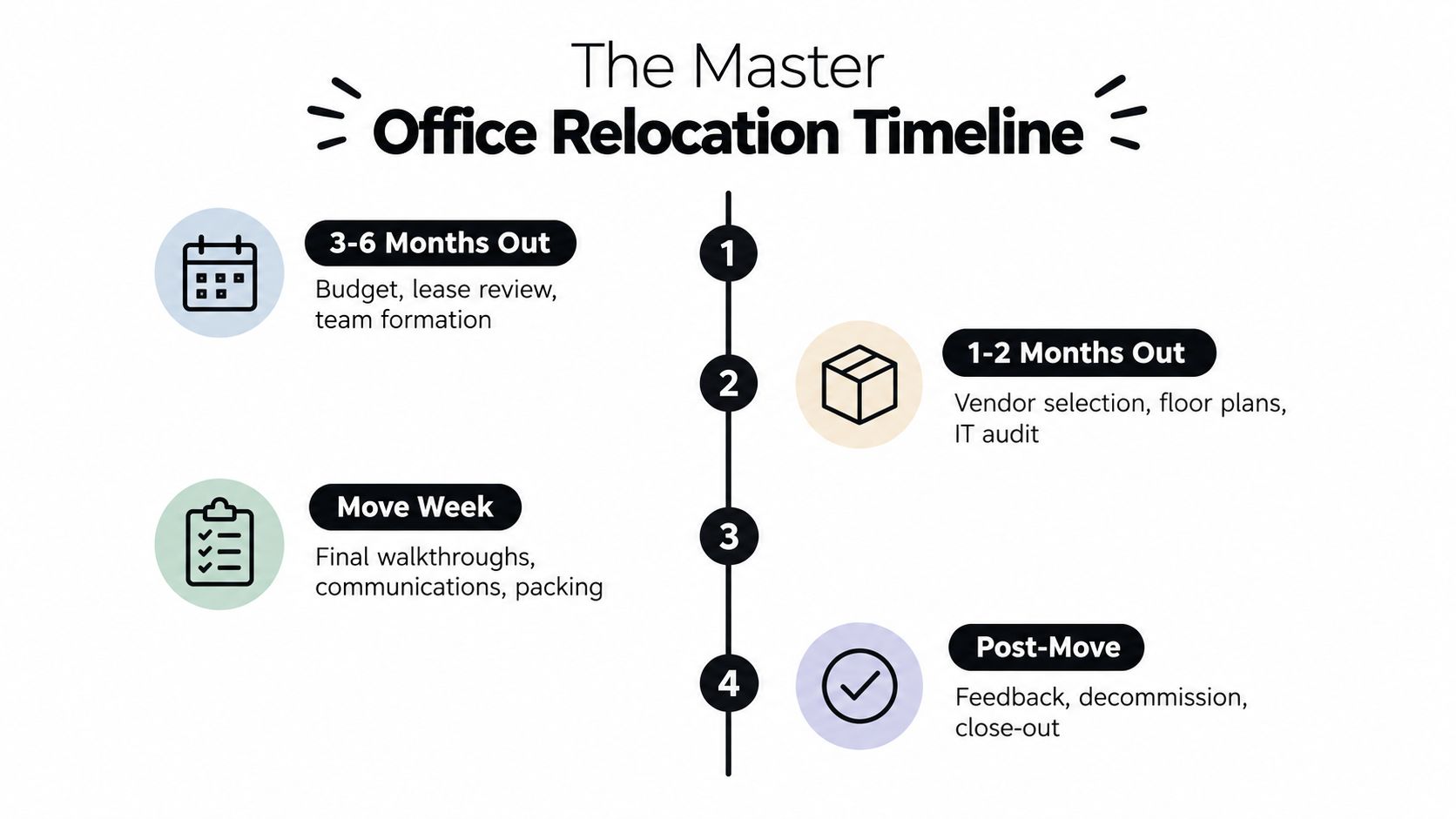
Three to six months out
The relocation lead should establish the project before suppliers begin quoting. Confirm the budget, review the current lease, inspect the new premises and validate the floor plan against actual headcount and equipment. The internal team should include a decision-maker, operations or facilities owner, IT lead, people or communications lead and finance contact.
At this point, check whether the new office is move-in ready. If it needs a fit-out, treat design, approvals, procurement, landlord works and handover as separate milestones. Don't approve a truck date until the project team has confirmed practical occupancy, not just lease commencement.
Core responsibilities include:
- Budget owner: Allow for moving services, fit-out, furniture, technology, building charges and any storage requirement.
- Facilities lead: Review loading access, freight lift rules, after-hours access, security and base-building requirements.
- IT lead: Audit workstations, servers, cabling, phones, Wi-Fi requirements and business-critical systems.
- Department heads: Confirm what can be discarded, archived, packed or moved first.
- Relocation lead: Maintain the master schedule and run weekly progress checks.
Eight to twelve weeks out
Supplier coordination becomes the priority. Confirm the moving contractor, furniture installer, IT provider, connectivity supplier and any specialist trades. The IT lead should document the shutdown and restart sequence, rack location, cabling plan, power requirements, Wi-Fi coverage and testing responsibilities.
A dedicated office relocation technology checklist can help the IT and facilities teams identify technology dependencies before they become move-week faults. Use it alongside a floor plan that shows desks, meeting rooms, printers, storage, network equipment and high-priority teams.
Four to six weeks out
Packing and communication now become visible to staff. Issue boxes, labels and department instructions. Labels should identify the destination room, workstation or team, not merely the employee's current location. Confirm the new address, contact details, visitor instructions and client-facing updates.
Australian move-planning guidance recommends updating ASIC address details and Australian Business Register records 6 to 8 weeks before the move, then confirming vendor bookings and loading dock arrangements 2 to 4 weeks before moving day (The Work Project office relocation checklist). If those tasks aren't complete, assign an owner immediately rather than leaving them with a general department.
Moving week
The relocation lead should hold a final walkthrough at both properties. Confirm access cards, keys, lift bookings, dock times, utilities, cleaning, floor protection and security arrangements. IT should verify that connectivity, cabling, racks, power and restart procedures are ready before anyone begins disconnecting equipment.
The final communication should state when staff can enter, where they should report, what they should bring, how seating works and who handles issues. A simple chain of command prevents staff from sending access, furniture and technical problems to different people without resolution.
Post move
The project remains open until the new office works in practice. Test connectivity, phones, printers, meeting-room equipment, access control and workstation layouts. Keep an issue register with an owner and priority, then review it regularly through the first weeks.
A staged Australian office move plan can include 1 to 4 weeks post-move for review and decommissioning, after which the team closes outstanding landlord, storage, asset and compliance tasks (Get n Go office move project plan). The physical relocation is complete when the trucks leave. The business relocation is complete when people can work normally.
Sample Timelines for Small Medium and Large Offices
Office size is only one variable. A small business with a complex server environment or a substantial fit-out may need more time than a larger team moving into a serviced space. Use headcount as a starting point, then add time for construction, technology, interstate logistics, furniture procurement and building restrictions.
| Office Size | Planning Window | Key Focus Areas |
|---|---|---|
| Small office, under 20 staff | 8 to 12 weeks | Lease checks, lean supplier coordination, essential IT, packing and a controlled weekend move |
| Medium office | 3 to 6 months | Lease and fit-out coordination, staged IT preparation, furniture planning, communications and weekend execution |
| Large office | 6 to 12 months | Design, approvals, vendor selection, procurement, fit-out, phased departments and detailed continuity planning |
Small offices
A small office can move on a leaner schedule when the new space needs little work. The relocation lead can combine facilities, supplier and communications duties, but IT still needs a named owner. The physical move may take 1 to 3 days, usually over a weekend, according to Australian office relocation guidance (Upmove office relocation guide).
The main risk is assuming that fewer people means fewer dependencies. A small team may rely heavily on one internet connection, one phone system or one person who knows how everything is configured. Photograph cabling before disconnection, label every endpoint and test the first workstation before unpacking the rest.
Medium offices
Medium businesses usually need a full 3 to 6 months for planning and preparation. The time goes into confirming the lease, validating the floor plan, ordering furniture, coordinating IT and preparing departments to pack consistently. Stage high-priority teams first, especially those serving clients or relying on specialised systems.
A weekend move reduces disruption, but it doesn't remove the need for a fallback plan. Keep a clear list of critical functions, responsible managers and the conditions required before staff return.
Large offices
Large organisations should begin at least 6 to 12 months ahead when the project includes design, fit-out, vendor selection or phased occupation. The relocation may require floor-by-floor sequencing, executive approvals, specialist equipment handling and multiple building interfaces.
A formal governance rhythm earns its keep. Use a master programme, a risk register and weekly decision meetings. Don't let the moving contractor become responsible for unresolved construction, lease or technology decisions. Their work starts after the premises and operating conditions are properly defined.
For practical packing and sequencing advice, review these tips for making an office move go smoothly, then adapt the process to your building's access rules and your team's operating hours.
Move Week and Move Day Duties That Keep Business Running
Move week should feel controlled, not heroic. Every task should answer three questions: who owns it, when is it checked and what happens if it fails? The relocation lead should keep one live schedule rather than allowing IT, facilities, movers and department heads to work from separate versions.
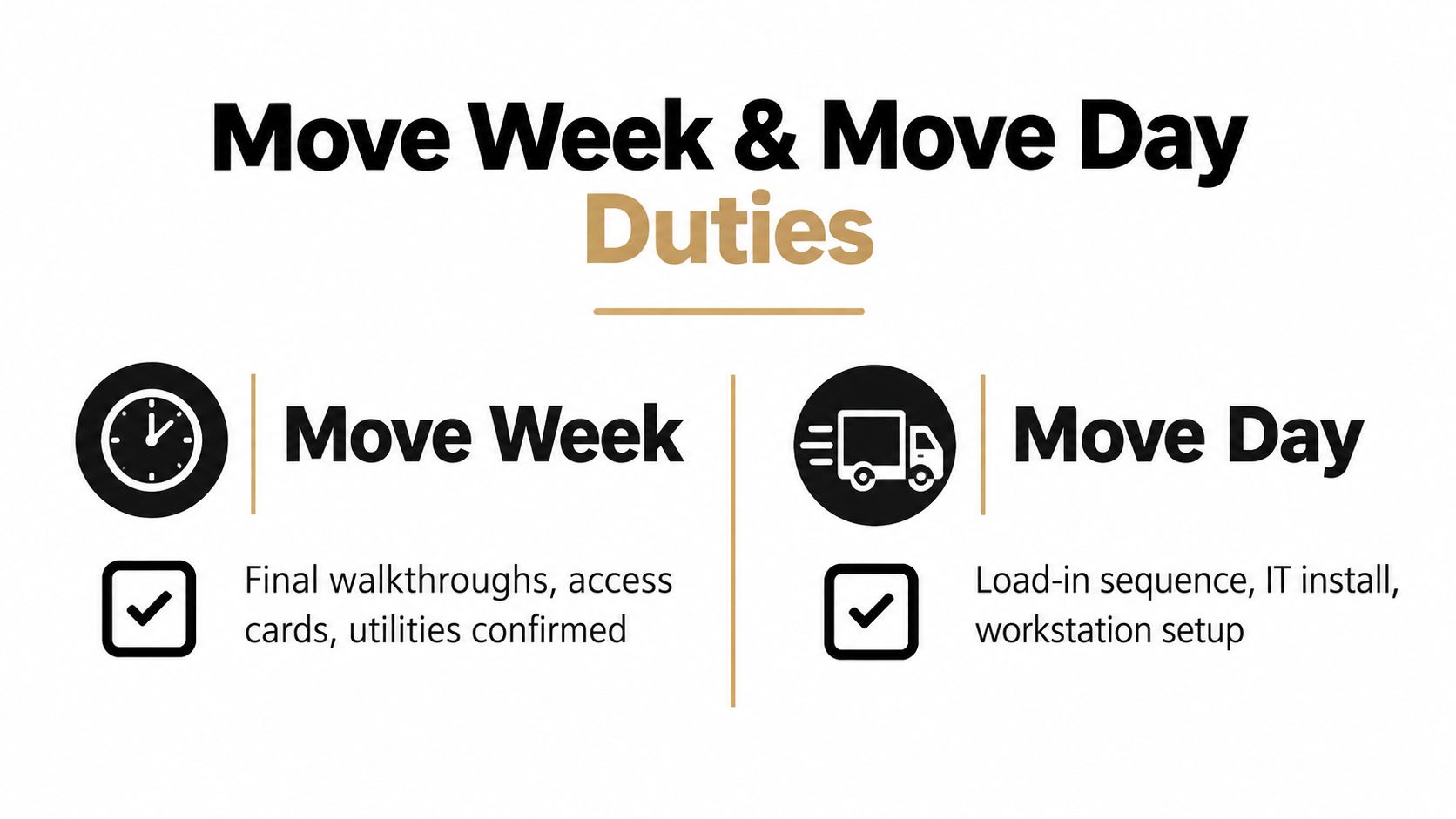
Seven days before
Run the final walkthrough with building management. Check the freight lift, loading dock, access cards, door widths, floor protection, parking, security procedures and after-hours contacts. Confirm that utilities and connectivity are active or have a named technician and escalation path.
The IT lead should check the shutdown and restart sequence for critical systems. That includes NBN or carrier activation, internal cabling, rack setup, power, Wi-Fi coverage and the order in which systems return online. Allied's Australian project guidance highlights these readiness checks and identifies skipped IT checks, unlabelled cables and poor team staging as common sources of extended downtime (Allied business relocation project guidance).
The final working day
Staff should finish personal packing, clear confidential material and attach labels to every box and cable bundle. The department lead signs off each area, while IT photographs server rooms, racks and desk connections before anything is unplugged.
Create a first-day kit containing chargers, power boards, printer supplies, cleaning items, stationery, access information and basic tools. It prevents a simple missing cable or empty printer tray from becoming the first problem reported to leadership.
Move day sequence
The exact hours depend on the building, but the sequence should remain deliberate:
- Access check: The site lead confirms building access, lift availability and protection before loading begins.
- Priority load: Movers load sensitive equipment and high-priority work areas according to the agreed sequence.
- Receiving check: The new-site lead verifies room, floor and workstation destinations as items arrive.
- IT installation: The technology team positions racks, connects priority equipment and begins testing before general unpacking.
- Workstation setup: Furniture and equipment are placed against the validated floor plan, with cables kept attached to their labelled endpoints.
- Walkthrough: The relocation lead records damage, missing items, access faults and unsafe conditions before sign-off.
- Close-out: The old office receives a final sweep, while the new office gets a first operational test.
Move-day discipline: Don't allow everyone to solve problems independently. Use one relocation lead, one building contact, one IT lead and one representative for each priority department.
Professional packing can be useful where staff need to keep operating until late in the week or where equipment requires careful protection. Services such as professional packing for office moves can reduce inconsistent labelling and keep department heads focused on business operations.
Business continuity planning should also cover access failure, connectivity delays, damaged equipment and temporary workspace needs. A practical resource on how to build operational resilience in 2025 can help leadership connect relocation risks with broader operational controls.
Coordinating IT Permits Lift Bookings and People Without Delays
A move can lose a day even when the trucks and movers arrive on time. The usual causes sit earlier in the sequence: an unapproved loading dock, a lift booking that does not match building access, or an internet service that has not been tested. Build the dependency map from the occupancy date backward, then assign an owner and confirmation point to every task.
Technology dependencies
The IT lead should confirm carrier activation, internal cabling, rack setup, power, Wi-Fi coverage, and the shutdown and restart sequence for business-critical systems. Label cables and endpoints before disconnection. A cable that looks obvious on Friday night can become a long fault-finding exercise on Saturday.
Agree on acceptance tests before move week. Name the person responsible for checking internet access, phones, printers, meeting rooms, security systems, and priority applications. Record the result, the time tested, and any workaround. Staff should not be the first people to discover a failed connection on Monday.
Building dependencies
Put lift and loading dock bookings on the same schedule as IT. Confirm access hours, permit requirements, contractor induction, lift protection, and the building security contact. A truck waiting outside while the dock is unavailable creates delay, extra handling, and pressure on the installation sequence.
Give administrative updates clear owners. Update ASIC and Australian Business Register records 6 to 8 weeks before the move. Confirm vendor bookings and loading dock reservations 2 to 4 weeks before moving day, following the timing set out in The Work Project relocation checklist. Store emails, permits, booking references, and approvals in the project record.
People and stakeholder notice
Staff, clients, and suppliers need instructions that change their behaviour. Give the first formal notice and reminder cycle 4 to 6 weeks before the move where downtime, lift bookings, visitor access, or IT continuity affect them. At least two weeks' notice is the stated minimum in the regional relocation guidance (Allied Australian business relocation guidance).
Victoria has separate workplace-change notice thresholds. Victorian Government VPS guidance states that a temporary change within a work area requires at least 24 hours' notice. A temporary move to a different work area requires at least two weeks' notice, as does a permanent change within a work area unless a shorter period is agreed (Victorian Government usual place or places of work guidance.pdf)).
Use one communication register for staff, clients, suppliers, building management, and emergency contacts. Include the relocation lead, IT owner, facilities contact, and department representatives. For Melbourne businesses coordinating the physical move, commercial office removalists in Melbourne can be listed alongside those owners, with each booking and approval tied to the occupancy date.
Post Move Follow Ups and Your Next Steps to Settle In
The first morning shows whether the sequence held. The following weeks decide whether the workplace becomes usable and stable. Keep the relocation lead active after the trucks leave. Log each fault, assign an owner, and rank it by business impact, not by who reports it most loudly.
Test connectivity, phones, printers, meeting rooms, access cards, Wi-Fi coverage, workstations, and visitor entry. A failed executive display can wait. A disconnected customer service team can affect the business. Address safety, access, and critical technology issues first, then work through furniture, storage, and presentation matters.
The first week
Walk the new premises with facilities and department leads. Check wayfinding, room names, signage, storage, cleaning, kitchen supplies, and emergency information. At the old premises, complete the final sweep, photograph the condition, and confirm the landlord's handover requirements.
Keep the issue register open through the initial review period. Australian office relocation planning guidance allows 1 to 4 weeks post-move for review and decommissioning, giving the team time to close defects, return access items, clear storage, and finalise the old site.
If furniture or records cannot move immediately, controlled short-term storage for office items can keep the new workplace clear while outstanding work is completed.
The close-out
Hold a short review with the relocation team and department representatives. Record what caused delays, which supplier dependencies were difficult, whether the floor plan matched reality, and what should change before the next lease cycle. Keep decisions, unresolved defects, and assigned owners in one close-out record.
Your next steps are practical. Name one coordinator, set the occupancy date, map dependencies backward from a functional workplace, and confirm IT and building access early. Run weekly checks until the issue register is closed. The truck booking is one milestone, not the plan.
Get n Go Removals Melbourne can coordinate commercial office relocations with packing, furniture disassembly and reassembly, protective equipment, transport, and secure storage options. Visit Get n Go Removals Melbourne to discuss your occupancy date, access requirements, and a move sequence designed to minimise disruption.