
Office Relocation Services That Keep Your Business Moving
The lease renewal lands in your inbox on a Monday morning. Your Melbourne team is already late to its stand-up, the move date is only weeks away, and nobody can answer the basic questions. Which desks are staying? Who owns the IT cutover? Has the new building approved the loading dock booking? Is the server room documented anywhere?
That's when an office move stops being a furniture problem and becomes a business continuity problem. Office relocation services should coordinate the decisions, people, technology, access arrangements and transport that keep your organisation operating while the premises change around it.
Australia has a mature removals market. Australia Post reports that around 1.14 million Australians move house each year, with about 84% using its Mail Redirection service.Australia Post's movers statistics The broader Australian removals industry is valued at about A$2.6 billion in 2026, with 8,310 businesses operating in the sector.IBISWorld data reported through Australia Post's market context Commercial relocation sits inside that established network, but office moves demand more planning than a typical household transfer.
The practical answer is a staged project with a clear scope, a named coordinator, documented IT handovers and a realistic downtime plan. The sections below focus on the calls that protect your budget and your first working day at the new premises.
The Monday Morning a Team Realises They Need to Move
At 8.47 am, the coffee is still too hot to drink when the operations manager opens the lease email. The landlord wants a decision. The proposed handover date is six or eight weeks away. The office has no current asset list, no confirmed floor plan and no person assigned to the technology cutover.
The signals appear quickly. Shared inboxes fill with forwarded mail because the address-change process hasn't been assigned. Staff ask whether they'll sit on the north or south side of the new floor. Someone discovers that the server room has grown through years of improvised equipment changes, yet nobody has a current diagram of the racks, switches or cabling.
A rushed move usually fails in handovers rather than on the road. The truck can arrive on time while the business still loses productivity because desks are placed against the wrong wall, access cards aren't active, printers aren't connected, or confidential records are mixed with general cartons.
Treat the move as a business project
A capable relocation provider should give you more than labour and vehicles. You need a move plan, an asset register, access checks at both buildings, a floor-by-floor sequence and a person who can make decisions when the building manager, IT supplier and internal team disagree.
The first meeting should establish:
- Scope: What is moving, what is being disposed of, what is being stored and what will be purchased new?
- Ownership: Who approves the budget, signs off the floor plan and authorises changes?
- Continuity: Which teams, systems and customer services must remain available?
- Access: What are the lift, loading dock, loading-zone and security requirements?
- Handover: Who confirms that every floor, workstation and technology area is ready?
Practical rule: If nobody owns the IT cutover, nobody owns the move.
Melbourne adds its own friction. A CBD tower may require lift reservations, loading-dock windows, public liability documents and strict delivery rules. A suburban office may offer easier vehicle access but still have narrow doors, stairs or shared car-park restrictions. These details belong in the plan before the crew arrives, not in a phone call made on move morning.
Office relocation services earn their place by absorbing that coordination burden. Your internal team should make business decisions and communicate with staff. The mover should turn those decisions into a controlled sequence that covers scoping, cost, timing, IT, downtime and final placement.
What Office Relocation Services Actually Cover
A credible quote should read like a project scope, not a sentence promising a “stress-free move”. Ask the provider to show exactly what happens before, during and after transport. That makes competing proposals easier to compare and exposes missing work before it becomes a variation.
Start with the site and inventory
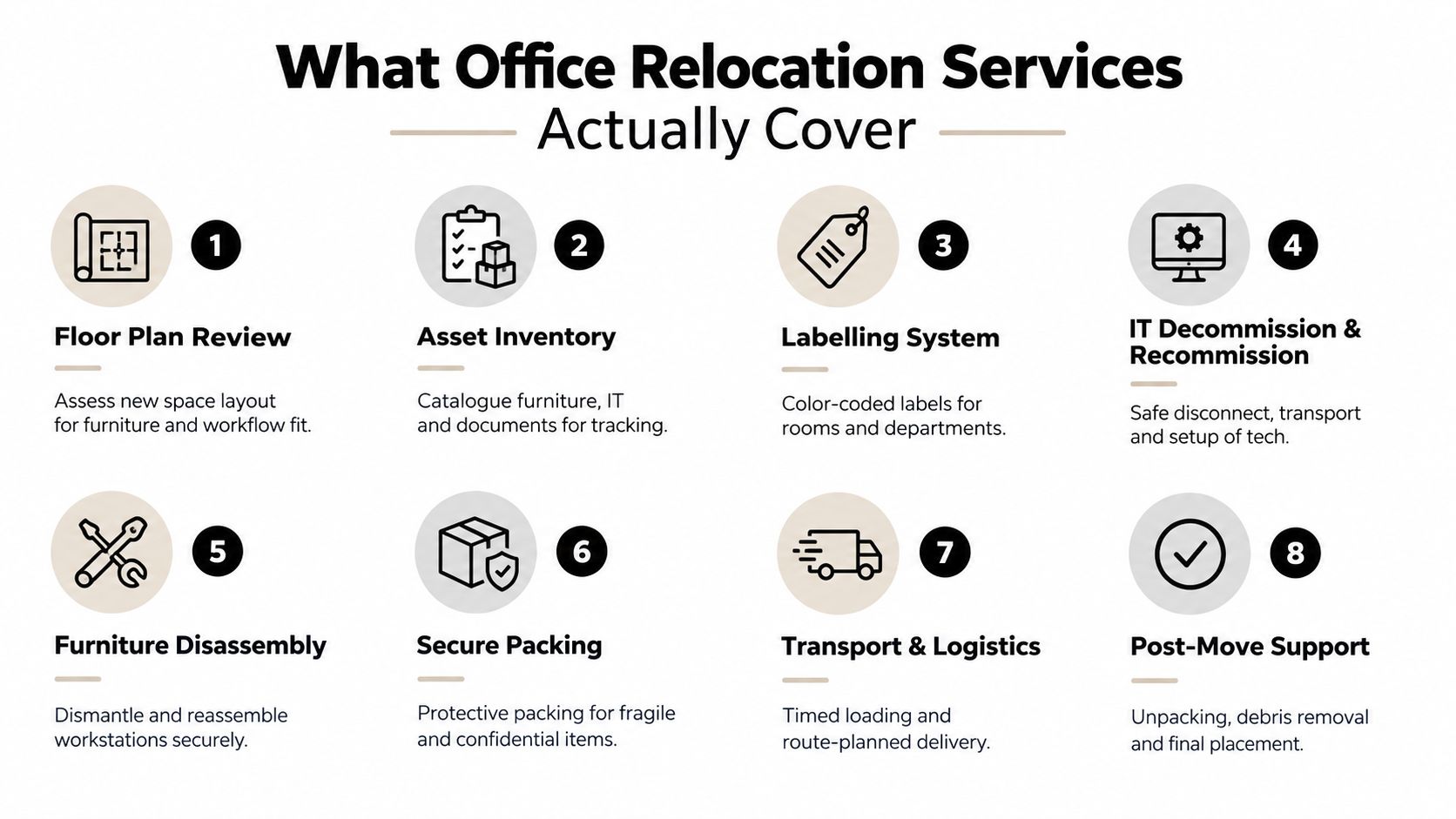
The planning visit should include a review of the current and new floor plans, an asset inventory and an access audit at both sites. The inventory needs more detail than “desks and boxes”. Record workstations, monitors, printers, server racks, archive cartons, shelving, kitchen equipment, whiteboards and specialist items.
A good labelling system connects each item to its destination. Use room, department or zone codes that match the new floor plan. A relocation manager should act as the single point of contact, coordinating your facilities lead, IT supplier, building managers and removal crew.
Protect, disconnect and prepare
Packing requirements vary by item. Documents belong in secure crates or clearly identified archive cartons. Monitors and printers need protective wrapping. Confidential records need controlled handling and a chain-of-custody process. Workstations may need decommissioning, with components labelled so reassembly doesn't become a guessing game.
Technology should be treated as its own workstream. Confirm who disconnects servers, racks, phones, network equipment and workstations. The scope should state whether the mover handles transport only, or whether it also supports disconnection, cabling, reassembly and testing.
Sequence the physical move
On move day, the crew should load by destination sequence rather than by convenience. Labels should support tracking from the origin floor to the receiving room. Furniture disassembly and reassembly must include workstations, shelving, whiteboards and other fixtures, while kitchen equipment needs suitable protection and placement.
The handover doesn't finish when the last carton enters the building. Include unpacking, debris removal, final placement and a next-day snag process. The first business day often reveals small but disruptive faults, such as a missing monitor arm, a misaligned workstation or a cable that wasn't connected to the intended desk.
For a Melbourne commercial move, compare a provider's written scope with the service details on its commercial office removalists Melbourne page. If the quote leaves out access coordination, IT responsibilities or post-move fixes, ask for those exclusions in writing.
A relocation can also be a good time to replace ageing workplace equipment. If staff are returning to a refreshed kitchen or breakout area, review practical options such as these best water dispensers for work before the new fit-out is finalised.
What Drives the Cost of an Office Move
An office relocation quote is shaped by handling complexity, access and scope. The floor area alone won't tell you what the move will cost. A compact office with server racks, archive records and difficult loading access may require more planning than a larger space with lightweight furniture and a clear dock.
The inventory establishes the physical baseline. Workstations, archive boxes, server racks, printers and specialist equipment have different packing, handling and insurance requirements. Ask the mover to separate these categories rather than combining every item under a broad “office contents” description.
Access can change the labour plan quickly. Lift bookings, loading-dock hours, security procedures, stairs, restricted vehicle access and CBD street parking all affect sequencing. In Port Phillip, a formal temporary parking permit can be arranged for a moving truck, and the council states that the moving company's name should replace registration details on the application. The listed parking reservation fee is $50 per permit.Port Phillip Council's temporary parking permit guidance
Distance matters, but fleet strategy matters too. One larger truck may reduce repeated loading, while multiple smaller runs can work better where access is restricted or floors need to be moved in phases. After-hours and weekend work can increase the quote while reducing the commercial cost of staff sitting idle.
| Cost Driver | Effect on Quote | Why It Matters |
|---|---|---|
| Inventory and item type | More handling, packing or specialist labour | Fragile, heavy and confidential items need different controls |
| Building access | May add bookings, waiting time or additional labour | Lifts, docks and street access determine the move sequence |
| Transport plan | Changes vehicle and crew requirements | One large load isn't always practical in Melbourne buildings |
| Packing scope | Self-pack generally transfers work to your staff | Full-service packing protects internal productivity |
| IT responsibility | Disconnect and reconnect work adds specialist coordination | Technology faults can extend the outage |
| Reassembly and unpacking | Adds labour but reduces day-two disruption | Staff can return to usable workstations sooner |
| Phasing and timing | Weekend or floor-by-floor work affects labour planning | The right window can protect revenue-generating activity |
| Insurance selection | Changes protection and risk allocation | Confirm limits, exclusions and excess before signing |
For a broader explanation of what influences removal pricing, review this guide to the cost of movers. The useful comparison isn't the cheapest headline figure. It's the quote with the clearest inclusions, exclusions, assumptions and responsibility for variations.
The 24-Week Office Relocation Timeline
Start earlier than feels necessary. Australian workplace guidance recommends coordinating an office relocation during construction, up to 24 weeks before move-in, and organising the work through plan, communicate, transfer, organise and confirm phases.JLL's Australian office relocation guide A separate Australian moving guide recommends beginning three to six months ahead, with phased moves, off-hours execution and IT planning.Chess Moving's office relocation guidance
Weeks 24 to 16, plan
Confirm the business case, lease terms, construction status and target handover. Review the new floor plan against furniture, power, network access, meeting areas and storage. Appoint the internal relocation lead and request site visits from commercial movers.
Select the provider only after comparing scope, access assumptions, insurance and IT responsibilities. Put the decision in writing. A cheap quote that excludes lift bookings or workstation reassembly isn't cheap once the missing work appears.
Weeks 15 to 8, communicate
Announce the move to staff with practical information, not just the new address. Explain desk allocation, personal-item rules, access-card timing, transport changes and the date when mail, suppliers and customers should use the new address.
Coordinate IT vendors, building managers, furniture suppliers and any storage provider. Begin asset tagging and order packing supplies. This is also the point to identify items that should be archived, donated, recycled or replaced rather than transported.
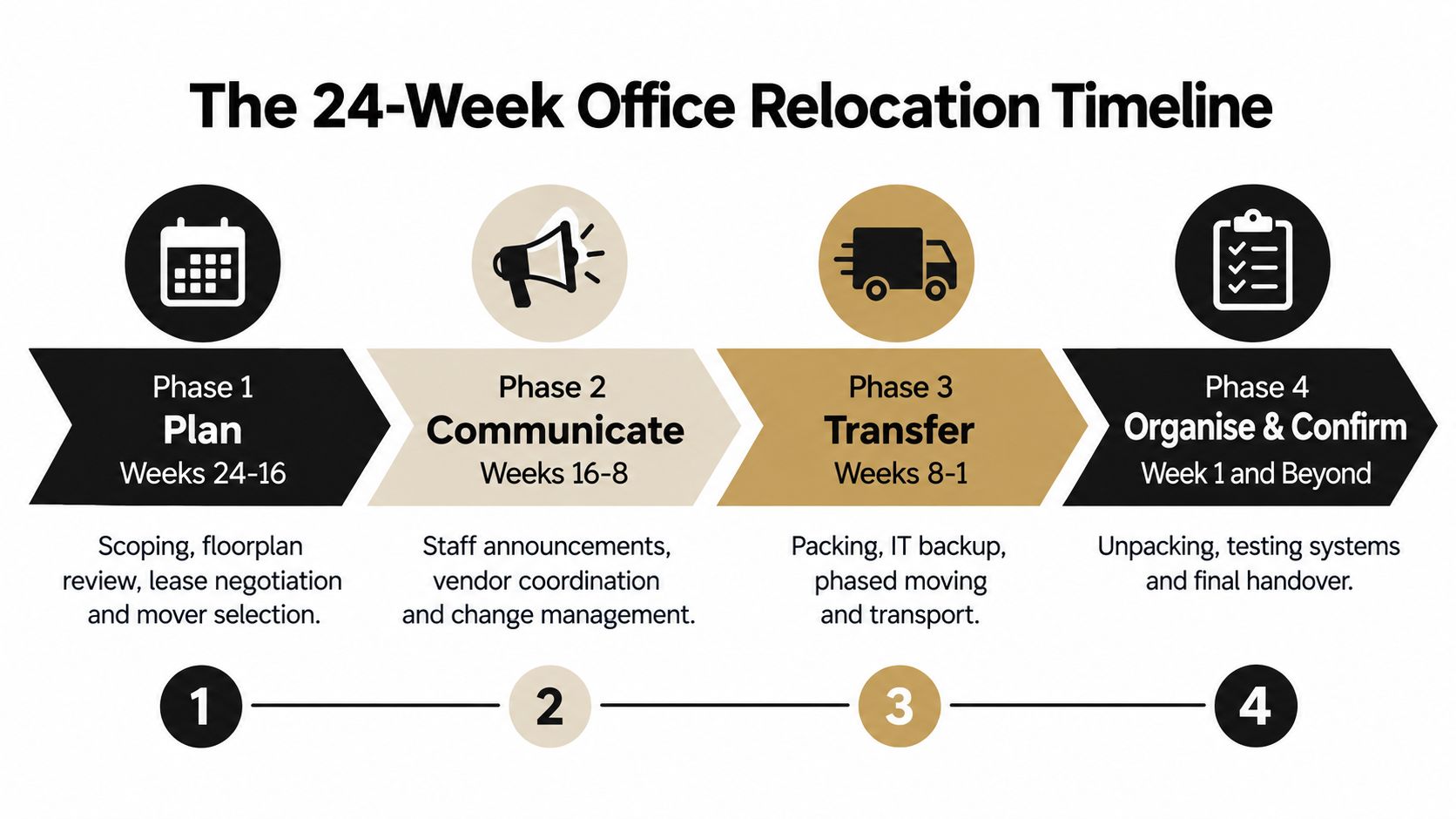
Weeks 7 to 2, transfer
Label every workstation, department area and carton against the destination floor plan. Archive files that don't need to travel immediately. Confirm server-room access, network requirements, lift reservations and loading arrangements.
Run the IT backup and cutover plan separately from the furniture schedule. Decide which teams can move first and which services must remain operational until the final window. For general moving-time planning context, businesses can also use this guide to how long it takes to move house, while recognising that an office requires additional coordination.
Final two weeks, organise and confirm
Walk through both buildings with the relocation manager. Check access cards, security rules, lift protection, loading zones, floor protection and emergency contacts. Confirm the day-of run sheet, crew arrival, loading order, destination sequence and contingency arrangements.
Budget time after the physical move for settling in. Australian office relocation guidance recommends treating the first two weeks after the move as a post-move settling period, not as an instant return to normal.Onyx Removals' office relocation project plan The final checklist should include IT testing, missing-item checks, furniture adjustments, debris removal and landlord handover.
How Professional Movers Cut Downtime to a Minimum
Downtime falls when the move is designed around business operations rather than truck availability. That means moving work in parallel, protecting critical systems and preparing the destination before staff arrive.
Off-hours execution is the first lever. Pack non-essential areas while teams are working, then move the remaining workstations during an agreed evening or weekend window. The schedule should reflect your busiest customer periods, payroll deadlines, trading activity and support obligations.
Run parallel workstreams
A professional crew can pack one floor while another team stages furniture at the new site. IT can decommission equipment in a controlled sequence while the movers clear completed areas. At the destination, labelled workstations can be assembled by zone rather than waiting for the entire office to arrive.
This approach only works when the floor plan is accurate. A desk placed in the wrong zone creates more than a cosmetic problem. It can interrupt power access, network connections, team seating and staff communication, forcing the crew to redo work after the move.
Treat IT as a handover, not a carton
Label cables at both ends. Photograph rack layouts before disconnection. Record device locations and test the receiving network before employees return. Critical systems need a defined backup, shutdown, transport, reconnection and verification sequence.
One coordinator should control changes to the run sheet. Without that role, your IT supplier may assume the removal crew is handling a task that the crew has excluded, while the building manager waits for an access confirmation from someone else.
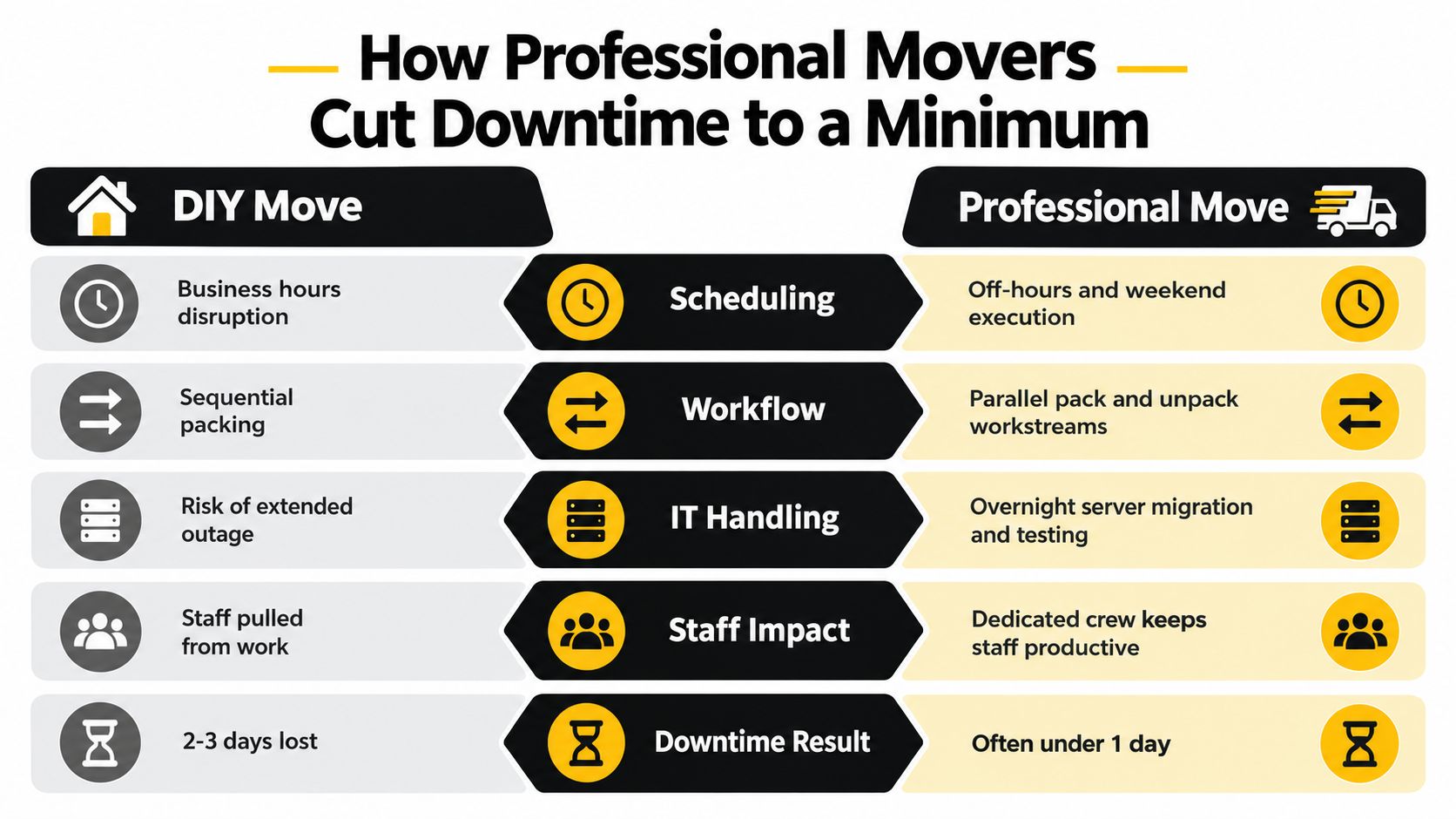
A self-managed move can look economical because employees provide the labour. The hidden cost is the work they stop doing, the time spent locating items and the delay caused by untested systems. A professional plan assigns packing, transport, placement and reassembly to a dedicated crew, leaving staff to manage decisions and communications.
Operational test: The move is successful when employees can find their workstations, connect to the systems they need and serve customers without waiting for the removal team.
For a Melbourne crew that combines packing and moving support, review the scope described for movers and packers in Melbourne. Ask specifically how the provider handles parallel work, after-hours access, IT coordination and next-day snags.
Choosing the Right Office Relocation Partner in Melbourne
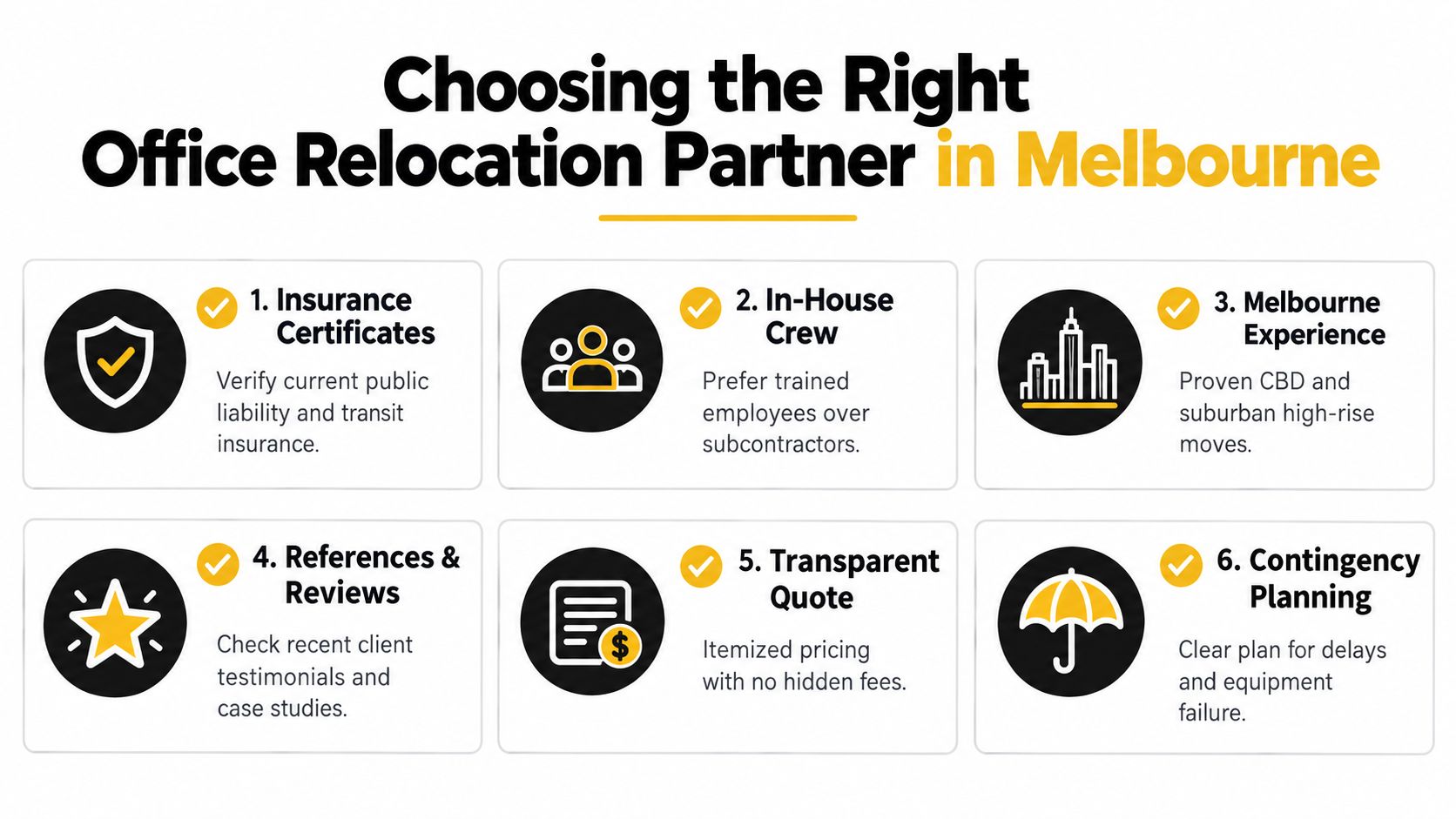
Your relocation partner should prove operational control before you compare prices. Shortlist providers that can show current documents, named supervisors, suitable vehicles, building-access planning and a written scope. A move is a staged business decision, so the provider must protect trading time as well as furniture.
Check the evidence before the price
Request current public liability and transit insurance certificates. Confirm covered items, exclusions and excesses for office equipment. Australian government relocation guidance places responsibility for personal and household-goods insurance with employees, while the Department of Finance covers standard insurance up to a maximum of $80,000 in household-goods value under its policy framework.Department of Finance relocation expenses guidance That arrangement does not replace commercial contents advice. Put every insurance responsibility in writing.
Ask whether the crew is employed in-house or supplied by subcontractors. Get the names of the site supervisor and project coordinator, then confirm who remains accountable if equipment is damaged, access changes or the program slips.
Review the provider's Melbourne fleet and availability. CBD loading windows, lift bookings and staged deliveries can restrict the plan. A company-owned fleet with suitable truck sizes may reduce handover risk, but the largest truck is rarely the answer. Require a suitable primary vehicle and a credible backup arrangement.
Reject vague proposals
For a complex office, insist on a site visit. Reject a firm quote prepared without inspecting the building, a proposal that hides exclusions, or an operator that cannot explain its approach to lifts, server rooms and access rules.
Use this filter:
- Insurance documents: Verify current certificates, limits and exclusions.
- Named coordinator: Get one accountable contact for the project.
- Written scope: Require inclusions, exclusions and variation triggers.
- Comparable references: Request examples with similar access, technology or staffing requirements.
- Contingency plan: Confirm the response to lift failure, delayed handover or damaged equipment.
- Clear labour model: Establish who performs the work and how the supervisor checks quality.
Get n Go Removals Melbourne is one provider to assess against these requirements. Its published information describes commercial relocations, packing, furniture disassembly and reassembly, protective equipment, transport, storage, a company-owned fleet, full-time police-checked staff, public liability and transit insurance, and a single point of contact.Get n Go Removals Melbourne
Compare those documents and the site process with a broader guide to the best moving companies in Melbourne. Choose the provider that fits your building, schedule, IT handover and risk profile, not the one with the most polished sales copy.
Why a High-Vacancy Market Can Be the Right Time to Move
Melbourne's vacancy conditions give tenants more choice, but choice only creates value when you compare the cost of staying with the cost of changing premises. National CBD vacancy was 15.9% in January 2026, while Melbourne CBD vacancy reached 19.0%. Enquiry volumes rose 19% in the first half of 2026, according to the Property Council of Australia market analysis.Property Council of Australia's 2026 CBD office market analysis
That combination points to an active decision window. Landlords with empty space may be more open to discussing rent, fit-out contributions, incentives and rent-free fit-out periods. The exact offer depends on the building, lease structure and tenant profile, so model the whole occupancy cost rather than negotiating only the face rent.
A relocation also gives you a chance to correct an office that no longer fits. The Property Council reported that just over two-thirds of businesses that moved premises during the past three years upgraded to a better-quality office building.CBRE and Property Council of Australia occupancy reporting That supports a strategic view of relocation. Businesses aren't always chasing more desks. They may be seeking better access, amenity, building quality, employee experience or a layout that supports hybrid attendance.
Current workplace demand also requires sharper space planning. National net absorption reached 364,635 square metres in the 12 months to January 2026, the strongest result since 2018. In the latest reported period, 52% of relocating tenants expanded and 14% downsized.Broker News coverage of the 2026 office demand data Use those figures as market context, not as a reason to copy another tenant's footprint. Forecast attendance, shared-desk use, meeting demand and likely headcount before committing to a floor.
| Factor | Relocate Now | Delay 12 Months |
|---|---|---|
| Lease leverage | More opportunity to negotiate incentives and fit-out support | Current options may change, and suitable space may be committed |
| Workplace quality | Move into a building that better supports staff and clients | Continue paying for limitations in the existing premises |
| Hybrid planning | Design capacity around actual attendance and future needs | Carry an unsuitable layout while uncertainty continues |
| Downtime | Plan the disruption once and align it with lease and fit-out dates | Risk a compressed move when lease or project deadlines arrive |
| Fit-out decisions | Coordinate construction, technology and furniture as one project | Pay for interim fixes that may not support the next lease term |
| Strategic timing | Treat relocation as an operating decision | Preserve flexibility, but delay the benefits and planning work |
The right next step is not to book a truck. Request a site-and-stocktake walkthrough from a Melbourne commercial mover, then use the inventory, floor plan and downtime plan to test whether the lease opportunity works financially. Providers that coordinate office contents with IT and access work can help place the move into a low-disruption window, including periods such as December or February when those dates suit your business and building.
Get n Go Removals Melbourne can coordinate commercial office relocations with packing, furniture disassembly and reassembly, protective equipment, transport, storage and a single point of contact. Visit Get n Go Removals Melbourne to request a walkthrough and detailed quotation that matches your Melbourne site, access requirements and staged move calendar.