

Your Ultimate Guide to Finding Movers & Packers Near Me in Australia
Finding trustworthy movers and packers near me typically starts with a quick online search, but it's easy to get overwhelmed by the sheer number of options. The key to a stress-free move is having a solid, well-thought-out plan.
Your strategy should begin with verifying their credentials and ensuring they are fully insured. Next, you need to gather several detailed quotes to truly understand the costs involved. Finally, lock in your booking well in advance. This straightforward approach helps you avoid unreliable operators and paves the way for a seamless moving experience.
Starting Your Search for Local Movers and Packers
Choosing the right removalist is arguably the most critical decision you'll make for your entire move. You aren't just transporting boxes from one location to another; you are entrusting your entire household of possessions to a team of professionals. Investing time in thorough research from the outset will save you significant stress and potential heartache later on.
Instead of defaulting to the first quote or the cheapest price you find, a bit of upfront diligence is crucial. Your initial task is to create a shortlist of potential companies. A great starting point is to look for local movers with a strong reputation within your community. For those in Melbourne, our guide on finding reliable removalists near me is an excellent resource to kickstart your search.
Understanding the Current Moving Landscape
The removalist industry in Australia is in a constant state of flux, influenced by economic shifts and evolving lifestyle preferences. A significant recent trend is the migration of people from major cities to regional areas.
For example, there was a 10.5% increase in people moving from metropolitan hubs to regional Australia between the December 2024 and March 2025 quarters. This isn't just a statistic; it directly impacts your move. It means that movers, particularly those servicing regional routes, may get booked up faster, and pricing could be affected. This is a crucial factor to consider during your planning phase.
Your Initial Vetting Process
Before you request a single quote, a quick background check can effectively filter out companies that aren't worth your time. A professional and reputable moving company will be transparent and have nothing to hide.
Here’s a concise checklist to guide your initial vetting:
- Professional Online Presence: Do they have a well-designed, professional website? It should feature clear contact details, including a physical address, not just a mobile number.
- Authentic Customer Reviews: Don't solely rely on testimonials featured on their website. Check independent review platforms like Google or Facebook for genuine, detailed feedback from previous customers.
- Comprehensive Service Offerings: Scrutinise what they actually provide. Do they offer the specific services you require, such as professional packing, secure short-term storage, or specialised handling for delicate items like pianos or valuable artwork?
This simple, three-step process is the bedrock for finding a mover you can confidently trust.
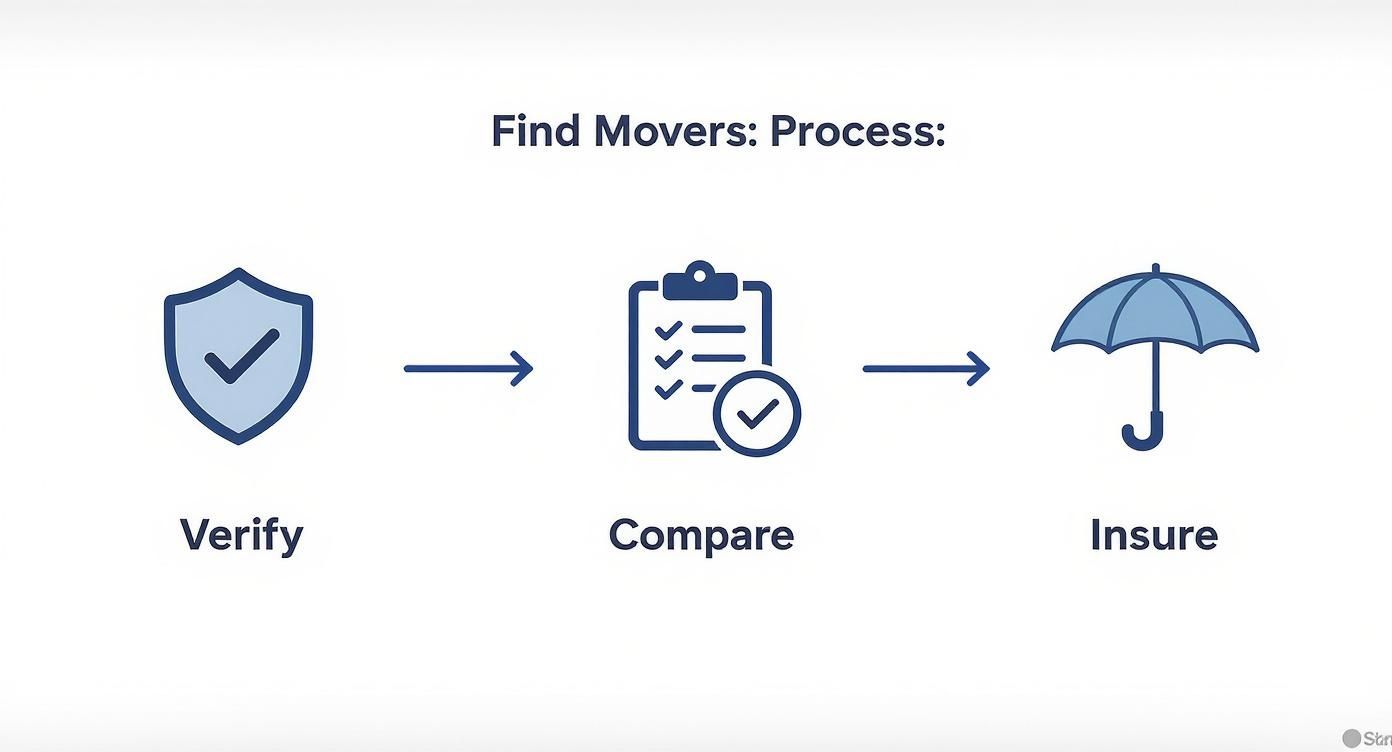
Mastering these core steps—verification, comparison, and insurance—is what differentiates a stressful, problematic move from a successful, smooth one.
Decoding Quotes to Avoid Hidden Moving Costs

Receiving a moving quote is one thing; thoroughly understanding it is another. An unusually low estimate might seem like a victory, but it is often a major red flag. Hidden charges have an unpleasant tendency to appear on the final invoice, transforming a great deal into a budgetary disaster.
The first critical detail to clarify is whether you are receiving a binding or non-binding quote. A binding quote is a fixed price—what you are quoted is what you pay, provided you don't add significant extra items to the move. A non-binding quote, conversely, is an estimate. The final cost can fluctuate based on the actual time and resources required for the move.
Spotting Common Hidden Charges
Many initial quotes only cover the basics, leaving ample opportunity for extra fees to be added on moving day. By knowing what to look for, you can ask the right questions from the beginning and ensure your quote is genuinely all-inclusive.
Be vigilant for these common add-ons that can inflate your bill:
- Stair Fees: You can be charged for each flight of stairs the moving crew has to navigate at either your origin or destination property.
- Long-Carry Fees: If the moving truck cannot park directly outside your door, you might incur an extra fee for every metre they have to carry your belongings beyond a specified distance (e.g., 20 metres).
- Heavy Item Surcharges: Large, heavy, or awkward items like pianos, pool tables, or large safes require special equipment and additional labour, which almost always comes with a separate fee.
- Disassembly/Reassembly: Never assume that dismantling your bed or reassembling your office desk is included in the standard service. It is often billed as an extra charge.
A trustworthy moving company will transparently outline these potential costs in their quote or clearly state what is not included. If an estimate seems ambiguous or too good to be true, it almost certainly is.
For a more in-depth look at budgeting for your move, our guide on the cost of movers provides a clearer picture of what to expect.
A quick review of this table illustrates how service inclusions can vary dramatically.
Comparing Moving Service Inclusions
| Service Feature | Basic Service (Self-Pack) | Full-Service Packing | Premium Service (Pack & Unpack) |
|---|---|---|---|
| Truck & Movers | ✅ Included | ✅ Included | ✅ Included |
| Basic Furniture Protection | ✅ Included | ✅ Included | ✅ Included |
| Packing Supplies | ❌ Not Included | ✅ Included | ✅ Included |
| Packing of Boxes | ❌ You pack everything | ✅ Movers pack all items | ✅ Movers pack all items |
| Furniture Disassembly | ⚠️ Often an extra fee | ✅ Typically included | ✅ Included |
| Furniture Reassembly | ⚠️ Often an extra fee | ✅ Typically included | ✅ Included |
| Unpacking Boxes | ❌ You unpack everything | ❌ You unpack everything | ✅ Movers unpack everything |
| Box & Debris Removal | ❌ Your responsibility | ❌ Your responsibility | ✅ Included |
Always confirm precisely what your selected service level covers to avoid any unwelcome surprises on moving day.
The Problem with 'Too-Good-to-Be-True' Pricing
Let’s consider a common scenario. You're searching for "movers & packers near me" and receive two quotes. Company A provides a tempting flat rate of $900. Company B sends a detailed, itemised quote totalling $1,300. The cheaper option seems obvious, right?
But then moving day arrives. Company A adds $150 for the three flights of stairs at your old apartment, another $100 because they had to park down the street, and $150 to reassemble your furniture. Suddenly, your "cheap" $900 move has become a $1,300 reality—the exact same price as the upfront, transparent quote from Company B, but with a significant amount of added stress and frustration.
If you're interested, understanding how moving companies create estimates can provide more insight into what should be included from the start.
The lesson is clear: always insist on a written, itemised quote that meticulously lists every potential charge. It is the only way to compare services accurately and select a mover who prioritises transparency over hidden fees.
How to Vet Removalists for a Stress-Free Move
When you're entrusting a company with all your worldly possessions, a quick glance at star ratings is simply not enough. Properly vetting a potential mover involves a few straightforward checks that can mean the difference between a seamless move and a complete disaster. This process isn't just about finding the cheapest quote; it's about ensuring you hire legitimate, professional, and accountable movers.
First and foremost, let's confirm you are dealing with a legitimate business.
Confirming They Are a Real Business
Any credible removalist in Australia will be a registered business. Do not hesitate to ask for their Australian Business Number (ABN). You can verify it in seconds using the official ABN Lookup service online. This single step confirms they are a genuine, trading company, not just an individual with a van and a Facebook page.
A verifiable physical address is another non-negotiable. If a company only lists a P.O. Box or displays a vague "service area" on its website, proceed with caution. A quick search on Google Maps can be very illuminating. If their listed address is a residential home or an empty lot, that's a significant red flag. A professional operation will have a depot or office where their fleet is based.
It’s also beneficial to understand the current state of the moving industry. Through 2024 and 2025, demand in the Australian moving sector reached a 20-year low, with online searches for removalists dropping by a substantial 22% since 2019. This downturn, linked to the housing crisis, means that while established companies face challenges, it also attracts unscrupulous operators looking to make a quick profit.
Insurance is Non-Negotiable
You should never simply assume a moving company is insured. You must ask for proof of two crucial types of insurance:
- Public Liability Insurance: This protects you if the movers accidentally damage property, such as gouging a wall in your rental or damaging a common area in an apartment complex.
- Transit Insurance: This is the most critical one. It specifically covers your belongings while they are in the movers' custody—from the moment they are loaded onto the truck until they are safely delivered to your new home.
A professional mover will have no hesitation in providing you with their Certificates of Currency for both policies. If they become defensive or make excuses, that is your signal to walk away. The risk of using an uninsured mover is simply too high.
For more insights on distinguishing professionals from amateurs, our guide on choosing the right removals firm for your move offers additional useful tips.
Reading Between the Lines of Reviews
Online reviews are an invaluable tool, but you must learn to read them critically. Look for specific details. A review stating, "They showed up on time, wrapped my antique dresser with care, and expertly reassembled my complicated bed frame," provides far more insight than a generic "Great service!"
Pay close attention to how a company responds to negative feedback. A professional, constructive response indicates they value customer feedback and are committed to improvement. A company that engages in arguments with unhappy clients is one to avoid.
Finally, the quality of their equipment and materials speaks volumes. Seeing what kind of packaging supplies recommended by movers can give you an indication of their professional standards. Taking these extra small steps is what ensures your possessions are in genuinely safe hands.
Choosing the Right Packing Service for Your Needs

Let's be honest, packing is easily the most exhausting and time-consuming part of any move. It invariably takes longer than anticipated, and the sheer volume of belongings can feel overwhelming. The good news is, you don't have to face it alone.
When searching for movers and packers, you'll discover that most professional companies offer various levels of packing assistance. It’s all about finding the optimal balance between your budget and the amount of your own time and effort you wish to invest.
Full-Service Packing
This is the ultimate hands-off solution. The moving crew arrives and packs literally everything for you—from the cutlery in your kitchen drawers to the clothes in your wardrobe. They provide all the high-quality materials, such as boxes, tape, bubble wrap, and packing paper, and their expertise ensures everything is handled with professional care.
While it is the premium option, the benefits are immense. You reclaim dozens of hours, significantly reduce the risk of items being damaged due to improper packing, and free yourself up to manage the myriad other tasks associated with moving day. If your budget allows, it's well worth exploring the top benefits of using professional packing services to determine if it’s the right choice for you.
Fragile-Only Packing
Perhaps you're comfortable packing clothes and books, but the thought of wrapping all your glassware and your grandmother's antique mirror fills you with anxiety. This is where fragile-only packing is the perfect compromise.
The professionals come in and handle only the high-risk, delicate items. This typically includes:
- Kitchenware: China, wine glasses, and delicate serving dishes.
- Artwork & Mirrors: Custom wrapping and crating for your valuable pieces.
- Electronics: Large-screen TVs, computers, and other sensitive equipment.
You pack the durable, straightforward items, and they manage the rest. This allows you to save a considerable amount of money while still getting expert protection where it matters most.
This hybrid approach offers a fantastic balance of professional security and cost-effectiveness. It ensures your most precious and breakable items receive the expert attention they require, giving you peace of mind without the full-service price tag.
DIY Packing with Professional Materials
Opting for the full DIY route is the most budget-friendly option, but this is one area where you absolutely must not compromise on the quality of your supplies. Used boxes from the supermarket or old towels are not adequate substitutes for proper moving materials. Your movers can supply you with industry-grade moving boxes, paper, and tape designed specifically for the rigours of relocation.
If you decide to pack yourself, here are a few professional tips:
- Create an "Essentials Box": This is a lifesaver. Pack one box with everything you'll need for your first 24 hours in the new house: toiletries, medications, a change of clothes, phone chargers, and the kettle with a couple of mugs. Keep this box with you at all times.
- Label Everything Specifically: Don't just write "Kitchen" on a box. Be precise: "Pots and Pans" or "Glassware – FRAGILE." It is also extremely helpful to label which room the box should go into at the destination. This streamlines the unpacking process immensely.
- Protect Your Tech: Before unplugging your TV and computer, take a quick photo of the cable configuration on your phone. It will save you a major headache later. If you have the original boxes, use them. If not, wrap electronics securely in blankets and bubble wrap.
Mastering Moving Day Logistics and Coordination
All your meticulous planning culminates in how the final few hours unfold. With the boxes sealed and the truck booked, ensuring moving day itself proceeds without a hitch is what distinguishes a stressful move from a smooth one. A little coordination can transform potential chaos into a well-oiled machine.
On the day, your role is essentially that of a project manager. Begin by giving the moving company a quick call on the morning of the move to confirm the crew's arrival time. It’s a small gesture, but it ensures everyone is aligned from the start.
Getting Your Home Ready for the Crew
Before the removalists even arrive, your first task is to prepare the space so they can work efficiently and safely. This isn’t just about being helpful—it’s about protecting your belongings and preventing any damage to the property.
Think of your home as a temporary worksite. The primary goal is to clear the way for the crew.
- Create Clear Pathways: Ensure there is an easy, unobstructed path from every room to the front door. Roll up rugs, remove doorstops, and move any small furniture that could pose a trip hazard.
- Protect Your Surfaces: While good movers will bring their own protective blankets, laying down old sheets or flattened cardboard on high-traffic floor areas can provide extra peace of mind.
- Set Up a "Do Not Touch" Zone: Have a box of first-night essentials or important documents you plan to transport yourself? Place them all in one designated spot—a spare bathroom is ideal—and affix a clear sign to the door so the crew knows to leave that area untouched.
These simple steps can make a massive difference in the speed and efficiency of the loading process.
You are not there to do the heavy lifting; you are there to direct the operation. Be available to answer questions, point out boxes marked 'fragile', and ensure the team leader understands the plan.
This level of on-the-day organisation is crucial. The removalist industry is a significant component of the Australian economy, and it operates on logistics. In 2025, the industry is projected to generate approximately AUD 2.6 billion in revenue, with long-distance moves being a major contributor. These large-scale operations depend on precision, and your move should be no different. For a deeper analysis, you can read the full research on removalist industry trends.
Your Role During Loading and Unloading
While the crew is loading the truck, remain available but stay out of their direct path. Your main responsibility here is to supervise and communicate with the crew leader, checking items off your inventory list as they are loaded onto the truck.
The final walkthrough is absolutely non-negotiable. Before the truck door is closed, walk through every room, cupboard, and wardrobe in your old home one last time with the moving supervisor. This is your final opportunity to ensure nothing has been left behind.
Upon arrival at your new home, your role reverses. Now you are directing the crew on where each box and piece of furniture should be placed. Providing clear guidance at this stage makes the unpacking process a thousand times easier. This final check confirms that your move is successfully completed.
Answering Your Top Questions About Movers and Packers

Even with the most comprehensive plan, you're likely to have a few questions as moving day approaches. This is completely normal. Gaining clarity on the smaller details is key to feeling confident that everything is under control.
To assist you, we’ve compiled straightforward answers to the questions we frequently hear from people searching for "movers and packers near me". Consider this as a way to fill in any gaps so no small detail is overlooked.
How Far In Advance Should I Book Movers in Australia?
The ideal time to book your removalists is 4-6 weeks before your moving date. This is particularly important if you are moving during a peak period, such as the summer months or school holidays, when demand is highest.
If you are planning a larger, more complex interstate move, allow for an even greater buffer. Aim to book around 8 weeks in advance. This additional time is a game-changer, giving you ample opportunity to calmly gather quotes, research different companies, and secure your preferred date without any last-minute stress.
While some companies may accommodate last-minute bookings, you will likely pay a premium and have far fewer options. A little forward planning is your best strategy for securing a quality crew at a reasonable price.
What's The Difference Between Transit Insurance and My Home Insurance?
This is a critically important distinction that often causes confusion. Transit insurance is a specialised type of cover offered by your moving company. It protects your belongings while they are in the physical care of the movers—this includes during packing, loading, transport, and unloading.
In contrast, your standard home and contents insurance policy typically offers very limited (or no) coverage once your possessions leave your property boundary. It is absolutely essential to review your policy documents to understand exactly what is and isn't covered on moving day.
To ensure your belongings are fully protected against any unforeseen incidents, always investigate the comprehensive transit insurance offered by your removalist. It is a small price to pay for complete peace of mind.
Are There Items Movers and Packers Won't Take?
Yes, absolutely. For crucial safety and legal reasons, professional movers have a list of prohibited items they cannot transport. You will need to make alternative arrangements to move these items yourself.
This list almost always includes:
- Hazardous Materials: Flammable liquids like petrol and paint, explosives such as fireworks or ammunition, corrosives like acid, and compressed gases like the propane tank for your BBQ.
- Perishables: Any food that can spoil, including all items from your refrigerator and freezer.
- Living Things: This includes pets and house plants, neither of which can be safely transported in the back of a moving truck.
Before you begin packing, simply ask your chosen moving company for their specific list of prohibited items. And if you have more questions, you can find a wealth of additional answers in our detailed frequently asked questions section.
Should I Tip Movers in Australia?
In Australia, tipping your moving crew is not a standard practice or an expectation. Movers here are paid a full wage for their labour, so unlike in some other countries, a tip is not considered a necessary part of their income.
That being said, if your crew provides absolutely exceptional service, goes above and beyond, and treats your belongings with outstanding care, a tip is always a wonderful and much-appreciated gesture.
Other excellent ways to show your gratitude include offering them cold drinks and snacks throughout the day, or taking a few minutes to leave a positive online review that mentions the crew members by name.
Planning your next move? Let the experienced, professional team at Get n Go Removals Melbourne handle the heavy lifting. From expert packing to secure transport, we provide a seamless, stress-free relocation experience. Contact us today for a transparent, obligation-free quote!