Removal Van Cost in Melbourne: Your 2026 Pricing Guide
A defensible starting point for a Melbourne removal van cost is the Victorian benchmark of approximately $307 for moves up to 25 kilometres, $394 for 25 to 100 kilometres, and $748 for 100 to 250 kilometres, with extra-long Victorian moves averaging about $785. Those figures are benchmarks, not quotes, because stairs, parking, lift delays, furniture volume, packing and travel time can change the final bill substantially.
It's 7:30am in Brackley, and a tenant is watching two removalists carry a fridge down a narrow driveway in Brunswick. The truck is idling on a permit-only street, the lift booking at the new apartment has a fixed window, and every minute spent walking between the front door and the truck becomes part of the job's labour time.
That's why two removal van quotes for apparently similar Melbourne homes can look completely different. A move isn't priced by kilometres alone. The mover is pricing the truck, crew, working time, access conditions, travel, handling risk and optional services required to complete it without avoidable delays.
Australia has a large, recurring moving market. In the 2019–20 financial year, 1.14 million households, or 12% of all Australian households, moved at least once during the preceding 12 months, according to the Australian Bureau of Statistics housing mobility data. Most moves were within the same state or territory, which is consistent with Melbourne's strong local and Victorian removal demand, while interstate work remains an important part of the market.
What Most Melbourne Moves Actually Cost in 2026
At 7:30am in Brunswick, a tenant watches two removalists carry a fridge down a narrow driveway. The truck is idling on a permit-only street, the lift at the new apartment has a fixed booking window, and every extra trip between the entrance and truck adds labour time. The distance between addresses is only one part of the bill.
A defensible removal van cost estimate includes the truck, crew, working hours, access conditions, fuel and travel, waiting time, handling risk and any optional service. It should also account for costs around the move itself, such as packing, a rental overlap or a bond payment. Those items may not appear on the mover's quote, but they still determine what the move costs your household.
Use benchmarks as a starting point
The Victorian removal cost benchmarks are useful for testing whether a quote appears broadly plausible, but they are not a fixed tariff. Compare the relevant distance and bedroom-based averages cited above, then adjust for your inventory, building access and expected working time. The underlying report is based on a nationally representative survey of 1,000 Australians who had moved within five years, so its figures describe typical scenarios rather than a guaranteed Melbourne price. The Victorian removal cost benchmarks provide a reference point, not a substitute for a property-specific quote.
A one-bedroom apartment may sit near the lower end when furniture is limited, parking is close and a functioning lift is booked. A smaller home can cost more when stairs, a long carry, dismantling, protected surfaces or restricted truck access slow the crew.
Use four stages to build your own estimate:
- List the load. Record furniture, appliances, boxes, unusually heavy items and anything requiring dismantling or special handling.
- Set the vehicle and crew. Check that the truck has enough capacity and that the quoted crew can complete the work without unnecessary trips.
- Measure the working conditions. Allow for travel, fuel, parking, stairs, lift bookings, long carries, permits and waiting time.
- Add services and household overlap. Price packing, materials, storage or assembly separately, then include any rent overlap and bond timing in your moving budget.
Why the spread is wide
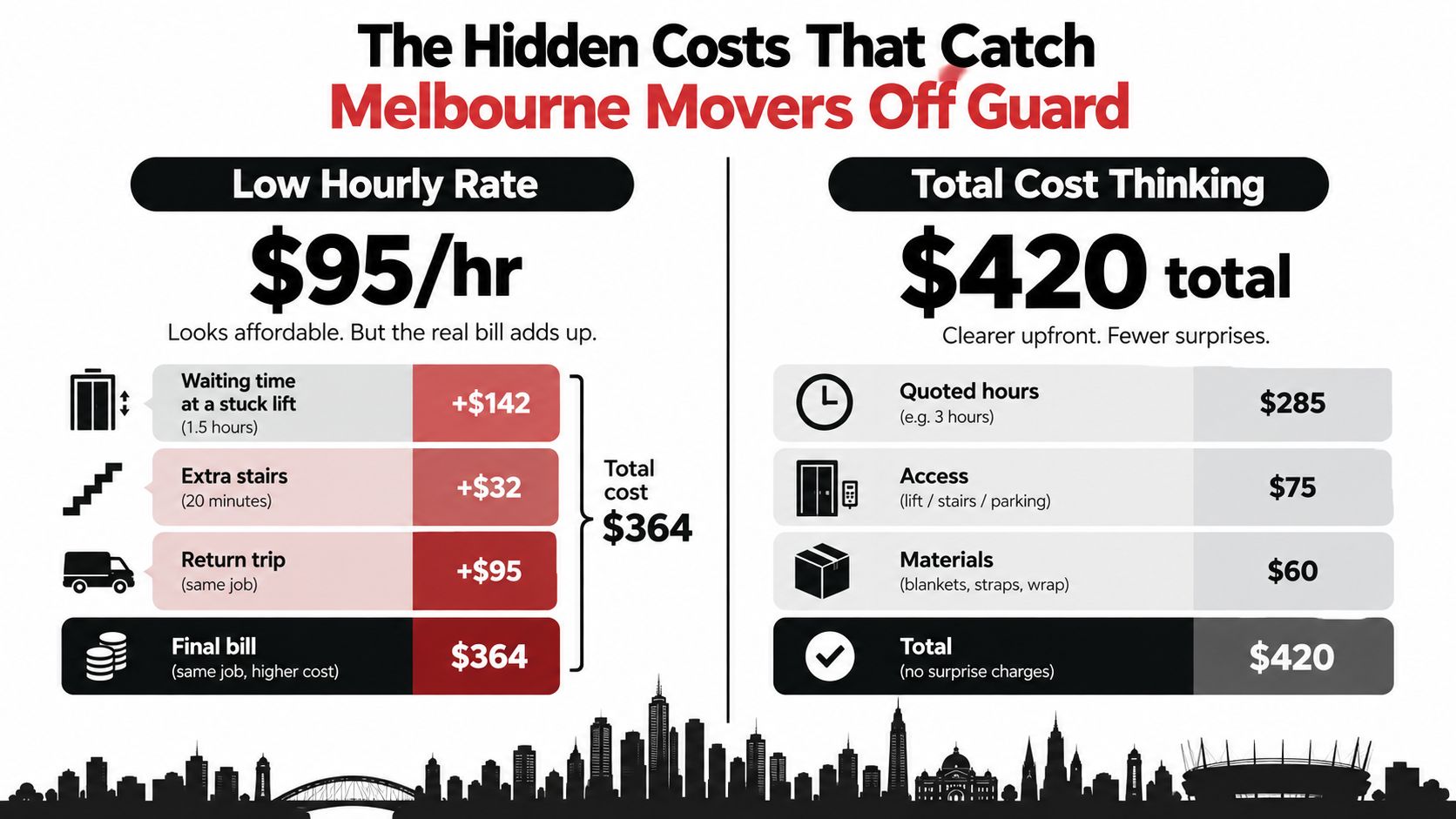
A low hourly rate can still produce a high total if the crew spends time waiting for access, walking from distant parking or making another trip. A fixed quote may include travel and standard handling, while an hourly quote may bill travel, tolls, packing materials, waiting or minimum hours separately.
Before accepting a figure, confirm the truck and crew, minimum charge, travel treatment, access delays, floor protection, blankets, transit cover, packing, disassembly, storage and specialty handling. Ask for these assumptions in writing so competing quotes describe the same job.
For another practical view of the moving house cost, compare the inclusions rather than chasing one headline rate. A fair quote explains what is included, what can trigger extra time and which costs remain outside the removal service.
The Four Drivers Behind Every Removal Van Quote
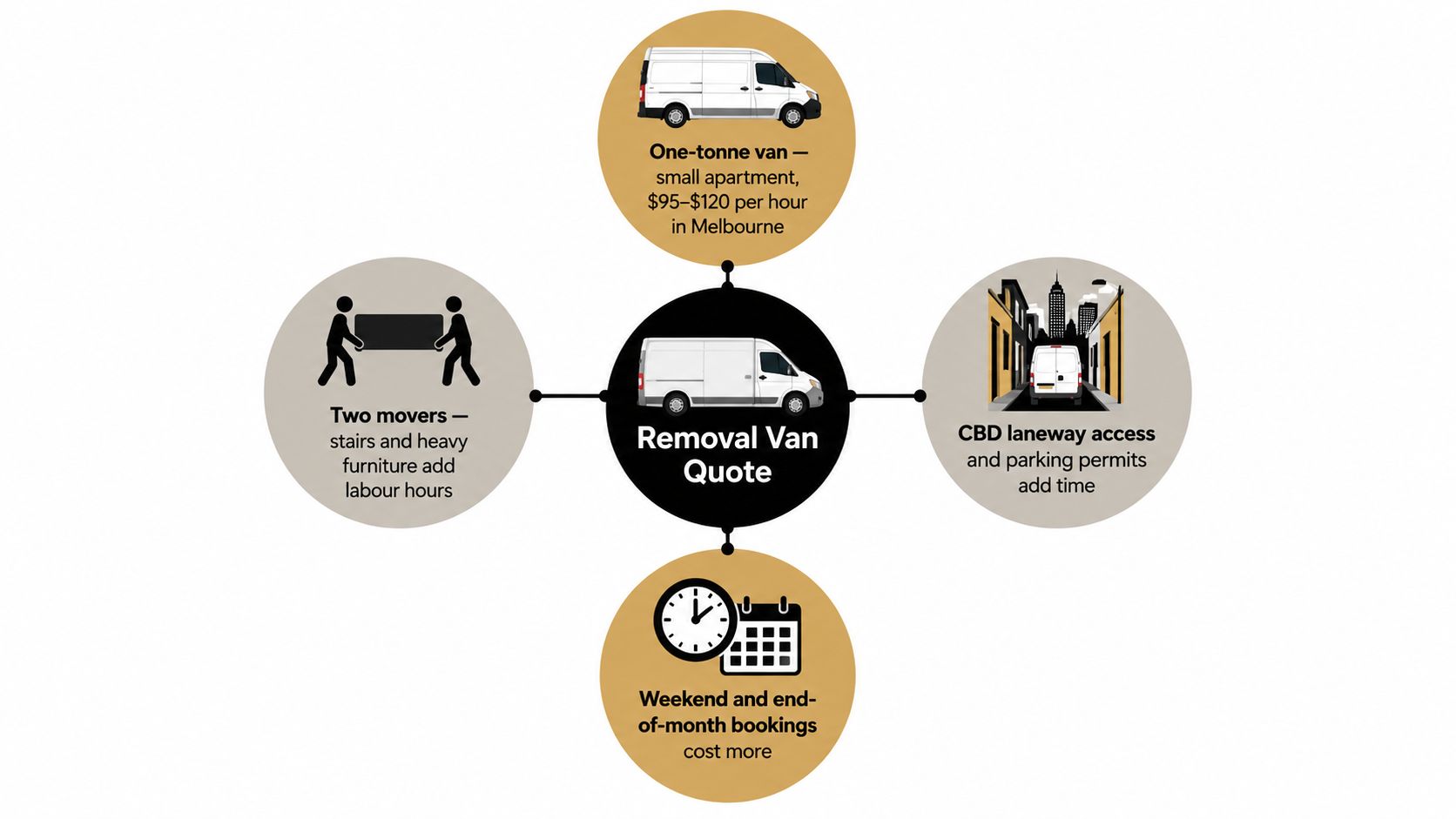
Every removal van quote is built from four practical questions. What vehicle is required? How far must it travel? How many crew hours will the work take? What access or additional service makes the job harder?
Truck size
A vehicle must have enough capacity for the load and enough payload for dense items. Bedroom count helps with an initial conversation, but it isn't an inventory. A household with fewer rooms can still need substantial capacity if it has large appliances, commercial equipment, a piano, a pool table or heavy books.
The truck also affects the way the crew works. An undersized vehicle may require multiple trips, extra loading and unloading, or staged transport. A larger vehicle may cost more per hour but finish the job in one trip. The right comparison is therefore not the hourly vehicle rate in isolation. Compare vehicle cost multiplied by realistic billable time.
Distance and travel time
Distance affects more than fuel. The crew may spend time driving through congested areas, finding legal parking, travelling between properties and returning the vehicle after the job. A local move can still take longer than expected if the truck is parked away from the entrance or the route includes difficult access.
For interstate work, transit distance and scheduling complexity become much more significant. The ABS found that 87.0% of people who changed address between 2016 and 2021 moved within the same state or territory, while 10.9% moved interstate, as reported in the ABS population movement analysis. That pattern makes local and intrastate work the main volume category, while Melbourne to Sydney, Brisbane and other East Coast routes need a separate long-distance assessment.
Crew hours
Crew size changes both speed and labour cost. Two movers may suit a straightforward apartment move with clear access. More people may be appropriate for heavy furniture, difficult stairs, large homes or a tight settlement window.
The important question is how the provider separates productive time from non-productive time. Loading, transit and unloading should be considered separately, because a lift delay or long carry can consume paid time without changing the amount of furniture transported.
Access and services
Access is where many estimates fail. A narrow Fitzroy laneway, a Southbank lift booking, a permit-only street or a long path from the truck to the front door can add work without adding possessions.
Packing, furniture disassembly, reassembly, piano handling, pool-table handling, storage and specialty protection should appear as identifiable line items. A clear method for estimating cubic metres helps the mover choose a suitable vehicle and reduces the risk of an undersized truck.
Stacking these four drivers produces a defensible estimate. Treating the hourly rate as the whole price produces a guess.
Price Benchmarks by Distance and Home Size
A benchmark is useful only when its limits are clear. The Victorian figures below are independent marketplace benchmarks, not guaranteed Melbourne tariffs. Use them with the bedroom averages as two separate checks, then adjust for the actual truck, crew, access and services required.
Published datasets do not always use the same distance bands customers use when requesting quotes. The table therefore shows the closest available comparison rather than inventing a figure for an unsupported range.
2026 Removal Van Cost Benchmarks by Distance and Home Size
| Distance Band | Closest Victorian Benchmark | Bedroom Benchmark | How to read it |
|---|---|---|---|
| Under 20 km, inner Melbourne | Up to 25 km, approximately $307 | 1 bedroom: $486, 2 bedroom: $628, 3 bedroom: $824 | Use the distance figure for the route and the bedroom figure for household size. Access may push the quote higher. |
| 20 to 100 km, regional Victoria | 25 to 100 km, approximately $394 | 1 bedroom: $486, 2 bedroom: $628, 3 bedroom: $824 | Compare both figures, then allow for the inventory, travel time and property access. |
| 100 to 300 km, interstate-adjacent | 100 to 250 km, approximately $748 | 1 bedroom: $486, 2 bedroom: $628, 3 bedroom: $824 | The distance benchmark reflects the longer route. The bedroom benchmark remains a separate household-size check. |
| 300 km and above | Above 250 km, approximately $785 | 1 bedroom: $486, 2 bedroom: $628, 3 bedroom: $824 | Treat the figures as boundaries for discussion, not as a complete long-distance quotation. |
The distance figures and bedroom averages are reported in the Australian moving-cost benchmark report. They do not mean every one-bedroom move costs the same or that every four-bedroom home suits one vehicle. A bedroom count is only a proxy. Furniture volume, stairs, lift bookings, carrying distance and parking can move the quote well away from the benchmark.
What the benchmarks include and exclude
Use these figures to test a conventional move involving a truck, a basic crew and ordinary handling. They may exclude packing materials, upgraded insurance, storage, heavy-item charges, waiting time, difficult access and extensive dismantling. A fair quote should identify those items rather than burying them in a final adjustment.
A Sydney to Melbourne move needs its own written assessment. Interstate work involves substantial transit distance, route planning and scheduling coordination, so a local Victorian benchmark cannot replace a route-specific quote.
If a proposal sits well outside the relevant benchmark, ask the provider to explain the difference in writing. A higher figure may be justified by a large inventory, difficult access, premium timing or specialist handling. The practical test is visibility: you should be able to see which part of the cost stack changed. The guide to household movers cost can help frame those questions before comparing proposals.
How to Build Your Own Removal Van Estimate
A reliable estimate starts with the inventory, not the hourly rate. Walk through the property with your phone and record furniture, appliances, boxes, stairs, lifts, parking distance and anything requiring dismantling or specialist handling.
Stage one, classify the distance
Put the job into a broad category:
- Inner Melbourne: A local metropolitan move where access, congestion and parking may matter more than kilometres.
- Regional Victoria: A longer Victorian move requiring a separate travel and scheduling allowance.
- Interstate: A route such as Melbourne to Sydney, Brisbane, Canberra or Adelaide, where transit planning becomes a major part of the quotation.
This classification narrows the relevant benchmark but doesn't replace a route-specific quote.
Stage two, estimate volume
Count large items room by room, then list unusual pieces separately. A bedroom count is only a starting proxy. A piano, safe, pool table, large fridge, commercial appliance or dense collection of books can change vehicle selection and crew requirements.
Record:
- Beds, wardrobes and tall cabinets.
- Sofas, dining tables and outdoor furniture.
- Whitegoods and televisions.
- Boxes, tubs and loose items.
- Items needing dismantling, wrapping or specialist equipment.
The removalist cost calculator can help organise the inputs, but the output remains an estimate until the mover verifies the inventory and access.
Stage three, separate working time
Estimate loading, transit and unloading as separate activities. Don't assume that the truck rate alone determines the cost. The crew may be productive while carrying furniture, but a lift booking delay, restricted parking or a long walk can consume paid time without increasing truck volume.
A useful comparison should show the vehicle, crew, estimated hours and travel treatment on separate lines. If you're weighing digital budgeting tools for broader planning, you can also compare Estimatty plans as part of organising the moving budget, while keeping the removalist's written scope as the commercial reference.
Stage four, add access and services
Add the conditions that make the work different from a simple driveway-to-driveway move. Note stairs at either property, lift bookings, permits, walking distance, narrow streets, packing, storage, furniture disassembly and fragile or oversized goods.
| Cost Line | Southbank 2-Bed Apartment | Melbourne to Sydney 4-Bed Home |
|---|---|---|
| Distance category | Metropolitan move | Interstate move |
| Inventory | Two-bedroom inventory with bulky items listed separately | Full-home inventory, with dense and oversized items identified |
| Loading | Apartment access, lift booking and staging required | Larger load, more extensive loading plan |
| Transit | Local travel and urban access time | Long-distance transit and scheduling |
| Unloading | Destination lift, stairs and parking conditions | Destination access, delivery coordination and unloading |
| Add-ons | Packing, dismantling or storage if selected | Packing, storage, specialty handling or staged delivery if selected |
| Quote control | Written access and waiting rules | Written route, inclusions, timing and variation rules |
The table deliberately leaves the dollar total open. Without an item inventory, route, vehicle choice and access assessment, a precise figure would be false precision. A strong quote records origin and destination access, estimated volume, crew size, kilometres, travel treatment, packing scope and insurance conditions.
The Hidden Costs That Catch Melbourne Movers Off Guard
A low hourly rate can win the first phone call and lose the final budget comparison. The bill changes when a crew waits for a lift, carries furniture from a distant parking space, makes a second trip for an overflow load, or supplies materials that were not listed in the quote. Truck size, crew time, access, fuel, waiting, packing and storage all belong in the cost stack.
The broader moving ledger matters too, as detailed in this guide to hidden costs in moving house. Australian renters report an average total moving cost of $5,128, rising to $7,676 when lost work time is included, according to the Australian renter moving report. That total reaches beyond the removalist invoice. It can include a new bond paid before the old bond is returned, overlapping rent, cleaning and other end-of-lease services.
The cash-flow traps
A renter may need to fund the new bond before receiving the previous bond. They may also pay rent at two properties, book cleaning for a fixed handover time, arrange child care, take unpaid leave or store furniture if settlement or key collection slips. These costs can arrive in the same week as the removalist invoice, so a quote that fits the moving service budget may still leave the household short of cash.
Victoria-specific reporting puts the average renter's moving cost at about $4,700 over the past decade, or approximately $1,567 per move, with 45% identifying removalist fees and 44% identifying bond timing as major financial pressures, as reported in the same Australian renter cost analysis. A cheaper van quote does not necessarily minimise the total cost of the week.
Fuel, waiting and cover
Melbourne household transport costs reached $27,474 per year, or $528.35 per week, in the June quarter of 2025. Average capital-city petrol prices fell by 7.1 cents per litre and diesel by 7.8 cents, while Melbourne household transport costs still rose by $106 from the previous quarter. By the December quarter, Melbourne's annual household transport cost had reached $27,977, and national capital-city diesel prices had increased by 4.7 cents per litre for a second consecutive quarter. The transport affordability report shows why fuel should not be treated as an automatic surcharge.
Ask whether fuel, tolls, waiting, lift bookings and depot travel are included. Check the policy wording for insurance for moving coverage rather than assuming every item has the same protection.
The right comparison is total landed cost. A slower move can increase lost work time, rent overlap and storage exposure even when its hourly rate looks lower. More capacity may cost less overall if it avoids a second trip, provided the mover confirms that the vehicle, route and load remain compliant.
Smart Habits for a Fair and Predictable Moving Bill
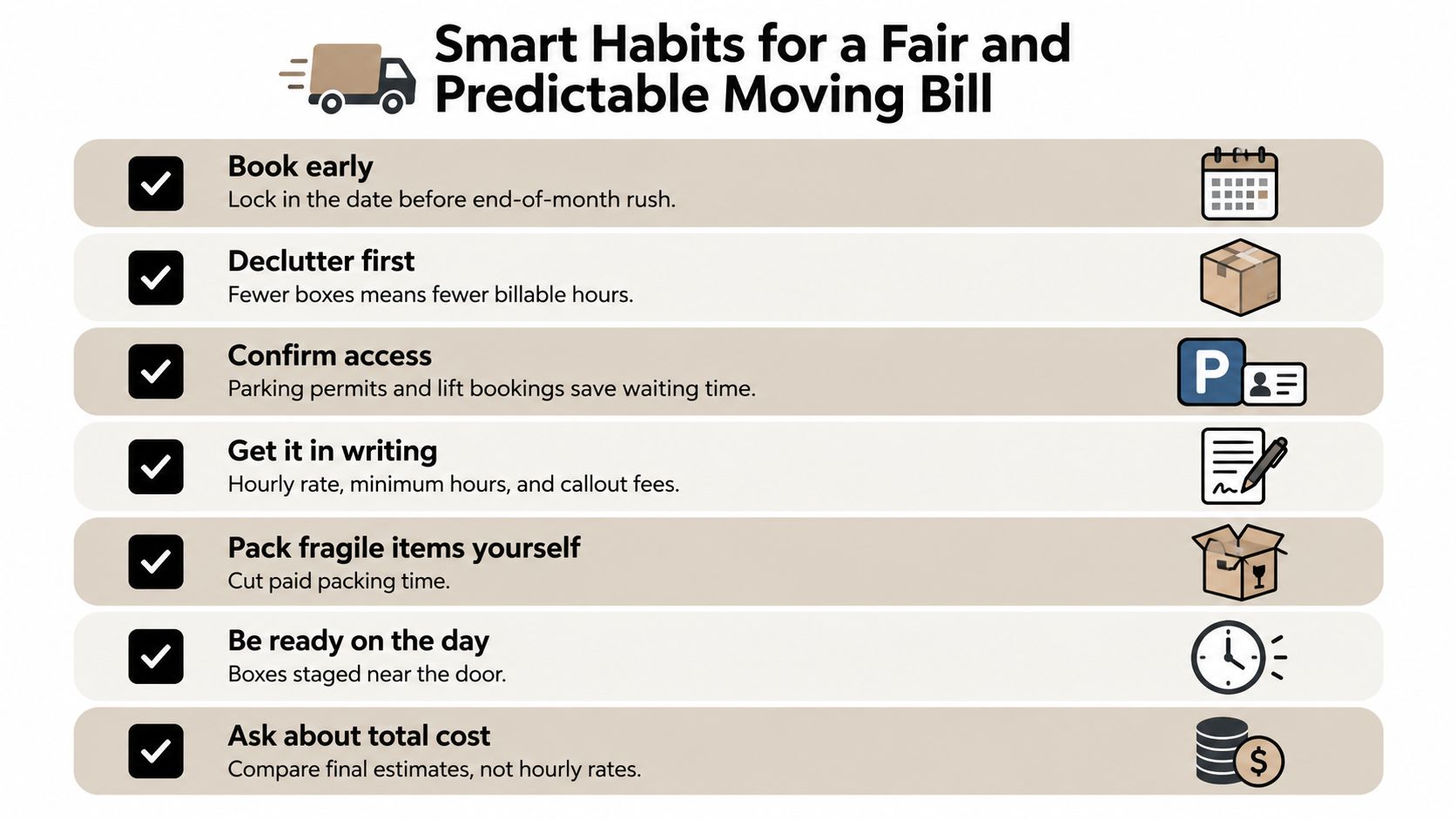
Predictable pricing starts before moving day. Give every provider the same inventory, addresses, access details and service requirements, then compare the assumptions rather than the headline number.
Put the scope in writing
Request an itemised quote that separates labour, truck, travel, fuel, waiting, access fees, packing and storage. The quote should state whether pricing is hourly or fixed, the minimum charge, the treatment of tolls and waiting, cancellation terms, variation rules and what insurance covers.
Compare at least two quotes using identical information. If one mover knows about a lift booking and another doesn't, the comparison isn't meaningful.
Quote check: A fair proposal explains what happens when the truck can't park at the entrance, the lift is delayed or the inventory doesn't fit the selected vehicle.
Remove avoidable delays
Book a suitable access window, arrange permits, reserve the lift and stage sealed boxes near the entrance where building rules allow it. Tell the mover about furniture that needs disassembly, fragile goods, narrow staircases and restricted streets before the truck arrives.
Fuel and access should never appear as surprises. The Australian affordability guidance also supports separating productive work from delays and retaining contingency for unlisted work. A contingency is a budgeting safeguard, not permission for a provider to add unexplained fees.
Keep a simple quote-folder checklist
- Inventory: List bulky, heavy and specialist items.
- Access: Confirm stairs, lifts, permits, walking distance and parking.
- Timing: Record collection, delivery and building access windows.
- Pricing: Check the hourly or fixed basis, minimum charge and travel rules.
- Inclusions: Confirm materials, protection, fuel, tolls, storage and waiting.
- Insurance: Obtain the coverage conditions in writing.
- Evidence: Photograph pre-existing damage and record the truck condition at collection and delivery.
Vehicle capacity also deserves honest disclosure. The 2021 Census found that 91.3% of Australian households reported at least one vehicle and 55.1% reported two or more vehicles, although those figures aren't a removal-industry measure or a direct truck-size calculation. They reinforce the need to identify large assets and unusual items during quoting, rather than relying on bedrooms alone, as described by the Australian Bureau of Statistics Census vehicle data.
Heavy-vehicle rules can also affect vehicle choice and scheduling. The National Heavy Vehicle Regulator says changes to mass and dimension requirements are scheduled to commence on 1 August 2026, including changes to mass limits and loading provisions described in its published fact sheet. Those rules aren't consumer price guarantees, so don't treat extra capacity as a reason to overload a truck. Give the mover an accurate inventory and let them confirm the compliant vehicle, route and loading plan.
For a Melbourne move, Get n Go Removals Melbourne can assess the inventory, vehicle capacity, access conditions, packing, storage and interstate requirements before quoting. Visit Get n Go Removals Melbourne with your addresses and item list ready, and ask for a written estimate that makes every cost component clear.