Event Transport Services in Melbourne: A Practical Guide
A van is halfway through a dock door, the stage crew is waiting, and the venue has already started counting down the access window. The dock closes in three hours, one road case is still unaccounted for, and the driver has just learned that the loading bay height is tighter than the booking notes suggested. Here, event transport stops looking like an ordinary delivery.
Melbourne event transport services need to account for venue access windows, dock rules, crew movements, fragile equipment, public-road approvals and return logistics at the same time. The state's event economy creates recurring demand for that coordination. Before the pandemic, Victoria hosted more than 120,000 events annually, generated over AUD 15 billion in direct spending, and employed more than 70,000 people, according to the Victorian event industry breakdown.
Trade shows, corporate conferences, weddings, festivals and community events all move different freight through different venues. A reliable plan treats each movement as part of the production schedule, not as a separate courier booking.
What Event Transport Services Actually Involve
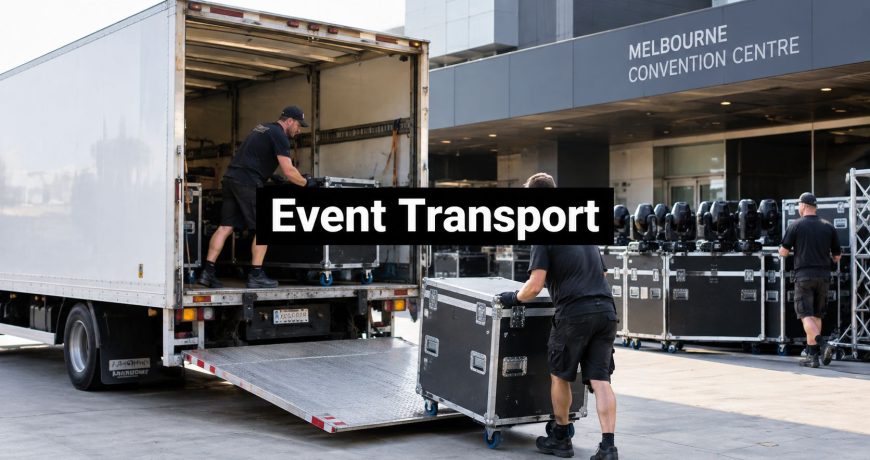
Event transport services coordinate the movement of staging, signage, audio-visual equipment, furniture, décor, exhibition stock and temporary infrastructure into and out of a venue on a fixed schedule. The work usually involves three connected phases:
- Pre-event load-in: Freight leaves a warehouse, arrives during an allocated venue window and moves from the dock to a holding area, stage or exhibition stand.
- Same-day transfers and resets: Crews move replacement equipment, spare parts, furniture, signage or catering assets between locations while the event is operating.
- Post-event load-out and returns: Equipment is checked, packed, collected and returned to a warehouse, supplier or next venue.
A house move is usually judged by whether everything reaches the new address safely. Event logistics has a stricter failure point. One missing cable, bracket, lectern or branded panel can delay an opening session or leave a finished stand incomplete. Most event freight lands already assembled or carefully packed, so the transport team must preserve the build order, label every case and hand each item to the right person.
Why a removalist add-on falls short
Event transport runs on venue clock-windows, not business-day estimates. A truck that arrives within a broad delivery period may still be useless if the dock is occupied, the lift is booked by another exhibitor or the venue stops accepting freight at a fixed time.
The vehicle also has to suit the site. A tail-lift truck may be right for pallets but wrong for a low dock. A curtain-sider with a rear ramp may suit a trade-show build, while an air-ride van may be safer for delicate displays. Drivers and crew need to understand venue inductions, pedestrian separation, dock-master instructions and manual-handling requirements.
Practical rule: Treat every case, pallet and loose component as part of the production schedule. If the floor plan changes, the load list and transport sequence must change with it.
The scale of major events makes the distinction clear. The 2023 Formula 1 Australian Grand Prix in Melbourne attracted 444,631 attendees over four days and delivered an estimated AUD 268 million in total economic impact, as recorded in Australian major-events evidence. Even where a transport provider handles only equipment rather than passengers, concentrated arrivals, restricted access and tightly sequenced load-ins create specialist logistics conditions.
How a Typical Event Transport Run Unfolds
At the warehouse, the crew starts with the conference floor plan rather than the truck. Road cases are built, pallets are wrapped and each item is tagged against a load list showing its destination zone, sequence and handling requirement.
A lighting console may go to the production desk, lecterns to the plenary room and sponsor walls to a separate exhibition area. The team loads in reverse order where necessary, so the items needed first remain accessible. The driver receives the route, venue contact, dock instructions and delivery sequence before leaving.
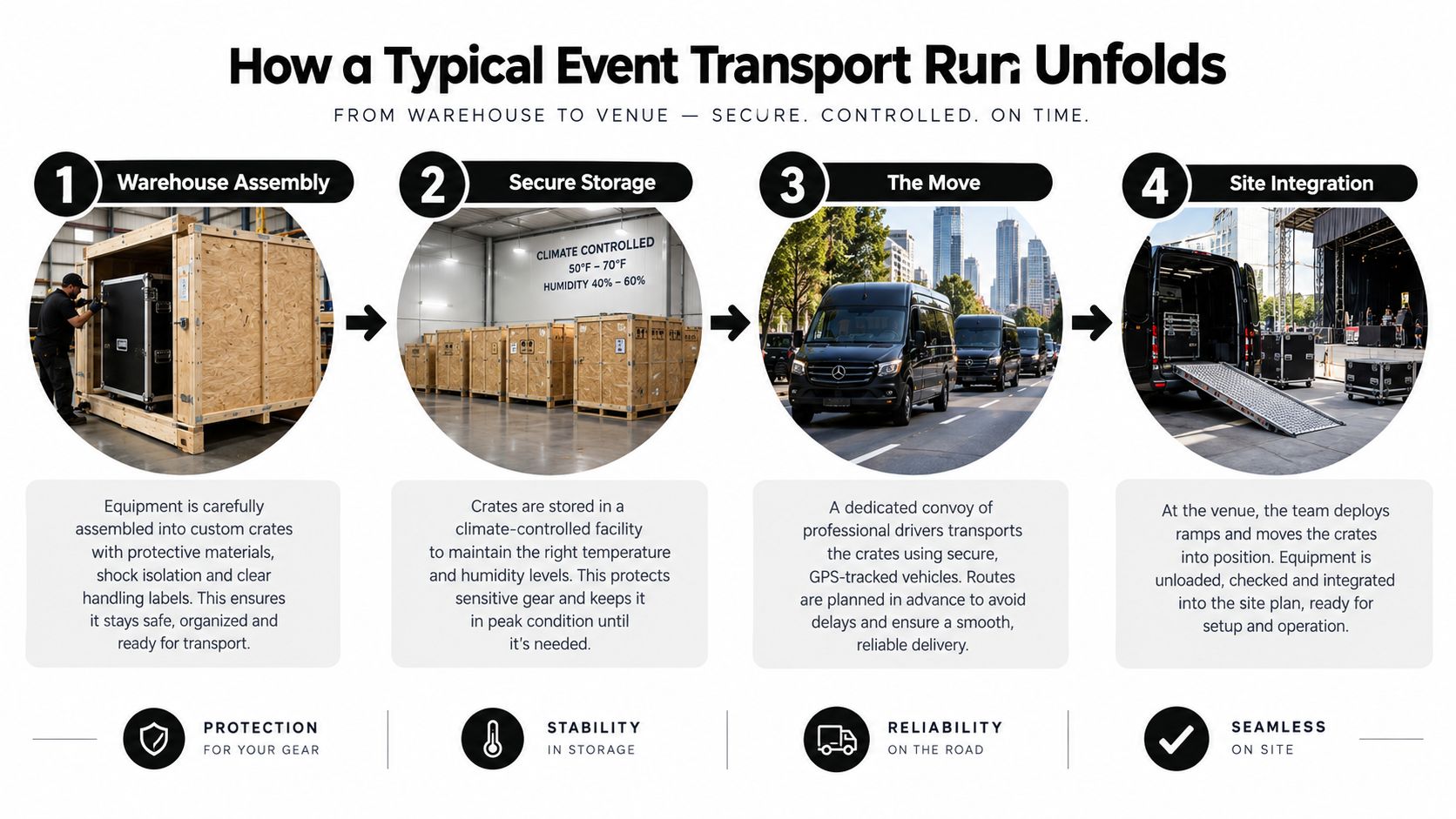
At a Melbourne CBD venue, the truck may join a staged queue rather than drive straight to the dock. The driver checks in, completes the venue induction and waits for the dock-master to confirm that the bay is clear. Freight then moves from dock to holding bay, and from holding bay to the stage or allocated stand according to a printed run sheet.
For a practical overview of planning principles in another Australian market, planners can also find Sydney event logistics advice. The operating conditions differ, but the value of early route, access and handover planning is similar.
The live phase
Once the conference opens, the transport plan doesn't disappear. A supplier may need a same-day transfer between venues, a spare bracket may need to reach the production desk, or a damaged display component may need replacement before a sponsor session.
Each handoff should be logged with the item identifier, location, vehicle, timestamp and receiving person. A useful technical baseline is the Australian freight-data standard for traceable logistics events, which identifies location, transport asset, logistic unit and the event's what, where, when and why attributes.
For a Melbourne-focused operational reference, planners can review event logistics transport options and compare how the provider handles staged deliveries, storage, crew access and returns.
At load-out, the crew checks cases and equipment against the original list, records condition and captures exceptions before the truck leaves. Returned gear goes back to the warehouse for inspection, cleaning, repair or rehire. That final reconciliation matters because an item that appears to be missing may still be sitting in a venue holding room or inside another supplier's case.
Core Service Types Planners Should Know
The right vehicle depends on the freight, the venue and the handling sequence. Asking for “a truck” without describing the load often produces a vehicle that can carry the weight but can't safely access the dock or protect the equipment.
| Service Type | Typical Client | Vehicle / Equipment | Handling Note |
|---|---|---|---|
| Freight and palletised transport | Trade exhibitors, suppliers and event warehouses | Tail-lift trucks, pallet equipment and secure load restraint | Confirm pallet dimensions, dock height and unloading order before booking |
| AV and equipment transport | Production companies, conferences and live events | Air-ride vans, curtain-siders with rear ramps and protective cases | Use trained crew for road cases, trussing, consoles and two-person lifts |
| Specialty asset handling | Musicians, galleries, florists and premium event designers | Climate-aware vehicles, custom crates, blankets and secure cages | Protect against vibration, moisture, temperature change and surface damage |
| Back-of-house logistics | Venues, organisers and production managers | Holding space, run-team staffing and return vehicles | Plan storage, replenishment, waste streams and post-event reconciliation |
Freight and palletised transport
Trade exhibitors often move bulk product, machinery, stands and promotional stock into exhibition halls. The challenge isn't only payload. Pallets may need to travel through a service lift, pass through a narrow dock or remain in a secure holding area before the exhibitor is ready.
A tail-lift truck can simplify ground-level unloading, but it doesn't solve a height restriction or a long internal route. Confirm the dock dimensions, pallet access, forklift responsibility and delivery order with the venue before the vehicle is allocated.
AV and specialist equipment
Speakers, lighting consoles, screens, trussing and production cases need controlled handling. Use vehicles with suitable suspension and restraint points, and make sure the crew understands which cases can be stacked and which must remain upright.
A two-person lift isn't a luxury for awkward or valuable cases. It protects the equipment and reduces the chance that a rushed operator damages a finished floor, wall or display.
Back-of-house and returns
Some events need a transport team to stay available during the show. That may involve moving empty packaging, holding spare stock, collecting waste or returning furniture after a room reset. A provider that can supply a run team and secure storage cage is more useful than a courier that only completes the original delivery.
For staffing and vehicle planning, Melbourne driver hire for logistics support can be considered alongside the freight booking, particularly where the driver must remain available for repeated venue movements.
Don't force every job into the same vehicle. Match the equipment to the freight, then match the crew to the handling risk.
Building a Reverse Planning Timeline
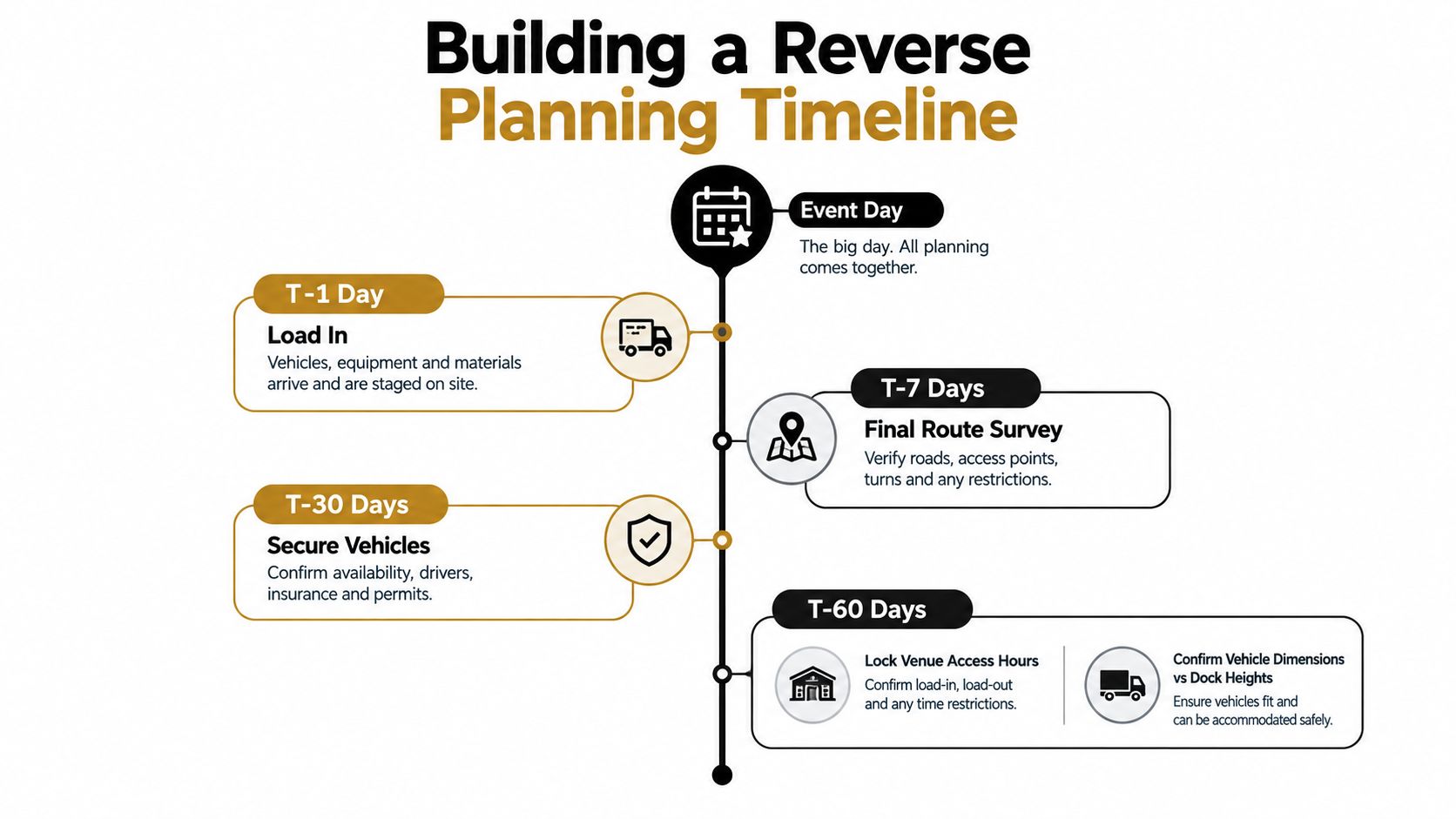
Event transport starts with the venue-ready time and works backwards. Set the opening time, then allow for installation, unloading, internal movement, travel, check-in and disruption. This exposes access problems before a truck is booked. A vehicle that suits the freight is still the wrong choice if it cannot reach the dock or meet the venue's loading window.
At 60 days
Confirm venue access hours, loading-bay rules and dock dimensions. Check vehicle height, length and turning requirements against the venue information. Shortlist providers that can handle the required mix of pallets, road cases and fragile displays.
Where an event affects a major road or freeway, Victoria's Department of Transport and Planning requires a complete non-road activity application at least 60 days before the event date, according to the DTP event-permission requirements. Build that deadline into the transport brief rather than leaving it with a separate compliance team.
At 30 days
Confirm the call sheet, delivery order, driver contacts and venue escalation path. Mark vehicle restrictions, narrow approaches, separate supplier entrances and any holding area on the working route plan.
For major venues, an early-morning load-in window of 04:00 to 08:00 may suit the schedule, but it is not a standard venue rule. Obtain the actual slot in writing. CBD access can also change with DTP restrictions, roadworks and traffic-management requirements, so assign someone to check the route before final dispatch instructions are issued.
One week before
Reconfirm crew call times, truck details, dock bookings and contact numbers. Stage pre-load orders in the warehouse, print chain-of-custody tags and compare the load list with the latest floor plan. These checks help establish who accepted each item and where it should go.
Ask what happens if the venue opens late, a lift is unavailable or a truck misses its slot. Name the person who can approve a revised sequence, holding location or replacement vehicle.
On the day
Run a live schedule covering arrival slots, dock marshals, holding locations and escalation contacts. Record dispatch, arrival, unloading, handover and exception times. The National Freight Data Hub provides time-dependent route and disruption information, which is more useful for scheduling than fixed distance estimates alone.
The result is a clear evidence trail when congestion, a closure or a venue delay forces rescheduling.
Permits, Insurance, and Loading Zone Rules
A venue booking does not give a truck permission to occupy the road outside it. Before confirming the run, identify every affected space: arterial road, freeway, local road, footpath, nature strip, kerb or pavement. Then establish which authority controls that space and whether the vehicle will stop, queue, unload or require traffic control.
For arterial roads and freeways, DTP coordinates permissions for non-road activities. Local-road impacts go to the relevant municipal council. Victoria Police must also be notified, and a separate police highway-events approval may apply. The DTP guidance for events and road permissions sets out the application pathway.
| Approval | Issuing Body | Typical Lead Time | Notes |
|---|---|---|---|
| Event permission affecting a major road or freeway | Department of Transport and Planning | Complete application at least 60 days before the event | Confirm vehicle access, traffic controls and unloading activity |
| Local-road closure or occupation | Relevant municipal council | Confirm with council before booking the transport window | Requirements depend on the road and proposed use |
| Road Occupancy Permit | Road authority or council | Apply before occupying public space | May cover footpaths, kerbs, channels, nature strips and road pavement |
| Police highway-events approval | Victoria Police | Confirm during event approval planning | May be separate from DTP permission |
| Certificate of currency | Insurer or transport provider | Obtain before venue access | Venues may request public liability and transit cover |
Loading zones are not waiting bays
Victorian loading zones are intended for active pickup or delivery. A goods-carrying vehicle, courier or signed delivery vehicle may generally stop for up to 30 minutes, unless the signs set another limit, according to the Victorian loading-zone design guidance.
Assembly, repeated trips between the truck and venue, or a vehicle that must remain beyond the signed period requires a different plan. Book private dock access, arrange a holding location or investigate a road-occupancy approval. Do not use a loading zone as a queue for crew, cases or event equipment.
A Road Occupancy Permit may be required before occupying a footpath, nature strip, channel, kerbing or road pavement. Melbourne council guidance describes temporary portable storage units in special circumstances as having maximum dimensions of 2.2 metres long, 1.5 metres wide and 2.2 metres high, a maximum weight of one tonne, and same-day removal requirements, as described in the Road Occupancy Permit guidance.
Insurance wording needs the same practical review. Public liability can respond to certain third-party injury or property claims. Carrier's liability and goods-in-transit cover address freight risks, but the boundaries vary between policies. Request the certificate of currency, exclusions, claim limits and written responsibility for loading, temporary storage and venue handover. Use this moving company insurance coverage information when checking what a transport quote includes. Clearance, cover and custody should be agreed before the truck is dispatched, not at the venue gate.
Why a Specialist Provider Makes the Difference
A generic courier is built for repeatable point-to-point delivery. A general removalist is built for household or office contents. Event transport sits between those models and adds a production schedule, venue access protocol and return obligation.
The fleet is the first difference. A suitable provider may need tail-lift trucks for pallets, curtain-siders with rear ramps for exhibition freight, low-loader capability for unusual stage components, or air-ride vans for sensitive equipment. The question isn't whether the truck can carry the load. It's whether the truck can enter, unload, protect and leave within the venue's rules.
Equipment protects the finish
Event freight arrives at a finished venue where a scuffed wall or damaged sponsor panel is immediately visible. Useful transport equipment includes ramp boards, furniture blankets, export wrap, corner protection, load bars and purpose-made stillages.
Road cases need restraint and an unloading sequence. Furniture may need blankets and floor protection. Floral installations, instruments and artwork may need custom crating, climate awareness or a white-glove handover. Those requirements should appear in the quote rather than being added after the truck arrives.
People absorb the friction
Venue work involves dock-masters, security teams, production managers, exhibitors, talent, VIPs and sometimes a live audience. Crew should know how to follow an induction, keep pedestrian paths clear, communicate a delay and record a handover without interrupting the show.
Police-checked staff can be appropriate where the work involves sensitive areas, valuable goods or access around performers and guests. The important point is role clarity. One person should own the load list, one person should coordinate with the venue and every handoff should have a named receiver.
Scheduling needs flexibility
Rehearsals overrun. Speeches change. A supplier finishes late. A truck may need to wait, return after midnight or support a split shift across two venues. A specialist provider can plan overnight, weekend and standby movements instead of treating every change as an exception.
For fragile displays, artwork, pianos or other unusual items, specialty item moving support can help planners assess packing, handling and transport requirements before assigning a vehicle.
The useful test: Ask the provider what happens when the schedule changes. The answer should include a named coordinator, a revised run sheet and a way to preserve chain-of-custody control.
Accessibility, Sustainability, and Live Disruption Risks
A larger vehicle doesn't automatically create accessible event transport. Accessibility starts with the complete route, from the transport point to the venue entrance and through the working area.
Organisers should publish the nearest accessible public-transport stop, accessible parking, drop-off zones, road closures and a continuous step-free route. The inclusive and accessible event guidelines provide a practical framework that Melbourne planners can adapt.
Accessibility needs a site plan
Check ramp gradients, lift dimensions, step-free loading bays and accessible drop-off points before pallets and road cases arrive. Keep crates, packaging and trolleys out of accessible routes during load-in. Confirm who coordinates loading around mobility-parking restrictions and what happens if a lift, road or public-transport connection is disrupted.
Sustainability also needs evidence rather than a vague “green transport” label. Ask for the truck type, estimated kilometres, consolidated-load plan, empty-return approach, idle-time controls, reusable protective materials and reporting boundary. The RMIT sustainable transport plan records targets including zero-emission public-transport bus purchases from 2025, 50% zero-emission light-vehicle purchases by 2030 and a 25% active-transport share by 2030. These are organisational targets, not a promise that every event vehicle will be electric.
A larger truck can sometimes create a lower-impact plan if it consolidates several deliveries into one appropriately sized run. Ask the supplier to explain the trade-off, and use practical carbon-footprint tips for planners when building the wider event sustainability brief.
Live disruption changes the route
Melbourne traffic incidents, rail crossings around Richmond and South Melbourne, roadworks, closures and weather affecting outdoor festivals can change a plan after dispatch. Drivers need a live communication channel, route-replanning authority and a requirement to log changes against the freight record.
Use this supplier checklist before signing:
- Access: Can the provider confirm ramps, lift dimensions, dock rules and accessible drop-off points?
- Evidence: Will it report kilometres, vehicle type, idle time and consolidated runs?
- Resilience: Can it re-route, hold a vehicle or support a delayed load-in?
- Traceability: Are dispatch, arrival, handover and exceptions timestamped?
- Returns: Does the plan include inspection, storage, waste streams and reverse logistics?
For planners comparing lower-impact moving and transport options, eco removals in Melbourne can form part of the supplier review, alongside direct questions about vehicles, routes and reporting.
Get n Go Removals Melbourne offers commercial and event transport for exhibition materials, event stock, furniture, branded structures and fragile display pieces, with packing, unpacking, disassembly, reassembly, storage and flexible early-morning or late-night scheduling. Visit Get n Go Removals Melbourne to discuss your venue access window, load list and return plan before booking the transport.