
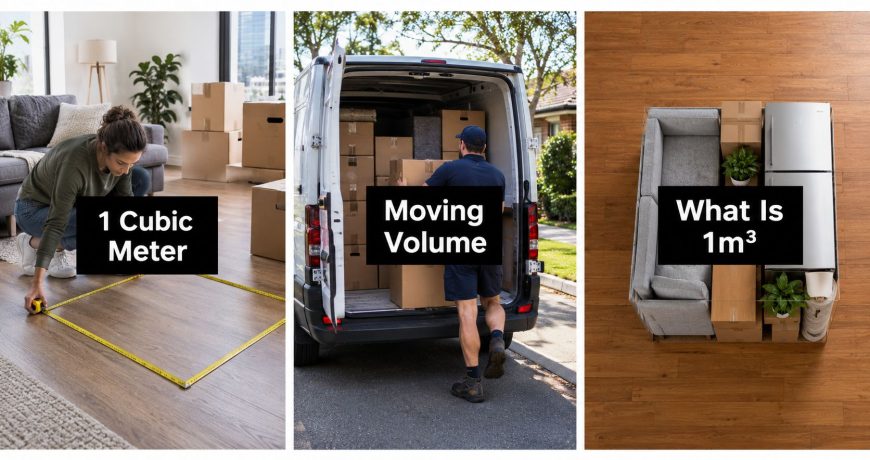
What Is 1 Cubic Meter in Melbourne Moving
One cubic metre is a 1 m × 1 m × 1 m cube equal to roughly eight standard moving cartons. It's the basic volume unit Melbourne removalists use to size trucks and calculate moving costs.
You're standing in an empty living room, looking at a sofa, bookcase and a pile of packed cartons, trying to work out whether everything will fit in one truck. That's where 1 cubic meter, more commonly written as 1 cubic metre in Australia, becomes useful. It turns a vague collection of furniture into a practical measurement you can discuss with a removalist.
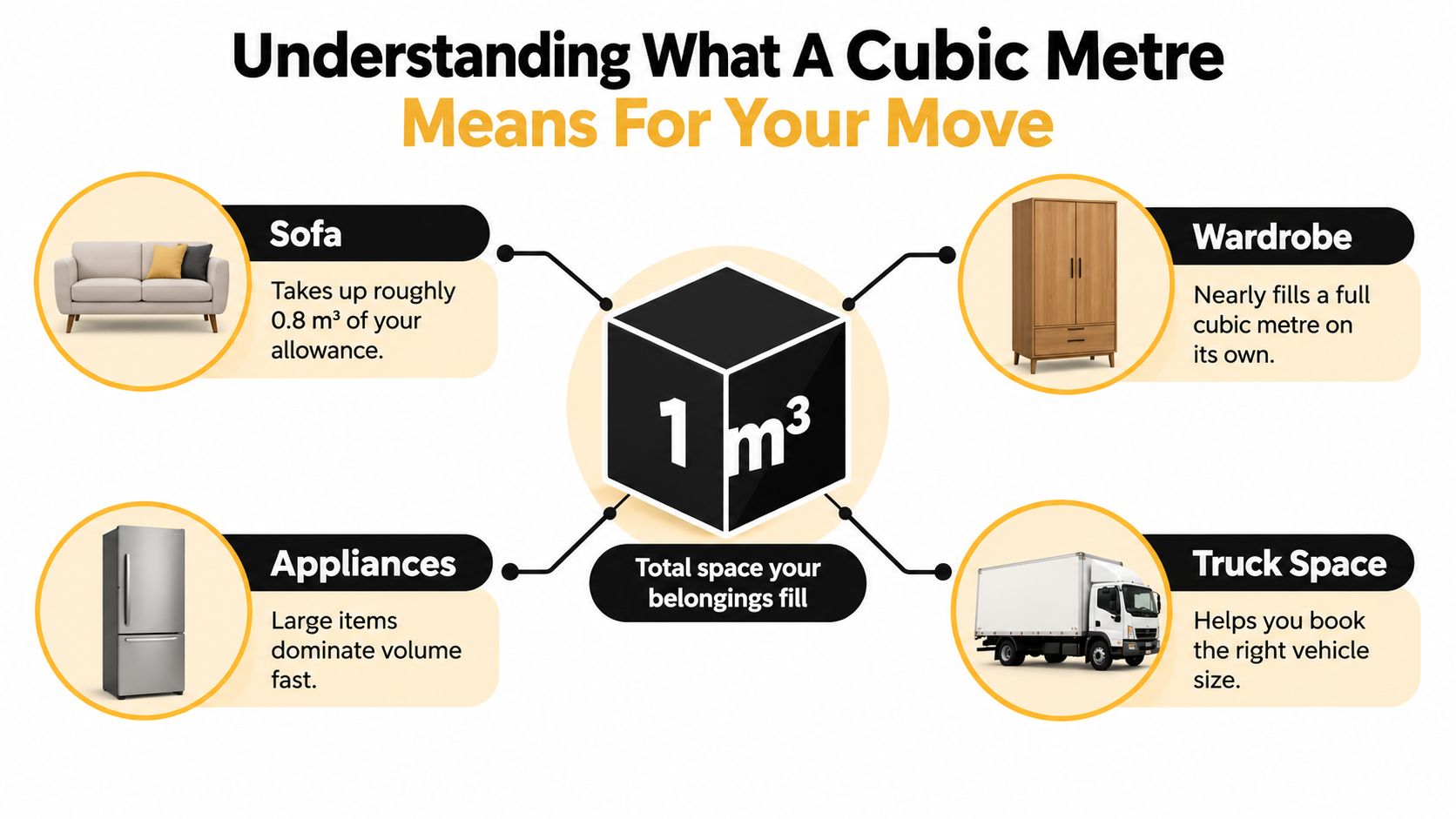
Understanding What A Cubic Metre Means For Your Move
A cubic metre is a box measuring one metre wide, one metre high and one metre deep. Its capacity is 1,000 litres, and Australian moving guides commonly translate it into roughly eight standard moving cartons for easier household planning. Muval explains how a cubic metre works in Australian removals
That definition sounds simple, but it answers a question customers ask every week: “How much room will my belongings take?” A wardrobe, packed cartons and a small appliance may occupy a similar amount of truck space even though their shapes are completely different. Removalists measure the outside dimensions and estimate the total space those items will fill once loaded.
Why Melbourne movers use the unit
Melbourne moves often involve narrow driveways, apartment loading bays, lift bookings and limited parking windows. A volume estimate helps the mover decide whether a smaller vehicle is practical or whether the job needs more truck capacity. It also gives you a common language for comparing quotes.
A quote based only on “one bedroom” or “a small apartment” can be too broad. One renter may have a furnished room and a few boxes, while another has bulky furniture, appliances and stored belongings. The number of bedrooms describes the property. Cubic metres describe the belongings.
For a straightforward explanation before you request a quote, you can also read this guide to what a cubic metre means for furniture removals. If you're arranging cleaning around a move, a resource such as Moving your window cleaning service can help you think about timing tasks around packing, access and handover.
Practical rule: Measure the goods you're taking, not the rooms you're leaving behind.
How To Calculate Your Moving Volume Correctly
The core formula is straightforward:
Length × width × height = cubic metres
Measure each item in metres, multiply its three dimensions, then add the results. A cabinet measuring one metre long, half a metre deep and two metres high would be calculated from those dimensions. A tape measure, a note on your phone and a consistent method are enough for most Melbourne household moves.
A reliable home measuring process
Begin with the larger pieces. Record sofas, beds, wardrobes, refrigerators, washing machines, dining tables and desks before counting cartons. These items can change the estimate quickly, and their dimensions are easier to capture than a room full of loose belongings.
Pack or group smaller goods before measuring them. Books, kitchenware and toys can be counted as cartons or storage tubs rather than measured individually. Keep a separate note for furniture that can be dismantled, because a flat-packed table or bed frame may use less transport space than its assembled dimensions suggest.
Use this order:
- List the large furniture: Write down each item and its packed length, width and height.
- Add appliances: Record refrigerators, washing machines and other large units separately.
- Group cartons: Estimate the number of packed boxes and their approximate carton size.
- Allow for protective packing: Moving blankets, wrapping and awkward gaps require some additional room.
- Review what isn't moving: Remove donated, sold or discarded goods from the estimate.
Record the packed size where possible, not just the item's showroom dimensions. A wardrobe may be measured as one unit, while a dismantled bed frame needs its bundled dimensions. This gives the removalist a more useful picture of truck space and loading order.
An Australian freight example represents one cubic metre as six cardboard tea chests or twelve cardboard book cartons. Upmove provides practical Australian examples for converting household goods into cubic metres Use that comparison as a rough sense check, since carton sizes and packing methods vary between households.
For a step-by-step explanation, read this guide on how to calculate cubic metres for a move. A rough estimate from your lounge room floor gives the removalist enough information to plan labour, vehicle space and loading order. Good measurements also make it easier to explain why a quote changes when extra furniture or packed boxes are added.
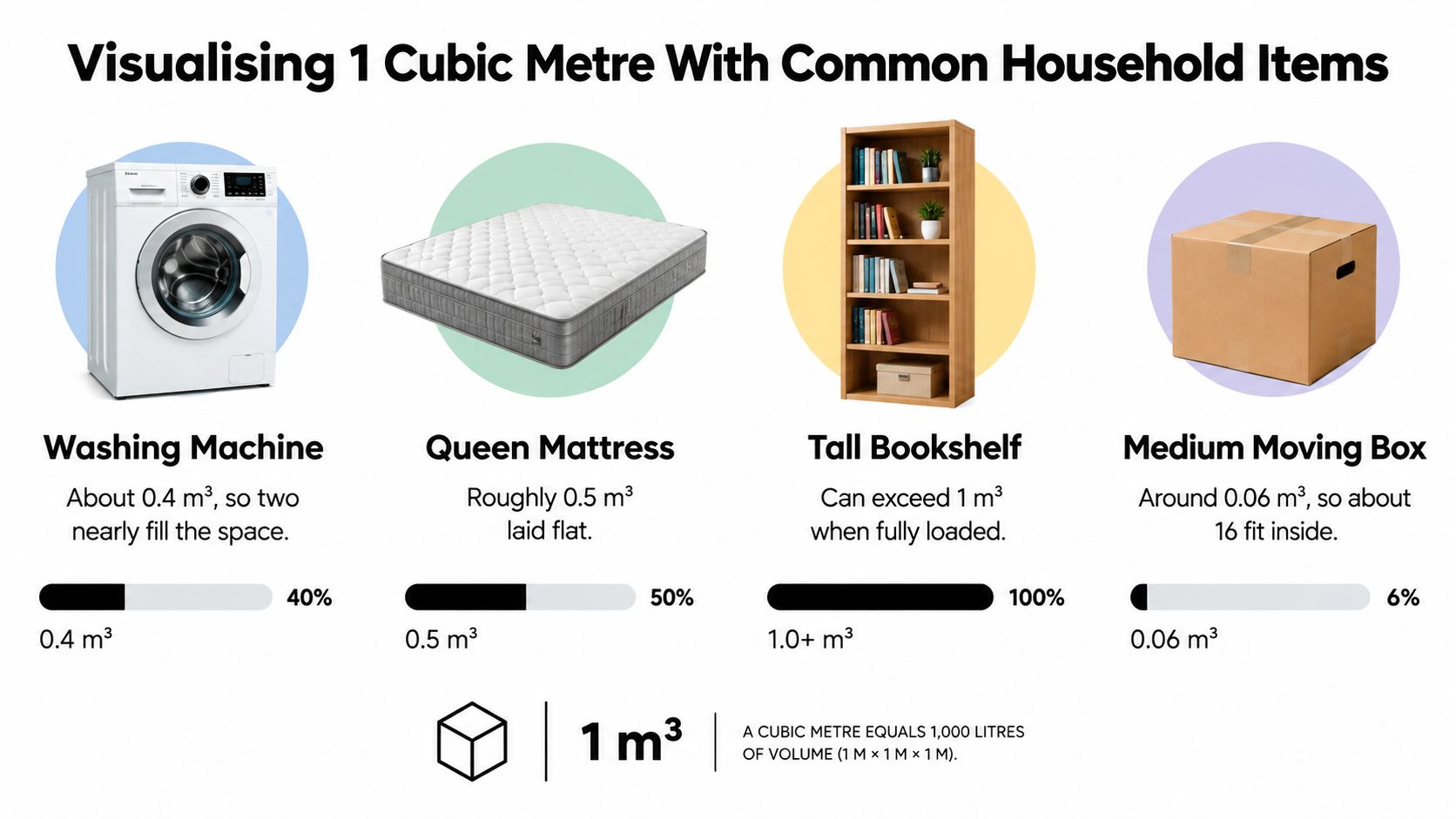
Visualising 1 Cubic Metre With Common Household Items
The easiest way to understand a cubic metre is to compare it with furniture you already know. A standard refrigerator can occupy around 1.0 m³, while a queen bed can take roughly 1.7 m³ and a three-seater sofa about 1.8 m³, according to Australian furniture-removal guidance. These furniture examples show how quickly large household items use available volume
That comparison changes the way many people think about their move. A single fridge can represent about the same volume as the rough carton allowance for one cubic metre. A sofa or queen bed can exceed that allowance before you add cushions, bedding, bedside tables or surrounding cartons.
Shape matters as much as the calculation
Furniture doesn't arrive as a perfect cube. A sofa has arms and a back, a bed frame has open spaces, and a table may be able to travel on its side. Skilled removalists use those shapes to build a tighter load, but customers shouldn't assume every gap will disappear.
A tall bookcase filled with books can use more truck space than the empty frame suggests. A mattress may be flexible, but it still needs protection and careful placement. A refrigerator should remain secure and upright according to the mover's handling requirements, so its practical loading footprint may differ from a simple volume calculation.
The most useful approach is to separate volume estimates from loading decisions. The estimate tells you how much physical capacity your goods may need. The loading plan determines how those goods can be positioned safely inside the vehicle.
If you're comparing physical capacities and want another way to think about measured space, this explanation of how many wheelbarrows fit in a cubic metre offers a different visual reference. For a Melbourne household move, though, furniture dimensions and packed cartons remain more useful than a loose visual comparison.
Estimating Volume For Different Home Sizes In Melbourne
A home's size gives you a starting point, not a reliable quote. One Melbourne studio might contain a bed, sofa, table, clothing and a few cartons. Another may be packed with books, gym equipment, musical instruments or stored furniture. The floor plan cannot show that difference.
Broad removal-planning ranges can provide a useful yardstick, but they are not guarantees. The contents matter more than the number of rooms. A lightly furnished home may fit comfortably within a smaller vehicle, while a crowded apartment can require more space than its floor area suggests.
A practical comparison
A compact apartment with limited furniture may sit toward the lower end of a removalist's capacity range. Add a full lounge suite, bedroom furniture, appliances and a storage cage, and the allowance changes quickly. Storage cages are easy to miss because they sit outside the living area. In Melbourne apartment moves, they often hold dense cartons, tools, bikes or awkward seasonal items.
A family home usually gains volume through repetition. Several beds, wardrobes, desks, outdoor furniture, children's belongings and garage contents add up quickly. A partially furnished property can remain straightforward to load, while a fully furnished home with years of accumulated goods may need a larger vehicle and more careful packing.
Use the property type as an initial checklist:
- Studio or compact apartment: Count every large item. One sofa, appliance or exercise machine can change the estimate quickly.
- One-bedroom home: Include the storage cage, balcony, spare cupboards and laundry, not only the bedroom and lounge.
- Family property: List garage, shed and outdoor goods separately from the main household contents.
- Office or mixed-use space: Record desks, chairs, shelving, archive cartons and equipment as separate groups.
The item list also helps match your goods to a suitable truck. This guide on what size moving truck you may need can help you compare vehicle capacity with your estimate. Treat the result as a planning guide, then confirm the vehicle after considering access, travel distance and the loading environment. A clear inventory, including cartons and stored items, gives the removalist a much better basis for planning the move.
Why Volume Is Only Part Of Your Moving Quote
Cubic metres tell you how much space the goods may occupy. They don't tell you how long the crew will spend carrying those goods, how difficult the access will be or how far the truck must travel. That's why two Melbourne moves with similar volumes can produce different quotes.
The route is one factor. A local move and an interstate relocation involve different travel requirements, scheduling considerations and vehicle planning. Parking can also change the job. A truck positioned directly outside both properties creates a different workload from a move involving a long carry, loading-zone restrictions or repeated repositioning.
Access changes the labour
Lifts, stairs, narrow hallways and basement car parks all affect the physical work. An apartment move may have modest volume but require careful lift coordination and multiple trips between the unit and loading area. A ground-floor house with a clear driveway may be faster to load even if it contains more furniture.
The goods themselves matter too. A piano, pool table, solid timber cabinet or oversized sofa needs more planning than a similar amount of boxed clothing. Disassembly, reassembly, wrapping and protective equipment can add labour without increasing the cubic-metre total.
Australian freight pricing demonstrates why volume can also become a chargeable weight. A common domestic road and express-freight benchmark treats 1 m³ as 250 kg, so a shipment measuring 2.0 m × 1.0 m × 1.0 m may be billed at 500 kg even when its actual mass is lower. National Freight Management explains the Australian cubic-weight calculation
Air freight uses a different approach. A common divisor is 6,000 cm³ per kilogram, equivalent to about 167 kg per cubic metre, while some domestic Australian systems use 200 kg per cubic metre. Qantas Freight explains how volumetric weight affects freight costs That's why removing empty space, dismantling bulky items and packing carefully can matter for time-sensitive freight.
Public Australian quote data includes moves measured at 6.00 m³, 7.00 m³, 19.00 m³ and 26.00 m³, but the prices vary because volume isn't the only input. Muval's moving data shows why customers should compare the full scope of a quote If you're preparing a property for handover, a separate guide to Dallas move-out cleaning costs illustrates why cleaning and moving should be planned as different services with different cost drivers. For the moving side, review how removalist costs are calculated rather than judging a quote from cubic metres alone.
Final Tips For Accurately Estimating Your Move
A useful estimate doesn't require perfect measurements. It requires a complete list, honest information about access and enough detail for the removalist to understand what will be loaded. Underestimating is rarely helpful. It can lead to a vehicle that's too small, extra handling or a rushed loading plan.
Start with the furniture that dominates the space, then add the cartons and smaller items around it. Take photos of crowded rooms, storage areas and large individual pieces. A photograph often reveals details that a quick phone description misses, especially for staircases, narrow corridors, balconies and basement access.
A practical checklist before you call
- Measure the bulky items: Record the length, width and height of sofas, beds, wardrobes, appliances and shelving.
- Count packed cartons: Keep books, kitchen goods, clothing and fragile items in separate groups where possible.
- Include hidden storage: Check garages, sheds, balconies, storage cages and the top of wardrobes.
- Mark what's being removed: Don't include furniture that will be sold, donated, recycled or left at the property.
- Describe access accurately: Mention stairs, lifts, long carries, narrow driveways, loading restrictions and parking limitations.
- Identify specialist items: Flag pianos, pool tables, antiques, safes and unusually heavy furniture before moving day.
- Ask about packing: Confirm whether you're packing yourself or need professional packing, unpacking, disassembly or reassembly.
- Keep the estimate updated: Recalculate if you buy furniture, clear a storage unit or decide to move items that were previously excluded.
A cubic-metre estimate works best when it supports a conversation, not when it replaces one. Give the mover your item list, dimensions, photos, addresses and access details. The more accurately you describe the job, the easier it is to select a suitable truck and organise the crew.
Use 1 cubic metre as your basic building block, but judge the move as a complete operation. Volume, handling, access, distance and timing all contribute to a practical plan.
Get n Go Removals Melbourne can help estimate your household or office volume, plan the right truck capacity and coordinate packing, furniture disassembly, storage or interstate transport. Visit Get n Go Removals Melbourne with your item list and access details to start preparing an accurate moving plan.