Backloading Melbourne to Brisbane: Costs, Timing and Tips
A backload is a carrier filling spare capacity on the return leg of a truck already travelling to Brisbane with your goods, so you pay for a share of a trip that would otherwise run partly empty.
Backloading Melbourne to Brisbane at a Glance
Indicative backload versus full-load prices and transit times
| Load size | Typical backload price | Dedicated full-load price | Typical transit time |
|---|---|---|---|
| Studio or one-bedroom | Written price based on inventory and available return space | $1,800 – $2,800 | 4 – 8 days door to door |
| Two-bedroom apartment or house | Written price based on inventory and available return space | $2,800 – $4,500 | 4 – 8 days door to door |
| Three-bedroom house | $1,500 – $2,800 | Exclusive-vehicle quote based on inventory and access | 5 – 10 days door to door |
Treat these figures as illustrative budgeting allowances, not current advertised rates or guaranteed delivery windows. A room count can't establish the actual space, weight or labour required, and a written inventory-based quote should replace the allowance before you commit.
You might already have the Brisbane keys lined up, boxes gathering in the hallway and a Melbourne lease about to end. The important question isn't whether a shared truck costs less. It's whether you can accept its collection and delivery windows without spending the saving on accommodation, missed work or extra handling.
Read the total price, not just the transport charge
Backloading Melbourne to Brisbane usually makes the strongest financial case for smaller loads and flexible dates. The gap can narrow when a carrier needs a smaller shuttle vehicle, extra labour for stairs or a tightly timed delivery.
Quotes change with the carrier's available run, season, access and intermediate stops. Ask whether the total includes loading, unloading, protective materials, GST, depot transfers and any storage.
Budgeting rule: Compare the amount needed to get everything inside the destination property, not the amount needed to put it on the interstate truck.
A door-to-door allowance can include waiting for the scheduled run as well as transport. Use the booking steps below to request comparable written quotes against the same inventory and date window.
What Backloading Is and Why Trucks Fill Up on the Return Leg
A backload is like taking a seat in a car that would otherwise sit empty. You aren't commissioning the whole journey, but your belongings still need a properly planned place on it.
Say you're moving furniture from a Melbourne townhouse to a Brisbane unit. The carrier has completed a southbound delivery and is arranging the northbound return:
- The carrier finishes a delivery in Melbourne. Its truck needs to head north again, with capacity available for another consignment.
- Your goods are collected from the Melbourne address within an agreed pickup window.
- The crew allocates and secures your load. Furniture and cartons travel alongside compatible consignments, with each customer's goods identified and separated.
- The truck travels to Brisbane, where the crew unloads your belongings at the agreed address.
The key operational task is matching the goods to the available space and delivery sequence. A sofa that fits physically can still be awkward if another customer's goods must come off first.
Shared space still needs a loading plan
Ask whether collection is onto the interstate vehicle or onto a local truck for transfer at a depot. Consolidation can involve unloading and reloading, so the cheapest arrangement isn't necessarily the one with the fewest handling points.
The corridor has substantial freight activity: Infrastructure Australia reports that Melbourne generated 18.2 billion tonne-kilometres of road freight in 2024–25, compared with 11.4 billion tonne-kilometres for Brisbane.
That scale helps explain why operators seek return freight, but it doesn't prove that a suitable truck has space for your particular move. Availability still requires a match between inventory, access and dates.
A backload is not a sealed container with a fixed departure, unless that arrangement is expressly contracted. It also isn't guaranteed to leave on your preferred day merely because you've accepted a quote.
Weekly Schedules and How Long a Backload Takes
Which scheduled run will carry your goods? Get an answer before arranging flights, handing back keys or booking a Brisbane loading dock.
A weekly service doesn't mean every collection travels immediately. The planner needs to allocate your load to a specific run and distinguish collection, departure and delivery dates.
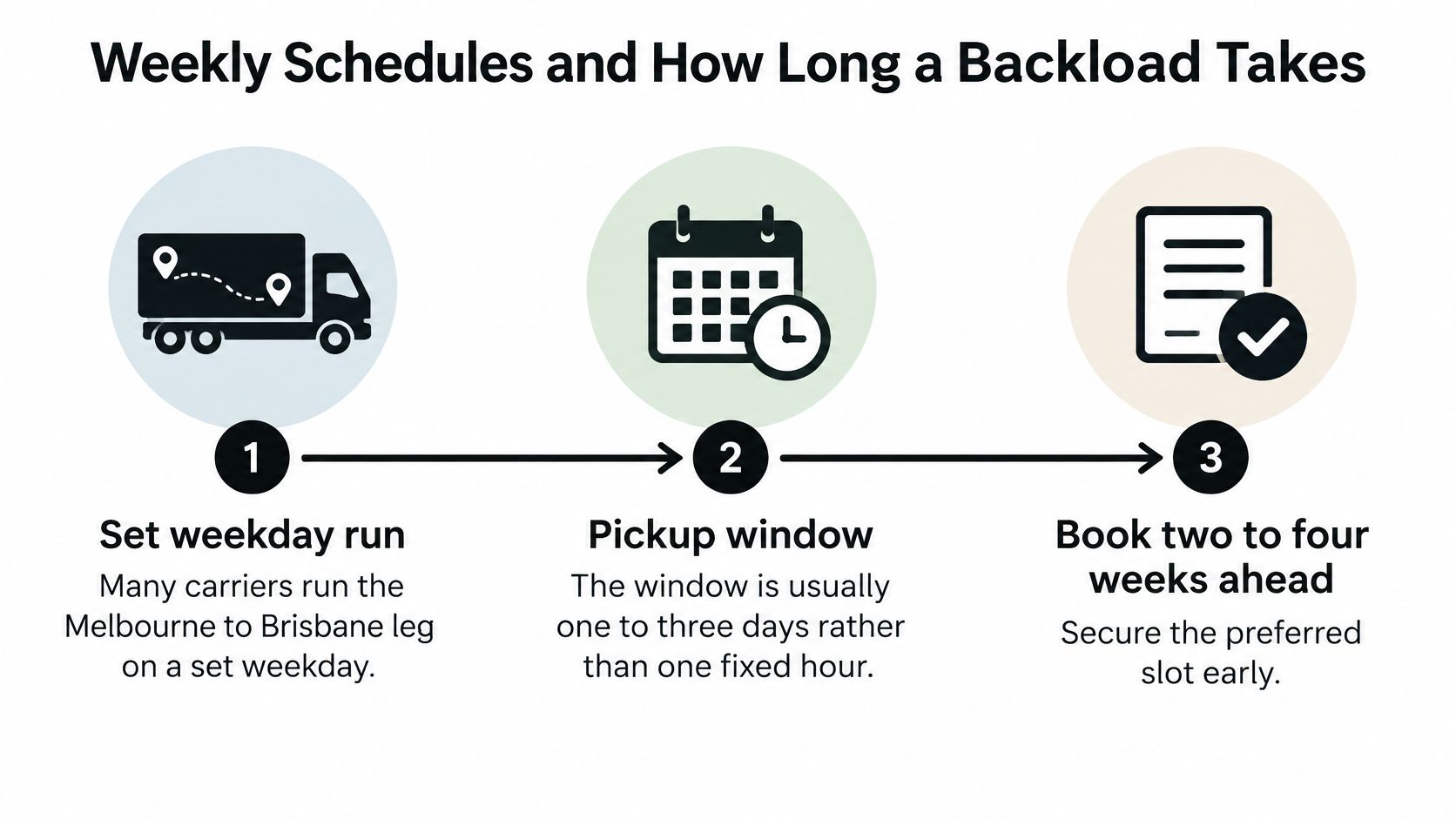
Use this timeline as a checklist for the scheduling conversation.
Build a calendar around the actual run
A hypothetical booking might look like this:
- Booking stage: Request space two to four weeks ahead, then obtain written acceptance of the inventory and proposed run.
- Collection stage: Allow a one-to-three-day pickup window rather than assuming a fixed arrival hour.
- Transport stage: A sample itinerary might allocate four to six days for transport, intermediate work and rest. That isn't a measure of continuous driving time.
- Delivery stage: Agree when the carrier will narrow the arrival window, such as a day or two before delivery.
These are planning examples, not a published timetable. Short-notice collection only works when suitable space, crew time and access align.
For a wider relocation plan, the Brisbane interstate removals information is a useful starting point for organising destination details.
Driver hours aren't negotiable
The National Heavy Vehicle Regulator's record-keeping requirements state that drivers of fatigue-regulated heavy vehicles operating more than 100 km from base under standard hours must carry and complete a National Driver Work Diary.
Loading, waiting and unloading must fit within compliant work and rest arrangements. A planner can't turn the road distance into a delivery promise without considering those activities.
For a lease handover or settlement, I would build a buffer beyond the quoted delivery window. In a hypothetical plan, that might mean allowing at least two additional days, while recognising that a buffer isn't a guarantee against disruption.
Don't make an irreversible property handover depend on an estimated arrival time.
If the Brisbane property isn't ready, agree whether secure storage is available, where it will be and who authorises release. Get the daily storage charge, handling fees and redelivery arrangements in writing.
Keep the delivery contact and building manager's details together when reviewing the moving arrangements.
Backloading or a Full-Load Truck Side by Side
| Criteria | Backloading | Full-load truck |
|---|---|---|
| Cost | Lower, because the truck is shared | Higher, because the truck is for your load only |
| Date flexibility | Limited to the carrier's run and pickup window | Set around your preferred dates |
| Transit speed | Usually slower, with possible stops for other loads | Usually faster, direct run |
| Handling points | More, with possible depot rehandling | Fewer, often a single load and unload |
| Damage exposure | Higher for fragile or heavy items without careful packing | Lower exposure to handling damage when transfers are avoided |
| Best suited to | Flexible dates, small to medium loads | Fixed settlement dates, large, fragile or valuable items |
Cost, control and handling
Cost comes first, but compare identical work. A shared-load quote that excludes packing, stairs or final delivery isn't directly comparable with an inclusive dedicated-truck price. Use the interstate moving cost guide to identify the charges that need itemising.
Control comes next. A dedicated vehicle can be planned around your dates and route, subject to lawful driving arrangements and road conditions. A backload needs to fit the existing schedule, so ask whether the quoted delivery window is an estimate or a contractual commitment.
Handling can outweigh the saving. A depot transfer creates another occasion to lift, position and secure furniture. Ask for the truck type, consolidation method, expected handling points and whether the interstate leg is direct.
Freight growth gives this decision broader context: the BITRE freight chapter records Infrastructure Australia projections of Melbourne road freight growth of 42% and Brisbane growth of 36% between 2024–25 and 2040.
Choose the service around the consequence of being late, not just the likelihood of arriving on time.
A flexible household with ordinary furniture is a good candidate for backloading. A fixed settlement, piano, large glass table or office that must reopen promptly can justify a dedicated vehicle and specialist handling.
Neither arrangement automatically proves a lower environmental impact. That requires a closer look at the actual journey.
Does Backloading Reduce Emissions
A shared truck only lowers the fuel burned per household if it removes running that would otherwise occur. Filling spare capacity on a truck already driving Melbourne to Brisbane can do exactly that. The benefit disappears when your booking adds a collection detour, a shuttle run or a second handling leg a direct job would never need.
Vehicle utilisation and total trip emissions are different measures. Utilisation describes how full the truck runs. Total emissions cover everything around the move, including extra driving and fuel burned while idling between drops. A fuller truck can still consume more fuel overall than a lighter one on a simpler route.
Ask for the operational details
The same questions that protect your schedule also reveal the journey behind an emissions claim:
- Truck type and capacity: the vehicle determines fuel use per trip, and a separate collection van adds its own running.
- Consolidation method: a depot transfer adds a leg a direct run avoids.
- Handling points: every unload, store and reload is fuel and time the "shared load" label hides.
- Planned route: a consignment that fits an existing direct run avoids the collection and delivery kilometres a diverted truck adds.
Legal driving hours push the same point. Required rest breaks decide where a loaded truck can stop, which is one reason consignments get staged through depots rather than driven straight through to Brisbane.
Before accepting a lower-impact claim, ask the carrier what options it offers and what each involves in practice, and read what it publishes rather than relying on the label. A page such as the operator's eco removals Melbourne description is a starting point for those questions, not proof that a particular trip emits less.
Decluttering before the inventory is finalised helps for a second reason: the planner can allocate space to the goods you are taking. Sell or donate usable items locally rather than paying to transport things you will discard after arrival.
Treat vague eco-friendly marketing without journey details as a claim, not evidence. Exact emissions savings require a defined comparison and a defensible calculation, and a carrier that cannot describe the route cannot describe the saving either.
Insurance, Packing and Access Checks
Start with insurance, before cartons are sealed or a deposit is paid. Public liability insurance and protection for your belongings aren't interchangeable, and an insurance certificate alone doesn't explain every exclusion.
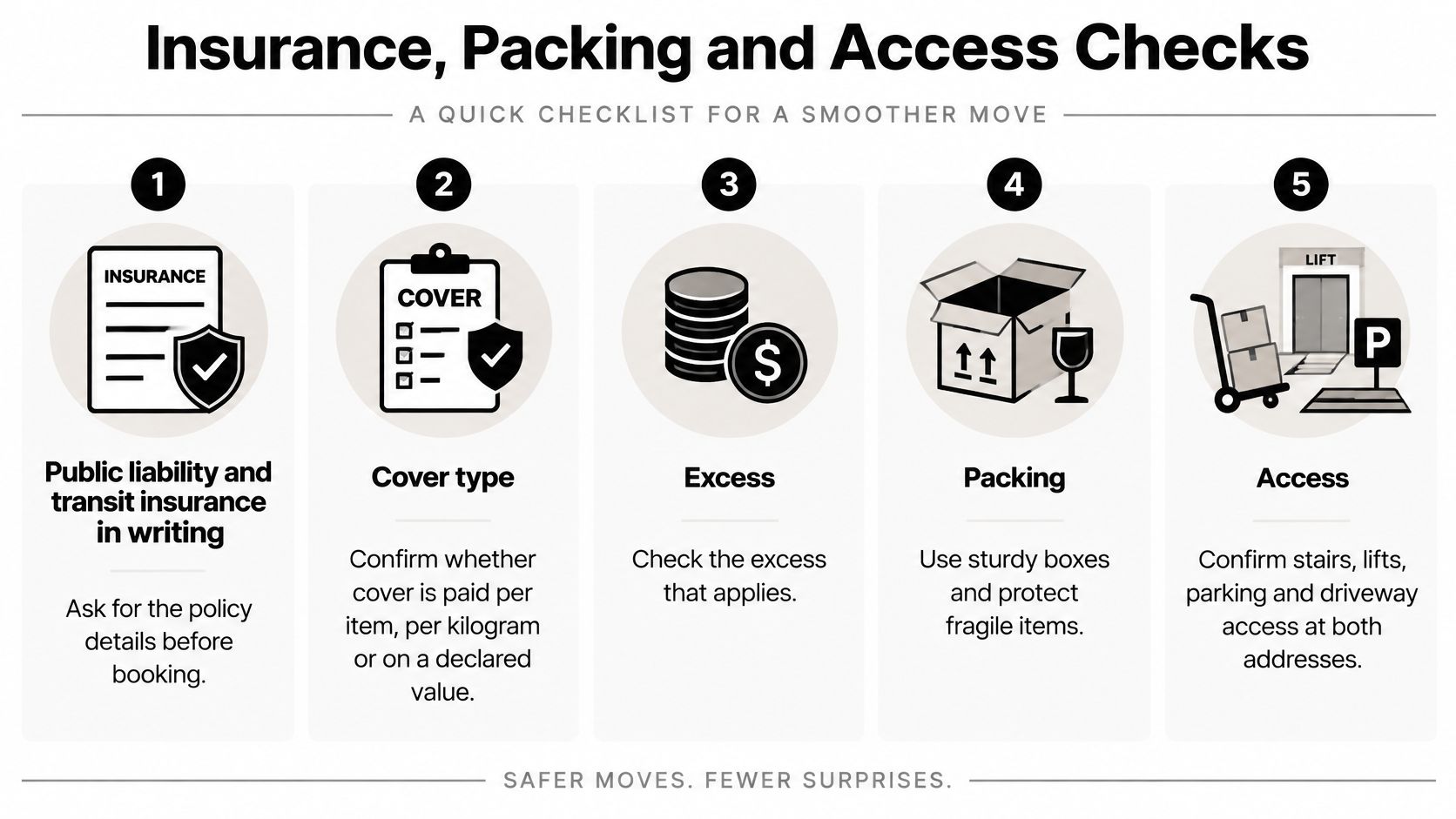
Use this checklist to gather the documents and property details that affect the move.
Protect the goods and the evidence
- Confirm the insurance basis. Obtain public liability and transit insurance details in writing, then establish whether settlement is assessed per item, by weight or against declared value.
- Check the excess, exclusions and claim notification requirements, including treatment of owner-packed cartons and goods held in storage.
- Create a condition record. Agree on a written inventory, identifiable furniture photographs and a delivery check before the crew leaves.
The goods-in-transit insurance information helps distinguish transport protection from general liability cover. Don't assume a home's contents policy automatically follows goods through every stage of an interstate move.
If a renovation delays access, Standby Self Storage's guide to insuring household belongings during renovations offers useful questions about storage cover. It's a UK resource, so confirm the applicable terms with your Australian insurer rather than treating it as local policy advice.
Pack for stacking and check the vehicle
- Use strong cartons and clear identification. Label each box with your surname and destination room, wrap fragile pieces separately, fill voids with packing paper and tape the carton base securely.
- Disassemble suitable beds and tables, bag their fittings and protect exposed corners; tell the crew about dense cartons of books, tools or files so they can position them safely rather than high in the load.
Vehicle capacity isn't just cubic space: the NHVR access guide describes general-access rigid trucks up to 12.5 metres long, 2.5 metres wide and 4.3 metres high, with a maximum mass of 31 tonnes, and certain combinations up to 20 metres and 43.5 tonnes, subject to conditions. Dense goods can reach a permitted mass limit before a truck is physically full, so the operator must also check payload, axle distribution and route access.
Finish with both properties. Send photographs of loading areas, narrow turns, stairs and lift entrances. Confirm loading-zone permission, lift reservations, building clearances and the carrying route from truck to door.
A smaller vehicle may solve a narrow-street problem but introduce a transfer. Disclose access restrictions before quoting so the planner can price the actual job.
Two-Bedroom Apartment to Brisbane
Consider a hypothetical renter moving a two-bedroom load from Melbourne's inner north to a Brisbane flat. Their new lease can start within a flexible window, and they can stay with family while the furniture travels.
Suppose the written backload quote is $1,450, while an equivalent dedicated-truck quote is $3,600. The difference is $2,150, provided both prices cover the same inventory, access and inclusions.
Those are example figures, not a current offer. The renter's decision turns on whether the flexibility needed to obtain that saving is manageable.
The inventory is ready and the essentials will travel separately.

The lift booking changes the conversation
The sample pickup window runs from Tuesday to Thursday. Collection takes place on Wednesday, and delivery is subsequently proposed for the following Monday, the sixth calendar day when collection day is counted.
Then the renter discovers that the Brisbane building only permits removals during a reserved morning slot. A broad delivery estimate won't secure access.
They send the building requirements to the planner and request written acceptance of a compatible delivery window. They also agree a buffer day with the landlord and establish what happens if the truck can't meet the lift reservation.
The apartment moving planning guide is useful for assembling those building details before the quote is accepted. A loading dock reservation should be treated as part of the transport plan, not an administrative task left until arrival.
What would change the choice
- No overlap between leases: If the renter must leave Melbourne and occupy the furnished Brisbane property immediately, they would favour a dedicated service with an agreed delivery commitment.
- Specialist furniture: A piano or large glass table would prompt a separate handling assessment, protective packing specification and potentially a dedicated vehicle.
- Unresolved building access: If the building won't accept the available delivery window, the renter needs another arrangement before collection.
The renter keeps medication, documents, chargers, work equipment and basic clothing with them. That prevents an ordinary scheduling change from becoming an immediate household problem.
The saving in this scenario is real arithmetic, but it is bought with flexible dates and a planned buffer. Without those conditions, the lower transport quote may not produce the cheaper move.
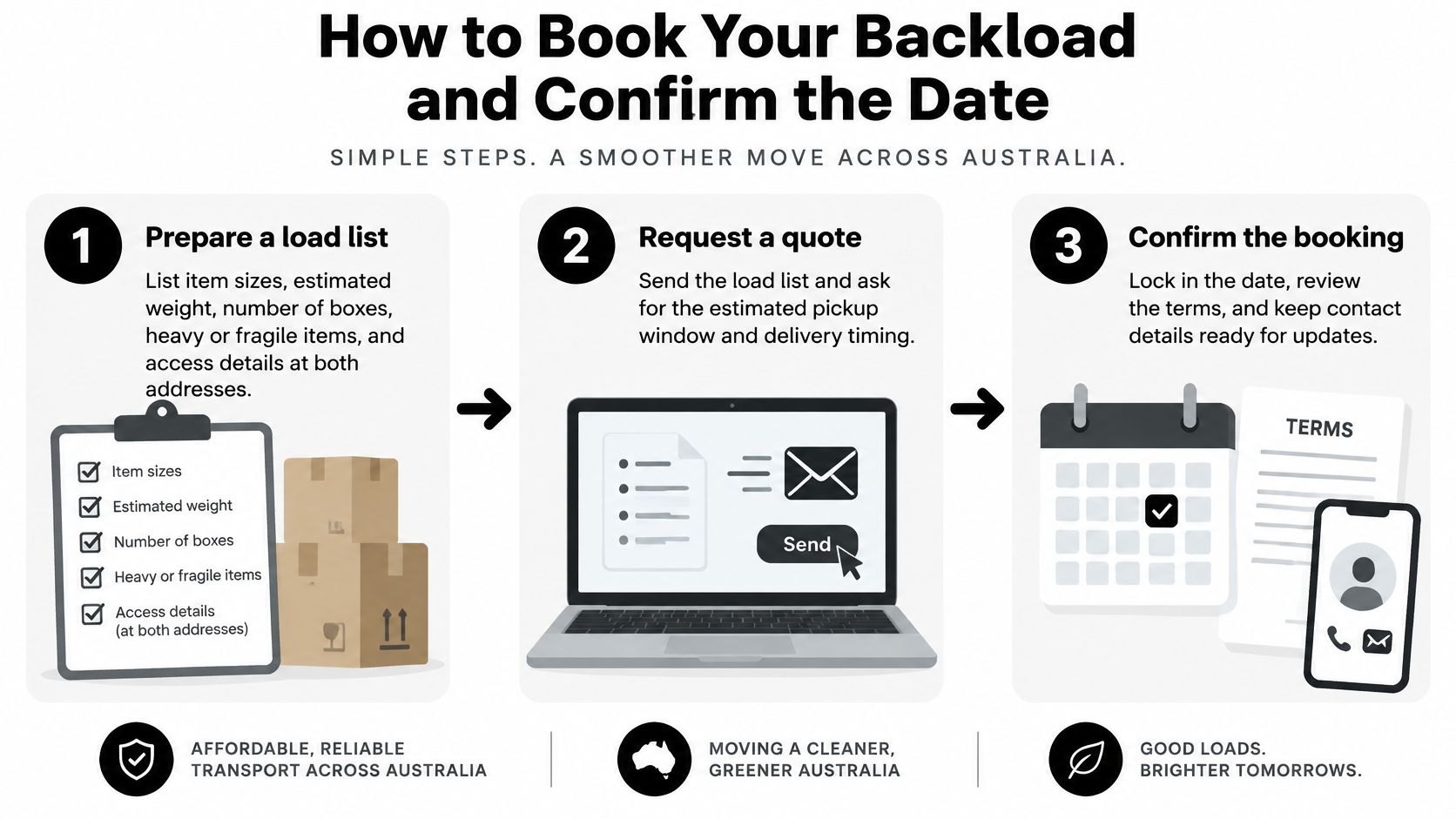
How to Book Your Backload and Confirm the Date
Make the booking specific enough that you and the planner can identify the same goods, addresses and service. “A small apartment sometime next month” isn't enough to reserve suitable capacity.
Use the booking process to turn an estimate into an agreed moving plan.
Get the scope and dates in writing
- Prepare the load list. Include furniture dimensions, estimated weights where known, box counts, heavy or fragile pieces, and photographs of access at both addresses.
- Request comparable written quotes using that same list, asking each carrier to identify the truck type, consolidation method and proposed run day.
- Confirm appropriate driver licensing. Victoria's heavy-vehicle licence guide requires a heavy-vehicle licence for a truck or bus above 4.5 tonnes GVM and advises checking destination-state licensing requirements when moving interstate.
- Agree the pickup window, transport estimate and delivery window in writing, including the approach to lift bookings and any deadline the carrier has expressly accepted.
- Review insurance and inventory arrangements. Check the certificate, relevant policy terms and process for recording condition at collection and delivery.
- Pay a deposit only after receiving written confirmation of the proposed run, the service inclusions and the cancellation or rescheduling terms.
- Reconfirm collection arrangements. Set a pre-collection contact checkpoint with the planner, check the arrival window and identify who will be available to grant access.
Resolve the exceptions before collection
Ask how extra items will be priced if the inventory changes. Also establish who approves additional charges and what happens if the allocated vehicle can't accommodate the final load.
For an office move, identify the equipment that must remain available until the business closes and what must arrive before staff return. Keep critical documents and securely backed-up business information under your own control.
We offer weekly interstate runs from Melbourne to Brisbane and Melbourne to Sydney, plus short-term and long-term secure storage in Melbourne. Ask us to confirm the current run dates and suitable storage arrangements against your inventory, rather than assuming storage can be added after the truck is loaded.
Before paying: Keep the accepted quote, inventory, access photographs and scheduling confirmation together so everyone works from the same agreement.
Send your load size, addresses and available date window for a written quote, then compare the complete price with the opening budgeting table before committing.
Get n Go Removals Melbourne offers weekly Melbourne-to-Brisbane interstate services and secure short-term and long-term storage in Melbourne. Visit Get n Go Removals Melbourne with your inventory and date window to request a written quote and confirm which run suits your move.