
Mel to Syd Removals: Costs, Timing and Booking
Mel to Syd is about 879 km by road, with passenger travel taking roughly 12 hours by coach and 12.5 hours by rail; for a removal truck, plan at least one extra day once loading, driver rest and Sydney access are included. Treat that allowance as a planning buffer, not a guaranteed delivery schedule.
You might already have the Melbourne keys due back, a Sydney lease starting and a building manager asking when to reserve the lift. The difficult part isn't choosing a highway route. It's making sure the truck, your keys and the destination access are ready together, without paying for avoidable waiting or another delivery attempt.
How Long a Mel to Syd Removal Takes
The inland Melbourne to Sydney corridor is approximately 879 km, with typical coach travel of 12 hours and rail travel of 12.5 hours, according to Tourism Australia's transport guide. Those passenger journey times are useful orientation, but they aren't furniture delivery commitments.
A removal starts before the truck reaches the highway and finishes after the last item reaches its room. Loading, protecting furniture, securing the load and completing the inventory all need their own place in the schedule.
Mel to Syd travel times by mode
| Mode | Typical duration | What it means for a removal |
|---|---|---|
| Passenger coach | About 12 hours | Scheduled travel only, not a removal timeframe |
| Passenger rail | About 12.5 hours | Scheduled travel only; freight is planned separately |
| Private car via Hume Highway | Allow about 9 to 10 hours driving as a planning estimate | Driving time only, excluding stops and breaks |
| Removal truck, line-haul | A scheduled driving leg with compliant rest periods | Load size, loading completion and arrival timing determine dispatch |
| Removal truck, door to door | Collection and delivery across separate planned service windows | Lift bookings, building access and the Sydney delivery window determine completion |
The car estimate isn't a suitable truck dispatch target. A household move that looks like a single day on a map can require collection and delivery on different days, particularly when either address has restricted access.
At the Melbourne end, a narrow street can prevent the truck from stopping beside the property. Stairs, a distant loading bay or furniture that won't fit through a doorway can extend loading before interstate travel even begins.
At the Sydney end, the truck may reach the suburb but still be unable to unload. A service lift, loading dock or concierge approval can control when the crew starts.
Build the schedule around the whole job
For fatigue-regulated heavy vehicles operating under standard hours 100 km or more from base, the National Heavy Vehicle Regulator's work diary guidance requires drivers to carry and complete a National Driver Work Diary, with an approved electronic alternative available. The dispatcher must therefore plan lawful work and rest, not just choose the shortest navigation estimate.
A direct run keeps your load together rather than routing it through transfer depots. That reduces unnecessary handling, but it works best when cartons and furniture are identified by customer, room and unloading sequence before departure.
Planning rule: Compare the collection window and delivery window with your actual key handovers, not just the journey shown on a map.
Use the Melbourne to Sydney distance guide to orient your travel plans, then confirm a separate door-to-door schedule. Keep room for the final delivery leg rather than booking every dependent appointment against the earliest possible arrival.
What Drives the Price of a Mel to Syd Move
Volume and crew time usually tell you more about a removal quote than distance alone. A lightly furnished apartment and a full household might use the same interstate corridor, but they don't require the same truck capacity, packing materials or labour.
The route establishes the line-haul component. Your inventory, access and service choices establish much of the remaining work, so no fixed per-kilometre figure reliably prices the whole move.
Cost drivers for a Mel to Syd removal
| Cost driver | How it changes the price | How to control it |
|---|---|---|
| Home size and volume | Larger loads need more truck capacity and crew hours | Declutter, sell or donate before the quote |
| Line-haul distance | The intercity corridor sets the main travel component; address-level travel still matters | Compare the full quote, not the line-haul rate alone |
| Access at origin and destination | Stairs, lift restrictions and long carries add crew time | Send access details and photos with the inventory |
| Parking distance | Longer carries and permit requirements add work | Arrange legal loading access before moving day |
| Packing and unpacking service | Adds labour and materials | Self-pack suitable items or book only the rooms needing help |
| Furniture disassembly and reassembly | Adds crew time at both ends | Identify beds, wardrobes and desks needing dismantling |
| Storage between dates | Adds storage fees and handling | Align settlement and delivery dates where practical |
| Timing and peak periods | Weekends, school holidays and month-end can reduce availability | Enquire early and keep acceptable dates flexible |
Compare the total job, not the headline
A low line-haul rate can become an expensive choice if the booking leaves no workable Sydney unloading window. Waiting time, storage, an additional crew visit or a redelivery can outweigh an apparent saving.
Check the inclusions in writing. Establish whether the price covers packing materials, dismantling, reassembly, stairs, long carries and the delivery conditions at your actual address. Clarify how changed inventory or unavailable access would be charged.
For an office move, include workstations, monitors, filing cabinets and equipment requiring specialist handling. Don't describe a room of assembled desks as a few office items, because that hides both volume and dismantling time.
A useful quote prices the job you actually have, including the awkward parts, rather than the easiest version of it.
Before requesting a quote, declutter, measure bulky furniture, and send a complete inventory with access photos. Photograph stair turns and loading approaches, not just the furniture.
This guide doesn't quote set interstate prices. Use the interstate moving costs guide to understand the components, then compare written quotes built from the same inventory, addresses and dates.
Packing, Insurance and Biosecurity Checks
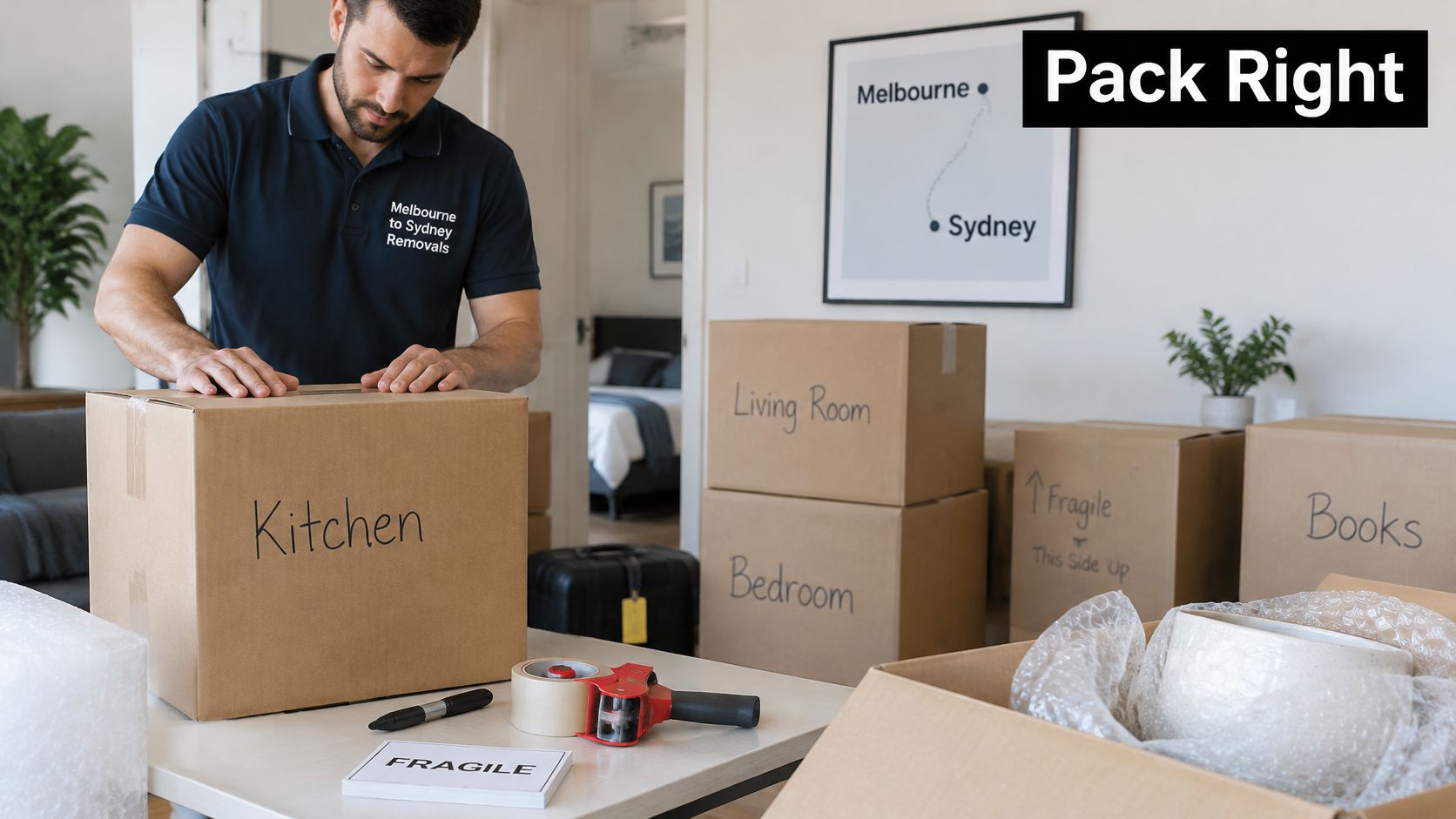
Pack for sustained road vibration, not just the lift from your front door to the truck. A loose ornament inside a half-empty carton can strike neighbouring items repeatedly, even when the carton itself stays upright.
Use sturdy removal cartons, reinforce their bases with packing tape and fill empty spaces with crumpled packing paper. Wrap fragile pieces individually and separate them with cushioning so glass, ceramic and polished surfaces can't rub together.
Protect furniture and record its condition
Keep heavy contents low inside cartons and use smaller boxes for dense items such as books. Wrap furniture with clean removal blankets, protect exposed corners and avoid sticking adhesive tape directly onto finished surfaces.
Put dismantled furniture fittings into labelled bags attached securely to the corresponding wrapped item. The loading crew should position heavy furniture low, restrain it with suitable rated equipment and isolate fragile pieces from pressure.
Take dated pickup photos showing existing marks, vulnerable corners and the condition of high-value pieces. Declare artwork, antiques and specialist equipment before loading so handling and cover can be clarified.
Check cover before the truck arrives
Transit insurance and public liability aren't interchangeable. Ask what cover applies during loading, road transport, storage and unloading, then check the excess, exclusions and any conditions affecting owner-packed cartons.
The goods-in-transit insurance guide can help you identify the questions to resolve. Don't assume that every cause of damage, every item or every stage of the move is automatically covered.
Keep jewellery, passports, important documents and medication with you. For business relocations, retain access credentials, essential records and backup devices separately from the general office load.
Separate restricted goods before packing
The Department of Agriculture, Fisheries and Forestry's domestic travel guidance identifies restrictions affecting produce, household potted plants such as fruit trees, and some animals when crossing state and quarantine borders. Check current requirements for your specific items rather than assuming ordinary household packing rules apply.
Restricted produce may need disposal in designated quarantine bins. Pets need their own suitable travel arrangements, not disposal or inclusion with furniture.
Before loading, complete this check:
- Cartons sealed: No open tops, protruding objects or loose contents.
- Furniture protected: Corners, finishes and detachable parts secured.
- Cover understood: Valuable items declared and policy conditions checked.
- Restricted goods separated: Plants, produce, garden items and pets assessed.
- Personal essentials retained: Medication, documents and valuables kept with you.
Storage Options When Your Dates Do Not Line Up
Your Melbourne settlement can finish before the Sydney property is available. A renovation, delayed handover or incomplete building approval can create the same problem even when both contracts originally looked aligned.
Storage gives you somewhere deliberate to put the load. The useful comparison is certainty versus handling, not the lowest advertised storage rate.
Storage options for interstate moves
| Option | Best for | Main trade-off |
|---|---|---|
| Short-term storage at origin | Melbourne settlement closes before the Sydney home is ready | Extra storage days if release timing isn't managed |
| Short-term storage at destination | Delayed settlement or building access in Sydney | Additional handling and a transfer to the property |
| Long-term storage | Renovations, overseas postings or unsettled plans | Ongoing cost and more planning for retrieval |
| Staged delivery from storage | Small Sydney home or apartment with limited space | More handling and a longer overall schedule |
| Direct delivery with no storage | Settlement and move-in dates align with the delivery window | Little slack if the truck or access runs late |
Storage at origin suits a move where the Sydney release date is still uncertain. Holding the furniture before dispatch avoids sending it towards an address that can't receive it, but you need a clear release process and confirmed onward capacity.
Storage at destination is useful when the interstate journey can proceed but the property handover can't. Confirm who arranges the final transfer, what notice is needed and whether the delivery crew will have the same inventory.
Choose retrieval arrangements before storing
Long-term storage needs more than a space reservation. Check protection from moisture, inventory records, access arrangements and how much notice is needed to retrieve furniture.
For staged delivery, identify the first batch before the load enters storage. Beds, essential seating and kitchen cartons should be retrievable without unpacking everything else; otherwise, a convenient staged move becomes an avoidable sorting job.
Storage decision: Put uncertainty into a planned storage arrangement, rather than leaving a loaded truck waiting for keys.
Direct delivery avoids storage handling, but matching calendar dates alone isn't enough. The property must be available throughout the agreed unloading window, with legal parking and building access ready.
Use the short-term storage in Melbourne guide to prepare your storage questions. Before choosing an option, mark each date as firm, provisional or flexible, and identify which belongings you'll need while the rest remain packed.
Booking the Sydney Delivery and Fixing Common Problems
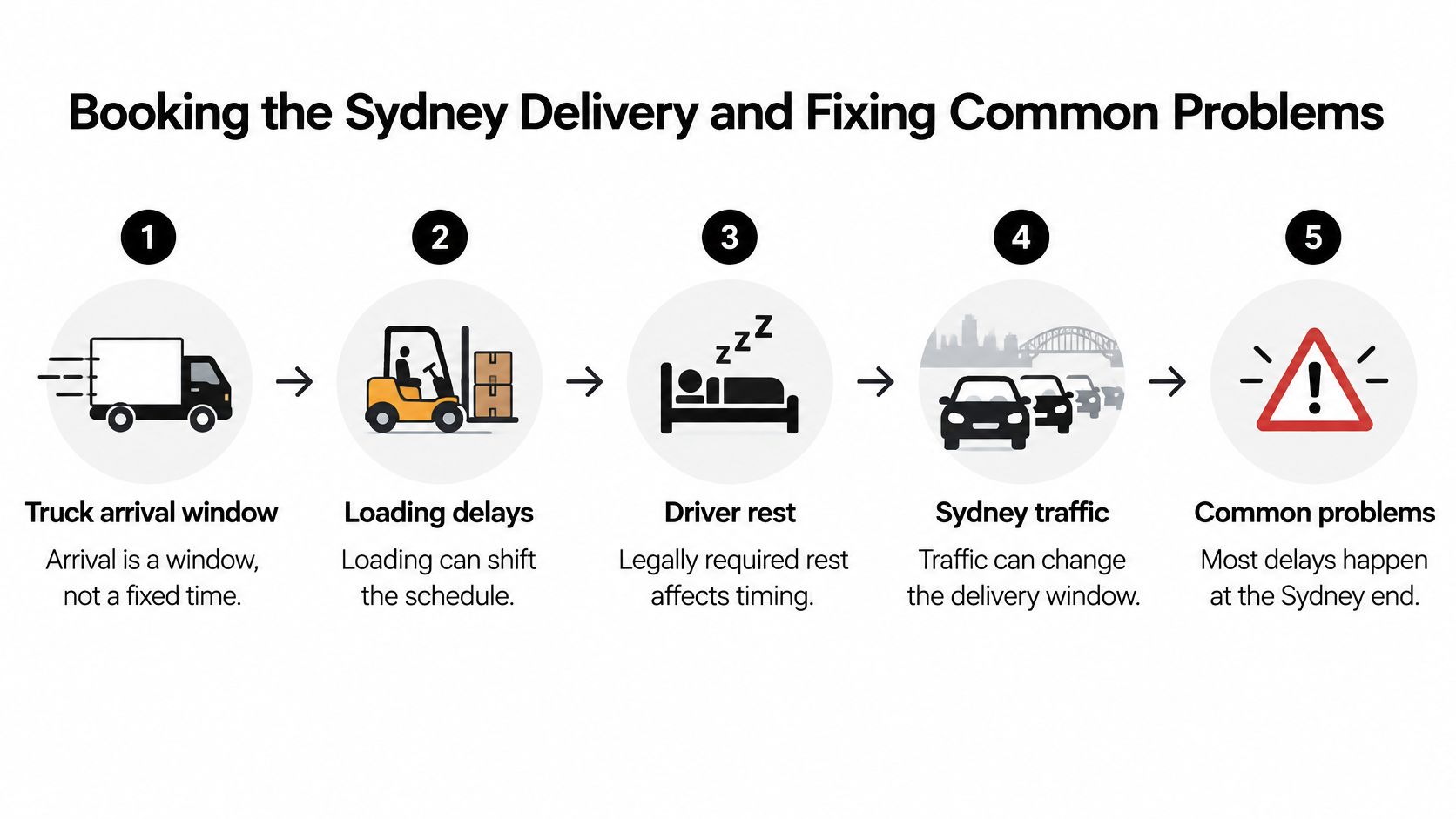
Book an arrival window, not an exact arrival time. Loading completion, driver rest and metropolitan traffic can move the schedule, while a missed Sydney building slot can prevent unloading even after the truck arrives.
The practical buffer should protect the handover you can't easily change. For an apartment, that's usually building access; for an office, it may be the period before staff need their workstations operating.
Arrange access before committing to the date
Confirm both addresses and their restrictions. Record stairs, lift dimensions, strata requirements, loading dock access and the carrying distance from legal parking. Include gate codes and the name of the person authorised to admit the crew.
Match the travel date to the available run and settlement. When considering a weekly direct service, confirm the collection window and proposed delivery window together. Don't assume a departure date automatically gives you a particular unloading appointment.
Reserve capacity early for constrained dates. For school holidays, month-end or summer, I would start enquiries six to eight weeks ahead as a planning recommendation, not a promise of availability. A fixed lease end or office shutdown gives you less room to accept alternative dates.
Label for unloading order. Give each carton a room destination and inventory identifier, and mark priority items clearly. For an office, use desk or department identifiers so equipment reaches the right workstation rather than a general pile.
Arrange permits and lift access. Confirm parking requirements with the relevant authority and reserve the service lift with the building manager. Check protective padding requirements, loading dock clearance and the process if the reserved slot is missed.
Protect the move-in with a buffer. For an apartment, I recommend at least one day between the expected delivery and any commitment that cannot move. Where the building offers only a narrow unloading slot, arrange an approved fallback rather than assuming the crew can wait outside.
Check official traffic information before dispatch. Ask the dispatcher to review the final approach as well as the highway route. Maintenance notices can change the usable ramps and streets near the destination.
Transport for NSW's disruption notices reported 2025 M4 and M7 restrictions, while Great Western Highway works included overnight closures, detours and a 40 km/h limit. Those examples show why an open interstate route doesn't guarantee an unobstructed final urban leg; they aren't a statement of current road conditions.
Match the contingency to the property
For a house, keep the driveway and entrance clear and make sure someone can receive the load throughout the window. Don't arrange another large delivery to occupy the same access.
For an apartment, ask the building manager what happens if the truck misses its booking. Get the alternative procedure agreed before collection, including whether another slot or temporary holding arrangement is possible.
For an office, separate furniture arrival from the deadline for staff to resume work. IT reconnection, workstation assembly and clear emergency exits need their own completion checks.
For event transport, work backwards from venue bump-in restrictions. A truck reaching the venue after the dock closes isn't a usable delivery.
Interstate removal problems, causes and fixes
| Problem | Usual cause | Fix |
|---|---|---|
| Truck arrives late in Sydney | Loading time, rest breaks and traffic | Build a buffer and check live traffic on dispatch day |
| No parking at the destination | Permit not arranged in advance | Apply for the permit before moving day |
| Lift unavailable at delivery | Lift not booked or building not notified | Book the lift and confirm with the building manager |
| Items damaged in transit | Poor wrapping or a loose load | Photograph items at pickup and report damage promptly |
| Items missing at delivery | Inventory not labelled clearly by room and item | Check every item against the labelled inventory before signing |
Photos support condition records; they don't prevent damage. Likewise, inventory checking helps identify shortages promptly, but careful identification and loading checks are the preventive work.
Use the interstate moving quote checklist to get access assumptions and delivery arrangements recorded. Decide which alternative delivery date remains workable if the truck runs late.
On delivery morning, confirm keys are available, parking is clear, the lift booking remains active, and the receiving contact is reachable. Keep the inventory ready, inspect accessible items and record any exceptions on the delivery paperwork before signing.
Lock In Your Melbourne to Sydney Move
Before requesting a booking, settle the decisions that change the job: the collection window, the Sydney delivery window, storage needs and packing scope. You don't need every household detail finalised, but you do need to identify what cannot move and what still might change.
A complete inventory lets the removalist allocate capacity and plan handling. Access photos reveal work that a room count misses, such as a steep driveway, restricted loading dock or wardrobe that needs dismantling.
Send a booking-ready move summary
Keep the information together so the quote and dispatch plan describe the same move:
- Move dates: Your preferred collection date, acceptable alternatives and key handover conditions.
- Both addresses: Include unit numbers, stairs, loading access and building contacts.
- Inventory: List furniture, cartons and specialist items, with dimensions for bulky pieces.
- Service scope: Identify packing, dismantling, reassembly and any storage requirement.
- Delivery conditions: State the lift slot, parking arrangements and the fallback if access changes.
Get n Go Removals Melbourne is a family-owned removalist with more than ten years of experience, and we've moved thousands of homes across Melbourne. We offer interstate removals with weekly runs from Melbourne to Sydney and Melbourne to Brisbane, alongside packing, furniture handling and storage options for moves that need them.
A weekly direct run can suit a planned relocation when the departure schedule and property access align. It shouldn't be treated as a substitute for confirming your individual delivery arrangements.
Make the delivery window part of the booking
Keep a copy of the agreed inventory and update it if you add furniture or change access. Make sure the receiving contact knows what the crew is delivering and has authority to resolve building-access questions.
Call 0403 559 241 with your move dates, both addresses and inventory. Ask for the delivery window to be written into the booking, together with the arrangements that apply if your Sydney property isn't ready.
Get n Go Removals Melbourne offers Melbourne to Sydney interstate moves, with packing and storage available when your relocation needs more than transport. Visit Get n Go Removals Melbourne to arrange a quote using your inventory, access details and preferred dates, and confirm a Sydney delivery window you can realistically work around.