
Household Movers Cost: A 2026 Melbourne Guide
You're probably looking around your place right now thinking the same thing many movers think before a move: Why do moving quotes seem so different, and what will I end up paying?
That confusion is normal. One quote sounds simple, another mentions stairs, travel time, depot fees, packing, access, or minimum hours, and suddenly the price feels harder to compare than the move itself. The tricky part is that most quotes aren't random. They're usually built from a small set of variables that affect labour time, truck use, and logistics.
If you understand those variables, the whole process gets easier. You stop guessing. You start spotting what's included, what's missing, and where your own preparation can lower the final bill.
Decoding Your Household Movers Cost
A common Melbourne move starts with a customer saying something like, “It's only a two-bedroom apartment, so it shouldn't be too much.” Then the details come out. There's basement parking. The lift needs a booking. The loading zone is around the corner. A storage cage has to be emptied. The new place has a narrow hallway and three flights of stairs.
Same furniture. Very different job.
That's why household movers cost can feel unpredictable until you know what the mover is measuring. It's not just the size of your home. It's the time, access, distance, and extras wrapped around it.
Residential moving is also a regular part of Australian life. The HILDA Survey shows 11.9% of people changed address in 2023, and renters were much more mobile at 27.2%, compared with 5.4% for owner-occupiers with a mortgage. That helps explain why apartment moves, rental turnover, and budget-focused relocations are such a large part of the Melbourne market, as noted in this overview of moving company costs and mobility trends.
For customers, the useful question isn't “What's the average moving price?” It's “What exactly makes my move take longer, need a bigger truck, or require more hands?”
Practical rule: A quote becomes clearer the moment you break it into labour, truck, access, and optional services.
If you want a local pricing reference before requesting quotes, a practical starting point is this guide to the cost of movers in Melbourne. It helps you compare what's usually included versus what may be added later.
How Professional Movers Calculate Your Bill
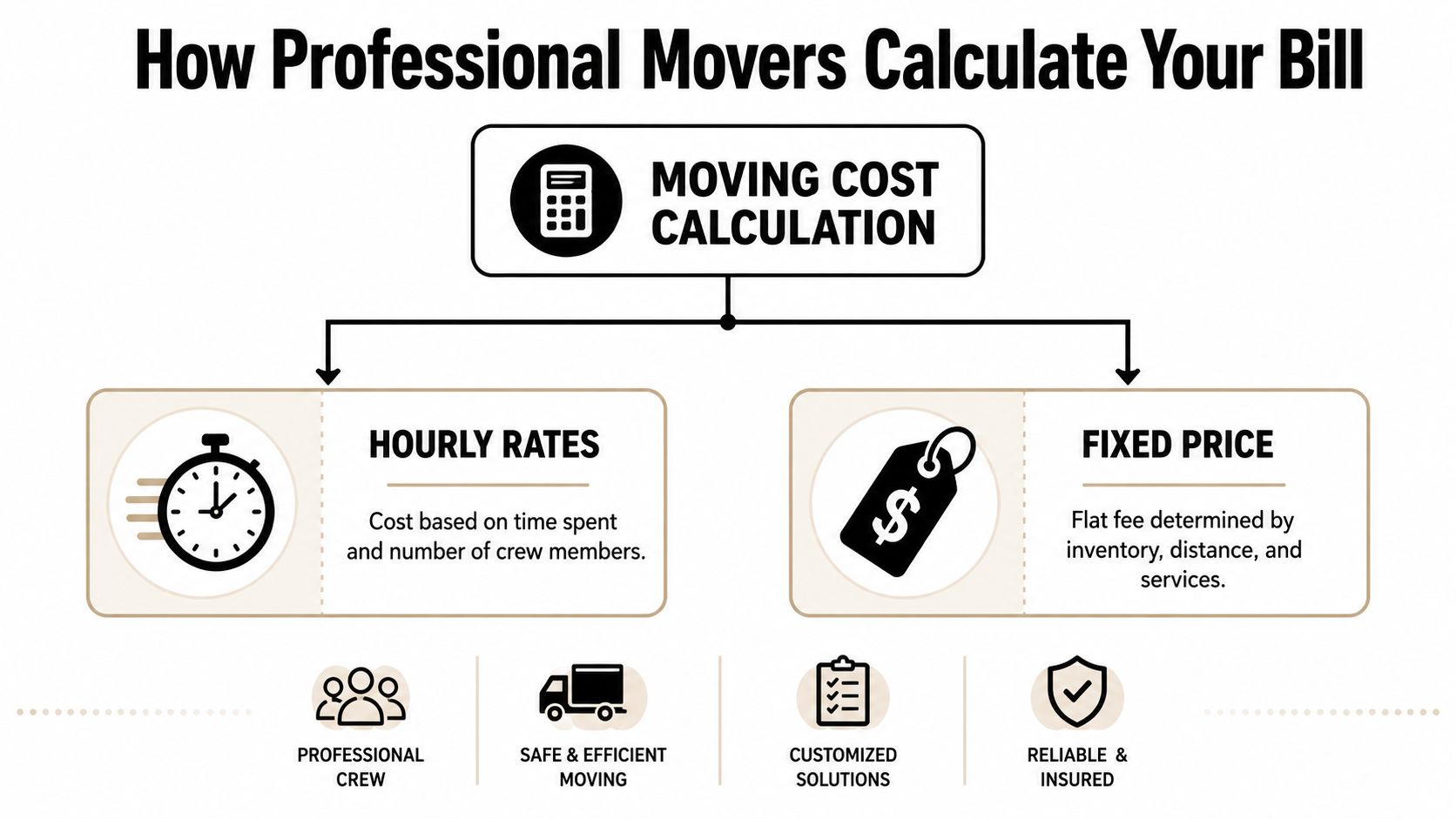
Most moving quotes fall into two pricing models. Once you know which one you're looking at, the rest of the quote makes far more sense.
Hourly pricing for local moves
For local jobs, movers usually charge by time. Picture it like hiring a car for city driving. You're paying for use over a period, not for crossing a state border.
That hourly structure is common because short-distance moves can vary wildly based on traffic, parking, stairs, lift waits, and how organised the home is when the crew arrives. A move with the same furniture load can finish smoothly at one address and drag out at another because the truck can't park close or the lift isn't available.
Industry calculators commonly frame local pricing at about $50 to $90 per mover per hour, especially for shorter-distance jobs where labour time is the core cost driver, according to this moving cost calculator reference.
Fixed pricing for interstate moves
Interstate work is different. It behaves more like a road trip than a quick suburban run. The mover needs to account for route planning, truck space, linehaul scheduling, and the size of the load over a much longer distance.
That's why interstate quotes are often fixed-price or based on a freight-style estimate rather than a simple hourly tally. The mover is pricing the job as a transport task with loading and unloading attached, not just a crew on the clock.
A useful customer reference for comparing formats is this explanation of moving company cost models.
Why prices change even when the service looks similar
Customers often ask why the same move seems dearer than it did before. The answer usually sits outside the lounge room.
The ABS Consumer Price Index rose 4.1% over the year to the June quarter 2024, with transport a significant contributor. That matters because moving businesses rely on fuel, vehicle maintenance, logistics, and labour. When those rise, quotes shift too, as noted in this summary of Australian CPI and moving cost pressures.
A moving quote isn't built in isolation. It sits inside the wider cost of running trucks, scheduling crews, and keeping transport moving.
The Key Factors That Drive Up Your Moving Cost
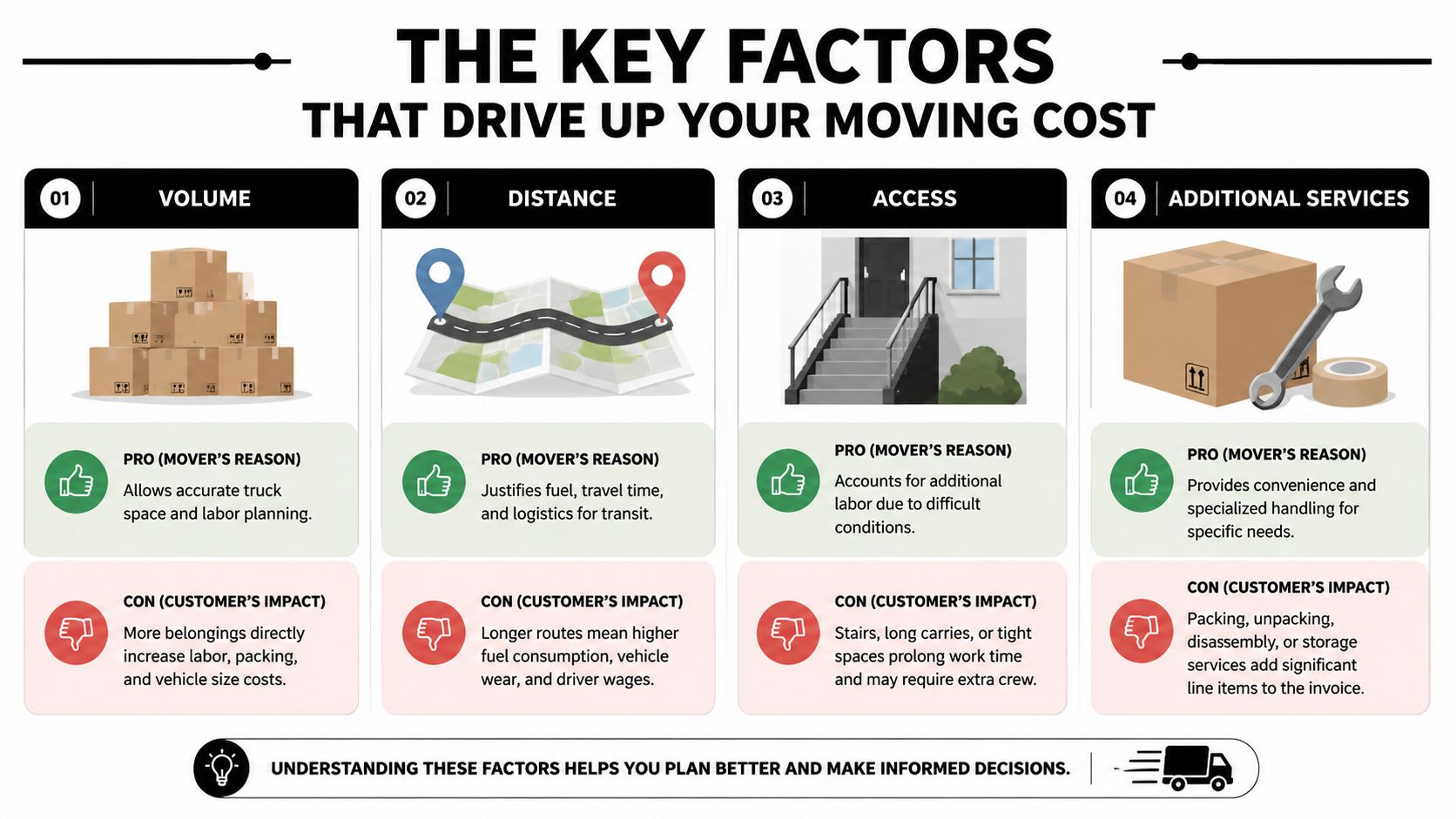
The final bill usually comes down to four moving parts. Volume, distance, access, and additional services. Customers tend to focus on the first two. In Melbourne, the hidden blowouts often sit in the other two.
Volume changes everything first
The amount you're moving shapes the truck size, the crew workload, and the loading plan. A home with lots of flat-pack furniture, books, garage items, or outdoor pieces can look modest on inspection but take far longer than expected once the truck is being packed.
Movers don't just count rooms. They assess what those rooms contain. A one-bedroom apartment with a study nook, balcony setting, and full storage cage often behaves more like a larger move than the customer expects.
Distance affects more than fuel
On local moves, distance often matters less than people assume because labour time can outweigh the drive itself. A short trip between suburbs can still be expensive if access is poor at both ends.
On interstate moves, distance becomes more important because transport logistics sit at the centre of the quote. That includes route planning, truck allocation, scheduling windows, and handling time at pickup and delivery.
Access is where many quotes go off track
This is the factor customers most often underestimate. Access means anything that slows the crew between the truck and your front door.
It includes:
- Stairs: Repeated stair carries add physical effort and slow each trip.
- Lifts: Waiting for a shared lift can chew through paid time quickly.
- Long carries: If the truck can't park close, every item takes longer to move.
- Tight spaces: Narrow corridors and awkward corners slow furniture handling.
- Driveway limits: If a large truck can't reach the property, the crew may have to shuttle items further.
For local moves, this matters directly because the clock is running. Movers typically charge about $50 to $90 per mover per hour, and access constraints like stairs, elevators, and long carries can materially increase labour time, as explained in this guide to hidden moving costs.
If a two-person crew loses an extra hour to lift delays, that isn't just “a bit of waiting.” It becomes an extra hour of billable labour across the whole crew.
Additional services are convenient but not invisible
Packing, unpacking, disassembly, reassembly, mattress wrapping, fragile-only packing, storage, and special item handling all add labour or materials. None of that is unreasonable. It just needs to be clearly shown before moving day.
A helpful way to think about extras is this. The truck gets your goods from A to B. Everything else changes how ready those goods are to travel.
A few examples make that clearer:
| Extra service | Why it affects cost |
|---|---|
| Packing service | Adds labour time and packing materials |
| Furniture disassembly | Takes time before loading can even begin |
| Reassembly at delivery | Extends the job after unloading |
| Storage | Adds handling, administration, and future redelivery steps |
| Fragile item preparation | Requires slower handling and protective materials |
Customers who want the cleanest quotes usually reduce surprises before the survey. A simple inventory, photos of access points, and clear notes about stairs or lift bookings often make a bigger difference than negotiating the rate later.
Sample Moving Costs in Melbourne and Interstate 2026
Price comparisons help, but they need context. A local move and an interstate move can't be judged by the same logic, even if the home size is similar.
Local jobs are usually time-driven. Interstate jobs are usually logistics-driven. That's why one move can feel flexible while the other feels more like freight planning.
Estimated moving costs from Melbourne 2026
The table below uses only the verified local hourly guide and qualitative interstate pricing logic. Local figures are shown as hourly-based indications, not total guaranteed quotes. Interstate entries are described qualitatively because a precise all-market benchmark wasn't provided in the verified data.
| Move Type | 1-2 Bedroom Home | 3-4 Bedroom Home |
|---|---|---|
| Local Melbourne move | Often calculated from $50 to $90 per mover per hour depending on crew size, time on site, and access conditions | Often calculated from $50 to $90 per mover per hour with longer loading times, more volume, and more likely truck or crew upgrades |
| Interstate move from Melbourne | Usually quoted as a fixed price based on inventory, distance, and logistics conditions | Usually quoted as a fixed price with stronger impact from volume, scheduling, linehaul space, and delivery requirements |
Why interstate quotes vary more
Interstate household movers cost doesn't move in a straight line with kilometres alone. Freight volatility can affect the final price in ways customers don't always see. Port handling charges, linehaul capacity, and demand pressure on the Melbourne, Sydney, and Brisbane corridor can all influence interstate pricing. That's why a fixed-price quote from an experienced interstate removalist can be valuable for budget certainty, as explained in this discussion of freight volatility and interstate moving costs.
That doesn't mean every fixed quote is automatically better. It means fixed pricing can protect you when the risk of delay or logistics changes sits outside your control.
How to benchmark a quote sensibly
A fair comparison isn't just “Which one is cheapest?” It's closer to this:
- Check the pricing model: Hourly and fixed quotes need different questions.
- Compare scope, not just price: Packing, travel, waiting time, and special items may or may not be included.
- Look at access assumptions: A quote based on easy parking will unravel if the truck ends up a long walk away.
- Ask how variations are handled: If conditions change, who decides the extra cost and when?
If your move is tied to a purchase or settlement, it also helps to understand the wider chain of relocation costs around property. This guide on understanding property investment costs Victoria gives useful context on the expenses that often sit around a move, not just inside it.
How to Accurately Estimate Your Move and Get a Firm Quote
The quality of your quote depends on the quality of the information you give. When customers are vague, movers have to guess. When movers have to guess, the quote usually becomes less useful.
The best quotes come from customers who treat the estimate like a checklist, not a quick phone call.

Start with a room by room inventory
Walk through the home one room at a time. Write down large furniture, whitegoods, boxed items, outdoor pieces, garage contents, and anything awkward or fragile.
Don't rely on memory. Customers regularly remember the sofa and forget the treadmill, the storage cage, the barbecue, or the pot plants.
A practical tool for this stage is a cubic metre calculator for moving volume. It helps turn a rough idea of “about a small apartment” into something more measurable.
Assess access like a mover would
Stand at the truck's likely parking point and trace the path into the property. Count stairs. Note lift access. Check whether building management requires bookings. Take photos of laneways, driveways, and any pinch points.
The same check should be done at the delivery address. Many inaccurate quotes happen because the pickup is straightforward and the drop-off isn't.
The mover doesn't bill for the shape of your furniture. They bill for the time and effort required to get that furniture through the actual path available.
Clarify what help you want
Some customers want transport only. Others want packing, bed dismantling, unpacking, or temporary storage. Those are different jobs.
A written quote works best when it answers these questions clearly:
- What is being moved?
- From where to where?
- What access issues exist at each end?
- What extra services are included?
- Is the quote estimated or firm?
If you're moving as part of a larger housing decision, this overview of financing a home build or purchase can help you think through the broader budgeting side at the same time.
For customers comparing providers, a virtual or in-person survey is often the cleanest way to remove guesswork. Get n Go Removals Melbourne, for example, offers quote-based moving services tied to inventory, access, and service scope rather than relying on a one-line estimate.
Smart Ways to Reduce Your Moving Bill
You can't control every part of a move, but you can control more than commonly realised. The cheapest move isn't always the one with the lowest hourly rate. It's usually the one that runs cleanly, with fewer delays and fewer add-ons.

Save time before the crew arrives
On hourly moves, readiness matters. If the crew arrives and you're still taping boxes, emptying drawers, or deciding what goes to storage, the paid time keeps running.
The simplest cost-cutting habits are often the most effective:
- Finish packing early: Have boxes sealed, labelled, and stacked safely before start time.
- Disconnect appliances in advance: Don't leave washing machine hoses or fridge shelving for the crew unless that service has been arranged.
- Clear pathways: Remove shoes, rugs, cords, and loose items that slow every trip in and out.
- Reserve access: Book the lift, secure loading access, and warn building management ahead of time.
Reduce volume with purpose
Decluttering helps, but random decluttering doesn't always save much. Focus on bulky, low-value items that take up truck space or handling time. Old outdoor settings, unused shelving, spare mattresses, half-empty storage cages, and flat-pack pieces that won't survive another move are the usual suspects.
A smaller, cleaner inventory also makes quotes more accurate because the mover isn't pricing around uncertainty.
For more practical ways to trim labour time and avoid add-ons, this guide shares tips to keep your moving costs down.
Choose timing carefully
Some dates are naturally busier. End-of-lease periods, weekends, and settlement-heavy days can tighten availability and reduce flexibility. If your dates are open, ask about quieter scheduling windows.
That doesn't guarantee a lower quote every time, but it often gives you more room to choose the service format that suits your budget.
A quick visual walkthrough can also help you avoid expensive oversights before moving day:
Small delays repeat. One extra minute per trip becomes a much bigger problem when the crew makes dozens of trips.
Your Checklist for an Accurate and Fair Moving Quote
By this point, the goal isn't to become a removalist. It's to become the kind of customer who can read a quote properly and catch the gaps before they become charges.
Many households are already under budget pressure, so an unexpected moving expense can hit hard. It's important to ask whether a quote is an all-in price or whether extras like stair carries, long carries, packing materials, storage, or weekend timing may be added later, as highlighted in this article on understanding all-in moving pricing.
Use this shortlist when you compare quotes:
- What pricing model applies: Is it hourly, fixed, or a mix of both?
- What exactly is included: Travel time, truck, labour, fuel-related charges, packing materials, and GST should be clear in writing.
- How access has been assessed: Has the mover allowed for stairs, lifts, restricted parking, or long carries?
- Which items need special handling: Pianos, pool tables, oversized fridges, glass tops, gym gear, and fragile pieces should be named, not assumed.
- What triggers extra charges: Waiting time, last-minute volume changes, difficult access, or storage delays should be spelled out.
- What cover is available: Ask what insurance or valuation options apply to the move.
- When the final price can change: If it's an estimate, ask how variations are approved and documented.
A fair quote shouldn't leave you decoding surprises on moving day. It should tell you, in plain language, what the mover expects the job to involve and what happens if those conditions change.
If you'd like a clear, written quote for your Melbourne or interstate move, Get n Go Removals Melbourne can assess your inventory, access, and service needs so you can budget with fewer surprises and make decisions with confidence.