
Crate Packing Services Explained for Melbourne Movers
You're in the week before a Melbourne move, and the boxes have started to expose their limits. The television needs more than a blanket, the glass cabinet won't safely pass through a narrow Richmond staircase, and the office server rack has to leave a Docklands tenancy without taking a knock. A piano, marble table, antique mirror, or commercial machine can turn an ordinary move into a damage-control exercise.
That's where crate packing services earn their place. They aren't an automatic upgrade for every household item. They're a risk-reduction decision for objects that are heavy, fragile, unusually shaped, expensive, or difficult to handle through apartment access points. You can still pack books, linen, and everyday kitchenware in cartons, but the items that can't tolerate impact or movement deserve a more deliberate system. If you're still sourcing ordinary cartons, this guide to where to find moving boxes will help you separate general packing from specialist protection.
The Week Most Melbourne Movers Realise Boxes Are Not Enough
The warning sign usually appears during a pre-move sort. You lift a box of books and feel the bottom flex. You wrap a framed artwork in an old towel and realise the corners remain exposed. Then someone suggests carrying the glass cabinet down the stairs, and everyone pauses because nobody has a proper answer for how the doors, shelves, and frame will stay together.
A standard carton works well when the contents are compact, reasonably light, and tolerant of ordinary handling. It becomes the wrong tool when the item has a concentrated weight, delicate surfaces, exposed corners, moving parts, or a shape that leaves large empty spaces around it. Filling that space with loose paper doesn't immobilise a valuable object. It only creates the appearance of protection.
Decide by consequence, not by room
Start with the items that would be difficult or costly to replace. For a home, that might include a marble dining table, a piano, a designer cabinet, a large mirror, or a television. For a small business, it could be a server rack, medical equipment, display cases, artwork, or machinery with sensitive components.
Use this quick test:
- Weight: Can two people safely lift the item without the packaging twisting or collapsing?
- Fragility: Would vibration, a corner impact, or pressure from another item cause damage?
- Shape: Does the item have an irregular profile that a carton can't hold securely?
- Value: Would replacing or repairing it cost more than building suitable protection?
- Access: Will it travel through a lift, stairwell, loading dock, or narrow corridor?
If an item fails several of those tests, don't treat it as a large box. Treat it as a load that needs a designed enclosure.
Practical rule: Pack the ordinary belongings economically, but engineer protection around the items that can ruin the move.
This guide is for Melbourne homeowners, renters, apartment residents, office managers, and small business operators who need a clear answer rather than a sales pitch. You'll learn what a crate does, when cardboard remains sensible, how a professional job runs, which quote details matter, and how lift bookings and road restraint affect the packing plan. The central point is simple: crating controls risk before the item reaches the truck.
What Crate Packing Services Actually Do
A purpose-built crate is more than a timber shell. The provider first creates a stable base, then protects the item from direct contact with the crate walls and limits movement inside the enclosure. Depending on the object, that can involve blocking, internal bracing, foam cushioning, suspension, wrapping, bolting, or tie-down points.
Take a marble dining table. A carton can cover the surface, but it won't reliably stop the stone from shifting or spreading its weight into a weak panel. A proper crate can support the load through a reinforced base, protect the edges with shaped padding, and use blocking so the table can't slide when the crate is moved or loaded.
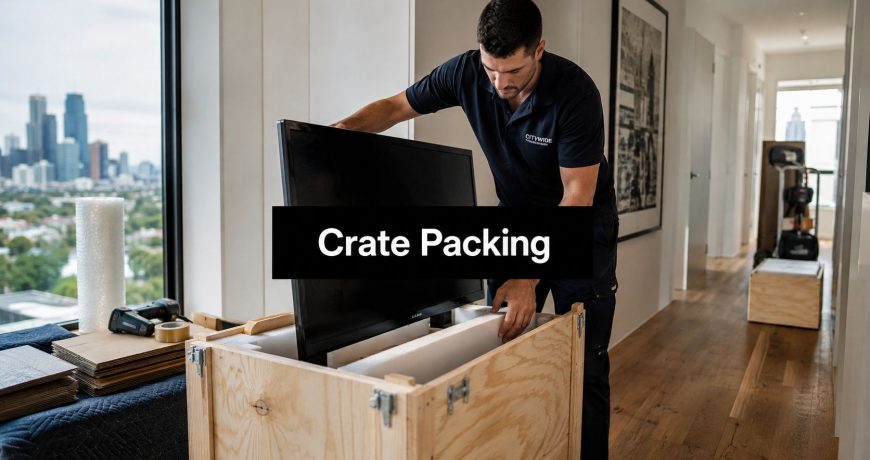
A flat-screen TV needs a different approach. The screen requires separation from pressure, the corners need impact protection, and the crate should prevent the television from leaning against a hard surface. The packing team should document the condition, protect the face, cushion the perimeter, and build a snug internal fit rather than just wrapping the unit and filling a large crate with loose material.
Custom crates and modular programmes
A custom crate is built for one object or one tightly defined group of items. It suits a piano, sculpture, oversized cabinet, machine, or a single high-value piece with unusual dimensions. The design follows the item's weight, centre of gravity, handling points, and route through the property.
A modular crate programme uses repeatable crate sizes, standardised internal protection, and consistent labels across a larger move. That approach works well for offices, galleries, multi-room relocations, and multi-drop freight because the team can identify, stack, handle, and inventory units consistently.
The crate must also match the way the object will be handled. A team should know whether it will be lifted by hand, moved with equipment, loaded onto a truck, placed in storage, or transferred between vehicles. A sound enclosure can still fail if nobody plans for the next handling stage.
Where valet packing fits
White-glove or valet packing overlaps with crating, but the services aren't identical. Valet packing covers the careful preparation of a broader move, including wrapping, carton packing, labelling, furniture protection, and unpacking. Crating focuses on the items that need a rigid, immobilising structure.
A provider that can handle both can keep the decision in one workflow. Everyday possessions go into correctly packed cartons, while the piano, artwork, marble table, or server rack receives specialist treatment. That coordinated approach is usually cleaner than asking one team to pack boxes and another to improvise protection around the difficult items. You can compare the wider advantages of specialist help in this guide to professional packing services.
Crate Packing vs Cardboard Boxes vs DIY
There isn't one correct packing method for an entire move. The sensible answer is usually a mixed system, with cartons for tolerant items and crates for objects where movement, impact, or compression creates a serious loss.
Cardboard wins on convenience. It's light, easy to label, and suitable for books, linen, clothing, pantry goods, and many non-breakable household items. It also makes unpacking straightforward because you can open a room's cartons in sequence without dismantling a timber enclosure.
A crate wins on structural protection. It provides a rigid barrier and gives the packing team somewhere to install blocking, bracing, and fixed supports. DIY can work for low-risk contents, but it becomes unreliable when the owner doesn't know how to distribute weight, isolate fragile surfaces, or secure an object against movement.
Compare the real decision points
| Criterion | Crate packing | Cardboard boxes | DIY packing |
|---|---|---|---|
| Protection | Strong choice for heavy, fragile, high-value, and irregular items | Suitable for stable, lighter contents | Depends on materials, technique, and available time |
| Packing speed | Efficient for planned specialist items, but requires assessment and construction | Fast for ordinary belongings | Often slower than expected because materials and decisions are improvised |
| Total cost | Higher upfront cost, with protection designed around the item | Lower material cost for everyday contents | May appear cheapest, but breakage and replacement can change the result |
| Settlement-week stress | Reduces decisions around the most vulnerable items | Keeps routine packing manageable | Leaves the owner responsible for every packing and handling choice |
The key legal and practical issue is movement during transport. Australian load-unitisation guidance requires professional packing to account for prescribed transport forces of up to 0.8g forward, 0.5g rearward and sideways, and 0.2g upward, as set out in the NHVR Load Restraint Guide. That doesn't mean every household possession needs a timber crate. It does mean heavy freight needs a system that combines the packaging structure with blocking, strapping, or containment.
A carton protects an object from ordinary contact. A crate is designed to keep the object in position.
DIY packing still makes sense when you're dealing with books, towels, clothing, soft furnishings, and sturdy kitchenware. Keep cartons small enough to lift, don't mix dense items with fragile ones, and avoid putting a valuable object into a box just because the box is available.
For people considering storage alongside a move, it can also help to understand flexible storage unit alternatives, especially when a property settlement, renovation, or delayed handover changes the timing. Storage doesn't replace proper packing, but it can reduce rushed transfers and unnecessary double handling.
How a Professional Crate Packing Job Actually Runs
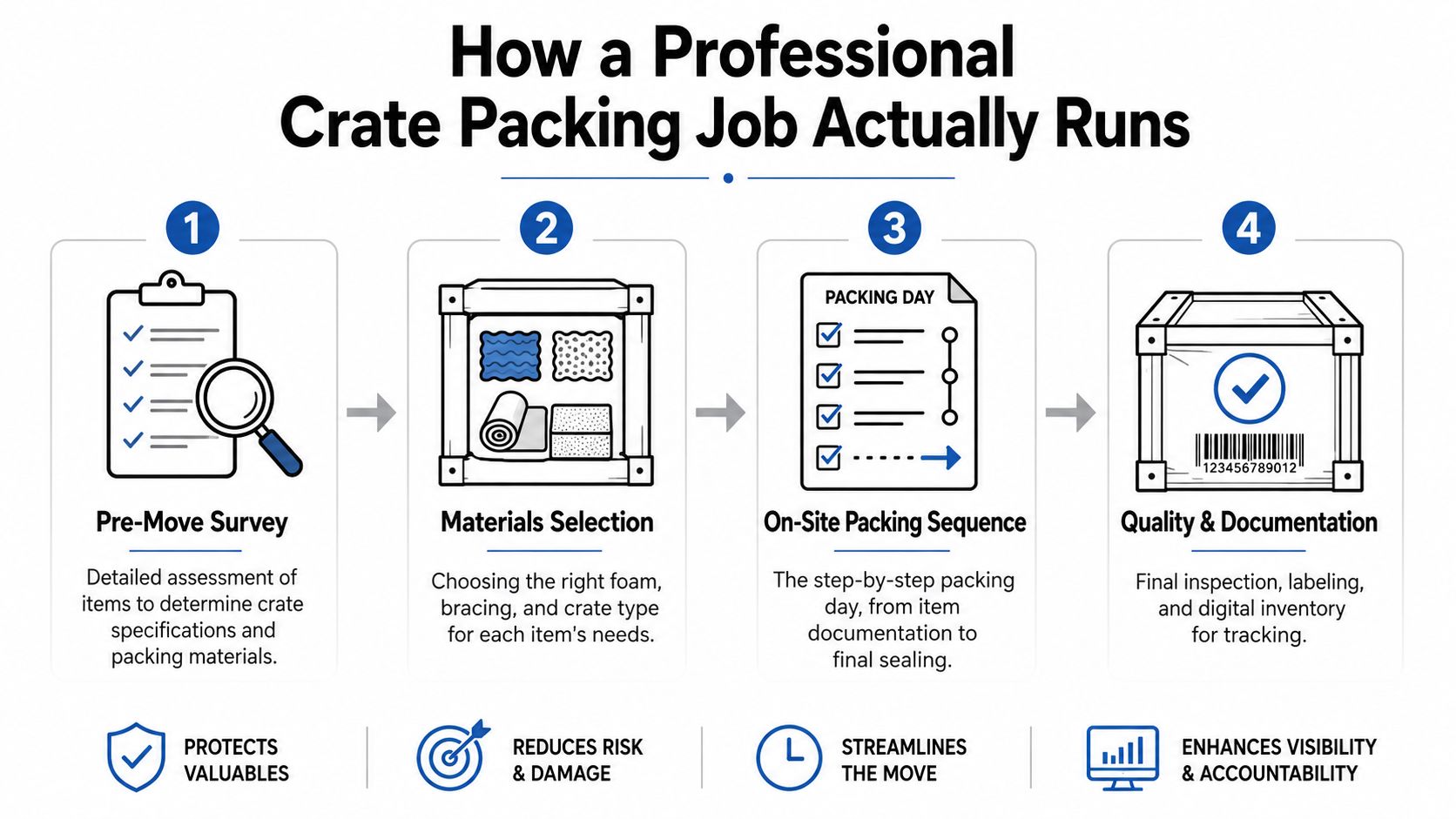
A good crating job starts before timber arrives. The provider should inspect the item, the room, and the route it must travel. That means looking at door clearances, stair turns, lift dimensions, loading areas, floor protection, and the point where the crate will meet the removal truck.
The survey should answer practical questions. What does the item weigh? Where is its centre of gravity? Can it be lifted safely? Which surfaces need isolation? Will the crate travel directly to the destination, go into storage, or be transferred between vehicles?
The decisions behind the materials
The team should match the crate size to the item rather than choosing a large enclosure and filling it with random material. Oversized internal space gives the load room to gain momentum. Foam density should reflect the object's weight and sensitivity, while bracing should control the directions in which the item might shift.
For export-adjacent or international freight, ask whether the timber requires the appropriate treatment and marking. ISPM 15 applies to solid wood packaging material such as pallets, boxes, cases, and blocks, and its purpose is phytosanitary treatment and marking, as described in Australian guidance on shipping regulations.
The packing sequence
On the day, the team should document the item's condition before covering it. They'll prepare the base, protect exposed surfaces, place the object, add internal supports, and test whether it can move inside the enclosure. For a heavy or irregular item, the contents may be tied down, bolted, or blocked so the crate carries the load without allowing internal movement.
The crate then receives clear identification. Labels should connect the physical unit to an inventory, handling instructions, orientation marks, and any relevant destination information. The provider should also protect the crate during the period between sealing and truck loading, particularly if the move involves a shared loading zone or staged collection.
A single point of contact across packing and removals prevents handoff errors. The person who knows why a crate has a particular lifting face or orientation should be available when the removal crew loads it. For a broader moving team, see the Melbourne movers and packers service and ask how specialist crates fit into the complete move plan.
The final check should confirm that the crate is closed securely, the item is immobilised, the labels are legible, and the inventory matches what the crew is taking.
What Drives the Price of Crate Packing Services
A crate quote reflects more than the timber. The provider is pricing the design, labour, packing materials, access conditions, handling, documentation, and responsibility for getting a vulnerable item ready for transport.
The largest cost drivers are usually the number of crates, their dimensions, whether each enclosure is custom-built, the internal protection required, and how difficult it is to work at the property. A crate built around a piano or machine takes a different amount of planning from a modular enclosure for compact office equipment.
Access changes the job quickly. A street-level warehouse with a loading dock is straightforward. A Melbourne apartment with a tight service lift, booked loading zone, protective floor requirements, and a long carry to the truck requires more coordination even if the item itself is uncomplicated.
How to sanity-check a quote
Ask for the quote to separate these elements:
- Crate construction: Does the price include the base, frame, lid, hardware, and internal supports?
- Protective materials: Are foam, corner protection, wrapping, moisture barriers, or other materials included?
- Handling: Does the crew move the item into position, or does another contractor do that?
- Access: Has the provider allowed for stairs, lifts, narrow corridors, loading docks, and building rules?
- Destination work: Is unpacking, crate opening, debris removal, and item placement included?
- Insurance: What cover applies during packing, loading, transport, storage, and unpacking?
Two quotes can differ substantially without either provider making a mistake. One may include a custom build and destination unpacking, while another may price only a carton, basic wrap, and transport. Compare the scope, not just the total. The wider cost of movers can also help you understand which parts of a moving estimate sit outside specialist packing.
| Item Type | Recommended Packing | Why It Matters |
|---|---|---|
| Marble dining table | Custom crate with reinforced base, edge protection, and blocking | Concentrated weight and brittle surfaces need support without pressure points |
| Flat-screen TV | Fitted protective wrap and rigid crate | Prevents screen pressure, corner impacts, and internal movement |
| Piano | Specialist handling with a purpose-built protective enclosure | Weight, finish, shape, and centre of gravity make improvised cartons unsuitable |
| Server rack | Custom crate or engineered transport enclosure | Protects sensitive equipment and keeps the unit stable through handling |
| Books and linen | Appropriately sized cardboard cartons | These items are generally tolerant of standard carton packing |
My rule is direct: if the item is worth more than the crate that protects it, the crate is usually the bargain. Don't accept a carton-only quote for a fragile object because it looks cheaper at first glance.
Insurance, Load Restraint and What to Ask Before You Sign
Packing quality and insurance are separate controls. Insurance may help after damage occurs, but it doesn't make an unstable load safe, and it won't necessarily cover every condition, exclusion, pre-existing mark, or packing decision.
Australian road transport guidance requires a load to remain secure under defined transport forces. Heavy freight can't rely on stretch or shrink wrap alone, because wrap is generally a unitisation aid rather than a complete restraint system. A crate can form part of the protection and restraint strategy, but the crew still needs to secure the crate and the overall load correctly.
Ask the provider to explain the complete chain:
- Who is responsible for the item while it's being packed?
- What insurance applies during packing, loading, transport, storage, and unpacking?
- What exclusions apply to owner-packed cartons or pre-existing damage?
- How will the item's condition be recorded?
- Will the crate be listed on an inventory with a readable identifier?
- Who checks the crate and load restraint before departure?
- What happens if the crate doesn't fit the booked lift or loading area?
- Who opens the crate at the destination, and who removes the packing waste?
The restraint question matters
The NHVR framework is practical, not theoretical. During braking, cornering, vibration, and changes in road surface, the crate and its contents experience forces in different directions. The internal supports need to stop the item moving, while the external restraint needs to stop the transport unit shifting.
For light vehicles and other road transport situations, restraint equipment must be fit for purpose, in good working order, and matched to the load capacity under the applicable framework. Ask what equipment the crew will use and whether the packing plan identifies the intended lifting and restraint points.
The packaging-services sector is substantial, with an estimated market size of A$3.8 billion in 2026, 1,044 businesses, and 11,962 people employed in 2024, according to APCO's Australian packaging consumption and recovery data. That scale gives customers choice, but it also means you need to distinguish a proper packing plan from a vague promise that an item will be “wrapped securely”.
If a provider can't explain what stops the item moving, what cover applies, and how the crate will be handled, the quote isn't complete.
Melbourne and Interstate Moves Made Practical
Melbourne apartment access can decide the crate before the packing team decides the timber. Many buildings require lift bookings lasting 2 to 4 hours, arranged 7 to 14 days ahead, and may require common-area protection plus a refundable bond of $200 to $500, as outlined in Melbourne CBD apartment relocation guidance. Confirm those rules before measuring the crate, because a technically sound enclosure is useless if it can't enter the service lift.
Ask building management about internal lift dimensions, door width, weight restrictions, padding, loading-bay access, rubbish removal, and permitted move windows. A crate that fits the apartment doorway may still fail at the lift entrance or in a tight basement corridor. Pack large items in a way that supports vertical or angled handling only when the crate design allows it.
Three common Melbourne scenarios
- Inner-city apartments: Book the lift first, then confirm crate dimensions and weight with the provider. Reserve the loading area and arrange floor and wall protection.
- Suburban homes: Inspect driveways, gates, stairs, verandas, and low clearances. The packing plan should account for the distance between the room and truck.
- Interstate relocations: Melbourne to Sydney or Brisbane adds a longer road journey and more handling points. Use a sealed, immobilised packing system and confirm whether the provider manages direct transport, storage, or transfers.
For households travelling with animals, pet logistics can become a separate project from the household freight. If an interstate move connects with overseas travel, this pet export paperwork help can help you organise the documentation while the moving team focuses on the physical load.
Apartment moves often fail on access planning, not on the first layer of packing. A provider familiar with strata requirements, settlement deadlines, loading zones, and east-coast routes can remove more risk by coordinating the day properly than by adding unnecessary material to every carton.
Your Crate Packing Checklist and Smart Next Step
Three assumptions cause most packing trouble:
- “Every item needs a crate.” No. Use cartons for books, linen, clothing, and heavy-duty everyday goods. Reserve crates for heavy, fragile, valuable, or awkward items.
- “A thick layer of wrap is enough.” No. Wrap protects surfaces, but it doesn't immobilise a heavy load or replace proper restraint.
- “The building can sort out access on moving day.” No. Confirm the lift, loading area, protective requirements, bond, and move window before the packing plan is finalised.
Use this checklist:
- Identify the items that need crates.
- Photograph condition before packing.
- Confirm crate dimensions against doors, stairs, and service lifts.
- Ask for internal blocking, bracing, cushioning, and tie-down details.
- Confirm insurance exclusions and responsibility during packing.
- Request an inventory and clear crate labels.
- Keep ordinary cartons small, stable, and correctly marked.
- Finish access bookings and clear corridors before the crew arrives.
- Keep keys, building contacts, medication, documents, and essentials out of the truck.
- Use this practical moving house checklist for Australia to cover the remaining tasks, and review a first home essentials guide if you're moving into your first property.
For Melbourne customers, Get n Go Removals Melbourne offers police-checked staff, valet packing, specialist handling for pianos and pool tables, a company-owned fleet, and weekly direct runs to Sydney and Brisbane. Ask for a packing assessment that separates ordinary carton work from the specific items that need engineered protection.
Get n Go Removals Melbourne can coordinate valet packing, specialist item handling, transport, and storage around your lift booking or settlement timetable. Visit Get n Go Removals Melbourne to request a clear moving and crate-packing assessment before moving day.