Apartment Removalists Brisbane How to Choose and Prepare
You've found the apartment, agreed on the handover date, and booked the lift. Then the building manager mentions a restricted loading bay, the truck can't clear the entry, and your access window starts shrinking. In Brisbane, an apartment move can go wrong before the first box leaves the old unit.
The right apartment removalists Brisbane service does more than carry furniture. It coordinates service lifts, loading zones, parking restrictions, protection for common areas, stairs, narrow corridors and the timing of settlement or tenancy handover. This guide explains how to choose a suitable crew and prepare your building so move day stays controlled.
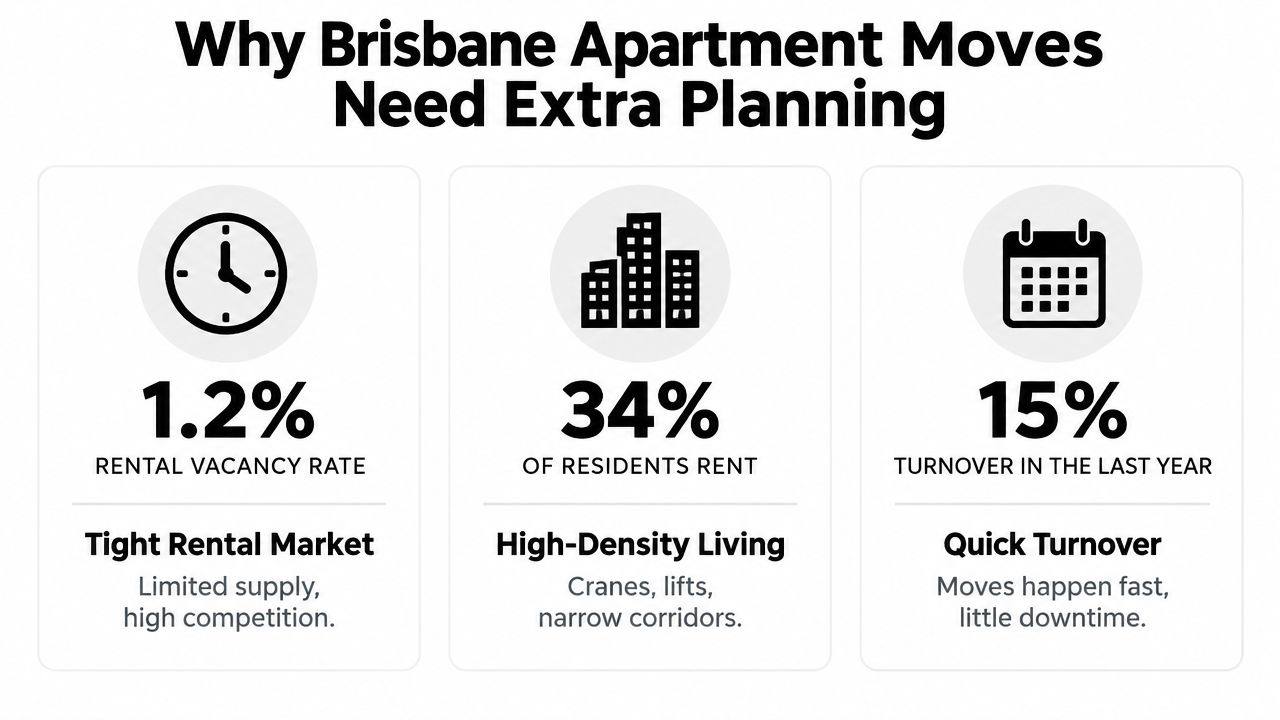
Why Brisbane Apartment Moves Need Extra Planning
A high-rise move often looks simple from inside the apartment. A removalist loads furniture into a service lift, drives to the next building and unloads. It involves a chain of bookings. If the lift isn't reserved, the loading bay is occupied or the truck can't access the street, a crew may spend the paid time waiting rather than moving.
Brisbane's apartment market adds pressure to that chain. The South East Queensland Regional Plan expects around 8,000 attached dwellings each year through 2031, while inner Brisbane averaged about 1,400 apartment completions a year from 2020 to 2024, according to reported Brisbane apartment availability data. Fewer new apartments entering the market means existing stock stays tightly used, and renters and owners often have little flexibility around dates.
The same source reported approximately 880 apartments completed in Brisbane during the first half of 2026, with 2,280 expected for the full year and roughly 2,706 apartments under construction for completion that year. Those figures point to slow replenishment compared with housing demand, which helps explain why apartment relocations remain a regular part of Brisbane's moving workload.
Rental pressure changes the move timetable
Brisbane's apartment rental market has also remained exceptionally tight. JLL reported a 0.9% rental vacancy rate in mid-2026, apartment rents of around $650 per week, and annual rent growth of 8.3%, as shown in its Brisbane residential market update. Earlier figures in the same market reporting showed 1.0% vacancy, 7.8% annual rent growth, and a median apartment price of $735,000 at the end of Q3 2025.
By Q2 2026, the reported median apartment sale price had reached $765,000, up 17.7% year-on-year, while inner Brisbane recorded just over 2,000 apartment sales in one quarter in 2025. For a mover, the practical result is more date pressure. A tenant may have a short gap between leases, while an owner-occupier may need furniture removed around settlement and handover.
Apartment removalists are useful because they understand this access sequence. They'll normally ask about the service lift, truck route, stairs, parking, building protection and the amount of furniture before quoting. A smooth move isn't fast. It's a move where everyone follows the building's rules and the crew can work continuously inside the booked window.
If you're moving with a dog, plan its transport separately from the noise, open doors and foot traffic. A practical guide on using Passpaw for dog moves can help you organise that part without putting your pet in the middle of the removal.
How to Choose the Right Apartment Removalists in Brisbane
The cheapest hourly rate isn't automatically the cheapest apartment move. A low rate can lose its advantage if the crew lacks high-rise experience, arrives with unsuitable equipment or waits because the lift booking wasn't understood.
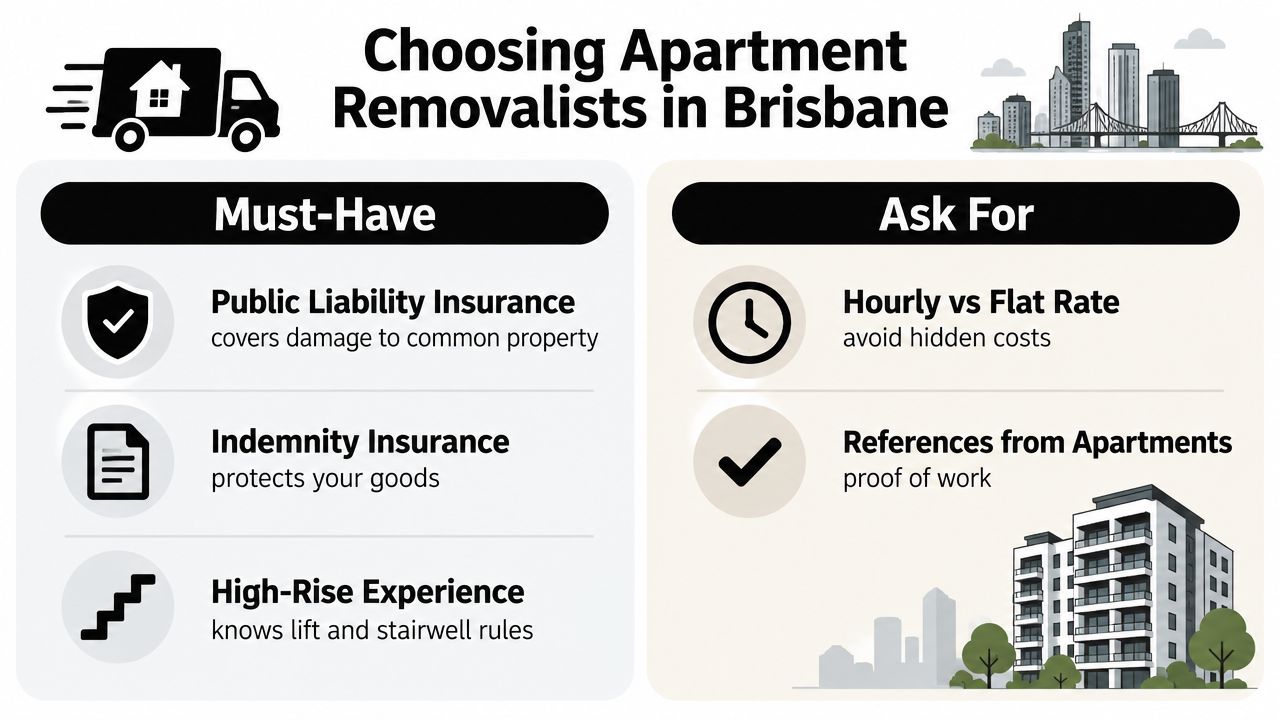
Start by checking insurance. Ask for a current certificate of currency for public-liability insurance, and ask what transit cover or goods-in-transit protection applies to your belongings. Public liability is relevant to damage involving common property, such as a wall, tiled foyer or lift interior. Transit cover concerns your furniture while it's being handled and transported. Don't accept “we're insured” as the complete answer. Ask for the insurer, policy type, expiry date and any exclusions that could affect an apartment move.
Compare the crew, equipment and truck
A suitable crew should be familiar with padded service lifts, protective floor coverings, stairwells, narrow doorways and building sign-in procedures. Full-time, police-checked staff can also matter when strangers are working inside a private home and moving through shared areas.
Truck selection needs a practical match, not a guess. A 4.5 tonne truck may suit a smaller apartment or restricted street, while a 12 tonne truck can carry a larger load but may create clearance or parking problems. The removalist should consider the volume of furniture, the distance from truck to lift and the building's height restrictions before selecting the vehicle.
Ask these questions before accepting a quote:
- Apartment experience: How often does the crew move through high-rise buildings with booked service lifts?
- Protection: Do they bring mattress bags, furniture blankets, corner protection and floor coverings?
- Furniture work: Is disassembly and reassembly included, and who handles complex pieces?
- Fragile or heavy items: Can they manage pianos, pool tables, glass and oversized furniture?
- Pricing: Is the quote hourly or fixed, and what happens if the lift is unavailable?
- Scheduling: Can they work around settlement dates, weekend access or an early building window?
- Documentation: Will they provide insurance details and a written scope of work?
The guide to choosing the right removals firm is useful when you're comparing these points rather than comparing star ratings alone.
One option for interstate work is Get n Go Removals Melbourne. Its service information describes full-time, police-checked staff, public-liability and transit insurance, a company-owned fleet from 4.5 to 12 tonne trucks, packing, furniture disassembly, specialist handling, storage and weekly direct runs between Melbourne, Brisbane and other East Coast destinations. Treat those as service features to verify against your own route and building requirements, not as a substitute for checking the written quote.
Practical rule: Choose the crew that can explain your building access plan clearly. If the salesperson only discusses truck size and hourly price, keep asking questions.
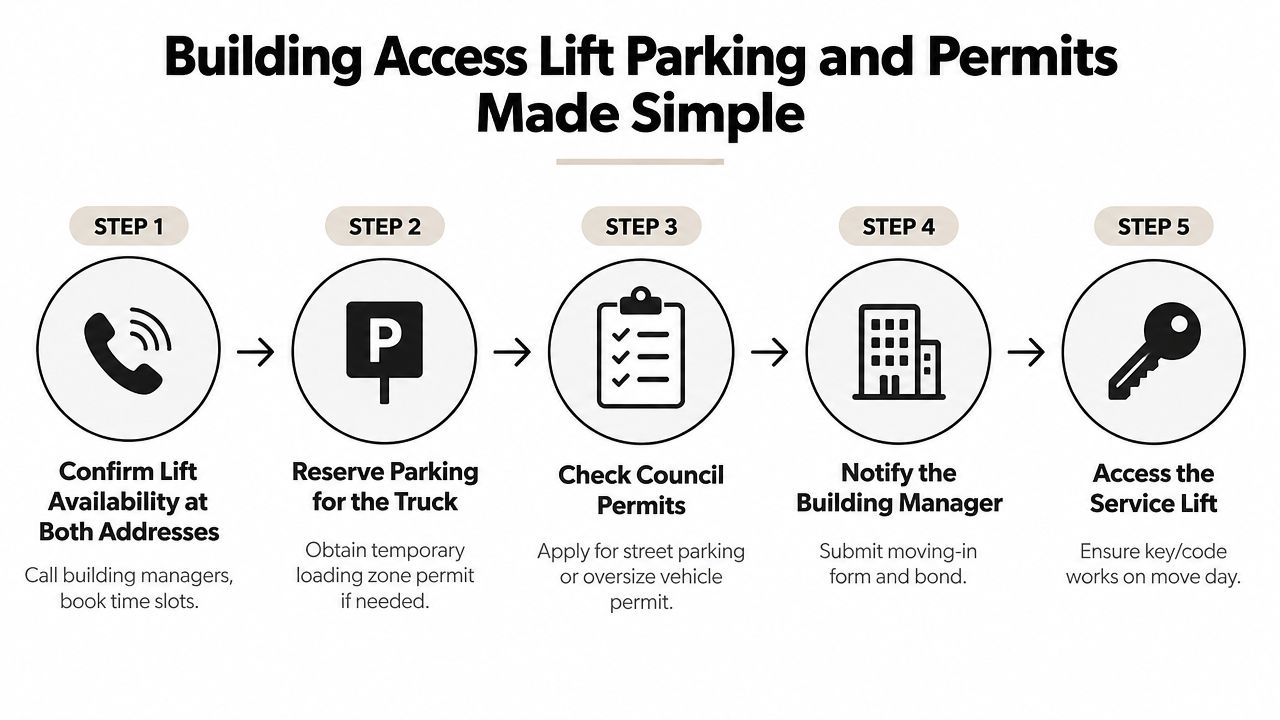
Building Access Lift Parking and Permits Made Simple
Apartment access should be treated as a booking process, not an assumption. Start with the building manager or body corporate contact at both addresses. Confirm the service lift, moving hours, loading location, access code, protective requirements and the person who releases the lift key or padding on move day.
Follow the access sequence
First, confirm the lift. Some buildings require moves to use a service lift, and some require the lift to be padded or booked into a fixed time slot. Independent Brisbane apartment-move listings also describe goods-lift use and a booked loading bay, with one Brisbane CBD listing specifying 2.8 metres of loading-zone backing clearance for truck access, as outlined in apartment moving access guidance. Record the booking in writing at both ends.
Next, check the truck route. Measure or confirm entry-height limits at basement driveways, loading docks and awnings. A truck that fits the street may not fit the building entrance. Ask whether the bay accommodates one truck at a time and whether the driver must approach from a particular direction.
Then, check the bay rules. One Brisbane high-rise moving guide states that many loading bays fit only one truck and are commonly restricted to 20 minutes, unless an exemption is arranged. Buildings without a suitable bay may require a Brisbane City Council loading zone or temporary truck parking permit, according to the same Brisbane apartment moving logistics guide.
After that, submit building forms. Some strata buildings ask for a moving-in or moving-out form, a bond, insurance documentation and details of the removalist. Notice requirements vary. Building guidance may require 48 hours' notice, while broader Australian strata guidance commonly recommends 14 days, alongside restricted hours and loading-bay limits, as explained in strata moving procedures.
Finally, test access on the day. Make sure the key, swipe card or lift code works before the crew starts carrying furniture. At Queen's Wharf Residences, the published procedure requires lift bookings at least 48 business hours before move-in, and large deliveries and move-ins must use the loading dock rather than the main lobby, according to the Queen's Wharf Residences move-in information.
If access is denied, don't send the crew into a confrontation with building staff. Ask the manager to confirm the reason, contact the removalist immediately and document any revised slot. A useful moving truck with lift gate may help with certain access conditions, but it won't solve a missing lift booking or an occupied loading bay.
Packing and Timing Tips That Save Hours on Move Day
The lift clock starts when the crew arrives, not when you begin deciding what belongs in each box. Finish the sorting before packing day where possible. Donate, sell or dispose of items you won't take, because every unwanted chair or half-filled carton still travels through the lift and costs handling time.
Pack for a controlled carry
Label each box on the top and at least one side with the destination room and a short contents description. Mark fragile cartons clearly, but don't make every box “fragile”, because that removes useful information for the crew. Keep jewellery, passports, medication, keys, laptops and important documents with you.
Disassemble beds, tables and shelving before the removalists arrive if you're doing that work yourself. Put screws and fittings in labelled bags and tape those bags to the relevant furniture. Leave specialist items such as pianos, pool tables, oversized glass and difficult modular furniture for a crew with the right equipment and experience.
Use proper cartons, strong tape, mattress protection, blankets and corner protection. Loose shopping bags and overloaded boxes slow stacking and increase the chance of damage. If your schedule is tight, valet packing can shift the work to the removalist, although you'll pay for that service rather than spending your own time packing.
Keep a clear path from each room to the front door. Reserve the essentials carton for last loading and first unloading. It should contain basic toiletries, a change of clothes, chargers, cleaning supplies, a kettle or simple food, and anything needed for the first night.
Queensland tenancy rules restrict general entry to a rental property to 8am to 6pm Monday to Saturday, according to the Residential Tenancies Authority entry rules. Coordinate inspections, access and handover around those hours rather than assuming a late-night move will be accepted.
Watch the practical packing sequence in this moving video after you've assessed your own furniture and access route:
For a detailed check against common packing failures, use this packing mistakes guide.
Key takeaway: A booked lift window rewards preparation. If the furniture is disassembled, the cartons are labelled and the walkway is clear, the crew can carry instead of sorting.
What Apartment Moves Cost in Brisbane and How to Control It
Apartment removalist pricing depends on the work involved, not just the number of rooms. A smaller apartment can cost more than expected if the truck stops far from the lift, the crew must use stairs, parking expires or the service lift becomes unavailable. Packing, furniture assembly, storage and specialist handling add separate layers of work.
Quotes are easier to compare when each company receives the same information. Give the apartment size, inventory, pickup and delivery addresses, floor levels, lift details, stairs, parking conditions, bulky items, packing needs and preferred dates. Ask whether travel, waiting, materials, insurance and reassembly are included or charged separately.
| Cost Factor | Why It Matters | How to Control It |
|---|---|---|
| Apartment volume | More furniture means more carrying, protection and truck space. | Remove unwanted items before quoting and provide an honest inventory. |
| Truck-to-lift distance | A long carry takes more crew time than a direct loading-bay route. | Send photos or ask the building manager to describe the route. |
| Lift and stair access | Stairs and restricted lifts increase handling time. | Reserve the service lift and identify stair-only items early. |
| Parking and permits | A legal parking position prevents waiting and relocation delays. | Confirm bay rules and arrange council permissions where required. |
| Idle time | A missed booking can leave the crew paid but unable to move furniture. | Hold written access confirmation and arrive ready to work. |
| Packing and protection | Materials and packing labour add convenience and handling control. | Pack non-fragile items yourself, or book a defined valet service. |
| Storage | Storage extends the move beyond collection and delivery. | Confirm storage duration, access terms and insurance before booking. |
Hourly pricing can favour a well-prepared move because the crew spends less time on decisions, packing and disassembly. A fixed quote can provide certainty, but only if the inventory and access conditions are accurate. Ask what happens if the lift is unavailable, the truck can't enter or extra stairs are required.
For practical budgeting measures, review these tips to keep moving costs down. The best saving usually comes from removing avoidable waiting, not from choosing a crew that lacks the equipment or insurance your building expects.
If you're moving beyond Brisbane, ask whether the provider runs a dedicated or scheduled interstate service, how delivery dates are set and whether your goods share space with other consignments. Weekly direct runs may suit a flexible relocation, while a settlement-linked move usually needs a clearly confirmed delivery commitment.
Your Pre Move Checklist for a Smooth Apartment Relocation
Use the checklist as a final verification tool. The move is ready when the building, removalist, truck, goods and handover dates all agree with one another in writing.
Two weeks before moving
- Confirm the booking: Check the date, arrival time, addresses, inventory, crew size, truck type and quoted inclusions.
- Verify insurance: Request the current public-liability and transit-insurance details, including relevant exclusions.
- Contact both buildings: Ask for the moving procedure, service-lift rules, loading-bay location, restricted hours, access codes and required forms.
- Check notice requirements: Lodge the building booking as early as the manager requires. Some buildings accept bookings from 48 business hours before a move, while others expect longer notice.
- Review parking: Confirm truck height, approach route, bay dimensions, street restrictions and whether a Brisbane City Council permit is needed.
- Plan specialist items: Tell the removalist about pianos, pool tables, large mirrors, safes and furniture that needs dismantling.
Before the final week
- Finish decisions: Donate, sell or dispose of unwanted furniture before the crew arrives.
- Pack by room: Use strong cartons, consistent labels and separate essentials from long-term storage.
- Protect valuables: Keep documents, medication, jewellery, electronics and keys with you.
- Prepare furniture: Empty drawers, remove shelves where appropriate and group fittings in labelled bags.
- Confirm handover timing: Coordinate inspections and rental access with Queensland's permitted general-entry window of 8am to 6pm Monday to Saturday, where those rules apply.
The night before
- Clear the route: Remove rugs, clutter and door obstacles from the apartment to the lift.
- Charge devices: Keep your phone available for the building manager, driver and agent.
- Check access details: Put the lift booking, parking confirmation, manager's contact and access code together.
- Separate essentials: Load the first-night carton last and keep it visible.
On move day
- Meet the crew early: Walk through the apartment, identify fragile items and show the agreed route.
- Check the lift: Confirm padding, key access and the booked time before loading begins.
- Monitor the first load: Make sure protective materials are in place and cartons travel to the correct destination.
- Inspect both properties: Complete a final walkthrough, check cupboards and storage cages, photograph condition where appropriate, and return keys through the agreed channel.
The essential moving home to-do list can help you keep the administrative tasks alongside the physical preparation.
You don't need to make an apartment move complicated, but you do need to make it organised. Confirm the building requirements, choose apartment-capable removalists, prepare the load and protect the booked access window.
Get n Go Removals Melbourne provides apartment and residential relocations, packing and unpacking, furniture disassembly and reassembly, specialist handling, storage and interstate services between Melbourne, Brisbane and other East Coast destinations. Visit Get n Go Removals Melbourne to discuss your apartment access requirements, truck clearance, lift booking and moving timetable before you lock in the date.