What Size Moving Truck Do I Need: A Practical Guide
A 1-bedroom move usually needs about 12–20 m³, a 2-bedroom move about 20–30 m³, a 3-bedroom move about 35–50 m³, and a 4+ bedroom move about 50–70 m³. The right truck comes from three checks working together, a room-and-volume estimate, a payload check, and a site-access check. Bedroom count alone is the least reliable of the three.
You're probably making this decision with a settlement date approaching, boxes spreading across the hallway, and a moving truck booking page asking you to choose between 4.5, 6, 8, or 12 tonnes. Pick too small and you're paying for another trip, extra loading, and more handling. Pick too large and the truck may not fit the basement, loading dock, driveway, or licence class you've planned around.
Melbourne moves punish shortcuts. A lift booking, narrow laneway, low basement clearance, long driveway, or restricted loading bay can matter more than the number of bedrooms. This guide gives you a practical way to answer what size moving truck do I need without relying on a bedroom label that hides the actual workload.
Why Bedroom Counts Alone Pick the Wrong Truck
Settlement day arrives, the hallway fills with boxes, and the booking form asks you to choose a truck. A two-bedroom South Yarra apartment may be a straightforward load, or a difficult full-day job if it includes a piano, home gym, inherited furniture, and a garage packed with tools.
Start with volume, but do not stop there. Australian benchmarks estimate that a 2-bedroom home typically needs about 20–30 m³, while a 3-bedroom home generally needs about 35–50 m³ according to an Australian move-size calculator. Treat those figures as starting points. A lightly furnished apartment can sit near the lower end, while dense storage, appliances, and hobby equipment quickly add space.
Then check payload. Cubic metres show how much room your belongings occupy, not how heavy they are. Bookcases, gym equipment, stone tables, tools, and whitegoods can reach a truck's payload or GVM limit before the body looks full. Australian removal guidance places small trucks around 3–5 tonnes at roughly 1,500–2,200 kg payload, while medium trucks around 6–10 tonnes commonly sit around 3,000–4,300 kg payload in this removal-industry guide.
Three checks decide the booking
- Room and volume estimate: List large furniture, appliances, boxes, garage contents, and outdoor items, then estimate the cubic metres.
- Payload check: Identify dense or unusually heavy pieces and confirm the truck's payload and GVM rating.
- Site-access check: Measure lifts, basement clearances, turning circles, driveway width, kerbs, gradients, laneways, and the walking distance from truck to door.
Access can decide the truck before volume does. A narrow Melbourne laneway, low basement, restricted loading bay, long driveway, or lift booking may rule out a larger vehicle. Licence class matters as well, so choose a truck that suits both the load and the driver's licence.
Bedroom counts are especially unreliable for home offices, share houses, downsizer moves, and inner-city rentals filled with furniture collected over many years. Victorian apartments range from 32.2 m² to 243.1 m², with a mean of 86.4 m², so “two-bedroom apartment” says little about the contents in the Victorian housing data resource.
Practical rule: Book only after the volume, payload, and access checks agree. A bedroom label is not a truck specification.
Estimating Your Move by Room Volume
A cubic-metre estimate gives you a practical booking figure, especially when a Melbourne lift, basement, laneway, or driveway limits truck choice. Australian removal guidance places each bedroom's furniture at about 5–7 m³, a living room at 4–6 m³, a kitchen with whitegoods and 6–8 boxes at 4–5 m³, and a normal garage at 5–8 m³ using this Australian removal volume guide.
Build the estimate from the large pieces first. Then add cartons, protective wrapping, and items that cannot stack neatly.
Per-Room Volume Estimates for an Australian Household
| Room or Item Group | Volume Range (m³) | Common Overlooked Items |
|---|---|---|
| Studio living area | 8–12 | Sofa, mattress, small dining set, boxes |
| Single bedroom | 5–7 | Bed base, tall dresser, mirror, linen |
| Double bedroom with queen bed | 5–7 | Side tables, drawers, extra mattresses |
| Kitchen | 4–5 | Fridge, washer, dryer, pantry boxes |
| Dining area | 3–5 | Table leaves, chairs, buffet, wine rack |
| Lounge room | 4–6 | Recliners, entertainment unit, bookcases |
| Home office | 2–4 | Desk, monitor stands, filing cabinet, books |
| Garage | 5–8 | Tools, shelving, tubs, workbench, mower |
| Outdoor items | 3–6 | Outdoor setting, barbecue, bikes, pot plants |
A modest two-bedroom move may total roughly 20–30 m³ once two bedrooms, a lounge, kitchen, dining area, and cartons are included. A garage, office, outdoor setting, piano, or home gym can push the load above that range quickly. Use Get n Go Removals' cubic metre moving tool to turn your item list into a clearer estimate.
Small-looking items can consume substantial truck space. Book collections are dense, wine racks create awkward gaps, gym equipment has irregular shapes, and outdoor furniture wastes vertical space. A garage packed with tools can require more loading room than a bedroom filled with uniform cartons.
Write down the largest items, estimate each room, and add a realistic allowance for boxes and irregular furniture. Match that final cubic-metre figure to the truck, then confirm payload, GVM, licence class, and site access. The bedroom label is only a starting point.
Room to Truck Mapping for Australian Homes
Truck choice should start with access and fleet fit, then confirm the packed volume. Bedroom count provides a useful check, but Melbourne lifts, basements, driveways, turning space, and licence class can change the practical recommendation.
| Home Profile | Packed Volume (m³) | Recommended Truck Size | Realistic Trip Count |
|---|---|---|---|
| Studio or lightly furnished 1-bedroom | 12–20 | About 3 tonnes or 4.5 tonnes for access | Usually one trip |
| 2-bedroom apartment or small house | 20–30 | About 4.5–6 tonnes | Usually one trip if access is good |
| 3-bedroom family home | 35–50 | About 6–8 tonnes | One trip when the load is organised |
| 4+ bedroom home | 50–70 | About 8–12 tonnes | One larger trip or planned split loads |
These volume bands remain useful planning markers: 12–20 m³ for 1-bedroom homes, 20–30 m³ for 2-bedroom homes, 35–50 m³ for 3-bedroom homes, and 50–70 m³ for 4+ bedroom homes. A studio or lightly furnished one-bedroom home generally suits the smaller end of the fleet.
A 4.5-tonne truck offers about 18.5 m³ of capacity, with cargo dimensions of roughly 2.1 m high, 4.2 m long, and 2.1 m wide. It is typically covered by a car licence, according to the Budget Trucks fleet information. Loads near the upper volume limit require disciplined packing and may need a second run.
A two-bedroom apartment commonly fits a 4.5- or 6-tonne truck. Published Australian capacity guidance places a 4T truck at about 18 m³, a 6T truck at about 28 m³, and an 8T truck at about 38 m³, with furnishings and site access determining the workable choice. Use the smaller option when the building restricts truck size and the load can be staged efficiently. Choose the larger option when the route accepts it and avoiding a second trip matters.
Three-bedroom homes usually sit in the 6–8 tonne tier, especially with full lounge and dining furniture, whitegoods, children's rooms, and outdoor items. Four-plus-bedroom homes with garages and complete contents often require the upper fleet range. Capacity guidance places 8–10 tonne vehicles around 35–50 m³ and 10–12 tonne vehicles around 45–60 m³ in this practical capacity guide. For a Melbourne booking, give Get n Go Removals the volume estimate and every access restriction before selecting the truck.
When Access Constraints Override Volume
A measured load can still fail when the truck cannot reach the loading point. In Melbourne, lifts, basements, driveways, turning circles, and licence requirements often decide the workable vehicle before the furniture volume does.
A two-bedroom apartment in a South Yarra tower measured 32 m³, a load that would usually suit a 6-tonne truck. The building allowed a lift booking with a 30-minute loading window, the porte-cochère had a narrow turning circle, and management prohibited trucks over six tonnes. Those conditions made a 4.5-tonne truck across two trips the practical choice.
The smaller vehicle was required because the building controlled access. The crew needed a truck that could enter, turn, load, and leave within the booking. Before confirming an apartment move, ask building management about truck limits, lift padding, dock access, loading windows, height restrictions, and parking permits. Plan how large items will be carried through restricted areas with these practical heavy furniture moving tips.
A suburban property can create a different restriction.
A four-bedroom weatherboard in Glen Waverley had enough contents for an 8-tonne truck, but the site included a 60-metre driveway, low verandah eaves, and an overhead powerline at the kerb. The booking needed a parking plan, extra protection for the lounges, and more time at both ends because the truck could not sit beside the house.
That move shows why access belongs in the booking conversation from the start. A long carry slows loading and increases handling. Low clearance can rule out a truck before volume matters. A steep gradient or narrow turning area can make a vehicle unsafe or impractical, even when its capacity is right.
Measure the driveway entrance, narrowest turn, lowest overhead point, and distance from parking to the front door. For apartments, confirm the lift door and internal dimensions, basement height, loading dock rules, and booking duration. Check the vehicle's licence class as well as its physical fit, since a truck that suits the load may still require the wrong licence for the driver. Choose the largest truck that physically fits the site, not the largest truck that fits the furniture.
Matching the Get n Go Fleet to Your Move
Get n Go Removals runs a company-owned fleet from 4.5 to 12 tonnes. Choose by usable volume, payload, vehicle dimensions, access, and licence class, not the tonne rating alone. The right truck is the largest one that can safely reach the property and legally be driven by the assigned operator.
| Truck Size | Payload | Capacity (m³) | Licence Class | Ideal Move |
|---|---|---|---|---|
| 4.5 tonnes | Confirm for the specific vehicle | About 18.5 | Car licence | Studio or light 1-bedroom, tight inner-city access |
| 6 tonnes | Confirm for the specific vehicle | About 28–30 | LR where required | 2–3 bedroom apartment with moderate contents |
| 8 tonnes | Confirm for the specific vehicle | About 35–50 | LR where required | 3–4 bedroom home with mixed heavy items |
| 12 tonnes | Confirm for the specific vehicle | About 45–60 | MR | 4+ bedroom home, garage, whitegoods, full contents |
A 4.5-tonne truck fits a studio or lightly furnished one-bedroom home, particularly where a basement, laneway, or tight inner-city loading area rewards manoeuvrability. It falls within the Class C licence limit for vehicles up to 4.5 tonnes GVM in Australia, as outlined in this Australian fleet guide.
Choose the 6-tonne truck for a fuller two-bedroom apartment or a moderate three-bedroom move. It provides more deck length for appliances and living-room furniture, but the entrance and turning space still need checking.
For a three- to four-bedroom home, the 8-tonne truck is the practical choice when the contents include dense furniture, a piano, outdoor settings, or several heavy items. Confirm the assigned vehicle's licence requirement, because configuration can change what the driver needs.
The 12-tonne truck suits a large four-bedroom-plus move with full contents, garage storage, whitegoods, and substantial furniture. It requires a suitable kerbside position and an MR licence. Review Get n Go Removals' moving services information to confirm the service and truck arrangement for your property.
A smaller truck may be the better booking if a larger vehicle cannot clear the driveway, fit the basement, or reach the loading point. Ask for the assigned vehicle's internal capacity, payload, dimensions, licence requirement, crew size, and access assumptions in writing before moving day.
Loading Tips That Make Any Truck Work Harder
Truck capacity only helps when the crew loads the space properly. Start with the heavy pieces, placed low and towards the front wall near the cab, so the load stays balanced rather than concentrating weight at the rear.
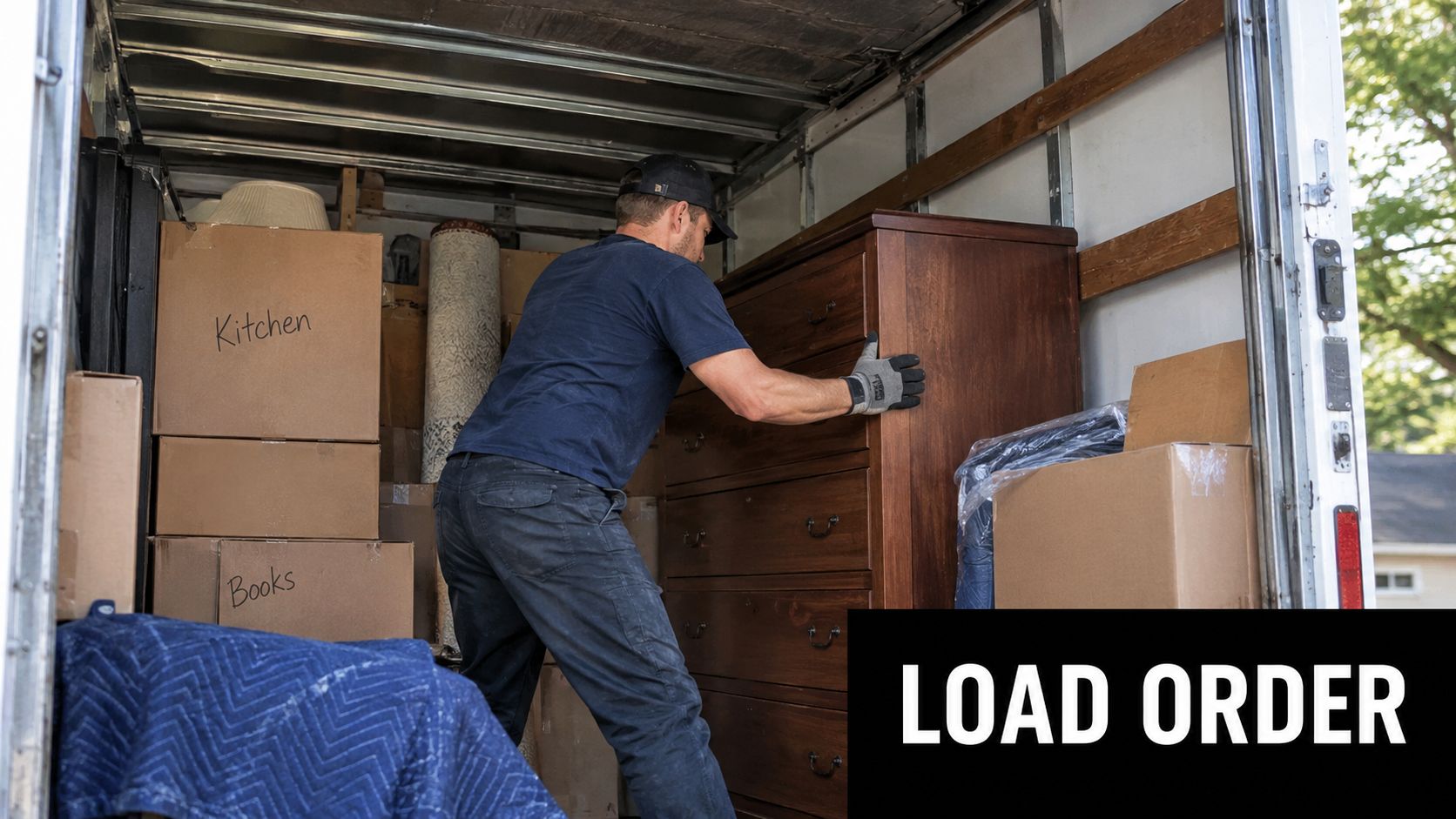
Fridges, washing machines, and dryers should be secured with straps attached to rated rails. Don't tie heavy appliances to wall panels that aren't designed for restraint. Once the large appliances are stable, build a flat second layer with mattresses and box-spring bases. That creates a working deck and lets the crew use vertical space without crushing cartons.
Build the load from the structure out
Stand lounges, dining tables, and headboards on edge along the side walls after wrapping them in moving blankets. Disassemble table legs and bed frames where practical, then protect corners before placing the pieces upright. This recovers floor space while keeping padded furniture away from exposed edges.
Keep a soft-cube zone near the rear doors for fragile items. Nothing should be stacked on top of that zone. Kitchen cartons should travel last in the loading sequence, placed on top of sturdy furniture so they can be unloaded first at the destination.
Use these practical packing tips for moving house to organise cartons by room, protect breakables, and reduce searching during unloading. A labelled load gives the crew a better chance of finding the essentials without dismantling the whole truck.
The loading order also determines the unloading order, so photograph the load at three stages. Take one image after the heavy base is secured, another once the main furniture is in place, and a final image before the doors close. Those photos help the delivery crew understand what needs to come out first and where fragile pieces are positioned.
The video below shows the kind of controlled furniture placement that prevents wasted floor space and avoidable contact damage.
Loading principle: Use the truck's height, but never sacrifice balance, restraint, or a protected fragile zone to squeeze in another item.
Quick Checklist and Common Sizing Questions
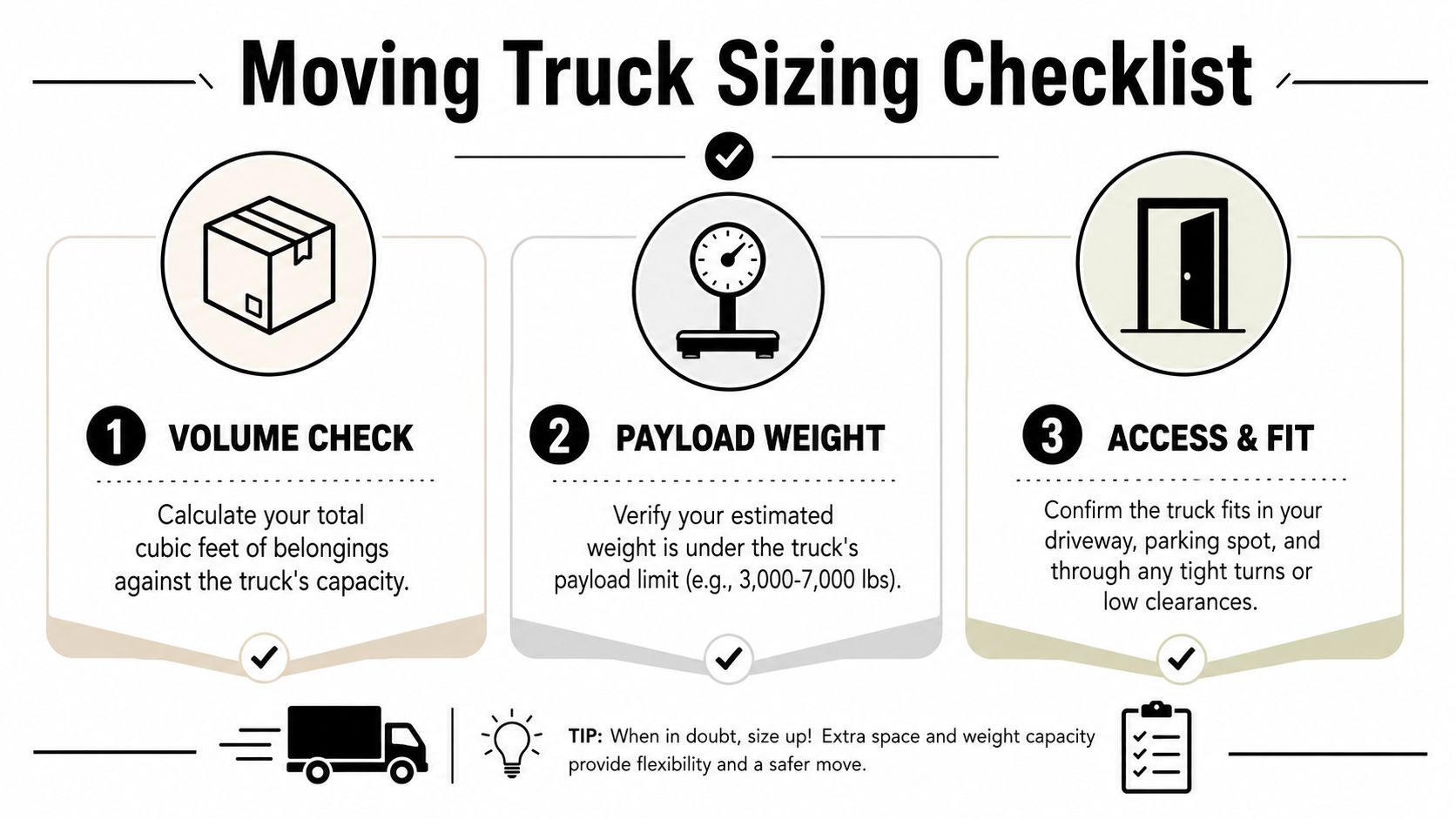
A Melbourne move can fail on access before it fails on volume. Check the load, the property, and the vehicle before confirming the booking. Keep your item list, measurements, parking details, and truck information together on your phone.
- Calculate total cubic metres: Include bedrooms, living areas, kitchen contents, office equipment, garage storage, outdoor furniture, cartons, and irregular items. Compare the result with the truck's published capacity, rather than relying on the property description. Australian calculators show why payload must be checked alongside volume, with vehicles ranging from 4.55 m³ for a 1-tonne vehicle to a 38 m³ truck with 4.1 tonnes of load capacity in this Australian moving calculator.
- Check the heaviest single item: List pianos, gym equipment, stone furniture, safes, appliances, tools, and dense book collections. Spare floor space does not make an overweight load safe.
- Measure driveway and lift dimensions: Record height, width, turning space, gradient, loading-dock access, lift-door size, and the route from the truck to the property. A basement ramp or tight Melbourne driveway can rule out a truck that fits the household volume.
- Confirm parking distance at both addresses: A long carry changes the crew's handling plan. A smaller truck parked close to the entrance may work better than a larger vehicle left far away.
- Confirm the licence class: A Class C car licence covers vehicles up to 4.5 tonnes GVM. Larger trucks may require LR or MR licensing, so confirm the assigned vehicle and licence requirement with the removal company before booking.
Is a slightly larger truck safer than an undersized one?
A little spare capacity is usually safer than finding extra cartons with nowhere to go. Stop at the next practical size up, not automatically at a 12-tonne truck. An oversized vehicle can waste loading time, create lift or driveway problems, and cost more than a correctly matched option. Check the site before choosing the larger body.
When should I split the move between smaller trucks?
Two smaller runs can suit restricted parking, a long carry, a building with truck limits, or fragile high-value pieces that need separate handling. Splitting the move also helps when one large vehicle cannot turn safely into the property. Compare the added travel and loading time with the access risk before deciding.
What licence do I need for each Get n Go truck?
A 4.5-tonne truck is generally within a standard car licence limit. A 6-tonne or 8-tonne truck may require an LR licence, while the 12-tonne truck requires an MR licence. Confirm the exact configuration with Get n Go before booking, because the assigned vehicle determines the requirement.
What happens if the volume surprises me on moving day?
Stop loading before the truck becomes unstable or overloaded. Separate items for disposal, storage, or a second trip, then have the crew reassess volume, payload, access, and the safest transport option. Do not force cartons into gaps around heavy furniture or ignore a payload concern to avoid another run.
For storage volume and unit selection, the American Mini Storage size guide provides a supplementary reference. Melbourne truck selection still depends on Australian vehicle classes and local access. Use this Australian moving house checklist to organise the wider move, then request a written quote confirming the truck size, crew, access assumptions, and travel time.
Get n Go Removals Melbourne can assess cubic-metre volume, payload risks, lift or driveway restrictions, and the suitable truck from its 4.5 to 12 tonne fleet. Visit Get n Go Removals Melbourne and request a written quote confirming the truck size, crew, and travel plan before moving day.