Interstate Removals Melbourne to Sydney: A Complete Guide
Embarking on a move from Melbourne to Sydney is a significant undertaking, but with a robust plan, it can be a seamless and exciting transition. This comprehensive guide serves as your ultimate roadmap for interstate removals Melbourne to Sydney, transforming a potentially overwhelming task into a smooth, manageable process. Consider this your go-to resource for navigating every stage with absolute confidence.
Charting Your Course From Melbourne to Sydney
Relocating your life nearly 900 kilometres is a major logistical challenge that extends far beyond simply packing boxes. It's a complex operation where early and detailed planning is your greatest asset. A well-structured strategy is the best defence against last-minute stress, ensuring your budget remains intact and your possessions are transported securely. The true journey from your Melbourne residence to your new life in Sydney begins months before the moving truck arrives.
The entire relocation process can be broken down into several key phases, each with its own set of critical tasks. By approaching the move in manageable, bite-sized segments, the overall project becomes far less daunting.
Key Milestones in Your Relocation Plan
First and foremost, establishing a realistic timeline is crucial. A successful interstate move is the culmination of weeks, not days, of meticulous preparation. Every task, from decluttering your home to reduce moving volume to coordinating the disconnection and reconnection of utilities, needs a designated spot on your calendar.
Next comes one of the most pivotal decisions you'll make: selecting your removalist. This choice can define the success of your move, as it directly impacts the safety, security, and handling of every item you own. We'll delve into how to identify a reliable partner with proven expertise on the Melbourne to Sydney route.
Finally, your plan must extend beyond moving day. Settling into Sydney is a process in itself, involving updating official documents, sourcing local services, and familiarising yourself with your new community.
A successful interstate move is 10% moving and 90% planning. The more you organise in advance, the smoother the final journey will be. Taking the time to structure your tasks with a detailed checklist will yield significant dividends in stress reduction.
As you map out your move, remember to account for any pets. Consulting a comprehensive guide to traveling with pets is essential to ensure they have a safe and comfortable journey. By meticulously managing every detail, from your largest piece of furniture to your furry companions, you are setting the stage for a seamless transition into your exciting new chapter in Sydney.
Budgeting for Your Interstate Move
Let's discuss finances. A clear understanding of the costs involved is the foundational step for a move that avoids unpleasant financial surprises. When planning a significant relocation like an interstate removal from Melbourne to Sydney, creating a realistic and detailed budget is what distinguishes a smooth transition from a stressful ordeal.
The total cost is not a single figure but a composite of various factors. Understanding these elements empowers you to make informed decisions that align with your financial goals.
The primary driver of your moving cost is the total volume of your belongings, measured in cubic metres (m³). A one-bedroom apartment typically occupies 10-15m³, whereas a four-bedroom family home can easily exceed 40m³. The principle is simple: the more items you have, the more truck space is required, which directly increases the price.
Key Factors That Shape Your Moving Quote
Beyond the volume of your possessions, several other factors can significantly influence the final cost. The time of year, for instance, has a substantial impact. Moving during the peak summer season (December-January) or on a weekend will invariably be more expensive due to heightened demand.
The level of service you select also plays a crucial role. Will you require professional packing for every item, or will you handle the packing yourself? These decisions are vital when constructing your budget. For a more detailed exploration of all potential expenses, refer to our guide on the cost of movers in Australia.
Comparing Standard Services with Backloading
As you begin to gather quotes, you will encounter two primary service options for an interstate move: a standard dedicated service and backloading. These are fundamentally different approaches.
-
Standard Removals: This is the premium, express option where a truck is exclusively reserved for your belongings. This results in a much faster transit time, with delivery to Sydney typically within 2-4 business days. You gain complete control over pick-up and delivery dates, but this convenience comes at a higher cost.
-
Backloading: This is the cost-effective, savvy choice. Your items share truck space with other consignments, effectively utilising available capacity on a truck already making the journey. This can lead to significant savings, but the trade-off is reduced flexibility. Delivery windows are considerably wider, often spanning 5-14 days.
Backloading is an excellent way to save money on your interstate move if your timeline is flexible. It leverages empty space on trucks already making the trip, reducing both the cost for you and the environmental footprint of the journey.
The cost data for the Melbourne to Sydney route highlights this difference clearly. On average, moving costs for this popular corridor range between $1,660 and $4,742, with a typical professional service costing around $2,800.
If budget is a key concern, backloading can reduce these costs by up to 50%, with some flexible customers paying as little as $765. This significant price difference is rooted in the per-metre rate: standard moves average approximately $145 per cubic metre, whereas backloading is closer to $95 per cubic metre. Furthermore, booking your move on a weekday can reduce the price by an additional 10-15% compared to a weekend slot. You can find more details on these pricing trends by reviewing interstate moving costs on Zoom Removals.
Here’s a comparative breakdown of estimated costs for the journey from Melbourne to Sydney.
Estimated Moving Costs from Melbourne to Sydney
| Household Size | Average Volume (m³) | Standard Removalist Cost (Est.) | Backloading Cost (Est.) |
|---|---|---|---|
| 1 Bedroom Apt | 10-15 m³ | $1,450 – $2,175 | $950 – $1,425 |
| 2 Bedroom Home | 20-25 m³ | $2,900 – $3,625 | $1,900 – $2,375 |
| 3 Bedroom Home | 30-38 m³ | $4,350 – $5,510 | $2,850 – $3,610 |
| 4 Bedroom Home | 40-50 m³ | $5,800 – $7,250 | $3,800 – $4,750 |
These figures are estimates and can vary based on the specific removalist, time of year, and services required. It's always best to get a detailed quote.
As demonstrated, flexibility with your moving dates and opting for backloading can substantially impact your final expenses.
How to Read Your Quote and Spot Hidden Fees
A reputable and trustworthy removalist will provide a detailed, itemised quote. An estimate that feels vague or seems too good to be true should be treated with caution.
Ensure the quote provides a clear breakdown of all charges, including:
- The total volume (m³) being transported.
- The rate charged per cubic metre.
- Any additional fees for challenging access (e.g., multiple flights of stairs, long-carry distances).
- Fuel levies or applicable road tolls.
- Specifics on the insurance coverage included.
Always inquire about potential extra costs before signing any agreement. Unforeseen charges can arise for things like waiting time if you are not ready at the scheduled time, or for shuttle van services if the primary truck cannot access your new street. By understanding every line item, you can build an accurate budget and select a mover that aligns perfectly with your plan.
Your Pre-Move Timeline and Checklist
A smooth and stress-free move from Melbourne to Sydney is achieved through solid, forward-thinking planning. Attempting to manage an interstate relocation without a structured plan is not advisable. A detailed timeline is your most valuable tool for preventing last-minute chaos and ensuring a seamless process. By breaking down the entire move into manageable weekly tasks, a seemingly monumental project becomes a series of achievable goals.
This timeline will guide you through the critical stages, ensuring that by moving day, you are thoroughly prepared.
Eight Weeks Out: The Strategic Start
With two months to go, the focus is on big-picture planning and making key decisions. This is the ideal time to begin a purposeful decluttering process. Methodically go through every room, cupboard, and drawer. Be ruthless in your evaluation. Every item you choose not to take is one less thing to pack, move, and pay for.
Consider this: with an average interstate removal cost of around $145 per cubic metre, discarding an old bookshelf or spare mattress that occupies just one cubic metre instantly saves you money. This is also the time to start researching and requesting quotes from professional removalists who specialise in the Melbourne to Sydney route.
Four Weeks Out: Getting Hands-On
At the one-month mark, the move begins to feel more tangible. Now is the time to start packing non-essential items. This includes books, out-of-season clothing, guest room linens, and any decorative items you won't need in the coming weeks.
This is also the deadline for critical administrative tasks. Notify your utility providers (electricity, gas, internet) of your moving date and arrange for final meter readings. Simultaneously, schedule the connection of services at your new Sydney address. Remember to set up mail redirection with Australia Post to ensure no important correspondence is lost during the transition.
Pro Tip: Create a detailed inventory of your belongings as you pack. A simple spreadsheet listing the box number, the destination room, and a brief summary of its contents is invaluable. This document is essential for insurance purposes and for verifying that all items have arrived safely in Sydney.
For an even more granular breakdown of every task, you can use our comprehensive moving house checklist, the only guide you will ever need to work alongside this timeline.
This timeline infographic breaks down the key phases of your pre-move preparation.
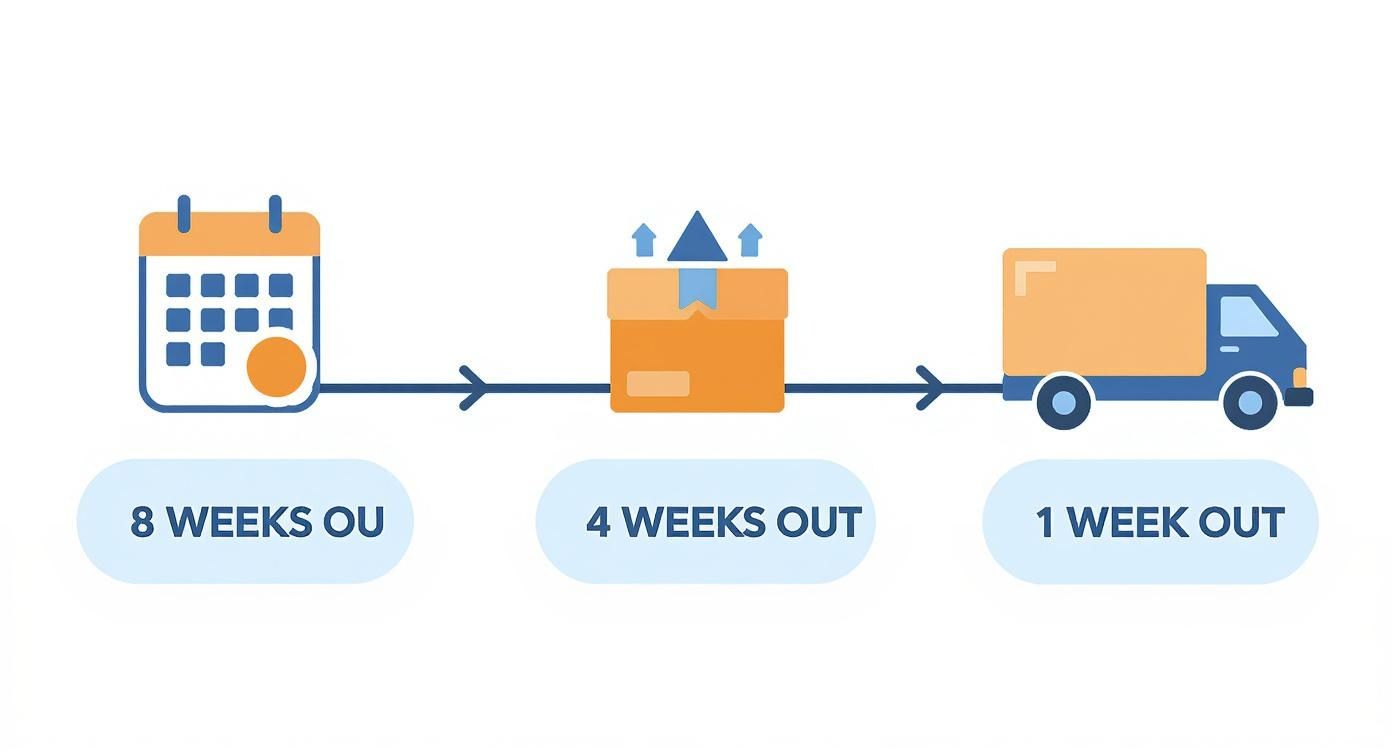
Visualising your move in stages—from big-picture planning eight weeks out to final preparations in the last week—helps keep the process organised and manageable.
The Final Week: The Home Stretch
The last seven days are dedicated to final preparations and completing the last few tasks. By this point, the majority of your home should be packed, leaving out only daily essentials. Contact your removalist to confirm all details, including arrival times, contact numbers, and any special access instructions for your new Sydney property.
One of the most critical tasks during this final week is to pack a dedicated 'essentials' box. This box should travel with you in your car, not on the moving truck.
It should contain everything you'll need immediately upon arrival, such as:
- Kettle, coffee, tea, and mugs
- Basic toiletries and a change of clothes for each family member
- Phone chargers and any essential medications
- A small toolkit with a screwdriver and Allen keys
- Bed linen for the first night
To ensure a smooth departure from your old home, a thorough clean is essential. You can refer to this ultimate end of lease cleaning checklist to help you cover all the bases. Finally, conduct a final walkthrough of your empty Melbourne home to ensure nothing has been left behind. With your timeline completed, you are now ready for the journey ahead.
Packing Strategically For The Long Haul
Packing your entire life for a nearly 900-kilometre journey is fundamentally different from a local move. When undertaking an interstate removal from Melbourne to Sydney, your belongings will endure a much longer transit. They will be exposed to more road vibrations and potential shifts, which demands a packing strategy that is robust, methodical, and focused on maximum protection.
Your first line of defence is using the right materials. Flimsy, single-walled boxes from the supermarket are inadequate for this journey. Investing in high-quality, double-walled cardboard boxes is absolutely non-negotiable for long-distance moves.

Essential Packing Materials For Interstate Protection
To properly secure your items for transit, a specific set of tools is required. This goes beyond simple boxes and tape.
- Double-Walled Boxes: These are the industry standard for strength. They provide superior crush resistance, which is critical when boxes are stacked high in a moving truck.
- Specialised Wraps: Bubble wrap is essential for delicate items, while butcher's paper is ideal for glassware to avoid ink transfer from newspaper. For electronics, anti-static bubble wrap is a must.
- Heavy-Duty Packing Tape: Do not compromise on quality here. Secure the bottom and top of every box with multiple strips of tape to prevent them from bursting open during transit.
- Furniture Blankets and Pads: Professional movers use these for a reason. They are vital for protecting wooden surfaces from scratches, dents, and other damage in transit.
- Permanent Markers: Clear, bold labelling will be your greatest asset when you arrive in Sydney, exhausted and faced with a mountain of identical boxes.
Proven Packing Methods For A Seamless Unpack
How you pack is just as important as what you pack with. The objective is to create solid, stable boxes that can withstand the journey and facilitate a straightforward unpacking process in your new Sydney home. For a complete guide to best practices, our in-depth article on how to pack for moving offers even more detailed advice.
Always begin by reinforcing the bottom of every box. A single strip of tape is insufficient; use the 'H-tape' method, taping along all seams for maximum strength.
Next, focus on correct weight distribution. Place heavier items at the bottom and lighter ones on top. This creates a stable centre of gravity and prevents delicate belongings from being crushed. Aim to keep each box around 20kg—sturdy enough for protection, yet manageable for one person to lift safely.
A well-packed box should have no empty space. Gaps allow items to shift and break. Fill any voids with crushed packing paper, towels, or soft linens to create a snug, cushioned environment.
Labelling Everything For An Organised Arrival
Effective labelling is the difference between a chaotic guessing game and a streamlined unpacking process. Do not just write "Kitchen" on a box; be specific.
A comprehensive label should include three key pieces of information:
- Destination Room: e.g., "Main Bedroom," "Kitchen," "Living Room."
- Brief Contents Summary: e.g., "Everyday Plates & Bowls," "Linen Closet – Towels."
- Handling Instructions: Clearly mark boxes with "FRAGILE," "THIS WAY UP," or "HEAVY."
This simple system allows you or your movers to place each box in the correct room as it comes off the truck. You'll be able to locate the kettle and coffee mugs without having to open twenty different boxes—a small victory that feels immense after a long-distance move.
Finally, apply the same level of care to your furniture. Wrap large pieces in thick moving blankets and secure them with packing tape (ensuring the tape does not touch the furniture's surface). Disassemble items like bed frames and tables where possible, and keep all screws and bolts in a labelled zip-lock bag taped securely to the main component. This meticulous approach ensures everything arrives in Sydney in the same condition it left Melbourne.
How to Choose a Trustworthy Interstate Removalist
Choosing your removalist is undeniably the most critical decision for your interstate removals from Melbourne to Sydney. You are not merely hiring a truck; you are entrusting a company with all your worldly possessions for a journey spanning nearly 900 kilometres. A correct choice here ensures a smooth, secure, and stress-free move.
The selection process begins with thorough research. A legitimate removalist will have a professional website, a verifiable physical address, and easily accessible contact details. Be wary of any company that operates only with a mobile number or provides a quote that seems drastically lower than competitors, as this can be a red flag for hidden fees or substandard service.

Verifying Credentials and Reputation
Before requesting a quote, perform due diligence. A reputable company should be a member of a professional organisation like the Australian Furniture Removers Association (AFRA). AFRA members adhere to a strict code of conduct, which means they are equipped with the proper equipment, well-maintained vehicles, and professionally trained staff to handle your move to the highest standards.
Beyond official accreditations, a company's public reputation provides valuable insight. Check for recent, genuine customer reviews on independent platforms. While an isolated negative comment is not necessarily a deal-breaker, pay close attention to how the company responds. A professional firm will engage with feedback constructively and seek to resolve issues, demonstrating accountability and a commitment to customer satisfaction.
Understanding Insurance and Liability
This is a critical area that is often misunderstood. Any professional removalist will carry Public Liability Insurance and Transit Insurance for their vehicles. However, it is crucial to understand that this does not automatically cover the full replacement value of your personal belongings in the event of accidental damage.
It's a common misconception that the removalist's standard insurance covers everything. For complete peace of mind, you must arrange comprehensive moving insurance. This protects the replacement value of your goods if they are lost or damaged in transit.
Ask any potential mover to explain their insurance options in detail. They should be able to offer a suitable policy directly or recommend a trusted third-party provider. If a company is vague about insurance or dismisses its importance, consider it a significant warning sign and look elsewhere. For a more thorough explanation, our guide on how to choose the best interstate removalists is an excellent resource.
Analysing Quotes and Services
When you receive quotes, look beyond the final price. A detailed, itemised quote is a hallmark of a professional operation. It should clearly break down:
- The total volume of your goods in cubic metres (m³).
- All included services, such as packing, disassembly, or short-term storage.
- A transparent breakdown of costs, highlighting any potential extra fees for issues like difficult access or delays.
- The estimated pick-up and delivery timeframe.
The Melbourne to Sydney route is one of Australia's busiest transport corridors, representing a 10-12 hour drive. The cost for such a move typically ranges from $1,660 to $4,742, depending on the volume of goods, the time of year, and the level of service required. For those with flexible schedules, backloading can offer significant savings, with prices starting from as low as $765.
Finally, before committing, ask some final qualifying questions. Do they use their own trained employees or subcontract the work? What is their communication protocol during transit? A trustworthy removalist will gladly answer all your questions, providing the confidence you need for your move to Sydney.
Arriving and Settling into Your New Sydney Home
The truck has arrived and your boxes are being unloaded, but the final phase of your **interstate removals Melbourne to Sydney** is just beginning. This stage is about transforming a house filled with boxes into a functional and comfortable home. A clear plan for this part of the process is invaluable.
Prioritise the essentials. Before unpacking begins, conduct a quick walkthrough of your new home. Direct the movers on where to place large furniture items and stacks of boxes—this is where your detailed labelling system proves its worth. Once the truck has departed, locate your 'essentials' box. Make the beds, put the kettle on, and take a moment to decompress. You've earned it.
Your Post-Move Action Plan
With immediate needs met, it's time to tackle the administrative tasks that officially establish you as a Sydney resident.
Your immediate to-do list should include:
- Connect Utilities: Even if pre-booked, verify that your electricity, gas, and internet services are active. Discovering you have no hot water after a long day of unpacking is an easily avoidable frustration.
- Update Your Details: Contact Service NSW to update the address on your driver's licence and vehicle registration. Remember to update your details on the electoral roll as well.
- Find Local Services: Begin identifying your new local amenities. This includes finding and registering with a local GP and dentist, and noting the location of the nearest hospital or medical centre.
A methodical approach to unpacking is your best friend right now. Start with the most frequently used rooms—the kitchen, bedrooms, and bathrooms. Completely unpack and organise one room before moving to the next. This creates pockets of order and makes the entire house feel far less overwhelming.
Getting to Know Your New Neighbourhood
Once the administrative tasks are handled, the enjoyable part begins: exploring your new community. Sydney is a city of distinct villages, each with its own unique character. Take the time to go for a walk.
Locate the nearest supermarket, post office, and pharmacy. Find a local park or walking trail to get some fresh air after being surrounded by boxes. Familiarising yourself with Sydney’s public transport system early on will also build your confidence for exploring further afield.
The adjustment period is an integral part of the relocation journey. You are not alone in making this popular move. The migration between Australia's two largest cities is significant. In recent years, population flows have shifted, and by September 2023, Sydney's outbound moving enquiries reached 30%, indicating a dynamic and ever-changing demographic landscape. You can explore these patterns further by looking into Australia's interstate moving trends on Find a Mover.
Your Top Questions About Moving to Sydney
Even with the most meticulous planning, questions can arise. When undertaking a move as significant as Melbourne to Sydney, it's natural to have some uncertainties. To provide clarity, we have compiled and answered the most frequently asked questions.
How Long Will My Belongings Take to Arrive?
While the drive itself takes approximately 9-10 hours, the delivery time for your belongings is longer.
If you have booked a dedicated truck (a standard removal service), the transit is much faster. In this case, you can expect your belongings to arrive in as little as 2-4 business days.
Conversely, if you opt for a budget-friendly backloading service (sharing truck space), the timeline is extended. The delivery window is typically between 5-14 days. This allows the removalist to coordinate multiple pick-ups and drop-offs along their route. Always obtain a firm delivery window in writing before you finalise your booking.
Do I Need Special Moving Insurance?
Yes, absolutely. While any reputable removalist will have Public Liability and Carrier's Liability insurance, this provides only basic coverage. It is often limited and is unlikely to cover the full replacement value of your goods in the event of an incident.
For genuine peace of mind, you really need to arrange your own comprehensive transit insurance. This kind of policy is designed specifically to cover your belongings for their full value against accidental damage or loss, all the way from your old front door to your new one.
What Is the Best Time of Year to Move?
To achieve cost savings and greater flexibility, aim for the off-peak season. Summer, particularly the hectic period of December and January, is the busiest and most expensive time to move. School holidays also see a surge in demand and prices.
You will generally find more competitive rates and better availability by moving mid-week (Tuesday to Thursday) and mid-month. The shoulder seasons of autumn (March-May) and spring (September-November) often represent the ideal balance, offering pleasant weather and more favourable pricing for your Sydney relocation.
Can Removalists Transport My Plants or Pets?
This is almost always a no. The vast majority of professional removalists cannot transport live plants due to state quarantine regulations and the high probability that plants will not survive the journey in a dark, enclosed truck. It is best to transport them in your own vehicle or re-home them before you leave.
For pets, you must engage a specialised pet transport service. These companies are equipped to move animals safely and humanely, by road or air. They manage all the logistics to ensure your furry family members are comfortable and that all travel regulations are met.
When you're ready to make your move from Melbourne to Sydney, you need a team you can trust. Get n Go Removals Melbourne offers reliable, professional, and careful interstate removal services to ensure your belongings arrive safely. With years of experience and a commitment to transparent communication, we make your big move a smooth one.