
Office Removalists in Brisbane: A Practical 2026 Guide
You've booked the new office, told the team, and promised everyone they'll be operational on Monday. Then the building manager asks for a loading-dock booking, the removalist asks for an inventory, and your IT contractor wants a confirmed server cutover window. Suddenly, an office move looks less like a truck booking and more like a tightly controlled construction project.
That's the reality for businesses comparing office removalists in Brisbane. Furniture is only one part of the job. Building access, lift protection, council restrictions, lease obligations, records, IT equipment and staff safety determine whether the move finishes without disruption or consumes the first week in the new premises.
The Weekend Move That Almost Cost a Business a Quarter
A Brisbane CBD accounting firm once tried to move after close on Friday and reopen in the new office on Monday. The plan lived in a few emails, there was no single move coordinator, and nobody had obtained a written sequence from the building manager.
Friday started smoothly. The crew arrived after hours, but the service lift booking had been entered against the wrong tenancy. By the time that was corrected, the permitted access window was shrinking. Desks came apart, but the destination floor wasn't ready to receive them. Several workstations ended up staged in the lobby, where they blocked access and needed to be moved again.
Operational rule: If an item has no labelled destination and no confirmed route, it isn't ready to leave the old office.
The server room caused the actual damage. The rack was transported safely, but power and connectivity at the new site hadn't been tested. The IT team couldn't bring systems online until Monday lunchtime, leaving staff unable to work through the morning. The furniture move itself had finished, but the business still wasn't operational.
A better plan would have split the relocation into two controlled stages. Non-critical furniture, archives and surplus equipment could have moved first, followed by a final cutover for servers, network equipment and essential workstations. That approach gives the new office time to receive, test and organise assets before staff arrive.
Brisbane demand cycles make this planning discipline important. The CBD recorded more than 44,000 square metres of net office absorption in the six months to July 2022, compared with a long-run average of approximately 9,000 square metres every six months, according to the Property Council of Australia's Brisbane office market report. Leasing activity, upgrades and relocations can create pressure on commercial crews and building facilities.
The rest of this guide covers the services to specify, the timeline to follow, the access rules that can stop a truck, the factors that change a quote and the records you must protect. Treat those details as part of the move, not administration after the booking.
Why Brisbane's Office Market Should Shape Your Move Plan
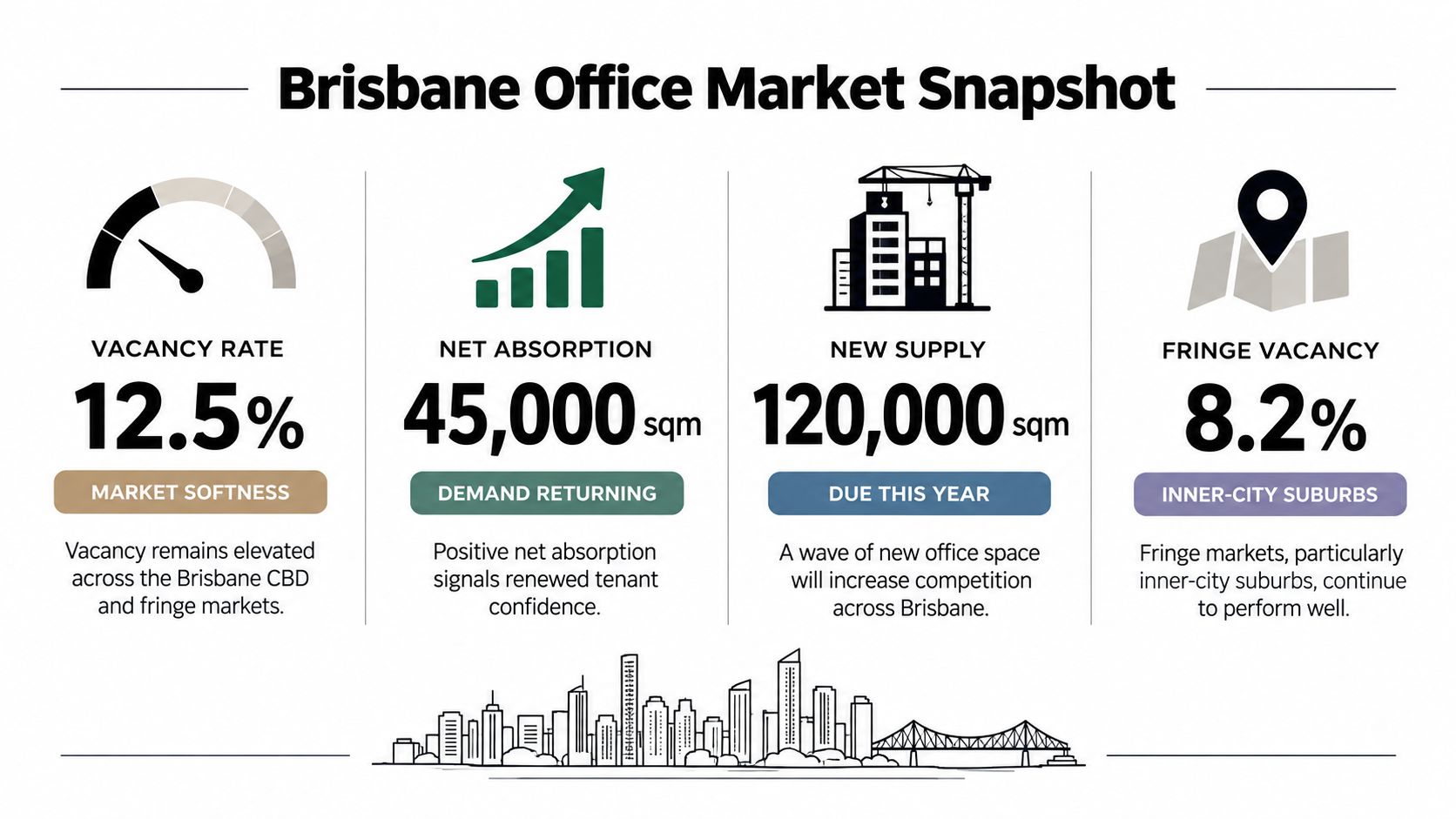
Headline vacancy doesn't tell you whether your move will be easy. The building grade and precinct matter more because they determine how many other tenants compete for docks, service lifts, inductions and approved moving windows.
Brisbane's CBD vacancy moved from 10.2% in January 2025 to 10.7% in July 2025, while premium-grade vacancy was only 3.8%. Annual net absorption reached 37,480 square metres, described as the strongest result among Australia's major office markets in the Cushman & Wakefield Brisbane CBD Office Q2 2025 report.
That combination creates a practical trap. Overall availability can look comfortable while premium buildings remain operationally tight. A business moving from secondary space into a premium tower may face stricter contractor induction, protective-cover requirements, loading-dock procedures and lift bookings. The property is available, but the move slots may not be.
Read the building, not just the vacancy rate
Brisbane's CBD and fringe markets both generate relocation work. In the six months to July 2022, the fringe recorded more than 22,000 square metres of net absorption, while fringe vacancy fell from 16.2% to 15.6%, according to the Property Council's Brisbane office market commentary.
That matters when you're planning routes between the CBD, fringe precincts and suburban offices. A move may involve multiple access systems, different truck approaches and separate building contacts. New supply can also cluster relocations around handovers, while premium tenants compete for limited building resources.
For Melbourne businesses relocating to Brisbane, interstate transport must be coordinated with the destination building's access window. The truck's arrival time is only useful if the dock, lift, induction and receiving team are ready.
A good removalist asks for the building rules before confirming the programme. An average one asks how many desks you have and sends a truck.
Services a Brisbane Office Removalist Should Provide
A commercial move starts with a site survey, not a loading estimate. The survey should record access routes, stairs, lift dimensions, dock restrictions, parking conditions, floor protection, furniture quantities, IT assets and the receiving layout.
You should appoint one move coordinator on your side. That person approves the inventory, controls staff communication, confirms landlord requirements and makes decisions when access changes. A removalist should provide one operational contact as well, rather than sending you between a sales representative, dispatcher and crew leader.
Specify the work, not a vague “office move”
Ask for these services where they apply:
- Site surveys: Inspect both premises and identify routes, pinch points, stairs, dock rules and lift limits.
- Inventory and labelling: Assign each crate, desk, cabinet and device to a department or destination position.
- Furniture handling: Include disassembly, protective wrapping, transport, reassembly and placement.
- IT coordination: Schedule disconnection, packing, transport, reconnection and testing with your IT provider. Specialist guidance on IT asset relocation for businesses can help when equipment requires controlled handling and chain-of-custody records.
- Packing and archives: Use labelled crates for files, secure handling for confidential material and a clear unpacking sequence.
- Storage: Confirm whether short-term storage is secure, insured, access-controlled and priced separately.
- After-hours labour: State whether evening, weekend or public-holiday work is included.
- Specialist items: Identify safes, server cabinets, heavy meeting tables and other awkward assets before quoting. Pianos and pool tables belong in a specialist scope, not an improvised office crew plan.
A commercial crew should also protect walls, floors, lifts, doors and shared areas. If the quote only mentions transport, ask who handles those items and who pays if building management requires additional protection.
For a broader service outline, review the office relocation services available from a commercial moving provider, then compare the actual inclusions against your own inventory.
| Service | Residential crew | Commercial-ready crew |
|---|---|---|
| Site survey | May estimate from photos | Surveys both sites and records access limits |
| Furniture | Moves loose items | Disassembles, protects, labels and reassembles |
| IT equipment | Transports boxes | Coordinates cutover, handling and destination placement |
| Building access | Assumes street or basic lift access | Confirms dock, lift, induction and move windows |
| Records and storage | May load cartons | Provides controlled handling and documented storage options |
The difference is coordination. A residential crew can carry furniture, but a commercial-ready team manages the building, sequence and operational risk around it.
Building an Eight-Week to Moving-Week Office Move Timeline
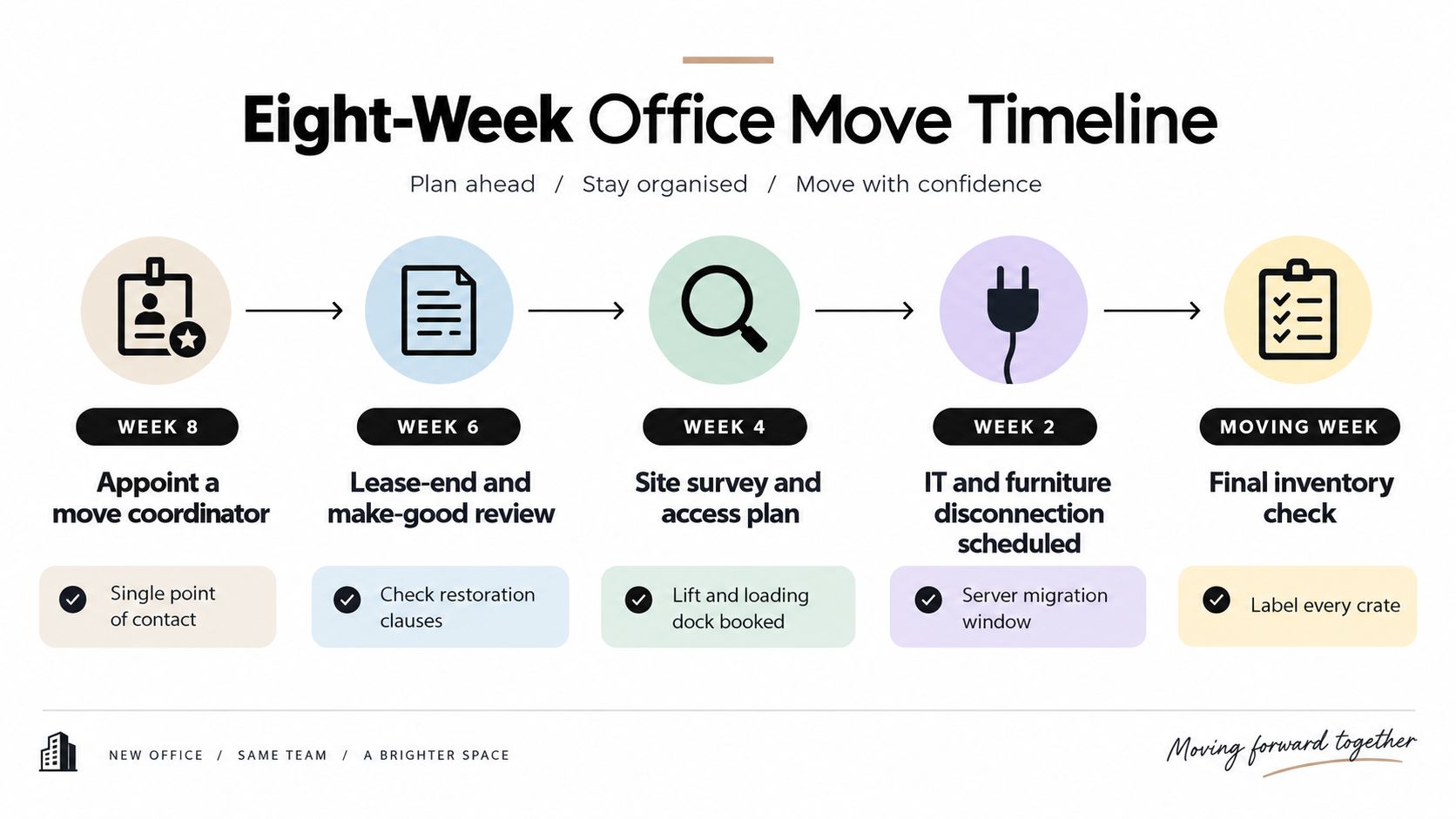
An eight-week programme gives you enough room to resolve lease, access, IT and inventory issues before they become moving-day emergencies. Appoint one internal coordinator at the outset. Committees discuss problems; one named owner closes them.
Weeks eight to six
At week eight, review the lease end date, make-good clauses, reinstatement obligations and handover requirements. Survey the old and new sites, then create a floor plan showing destinations for desks, cabinets, meeting furniture and equipment.
By week six, confirm the preferred move sequence and identify what can be discarded, donated, recycled, stored or transferred. Ask the building managers for dock procedures, lift dimensions, access hours, contractor induction requirements and protection standards.
Weeks four to two
At week four, introduce the labelling system. Use department, destination and priority information on every crate and major item. Record the inventory in a shared document that the coordinator, removalist and IT lead can use.
Schedule furniture disconnection, server migration and workstation shutdowns. Map the movement routes for trolleys, roller pallets, ramps and team lifts. Filing cabinets, server racks and sit-stand desks can be difficult to control even when an individual component doesn't appear exceptionally heavy.
Safe Work Australia defines hazardous manual tasks as those involving repetitive movement, sustained or sudden force, or sustained awkward postures, with controls including layout redesign, mechanical aids and task rotation, as explained in its guidance on lifting, pushing and pulling manual tasks.
Moving week and the first week after
In the final week, confirm dock and lift bookings in writing, circulate the go-live agenda, complete the inventory check and label every crate. Pack essential IT equipment last and plan for it to be unloaded and reconnected first.
Staff shouldn't independently move bulky, unstable or awkward equipment. The coordinator should schedule team lifts and make mechanical aids available before the crew starts.
A practical office relocation timeline should continue into the first week after the move. Test internet, phones, printers, access control and meeting-room systems before declaring the project complete. Keep a short support window for missing labels, damaged packaging or equipment that needs repositioning.
What Actually Moves an Office Removal Quote in Brisbane
An office removal quote reflects handling time, access difficulty and project complexity. The number of desks matters, but it doesn't tell the whole story. A compact office with a difficult dock, restricted lift or long internal carry can take more labour than a larger ground-floor site with direct access.
The quote usually changes according to:
- Access: Dock availability, lift size, stairs, security gates, long carries and protective requirements add handling.
- Furniture: Modular desks, sit-stand frames, boardroom tables and fixed cabinetry require different disassembly and reassembly work.
- Timing: After-hours labour may be necessary where the building or business can't tolerate daytime disruption.
- Travel: Distance and vehicle requirements affect transport planning, particularly for interstate or multi-site moves.
- IT: Servers, network cabinets, monitors and specialist equipment need controlled packing, placement and coordination.
- Storage: Temporary storage can solve lease overlap or delayed access, but it must be clearly priced and insured.
- Exit work: Disposal, rubbish removal, archive handling, cleaning and make-good support may sit outside the base move.
A low hourly rate is meaningless if it excludes building protection, after-hours work, additional handling, rubbish removal or temporary storage. Ask every removalist to itemise the same scope, including crew size, vehicle type, estimated handling, access assumptions, packing materials, disassembly, reassembly, insurance, storage and cancellation terms.
Council access can also alter the plan. Brisbane City Council states that regular loading and unloading adjacent to a site requires a work zone, and general kerbside layover isn't permitted without a work-zone permit, as set out in its CBD and City Frame construction-management guideline.
Compare quotes on the same inventory and access conditions. The cheapest headline price often becomes the most expensive option when the crew arrives without the required equipment or the building refuses access.
Use a detailed cost of movers guide as a comparison prompt, but insist on a written quote for your specific premises.
Credentials, Insurances and Red Flags to Verify
Before signing, verify the company rather than relying on polished branding. An active ABN, a real business address, clear contact details and a written agreement give you a basic accountability trail.
Request current certificates for public liability, goods-in-transit cover and workers' compensation. Read the certificate holder, policy dates, insurer, covered business name and relevant limits. The cover should make sense for the value and risk of your inventory, not just exist as an attachment.
The thirty-minute verification routine
Use a short call and email sequence:
- Confirm the business: Check the ABN on the quotation and invoice, then ensure the legal entity matches the insured business.
- Read the scope: Look for crew numbers, vehicle assumptions, access conditions, packing, furniture work, storage, disposal and overtime.
- Verify insurance: Ask what happens if goods are damaged in transit, while being handled, or while stored.
- Name the contacts: Confirm who coordinates the removalist, your building manager and your IT provider.
- Check the crew: Ask whether staff are employed, trained, police checked or subject to formal site induction.
- Record exclusions: Get every surcharge, waiting condition and cancellation rule in writing.
A professional provider won't object to sensible questions. Cash-only deposits, vague verbal estimates, missing insurance documents, no fixed premises and refusal to confirm details in writing should end the conversation.
Practical rule: A quote is only useful when another person can read it and understand exactly what the crew will and won't do.
Interstate moves need another layer of control. Ask how the truck, driver and crew are managed across the journey, who accepts responsibility at handover and how delays are communicated. The chain of responsibility must be clear when multiple parties influence loading, driving, scheduling and delivery.
A provider's insurance explanation should also be understandable to a non-specialist. This moving company insurance coverage guide can help you prepare questions, but the removalist's own certificates and written terms remain the documents that matter.

Brisbane Lift, Parking and Dock Access Rules That Decide the Day
Brisbane CBD access can stop a move before the first desk reaches the truck. Don't assume a vehicle can wait outside the building while the crew sorts out a lift or security issue.
Council guidance requires a work zone for regular loading and unloading adjacent to a site. General kerbside layover isn't permitted without a work-zone permit, and heavy vehicles can't wait within the CBD for access. For heavy vehicles over 12.5 metres, weekday restrictions include a lockout from 7:30 to 9:00 am and 4:00 to 6:30 pm, according to Brisbane City Council's construction-management guidance for the CBD and City Frame.
Confirm these items before booking the truck
- Dock: Obtain written confirmation of the loading-dock booking, arrival window, vehicle height and vehicle length limits.
- Lift: Check service-lift dimensions, weight limits, protection requirements, booking duration and access route.
- Truck: Match the vehicle to the building and the legal access window. A larger truck isn't automatically more efficient.
- Kerb access: Confirm whether the truck can use a private dock or needs an approved work zone or loading area.
- Permit: Check whether the vehicle qualifies for a commercial parking permit and apply early where required. Council explains that commercial parking permits can apply in particular restricted areas, but they don't remove loading-zone conditions.
- Contingency: Decide where the crew goes if the dock is occupied, the lift fails or traffic delays the arrival.
Brisbane City Council distinguishes commercial vehicles from ordinary vehicles in loading zones. Commercial vehicles may stop for up to 30 minutes to load or unload goods, while non-commercial vehicles are generally limited to 20 minutes for goods. Where a sign shows no operating hours, the restriction applies 24 hours a day, as outlined in the street parking rules and signs.
Don't leave these questions for moving day. Get the dock booking, lift booking, protection instructions, after-hours approval and access contingency in writing before the removalist finalises the schedule.
A Downtime-Free Week Checklist for the Move
The final week should feel repetitive. Repetition means the risky decisions were made earlier.
- Confirm access: Recheck the dock, service lift, vehicle details, protection materials, security induction and approved moving hours.
- Issue the agenda: Send staff the packing deadline, workstation shutdown time, first-day arrival instructions and the name of the move coordinator.
- Protect IT: Back up critical systems, pack equipment last, label every device and reconnect priority infrastructure first.
- Control records: Keep confidential files in sealed, labelled containers and record who packs, transports, receives and stores them.
- Prepare a rollback: Keep a short contingency window if power, internet, access control or server connectivity fails at the new site.
- Check the old premises: Photograph the condition, remove rubbish, confirm make-good tasks and retain handover evidence.
The ATO requires businesses to retain most tax, superannuation and registration records for five years from when the record is prepared or obtained, or when the related transaction is completed, whichever occurs later, according to its overview of business record-keeping rules.
You may digitise paper records when the digital images are true, clear reproductions that meet the ATO's requirements. Entering information into accounting software doesn't automatically replace the underlying source document. Keep the actual record digitally or on paper, back up electronic files and retain secure access during the move.
If the new premises contains fire equipment or requires a compliance review, a practical guide to extinguisher compliance for QLD can help your facilities contact identify questions for the building manager.
Treat the relocation as a coordinated project with named owners, written access approvals, controlled records and a tested IT cutover. That structure protects trading far better than just booking a truck for the weekend.
Get n Go Removals Melbourne offers office relocations, furniture disassembly and reassembly, secure packing, storage and interstate transport, including scheduled Melbourne to Brisbane services that can be coordinated around building access. Visit Get n Go Removals Melbourne to discuss your inventory, access conditions and a move plan designed to keep your business operating.