
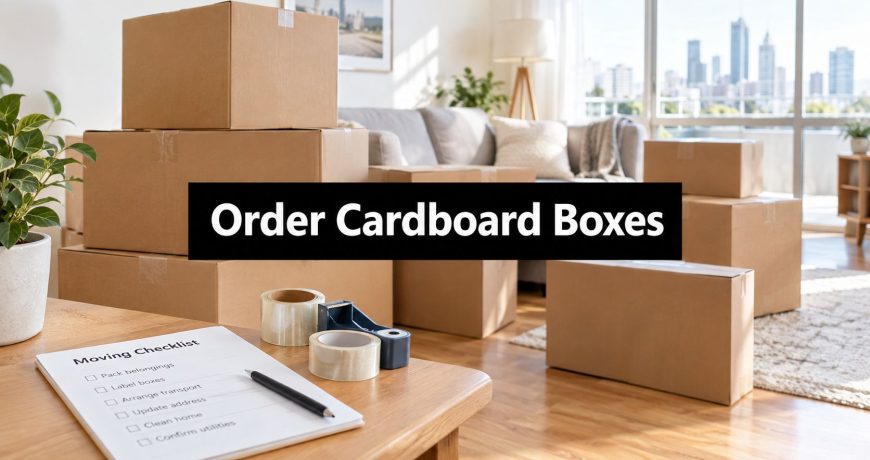
How to Order Cardboard Boxes for Your Melbourne Move
You've got the settlement date, the removal booking, and a house full of belongings to pack. Then you realise the cartons you collected are soft, mismatched, or far too large for the books and kitchenware they need to carry. That last-minute scramble is where avoidable damage, awkward lifting and unnecessary waste usually begin.
To order cardboard boxes properly, match each carton to the weight, shape and handling risk of its contents. Melbourne moves also need a plan for what happens after unpacking, because a box labelled recyclable only reaches a recycling facility if it remains clean, dry and correctly separated.
Why Ordering the Right Boxes Matters for Your Move
On site, the same packing failure appears repeatedly: plates in a deep carton, books in a large box, and linen forced into leftover gaps. The base bows before loading, the dense carton becomes unsafe to carry, and items may need repacking before they reach the truck. Ordering cardboard boxes by contents prevents those problems earlier.

The expense extends beyond another carton. A failed box can damage crockery, scratch furniture, or leave a removalist handling an unstable load several times. Poor weight distribution also increases physical strain, especially in apartment buildings where cartons pass through corridors, stairs, and lifts before reaching the truck.
Start with the contents, not the carton count
Australia's housing mobility means box planning cannot wait until packing day. In 2019–20, 1.14 million households, or 12% of all Australian households, had moved during the previous 12 months, while more than 40% had moved during the previous five years, according to the Australian Bureau of Statistics housing mobility data. Moves within the same state, Victorian relocations, and interstate jobs still create different handling demands.
A short apartment move calls for cartons that one person can carry through a lift and place down under control. Interstate transport requires closer attention to stacking, moisture, and repeated handling. Office moves create dense loads of files, stationery, and equipment, so one oversized carton can become difficult to lift and unstable in transit.
Practical rule: A carton should be easy for one person to grip, carry, and place down without twisting or losing control.
Order a little spare capacity
Ordering only the theoretical quantity leaves no allowance for a damaged carton, newly discovered cupboard contents, or packaging affected by moisture. A modest reserve is more useful than improvising with weak boxes on packing day. Guidance associated with the Australian moving-carton specification recommends approximately 5–10% spare cartons for damaged packaging, late-discovered items, and separating heavy contents.
Inventory each room, group possessions by density, and select carton strength before comparing price. Before sealing anything, also decide whether each box will be reused, passed on, or kept clean and dry for recycling. That post-move decision prevents usable cardboard from becoming avoidable waste.
Choosing the Correct Box Sizes and Strengths
A carton can look roomy on the floor and become unsafe once packed. Books, records, canned goods and tools create concentrated weight, while linen and cushions fill space without adding much load. Pack those categories together in one large box and the base, seams or your grip may give way during a lift.
Match the carton to the contents
Use the table as a starting point, then check how the packed carton will be handled inside the property and in the truck.
| Box Size | Best For | Key Consideration |
|---|---|---|
| Small | Books, records, canned goods and compact tools | Keeps dense loads manageable and reduces base strain |
| Medium | General household contents, kitchenware and mixed room items | Provides useful capacity without encouraging excessive weight |
| Large | Linen, cushions and other light bulky possessions | Avoid it for books, files, crockery or equipment |
A common medium moving carton measures 406 × 298 × 431 mm, with a nominal 52 L capacity, 3.5 mm material thickness, single-wall construction and at least 70% recycled content, according to its product specification. Treat the 52 L figure as an external guide rather than usable packing space. Protective wrap, the carton's internal shape and required headspace all reduce capacity.
For customers comparing small moving boxes, check whether the filled carton stays stable during repeated lifting, truck stacking and movement through doorways. A box that holds more can still be the wrong choice if it becomes awkward or shifts under load.
Check the rating before ordering
External dimensions do not establish a safe weight limit. Before placing a bulk order, request the supplier's edge-crush test, or ECT, value and internal dimensions in writing. Then test-pack one carton with books and lift it through a doorway. Check your grip, the base deflection and whether the contents move when the carton is tilted slightly.
Use smaller cartons or double-wall construction for fragile, valuable or high-compression loads. If a large carton seems convenient because it reduces the carton count, consider who will carry it after it is filled with books or office files. More manageable cartons are often safer than fewer overloaded ones.
Before sealing the order, separate cartons by their likely post-move use. Clean, dry boxes may be reused or passed on, while damaged or wet cardboard needs different handling. Planning that decision at the buying stage reduces waste and stops recyclable material from automatically going to landfill.
Single-Wall Versus Double-Wall Cardboard Options
Single-wall and double-wall cartons serve different jobs. Single-wall cardboard has one fluted layer between two liners and suits light to medium household loads when the contents are packed tightly and the carton won't face excessive stacking or impact.
Double-wall cardboard has two fluted layers. It offers greater resistance to compression and impact, which makes it a better choice for heavy electronics, framed artwork, dense office files, fragile possessions and interstate journeys where cartons may be stacked and handled repeatedly.
Compare the trade-offs
| Option | Works well for | Limitations |
|---|---|---|
| Single-wall | Linen, clothing, ordinary household goods and light general packing | More vulnerable to compression, punctures and repeated handling |
| Double-wall | High-value, fragile or dense contents, plus longer transport | Costs more and can be unnecessary for light, low-risk items |
The mistake is treating double-wall cartons as automatically better for everything. A strong carton still fails if it's overfilled, poorly sealed or carried with a damaged base. Equally, choosing the thinnest carton for a television, computer, artwork or dense file load can create a false economy. The right allocation is usually mixed. Spend more on cartons exposed to weight, impact or long-distance handling, and use single-wall boxes for lighter contents.
For buyers researching specifications beyond Australian retail stock, this guide to wholesale double wall boxes UK provides useful terminology for comparing double-wall construction. The location of the supplier doesn't make an overseas carton suitable for a Melbourne move by itself, so check dimensions, compression information, availability and delivery timing before ordering.
Generic retail cartons are convenient for a small local move. Specialist removal suppliers can be more practical for a large house, office relocation or interstate load because they can help match carton types to contents and handling conditions. The packing and moving boxes range is one local option to consider when you need cartons alongside broader packing support.
Where to Buy and Source Eco-Friendly Boxes
The cheapest carton isn't always the cheapest move. A thin box that collapses can damage its contents and become waste after one use, while a sturdier carton may survive unpacking and serve another move or storage cycle.
Office supply retailers offer predictable new stock and convenient local collection, which suits a short-notice Melbourne move. Specialist removal suppliers are often more suitable when you need mixed sizes, heavy-duty cartons, protective materials or packaging advice for an office and household move at the same time.
Second-hand cartons can work, particularly when they're clean and structurally sound. Inspect every panel before use. Reject boxes with softened corners, crushed edges, grease, food residue, strong odours or visible moisture damage. A used carton that has already lost its shape isn't an environmentally responsible choice if it fails during transport.
Look beyond recycled content
Australia's packaging system shows why “recyclable” is only part of the decision. Paper and cardboard accounted for more than half of packaging placed on the Australian market, and paper and cardboard recorded the highest material recovery rate at 68%, according to the Australian recycling market review. Yet in 2020–21, 44% of packaging was disposed of in landfill, while 35% was recyclable but not collected or reprocessed, according to the same source.
Choose corrugated cardboard without wax coatings, extensive lamination or contamination. Then protect the carton from rain, damp floors, food and oily materials. Clean construction and careful use give the fibre a better chance of remaining recoverable.
APCO reports that about 2,897,221 tonnes of corrugated cardboard were placed on the Australian market and approximately 65% of paper and paperboard packaging was recovered in 2022–23, while 94% received a good recycling-potential rating, as stated in its paper and paperboard material factsheet. Those figures point to a practical conclusion: purchase quality that can be reused, then keep it in good condition.
Businesses tracking packaging purchases and disposal may also benefit from a waste management accounting template when recording carton purchases, reuse and waste streams. For household customers, the same principle can be managed with a simple room-by-room order list and a separate post-move recovery plan.
Here's a useful visual reminder of how carton condition and handling affect the result:
Before ordering, compare the supplier's material, wall construction, internal dimensions, delivery timing and return policy. Melbourne customers can also review where to buy packing boxes when they need a local source rather than collecting mismatched cartons from several places.
Packing Procedures and Safety Handling Guidelines
A good carton still needs disciplined packing. Start with a room inventory and estimate demand by category. Keep dense possessions in smaller boxes, reserve medium cartons for general household items, and use large cartons for light, bulky contents only.
Pack for stability
Line the base with suitable cushioning, then place the heaviest items low and centred. Add lighter items above them, leaving enough headspace for protection without forcing the flaps upward. Fill voids so contents can't shift when the carton is tilted or carried.
Seal every carton with reinforced tape across the centre seam and both edges. One narrow strip over a heavily loaded base is an invitation for failure. Check the underside before carrying the carton, especially if the box has been stored for a while.
For fragile possessions, use the separate procedures described in this guide to pack fragile items for moving. Plates, glassware, artwork and electronics need individual protection rather than just more loose filler.
Keep manual handling under control
Safe Work Australia recommends labelling stock with its weight and contents so workers can recognise handling risks. Its guidance also recommends handling and lifting between mid-thigh and shoulder height where possible, using the whole hand for a firm grip and keeping the load close to the body, as outlined in this manual handling guidance.
Label each carton with its destination room, contents and handling priority. Mark heavy cartons clearly and avoid packing anything beyond what one person can safely lift. In apartment moves, those labels help the crew place cartons efficiently instead of repeatedly opening, shifting or guessing which boxes contain fragile goods.
Lifting check: If you need to brace the carton against your body, tilt it awkwardly or ask someone to help before you've cleared the doorway, repack it into smaller cartons.
Before loading, reject cartons with buckled panels, softened bases or torn handholds. A damaged carton isn't made safe by adding more tape around the outside.
Complete Your Move, Reuse, Recycle, and Dispose
The box journey doesn't end when the last item reaches the new property. Make a decision in this order: reuse first, recycle second, dispose only when the material cannot be recovered.
Sturdy cartons can be kept for a future move, storage, seasonal items or a neighbour who is packing. Some customers may prefer a reusable storage solution, particularly for repeated moves, office changes or longer storage cycles. Comparing portable storage solutions can help when cartons alone don't suit the timing or access conditions.
Use this post-move decision tree
- Reuse: Keep boxes that remain dry, square and structurally sound. Remove old labels and fold them flat for storage.
- Share: Offer usable cartons to neighbours or local community groups. This keeps a serviceable box in circulation.
- Recycle: Flatten clean, dry, uncoated cardboard and place it in the yellow-lid bin where council guidance permits. Large quantities may require a council drop-off option.
- Separate: Keep wet, greasy, waxed, foil-lined, plastic-coated or heavily tape-covered material out of the clean cardboard stream.
Australia generated approximately 4.9 million tonnes of paper and cardboard waste in 2022–23, and 50% was recycled, down from 60% in 2016–17, according to Forest Australia's recycled forest products data. Victoria, New South Wales and Queensland accounted for 81% of the recycled paper and cardboard waste, making correct recovery especially relevant for Melbourne households and businesses.
If you're looking for cartons that can be returned rather than stored, free moving boxes may be worth checking before ordering additional stock. The best order is not always the smallest. Durable cartons that survive reuse can create less waste than thin boxes that fail halfway through one move.
Get n Go Removals Melbourne supplies cardboard boxes and packing materials, and can support house, apartment, office and interstate relocations with professional packing, handling and storage options. For help choosing cartons that match your contents and move conditions, visit Get n Go Removals Melbourne and arrange a practical moving plan before packing day.