Man with a Van Insurance: What Customers Must Know
Man with a van insurance usually means a mix of commercial vehicle cover, public liability, and goods-in-transit protection, and customers should ask for a certificate of currency before booking. In Melbourne, that mix matters because a small move still sends people, furniture, and vehicles through tight spaces where one mistake can trigger a claim.
A homeowner booking a short move often hears “we're insured” and assumes that covers everything. It doesn't. The key question is which policy responds when a couch scrapes a stairwell, a fridge tips in the truck, or someone gets hurt in the driveway.
Understanding Man With a Van Insurance
A Melbourne customer rings a small removals operator, checks the quote, and hears the familiar line, “We're insured.” The useful question comes next: insured for which risk, and under which policy?
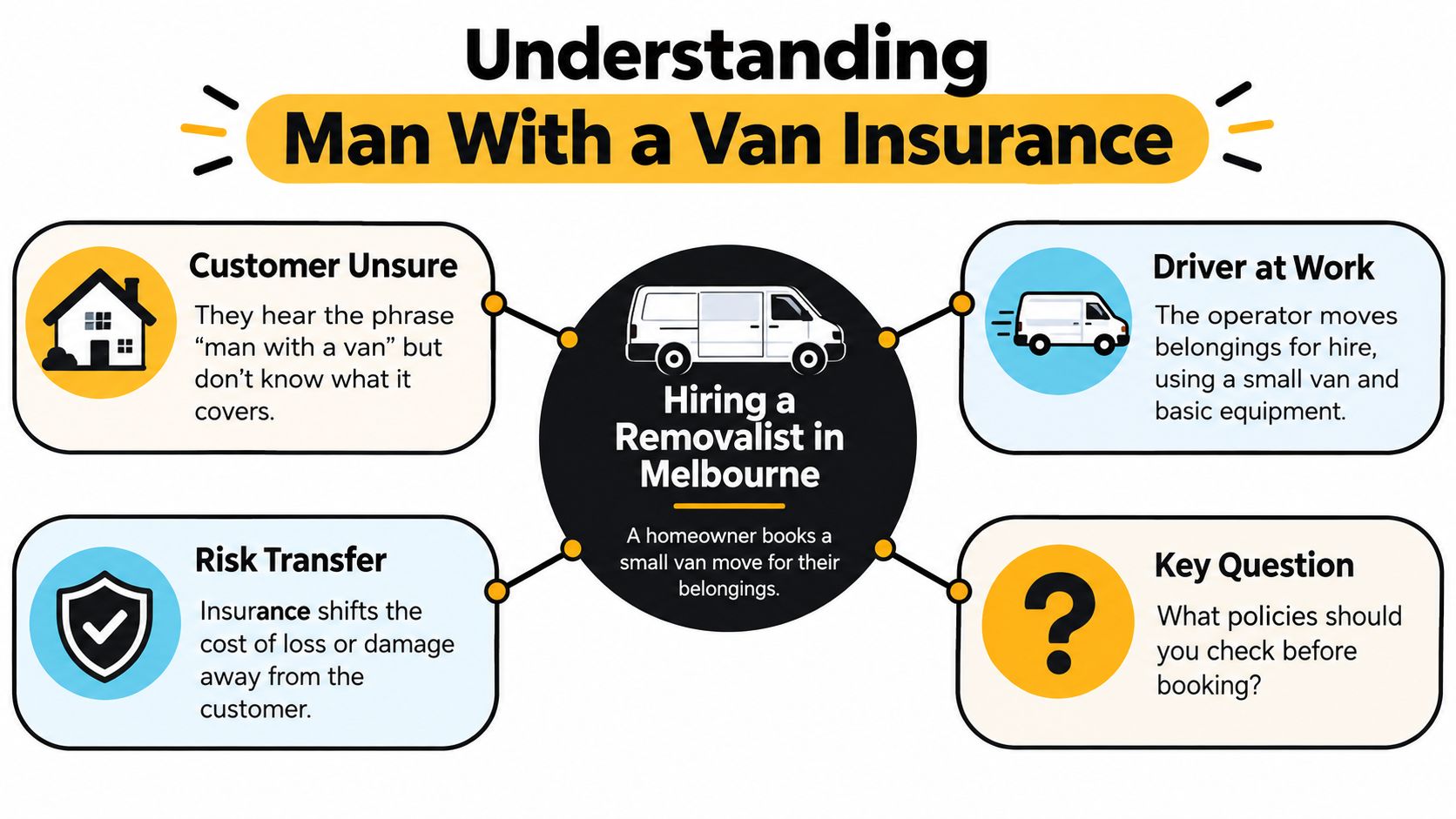
A proper man with a van insurance setup is a stack of protections, not one product with one promise. If you want a clearer breakdown of what sits inside that stack, see our guide to man with a van insurance. The customer's belongings are only covered if the wording matches the job, because each part of the move creates a different kind of exposure.
What the phrase really means
A paid move is a commercial job. The van is being used for business, and the operator has to account for vehicle damage, injury risk, property damage, and damage to goods while they are being carried or driven.
The practical test is simple. If the van is carrying furniture for payment, the insurance has to match that work, not just the vehicle itself.
A policy name can be misleading. The schedule and exclusions matter more than the sales pitch.
For smaller operators, insurance is often treated as a core control, but it is not always straightforward to buy or keep in place. A 2026 survey of 538 Australian small businesses found that 90% held at least one insurance product, and among those with insurance, public liability was the most widely held category at 96% (small business insurance submission). That shows how often liability cover sits at the centre of moving work.
A Melbourne customer should treat the cover as a risk-transfer tool, not a reassurance slogan. If the mover cannot show which risks are covered, the booking still leaves the customer exposed.
The Four Main Types of Cover to Know
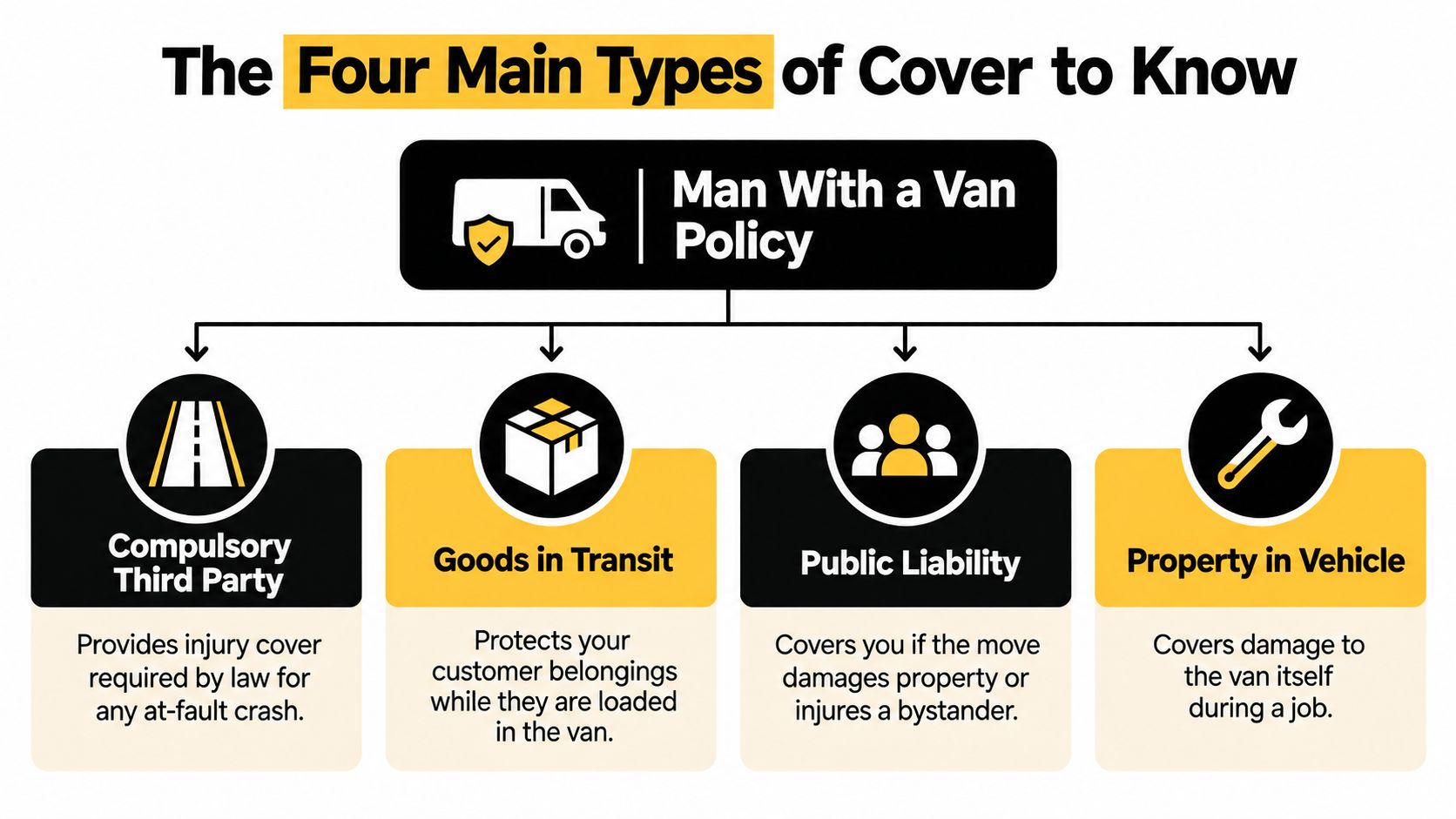
A van move usually touches four different insurance ideas, and they don't overlap as much as people think. If you treat them as one bundle, you can miss the gap that matters most on moving day.
Compulsory third party and commercial motor
Compulsory third party, or CTP, is about bodily injury caused by the vehicle. In Victoria, a van used for paid removals must have vehicle insurance that covers commercial or business use, and Business Victoria says commercial vehicles require third-party injury insurance (Business Victoria insurance guidance).
That is separate from the van itself. CTP doesn't pay to fix the vehicle, and it doesn't cover the customer's furniture, the building, or anything damaged while boxes are being carried.
Public liability
Public liability covers the business's legal liability for third-party injury or property damage arising from the job. That could mean a chipped wall, a broken lift panel, or a bystander injured during a move.
It's a different risk from vehicle damage, and it's a different risk again from the customer's goods. The policy wording has to match the operation, not just say “business.”
Goods in transit
Goods-in-transit cover is aimed at the customer's belongings while they're being transported. It's the layer that matters when a table gets damaged in the truck or a box is stolen from a vehicle under the wrong conditions.
The important point is what it excludes. Packing requirements, storage periods, unattended-vehicle rules, and fragile-item limits can all change whether a claim lands or fails.
Property in the vehicle
This is the part many customers forget to ask about. Damage to the van itself, including the load area or attached equipment, sits in the commercial motor policy, not in public liability or transit cover. If the mover says everything is covered, that claim should be tested against the actual schedule.
A Melbourne customer can use Get n Go's moving company insurance coverage guide as a starting point, but the policy documents always decide the outcome.
If the mover can't name the policy type, the cover probably isn't being explained clearly enough.
Which Policy Responds When Things Go Wrong
The clearest way to judge insurance is to match the risk to the policy that normally responds. That is more useful than asking whether a mover is “fully insured”, because that phrase can hide the detail that decides a claim.
| Scenario | Likely Policy Response | Key Condition |
|---|---|---|
| A television is dropped while being carried down stairs | Public liability or goods-in-transit, depending on where the loss happened and how the policy is written | The booking terms and policy wording need to show whether handling, loading, or unloading is included |
| The van collides with another vehicle on the way to the new address | Commercial motor, with CTP handling injury liability | The van must be insured for commercial use and the driver must be declared correctly |
| A locked van is broken into overnight and boxes go missing | Goods-in-transit, if the policy includes overnight storage or secure parking conditions | The policy may require defined security conditions and may exclude unattended situations |
| A wall, lift, or doorway is damaged during stair carrying | Public liability | The damage has to fall within the policy's property-damage wording and exclusions |
| Furniture stays in the truck overnight between pickup and delivery | Goods-in-transit, only if the cover includes storage or an overnight break | Storage wording, valuation method, and item exclusions matter |
| A passenger or bystander is hurt by the vehicle | CTP | This is bodily injury only, not property damage or goods loss |
The reason this matrix matters is simple. Vehicle cover, liability cover, and transit cover solve different problems. The Australian Government's business insurance guidance separates those roles clearly, including CTP, public liability, and goods-in-transit cover (business insurance types).
A company can look insured and still leave one big gap. That is why the documents have to be checked before money changes hands. For a practical explanation of what transit cover is meant to address, see goods-in-transit insurance details alongside the policy schedule.
How to Verify a Remover's Insurance Before Booking
The fastest way to avoid a dispute later is to ask for documents before the booking is locked in. A vague answer on the phone doesn't protect anyone when a claim lands.
What to request
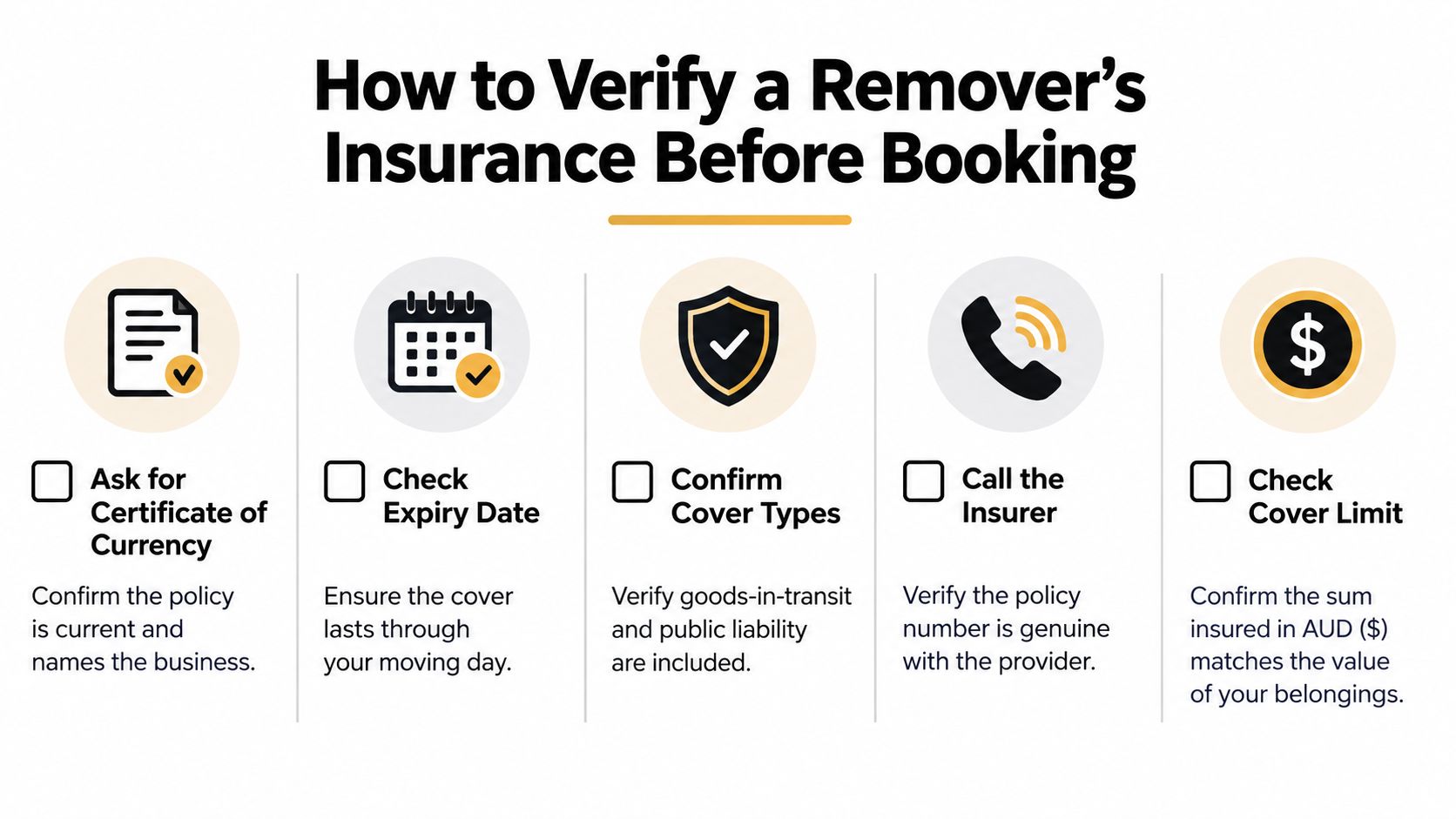
Start with the certificate of currency. That confirms the policy is current, and it should name the business you're hiring.
Then ask for the policy type, the coverage limits, and the exclusions. If the mover hesitates, that's a signal to slow down, not to assume the answer is fine.
Don't book on reassurance alone. Book on paper.
What to check next
Ask whether the policy covers loading, unloading, storage, and high-value items. Those are the areas where moving claims usually get messy, because the job often shifts between handling, transport, and temporary holding.
It also helps to ask the insurer or broker whether the policy number is genuine and active. A current-looking PDF isn't enough if the details don't line up.
If you want a service that already frames moving insurance in practical terms, Get n Go Removals Melbourne is one option to review alongside any other quote you're considering.
Questions worth asking before payment
- Who is insured: Confirm the legal entity matches the quote.
- What is covered: Separate vehicle damage, public liability, and goods in transit.
- What is excluded: Look closely at fragile items, customer-packed boxes, and storage.
- When cover starts: Make sure the timing fits your pickup and delivery window.
- How claims are handled: Ask what evidence they want if something is damaged.
A mover who can answer these points clearly is far easier to deal with than one who hides behind generic language. That clarity is part of good risk management, not paperwork theatre.
Why Goods-in-Transit and Public Liability Matter Most
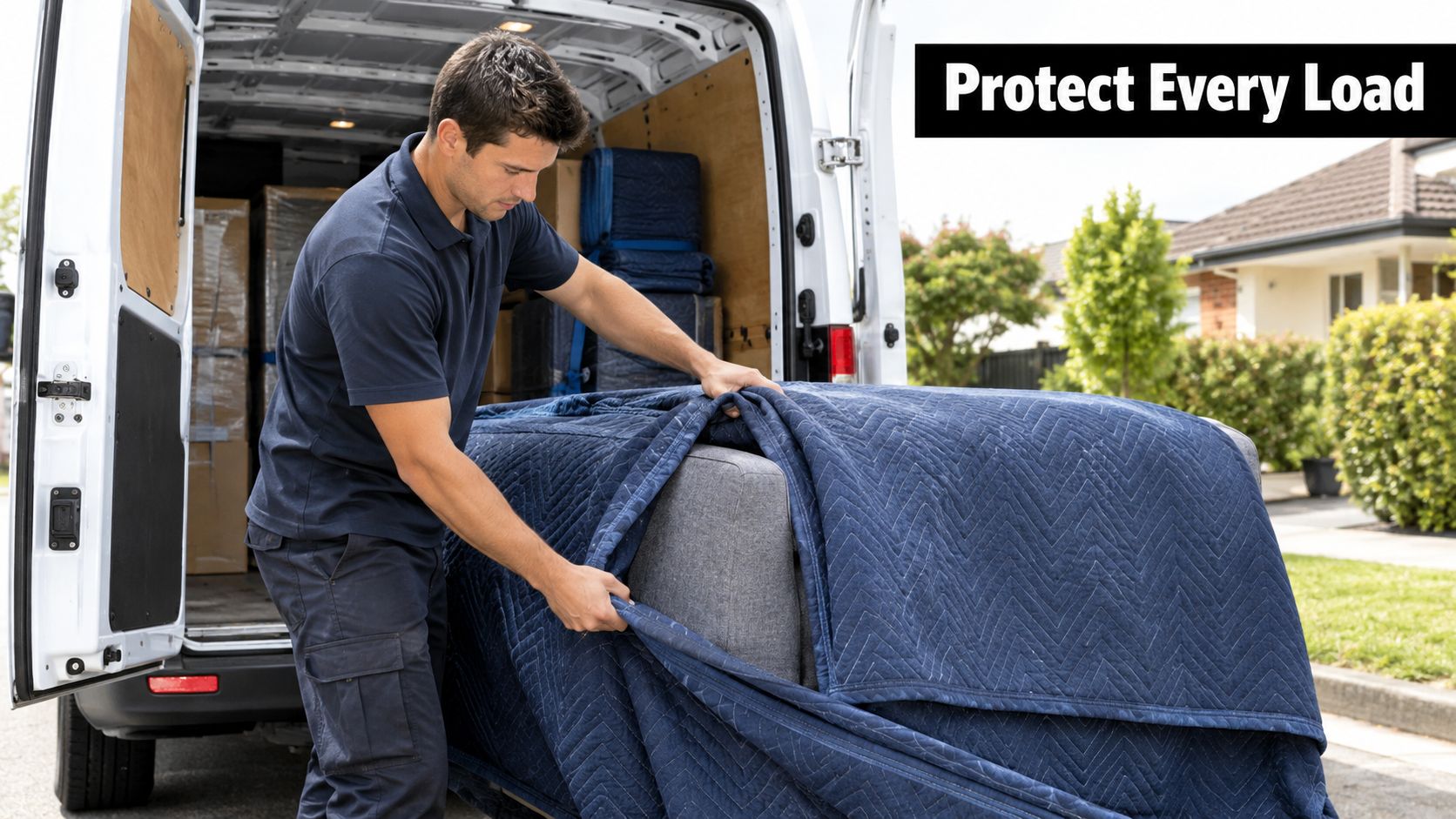
The two covers that deserve the closest look are goods-in-transit and public liability. They deal with the part of the move where risk is highest, when items are being lifted, carried, loaded, or taken through tight spaces around homes, apartments, and offices.
A lot of disputes start because “insured” gets treated like one blanket promise. It is not. A chair damaged in a hallway, a lamp cracked by movement in the van, and a passer-by injury are three different events, and they usually sit under different parts of the policy. If you want the plain-language version of public liability for movers, read our guide to public liability insurance for movers.
There is a useful parallel in other high-risk work. Good site-risk discipline in construction separates hazards instead of wrapping them into one vague safety claim, and practical guidance like construction site risk tips makes the same point. Moving work needs that same discipline, because the risk changes from driveway to stairwell to loading bay.
The practical rule is simple. If the item is still being handled or carried, goods-in-transit is the cover to check first. If someone outside the truck is injured or property is damaged, public liability is the relevant cover. If the van itself is damaged on the road, that sits elsewhere again.
A customer should never stop at a bundle label. Ask which event triggers which section, then check the exclusions under that section before booking. That is the only way to match the move to the policy that responds.
Consumer Rights Under Australian Consumer Law
Australian Consumer Law applies to furniture-removal services, and those rights can't be signed away in a booking form. That matters because some operators try to soften obligations with broad disclaimer language.
If a service fails badly enough, the consumer can cancel and seek a refund for unconsumed services, or keep the contract and claim compensation for the reduced value. The customer chooses the remedy, not the supplier (ACCC consumer law guide).
For a minor failure, the supplier generally has to be given a chance to fix the problem first. That could mean correcting a service mistake, completing a missing step, or repairing a manageable issue before the dispute escalates.
A business also mustn't accept payment when it knows, or should have known, that it can't supply the service in a timely manner. That rule matters for removal bookings, especially where the mover has accepted a date without the truck, crew, or capacity to complete the job properly.
Keep the booking confirmation, the insurance documents, and the condition photos together. Those three items make claims and complaints far easier to resolve.
Insurance and consumer rights work together, but they're not the same thing. Insurance helps absorb loss, while consumer law gives the customer a separate route when the service itself falls short.
Your Pre-Booking Insurance Checklist
A booking looks fine on paper until a claim needs to be made. Before you hand over a deposit, check the certificate of currency, the policy name, and the exact business entity on the paperwork. If any of those details do not match, stop and ask for corrected documents.
Ask whether the quote includes commercial vehicle use, public liability, and goods-in-transit cover. Then ask what is excluded, especially for loading, unloading, storage, and high-value items.
Get written confirmation of the insurer, the policy number, and the expiry date. If your move includes stairs, lift bookings, overnight holding, or interstate travel, have those details matched to the cover in writing. That is where policy language needs to match the job, not just the invoice.
Keep your own records too. Photos of pre-existing damage, a signed inventory, and the booking terms can save hours of argument later. Keep them with the quote and the insurance documents so there is one clear file if something goes wrong.
Read the cover carefully, compare the exclusions, and choose the operator who can show you exactly what protects your belongings before moving day.