
Understanding Interstate Moving Rates in Australia: A Complete Guide
Planning a move across state lines is a significant undertaking. While the excitement of a new beginning is high, the first practical question is always: "How much will this actually cost?" The answer to understanding interstate moving rates primarily depends on two key factors: the distance of your move and the total volume of your belongings. Consequently, moving a small apartment from Sydney to Melbourne will have a vastly different price tag compared to relocating a large family home from Brisbane to Perth.
This comprehensive guide is designed to demystify the entire process. We will delve into the details of each cost factor, providing you with the clear, expert advice needed to navigate your interstate move with confidence and financial clarity.
Your Quick Guide to Interstate Moving Rates
Moving interstate is a major life event, and gaining a firm grasp of the associated costs is the first step toward a seamless transition. It’s tempting to focus solely on the final figure of a quote, but by understanding the components that make up that price, you empower yourself to plan more effectively, budget accurately, and make informed decisions.
Consider your moving quote not as a simple price tag, but as a detailed breakdown of services. Each component contributes to the final cost. By dissecting these elements, you can see precisely where your money is allocated and identify potential opportunities for savings.
The Core Cost Drivers
Every interstate moving quote is built upon a foundation of fundamental factors. These are the primary variables that professional removalists use to calculate the baseline price for your relocation. Mastering these concepts will enable you to interpret any quote with expertise.
When formulating your moving budget, a few key elements consistently exert the greatest influence on the final price. The table below outlines these factors and explains their impact on your quote.
| Key Factors Influencing Your Interstate Moving Quote |
| :— | :— | :— |
| Cost Factor | Description | Impact on Rate (Low to High) |
| Distance Travelled | The total kilometres between your origin and destination addresses. This accounts for fuel, driver wages, and vehicle maintenance. | The greater the distance, the higher the cost. A move from Victoria to Queensland will be more expensive than one from Victoria to NSW. |
| Volume of Goods (m³) | The total space your belongings occupy in the truck, measured in cubic metres. More items necessitate a larger truck or multiple trips. | A studio apartment has a low impact, whereas a 4-bedroom home with extensive garage contents has a high impact. |
| Level of Service | The scope of services required, ranging from basic loading and unloading to a full-service move with professional packing and unpacking. | A standard "door-to-door" service is the most cost-effective option, while comprehensive, all-inclusive services will increase the rate. |
| Timing & Seasonality | The time of your move, such as a weekday in winter versus a weekend during peak summer. Supply and demand significantly affect pricing. | Off-peak periods (mid-month, mid-week, winter) have a low impact. Peak periods (weekends, public holidays, summer) have a high impact. |
As illustrated, the final cost is not determined by a single factor but by the interplay of these key variables.
Understanding these core elements is your first step to budgeting accurately. You're no longer just looking at a price; you're seeing the story behind it. For a deeper dive, check out our guide on the average cost of movers to see how these services stack up.
This guide will pull back the curtain on the entire process, providing the detailed insights you need to manage your interstate move confidently.
The Three Pillars of Your Moving Quote
Every interstate moving quote you receive is fundamentally constructed upon three core pillars. Grasping these pillars demystifies the pricing structure and equips you to evaluate quotes with enhanced confidence.
When you delve into interstate moving rates, you'll find that distance, the volume of your possessions, and the required labour are the foundational elements. These are the universal metrics in the moving industry that determine the true cost of relocating your life from point A to point B.
Pillar 1: Distance – The Kilometres Count
This is the most straightforward pillar. Moving your entire household from Sydney to Perth is a vastly different logistical challenge than a shorter trip from Sydney to Melbourne. The cost implications extend beyond just fuel consumption.
Longer journeys equate to more time on the road for the moving crew, leading to higher labour costs. They also result in increased wear and tear on the vehicle and introduce a greater potential for logistical complexities and delays.
- Fuel Costs: The most significant and direct expense tied to the distance of your move.
- Driver Wages: The crew must be compensated for their total time, including the hours spent driving, not just loading and unloading.
- Vehicle Maintenance: Long-haul trips place considerable strain on trucks, and the cost of maintaining a reliable fleet is factored into your rate.
In short, the further your destination, the more substantial this portion of your quote will be.
Pillar 2: Volume – The Space Your Life Occupies
The second pillar is volume, measured in cubic metres (m³). This represents the total space your belongings will occupy in the moving truck. A larger volume of goods requires a larger truck and more resources, thus increasing the cost.
For context, a one-bedroom apartment might occupy 10-15m³, while a three-bedroom family home could easily require 30-40m³ or more. Professional removalists are skilled at estimating volume, but you can approximate it by considering the quantity of your furniture and the number of boxes.
A common pitfall is underestimating volume. Items stored in the garage, shed, or bulky sporting equipment can add several cubic metres that you may not have initially accounted for, leading to an unexpected price increase.
This is precisely why a thorough declutter before you move is one of the most effective cost-saving strategies. Fewer possessions mean less volume, which directly translates to a lower moving bill.
Pillar 3: Labour and Transport – The Human and Machine Power
The final pillar encompasses the personnel and equipment required to execute your move successfully. This includes the professional removalists performing the physical work and the truck itself. The cost is influenced by the complexity of your move and the specific services you require.
Labour involves more than just lifting boxes. It includes the skilled technique of packing a truck securely to prevent items from shifting or breaking during a long journey. It also accounts for navigating access challenges, such as narrow stairwells or apartment buildings without elevators. To understand the specifics for your move, it's best to obtain a detailed moving quote that considers these variables.
The transport component refers to the actual vehicle. A large-scale move needing a 12-tonne truck will naturally cost more than a smaller one requiring only a 4.5-tonne truck. This pillar ensures that the right-sized team and vehicle are allocated for an efficient and seamless relocation.
Unpacking The Cost of Additional Moving Services
While distance, volume, and labour form the foundation of your moving quote, a truly smooth interstate move often involves more than just transporting boxes. This is where additional services become crucial. Although they add to the initial quote, they can provide invaluable savings in time and stress, while also safeguarding your belongings. These services are what truly refine the final interstate moving rates.
One of the most requested add-ons is professional packing and unpacking. While it may seem like a luxury, its true value lies in the expertise provided. Professional movers are trained to wrap, box, and secure items using industry-best practices, significantly reducing the risk of damage during transit. For an average three-bedroom house, this service can add several hundred dollars to the cost but saves you countless hours of meticulous work.
Valuing Protection With Transit Insurance
It's wise to view transit insurance not as an optional extra, but as an essential component of your move. The basic liability coverage included by most removalists is typically very limited, often only applying in cases of major incidents like a vehicle fire and paying out based on weight. This means a high-value television could be valued the same as a box of old towels—a far from ideal scenario.
Comprehensive transit insurance, however, covers your goods for their actual replacement value, providing a crucial safety net against accidental damage that can occur during a long journey.
- Peace of Mind: Relax knowing your valuables are properly protected.
- Financial Security: Avoid unexpected expenses for repairing or replacing damaged items.
- Customisable Coverage: Policies can be tailored to match the specific value of your belongings.
This protection ensures that a minor mishap on the road doesn't escalate into a significant financial burden upon your arrival.
This flowchart illustrates the primary factors—distance, volume, and labour—that form the basis of every moving quote.
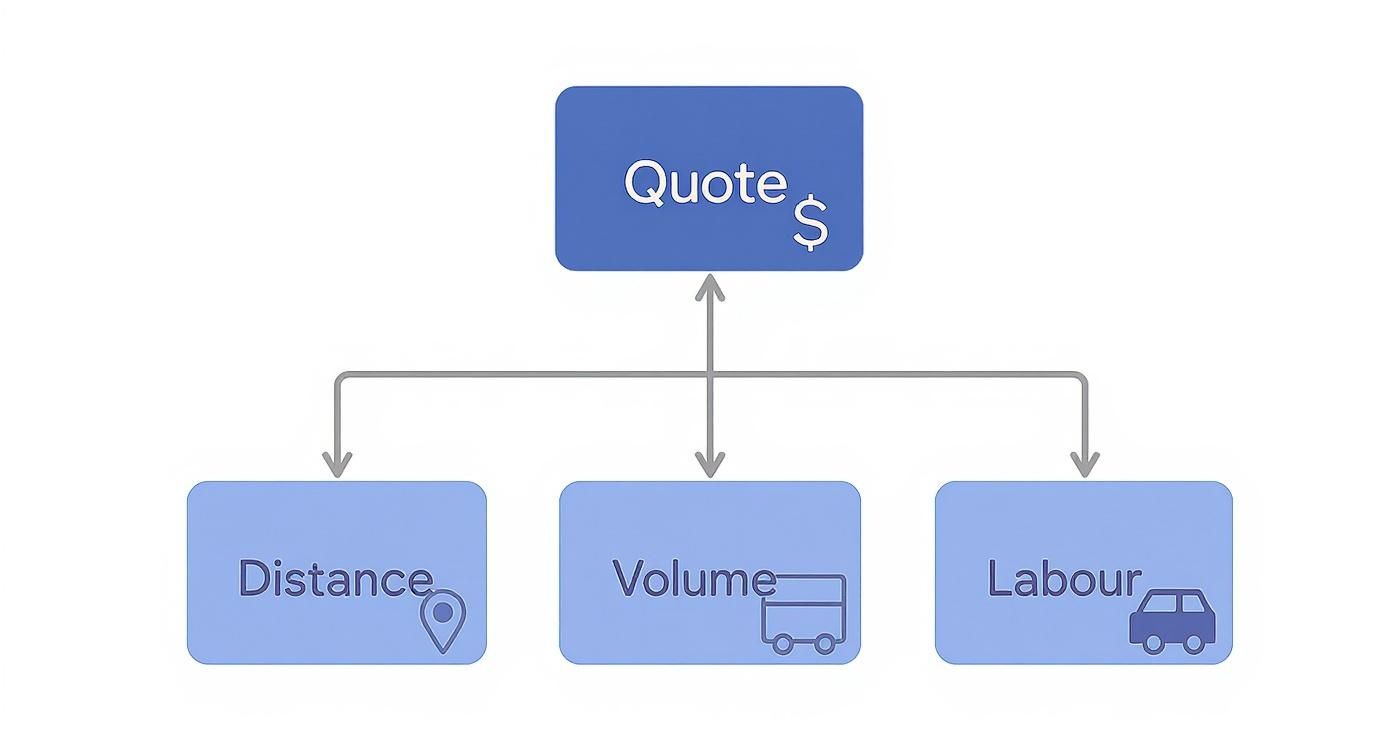
Understanding these core components helps you see how additional services build upon this base price to create your final moving cost.
Handling Specialised and High-Value Items
Certain possessions require more than a standard moving box. For delicate, bulky, or high-value items, specialised services are necessary.
Proper preparation is critical, which is why understanding the nuances of shipping antique furniture safely, for instance, is vital. Items that frequently require specialised attention include:
- Pianos and Pool Tables: These items are not just heavy; they require specialist equipment and expertise for correct dismantling, transportation, and reassembly.
- Artwork and Antiques: These irreplaceable items may necessitate custom crating and even climate-controlled transport to protect them from damage.
- Vehicle Transport: Professional vehicle transport offers a convenient solution for moving a second car across the country without a long road trip.
- Pet Relocation: Specialised pet movers ensure your furry family members travel safely and comfortably, in compliance with all state regulations.
Each of these services is priced based on the specific needs of the item and the associated risk. While they increase the total cost, they are essential for ensuring your most treasured possessions arrive at your new home intact. It is also beneficial to be aware of all potential expenses. For a complete overview, consult our guide on the hidden costs in moving house.
How Timing and Location Impact Your Moving Price
Beyond the volume of your belongings and the distance of your move, two other significant factors influence your final bill: when you move and where you're moving to and from. This is analogous to booking a flight, where the same seat can have vastly different prices depending on the season or day of the week. Understanding these dynamics can provide a strategic advantage in planning a cost-effective move.
The moving industry operates on a cyclical rhythm, with distinct peak and off-peak seasons. Unsurprisingly, as demand for removalists increases, so do the prices.
Navigating Peak and Off-Peak Seasons
The peak season for moving in Australia is undoubtedly summer. From December to February, a confluence of factors—school holidays, favourable weather, and the end of many work contracts and leases—leads to a surge in demand. If you plan your move during this period, you will be competing with a large portion of the country for a limited number of trucks and moving crews.
Conversely, the off-peak season typically occurs during the cooler months, from approximately May to August. With fewer people relocating, removalists have greater availability. To maintain a steady workflow, they are often more inclined to offer competitive rates.
Key Takeaway: If your schedule allows for flexibility, booking your move for a weekday in the middle of winter could result in significant savings compared to a Saturday in January. Even shifting your move to mid-month, rather than the end-of-month rush, can often lead to a more favourable price.
The Influence of Moving Routes and Regional Demand
Your origin and destination postcodes are crucial, but the pricing is more complex than just the distance between them. The popularity of a moving route is a major determinant.
Consider a high-traffic corridor like Sydney to Melbourne. Trucks operate frequently in both directions, often fully loaded. This operational efficiency allows moving companies to offer more competitive pricing. For more insight, explore our detailed guide for removals from Sydney to Melbourne.
In contrast, moving to a more remote or less-travelled location can increase the cost. A removalist may need to "deadhead"—drive the truck back empty—and this operational cost is typically passed on to the customer. The direction of your move is also relevant, as it is influenced by national migration patterns.
Recent statistics from the Australian Bureau of Statistics provide a clear picture. In the year ending June 2023, Queensland experienced a net gain of 32,625 people from interstate migration, while New South Wales had a net loss of 33,184 residents. This indicates that significantly more people are moving into Queensland than are leaving. High demand for removal services on inbound routes to popular states can consequently increase prices. You can explore more detailed Australian migration statistics to see these trends for yourself.
By understanding these market forces, you can transition from simply collecting quotes to making strategic decisions. Aiming for quieter periods and choosing routes with better value can turn market trends into tangible savings for your interstate move.
Real-World Interstate Moving Rate Examples
Discussing the factors that influence interstate moving rates is informative, but seeing concrete figures provides practical clarity. To help you budget effectively, we have compiled cost estimates for some of Australia's most common moving routes.
These figures should be considered a starting point, not a definitive quote. They are intended to provide a ballpark estimate, enabling you to create a realistic budget and evaluate whether the quotes you receive are reasonable.
Assumptions Behind These Estimates
Before reviewing the numbers, it's important to understand the basis for these estimates. The price ranges are for a standard move without significant complications.
Here’s what we’re assuming:
- Standard Service: This includes the crew loading your pre-packed boxes and furniture, transporting them to your new home, and unloading. It does not include professional packing, unpacking, or storage.
- Easy Access: This assumes homes with straightforward access for the moving truck, without significant challenges like multiple flights of stairs, long walks from the truck to the door, or restricted parking.
- Off-Peak Move: These prices are based on a weekday move outside of peak season. A move on a weekend or during the summer school holidays will typically incur higher costs.
With these assumptions in mind, let's examine the estimated costs.
Estimated Interstate Moving Rates For Popular Australian Routes
The table below provides a breakdown of potential costs for some of the most frequently travelled routes in Australia. It clearly demonstrates how both distance and the size of your home significantly impact the final price.
| Route (From/To) | 1-Bedroom Apartment (Est. Cost) | 3-Bedroom House (Est. Cost) | 5-Bedroom House (Est. Cost) |
|---|---|---|---|
| Sydney to Melbourne | $1,500 – $2,500 | $3,000 – $4,500 | $5,000 – $7,000 |
| Sydney to Brisbane | $1,800 – $2,800 | $3,500 – $5,000 | $5,500 – $7,500 |
| Melbourne to Brisbane | $2,200 – $3,500 | $4,000 – $6,000 | $6,500 – $9,000 |
| Brisbane to Perth | $4,500 – $6,500 | $7,000 – $10,000 | $9,500 – $13,000 |
| Melbourne to Adelaide | $1,400 – $2,400 | $2,800 – $4,200 | $4,500 – $6,500 |
As you can see, the variation is substantial. A common route like Melbourne to Adelaide is significantly more affordable than a cross-country relocation from Brisbane to Perth.
Why Your Quote Might Be Different
This table serves as a valuable guide, but your final quote will be tailored to your unique circumstances. If your move requires professional packing, short-term storage, or involves navigating a complex apartment building, your costs will be higher.
Remember, the cheapest quote is not always the best value. A reputable mover provides peace of mind through experienced staff, proper insurance, and reliability—assets that are invaluable during a long-distance move.
Use these figures as a tool for informed discussions with potential movers. For a large-scale move, our team of expert long distance movers can provide a precise quote based on your specific requirements, ensuring your budget is based on facts, not just industry averages.
Smart Strategies to Lower Your Moving Costs
Understanding the components of an interstate moving quote is the first step; actively reducing that cost is the ultimate goal. With strategic planning, you can significantly lower your final bill without compromising on a safe and efficient move. This is your game plan for a budget-friendly relocation.
A few calculated decisions in the weeks before your move can save you hundreds, or even thousands, of dollars—money that can be better allocated to settling into your new home.
Declutter and Downsize Your Volume
The most effective way to reduce moving costs is to move fewer items. As volume is a primary driver of your quote, every item you decide not to take translates into direct savings. A thorough and honest decluttering process is not merely about tidying up; it is one of the most powerful budgeting tools at your disposal.
A simple rule of thumb: if you haven't used an item in over a year, carefully consider whether it's worth paying to transport it across the country.
By donating, selling, or recycling unwanted furniture and other belongings, you reduce the total cubic meterage required for your move. This can lower your quote and may even allow for the use of a smaller, more cost-effective truck.
Consider this: disposing of a bulky old sofa not only saves you the cost of moving it but might also generate some cash if you sell it online. It's a win-win strategy with an immediate positive impact on your interstate moving rates.
Become a Savvy Packer
While professional packing services offer significant convenience, adopting a DIY or hybrid approach can yield substantial savings. You can easily pack non-fragile items such as clothes, books, and linen yourself, while entrusting more delicate items—like glassware and electronics—to the experts.
You can also be resourceful in sourcing packing materials to cut costs:
- Hunt for Free Boxes: Visit local supermarkets, liquor stores, or retail outlets. They often have sturdy boxes available for free. Online community forums are another excellent resource.
- Use What You Already Own: Towels, blankets, and clothing can serve as effective padding for fragile items, reducing the need to purchase bubble wrap and packing paper.
- Buy in Bulk: If you need to purchase supplies, hardware stores often offer better value when buying in bulk compared to specialty moving stores.
Compare Quotes with a Critical Eye
Obtaining multiple quotes is essential, but the process should go beyond simply selecting the lowest price. A suspiciously low quote may conceal exclusions or hidden fees that could lead to unexpected costs later. When comparing, look beyond the final number to assess the overall value provided.
Lay your quotes side-by-side and ask critical questions:
- What level of transit insurance is included, and what are the terms?
- Are there potential extra charges for difficult access, stairs, or delays?
- Is GST included in the final price?
- What is the company's policy on cancellation or rescheduling?
By thoroughly vetting what each quote includes, you can avoid unpleasant surprises and maintain control over your budget, paving the way for a genuinely affordable and stress-free interstate move.
Got Questions About Moving Rates? We’ve Got Answers.
Let's address some of the most frequently asked questions about interstate moving rates. Moving is a complex process, and it's natural for questions to arise as your moving day approaches. Our goal is to ensure you feel completely prepared and confident.
How Far in Advance Should I Book My Removalist?
For an interstate move, the best advice is to book as early as possible. As a general rule, we recommend securing your removalist at least four to six weeks before your planned move date. If you are moving during the peak summer season (December to February), you should aim to book even earlier—ideally eight weeks or more in advance.
Booking early offers several distinct advantages:
- Greater Choice: You have access to a wider selection of reputable movers, rather than being limited to last-minute availability.
- Better Pricing: Early bookings can often secure more competitive rates before demand drives prices up.
- Reduced Stress: It provides ample time to coordinate packing, insurance, and other logistical details without a sense of urgency.
Is a DIY Move Cheaper for Long Distances?
The idea of renting a truck and managing the move yourself can seem like a cost-effective option. While this may be true for a local move, the financial equation for an interstate relocation is far more complex. When you account for all the associated costs, a DIY move can quickly become a logistical and financial burden.
Consider the true costs of a DIY interstate move:
- Substantial one-way truck rental fees.
- The significant cost of fuel to travel hundreds or thousands of kilometres.
- Accommodation for overnight stops during the journey.
- The value of your own time, physical effort, and the risk of injury from improper lifting.
For long distances, the comprehensive pricing, efficiency, and safety offered by a professional removalist typically provide superior value and peace of mind.
What Is Backloading and How Can It Save Me Money?
Backloading is an industry term for a cost-saving solution that can significantly reduce your moving expenses. It involves booking space on a moving truck that is making a return trip from a previous job. For example, if a truck completes a delivery from Melbourne to Sydney, it can transport your belongings on its otherwise empty return journey to Melbourne.
Backloading allows you to utilize that empty truck space at a heavily discounted rate. You still receive professional moving services, but because the truck was already scheduled to make the trip, the company can offer a much lower price.
This is an excellent option if you have some flexibility with your moving dates, as your schedule will need to align with the truck's itinerary. It is also an environmentally friendly choice, as it ensures trucks are not consuming fuel on empty runs.
Ready to get a clear, no-surprise quote for your interstate move? The team at Get n Go Removals Melbourne has the experience and expertise to make your relocation seamless and affordable. Contact us today for a free, detailed moving quote.