Couch Removal Melbourne: A Complete 2026 Guide
You're halfway through moving day in Melbourne, and the old couch is still wedged in the lounge room. The new occupants are arriving, the lift booking is running out, and the sofa won't fit through the hallway without careful planning. At that point, couch removal in Melbourne isn't just a matter of finding a truck. You need to choose the right disposal route, check your local council's rules, and account for stairs, lifts, parking and the couch's condition.
Introduction to Couch Removal in Melbourne
A couch can be reusable furniture, council hard waste, or a paid removal job. The right lane depends on three checks: your council area, the sofa's condition, and the route from the room to the collection point. Treating those checks like a pre-trip inspection helps prevent a cheap disposal plan from becoming an expensive last-minute booking.
Melbourne councils provide formal ways to handle bulky furniture. The City of Melbourne classifies furniture as hard waste and lists the Dynon Road Waste and Recycling Centre in West Melbourne as a disposal option open 7 days a week from 9am to 3pm, except Good Friday and Christmas Day. Review the council's hard-waste information before choosing between a booked collection and a drop-off.
A couch cannot go in a regular household bin. Local hard-waste services create a structured disposal route, while councils also encourage reuse or donation when furniture remains in good condition. A clean, usable sofa belongs in the reuse lane. A council collection suits eligible households with flexible timing. Paid removal is the practical choice when the sofa must be carried from an apartment, access is difficult, or the collection schedule does not match your move.
Practical rule: Check your council area, the couch's condition, and the path to the kerb or truck before choosing a disposal method.
For example, a renter leaving an apartment may need a fast pickup with stair handling and wall protection. A homeowner with a ground-floor sofa and flexible timing may save money through a booked council service. Someone replacing a presentable couch might sell or donate it instead of paying for disposal. If the couch is part of a larger move, this Melbourne relocation guide can help organise furniture, packing, and settlement tasks.
The rules change between municipalities. Booking requirements, collection limits, accepted items, and placement instructions depend on the council that services the property. The City of Melbourne offers one free hard-waste collection of up to 1 cubic metre per financial year, with dates released two months ahead for booking. Merri-bek provides another example, offering two free collections each year to properties that pay the annual Waste Service charge, according to its hard-waste guidance.
The cheapest reliable option is therefore a local decision, not a city-wide rule. Check council eligibility first, then measure the couch and inspect every tight point, including corridors, stairs, lifts, doorways, and parking access. Those details determine whether a free collection remains straightforward or whether scheduled movers provide better value.
Comparing Removal Options in Melbourne
The right removal method depends on four practical questions: eligibility, timing, labour and access. A council service may have no collection charge for an eligible household, yet prove unsuitable for a last-minute move or a couch that exceeds the allowed volume. Treat the decision like choosing transport for a large parcel. The cheapest vehicle is useful only if it can reach the property and meet the schedule.
Council hard-waste collection
Start with your council's booking rules. The City of Melbourne permits one free collection per financial year, capped at 1 cubic metre, while Merri-bek offers two free collections each year for eligible properties. Couches are accepted as hard waste in these programs, but acceptance, booking windows and placement rules vary between municipalities.
This option suits a ground-floor couch that can be placed at the kerb or another approved accessible point. Its strengths are low disposal cost and a defined municipal process. Its limits are advance booking, volume restrictions and the fact that crews generally do not enter the home. A narrow hallway or several flights of stairs can turn a free collection into a separate lifting problem.
Donation or resale
A clean, intact couch may still serve another household. Photograph it clearly, provide the dimensions, and disclose stains, pet exposure and structural faults. Donation services set their own conditions, so a marked couch or furniture in a difficult location may be refused.
Selling can reduce the amount you spend on removal, but the buyer must still collect it or arrange transport. If the sale or settlement is delayed, moving home storage advice can help you plan temporary storage without leaving the couch across a corridor, driveway or loading area.
DIY transfer-station drop-off
A transfer-station trip gives you control over the day, provided you have a suitable vehicle, lifting help and a facility that accepts the couch. Disposal fees can vary by couch size. One Victorian schedule lists a single couch at $27.00–$34.00 and a double-or-larger couch at $32.00–$40.00. Use figures such as these as an example, then check your own council before loading the vehicle.
Paid removal service
Professional removal is often the more reliable choice for a heavy sofa, difficult access, urgent timing or an item that must be collected from inside the property. Request an itemised quote covering labour, loading, transport, disposal, protection, stairs and lift handling. The comparison is not only the invoice. It also includes the time, vehicle arrangement and physical risk involved in a DIY lift.
Cost Breakdown for Couch Removal
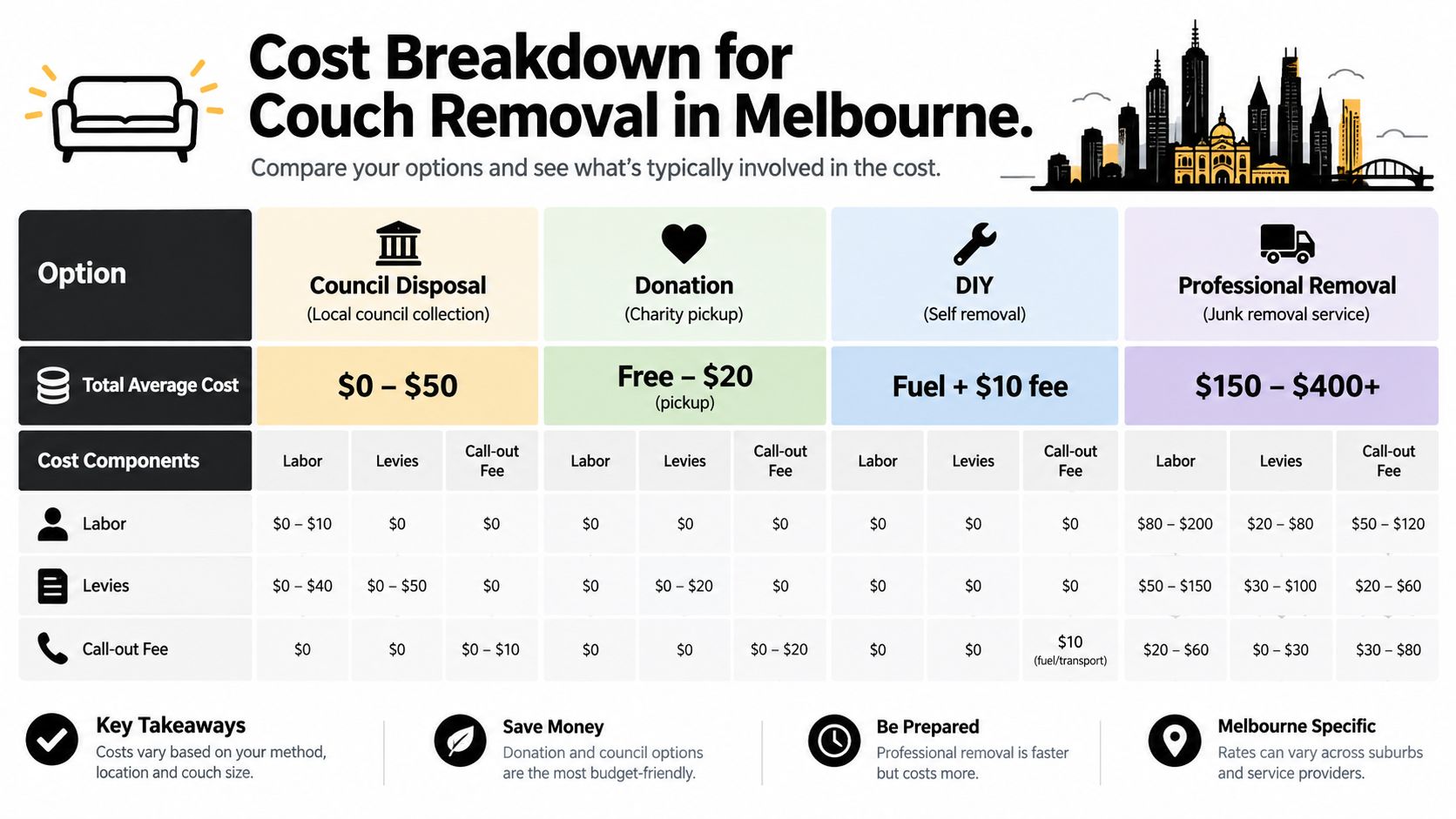
A Melbourne homeowner can face very different costs for the same couch. The final quote depends on the disposal route, collection point, access, travel distance and vehicle space. Disposal is only one component. Labour and landfill-related charges may also affect the total.
Council collection can be the lowest-cost option when the household qualifies and the couch fits the local allocation. The City of Melbourne's free service allows 1 cubic metre per address and requires advance booking. It excludes commercial and retail properties. The couch must be placed at the kerbside or another accessible location by the day before collection, because crews will not enter private property (City of Melbourne hard-waste booking information).
DIY disposal gives you a clearer upfront fee, but the full cost includes more than the transfer-station charge. Allow for fuel, a suitable vehicle and lifting help. Victorian fee examples show that a single-seater and a larger sofa can fall into different price categories. They illustrate size-based charging, not a universal Melbourne tariff.
| Council | Single Seater | 2-3 Seater |
|---|---|---|
| Hepburn Shire example | $27.00–$34.00 | $32.00–$40.00 |
| Other Victorian council example | $30.00 | $40.00 |
These fee ranges come from published Victorian transfer-station schedules. Check the receiving facility before loading the couch. A Melbourne-area site may use different categories, conditions or charges.
Victoria also applies a landfill levy to waste received at landfill. That charge can influence the provider's disposal cost, even when the sofa is treated as ordinary bulky waste. The invoice may therefore include downstream disposal costs as well as transport (EPA Victoria's waste levy explanation).
What a private quote includes
A private quote usually covers:
- Labour: Carrying the couch from its room, protecting surfaces, handling stairs and loading the vehicle.
- Vehicle capacity: A sectional or several sofas may need more space than a single-item van offers.
- Travel: Pickup distance affects driving time and fuel use.
- Access: A ground-floor kerbside collection takes less time than an upper-floor apartment job.
- Disposal: The provider may pay a facility fee or landfill-related charge.
- Minimum booking requirements: Some operators charge for minimum labour or vehicle time.
- Special handling: Recliners, modular frames, antique furniture and delicate upholstery may need extra preparation.
For context on labour pricing during household moves, read this guide to the cost of movers. Keep separate household budgets separate too. You can compare bathroom renovation costs without combining that project with the removal invoice.
Size Weight and Access Impact on Pricing
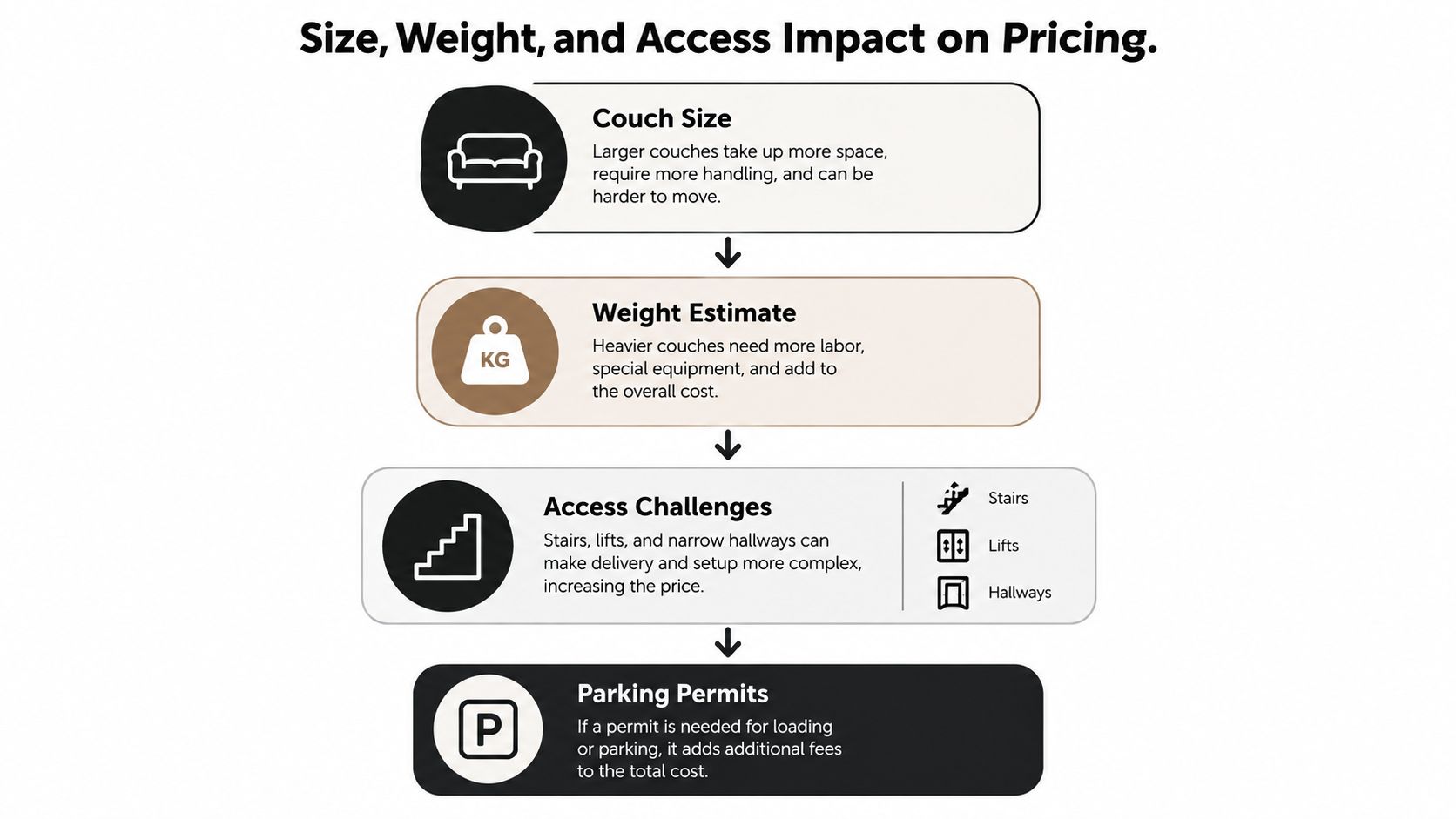
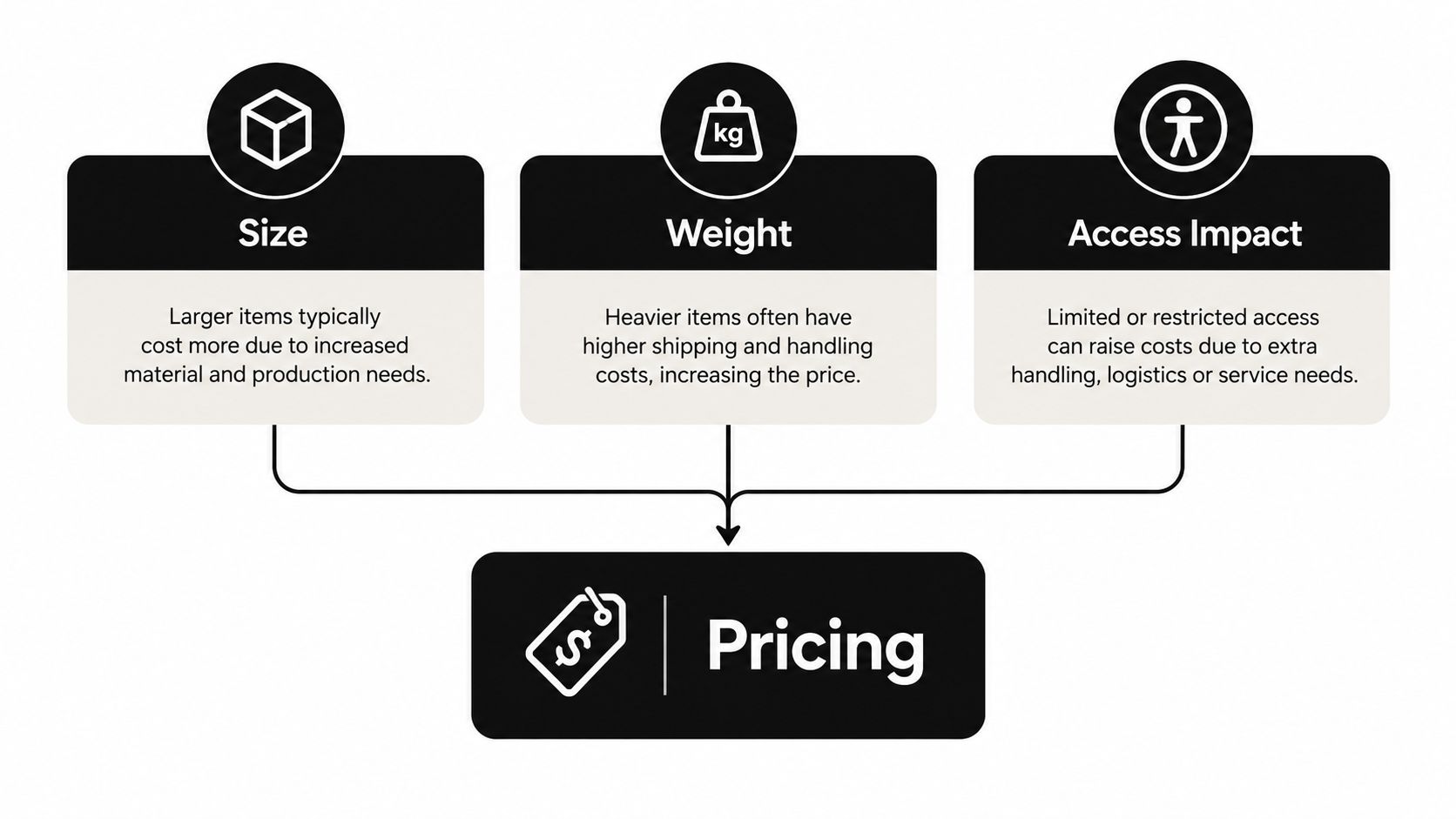
A couch's dimensions are only the starting point. The removal team must understand how the item behaves in the building, not just how it looks in the room. A compact sofa can become difficult if it needs to turn through a narrow stairwell, while a larger model may be straightforward when it sits beside a wide ground-floor doorway.
Measure the complete route
Measure the couch's length, height and depth. Then measure the entry door, internal doorway, hallway width, lift opening and any tight turn. Include skirting boards, handrails and low ceilings in your assessment. A sofa that fits the front door may still fail at the first corner inside.
Weight affects the number of people and the equipment required. Recliners and modular furniture may distribute weight unevenly, which makes them harder to balance. If the legs, arms or sections can be removed safely, tell the mover before the quote is prepared.
Treat access as part of the job
An easy pickup has a clear path, legal parking nearby and a couch that can be carried without dismantling. An apartment removal may involve a lift booking, protective coverings for shared areas, a long walk from the loading zone or multiple flights of stairs. Those conditions increase handling time and may require extra crew members or a larger vehicle.
Providers note that multiple couches and bulky items may require a large truck and 2–3 strong people for safe carrying, lifting and loading (Melbourne clearance-service guidance). That doesn't mean every single sofa needs the same crew. It shows why an accurate quote depends on the item and route together.
Before requesting a quote: Send photographs of the couch, the pickup room, the building entrance, stairs or lift, and the planned parking position.
Parking can create a separate delay. If the truck can't stop close to the entrance, the team must carry the couch farther, and a busy street may require building or council coordination. Give the mover the suburb, floor level, lift details and any restricted access information. You can also use this guide to calculate cubic metres when several items are leaving the property at once.
Specialist Handling Practices by Professional Movers
Professional couch removal is less about brute strength and more about controlling movement. A trained team first checks the couch, identifies removable parts and studies the route. They then choose the safest way to protect the upholstery, walls, floors and door frames.
A typical handling sequence looks like this:
- Inspect the sofa: Check reclining mechanisms, loose legs, modular joins, fragile timber and areas that could snag.
- Prepare the path: Remove ornaments, rugs and small furniture. Open doors fully and protect vulnerable corners.
- Wrap exposed surfaces: Use moving blankets, stretch wrap and corner protection where appropriate. Upholstery needs breathable protection when it will be stored for an extended period.
- Disassemble carefully: Remove legs or separate modular sections only when the construction allows it. Keep hardware together and label parts.
- Use controlled lifting: Dollies, lifting straps and coordinated commands help the team move the couch without twisting or dropping it.
- Load securely: Position the sofa to reduce pressure on delicate parts, then secure it against movement in transit.
- Reassemble and check: If the service includes reassembly, refit components and inspect the furniture and access route.
White-glove handling becomes especially valuable for antique, designer or delicate sofas. One useful way to think about it is piano-style care adapted to upholstery: the team plans every turn, pads contact points and treats the surrounding property as part of the item's protection zone.
A careful mover doesn't ask only, “Can we lift it?” They ask, “Where can it touch, what can catch, and how do we control the next movement?”
Premium handling can be worthwhile when the couch has high replacement value, delicate timber, light-coloured fabric or an awkward construction. It can also suit apartment residents who can't risk marks in shared corridors or damage to lift panels. For this level of service, review the white-glove moving service and confirm exactly what wrapping, disassembly, reassembly and insurance cover are included.
Scheduling Your Removal and What to Expect on the Day
A smooth booking starts with clear details. Send the mover the couch's dimensions, photos, pickup and delivery suburbs, floor levels, lift access, stairs, parking limits, and whether the sofa is going to disposal, storage, sale, or relocation. That gives the crew a proper plan instead of a guess.
A practical booking sequence
- Request quotes: Ask for a written breakdown, not a vague total.
- Confirm the date: Match the job with settlement, lease handover, delivery, or council timing.
- Check council windows: If you are using hard-waste, book early and follow the local collection rules, as noted earlier.
- Prepare the area: Clear the route, empty drawers, remove cushions, and secure loose parts.
- Coordinate arrival: Keep your phone close and make sure the team can reach the agreed loading point.
- Complete the pickup: Check that the room, hallway, and furniture are clear before the vehicle leaves.
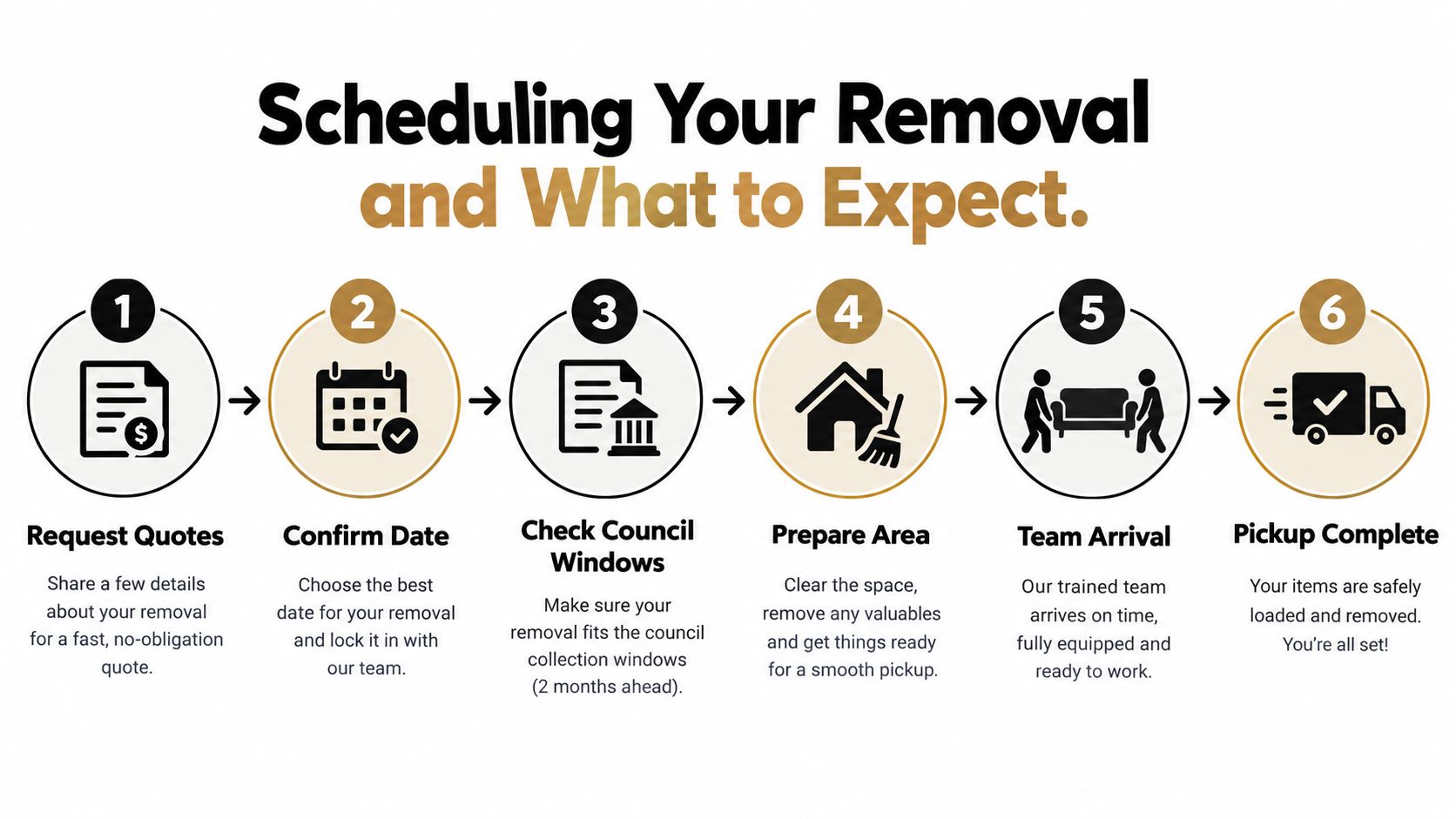
Council rules still shape the timetable. Hard-waste collection slots are released in advance, so a booking needs to be made before moving day, not after it. The couch also has to sit where the crew can reach it, so confirm whether that means the kerb, a designated collection point, or another approved location.
For a professional pickup, clear the route before the team arrives. Move boxes out of hallways, open gates, reserve the lift if needed, and check whether the truck can stop safely. Do not assume the crew can enter a private area or dismantle a sofa without agreement first.
Wrong access details are one of the most common causes of delays. Calling a basement route “ground floor” or forgetting a narrow lift changes the labour plan and the equipment the mover brings. Late cancellations can also upset a scheduled route, so read the booking terms and report changes as soon as they come up.
A short visual guide can help before the appointment:
Conclusion and Choosing the Best Service
The right couch removal method depends on your priorities. Council collection can minimise disposal costs when your household qualifies and the sofa fits the local rules. Donation or resale may avoid disposal altogether when the item is clean and usable. Paid removal earns its cost when timing, stairs, lifts, distance or careful handling matter more than the lowest possible fee.
Measure the couch and access route before asking for a quote, and describe every obstacle clearly. If you're protecting a sofa before a move or storage period, Casamé Home couch covers may help keep it covered between uses. For local support, compare furniture removalists near you and choose the service that matches your budget, schedule and handling requirements.
Get n Go Removals Melbourne can move a single couch or coordinate it as part of a home or apartment relocation, with furniture protection, disassembly and access planning available for suitable jobs. Visit Get n Go Removals Melbourne to describe your couch, pickup conditions and preferred date, then request a clear quote for a safer, more organised removal.