
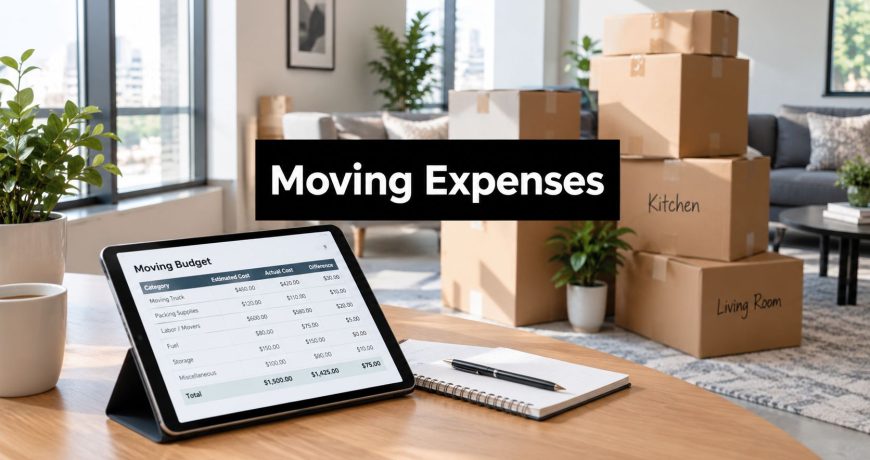
Business Moving Expenses: A Practical Budget Guide
You've signed the new lease, told the team, and locked in a removalist quote that looked reasonable. Then the extras start. IT needs after-hours help, the building wants a lift booking fee, and half the furniture has to sit in storage because the fit-out isn't ready. That's how business moving expenses drift. Not through one big mistake, but through dozens of small costs nobody owned, categorised, or documented from day one.
Why Most Office Moves Blow the Budget
Most Melbourne operations leads know this pattern. The truck and crew were quoted tightly, so finance approved the number. Nobody priced disconnection and reconnection, weekend access, packing materials, or the extra day of storage when settlement slipped. The final invoice lands well above the quote and everyone's surprised except the person who had to fix problems on the day.
Your first decision is simple. Treat the move as one project with one owner and one ledger, not as a transport booking with loose receipts attached. Budgeting, tracking, and tax treatment aren't separate jobs. They're the same job viewed by operations, finance, and your tax adviser.
Three Ways Budgets Drift
- Unbundled quotes: The removalist price covers loading and transport, but furniture reassembly, secure document handling, parking permits, and after-hours labour sit outside it. You pay for them anyway, just without approval or comparison.
- Mixed costs: Office assets, an employee's household goods, staff travel, and temporary accommodation end up on one invoice. Finance then can't tell what's a business operating cost, what's an employee benefit, and what's private.
- Reactive overtime: Lift bookings, loading dock slots, and IT sequencing get sorted late. Crews wait, work runs into the evening, and you pay premium rates to solve a scheduling problem.
Start by asking any provider you're assessing from business moving companies near you to itemise what's included and what isn't. Put every exclusion into your own budget lines. If a cost has no owner, no category, and no supporting document planned, it doesn't belong in an approved budget yet.
Practical rule: If you can't say who approved a moving cost, what business purpose it served, and where the invoice will be filed, don't commit to it.
That discipline sounds administrative. It is operational. A named owner spots clashes early, challenges duplicate charges, and stops staff buying boxes, tape, and trolleys on personal cards with no record. You will still get surprises on moving day. You won't get a finance surprise a month later.
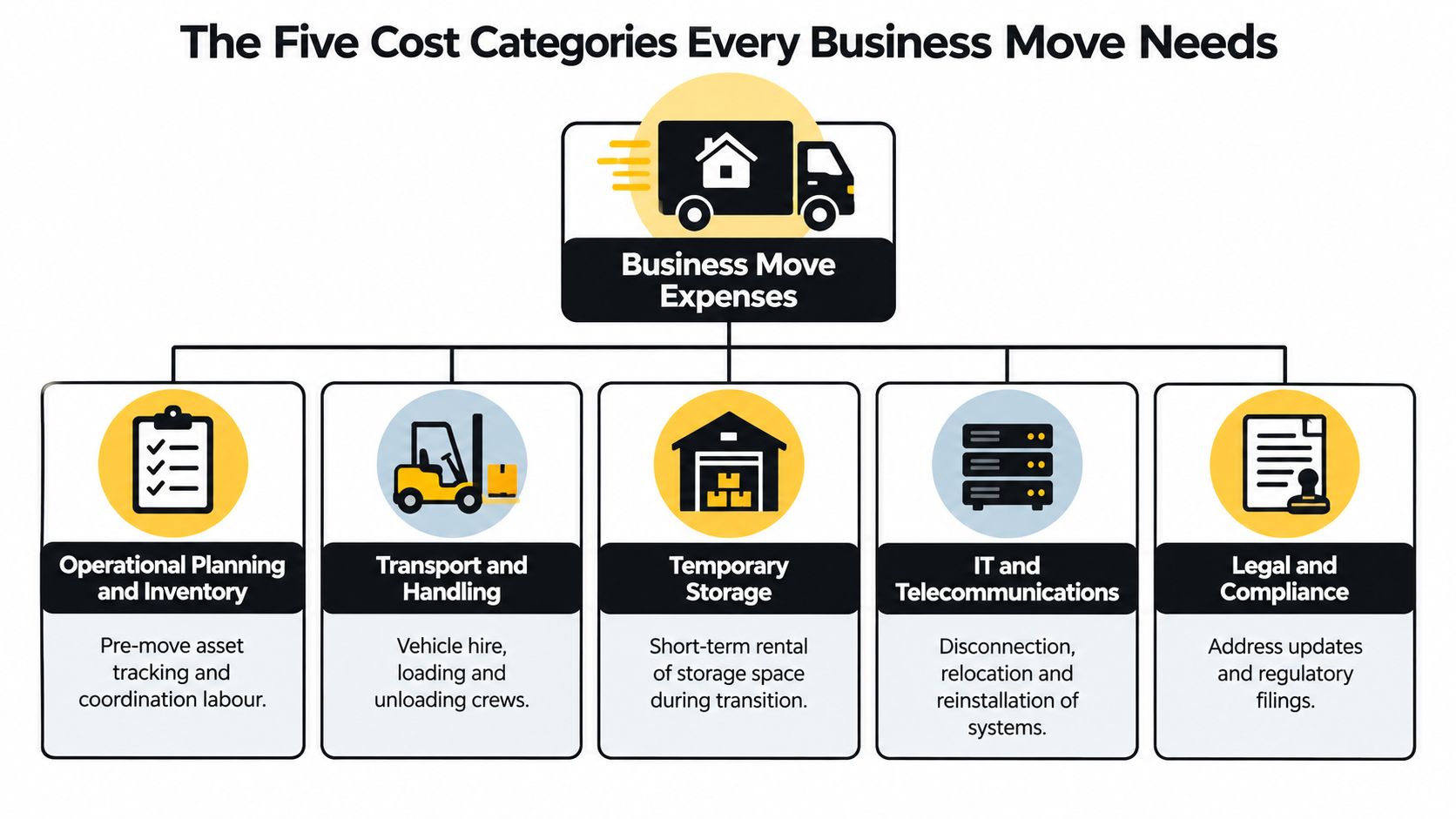
The Five Cost Categories Every Business Move Needs
Build your budget around five categories. They force you to price the whole relocation, not just the trip between buildings. The Department of Finance relocation cost framework shows relocation costs can extend beyond transport to travel, removal and storage of household goods, insurance, pet relocation, and temporary accommodation. Adapt that thinking to office assets and any affected staff.
Planning, Transport and Storage
1. Operational planning and inventory. Pay for asset audits, floor plans, labelling, packing materials, and coordination labour. In a CBD tower, that includes confirming lift dimensions and dock access before you choose a truck size.
2. Transport and handling. This covers crews, vehicles, loading, unloading, furniture disassembly and reassembly, and specialist handling for servers or bulky equipment. Compare it properly against your understanding of the cost of movers so you know whether you're paying for labour only or a full service.
3. Temporary storage. Lease overlaps rarely line up perfectly. Budget for short-term warehouse space, insurance while goods are stored, and a second delivery run when the new site is ready. Facilities should own this category, with finance approving the duration.
People and Post-Move Setup
4. Employee travel and accommodation. Some moves involve staff travelling between sites, working interstate during transition, or relocating residence. Keep these costs separate from office transport. They carry different tax and fringe benefits tax questions, and they need their own evidence.
5. Post-move setup and reconnection. Budget for IT and phone reconnection, testing, signage, cleaning at both sites, secure shredding, and waste removal. IT should sign off reconnection, while operations signs off cleaning and make-good tasks.
Don't forget small lines that cause outsized arguments. Parking permits, replacement cables, extra keys, and damage repairs belong somewhere. Put them in the category that caused them, assign an owner, and set an approval limit before the move begins.
Tracking Every Dollar With a Job-Costing Ledger
Create the ledger the day the move is approved. If you build it the week before the truck arrives, you'll reconstruct decisions from emails and credit card statements. A shared spreadsheet works for a small team. A lightweight job-costing tool works better once multiple approvers and suppliers are involved.
Give each cost category its own purchase order lines. Separate removalist fees, packing materials, storage, staff travel, IT work, and private or non-deductible items. If you're setting this up for the first time, learning how to calculate job profitability accurately helps you structure codes so forecast, committed, and actual costs stay visible.
Sample Job-Costing Lines for a Melbourne Office Relocation
| Cost category | Example line item | Internal owner | Supporting evidence |
|---|---|---|---|
| Planning and inventory | Asset labels and packing cartons | Operations | Supplier invoice and inventory list |
| Transport and handling | Crew, truck and furniture reassembly | Operations | Itemised removalist invoice |
| Temporary storage | Warehouse space during lease overlap | Facilities | Storage agreement and delivery dockets |
| Employee travel | Staff travel between old and new sites | Finance | Tickets and business purpose note |
| Post-move setup | IT reconnection and testing | IT manager | Service invoice and sign-off sheet |
Take a team of 25 moving from Richmond to Cremorne. Operations opens the ledger using an office move project plan template, IT adds disconnection and reconnection lines, and finance adds storage and travel codes. When someone buys extra boxes, the receipt goes against planning, not into a general office supplies account. Nobody asks who paid for the boxes three weeks later.
Reconcile every line before payment. Match the invoice to the purchase order, note the business purpose, and file the contract or delivery record with it. The ATO guidance on removal and relocation costs sits within a broader record-keeping position where deductible business expenses need supporting records and tax records generally need to be retained for five years.
That habit pays you twice. During the move, you see category overruns early enough to act. At year end, finance can prepare the tax position from evidence instead of memory.
How the ATO Treats Business Moving Expenses
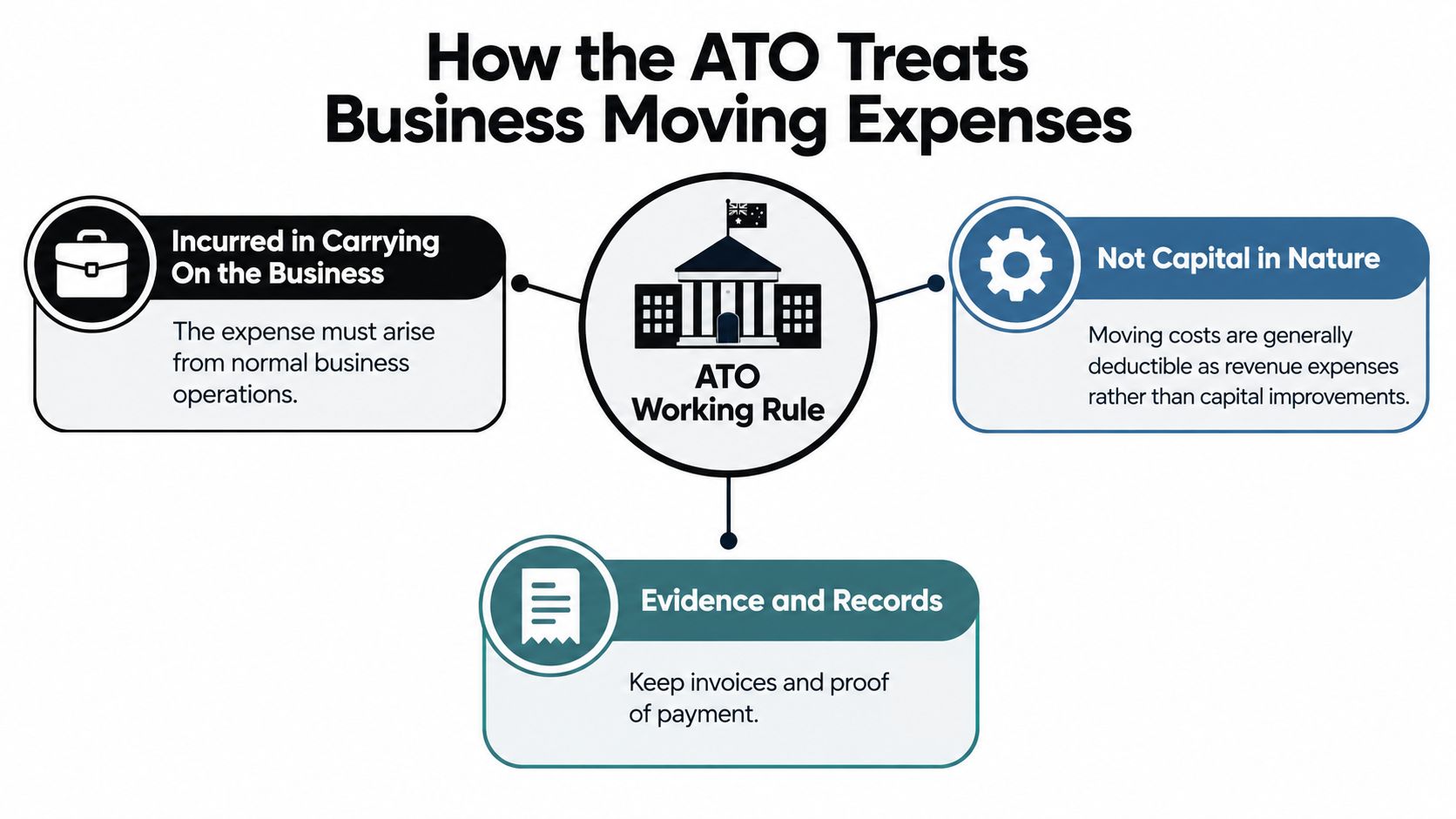
Don't treat every moving receipt as deductible. That's the mistake I see growing companies make, and it's avoidable if you separate costs before you spend. The ATO's working principle is that a business expense generally needs a direct connection with earning business income, must be business rather than private, and must be supported by records.
Moving office furniture, stock, documents, and equipment to carry on the business sits in a different bucket from moving an employee's home. An employee generally can't claim a personal deduction for removal or relocation costs when transferring to a new work location, accepting a new job, or relocating as a condition of employment. Those costs are treated as private because they're incurred to begin or maintain employment, not directly in earning employment income.
Where Fringe Benefits Tax Enters the Picture
When the employer pays an employee's relocation costs, you're no longer dealing only with a business deduction question. You may be providing a fringe benefit. The ATO relocation expenses fringe benefit concessions may apply to eligible categories including transport in the employee's car, temporary accommodation, and meals when the employee must move residence or live away from home to perform work.
Don't assume a concession applies. Document why the move was required, the employee's work requirement, the dates, and the nature of each reimbursed expense. Keep household effects separate from office assets on quotes, purchase orders, and invoices. Mixing them creates messy GST, payroll, FBT, and income tax treatment.
Business travel needs the same care. Only the business component is relevant for deduction purposes, and private components must be excluded and apportioned where costs are mixed. If your team needs a plain-English refresher before speaking to your adviser, a guide for Australian business owners can help frame the questions, but it doesn't replace advice on your facts.
Get your registered tax adviser to confirm treatment before contracts are signed, not after invoices are paid. Restructuring paperwork later is harder and sometimes impossible.
My recommendation is blunt. Build five separate evidence packs for office assets, employee effects, storage, travel, and temporary accommodation. If a supplier insists on one combined invoice, push back or get an itemised schedule attached. Clean separation is your best protection.
The 28-Day Compliance Checklist Most Movers Forget
The truck leaves and everyone relaxes. Then mail goes to the old address, an insurer says the new premises weren't noted, and ASIC correspondence is missed. Administration isn't a post-move tidy-up. It runs in parallel from the day the lease is signed.
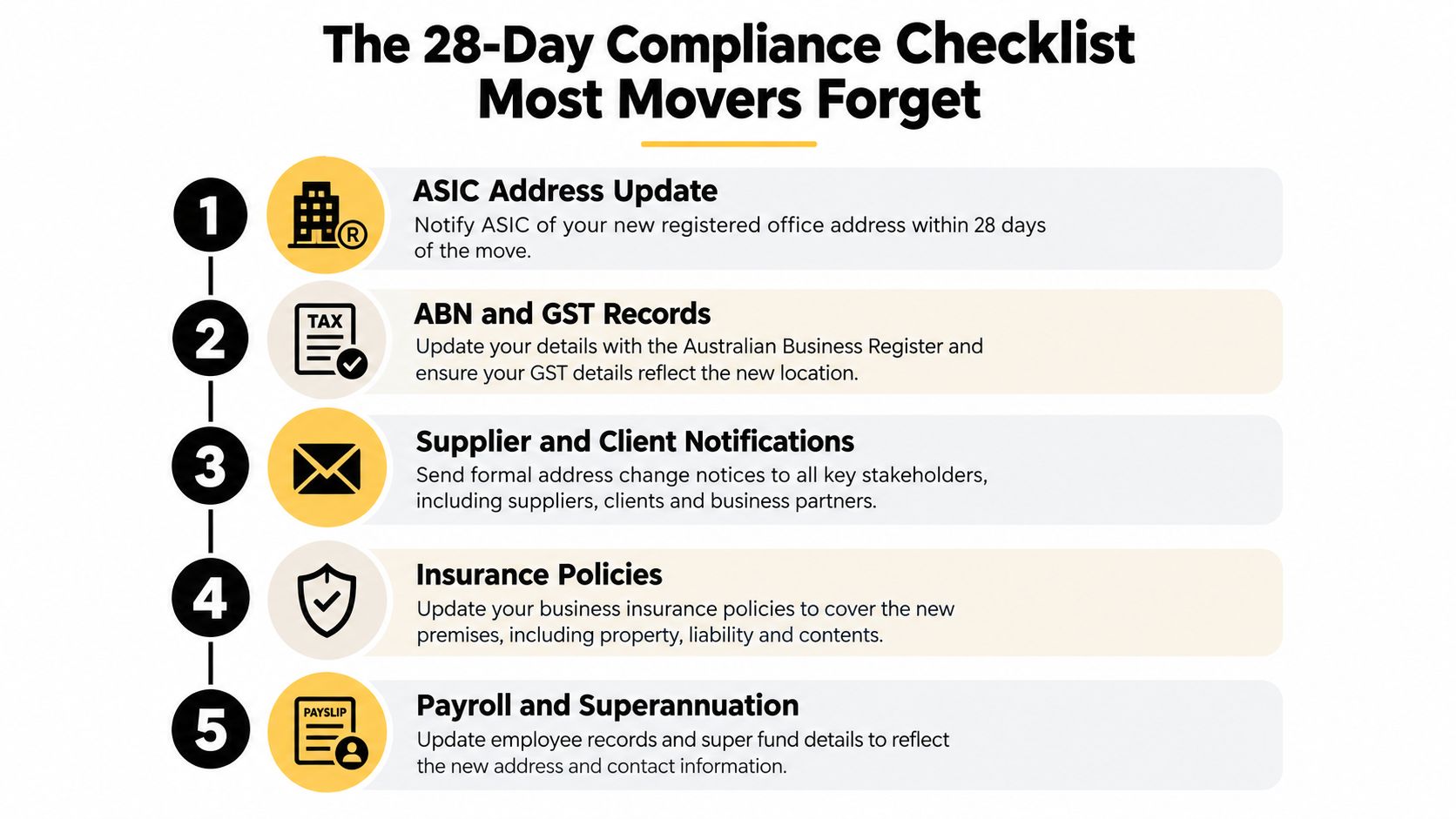
A company must update its registered office and principal place of business with ASIC within 28 days of a change or risk a late fee, and both must be physical Australian street addresses, not PO Boxes, as set out in ASIC guidance on changing a company address. If you hold a business name, check that register separately, including the business email address.
Hand This List to Your Office Manager
- ASIC and registers: Update company addresses through the right channel, record the effective date, and retain the submission acknowledgement. Check the business names register as a separate task.
- Licences and insurance: Notify licensing bodies, update certificates of currency, and confirm cover for goods in transit, in storage, and at the new premises.
- Banking and payroll: Update bank records, merchant facilities, payroll and superannuation details, and supplier payment information.
- Suppliers and customers: Send formal address change notices, redirect mail, and set a date for old-site collections to stop.
- Customer-facing details: Change invoices, quotes, email signatures, website footer, Google Business Profile, and contract templates.
Assign a due date and owner to each item. ASIC's 28-day window is the hard deadline, but insurers and banks should be told before you move, not after. File acknowledgements in the same relocation folder as your invoices. If finance ever needs to prove when the business started operating from the new site, the evidence is already together.
Budget a small amount of staff time for this work. It's a real relocation cost, even when no external invoice arrives.
Cutting Downtime and Avoiding Surprise Overtime
Downtime is usually your most expensive line item, even though it never appears on a removalist invoice. Staff who can't log in, take calls, or find equipment still cost you money. Paying a bit more for a well-sequenced weekend move often beats saving on labour and losing productive days.
Sequence the move backwards from when teams must be working normally. Disconnect non-essential IT late Friday, move and reassemble core workstations over the weekend, then test phones, printers, and network access before staff arrive Monday. Use an office relocation timeline to lock dependencies instead of relying on verbal promises.

Levers That Actually Work
Book lifts, loading docks, and building access early, in writing. Confirm after-hours rules at both buildings, including security escorts and air conditioning, because a crew standing at a locked dock burns your budget fast.
Choose one point of contact on your side and require the same from the removalist. Decisions about extra runs, damaged access, or changed sequencing shouldn't be negotiated with whoever happens to answer the phone. For sensitive files or equipment, ask who'll be on site and what screening or supervision arrangements apply.
Use professional packing where it frees revenue-generating staff from box duty. It's not automatically worth it for archived files you'll shred anyway. It is worth pricing for IT equipment, shared work areas, and teams who'd otherwise spend billable days packing badly.
Finally, declutter before you get quotes. Don't pay to move broken chairs, obsolete stock, and files past their retention need. Fewer items means fewer truck loads, faster reassembly, and less storage. That's a direct saving, not a housekeeping preference.
Your Monday Morning Relocation Action Plan
Start this week, even if moving day feels distant. Waiting until the final week is the most expensive decision you can make because every late choice narrows your options and increases overtime.
- Name one owner: Give that person authority over the ledger, supplier questions, and building bookings.
- Open five cost categories: Add purchase order lines for planning, transport, storage, employee travel, and setup. If you'll stagger the move, price commercial storage now rather than during lease overlap panic.
- Separate tax buckets: Split office assets from employee household effects, then confirm FBT and deduction treatment with your registered tax adviser.
- Start the 28-day list: Prepare ASIC, insurance, banking, payroll, supplier, and customer updates before the move date.
- Deal with old devices: Audit surplus equipment early. A structured option such as myhalo's move-out device program is worth investigating where device collection or disposal would otherwise fall to your IT team.
Takeaway for your project brief: Business moving expenses stay under control when one owner categorises every cost, reconciles it to evidence, and confirms tax treatment before the money is spent.
If you're planning a Melbourne office relocation and want one team to handle packing, furniture disassembly and reassembly, transport, building access coordination, and secure storage around your operating hours, talk to Get n Go Removals Melbourne before you lock your budget. Ask for an itemised quote aligned to your five cost categories, so you can approve the full relocation cost upfront and keep downtime to a minimum.