
Backloading Melbourne How to Save on Interstate Moves
You've found a Melbourne home, booked the settlement date, and then realised your furniture doesn't justify paying for an entire interstate truck. Perhaps you're moving from an apartment to Sydney, sending office equipment to Brisbane, or storing part of your household while a lease catches up. Backloading Melbourne can solve that mismatch by letting you pay for the truck space your goods use.
The saving doesn't come from a lower standard of care. It comes from sharing capacity with other customers whose belongings are travelling in the same direction. The trade-off is that you'll usually need more flexibility around collection and delivery, and a small or awkwardly timed load may not produce the saving you expected.
This guide explains how the system works, what Melbourne routes suit it, how to compare cubic-metre pricing with a dedicated truck, and which questions to ask about timing, handling, insurance and storage. If you're organising the move yourself, these tips for moving house storage can also help you decide what should travel immediately and what can wait.
For a professional assessment of an interstate move, you can also review interstate transport from Melbourne before requesting quotes.
Introduction to Backloading From Melbourne
A renter leaving a Carlton apartment may have a bed, sofa, dining table, appliances and several boxes to send to Sydney. Paying for a whole truck could mean paying for capacity the move does not use. A family travelling from Melbourne to Brisbane can face the same mismatch after selling or donating much of its furniture.
Backloading uses spare capacity on a truck already travelling the required route. The removalist combines compatible loads, labels them separately and charges for the portion of space assigned to each customer. It works like sharing a scheduled freight run rather than chartering the entire vehicle.
Melbourne suits this arrangement because it is a major freight hub. BITRE recorded Melbourne as having the highest metropolitan road-freight activity among Australian metropolitan areas in 2024–25, at 18.2 billion tonne-kilometres (BITRE's 2025 freight yearbook). Regular freight movement gives removalists more opportunities to match part-load customers with trucks using east-coast corridors.
The practical exchange: you pay for less truck capacity, while accepting less control over the exact collection or delivery date.
That trade-off can suit a student sending furniture to Sydney, a couple moving between leases, or a business transporting non-urgent stock. A move tied to settlement, a lift booking and a new job may justify a dedicated vehicle because a fixed arrival day has greater value.
The corridor also affects the likely wait. Melbourne to Sydney and Melbourne to Brisbane are established backloading routes, but timing depends on loading order, regional access, customer availability and the carrier's schedule. Treat any quoted window as a planning guide, not a promise.
Your available cubic metres and your deadline should therefore be considered together. A small load may cost less when it fills unused space, but the saving can narrow if collection requires special access or delivery must happen on one particular day. These tips for moving house storage may help if some belongings can wait.
For a professional assessment, review interstate transport from Melbourne and compare the quoted volume, transit window and flexibility terms. The useful question is not whether backloading is cheaper. Ask what your preferred date is worth, and what happens if delivery occurs later.
How Backloading Works on Melbourne Interstate Routes
Think of a dedicated truck as chartering an entire bus for your household. Backloading is closer to reserving a few seats on a bus that's already going your way. You pay for the part you occupy, while other customers use the remaining capacity.
The process usually follows a straightforward sequence:
- You describe the move. Provide the Melbourne pickup suburb, destination, approximate inventory, access details and date range.
- The removalist estimates volume. Furniture and boxes are assessed in cubic metres, then matched with available capacity.
- The carrier builds a route. Your goods may share a vehicle with loads collected in Melbourne and deliveries scheduled along the same interstate corridor.
- The crew collects and labels everything. Your inventory needs clear identification so it remains separated from other customers' belongings.
- The truck completes several stops. Delivery order depends on the route, not only on your preferred arrival time.
- Your goods arrive within the agreed window. The removalist should explain how updates will work before collection.
Backloading is particularly practical where trucks regularly travel between major cities. Melbourne to Sydney and Melbourne to Brisbane have substantial freight movement, which makes it easier to find spare capacity on an existing trip. The model can operate on outbound and return legs, turning capacity that might otherwise travel unused into a paid load.
Victorian freight monitoring material defines backloaded operations as containers hauled on both inbound and outbound legs of a terminal trip, describing the approach as a way to make more effective use of trucks and landside infrastructure (Victoria's Voluntary Performance Monitoring Framework). In household removals, the same principle appears as shared truck space on a long interstate run.
The truck operator has to solve a matching problem. Your furniture must fit the available space, your pickup must align with the vehicle's route and the delivery sequence must remain workable for every customer onboard. That's why “flexible dates” can mean a window rather than a specific morning.
Melbourne's role in this network isn't new. A BITRE report recorded that Melbourne represented 16.4% of total VBS truck operations classified as backloaded during January to June 2015, the highest share among the major eastern and southern freight ports compared in that report (BITRE's statistical report). The figure provides historical context. Backloading has been part of Melbourne's freight mix for years, rather than a temporary discount tactic created for household moves.
For a customer, the key lesson is simple. The more your dates, access arrangements and inventory can fit an existing route, the more useful shared capacity becomes. You're helping the removalist fill a journey that already needs to happen.
For route-specific planning, see the information on Melbourne to Sydney movers and ask how your load would fit the next suitable run.
Backloading Versus Dedicated Trucks and When Each Makes Sense
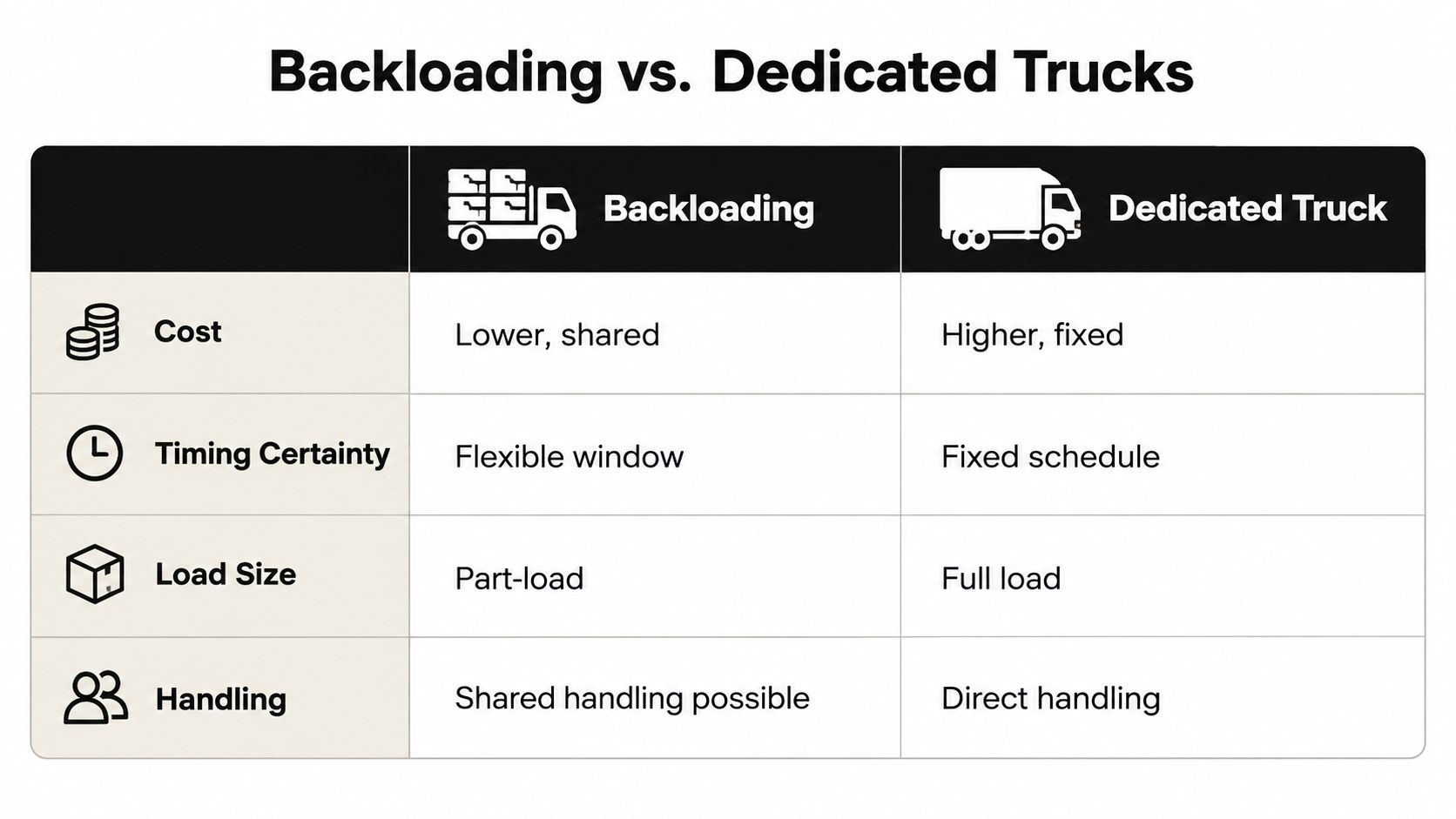
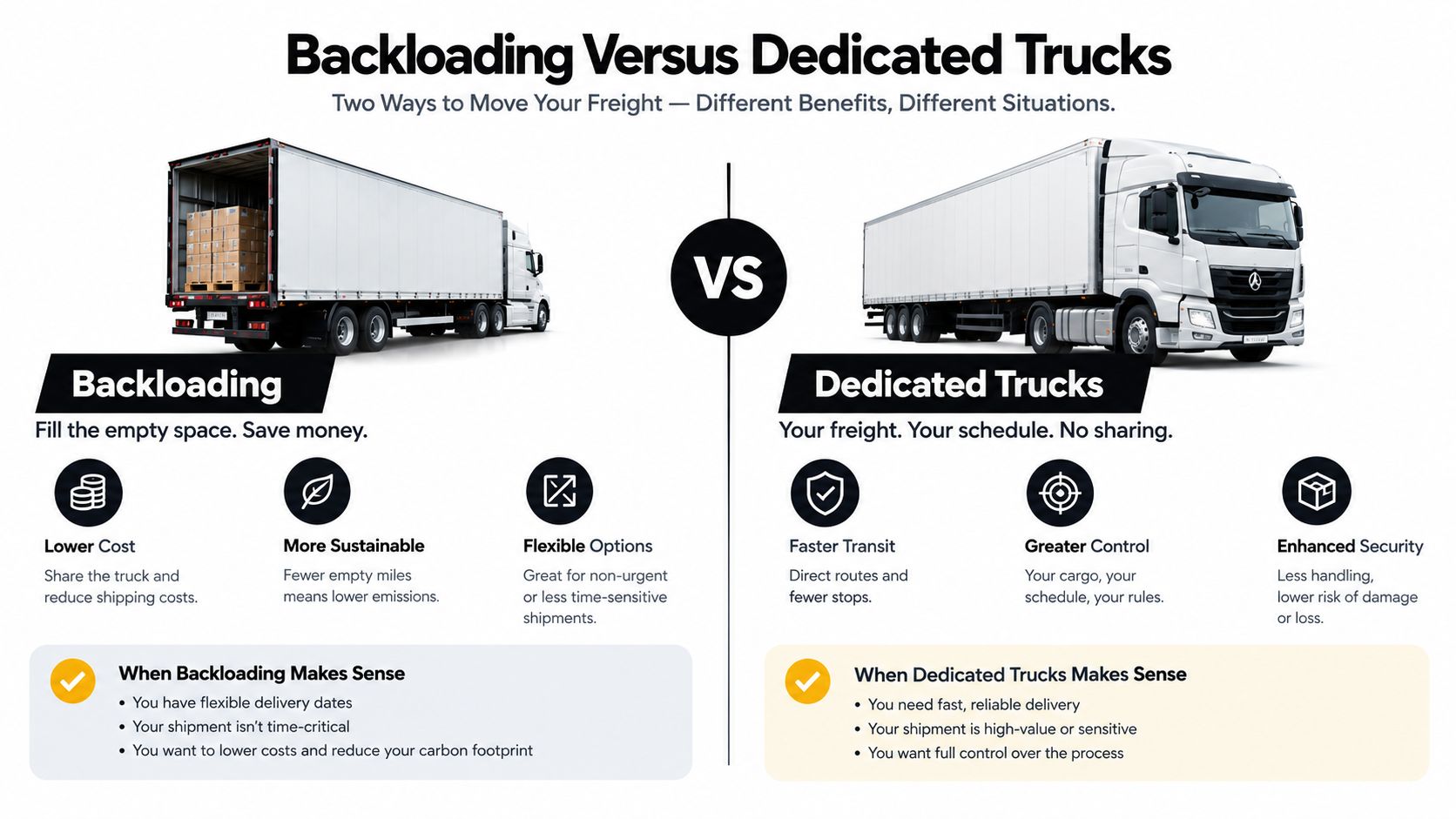
Backloading and dedicated transport solve different problems. Backloading prioritises efficient use of space and a lower transport cost. A dedicated truck prioritises control over timing, route and handling.
| Decision factor | Backloading | Dedicated truck |
|---|---|---|
| Pricing basis | Pay for the portion of capacity used | Pay for a truck reserved for your move |
| Collection | Flexible window | Agreed date, subject to the provider's terms |
| Delivery | Route-dependent window | More direct and predictable |
| Load | Part-load or consolidated shipment | Your household or office occupies the vehicle |
| Handling | Shared route and possible additional stops | Fewer customer-related stops |
| Best fit | Smaller loads and flexible moves | Full homes, urgent moves and fixed schedules |
A small apartment move often fits backloading naturally. You might be able to vacate on one day and accept delivery later, particularly if you can stay with family or use temporary storage. A full house can be different. Once your inventory occupies a large share of a truck, the per-cubic-metre advantage may narrow, while a dedicated quote may provide more useful control.
Urgency also changes the calculation. If you have a settlement handover, a booked lift, a rental start date or staff waiting to open an office, a broad delivery window creates practical costs. You may need accommodation, temporary equipment, storage or a second access booking. Those costs can outweigh the transport saving.
Use this quick decision test:
- Choose backloading when your dates are open. It's a sensible option if collection and delivery can move within a practical window.
- Choose a dedicated truck when the date controls everything. A fixed settlement or limited building access makes certainty more valuable.
- Compare both for a large inventory. A dedicated quote may become competitive as your load takes up more of the vehicle.
- Discuss fragile or specialist items separately. Artwork, antiques, glass, pianos and other awkward goods may need a handling plan that doesn't suit ordinary consolidation.
- Check regional access before assuming availability. Major capital routes generally offer more matching opportunities than less-travelled destinations.
The fairest comparison uses the same inventory, packing standard, access conditions, insurance arrangement and service level for both options. A transport-only backload shouldn't be compared with a dedicated quote that includes packing, dismantling, reassembly and unpacking.
For practical planning around furniture and service levels, review this guide to the best way to move furniture interstate. It can help you identify which items need specialist attention before you request a final quote.
What Backloading From Melbourne Really Costs
A backload can look inexpensive until the full move is priced. The quoted rate per cubic metre is only the starting point. Route, shipment size, access, packing, minimum charges and date flexibility can all change the final amount.
Published Melbourne figures show why one headline rate is not enough. Muval reports an average of $183.63 per m³ and an average job size of 12.83 m³. A 2026 Australian rate card lists about $135 per m³ for Sydney to Melbourne and Melbourne to Canberra, and approximately $176–$178 per m³ for Melbourne to Brisbane, depending on direction (Muval's Melbourne backloading data, PEA Logistics' 2026 rate card).
| Route | Indicative rate per m³ | Notes |
|---|---|---|
| Sydney to Melbourne | About $135 | Published 2026 rate-card example for a standard 11–20 m³ load |
| Melbourne to Canberra | About $135 | Published 2026 rate-card example for a busy Melbourne corridor |
| Melbourne to Brisbane | About $176–$178 | Higher published rate-card example, varying by direction |
| Melbourne interstate moves generally | Average of $183.63 | Published Melbourne source average, with load size and route affecting the quote |
Use these figures as a question prompt, not a guaranteed price list. A provider may apply a minimum charge, so a small shipment can be billed above the space its items appear to occupy. Stairs, a long carry, narrow access, a timed appointment or special packing can add costs that the transport rate does not show.
Breakeven rule: compare the complete delivered service, not only the cubic-metre multiplication.
Start by measuring the inventory, multiplying the volume by the quoted rate, and adding each disclosed service charge. Then request a dedicated-truck quote for the same goods and service level. Backloading reaches its true breakeven when the capacity saving is greater than the value of any waiting, storage, accommodation, access difficulty or extra handling it creates.
Published guides commonly place backloading around 10%–30% less than a dedicated truck, while some market guides cite savings closer to 40%–60%, depending on flexibility, load size and route demand (Zoom Removals' backloading guide). That spread matters. A flexible Melbourne to Sydney move may benefit from shared capacity, while a fixed-date Melbourne to Brisbane move can lose the advantage if waiting or temporary storage becomes necessary.
Long-distance freight also helps explain the pricing. An ATRF paper notes that Australian road freight trips are often over 2,000 km and may cost more than $300 per tonne of payload freight, so unused return space can affect the carrier's costs (ATRF 2023 paper). Ask what the quote includes, how access is charged and where the shared-load saving comes from.
Before comparing proposals, use this checklist of interstate moving costs to check packing, access, insurance, storage and delivery conditions.
Scheduling Timing and Flexibility for Melbourne Backloads
A Melbourne backload rarely runs like a private taxi. The truck may collect several consignments along the Hume or Pacific corridor, so your booking usually has a collection and delivery window, not a guaranteed arrival hour. Shared capacity can reduce the cost, while the trade-off is less control over the exact day.
Route order helps determine where your move sits inside that window. A shipment loaded early in Melbourne may wait while the truck collects freight from nearby suburbs or regional stops. If your goods are placed behind another consignment, delivery can move later even when the road distance is unchanged. Ask whether your items will be loaded first, last or transferred between vehicles.
Build the window around your real commitments
List the dates that cannot move, including settlement, lease expiry, lift access, key collection, school and work commitments. Tell the removalist which dates are fixed and where you can allow room. That distinction helps the operator match your goods to a suitable run instead of treating every date as equally urgent.
A useful booking conversation should answer these questions:
- When could collection occur? Request the broadest realistic window and ask how much notice you will receive before the crew arrives.
- When could delivery occur? Confirm the expected range and whether route stops or loading order could change it.
- What happens if access changes? Explain parking restrictions, apartment loading zones, narrow streets and building booking rules.
- Who provides updates? Keep one contact responsible for confirming the truck, collection and delivery.
- Can the inventory be consolidated? A precise list helps the operator match your volume to available capacity.
Recent mobility data indicates softer movement nationally, with relocations lower than the previous quarter and the same period a year earlier, while inter-regional migration also fell in that quarter (CommBank Regional Movers Index, June 2025). That may influence available capacity, but it does not guarantee a faster pickup. Melbourne availability still depends on the corridor, truck route and space remaining on a particular run.
Prepare for delivery day before the truck is confirmed
Keep documents, medication, chargers, work equipment and a change of clothes separate from the backload. Confirm that someone can receive the shipment, the destination has clear access, and any lift or building booking allows a window rather than one fixed arrival time.
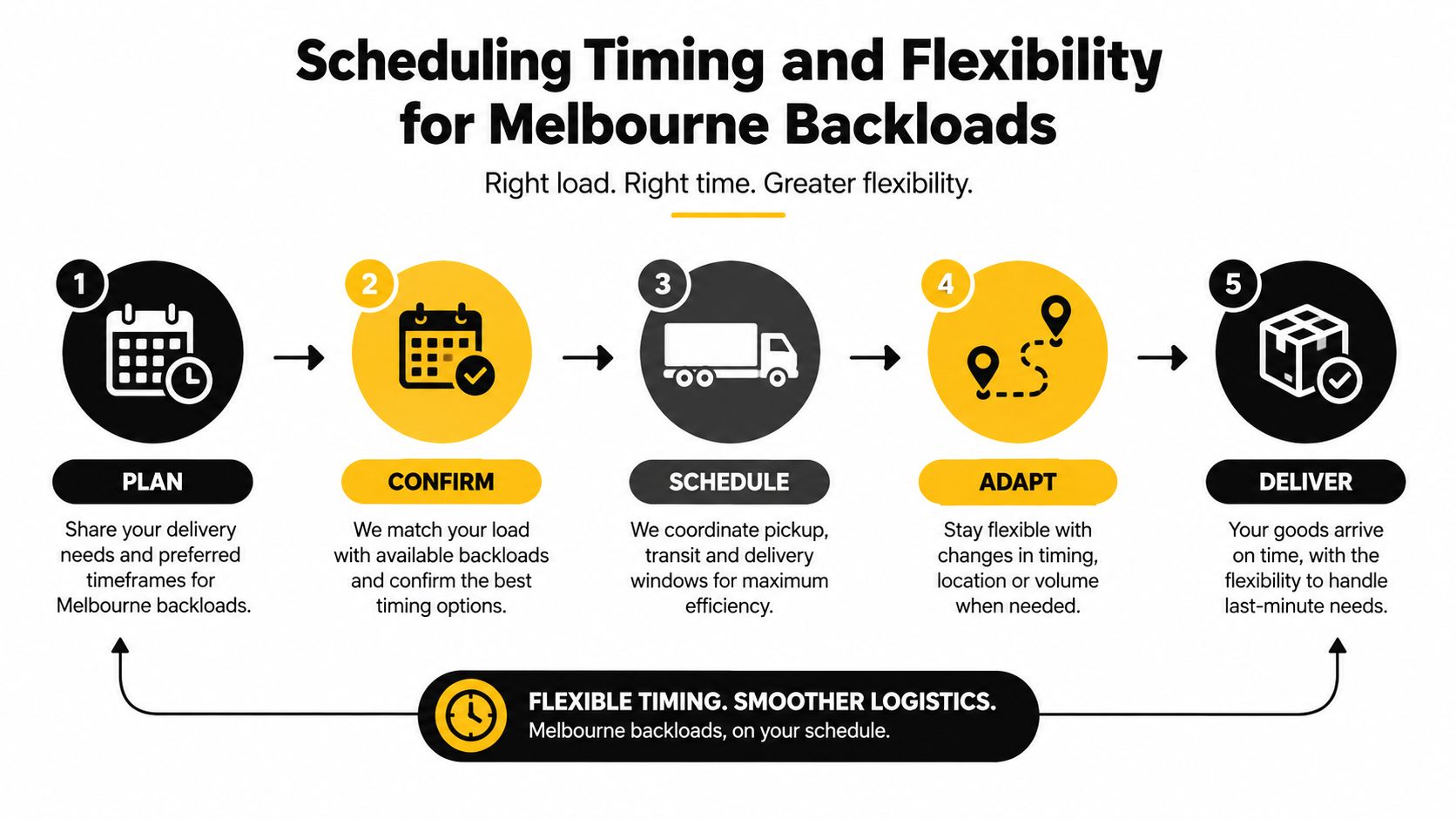
Flexibility means allowing the carrier to set the route while you prepare for each likely timing outcome. Confirm the window in writing, keep a small essentials bag with you, and avoid booking a same-day commitment at the delivery end.
Insurance Risk and How to Protect Your Belongings
Shared transport doesn't automatically mean unsafe transport, but it does make preparation and documentation especially important. Your goods may travel beside other customers' items and the truck may make multiple delivery stops. Good labelling, suitable wrapping and a complete inventory help the crew identify your belongings throughout the route.
Ask the removalist to explain the difference between public liability insurance and goods-in-transit cover. Public liability generally relates to injury or property damage caused during the service, while transit cover concerns the goods being moved. Don't assume that either policy covers every form of damage, packing method or customer-packed item.
Questions to ask before booking
Request written answers to these points:
- What events does transit insurance cover? Ask whether the policy responds to collision, fire, theft, overturning, handling damage and breakage.
- Are customer-packed boxes treated differently? Some policies apply conditions when the removalist didn't pack or inspect the contents.
- What are the limits and exclusions? Check item limits, high-value goods, fragile pieces, appliances and specialist equipment.
- How do you report damage? Find out the deadline, evidence required and person responsible for the claim.
- What protection is used? Confirm whether crews use blankets, floor runners, furniture wrap, cartons, straps and corner protection.
Create your own inventory with photographs before loading. Mark boxes by room and note fragile contents. Disassemble suitable furniture where this reduces movement, but leave complex or valuable pieces to trained removalists if the quote includes that service.

Plan for belongings left behind
Settlement delays and lease timing can leave goods at a Victorian rental property. Consumer Affairs Victoria says rental providers must store certain goods left behind for at least 14 days, including goods that can be sold, labelled containers or urns containing human remains, specialised medical devices and prescription medicines. Personal documents must be stored for at least 90 days, while perishable food, dangerous goods and valueless items can be disposed of immediately (Consumer Affairs Victoria's guidance on goods left behind).
Those rules don't replace a moving plan. Remove essential medication, identity documents and valuable items yourself, and arrange proper storage for furniture that can't yet travel.
For a plain-language explanation of transit protection, review goods-in-transit insurance and ask the provider to match the cover to your actual inventory.
Smart Tips to Get the Best Backloading Result From Melbourne
The strongest backload booking starts before the quote. Reduce the volume you're paying to transport, give the removalist an honest inventory, and make the collection and delivery points easy for the crew to service.
Use this preparation checklist:
- Declutter first: Sell, donate or dispose of items you won't use at the destination. A smaller load can be easier to match and cheaper to transport.
- Measure bulky furniture: Include sofas, wardrobes, beds, appliances and outdoor items. A rough description can produce a rough quote.
- Separate essentials: Keep documents, medicines, valuables, chargers and work equipment with you.
- Label every carton: Add your name, destination room and handling instructions. Consistent labels reduce confusion when multiple customers share a vehicle.
- Finish packing before collection: Loose items slow loading and are harder to protect.
- Prepare furniture: Empty drawers, secure doors and identify pieces that require disassembly or specialist handling.
- Confirm access: Tell the mover about stairs, lifts, loading docks, parking limits, narrow driveways and regional roads.
- Allow delivery flexibility: Don't book a tightly timed lift or tradesperson unless the delivery window supports it.
- Compare like with like: Check packing, wrapping, dismantling, reassembly, storage, insurance and access charges in every quote.
- Nominate one contact: A single person should receive schedule updates and approve changes.
Get n Go Removals Melbourne offers backloading assessments, dedicated interstate transport, packing, furniture disassembly, storage and goods-in-transit arrangements, with weekly direct runs connecting Melbourne with Sydney, Brisbane and other East Coast destinations. Ask any removalist to explain whether your inventory suits a shared load or whether a dedicated truck would provide better value after all timing and service requirements are included.
Backloading makes sense when you have a manageable load, a major interstate route and room to move your dates. If those conditions fit, prepare your inventory now and request a quote that states the volume, inclusions, collection window, delivery expectation and insurance terms in writing.
Get n Go Removals Melbourne can assess your inventory and compare a flexible backload with dedicated interstate transport, including packing, protective equipment and storage where required. Visit Get n Go Removals Melbourne to discuss your Melbourne move and request a clear quote built around your route, load size and timing.