

4.2m Moving Van Guide for Melbourne Movers
If you're staring at a booking page, a pile of boxes, and a nagging question about whether a 4.2m moving van will do the job, you're in the same spot most first-time movers hit. On paper, the van sounds simple. In real life, the answer depends on what you're moving, how you're packing it, and whether the truck can even stop outside your place without turning the whole street into a traffic problem.
For Melbourne moves, that's where people get caught out. They focus on the van size and forget the street, the loading bay, the apartment lift booking, the rear door clearance, or the fact that a legal loading zone isn't just a spare car park with better signage. A 4.2m moving van can be a smart fit, but only if the load and the access match the vehicle.
Picture This on Moving Day
Jess is moving out of a one-bedroom place in Brunswick. Her mattress is leaning in the hallway, the couch is still upstairs, the washing machine hasn't been drained properly, and there are boxes everywhere. Then the van arrives.
It looks big enough at first glance. Then the questions start. Will the bed fit in without standing it on an angle? Is there room for the couch and drawers after the boxes go in? If the front spot is taken, can the driver still park close enough to the house? And if one bulky item doesn't fit, is she facing a second trip across town?
That's the moment a lot of people realise they don't need a bigger truck. They need a better understanding of what a 4.2m moving van is designed to handle.
The four questions most movers ask
For a local Melbourne move, the same concerns come up again and again:
- Capacity: Will it take the contents of a studio or one-bedroom home in one go?
- Fit: Will awkward items like mattresses, fridges, and small sofas load cleanly?
- Loading method: Can you pack it so you don't waste half the usable space?
- Access: Can the van legally and practically stop where you need it to?
Those aren't abstract questions. They're what decides whether moving day feels organised or chaotic.
Practical rule: The right van size isn't only about how much you own. It's also about how close the van can get to the door, lift, or stairwell.
A 4.2m moving van is one of the most common mid-size moving vehicles you'll see around Melbourne suburbs. It's popular because it sits in the middle ground. Big enough for a meaningful household load. Small enough to stay workable in tighter streets, older unit blocks, and city-fringe parking conditions.
What a 4.2m Moving Van Is
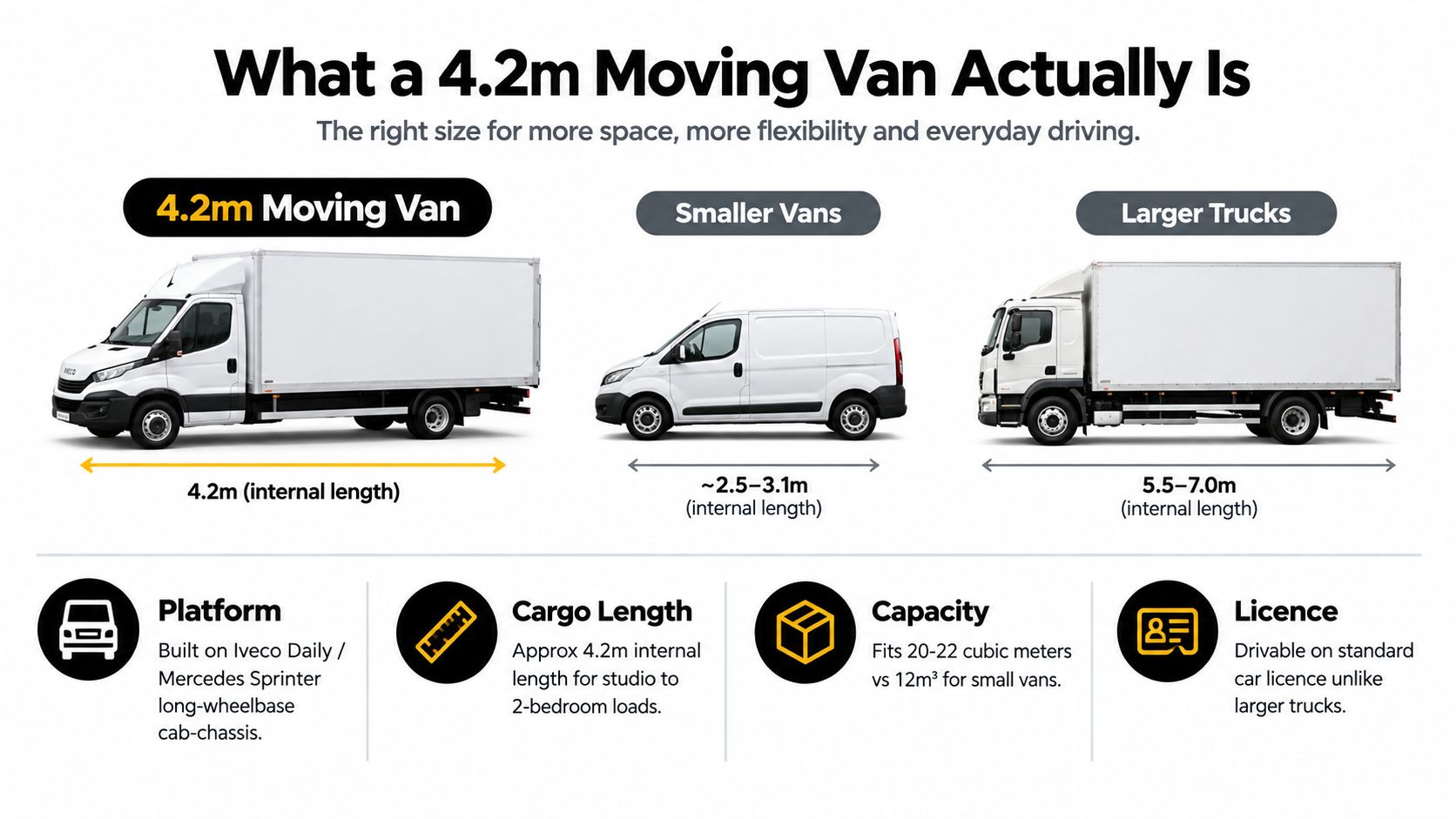
A 4.2m moving van is a small-to-mid rigid truck with an enclosed box on the back. The key point is that the 4.2m figure usually refers to the length of the cargo area, not the full vehicle from bumper to bumper.
That catches first-time movers out.
On the phone, "4.2 metres" can sound close to a large van. In practice, it is a proper furniture-carrying vehicle with square walls, full-height load space, and enough room to stack cartons and household items in layers instead of squeezing everything in around wheel arches like you would in a passenger-style van.
Why this size exists
This vehicle size sits in a useful middle band. Smaller vans fill up quickly once you add a mattress, fridge, or couch. Larger trucks carry more, but Melbourne streets often decide whether that extra size is helpful or a nuisance.
A 4.2m van works well for moves where both volume and access matter. That includes older apartment blocks in Carlton, narrow residential streets in Brunswick, and unit complexes in the eastern suburbs where the truck may need to reverse carefully, stop under trees, or fit beside parked cars without blocking the whole road.
If you're weighing up local vehicle options, this guide to renting a moving van in Melbourne shows how this class fits into the broader hire market.
What the vehicle is built to carry
Hire fleets commonly position this van size for compact household moves, such as a studio or one-bedroom setup. A similar Australian listing from Budget Truck Rental's 4m moving van page shows an internal box around 4.2m x 2.1m x 2.1m, which helps explain why it suits furniture rather than just boxes.
The practical picture matters more than the label. This is the sort of van that can usually take a mattress, washing machine, small fridge, chest of drawers, dining chairs, and a run of packed cartons if the load is planned properly.
It works like the difference between a wardrobe and a hallway cupboard. Both store things, but one is built for bulkier items with less awkward wasted space.
That is also why Melbourne access matters so much with this size. A larger truck may carry more on paper, but if it cannot stop near the building, the extra capacity disappears into longer hand-carry distances, lift delays, and extra labour. A 4.2m moving van often earns its keep by being easier to place where the loading job starts.
Dimensions and Load Capacity Explained
Length gives you only part of the answer. What decides whether a 4.2m moving van will work is the combination of internal volume, the shape of your furniture, and how well the load can be stacked and tied off.
For this van class, hire fleets commonly describe the cargo box as being around 4.2m long, 2.1m wide, and 2.1m high, with total volume in the high teens of cubic metres. On paper, that sounds straightforward. In practice, the better question is: how much of that space is usable once you add a mattress, a fridge, a sofa with rounded arms, and the blankets needed to protect them?
A good way to read the space is to picture a neat rectangular room, then subtract the awkward gaps created by real household items. Boxes use space efficiently. Furniture rarely does. If you want to put numbers against your own list before booking, this guide to calculating cubic metres for a move helps turn furniture and cartons into a more realistic estimate.
| Measurement | Approximate Value | What It Means on Moving Day |
|---|---|---|
| Cargo length | About 4.2m | Long enough for mattresses, bed frames, dining tops, and stacked furniture |
| Cargo width | About 2.1m | Gives room for side-by-side placement of boxes, whitegoods, and upright pieces |
| Cargo height | About 2.1m | Allows vertical stacking, but only if the load is stable and fragile items are protected |
| Cargo volume | High teens in cubic metres | Commonly suited to studio and one-bedroom moves, depending on how bulky the contents are |
| Practical load shape | Varies by inventory | Square cartons pack tightly. Sofas, chairs, bikes, and lamps create wasted pockets of space |
What those numbers look like in a real move
A one-bedroom flat in Carlton with a queen bed, two bedside tables, a small couch, a fridge, a washing machine, a TV unit, and 20 to 30 cartons will often sit comfortably in this size range if it is loaded properly. The same van can feel tight for a St Kilda apartment with oversized furniture, lots of plants, garage gear, and a narrow loading window that forces rushed packing.
That is the part generic size guides often miss. Capacity is not just about what fits inside the box. In Melbourne, it is also shaped by how the job gets loaded. If the van has to park half a block away because the street is full, or if the building manager limits lift access to a short booking window, the load usually goes in less neatly than it would from a clear driveway.
Where people misjudge the space
Height catches people out first. A fridge may fit inside the van, but question is whether it can be brought in upright, padded, and positioned without crushing lighter items around it.
Weight is the other issue. Books, tools, gym gear, and dense packed cartons can make a van harder to load safely even when there still seems to be empty space left.
A few common trouble spots come up again and again:
- Bulky items waste room: Sofas, armchairs, and tall chairs leave gaps that cartons cannot easily fill.
- Loose packing costs space: Small gaps between boxes spread through the whole load.
- Protective materials take room: Blankets, straps, and upright spacing for appliances all reduce usable capacity.
- Forgotten extras add up: Pot plants, hallway tables, bikes, and outdoor items often get left off the first estimate.
If your list looks close to the limit, leave margin. That matters even more in Melbourne suburbs where access is tight, parking is limited, and the neat loading plan you had on paper can change the moment you arrive.
How a 4.2m Van Compares to Other Truck Sizes
A 4.2m van makes the most sense when a small van is too small and a larger truck is more vehicle than your access conditions can comfortably support. That's why it's such a common pick for metro moves.
The trick is to compare by use case, not just by length. A shorter van suits boxes and a few pieces. A bigger truck suits full-house relocations. The 4.2m class sits between those jobs.
Where it fits in the line-up
| Vehicle Type | Length (m) | Approx. Capacity | Best For | Typical Use |
|---|---|---|---|---|
| Small cargo van | 2.0 to 3.0 | Smaller than a 4.2m van | Few furniture pieces, cartons, single pickups | Marketplace buys, student rooms, storage runs |
| 4.2m moving van | 4.2 | About 18.5m³ to 19m³ | Studio and one-bedroom moves, some small two-bedroom loads | Apartment moves, compact office shifts, local suburban relocations |
| Mid-size truck | 4.8 to 6.0 | More than a 4.2m van | Larger furniture sets and broader household loads | Bigger townhouse and family moves |
| Large removal truck | 8.0 and beyond | Much greater volume | Full-house relocations and bulky multi-room loads | Large homes, interstate loads, major office moves |
Why some people should size up or down
The answer changes depending on what's in the home.
A single person moving from a studio with mostly cartons, a bed, and a desk may not need anything larger than this. A couple with a packed garage, oversized sofa, and bulky dining setting may hit the van's limit faster than they expect. If you're choosing between sizes, this moving truck size guide is useful for matching a household to the right class.
A van that fits the furniture but needs awkward double-handling from half a street away can cost more time and effort than a slightly different vehicle choice.
There's also a cost logic to the size question, even if every operator prices differently. The Australian removal-services market was about $2.5bn in 2025 and fell 5.4% that year according to IBISWorld's market size snapshot. In a price-sensitive market, a smaller van can be the smarter option when it matches the load and the street access. But if it forces extra runs or blows out your loading window, the apparent saving disappears quickly.
Packing and Loading a 4.2m Van the Right Way
A 4.2m moving van rewards organised loading. Pack it badly and you'll waste space, crush lighter items, and end up unloading half the truck to reach one thing near the front. Pack it properly and it can carry far more cleanly than you might expect.
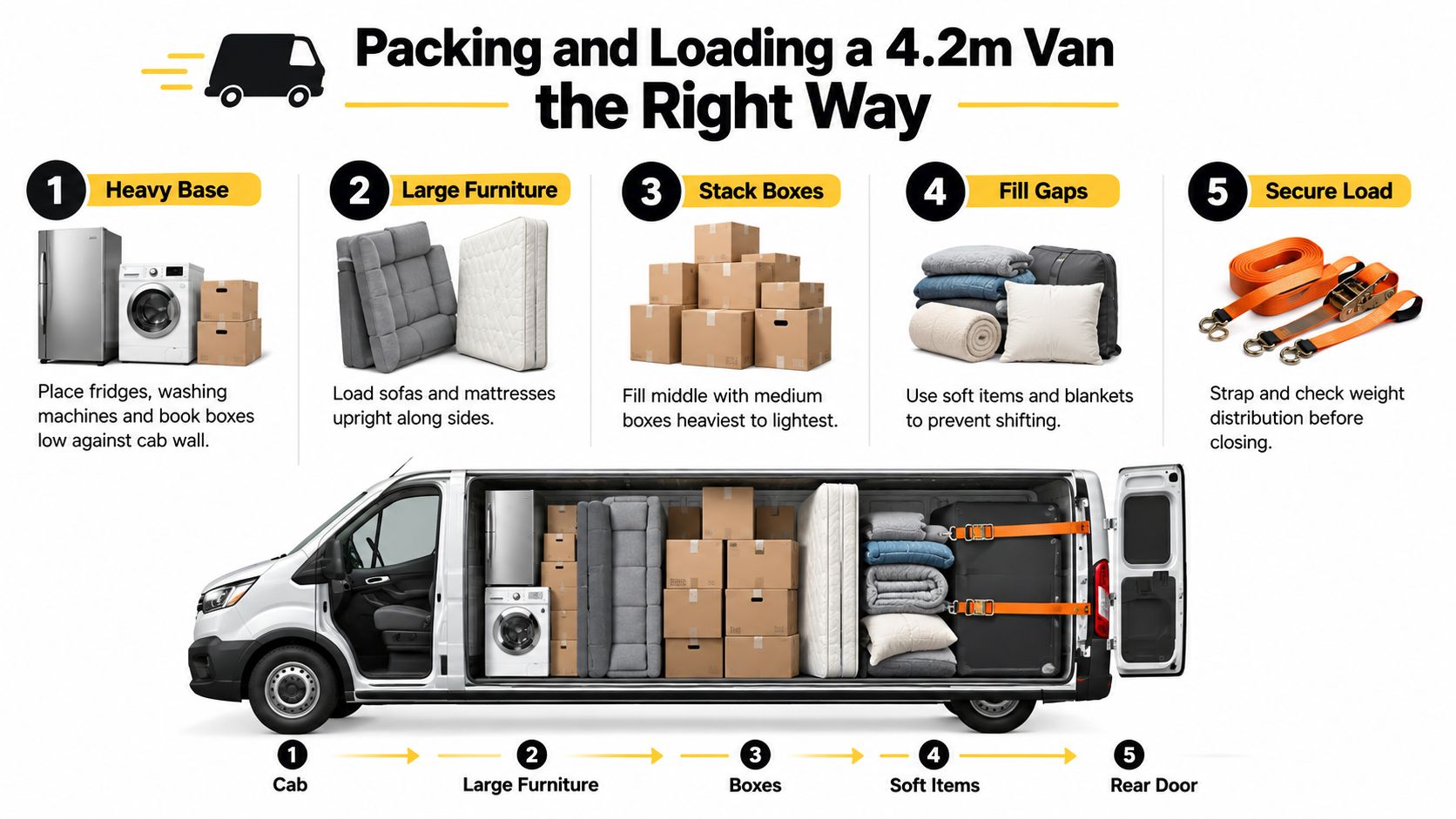
Start with a simple idea. Heavy and dense items go low and forward. Lighter and crushable items go higher and later. That keeps the van steadier and uses the best part of the floor first.
A loading order that works
- Begin at the front wall: Fridges, washing machines, book boxes, and other dense pieces should sit against the bulkhead.
- Stand long furniture carefully: Mattresses, bed bases, and headboards often work best upright along the sides if they're protected.
- Build the middle section: Stack medium boxes tightly, with the heaviest cartons on the bottom.
- Fill dead space: Soft bags, doonas, cushions, and moving blankets stop shifting.
- Secure the load: Use straps on anchor points or rails so the rear section doesn't move under braking.
For anyone measuring awkward pieces before the move, these Tip Top Furniture & Mattresses measurement tips are a handy reminder to check width, height, diagonals, and turning clearances, not just the headline dimension.
Common loading mistakes
People often waste space by spreading heavy items across the floor instead of creating a stable base. Another frequent problem is front-loading half the van, then leaving irregular tail gaps that can't take boxes properly.
A few practical habits prevent that:
- Label by room: It makes the unload faster and reduces rehandling.
- Keep one clear path early: You need enough room to move deeper into the van while loading.
- Protect corners and faces: Blankets, cardboard, and wraps matter most on timber edges, fridges, and whitegoods.
- Don't crush soft cartons: Linen and clothing can go on top, not under dense loads.
A short visual helps if you're doing this for the first time:
If you're planning the pack yourself, this list of common packing mistakes when moving home is worth checking before the van arrives.
Melbourne Access, Parking, and Loading Zone Realities
This is the part most generic van guides skip. The van can be the right size on paper and still be wrong for your address if the access doesn't work.
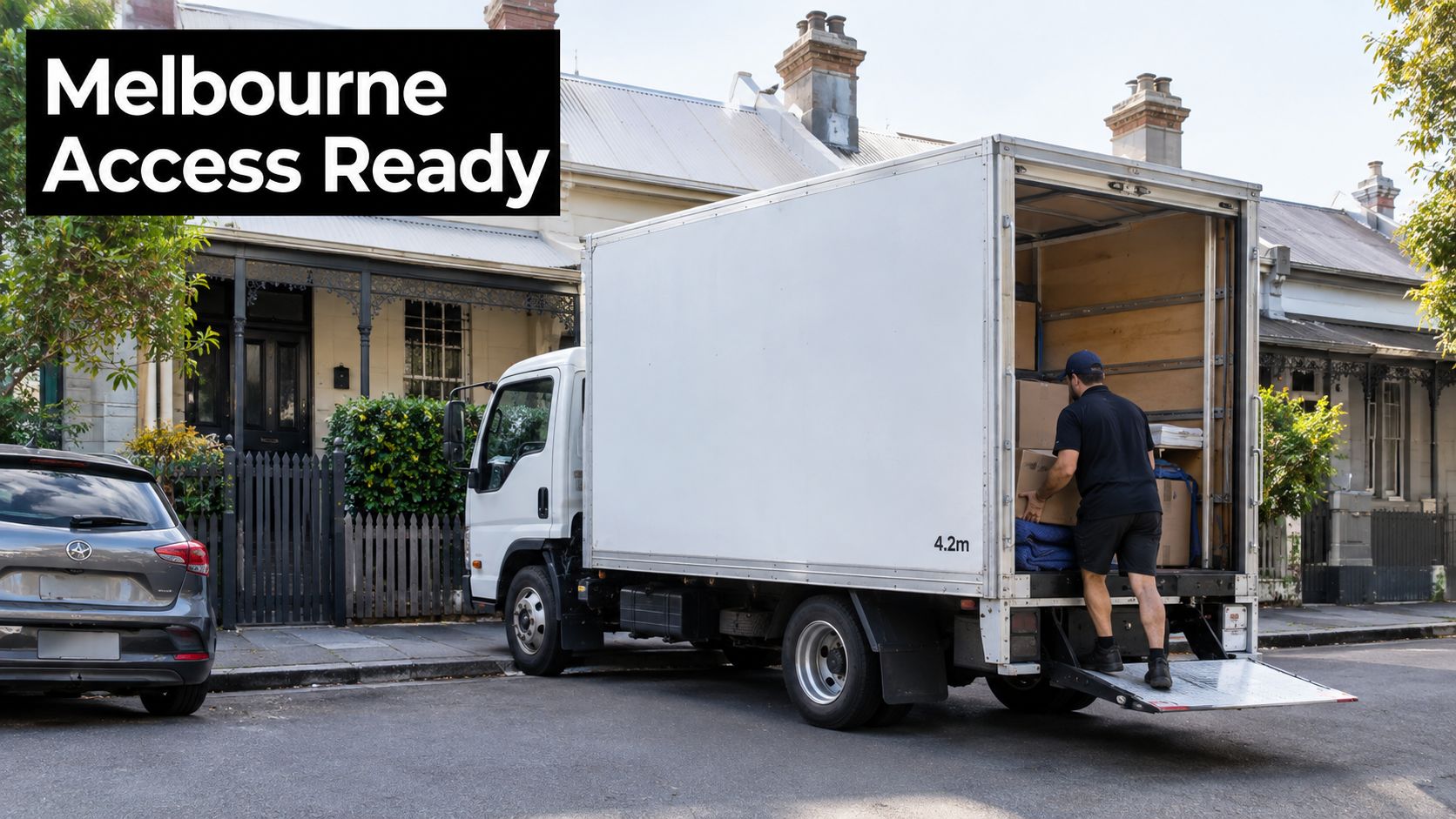
Inner Melbourne moves often fail on the kerb, not in the cargo box. Brunswick side streets, Richmond terrace rows, South Yarra apartment frontages, and CBD lanes can all create the same problem. You may have enough household volume for a 4.2m moving van, but not enough legal stopping space to load it cleanly.
Why the street matters as much as the truck
Under national heavy vehicle dimension guidance, a truck and load generally has a maximum width of 2.5m, a standard heavy vehicle maximum height of 4.3m, and rigid truck length limits are generally 12.5m according to the National Heavy Vehicle Regulator dimension rules. A 4.2m moving van sits well inside those limits, which helps explain why this class is so common for urban work.
But legal road dimensions don't guarantee easy kerb access. Victorian guidance for loading zones says a bay should be at least 3.6m wide, and a truck zone for one light rigid truck should be about 12m long according to the VicRoads loading zones guideline. That matters because your cargo box might be 4.2m, but the usable stopping footprint is longer once you allow for the full vehicle, rear-door swing, and walking space.
What loading zones do and don't allow
A loading zone isn't a general parking exemption for movers. Transport guidance reproduced in the Avis commercial fleet guide PDF states vehicles may stop in a loading zone for up to 30 minutes, or less if signed, and only while loading or unloading goods or passengers.
That rule catches a lot of apartment moves. If the building wants a tight lift booking window and your van is in a short loading zone, every delay starts to matter.
If your building manager says you have a one-lift slot and the street only gives you a short lawful stop, the move needs timing, not just muscle.
Even where permits are available, they don't automatically override no-stopping areas, clearways, bus zones, or disability bays. A practical local overview of parking a moving truck legally in Melbourne highlights how often movers underestimate legal stopping limits and fallback planning. For wider perspective on bulky-item access planning, these notes on UK mattress delivery logistics are useful because they focus on route, doorway, and delivery-path issues that also affect local move-ins.
If your move involves apartment booking rules, kerb access questions, or city-fringe timing, this Melbourne relocation guide is a practical place to start.
Is a 4.2m Moving Van Right for Your Move
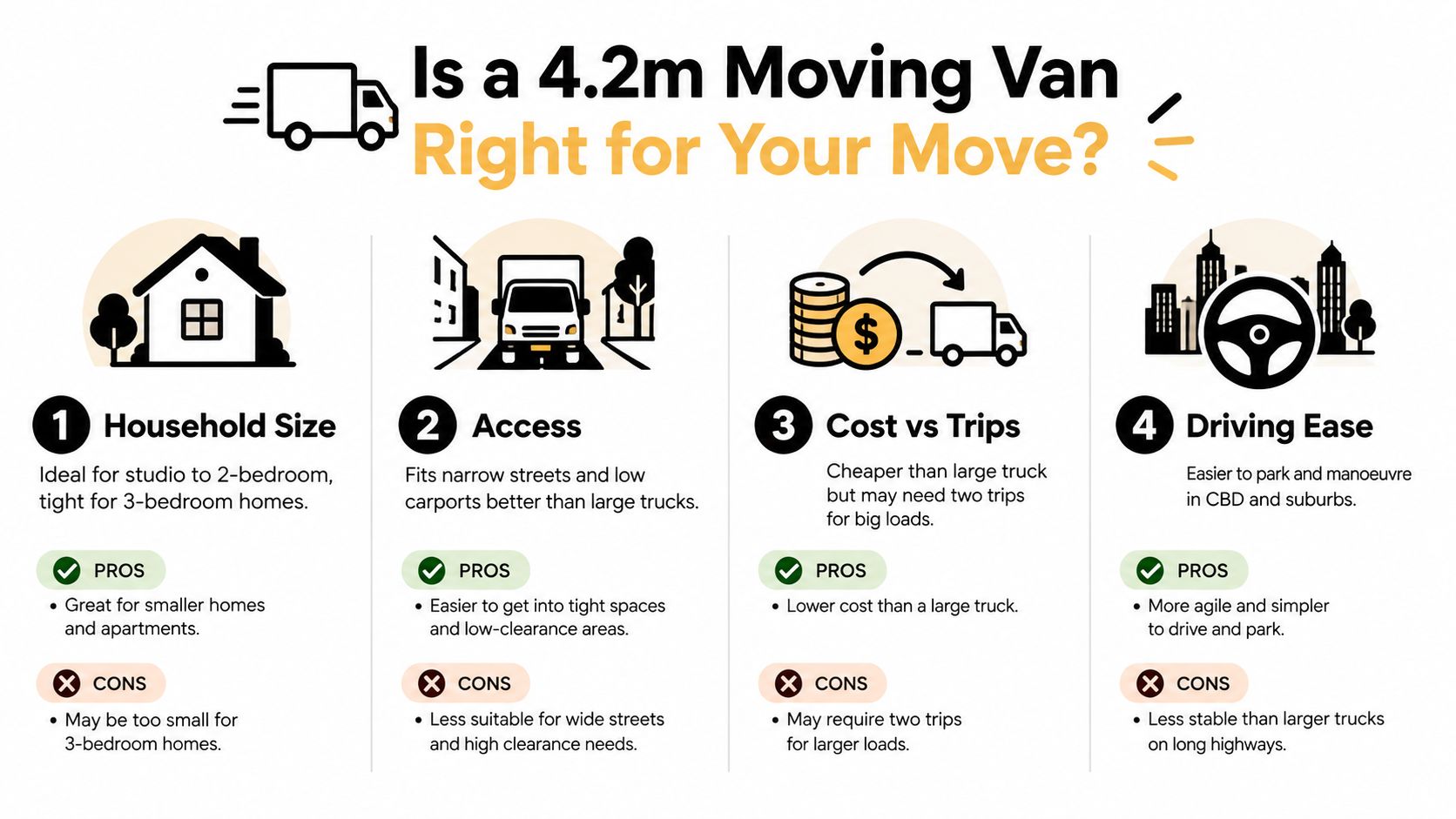
For many Melbourne movers, the answer is yes. For some, it's clearly no. The easiest way to decide is to check four things together: household size, access, time pressure, and tolerance for a second run.
A 4.2m moving van is often a sensible fit when the load is compact, the furniture is standard household size, and the address doesn't support a much larger truck. It's less suitable when the move includes oversized items, very dense contents, or a strict one-trip requirement with no margin for overflow.
Good match scenarios
These moves usually suit this van size well:
- Studio or one-bedroom home: Bed, couch, fridge, drawers, cartons, and loose household items.
- Small two-bedroom move: Works if the furniture is modest and packing is tight.
- Apartment relocation with tricky access: Easier to place than a larger truck in many suburban and city-fringe streets.
- Office or furniture transfer: Useful for compact commercial loads and staged relocations.
Situations where it may be too tight
Some jobs push this size past its sweet spot.
A family move with bulky outdoor gear, multiple bedroom suites, large whitegoods, and dense storage usually needs a larger truck or a second trip. The same goes for awkward specialist pieces such as a piano, a heavy stone dining table, or a heavily furnished multi-storey home.
If you need help matching the vehicle to the job rather than guessing, Get n Go Removals Melbourne handles smaller truck-based moves and larger household relocations, so the vehicle choice can be matched to the access and inventory rather than picked by guesswork alone.
Choose the van for the hardest part of the move, not the easiest part. The hardest part is usually access, one bulky item, or a strict timing window.
If your move is compact, urban, and reasonably organised, a 4.2m moving van is often the sweet spot. If your move is bulky, heavy, or absolutely must finish in one trip, stepping up early usually saves stress.
Key Takeaways and Booking Tips
Booking the right van is a bit like choosing the right size box for a fragile item. Too small, and you end up forcing things in, wasting time, or booking a second trip. Too large, and you may create a different problem in Melbourne, where tight streets, apartment loading bays, clearways, and short loading windows can matter just as much as cargo space.
The short version is simple. A 4.2m moving van suits many smaller home moves, but the booking decision should rest on three checks. What you are taking, how it is packed, and whether the van can stop legally and load safely at both addresses.
What to confirm before you book
- Ask for usable cargo space, not just the van label. Two vehicles described as 4.2m can differ in internal layout, wheel arch intrusion, and door opening size.
- Measure the awkward items first. Fridges, mattresses, sofas, tallboys, and dining tables usually decide whether the load fits neatly or becomes a puzzle on the day.
- Check what equipment is included. A trolley, blankets, straps, and tail-lift can change a difficult load into a manageable one.
- Confirm access at both properties. Look at laneways, driveway width, basement height limits, lift bookings, and whether rear doors can open fully.
- Sort parking before moving day. In Melbourne, a well-sized van can still become the wrong choice if there is nowhere lawful to stop close to the entrance.
That last point catches first-time movers all the time.
A van might fit your one-bedroom apartment perfectly on paper, then lose an hour because the street outside is a permit zone, the body corporate only allows a narrow lift window, or the loading bay is shared and already booked. The vehicle choice and the access plan need to match each other.
A good booking mindset is to choose for the hardest part of the job. If the hardest part is a narrow inner-city street in Carlton, Brunswick, South Yarra, or the CBD fringe, access may matter more than squeezing in one extra item. If the hardest part is fitting everything into one trip from a suburban unit with easy parking, then load volume becomes the bigger question.
If you want help checking that balance, Get n Go Removals Melbourne handles residential and commercial moves, truck-based relocations, packing help, and access planning. That can be useful when the decision is less about raw van size and more about whether the vehicle, building rules, and street conditions all line up on the same day.