

Office Relocation Notice for Melbourne Businesses in 2026
A ten-person team in Cremorne can pack an office quickly. The harder part is making sure everyone else knows what the move changes, and what it doesn't. The lease may have been signed months ago, yet the operations lead still has to coordinate staff, clients, suppliers, couriers, payroll, IT, building access and official records before the first desk is moved.
That's where a well-prepared office relocation notice earns its keep. It connects the move across daily operations and formal administration, so a client doesn't arrive at the old address, a supplier doesn't deliver stationery to an empty reception area, and a payroll or invoice run doesn't carry outdated details. In Victoria, the timing can also intersect with workplace obligations, not just business etiquette.
Why an Office Relocation Notice Matters More Than You Think
An office move usually starts as a property decision, but it quickly becomes a communication project. Staff need to know where they'll work and how they'll get inside. Clients need confidence that meetings, services and account contacts will continue. Suppliers need the correct delivery point, invoice address and receiving hours.
A casual message in a team chat won't cover those needs. It may tell people that “we're moving soon”, but it won't create a reliable written record of the effective date, the new street address, the final day at the old premises or the person responsible for questions.
The cost of leaving details vague
One Melbourne business can have several addresses in circulation at once. The old address might still appear on invoices, email signatures, Google Business Profile, purchase orders, courier accounts and building signage. If the relocation notice doesn't identify which address applies from which date, every department fills the gap differently.
That creates small failures that become expensive distractions:
- Client meetings: A customer arrives at the former office because the calendar invitation still shows the old location.
- Supplier deliveries: A courier follows an outdated purchase order and sends stock to a building where nobody can receive it.
- Business administration: Company or business-name records remain out of date after the physical move.
- Technology: Staff begin work at the new site without knowing when phones, internet access or shared systems will be unavailable.
- People management: Employees learn about a changed usual workplace through a general announcement rather than a proper consultation process.
Practical rule: If a reader can't tell what changes, when it changes and who can help, the notice isn't finished.
A strong office relocation notice becomes the central reference point for the move. It doesn't replace a project plan, staff consultation or IT cutover schedule, but it gives each audience a dependable version of the facts. That distinction matters in Melbourne, where a short move between nearby suburbs can still affect commuting, parking, deliveries and workplace arrangements.
What an Office Relocation Notice Actually Is
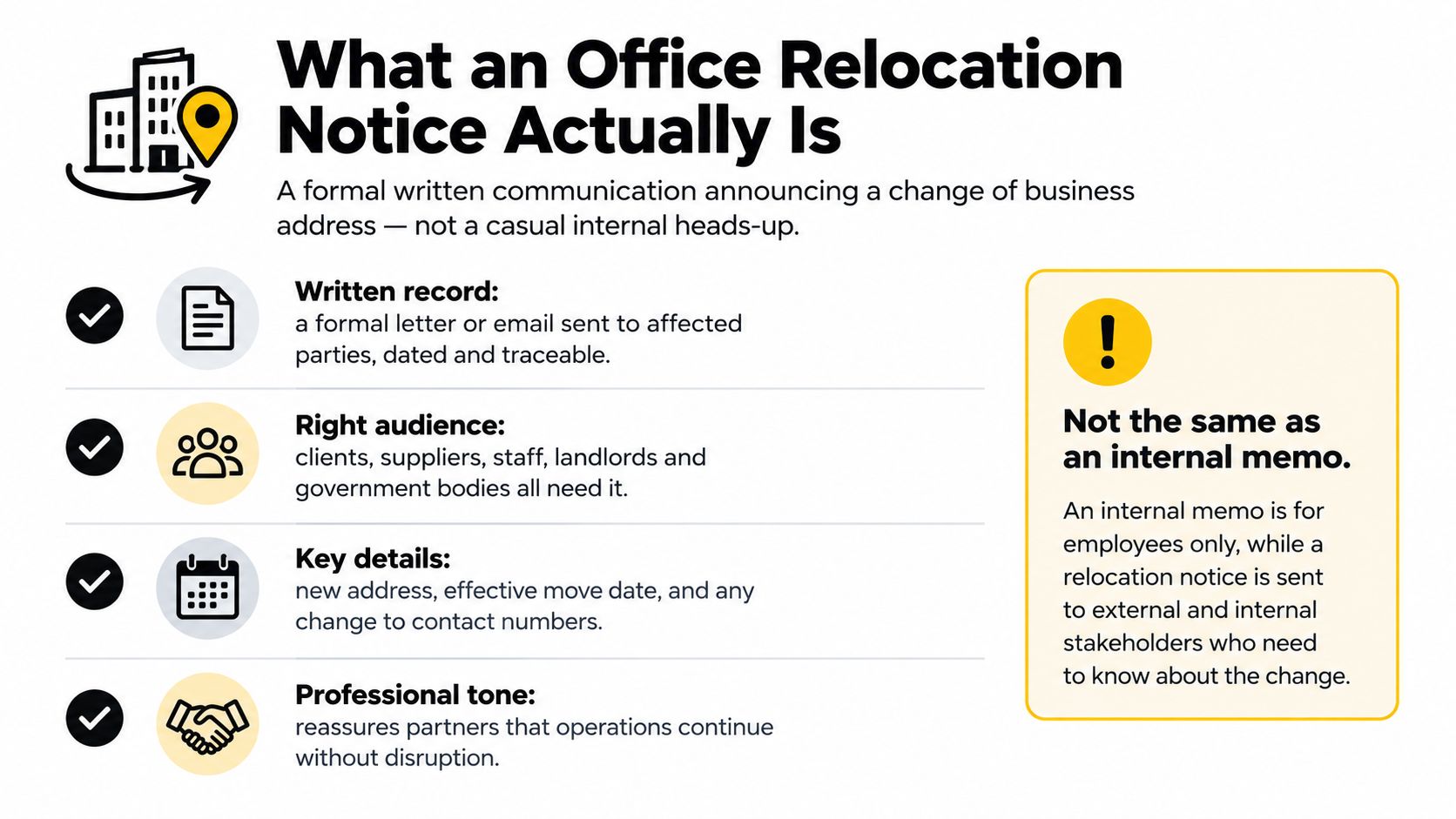
An office relocation notice is a dated written communication that announces a change to a business address and explains the operational effect for a defined audience. It's more formal than an internal heads-up because it creates a traceable record that can be saved, forwarded, printed or used to update another system.
The notice can apply to several different arrangements:
- A short-term move within the same work area: This may involve a swing space, temporary premises or a move to another floor while works take place.
- A temporary move to a different work area: A business may operate from another suburb or site before returning to its usual location.
- A permanent move to new premises: This is the conventional office relocation, with a new address becoming the ongoing place of business.
- A residence-based arrangement: The business or an affected worker may move work activities to a home or residence-based setting, which can change contact, access and working arrangements.
The document should be written for the people receiving it, not for the person who already knows the project. Include the sender's business name and contact details, the current and new address, the effective date, any transition window, the reason for the move, key contacts and a clear route for questions.
Details that prevent follow-up confusion
Add the suite, floor, building name and access instructions where relevant. State whether phone numbers, email addresses, reception hours, delivery instructions, parking arrangements or meeting procedures will change. If there's expected downtime for phones, internet or in-person service, give the window plainly rather than promising that disruption will be “minimal”.
A single notice rarely works for everyone. Staff need information about commuting, access, desks, rosters and support. Clients need continuity and delivery guidance. Suppliers need invoice, purchase-order and receiving details. Government bodies and registers need accurate administrative information.
For a useful example of the difference between a formal notice and a quick internal message, compare this guide to a Victorian notice to vacate with the operational detail required in a business relocation announcement.
Australian Notice Timing Rules You Need to Get Right
An office move can be operationally ready while the notice is legally late. A Melbourne business may need to coordinate staff, clients, suppliers and government records on different clocks. The correct deadline depends on who is affected, whether the workplace change is temporary or permanent, the employment instrument that applies and which business records must be updated.
For Victorian public-sector employment settings, the Victorian Government's VPS guidance sets specific notice thresholds. A temporary change within the same work area requires at least 24 hours' notice. A temporary move to a different work area requires at least two weeks' notice, unless a shorter period is agreed. A permanent change within a work area also requires two weeks' notice. If the relocation makes it reasonable and necessary for an employee to move residence, the employee may be entitled to up to three days' paid leave and reimbursement of reasonable relocation expenses. These rules are set out in the Victorian Government guidance on usual places of work.pdf).
The ATO enterprise agreement provides another useful benchmark. It requires as much notice as is reasonable. For a move between suburbs, or between the CBD and a suburb, the notice must be at least one month, unless the employee and delegate agree otherwise. That agreement does not automatically apply to private Melbourne employers, but it shows why a significant commute change should not be announced at the last minute. Staff also need a reasonable period to consider the effect of the move. Australian case guidance described “say two weeks” as prudent in one relocation context, as discussed in the Fair Work transfer-of-business guidance.
Separate staff timing from administration timing
ASIC deadlines operate separately from employee notice rules. A company must notify ASIC within 28 days when its registered office address or principal place of business changes, or a late fee may apply. The registered address must be a physical street address in Australia rather than a PO box, according to ASIC's company address requirements. Business-name address details, including the business email address, must also be updated within 28 days under ASIC's business-name address guidance.
Clients and suppliers generally have no single statutory notice period for an ordinary office move. They still need time to update invoices, mail redirection, delivery routes and internal systems. A staged announcement several weeks before the move, followed by a move-week reminder, gives those teams a workable handover period. Sending one email on the afternoon before the keys change hands leaves little time to correct errors.
Regional Australian relocation guidance recommends an initial notice 4 to 6 weeks before the move, with at least 2 weeks as a practical notice floor. The first communication should identify the effective date, full address and expected service downtime. Our office relocation timeline explains the operational reasoning behind that sequence. The Australian business relocation timing guidance provides further context for planning the announcement sequence.
| Audience or regulator | Minimum notice | Source or rationale | Risk if missed |
|---|---|---|---|
| Victorian public-sector staff, temporary change within a work area | 24 hours | VPS workplace guidance | The applicable workplace arrangement may be breached |
| Victorian public-sector staff, temporary move to a different work area | Two weeks unless a shorter period is agreed | VPS workplace guidance | Staff may not have enough time to prepare |
| Victorian public-sector staff, permanent change within a work area | Two weeks unless a shorter period is agreed | VPS workplace guidance | The workplace-change process may be mishandled |
| ATO employees moving between suburbs or CBD and suburb | One month unless otherwise agreed | ATO enterprise agreement | Staff may not have enough time to consider commuting impact |
| Company registered office or principal place of business | 28 days | ASIC address-change requirement | Records may be late and a late fee may apply |
| Registered business name address and business email | 28 days | ASIC business-name requirement | Public records and business communications may remain inaccurate |
| Clients and suppliers | No single statutory period for an ordinary move | Operational planning, invoicing and delivery needs | Parcels, invoices and meetings may go to the wrong place |
Set the earliest applicable staff or regulator deadline first. Then schedule client and supplier communications around the point when the move details are confirmed. If the legal threshold is shorter than the practical lead time, use the longer operational window.
Drafting and Sending Your Office Relocation Notice
Start with an internal fact sheet before drafting any audience-facing message. Confirm the settlement or fitout completion date, the last operating day at the old premises, the new street address with suite or level, phone arrangements, mail forwarding, reception hours and the expected downtime window. If any of those details are still provisional, mark them as decisions to resolve rather than allowing different teams to guess.
Staff consultation comes before a final announcement where the change may significantly affect employees. Discuss the timing and practical impact, provide written information and consider feedback, particularly where the move changes commuting time, parking, public transport, rostered days or family responsibilities. Fair Work guidance treats major workplace changes as a consultation issue, not merely a facilities update.
Build versions for each audience
Once the facts and consultation feedback are settled, write separate notices:
- Staff: Explain the reason for the move, the new usual workplace, access arrangements, desk or roster changes, support contacts and what happens during the cutover.
- Clients: Lead with continuity. Give the effective date, new address, contact details and any temporary courier or meeting instructions.
- Suppliers: Focus on invoices, purchase orders, delivery windows, loading-dock access, receiving hours and emergency contacts.
- Authorities and records teams: Use the exact legal entity name and the address format required by the relevant register.
Email should be the baseline channel, but don't rely on it alone. Use a printed notice in staff areas and reception, update the website footer, change email signatures when the effective date arrives and contact important accounts directly. Guidance on communicating new scheduling systems to hourly staff is also useful where the relocation affects rosters or frontline coverage.
A move-week reminder should go out three days before the cutover. Keep it short: confirm the cutover time, access rules, who will be available on moving day, the temporary destination for urgent deliveries and the number or email for immediate support. The office move planning resource can help teams align this communication with the physical work rather than treating the notice as a standalone email.
Ready-to-Use Notice Templates for Staff, Clients and Suppliers
Templates work when they give the recipient the information needed to act. They fail when a business copies one generic letter to every audience and leaves the reader to work out whether deliveries, meetings, invoices or staff arrangements are affected.
Use a clear subject line, name the sender and replace every bracketed field before sending. The office move project plan template can sit behind these messages as the internal record of decisions, owners and dates.
Staff notice
Subject: Office Move Notification, Effective [Date]
Hi team,
We're relocating our office from [current address] to [new address, building, floor and suite], effective [date]. Our final working day at the current site will be [date], and we expect the move and systems cutover to take place from [time and date] to [time and date].
The move supports [brief reason, such as lease expiry, space requirements or a change in operating arrangements]. From [first working day at the new site], please use the new entrance at [entrance details]. Access will require [access fob, security pass or reception sign-in]. Your move coordinator is [name], who can help with access, desk allocation and personal items.
Please note the following practical changes:
- Parking: [parking arrangements, booking process or permit details]
- Public transport: [nearest station, tram, bus or walking instructions]
- Desk allocation: [whether seats, lockers or team zones will change]
- IT support: [cutover details, support contact and what staff should do if systems are unavailable]
- Working arrangements: [any roster, remote-work or start-time changes]
Please remove personal items by [date] and label any equipment or documents that must be moved. If the relocation affects your commute, working pattern or other arrangements, contact [manager or HR contact] by [date] so we can discuss your questions.
On move day, contact [name and phone number] for urgent assistance. We'll provide a further reminder before the cutover.
Regards,
[Name]
[Role]
[Phone and email]
The staff version should feel warm and direct. Don't bury a commute or roster change inside a paragraph about new carpet and meeting rooms.
Client notice
Subject: Office Move Notification, Effective [Date]
Dear [Client name],
Our services, account contacts and usual support arrangements will remain unchanged. From [effective date], our office will be located at:
[Business name]
[New street address]
[Suite or floor]
[Suburb, state and postcode]
Please use [new phone number or existing phone number] and [new email address or existing email address] from that date. During the transition week, courier deliveries should be sent to [delivery instruction or temporary receiving address]. Our service team will remain available during the move, although in-person access may be limited between [time and date] and [time and date].
Your usual contact and service arrangements won't change. Please update your records and contact [named contact] with any questions.
Kind regards,
[Name]
[Role]
[Phone and email]
Clients need reassurance without vague promises. State what stays the same, then make the address and transition instructions easy to copy.
Supplier notice
Subject: Office Move Notification, Effective [Date]
Hello [Supplier name],
Please update your records for [business name] from [effective date].
New address: [full address, suite or floor]
Invoices and purchase orders: [new billing details]
Deliveries: [receiving entrance, loading dock and delivery instructions]
Receiving hours: [hours]
After-hours or emergency contact: [name and number]
Please use the new address on invoices, purchase orders and delivery documentation from the effective date. During the transition, send urgent delivery queries to [contact].
Regards,
[Name]
[Role]
[Phone and email]
The supplier version should be factual and operational. It's not the place for a long explanation of the office's design or the history of the business.
Common Mistakes That Derail Melbourne Office Moves
The most expensive mistakes usually look harmless while someone is drafting the notice. “Everyone knows we're moving” is not a communication plan. People know different parts of the project, and external partners often know none of it.
The operational failures
Downtime is described vaguely. Saying “there may be minor disruption” doesn't tell a client whether phones will work, whether reception will be open or where an urgent parcel should go. State the cutover window, the diversion address and the support contact.
IT is left until the furniture arrives. Internet, VoIP, shared drives, printers, access control and meeting-room systems can fail independently. Test the network at the new site at least 48 hours before staff arrive, then give staff a clear escalation route.
The business sends one message to everyone. Staff need personal and workplace information. Clients need continuity. Suppliers need delivery and billing instructions. A generic message forces recipients to ask questions that a personalized notice could have answered immediately.
Consultation is skipped. A move can affect carers, shift workers and people with long commutes even when the new premises look close on a map. Employers should notify affected staff, provide written information, discuss the proposed change and consider feedback where the change may have significant effects. If the relocation isn't agreed and materially changes the employment contract, Fair Work guidance indicates that employees may reasonably refuse to move and could become entitled to redundancy pay.
The ASIC deadline disappears into the project plan. A team may update signage and email signatures while leaving the registered office, principal place of business or business-name details untouched. Put the ASIC task beside the physical move, not at the bottom of a general administration list.
Other oversights cause less obvious friction:
- Mail redirection is forgotten: Letters and legal documents keep going to the former premises.
- The company extract isn't checked: The public record may not show the address the team believes it has updated.
- ABN and ATO details are overlooked: Invoices and government records can carry inconsistent information.
- Google Business Profile stays behind: Visitors search for directions and arrive at the old suburb.
- Parking signage isn't changed: Clients and couriers lose time before they reach reception.
- Voicemail gives the wrong suburb: Callers receive an inaccurate instruction even after the website is fixed.
Move-Week and Post-Move Checklist to Lock Everything In
A relocation isn't complete when the last chair enters the new office. It's complete when people can find the site, systems work, records show the correct details and the former premises no longer receives important business.
Use the following as a shared checklist. Give one person ownership of each item and record completion rather than assuming that another team has handled it.
Move-week actions
- Brief staff: Send the final address, access-fob instructions, floor plan, arrival arrangements and move-day support number.
- Confirm IT timing: Tell each team when phones, internet, shared drives, printers and security systems will be unavailable or ready.
- Explain Melbourne access: Include parking, public transport and walking details for the CBD or inner-suburban site, along with any building entry restrictions.
- Confirm loading logistics: Check lift and loading-dock bookings with building management, and make sure movers know the permitted access route.
- Change physical signage: Place a clear notice at the old reception and install the new building and suite signage.
- Redirect mail: Arrange postal redirection and give the new receiving team instructions for items that still arrive at the former address.
- Protect urgent service: Keep a named contact available for clients, suppliers and couriers during the transition window.
A printed or shared office relocation checklist helps prevent the familiar problem of completing the visible move while leaving the invisible administration unfinished. For teams changing printed stationery, signage or delivery materials, this print copy centre relocation advice is a useful reminder to coordinate production with the new address and cutover date.
Post-move verification
- Check official records: Confirm that the ASIC address change is reflected on the public register and that the business-name details are correct.
- Update digital listings: Change the website, Google Business Profile, email signatures, online directories and booking pages.
- Update ABN records: Review the relevant business and ATO details, then check a current invoice for the new address.
- Notify banks and insurers: Give each provider the effective date and legal entity details they require.
- Test communications: Call the main line, listen to the voicemail greeting, test internet access and confirm security systems.
- Run payroll from the new site: Check that the team can access the payroll platform and complete the normal approval path.
- Close the old address loop: Confirm mail diversion, courier instructions, landlord contacts and any remaining signage.
- Send a settled notice: About one week after the move, send a short message confirming that the new address is operating and restating the correct contact details.
Keep a 24-hour support contact available through the cutover, even if that contact routes issues to the right person. Retain signed staff notices, consultation records and final communications in the appropriate HR and business files. Those records show what was communicated, when it was communicated and which arrangements applied.
A careful office relocation notice, followed by disciplined verification, turns a disruptive change of premises into a controlled operational handover. Get n Go Removals Melbourne can coordinate commercial relocations, packing, furniture handling, storage and flexible scheduling around your settlement, fitout and access requirements. Visit Get n Go Removals Melbourne to discuss a move plan that protects your timeline and keeps your team focused on running the business.