
Where to Buy Moving Boxes in Melbourne: A 2026 Guide
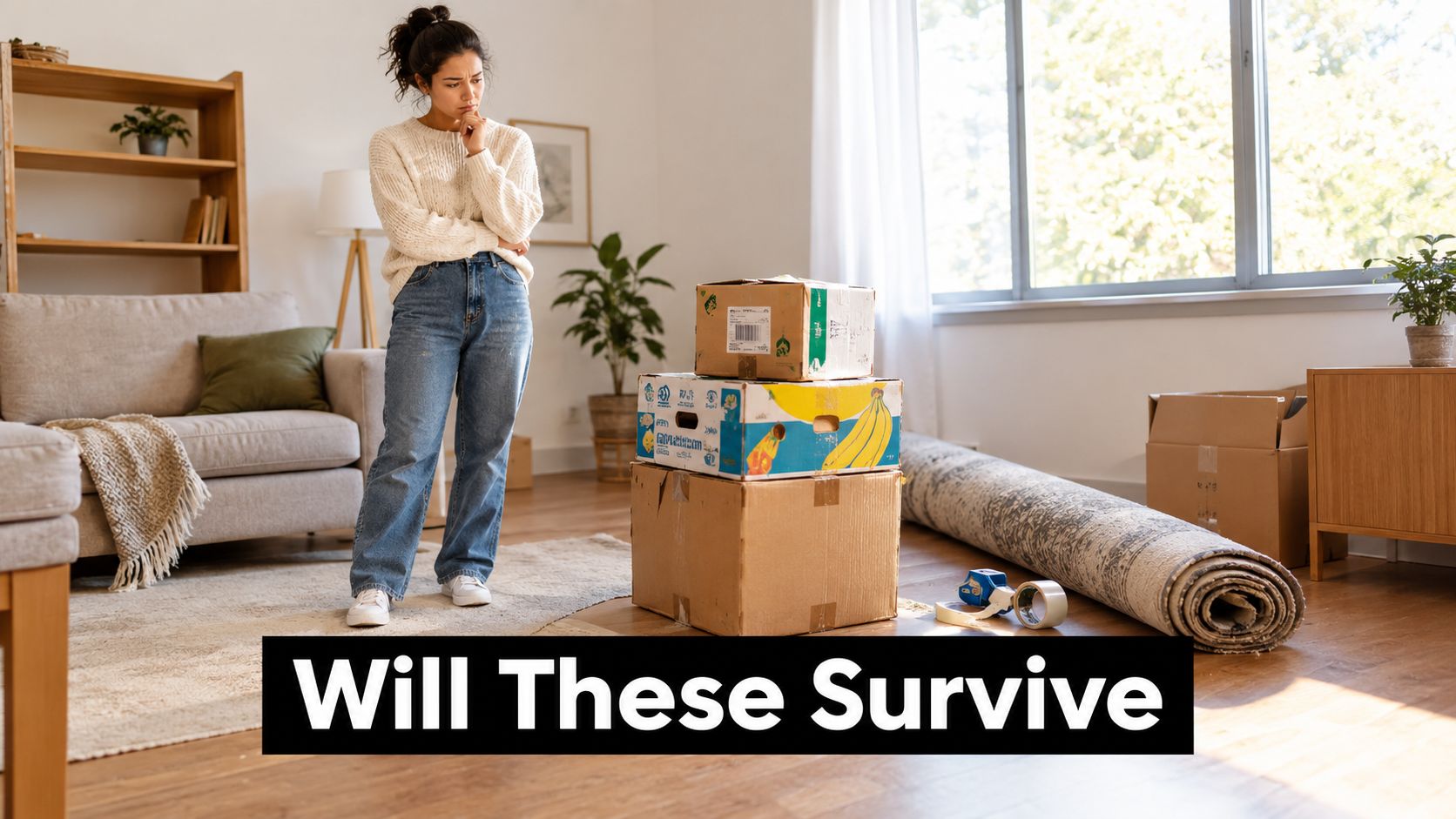
You're mid-pack, staring at a wobbly stack of mismatched cartons from a quick supermarket run, and the pressing question isn't whether they're cheap. It's whether they'll survive the lift, the truck, and the first stack in storage without lids popping or corners collapsing. In Melbourne moves, that's the whole game, because the right carton is the one that matches how it'll be handled, not just how little it cost at checkout.
If you buy moving boxes with that in mind, the decision gets much easier. You need to sort four things fast, box type, box grade, buying channel, and quantity, then match each carton to the job it has to do. A box that's carried once from lounge room to truck is a different purchase from a box that'll be lifted three times, stacked high, and sat under heavier loads for hours.
Practical rule: buy for the roughest part of the move, not the easiest one. If a carton needs to survive a stair carry, a van load, and a second-hand resale, it should be chosen for strength first and price second.
Standing in a Half-Packed Lounge Room
The usual moving-day mistake starts in the lounge room. Someone has rescued a few cartons from Coles, folded over some old tape, and decided they'll do for books, plates, and that awkward pile of kitchen bits that never quite fitted anywhere else. They might hold up for a short carry, but the true test comes when the removalist stacks them in the truck and weight starts pressing down from above.
That's why the smarter way to buy moving boxes is to think in handling stages. A carton that gets one gentle lift can be lighter-duty than one that will be stacked, dragged, tilted, and squeezed between heavier furniture. Single lifts, stacking, and long-haul transit are three different stresses, and the box you choose should answer the harshest one.
The decision set behind every move
Most Melbourne movers are really making four decisions at once. They're choosing the carton shape, deciding how strong it needs to be, picking where to buy it, and working out how many they need. That sounds obvious until the final week of packing, when people start buying whatever is left on the shelf and hope for the best.
The more reliable approach is simple. Dense items need smaller, stronger cartons. Bulky light items need bigger cartons. Fragile or interstate loads need better board and better sealing. That framework keeps the move together when the truck starts filling and the apartment lift keeps stopping on every floor.
A lot of moving advice sells boxes like they're all the same. They're not. A good carton system saves time, protects contents, and makes unpacking less chaotic because every box has a job before it gets taped shut.
The Moving Box Types and Sizes Worth Buying
A carton's job changes once it leaves the floor. It may be lifted through a Melbourne apartment, stacked beside furniture in a truck, tilted around a townhouse stairwell, or carried through shared corridors. Choose its size for those handling conditions, not just for how much it appears to hold.
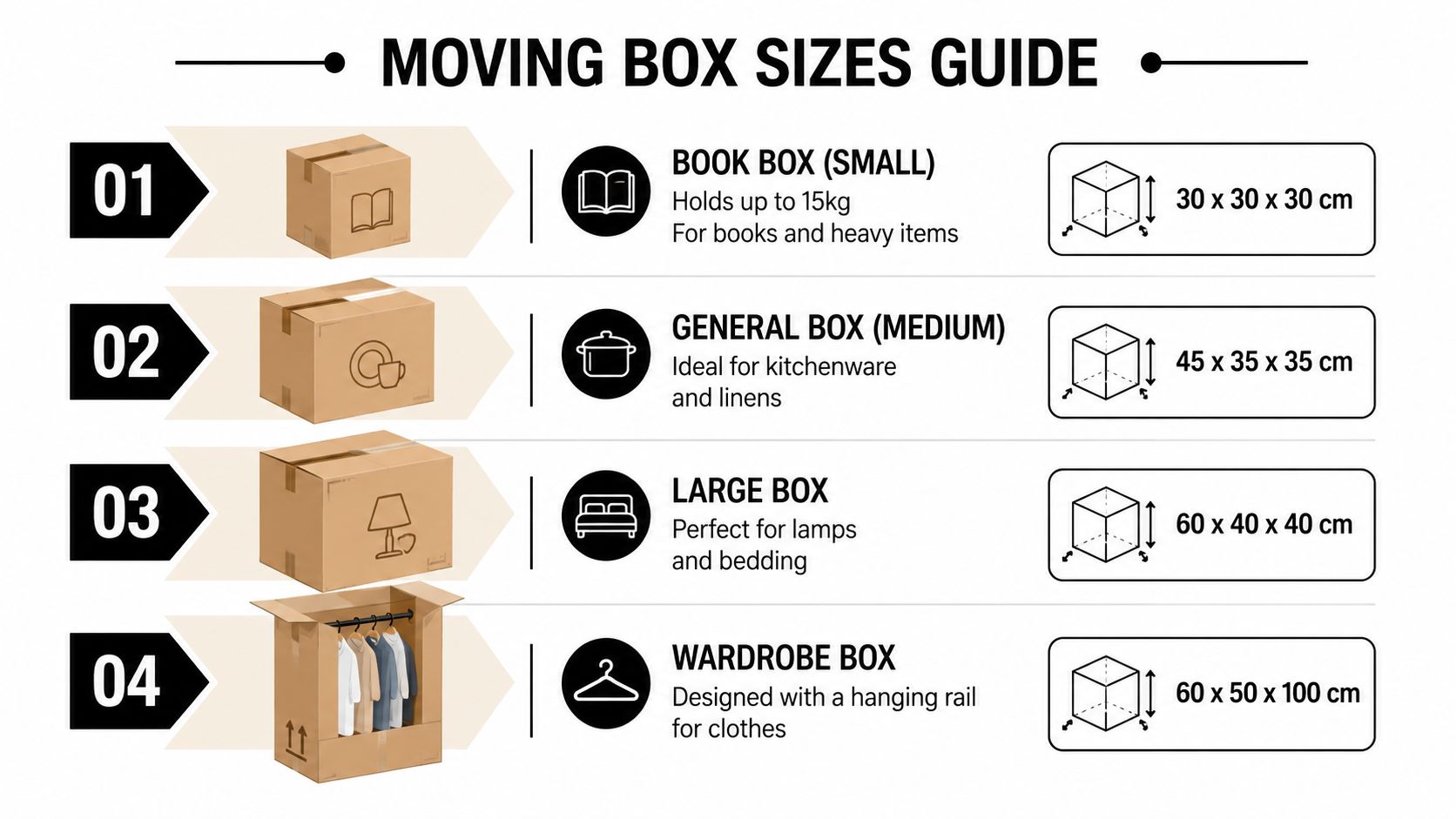
Small cartons carry weight, medium cartons handle general household items, large cartons hold light bulky goods, and specialty cartons protect awkward shapes. That division prevents the usual failures: crushed corners, split seams, and boxes nobody can safely lift.
Start with dense contents
Small book cartons are the workhorses for books, tools, canned food, and other heavy items. A local sizing guide places book or small boxes at about 0.06 cubic metres, or 40 to 50 litres, a useful range for keeping dense contents under control InstaMove's moving box guide.
Another Australian guide lists a small 35 x 35 x 35 cm box at about 42 litres, with a 20 to 25 kg practical load range Starmoving's size guide. The figures vary by supplier, but the handling rule remains consistent. Pack heavy items into a compact carton that can be lifted without twisting your back or losing control on stairs.
Heavy items need less room and more restraint.
Use medium cartons for mixed household loads
Medium cartons suit kitchenware, toys, general household goods, and loose items that do not need a dedicated carton. A medium 45 x 45 x 45 cm box holds about 90 litres and has a 20 to 25 kg practical load range, according to the same sizing guide.
| Carton type | Common size or capacity | Suitable contents | Handling role |
|---|---|---|---|
| Small | 35 x 35 x 35 cm, about 42 litres | Books, tools, dense goods | Keeps weight manageable |
| Medium | 45 x 45 x 45 cm, about 90 litres | Kitchenware, toys, household items | General-purpose carrying |
| Large | 60 x 45 x 45 cm, about 120 litres | Bedding, cushions, doonas | Adds volume without dense weight |
Reserve large and specialty cartons for the right jobs
A large box at 60 x 45 x 45 cm, about 120 litres, has a 15 to 20 kg capacity range. Use it for bedding, cushions, doonas, pillows, and lampshades rather than books or crockery. Large cartons become difficult to control when dense items settle at the bottom, especially on stairwells or during truck loading.
Wardrobe boxes keep suits, dresses, and coats hanging instead of folded into wrinkles. Picture and mirror boxes protect flat fragile items by supporting their edges, rather than leaving artwork or glass loose inside a deep carton.
Extra-large cartons can suit oversized soft goods, but only while they remain light enough to carry at chest height. In a Melbourne apartment with tight turns, lift delays, and shared corridors, skipping the biggest size can reduce handling risk and speed up the move.
Label each carton by room and unloading priority. The practical storage box label ideas can be adapted for moving day, particularly when several cartons look identical.
For a starter pack, the guide to small moving boxes helps match compact cartons to the heaviest contents, so the first boxes loaded are also the easiest to control.
Single Wall vs Double Wall Cartons and Why It Matters
The difference between single-wall and double-wall cartons shows up in the truck, not in the shop aisle. A single-wall carton built around 4 mm board and 560 gsm corrugated material is fine for lighter domestic loads, especially where the box is handled once or twice and not asked to hold up under serious stacking pressure Get n Go's packing materials guide. Once the load gets heavier, or the transit gets longer, the construction matters far more than the print on the outside.
What the structure changes
Single-wall cartons work well for books, toys, and canned food when the packing stays sensible. The problem starts when they're used like warehouse boxes, stacked high with kitchen gear inside, or loaded into a truck where every bump shifts force through the side panels and base. The middle bows first, then the seams begin to complain, then the box stops behaving like a box.
Double-wall cartons use two fluted layers bonded together, which gives them much better shape retention under weight and vibration Get n Go's packing materials guide. That's why they suit ceramics, glassware, stereo gear, and interstate runs where cartons sit in transit longer and get handled more than once.
| Feature | Single-Wall Carton | Double-Wall Carton |
|---|---|---|
| Board construction | One fluted layer | Two fluted layers bonded together |
| Common use | Light to moderate household items | Fragile, heavy, or long-transit loads |
| Best load profile | Under about 12 kg Get n Go's packing materials guide | Heavier stacks and more demanding handling |
| Truck performance | More likely to bow under stacked weight | Holds shape better under pressure |
| Value use | Everyday moves, lighter contents | Better protection for items that can't be replaced cheaply |
Practical rule: if a carton will be stacked above knee height or carried more than once, single-wall is a gamble.
The cost premium on double-wall board makes sense when the alternative is a cracked screen, chipped crockery, or a speaker that got crushed at the base of the pile. Reusable double-wall cartons also keep more of their shape for a second move, which means they hold value better if you pass them on later or resell them.
For a Melbourne move, the construction call is simple. Use single-wall where the contents are light and the handling is straightforward. Use double-wall where the contents are fragile, heavy, or headed interstate.
Where to Buy Moving Boxes in Melbourne
Melbourne gives you four practical buying channels, and each one suits a different kind of move. The best choice depends on how many cartons you need, how quickly you need them, and whether you care more about convenience or uniform quality. That's why a one-bedroom apartment and a four-bedroom family house usually end up buying boxes very differently.
Compare the buying channels
| Buying Channel | Typical Price per Carton | Quality | Best For | Watch-outs |
|---|---|---|---|---|
| Removalist companies | Varies by package | Usually strong and move-ready | People who want cartons bundled with packing and transport | Stock can be tied to booking windows, and you may need to plan early |
| Warehouse and packaging suppliers | Usually better value in bulk | Often consistent and purpose-built | Larger orders and proper carton matching | You may need to collect from industrial suburbs and manage access |
| Big-box retail | Convenient for small top-ups | Decent for standard domestic use | Studio moves and last-minute extras | Range can be patchy, especially if you need many cartons at once |
| Second-hand channels | Free or low cost | Mixed quality | Light items, short-notice fill-ins | Quality varies, and supermarket-style cartons need inspection before use |
Removalist companies work well when the same supplier is also loading the truck. That makes the cartons part of the moving system rather than a separate shopping errand, which suits one-to-three-bedroom moves especially well. If you're already booking the move, that is the moment when a lot of people simplify the whole process.
Warehouse and packaging suppliers in places like Preston, Moorabbin, and Dandenong are the better fit when you need volume. Bulk buying usually gives you a cleaner carton mix, and you're less likely to end up with a strange assortment that won't stack neatly in the truck. For larger orders, that consistency saves more time than it looks like it should.
Big-box retail, including places like Bunnings, Officeworks, and Kmart, suits top-ups and smaller moves. It's the easiest option when you only need a handful of cartons and you want to leave with them the same day. The trade-off is that you're buying from the shelf, not from a packing system, so the selection can be thinner.
Second-hand channels like Facebook Marketplace, Gumtree, and Freecycle are useful if you need cheap cartons fast. Free boxes are often supermarket or produce boxes, not real moving cartons, so they need a structural check before you trust them with anything heavy. If you're driving across town, factor in CBD parking, loading dock access, and click-and-collect cut-off times before you commit to a pickup.
If you want cartons and packing supplies in one place, the shop page at Get n Go's packing supplies is the kind of consolidated option many movers use when they want the order and the move to line up.
How Many Boxes You Really Need for Your Move
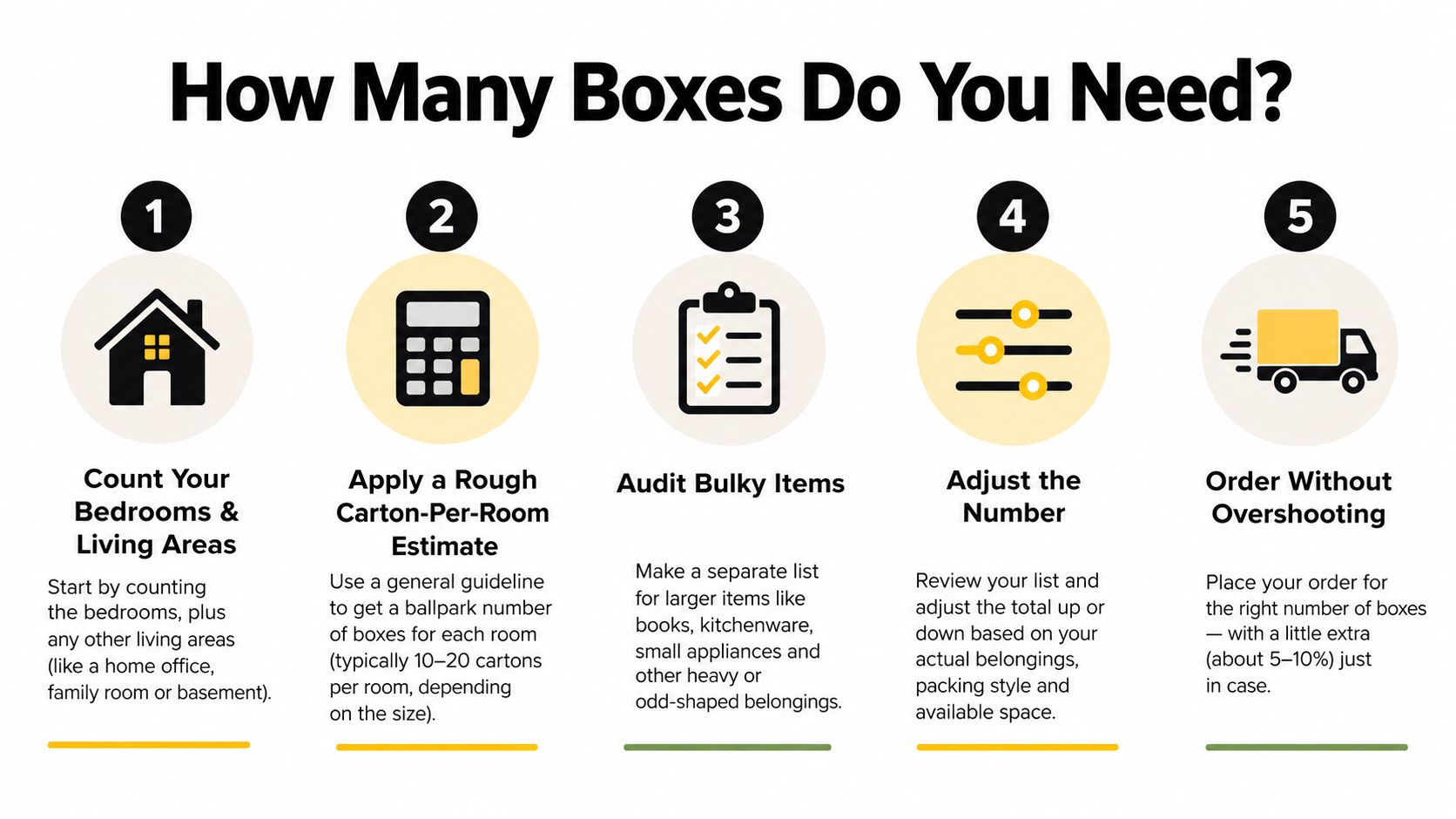
The fastest way to order enough cartons is to start with property size, then correct for what's inside the home. A studio doesn't pack like a three-bedroom townhouse, and a two-bedroom apartment with a full bookcase, a heavy kitchen, and garage overflow needs a very different order from a minimalist place with a few shelves and a wardrobe. The point is to avoid both shortages and a pile of unused cartons at the end.
Use a quick baseline
A practical starting point is around 15 to 20 cartons for a studio, 30 to 40 for a two-bedroom home, 50 to 65 for a three-bedroom home, and 70 to 90 for a four-bedroom home. That range gives you a planning anchor before you count the extra stuff that always turns up in cupboards, under beds, and behind doors. If you want a rough volume check as well, the calculator-style method in how to calculate cubic metres helps turn an inventory into a clearer order.
Adjust by what you own
A book-heavy home needs more small cartons. A linen-heavy home needs more large ones. Kitchens with a lot of glassware need more protected packing than a place full of plastic containers and a few plates. Garage contents, tools, and small appliances add up quickly, and they're often the reason people run short.
A workable mix often looks like this:
- 40 percent medium cartons, because they handle the broadest range of household items.
- 25 percent large cartons, for doonas, cushions, and other light bulky goods.
- 15 percent small/book cartons, for dense items that should stay compact.
- 10 percent extra-large cartons, for bedding and soft fill.
- 10 percent specialised cartons, for wardrobe, picture, and dish items.
Practical rule: if a drawer holds books, treat it like a small carton. If a shelf holds linen, treat it like a large one.
A simple shortcut works well in real homes. Count one tea-chest equivalent per cupboard shelf, one small carton per drawer of books, and add a buffer of five to ten spare cartons for donation runs and last-minute items. That buffer is what saves you when the pantry still has jars in it at 8 p.m. the night before the move.
The Cheapest Box Is Not Always the Best Value Box
The cheapest carton on the spreadsheet can become the most expensive choice in the truck. You pay for moving boxes once, but you pay for bad boxes three more times, in breakages, in packing delays, and again when you have to dispose of soaked or crushed cardboard after the move. Value only makes sense when you count the full life of the carton, not just the price tag.
Free boxes need a structural check
Supermarket and produce boxes are tempting because they're free and easy to find. The issue is that many of them were never designed for repeated stacking under household loads, and plenty have already spent time in damp storage, delivery cages, or back-of-shop handling. Once a soft corner gives way in the truck, the savings disappear very quickly.
That's why a single-wall carton at about 4 mm and 560 gsm is the minimum sensible spec for anything that will be lifted more than once or stacked above knee height Get n Go's packing materials guide. For items over 12 kg or for interstate runs where cartons sit in transit longer, double-wall is the better call QSM's technical manual.
Buy for reuse, not disposal
A quality carton has a second life. It can go to a school fundraiser, a community pantry, or back onto Marketplace once the move is done, which means the purchase can turn into a small credit instead of a one-time waste cost. That's part of why it makes sense to buy cartons that survive cleanly rather than bargain bins that collapse on contact.
Victoria's packaging stewardship framework sets a 90% recovery target for packaging materials under the National Environment Protection (Used Packaging Materials) Measure 2011, and Victoria's EPA also notes used packaging materials can be classed as industrial waste that must go to an authorised place EPA Victoria's used packaging materials guidance. In practice, that means the smarter carton is the one you can flatten, reuse, and recycle without extra drama.
The better purchase is usually the one that saves you from a failed stack, a cracked plate set, and a second trip to the kerb with soggy cardboard. Paying a little more up front is often the cheaper move by the end of the week.
Your Pre-Move Packing Checklist
A good packing checklist should feel like a tool, not a lecture. By the final two weeks, you want a simple routine that tells you what to buy, how to label it, and what to do with the cardboard after the move. That's the part people usually skip, and it's why garages fill up with flattened boxes no one wants to deal with later.
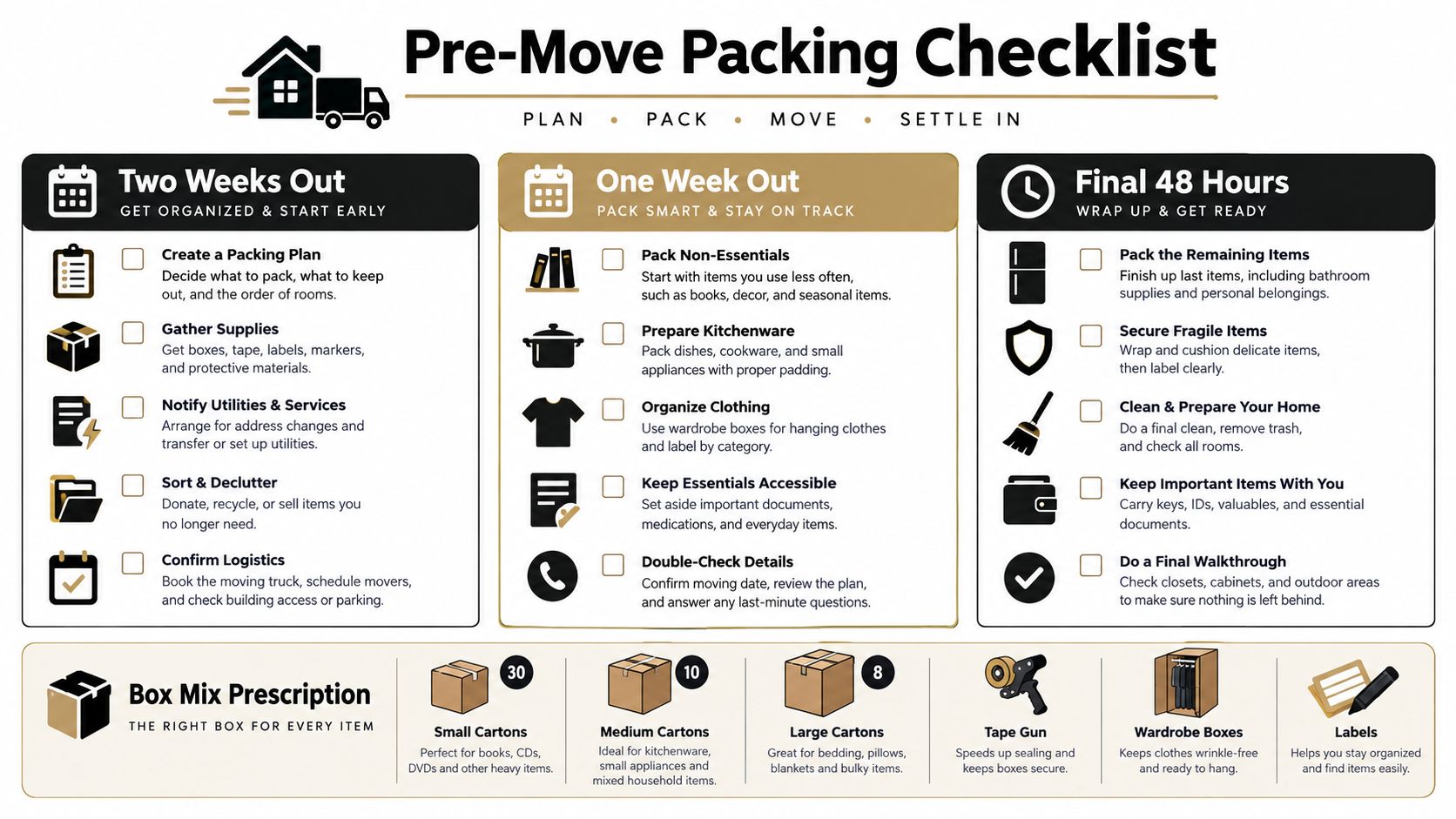
Two weeks out
- Order the right mix: Start with 30 small cartons for books, crockery, and canned goods, 20 medium cartons for general household items, 10 large cartons for bulky but light goods, 4 extra-large cartons for bedding, and 2 to 4 wardrobe cartons for hanging clothes.
- Buy proper tape: Use 48 mm tape and keep a tape gun handy so every seam is sealed properly.
- Prepare labels: Mark each carton by room and contents so unpacking doesn't turn into guesswork.
One week out
- Set aside fragile cartons: Reserve 5 cartons for stemware, screens, and lampshades, and mark them FRAGILE on more than one side.
- Stack by type: Keep small cartons together, then medium, then large, so the load plan stays tidy when the truck is packed.
- Check your extras: Keep a few cartons back for donation items, especially if the declutter goes better than expected.
Final 48 hours
- Seal every seam: Use the tape in an H-pattern across the top and bottom flaps so the joins stay tight.
- Use the right disposal route: Flatten clean cartons for recycling, pass reusable ones to local Buy Nothing groups or community halls, and keep four quality cartons for storage.
- Do the last check: Make sure fragile cartons, wardrobe boxes, and labels are all in one spot before move day starts.
If you need the broader moving prep sequence, the moving house checklist Australia is a sensible companion piece to keep nearby while you pack.
If you want cartons, packing materials, and a moving plan that all line up properly, Get n Go Removals Melbourne can help with that side of the move as well. The team supplies premium packing materials and handles Melbourne moves with the same practical focus on strength, stacking, and transport that this guide covers.