
Moving Boxes Cheap: Smart Sourcing Tips for Melbourne
You've got a move booked from Brunswick to South Yarra, the apartment lift is available for a narrow window, and half your belongings are still loose in cupboards. The temptation is to search for moving boxes cheap, grab the lowest price you can find, and worry about the rest later. That approach often costs more through wasted trips, crushed cartons, rushed purchases, and a pile of cardboard blocking the new hallway.
The sensible target isn't the lowest sticker price. It's the lowest usable cost per safe, correctly sized box, including collection, tape, transport, storage, and disposal. In Melbourne, you can buy cartons for only a few dollars, hire reusable boxes, or collect free stock, but each option suits a different move.
What Cheap Moving Boxes Actually Cost in Melbourne Right Now
For a two-bedroom apartment move, cheap means accessible, dry, strong enough for the contents, and available before packing day. Australian suppliers currently list standard moving cartons at about AU$1.27 to AU$4.95 each, while bulk tea-chest and medium removalist cartons can sit around AU$2.88 to AU$3.48 each before GST. ABL Distribution's moving-box listings show why a single advertised price doesn't tell the whole story.
A medium carton bought in quantity may cost less than a larger tea-chest-style box. Larger cartons can move into the AU$7 to AU$15 range, depending on dimensions and wall thickness. That makes the cheapest box a poor choice for every room. Use low-cost medium cartons for general household goods, smaller strong cartons for books and cookware, and reserve reinforced formats for items that punish weak cardboard.
The price you see isn't the full packing bill
A carton price usually excludes tape, protective paper, and delivery. A bulk order can look attractive until you discover a minimum quantity or a freight charge to an apartment building. Single-wall cartons are fine for linen, clothing, cushions, and other light contents. Double-wall or reinforced cartons earn their cost for fragile electronics, dense kitchenware, and awkward items that will be handled repeatedly.
Australian recycled cardboard supply also keeps the budget end of the market competitive. Visy Specialties explains that its cardboard boxes use 100% recycled cardboard and are designed to be recyclable. Suppliers also advertise bulk pricing as low as around AU$1.22 to AU$3.00 per box, although the final price still depends on size, quantity, and delivery.
Removalist's rule: Don't buy a large carton just because it holds more. A smaller full box is usually easier to carry, safer to stack, and less likely to waste truck space.
Before ordering, count the boxes you can source free, identify the rooms needing stronger cartons, and price tape and transport beside the cartons. These practical ways to keep moving costs down matter more than chasing a theoretical bargain that arrives late or fails under load.
Free and Low-Cost Sources for Moving Boxes in Melbourne
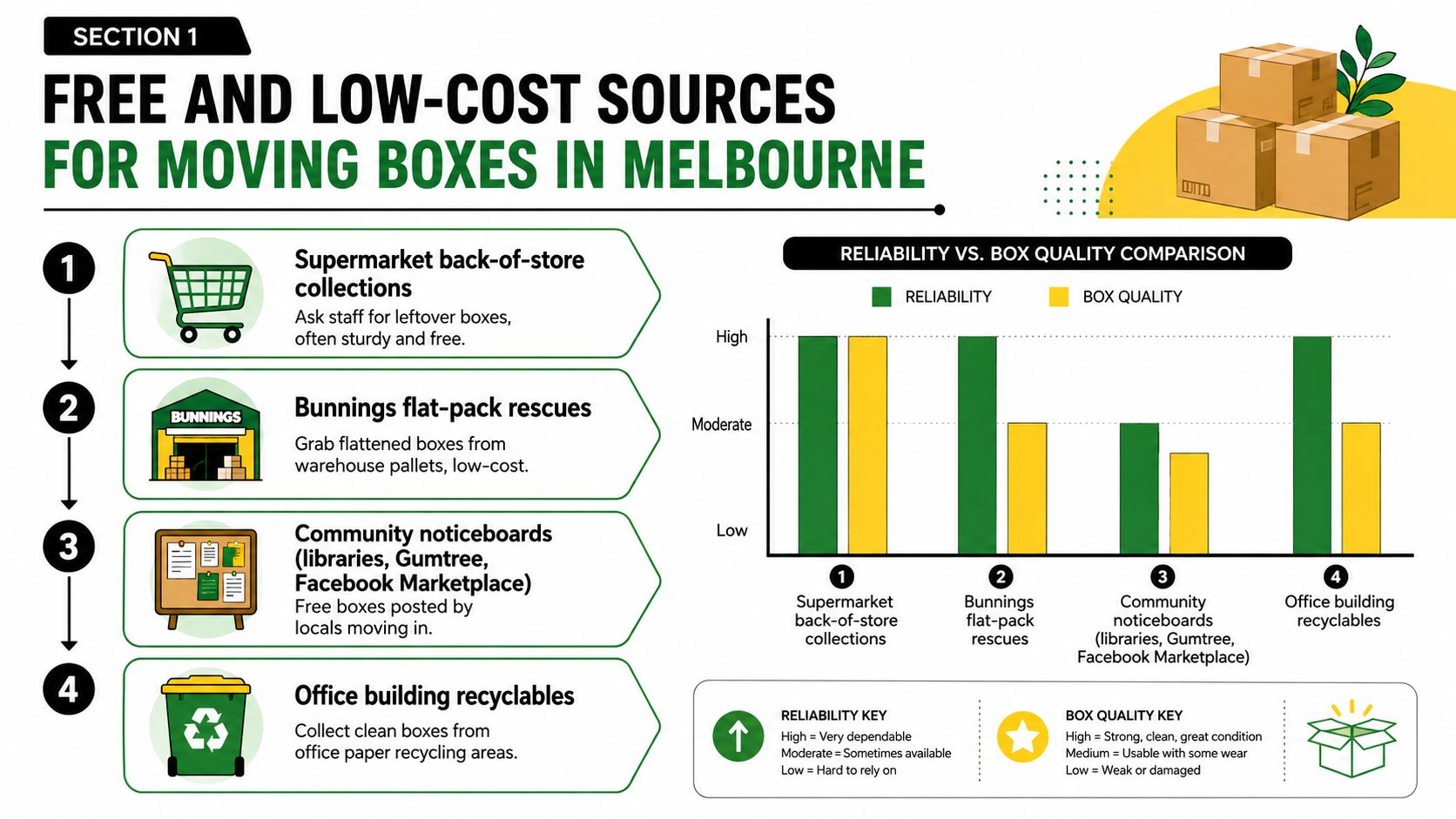
Free boxes are useful, but only when the collection is predictable and the cartons are clean. Rank Melbourne sources by reliability, condition, and travel time, not by the word “free”. A ten-minute collection from a nearby shop can beat a long drive for a mixed pile of damp, flattened boxes.
Start with businesses that receive regular stock
Supermarkets are the first call. Ask the service desk or a manager whether clean dry-goods cartons can be held aside, and avoid produce boxes that smell of food or have absorbed moisture. Liquor shops can provide compact cartons with internal dividers, while bookstores often have strong, manageable boxes suited to books and files.
Bunnings and similar warehouse retailers may have flattened cartons from flat-pack deliveries. These can be useful, but inspect every fold and cut before loading them. Office fit-out clear-outs in the CBD can produce clean cartons designed for paper, stationery, and equipment, though access and collection timing can be less convenient.
University end-of-semester clear-outs are another worthwhile lead. Inner suburbs with dense apartment turnover, including Brunswick, Carlton, Parkville, North Melbourne, Richmond, and South Yarra, tend to offer better opportunities because more people move through compact housing. Supply changes constantly, so contact the source rather than assuming boxes will be waiting.
Use community listings strategically
Facebook Marketplace, Gumtree, Buy Nothing groups, and local noticeboards can deliver a coordinated bundle from someone who has just unpacked. Ask three questions before travelling:
- Condition: Are the boxes dry, clean, pest-free, and still rigid?
- Format: Are they assembled, flattened, or mixed with specialty cartons?
- Collection: Is pickup possible at a time that works with your packing schedule?
Offer a small donation, coffee, or a prompt collection when appropriate. Staff and neighbours are more likely to help again when you don't leave a mess or demand sorting work.
The common traps are predictable. Food-soiled cartons attract pests, damp loading-dock boxes collapse, and poorly flattened cartons take up more car space than expected. If you need a dependable fallback, these Melbourne box-finding options are more useful than spending an afternoon driving between random retailers.
Buy New, Hire, or Reuse Which Option Saves You Most
There are three sensible routes. Buying new gives you consistent dimensions and predictable strength. Reusing free or used cartons reduces the cash bill but charges you in searching, checking, collecting, and storing. Hiring reusable cartons sits between the two and removes much of the end-of-move disposal work.
| Option | Avg Cost for 1-Bed Move | Time Investment | Box Condition | End-of-Move Disposal |
|---|---|---|---|---|
| Buy new | Depends on size and quantity, with standard cartons commonly priced around AU$2 to AU$6 each at major retailers | Low | Consistent | Flatten and recycle or pass on |
| Hire | From AU$3.25 per box for up to three months, with refundable deposits of AU$1.60 for a medium box and AU$2.50 for a large box | Low to moderate | Reusable and supplied by the provider | Provider collects them |
| Reuse | Free when sourced through local networks, or used cartons around AU$2.95 for medium and AU$3.95 for large | High | Varies and requires inspection | Donate, resell, or recycle |
The hire and used-box figures come from Hire a Box's Australian pricing. The provider's hire model is especially practical for renters, short-notice moves, and households that don't want cardboard stored in a corridor or garage.
Match the option to the move
For a studio with a tight deadline, buy a consistent set or hire cartons if delivery and collection are available. The time saved is worth more than a small per-box saving. For a family move containing heirlooms, use new reinforced cartons for fragile and valuable items, then fill the balance with inspected reused boxes.
For an interstate shipment, new cardboard generally makes more sense than a local reusable-crate service because collection logistics become difficult at the destination. If you're comparing broader transport choices, this guide to rent uhaul can help you think through vehicle and distance considerations without confusing transport hire with box hire.
Your decision rule is simple. Short move, short storage period, and limited time means hire or buy new. More time, local collection access, and a vehicle mean reuse. Long distance or fragile contents means prioritise uniform, reliable cartons. Count disposal labour as a cost, especially in an apartment where every flattened box must travel through a lift or stairwell.
Choosing the Right Box Size and Type for Every Room
Boxes aren't interchangeable. A carton that works for towels is the wrong tool for books, and a large empty box invites overloading. One Australian supplier lists a 27.0-litre cube at 300 x 300 x 300 mm, a 51.9-litre medium box at 500 x 335 x 310 mm, and a 100.4-litre large tea chest at 465 x 360 x 600 mm. Super Cheap Boxes provides these dimensions and capacities.
| Box Type (Litre) | Best For | Max Weight | Approx. Per Room |
|---|---|---|---|
| Cube, 27.0 L | Books, tools, records, dense kitchen items | Keep manageable by hand | Several for office or kitchen |
| Medium, 51.9 L | Toys, folded clothing, small appliances | Avoid dense overfilling | Several for living and bedrooms |
| Large tea chest, 100.4 L | Linen, cushions, bulky light goods | Light contents only | Limited use in bedrooms |
| Wardrobe carton | Hanging clothing | Keep clothing load controlled | One or more where wardrobes are full |
| Reinforced specialty carton | TVs, electronics, fragile equipment | Follow the carton specification | As required |
Pack by weight before volume
Use small cartons for books, canned goods, cookware, records, and tools. Medium cartons suit mixed household goods and small appliances. Large cartons belong to light items such as bedding, towels, cushions, and soft toys. Wardrobe cartons let hanging clothing transfer directly without folding, while picture and mirror cartons protect flat, awkward pieces.
Don't fill large cartons with dense items. They become difficult to lift, their bases take more strain, and they consume truck space inefficiently. Put heavy items low, fill gaps with light material, and keep every carton firm without forcing the flaps.
Labels also save money because they reduce searching and rehandling. For practical ideas on clear room and storage labelling, InchBug's organising tips are a useful reference. Write the room and contents on more than one visible side, especially when boxes will be stacked.
Fragile packing deserves its own method, not a larger box. Use the guidance in this fragile-item packing resource for cushioning, movement checks, and sealing. The Australian industry summary linked there reports that inadequate cushioning and poor box selection account for about 68% of moving-related damage, while its protocol reports a 98.2% undamaged-delivery success rate. It also warns that overfilling beyond 15 kg increases breakage by 34%. Treat those figures as a reason to control weight and movement, not as permission to stuff cartons until they bulge.
Packing Tips That Cut Your Box Count in Half
Most households buy too many boxes because they pack loosely. A half-filled carton needs another carton for the items left behind, while gaps allow contents to shift and damage one another. The aim is not to cram everything together. It's to use the right box, distribute weight, and fill empty space with material you already own.
Start with a strict room-by-room sequence. Declutter before sourcing cartons, then pack heavy items into small boxes and light bulky items into larger ones. Towels, socks, scarves, bedding, and clean clothing can cushion fragile goods without adding a separate purchase.
- Build a stable base: Use a proper H-pattern tape seal and add cushioning before placing glass, ceramics, or electronics inside.
- Wrap items separately: Individual wrapping prevents pieces from knocking together and often fits more safely than burying loose objects in padding.
- Zone the weight: Put books and dense kitchenware at the bottom of a small carton, then use lighter items only where the box still closes without pressure.
- Fill the voids: A box should finish firm, with no internal movement when gently shaken. Don't leave soft pockets that collapse under a stack.
- Label hardware immediately: Put screws and fittings in a labelled zip-lock bag, then tape it to the furniture it belongs to.
- Flatten furniture where sensible: Disassembly can reduce awkward dimensions, but only do it when the piece can be safely reassembled.
Cheap moving boxes become economical when used correctly. A correctly filled carton stacks cleanly, protects its contents, and reduces the number of extra cartons needed. It also reduces handling time because movers aren't repeatedly opening, rearranging, or replacing unstable boxes.
The Australian packaging system gives you another reason not to overbuy. Packaging waste represents roughly 9% of total waste generation, and APCO reports 2.9 million tonnes of packaging were sent to landfill in 2018–19, around 50% of packaging placed on the market. The National Environment Protection Council's packaging impacts document provides that national context. Buy the cartons your packing plan requires, not a random surplus because the unit price looks low.
Use this moving house packing checklist for 2025 to organise the sequence, then apply the more detailed house-packing tips to reduce rushed purchases.
How a Melbourne Removalist Can Solve the Box Problem
A removalist can do more than carry cartons from one address to another. The useful service is material coordination. A professional team can supply the standard cartons, wardrobe boxes, mattress protection, tape, and other packing materials, then align delivery with your packing schedule.
That matters in Melbourne apartments. A lift booking, loading-zone restriction, narrow corridor, or long walk from truck to foyer can turn a cheap-box hunt into a timing problem. If cartons arrive late, you either pay for emergency retail stock or pack into unsuitable boxes. If you collect too many, you need somewhere dry to store them before and after the move.
The value is in the logistics
A removalist can sequence the load so packed cartons spend less time obstructing common areas. The team can also plan the trolley route, protect lift interiors, and keep room-labelled cartons together rather than scattering them through the truck.
Ask for the box arrangement in writing. Confirm whether cartons are supplied, hired, kept, returned, or charged separately. Also check whether unused cartons can be returned and whether the service includes collection after unpacking.
Get n Go Removals Melbourne offers customers boxes they can keep and pay for or return within two weeks for a full refund, subject to the provider's terms. Its packing service also includes moving boxes and protective materials, which can suit households without a vehicle, storage space, or time to source cartons independently.
The right comparison isn't “DIY boxes versus removalist boxes”. It's total move effort versus total move cost. Include petrol, collection trips, tape, failed cartons, disposal runs, apartment access, and the time spent waiting for pickups. For a broader explanation of how material supply fits into a moving booking, see why hiring removal services can be a smart move.
What to Do With Cheap Boxes After the Move
The cheapest box is only good value if it doesn't create a second job. Once the last carton is emptied, you have four practical choices: pass it on, keep it, sell it, or recycle it. Decide before moving day, because a stack of cardboard quickly takes over an apartment hallway, spare room, or balcony.
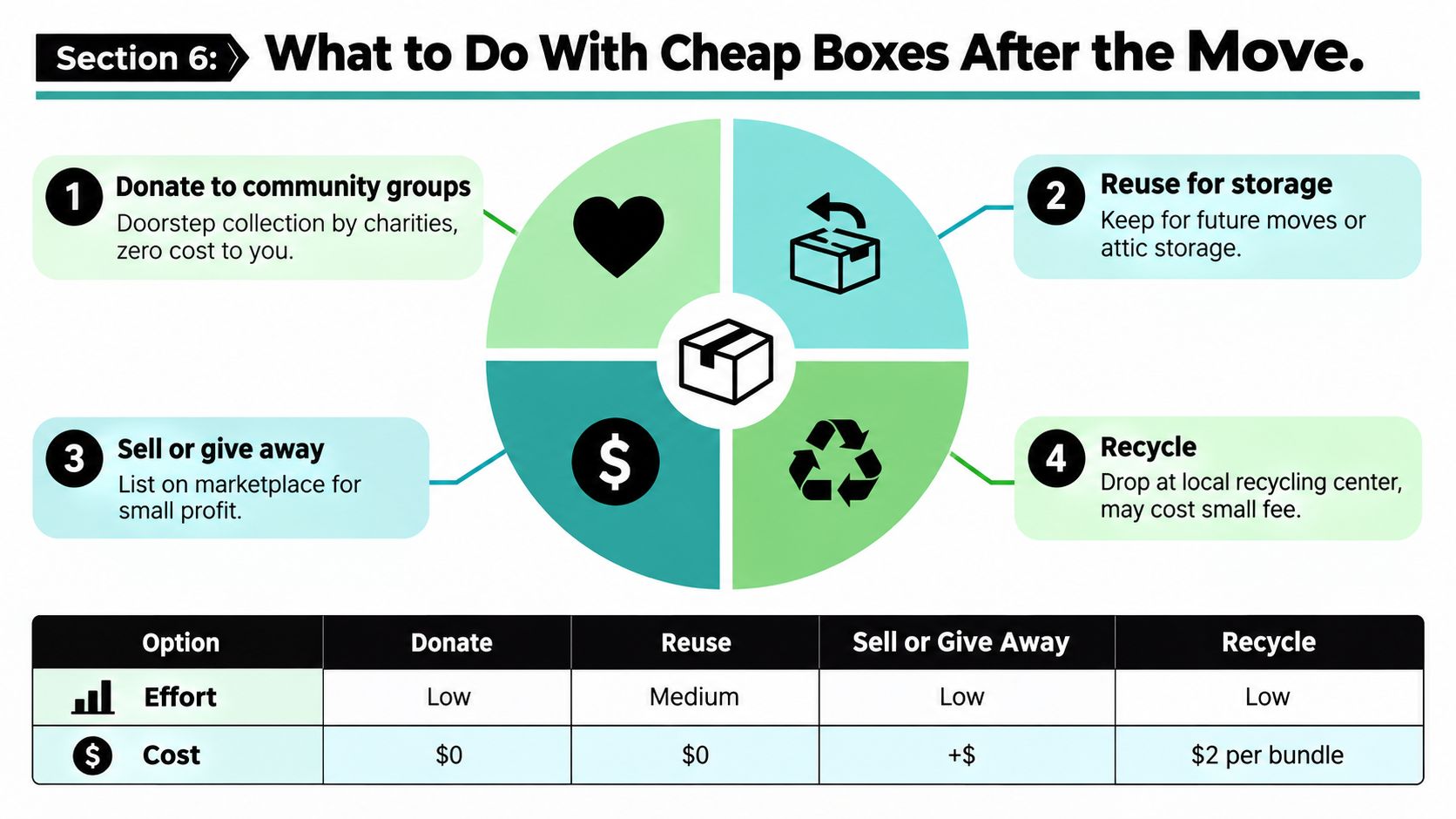
Clean, dry, structurally sound cartons are worth offering to Buy Nothing groups, Gumtree, Facebook Marketplace, or neighbours. List them for prompt pickup and state whether they're flattened. You can also ask Salvation Army or Vinnies depots whether a nearby location accepts intact cartons for reuse, but check first because acceptance policies vary.
If a box is torn, stained, damp, or no longer rigid, flatten it and use the appropriate cardboard recycling route. Visy and Cleanaway facilities may provide dedicated recycling or transfer options, but confirm local requirements and whether a fee applies before loading the car. Keep cardboard separate from food contamination and plastic packing materials.
Victoria's Container Deposit Scheme is a different stream. The scheme reached 1 billion containers returned by mid-2026, showing strong participation in return behaviour, but cardboard boxes don't qualify for the container refund. If eligible beverage containers travelled inside your cartons, separate and return those through the Victorian scheme rather than placing them in cardboard recycling.
Plan on moving day: Keep one corner for empty cartons, one bag for tape and soft plastic, and a clear collection time for anything being donated.
The cost of a box includes the work after unpacking. A carton bought for a few dollars isn't cheap if it requires extra transport, storage, or a rushed waste collection. Reuse it while it's sound, pass it to another mover, and recycle only when its working life is finished.
Get n Go Removals Melbourne can supply packing materials, handle apartment and house moves, and coordinate packing, transport, storage, and box returns across Melbourne and interstate. Visit Get n Go Removals Melbourne to organise a practical quote that accounts for your cartons, access, lift booking, and move-day timeline.