Office Relocation Services Melbourne: The Complete Guide
Melbourne's CBD office vacancy reached 19.0% in January 2026, the highest level reported since 1997, leaving roughly one in five office metres vacant. Property Council of Australia reporting That figure changes the way businesses should think about office relocation services in Melbourne. The move may be triggered by an expiring lease, but the underlying decision is often larger: reduce an oversized footprint, secure better amenities, consolidate teams, or reset the workplace around hybrid operations.
A commercial move succeeds when the physical logistics support that business decision. A removalist that only loads desks and delivers them to a new address can leave you with misplaced workstations, unavailable technology, missed lift bookings, and staff unable to work on the first day. The right approach combines planning, building coordination, secure handling, transport, IT sequencing, unpacking, and post-move checks.
Why Melbourne Office Relocations Are Surging
Melbourne's CBD office market remains under sustained structural pressure. Vacancy rose from 18.0% in January 2025 to 19.0% in January 2026, leaving tenants with more room to compare buildings, negotiate terms, and reconsider how much space their teams use, according to the Property Council of Australia's Melbourne vacancy update.
The result is not a one-way exodus from the CBD. Businesses are reassessing location, layout, and amenity together. Older B-grade premises may no longer justify limited end-of-trip facilities, dated meeting areas, restricted access, or weak technology infrastructure when alternative space is available. Some moves stay within the Hoddle Grid. Others shift towards Southbank, Cremorne, St Kilda Road, or another Victorian precinct that better suits staff patterns and client access.
Hybrid work has changed the workplace brief. Fewer assigned desks may be required, while collaboration areas, quiet rooms, video-conferencing capability, storage discipline, and flexible furniture become more important. A relocation therefore becomes a strategic workplace reset rather than a simple logistics task.
The market signals behind the move
Lease expiry creates a natural review point. Landlord incentives, refurbished buildings, and available alternatives can bring forward a decision that might otherwise have been delayed. The JLL Melbourne office market update reported approximately 1.1 million square metres of vacant CBD stock alongside a 20.5% headline vacancy rate in a 2026 market update. Earlier reporting recorded negative net absorption of 44,962 square metres in the six months to January 2025, the fifth consecutive negative period, indicating that more space was being vacated than leased during that period.
For a move coordinator, these conditions appear as different project types. One tenant is reducing its footprint, another is taking refurbished space, and another is combining several offices. The practical requirements vary: a downsizer may need controlled disposal and storage, while a growing tenant may need staged deliveries around construction or fit-out work.
| Metric | Current Value | Impact on Relocation Decisions |
|---|---|---|
| Melbourne CBD vacancy, January 2025 | 18.0% | More tenants can compare alternatives rather than accept an unsuitable renewal |
| Melbourne CBD vacancy, January 2026 | 19.0% | Consolidation, downsizing, and quality-led relocations remain prominent considerations |
| Vacant CBD stock in a 2026 market update | About 1.1 million square metres | A large pool of available space can support workplace changes and negotiated relocations |
| Net absorption to January 2025 | Negative 44,962 square metres | Signals ongoing reshuffling and space reduction across occupiers |
Before engaging a practical guide to moving to Melbourne, separate the property decision from the transport task. Define the workplace outcome first, then ask office relocation services Melbourne providers to price the labour, access, packing, storage, specialist handling, and timing required to deliver it. This is how the physical move supports the leasing and workplace strategy, rather than dictating it.
Full Scope of Office Relocation Services
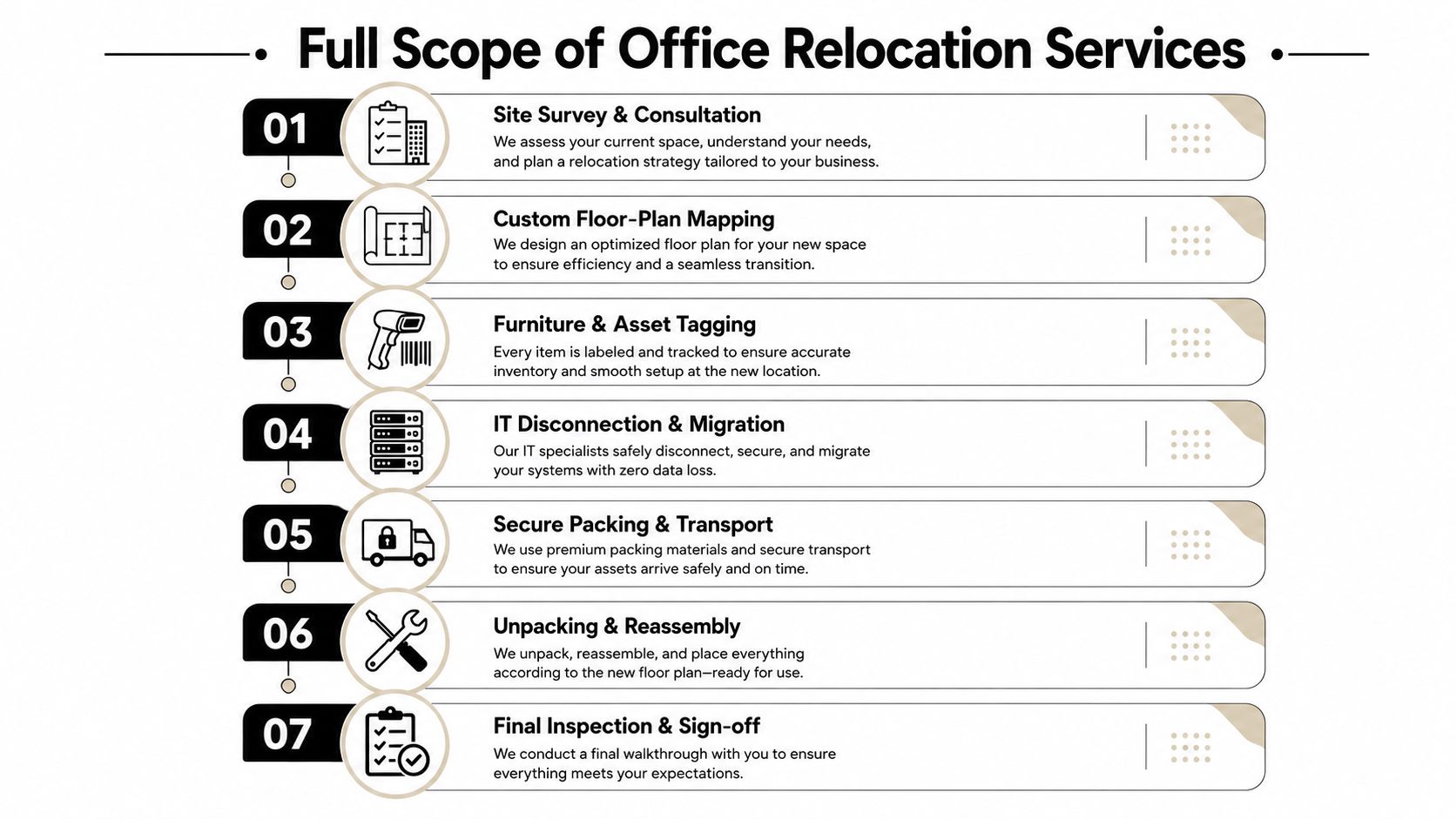
A removalist that only loads desks and delivers them to a new address can leave misplaced workstations, unavailable technology, missed lift bookings, and staff unable to work on the first day. Professional office relocation services begin with the site conditions that control the move. A survey should record lift dimensions, loading areas, stairs, access restrictions, security procedures, floor layouts, and fragile or oversized items. In Melbourne's older buildings, narrow service corridors, heritage features, limited parking, and restricted laneways can determine the method before a workstation is dismantled.
The coordinator then maps the existing floor plan to the destination. Each department, desk, cabinet, monitor, crate, and specialist item needs a destination code. Asset tagging reduces a common delivery error: everything reaches the correct building but the wrong floor, team, or workstation.
Planning and packing
The planning stage should settle three decisions:
- Move: Which furniture, equipment, files, and supplies are going to the new premises?
- Decommission: Which assets will be sold, recycled, donated, or disposed of?
- Store: Which retained items are not needed immediately?
Packing may involve crate hire, workstation dismantling, labelled tubs, secure document boxes, protective wrapping, and department-specific staging. Colour or code systems work best when labels match the floor plan, rather than using only a broad department name. Staff also need clear instructions for personal items, confidential files, and equipment that must stay connected until the IT handover.
Teams coordinating furniture, technology, and disposal decisions can use this definitive office move checklist as a supporting reference.
Technology and specialist assets
IT relocation needs a separate sequence. Technicians may document rack layouts, label cables, shut down servers, protect drives, disconnect meeting-room systems, and coordinate reconnection at the destination. Sensitive hardware should travel in suitable protective packaging and follow the agreed recommissioning plan.
Specialist handling may apply to safes, boardroom tables, artwork, laboratory equipment, display cases, and unusually heavy furniture. Custom crating, hydraulic trolleys, protective floor coverings, and additional handlers can be required. Storage must suit the asset. Climate-sensitive equipment and confidential files need controlled, traceable placement rather than an untracked warehouse position.
The last handover determines whether the new office is ready for work. A full-service team can unpack, remove cartons and waste, reassemble desks, reconfigure furniture, and complete a room-by-room sign-off. Outstanding issues are recorded before staff return, when corrections are faster and less disruptive.
Understanding the Real Cost Drivers
Office relocation quotes vary because the work environment varies. A ground-floor suburban tenancy with easy vehicle access can require a very different crew plan from a multi-storey CBD office with a booked goods lift, restricted dock, security induction, and after-hours delivery window.
Floor count affects the number of handling stages. Lift access affects waiting time and the order in which items can move. A building with a long route from dock to lift can add labour even when the office contents are modest. Stairs, narrow corridors, fragile finishes, and strict loading procedures also influence the quote.
IT complexity is another major variable. Moving ordinary monitors and desktop peripherals isn't the same as relocating a server room, structured cabling, access-control equipment, meeting-room technology, or specialist hardware. If the business must remain operational, the project may require evening or weekend work, staged floors, temporary storage, and coordination with an external IT provider.
The quote should also identify insurance arrangements, transit cover, packing materials, storage, furniture disposal, reassembly, and any building-related attendance time. A low headline price can exclude the very controls that prevent damage and downtime.
| Cost Driver | Typical Impact on Quote | Mitigation Strategy |
|---|---|---|
| Floor level and lift access | More handling stages and waiting can increase labour requirements | Confirm lift dimensions, booking rules, and delivery paths during the site survey |
| CBD loading dock | Restricted windows and building procedures can constrain crew productivity | Obtain written dock and goods-lift requirements before pricing is finalised |
| IT and communications | Server, cabling, and meeting-room work may require specialist sequencing | Separate IT tasks from general furniture transport and confirm responsibility |
| After-hours scheduling | Premium labour and building attendance may apply | Compare the cost of downtime with the cost of evening or weekend access |
| Packing and storage | Crates, secure boxes, inventory control, and warehouse handling add scope | Decide what will be moved, disposed of, or stored before the quote |
| Specialist assets | Safes, artwork, laboratory equipment, and heavy furniture need additional controls | Request a handling method statement and identify items during the survey |
The cost of movers guide can help businesses frame the questions they should ask before comparing quotations. Don't ask only for a truck rate. Ask what the quoted crew will do, what the client must provide, how waiting time is treated, and which access assumptions sit behind the price.
Timeline Planning and Downtime Minimisation
A reliable office move follows a critical path. Building access, IT readiness, packing, transport, furniture installation, and staff communication must line up. If one of those activities is late, the problem usually appears at the destination when the crew has no safe or authorised place to unload.
Twelve weeks to four weeks out
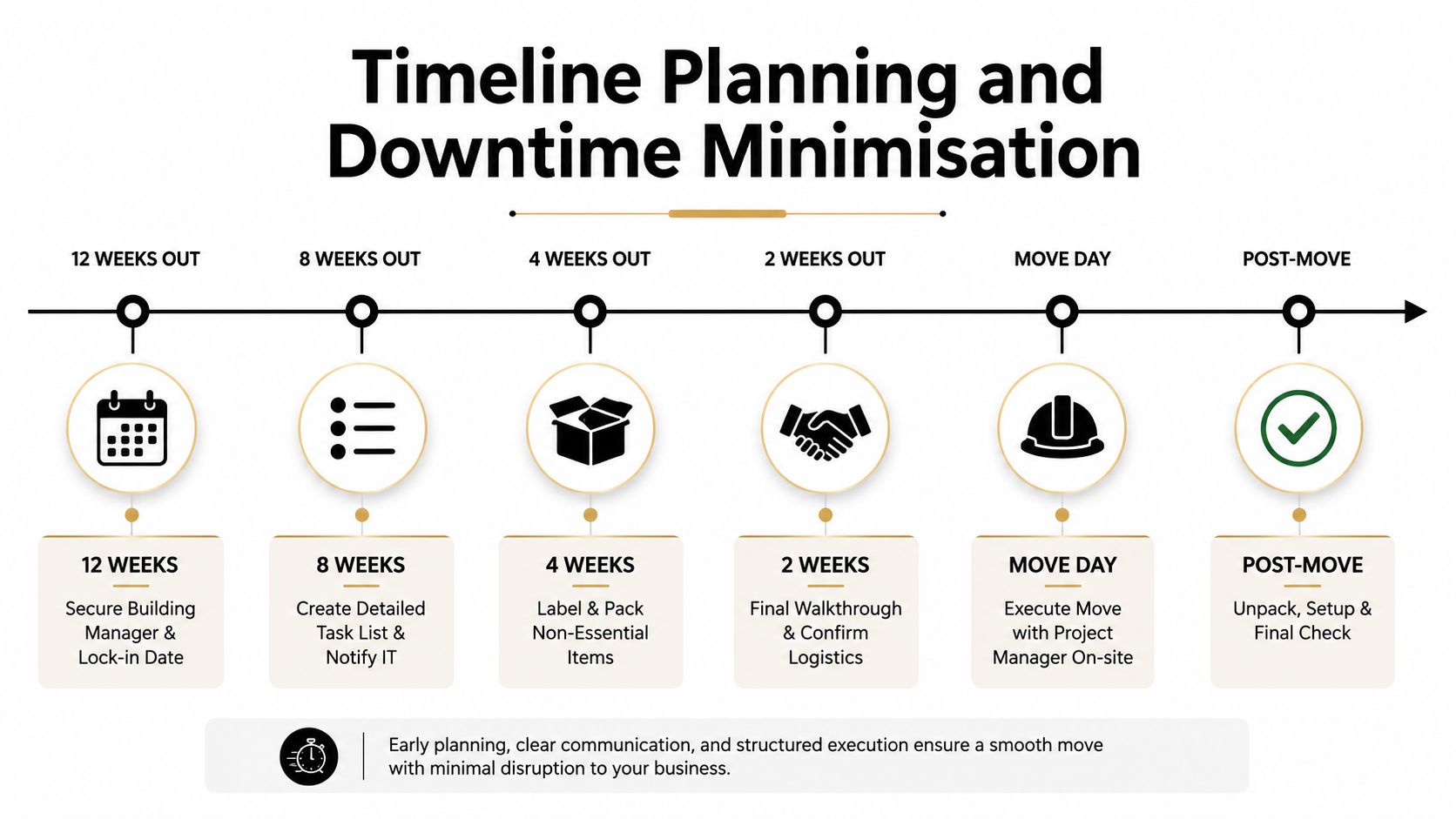
At 12 weeks, confirm the target date, lease handover requirements, building contacts, destination access, and the scope of the move. Melbourne CBD buildings commonly require written confirmation of loading dock and goods-lift rules, including allowable hours, dock dimensions, lift weight limits, induction requirements, and insurance or SWMS documentation, as outlined in this Melbourne CBD load-in and lift planning guide.
At 8 weeks, complete the asset audit, floor-plan mapping, IT responsibility matrix, and staff communication plan. Confirm what will be packed by the removalist and what must remain connected for the technology handover. At 4 weeks, label non-essential items, book storage if required, confirm specialist handling, and begin packing material delivery.
The final fortnight and move window
At 2 weeks, run a final walkthrough with the building manager, removalist, IT team, and fit-out contractor. Confirm dock reservations, lift access, parking or traffic arrangements, crate quantities, security procedures, and the floor-by-floor delivery sequence.
A dedicated move coordinator should control handovers between the packing crew, transport team, IT specialists, furniture installers, and destination contacts. Without that role, each supplier may assume another party has booked the lift, protected the floor, or approved the delivery route.
Weekend and after-hours moves are often chosen to protect business continuity, especially for professional services firms and customer-facing operations. The decision should be based on the cost of interruption, not habit. A staged weekday move can work when teams can operate elsewhere, while a concentrated out-of-hours move may suit a business that needs the office ready for the next trading day.
The office move tips from Get n Go Removals provide a useful operational prompt, but the plan still needs to be customised to the specific building, access rules, staff profile, and technology environment.
Practical rule: Test the destination network, power, meeting-room technology, and access systems before the first staff wave arrives. A delivery can be on time and still fail if the workplace isn't usable.
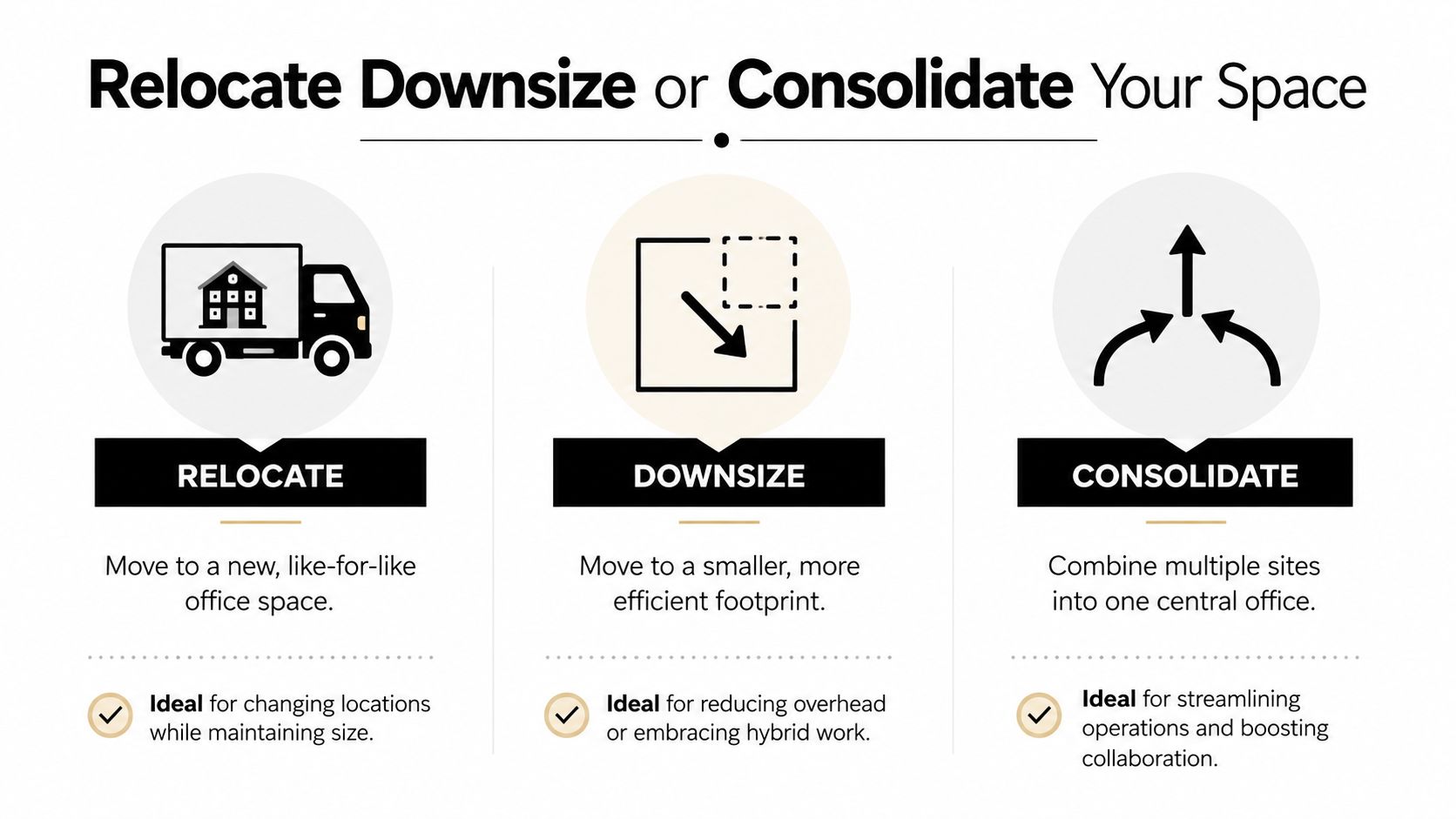
Relocate Downsize or Consolidate Your Space
The physical move should follow the property strategy, not decide it. Melbourne's high vacancy environment gives businesses a reason to compare like-for-like relocation with a smaller footprint or a consolidated workplace. The right choice depends on headcount patterns, collaboration needs, storage, client access, lease terms, and the quality of the alternative premises.
Relocate like for like
A like-for-like move suits a business that needs a different location without changing its operating model. The removalist scope is comparatively direct, but the organisation still needs to check whether existing furniture fits the new floor plate, whether power and data points align, and whether the destination has the required meeting, storage, and staff facilities.
CBRE's 2025 Australian Office Occupier Survey found that 77% of respondents considered improved amenity and services essential when considering a relocation, as reported through this Melbourne office moving resource. That supports a broader assessment than rent or square metres alone. A cheaper floor can become poor value if it needs substantial rework or doesn't support the intended workplace.
Downsize for efficiency
Downsizing requires decisions before packing begins. Dispose of surplus desks, archive files, redundant storage, and unused equipment before the removalist prices the final volume. Storage can preserve flexibility, but it shouldn't become a default destination for assets nobody has reviewed.
The move itself may need fewer vehicles and a shorter delivery schedule, yet the pre-move audit can be more demanding. Furniture plans must be tested against desk sharing, collaboration zones, quiet work, and employee storage. If the smaller office hasn't been planned carefully, staff may experience congestion even though the move has reduced occupancy costs.
Consolidate multiple sites
Consolidation brings several pickup locations into one destination. It can simplify operations, but the logistics are more complex. The crew may need separate collection schedules, different building contacts, staged loading, asset segregation, and a delivery plan that prevents one site's contents from being mixed with another's.
Decision test: If the new lease strategy hasn't defined what the workplace must enable, a removalist quote is premature. Scope the outcome first, then price the physical work.
Interstate Office Moves to East Coast Cities
An office move from Melbourne to Sydney, Brisbane, or another East Coast destination needs one project plan for two buildings. The Melbourne departure may have a narrow dock window, while the receiving building may allow deliveries at different times or require separate inductions. A business shouldn't treat the interstate leg as a simple extension of a local move.
The first decision is transport structure. A direct run gives the project tighter control over departure and arrival sequencing. A shared load or backload can be useful when timing is flexible, but the delivery plan must account for consolidation, handling stages, and the possibility that building dates won't align.
A single project manager should coordinate the Melbourne survey, packing, dispatch, transit documentation, destination booking, and final placement. That avoids the common failure where the origin team believes the destination has accepted delivery, while the destination team is still waiting for lift approval.
| Destination | Approx. Distance | Transit Window | Key Logistics Consideration |
|---|---|---|---|
| Sydney | Not specified | Depends on the selected service and access dates | Coordinate Melbourne departure with Sydney dock and goods-lift rules |
| Brisbane | Not specified | Depends on the selected service and access dates | Allow for longer route planning, destination scheduling, and asset protection |
| Other East Coast destinations | Not specified | Depends on route and delivery requirements | Confirm state-border fleet arrangements and site-specific access conditions |
High-value servers, specialist furniture, artwork, and confidential records need documented inventory control and suitable transit insurance. The team should photograph or record condition where appropriate, label every asset against the destination plan, and keep technology components together.
Fuel, toll routes, vehicle availability, crew accommodation, delivery timing, and backload opportunities can all affect the commercial quote. The customer should also confirm whether the provider's fleet and insurance arrangements support the route, rather than assuming a local crew can handle every interstate requirement.
For businesses comparing a direct Melbourne to Sydney service, the interstate removalists Melbourne to Sydney information is a useful starting point for discussing collection, transit, and delivery requirements.
How Get n Go Removals Manages Commercial Moves
A commercial relocation needs a defined chain of responsibility. Get n Go Removals Melbourne provides a full-service model covering office packing, furniture disassembly and reassembly, specialist handling, storage, transport, and commercial move coordination. Its company-owned fleet includes trucks from 4.5 to 12 tonnes, which supports different access and volume requirements without assuming every project needs the same vehicle.
The operating model uses a single point of contact to coordinate the customer's scope, building access, loading dock scheduling, packing sequence, transport, and destination handover. That matters in Melbourne buildings where a missed booking or incorrect delivery route can stop an otherwise capable crew.
Staffing and asset protection also form part of the service design. The company states that its team includes full-time, police-checked staff, with public liability and transit insurance available for moving work. White-glove packing, protective equipment, and documented handling processes are appropriate for executive suites, sensitive hardware, boardroom furniture, artwork, and other items that shouldn't be treated as ordinary cartons.
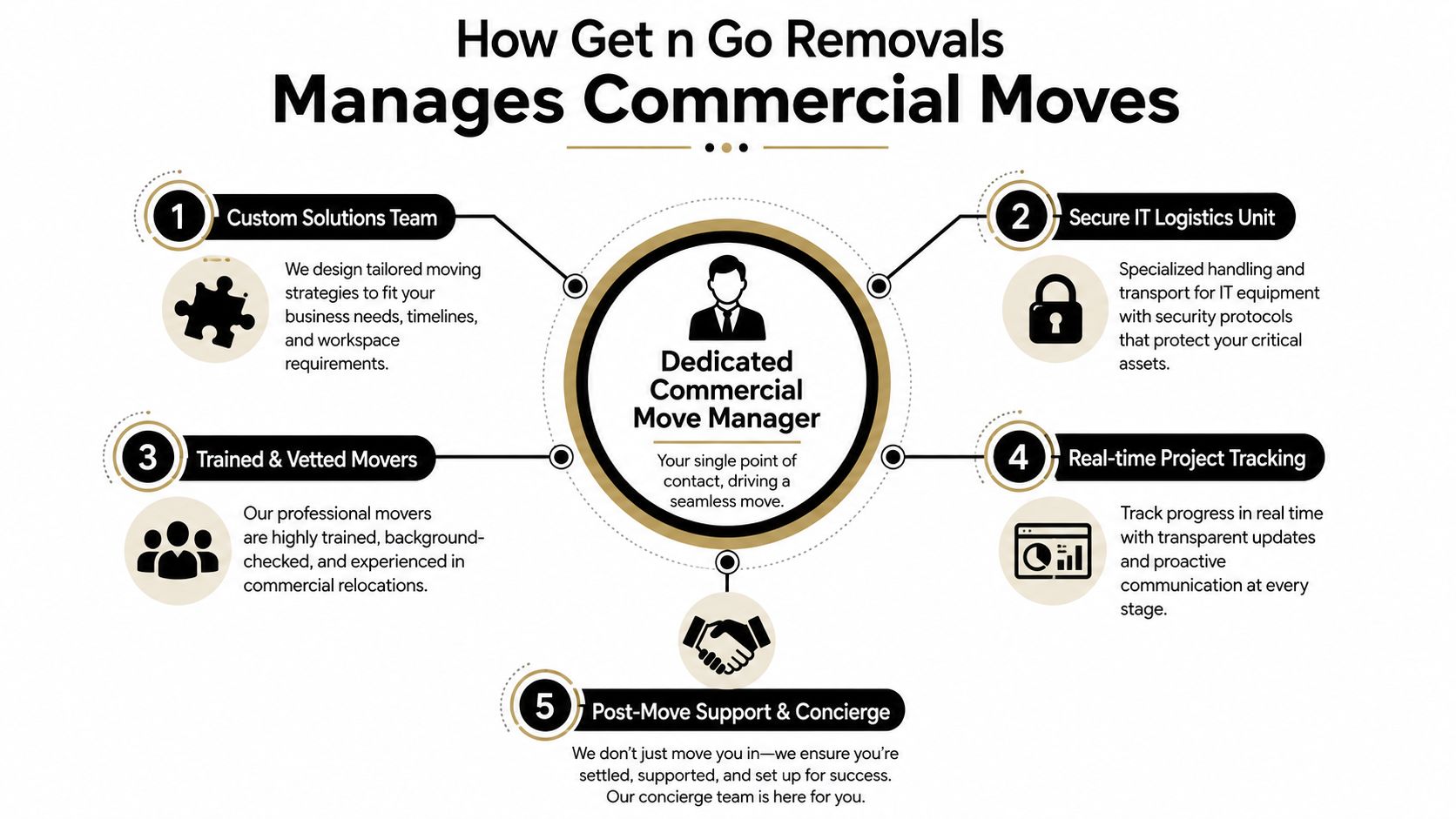
Melbourne-specific planning includes heritage building restrictions, narrow CBD laneway access, lift protection, security procedures, and after-hours windows. The team can also support short- and long-term storage, unpacking, and furniture reconfiguration, which helps businesses separate the move date from the final workplace setup.
The following video provides a visual introduction to the company's moving approach:
Businesses assessing the service can review commercial office removalists in Melbourne based on scope, access planning, staff capability, insurance, storage, and the quality of the proposed project controls, not only the hourly rate.
Your Office Relocation Action Checklist
Start with the business outcome, then build the logistics around it. A practical checklist should expose decisions early enough for building managers, IT providers, staff, and removal crews to act without competing instructions.
Pre-move planning
- Lease and workplace decision: Confirm whether the project is a like-for-like relocation, downsizing, or consolidation before requesting a final quote.
- Destination floor plan: Mark desks, teams, storage, meeting rooms, power requirements, and technology locations.
- Asset audit: Separate items to move, store, dispose of, sell, recycle, or donate.
- IT responsibility: Document who disconnects servers, workstations, meeting-room systems, access control, and structured cabling.
- Removalist shortlist: Compare site-survey findings, crew scope, insurance, access assumptions, packing materials, storage, and reassembly.
Active preparation
- Building approvals: Give the building manager written confirmation of loading dock and goods-lift requirements, including hours, dimensions, weight limits, induction, and required documentation.
- Staff communication: Issue packing instructions, confidential-file procedures, workstation preparation notes, and first-day access information.
- Specialist assessment: Identify safes, artwork, laboratory equipment, heavy boardroom furniture, and sensitive technology before the crew arrives.
- Packing schedule: Label by destination floor, department, and workstation. Pack non-essential materials before operational equipment.
- Contingency planning: Decide how the team will operate if access, technology, or furniture installation runs late.
Execution week
- IT decommissioning: Complete the agreed shutdown and inventory process before general loading begins.
- Move waves: Use a floor-by-floor or department-by-department sequence, with the move coordinator controlling each handover.
- Destination setup: Protect floors, place furniture according to the plan, reconnect approved equipment, and remove packing waste.
- First-day check: Test access, power, internet, meeting rooms, printing, storage, and workstation readiness before the wider team returns.
- Final sign-off: Record missing, damaged, or incomplete items and assign an owner for each outstanding task.
Victoria employers should also review workplace obligations when an employee's usual place of work changes. Under the Victorian relocation-at-work guidance, an employee may be entitled to up to three days of paid leave and reimbursement of reasonable relocation expenses when the usual workplace changes to a different location. That requirement belongs in the project plan, not as an afterthought.
Get n Go Removals Melbourne offers coordinated commercial relocations across Victoria and interstate, including site planning, secure packing, furniture handling, storage, and flexible scheduling around building access. Visit Get n Go Removals Melbourne to arrange a site assessment and request an office relocation quote.