

Sydney Movers and Packers: Your Complete Guide
You've timed the removal van, packed the cartons, and arranged the handover. Then the building manager tells you the lift is unavailable, the truck can't stop outside, and the unwanted sofa can't be left beside the bins. In Sydney, those details can disrupt an otherwise well-organised move faster than the distance between addresses.
Choosing Sydney movers and packers is therefore about more than finding a truck and comparing hourly rates. You need a plan for access, packing, insurance, storage, council requirements, and the people responsible for each decision. This guide focuses on the practical problems that create delays and extra charges, whether you're moving across Sydney or relocating between Melbourne and Sydney.
Understanding Sydney Moves and Their Unique Challenges
A family arrives at a new apartment with the removal truck close behind. The lift has been booked by another resident, the loading area is restricted, and the largest wardrobe won't turn through the stairwell. At the old property, several pieces of furniture are ready for disposal, but no council collection has been arranged. The crew can still work, but every overlooked detail now adds carrying, waiting, or rescheduling time.
Sydney's housing stock creates this kind of complexity. The 2021 Census recorded 1,852,206 private dwellings in the Sydney urban area, with an average household size of 2.7 people (Australian Bureau of Statistics Sydney Census data). That scale includes family homes, apartment buildings, single-person residences, and shared accommodation, each with different handling requirements.
Why access matters more than truck size
A large truck doesn't solve a narrow laneway, a low-clearance car park, or a building with a small goods lift. Before booking, establish:
- Truck position: Can the vehicle stop legally and safely outside the property?
- Carrying distance: Is there a long path from the kerb to the entrance?
- Vertical access: Are stairs available, and can the lift take furniture, trolleys, and protective coverings?
- Building approval: Does strata or building management require a booking, deposit, or move-in window?
- Special items: Will pianos, pool tables, appliances, or oversized furniture need a separate handling method?
Sydney's market also reflects substantial movement in both directions. In 2023–24, Greater Sydney grew by approximately 107,500 people, or 2.0%, while net internal migration was negative by 41,100 (Australian Bureau of Statistics regional population data). That combination means removalists need to support inbound household formation and outbound interstate relocations, not just local moves.
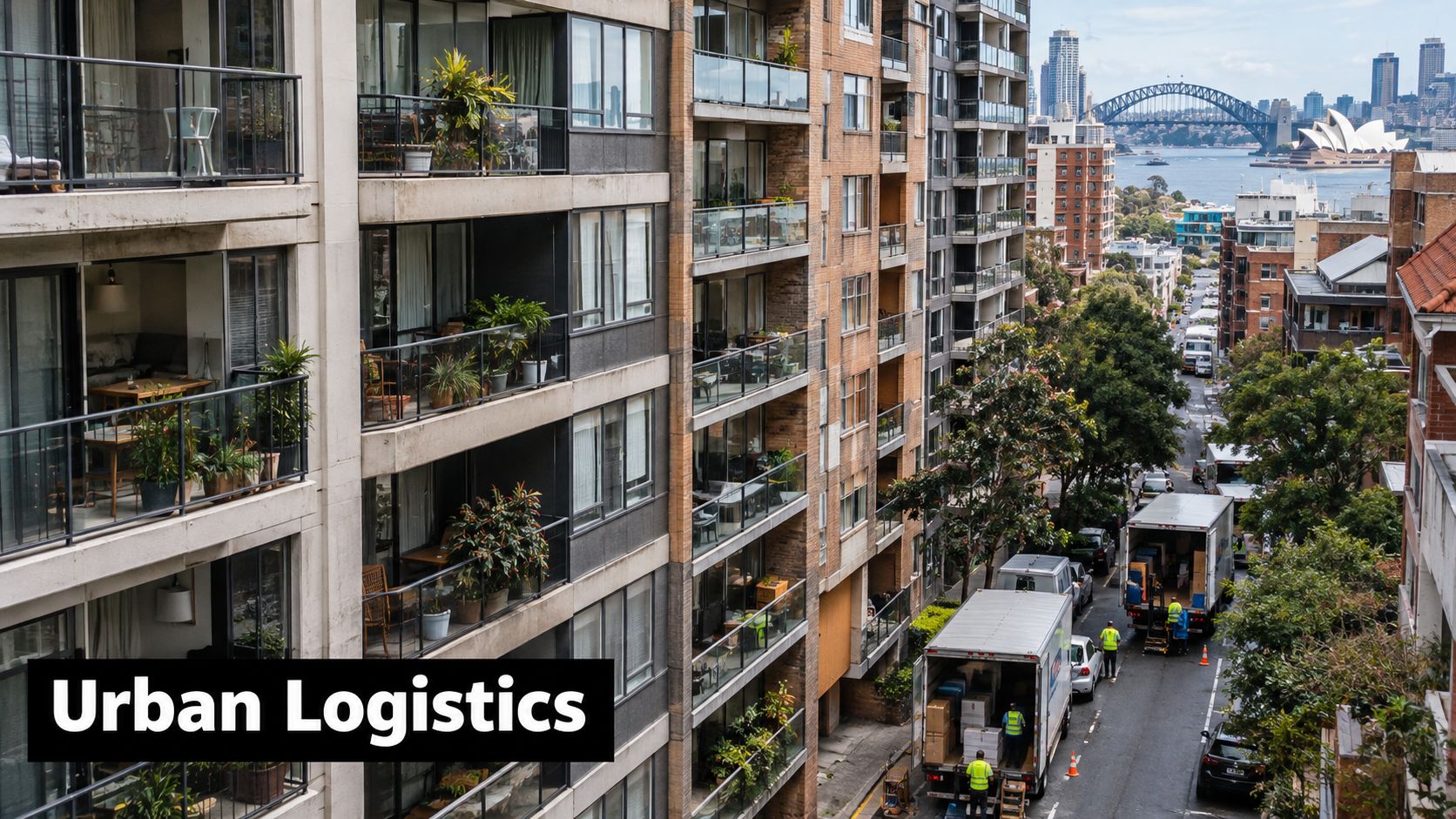
For broader neighbourhood planning, compare the practical character of different areas to live in Sydney, then ask a mover whether they regularly handle the access conditions in your chosen suburb.
Practical rule: Treat the building, street, lift, and waste arrangements as part of the move itself. They aren't administrative details added afterwards.
Packing Services You Can Choose From
Packing support should match your time, risk tolerance, and the type of belongings involved. A self-packed move can reduce labour costs, but it transfers responsibility for carton strength, labelling, wrapping, and safe stacking to you. Professional packing costs more upfront, yet it can reduce damage risk and make loading and unpacking more orderly.
Self-packing
With self-packing, you buy or source cartons, wrap your own belongings, and present sealed boxes for loading. This works well when you have time, straightforward furniture, and mostly durable household goods.
Use small, strong cartons for books and dense items. Keep heavier contents low, avoid overfilling, and label every box on two sides with its destination room. Don't mix essential items with long-term storage cartons, because you may need documents, medication, chargers, and basic kitchenware immediately.
The weakness is inconsistency. A box that looks sealed may still collapse if the base isn't taped properly or fragile objects are packed without internal cushioning. Removalists can transport what you give them, but they can't assess every carton's internal packing once it has been closed.
Partial packing
Partial packing is the useful middle ground. The crew handles fragile, valuable, awkward, or time-consuming items while you pack everyday clothing, linen, and non-breakable contents.
Ask for specific inclusions rather than accepting “fragile packing” as a vague label. Suitable materials may include:
- Wardrobe cartons: Keep hanging clothes upright and reduce folding and creasing.
- Dish kits: Use divided inserts and cushioning for plates, glasses, and crockery.
- Furniture wraps: Protect polished surfaces, upholstery, corners, and painted finishes during handling.
- Bubble wrap and paper: Separate delicate surfaces and fill movement gaps inside cartons.
This tier suits busy households that can organise routine belongings but don't want to risk artwork, glassware, electronics, or sentimental pieces.
Full valet packing
Full-service or white-glove packing places the inventory, material selection, wrapping, labelling, and packing sequence with the professional team. Depending on the agreement, unpacking and removal of used materials can also be included at the destination.
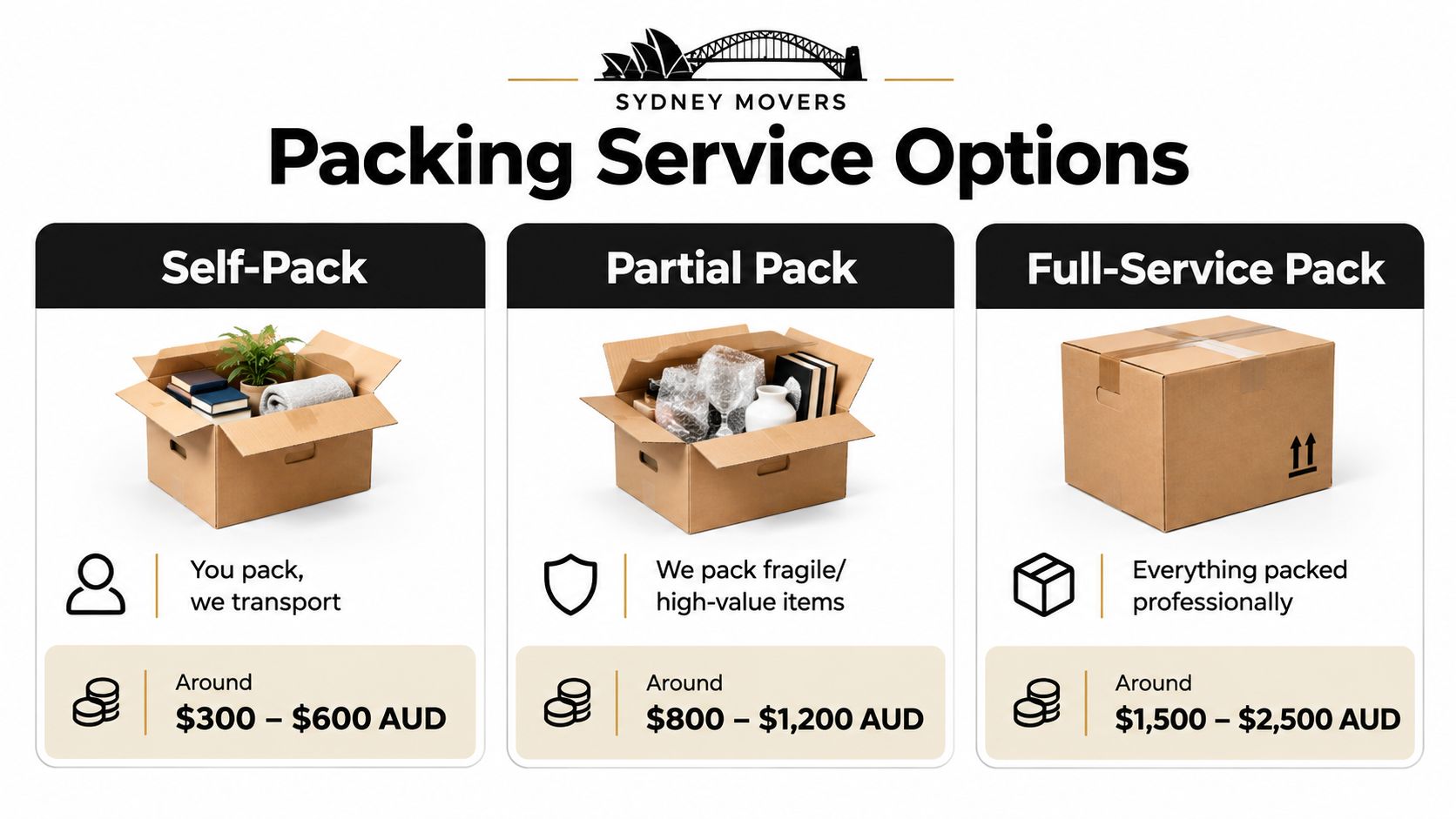
Choose this option when settlement dates are tight, your household has limited time, or the property contains many fragile and high-value items. If you're also preparing a rental for inspection, these cleaning tips for tenants can help separate cleaning tasks from packing and removal work.
For a detailed discussion of when professional packing makes sense, see this guide to the benefits of using professional packing services.
Insurance Options and What They Cover
Insurance conversations often become unclear because movers and customers use “covered” to mean different things. Ask the provider to separate transit insurance from public liability insurance, then request the policy wording or certificate before signing.
Transit insurance relates to your belongings while they're being loaded, transported, unloaded, or handled under the terms of the policy. It may respond to accidental damage or loss, but exclusions can apply to inadequate customer packing, pre-existing damage, fragile items, unattended goods, natural wear, or items that weren't declared.
Public liability insurance protects against claims involving accidental damage to property or injury to a third party arising from the mover's work. For example, it may be relevant if a crew damages common property while carrying furniture through an apartment building. It isn't a substitute for cover on your own contents.
Questions to put in writing
Ask the mover to confirm:
- Policy type: Is the cover transit, public liability, or both?
- Insured property: Are household goods, business records, electronics, and specialty items included?
- Packing condition: Does customer-packed property have different protection from professionally packed property?
- Excess and exclusions: What amount applies to a claim, and which goods or events are excluded?
- Storage period: Does cover continue if your belongings enter a warehouse?
- Claims process: Who receives the claim, what evidence is needed, and what deadlines apply?
A low quote may reflect limited cover, a high excess, or no meaningful protection for customer-packed goods. That doesn't automatically make the provider unsuitable, but you should know what you're trading away.
Verify the documentation
Check that the business name on the certificate matches the contracting entity. Confirm the policy period, cover type, and relevant limits. Photograph valuable belongings before the move, record existing marks, and keep invoices or valuation evidence where available.
For another practical explanation of moving cover, read the Duncan & Associates moving insurance guide. You can also review how a provider describes its moving company insurance coverage before comparing quotes.
Local Moves Versus Interstate Relocations
A move within Sydney and a move from Sydney to Melbourne may involve the same dining table, but the planning assumptions are different. Local work can often respond to changing dates and shorter travel distances. Interstate work needs firmer collection windows, a documented inventory, and a delivery plan that accounts for the destination property.
The Census recorded 920,982 interstate movers in 2021, representing 3.8% of the population (Australian Bureau of Statistics population movement data). Interstate moves are a minority of all moves, but they create a distinct coordination problem because collection and delivery may not happen on the same day.
Compare the operating model
| Factor | Local Sydney Move | Interstate Relocation |
|---|---|---|
| Scheduling | May allow greater flexibility, subject to crew and building availability | Requires agreed collection and delivery windows |
| Travel | Shorter route, with local traffic and access delays | Longer route with planned transit and destination coordination |
| Packing | Self-packing may suit a straightforward move | Stronger inventory control and protective packing are more important |
| Storage | Often used for short gaps between properties | May be needed when settlement, lease, or delivery dates don't align |
| Access | Lift bookings and street restrictions can dominate the day | Both origin and destination access must be checked |
| Delivery | Same-day or close-together delivery may be possible | Delivery timing depends on the agreed transport arrangement |
For a local apartment move, contact strata or building management before confirming the date. Book the lift, identify the loading area, and tell the removalist about stairs or long carries. A suburban house with a driveway may be simpler, but don't assume it is automatically easy. Garages, steep driveways, detached sheds, and narrow gates can still change the crew's method.
Interstate planning needs a firmer handover
For Sydney to Melbourne or Sydney to Brisbane, confirm the inventory before loading. Decide whether the load will travel in dedicated transport or as part of consolidated capacity, then clarify whether delivery is direct or subject to a scheduled run.
The 2019–20 financial year recorded 1.14 million Australian households moving within the preceding 12 months, equal to 12% of households (Australian Information Commissioner guidance page containing the cited mobility data). Those moves include many local relocations, so your interstate booking should be treated as a specialised job rather than a longer version of a local hourly move.
Transit and Storage Options Explained
Storage is most useful when it solves a timing problem without creating a security or access problem. Common triggers include settlement gaps, lease overlap, renovation, delayed construction, temporary accommodation, or a need to stage furniture before a property is ready.
Start by identifying how much access you'll need. Warehouse storage may be economical when you can store everything and retrieve it only at the end. More accessible arrangements can suit customers who expect to remove documents, seasonal items, or equipment during the storage period.
Choose the transport arrangement
Consolidated transport combines your goods with other compatible consignments on a planned route. It may suit an interstate move with flexible dates, but ask how the provider protects your inventory from shifting, how items are identified, and whether the collection and delivery windows are fixed.
Dedicated transport reserves the vehicle or transport capacity for your consignment. It can provide clearer control over the route and timing, but the price may be higher because the space isn't shared.
The right choice depends on timing and priority, not just truck size. A customer with a firm settlement deadline may value schedule control more than the lowest transport rate.
Check the storage facility
Before placing belongings into storage, ask:
- Access rights: Can you visit the goods, and must appointments be arranged?
- Security controls: Are entry records, surveillance, alarms, and restricted access used?
- Condition management: Is the area suitable for timber, artwork, electronics, instruments, or documents?
- Inventory records: Will cartons and larger items be listed and identified?
- Handling charges: Are collection, retrieval, redelivery, or re-handling charged separately?
- Insurance: Does the storage arrangement include cover, or must you arrange it independently?
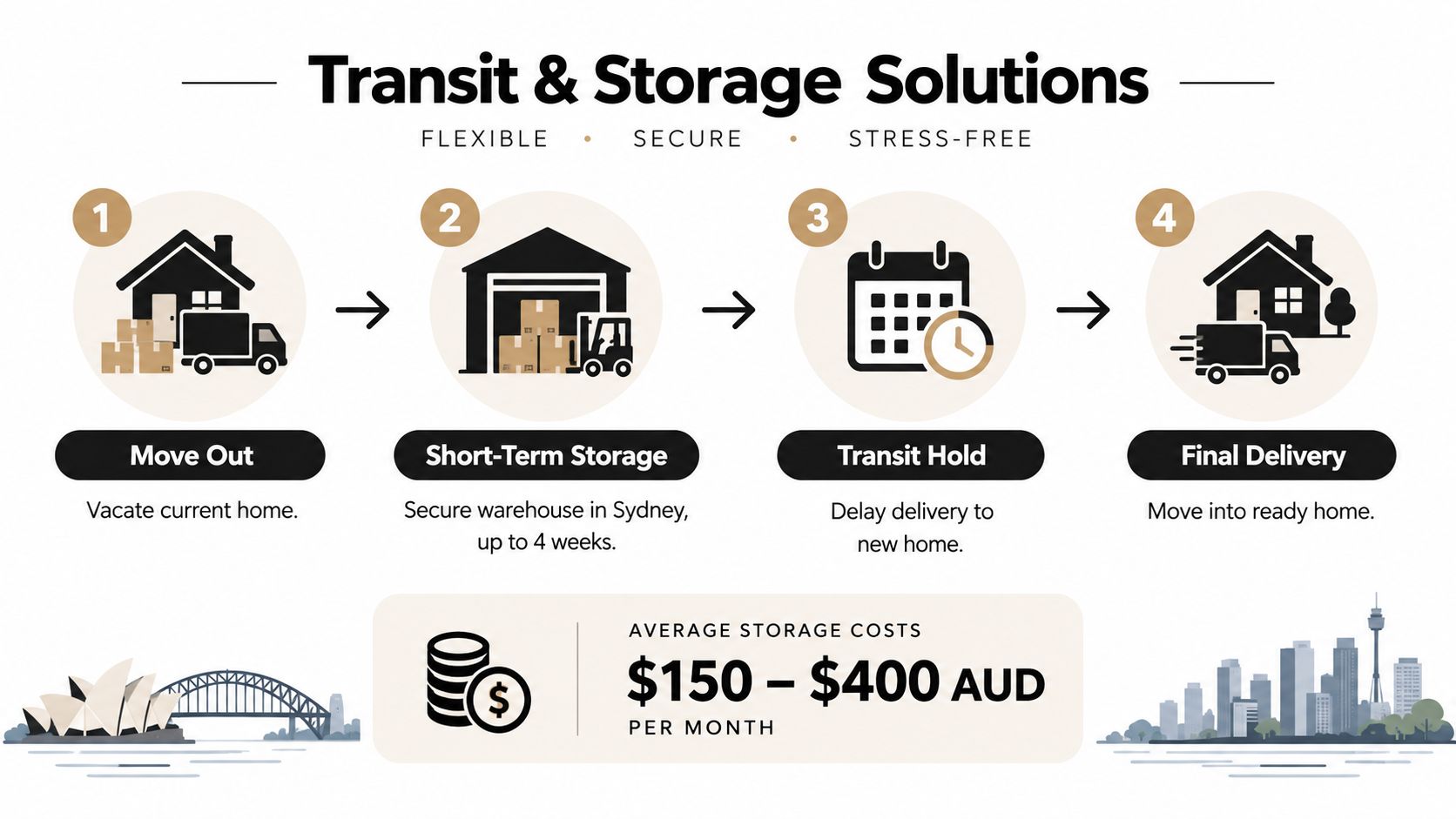
For a temporary gap between addresses, review the options for short-term storage and ask whether goods remain wrapped, palletised, or placed in a modular container. Sensitive items may require a controlled environment, while ordinary household goods primarily need dry, secure, well-managed storage.
Understanding Cost Factors and Hidden Charges
The hourly rate is only one part of a Sydney removalist quote. The final charge reflects the amount of work between the front door and the truck, not merely the distance driven.
A useful quote should account for:
- Crew size and hours: More labour may reduce the elapsed time, but it increases the labour component.
- Truck capacity: An undersized truck can create a second trip. An oversized vehicle may be difficult to position in a tight street.
- Packing materials: Cartons, paper, wraps, mattress protection, and specialty packaging may be separate.
- Furniture preparation: Disassembly and reassembly can require additional time and tools.
- Special handling: Pianos, pool tables, safes, oversized appliances, and unstable items need a method agreed in advance.
- Access conditions: Stairs, long carries, lift delays, restricted parking, and narrow entrances affect productivity.
- Storage and disposal: A settlement gap or unwanted furniture can add services outside the basic transport booking.
The cheaper quote can cost more
Suppose one mover offers a lower hourly figure but hasn't checked the lift, truck position, or carrying distance. If the crew waits for access, carries furniture further than expected, or needs another trip, the original saving can disappear. A transparent access audit is often more valuable than a small reduction in the advertised rate.
Cost test: Compare the total plan, not just the rate. Ask how the quote changes if the truck can't park outside, the lift is delayed, or the job runs beyond the estimate.
Before moving day, write down the truck dimensions, street restrictions, lift booking, stair access, loading distance, and permit responsibility. Ask who must contact strata, the building manager, or council. For practical examples of charges that customers often overlook, review this guide to hidden costs in moving house.
Waste needs its own schedule
The City of Sydney requires bulky-item collections to be booked in advance. Residents can book a free weekly collection, but items left without a booking on streets, beside bins, or in common areas may constitute illegal dumping (City of Sydney moving waste guidance).
Separate cardboard, polystyrene, batteries, electronics, metals, whitegoods, and unwanted furniture before the move. Confirm strata rules, check whether the building uses a single booking, and place eligible items out only during the permitted window. Loose material isn't collected, so don't treat the pavement as a temporary disposal area.
How to Choose a Reputable Moving Provider
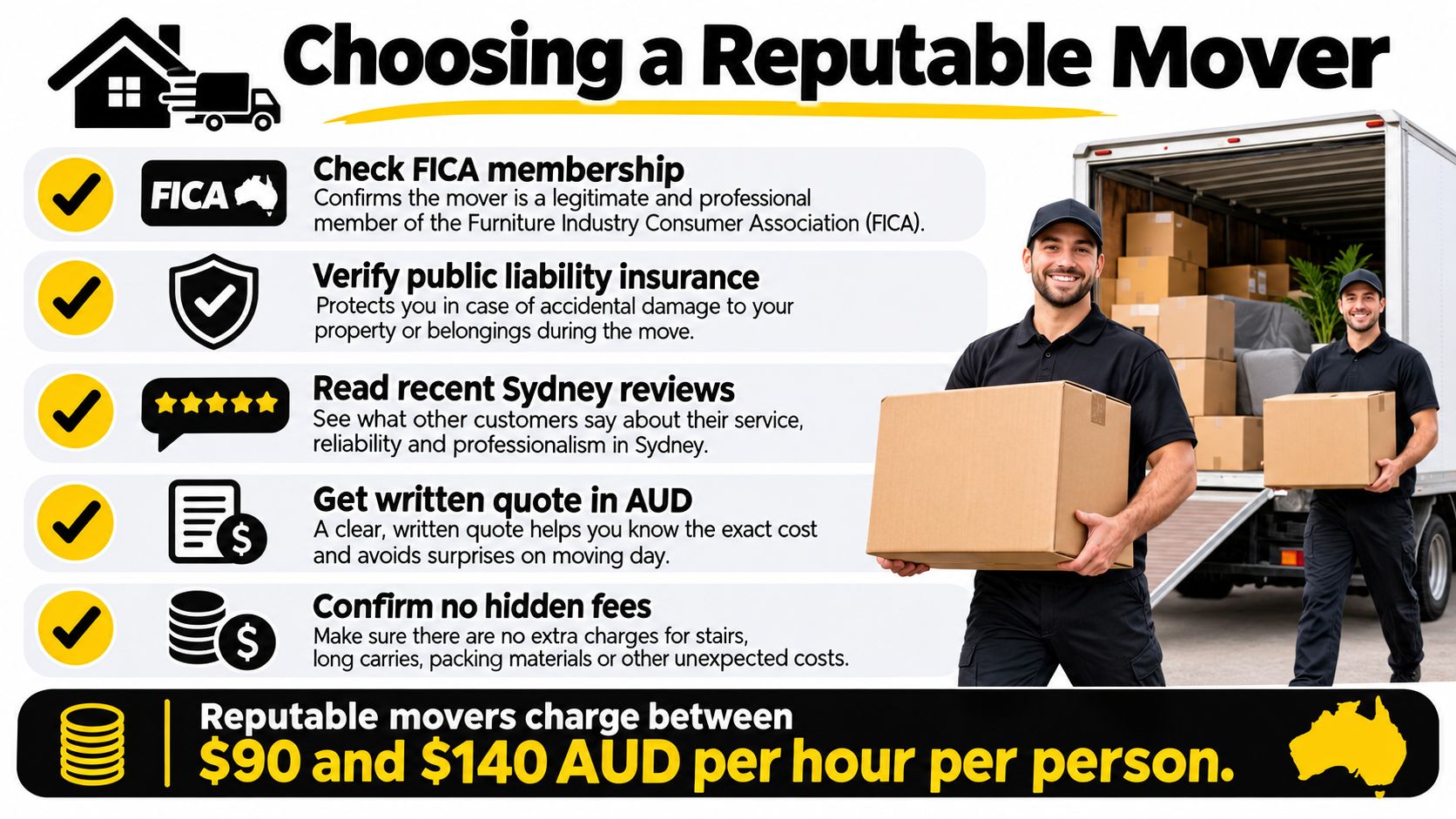
The right provider gives you clear answers before the truck arrives. They ask about inventory, access, stairs, lifts, parking, fragile items, and timing because those details determine the work. A provider that quotes from a bedroom count alone may still be capable, but the quote carries more uncertainty.
Start with written information. Ask for an itemised quote that identifies the crew, truck assumption, packing materials, travel treatment, access charges, storage, specialty handling, and what happens if the estimated time is exceeded.
Questions worth asking
- Who will do the work? Confirm whether staff are full-time, police-checked, subcontracted, or supplied through labour hire.
- What equipment arrives? Ask about trolleys, ramps, straps, blankets, floor protection, mattress covers, and specialty equipment.
- Who owns the fleet? A company-owned fleet may provide more direct control over truck condition and availability, but ask how the actual vehicle is allocated.
- What insurance applies? Request current public liability and transit documentation, then read the exclusions.
- Who coordinates the booking? A single point of contact can reduce contradictory instructions between sales, operations, and the crew.
- What do recent reviews say? Look for comments about punctuality, handling, communication, final pricing, and apartment access, not just star ratings.
The Australian transport and storage industry recorded 86 work-related injuries per 1,000 workers, compared with 69 per 1,000 across all Australian workers, in the ABS 2009–10 Work-Related Injuries Survey (Safe Work Australia transport guidance). The same source identifies lifting, pushing, pulling, and same-level falls as important risk mechanisms. Ask how crews manage heavy and awkward goods, rather than assuming speed means competence.
Your final comparison checklist
| Check | What a satisfactory answer looks like |
|---|---|
| Written scope | Inventory, access, services, timing, and exclusions are stated |
| Insurance | Policy documents and claims process are available |
| Access plan | Lift, parking, stairs, truck dimensions, and permits are assigned |
| Handling method | Heavy, fragile, and unusual items have a clear procedure |
| Waste plan | Disposal and council collection responsibilities are understood |
| Communication | One person can answer operational questions |
| Payment terms | Deposit, hourly treatment, overtime, and cancellation terms are clear |
For office relocations, add a privacy check. The Privacy Act 1988 includes 13 Australian Privacy Principles, and OAIC guidance says organisations should restrict access to people who need it, protect information from unauthorised access or loss, and destroy or de-identify information when it is no longer needed unless retention is legally required (OAIC Australian Privacy Principles guidance). Files and devices in temporary storage remain part of the business's information-management responsibility, even when a third party physically holds them (OAIC privacy management guidance).
Get n Go Removals Melbourne provides local and interstate relocations, professional packing and unpacking, specialist furniture handling, office moves, and short- or long-term storage, including weekly direct runs between Melbourne and Sydney. If your move involves difficult access, a tight settlement window, or a Sydney to Melbourne transfer, visit Get n Go Removals Melbourne to discuss the inventory, access plan, packing level, and delivery requirements before booking.