
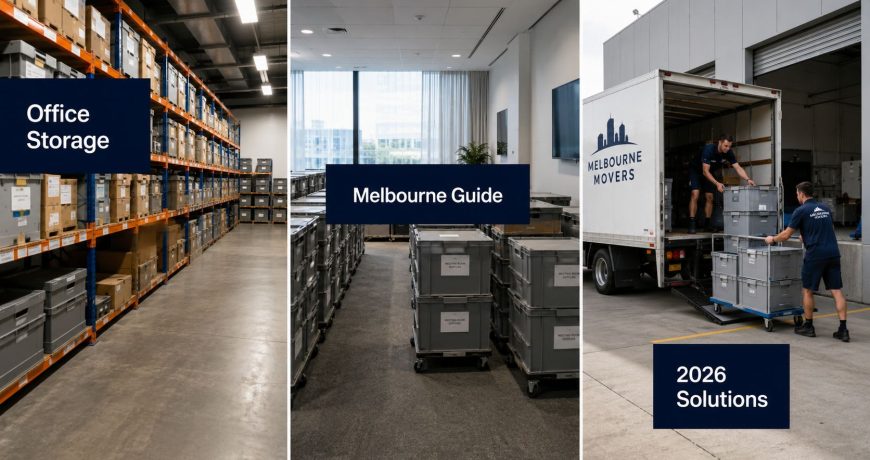
Office Storage Melbourne: Your 2026 Guide to Solutions
You're usually not looking for office storage in Melbourne because everything's calm. It's more often the opposite. The lease is ending, the new fit-out isn't ready, half the filing cabinets are full of material nobody's checked in years, and someone has just asked whether the archive boxes, spare monitors, and marketing stock can all “just go into storage” by Friday.
That's where businesses get into trouble.
Storage sounds simple until it's tied to an office move. Then every decision affects access, labour, floor space, document control, and how quickly your team can get back to normal. Good storage planning doesn't sit beside relocation planning. It's part of it. If you separate the two, downtime usually creeps in through the gaps.
Why Smart Office Storage Is Crucial for Melbourne Businesses
Monday starts in the old office. By Wednesday, the new tenancy has builders finishing joinery, IT is waiting on cabling, and your staff still need to answer clients, process orders, and find active files. In that gap, storage stops being a side service and becomes part of the move plan.
The right office storage Melbourne businesses use during relocation helps control what moves now, what waits, and what stays accessible without crowding the new site. Get that sequence wrong and the costs show up fast. Extra handling, longer truck time, blocked workstations, misplaced archive boxes, and staff standing around waiting for the wrong items to arrive.
Storage planning has a direct effect on downtime
I've seen plenty of office moves run late because everything was treated as equal. It never is. Current records, live equipment, and day-one furniture need a different handling plan from surplus desks, old print stock, and archived documents.
A good storage plan creates order before moving day. Low-use items go off-site first. Business-critical items stay tagged for immediate access. Overflow stock and retired furniture stop taking up truck space and floor space your team needs to get operational again.
One practical step is to estimate volume before you book trucks or storage. A simple office move cubic metre calculator helps set realistic allowances for both transport and storage, which reduces the chance of paying for the wrong unit size or needing a second uplift.
Practical rule: If an item is not needed in the first week after relocation, it should not be loaded with your first-priority setup items.
Melbourne offices pay for clutter twice
First in rent. Then in labour.
CBD suites, fringe offices, and suburban business parks all have the same issue. Once unwanted items land in the new office, they absorb usable space and create more handling later. Teams shift boxes from meeting rooms to utility areas, then from utility areas to corridors, then finally into storage after they realise the office still feels half-moved.
That rework is avoidable. Smart storage lets you stage the move properly, especially when the new fit-out has less back-of-house space than the old tenancy. For smaller workplaces, details like cabinet depth, shelf adjustability, and vertical storage matter more than owners expect. Cubicle By Design's smart storage options show the sort of compact setups that can keep a smaller office functional without turning every spare wall into a dumping zone.
Good storage decisions protect access and accountability
Storage during a relocation is also about control. Someone needs to know what has gone off-site, who approved it, how it is labelled, and how quickly it can be retrieved. Without that, storage becomes expensive delay. The business keeps paying to hold items nobody can locate or confidently dispose of.
The best move plans treat storage as an active part of relocation scheduling. That means matching storage choices to handover dates, fit-out timing, records management, and the order each department will be brought back online. Done properly, storage supports the move. Done badly, it extends it.
First Steps Assessing Your True Storage Needs
Before you compare unit types or ask for a quote, you need an accurate brief. Most businesses start with “we need some storage”. That's too vague to be useful. A proper brief tells you what's going into storage, how often it needs to be accessed, how sensitive it is, and whether it should be stored at all.

Start with a room-by-room audit
Walk the office with a tablet or printed checklist and record every item by category. Don't rely on memory. People always forget what's in utility cupboards, under benches, or behind reception joinery.
Use categories that reflect how the business works:
Documents and records
Separate current files from archive boxes. Then flag anything confidential, compliance-related, or due for digitisation.Office supplies and consumables
Stationery, print stock, branded material, uniforms, kitchen overflow, and event collateral often take more space than expected.Equipment and technology
Monitors, docking stations, spare laptops, cords, printers, scanners, phones, and accessories need tighter tracking than general furniture.Furniture and fixtures
Spare task chairs, unused desks, pedestals, shelving, and reception pieces should be assessed critically. Some are worth storing. Some are just expensive clutter.
Sort by access frequency, not sentiment
A common mistake is storing according to habit. Businesses keep what they're used to seeing. A better method is to sort by how often each item is needed.
Think in practical bands:
- Daily or weekly access means it should stay on-site or be loaded last so it unloads first.
- Monthly access suits organised off-site storage if retrieval is straightforward.
- Rare access is archive material, old fit-out stock, or backup furniture that can sit deeper in storage.
If your team can't answer “who uses this and how often?”, the item belongs on a review list before it belongs in storage.
Define the storage conditions
Not everything can be treated the same way. Sensitive paper files need secure handling. Electronics need careful packing and stable placement. Marketing materials may need clean, dry conditions so they don't come back damaged or unusable.
A simple checklist helps:
| Storage question | Why it matters |
|---|---|
| Does it contain confidential information | This affects security controls and who can access it |
| Will anyone need it quickly | This changes how it should be labelled and placed |
| Is it fragile or awkward | This affects packing method and labour |
| Is it worth storing | Some items cost more to move and store than to replace |
| Is it temporary or ongoing | This shapes the most sensible storage model |
Turn the audit into a measurable volume
Once categories are clear, estimate volume before booking trucks or units. That gives you a more realistic cost picture and prevents overbooking space you won't use. If you need help translating desks, boxes, and cabinets into a practical storage estimate, use a cubic metre calculator for moving and storage planning.
The best storage brief is short and specific. For example: secure archive storage, medium retrieval access, packed by department, with separate handling for IT and confidential records. That level of detail saves time later because every packing, moving, and access decision becomes easier.
Comparing Melbourne Storage Options
Not all office storage in Melbourne solves the same problem. Some options suit a hands-on business with spare staff time. Others suit a company that needs a mover to collect, inventory, and redeliver items without dragging internal teams into warehouse logistics.

Traditional self-storage
Self-storage works best when your business wants direct control and can handle the labour. You pack the goods, transport them, stack the unit, and return whenever access is needed.
The upside is simplicity. The downside is that office teams usually underestimate the time involved. Someone still has to supervise loading, make repeated trips, maintain the inventory, and retrieve items without disrupting normal operations.
Self-storage tends to suit:
- Small overflow needs such as archive boxes or a few spare items
- Businesses with internal transport capacity
- Teams that expect frequent access and don't mind doing the handling themselves
It tends not to suit a relocation where downtime is the main concern.
Managed storage and warehousing
Managed storage is usually the cleaner choice during an office move because the service can be integrated into the relocation itself. Items are picked up, documented, stored, and redelivered as needed. That reduces the number of moving parts your team has to control internally.
One practical option in this category is a provider that handles office relocation and storage together, such as Get n Go Removals Melbourne storage pricing information, where transport and storage planning can sit under the same job workflow rather than being split across multiple suppliers.
Managed storage makes sense when staff time is more valuable than the appearance of a lower monthly unit fee.
Document archiving services
If your biggest storage burden is records, document archiving is a separate category worth considering. It's less about furniture and more about secure, indexed off-site retention.
This model suits businesses that need disciplined document control, especially where access is occasional but accuracy matters. It's stronger for file boxes than for mixed office goods.
Use it when you need:
- Structured file retrieval
- Clear box-level indexing
- Better separation between active and archival records
On-site container solutions
On-site containers can work during renovations, staged fit-outs, or situations where the office needs nearby temporary space. They're convenient because the storage sits close to the action.
They're less ideal when the site has limited loading access, no spare footprint, or strict building management rules. In many Melbourne buildings, especially tighter CBD sites, on-site container use may be more awkward than it first appears.
A quick overview helps compare the trade-offs:
| Storage type | Best for | Main drawback |
|---|---|---|
| Self-storage | Businesses that can self-manage packing and access | Hidden labour and transport burden |
| Managed warehousing | Office relocations where downtime matters | Less direct walk-in access |
| Document archiving | File-heavy businesses with strict record handling | Not suitable for mixed office furniture loads |
| On-site containers | Renovations or short staging periods | Site and access limitations |
This video gives a useful visual overview of how storage choices fit into the moving process.
The right answer depends on one question: are you trying to rent space, or are you trying to protect business continuity? Those aren't always the same thing.
The Pre-Move Playbook Packing and Labelling for Success
At 8:30 on a Monday, the truck can be unloaded, the keys can be handed over, and the new office can still be half unusable. The usual cause is poor storage prep. Staff are waiting on screens without power leads, archived files are mixed with current client work, and nobody can tell which boxes need to be opened first.
Storage planning decides whether the move supports business continuity or interrupts it. If items are packed for fast retrieval instead of fast removal, the first day in the new office is far easier to control.
Why pre-move discipline matters
The offices that run into trouble usually make the same mistake. They treat packing as the last task before moving day, instead of part of the relocation plan from the start.
A better method is simple. Decide what goes straight to the new site, what needs short-term storage during the transition, and what should never be moved at all. That decision should happen before the first crate is packed. It cuts double-handling, reduces the amount of stock sitting in expensive temporary space, and stops your team wasting time searching for items that should have been tagged properly in the first place.

Build the inventory around the move sequence
A useful inventory is not a long spreadsheet full of vague descriptions. It should tell the movers, the storage team, and your staff three things immediately: what the item is, where it is going, and when it will be needed again.
Start with these categories:
- Go now. Daily-use desks, chairs, IT equipment, live files, reception items.
- Store for staged return. Spare furniture, archived records, surplus joinery, seasonal stock, marketing collateral.
- Dispose, donate, or recycle. Broken furniture, duplicate equipment, outdated paper files, unused stationery.
Then add a retrieval priority against every stored item:
- Priority 1 for anything needed within the first week
- Priority 2 for items likely to be recalled within the first month
- Priority 3 for true archive or long-term hold items
Businesses save real time through efficient storage. If storage is set up by retrieval priority, the first urgent call for an old contract file or spare monitor does not turn into a half-day search.
Label for retrieval, not for packing speed
A label that says “Finance” or “Boardroom” is too broad. It helps on moving day and causes problems later.
Use a consistent format on every carton, tub, and furniture tag:
Department | Contents | Destination | Priority | Box Number
For example:
HR | Active personnel files A-F | Storage | P1 | Box 12
Sales | Trade show materials | Storage | P2 | Box 44
IT | Workstation kit for J. Tran | New Office Level 8 | Immediate | Box 03
Colour coding also helps, but only if everyone follows the same key. Keep it tight. One colour for direct-to-office items, one for storage, one for confidential material, one for disposal. Too many colours create their own confusion.
Pack in a way the storage team can work with
Good packing protects goods. Better packing also makes handling and retrieval faster.
Use these rules on Melbourne office moves:
Keep workstation kits together
Every monitor, dock, keyboard, mouse, headset, and power lead should stay assigned to one person or one desk location.Do not overpack archive cartons
Paper gets heavy quickly. Smaller, uniform boxes stack better and are safer to lift.Separate confidential records from general office items
Do not bury personnel files between stationery and kitchen supplies.Tag furniture by floorplan reference
A desk number that matches the new layout is more useful than “desk parts”.Photograph cable setups before disconnecting
This saves a surprising amount of time during reinstallation.Load storage-bound goods differently from direct-delivery goods
If both streams go on the same truck, they must still be easy to split on arrival.
If your staff need a practical refresher before packing starts, these packing tips for moving house cover the basics that also prevent damage in office relocations.
Assign one person to control the list
Shared responsibility usually means no real responsibility.
Nominate a move coordinator, even in a small office. That person should approve naming conventions, track box counts, confirm what is going into storage, and keep the master inventory current as items leave the old site. Without that control point, labels drift, teams make up their own system, and stored goods become harder to retrieve than they should be.
I have seen expensive delays caused by something as small as three departments using different names for the same room. “Meeting Room 2”, “Small Boardroom”, and “South Room” can all mean the same destination. If the tags are inconsistent, unloading slows down and storage intake gets messy.
Use proper materials and staging areas
Spare boxes from the print room are rarely good enough for an office move that includes storage. Use commercial crates or strong cartons, tamper-evident seals for sensitive records, anti-static protection for IT gear, and clear aisle space for sorted staging before pickup.
Set up at least two staging zones in the old office:
- Direct to new office
- Into storage
A third zone for disposal is even better if building access allows it. Physical separation on site reduces loading mistakes. It also gives the moving crew a clearer run sheet, which matters when lift bookings and dock times are tight.
A short checklist before the truck arrives
Use this final check the day before collection:
- Every box has a box number and destination
- Every storage item appears on the master inventory
- Confidential items are packed separately and marked correctly
- IT equipment is assigned to a user, desk, or team
- Priority retrieval items are loaded for easy access
- Disposal items are removed from the move area
- One staff member is available to answer location questions during loading
Well-packed storage does more than keep goods safe. It shortens setup time at the new office, reduces repeat handling, and gives you a controlled way to bring back non-essential items after the business is already up and running. That is the difference between storing leftover office contents and using storage as part of a well-managed move.
Navigating Costs Insurance and Compliance
Storage costs can either protect your move schedule or undermine it.
I see this happen when a business chooses the cheapest monthly rate, then pays for it in extra courier runs, staff time, retrieval delays, and rehandling. In an office relocation, storage is part of the move plan. If that plan is loose, downtime usually stretches longer than expected.

Cheap storage often creates expensive move problems
A low storage rate means very little if your team has to keep visiting the unit, wait days for access, or pay repeated transport fees to retrieve items that should have been staged better in the first place. The real question is whether the storage setup helps the business reopen quickly and stay organised during the changeover.
Check the full cost against the move plan:
- Collection and redelivery fees. These apply every time goods move between office, storage, and the new site.
- Handling charges. Some providers charge separately for intake, palletising, wrapping, or manual handling of bulky items.
- Packing materials. Office furniture, monitors, and boxed files need proper protection if they will sit in storage for weeks or months.
- Access arrangements. Restricted access can create delays when a team needs archived files, spare desks, or IT equipment back urgently.
- Internal labour. Staff time spent searching for items, approving retrievals, or fixing inventory errors still costs the business money.
For budgeting context, review self-storage costs and common pricing variables before you compare quotes. Even if you end up using managed storage rather than self-storage, the fee categories are useful because they show where providers tend to separate base rent from actual operating costs.
Insurance needs to match the handoff points
Insurance confusion usually shows up after damage, not before. A printer is scratched in transit, a monitor goes missing after intake, or boxed records are exposed to moisture, and no one is clear on which policy responds.
Check each stage separately. Goods in transit, goods awaiting intake, and goods sitting in storage may not fall under the same cover. If movers, storage operators, and subcontractors all touch the same items, get the responsibility in writing.
| Cost or risk area | What to confirm |
|---|---|
| Transit cover | Whether office goods are covered from pickup to delivery, including loading and unloading |
| Storage cover | Whether protection continues once items are checked into storage and under whose policy |
| Exclusions | Whether electronics, artwork, high-value fitout items, or confidential records have lower limits or special conditions |
| Claims process | Who records damage, what evidence is required, and how quickly notice must be given |
A simple test helps here. If a carton of client files or a batch of screens is damaged between the old office and storage, your team should already know who photographs it, who reports it, and who lodges the claim.
Compliance starts before the first item goes into storage
For Melbourne businesses, compliance usually comes down to three practical controls. Who can access the items, how clearly they are identified, and how quickly they can be retrieved when the business needs them. That matters for HR files, finance records, legal documents, and any equipment that still holds company data.
This is also where storage planning connects directly with disposal and redeployment. If part of the move includes retired laptops, old monitors, docking stations, or decommissioned desktops, review IT asset management for business moves before collection day. It helps tighten the chain between storage, tracking, recycling, and secure removal of obsolete gear.
Ask providers practical compliance questions, not broad promises:
- Who can authorise access to stored records and equipment
- How confidential boxes are identified without exposing sensitive information on the label
- Whether file batches, devices, and furniture are tracked by item, zone, or pallet
- How quickly specific items can be located and returned
- What site security and handling procedures apply to sensitive business assets
Good storage control reduces more than risk. It prevents the common relocation problem where the business is technically moved in, but key files, devices, or workstations are still effectively unavailable. That is downtime by another name.
Choosing Your Melbourne Storage and Moving Partner
By the time you're talking to providers, the decision shouldn't be based on who has “space available”. It should be based on who can support the move, protect access to business-critical items, and reduce the workload on your team.
The strongest providers don't treat storage as an add-on. They connect inventory, transport, loading sequence, storage placement, and retrieval into one operating plan.
What to ask before signing anything
If your move includes retired computers, old monitors, and cable-heavy workstations, storage planning should also connect with disposal and redeployment decisions. A practical resource on IT asset management for business moves can help you tighten the handover between storage, recycling, and equipment tracking.
Use a checklist, not a sales call memory test.
| Evaluation Criteria | What to Ask / Look For |
|---|---|
| Integrated move and storage service | Can the same provider handle transport, storage intake, and later retrieval without handing off to another company |
| Inventory control | How are boxes, furniture, and IT assets recorded and identified |
| Access process | What happens when you need one file batch, one desk, or one monitor back quickly |
| Insurance clarity | What cover applies in transit and in storage, and what exclusions matter for office goods |
| Staff handling your assets | Are staff screened, trained, and experienced with commercial relocations |
| Fleet and equipment | Do they have the truck sizes, trolleys, blankets, and protective materials needed for office work |
| Special item handling | Can they safely manage server-adjacent equipment, archived records, or bulky boardroom furniture |
| Communication | Will you have one contact coordinating timing, access windows, and updates |
| Building experience | Do they understand loading docks, lift bookings, and CBD access constraints |
| Scalability | Can they support short-term staging as well as longer storage if the new fit-out slips |
Look for operational fit, not just availability
A provider can be perfectly decent and still be the wrong fit for a time-sensitive office move. What matters is whether they understand sequencing. Which items leave first. Which stay accessible. Which need secure handling. Which return after day one, and which shouldn't come back until the office is settled.
If you're comparing commercial movers that also handle storage, this list of business moving companies in Melbourne is a practical starting point for evaluating what's included and what questions to ask.
A good partner won't just store your goods. They'll help you avoid storing the wrong ones, moving them twice, or losing time trying to find them later.
If you need storage and relocation coordinated under one plan, Get n Go Removals Melbourne provides office moves, packing, transport, and secure short or long-term storage so your business can stage assets properly, protect key records, and reduce disruption during the change.