How to Pack Books for Moving Like a Pro
If there's one golden rule for packing books, it's this: use small, sturdy boxes, reinforce them well, and never, ever let them get heavier than 15-18 kilograms. How you arrange them inside matters just as much. Paperbacks can lie flat or stand upright, but hardcovers need to be placed spine-down to protect their binding. Always remember to stuff any empty space with packing paper to stop your collection from shifting around during the move.
Your Essential Book Packing Toolkit
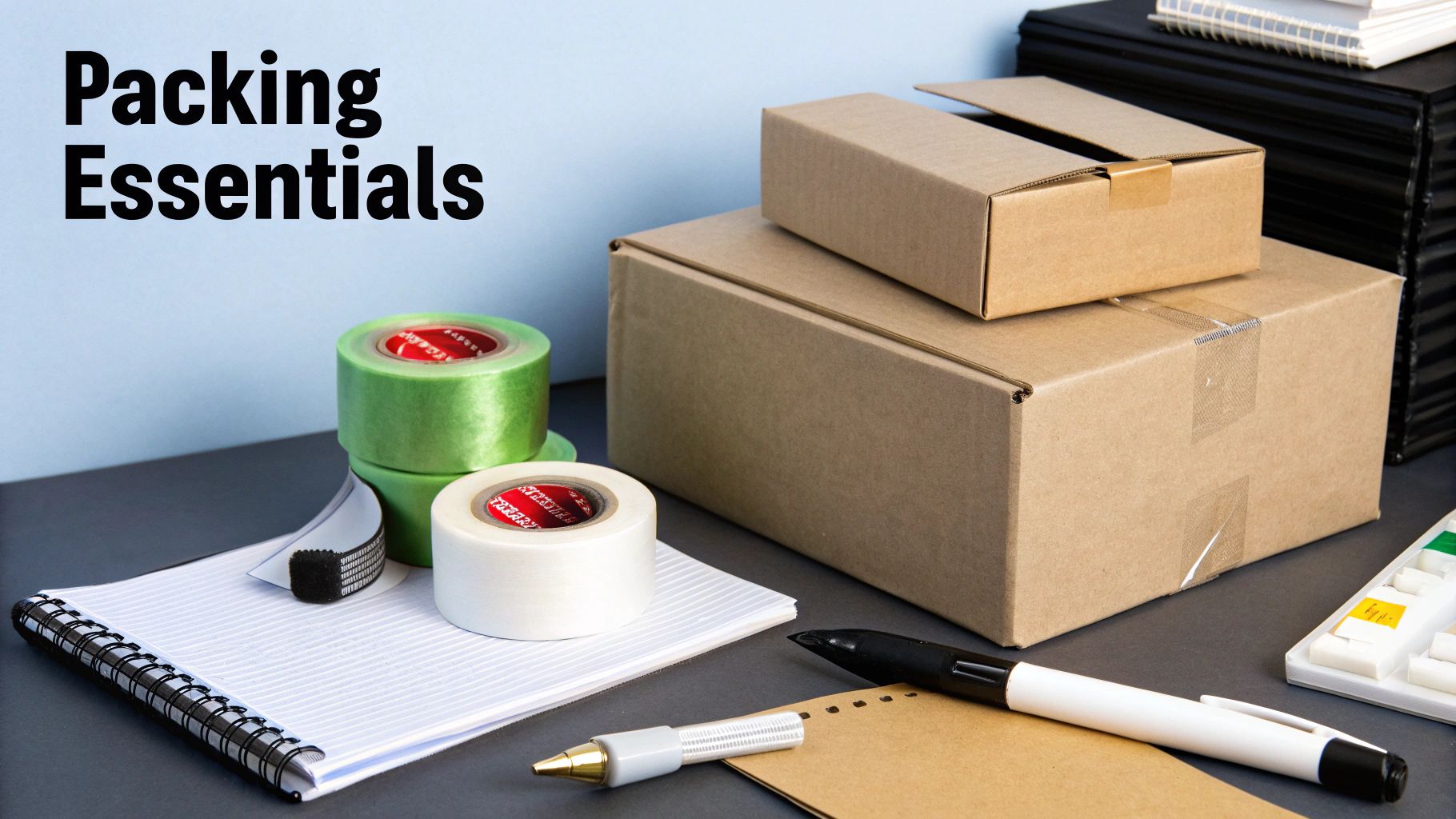
Before you even think about pulling a single book off the shelf, you need to get your supplies in order. This isn't just about finding any old box and roll of tape; it's about putting together a professional kit that will protect your beloved library and your back. The right gear is your first line of defence against bent covers, broken spines, and the soul-crushing moment a box gives way in the middle of a hallway.
Moving is a huge part of life here in Australia. Believe it or not, 43% of people aged 15 and over have moved house in the last five years. When you consider that over 1.5 million of us relocate during the peak moving season, you realise just how critical it is to know how to pack heavy items like books properly.
Choosing the Right Boxes
The most important choice you'll make is the box itself. It’s so tempting to grab a massive box and try to cram as many books in as possible, but that's a classic rookie mistake. Books are deceptively heavy, and a large box filled with them quickly becomes an immovable, back-breaking nightmare.
- Small Book Boxes are a Must: These aren't just a suggestion; they're non-negotiable. Their smaller size is designed to naturally limit the weight, keeping you under that crucial 18kg threshold.
- Look for Sturdy Construction: Always go for new or very gently used double-walled cardboard boxes. Steer clear of any box that looks like it's seen better days—any sign of water damage, crushing, or weakness is a red flag.
The goal isn’t just to fill a box; it's to create a dense, stable cube that's easy to lift and stack. A well-packed small box is infinitely safer and more manageable than a large, half-empty one.
Essential Packing Accessories
With your boxes sorted, a few other items will make your life a whole lot easier. Investing in quality supplies now will save you from the headache of tape peeling off mid-lift or labels smudging into an unreadable mess. For a full rundown of supplies, have a look at our guide on where to start when packing to move house.
Here’s a quick-reference table to get you started on your shopping list.
Book Packing Supplies Checklist
| Supply Item | Key Purpose |
|---|---|
| Small Book Boxes | Keeps the weight manageable and prevents back strain. |
| Strong Packing Tape | Secures the bottom and top seams to prevent collapses. |
| Packing Paper | Fills empty gaps and cushions books to stop them from shifting. |
| Permanent Markers | For clear, bold labelling (e.g., "HEAVY," "BOOKS"). |
Having these items on hand before you begin will make the whole process feel less like a chore and more like a well-executed plan.
Cull Your Collection Before You Pack
A move is the perfect opportunity to curate your library, not just shift it from one place to another. Think about it: every single book you decide not to take is one less thing you have to pack, lift, and then find a new home for. This pre-packing clear-out is hands-down one of the most effective ways to make your entire move easier and maybe even a bit cheaper.
Before a single roll of tape is unspooled, take a good, hard look at your bookshelves. You have to be honest with yourself about every single volume. Have you read it? Will you really ever read it again? Does it mean something special, or is it just gathering dust? That's the heart of downsizing effectively.
Deciding What Stays and What Goes
The easiest way to tackle this is to create three distinct zones: Keep, Donate, and Sell. This simple method takes what can be a sentimental, overwhelming task and turns it into a structured, manageable process. That old university textbook you haven't opened in a decade? It's a prime candidate for the 'donate' or 'sell' pile. The goal isn't to get rid of books you genuinely love, but to let go of the ones that are no longer serving a purpose.
This infographic breaks down a simple flow for sorting your books before the packing madness begins.
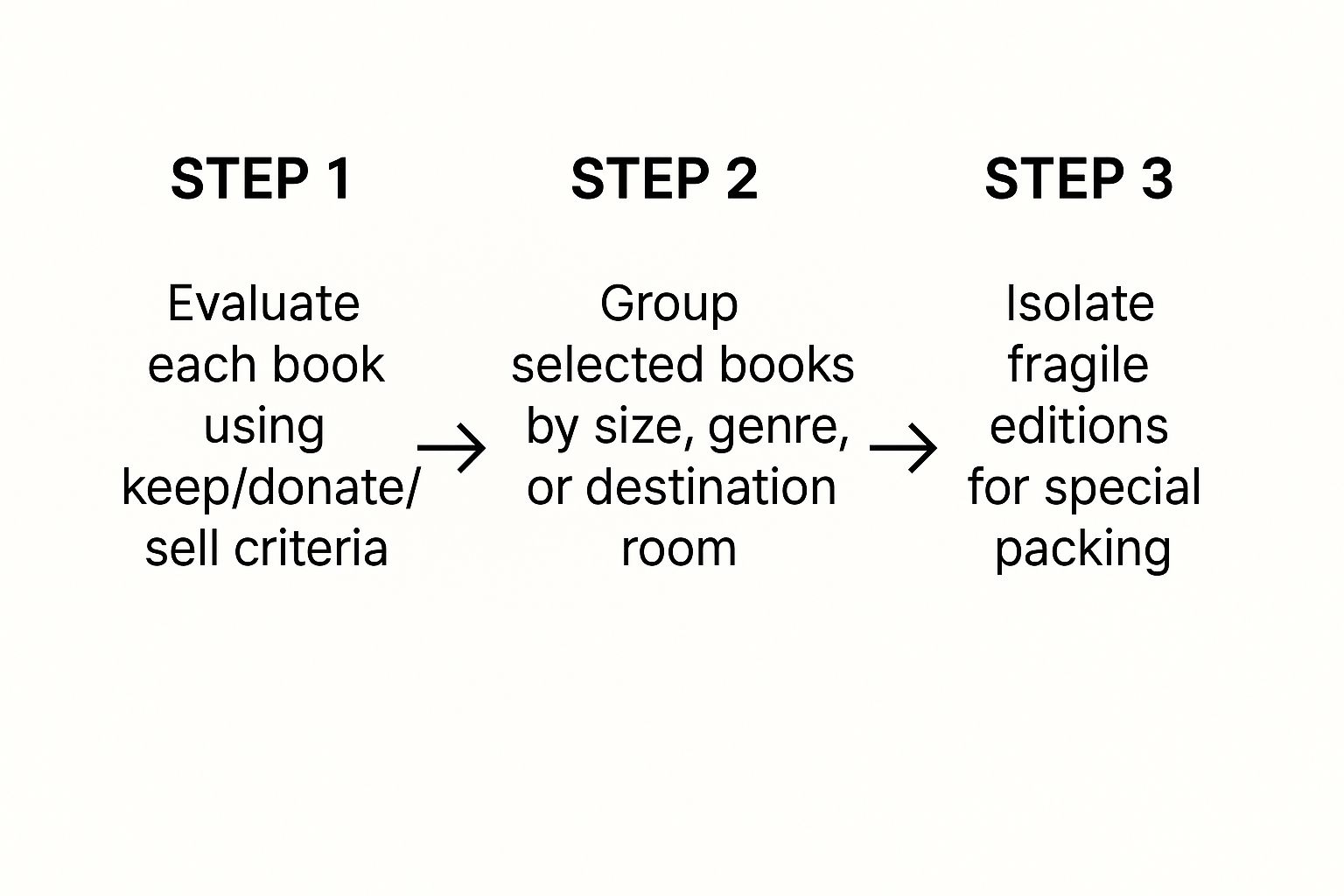
By taking the time to evaluate, group, and prepare your collection, you’re setting yourself up for a much more organised and efficient packing process from the get-go.
Once you’ve sorted your piles, you can start giving those unwanted books a second life. Local charities, libraries, and second-hand bookshops are almost always happy to take good-quality donations. If you've got a larger volume of books to part with, or other household items, you might find that professional junk removal services can efficiently handle anything that isn't suitable for donation.
For a deeper dive into decluttering, check out our complete guide on how to declutter before you move.
Grouping and Preparing Your Keepers
Right, now let's focus on the 'keep' pile. To make packing—and more importantly, unpacking—a breeze, it pays to group these books logically before they even see the inside of a box.
- Group by Size: Stacking books of a similar height and thickness together is a game-changer. It creates a solid, stable block inside the box, almost like a brick, which stops them from sliding around and getting damaged.
- Group by Destination Room: Already know the cookbooks are going straight to the kitchen and the novels to the new study? Group them that way now. Trust me, your future self will thank you when it comes time to unpack.
- Group by Genre: If you like your library organised by fiction, non-fiction, or another system, sort them that way before you pack. It makes recreating your perfect bookshelf order in the new house so much faster.
Finally, do a little bit of prep work. Give your books a quick wipe with a dry cloth to get rid of any dust. Pull aside any that are particularly fragile, old, or valuable. These treasures will need some extra TLC and padding, so keeping them separate from the main pile is a really smart move.
Master Proven Book Packing Techniques
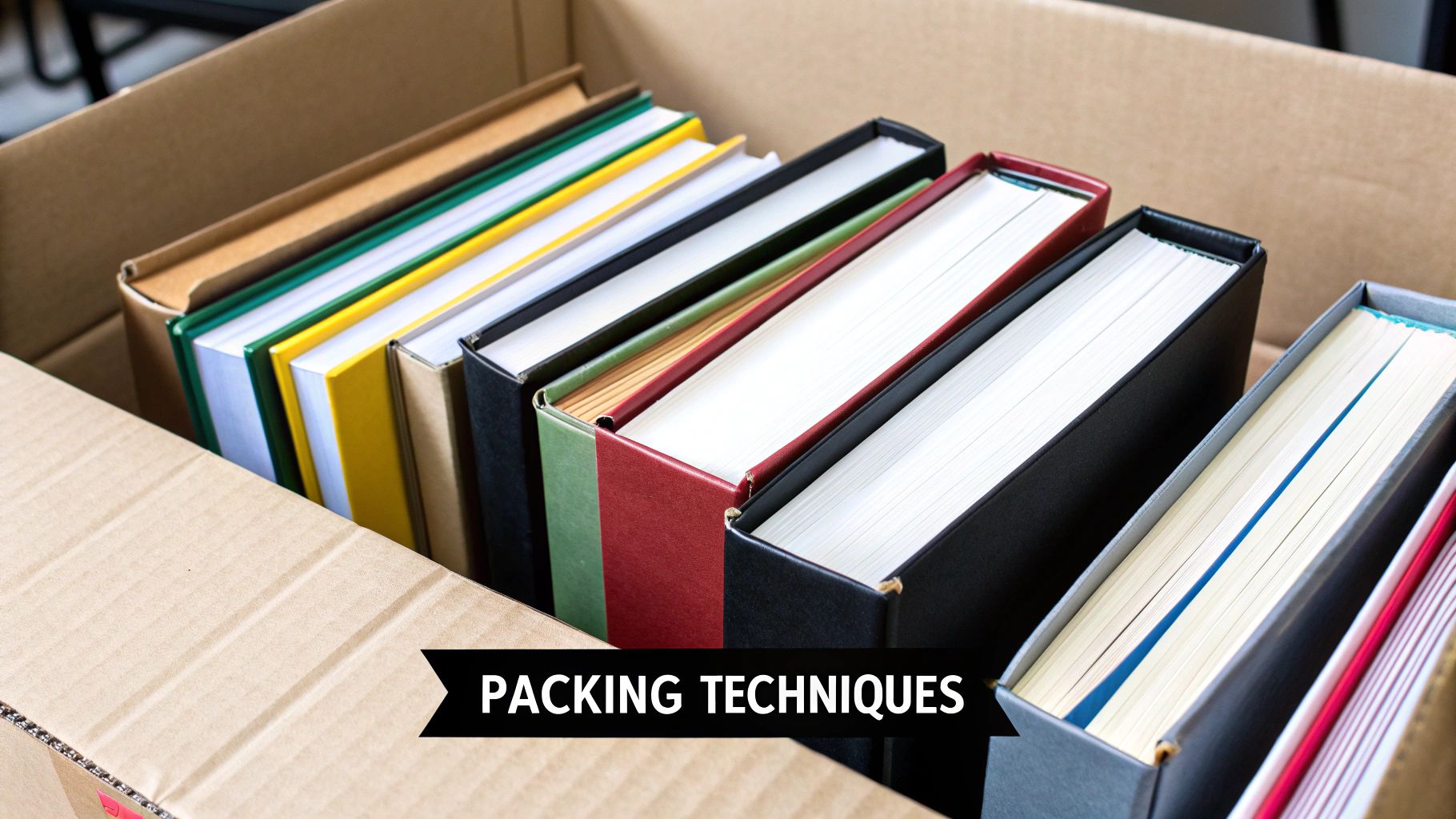
How you get your books into a moving box is more science than art. Just tossing them in randomly is a surefire way to end up with bent pages, broken spines, and boxes with such poor weight distribution they give up halfway to the truck.
The secret is to treat each box like a small, dense puzzle where every piece supports the others.
Getting the packing technique right ensures your books arrive in the same condition they left. It also creates stable, secure boxes that are safer for you (and your movers) to lift and much easier to stack. Let’s break down the three core methods and figure out when to use each one.
Packing Books Flat And Layered
This is the most straightforward method, and it works like a charm for paperbacks, especially if they're all a similar size. Packing them flat creates beautifully stable, even layers that distribute the weight perfectly.
Start by lining the bottom of the box with some crunched-up packing paper to create a cushion. Then, place your first layer of books flat, stacking them until you have a nice, even surface. If you’ve got a mix of sizes, always put the biggest and heaviest books at the bottom to build a solid foundation.
You can slip a sheet of packing paper between each layer to stop any rubbing or scuffing. Keep stacking until the box is full, but make sure to leave just enough room at the top for one last layer of cushioning paper before you tape it shut. This is a brilliant technique for your standard novels and prevents pages from getting folded or warped.
The Upright Method For Hardcovers
For most of your hardcovers, the best approach is to pack them standing upright, exactly how they’d sit on a bookshelf. This protects their structure and is especially critical for those with rigid spines.
- Spines Against the Wall: Stand the books up vertically in the box with their spines pressed firmly against the cardboard wall. This gives them the most support and stops the spine from getting crushed.
- Alternate the Spines: To get a more level and balanced arrangement, alternate the direction of the spines. Pack a few with spines to the left, then the next lot with spines to the right. This simple trick balances the weight and stops the books from leaning into each other.
- Fill Every Gap: Never, ever leave empty space. Books that can shift and slide around are books that get damaged. Use crumpled packing paper to fill in every single nook and cranny so everything is snug and totally immobile.
The golden rule for upright packing? Avoid placing books with the paper edges facing down. The pressure of the move can cause the pages to sag and bend, permanently messing up the book's shape.
Handling Oversized And Oddly Shaped Books
So, what about those beautiful but awkward coffee table books, hefty photo albums, or massive atlases? These items need a special approach because their size and weight make them pretty vulnerable.
The best way to handle these is to pack them flat, just like paperbacks, but with one crucial limit. Never stack more than two or three of these oversized books in a single box. Their weight adds up incredibly fast, and an overloaded box is a massive safety hazard. Always put the largest book at the very bottom and stack the smaller ones on top.
With a 10.5% increase in Aussies moving from capital cities to regional areas, more households are undertaking these big relocations. Ensuring heavy items like a book collection are packed properly is absolutely vital for a smooth transition.
No matter which method you use, the key is to avoid simple errors. To make sure you’re not falling into any common traps, take a moment to review our guide on the top 10 common packing mistakes when moving home. By mastering these techniques, you can turn a potentially damaging task into a systematic process that gets your entire library to its new home, safe and sound.
Protecting Your Most Valuable Books
Let's be honest, while every book has its place, some are just different. We're talking about the truly irreplaceable ones: the signed first editions, the fragile antiques passed down through generations, or that one book with so much sentimental value it’s practically priceless.
When you're figuring out how to pack books for moving, these special volumes need a whole different game plan. Think of it less like packing and more like curating a safe passage for your most precious stories.
Just tossing them into a box with the paperbacks won't cut it. The real goal here is to build a little protective fortress around each one, shielding it from moisture, pressure, and the acidic materials that lead to that dreaded yellowing over time. A few extra steps now will bring you enormous peace of mind later.
The Foundation of Protection: Acid-Free Paper
First things first, every valuable book needs to be wrapped individually. And not just with any paper. Standard packing paper and, especially, newspaper are full of acids that can leech into your book's cover and pages, causing permanent discolouration.
This is where acid-free tissue paper becomes your best friend.
Lay a sheet out on a clean, flat surface and place your book right in the middle. Wrap it up neatly, just like you would a gift, making sure every surface is covered. Use a tiny piece of tape to hold the paper in place, but be absolutely certain the tape only touches the wrapping paper, never the book itself. This simple layer is a powerful barrier against long-term environmental damage.
This initial wrap isn’t just about stopping acid transfer. It also creates a soft, non-abrasive buffer that prevents scuffs and scratches on delicate leather bindings or dust jackets while everything is in transit.
Adding Layers for Cushioning and Support
With the acid-free wrap in place, it’s time to add some serious cushioning. This is non-negotiable for antique books with brittle bindings or those with embossed covers that could be easily crushed.
- Bubble Wrap for Impact: Add a second layer of bubble wrap over the acid-free paper. It’s fantastic for shock absorption and will protect those vulnerable corners and spines from bumps and drops.
- Cardboard Inserts for Rigidity: For your most fragile hardcovers, you can easily make a cardboard "sandwich." Just cut two pieces of sturdy cardboard so they're slightly larger than the book's front and back covers. Place one on each side before you bubble wrap it to create a rigid shell that stops any bending or flexing.
These techniques are quite similar to how you’d handle other delicate items. If you want to dive deeper, you can learn more about how to pack fragile items for moving in our detailed guide.
Finally, never mix these specially-prepped books in with the rest of your collection. Give them their own dedicated small box. Label it clearly and boldly: "FRAGILE – VALUABLE BOOKS". If you can, consider keeping this box with you and transporting it in your own car instead of on the moving truck. That way, you have complete control, ensuring your most irreplaceable stories arrive safe and sound.
Label and Stack Boxes for a Smarter Move
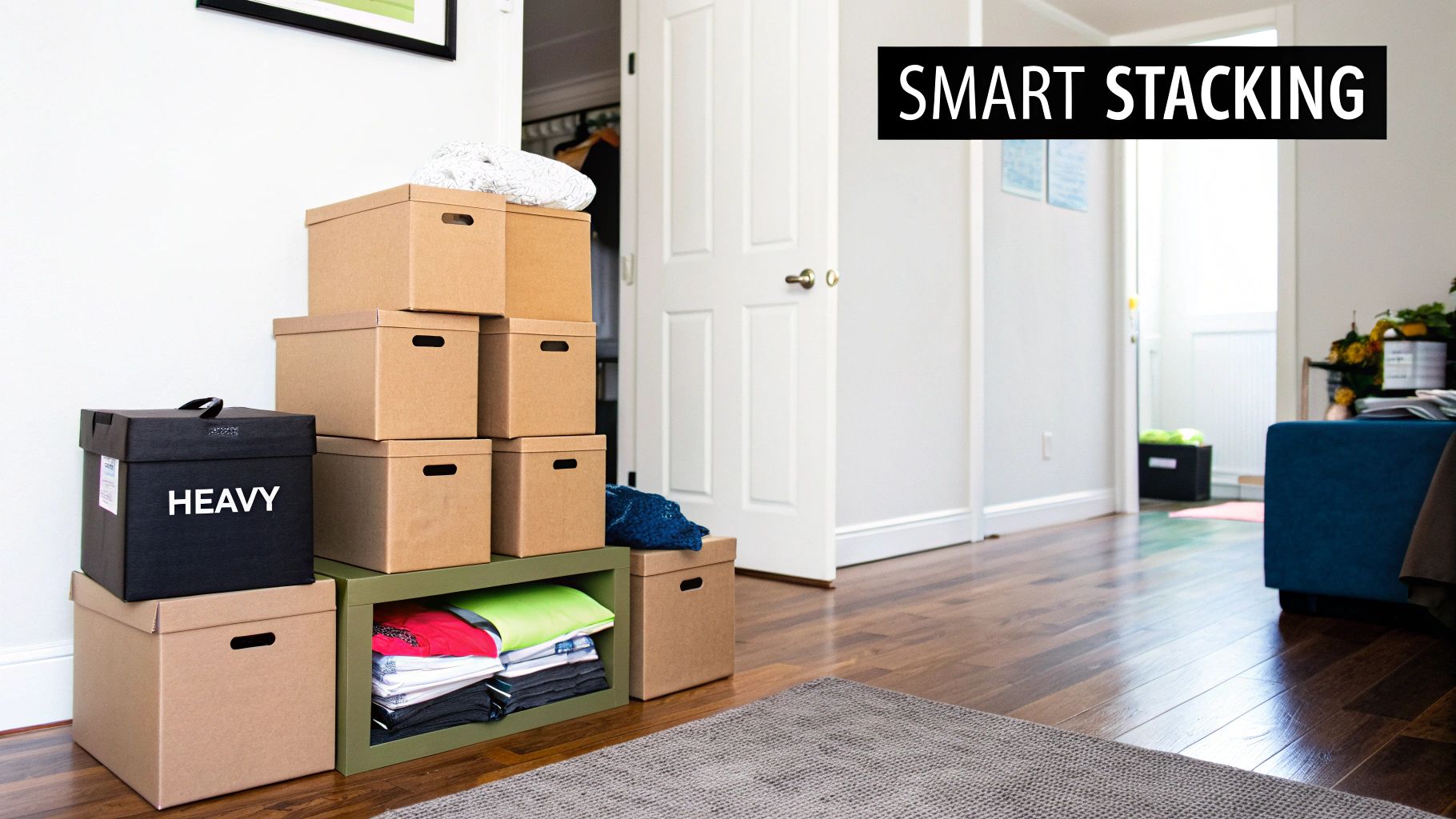
You’ve done the hard yards packing, but don’t stop now. These final touches are what truly separate a chaotic move from a seamless one. A solid labelling system and a bit of strategic stacking will save you—and your removalists—a world of pain on moving day.
Think of each box label as a mini instruction manual. Simply scrawling "Books" on the side just isn't enough if you want to find anything later. A well-marked box instantly tells everyone handling it where it goes and how heavy it is, making the whole process far more efficient.
Create a Labelling System That Works
The goal here is simple: convey the most critical information at a single glance. Grab a thick, permanent marker and write on at least two sides of every single box. This little trick ensures you can see what’s what, no matter how the boxes get shuffled around.
Here’s what you should write on every book box:
- Destination Room: Be specific. "Study," "Living Room," or "Leo's Bedroom" tells the movers exactly where to put it.
- Brief Contents Description: A quick note like "Fiction Novels" or "Cookbooks" helps you prioritise which boxes to open first.
- The 'HEAVY' Warning: This is non-negotiable. Writing "HEAVY" in big, bold letters is a crucial safety warning for anyone who has to lift the box.
This simple system ensures your boxes land in the correct rooms, ready for you to deal with when you have the time and energy.
To make this crystal clear, here’s a quick rundown of what an effective labelling system looks like.
Effective Box Labelling System
| Information to Include | Why It's Important |
|---|---|
| Destination Room | Directs movers to the correct location, saving you from having to move boxes again later. |
| Brief Contents | Helps you identify and prioritise boxes during unpacking. |
| "HEAVY" Warning | Alerts anyone lifting the box to its weight, preventing potential back injuries. |
Following these simple rules makes for a much smoother process for everyone involved.
An effective labelling strategy does more than just organise; it creates a safer environment on moving day. Clear warnings prevent injuries from unexpectedly heavy loads and help movers place boxes correctly the first time.
The Art of Stacking Boxes Securely
Once everything is labelled, how you stack your boxes is incredibly important. Books are dense and heavy, which actually makes their boxes the perfect foundation for any stack, both in your home and on the moving truck. It’s like building with bricks—you always put the strongest, heaviest ones at the bottom.
Never, ever place a heavy box of books on top of a lighter one filled with things like linen or kitchenware. That’s just asking for crushed boxes and broken belongings.
Always start your stacks with the book boxes to create a solid, stable base. Lay them flat and make sure you have a level surface before you even think about putting lighter boxes on top.
With Australia's dynamic property market, more people are on the move than ever, driven by population growth and shifting lifestyle priorities. As we seek out homes that better suit our needs, efficient moving practices—from packing books to loading the truck—are essential. You can discover more insights about Australian moving house trends on homemove.com.au.
By combining clear, bold labels with a physics-first approach to stacking, you’re setting yourself up for a much smoother, safer, and more organised move.
Common Questions About Packing Books
Even with the best plan, a few questions always pop up when you're staring at a mountain of books and a stack of empty boxes. It's totally normal to second-guess yourself. We get asked these questions all the time, so we've put together some quick, clear answers to help you pack with confidence.
Think of this as your go-to guide for solving those last-minute packing puzzles.
What Are the Absolute Best Boxes for Books?
The undisputed champion for packing books is the small, double-walled cardboard box. You’ll often see these sold as a "book box" or "half-size" moving box, and their compact size is exactly why they work so well.
Using smaller boxes naturally stops you from over-packing them, which is key to keeping the weight under the 18-20 kilogram limit. This not only saves your back but also makes sure the box itself won't buckle under the strain. Whatever you do, avoid using large boxes—they become dangerously heavy almost instantly.
As a pro tip, always try to get your boxes from a proper removalist supplier. If you're in a pinch, boxes from a bottle shop can be a decent substitute. They're designed to hold heavy, fragile glass bottles, so they’re usually quite sturdy.
Is It Okay to Use Suitcases for Books?
Absolutely! Using suitcases is a brilliant and often overlooked packing hack. A carry-on or medium-sized rolling suitcase is perfect for the job.
- Natural Weight Limit: Their size is great for keeping the load manageable.
- Built-in Wheels: This is the best part. The wheels make getting a heavy load of books from your house to the moving truck an absolute breeze.
- Durable Protection: The hard shell or padded sides of a suitcase offer fantastic protection against bumps and knocks during the move.
If you've got spare suitcases lying around, filling them with books is a smart way to use the space and make moving a heavy part of your collection so much easier.
How Do I Stop Book Corners From Getting Bent?
Bent corners and dinged-up covers are one of the most common and frustrating types of moving damage. The secret to preventing this is to stop any and all movement inside the box.
Start by grouping and packing books of a similar size together to create a solid, stable block. Once your books are in, you need to fill every single gap with crumpled packing paper, or even soft things like tea towels or old t-shirts. The aim is to make everything so snug that nothing can shift, slide, or knock against anything else while on the road. For your really precious or valuable books, wrapping the corners with a small piece of bubble wrap gives you that extra layer of defence.
What's a Safe Weight Limit for a Book Box?
The golden rule is to keep every single box of books under 20 kilograms. Honestly, the 15-18 kilogram range is even better. This is a non-negotiable for the safety of both you and your movers.
An easy way to check is with the "one-hand lift test." After you've taped a box shut, try to lift it just off the ground with one hand. If you can't do it comfortably, it’s too heavy. You'll have to open it back up and move some of the books into another box. It might feel like a pain at the time, but it’s far better than dealing with a burst box or a serious back injury.
Of course, tackling an entire house pack can be a huge job. If you find it's all getting a bit overwhelming, it might be worth looking into the top benefits of using professional packing services. It's a great, stress-free alternative that ensures everything—not just your books—is packed with expert care.
Ready to make your move completely seamless? Let the experts at Get n Go Removals Melbourne handle the heavy lifting. From professional packing to careful transport, we ensure your belongings arrive safely at their new home. Contact us today for a free, no-obligation quote and experience a stress-free move. Learn more at https://www.getngoremovals.com.au.