
Man with Van Sydney Costs, Access and Booking
Your keys are due back this afternoon, the sofa still needs moving, and the Sydney apartment building won't let a large truck wait at the entrance. You've searched for a man with van Sydney service, but the cheapest quote doesn't tell you whether the vehicle fits the dock or who will carry the sofa upstairs.
Book the move around access and handling, not the advertised hourly rate. For Melbourne customers heading to Sydney, the right choice might be a van, a staged delivery through storage, or a properly crewed truck. Work that out before paying a deposit.
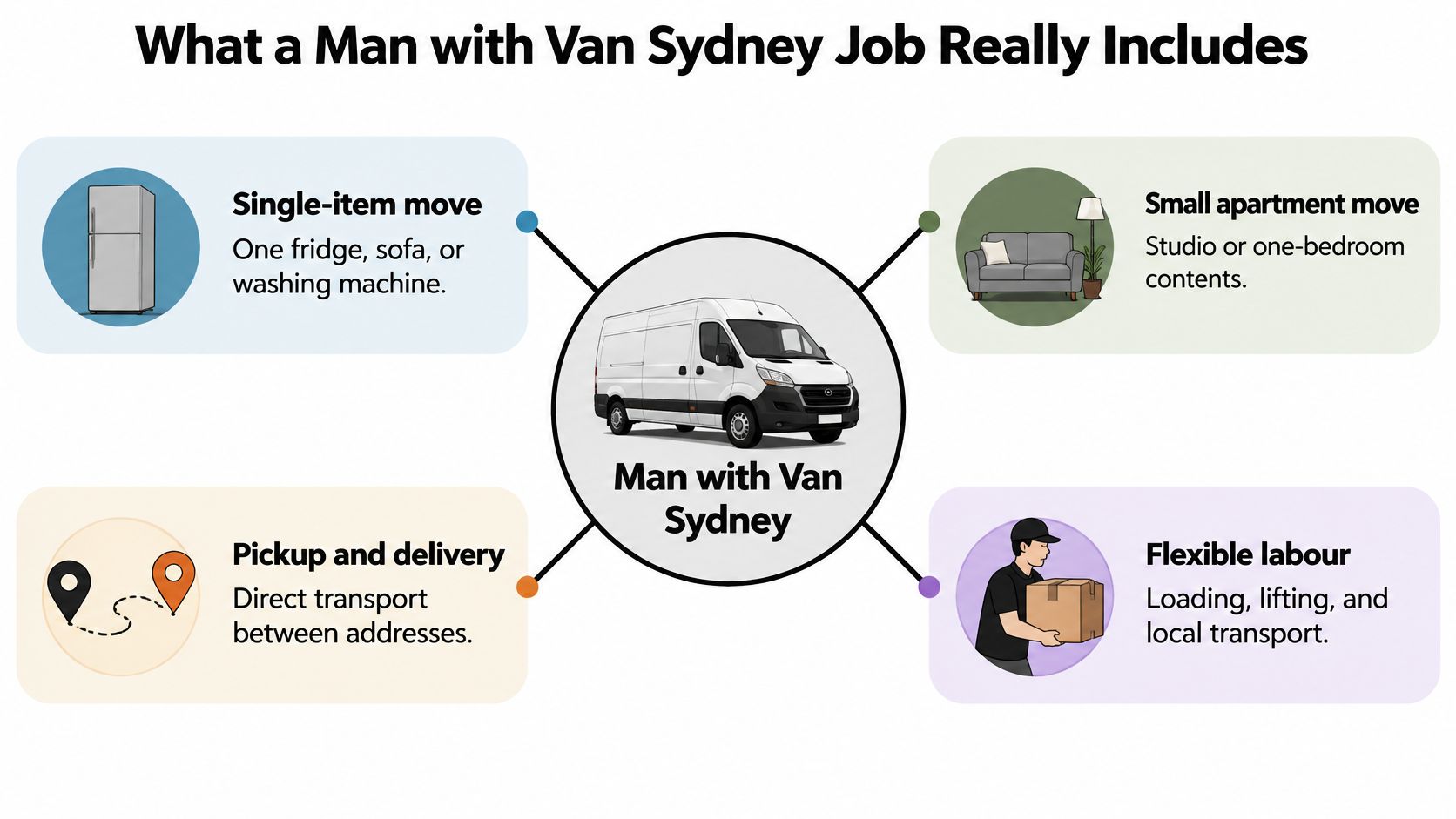
What a Man with Van Sydney Job Really Includes
On a tight handover day, a sofa and packed cartons can look like a straightforward transport job. Then the driver arrives and discovers the bed is still assembled, the loading area is unavailable, and you expected help packing the kitchen.
That's not a bigger version of the same booking. It's a different scope of work.
A man with a van service is a smaller removal using a vehicle and a small crew for a limited load, rather than a whole-house pack-out. It suits local transport and carefully planned longer trips when the inventory, lifting requirements and delivery arrangements are clear.
Agree on where the service starts and finishes
Treat loading, protective blankets, basic furniture handling and a direct drop as items to confirm, not automatic inclusions. Ask whether unloading means placement inside the nominated room or delivery to an accessible entrance.
Your quote should separate the core transport from additional work:
- Packing: State whether everything will be boxed and ready, or whether the crew must pack loose belongings.
- Furniture preparation: Identify anything requiring disassembly, reassembly or special protection.
- Extra movements: Have storage transfers, additional stops and return trips priced explicitly.
- Labour: Confirm who will lift bulky furniture. Don't assume the driver expects or accepts customer assistance.
A useful guide to moving costs helps you frame the questions, but the written scope matters more than a headline rate. Ask when charging begins and ends, whether travel is included, and how waiting time or an inventory change affects the total.
Why the service matters in Sydney
Greater Sydney reached 5,557,233 residents at June 2024 after growth of 107,538 people, or 2.0%, while net internal migration was −41,086, according to the Australian Bureau of Statistics regional population figures. That combination puts both local address changes and departures to other Australian regions into the planning picture.
Population figures won't tell you which vehicle to hire. Your inventory will.
Scope rule: If the mover can't describe exactly what they're collecting, handling and delivering, you're not ready to compare prices.
Small Moves and Single Items That Suit a Van
Suppose you need the couch and packed belongings moved today, while the remaining furniture stays until next week. That can be a sensible van booking, provided the separate collection is deliberate and priced, not the result of discovering everything won't fit.
Judge the job by the load and its hardest handling task. A short inventory doesn't automatically mean easy lifting.

Match the booking to the actual items
A studio or one-bedroom apartment is a candidate, not a guarantee. Send photos of wardrobes, balcony furniture, storage cages and boxed belongings, rather than just the main room.
For individual items and business loads, use these practical tests:
- Fridge or washing machine: Supply the model or dimensions, collection position and stair details. Confirm suitable handling equipment and enough labour.
- Marketplace sofa: Get measurements from the seller before paying. Include chaise sections, removable legs and the route out of the seller's property.
- Student room: List the desk, mattress, shelves and packed contents separately. Loose bags and unprepared furniture change the workload.
- Small office desk run: Identify glass tops, monitor arms, cable trays and equipment that needs separate packing.
- Event gear: Specify the receiving contact and permitted arrival window. A delivery isn't complete merely because the vehicle reaches the venue.
For fragile furniture, explain what makes it vulnerable. A glass cabinet needs a different handling plan from a flat-packed desk, even when both occupy similar space.
Know when to step up
A three-bedroom house, piano or pool table shouldn't be booked on the hope that a van will somehow manage. Ask for a larger crew or specialist assessment when weight, awkward handling or total volume stacks up.
Repeated trips can also leave you paying for more driving while the property remains half cleared. Compare the complete job, not the apparent simplicity of the vehicle.
Choose a van for a short, well-defined inventory with manageable handling. Choose more capacity and labour when either part stops being straightforward.
Apartment Access Rules That Change the Quote
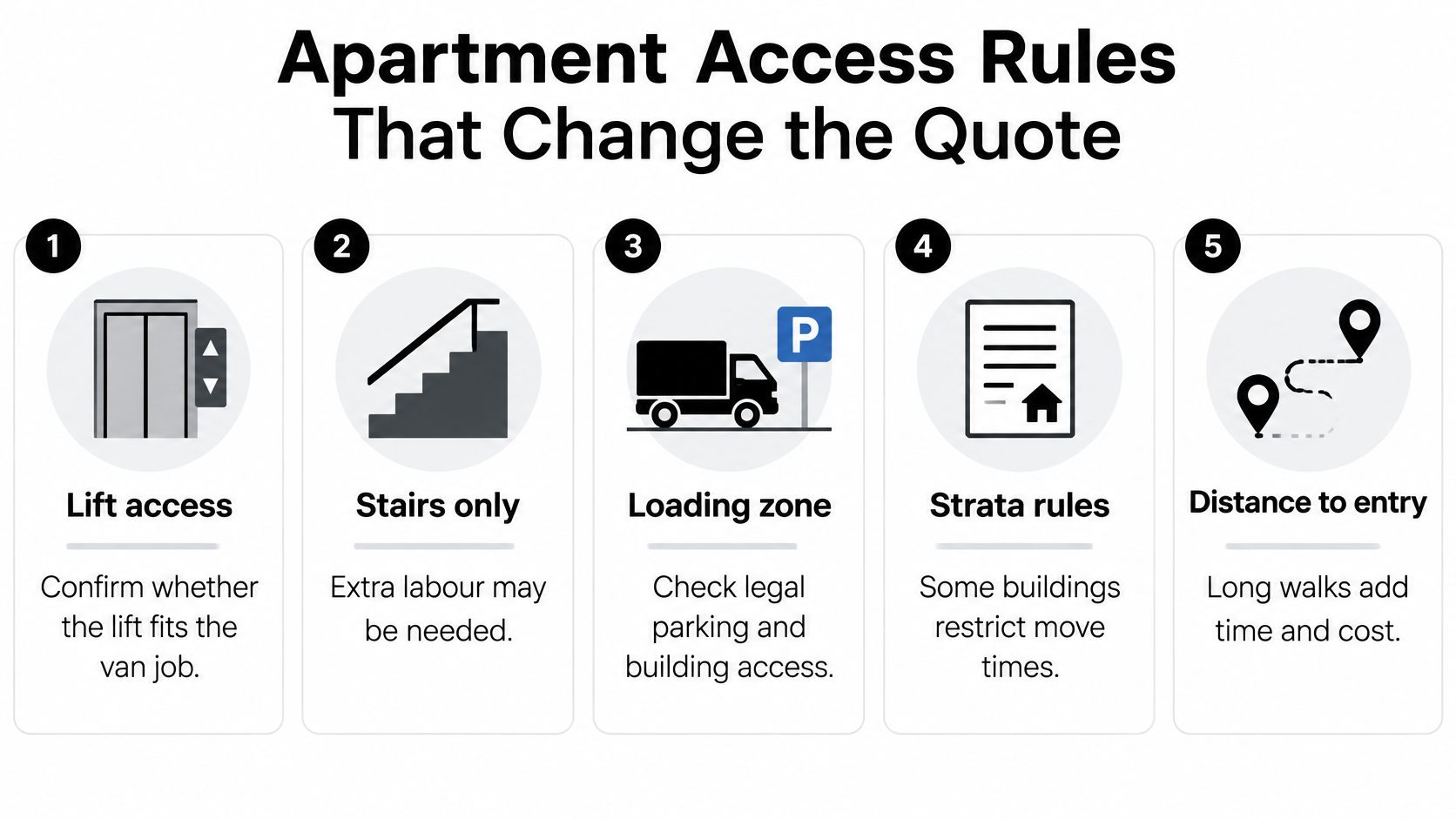
The cheapest van becomes an expensive choice when it misses the goods-lift booking and the crew has to shuttle furniture from the street. A confirmed address isn't confirmed access.
Sydney apartment moves can involve several decision-makers. Strata rules govern parking and common-property use, the building manager coordinates operational access, and the council may control the kerbside space outside.
NSW guidance explains that strata parking can involve allocated spaces, visitor restrictions, signage, barriers and by-laws, with breaches attracting penalties of up to $1,100 under the NSW Government's strata parking guidance. Don't ask a driver to improvise around those restrictions.
Get permission before accepting the quote
Follow this order so the mover prices a workable job:
- Obtain the building rules: Ask for permitted moving times, the approved entrance and any restrictions on common areas.
- Reserve the goods lift and dock: Get written confirmation, including who opens them and what happens if the booking runs late.
- Confirm physical clearance: Send the mover the dock height, entrance width and turning information. Ask them to confirm compatibility with the allocated vehicle.
- Check the kerb: Establish whether the intended loading position needs council approval. A building manager's permission doesn't settle a council requirement.
- Record damage and bond conditions: Ask whether protective coverings, an inspection or a refundable moving bond is required.
Measure the furniture route as well as the entrance
A sofa can clear the front doorway and still fail at the turn into the lift. Measure the complete path, including corridors, lift doors, internal lift dimensions and the final room entrance.
For help preparing those measurements, consult Stahl Home Center's furniture measuring guide. Use it as a measuring resource, then send your actual dimensions and photographs to the mover for assessment.
Melbourne customers should collect this information from the Sydney destination before agreeing to transport dates. The practical apartment move planning checklist can help organise the building conversations.
The lift reservation, dock permission and legal loading position must work together. Confirming just one doesn't make the move ready.
If access remains uncertain, ask for the alternative arrangement and its cost in writing. Don't accept an open-ended promise to work it out on arrival.
Vehicle Size, Payload and Sydney Street Limits
A vehicle can have spare floor space and still be unsuitable for the load. Dense cartons, appliances and equipment affect weight distribution, while the vehicle's external dimensions determine where it can travel and manoeuvre.
Australian guidance defines a light vehicle as having a gross vehicle mass of up to 4.5 tonnes; above that threshold, heavy-vehicle loading obligations apply, as explained in the NHVR load restraint guidance. Ask what the vehicle description on your quote means.
Standard rigid truck access figures
The following are published access parameters, subject to applicable conditions, not a promise that a truck will fit a particular Sydney street or building.
| Limit | Published figure | What it changes on moving day |
|---|---|---|
| Length | 12.5 metres | Turning space and kerbside positioning |
| Width | 2.5 metres | Narrow approaches and side clearance |
| Height | 4.3 metres | Loading docks, overhead structures and car-park entries |
| Mass | 31 tonnes | Access assessment and applicable operating conditions |
All figures in the table come from the NHVR's published rigid-truck access parameters. They aren't the dimensions or carrying capacity of every removal truck.
The distinction between gross vehicle mass and usable payload matters. A vehicle's rated total mass isn't the amount of furniture it can carry after accounting for the vehicle itself, crew and equipment.
Ask for a load match, not the biggest truck
Heavy vehicles must comply with applicable axle, axle-group and spacing-based limits, as well as the manufacturer's rating, under the NHVR General Mass Limits framework. Spare cubic capacity doesn't override those requirements.
Give the allocator information they can use:
- Approach details: Driveway gradient, narrow gates, restricted turns and overhead obstructions.
- Loading constraints: Available standing space and any vehicle restrictions attached to it.
- Handling dimensions: Lift size and the largest item's complete manoeuvring path.
- Dense contents: Book cartons, filing cabinets, tools and other concentrated loads.
A smaller vehicle with planned staging can be safer than forcing an unsuitable truck into a restricted site. Where repeated journeys are proposed, get the full transport and labour allowance before agreeing.
Use a moving truck size guide to prepare your inventory, then have the operator confirm the allocation. Photos help, but they don't replace weights, measurements or a loading assessment.
Van Jobs Versus Full-Service Removal Teams
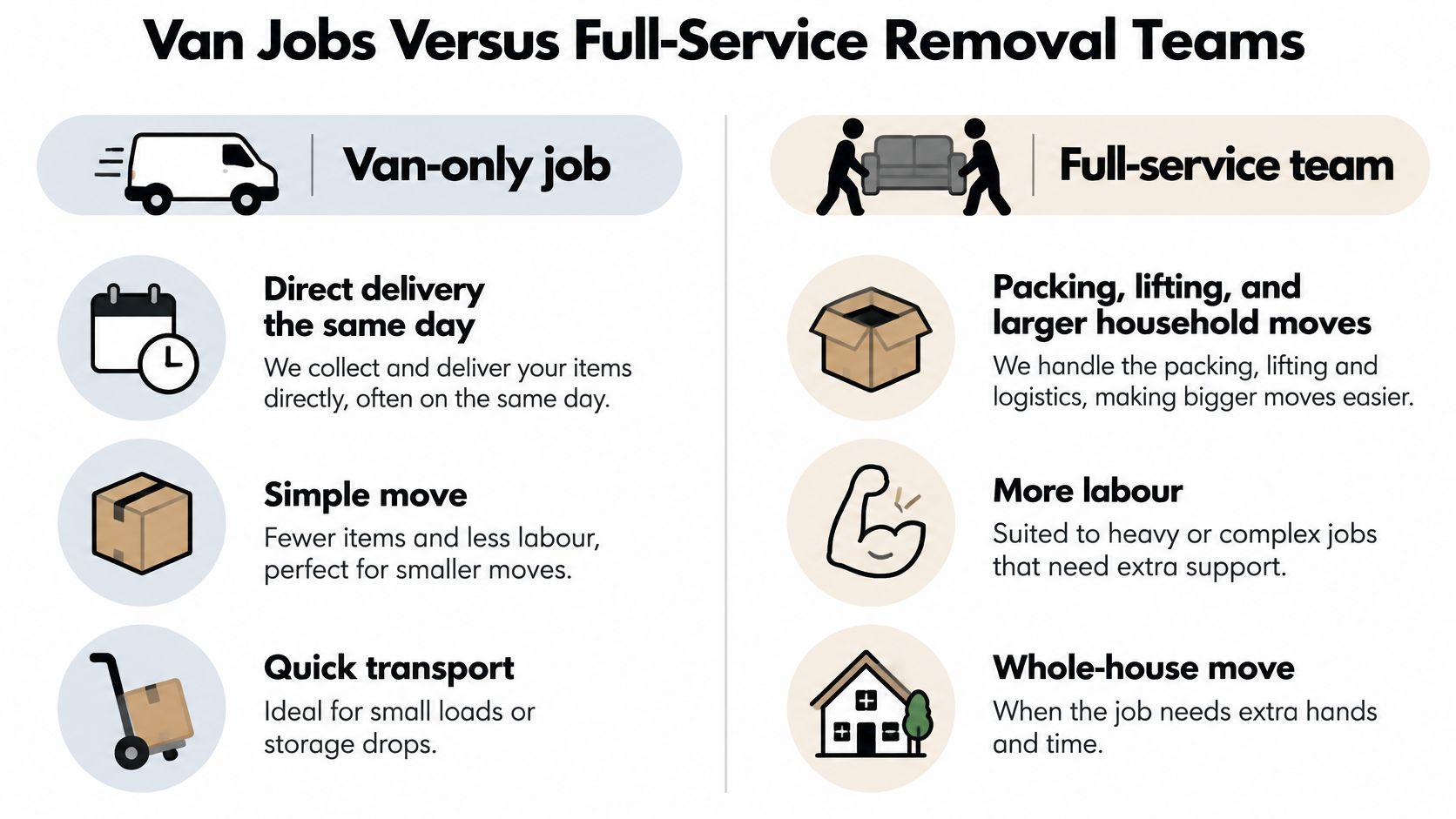
Your delivery arrangement should decide the service level. A small load with a reliable receiver needs different coordination from a household leaving Melbourne before the Sydney property is available.
Interstate relocation isn't something every household does routinely. Australia recorded about 362,000 interstate moves in the year to June 2025, down 5.9%, while 1.5% of Australians are projected to move interstate in 2027–28, according to the 2025 Population Statement material.
For the customer making that move, dependable handovers matter more than broad claims about migration demand. Work, family and settlement commitments don't become flexible because the load is small.
Choose the delivery arrangement first
| Your situation | Sensible arrangement | Trade-off to settle |
|---|---|---|
| A prepared small load with someone available to receive it | Direct van delivery where the route and timing allow | Less coordination, but little tolerance for an unavailable destination |
| Melbourne lease ends before Sydney handover | Collection followed by storage and scheduled delivery | Extra handling and storage costs in exchange for separating the deadlines |
| Only selected belongings can be received initially | Planned split consignment | Clear inventory separation and separately agreed delivery arrangements |
| Packing, heavy handling and household setup are needed | Full-service removal team | More labour and coordination, with a broader scope to price |
Don't choose split delivery merely because nobody has agreed to receive the main load. First establish whether an authorised receiver or a different delivery date solves the problem better.
When coordinated interstate service makes sense
Get n Go Removals is a family-owned Melbourne option offering house and office moves, packing and unpacking, furniture assembly, piano and pool-table handling, and short- and long-term storage. Its public liability and transit insurance, company-owned fleet and weekly direct Melbourne–Sydney runs make it relevant when the booking needs more coordination than a kerbside collection.
Confirm the allocated vehicle and service scope in the written quote rather than treating the fleet range as a promise about your booking.
For a useful distinction between transport and room-level setup, Slone Brothers Furniture discusses premium delivery for Orlando homeowners. That overseas furniture-delivery resource isn't an Australian removals standard, but it provides context for asking what unpacking, placement and assembly include.
Pay for the work you need completed, not just the distance your goods travel.
Insurance, Load Restraint and Hiring Checks
Before paying a deposit, establish who is doing the work, who is responsible for your goods and how the load will be restrained. These checks matter when a Sydney building's loading access or a Melbourne departure window leaves little room to fix problems on the day.
Ask for the public liability and goods-in-transit policy details. Check exclusions, excesses and how to make a claim. Use this goods-in-transit insurance guide to prepare questions, then confirm which documents apply to your booking.
Get clear answers in writing
Keep the answers with your quote:
- Operator identity: Confirm the business you are hiring and whether it may subcontract the move.
- Crew checks: Ask whether staff are police-checked and who supervises the job.
- Vehicle and licence: Confirm the vehicle class and that the driver holds the appropriate licence.
- Insurance responsibility: Establish whose policy covers carrying, loading, transport and unloading.
- Heavy-item preparation: Ask what handling equipment and restraint method the operator proposes for your furniture.
For general background on preparing awkward pieces, read furniture moving advice for North Georgia homeowners. Use it as supplementary reading only. The operator still needs to assess your specific furniture, access and vehicle.
Check the restraint method
Australia's load-restraint performance standards specify resistance equivalent to 0.8g forward, 0.5g sideways, 0.5g rearward and 0.2g upward when friction is relied on. Under severe braking, a 500 kg load can require approximately 400 kg-force of forward restraint, according to the NHVR load-restraint performance standards.
Stretch wrap protects surfaces and keeps loose components together. It does not replace restraints securing goods to the vehicle.
Heavy appliances and book cartons should sit low and near the centreline, with weight distributed appropriately. Before departure, ask the operator to check the straps, anchors and edge protection. Restraints may lose tension as goods settle or vibrate in transit, so ask when they will be checked again.
Before departure: Ask for a loading note that identifies the vehicle, item weights, placement and restraint equipment.
You do not need to design the restraint system. Hire an operator who can explain the method clearly and answer safety questions without brushing them aside.
How to Book the Move and What to Do Next
Start booking once the lease or settlement timing is known. Tell the mover which deadlines are fixed and which can move, rather than requesting a date without explaining the handover.
Keep the job details together. A shared email thread with the inventory, photos and written confirmations is more useful than scattered messages to different people.
Send a complete booking pack
Use this sequence:
- Secure the date: Identify collection availability and the earliest confirmed delivery opportunity.
- Send the inventory: Include photographs and the largest item's dimensions, plus anything requiring special handling.
- Confirm the reserved windows: Attach the agreed building and kerbside arrangements.
- Resolve any gap: Decide whether belongings need storage between addresses before finalising transport.
- Nominate a contact: Give the mover someone authorised to approve changes and receive updates.
Use the essential moving-home to-do list to organise the remaining preparation. Keep walkways clear, label cartons by destination room and have agreed furniture disassembly completed before the crew arrives.
Keep property records separate from moving paperwork
If you're starting a Victorian tenancy as part of the relocation sequence, return the signed condition report within five business days of moving in, excluding weekends and public holidays, under Consumer Affairs Victoria's condition-report guidance. Keep supporting photographs and retain your copy so existing damage isn't confused with damage during furniture handling.
That deadline concerns moving into a Victorian rental, not a new exit-report deadline when leaving for Sydney. Keep your departure inspection arrangements with the agent alongside, but separate from, the transport booking.
Before accepting the quote, check that it matches the final inventory and delivery arrangement. Changes are easier to price before dispatch than while a loaded vehicle waits outside.
Get n Go Removals Melbourne offers van-scale bookings, household and office removals, packing and storage for customers planning local or Melbourne-to-Sydney moves. Visit Get n Go Removals Melbourne with your inventory, access details and preferred dates to confirm vehicle fit, insurance and availability for a direct east-coast run or a small local job.