Removalists North Shore: 2026 Moving Guide
You can do everything right on moving day and still get caught by one missing booking. The truck arrives, the lift is unavailable, the loading zone is already occupied, and the whole job starts slipping by the minute. That's why removalists North Shore work is less about brute force and more about access, timing, and local rules.
Why North Shore Moving Requires Local Expertise
A North Shore move usually goes wrong in the small gaps between the job and the building, not in the loading itself. The truck might be ready, the crew might be on time, and the boxes might be labelled properly, yet a narrow street, a missed lift slot, or a short legal parking window can still derail the day. That is the true difference between a mover who knows the area and one who just turns up with a larger truck.

Local demand is built into the housing pattern
The broader housing picture explains why this market stays busy. In 2019–20, 1.14 million Australian households moved at least once, and 65% relocated within the same state but outside their former suburb, which lines up closely with metropolitan removal work rather than long-haul freight (ABS housing mobility data). That local movement pattern matters on the North Shore because most jobs are about suburb-to-suburb transitions, lease-end deadlines, and cross-city coordination, not just full-house relocations.
On the ground, that means a professional mover needs to think like a local traffic planner. A truck that fits the load is useless if it can't stay legally where it needs to be, and a perfect packing plan still fails if access is blocked by another resident or a timed restriction. The operational win comes from knowing what to check before the first box is lifted.
Practical rule: on the North Shore, the move is won before the truck arrives, not after it's parked.
That's why the strongest removalists north shore clients use are the ones who ask about the building, the street, the access path, and the settlement timing before quoting anything. A generic interstate-style approach can work on a freestanding house with open drive-up access, but it breaks down fast in apartment-heavy pockets and tighter streets. Local knowledge beats oversized equipment when the main constraint is a permit window or a lift booking.
Understanding North Shore Housing Demographics
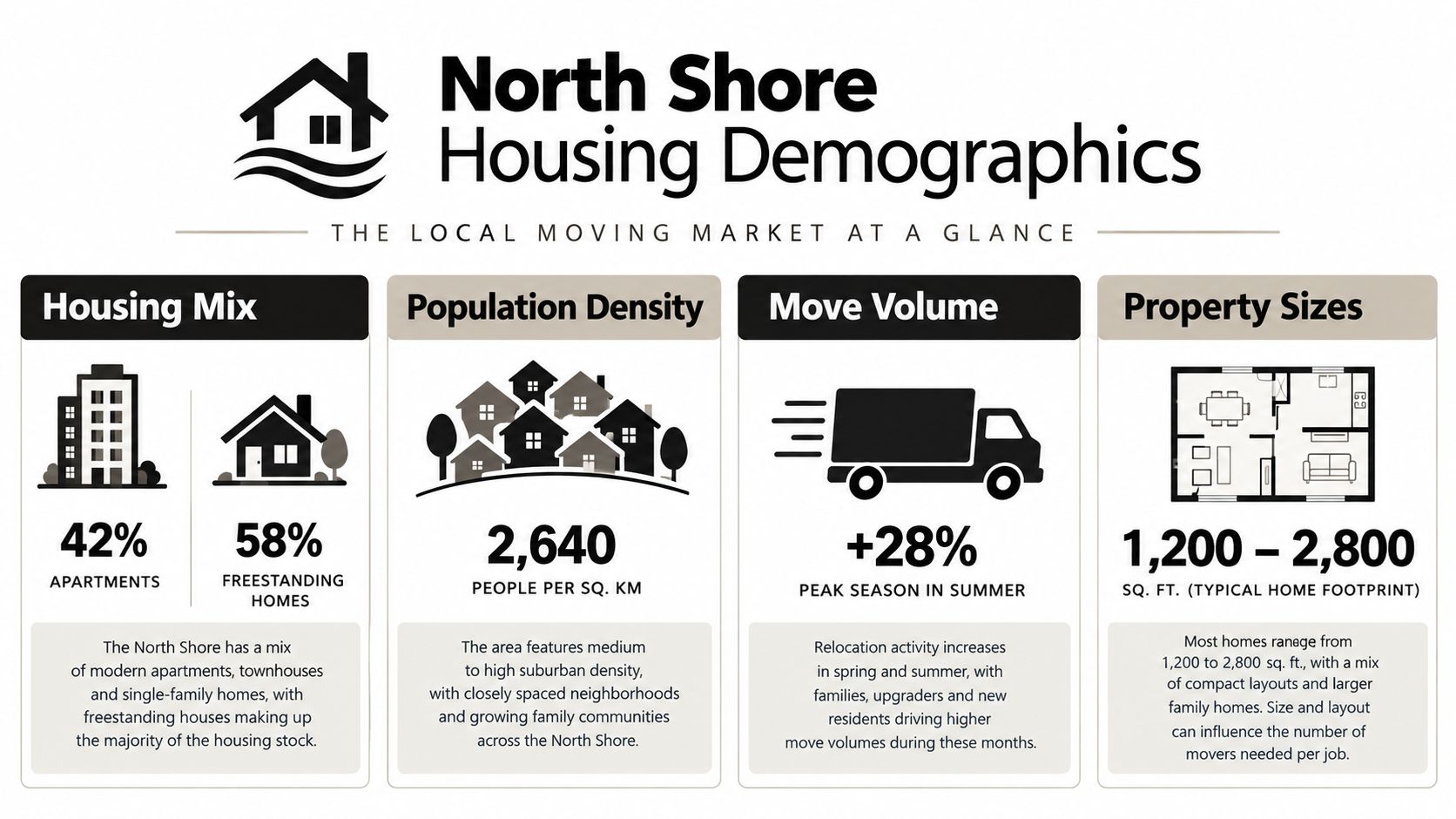
North Shore moves are driven by the housing mix, and that mix is tight. The 2021 Census counted 42,957 private dwellings in the ABS-defined North Shore area, with 35,742 occupied and 5,659 unoccupied (2021 Census QuickStats). That spread supports a steady stream of relocations across apartments, townhouses, and family homes, so the work is rarely one-size-fits-all.
Rentals drive short-notice moving work
Rentals do much of the heavy lifting here. 17,122 occupied private dwellings, or 47.9%, were rented, well above the 30.6% national average. That pattern creates more lease-end moves, tighter handover dates, and shorter booking windows, so crews need to stay flexible rather than assume a long lead time.
It also changes how jobs are planned. Rental moves are often smaller in volume, but they are less forgiving on timing because keys, access cards, and building rules all need to line up. Family moves still matter, yet the local demand base is broad enough that apartment relocations and house moves run side by side.
Occupancy patterns shape the job size
The same Census data shows 49.6% of North Shore dwellings are owner-occupied when outright ownership and ownership with a mortgage are combined, with 28.7% owned outright and 20.9% owned with a mortgage (2021 Census QuickStats). That matters because many owner-occupiers in this area still move within metropolitan Sydney, trade up, downsize, or shift between family homes and apartments.
Sydney's north-side lifestyle patterns explain this housing mix, and this overview on best areas to live in Sydney gives the wider context.
A mover that only prepares for large detached homes misses part of the work. Occupied rentals bring frequency, owner-occupied homes bring volume, and the combination demands flexible loading, packing help, and storage coordination.
Residential Versus Commercial Removal Services
Residential and commercial removals may share trucks, but they don't share the same job logic. A household move is about protecting personal belongings, keeping fragile items intact, and getting furniture into the right rooms without damaging the property. A business move is about continuity, because delays hit staff, customers, and workflow rather than just the unpacking schedule.
House moves need care and sequencing
In a home move, the pressure usually sits on packing quality, furniture handling, and access inside the destination. Sofas need to clear stairs, appliances need to be secured, and boxes need to land in the right room so the unpacking doesn't become a second move. That's where valet packing, furniture disassembly, and careful load sequencing pay off.
Home jobs also tend to involve more emotional friction than people expect. There's sentimental furniture, breakables, and often a long list of “don't scratch this” items that need to be loaded in a specific order. The best crews adapt to that without slowing to a crawl.
Office moves are a logistics exercise
Commercial work runs differently. IT equipment, desk systems, storage, and document handling all need a tighter chain of custody and a quicker handover. That's why office moves usually need precise start times, clear floor-by-floor sequencing, and an understanding of how to get in and out with minimal downtime.
For North Shore clients, the line between home and office can blur. A family might be moving a house, but also shifting a home office with monitors, filing, and specialist equipment. In that case, the mover has to treat part of the job like residential work and part like a small commercial relocation.
If you're comparing service types and want a planning lens for business moves, the guide on office move planning is a practical reference point. A mover such as Get n Go Removals Melbourne can handle residential and commercial relocations, but the right choice still comes down to whether the job is built around household protection or business continuity.
Good fit, not bigger truck: the right service is the one that matches the property type, not the one that sounds most impressive on paper.
Navigating Parking Rules and Vehicle Restrictions
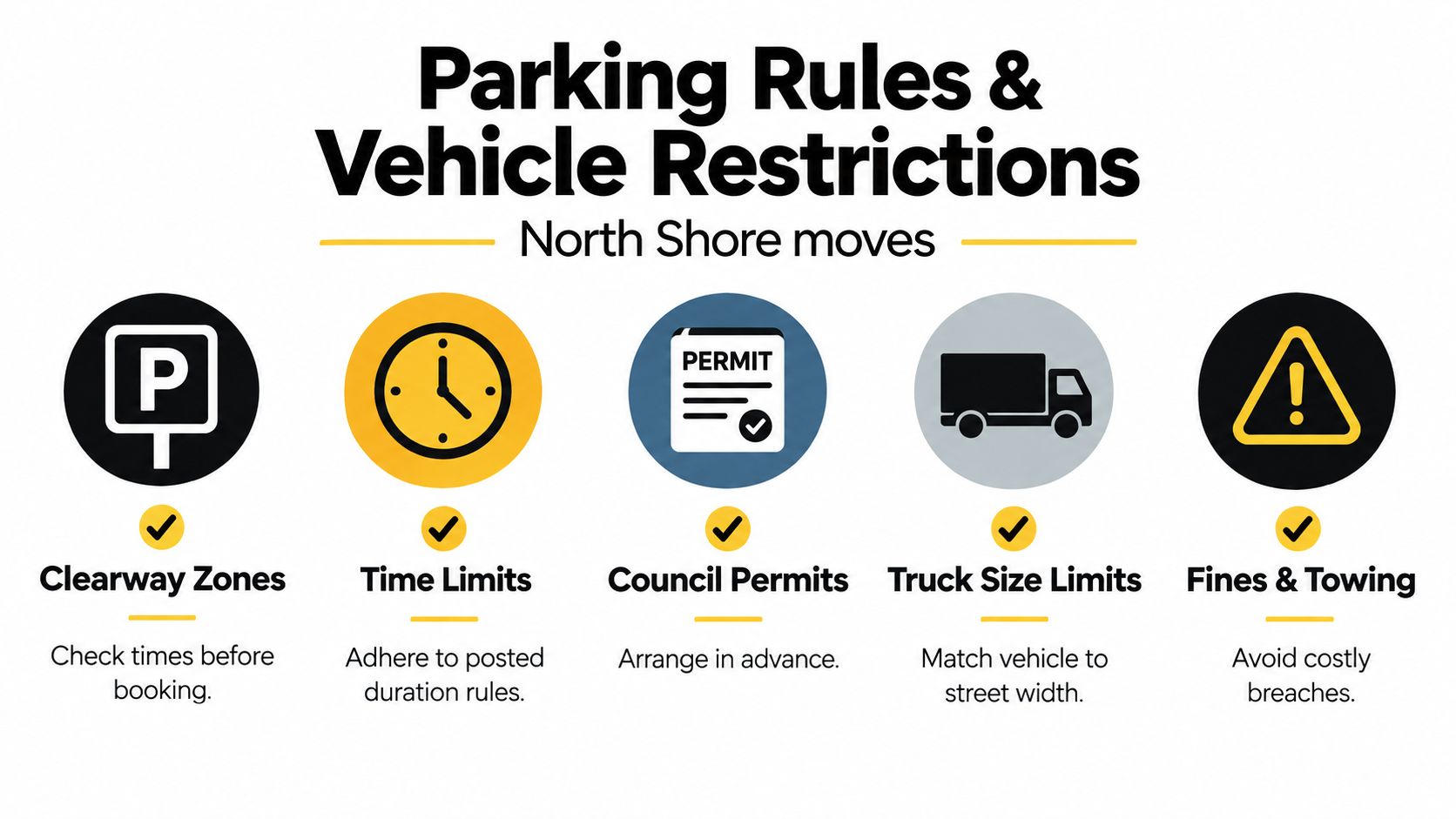
Parking on a North Shore move isn't a convenience issue, it's a legal one. New South Wales rules are clear that vehicles over 4.5 tonnes GVM can use a loading zone for up to 30 minutes only when actively loading or unloading, and heavy vehicles are generally limited to one hour in built-up areas unless signage says otherwise (NSW parking rules). That means the truck choice and the route choice have to work together.
Match the truck to the street, not just the load
The common mistake is booking the biggest truck available because it sounds efficient. On a tight street or a building with poor kerb access, a bigger truck can slow the move down if it blocks traffic, can't turn cleanly, or can't stay parked long enough to finish the transfer. In those cases, a smaller shuttle vehicle or staged loading is often the cleaner solution.
Before confirming a booking, the mover should record the truck's GVM and dimensions, inspect the approach width, and check whether the street has clearway hours or loading constraints. If the vehicle can't sit legally where the property needs it, the move starts under pressure. That's how fines, rushed carries, and unsafe handling begin.
Planning checklist before the job is locked in
- Confirm the vehicle class: make sure the truck's GVM suits the legal loading window and the property access.
- Measure the approach: check street width, turning space, and any tight entries before the booking is final.
- Check local signage: clearways and time-restricted kerbside zones can override what looks available at street level.
- Ask about approvals early: council or building permission may be needed for the actual parking setup.
- Keep the loading continuous: the goal is to transfer furniture within the legal window, not to use the truck as a storage spot.
The practical trade-off is simple. A truck that's too large can create access failure, while a vehicle that's too small can require extra shuttles. The best fit is the one that keeps the job moving continuously within the rule set, not the one with the largest box on the road.
If you're still deciding what size vehicle your job needs, this internal guide on truck size selection is the right place to sanity-check the logistics.
The Critical Role of Strata and Building Coordination
A lot of movers book the truck first and treat the building as a later admin task. That's backwards for apartment-heavy North Shore moves. The main constraint is often the lift window, the dock booking, or the building's access rules, and if those don't line up, the truck just waits outside while the clock runs.

The building sets the pace
Sydney building guidance indicates that apartment moves may require 24–72 hours' written notice, lift padding, a refundable bond, and a certificate of currency, with some larger buildings needing up to a week for coordination (building loading dock and lift booking form). Those rules don't exist to slow the move down, they exist to control traffic, protect common areas, and keep residents moving through the building safely.
That's why the access plan has to be built around the lift reservation, the loading-dock slot, the truck arrival, and the carry path. If one of those moves, the others usually need to move with it. Protective padding and controlled routes aren't cosmetic extras, they're what stops damage claims and resident complaints from piling up.
Who actually books what
The resident often has to make the lift booking, not the removalist. That detail gets missed constantly, especially when people assume the moving company will handle every building contact point. It helps to map responsibilities in advance so nobody is waiting on someone else on the morning of the move.
For sites that use stronger access controls, a good reference point is apartment access control, because the principle is the same, only the physical barrier changes. The move succeeds when access permissions, time windows, and building rules are confirmed before the crew is booked to arrive.
Building rule: if you don't have the lift slot, you don't have the move.
Apartment moves differ most from house moves here. The truck matters, but the building's calendar matters more. If you want a practical framework for organising that kind of move, the internal guide on planning an apartment move is a useful reference.
Essential Moving Checklist and Contingency Planning
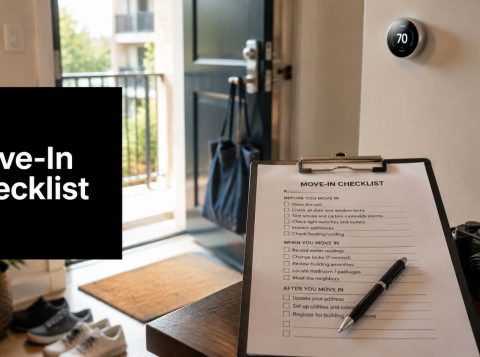
The best move day setups don't rely on memory. They rely on a sequence that handles packing, access, weather, and post-move paperwork without forcing the crew or the client to improvise. For North Shore moves, that sequence matters even more because one delayed arrival or one blocked dock can affect the rest of the day.
Start with what must be controlled before loading
Label every box by room and note anything fragile or awkward to stack. Keep the path from the property entrance to the truck as clear as possible, because even a short obstacle course adds fatigue and slows down the carry rhythm. If you're moving from a rental, this is also the stage where you should separate the items that need to stay accessible until the final inspection.
Victorian renters should complete a condition report immediately around the move and return one signed copy to the rental provider within five business days so pre-existing damage can be separated from new issues (Victorian renters' guide). That's not a paperwork formality, it's a record that can matter later if there's a dispute over walls, floors, appliances, or fixtures.
Build a weather plan before the forecast turns
Rain doesn't automatically cancel a move. The question is whether the pickup or delivery site stays usable, whether the loading dock stays clear, and whether the route between the street and the apartment stays safe for furniture and crew. For address-specific flood awareness, check the NSW flood data portal for both ends of the move, then ask the building manager or strata contact about basement access and emergency procedures.
A wet-weather plan should include floor protection, elevator protection where required, and a backup option if the dock or driveway becomes unsafe. For some jobs, temporary storage is smarter than pushing through bad access and risking damage. That's especially true on interstate moves where the pickup may be fine but the delivery site isn't.
Keep the order of the day tight
- Confirm the inventory: make sure the load list matches what's being moved.
- Protect the property: use coverings for floors, doorframes, and lift interiors where needed.
- Check access before the crew starts: don't wait until the truck is on site to learn the dock is blocked.
- Hold back essential items: keep chargers, documents, and first-night basics separate.
- Plan for storage if needed: if access fails, the job should still have a safe fallback.
If you're moving from an apartment into a house, the shift in access and volume changes the whole rhythm of the day, so this guide on transitioning from apartment to house is worth reading alongside your own checklist. For a broader step-by-step reference, the internal guide on moving house planning can help you keep the sequence straight.
The practical truth is that a good move isn't defined by speed alone. It's defined by how little has to be fixed on the day, and how well the plan absorbs delays without turning into a scramble.
If you're planning a North Shore move and want the access side handled properly, talk to Get n Go Removals Melbourne about a move plan that accounts for parking, building rules, and tight timing. They handle residential and commercial relocations with the kind of practical coordination this market demands, so you're not left solving strata and street issues after the truck has already arrived.