Melbourne Pallet Removals: Logistics and Safety Guide
A pallet removal job often starts with a deceptively simple request: clear the timber pallets from a warehouse, apartment basement, office loading area, or garage before the next delivery arrives. The difficulty appears when the crew finds narrow access, mixed loads, damaged boards, uncertain weights, limited lift access, or pallets that can't be treated as rubbish. Melbourne pallet removals need planning around dimensions, safe working loads, equipment, site access, and the recovery route after collection.
A sound removal plan protects the goods, the building, the workers, and the final disposal outcome. The practical question isn't only how to get pallets off your property. It's whether each pallet can be reused, repaired, recovered for energy, or needs another disposal pathway.
When Melbourne Businesses and Homes Need Pallet Removal
A warehouse in Dandenong may be clearing stock before a lease handover. In the CBD, an office relocation might leave archives, workstations, boxed equipment, and display materials secured on pallets. A strata manager may face a basement clear-out where pallets have accumulated beside household goods, old furniture, and building materials. Each job looks different, but the handling problems are similar: the load is unitised, heavy, awkward to access, and often unsuitable for ordinary rubbish collection.
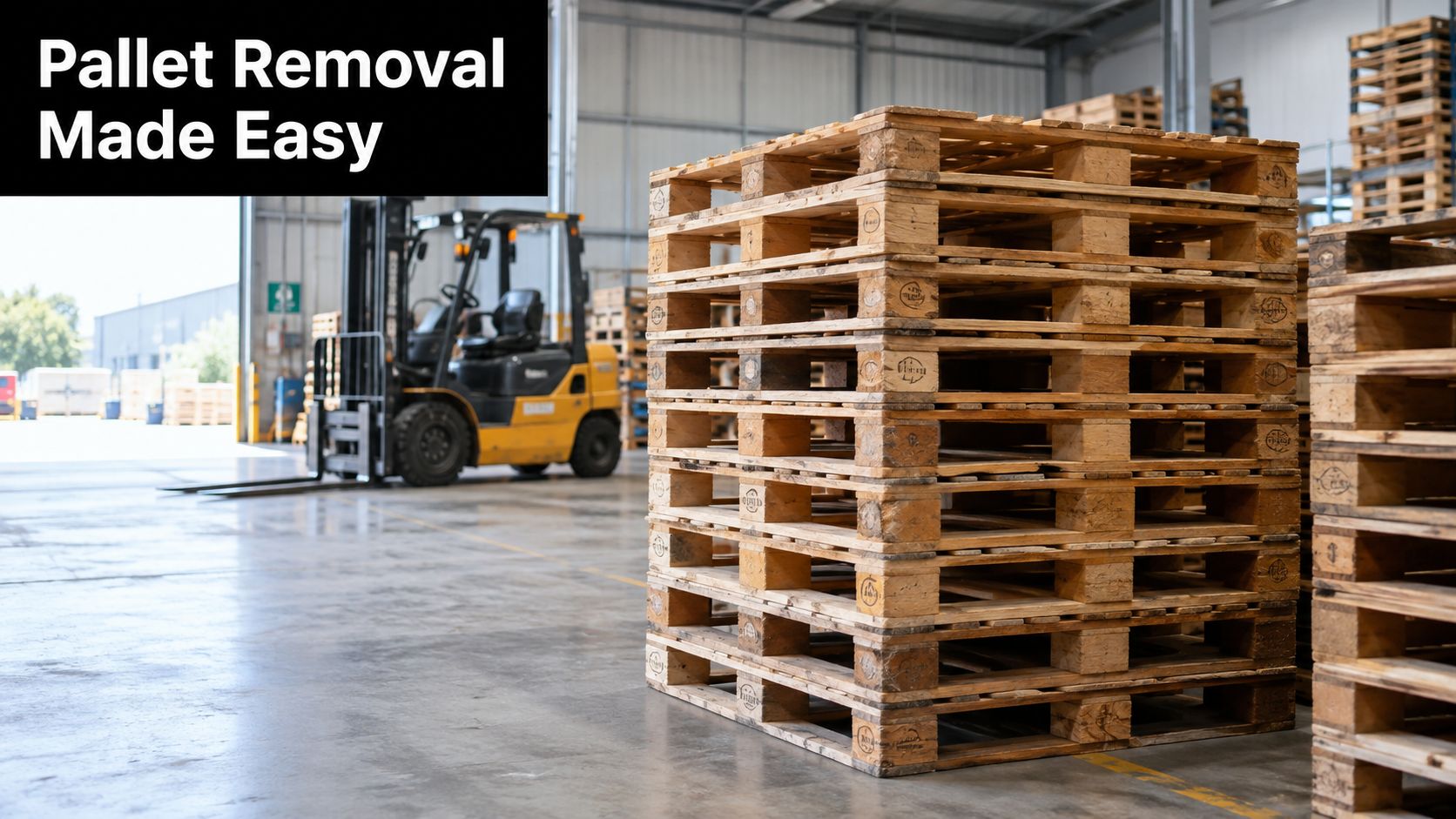
A pallet can make goods easier to move with the right equipment, but it also concentrates weight in one footprint. That affects floors, ramps, lift bookings, truck selection, and the sequence of loading. A residential customer may have pre-packed crates that need moving through a garage or driveway, while an event organiser may need pallets collected immediately after pack-down. The same removalist can't assume that a warehouse dock, a domestic driveway, and a basement loading zone offer the same conditions.
Common triggers for a removal
- Warehouse consolidation: Surplus pallets and palletised inventory may block aisles, loading areas, and access to racking.
- Office relocation: Archives, IT equipment, furniture, and boxed files often need staged transport rather than one continuous move.
- Lease or fit-out handover: Pallets, packaging, and loose freight may need clearing while contractors work around the site.
- Event transport: Exhibition stands, furniture, and equipment may arrive palletised and require coordinated collection after the event.
- Residential moves: Large crates and grouped household goods can need pallet handling even when the destination is a home or apartment.
The property itself matters as much as the freight. Lift dimensions, driveway gradients, door clearances, loading-zone restrictions, and the condition of the floor can determine whether a pallet jack or tail lift is suitable. For broader moving and storage requirements, customers can review furniture removal and storage in Melbourne alongside their pallet plan.
Practical rule: Treat the pallet, its contents, and the access route as one handling problem. Separating those decisions is how delays and damage begin.
Understanding Australian Standard Pallet Dimensions and Load Limits
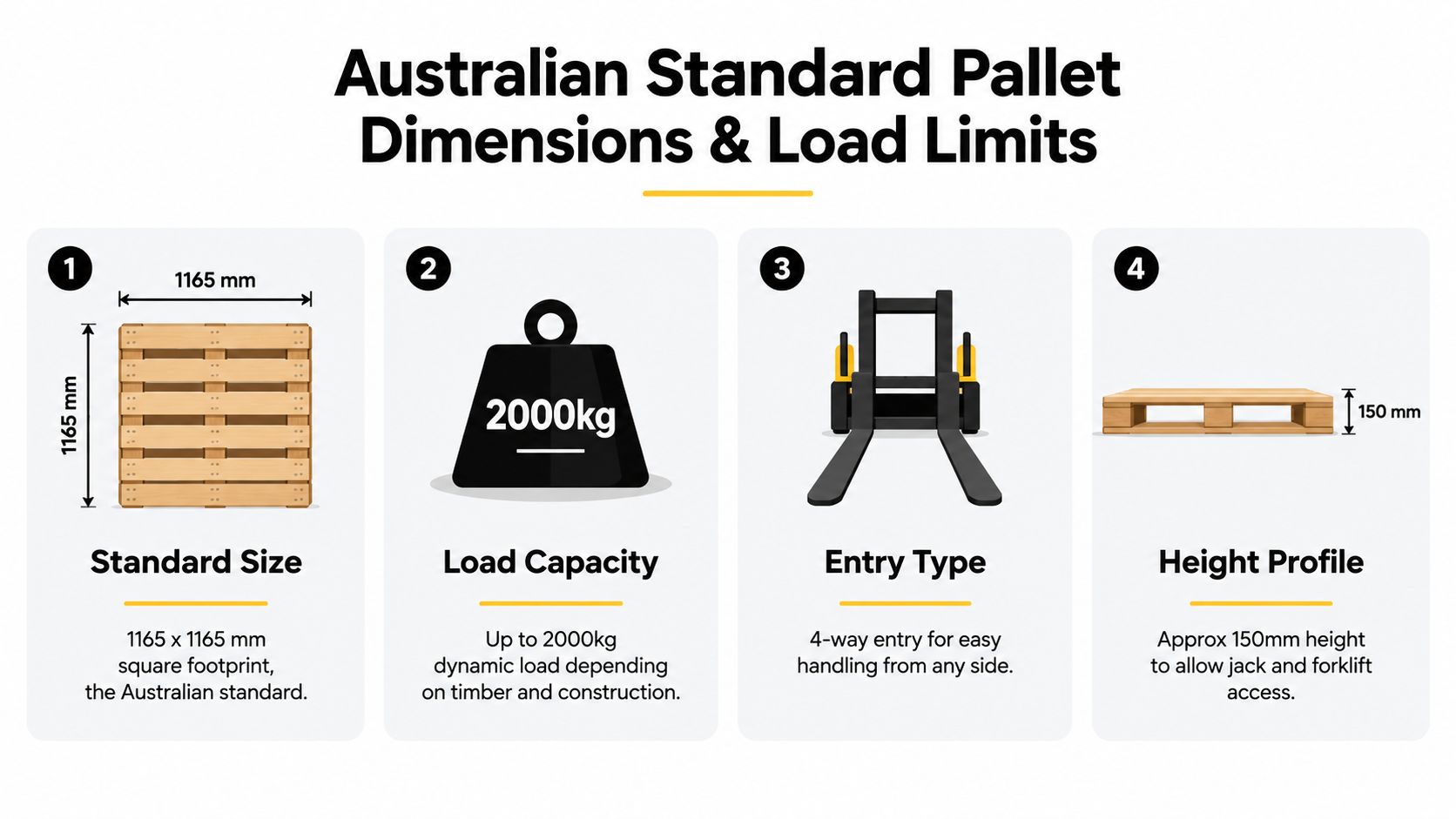
The Australian domestic standard pallet is commonly specified at 1165 × 1165 mm, with a square footprint designed around local warehousing, rail, and domestic freight systems. Australian pallet size guidance also identifies an overall height around 150 mm, a typical unloaded weight range of 25–35 kg, and four-way forklift entry. That format isn't the same as the Euro or export-oriented sizes, so a Melbourne removal crew needs the actual pallet footprint before planning trailer space or storage.
The square profile helps align goods with Australian warehouse and container systems, improving cube efficiency and reducing re-handling during pickup, transfer, and storage, as described in Melbourne freight pallet guidance. In operational terms, that means the footprint can support predictable forklift access and racking compatibility. It doesn't guarantee that every truck, lift, aisle, or storage bay will accept a loaded pallet without checking clearances.
Capacity depends on construction and condition
Load ratings vary because a new heavy-duty pallet, a light-medium pallet, and a reconditioned pallet don't perform identically. Standard pallet capacity information commonly distinguishes a static capacity of up to 5,000 kg from a dynamic capacity of about 1,000–1,500 kg, with some industry guides citing a rated working load up to 2,000 kg, depending on construction.
A separate Melbourne freight reference describes practical payload bands of 500 kg for light loads, 1,000 kg for medium loads, and 1,000+ kg for heavy-duty use. Those bands aren't a substitute for the pallet's marking or manufacturer instructions. They're a prompt to verify the pallet grade, load distribution, travel conditions, and storage arrangement before lifting.
| Planning detail | Why it matters |
|---|---|
| 1165 × 1165 mm footprint | Determines floor, trailer, racking, and doorway fit |
| Approx. 150 mm pallet height | Allows pallet jack and forklift access |
| Four-way entry | Gives operators more options in restricted areas |
| Dynamic working load | Controls safe movement during loading and transport |
| Static working load | Applies to stationary storage, not vehicle movement |
Use a cubic metre calculator for removal planning to estimate the broader shipment, but don't rely on volume alone. Weight distribution and safe working load control the handling decision.
Service Options for Pallet Transport and Storage
Pallet removal services generally fall into three practical levels. The right choice depends on whether the customer has already prepared the load, whether the goods need protection beyond ordinary transport, and whether the destination is ready to receive everything immediately.
Standard pickup and delivery suits stable, wrapped pallets positioned near an accessible loading point. The customer normally needs to identify the pallet count, confirm approximate weights, clear the route, and ensure someone can release and receive the goods. This option can be efficient for a warehouse transfer where the freight is already labelled and the dock is available.
Assisted handling adds equipment and labour for awkward access, internal movement, or staged loading. It works better for offices, apartment buildings, and properties without a conventional dock. The crew may need to move goods from a storage room to a truck, protect walls and floors, and coordinate with building management.
When white-glove handling earns its place
White-glove service makes sense when the pallet contains fragile furniture, finished interiors, valuable displays, sensitive office equipment, or goods that need unpacking at the destination. Packing can include protective blankets, corner protection, shrink-wrapping, and furniture disassembly. For loads exposed to dust or movement during staged transport, customers may also consider custom stretchhood packaging film as a packaging resource, subject to the product and handling method.
The trade-off is straightforward. More preparation and handling reduce the work left to the customer, but they require a clearer scope and more time on site. A rapid event teardown may need a simple collection plan, while a phased office relocation benefits from labels, inventory control, scheduled storage, and a single contact.
Storage changes the transport plan
Storage is useful when the new premises aren't ready, a settlement date shifts, or an office needs to vacate before the replacement site is available. Pallets should remain stable, protected, and identifiable throughout the holding period. A Melbourne storage solution can form part of a staged move, but the booking should specify whether the goods remain palletised, whether access is required during storage, and whether delivery will happen in one release or several.
Don't book a basic curbside service for goods that need internal placement, disassembly, or storage staging. Likewise, don't pay for white-glove handling when the freight is already secure, labelled, and dock-ready. The efficient service is the one that matches the actual handling risk.
Fleet and Equipment Considerations for Safe Handling
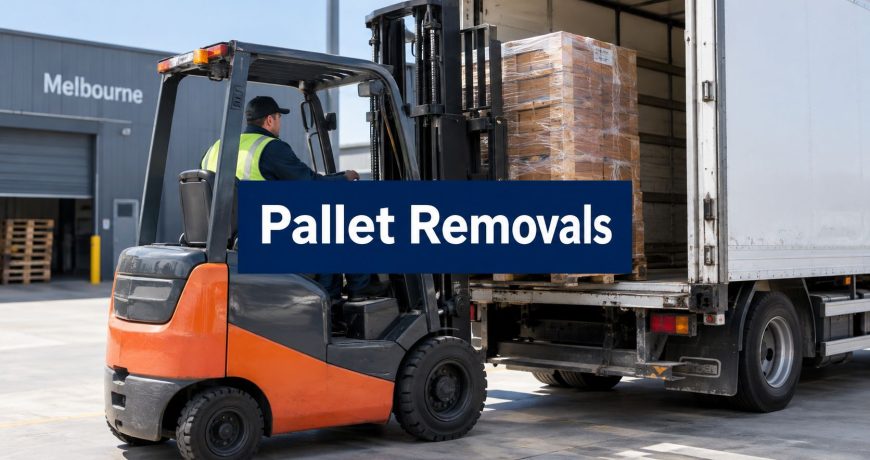
Manual lifting is the wrong starting point for heavy hardwood pallets. WorkSafe Victoria recommends eliminating manual lifting of hardwood pallets and prioritising mechanical aids, including four-wheel trolleys, lifters, pallet lift tables, and vacuum lifters. Its pallet racking operation and maintenance guidance also states that the safe working load must not be exceeded for the unit load, pallet beam, or bay, with the SWL taken from manufacturer instructions or AS 4084.2:2023.
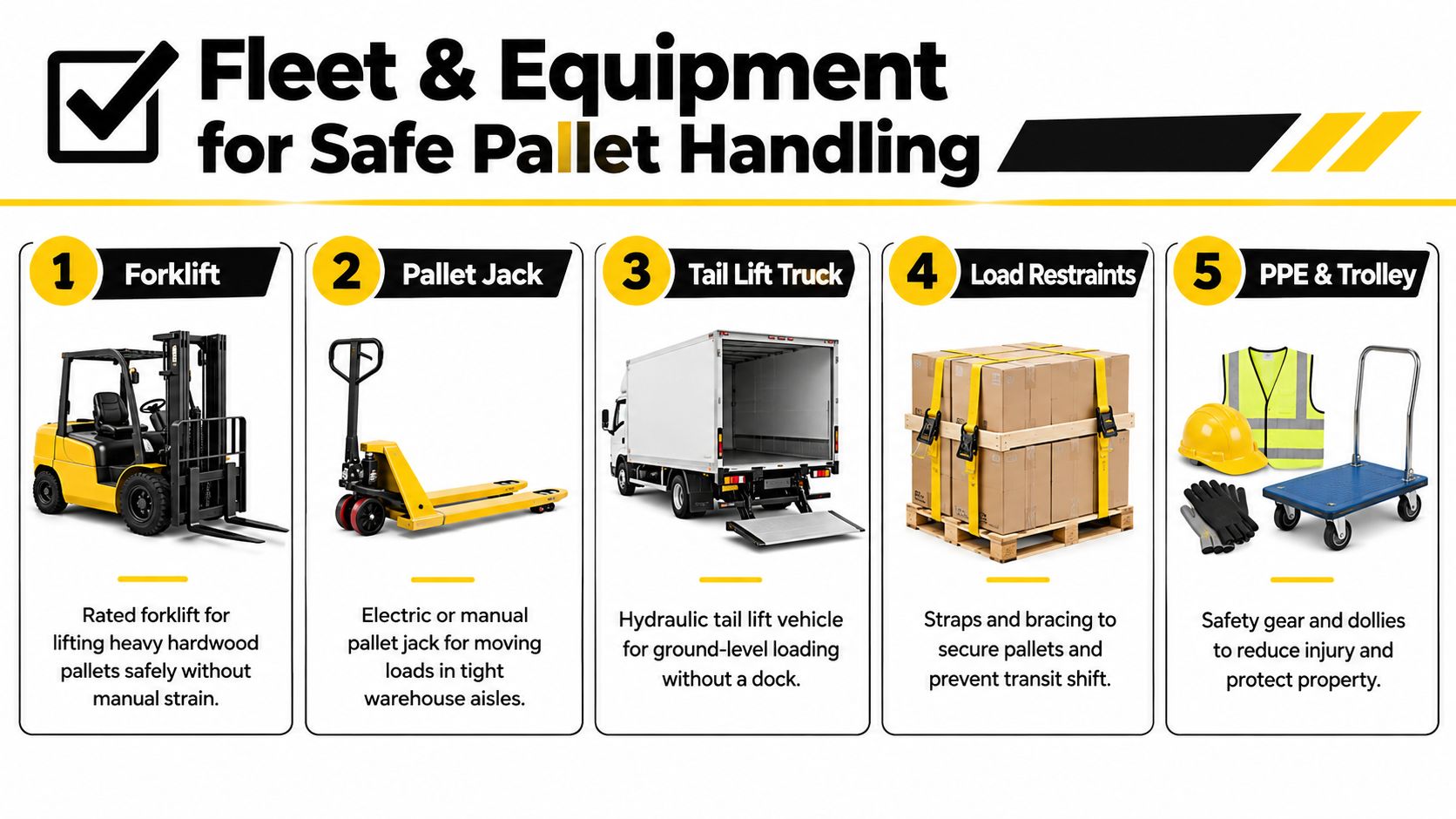
The equipment choice should follow the route, not the other way around. A forklift may suit a warehouse dock, but a tail lift and pallet jack may be more appropriate at a home or street-level commercial site. A lift table can reduce awkward height changes, while a four-wheel trolley can help move individual pallets or components across a controlled surface.
A safe loading sequence
- Inspect the pallet and load. Look for broken boards, unstable stacking, loose wrap, shifted cartons, and unknown weight.
- Confirm the SWL. Check the pallet, racking bay, lifting equipment, and vehicle restraints. Never assume the nominal pallet size proves the capacity.
- Clear the travel path. Remove trip hazards, protect vulnerable walls and floors, and confirm door and lift clearances.
- Use mechanical aids. Avoid asking workers to lift hardwood pallets manually. Position forks or pallet-jack wheels correctly before movement.
- Restrain the freight. Use suitable straps, bracing, and protective materials so the load can't shift in transit.
Overloading can raise the risk of musculoskeletal injury and racking failure. Placing the heaviest items low, keeping the centre of gravity controlled, and using mechanical handling reduces the chance of a tip, collapse, or uncontrolled movement. A practical plant ops logistics reliability guide can also help managers think about equipment condition and operational reliability. For labour and vehicle coordination, a two-man removalist and van service may suit smaller or more constrained jobs.
Navigating Local Regulations and End-of-Life Pathways
Removal isn't the same as recycling. Once pallets leave a Melbourne site, their next pathway depends on type, condition, contamination, ownership, and recovery channel. A clean, intact pallet may be suitable for reuse. A damaged pallet may have refurbishment value. A single-use pallet may be directed to energy recovery, including cement kilns or other energy-from-waste facilities, rather than returning to circulation.
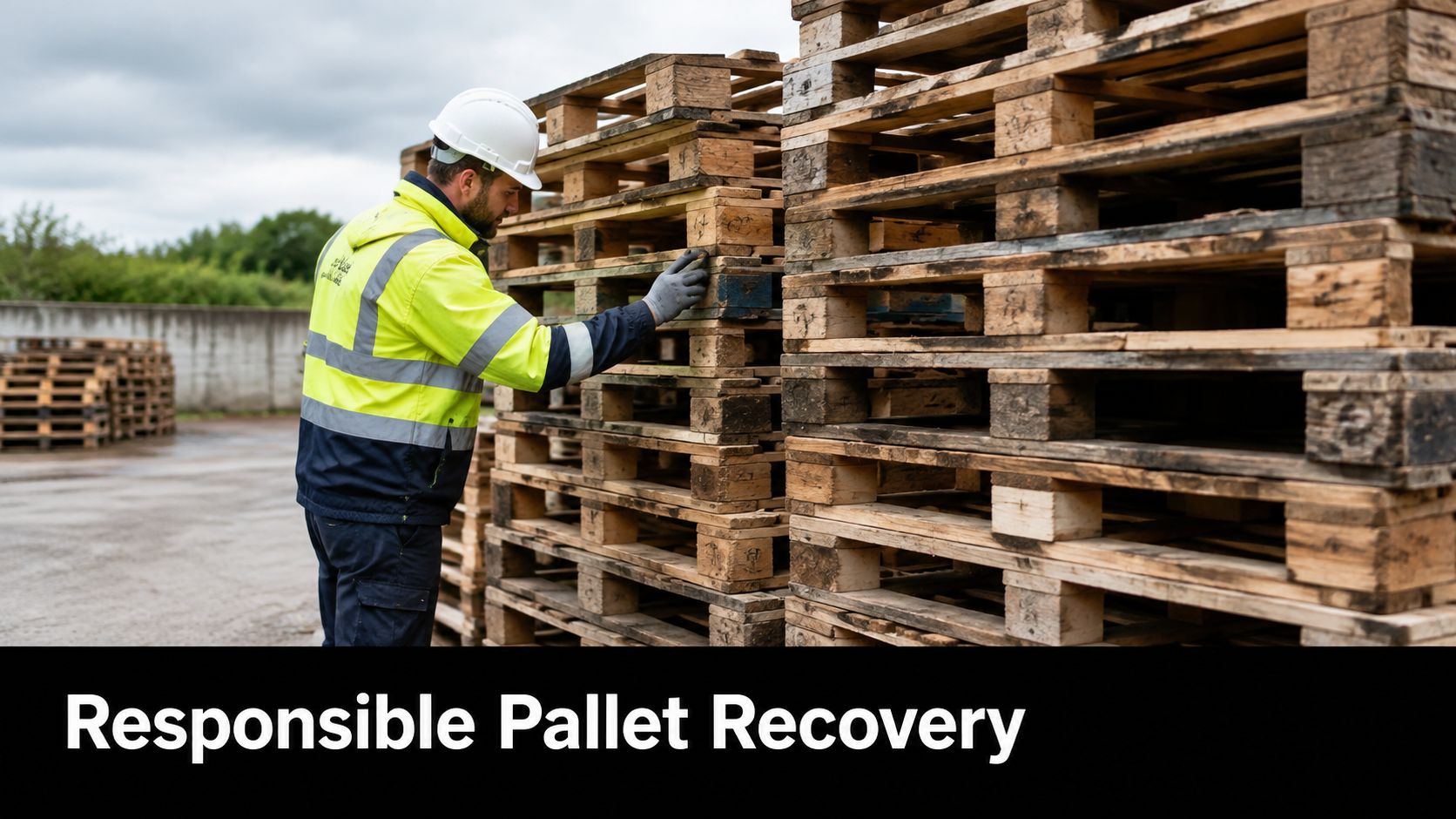
National packaging data records a 26.4% redemption rate for reusable timber pallets, and it also identifies recovery of some single-use pallets for energy production. Those figures show why a removal company shouldn't promise that every collected pallet will be recycled in the same way. The recovery result depends on what the crew collects and how the receiving facility classifies it. Australian packaging consumption and recovery data provides the relevant national context.
Separate the material before collection
A mixed hard-waste pile makes recovery harder. Keep reusable pallets away from wet waste, chemicals, soil, broken glass, and general rubbish. Mark pallets that belong to a pooling or hire system and confirm the return process rather than treating them as owned timber.
Victoria's waste system also matters to operational planning. The Victorian local government waste data dashboard publishes annual local-government data through 2023-24 and includes a recovery and disposal projection model extending to 2053-54. Sustainability Victoria's latest published series reports 10,765,300 tonnes recovered compared with 15,333,069 tonnes generated. These figures describe the broader system, not the guaranteed outcome for one removal job.
For a warehouse or strata clear-out, ask three direct questions before booking:
- Can it be reused? Check cleanliness, structural condition, ownership, and standard size.
- Can it be refurbished? Separate repairable boards from pallets with major structural damage.
- Does it need recovery or disposal? Keep contaminated, broken, or unsuitable timber apart so the provider can route it accurately.
That approach produces a more honest environmental claim and can affect fees, timing, and the handling method.
How to Prepare and Book Your Pallet Removal
Good preparation starts before the truck is assigned. The removal provider needs enough information to choose equipment, labour, storage capacity, and the correct vehicle access plan. A vague description such as “some pallets behind the office” leaves too much risk unresolved.
A practical preparation checklist
- Count and classify the pallets. Record the number, material, approximate condition, and whether they're owned, hired, or pooled.
- Inspect the load. Check for broken boards, leaning stacks, loose cartons, exposed nails, moisture, and unstable wrapping.
- Record dimensions and weights. Use the Australian footprint where applicable, but identify oversized pallets and unusual loads separately.
- Confirm safe working loads. Check markings and manufacturer information. Don't place an unknown load into racking until its capacity is established.
- Separate recovery streams. Keep reusable, repairable, contaminated, and general waste items apart.
- Photograph the site. Show the loading point, access route, stairs, lift, ramp, driveway, gate, and any tight turns.
- Arrange building access. Book loading docks, service lifts, concierge access, security clearance, and loading-zone windows.
- Check street requirements. Where parking or vehicle positioning affects public space, confirm whether council approval or a permit is needed.
- Nominate one contact. Give the crew one person who can approve sequencing, answer site questions, and sign off the collection.
- Confirm the recovery outcome. Ask whether pallets will be reused, repaired, sent for energy recovery, or handled through another approved stream.
A commercial site may also need a work method statement, induction, traffic plan, or landlord approval, depending on the property and scope. Racking removal, anchor extraction, floor repairs, and pallet collection shouldn't be bundled casually. They require separate checks because the crew may need different tools and controls.
Use guidance for choosing a removals firm when comparing providers. Ask for written confirmation of the pallet count, access assumptions, insurance, storage requirements, transport route, and any exclusions. If the job involves interstate movement, confirm where responsibility transfers and how damaged or refused freight will be handled.
Book early when the move depends on a settlement, lift reservation, event pack-down, or lease handover. Tight schedules can be managed, but only when the site details are accurate and the decision-maker is available.
Frequently Asked Questions About Pallet Removals
Can household goods and commercial pallets share a truck?
They can, provided the vehicle has enough cube and payload capacity, the goods are separated and protected, and the loading sequence prevents commercial stock from being crushed or blocked by household items. The Australian pallet footprint can also affect how efficiently mixed goods use the vehicle, especially when palletised freight must remain stable during transit.
What insurance should I ask about?
Ask the provider to explain public liability insurance and transit insurance separately. Public liability concerns injury or property damage connected with the work, while transit cover concerns eligible goods while they're being transported. High-value commercial stock needs an accurate inventory, declared value where required, and clear exclusions. Don't assume that a general moving quote automatically provides the level of cover your business needs.
Are interstate pallet removals different?
Melbourne to Sydney or Brisbane movements need a confirmed delivery address, access plan, pallet dimensions, handling instructions, and a clear receiving contact. Weekly direct runs can help coordinate recurring movements, but the sender still needs to check destination access, unloading equipment, and whether the receiving site accepts the pallet type.
What happens if the pallet is damaged?
Stop and isolate it before lifting. A damaged pallet may need repacking, transfer to another pallet, repair, or a different recovery route. Never conceal structural damage under wrap, because the load can shift during forklift movement or vehicle transport.
Can a removal happen outside ordinary business hours?
Flexible scheduling can help with settlements, building restrictions, events, and urgent clear-outs. The practical limit is site safety, equipment availability, access approval, and whether the receiving location can accept the delivery. Confirm the full sequence rather than booking only the pickup window.
What information should I provide for a quote?
Give the provider the pallet count, dimensions, approximate weights, photographs, contents, collection and delivery addresses, stairs or lifts, loading-zone conditions, storage needs, and preferred dates. That information produces a more realistic plan than a pallet count alone.
Get n Go Removals Melbourne can coordinate palletised household, office, commercial, and event loads with packing, equipment, interstate transport, and secure storage options. For a practical assessment of your access, load limits, and recovery requirements, visit Get n Go Removals Melbourne and provide the site details before booking.